Beyond a Reasonable Doubt
Can (or Should) BIM be Evidence-Based?
Dr. Debajyoti Pati HKS Architects 14 October 2010
Presenter
Debajyoti Pati
PhD, FIIA, LEED©AP
Vice President, Director of
Research, HKS Architects
Executive Director,
Center for Advanced Design
Research & Evaluation
(CADRE)
Learning Objectives
1. Understand factors that contributed to the emergence
of the EBD model
2. Understand the fundamental essence of the EBD
practice model in healthcare
3. Illustrate how physical design is being linked to
organizational performance and bottom line
4. Explore the implications of mapping the EBD model to
BIM
Agenda
 What is EBD and how it emerged?
 What changes is it effecting?
 Healthcare examples
 Implications for BIM
 Discussions
What is Evidence-Based Design
 Evidence-based design
is the conscientious,
explicit and judicious
use of current best
evidence from research
and practice in making
critical decisions,
together with an
informed client, about
the design of each
individual and unique
project.
(Center for Health Design)
 Is a natural parallel and
analog to evidence-
based medicine.
 Applicable to all
buildings sectors.
 Started in the
healthcare sector.
Emergence of EBD
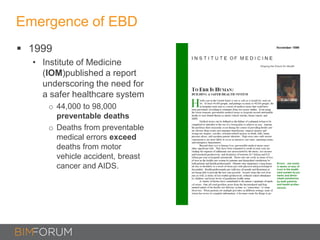
 1999
• Institute of Medicine
(IOM)published a report
underscoring the need for
a safer healthcare system
o 44,000 to 98,000
preventable deaths
o Deaths from preventable
medical errors exceed
deaths from motor
vehicle accident, breast
cancer and AIDS.
Emergence of EBD
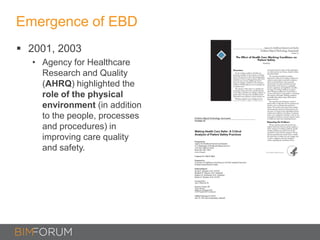
 2001, 2003
• Agency for Healthcare
Research and Quality
(AHRQ) highlighted the
role of the physical
environment (in addition
to the people, processes
and procedures) in
improving care quality
and safety.
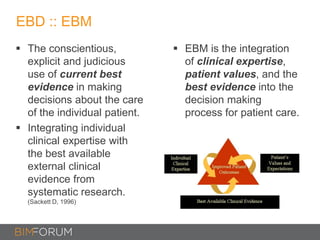
EBD :: EBM
 The conscientious,
explicit and judicious
use of current best
evidence in making
decisions about the care
of the individual patient.
 Integrating individual
clinical expertise with
the best available
external clinical
evidence from
systematic research.
(Sackett D, 1996)
 EBM is the integration
of clinical expertise,
patient values, and the
best evidence into the
decision making
process for patient care.
CHANGING THE DESIGNER – CLIENT
DYNAMICS
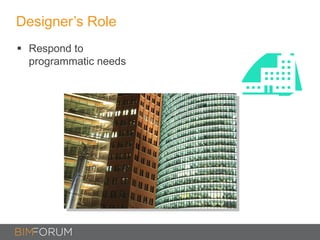
Designer’s Role
 Respond to
programmatic needs
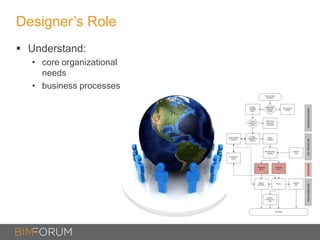
Designer’s Role
 Understand:
• core organizational
needs
• business processes
SURGERYDECISIONPRE-PROCEDUREPROCEDUREPOST-PROCEDURE
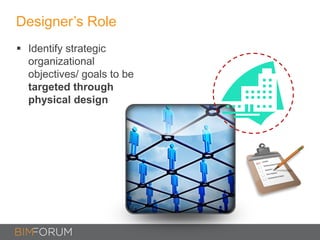
Designer’s Role
 Identify strategic
organizational
objectives/ goals to be
targeted through
physical design
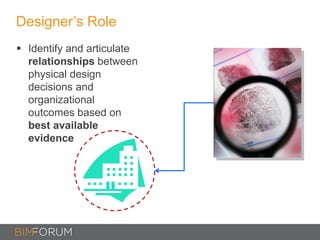
Designer’s Role
 Identify and articulate
relationships between
physical design
decisions and
organizational
outcomes based on
best available
evidence
Designer’s Role
 Conduct research to
inform decision-making
if evidence is not
available
Designer’s Role
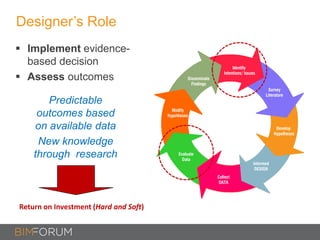
 Implement evidence-
based decision
 Assess outcomes
Predictable
outcomes based
on available data
New knowledge
through research
Identify
Intentions/ Issues
Develop
Hypotheses
Informed
DESIGN
Collect
DATA
Evaluate
Data
Modify
Hypotheses
Disseminate
Findings
Survey
Literature
Return on Investment (Hard and Soft)
FROM ACTIVE RESPONSE TO
PROGRAMMATIC NEEDS TO
‘PREDICTABLE’ INFLUENCE ON
OUTCOMES OF ORGANIZATIONAL
INTEREST
HEALTHCARE EXAMPLES
Organizational Outcomes of Interest
 Reduce patient falls
• Cost =10K un-litigated
 Reduce patient transfer
• Cost per transfer = $ 300
 Reduce hospital
acquired infection
• Cost per infection = 10-
30K
 Nurse retention
• Cost per recruitment =
60K
 Patient satisfaction
 Market segment,
referrals
 …
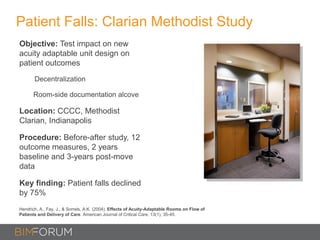
Patient Falls: Clarian Methodist Study
Objective: Test impact on new
acuity adaptable unit design on
patient outcomes
Decentralization
Room-side documentation alcove
Location: CCCC, Methodist
Clarian, Indianapolis
Procedure: Before-after study, 12
outcome measures, 2 years
baseline and 3-years post-move
data
Key finding: Patient falls declined
by 75%
Hendrich, A., Fay, J., & Sorrels, A.K. (2004). Effects of Acuity-Adaptable Rooms on Flow of
Patients and Delivery of Care. American Journal of Critical Care, 13(1), 35-45.
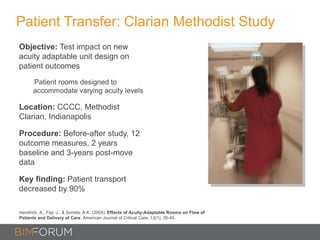
Patient Transfer: Clarian Methodist Study
Objective: Test impact on new
acuity adaptable unit design on
patient outcomes
Patient rooms designed to
accommodate varying acuity levels
Location: CCCC, Methodist
Clarian, Indianapolis
Procedure: Before-after study, 12
outcome measures, 2 years
baseline and 3-years post-move
data
Key finding: Patient transport
decreased by 90%
Hendrich, A., Fay, J., & Sorrels, A.K. (2004). Effects of Acuity-Adaptable Rooms on Flow of
Patients and Delivery of Care. American Journal of Critical Care, 13(1), 35-45.
Patient Visibility: Stanford-Harvard Study
Objective: Contrast safety concerns of
frontline staff with national patient safety
initiatives
Funding: AHRQ + Fishman-Davidson
Center for Service and Operations
Management
Location: 20 representative sample of
hospitals across the U.S.
Data Source: 1,732 staff-identified
operational failures (2004 – 2006)
Key finding: Top factors affecting
safety: Equipment and Facility
Tucker, A., Singer, S., Hayes, J., & Falwell, A. (2008). Front-line Staff Perspectives on
Opportunities for Improving the Safety and Efficiency of Hospital Work Systems. Health
Services Research, 43(5), 1807-1829.
Stanford-Harvard Study: Failure Sources
 Equipment/ Supply
(18%)
 Facility (18%)
• Layout
• Maintenance +
Housekeeping
• Non-functioning
infrastructure
 Communication/
Documentation (16%)
 Staffing/staff
development (16%)
 Medication (12%)
 Process/policy (6%)
 Response time (4%)
 Security (4%)
 Infection control (3%)
 Task management (2%)
Tucker, A., Singer, S., Hayes, J., & Falwell, A. (2008). Front-line Staff Perspectives on
Opportunities for Improving the Safety and Efficiency of Hospital Work Systems. Health
Services Research, 43(5), 1807-1829.
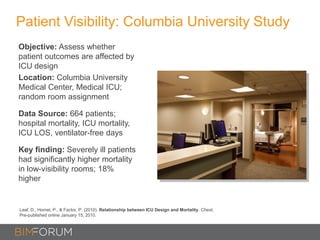
Patient Visibility: Columbia University Study
Objective: Assess whether
patient outcomes are affected by
ICU design
Location: Columbia University
Medical Center, Medical ICU;
random room assignment
Data Source: 664 patients;
hospital mortality, ICU mortality,
ICU LOS, ventilator-free days
Key finding: Severely ill patients
had significantly higher mortality
in low-visibility rooms; 18%
higher
Leaf, D., Homel, P., & Factor, P. (2010). Relationship between ICU Design and Mortality. Chest,
Pre-published online January 15, 2010.
Infection: Canadian HAI Study
Objective: Evaluate association
between roommate exposure and
risk of HAIs
Location: A tertiary care teaching
hospital in southeastern Ontario
Procedure: Retrospective data on
adult patients between 2001 –
2005; MRSA/VRE; C difficile; total
roommates, unique roommates
Key findings: each additional
roommate
• 11% increase in C difficile risk
• 10% increase in MRSA risk
• 11% increase in VRE risk
Hamel M, Zoutman D, O'Callaghan C. (2010). Exposure to hospital roommates as a risk factor for
health care-associated infection. American Journal of Infection Control, 38(3), 173-181.
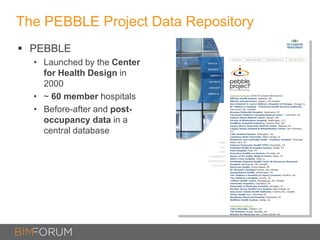
The PEBBLE Project Data Repository
 PEBBLE
• Launched by the Center
for Health Design in
2000
• ~ 60 member hospitals
• Before-after and post-
occupancy data in a
central database
IMPLICATIONS FOR BIM
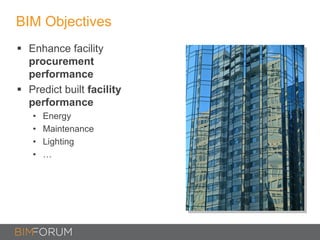
BIM Objectives
 Enhance facility
procurement
performance
 Predict built facility
performance
• Energy
• Maintenance
• Lighting
• …
BIM Status
 Sophisticated
performance models
 Assertions untested
• Little empirical evidence
from built facilities to
support contentions
 Similar to LEED status
 Standardization of
performance
measurement protocol
emerging…
• ASHRAE, USGBC,
CIBSE
Key Question
SHOULD BIM BE EVIDENCE-BASED?
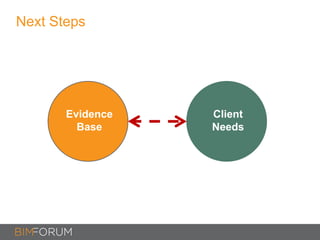
Next Steps
Evidence
Base
Client
Needs
Evidence Base
 Post-occupancy
performance
 Pebble type
commitment
 Central data base
Organizational Needs
 Framing BIM within
organizational needs
• Controlling airborne
infection may be more
crucial than saving on
HVAC cost…
 Situating BIM within the
larger context of
organizational
performance
• It is not necessarily about
more economic first and
life cycle cost
• It is about optimizing
facility performance to
target organizational
goals
A DIFFERENT NATURE OF
RELATIONSHIP WITH CLIENT
ORGANIZATIONS
MUST START WITH EVIDENCE
Where is the evidence?
THANK YOU

BIM Forum_2010_Beyond a Reasonable Doubt

  • 1.
    Beyond a ReasonableDoubt Can (or Should) BIM be Evidence-Based? Dr. Debajyoti Pati HKS Architects 14 October 2010
  • 2.
    Presenter Debajyoti Pati PhD, FIIA,LEED©AP Vice President, Director of Research, HKS Architects Executive Director, Center for Advanced Design Research & Evaluation (CADRE)
  • 3.
    Learning Objectives 1. Understandfactors that contributed to the emergence of the EBD model 2. Understand the fundamental essence of the EBD practice model in healthcare 3. Illustrate how physical design is being linked to organizational performance and bottom line 4. Explore the implications of mapping the EBD model to BIM
  • 4.
    Agenda  What isEBD and how it emerged?  What changes is it effecting?  Healthcare examples  Implications for BIM  Discussions
  • 5.
    What is Evidence-BasedDesign  Evidence-based design is the conscientious, explicit and judicious use of current best evidence from research and practice in making critical decisions, together with an informed client, about the design of each individual and unique project. (Center for Health Design)  Is a natural parallel and analog to evidence- based medicine.  Applicable to all buildings sectors.  Started in the healthcare sector.
  • 6.
    Emergence of EBD 1999 • Institute of Medicine (IOM)published a report underscoring the need for a safer healthcare system o 44,000 to 98,000 preventable deaths o Deaths from preventable medical errors exceed deaths from motor vehicle accident, breast cancer and AIDS.
  • 7.
    Emergence of EBD 2001, 2003 • Agency for Healthcare Research and Quality (AHRQ) highlighted the role of the physical environment (in addition to the people, processes and procedures) in improving care quality and safety.
  • 8.
    EBD :: EBM The conscientious, explicit and judicious use of current best evidence in making decisions about the care of the individual patient.  Integrating individual clinical expertise with the best available external clinical evidence from systematic research. (Sackett D, 1996)  EBM is the integration of clinical expertise, patient values, and the best evidence into the decision making process for patient care.
  • 9.
    CHANGING THE DESIGNER– CLIENT DYNAMICS
  • 10.
    Designer’s Role  Respondto programmatic needs
  • 11.
    Designer’s Role  Understand: •core organizational needs • business processes SURGERYDECISIONPRE-PROCEDUREPROCEDUREPOST-PROCEDURE
  • 12.
    Designer’s Role  Identifystrategic organizational objectives/ goals to be targeted through physical design
  • 13.
    Designer’s Role  Identifyand articulate relationships between physical design decisions and organizational outcomes based on best available evidence
  • 14.
    Designer’s Role  Conductresearch to inform decision-making if evidence is not available
  • 15.
    Designer’s Role  Implementevidence- based decision  Assess outcomes Predictable outcomes based on available data New knowledge through research Identify Intentions/ Issues Develop Hypotheses Informed DESIGN Collect DATA Evaluate Data Modify Hypotheses Disseminate Findings Survey Literature Return on Investment (Hard and Soft)
  • 16.
    FROM ACTIVE RESPONSETO PROGRAMMATIC NEEDS TO ‘PREDICTABLE’ INFLUENCE ON OUTCOMES OF ORGANIZATIONAL INTEREST
  • 17.
  • 18.
    Organizational Outcomes ofInterest  Reduce patient falls • Cost =10K un-litigated  Reduce patient transfer • Cost per transfer = $ 300  Reduce hospital acquired infection • Cost per infection = 10- 30K  Nurse retention • Cost per recruitment = 60K  Patient satisfaction  Market segment, referrals  …
  • 19.
    Patient Falls: ClarianMethodist Study Objective: Test impact on new acuity adaptable unit design on patient outcomes Decentralization Room-side documentation alcove Location: CCCC, Methodist Clarian, Indianapolis Procedure: Before-after study, 12 outcome measures, 2 years baseline and 3-years post-move data Key finding: Patient falls declined by 75% Hendrich, A., Fay, J., & Sorrels, A.K. (2004). Effects of Acuity-Adaptable Rooms on Flow of Patients and Delivery of Care. American Journal of Critical Care, 13(1), 35-45.
  • 20.
    Patient Transfer: ClarianMethodist Study Objective: Test impact on new acuity adaptable unit design on patient outcomes Patient rooms designed to accommodate varying acuity levels Location: CCCC, Methodist Clarian, Indianapolis Procedure: Before-after study, 12 outcome measures, 2 years baseline and 3-years post-move data Key finding: Patient transport decreased by 90% Hendrich, A., Fay, J., & Sorrels, A.K. (2004). Effects of Acuity-Adaptable Rooms on Flow of Patients and Delivery of Care. American Journal of Critical Care, 13(1), 35-45.
  • 21.
    Patient Visibility: Stanford-HarvardStudy Objective: Contrast safety concerns of frontline staff with national patient safety initiatives Funding: AHRQ + Fishman-Davidson Center for Service and Operations Management Location: 20 representative sample of hospitals across the U.S. Data Source: 1,732 staff-identified operational failures (2004 – 2006) Key finding: Top factors affecting safety: Equipment and Facility Tucker, A., Singer, S., Hayes, J., & Falwell, A. (2008). Front-line Staff Perspectives on Opportunities for Improving the Safety and Efficiency of Hospital Work Systems. Health Services Research, 43(5), 1807-1829.
  • 22.
    Stanford-Harvard Study: FailureSources  Equipment/ Supply (18%)  Facility (18%) • Layout • Maintenance + Housekeeping • Non-functioning infrastructure  Communication/ Documentation (16%)  Staffing/staff development (16%)  Medication (12%)  Process/policy (6%)  Response time (4%)  Security (4%)  Infection control (3%)  Task management (2%) Tucker, A., Singer, S., Hayes, J., & Falwell, A. (2008). Front-line Staff Perspectives on Opportunities for Improving the Safety and Efficiency of Hospital Work Systems. Health Services Research, 43(5), 1807-1829.
  • 23.
    Patient Visibility: ColumbiaUniversity Study Objective: Assess whether patient outcomes are affected by ICU design Location: Columbia University Medical Center, Medical ICU; random room assignment Data Source: 664 patients; hospital mortality, ICU mortality, ICU LOS, ventilator-free days Key finding: Severely ill patients had significantly higher mortality in low-visibility rooms; 18% higher Leaf, D., Homel, P., & Factor, P. (2010). Relationship between ICU Design and Mortality. Chest, Pre-published online January 15, 2010.
  • 24.
    Infection: Canadian HAIStudy Objective: Evaluate association between roommate exposure and risk of HAIs Location: A tertiary care teaching hospital in southeastern Ontario Procedure: Retrospective data on adult patients between 2001 – 2005; MRSA/VRE; C difficile; total roommates, unique roommates Key findings: each additional roommate • 11% increase in C difficile risk • 10% increase in MRSA risk • 11% increase in VRE risk Hamel M, Zoutman D, O'Callaghan C. (2010). Exposure to hospital roommates as a risk factor for health care-associated infection. American Journal of Infection Control, 38(3), 173-181.
  • 25.
    The PEBBLE ProjectData Repository  PEBBLE • Launched by the Center for Health Design in 2000 • ~ 60 member hospitals • Before-after and post- occupancy data in a central database
  • 26.
  • 27.
    BIM Objectives  Enhancefacility procurement performance  Predict built facility performance • Energy • Maintenance • Lighting • …
  • 28.
    BIM Status  Sophisticated performancemodels  Assertions untested • Little empirical evidence from built facilities to support contentions  Similar to LEED status  Standardization of performance measurement protocol emerging… • ASHRAE, USGBC, CIBSE
  • 29.
    Key Question SHOULD BIMBE EVIDENCE-BASED?
  • 30.
  • 31.
    Evidence Base  Post-occupancy performance Pebble type commitment  Central data base
  • 32.
    Organizational Needs  FramingBIM within organizational needs • Controlling airborne infection may be more crucial than saving on HVAC cost…  Situating BIM within the larger context of organizational performance • It is not necessarily about more economic first and life cycle cost • It is about optimizing facility performance to target organizational goals
  • 33.
    A DIFFERENT NATUREOF RELATIONSHIP WITH CLIENT ORGANIZATIONS MUST START WITH EVIDENCE Where is the evidence?
  • 34.