PERSONNEL
MANAGEMENT
MD 3Y1-8
Group 1
The Personnel
Function in our
organization
- Midterms Week 5
Outline
 The Personnel Function in our organization
 Recruitment, Induction, Placement &
Development, Personnel Budget
 Personnel Policies & Standing orders
 Absenteeism, Personnel Turnover & Problem of
indiscipline
 Transfers, Promotions & Voluntary retirements
 Compensation Plans - Perquisites & Bonus
 Job status, Grade & Salary & wage structure –
Out fore, Measure
 Morale studies & Personnel Research
Opening Case
 Develop a case study, where an individual after
an elaborate selection procedure, tenders in his
resignation after the first month. Form groups of
6 members, discuss & present your findings for
the following points.
 What could the reasons be?
 How could the HR Department have interviewed?
 How would the management fill the gap and justify
the “episode”?
The Personnel Function in our
organization
 Definition of Personnel Management
 The Role of the Personnel Manager
 Challenges of Modern Personnel
Management
 Approaches to Personnel Management
 Organizing the Personnel Unit
 Planning the Personnel Program
 Controlling the Personnel Unit
PERSONNEL MANAGEMENT
- Definition
Personnel Management is the
 Planning,
 Organizing,
 Directing and
 Controlling
Of the
 Procurement, Development,
 Compensation, Integration,
 Maintenance & Separation
Of human resources to the end that individual,
organizational, and societal objectives are accomplished.
The Role of the Personnel Manager
The Personnel Manager has Exclusive
responsibility of –
Personnel records,
Insurance Benefits administration
Unemployment compensation administration
Personnel Research
The Heart of a Personnel Programme
itself requires considerable coordination,
as well as coordination with units in the
remainder of the organization.
Challenges of Modern Personnel
Management
 Changing Mix of the Work force
 Changing Personal Values of the Work
force
 Changing expectations of citizen-
employees
 Changing levels of productivity
 Changing demands of government
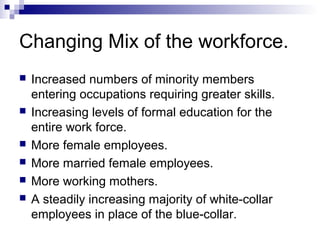
Changing Mix of the workforce.
 Increased numbers of minority members
entering occupations requiring greater skills.
 Increasing levels of formal education for the
entire work force.
 More female employees.
 More married female employees.
 More working mothers.
 A steadily increasing majority of white-collar
employees in place of the blue-collar.
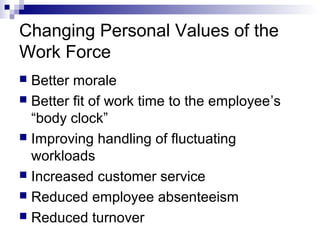
Changing Personal Values of the
Work Force
 Better morale
 Better fit of work time to the employee’s
“body clock”
 Improving handling of fluctuating
workloads
 Increased customer service
 Reduced employee absenteeism
 Reduced turnover
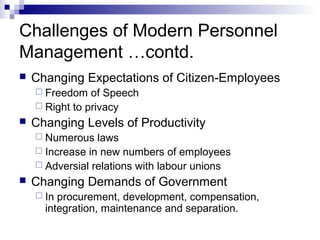
Challenges of Modern Personnel
Management …contd.
 Changing Expectations of Citizen-Employees
 Freedom of Speech
 Right to privacy
 Changing Levels of Productivity
 Numerous laws
 Increase in new numbers of employees
 Adversial relations with labour unions
 Changing Demands of Government
 In procurement, development, compensation,
integration, maintenance and separation.
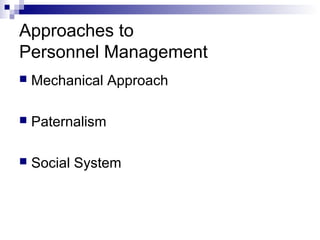
Approaches to
Personnel Management
 Mechanical Approach
 Paternalism
 Social System
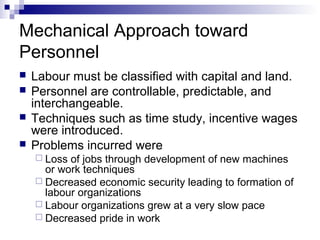
Mechanical Approach toward
Personnel
 Labour must be classified with capital and land.
 Personnel are controllable, predictable, and
interchangeable.
 Techniques such as time study, incentive wages
were introduced.
 Problems incurred were
 Loss of jobs through development of new machines
or work techniques
 Decreased economic security leading to formation of
labour organizations
 Labour organizations grew at a very slow pace
 Decreased pride in work
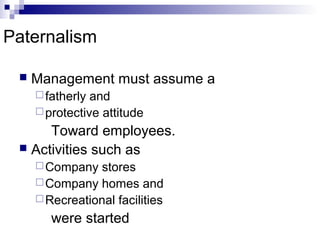
Paternalism
 Management must assume a
fatherly and
protective attitude
Toward employees.
 Activities such as
Company stores
Company homes and
Recreational facilities
were started
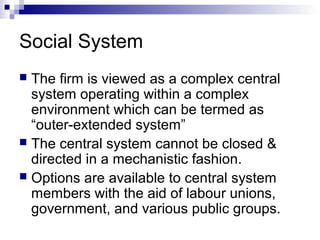
 The firm is viewed as a complex central
system operating within a complex
environment which can be termed as
“outer-extended system”
 The central system cannot be closed &
directed in a mechanistic fashion.
 Options are available to central system
members with the aid of labour unions,
government, and various public groups.
Social System
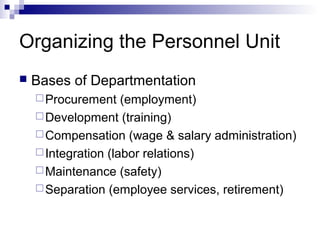
Organizing the Personnel Unit
 Bases of Departmentation
Procurement (employment)
Development (training)
Compensation (wage & salary administration)
Integration (labor relations)
Maintenance (safety)
Separation (employee services, retirement)
Organizing the Personnel Unit
 Line & Personnel Staff relationships
Line person may Advise and not Command or
Order
Staff relationship is of Service
Staff advice compels the line person only to
listen & not accept or follow advice
Staff should be able to give truthful advice to
superiors without fear of losing their jobs
Planning the Personnel Programme
Planning is determination of anything in
advance of action.
 Decision Making
 Programmes and Policies
 The Computer and Personnel
 Standards
Decision Making
1. Recognize & define a problem that
calls for action
2. Determine possible alternative
solutions
3. Collect and analyze facts bearing
upon the problem.
4. Decide on a solution
Programmes and Policies –
In 4 areas
1. Designing enriched jobs
2. The ease with which it can be
implemented in the organization
3. Projected economic benefits to the
firm
4. Possible economic risks associated
with the programmes.
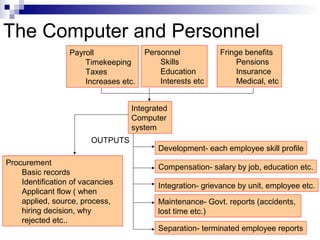
The Computer and Personnel
Payroll
Timekeeping
Taxes
Increases etc.
Personnel
Skills
Education
Interests etc
Fringe benefits
Pensions
Insurance
Medical, etc
Integrated
Computer
system
Procurement
Basic records
Identification of vacancies
Applicant flow ( when
applied, source, process,
hiring decision, why
rejected etc..
Development- each employee skill profile
Compensation- salary by job, education etc.
Integration- grievance by unit, employee etc.
Maintenance- Govt. reports (accidents,
lost time etc.)
Separation- terminated employee reports
OUTPUTS
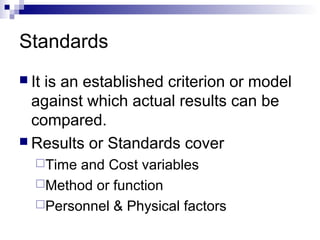
Standards
 It is an established criterion or model
against which actual results can be
compared.
 Results or Standards cover
Time and Cost variables
Method or function
Personnel & Physical factors
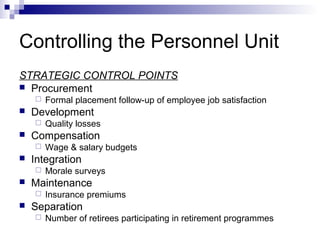
Controlling the Personnel Unit
STRATEGIC CONTROL POINTS
 Procurement
 Formal placement follow-up of employee job satisfaction
 Development
 Quality losses
 Compensation
 Wage & salary budgets
 Integration
 Morale surveys
 Maintenance
 Insurance premiums
 Separation
 Number of retirees participating in retirement programmes
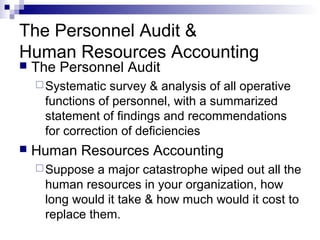
The Personnel Audit &
Human Resources Accounting
 The Personnel Audit
Systematic survey & analysis of all operative
functions of personnel, with a summarized
statement of findings and recommendations
for correction of deficiencies
 Human Resources Accounting
Suppose a major catastrophe wiped out all the
human resources in your organization, how
long would it take & how much would it cost to
replace them.
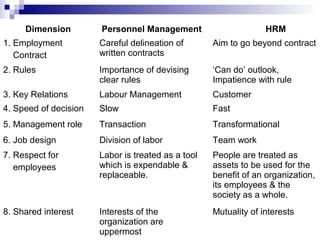
Dimension Personnel Management HRM
1. Employment
Contract
Careful delineation of
written contracts
Aim to go beyond contract
2. Rules Importance of devising
clear rules
‘Can do’ outlook,
Impatience with rule
3. Key Relations Labour Management Customer
4. Speed of decision Slow Fast
5. Management role Transaction Transformational
6. Job design Division of labor Team work
7. Respect for
employees
Labor is treated as a tool
which is expendable &
replaceable.
People are treated as
assets to be used for the
benefit of an organization,
its employees & the
society as a whole.
8. Shared interest Interests of the
organization are
uppermost
Mutuality of interests
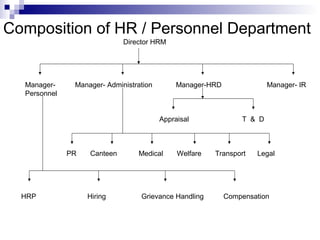
Composition of HR / Personnel Department
Director HRM
Manager- Manager- Administration Manager-HRD Manager- IR
Personnel
Appraisal T & D
PR Canteen Medical Welfare Transport Legal
HRP Hiring Grievance Handling Compensation
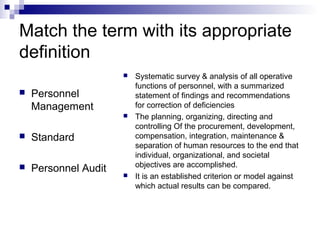
Match the term with its appropriate
definition
 Personnel
Management
 Standard
 Personnel Audit
 Systematic survey & analysis of all operative
functions of personnel, with a summarized
statement of findings and recommendations
for correction of deficiencies
 The planning, organizing, directing and
controlling Of the procurement, development,
compensation, integration, maintenance &
separation of human resources to the end that
individual, organizational, and societal
objectives are accomplished.
 It is an established criterion or model against
which actual results can be compared.
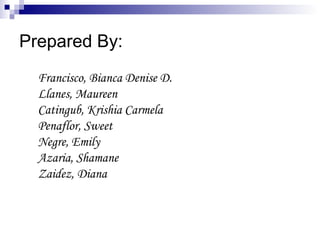
Prepared By:
Francisco, Bianca Denise D.
Llanes, Maureen
Catingub, Krishia Carmela
Penaflor, Sweet
Negre, Emily
Azaria, Shamane
Zaidez, Diana
Thank You

Personnel Management

  • 1.
  • 2.
    The Personnel Function inour organization - Midterms Week 5
  • 3.
    Outline  The PersonnelFunction in our organization  Recruitment, Induction, Placement & Development, Personnel Budget  Personnel Policies & Standing orders  Absenteeism, Personnel Turnover & Problem of indiscipline  Transfers, Promotions & Voluntary retirements  Compensation Plans - Perquisites & Bonus  Job status, Grade & Salary & wage structure – Out fore, Measure  Morale studies & Personnel Research
  • 4.
    Opening Case  Developa case study, where an individual after an elaborate selection procedure, tenders in his resignation after the first month. Form groups of 6 members, discuss & present your findings for the following points.  What could the reasons be?  How could the HR Department have interviewed?  How would the management fill the gap and justify the “episode”?
  • 5.
    The Personnel Functionin our organization  Definition of Personnel Management  The Role of the Personnel Manager  Challenges of Modern Personnel Management  Approaches to Personnel Management  Organizing the Personnel Unit  Planning the Personnel Program  Controlling the Personnel Unit
  • 6.
    PERSONNEL MANAGEMENT - Definition PersonnelManagement is the  Planning,  Organizing,  Directing and  Controlling Of the  Procurement, Development,  Compensation, Integration,  Maintenance & Separation Of human resources to the end that individual, organizational, and societal objectives are accomplished.
  • 7.
    The Role ofthe Personnel Manager The Personnel Manager has Exclusive responsibility of – Personnel records, Insurance Benefits administration Unemployment compensation administration Personnel Research The Heart of a Personnel Programme itself requires considerable coordination, as well as coordination with units in the remainder of the organization.
  • 8.
    Challenges of ModernPersonnel Management  Changing Mix of the Work force  Changing Personal Values of the Work force  Changing expectations of citizen- employees  Changing levels of productivity  Changing demands of government
  • 9.
    Changing Mix ofthe workforce.  Increased numbers of minority members entering occupations requiring greater skills.  Increasing levels of formal education for the entire work force.  More female employees.  More married female employees.  More working mothers.  A steadily increasing majority of white-collar employees in place of the blue-collar.
  • 10.
    Changing Personal Valuesof the Work Force  Better morale  Better fit of work time to the employee’s “body clock”  Improving handling of fluctuating workloads  Increased customer service  Reduced employee absenteeism  Reduced turnover
  • 11.
    Challenges of ModernPersonnel Management …contd.  Changing Expectations of Citizen-Employees  Freedom of Speech  Right to privacy  Changing Levels of Productivity  Numerous laws  Increase in new numbers of employees  Adversial relations with labour unions  Changing Demands of Government  In procurement, development, compensation, integration, maintenance and separation.
  • 12.
    Approaches to Personnel Management Mechanical Approach  Paternalism  Social System
  • 13.
    Mechanical Approach toward Personnel Labour must be classified with capital and land.  Personnel are controllable, predictable, and interchangeable.  Techniques such as time study, incentive wages were introduced.  Problems incurred were  Loss of jobs through development of new machines or work techniques  Decreased economic security leading to formation of labour organizations  Labour organizations grew at a very slow pace  Decreased pride in work
  • 14.
    Paternalism  Management mustassume a fatherly and protective attitude Toward employees.  Activities such as Company stores Company homes and Recreational facilities were started
  • 15.
     The firmis viewed as a complex central system operating within a complex environment which can be termed as “outer-extended system”  The central system cannot be closed & directed in a mechanistic fashion.  Options are available to central system members with the aid of labour unions, government, and various public groups. Social System
  • 16.
    Organizing the PersonnelUnit  Bases of Departmentation Procurement (employment) Development (training) Compensation (wage & salary administration) Integration (labor relations) Maintenance (safety) Separation (employee services, retirement)
  • 17.
    Organizing the PersonnelUnit  Line & Personnel Staff relationships Line person may Advise and not Command or Order Staff relationship is of Service Staff advice compels the line person only to listen & not accept or follow advice Staff should be able to give truthful advice to superiors without fear of losing their jobs
  • 18.
    Planning the PersonnelProgramme Planning is determination of anything in advance of action.  Decision Making  Programmes and Policies  The Computer and Personnel  Standards
  • 19.
    Decision Making 1. Recognize& define a problem that calls for action 2. Determine possible alternative solutions 3. Collect and analyze facts bearing upon the problem. 4. Decide on a solution
  • 20.
    Programmes and Policies– In 4 areas 1. Designing enriched jobs 2. The ease with which it can be implemented in the organization 3. Projected economic benefits to the firm 4. Possible economic risks associated with the programmes.
  • 21.
    The Computer andPersonnel Payroll Timekeeping Taxes Increases etc. Personnel Skills Education Interests etc Fringe benefits Pensions Insurance Medical, etc Integrated Computer system Procurement Basic records Identification of vacancies Applicant flow ( when applied, source, process, hiring decision, why rejected etc.. Development- each employee skill profile Compensation- salary by job, education etc. Integration- grievance by unit, employee etc. Maintenance- Govt. reports (accidents, lost time etc.) Separation- terminated employee reports OUTPUTS
  • 22.
    Standards  It isan established criterion or model against which actual results can be compared.  Results or Standards cover Time and Cost variables Method or function Personnel & Physical factors
  • 23.
    Controlling the PersonnelUnit STRATEGIC CONTROL POINTS  Procurement  Formal placement follow-up of employee job satisfaction  Development  Quality losses  Compensation  Wage & salary budgets  Integration  Morale surveys  Maintenance  Insurance premiums  Separation  Number of retirees participating in retirement programmes
  • 24.
    The Personnel Audit& Human Resources Accounting  The Personnel Audit Systematic survey & analysis of all operative functions of personnel, with a summarized statement of findings and recommendations for correction of deficiencies  Human Resources Accounting Suppose a major catastrophe wiped out all the human resources in your organization, how long would it take & how much would it cost to replace them.
  • 25.
    Dimension Personnel ManagementHRM 1. Employment Contract Careful delineation of written contracts Aim to go beyond contract 2. Rules Importance of devising clear rules ‘Can do’ outlook, Impatience with rule 3. Key Relations Labour Management Customer 4. Speed of decision Slow Fast 5. Management role Transaction Transformational 6. Job design Division of labor Team work 7. Respect for employees Labor is treated as a tool which is expendable & replaceable. People are treated as assets to be used for the benefit of an organization, its employees & the society as a whole. 8. Shared interest Interests of the organization are uppermost Mutuality of interests
  • 27.
    Composition of HR/ Personnel Department Director HRM Manager- Manager- Administration Manager-HRD Manager- IR Personnel Appraisal T & D PR Canteen Medical Welfare Transport Legal HRP Hiring Grievance Handling Compensation
  • 28.
    Match the termwith its appropriate definition  Personnel Management  Standard  Personnel Audit  Systematic survey & analysis of all operative functions of personnel, with a summarized statement of findings and recommendations for correction of deficiencies  The planning, organizing, directing and controlling Of the procurement, development, compensation, integration, maintenance & separation of human resources to the end that individual, organizational, and societal objectives are accomplished.  It is an established criterion or model against which actual results can be compared.
  • 29.
    Prepared By: Francisco, BiancaDenise D. Llanes, Maureen Catingub, Krishia Carmela Penaflor, Sweet Negre, Emily Azaria, Shamane Zaidez, Diana
  • 30.