Integrating Lean
into Healthcare
Facility Design
Written By: Brittany Hagedorn
SIMUL8 Corporation
Lead for Healthcare, North America
LeanHDX WhitePaper
For more information please visit: LeanHDX.com or e-mail info@LeanHDX.com
LeanHDX
Healthcare Whitepaper | www.LeanHDX.com
Growing a successful and sustained architecture practices
comes down to one question – are clients happy with their
designs? When they are, you build trust, clients return
and refer others, and the public acclaims your work.
To ensure client satisfaction is not an easy job of course. The building design needs to be beautiful and be
pleasant to spend time in, the layout must generate a positive experience for patients, and the processes
that happen within must work smoothly and efficiently. The first two – beauty and experience – are the focus
of architecture programs and are skills honed by years of experience in the field. But how do you ensure
efficiency? This is a topic that is frequently overlooked and differentiates designers you from everyone else.
So what does the client need (even if they
don’t articulate it this way)? For hospital
owners and operators, efficiency generally
falls into these five categories:
With these goals in mind, the best designs will have considered many different factors, each of which
contributes to how much time is spent travelling, searching for equipment, moving between departments,
and other time consuming movement. This is all considered “waste” by Lean practitioners; movement
and transportation are two of the eight wastes that are a target of many hospitals’ improvement teams.
Creating efficient spaces
that your customers love
1.	 Less travel distance (and time) for staff.
2.	 Easy way-finding for patients and their families.
3.	 Smooth traffic patterns without congestion.
4.	 Quick access to right equipment and resources
when and where they are needed.
5.	 Well-positioned department adjacencies.
The first step in eliminating unnecessary waste is to
examine the adjacencies between related departments.
A commonly discussed adjacency is the relationship of the Emergency Department (ED), relative to
the Operating Room (OR) and/or to the Cath Lab. This is an obvious opportunity for time savings
and to look for congestion, which is especially critical for patients who are coming into the ED
needing immediate surgical or procedural interventions, such as trauma or heart attack patients.
Less obvious may be the proximity of pediatric units to the cafeteria, or whether to locate the
Intensive Care Unit (ICU) near to the surgery suite or to step-down units. All of these adjacencies
have an impact on clinical care, the patient experience, and/or operational costs downstream.
The second, more detailed evaluation should
be done on a department level.
Specifically, it is important to consider total walk time by staff members and the distance between
locations within a single department, for example nurses walking on an inpatient unit between
patient rooms, medication storage, clean and dirty utility rooms, computer stations, etc. Studies
have shown that on average, nurses can walk ____ miles per 12-hour shift. This is a tremendous
waste of time and directly affects patient care, which then has a downstream impact on the
hospital’s operational costs. By considering these distances beforehand, the architect has a chance
to save the hospital money over the life of the building and to differentiate themselves.
Healthcare Whitepaper | www.LeanHDX.com
Both of these discussions must consider
the patient demand and how that may
evolve over time, the frequency of certain
events or tasks that are expected, and
also the sequence of activities that
may occur. By factoring in all of these
different variables, the adjacencies and
department layouts can be optimized to
meet the client’s needs effectively and
efficiently. In addition, it is important
to thoroughly discuss any anticipated
changes to how the building will be used.
For example
When doing a campus plan, it is important to
consider any legal, population, or reimbursement
changes that may happen. These changes
could have a direct impact on volumes, the mix
of services or locations of services that may
be required, and the kind of experience that
the patient will respond best to. How will your
design be flexible enough to accommodate those
possibilities, without losing the specialization of
space that makes processes more efficient? All of
this must be considered and planned for in order
to ensure a still-satisfied client in 5 or 10 years.
•	 The prevalence of heart attacks vary, even between populations
that live in close proximity, due to cultural and socio-economic
factors. If a community’s composition is changing, how will that
impact demand for these services? What does that mean for the
location and/or the number of Cath Lab suites that should be built?
•	 Some communities have a shortage of primary care physicians. What
if they begin to utilize a team-based care model, with perhaps a few
nurse practitioners, a nurse educator, and perhaps a part time social
worker working with patients? How does the ratio of rooms per
physician change? How many computer stations or collaboration
spaces will be needed and where should they be placed?
•	 A few clinics have begun to embrace the practice of patient self-
rooming. In theory, this completely eliminates the need for a
waiting room, but how can you be sure? How do you appropriately
size the waiting room for a process that has never been tested?
•	 During ski season, hospitals in some areas experience an influx of
orthopedic injuries, a portion of which must be surgically treated.
How many additional operating rooms should be built? What will
happen to the delays in the emergency room? What should be done
with the extra capacity during non-peak season? Can the spaces be
built to be flexible to serve other types of care, or should they be built
in a dedicated stand-alone facility to streamline the patient flow?
“Rules of Thumb”
are not enough.
Average doesn’t work, and organizations are beginning to realize
this. Their patients may be different, their focus shifting, the type
and quantity of services changing. Every organization has its own
unique needs, and public acclaim and customer loyalty are driven
by meeting these local requirements in an innovative way.
Let’s consider for a moment a
few examples of where client-
specific adjustments must be
made and there is not a clear
answer of what to do. While these
are just a few specific situations,
the need for adjustments and
reasons that “rules of thumb” are
not enough are abundant once
you begin to look for them.
Ultimately, efficiency comes down to saving time, for both patients and
for staff. This equates to distance travelled and time spent waiting.
Healthcare Whitepaper | www.LeanHDX.com
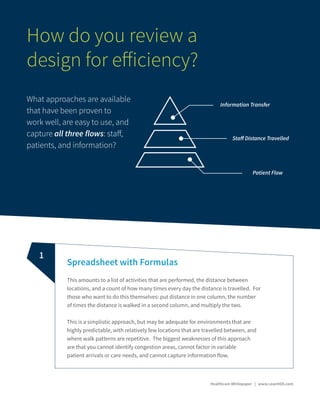
How do you review a
design for efficiency?
Spreadsheet with Formulas
This amounts to a list of activities that are performed, the distance between
locations, and a count of how many times every day the distance is travelled. For
those who want to do this themselves: put distance in one column, the number
of times the distance is walked in a second column, and multiply the two.
This is a simplistic approach, but may be adequate for environments that are
highly predictable, with relatively few locations that are travelled between, and
where walk patterns are repetitive. The biggest weaknesses of this approach
are that you cannot identify congestion areas, cannot factor in variable
patient arrivals or care needs, and cannot capture information flow.
Healthcare Whitepaper | www.LeanHDX.com
1
What approaches are available
that have been proven to
work well, are easy to use, and
capture all three flows: staff,
patients, and information?
Information Transfer
Staff Distance Travelled
Patient Flow
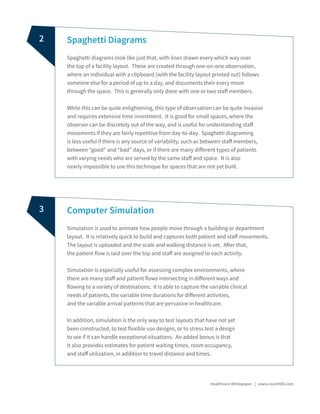
Spaghetti Diagrams
Spaghetti diagrams look like just that, with lines drawn every which way over
the top of a facility layout. These are created through one-on-one observation,
where an individual with a clipboard (with the facility layout printed out) follows
someone else for a period of up to a day, and documents their every move
through the space. This is generally only done with one or two staff members.
While this can be quite enlightening, this type of observation can be quite invasive
and requires extensive time investment. It is good for small spaces, where the
observer can be discretely out of the way, and is useful for understanding staff
movements if they are fairly repetitive from day-to-day. Spaghetti diagraming
is less useful if there is any source of variability, such as between staff members,
between “good” and “bad” days, or if there are many different types of patients
with varying needs who are served by the same staff and space. It is also
nearly impossible to use this technique for spaces that are not yet built.
Computer Simulation
Simulation is used to animate how people move through a building or department
layout. It is relatively quick to build and captures both patient and staff movements.
The layout is uploaded and the scale and walking distance is set. After that,
the patient flow is laid over the top and staff are assigned to each activity.
Simulation is especially useful for assessing complex environments, where
there are many staff and patient flows intersecting in different ways and
flowing to a variety of destinations. It is able to capture the variable clinical
needs of patients, the variable time durations for different activities,
and the variable arrival patterns that are pervasive in healthcare.
In addition, simulation is the only way to test layouts that have not yet
been constructed, to test flexible use designs, or to stress test a design
to see if it can handle exceptional situations. An added bonus is that
it also provides estimates for patient waiting times, room occupancy,
and staff utilization, in addition to travel distance and times.
Healthcare Whitepaper | www.LeanHDX.com
2
3
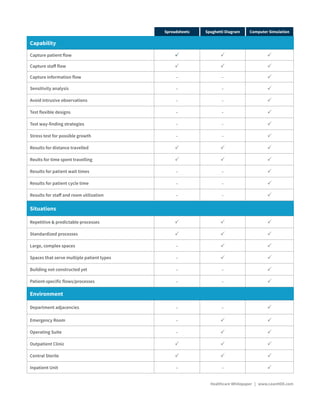
Spreadsheets Spaghetti Diagram Computer Simulation
Capability
Capture patient flow P P P
Capture staff flow P P P
Capture information flow - - P
Sensitivity analysis - - P
Avoid intrusive observations - - P
Test flexible designs - - P
Test way-finding strategies - - P
Stress test for possible growth - - P
Results for distance travelled P P P
Reults for time spent travelling P P P
Results for patient wait times - - P
Results for patient cycle time - - P
Results for staff and room utilization - - P
Situations
Repetitive & predictable processes P P P
Standardized processes P P P
Large, complex spaces - P P
Spaces that serve multiple patient types - P P
Building not constructed yet - - P
Patient-specific flows/processes - - P
Environment
Department adjacencies - - P
Emergency Room - P P
Operating Suite - P P
Outpatient Clinic P P P
Central Sterile P P P
Inpatient Unit - - P
Healthcare Whitepaper | www.LeanHDX.com
In today’s environment, you
have to be able to differentiate
yourself from your competitors.
One way to do so is to augment your design skills with
additional offerings. Buildings must be beautiful, offer a great
experience, AND also be efficient to own and operate.
By designing with flow in mind, there are many benefits for your client:
•	 Less staff travel means more time for patient care,
•	 Less waste means lower operating costs,
•	 Better way finding means higher patient satisfaction,
•	 Better adjacencies means less excess walking,
•	 Right number of beds means lower construction costs, and
•	 Right number of resources (ex. elevators) means less waiting around.
Healthcare Whitepaper | www.LeanHDX.com
This all comes together for better patient care, lower costs, and
happy clients. This is what evidence-based design and accountable
care are built on – and that is where acclaim is generated.

integrated-lean-led-facility-design

  • 1.
    Integrating Lean into Healthcare FacilityDesign Written By: Brittany Hagedorn SIMUL8 Corporation Lead for Healthcare, North America LeanHDX WhitePaper For more information please visit: LeanHDX.com or e-mail info@LeanHDX.com LeanHDX
  • 2.
    Healthcare Whitepaper |www.LeanHDX.com Growing a successful and sustained architecture practices comes down to one question – are clients happy with their designs? When they are, you build trust, clients return and refer others, and the public acclaims your work. To ensure client satisfaction is not an easy job of course. The building design needs to be beautiful and be pleasant to spend time in, the layout must generate a positive experience for patients, and the processes that happen within must work smoothly and efficiently. The first two – beauty and experience – are the focus of architecture programs and are skills honed by years of experience in the field. But how do you ensure efficiency? This is a topic that is frequently overlooked and differentiates designers you from everyone else. So what does the client need (even if they don’t articulate it this way)? For hospital owners and operators, efficiency generally falls into these five categories: With these goals in mind, the best designs will have considered many different factors, each of which contributes to how much time is spent travelling, searching for equipment, moving between departments, and other time consuming movement. This is all considered “waste” by Lean practitioners; movement and transportation are two of the eight wastes that are a target of many hospitals’ improvement teams. Creating efficient spaces that your customers love 1. Less travel distance (and time) for staff. 2. Easy way-finding for patients and their families. 3. Smooth traffic patterns without congestion. 4. Quick access to right equipment and resources when and where they are needed. 5. Well-positioned department adjacencies.
  • 3.
    The first stepin eliminating unnecessary waste is to examine the adjacencies between related departments. A commonly discussed adjacency is the relationship of the Emergency Department (ED), relative to the Operating Room (OR) and/or to the Cath Lab. This is an obvious opportunity for time savings and to look for congestion, which is especially critical for patients who are coming into the ED needing immediate surgical or procedural interventions, such as trauma or heart attack patients. Less obvious may be the proximity of pediatric units to the cafeteria, or whether to locate the Intensive Care Unit (ICU) near to the surgery suite or to step-down units. All of these adjacencies have an impact on clinical care, the patient experience, and/or operational costs downstream. The second, more detailed evaluation should be done on a department level. Specifically, it is important to consider total walk time by staff members and the distance between locations within a single department, for example nurses walking on an inpatient unit between patient rooms, medication storage, clean and dirty utility rooms, computer stations, etc. Studies have shown that on average, nurses can walk ____ miles per 12-hour shift. This is a tremendous waste of time and directly affects patient care, which then has a downstream impact on the hospital’s operational costs. By considering these distances beforehand, the architect has a chance to save the hospital money over the life of the building and to differentiate themselves. Healthcare Whitepaper | www.LeanHDX.com Both of these discussions must consider the patient demand and how that may evolve over time, the frequency of certain events or tasks that are expected, and also the sequence of activities that may occur. By factoring in all of these different variables, the adjacencies and department layouts can be optimized to meet the client’s needs effectively and efficiently. In addition, it is important to thoroughly discuss any anticipated changes to how the building will be used. For example When doing a campus plan, it is important to consider any legal, population, or reimbursement changes that may happen. These changes could have a direct impact on volumes, the mix of services or locations of services that may be required, and the kind of experience that the patient will respond best to. How will your design be flexible enough to accommodate those possibilities, without losing the specialization of space that makes processes more efficient? All of this must be considered and planned for in order to ensure a still-satisfied client in 5 or 10 years.
  • 4.
    • The prevalenceof heart attacks vary, even between populations that live in close proximity, due to cultural and socio-economic factors. If a community’s composition is changing, how will that impact demand for these services? What does that mean for the location and/or the number of Cath Lab suites that should be built? • Some communities have a shortage of primary care physicians. What if they begin to utilize a team-based care model, with perhaps a few nurse practitioners, a nurse educator, and perhaps a part time social worker working with patients? How does the ratio of rooms per physician change? How many computer stations or collaboration spaces will be needed and where should they be placed? • A few clinics have begun to embrace the practice of patient self- rooming. In theory, this completely eliminates the need for a waiting room, but how can you be sure? How do you appropriately size the waiting room for a process that has never been tested? • During ski season, hospitals in some areas experience an influx of orthopedic injuries, a portion of which must be surgically treated. How many additional operating rooms should be built? What will happen to the delays in the emergency room? What should be done with the extra capacity during non-peak season? Can the spaces be built to be flexible to serve other types of care, or should they be built in a dedicated stand-alone facility to streamline the patient flow? “Rules of Thumb” are not enough. Average doesn’t work, and organizations are beginning to realize this. Their patients may be different, their focus shifting, the type and quantity of services changing. Every organization has its own unique needs, and public acclaim and customer loyalty are driven by meeting these local requirements in an innovative way. Let’s consider for a moment a few examples of where client- specific adjustments must be made and there is not a clear answer of what to do. While these are just a few specific situations, the need for adjustments and reasons that “rules of thumb” are not enough are abundant once you begin to look for them. Ultimately, efficiency comes down to saving time, for both patients and for staff. This equates to distance travelled and time spent waiting. Healthcare Whitepaper | www.LeanHDX.com
  • 5.
    How do youreview a design for efficiency? Spreadsheet with Formulas This amounts to a list of activities that are performed, the distance between locations, and a count of how many times every day the distance is travelled. For those who want to do this themselves: put distance in one column, the number of times the distance is walked in a second column, and multiply the two. This is a simplistic approach, but may be adequate for environments that are highly predictable, with relatively few locations that are travelled between, and where walk patterns are repetitive. The biggest weaknesses of this approach are that you cannot identify congestion areas, cannot factor in variable patient arrivals or care needs, and cannot capture information flow. Healthcare Whitepaper | www.LeanHDX.com 1 What approaches are available that have been proven to work well, are easy to use, and capture all three flows: staff, patients, and information? Information Transfer Staff Distance Travelled Patient Flow
  • 6.
    Spaghetti Diagrams Spaghetti diagramslook like just that, with lines drawn every which way over the top of a facility layout. These are created through one-on-one observation, where an individual with a clipboard (with the facility layout printed out) follows someone else for a period of up to a day, and documents their every move through the space. This is generally only done with one or two staff members. While this can be quite enlightening, this type of observation can be quite invasive and requires extensive time investment. It is good for small spaces, where the observer can be discretely out of the way, and is useful for understanding staff movements if they are fairly repetitive from day-to-day. Spaghetti diagraming is less useful if there is any source of variability, such as between staff members, between “good” and “bad” days, or if there are many different types of patients with varying needs who are served by the same staff and space. It is also nearly impossible to use this technique for spaces that are not yet built. Computer Simulation Simulation is used to animate how people move through a building or department layout. It is relatively quick to build and captures both patient and staff movements. The layout is uploaded and the scale and walking distance is set. After that, the patient flow is laid over the top and staff are assigned to each activity. Simulation is especially useful for assessing complex environments, where there are many staff and patient flows intersecting in different ways and flowing to a variety of destinations. It is able to capture the variable clinical needs of patients, the variable time durations for different activities, and the variable arrival patterns that are pervasive in healthcare. In addition, simulation is the only way to test layouts that have not yet been constructed, to test flexible use designs, or to stress test a design to see if it can handle exceptional situations. An added bonus is that it also provides estimates for patient waiting times, room occupancy, and staff utilization, in addition to travel distance and times. Healthcare Whitepaper | www.LeanHDX.com 2 3
  • 7.
    Spreadsheets Spaghetti DiagramComputer Simulation Capability Capture patient flow P P P Capture staff flow P P P Capture information flow - - P Sensitivity analysis - - P Avoid intrusive observations - - P Test flexible designs - - P Test way-finding strategies - - P Stress test for possible growth - - P Results for distance travelled P P P Reults for time spent travelling P P P Results for patient wait times - - P Results for patient cycle time - - P Results for staff and room utilization - - P Situations Repetitive & predictable processes P P P Standardized processes P P P Large, complex spaces - P P Spaces that serve multiple patient types - P P Building not constructed yet - - P Patient-specific flows/processes - - P Environment Department adjacencies - - P Emergency Room - P P Operating Suite - P P Outpatient Clinic P P P Central Sterile P P P Inpatient Unit - - P Healthcare Whitepaper | www.LeanHDX.com
  • 8.
    In today’s environment,you have to be able to differentiate yourself from your competitors. One way to do so is to augment your design skills with additional offerings. Buildings must be beautiful, offer a great experience, AND also be efficient to own and operate. By designing with flow in mind, there are many benefits for your client: • Less staff travel means more time for patient care, • Less waste means lower operating costs, • Better way finding means higher patient satisfaction, • Better adjacencies means less excess walking, • Right number of beds means lower construction costs, and • Right number of resources (ex. elevators) means less waiting around. Healthcare Whitepaper | www.LeanHDX.com This all comes together for better patient care, lower costs, and happy clients. This is what evidence-based design and accountable care are built on – and that is where acclaim is generated.