Phomolo Madome
Trang Nguyen Thi Thuy
          Calle Lindén
         Emily Moore
Definition

 A clinical microsystem is a group of clinicians and staff
  working together with a shared clinical purpose to
  provide care for a population of patients (Mohr,
  Batalden & Barach, 2004)
 It has clinical and business aims, linked processes,
  shared information environment and produces
  performance outcomes.
 It must do the work, meet staff needs, and maintain
  itself as a clinical unit.
The microsystem is the place where

 Patients, families and health care teams meet.
 Care is made
 Quality, safety, reliability, efficiency and innovation are
  made
 Staff morale and patient satisfaction are made
Clinical system
 Small group of doctors, nurses, other clinicians
 Some administrative support
 Some information, information technology
 A small population of patients
 Interdependent for a common aim, purpose
Background
 Conceptual theory of the clinical microsystem is based
  on ideas developed by Deming, Senge and Wheatley
 Idea for the clinical microsystem stems from the work
  of Quinn
 Analyzed world’s best of best service organisations,
  such as FedEx
 Bronfenbrenner’s Ecological Systems Theory
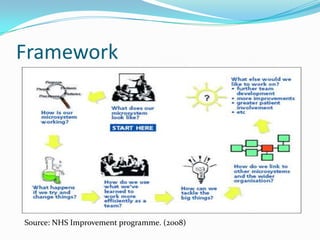
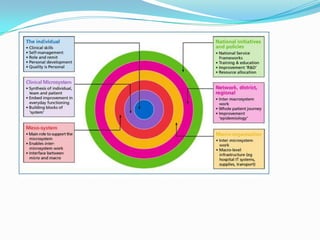
Framework


Source: NHS Improvement programme. (2008)
Micro – Meso – Macro Framework
Six stages can be identified in the development of the
relationship between macrosystems and microsystems:
1. A self-aware microsystem (m1)
2. A group of like microsystems (m1+ m1+ m1)
3. A group of unlike microsystems (m1+m2+m3)
4. A group of microsystems in relationship with a
   macrosystem (m1+m2+m3…+M1)
5. A group of like macrosystems (M1+ M1+ M1…)
6. A group of unlike macrosystems (M1+ M2+ M3…)
It can be used in:
 family practitioner’s office,
 an emergency department,
 an intensive care unit,
 a surgical suite,
 an inpatient care unit,
 a cardiologist’s office,
 a cardiac rehabilitation program,
 a nutritionist’s office,
 home-based nursing care from a visiting nurse
The five P
 Purpose - Does the whole team have a clear,
    unambiguous understanding of the core function of
    the microsystem?
   Patients - What does the microsystem really know
    about its patients?
   People - What is the microsystem like from the point
    of view of the staff that work within it?
   Processes - How does the microsystem get things
    done?
   Patterns - What data is available to help run the
    microsystem on a day-to-day basis?
Benefits
Improving patient safety (Mohr, Batalden & Barach,
 2004)
   Safety is a property of the clinical microsystem
   An important level at which to focus patient safety
    interventions
   Systems level that most patients and caregivers meet
   Errors occur within the microsystem
Benefits
 Entire staff team (both clinical and non-clinical) are
    included in the analysis, planning and execution of
    improvement work.
   Microsystem concept provides an effective way of
    connecting front-line teams to wider organisational
    priorities
   To produce better outcomes for patients and populations;
   To produce better operating performance for the health
    care organizations that are in business to provide care;
   to attract, develop, and retain caring and competent health
    care professionals who are engaged in their work.

     (NHS Improvement programme, 2008)
Benefits
 Focus of improvement or development is based on an
  understanding of priorities from both patient and staff
  perspectives.
 To attract, develop, and retain caring and competent
  health care professionals who are engaged in their
  work.
 Microsystem approach fits well with any previous or
  ongoing improvement work
   (NHS Improvement programme, 2008)
Negatives
 Clinical microsystems are by nature complex,
 dynamic, and adaptive systems. Some people have
 difficulty grasping systems thinking and others,
 having gotten the idea, personal responsibility,
 proclaiming that the system “made me do it.” Blaming
 the system is in league with a feeling of helplessness
How microsystems work and those
included
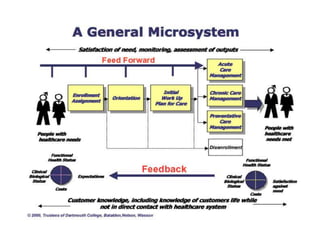
 We have this assortment of clinical microsystems as well as
  the patient’s own actions to improve or maintain health
  which can be viewed as the patient’s unique health system.
 This is the foundation of second-generation development
  for clinical microsystems. The patient needs these different
  and distinct, yet related,small systems to fit smoothly
  together as if they were a single health system designed just
  for the specific patient and tailored to his or her special
  needs.
 E.g. Acute care management, chronic care management,
  preventative care management.
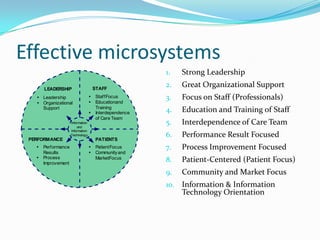
Effective microsystems
                                                     1.   Strong Leadership
      LEADERSHIP                  STAFF
                                                     2.   Great Organizational Support
   Ÿ Leadership                  Ÿ Staff Focus       3.   Focus on Staff (Professionals)
   Ÿ Organizational              Ÿ Educationand
                                   Training
     Support
                                 Ÿ Interdependence   4.   Education and Training of Staff
                                   of Care Team
                   Information
                       and
                                                     5.   Interdependence of Care Team
                   Information

 PERFORMANCE
                   Technology
                                   PATIENTS
                                                     6.   Performance Result Focused
   Ÿ Performance                 Ÿ Patient Focus     7.   Process Improvement Focused
     Results                     Ÿ Community and
   Ÿ Process
     Improvement
                                   MarketFocus
                                                     8.   Patient-Centered (Patient Focus)
                                                     9.   Community and Market Focus
                                                     10. Information & Information
                                                         Technology Orientation
References
 Espinosa, J. & Kosnik, L. (2003). Microsystems in Health Care: Part 7.
    The Microsystem as a Platform for Merging Strategic Planning and
    Operations. Joint Commission on Quality and Safety, 29, 452-459.
   Mohr, J, Batalden P, & Barach P. (2004). Integrating patient safety into
    the clinical microsystem. Qual saf health care, 13.
   Godfrey, Nelson, & Batalden (2004). Improving Health Care by
    Improving Your Microsystem: Trustees of Dartmouth College
   Gill, M., & Gray, M. (2006). Using Clinical Microsystems and
    Mesosystems as enablers for service improvement in mental health
    services. Humber Mental Health Teaching NHS Trust.
   NHS Improvement programme. (2008). Further Resources: Service
    Improvement Tools and Technques. Retrieved 9 April 2012.
    http://www.improvement.nhs.uk/heart/sustainability/further_resourc
    es/techniques/microsystems.html

Microsystem3

  • 1.
    Phomolo Madome Trang NguyenThi Thuy Calle Lindén Emily Moore
  • 2.
    Definition  A clinicalmicrosystem is a group of clinicians and staff working together with a shared clinical purpose to provide care for a population of patients (Mohr, Batalden & Barach, 2004)  It has clinical and business aims, linked processes, shared information environment and produces performance outcomes.  It must do the work, meet staff needs, and maintain itself as a clinical unit.
  • 3.
    The microsystem isthe place where  Patients, families and health care teams meet.  Care is made  Quality, safety, reliability, efficiency and innovation are made  Staff morale and patient satisfaction are made
  • 4.
    Clinical system  Smallgroup of doctors, nurses, other clinicians  Some administrative support  Some information, information technology  A small population of patients  Interdependent for a common aim, purpose
  • 5.
    Background  Conceptual theoryof the clinical microsystem is based on ideas developed by Deming, Senge and Wheatley  Idea for the clinical microsystem stems from the work of Quinn  Analyzed world’s best of best service organisations, such as FedEx
  • 6.
  • 8.
  • 9.
    Micro – Meso– Macro Framework Six stages can be identified in the development of the relationship between macrosystems and microsystems: 1. A self-aware microsystem (m1) 2. A group of like microsystems (m1+ m1+ m1) 3. A group of unlike microsystems (m1+m2+m3) 4. A group of microsystems in relationship with a macrosystem (m1+m2+m3…+M1) 5. A group of like macrosystems (M1+ M1+ M1…) 6. A group of unlike macrosystems (M1+ M2+ M3…)
  • 11.
    It can beused in:  family practitioner’s office,  an emergency department,  an intensive care unit,  a surgical suite,  an inpatient care unit,  a cardiologist’s office,  a cardiac rehabilitation program,  a nutritionist’s office,  home-based nursing care from a visiting nurse
  • 12.
    The five P Purpose - Does the whole team have a clear, unambiguous understanding of the core function of the microsystem?  Patients - What does the microsystem really know about its patients?  People - What is the microsystem like from the point of view of the staff that work within it?  Processes - How does the microsystem get things done?  Patterns - What data is available to help run the microsystem on a day-to-day basis?
  • 13.
    Benefits Improving patient safety(Mohr, Batalden & Barach, 2004)  Safety is a property of the clinical microsystem  An important level at which to focus patient safety interventions  Systems level that most patients and caregivers meet  Errors occur within the microsystem
  • 14.
    Benefits  Entire staffteam (both clinical and non-clinical) are included in the analysis, planning and execution of improvement work.  Microsystem concept provides an effective way of connecting front-line teams to wider organisational priorities  To produce better outcomes for patients and populations;  To produce better operating performance for the health care organizations that are in business to provide care;  to attract, develop, and retain caring and competent health care professionals who are engaged in their work.  (NHS Improvement programme, 2008)
  • 15.
    Benefits  Focus ofimprovement or development is based on an understanding of priorities from both patient and staff perspectives.  To attract, develop, and retain caring and competent health care professionals who are engaged in their work.  Microsystem approach fits well with any previous or ongoing improvement work  (NHS Improvement programme, 2008)
  • 16.
    Negatives  Clinical microsystemsare by nature complex, dynamic, and adaptive systems. Some people have difficulty grasping systems thinking and others, having gotten the idea, personal responsibility, proclaiming that the system “made me do it.” Blaming the system is in league with a feeling of helplessness
  • 17.
    How microsystems workand those included  We have this assortment of clinical microsystems as well as the patient’s own actions to improve or maintain health which can be viewed as the patient’s unique health system.  This is the foundation of second-generation development for clinical microsystems. The patient needs these different and distinct, yet related,small systems to fit smoothly together as if they were a single health system designed just for the specific patient and tailored to his or her special needs.  E.g. Acute care management, chronic care management, preventative care management.
  • 18.
    Effective microsystems 1. Strong Leadership LEADERSHIP STAFF 2. Great Organizational Support Ÿ Leadership Ÿ Staff Focus 3. Focus on Staff (Professionals) Ÿ Organizational Ÿ Educationand Training Support Ÿ Interdependence 4. Education and Training of Staff of Care Team Information and 5. Interdependence of Care Team Information PERFORMANCE Technology PATIENTS 6. Performance Result Focused Ÿ Performance Ÿ Patient Focus 7. Process Improvement Focused Results Ÿ Community and Ÿ Process Improvement MarketFocus 8. Patient-Centered (Patient Focus) 9. Community and Market Focus 10. Information & Information Technology Orientation
  • 19.
    References  Espinosa, J.& Kosnik, L. (2003). Microsystems in Health Care: Part 7. The Microsystem as a Platform for Merging Strategic Planning and Operations. Joint Commission on Quality and Safety, 29, 452-459.  Mohr, J, Batalden P, & Barach P. (2004). Integrating patient safety into the clinical microsystem. Qual saf health care, 13.  Godfrey, Nelson, & Batalden (2004). Improving Health Care by Improving Your Microsystem: Trustees of Dartmouth College  Gill, M., & Gray, M. (2006). Using Clinical Microsystems and Mesosystems as enablers for service improvement in mental health services. Humber Mental Health Teaching NHS Trust.  NHS Improvement programme. (2008). Further Resources: Service Improvement Tools and Technques. Retrieved 9 April 2012. http://www.improvement.nhs.uk/heart/sustainability/further_resourc es/techniques/microsystems.html

Editor's Notes

  • #3 http://www.clinicalmicrosystem.org/about/background/Gill, M., & Gray, M. (2006). Using Clinical Microsystems and Mesosystems as enablers for service improvement in mental health services. Retrieved from http://www.lj.se/info_files/infosida31595/micro_mesosystems_mjg_mdg.pdfNelson, E. C., Batalden, P. B., & Lazar, J. S. (2007). Practice-based learning and improvement: A clinical improvement action guide (2nd ed.). Oakbrook Terrace, Illinois: Joint Commission Resources.
  • #4 http://www.clinicalmicrosystem.org/about/background/
  • #6 Mohr J, Batalden P, Barach P. (2004). Integrating patient safety into the clinical microsystem. Department of Medicine, University of ChicagoRetrived on April 7 from:http://qualitysafety.bmj.com/content/13/suppl_2/ii34.full#ref-4
  • #8 http://www.clinicalmicrosystem.org/about/background/
  • #10 Inside out – creating the condition – outside inReferencesGodfrey, Nelson, & Batalden (2008). . Retrieved from [PDF] Table 3. Micro-Meso-Macro Framework Clinical Microsystem ...clinicalmicrosystem.org/materials/.../m3_matrix.pdfEspinosa, J. A., & Kosnik, L. (2003, Sept). Microsystems in Health Care. Joint Commission on Quality and Safety, 29, 452-459. Retrieved from http://clinicalmicrosystem.org/materials/publications/JQIPart7.pdf
  • #14 Mohr, J, Batalden P, & Barach P. (2004). Integrating patient safety into the clinical microsystem.Qual saf health care, 13.
  • #15 NHS Improvement programme. (2008). Further Resources: Service Improvement Tools and Technques. Retrieved 9 April 2012. http://www.improvement.nhs.uk/heart/sustainability/further_resources/techniques/microsystems.html
  • #16 NHS Improvement programme. (2008). Further Resources: Service Improvement Tools and Technques. Retrieved 9 April 2012. http://www.improvement.nhs.uk/heart/sustainability/further_resources/techniques/microsystems.html
  • #19 Gill, M., & Gray, M. (2006). Using Clinical Microsystems and Mesosystems as enablers for service improvement in mental health services. Retrieved from http://www.lj.se/info_files/infosida31595/micro_mesosystems_mjg_mdg.