Building Smart Without
Compromising Efficiency
Presenters
Bill Seed, Staff Vice President,
Universal Health Services
Angela Lee, AIA, ACHA, LEED AP,
Senior Vice President, HKS
Debajyoti Pati, PhD, FIIA, LEED AP,
Vice President and Director of
Research, HKS
Acknowledgments
• Summerlin Hospital,
Las Vegas, NV
• Texoma Medical
Center, Denison, TX
• Rapid Modeling
Corporation
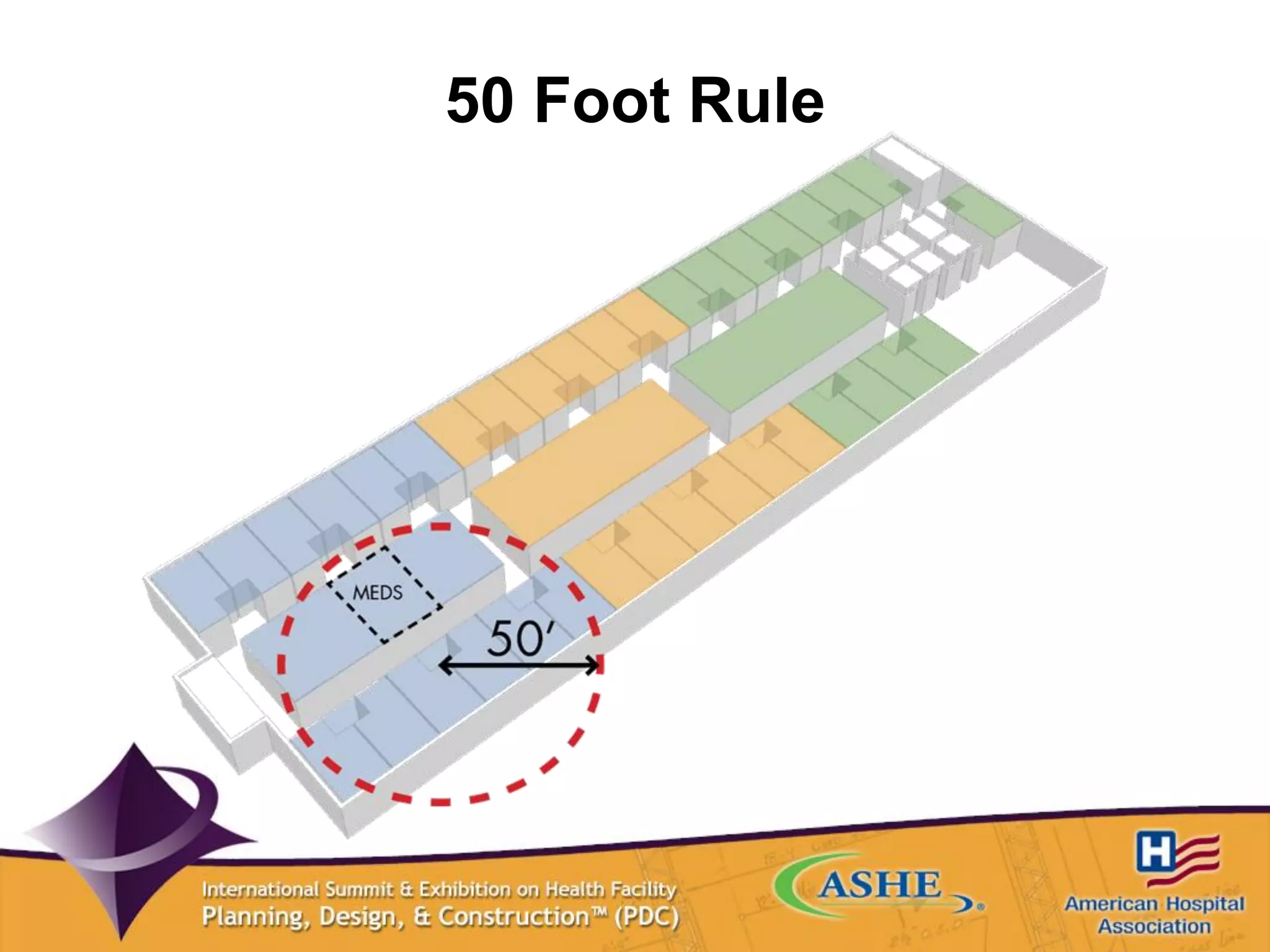
50 Foot Rule
CAN LARGER INPATIENT BED UNITS AND
EFFICIENT USE OF NURSING TIME GO
HAND IN HAND?
QUESTION
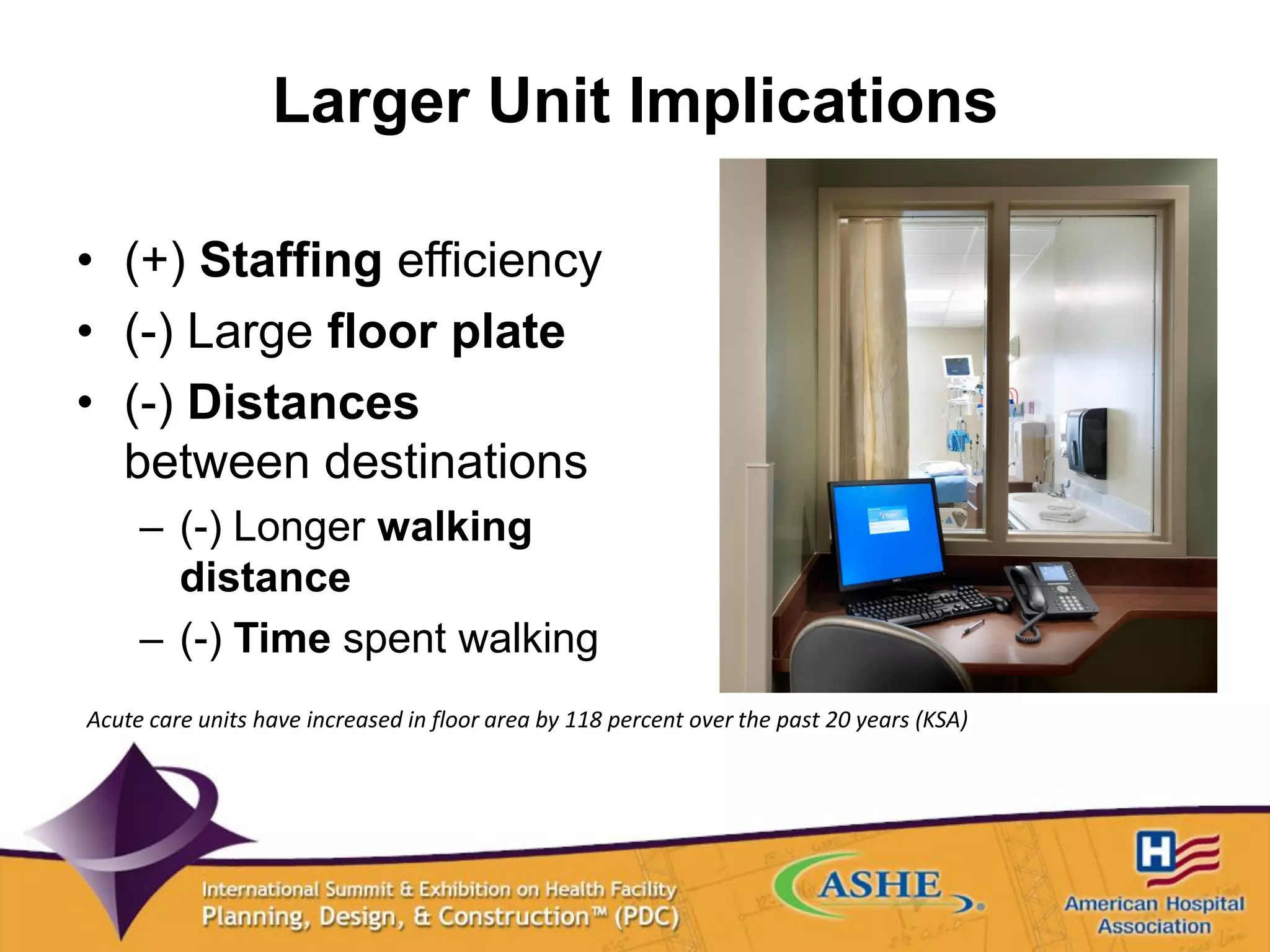
Larger Unit Implications
• (+) Staffing efficiency
• (-) Large floor plate
• (-) Distances
between destinations
– (-) Longer walking
distance
– (-) Time spent walking
Acute care units have increased in floor area by 118 percent over the past 20 years (KSA)
Implications of Walking
• System efficiency
– Unnecessary walking
= Waste
• Care quality
– Time away from
patients (patient-
centric care)
– Medication errors
• Individual
performance
– Interactions with
workplace stressors
– Alertness, stress,
fatigue
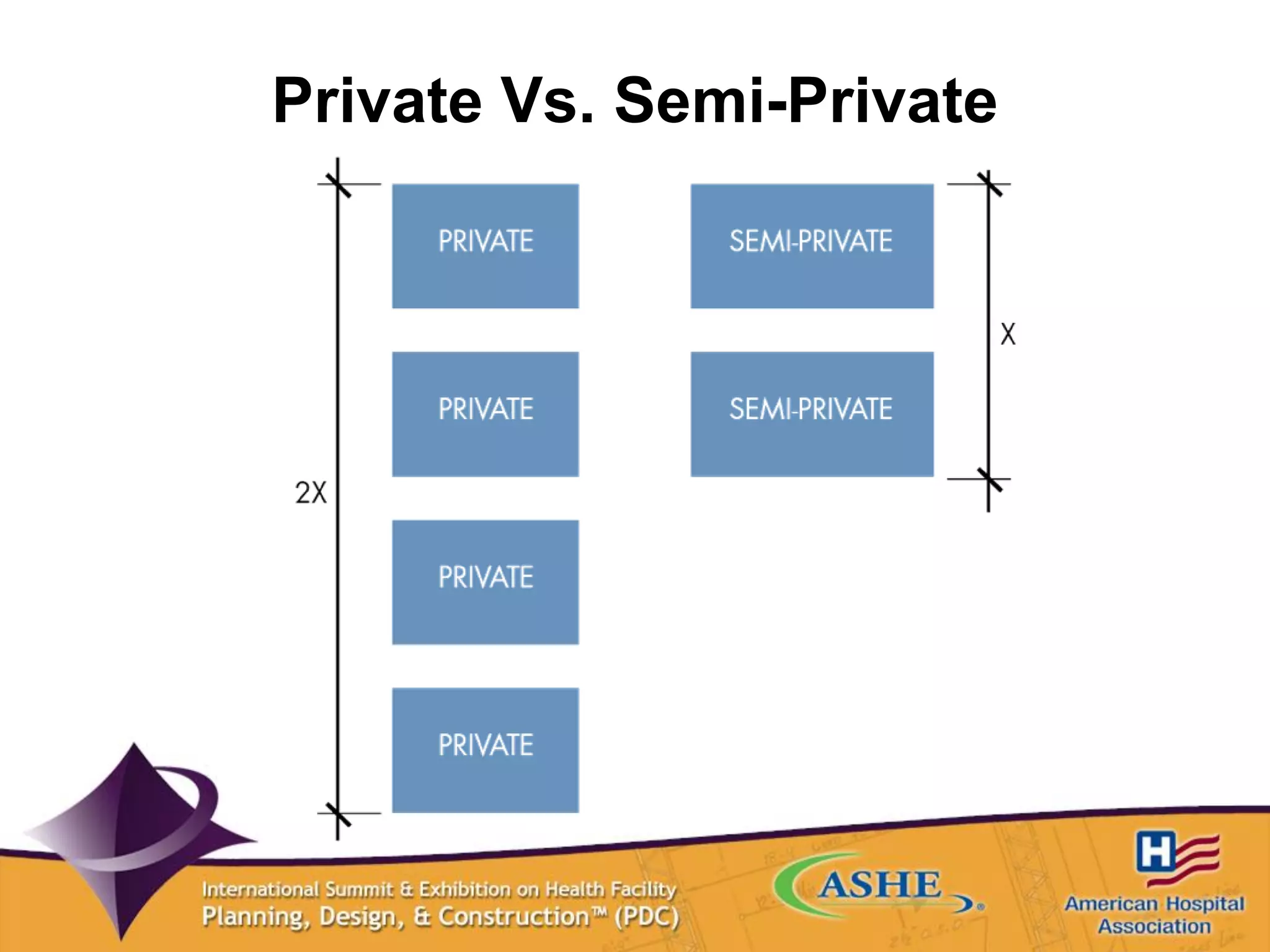
Private Vs. Semi-Private
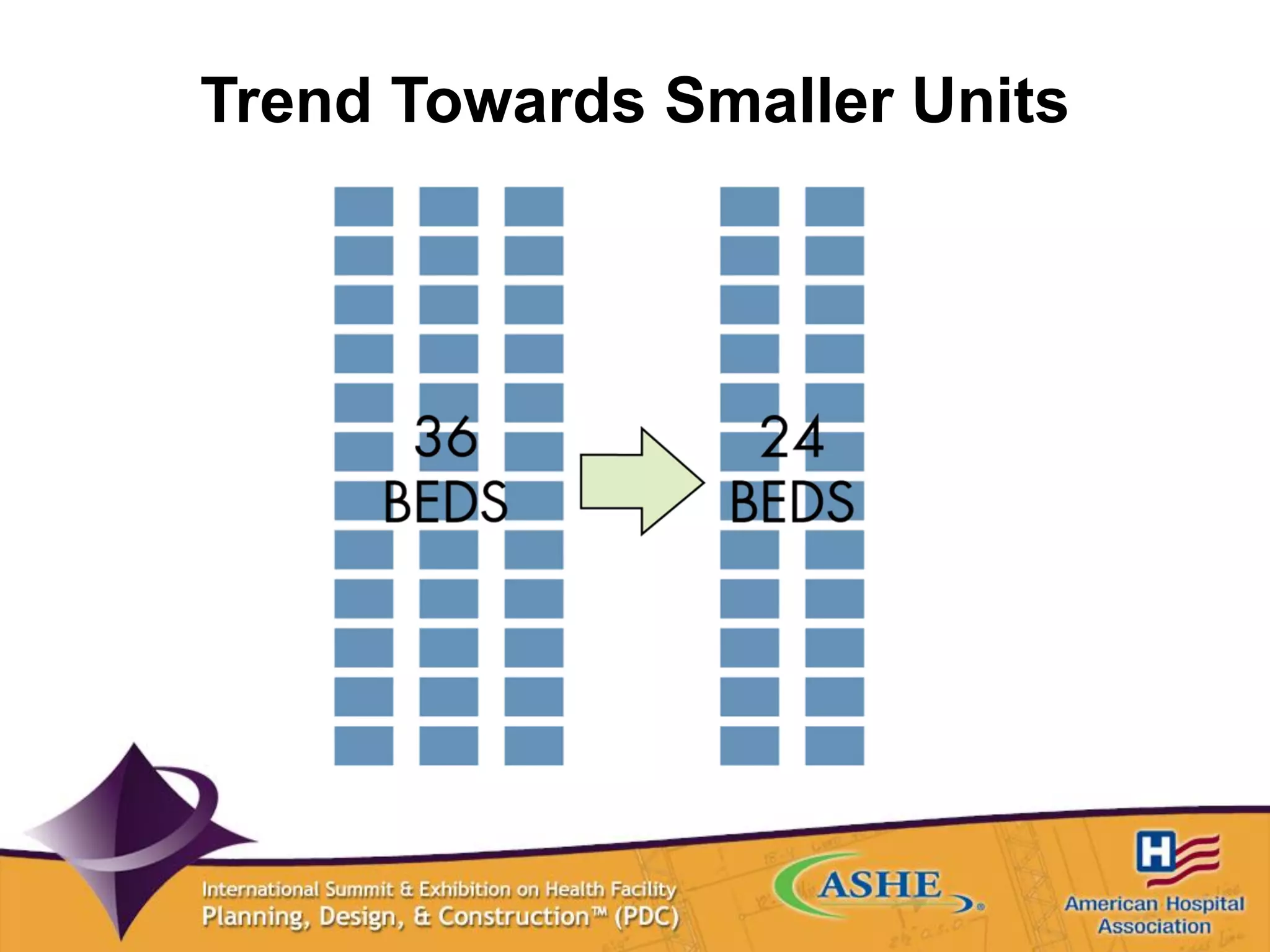
Trend Towards Smaller Units
CAN LARGER INPATIENT BED UNITS AND
EFFICIENT USE OF NURSING TIME GO
HAND IN HAND?
QUESTION
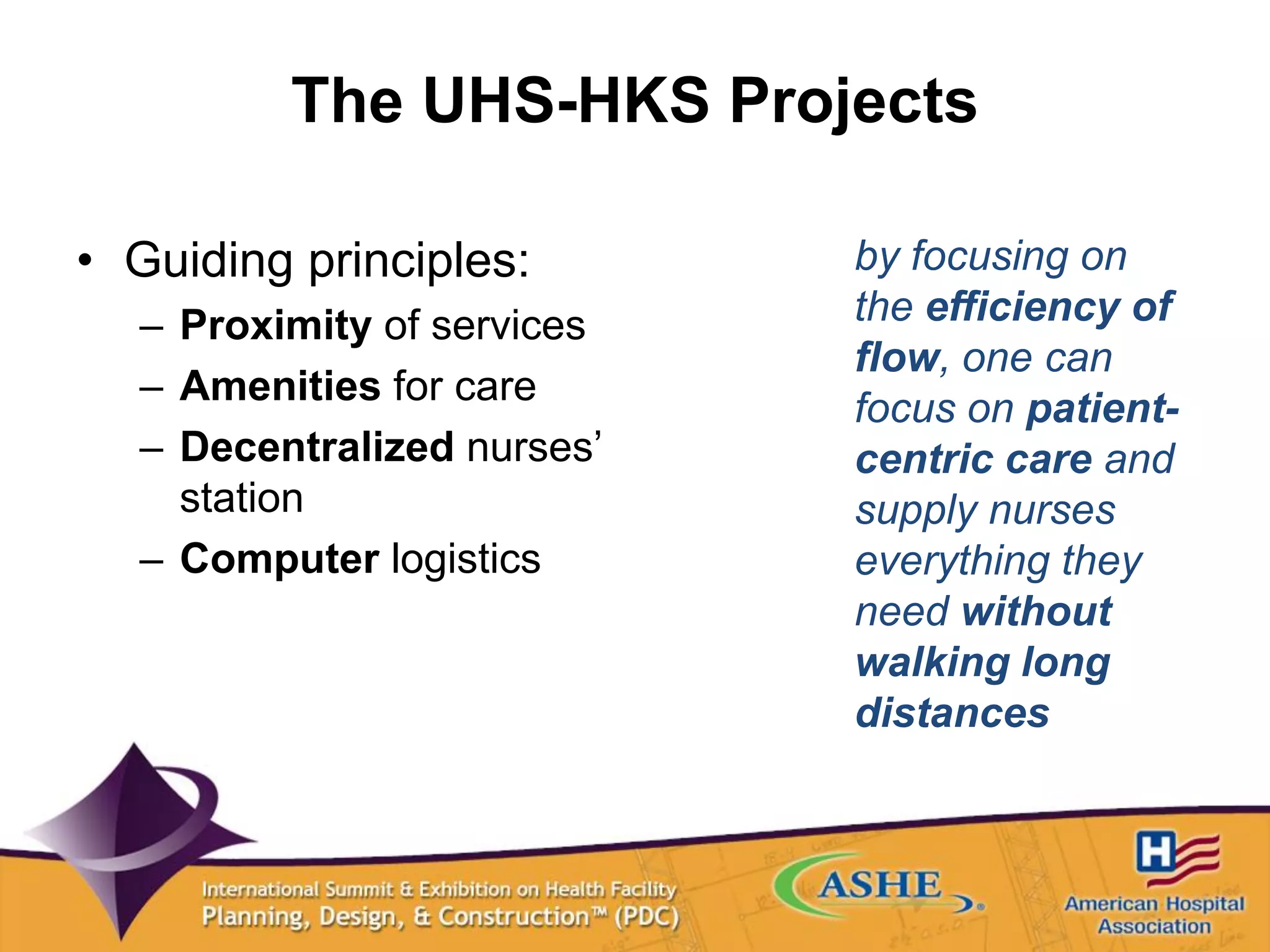
The UHS-HKS Projects
• Guiding principles:
– Proximity of services
– Amenities for care
– Decentralized nurses’
station
– Computer logistics
by focusing on
the efficiency of
flow, one can
focus on patient-
centric care and
supply nurses
everything they
need without
walking long
distances
BY OPTIMIZING FLOW AND REDUCING
POTENTIAL WASTE, THE LARGE UNIT
WOULD NOT RESULT IN WALKING
DISTANCES THAT ARE SUBSTANTIALLY
HIGHER THAN NATIONAL BENCHMARK
HYPOTHESIS
BY OPTIMIZING FLOW AND REDUCING
POTENTIAL WASTE, HOW NURSES SPEND
THEIR TIME WOULD NOT CONSTITUTE AN
OUTLIER
HYPOTHESIS
Texoma Medical Center
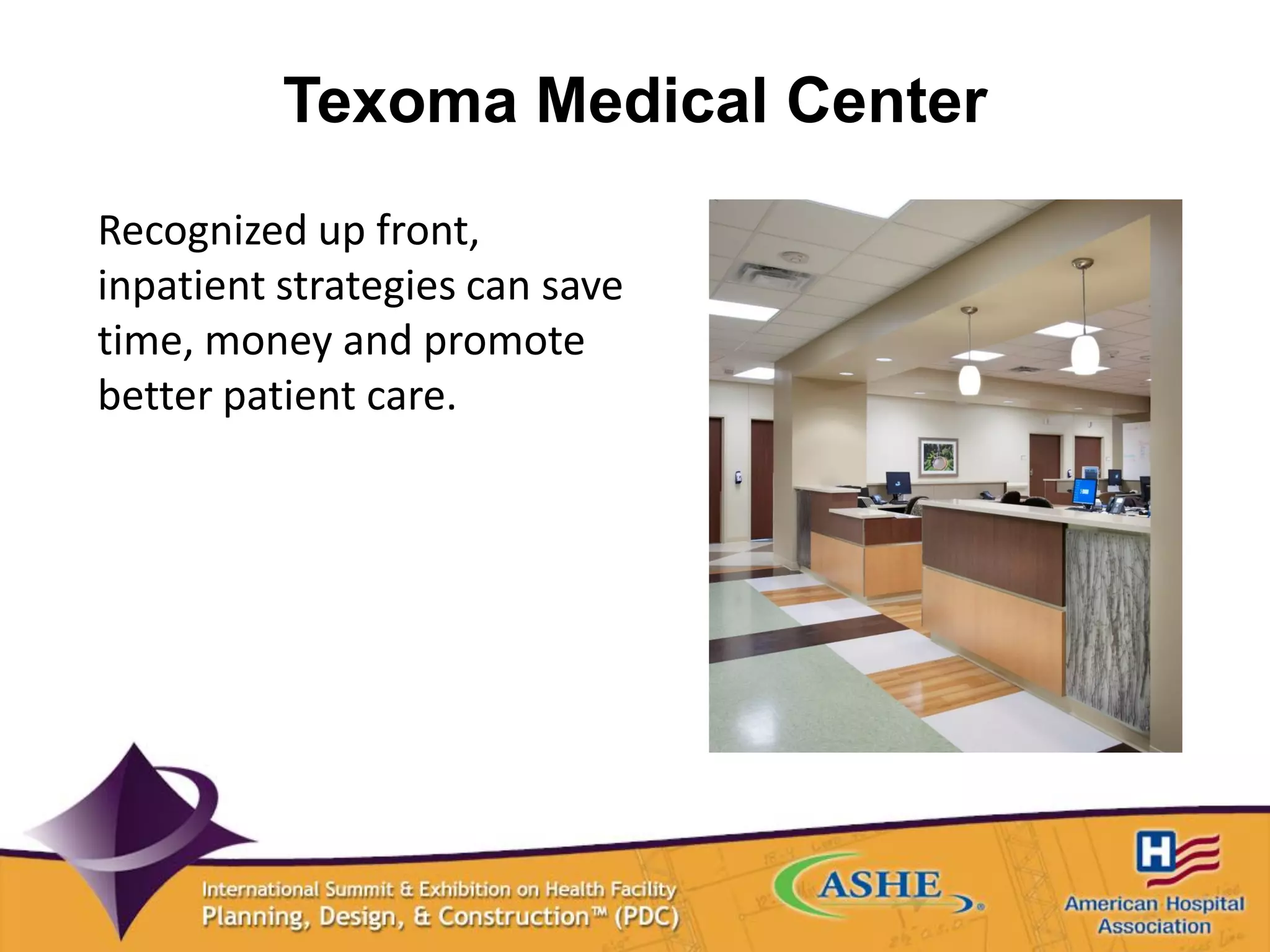
Recognized up front,
inpatient strategies can save
time, money and promote
better patient care.
Texoma Medical Center
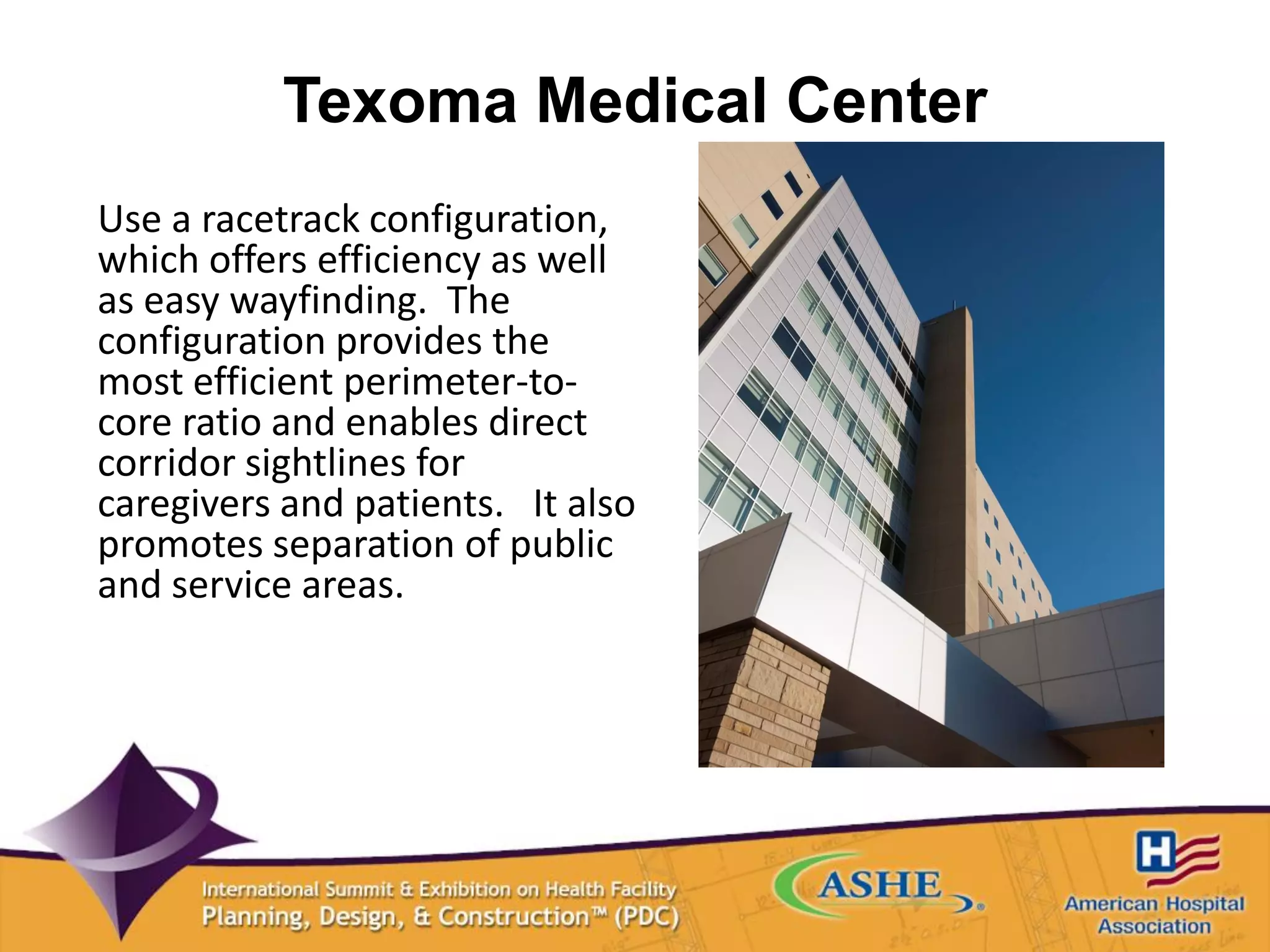
Use a racetrack configuration,
which offers efficiency as well
as easy wayfinding. The
configuration provides the
most efficient perimeter-to-
core ratio and enables direct
corridor sightlines for
caregivers and patients. It also
promotes separation of public
and service areas.
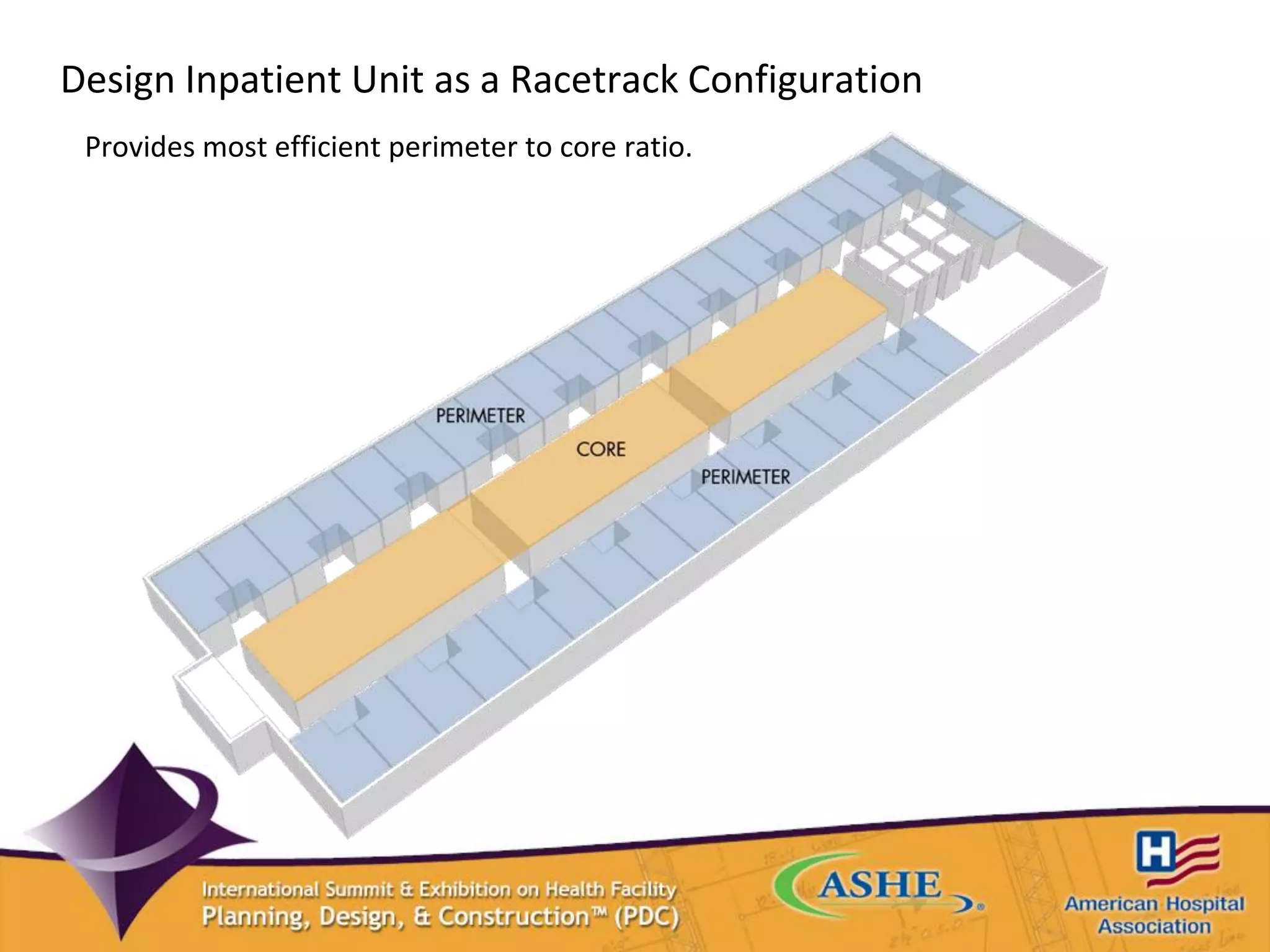
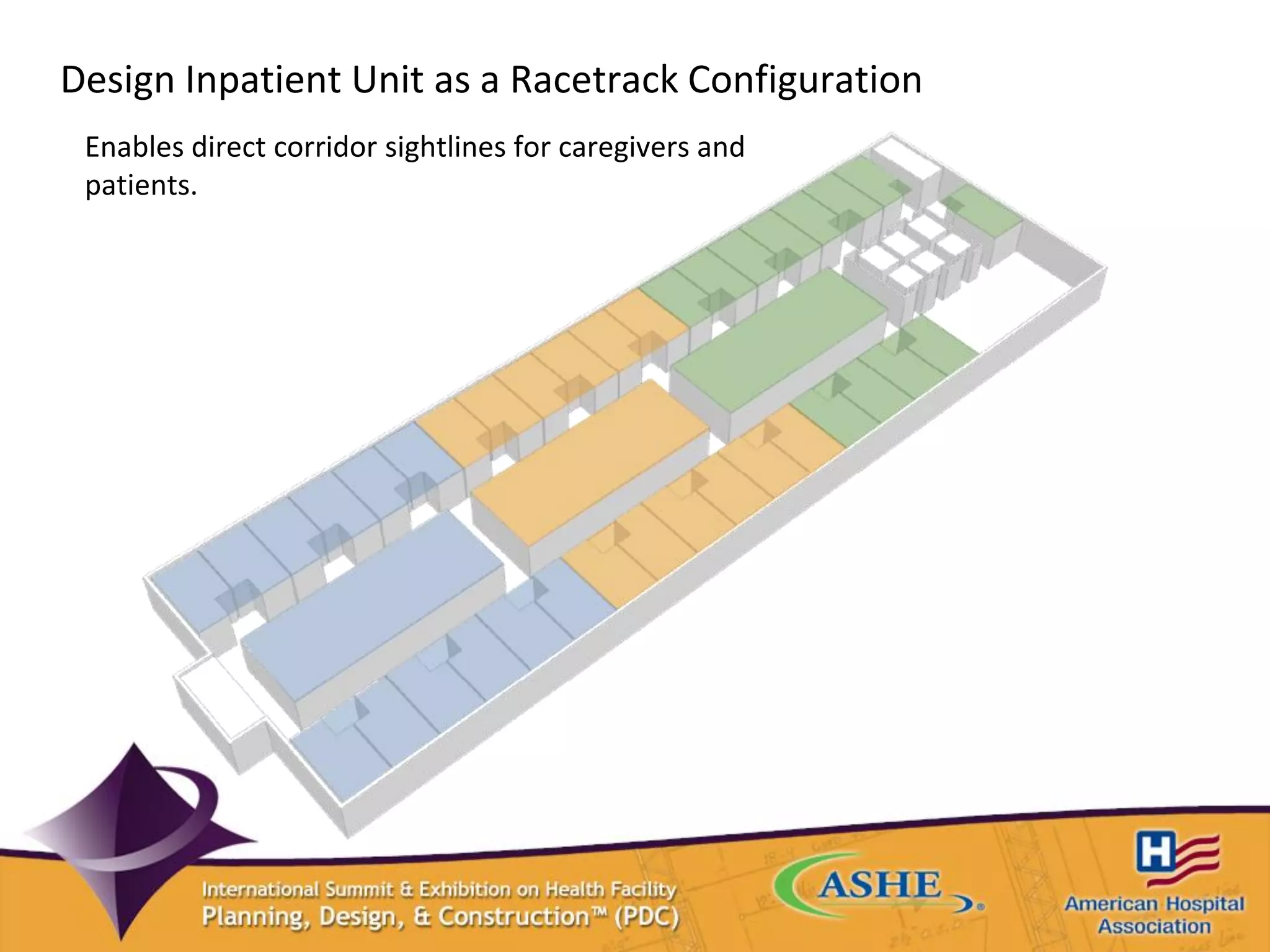
Design Inpatient Unit as a Racetrack Configuration
Provides most efficient perimeter to core ratio.
Design Inpatient Unit as a Racetrack Configuration
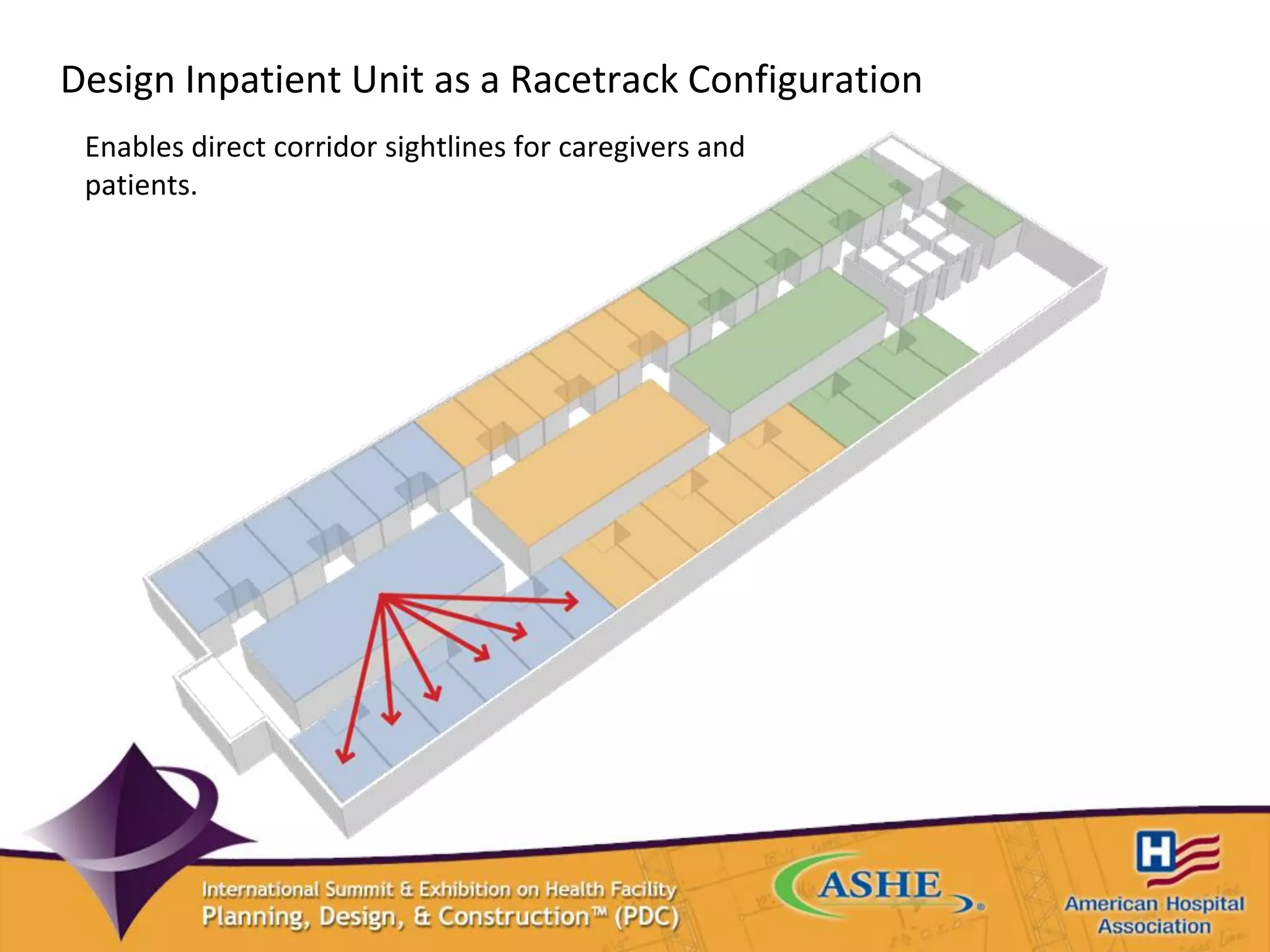
Enables direct corridor sightlines for caregivers and
patients.
Design Inpatient Unit as a Racetrack Configuration
Enables direct corridor sightlines for caregivers and
patients.
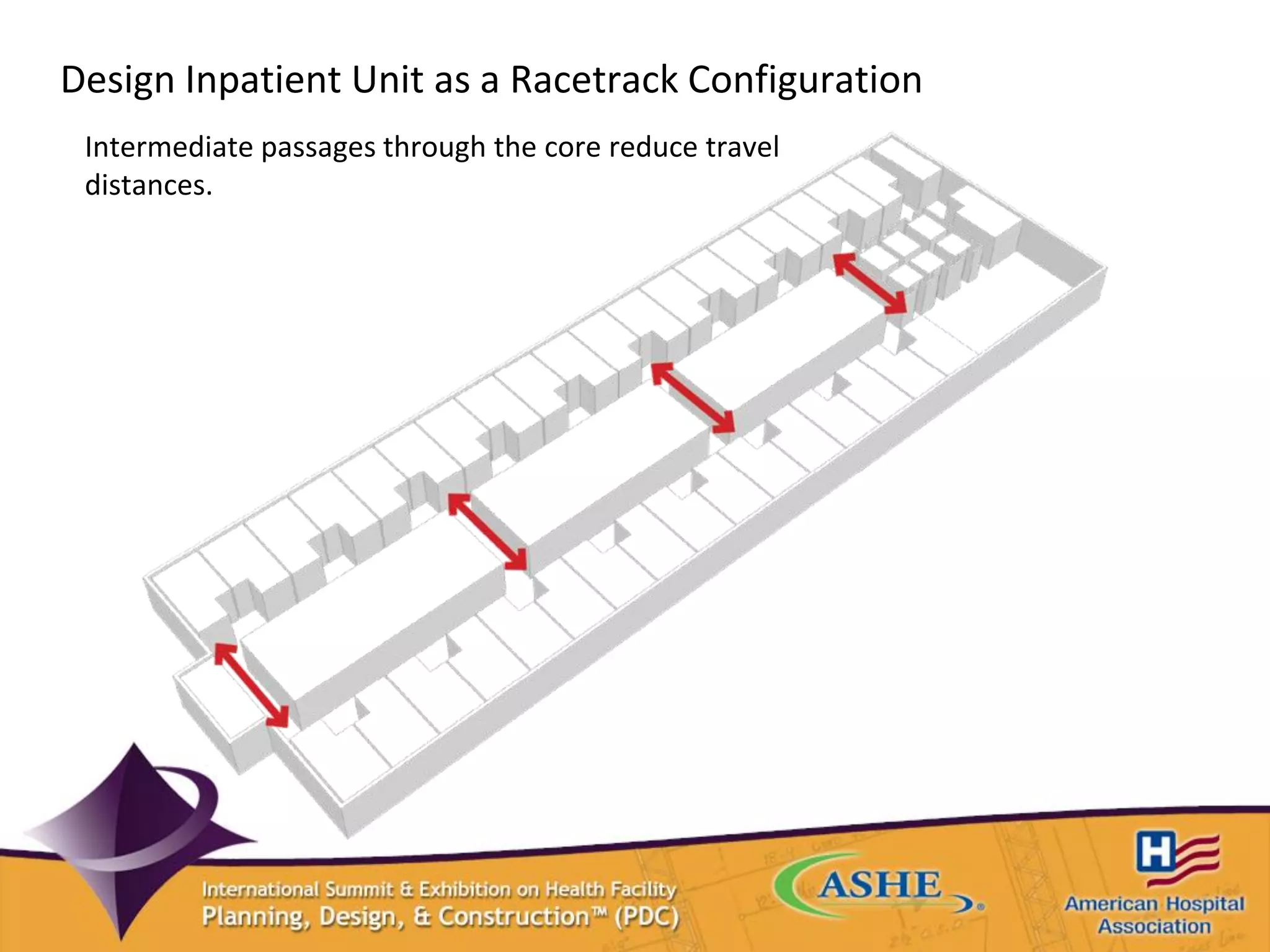
Design Inpatient Unit as a Racetrack Configuration
Intermediate passages through the core reduce travel
distances.
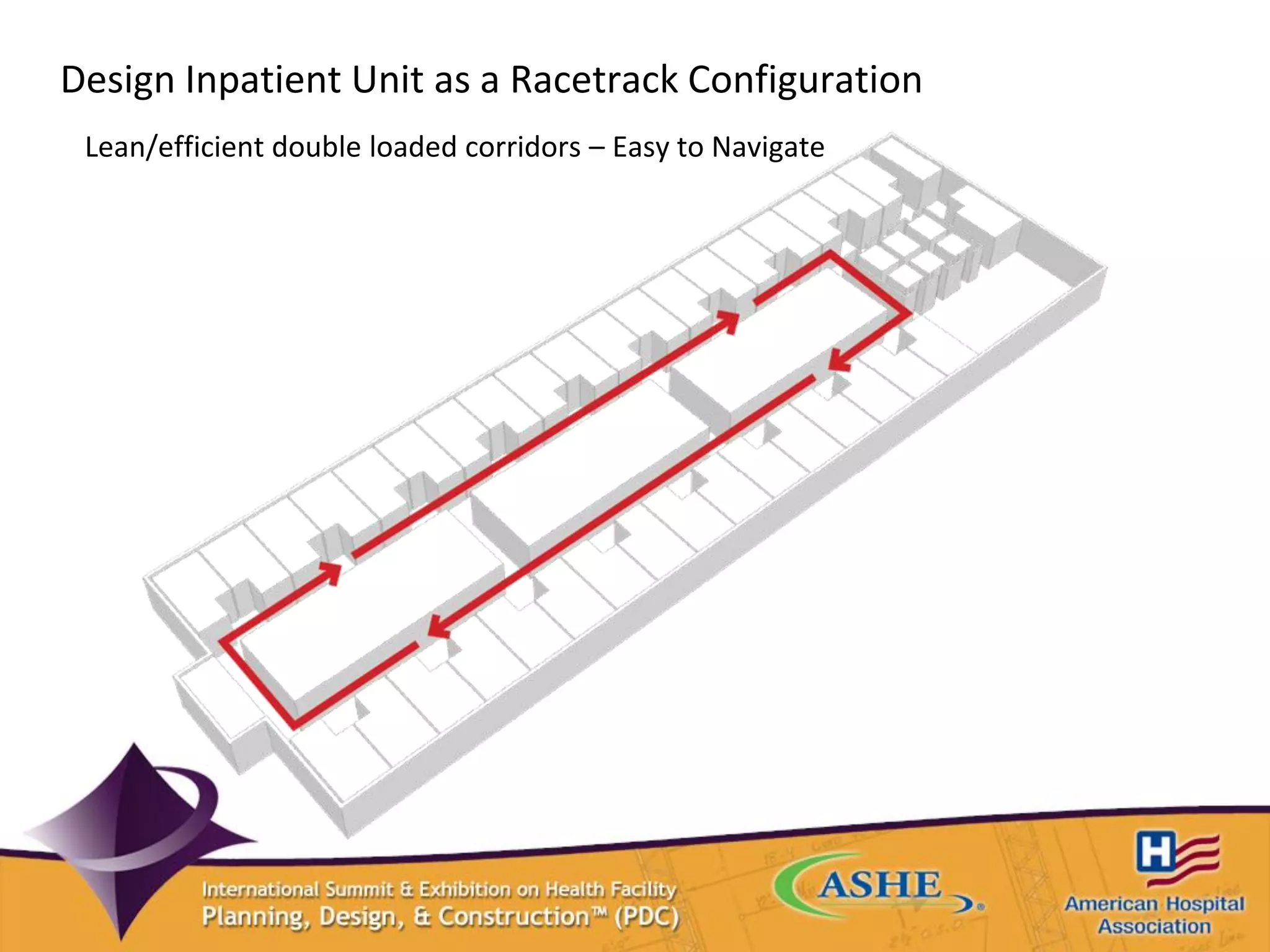
Design Inpatient Unit as a Racetrack Configuration
Lean/efficient double loaded corridors – Easy to Navigate
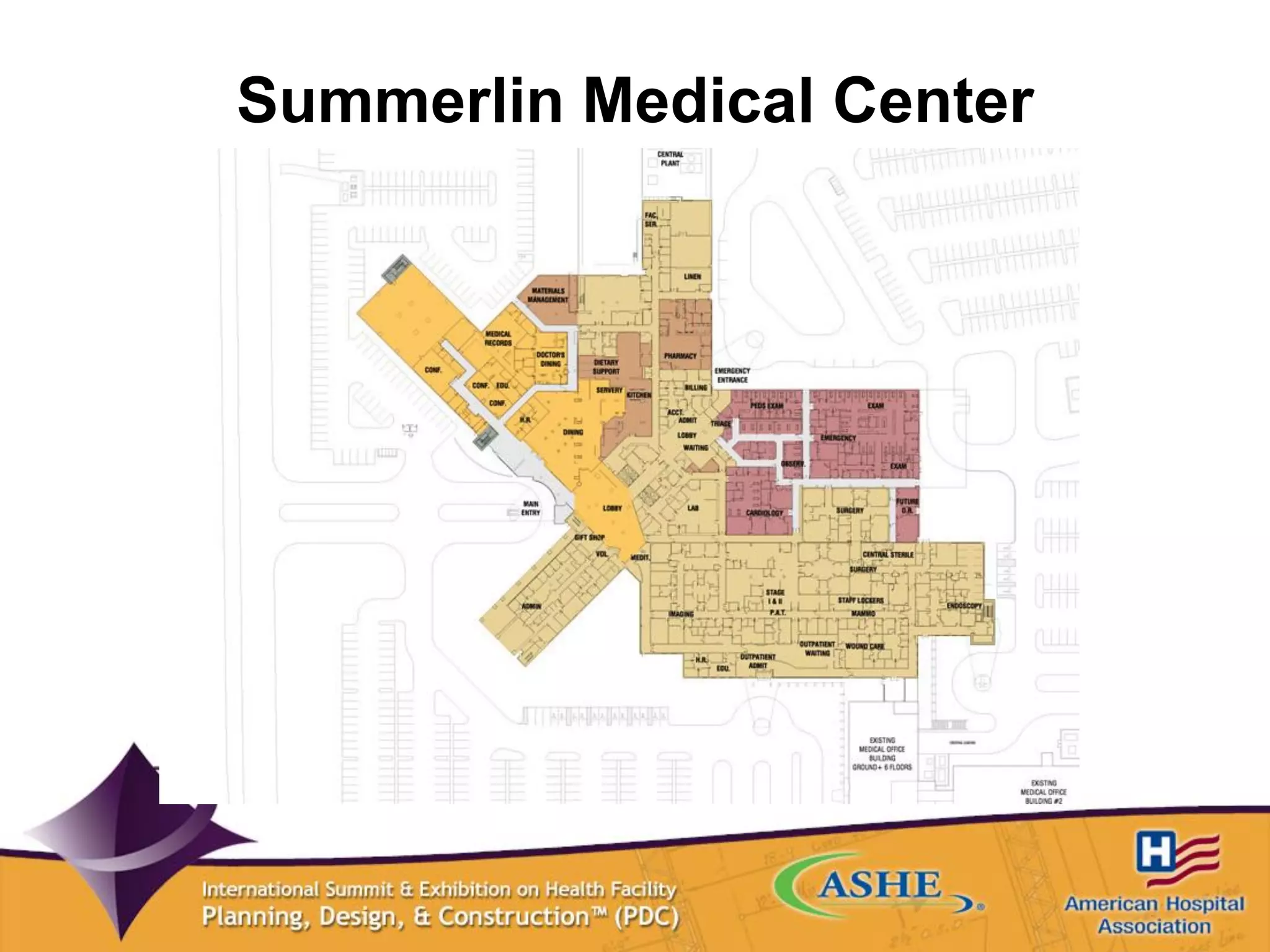
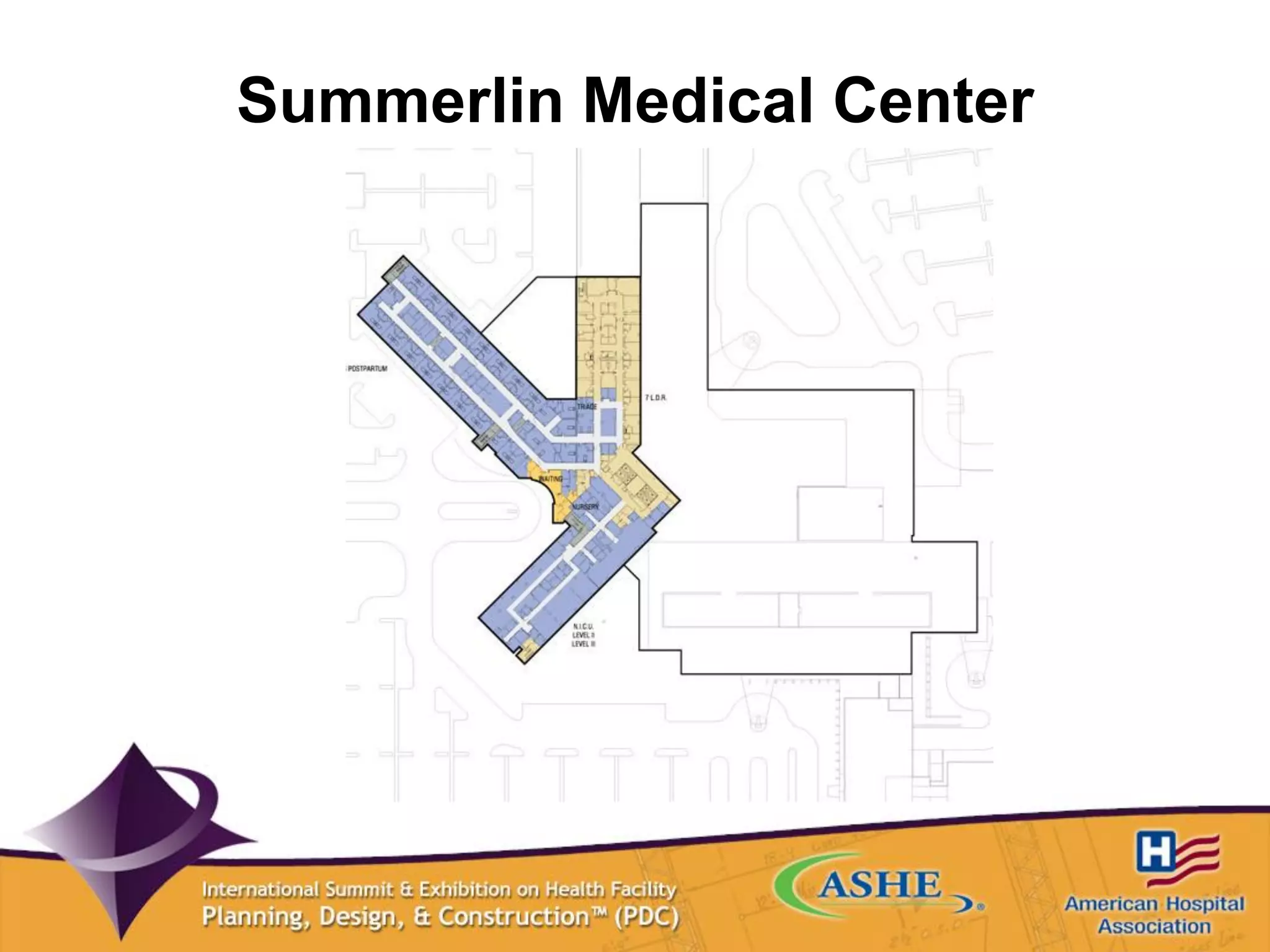
Summerlin Medical Center
A Patient Centered Expansion
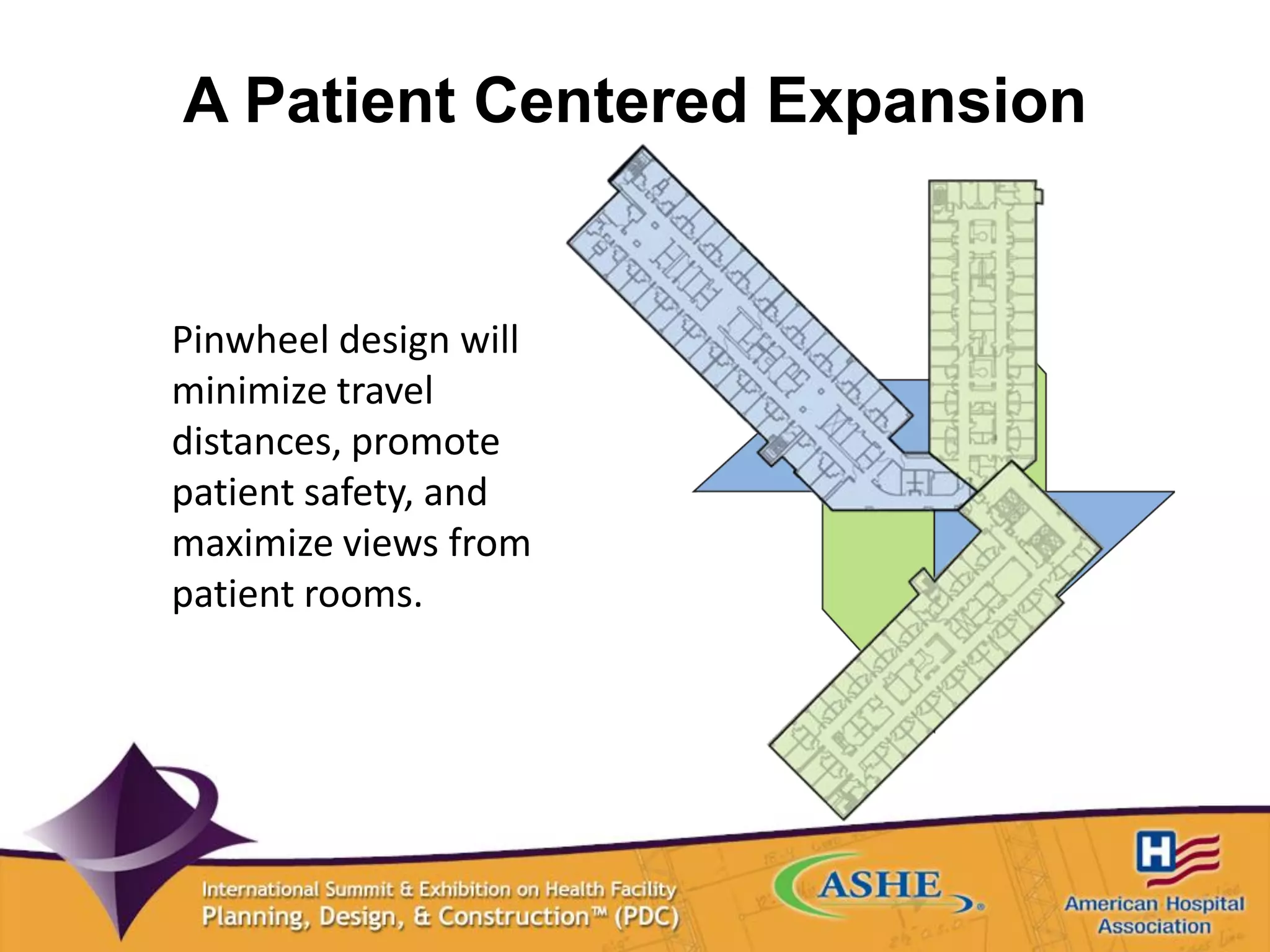
Pinwheel design will
minimize travel
distances, promote
patient safety, and
maximize views from
patient rooms.
A Patient Centered Expansion
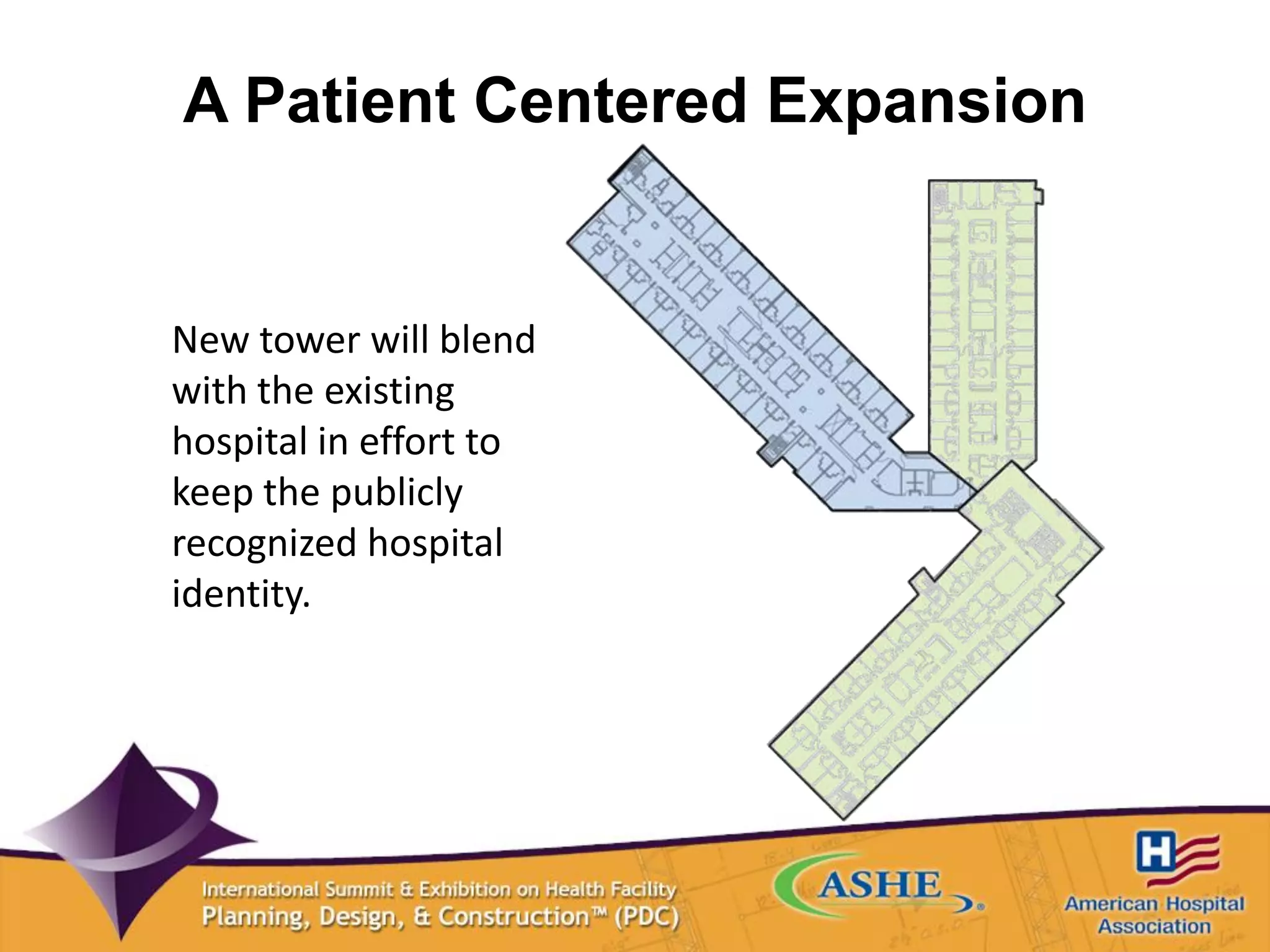
New tower will blend
with the existing
hospital in effort to
keep the publicly
recognized hospital
identity.
A Patient Centered Expansion
$100 million expansion and renovation in one of
southern Nevada’s fastest growing communities in Las
Vegas, Nevada
All of the changes were made externally, with breaking
through the connecting wall as a final step
Summerlin Medical Center
DATA COLLECTION
POST OCCUPANCY PERFORMANCE
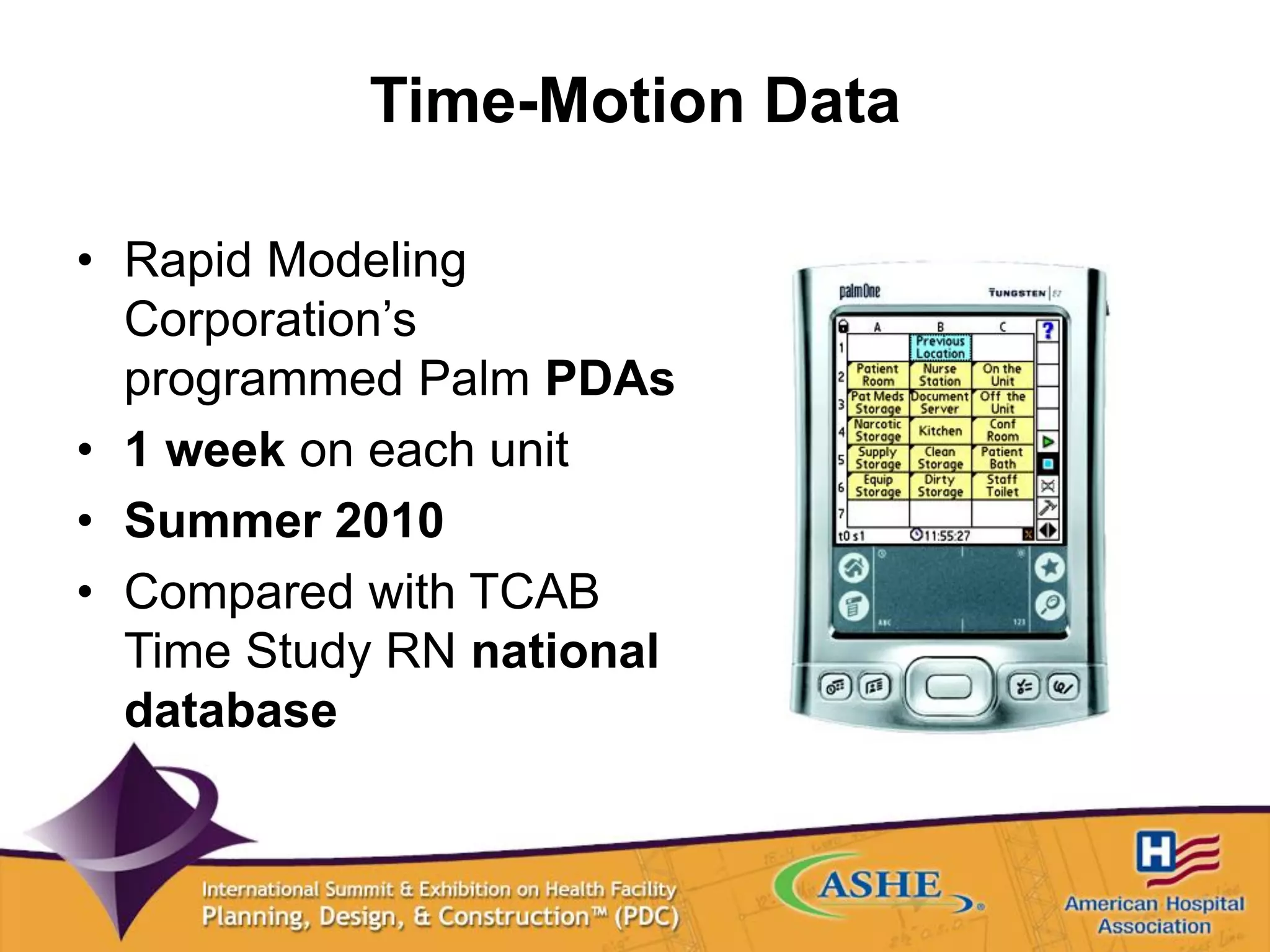
Time-Motion Data
• Rapid Modeling
Corporation’s
programmed Palm PDAs
• 1 week on each unit
• Summer 2010
• Compared with TCAB
Time Study RN national
database
Walking Data
• Sportline pedometer
• 1 week on each unit
• Summer 2010
• Compared with 36-
hospital time-motion
study*
*Hendrich, A., M. Chow, B.A. Skierczynski & Z. Lu. (2008). A 36-Hospital Time and Motion Study: How Do Medical-
Surgical Nurses Spend Their Time? The Permanente Journal, 12(3), 25-34.
FINDINGS
POST OCCUPANCY PERFORMANCE
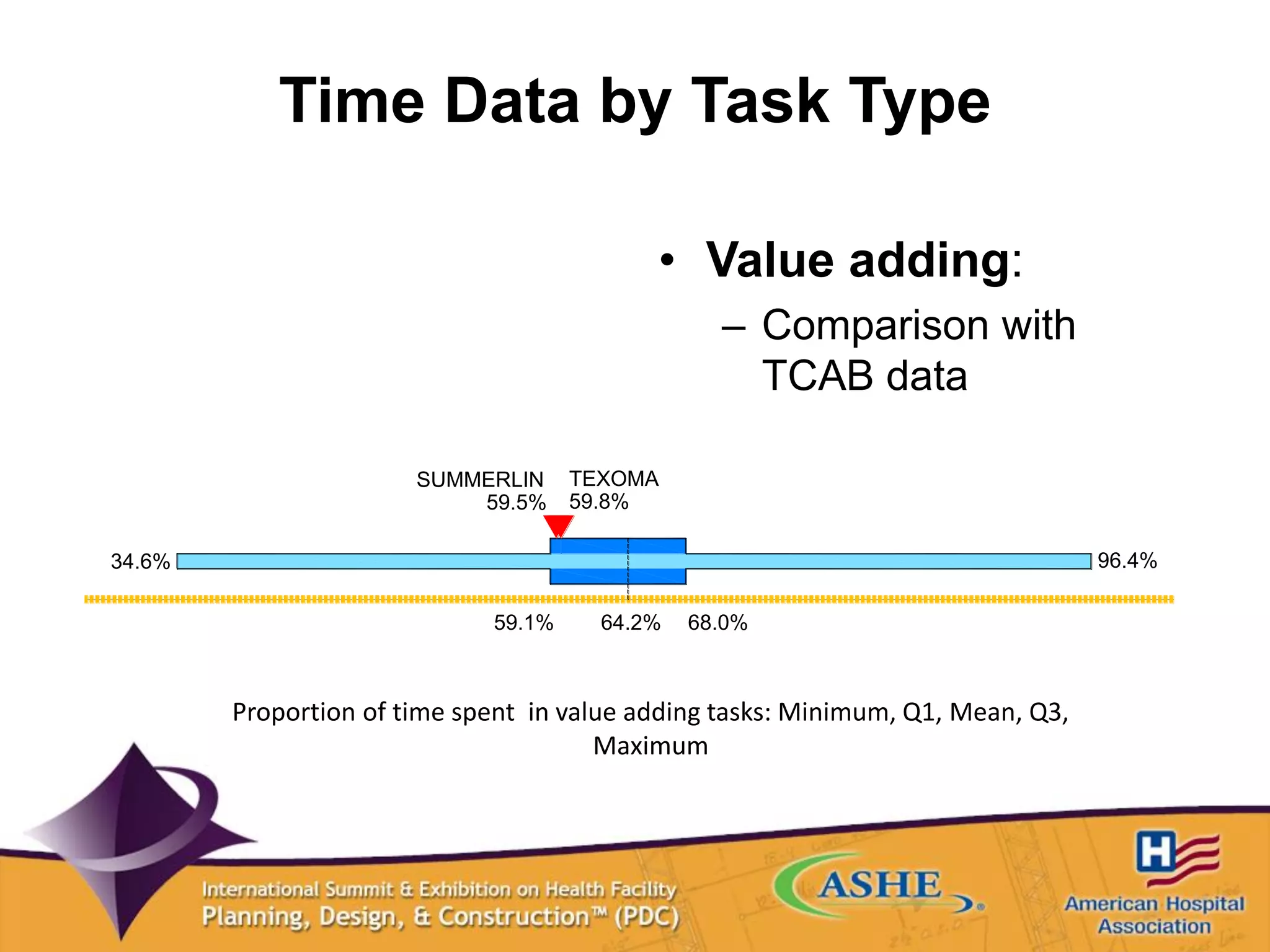
Time Data by Task Type
• Value adding:
– Comparison with
TCAB data
Proportion of time spent in value adding tasks: Minimum, Q1, Mean, Q3,
Maximum
34.6%
59.1% 64.2% 68.0%
96.4%
59.8%59.5%
TEXOMASUMMERLIN
Time Data by Task Type
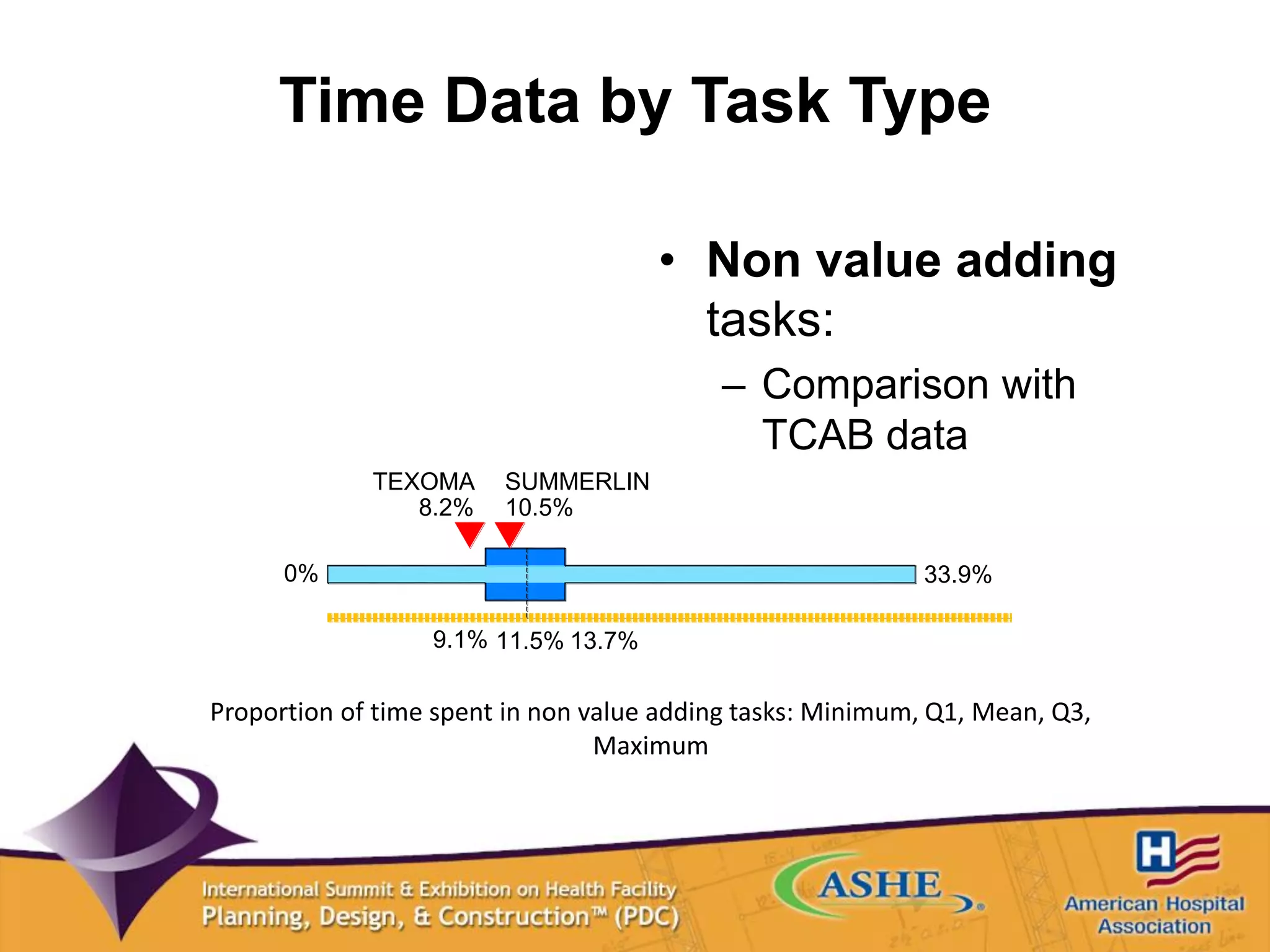
• Non value adding
tasks:
– Comparison with
TCAB data
Proportion of time spent in non value adding tasks: Minimum, Q1, Mean, Q3,
Maximum
0%
9.1% 11.5% 13.7%
33.9%
8.2% 10.5%
TEXOMA SUMMERLIN
Time Data by Task Type
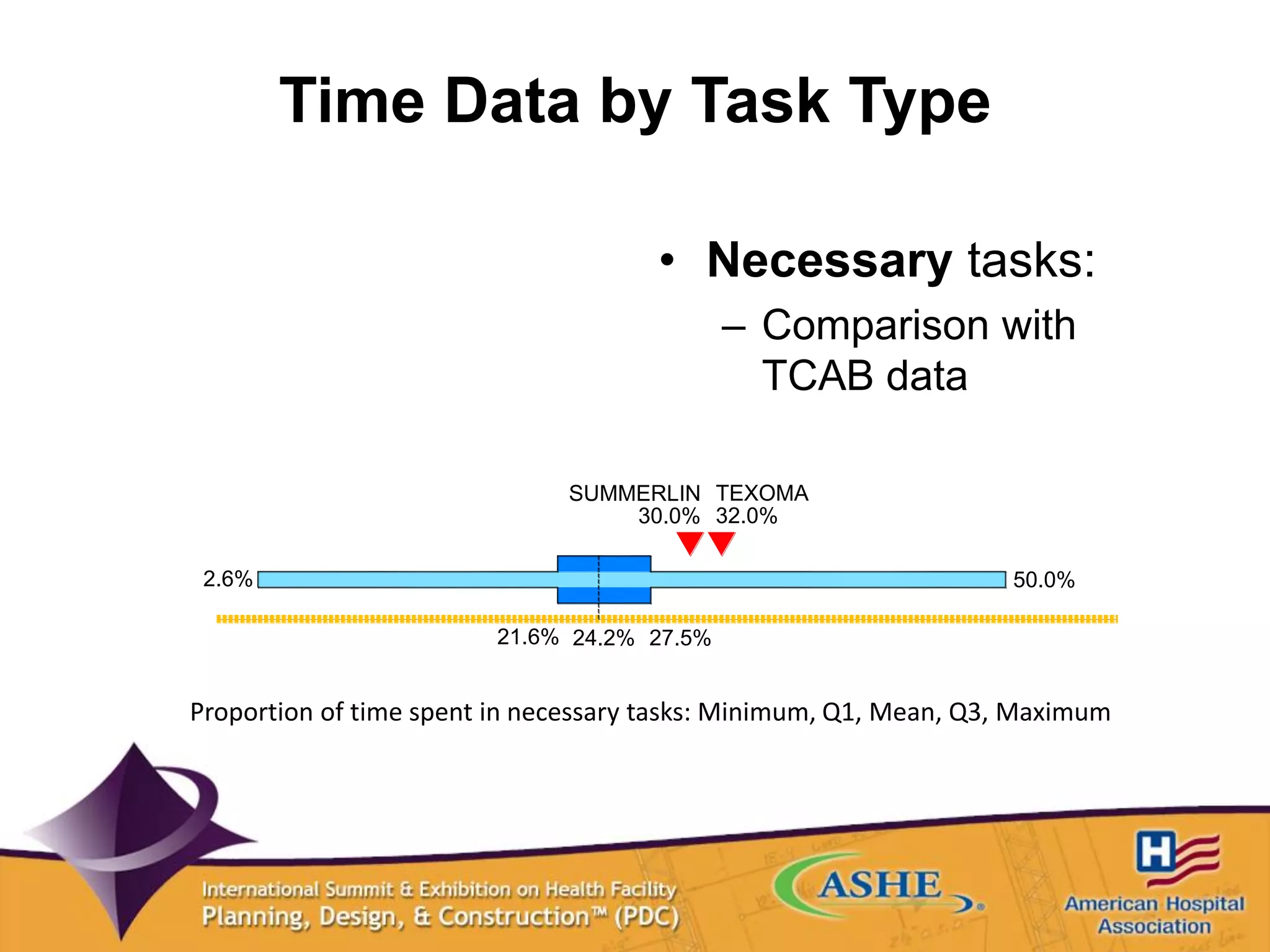
• Necessary tasks:
– Comparison with
TCAB data
Proportion of time spent in necessary tasks: Minimum, Q1, Mean, Q3, Maximum
2.6%
21.6% 24.2% 27.5%
50.0%
TEXOMASUMMERLIN
32.0%30.0%
Time Data by Task Category
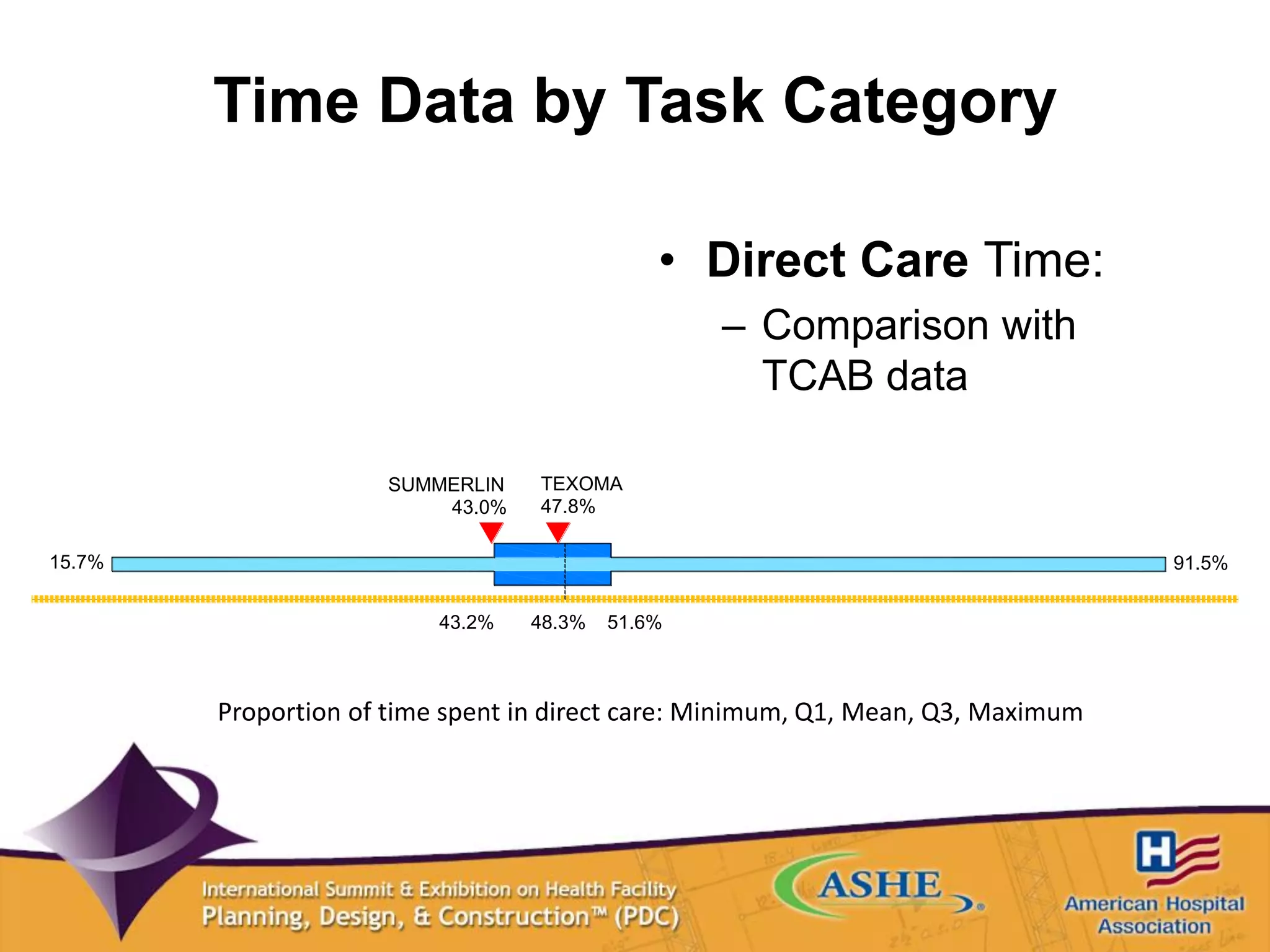
• Direct Care Time:
– Comparison with
TCAB data
Proportion of time spent in direct care: Minimum, Q1, Mean, Q3, Maximum
47.8%43.0%
91.5%15.7%
43.2% 48.3% 51.6%
TEXOMASUMMERLIN
Time Data by Task Category
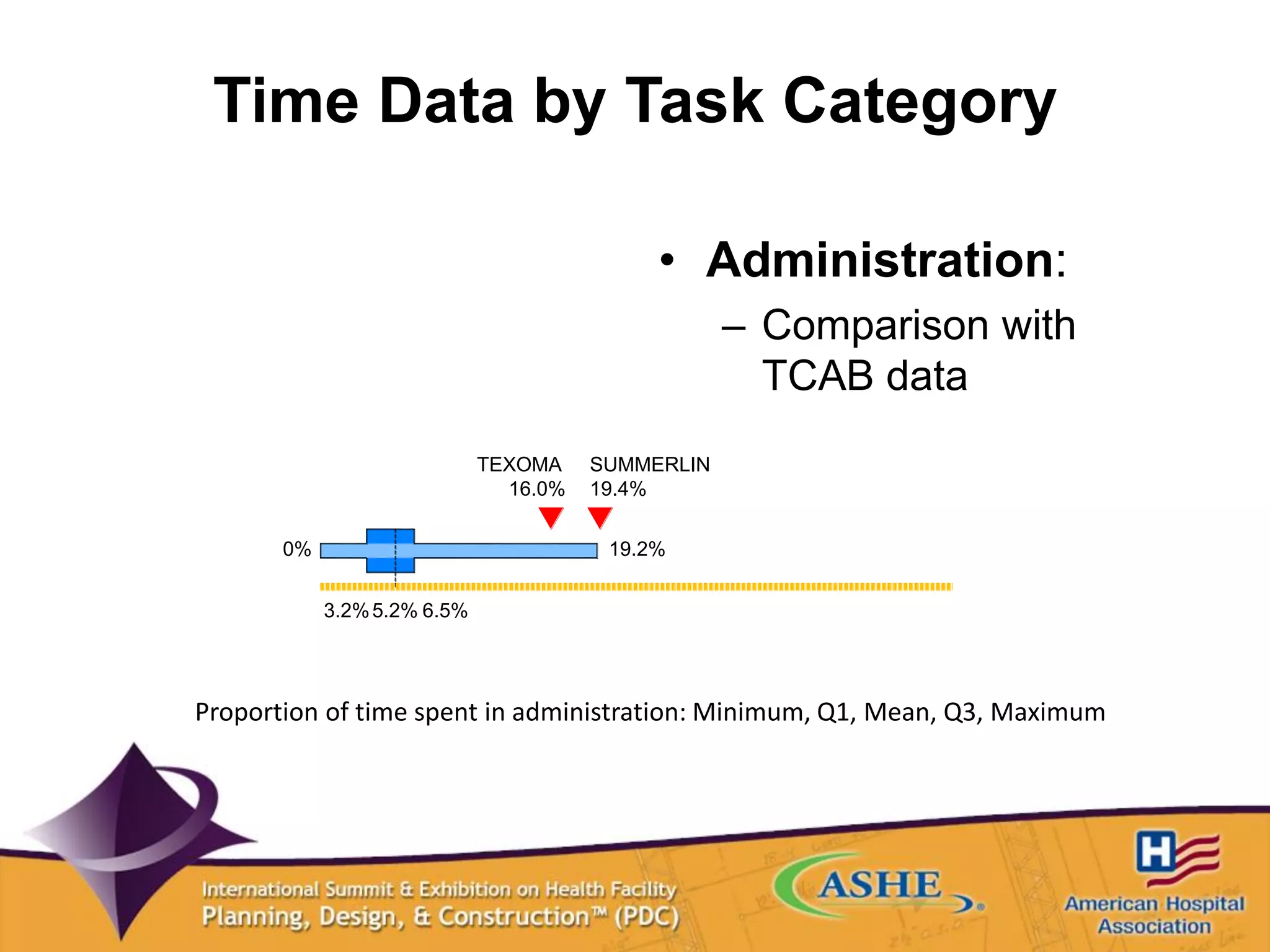
• Indirect care time:
– Comparison with
TCAB data
Proportion of time spent in indirect care : Minimum, Q1, Mean, Q3, Maximum
1.7%
13.6% 17.0% 20.1%
37.0%
12.0% 16.5%
TEXOMA SUMMERLIN
Time Data by Task Category
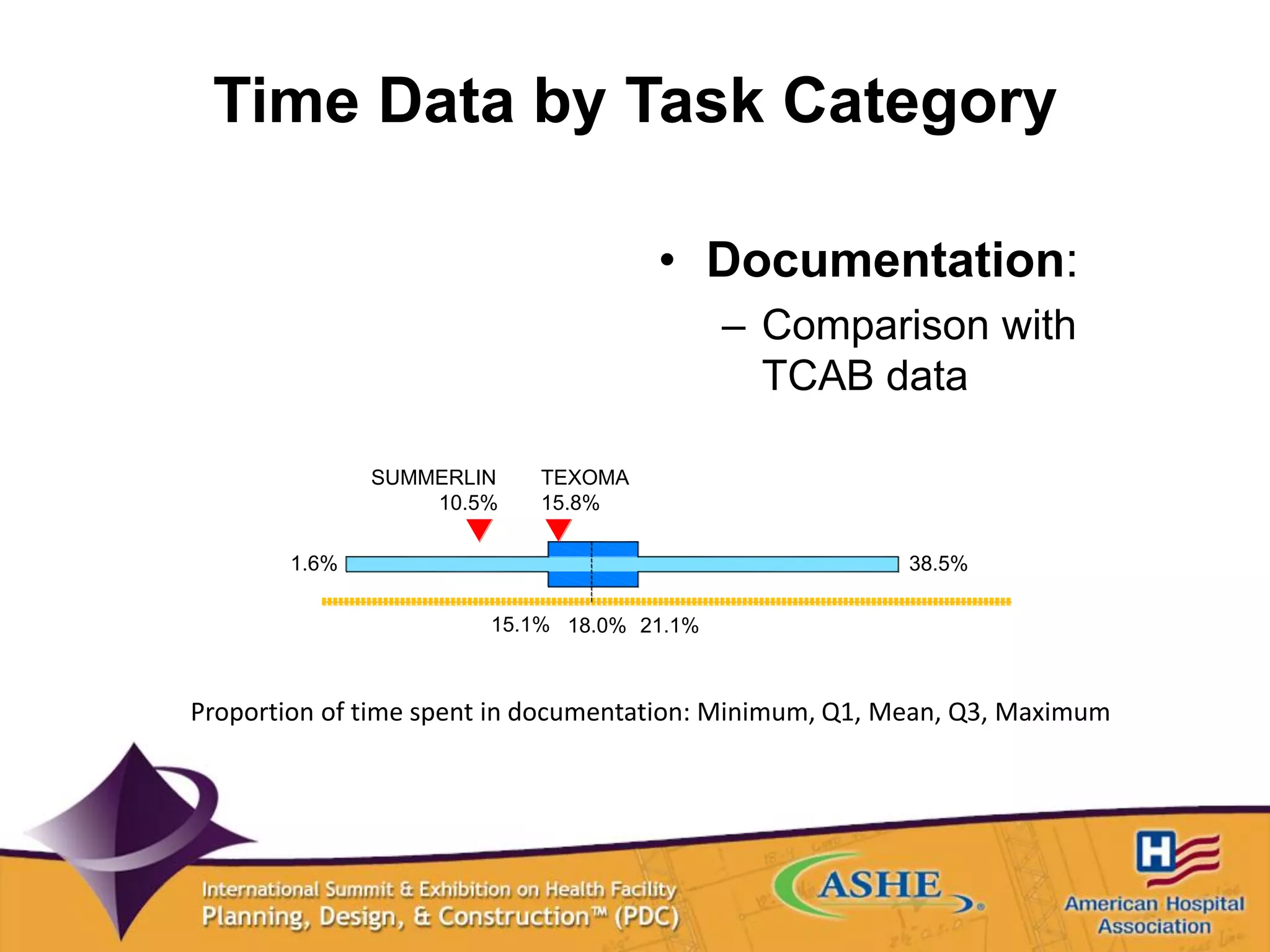
• Documentation:
– Comparison with
TCAB data
Proportion of time spent in documentation: Minimum, Q1, Mean, Q3, Maximum
1.6%
15.1% 18.0% 21.1%
38.5%
15.8%10.5%
TEXOMASUMMERLIN
Time Data by Task Category
• Administration:
– Comparison with
TCAB data
0% 19.2%
TEXOMA SUMMERLIN
16.0% 19.4%
3.2%5.2% 6.5%
Proportion of time spent in administration: Minimum, Q1, Mean, Q3, Maximum
Time Data by Task Category
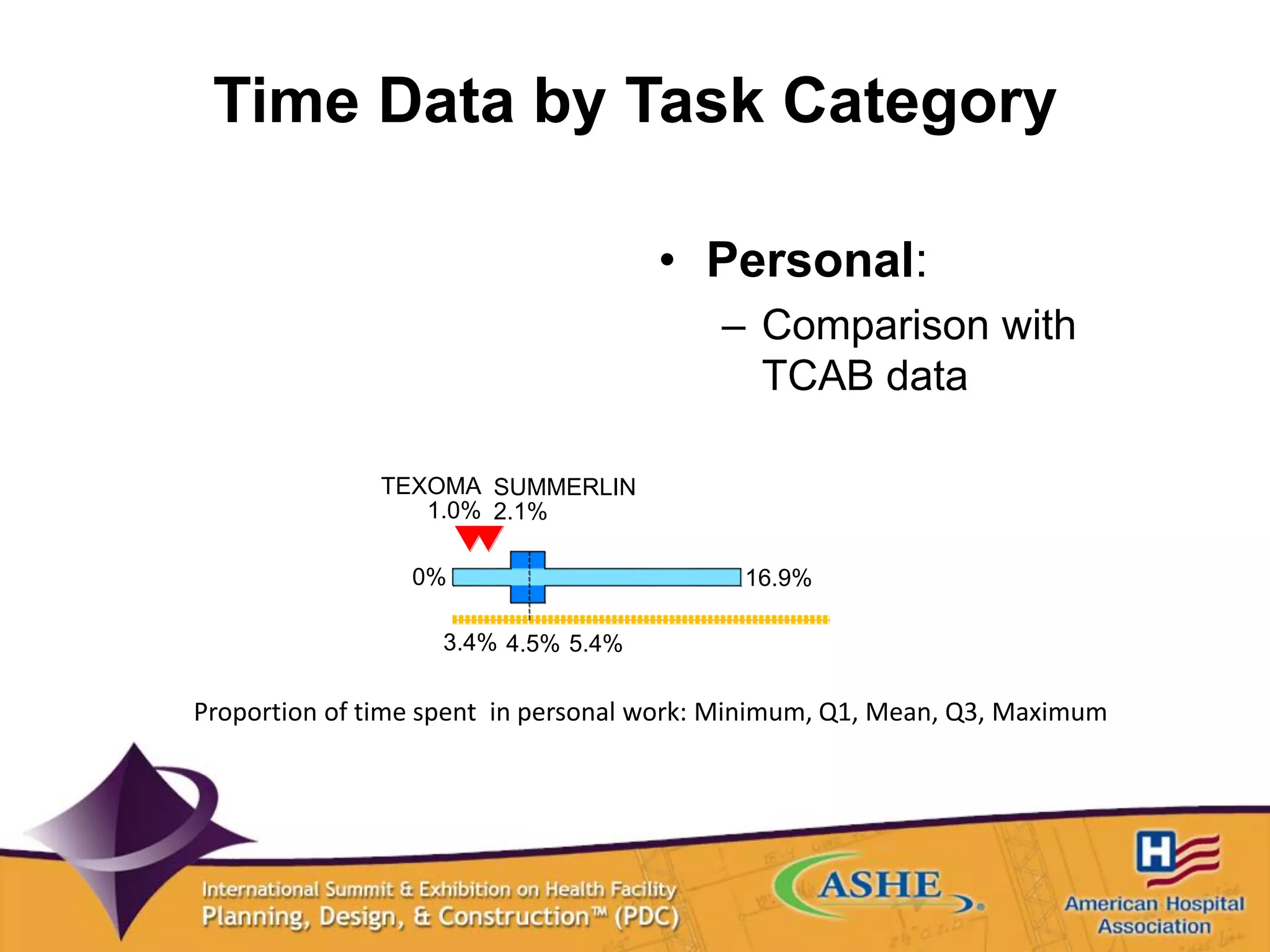
• Personal:
– Comparison with
TCAB data
Proportion of time spent in personal work: Minimum, Q1, Mean, Q3, Maximum
0%
3.4% 4.5% 5.4%
16.9%
1.0% 2.1%
TEXOMA SUMMERLIN
Time Data by Task Category
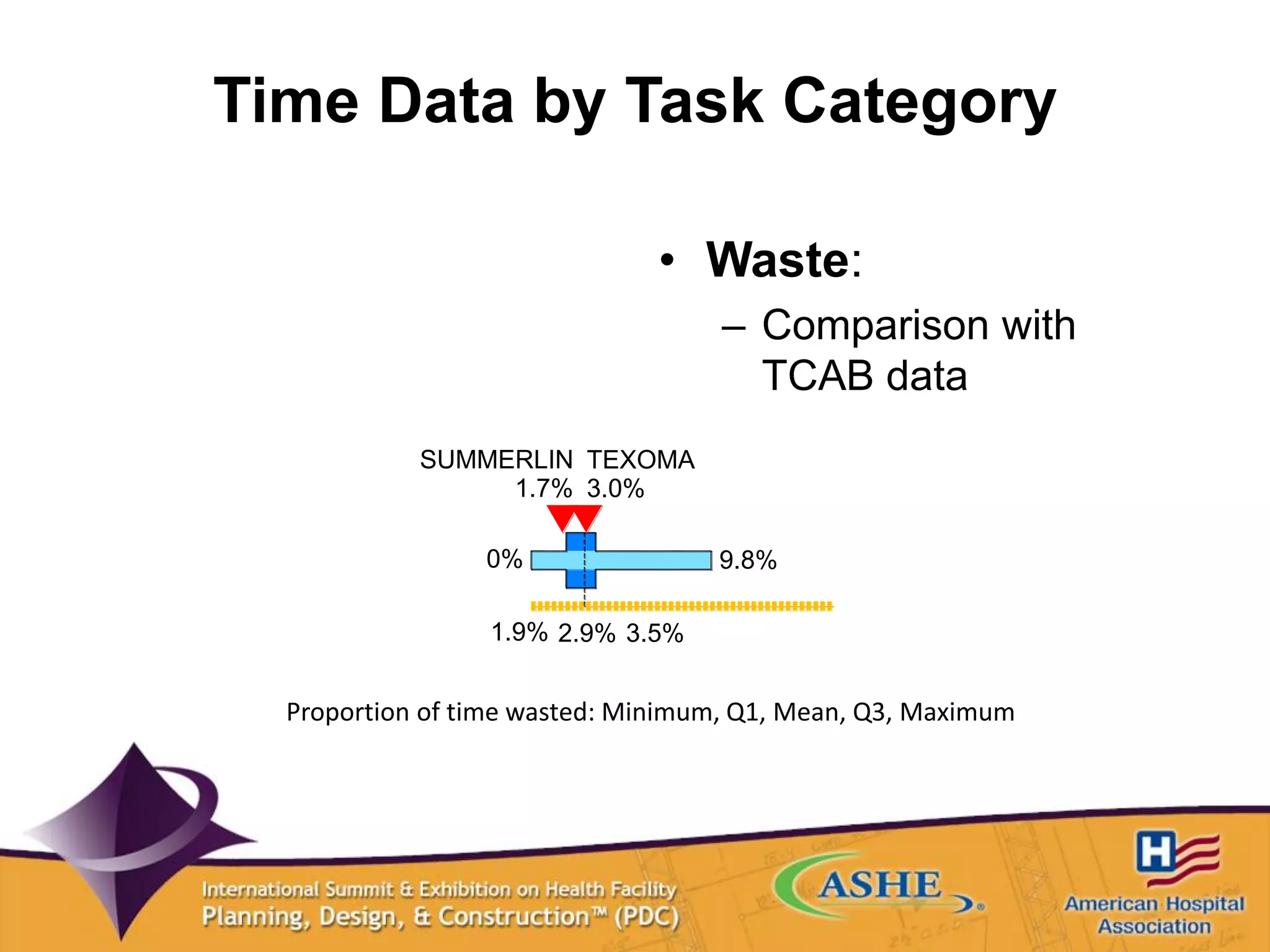
• Waste:
– Comparison with
TCAB data
Proportion of time wasted: Minimum, Q1, Mean, Q3, Maximum
0%
1.9% 2.9% 3.5%
9.8%
3.0%1.7%
TEXOMASUMMERLIN
Time Data by Task Level
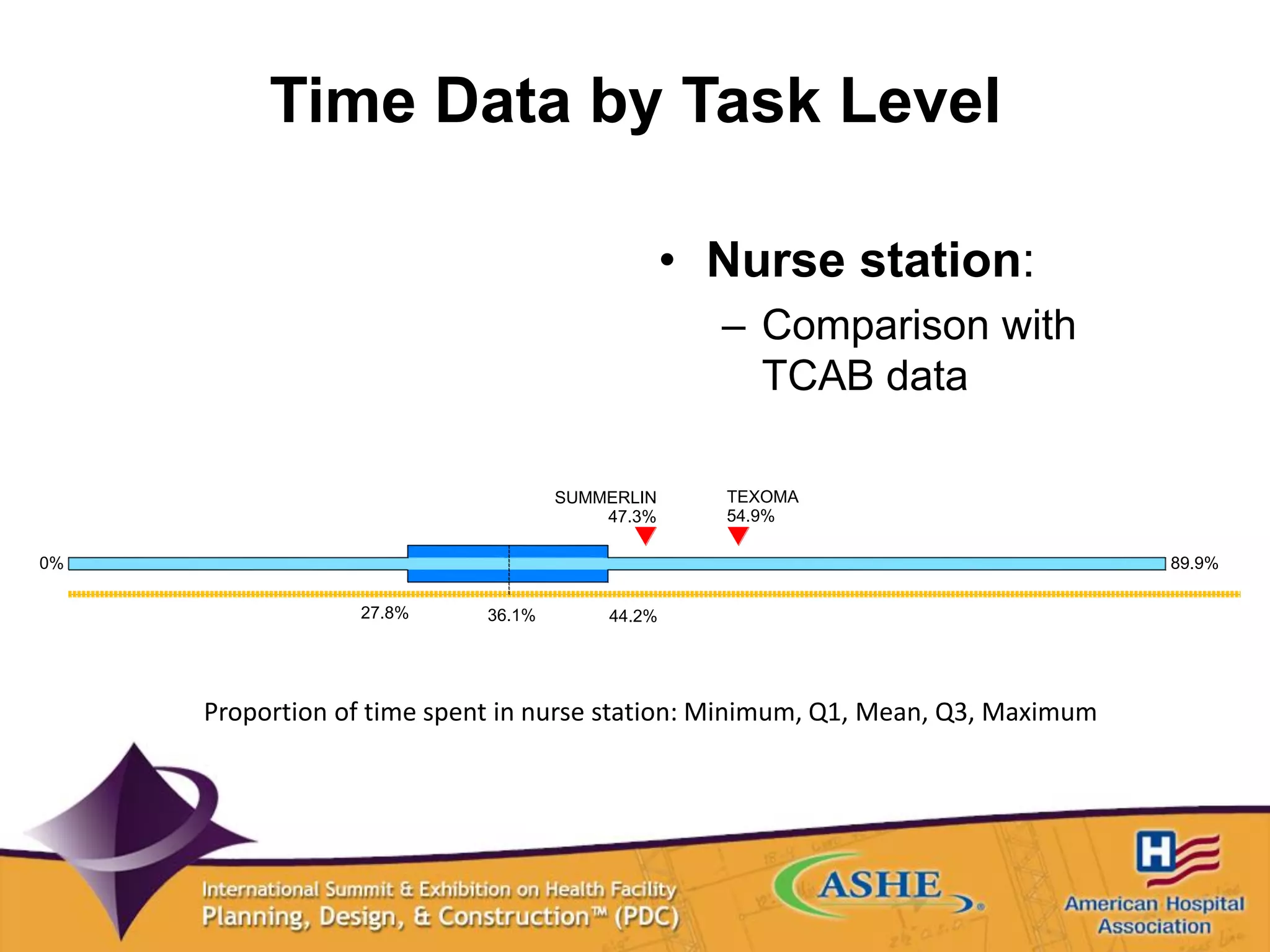
• Nurse station:
– Comparison with
TCAB data
Proportion of time spent in nurse station: Minimum, Q1, Mean, Q3, Maximum
0%
27.8% 36.1% 44.2%
89.9%
54.9%47.3%
TEXOMASUMMERLIN
Time Data by Task Level
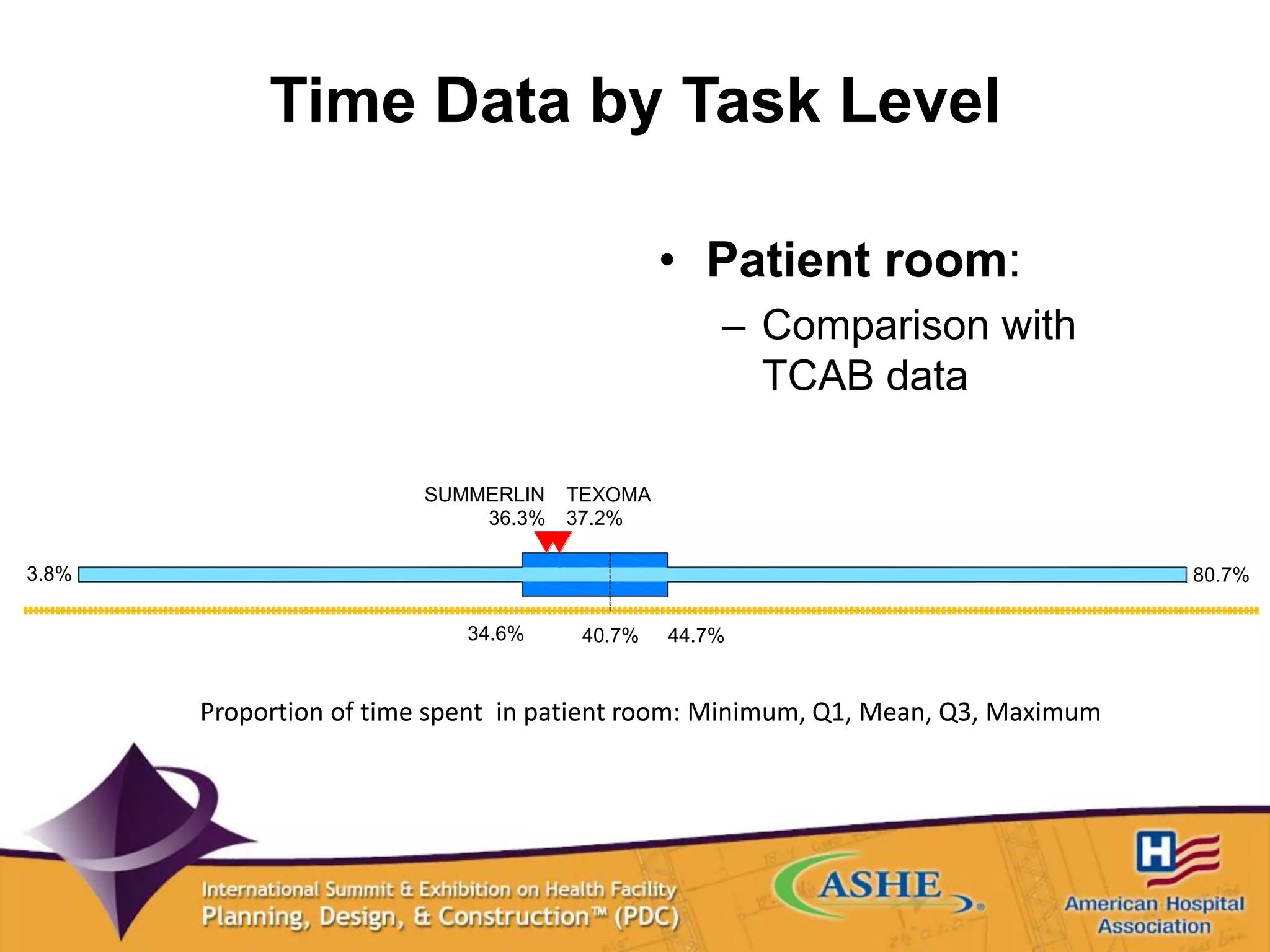
• Patient room:
– Comparison with
TCAB data
Proportion of time spent in patient room: Minimum, Q1, Mean, Q3, Maximum
3.8%
34.6% 40.7% 44.7%
80.7%
37.2%36.3%
TEXOMASUMMERLIN
Time Data by Task Level
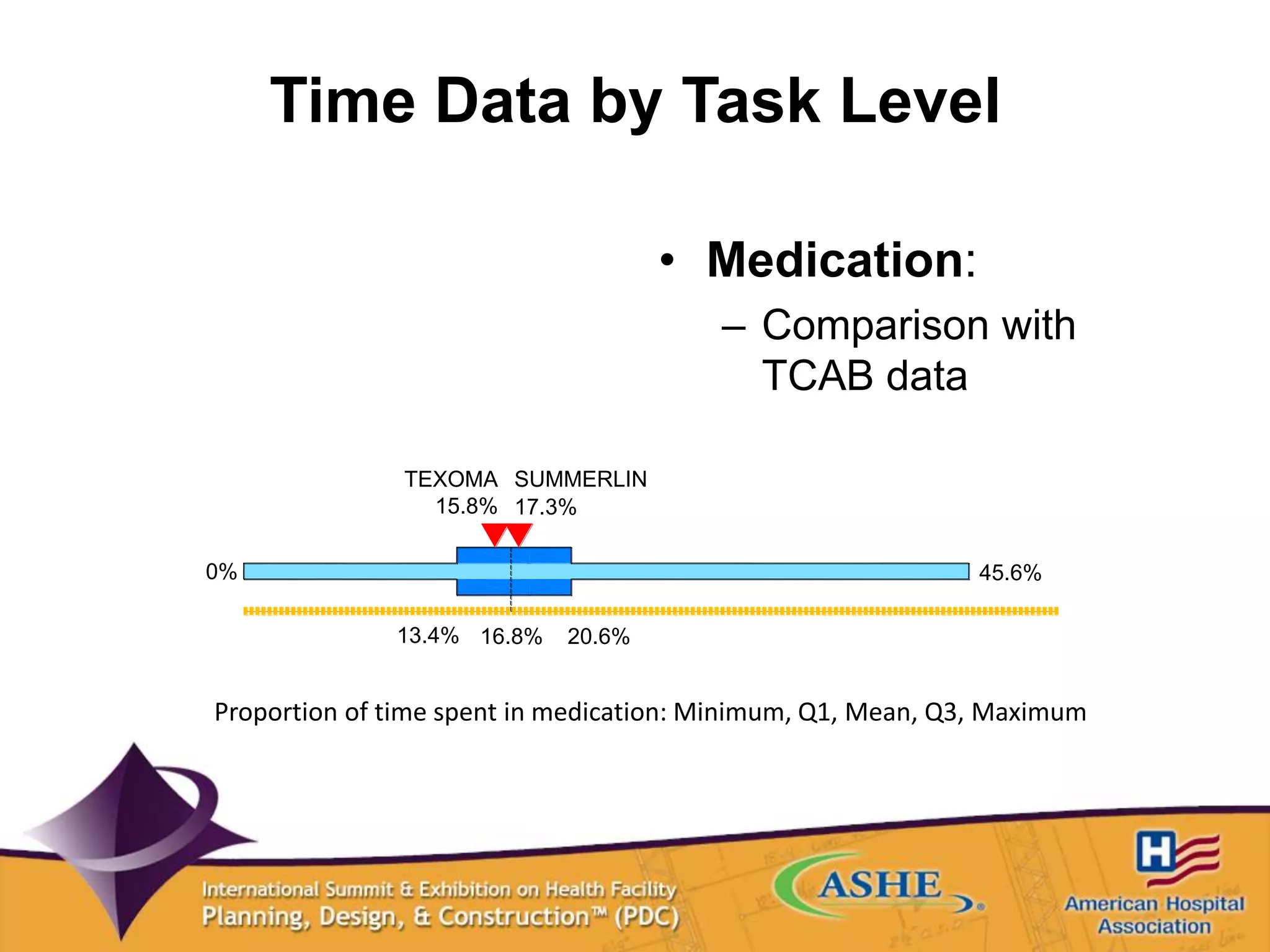
• Medication:
– Comparison with
TCAB data
Proportion of time spent in medication: Minimum, Q1, Mean, Q3, Maximum
0%
13.4% 16.8% 20.6%
45.6%
15.8% 17.3%
TEXOMA SUMMERLIN
Time Data by Task Level
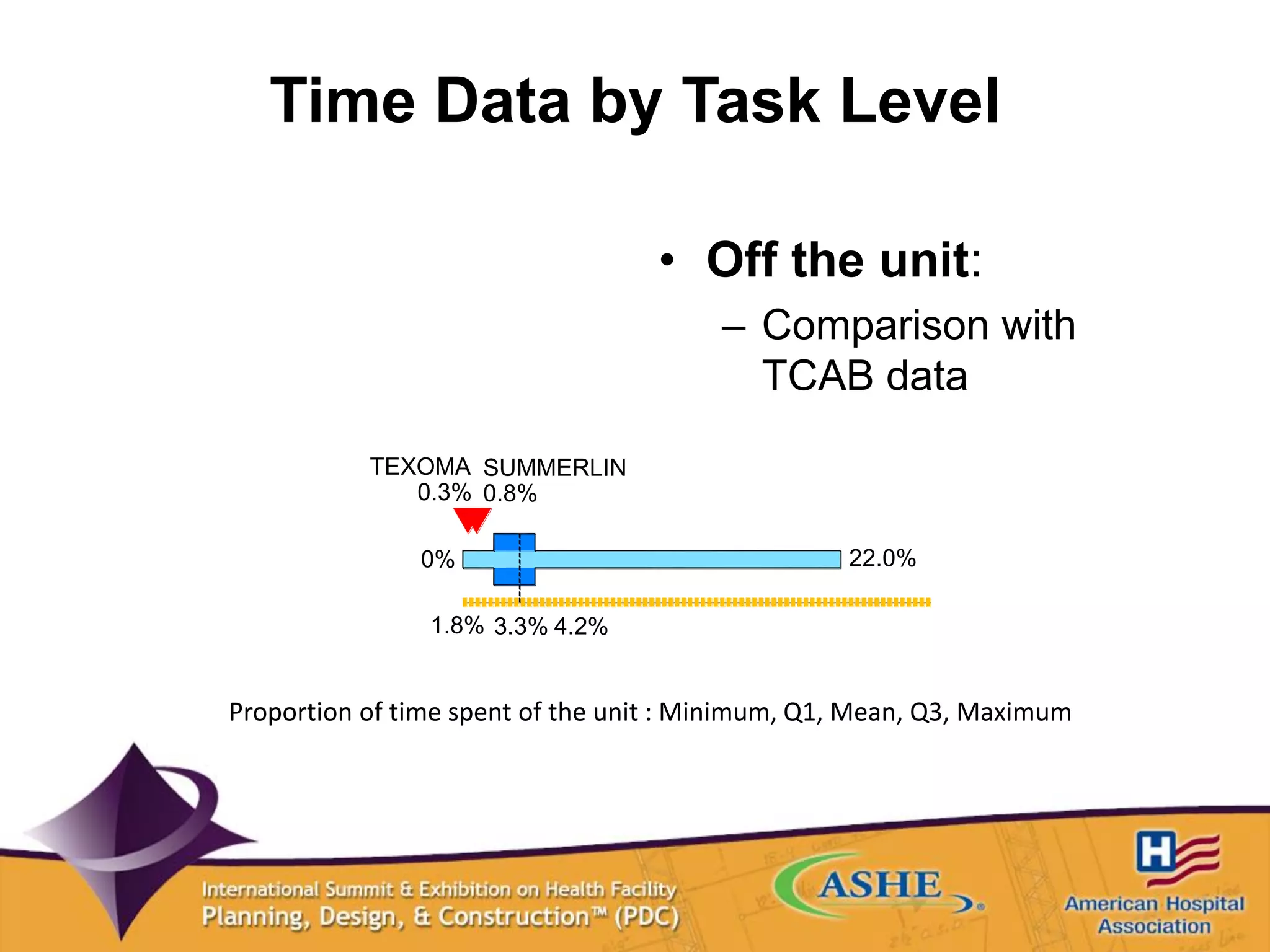
• Off the unit:
– Comparison with
TCAB data
Proportion of time spent of the unit : Minimum, Q1, Mean, Q3, Maximum
0%
1.8% 3.3% 4.2%
22.0%
0.3% 0.8%
TEXOMA SUMMERLIN
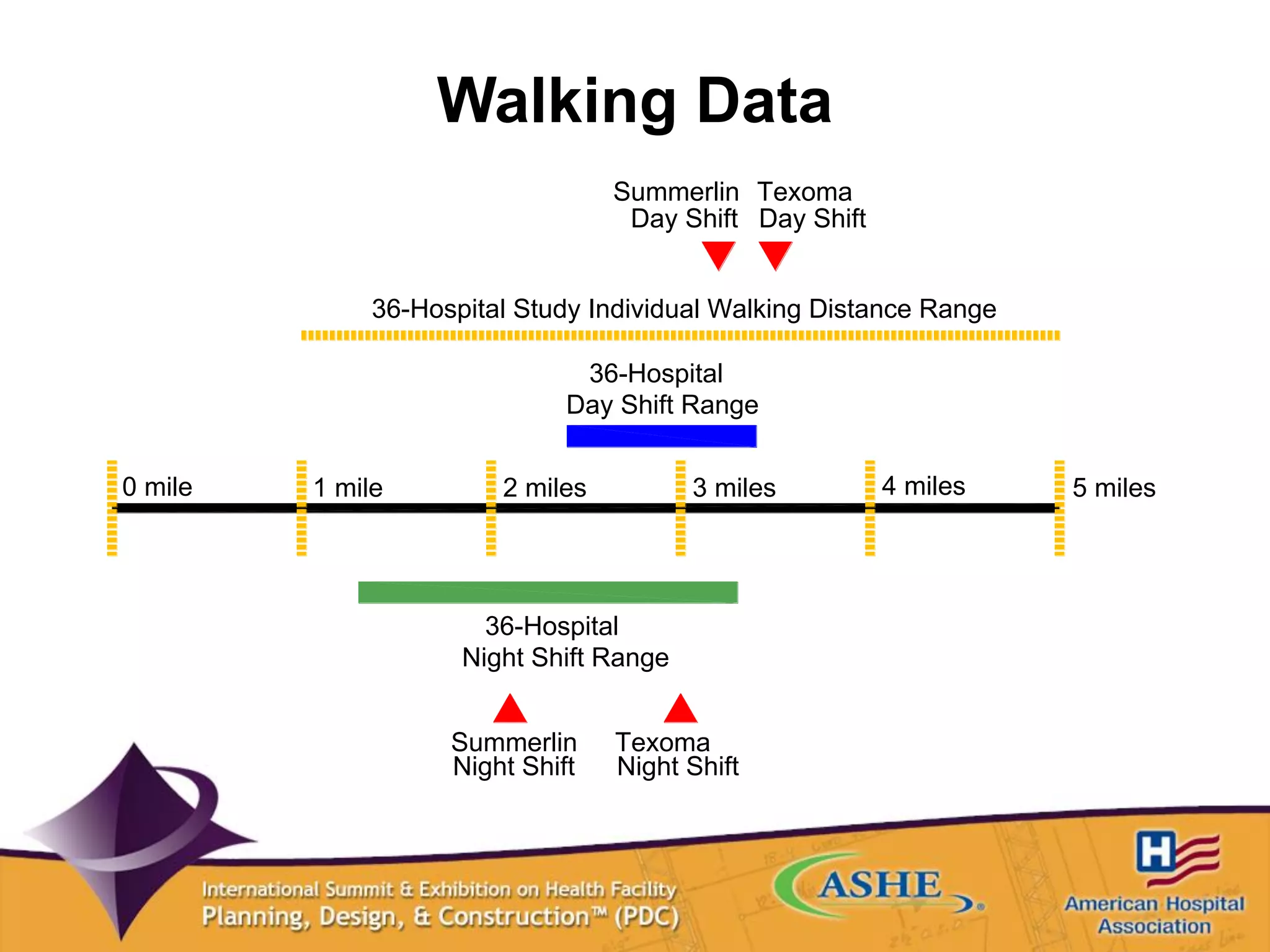
Walking Data
0 mile 1 mile 2 miles 3 miles 4 miles 5 miles
Day Shift Range
36-Hospital
Night Shift Range
36-Hospital
36-Hospital Study Individual Walking Distance Range
Day Shift
Summerlin
Night Shift
Summerlin
Night Shift
Texoma
Day Shift
Texoma
CONCLUSION
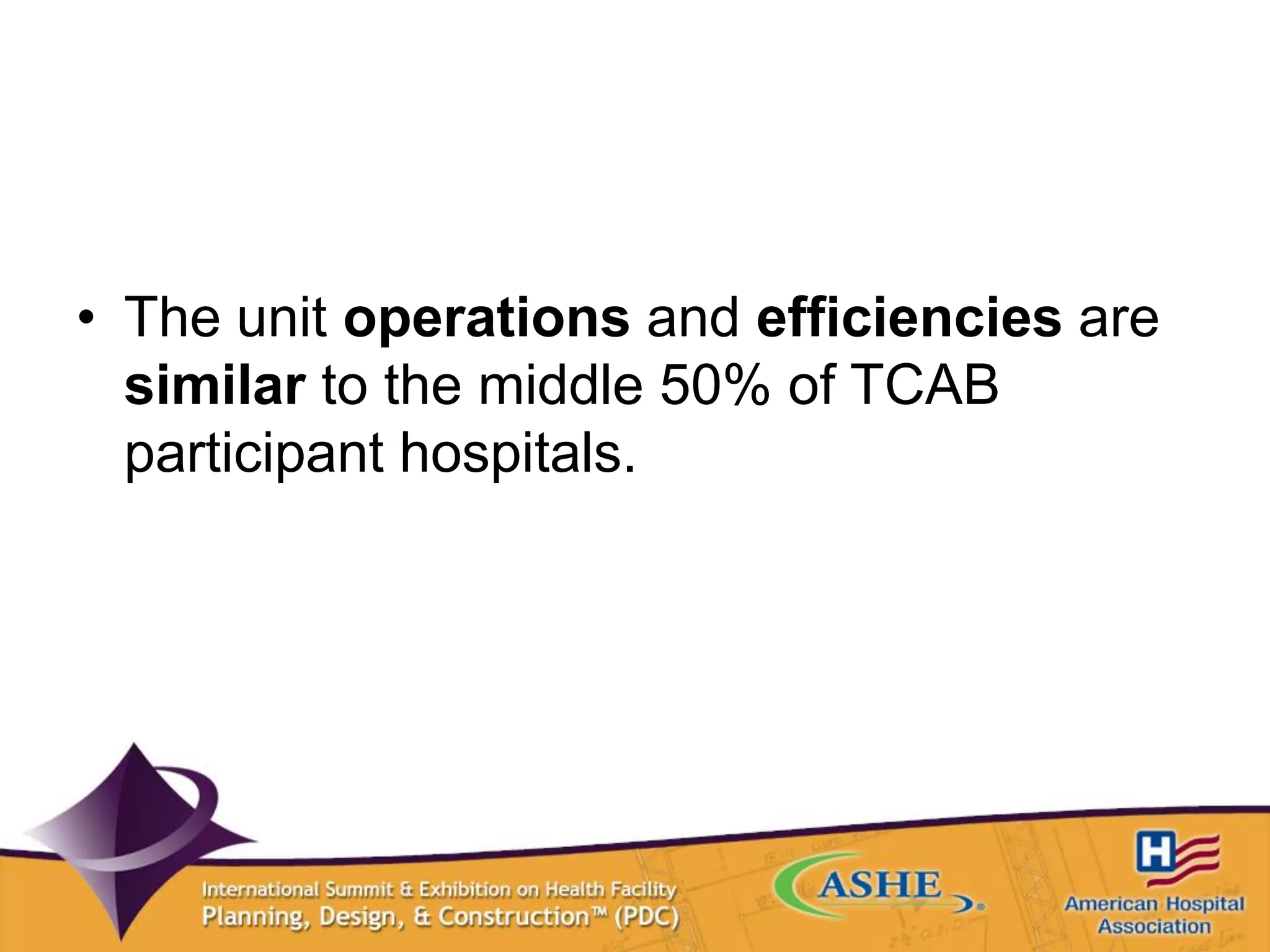
• The unit operations and efficiencies are
similar to the middle 50% of TCAB
participant hospitals.
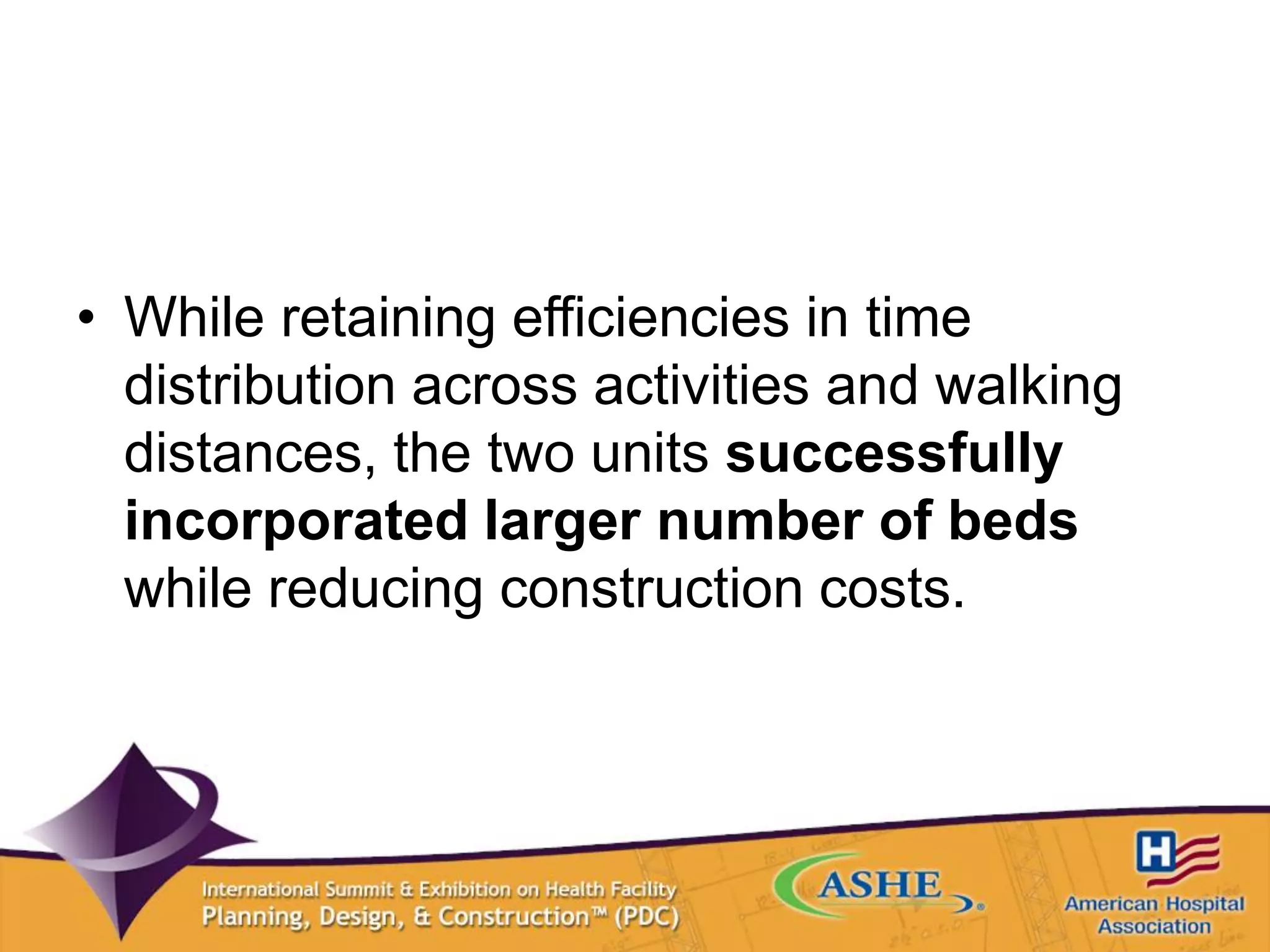
• While retaining efficiencies in time
distribution across activities and walking
distances, the two units successfully
incorporated larger number of beds
while reducing construction costs.
• A healthcare provider can significantly
reduce construction costs but operate
with the same efficiencies.
• Integrated decision-making with a primary
focus on the efficiencies of flow can be
used to address the seemingly difficult
task of achieving larger inpatient bed
units as well as efficient use of
caregiver time.

PDC_2011_Building Smart Without Compromising Efficiency

  • 1.
  • 2.
    Presenters Bill Seed, StaffVice President, Universal Health Services Angela Lee, AIA, ACHA, LEED AP, Senior Vice President, HKS Debajyoti Pati, PhD, FIIA, LEED AP, Vice President and Director of Research, HKS
  • 3.
    Acknowledgments • Summerlin Hospital, LasVegas, NV • Texoma Medical Center, Denison, TX • Rapid Modeling Corporation
  • 4.
  • 6.
    CAN LARGER INPATIENTBED UNITS AND EFFICIENT USE OF NURSING TIME GO HAND IN HAND? QUESTION
  • 7.
    Larger Unit Implications •(+) Staffing efficiency • (-) Large floor plate • (-) Distances between destinations – (-) Longer walking distance – (-) Time spent walking Acute care units have increased in floor area by 118 percent over the past 20 years (KSA)
  • 8.
    Implications of Walking •System efficiency – Unnecessary walking = Waste • Care quality – Time away from patients (patient- centric care) – Medication errors • Individual performance – Interactions with workplace stressors – Alertness, stress, fatigue
  • 9.
  • 10.
  • 11.
    CAN LARGER INPATIENTBED UNITS AND EFFICIENT USE OF NURSING TIME GO HAND IN HAND? QUESTION
  • 12.
    The UHS-HKS Projects •Guiding principles: – Proximity of services – Amenities for care – Decentralized nurses’ station – Computer logistics by focusing on the efficiency of flow, one can focus on patient- centric care and supply nurses everything they need without walking long distances
  • 13.
    BY OPTIMIZING FLOWAND REDUCING POTENTIAL WASTE, THE LARGE UNIT WOULD NOT RESULT IN WALKING DISTANCES THAT ARE SUBSTANTIALLY HIGHER THAN NATIONAL BENCHMARK HYPOTHESIS
  • 14.
    BY OPTIMIZING FLOWAND REDUCING POTENTIAL WASTE, HOW NURSES SPEND THEIR TIME WOULD NOT CONSTITUTE AN OUTLIER HYPOTHESIS
  • 15.
    Texoma Medical Center Recognizedup front, inpatient strategies can save time, money and promote better patient care.
  • 16.
    Texoma Medical Center Usea racetrack configuration, which offers efficiency as well as easy wayfinding. The configuration provides the most efficient perimeter-to- core ratio and enables direct corridor sightlines for caregivers and patients. It also promotes separation of public and service areas.
  • 17.
    Design Inpatient Unitas a Racetrack Configuration Provides most efficient perimeter to core ratio.
  • 18.
    Design Inpatient Unitas a Racetrack Configuration Enables direct corridor sightlines for caregivers and patients.
  • 19.
    Design Inpatient Unitas a Racetrack Configuration Enables direct corridor sightlines for caregivers and patients.
  • 20.
    Design Inpatient Unitas a Racetrack Configuration Intermediate passages through the core reduce travel distances.
  • 21.
    Design Inpatient Unitas a Racetrack Configuration Lean/efficient double loaded corridors – Easy to Navigate
  • 22.
  • 23.
    A Patient CenteredExpansion Pinwheel design will minimize travel distances, promote patient safety, and maximize views from patient rooms.
  • 24.
    A Patient CenteredExpansion New tower will blend with the existing hospital in effort to keep the publicly recognized hospital identity.
  • 25.
    A Patient CenteredExpansion $100 million expansion and renovation in one of southern Nevada’s fastest growing communities in Las Vegas, Nevada All of the changes were made externally, with breaking through the connecting wall as a final step
  • 26.
  • 27.
  • 28.
  • 29.
    Time-Motion Data • RapidModeling Corporation’s programmed Palm PDAs • 1 week on each unit • Summer 2010 • Compared with TCAB Time Study RN national database
  • 30.
    Walking Data • Sportlinepedometer • 1 week on each unit • Summer 2010 • Compared with 36- hospital time-motion study* *Hendrich, A., M. Chow, B.A. Skierczynski & Z. Lu. (2008). A 36-Hospital Time and Motion Study: How Do Medical- Surgical Nurses Spend Their Time? The Permanente Journal, 12(3), 25-34.
  • 31.
  • 32.
    Time Data byTask Type • Value adding: – Comparison with TCAB data Proportion of time spent in value adding tasks: Minimum, Q1, Mean, Q3, Maximum 34.6% 59.1% 64.2% 68.0% 96.4% 59.8%59.5% TEXOMASUMMERLIN
  • 33.
    Time Data byTask Type • Non value adding tasks: – Comparison with TCAB data Proportion of time spent in non value adding tasks: Minimum, Q1, Mean, Q3, Maximum 0% 9.1% 11.5% 13.7% 33.9% 8.2% 10.5% TEXOMA SUMMERLIN
  • 34.
    Time Data byTask Type • Necessary tasks: – Comparison with TCAB data Proportion of time spent in necessary tasks: Minimum, Q1, Mean, Q3, Maximum 2.6% 21.6% 24.2% 27.5% 50.0% TEXOMASUMMERLIN 32.0%30.0%
  • 35.
    Time Data byTask Category • Direct Care Time: – Comparison with TCAB data Proportion of time spent in direct care: Minimum, Q1, Mean, Q3, Maximum 47.8%43.0% 91.5%15.7% 43.2% 48.3% 51.6% TEXOMASUMMERLIN
  • 36.
    Time Data byTask Category • Indirect care time: – Comparison with TCAB data Proportion of time spent in indirect care : Minimum, Q1, Mean, Q3, Maximum 1.7% 13.6% 17.0% 20.1% 37.0% 12.0% 16.5% TEXOMA SUMMERLIN
  • 37.
    Time Data byTask Category • Documentation: – Comparison with TCAB data Proportion of time spent in documentation: Minimum, Q1, Mean, Q3, Maximum 1.6% 15.1% 18.0% 21.1% 38.5% 15.8%10.5% TEXOMASUMMERLIN
  • 38.
    Time Data byTask Category • Administration: – Comparison with TCAB data 0% 19.2% TEXOMA SUMMERLIN 16.0% 19.4% 3.2%5.2% 6.5% Proportion of time spent in administration: Minimum, Q1, Mean, Q3, Maximum
  • 39.
    Time Data byTask Category • Personal: – Comparison with TCAB data Proportion of time spent in personal work: Minimum, Q1, Mean, Q3, Maximum 0% 3.4% 4.5% 5.4% 16.9% 1.0% 2.1% TEXOMA SUMMERLIN
  • 40.
    Time Data byTask Category • Waste: – Comparison with TCAB data Proportion of time wasted: Minimum, Q1, Mean, Q3, Maximum 0% 1.9% 2.9% 3.5% 9.8% 3.0%1.7% TEXOMASUMMERLIN
  • 41.
    Time Data byTask Level • Nurse station: – Comparison with TCAB data Proportion of time spent in nurse station: Minimum, Q1, Mean, Q3, Maximum 0% 27.8% 36.1% 44.2% 89.9% 54.9%47.3% TEXOMASUMMERLIN
  • 42.
    Time Data byTask Level • Patient room: – Comparison with TCAB data Proportion of time spent in patient room: Minimum, Q1, Mean, Q3, Maximum 3.8% 34.6% 40.7% 44.7% 80.7% 37.2%36.3% TEXOMASUMMERLIN
  • 43.
    Time Data byTask Level • Medication: – Comparison with TCAB data Proportion of time spent in medication: Minimum, Q1, Mean, Q3, Maximum 0% 13.4% 16.8% 20.6% 45.6% 15.8% 17.3% TEXOMA SUMMERLIN
  • 44.
    Time Data byTask Level • Off the unit: – Comparison with TCAB data Proportion of time spent of the unit : Minimum, Q1, Mean, Q3, Maximum 0% 1.8% 3.3% 4.2% 22.0% 0.3% 0.8% TEXOMA SUMMERLIN
  • 45.
    Walking Data 0 mile1 mile 2 miles 3 miles 4 miles 5 miles Day Shift Range 36-Hospital Night Shift Range 36-Hospital 36-Hospital Study Individual Walking Distance Range Day Shift Summerlin Night Shift Summerlin Night Shift Texoma Day Shift Texoma
  • 46.
  • 47.
    • The unitoperations and efficiencies are similar to the middle 50% of TCAB participant hospitals.
  • 48.
    • While retainingefficiencies in time distribution across activities and walking distances, the two units successfully incorporated larger number of beds while reducing construction costs.
  • 49.
    • A healthcareprovider can significantly reduce construction costs but operate with the same efficiencies.
  • 50.
    • Integrated decision-makingwith a primary focus on the efficiencies of flow can be used to address the seemingly difficult task of achieving larger inpatient bed units as well as efficient use of caregiver time.