Personality
By : Murniati, S.Pd., M.Si.
Personality
 patterns of behaving and thinking that
are consistent across a variety of
situations
1. Psychoanalytic
2. Trait
3. Humanistic
4. Socio-Cognitive
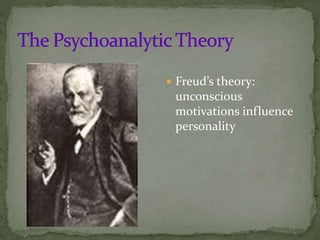
 Freud’s theory:
unconscious
motivations influence
personality
Psychoanalysis (Freud)
 Theory: our actions are due to
unconscious conflicts
 Therapy: treating psychological disorders
by uncovering and interpreting
unconscious conflicts
Free Association
 method of exploring the unconscious
 person relaxes and says whatever
comes to mind, no matter how trivial
or embarrassing
 Unconscious (Freud)
 A reservoir of mostly unacceptable thoughts, wishes,
feelings and memories
 Two main unconscious instincts:
 sex and aggression
 Preconscious
 information that is not conscious but is retrievable into
conscious awareness
1. Id
2. Ego
3. Superego
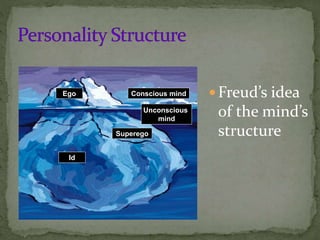
Freud’s idea
of the mind’s
structure
Id
Superego
Ego Conscious mind
Unconscious
mind
Id
 unconscious psychic energy
 strives to satisfy basic sexual and
aggressive instincts
 operates on the pleasure principle,
seeking immediate gratification
Superego
 our conscience
 given to us by family/society
 operates on morality principle, sets
standards right vs. wrong
Ego
 conscious part of personality
 mediates conflict between id and
superego
 operates on the reality principle, delays
gratification of id impulses
 Defense Mechanisms
 conflicts of id and superego produce anxiety
 defense mechanisms reduce anxiety by distorting reality
 Regression
 retreating to behavior appropriate for an earlier stage of
development (e.g., temper tantrum)
 Repression
 pushing anxiety arousing thoughts into the unconscious
(e.g., serious traumas like rape)
 Reaction Formation
 expressing feelings that are the opposite of their
anxiety-arousing unconscious feelings
(e.g., Ban the filth! I hate homosexuals!)
 Projection
 disguising our own impulses by attributing them to
others (e.g., You always start arguments!)
 Rationalization
 making up an untrue justification to ourselves for doing
something (e.g., sour grapes)
 Displacement
 shifting sexual or aggressive impulses toward a less
threatening object or person
(e.g., kicking the dog!)
 Sublimation
 rechanneling of unacceptable impulses into socially
approved activities (e.g., a great artist who paints
nudes!)
 Projective Tests
 used to assess personality (e.g., Rorschach or TAT tests)
 How? provides ambiguous stimuli and subject projects
his or her motives into the ambiguous stimuli
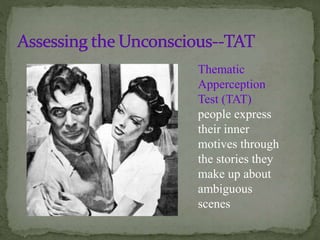
Thematic
Apperception
Test (TAT)
people express
their inner
motives through
the stories they
make up about
ambiguous
scenes
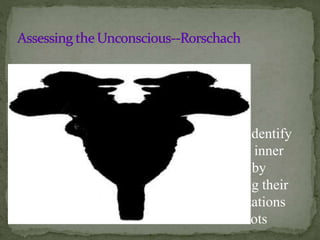
 Rorschach Inkblot Test
 the most widely used projective test
 a set of 10 inkblots designed by Hermann Rorschach
used to identify
people’s inner
feelings by
analyzing their
interpretations
of the blots
 Good tests are reliable and valid
 reliable: consistent, getting the same results each time
the test is administered
 valid: measure what it is suppose to measure
 (+) Can help us understand ego defenses used by
everyone (and OK to use if not overused)
 (+) Alerts us to the unconscious causes of behavior
 (-) Assessment is subjective (TAT, Rorschach)
 (-) Reliability and validity of measurement are
problems
 Trait
 a characteristic pattern of behavior
 usually assessed by self-report inventories
 Personality Inventory
 a questionnaire (often with true-false or agree-disagree
items) designed to assess traits
 objective scoring -- a real plus!
 Minnesota Multiphasic Personality Inventory (MMPI)
 the most widely researched and clinically used of all
personality tests
 developed to identify emotional disorders
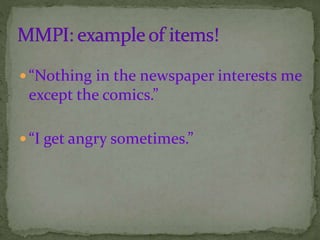
“Nothing in the newspaper interests me
except the comics.”
“I get angry sometimes.”
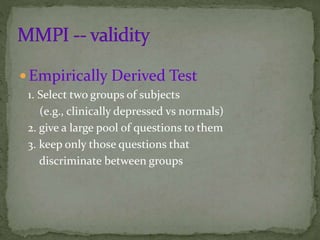
Empirically Derived Test
1. Select two groups of subjects
(e.g., clinically depressed vs normals)
2. give a large pool of questions to them
3. keep only those questions that
discriminate between groups
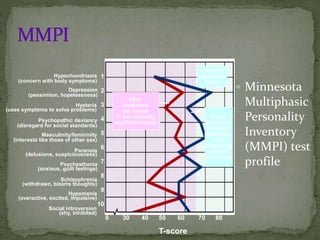
 Minnesota
Multiphasic
Personality
Inventory
(MMPI) test
profile
Hysteria
(uses symptoms to solve problems)
Masculinity/femininity
(interests like those of other sex)
T-score
1
2
3
4
5
6
7
8
9
10
0 30 40 50 60 70 80
Hypochondriasis
(concern with body symptoms)
Depression
(pessimism, hopelessness)
Psychopathic deviancy
(disregard for social standards)
Paranoia
(delusions, suspiciousness)
Psychasthenia
(anxious, guilt feelings)
Schizophrenia
(withdrawn, bizarre thoughts)
Hypomania
(overactive, excited, impulsive)
Social introversion
(shy, inhibited)
Clinically
significant
range
After
treatment
(no scores
in the clinically
significant range
Before
treatment
(anxious,
depressed,
and
displaying
deviant
behaviors)
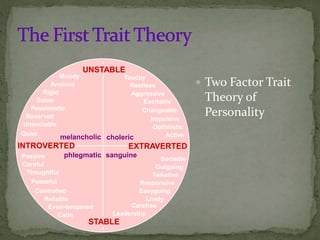
 Two Factor Trait
Theory of
Personality
UNSTABLE
STABLE
cholericmelancholic
phlegmatic sanguine
INTROVERTED EXTRAVERTED
Moody
Anxious
Rigid
Sober
Pessimistic
Reserved
Unsociable
Quiet
Sociable
Outgoing
Talkative
Responsive
Easygoing
Lively
Carefree
Leadership
Passive
Careful
Thoughtful
Peaceful
Controlled
Reliable
Even-tempered
Calm
Touchy
Restless
Aggressive
Excitable
Changeable
Impulsive
Optimistic
Active
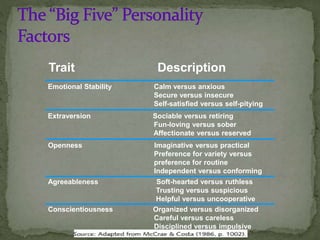
Trait Description
Emotional Stability Calm versus anxious
Secure versus insecure
Self-satisfied versus self-pitying
Extraversion Sociable versus retiring
Fun-loving versus sober
Affectionate versus reserved
Openness Imaginative versus practical
Preference for variety versus
preference for routine
Independent versus conforming
Agreeableness Soft-hearted versus ruthless
Trusting versus suspicious
Helpful versus uncooperative
Conscientiousness Organized versus disorganized
Careful versus careless
Disciplined versus impulsive
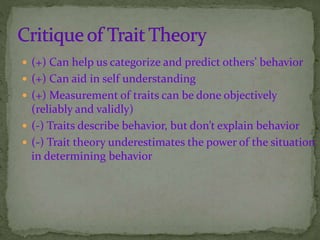
 (+) Can help us categorize and predict others’ behavior
 (+) Can aid in self understanding
 (+) Measurement of traits can be done objectively
(reliably and validly)
 (-) Traits describe behavior, but don’t explain behavior
 (-) Trait theory underestimates the power of the situation
in determining behavior
 Self-Concept
 one’s perception of oneself: “Who am I?”
 Ideal Self
 the self I would like to be
 Real Self
 the way I really am
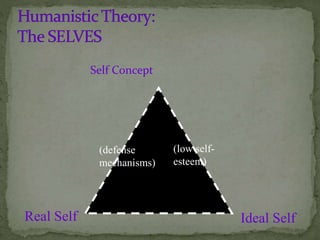
Self Concept
Ideal SelfReal Self
(defense
mechanisms)
(low self-
esteem)
 Self-Esteem
 one’s feelings of high or low self-worth
 Physical
 Intellectual
 Social
 Low Self-Esteem: Experiments tell us
 heightened prejudice
 heightened judgmentalism
 High Self-Esteem:
 lower levels of depression
 Self-Serving Bias
 a readiness to perceive oneself favorably
 “somewhat likely” to go to heaven?
 OJ Simpson, Bill Clinton, Michael Jordon, Mother
Theresa, or ________ !!
 Individualism (West)
 defining one’s identity in terms of personal attributes
(introverted, etc.)
 giving priority to one’s own goals over group goals
 Collectivism (East)
 defining one’s identity with group identifications (bin,
means “son of”)
 giving priority to the goals of one’s group over one’s own
goals
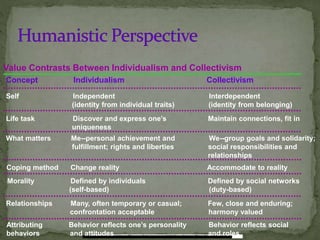
Morality Defined by individuals Defined by social networks
(self-based) (duty-based)
Attributing Behavior reflects one’s personality Behavior reflects social
behaviors and attitudes and roles
Value Contrasts Between Individualism and Collectivism
Concept Individualism Collectivism
Self Independent Interdependent
(identity from individual traits) (identity from belonging)
Life task Discover and express one’s Maintain connections, fit in
uniqueness
What matters Me--personal achievement and We--group goals and solidarity;
fulfillment; rights and liberties social responsibilities and
relationships
Coping method Change reality Accommodate to reality
Relationships Many, often temporary or casual; Few, close and enduring;
confrontation acceptable harmony valued
 (+) Makes the SELF central to our understanding of
behavior
 (-) Culture-bound theory (applies to the West)
 (-) Is too subjective, not objective
 (-) Maybe overly optimistic view of human nature (all of
us are moving toward self-actualization?)
 Behavior is due to
 Social influences (other people)
 Cognitive influences (how we perceive ourselves and our
social environment)
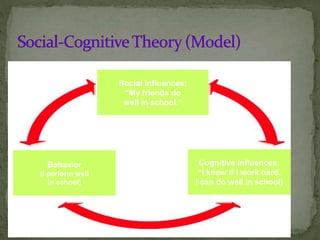
Social Influences:
“My friends do
well in school.”
Behavior
(I perform well
in school)
Cognitive Influences:
“I know if I work hard,
I can do well in school)
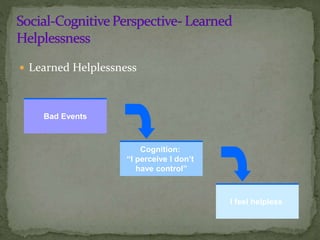
 Learned Helplessness
Bad Events
Cognition:
“I perceive I don’t
have control”
I feel helpless
 Personal Control
 a cognitive factor (in the model)
 our sense of controlling our environments rather than
feeling helpless
 Internal Locus of Control
 the perception that one controls one’s own fate
 External Locus of Control
 the perception that outside forces determine one’s fate
Positive Psychology
 scientific study of ways to foster a healthy
personality and community
Key Concept: Learned Optimism
 expecting positive events to occur an
seeing oneself as competent.
 research: optimistic people live
longer/healthier lives
 (+) Based on solid research
 (+) Takes into account both personality (especially
cognition) and social situation
 (-) Underemphasizes importance of traits

Kepribadian (Personality)

  • 1.
  • 2.
    Personality  patterns ofbehaving and thinking that are consistent across a variety of situations
  • 3.
    1. Psychoanalytic 2. Trait 3.Humanistic 4. Socio-Cognitive
  • 4.
  • 5.
    Psychoanalysis (Freud)  Theory:our actions are due to unconscious conflicts  Therapy: treating psychological disorders by uncovering and interpreting unconscious conflicts
  • 6.
    Free Association  methodof exploring the unconscious  person relaxes and says whatever comes to mind, no matter how trivial or embarrassing
  • 7.
     Unconscious (Freud) A reservoir of mostly unacceptable thoughts, wishes, feelings and memories  Two main unconscious instincts:  sex and aggression  Preconscious  information that is not conscious but is retrievable into conscious awareness
  • 8.
  • 9.
    Freud’s idea of themind’s structure Id Superego Ego Conscious mind Unconscious mind
  • 10.
    Id  unconscious psychicenergy  strives to satisfy basic sexual and aggressive instincts  operates on the pleasure principle, seeking immediate gratification
  • 11.
    Superego  our conscience given to us by family/society  operates on morality principle, sets standards right vs. wrong
  • 12.
    Ego  conscious partof personality  mediates conflict between id and superego  operates on the reality principle, delays gratification of id impulses
  • 13.
     Defense Mechanisms conflicts of id and superego produce anxiety  defense mechanisms reduce anxiety by distorting reality
  • 14.
     Regression  retreatingto behavior appropriate for an earlier stage of development (e.g., temper tantrum)  Repression  pushing anxiety arousing thoughts into the unconscious (e.g., serious traumas like rape)
  • 15.
     Reaction Formation expressing feelings that are the opposite of their anxiety-arousing unconscious feelings (e.g., Ban the filth! I hate homosexuals!)
  • 16.
     Projection  disguisingour own impulses by attributing them to others (e.g., You always start arguments!)  Rationalization  making up an untrue justification to ourselves for doing something (e.g., sour grapes)
  • 17.
     Displacement  shiftingsexual or aggressive impulses toward a less threatening object or person (e.g., kicking the dog!)  Sublimation  rechanneling of unacceptable impulses into socially approved activities (e.g., a great artist who paints nudes!)
  • 18.
     Projective Tests used to assess personality (e.g., Rorschach or TAT tests)  How? provides ambiguous stimuli and subject projects his or her motives into the ambiguous stimuli
  • 19.
    Thematic Apperception Test (TAT) people express theirinner motives through the stories they make up about ambiguous scenes
  • 20.
     Rorschach InkblotTest  the most widely used projective test  a set of 10 inkblots designed by Hermann Rorschach
  • 21.
    used to identify people’sinner feelings by analyzing their interpretations of the blots
  • 22.
     Good testsare reliable and valid  reliable: consistent, getting the same results each time the test is administered  valid: measure what it is suppose to measure
  • 23.
     (+) Canhelp us understand ego defenses used by everyone (and OK to use if not overused)  (+) Alerts us to the unconscious causes of behavior  (-) Assessment is subjective (TAT, Rorschach)  (-) Reliability and validity of measurement are problems
  • 24.
     Trait  acharacteristic pattern of behavior  usually assessed by self-report inventories
  • 25.
     Personality Inventory a questionnaire (often with true-false or agree-disagree items) designed to assess traits  objective scoring -- a real plus!
  • 26.
     Minnesota MultiphasicPersonality Inventory (MMPI)  the most widely researched and clinically used of all personality tests  developed to identify emotional disorders
  • 27.
    “Nothing in thenewspaper interests me except the comics.” “I get angry sometimes.”
  • 28.
    Empirically Derived Test 1.Select two groups of subjects (e.g., clinically depressed vs normals) 2. give a large pool of questions to them 3. keep only those questions that discriminate between groups
  • 29.
     Minnesota Multiphasic Personality Inventory (MMPI) test profile Hysteria (usessymptoms to solve problems) Masculinity/femininity (interests like those of other sex) T-score 1 2 3 4 5 6 7 8 9 10 0 30 40 50 60 70 80 Hypochondriasis (concern with body symptoms) Depression (pessimism, hopelessness) Psychopathic deviancy (disregard for social standards) Paranoia (delusions, suspiciousness) Psychasthenia (anxious, guilt feelings) Schizophrenia (withdrawn, bizarre thoughts) Hypomania (overactive, excited, impulsive) Social introversion (shy, inhibited) Clinically significant range After treatment (no scores in the clinically significant range Before treatment (anxious, depressed, and displaying deviant behaviors)
  • 30.
     Two FactorTrait Theory of Personality UNSTABLE STABLE cholericmelancholic phlegmatic sanguine INTROVERTED EXTRAVERTED Moody Anxious Rigid Sober Pessimistic Reserved Unsociable Quiet Sociable Outgoing Talkative Responsive Easygoing Lively Carefree Leadership Passive Careful Thoughtful Peaceful Controlled Reliable Even-tempered Calm Touchy Restless Aggressive Excitable Changeable Impulsive Optimistic Active
  • 31.
    Trait Description Emotional StabilityCalm versus anxious Secure versus insecure Self-satisfied versus self-pitying Extraversion Sociable versus retiring Fun-loving versus sober Affectionate versus reserved Openness Imaginative versus practical Preference for variety versus preference for routine Independent versus conforming Agreeableness Soft-hearted versus ruthless Trusting versus suspicious Helpful versus uncooperative Conscientiousness Organized versus disorganized Careful versus careless Disciplined versus impulsive
  • 32.
     (+) Canhelp us categorize and predict others’ behavior  (+) Can aid in self understanding  (+) Measurement of traits can be done objectively (reliably and validly)  (-) Traits describe behavior, but don’t explain behavior  (-) Trait theory underestimates the power of the situation in determining behavior
  • 33.
     Self-Concept  one’sperception of oneself: “Who am I?”  Ideal Self  the self I would like to be  Real Self  the way I really am
  • 34.
    Self Concept Ideal SelfRealSelf (defense mechanisms) (low self- esteem)
  • 35.
     Self-Esteem  one’sfeelings of high or low self-worth  Physical  Intellectual  Social
  • 36.
     Low Self-Esteem:Experiments tell us  heightened prejudice  heightened judgmentalism  High Self-Esteem:  lower levels of depression
  • 37.
     Self-Serving Bias a readiness to perceive oneself favorably  “somewhat likely” to go to heaven?  OJ Simpson, Bill Clinton, Michael Jordon, Mother Theresa, or ________ !!
  • 38.
     Individualism (West) defining one’s identity in terms of personal attributes (introverted, etc.)  giving priority to one’s own goals over group goals  Collectivism (East)  defining one’s identity with group identifications (bin, means “son of”)  giving priority to the goals of one’s group over one’s own goals
  • 39.
    Morality Defined byindividuals Defined by social networks (self-based) (duty-based) Attributing Behavior reflects one’s personality Behavior reflects social behaviors and attitudes and roles Value Contrasts Between Individualism and Collectivism Concept Individualism Collectivism Self Independent Interdependent (identity from individual traits) (identity from belonging) Life task Discover and express one’s Maintain connections, fit in uniqueness What matters Me--personal achievement and We--group goals and solidarity; fulfillment; rights and liberties social responsibilities and relationships Coping method Change reality Accommodate to reality Relationships Many, often temporary or casual; Few, close and enduring; confrontation acceptable harmony valued
  • 40.
     (+) Makesthe SELF central to our understanding of behavior  (-) Culture-bound theory (applies to the West)  (-) Is too subjective, not objective  (-) Maybe overly optimistic view of human nature (all of us are moving toward self-actualization?)
  • 41.
     Behavior isdue to  Social influences (other people)  Cognitive influences (how we perceive ourselves and our social environment)
  • 42.
    Social Influences: “My friendsdo well in school.” Behavior (I perform well in school) Cognitive Influences: “I know if I work hard, I can do well in school)
  • 43.
     Learned Helplessness BadEvents Cognition: “I perceive I don’t have control” I feel helpless
  • 44.
     Personal Control a cognitive factor (in the model)  our sense of controlling our environments rather than feeling helpless
  • 45.
     Internal Locusof Control  the perception that one controls one’s own fate  External Locus of Control  the perception that outside forces determine one’s fate
  • 46.
    Positive Psychology  scientificstudy of ways to foster a healthy personality and community Key Concept: Learned Optimism  expecting positive events to occur an seeing oneself as competent.  research: optimistic people live longer/healthier lives
  • 47.
     (+) Basedon solid research  (+) Takes into account both personality (especially cognition) and social situation  (-) Underemphasizes importance of traits