Welcome
AshaCL
• Depending on the length of the chain and
nature of groups attached to the chain silicones
are obtained in many forms.
• Obtained in the form of oils,fluids,resins or as
rubbers.
Properties of silicones
• Resistant to heat - used in applications where
organic materials would melt or decompose -
oxidation and most chemicals.
• Strong water repellents – silicone fluids-
Silicone chain surrounded by organic side
groups- shoe polish ,car polish.
• Good electrical insulators – silicone oils and
silicone resins-used as dielectric insulating
material in high voltage transformers.
• Non-stick properties- silicone resins
• Anti- foaming properties- beer making,textile
dyeing etc.
• Strength & inertness – stable Si-O-Si-O-Si
skeleton and high strength of Si-C bond.
• Lubricating property –Methyl silicones.
• Elastic property- Silicone rubbers-electrical
insulators –vulcanisation yield hard rubber
Boron Hydrides
• Also known as boranes.
• Classified into three.
• BnHn+2 series , Closo boranes
• BnHn+4 series ,Nido boranes.
• BnHn+6 series, Arachno boranes.
• The most important hydride of boron is
diborane (B2H6).
• This is a colourless gas.
• This substance is highly unstable at the
room temperature with a foul odour.
• It is highly toxic.
• This substance will ignite rapidly at room
temperature.
STRUCTURE OF DIBORANE
• It is an electron deficient species.
• Total 14 electrons are reqired for the formation of normal covalent
bonds.
• But there are only 12 valence electrons.
• Three from each boron atom and six from six hydrogen atoms.
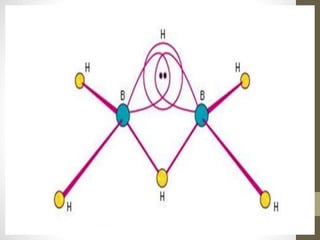
• Four hydrogens and two borons are in the same plane.
• Two bridging hydroens are in a plane perpendicular to the other
atoms in the molecule.
• This restricts the rotation between two boron atoms.
• Terminal four hydrogens are alike and and are called two
centre two electron( 2c-2e) bonds.
• The two bridges involve four electrons.
• One from each boron atom and one from each hydrogen
atom.
• Each BHB bridge bond is 3c -2e bond.
• Each diborane has two such 3c-2e bonds or banana bond.
Thank You

Dbc fdp

  • 1.
  • 3.
    • Depending onthe length of the chain and nature of groups attached to the chain silicones are obtained in many forms. • Obtained in the form of oils,fluids,resins or as rubbers.
  • 4.
  • 5.
    • Resistant toheat - used in applications where organic materials would melt or decompose - oxidation and most chemicals. • Strong water repellents – silicone fluids- Silicone chain surrounded by organic side groups- shoe polish ,car polish. • Good electrical insulators – silicone oils and silicone resins-used as dielectric insulating material in high voltage transformers.
  • 6.
    • Non-stick properties-silicone resins • Anti- foaming properties- beer making,textile dyeing etc. • Strength & inertness – stable Si-O-Si-O-Si skeleton and high strength of Si-C bond. • Lubricating property –Methyl silicones. • Elastic property- Silicone rubbers-electrical insulators –vulcanisation yield hard rubber
  • 7.
    Boron Hydrides • Alsoknown as boranes. • Classified into three. • BnHn+2 series , Closo boranes • BnHn+4 series ,Nido boranes. • BnHn+6 series, Arachno boranes.
  • 8.
    • The mostimportant hydride of boron is diborane (B2H6). • This is a colourless gas. • This substance is highly unstable at the room temperature with a foul odour. • It is highly toxic. • This substance will ignite rapidly at room temperature.
  • 9.
  • 10.
    • It isan electron deficient species. • Total 14 electrons are reqired for the formation of normal covalent bonds. • But there are only 12 valence electrons. • Three from each boron atom and six from six hydrogen atoms. • Four hydrogens and two borons are in the same plane. • Two bridging hydroens are in a plane perpendicular to the other atoms in the molecule. • This restricts the rotation between two boron atoms.
  • 12.
    • Terminal fourhydrogens are alike and and are called two centre two electron( 2c-2e) bonds. • The two bridges involve four electrons. • One from each boron atom and one from each hydrogen atom. • Each BHB bridge bond is 3c -2e bond. • Each diborane has two such 3c-2e bonds or banana bond.
  • 13.