STUDENT
NISHANT KATARA
BSC HON. CHEMISTRY
PROFESSOR
DR. PRIYAMVADA
INORGANIC CHEMISTRY
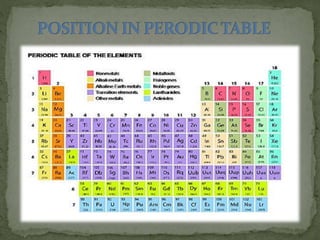
 GROUP - 13 or III A
 ELEMENTS – BORON (B)
ALUMINIUM (Al)
GALLIUM(Ga)
INDIUM(In)
THALLIUM (Tl)
 GENERAL ELECTRONIC CONFIGURATION
ns²np¹
 OXIDATION STATE
+3 or +1
 Atomic Number - 05
 Atomic Mass / g mol−¹ - 10.81
 Electronic Configuration – {He} 2s²2p¹
 Electron Negativity – 2.0
 Boron is a shiny, black metalloid.
 Metalloids have both the properties of a metal and a
non-metal.
 It a poor conductor of electricity at low temperatures
but a great conductor of electricity at high
temperatures.
 It is a pure substance meaning it is made up of one
type of atom.
 It has a high melting point 2453 °C.
 It has boiling point 3923 °C.
 When it is a solid, boron can be as hard diamonds.
 Even though it is very hard, it is still too fragile for
useful purposes.
 Boron can combine with oxygen to form boron trioxide
(B2O3).
 When it is in powder form, it reacts with hot nitric acid
(HNO3) and hot sulfuric acid (H2SO4).
 It also dissolves in molten metal.
 Atomic Number - 13
 Atomic Mass / g mol−¹ - 26.98
 Electronic Configuration – {Ne} 3s²3p¹
 Electron Negativity – 1.5
 Aluminium is soft, lightweight, silvery, metal.
 It is a great conductor of electricity.
 It has a melting point of 933° C
 It has a boiling point 2740°C
 It is both ductile and malleable.
 Ductile means “capable of being pulled into thin
wires”.
 Malleable means “capable of being hammered into
thin sheets.
 In moist air, it gradually combines with oxygen to
form aluminum oxide.
 Reacts with many hot acids and alkalis.
 Alkalis is a chemical with the opposite properties of
an acid.
 Aluminum also reacts with hot water and in powdered
form, it catches on fire.
 Atomic Number - 31
 Atomic Mass / g mol−¹ - 69.72
 Electronic Configuration – {Ar} 4s²4p¹
 Electron Negativity – 1.6
 Gallium is soft, silvery, shiny metal.
 Conductor of electricity.
 But unlike a regular metal, it is so soft it can melt in the
palm of your bare hand.
 It has a very low melting point at 29.7 °C
 Gallium can be cooled really easily into a solid but it can
still be cooled below 29.7 °C without turning into a solid.
 It has boiling point 2676 degrees Celsius
 Gallium can combine with most non-metals at high
temperatures
 It reacts to both acids and alkali metal.
 Atomic Number - 49
 Atomic Mass / g mol−¹ - 114.82
 Electronic Configuration – {Kr} 4d¹°5s²5p¹
 Electron Negativity – 1.7
 Indium is a silvery, shiny metal.
 Conductor of electricity.
 It is so soft, if rubbed on paper, it leaves a mark like
lead.
 It generates a brief screech when bent.
 It has a melting point of 156.6 °C
 It has a boiling point of 2075° C.
 Even though at really low temperatures, gallium can
still be very soft. This property allows gallium to be
used below the temperatures of Absolute Zero.
 Atomic Number - 81
 Atomic Mass / g mol−¹ - 204.38
 Electronic Configuration – {Xe} 5d¹°6s²6p¹
 Electron Negativity – 1.8
 Thallium is a bluish-white metal.
 Thallium resembles lead and can be used like lead too.
 It is also soft enough to be cut with a knife.
 It can melt fairly easily and has a melting point of
302° C.
 It Has a boiling point of 1456° C.
 Thallium reacts with acids.
 It also reacts with oxygen too and when exposed to
air, it forms a thin coating of thallium oxide (TL2O).
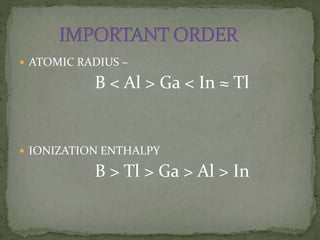
 ATOMIC RADIUS –
B < Al > Ga < In ≈ Tl
 IONIZATION ENTHALPY
B > Tl > Ga > Al > In
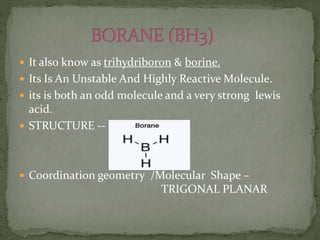
 It also know as trihydriboron & borine.
 Its Is An Unstable And Highly Reactive Molecule.
 its is both an odd molecule and a very strong lewis
acid.
 STRUCTURE --
 Coordination geometry /Molecular Shape –
TRIGONAL PLANAR
 Dipole moment = 0 D
 Appearance = colourless gas
 Hybridisation - sp²
 B-H bond length – 119pm
 Bond angle - 120°
 FORMULA –B2H6
 It is colorless & highly unstable
 It is pyrophoric gas at room temperature with a
repulsively sweet odor.
 Other name – boroethane
boron hydride
diboron hexahydride
 Coordination geometry - tetrahedral
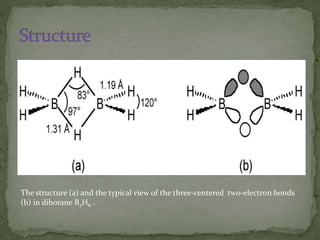
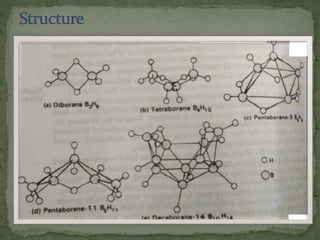
The structure (a) and the typical view of the three-centered two-electron bonds
(b) in diborane B2H6 .
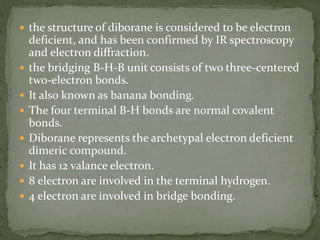
 the structure of diborane is considered to be electron
deficient, and has been confirmed by IR spectroscopy
and electron diffraction.
 the bridging B-H-B unit consists of two three-centered
two-electron bonds.
 It also known as banana bonding.
 The four terminal B-H bonds are normal covalent
bonds.
 Diborane represents the archetypal electron deficient
dimeric compound.
 It has 12 valance electron.
 8 electron are involved in the terminal hydrogen.
 4 electron are involved in bridge bonding.
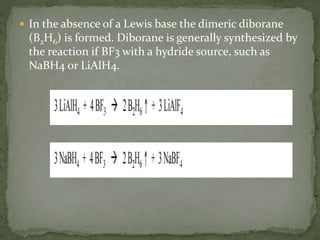
 In the absence of a Lewis base the dimeric diborane
(B2H6) is formed. Diborane is generally synthesized by
the reaction if BF3 with a hydride source, such as
NaBH4 or LiAlH4.
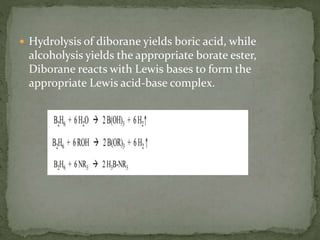
 Hydrolysis of diborane yields boric acid, while
alcoholysis yields the appropriate borate ester,
Diborane reacts with Lewis bases to form the
appropriate Lewis acid-base complex.
USES OF DIBORANE
 It Has Been Suggested As A Rocket
Propellant And Experimentally Fired But
Not Used In Any In Service Rocket As A
Rubbervulcaniser As A Catalyst For
Hydrocarbon , Polymerization As A Flame
Speed Accelerator And As A Doping Agent
For The Production Of Semiconductors.
 It Is Also An Intermideate In The Production Of
Highly Pure Boron For Semiconductor Production.
 it is also used to coat the walls of tokomaks to reduce
the amount of heavy metal impurities in the plasma.
 They are commonly known as BORANES
(analogy with the alkanes , hydrocarbons).
 REPRESENTED BY -
1. NIDO BORANES -- BnHn+6
2. ARACHNO-BORANES-- BnHn+4
2
ND ARE MORE STABLE THAN 1ST
A. The Latin prefixes mono-, di-, tri-, etc. are used
before "borane" to indicate the number of boron
atoms in the compound.
B. Immediately following the "e" in "borane" the
number of hydrogen atoms is placed in parentheses
using Arabic numerals.
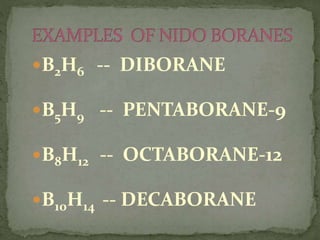
B2H6 -- DIBORANE
B5H9 -- PENTABORANE-9
B8H12 -- OCTABORANE-12
B10H14 -- DECABORANE
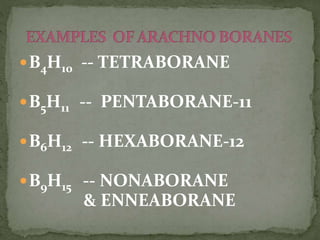
B4H10 -- TETRABORANE
B5H11 -- PENTABORANE-11
B6H12 -- HEXABORANE-12
B9H15 -- NONABORANE
& ENNEABORANE
 GENERAL FORMULA -- B2X4
 THESE DECOMPOSE SLOWLY AT ROOM
TEMPERATURE.
 EXAMPLE - B2Cl4
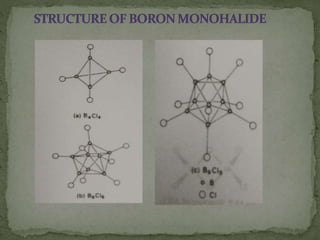
 BORON FORMS SEVERAL STABLE
POLYMERIC MONOHALIDES (BX)N .
 THE COMPOUND B4CL4 , B8CL8 ,B9CL9
ARE CRYSTALLINE SOLIDS.
 THEIR STRUCTURE HAVE A CLOSED
CAGE OR POLYHEDRON.
THANK YOU

B family

  • 2.
    STUDENT NISHANT KATARA BSC HON.CHEMISTRY PROFESSOR DR. PRIYAMVADA INORGANIC CHEMISTRY
  • 4.
     GROUP -13 or III A  ELEMENTS – BORON (B) ALUMINIUM (Al) GALLIUM(Ga) INDIUM(In) THALLIUM (Tl)
  • 6.
     GENERAL ELECTRONICCONFIGURATION ns²np¹  OXIDATION STATE +3 or +1
  • 7.
     Atomic Number- 05  Atomic Mass / g mol−¹ - 10.81  Electronic Configuration – {He} 2s²2p¹  Electron Negativity – 2.0  Boron is a shiny, black metalloid.  Metalloids have both the properties of a metal and a non-metal.  It a poor conductor of electricity at low temperatures but a great conductor of electricity at high temperatures.
  • 8.
     It isa pure substance meaning it is made up of one type of atom.  It has a high melting point 2453 °C.  It has boiling point 3923 °C.  When it is a solid, boron can be as hard diamonds.  Even though it is very hard, it is still too fragile for useful purposes.  Boron can combine with oxygen to form boron trioxide (B2O3).  When it is in powder form, it reacts with hot nitric acid (HNO3) and hot sulfuric acid (H2SO4).  It also dissolves in molten metal.
  • 9.
     Atomic Number- 13  Atomic Mass / g mol−¹ - 26.98  Electronic Configuration – {Ne} 3s²3p¹  Electron Negativity – 1.5  Aluminium is soft, lightweight, silvery, metal.  It is a great conductor of electricity.  It has a melting point of 933° C  It has a boiling point 2740°C
  • 10.
     It isboth ductile and malleable.  Ductile means “capable of being pulled into thin wires”.  Malleable means “capable of being hammered into thin sheets.  In moist air, it gradually combines with oxygen to form aluminum oxide.  Reacts with many hot acids and alkalis.  Alkalis is a chemical with the opposite properties of an acid.  Aluminum also reacts with hot water and in powdered form, it catches on fire.
  • 11.
     Atomic Number- 31  Atomic Mass / g mol−¹ - 69.72  Electronic Configuration – {Ar} 4s²4p¹  Electron Negativity – 1.6  Gallium is soft, silvery, shiny metal.  Conductor of electricity.  But unlike a regular metal, it is so soft it can melt in the palm of your bare hand.  It has a very low melting point at 29.7 °C  Gallium can be cooled really easily into a solid but it can still be cooled below 29.7 °C without turning into a solid.
  • 12.
     It hasboiling point 2676 degrees Celsius  Gallium can combine with most non-metals at high temperatures  It reacts to both acids and alkali metal.
  • 13.
     Atomic Number- 49  Atomic Mass / g mol−¹ - 114.82  Electronic Configuration – {Kr} 4d¹°5s²5p¹  Electron Negativity – 1.7  Indium is a silvery, shiny metal.  Conductor of electricity.  It is so soft, if rubbed on paper, it leaves a mark like lead.  It generates a brief screech when bent.  It has a melting point of 156.6 °C
  • 14.
     It hasa boiling point of 2075° C.  Even though at really low temperatures, gallium can still be very soft. This property allows gallium to be used below the temperatures of Absolute Zero.
  • 15.
     Atomic Number- 81  Atomic Mass / g mol−¹ - 204.38  Electronic Configuration – {Xe} 5d¹°6s²6p¹  Electron Negativity – 1.8  Thallium is a bluish-white metal.  Thallium resembles lead and can be used like lead too.  It is also soft enough to be cut with a knife.  It can melt fairly easily and has a melting point of 302° C.  It Has a boiling point of 1456° C.
  • 16.
     Thallium reactswith acids.  It also reacts with oxygen too and when exposed to air, it forms a thin coating of thallium oxide (TL2O).
  • 17.
     ATOMIC RADIUS– B < Al > Ga < In ≈ Tl  IONIZATION ENTHALPY B > Tl > Ga > Al > In
  • 19.
     It alsoknow as trihydriboron & borine.  Its Is An Unstable And Highly Reactive Molecule.  its is both an odd molecule and a very strong lewis acid.  STRUCTURE --  Coordination geometry /Molecular Shape – TRIGONAL PLANAR
  • 20.
     Dipole moment= 0 D  Appearance = colourless gas  Hybridisation - sp²  B-H bond length – 119pm  Bond angle - 120°
  • 21.
     FORMULA –B2H6 It is colorless & highly unstable  It is pyrophoric gas at room temperature with a repulsively sweet odor.  Other name – boroethane boron hydride diboron hexahydride  Coordination geometry - tetrahedral
  • 22.
    The structure (a)and the typical view of the three-centered two-electron bonds (b) in diborane B2H6 .
  • 23.
     the structureof diborane is considered to be electron deficient, and has been confirmed by IR spectroscopy and electron diffraction.  the bridging B-H-B unit consists of two three-centered two-electron bonds.  It also known as banana bonding.  The four terminal B-H bonds are normal covalent bonds.  Diborane represents the archetypal electron deficient dimeric compound.  It has 12 valance electron.  8 electron are involved in the terminal hydrogen.  4 electron are involved in bridge bonding.
  • 24.
     In theabsence of a Lewis base the dimeric diborane (B2H6) is formed. Diborane is generally synthesized by the reaction if BF3 with a hydride source, such as NaBH4 or LiAlH4.
  • 25.
     Hydrolysis ofdiborane yields boric acid, while alcoholysis yields the appropriate borate ester, Diborane reacts with Lewis bases to form the appropriate Lewis acid-base complex.
  • 26.
    USES OF DIBORANE It Has Been Suggested As A Rocket Propellant And Experimentally Fired But Not Used In Any In Service Rocket As A Rubbervulcaniser As A Catalyst For Hydrocarbon , Polymerization As A Flame Speed Accelerator And As A Doping Agent For The Production Of Semiconductors.
  • 27.
     It IsAlso An Intermideate In The Production Of Highly Pure Boron For Semiconductor Production.  it is also used to coat the walls of tokomaks to reduce the amount of heavy metal impurities in the plasma.
  • 28.
     They arecommonly known as BORANES (analogy with the alkanes , hydrocarbons).  REPRESENTED BY - 1. NIDO BORANES -- BnHn+6 2. ARACHNO-BORANES-- BnHn+4 2 ND ARE MORE STABLE THAN 1ST
  • 29.
    A. The Latinprefixes mono-, di-, tri-, etc. are used before "borane" to indicate the number of boron atoms in the compound. B. Immediately following the "e" in "borane" the number of hydrogen atoms is placed in parentheses using Arabic numerals.
  • 30.
    B2H6 -- DIBORANE B5H9-- PENTABORANE-9 B8H12 -- OCTABORANE-12 B10H14 -- DECABORANE
  • 32.
    B4H10 -- TETRABORANE B5H11-- PENTABORANE-11 B6H12 -- HEXABORANE-12 B9H15 -- NONABORANE & ENNEABORANE
  • 34.
     GENERAL FORMULA-- B2X4  THESE DECOMPOSE SLOWLY AT ROOM TEMPERATURE.  EXAMPLE - B2Cl4
  • 35.
     BORON FORMSSEVERAL STABLE POLYMERIC MONOHALIDES (BX)N .  THE COMPOUND B4CL4 , B8CL8 ,B9CL9 ARE CRYSTALLINE SOLIDS.  THEIR STRUCTURE HAVE A CLOSED CAGE OR POLYHEDRON.
  • 37.