Problem-based Learning:
Challenges, Components, and Benefits


 Stephen A. Bernhardt
 sab@udel.edu
Characteristics Needed in College Graduates

        • High level of communication skills
        • Ability to define problems, gather and
          evaluate information, develop solutions
        • Team skills -- ability to work with others
        • Ability to use all of the above to address
          problems in a complex real-world setting


Quality Assurance in Undergraduate Education (1994)
Wingspread Conference, ECS, Boulder, CO.
21st Century Literacies
        • Develop proficiency with the tools of technology
        • Build relationships with others to pose and solve
          problems collaboratively and cross-culturally
        • Design and share information for global
          communities to meet a variety of purposes
        • Manage, analyze and synthesize multiple streams
          of simultaneous information
        • Create, critique, analyze, and evaluate multi-
          media texts
        • Attend to the ethical responsibilities required by
          these complex environments


National Council of Teachers of English, Feb. 15, 2008
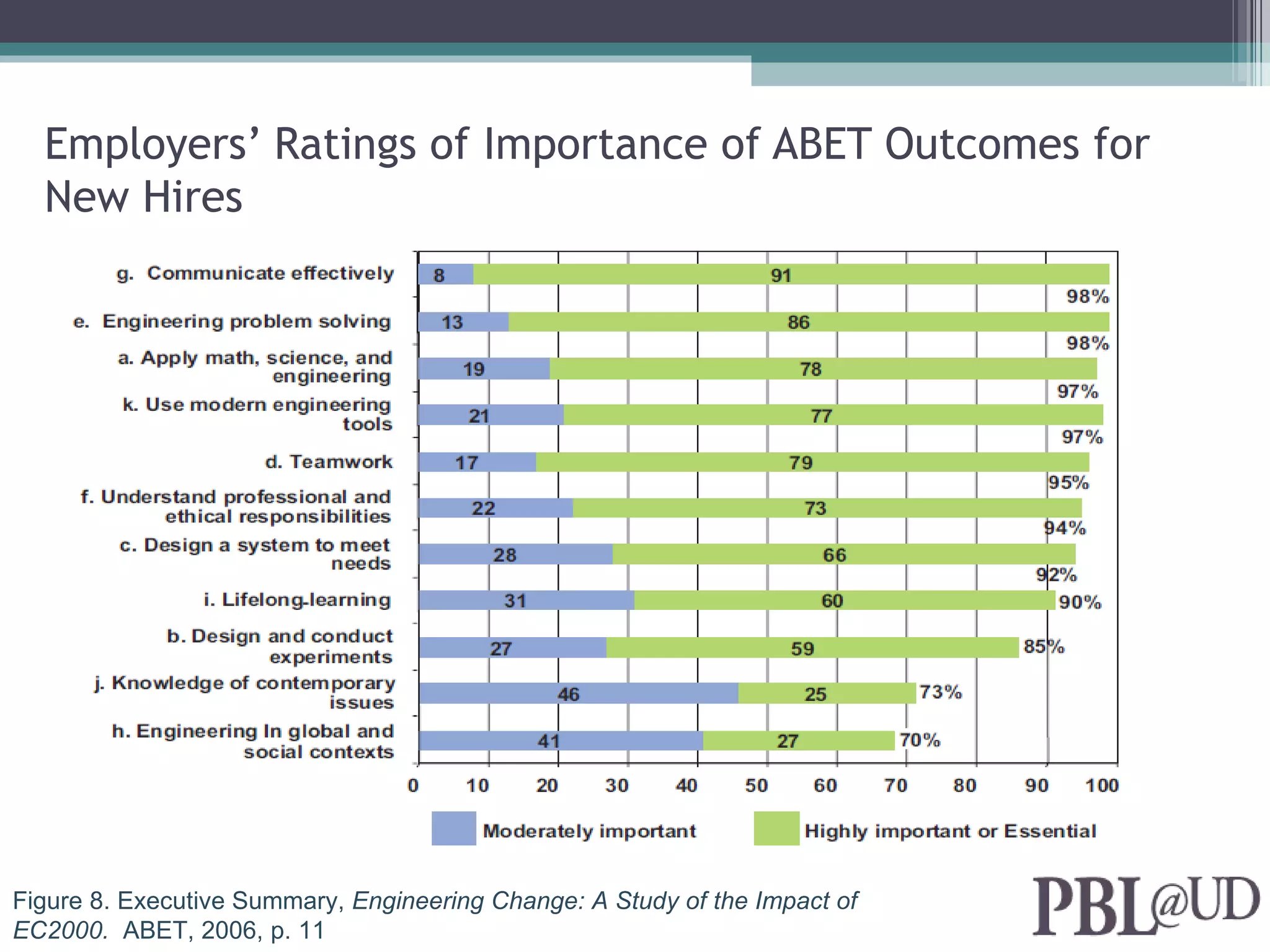
Employers’ Ratings of Importance of ABET Outcomes for
  New Hires


Figure 8. Executive Summary, Engineering Change: A Study of the Impact of
EC2000. ABET, 2006, p. 11
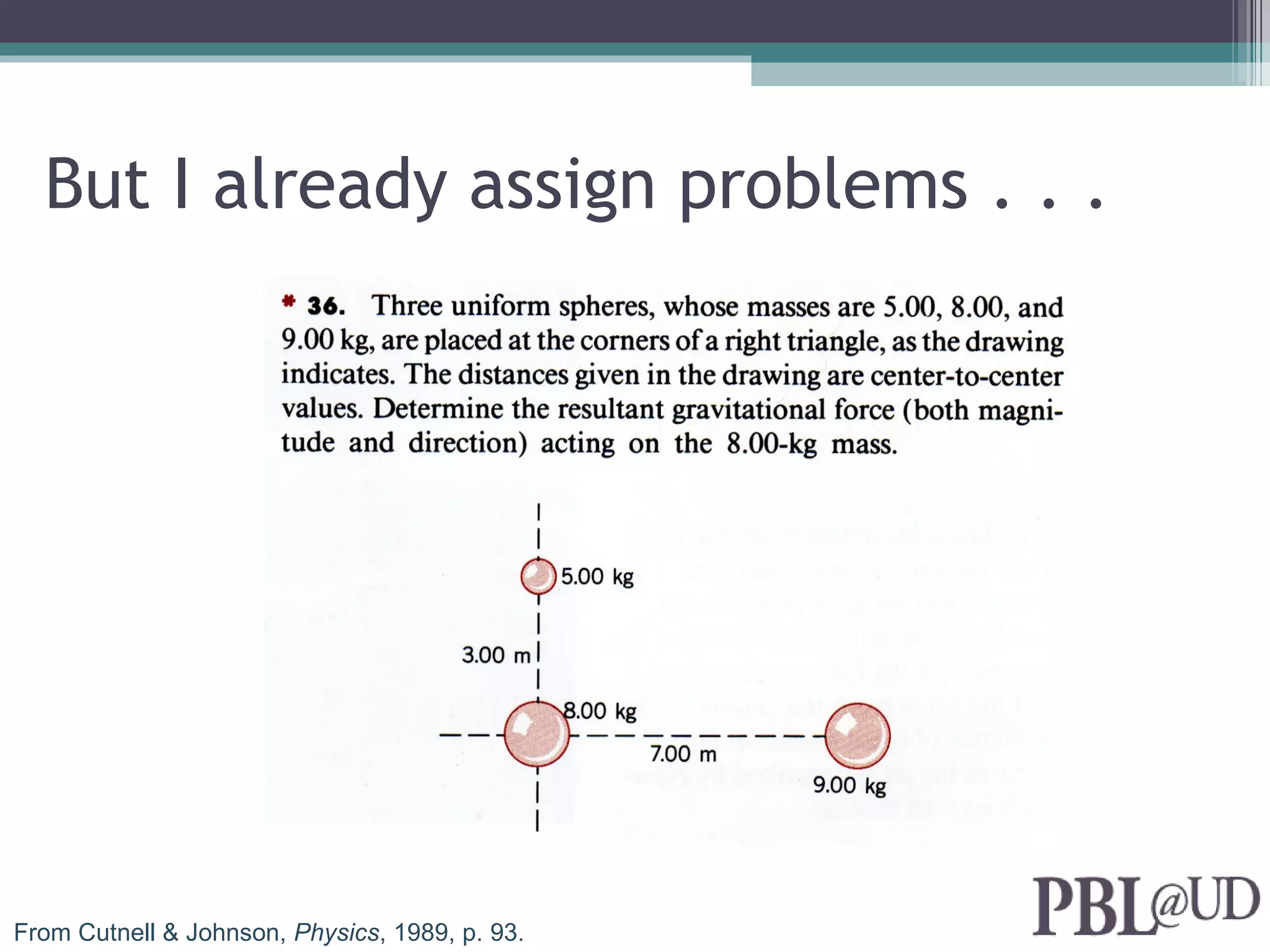
But I already assign problems . . .


From Cutnell & Johnson, Physics, 1989, p. 93.
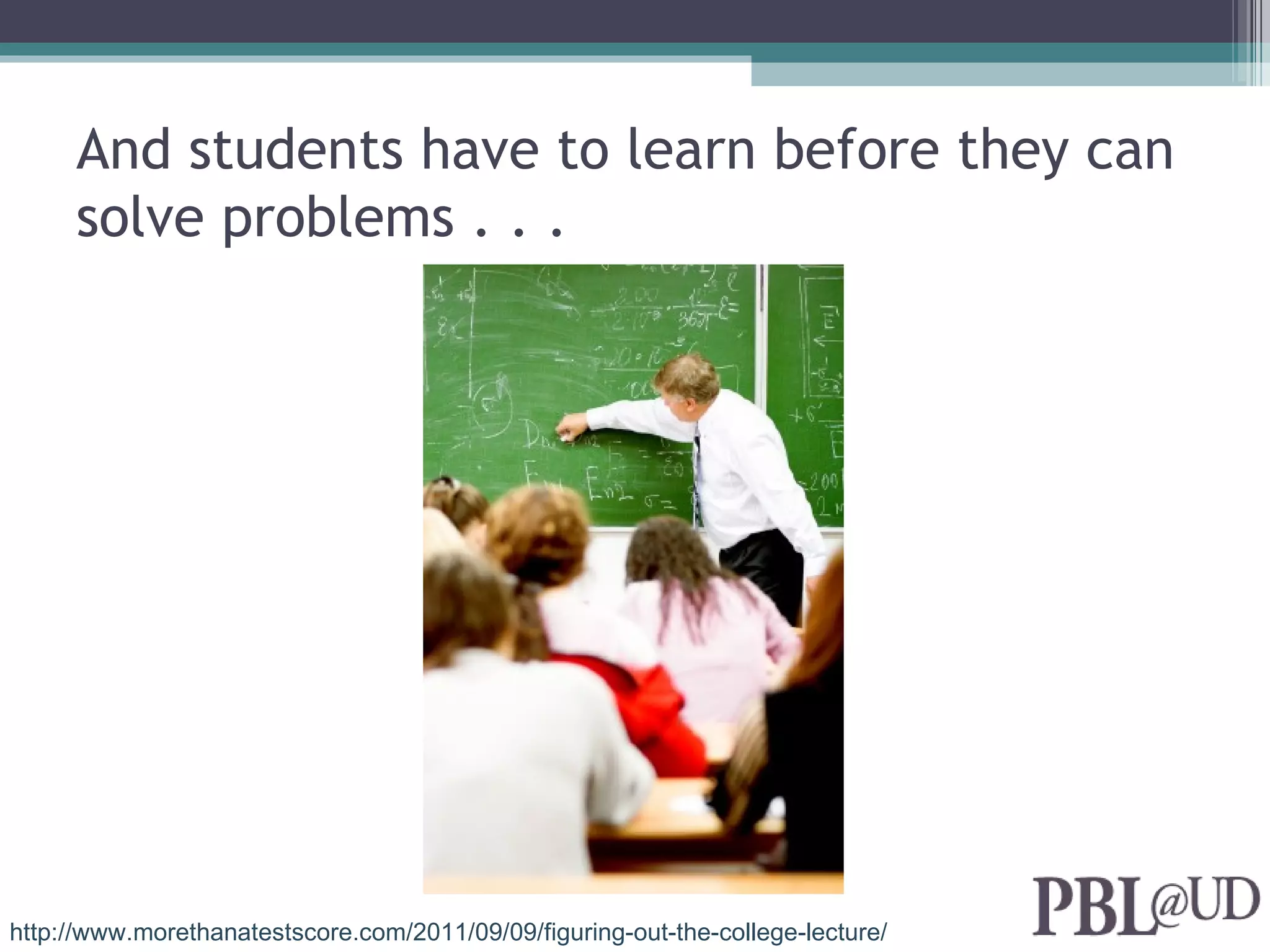
And students have to learn before they can
     solve problems . . .


http://www.morethanatestscore.com/2011/09/09/figuring-out-the-college-lecture/
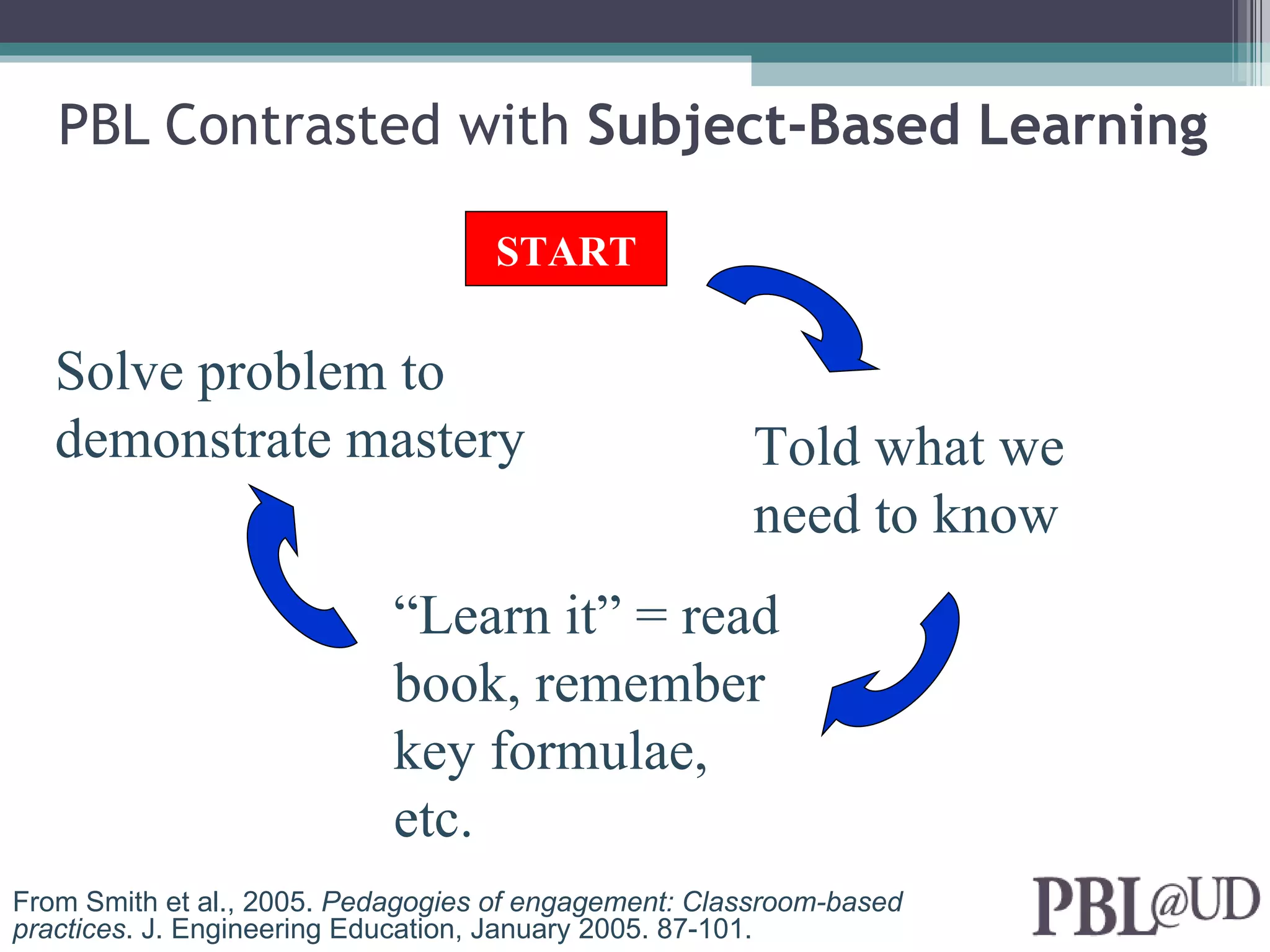
PBL Contrasted with Subject-Based Learning

                                   START

   Solve problem to
   demonstrate mastery                                Told what we
                                                      need to know
                            “Learn it” = read
                            book, remember
                            key formulae,
                            etc.
From Smith et al., 2005. Pedagogies of engagement: Classroom-based
practices. J. Engineering Education, January 2005. 87-101.
PBL begins with a problem . . . a different kind
    of problem

     • Major League Baseball (MLB) is looking to sell the
       Montreal Expos, which it currently owns. Competitive
       bids have been submitted by two Mexican cities, Mexico
       City and Monterrey. Prior to making a decision, MLB has
       asked your consulting firm to evaluate the effect that
       altitude would have on a fly ball in these two baseball
       stadiums . . .


PBL Clearinghouse “What a Drag!,” by Ed Nowak
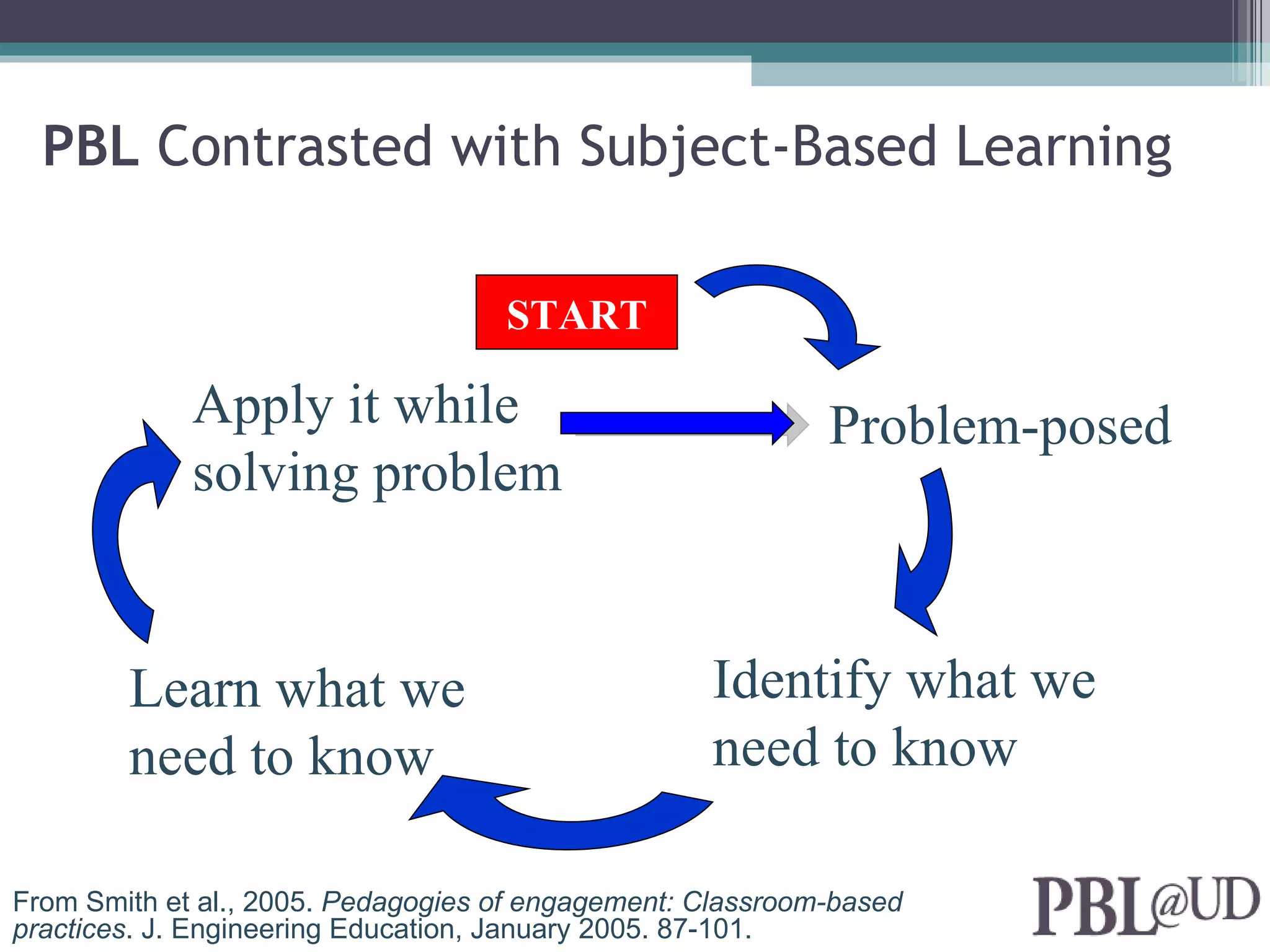
PBL Contrasted with Subject-Based Learning

                                    START

             Apply it while                                 Problem-posed
             solving problem


        Learn what we                              Identify what we
        need to know                               need to know

From Smith et al., 2005. Pedagogies of engagement: Classroom-based
practices. J. Engineering Education, January 2005. 87-101.
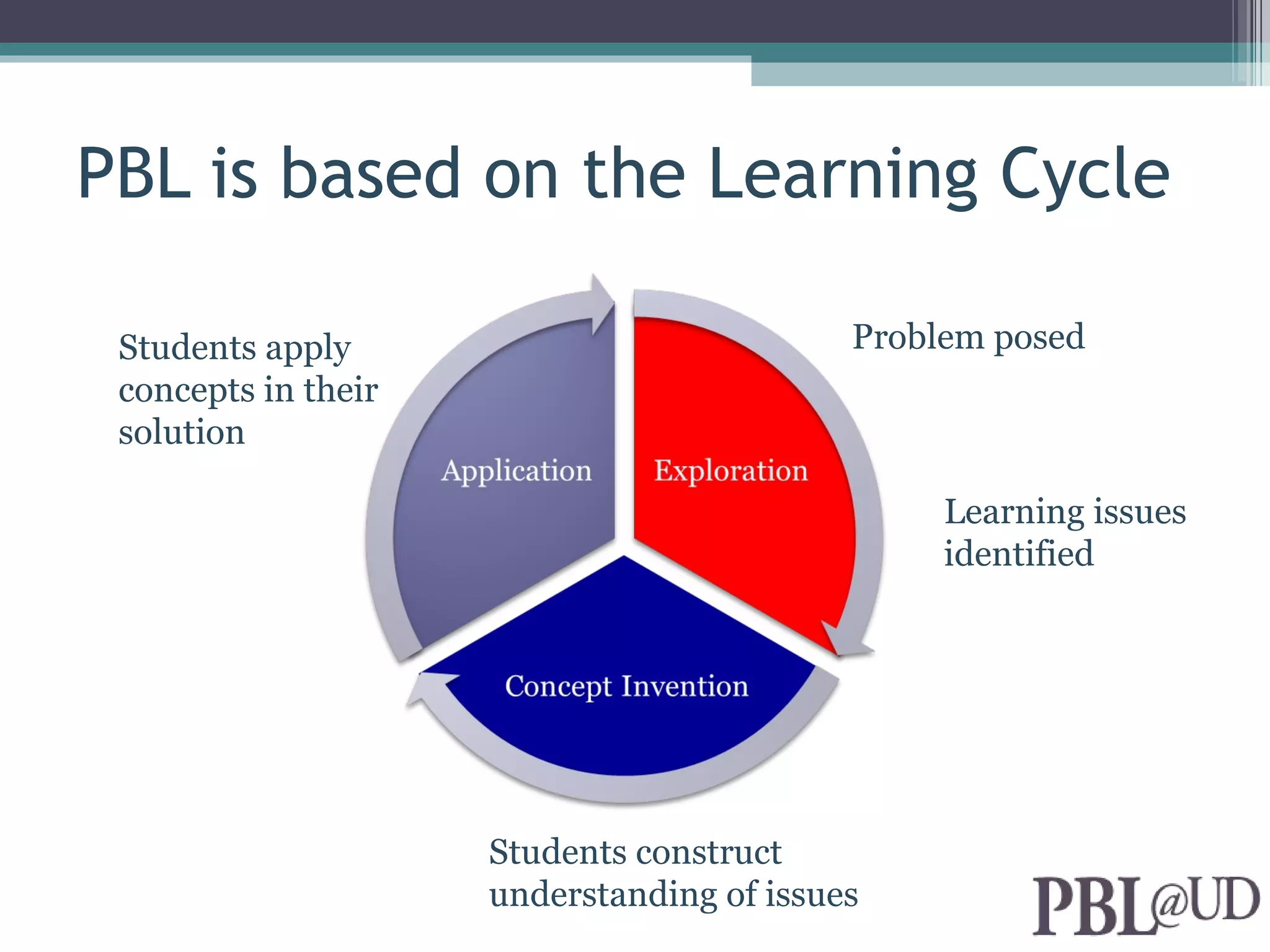
PBL is based on the Learning Cycle

 Students apply                            Problem posed
 concepts in their
 solution

                                                Learning issues
                                                identified


                     Students construct
                     understanding of issues
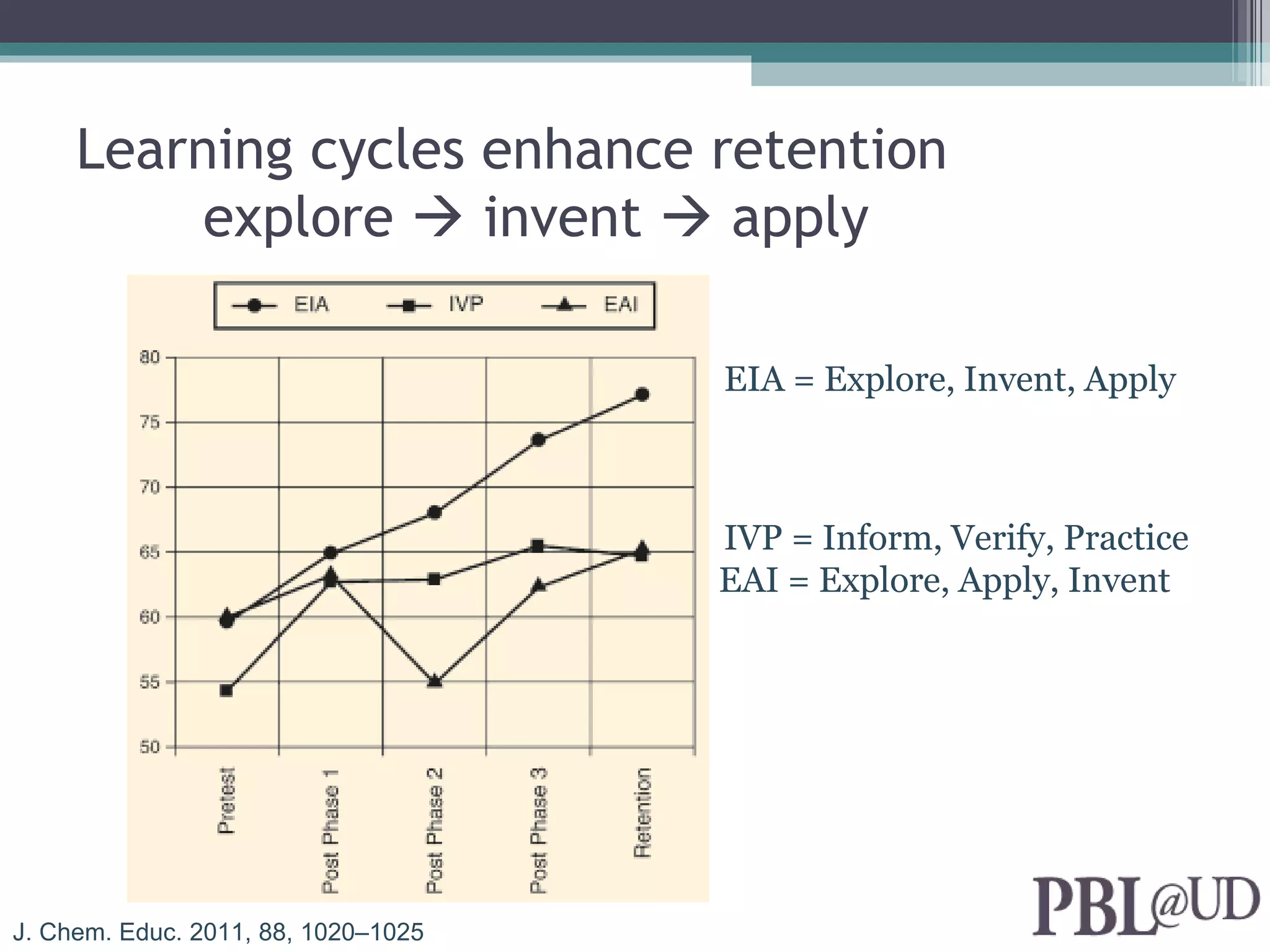
Learning cycles enhance retention
          explore  invent  apply

                                     EIA = Explore, Invent, Apply


                                     IVP = Inform, Verify, Practice
                                     EAI = Explore, Apply, Invent


J. Chem. Educ. 2011, 88, 1020–1025
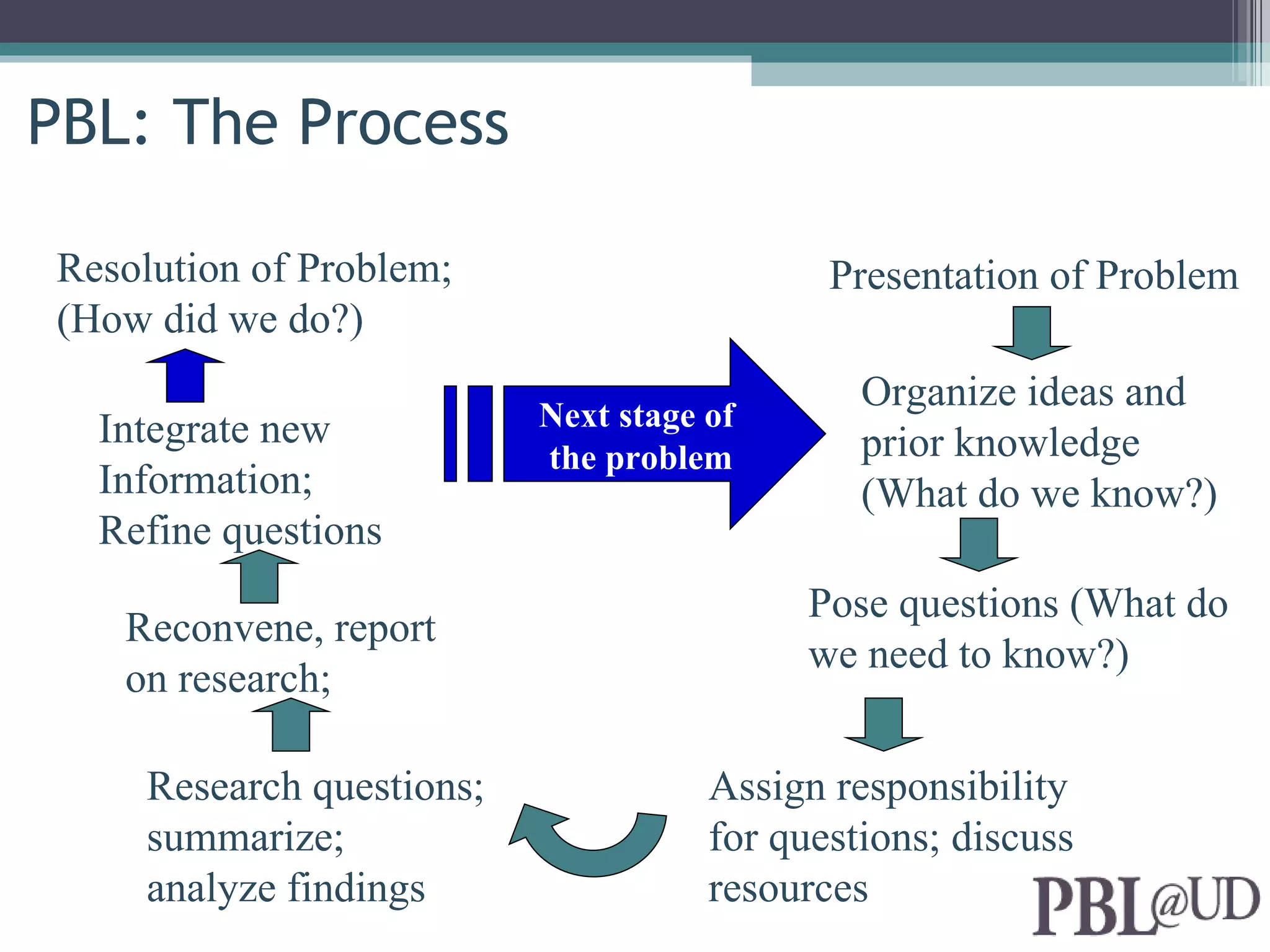
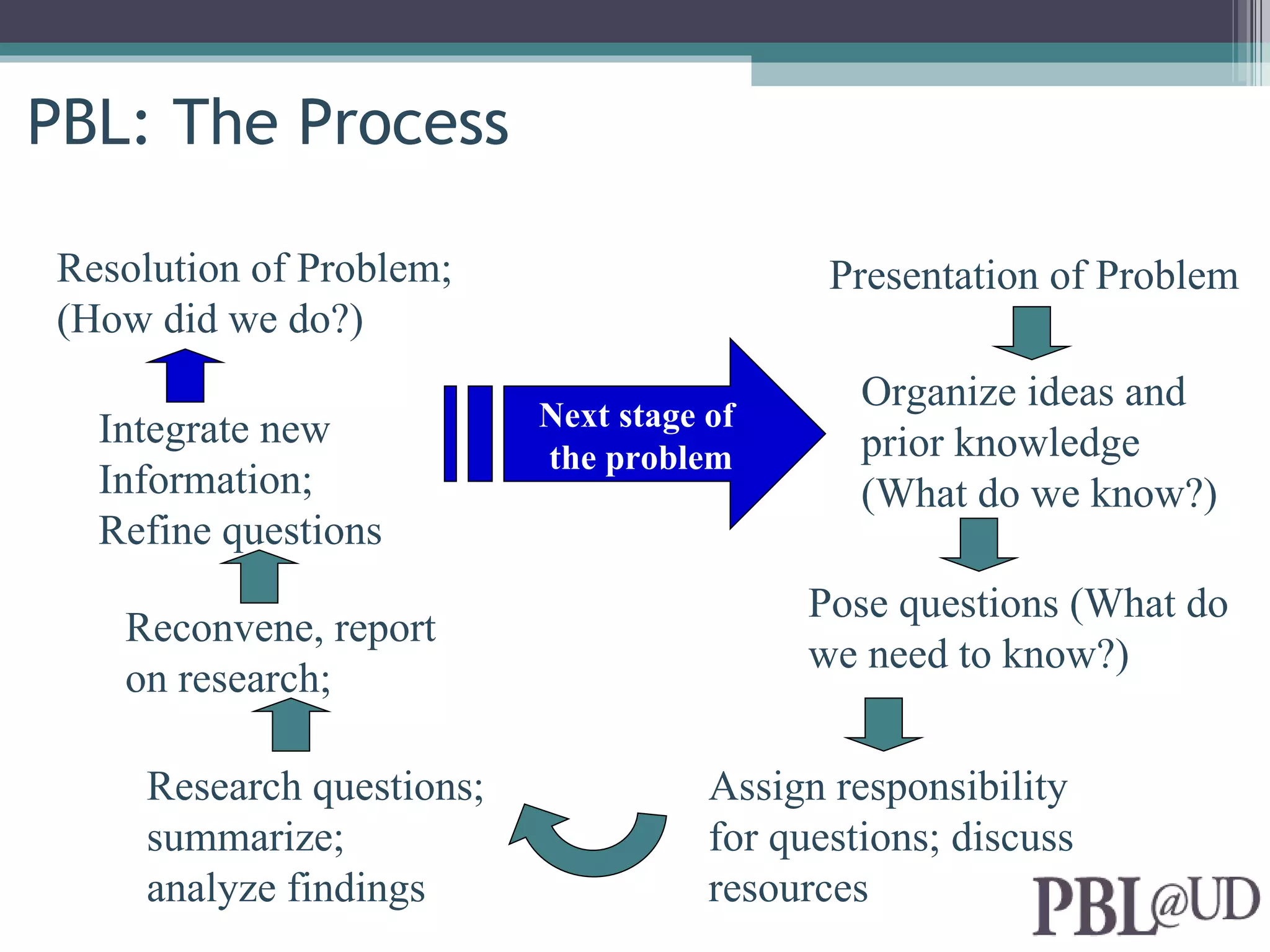
PBL: The Process

Resolution of Problem;                       Presentation of Problem
(How did we do?)
                                               Organize ideas and
  Integrate new            Next stage of
                           the problem         prior knowledge
  Information;                                 (What do we know?)
  Refine questions
                                            Pose questions (What do
   Reconvene, report
                                            we need to know?)
   on research;

     Research questions;              Assign responsibility
     summarize;                       for questions; discuss
     analyze findings                 resources
But I have to cover content…
Balancing Course Objectives
 Tackle hard decisions about course content
 • What content is essential?
 • What is needed in subsequent courses?
 • What knowledge is lasting?


 Don’t overlook process skills
 •Which skills are most important to your goals?
 •Can content and process go hand-in-hand?


         Learning Content      Developing Process Skills
Typical Medical School PBL Problem:
High Degree of Authenticity
  Patient arrives at hospital, ER, physician’s office
  presenting with symptoms X, Y, Z
    What questions should you ask?
    What tests should you order?
  Physician interviews patient, receives results of
  tests
    Differential diagnosis
    Preferred therapy
The Rule of 72
  Bill is working at a financial services firm as a summer
  intern. Stan, the area director, calls him into his office.

  Stan: One of our analysts is using the Rule of 72 to give
  predictions to our customers on how fast their money would
  grow. I’m concerned that this could get us in trouble. I’d like
  your recommendation on whether or not we should continue
  to use the rule to give estimates to our clients. Have your
  recommendations on my desk tomorrow.
  Bill: Um, sure….


Mark A. Serva, University of Delaware
PBL Models for Undergraduate Courses

 Medical School Model
     Small class, one instructor to 8-10 students
 Floating Facilitator Model
     Small to medium class, one instructor, up to
      ~75 students
 Peer Facilitator Model
     Small to large class, one instructor and
      several peer facilitators
 Large Class Models
   Floating facilitator and hybrid PBL/other
   activities
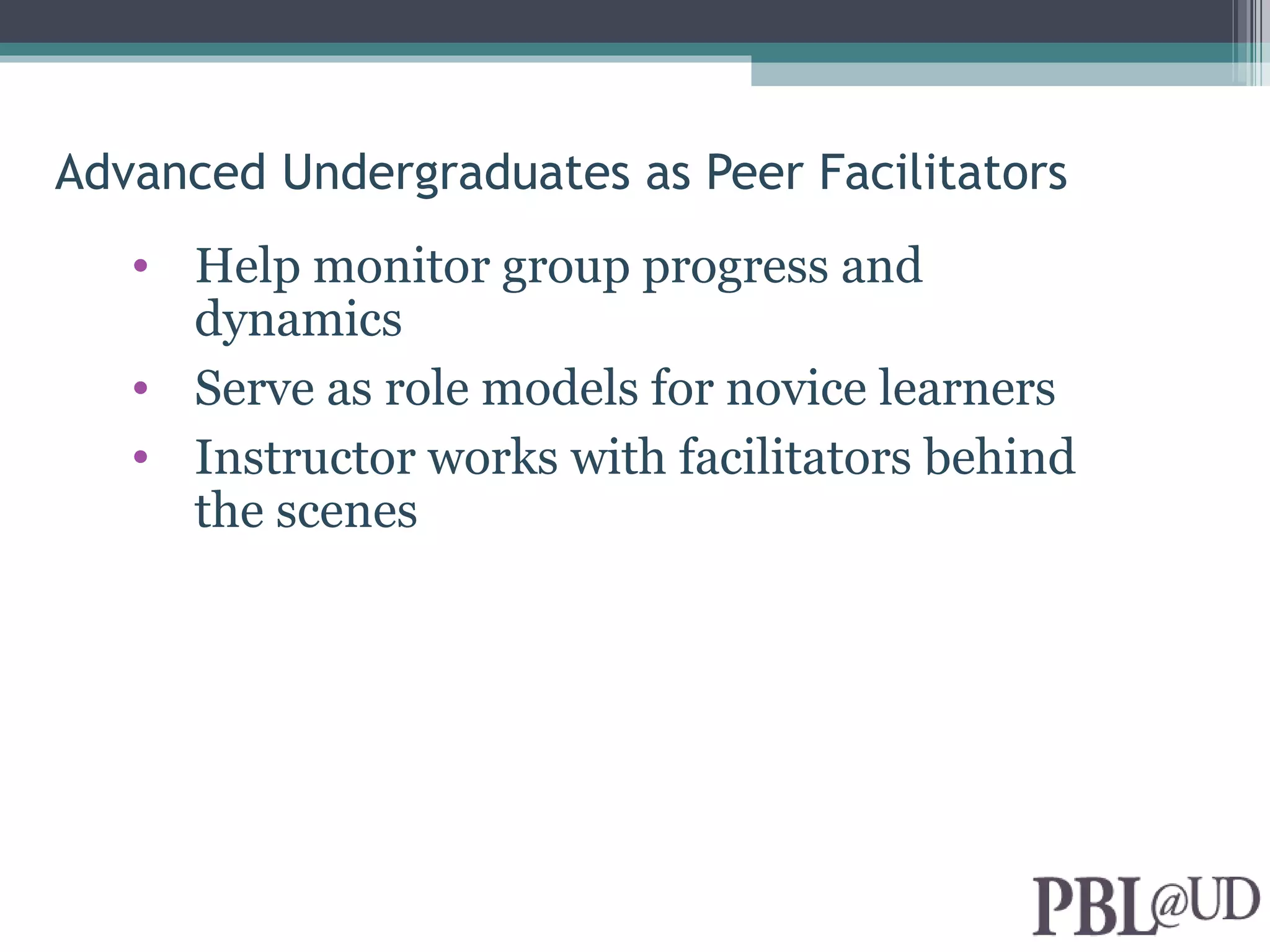
Advanced Undergraduates as Peer Facilitators
   • Help monitor group progress and
     dynamics
   • Serve as role models for novice learners
   • Instructor works with facilitators behind
     the scenes
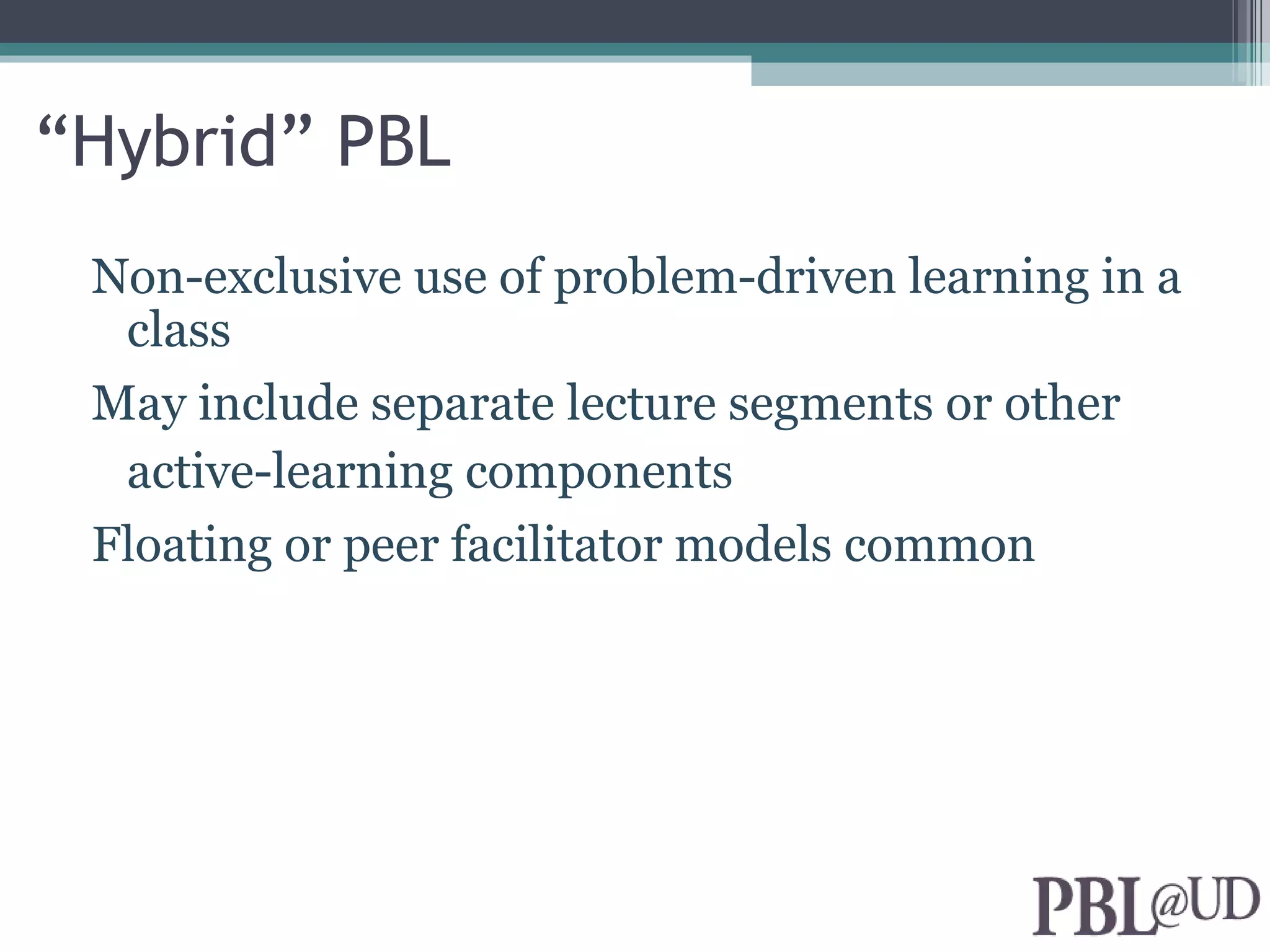
“Hybrid” PBL
 Non-exclusive use of problem-driven learning in a
  class
 May include separate lecture segments or other
  active-learning components
 Floating or peer facilitator models common
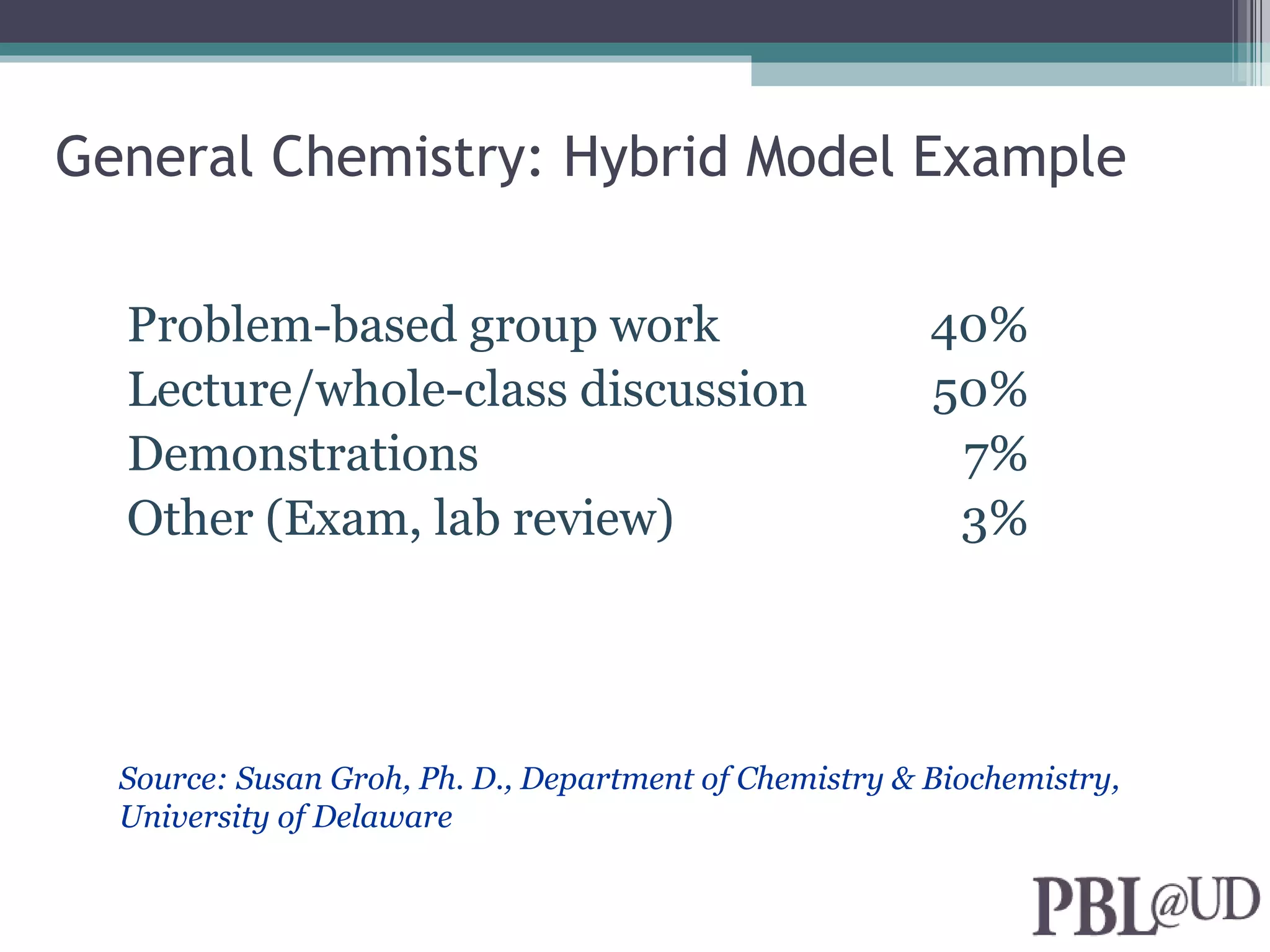
General Chemistry: Hybrid Model Example

  Problem-based group work                              40%
  Lecture/whole-class discussion                        50%
  Demonstrations                                         7%
  Other (Exam, lab review)                               3%


  Source: Susan Groh, Ph. D., Department of Chemistry & Biochemistry,
  University of Delaware
So what does the teacher do?
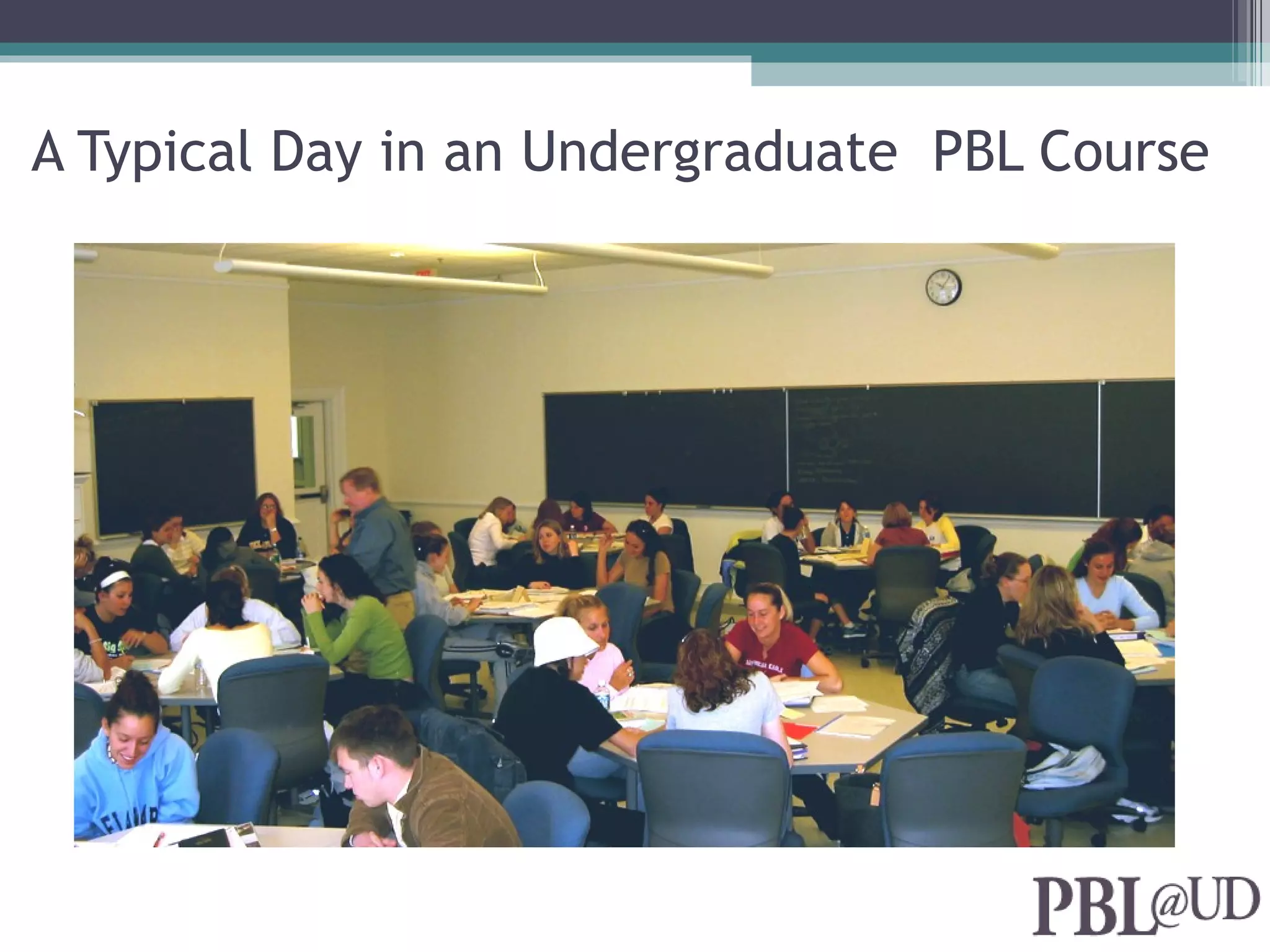
A Typical Day in an Undergraduate PBL Course
Instructor roles
 •   Establish learning goals
 •   Create great problems
 •   Keep teams on track
 •   Present information as needed
 •   Evaluate outcomes
 •   Encourage reflective learning and transfer
What Makes a Good PBL Problem?
• Well-formed learning objectives for content and process
• The need for a solution, decision, or recommendation
• A “hook” or human scenario
• Good prompting questions (“What do we know?” “What
  do we need to know?”)
• Need for research
• Thoughtful staging/selective disclosure
• Summative and formative assessment
Technologies for Haiti Relief
     • Problem: Propose a technology to address
       pressing issues in Haiti post-earthquake
     • Research: Students research situation in Haiti
       and available technologies (shelter, clean water,
       construction, communication)
     • Deliverables: Proposal, progress report,
       technical briefing, document for wider audience,
       presentation


Steve Bernhardt, Technical Writing, UD
PBL supports communication skills
• Discussion to define, analyze, evaluate
• Writing to set rules, assign tasks, manage team
• Reading to learn what is needed
• Speaking and writing to present findings,
  solutions, recommendations
• Writing and discussing to evaluate and reflect
Can we assess teamwork and problem solving?
Assessment in PBL
 • Evaluate knowledge, skills, behaviors, and
   applied learning
 • Use both formative feedback and summative
   evaluation
 • Assess performance and deliverables
 • Use self and peer evaluation
 • Assess both teamwork and individual learning
Common Features of PBL
• Learning is initiated by a problem.
• Problems are based on complex, real-world situations.
• All information needed to solve problem is not given
  initially.
• Students identify, find and use appropriate resources.
• Students work in permanent groups.
• Learning is active, integrated, cumulative and connected.
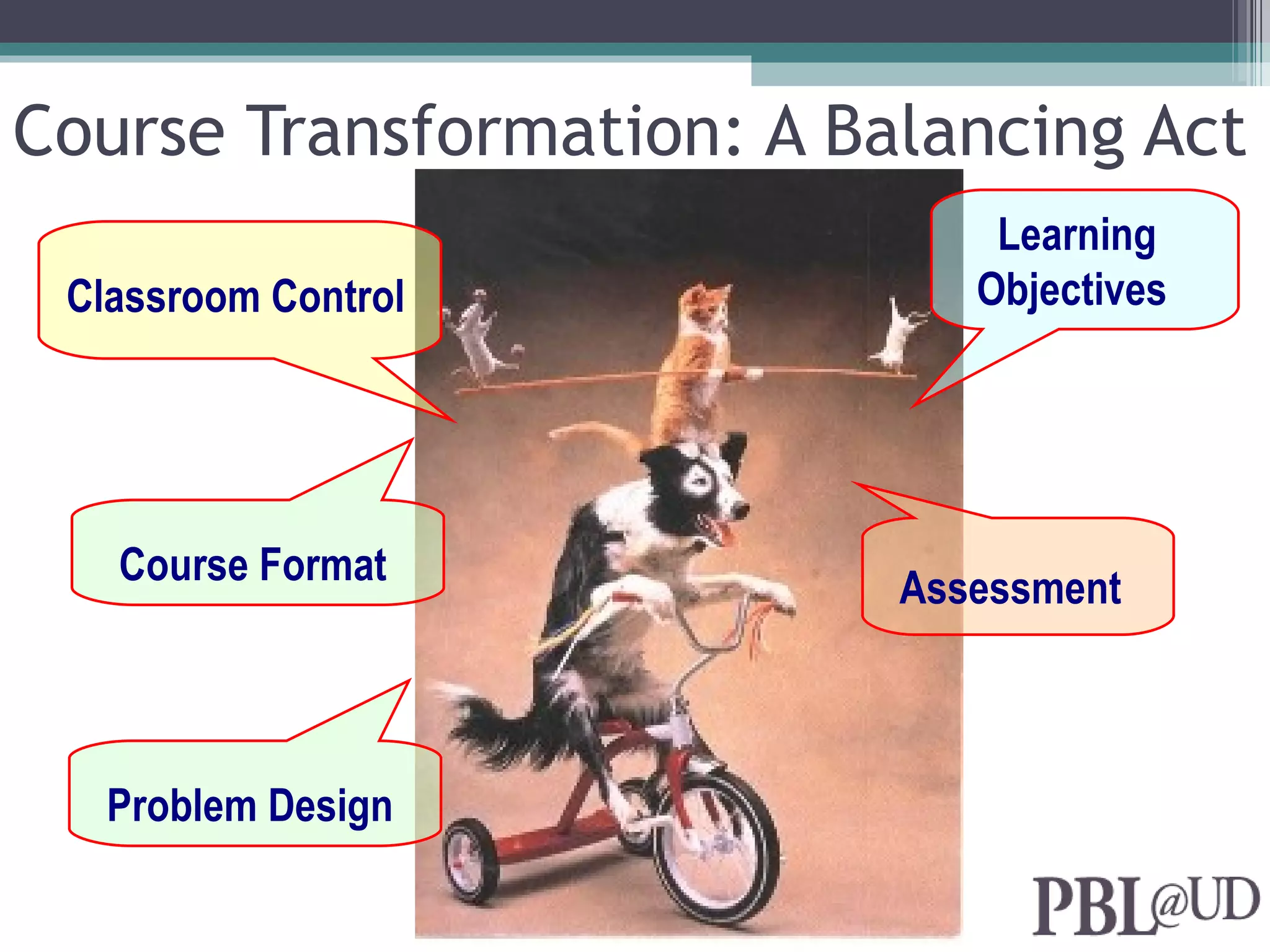
Course Transformation: A Balancing Act
                               Learning
 Classroom Control            Objectives


   Course Format
                           Assessment


   Problem Design
Interested in learning more?
•   Google PBL@UD
•   Visit and register for the PBL Clearinghouse
•   Find a colleague who wants to collaborate
•   Try a low stakes problem to get started on a unit
•   Watch for workshops
•   Ask me! sab@udel.edu
PBL: The Process

Resolution of Problem;                       Presentation of Problem
(How did we do?)
                                               Organize ideas and
  Integrate new            Next stage of
                           the problem         prior knowledge
  Information;                                 (What do we know?)
  Refine questions
                                            Pose questions (What do
   Reconvene, report
                                            we need to know?)
   on research;

     Research questions;              Assign responsibility
     summarize;                       for questions; discuss
     analyze findings                 resources
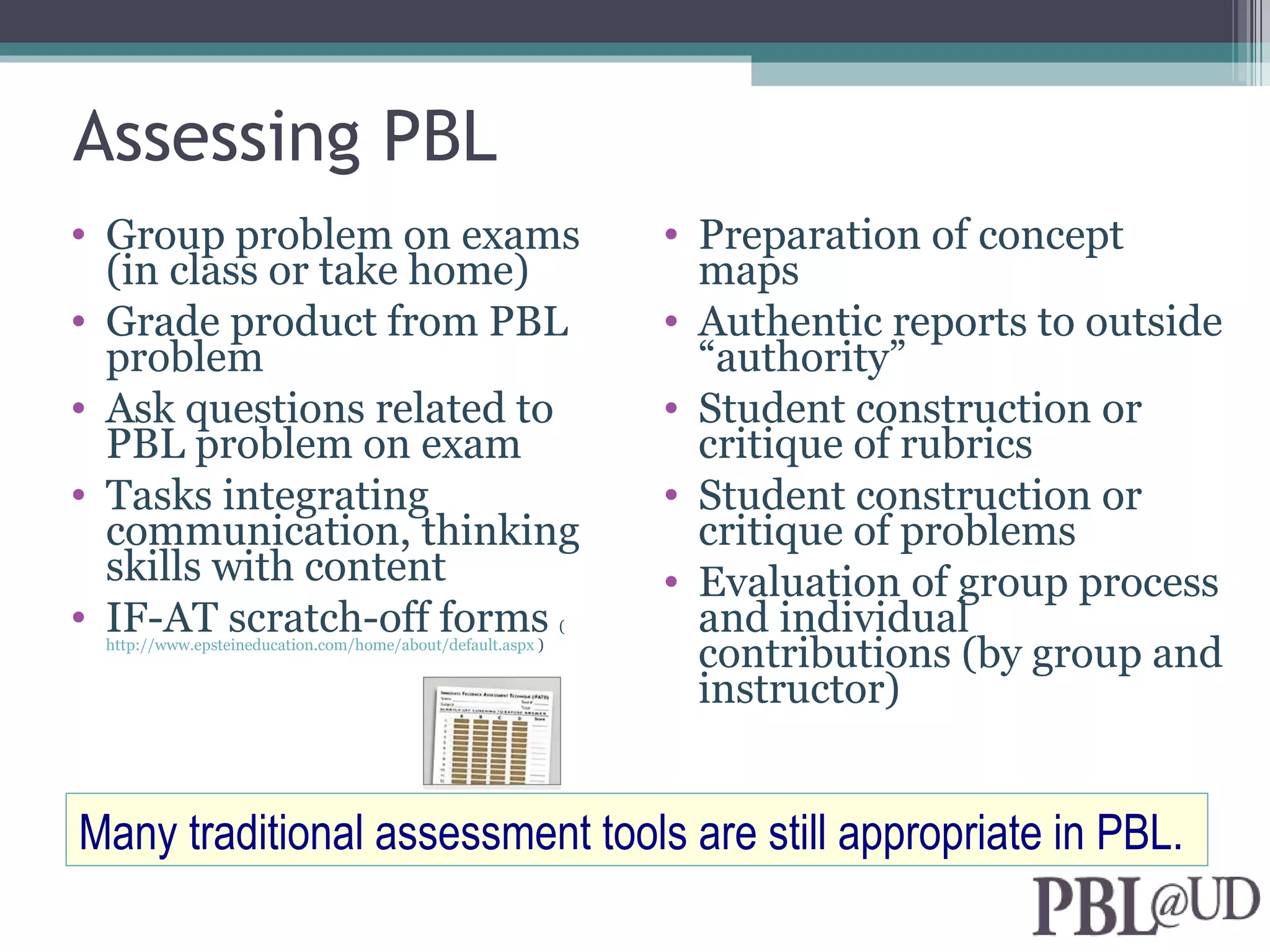
Assessing PBL
• Group problem on exams                                         • Preparation of concept
  (in class or take home)                                          maps
• Grade product from PBL                                         • Authentic reports to outside
  problem                                                          “authority”
• Ask questions related to                                       • Student construction or
  PBL problem on exam                                              critique of rubrics
• Tasks integrating                                              • Student construction or
  communication, thinking                                          critique of problems
  skills with content                                            • Evaluation of group process
• IF-AT scratch-off forms                                    (     and individual
 http://www.epsteineducation.com/home/about/default.aspx )
                                                                   contributions (by group and
                                                                   instructor)


Many traditional assessment tools are still appropriate in PBL.

Pbl why and how keynotelaplata 4_9_2012

  • 1.
    Problem-based Learning: Challenges, Components,and Benefits Stephen A. Bernhardt sab@udel.edu
  • 2.
    Characteristics Needed inCollege Graduates • High level of communication skills • Ability to define problems, gather and evaluate information, develop solutions • Team skills -- ability to work with others • Ability to use all of the above to address problems in a complex real-world setting Quality Assurance in Undergraduate Education (1994) Wingspread Conference, ECS, Boulder, CO.
  • 3.
    21st Century Literacies • Develop proficiency with the tools of technology • Build relationships with others to pose and solve problems collaboratively and cross-culturally • Design and share information for global communities to meet a variety of purposes • Manage, analyze and synthesize multiple streams of simultaneous information • Create, critique, analyze, and evaluate multi- media texts • Attend to the ethical responsibilities required by these complex environments National Council of Teachers of English, Feb. 15, 2008
  • 4.
    Employers’ Ratings ofImportance of ABET Outcomes for New Hires Figure 8. Executive Summary, Engineering Change: A Study of the Impact of EC2000. ABET, 2006, p. 11
  • 5.
    But I alreadyassign problems . . . From Cutnell & Johnson, Physics, 1989, p. 93.
  • 6.
    And students haveto learn before they can solve problems . . . http://www.morethanatestscore.com/2011/09/09/figuring-out-the-college-lecture/
  • 7.
    PBL Contrasted withSubject-Based Learning START Solve problem to demonstrate mastery Told what we need to know “Learn it” = read book, remember key formulae, etc. From Smith et al., 2005. Pedagogies of engagement: Classroom-based practices. J. Engineering Education, January 2005. 87-101.
  • 8.
    PBL begins witha problem . . . a different kind of problem • Major League Baseball (MLB) is looking to sell the Montreal Expos, which it currently owns. Competitive bids have been submitted by two Mexican cities, Mexico City and Monterrey. Prior to making a decision, MLB has asked your consulting firm to evaluate the effect that altitude would have on a fly ball in these two baseball stadiums . . . PBL Clearinghouse “What a Drag!,” by Ed Nowak
  • 9.
    PBL Contrasted withSubject-Based Learning START Apply it while Problem-posed solving problem Learn what we Identify what we need to know need to know From Smith et al., 2005. Pedagogies of engagement: Classroom-based practices. J. Engineering Education, January 2005. 87-101.
  • 10.
    PBL is basedon the Learning Cycle Students apply Problem posed concepts in their solution Learning issues identified Students construct understanding of issues
  • 11.
    Learning cycles enhanceretention explore  invent  apply EIA = Explore, Invent, Apply IVP = Inform, Verify, Practice EAI = Explore, Apply, Invent J. Chem. Educ. 2011, 88, 1020–1025
  • 12.
    PBL: The Process Resolutionof Problem; Presentation of Problem (How did we do?) Organize ideas and Integrate new Next stage of the problem prior knowledge Information; (What do we know?) Refine questions Pose questions (What do Reconvene, report we need to know?) on research; Research questions; Assign responsibility summarize; for questions; discuss analyze findings resources
  • 13.
    But I haveto cover content…
  • 14.
    Balancing Course Objectives Tackle hard decisions about course content • What content is essential? • What is needed in subsequent courses? • What knowledge is lasting? Don’t overlook process skills •Which skills are most important to your goals? •Can content and process go hand-in-hand? Learning Content Developing Process Skills
  • 15.
    Typical Medical SchoolPBL Problem: High Degree of Authenticity Patient arrives at hospital, ER, physician’s office presenting with symptoms X, Y, Z What questions should you ask? What tests should you order? Physician interviews patient, receives results of tests Differential diagnosis Preferred therapy
  • 16.
    The Rule of72 Bill is working at a financial services firm as a summer intern. Stan, the area director, calls him into his office. Stan: One of our analysts is using the Rule of 72 to give predictions to our customers on how fast their money would grow. I’m concerned that this could get us in trouble. I’d like your recommendation on whether or not we should continue to use the rule to give estimates to our clients. Have your recommendations on my desk tomorrow. Bill: Um, sure…. Mark A. Serva, University of Delaware
  • 17.
    PBL Models forUndergraduate Courses Medical School Model Small class, one instructor to 8-10 students Floating Facilitator Model Small to medium class, one instructor, up to ~75 students Peer Facilitator Model Small to large class, one instructor and several peer facilitators Large Class Models Floating facilitator and hybrid PBL/other activities
  • 18.
    Advanced Undergraduates asPeer Facilitators • Help monitor group progress and dynamics • Serve as role models for novice learners • Instructor works with facilitators behind the scenes
  • 19.
    “Hybrid” PBL Non-exclusiveuse of problem-driven learning in a class May include separate lecture segments or other active-learning components Floating or peer facilitator models common
  • 20.
    General Chemistry: HybridModel Example Problem-based group work 40% Lecture/whole-class discussion 50% Demonstrations 7% Other (Exam, lab review) 3% Source: Susan Groh, Ph. D., Department of Chemistry & Biochemistry, University of Delaware
  • 21.
    So what doesthe teacher do?
  • 22.
    A Typical Dayin an Undergraduate PBL Course
  • 23.
    Instructor roles • Establish learning goals • Create great problems • Keep teams on track • Present information as needed • Evaluate outcomes • Encourage reflective learning and transfer
  • 24.
    What Makes aGood PBL Problem? • Well-formed learning objectives for content and process • The need for a solution, decision, or recommendation • A “hook” or human scenario • Good prompting questions (“What do we know?” “What do we need to know?”) • Need for research • Thoughtful staging/selective disclosure • Summative and formative assessment
  • 25.
    Technologies for HaitiRelief • Problem: Propose a technology to address pressing issues in Haiti post-earthquake • Research: Students research situation in Haiti and available technologies (shelter, clean water, construction, communication) • Deliverables: Proposal, progress report, technical briefing, document for wider audience, presentation Steve Bernhardt, Technical Writing, UD
  • 26.
    PBL supports communicationskills • Discussion to define, analyze, evaluate • Writing to set rules, assign tasks, manage team • Reading to learn what is needed • Speaking and writing to present findings, solutions, recommendations • Writing and discussing to evaluate and reflect
  • 27.
    Can we assessteamwork and problem solving?
  • 28.
    Assessment in PBL • Evaluate knowledge, skills, behaviors, and applied learning • Use both formative feedback and summative evaluation • Assess performance and deliverables • Use self and peer evaluation • Assess both teamwork and individual learning
  • 29.
    Common Features ofPBL • Learning is initiated by a problem. • Problems are based on complex, real-world situations. • All information needed to solve problem is not given initially. • Students identify, find and use appropriate resources. • Students work in permanent groups. • Learning is active, integrated, cumulative and connected.
  • 30.
    Course Transformation: ABalancing Act Learning Classroom Control Objectives Course Format Assessment Problem Design
  • 31.
    Interested in learningmore? • Google PBL@UD • Visit and register for the PBL Clearinghouse • Find a colleague who wants to collaborate • Try a low stakes problem to get started on a unit • Watch for workshops • Ask me! sab@udel.edu
  • 32.
    PBL: The Process Resolutionof Problem; Presentation of Problem (How did we do?) Organize ideas and Integrate new Next stage of the problem prior knowledge Information; (What do we know?) Refine questions Pose questions (What do Reconvene, report we need to know?) on research; Research questions; Assign responsibility summarize; for questions; discuss analyze findings resources
  • 33.
    Assessing PBL • Groupproblem on exams • Preparation of concept (in class or take home) maps • Grade product from PBL • Authentic reports to outside problem “authority” • Ask questions related to • Student construction or PBL problem on exam critique of rubrics • Tasks integrating • Student construction or communication, thinking critique of problems skills with content • Evaluation of group process • IF-AT scratch-off forms ( and individual http://www.epsteineducation.com/home/about/default.aspx ) contributions (by group and instructor) Many traditional assessment tools are still appropriate in PBL.

Editor's Notes

  • #3 This was part of our motivation 17 years ago.
  • #4 Here’s a more current statement of what defines contemporary literacy—from English teachers’ perspective.
  • #5 And here is an engineers’ perspective—what’s important in terms of accreditation requirements for new engineers in workforce.
  • #6 Steve gets us to this slide, introduces it briefly. . . . Meredith’s notes: End of chapter. What is the value of such a problem? Students are asked to apply one or more concepts they’ve learned . . . gravitation and resulting forces. What processes does the student step through to solve this? ID type of problem (graviational force), look for correct equations (F=Gm1m2/r2), calculate and answer. Is this what we would call “problem solving” in the broad sense of the term? Ability to solve for net force on a sphere in a highly confined scenario is unlikely to be relevant to the student’s future career needs. Students have little input into the process by which problem is solved, other than correctly IDing problem type.
  • #7 Meredith’s notes: Students are informed. “Problem” on last slide also follows a standard instructional pattern by which the student learns how to ID a problem type, and which usually begins with a lecture. We all do this kind of teaching at some point, but how reflective of one’s professional life is this environment? From blog posting for college-bound students titled “Figuring out the college lecture.”
  • #8 A graphical depiction of pathway to “end of chapter” problems. At what point is student in control of the course of their learning process?
  • #9 To be more efficient, I folded two ideas into one. . . Problem type not initially clear. Students have to determine what variables are involved, and how they might change due to parameters provided. Aside from realistic parameters similar to those for a “consulting” job, students have control and responsibility for developing the problem’s solution. More than one answer could be acceptable, depending on groups’
  • #10 Students often become very invested in the problem, if well-written. Students want to know the answer, and therefore want to work to find it.
  • #11 Meredith
  • #12 Meredith
  • #13 Mark
  • #14 Mark
  • #15 Mark – reference first 3 slides as well
  • #16 Slide to emphasize where both process & content skills are needed. Differential diagnosis is structured problem solving where multiple possibilities are in play. It is a process of elimination of alternatives.
  • #17 Putting a problem in front of the audience for consideration. Interest compounds, so exponential calculations are necessary to get this accurate. But it is rough and ready as an estimate.
  • #19 6
  • #22 Mark to Steve
  • #23 Answer the previous question.
  • #26 My example—for a writing course…
  • #28 Steve to Mark
  • #32 [email_address] 1252steve
  • #33 Mark