Historical
Thinking
in the
21st
Century
sticky idea?
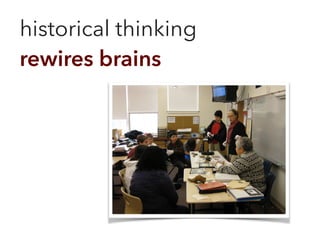
historical thinking
rewires brains
rewiring brains is a
good thing
HOW
WHY
Q&A
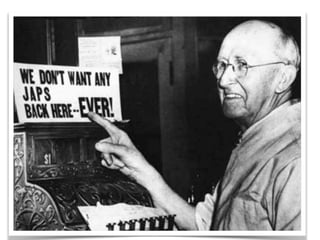
don’t be that guy
don’t be that guy
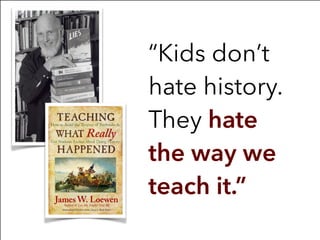
“Kids don’t
hate history.
They hate
the way we
teach it.”
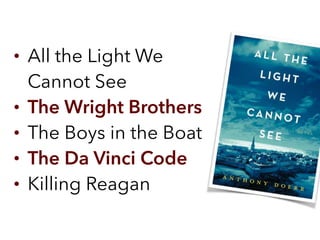
• All the Light We
Cannot See
• The Wright Brothers
• The Boys in the Boat
• The Da Vinci Code
• Killing Reagan
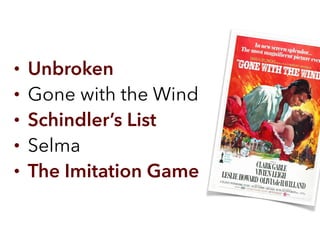
• Unbroken
• Gone with the Wind
• Schindler’s List
• Selma
• The Imitation Game
how are 

history students
different than
historians?
kids see
history as
answers
historians see
history as
problems
so what
does it
look like?
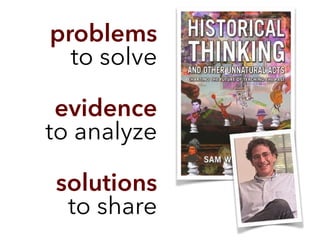
problems
to solve
evidence
to analyze
solutions
to share
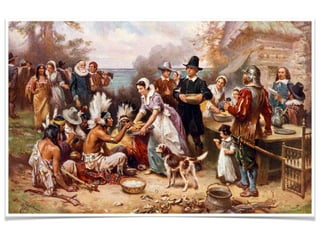
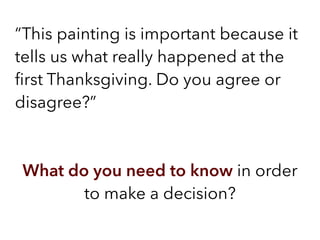
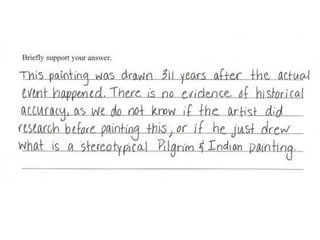
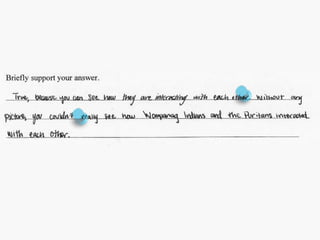
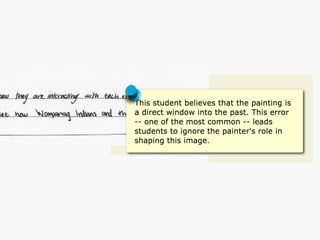
“This painting is important because it
tells us what really happened at the
first Thanksgiving. Do you agree or
disagree?”
What do you need to know in order
to make a decision?
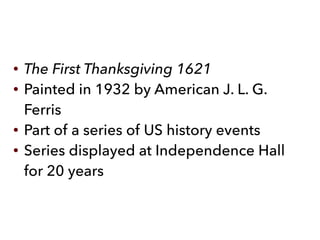
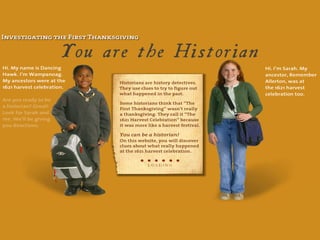
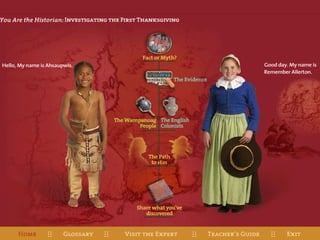
• The First Thanksgiving 1621
• Painted in 1932 by American J. L. G.

Ferris
• Part of a series of US history events
• Series displayed at Independence Hall

for 20 years
- The C4 FRAMEWORK -
COLLECT COLLABORATE
CREATE COMMUNICATE
Find even more C4 information, resources, and useful goodies at www.ceefour.com
- The C4 FRAMEWORK -
COLLECT COLLABORATE
CREATE COMMUNICATE
Find even more C4 information, resources, and useful goodies at www.ceefour.com
collect & organize evidence
- The C4 FRAMEWORK -
COLLECT COLLABORATE
CREATE COMMUNICATE
Find even more C4 information, resources, and useful goodies at www.ceefour.com
find a
buddy
20 Minute Expert
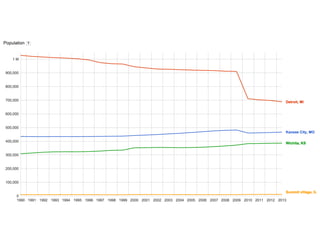
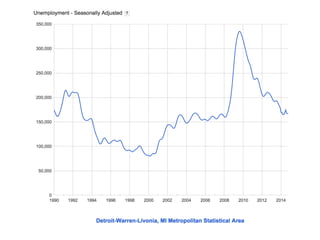
2008 Great Recession
causes / impact
causes impact
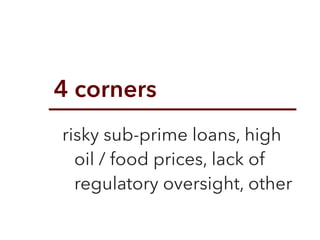
risky sub-prime loans, high
oil / food prices, lack of
regulatory oversight, other
4 corners
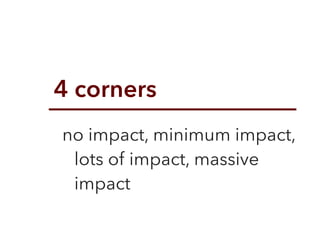
no impact, minimum impact,
lots of impact, massive
impact
4 corners
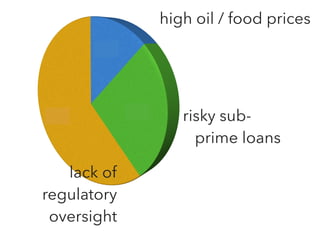
Pie Chart activity
risky sub-
prime loans
lack of
regulatory
oversight
high oil / food prices
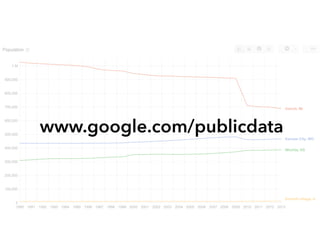
www.google.com/publicdata
“Social Studies content is the
vehicle for demonstrating
mastery, not the destination.”
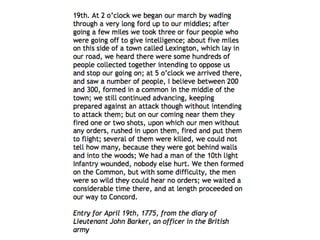
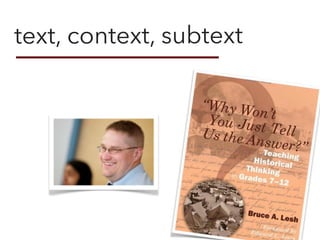
text, context, subtext
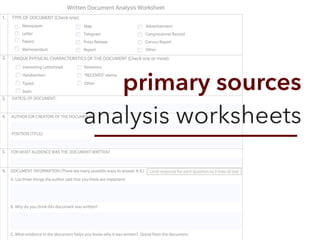
primary sources
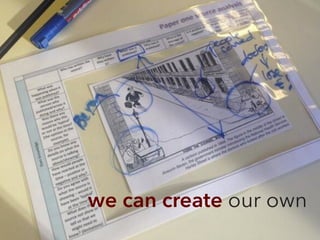
analysis worksheets
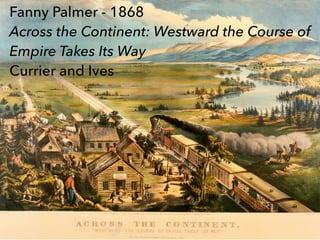
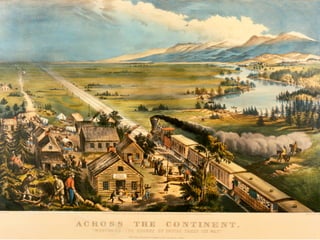
Fanny Palmer - 1868

Across the Continent: Westward the Course of
Empire Takes Its Way
Currier and Ives
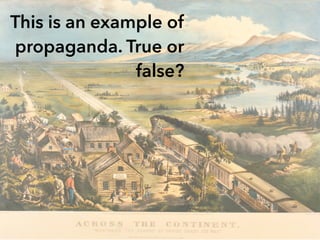
This is an example of
propaganda. True or
false?
we can create our own
STANFORD HISTORY EDUCATION GROUP SHEG.STANFORD.EDU
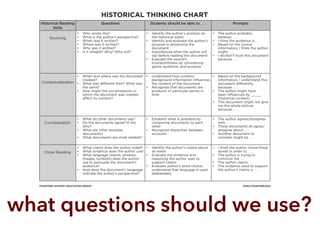
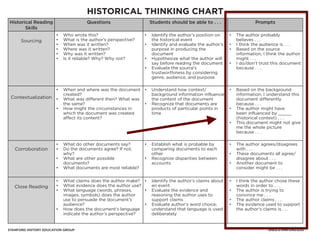
Historical Reading
Skills
Questions Students should be able to . . . Prompts
Sourcing
Who wrote this?
What is the author’s perspective?
When was it written?
Where was it written?
Why was it written?
Is it reliable? Why? Why not?
Identify the author’s position on
the historical event
Identify and evaluate the author’s
purpose in producing the
document
Hypothesize what the author will
say before reading the document
Evaluate the source’s
trustworthiness by considering
genre, audience, and purpose
The author probably
believes . . .
I think the audience is . . .
Based on the source
information, I think the author
might . . .
I do/don’t trust this document
because . . .
Contextualization
When and where was the document
created?
What was different then? What was
the same?
How might the circumstances in
which the document was created
affect its content?
Understand how context/
background information influences
the content of the document
Recognize that documents are
products of particular points in
time
Based on the background
information, I understand this
document differently
because . . .
The author might have
been influenced by _____
(historical context) . . .
This document might not give
me the whole picture
because . . .
Corroboration
What do other documents say?
Do the documents agree? If not,
why?
What are other possible
documents?
What documents are most reliable?
Establish what is probable by
comparing documents to each
other
Recognize disparities between
accounts
The author agrees/disagrees
with . . .
These documents all agree/
disagree about . . .
Another document to
consider might be . . .
Close Reading
What claims does the author make?
What evidence does the author use?
What language (words, phrases,
images, symbols) does the author
use to persuade the document’s
audience?
How does the document’s language
indicate the author’s perspective?
Identify the author’s claims about
an event
Evaluate the evidence and
reasoning the author uses to
support claims
Evaluate author’s word choice;
understand that language is used
deliberately
I think the author chose these
words in order to . . .
The author is trying to
convince me . . .
The author claims . . .
The evidence used to support
the author’s claims is . . .
HISTORICAL THINKING CHART
what questions should we use?
Literacy
activities
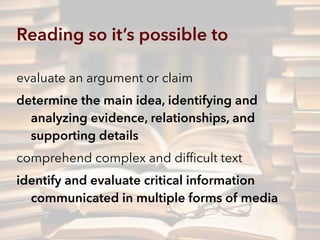
Reading so it’s possible to
evaluate an argument or claim
determine the main idea, identifying and
analyzing evidence, relationships, and
supporting details
comprehend complex and difficult text
identify and evaluate critical information
communicated in multiple forms of media
Writing clearly and coherently
to make an argument using evidence, logic, and
reasoning
to tell a story
by applying the appropriate technologies for the
purpose and audience
by gathering multiple sources of information
and integrating them into short and long term 

projects
Communicating effectively by
preparing and collaborating with diverse
partners
designing and delivering a presentation on a
specific topic
presenting information and evaluation to others
in a manner that is not totally written text
using multiple modes of communication
Literacy
activities
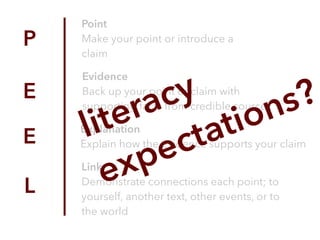
PEEL
Point

Make your point or introduce a
claim
Evidence

Back up your point or claim with
supporting facts from credible sources
Explanation

Explain how the evidence supports your claim
Link

Demonstrate connections each point; to
yourself, another text, other events, or to
the world
P
E
E
L
Point

Make your point or introduce a
claim
Evidence

Back up your point or claim with
supporting facts from credible sources
Explanation

Explain how the evidence supports your claim
Link

Demonstrate connections each point; to
yourself, another text, other events, or to
the world
P
E
E
L
literacy
expectations?
Literacy
activities
Tic Tac Tell
Literacy
activities
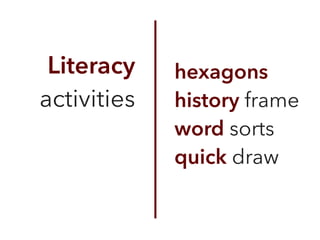
hexagons
history frame
word sorts
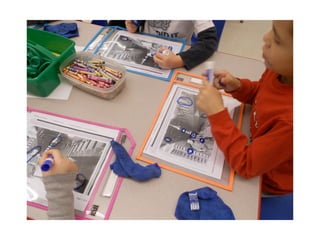
quick draw
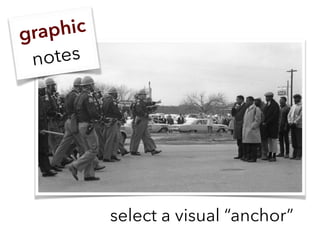
select a visual “anchor”
graphic
notes
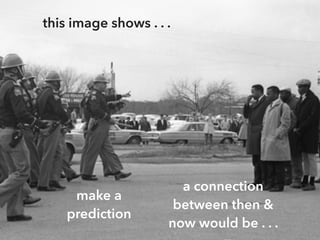
this image shows . . .
a connection
between then &
now would be . . .
make a
prediction
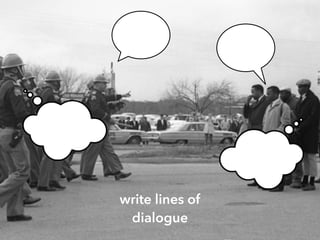
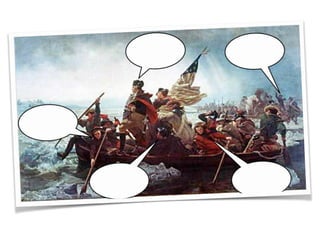
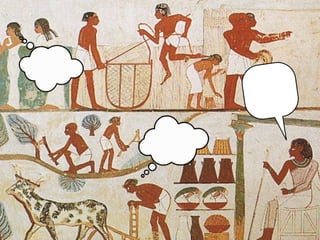
write lines of
dialogue
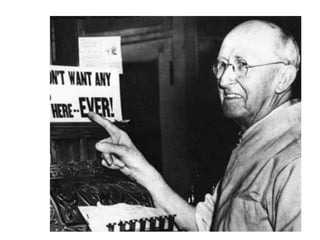
where when what
- The C4 FRAMEWORK -
COLLECT COLLABORATE
CREATE COMMUNICATE
Find even more C4 information, resources, and useful goodies at www.ceefour.com
- The C4 FRAMEWORK -
COLLECT COLLABORATE
CREATE COMMUNICATE
Find even more C4 information, resources, and useful goodies at www.ceefour.com
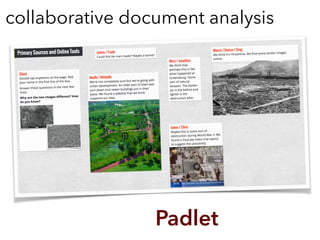
collaborate with others
collaborative document analysis
Padlet
padlet.com/glennw/secondarySS
evidence “dropbox”
presentation tool
print a book
“back channel”
exit card
survey / brainstorm
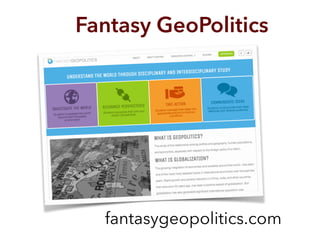
fantasygeopolitics.com
Fantasy GeoPolitics
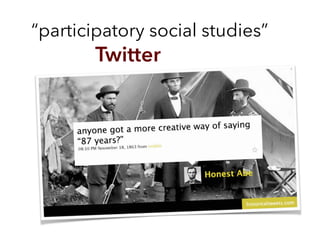
“participatory social studies”
Twitter
- The C4 FRAMEWORK -
COLLECT COLLABORATE
CREATE COMMUNICATE
Find even more C4 information, resources, and useful goodies at www.ceefour.com
- The C4 FRAMEWORK -
COLLECT COLLABORATE
CREATE COMMUNICATE
Find even more C4 information, resources, and useful goodies at www.ceefour.com
Create a solution
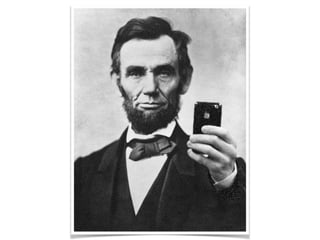
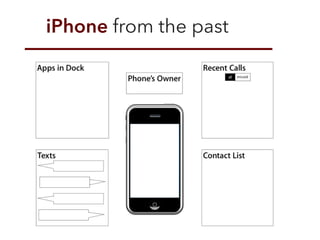
iPhone from the past
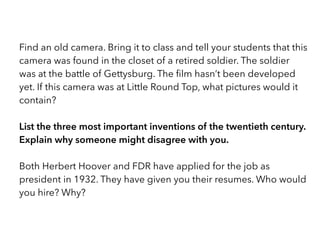
Find an old camera. Bring it to class and tell your students that this
camera was found in the closet of a retired soldier. The soldier
was at the battle of Gettysburg. The film hasn’t been developed
yet. If this camera was at Little Round Top, what pictures would it
contain?

List the three most important inventions of the twentieth century.
Explain why someone might disagree with you.

Both Herbert Hoover and FDR have applied for the job as
president in 1932. They have given you their resumes. Who would
you hire? Why?
STANFORD HISTORY EDUCATION GROUP SHEG.STANFORD.EDU
Historical Reading
Skills
Questions Students should be able to . . . Prompts
Sourcing
Who wrote this?
What is the author’s perspective?
When was it written?
Where was it written?
Why was it written?
Is it reliable? Why? Why not?
Identify the author’s position on
the historical event
Identify and evaluate the author’s
purpose in producing the
document
Hypothesize what the author will
say before reading the document
Evaluate the source’s
trustworthiness by considering
genre, audience, and purpose
The author probably
believes . . .
I think the audience is . . .
Based on the source
information, I think the author
might . . .
I do/don’t trust this document
because . . .
Contextualization
When and where was the document
created?
What was different then? What was
the same?
How might the circumstances in
which the document was created
affect its content?
Understand how context/
background information influences
the content of the document
Recognize that documents are
products of particular points in
time
Based on the background
information, I understand this
document differently
because . . .
The author might have
been influenced by _____
(historical context) . . .
This document might not give
me the whole picture
because . . .
Corroboration
What do other documents say?
Do the documents agree? If not,
why?
What are other possible
documents?
What documents are most reliable?
Establish what is probable by
comparing documents to each
other
Recognize disparities between
accounts
The author agrees/disagrees
with . . .
These documents all agree/
disagree about . . .
Another document to
consider might be . . .
Close Reading
What claims does the author make?
What evidence does the author use?
What language (words, phrases,
images, symbols) does the author
use to persuade the document’s
audience?
How does the document’s language
indicate the author’s perspective?
Identify the author’s claims about
an event
Evaluate the evidence and
reasoning the author uses to
support claims
Evaluate author’s word choice;
understand that language is used
deliberately
I think the author chose these
words in order to . . .
The author is trying to
convince me . . .
The author claims . . .
The evidence used to support
the author’s claims is . . .
HISTORICAL THINKING CHART
readwritethink.org
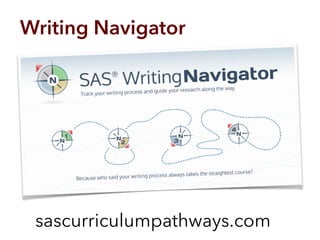
sascurriculumpathways.com
Writing Navigator
- The C4 FRAMEWORK -
COLLECT COLLABORATE
CREATE COMMUNICATE
Find even more C4 information, resources, and useful goodies at www.ceefour.com
- The C4 FRAMEWORK -
COLLECT COLLABORATE
CREATE COMMUNICATE
Find even more C4 information, resources, and useful goodies at www.ceefour.com
Communicate the solution
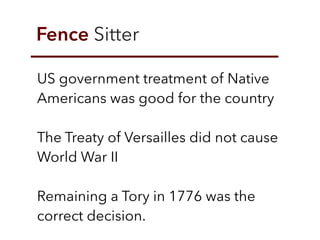
Fence Sitter
US government treatment of Native
Americans was good for the country
The Treaty of Versailles did not cause
World War II
Remaining a Tory in 1776 was the
correct decision.
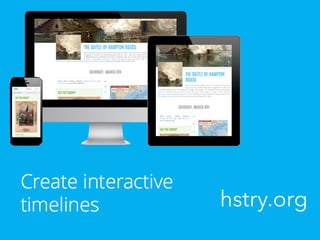
hstry.org
zoomin.edc.org
Zoom In
Kahoot
getkahoot.com kahoot.it
www.c4framework.com
glennw@essdack.org
@glennw98
glennwiebe.org
c4framework.com
Glenn Wiebe

C4 Framework & Historical Thinking October 2015

  • 1.
  • 3.
  • 4.
  • 5.
    rewiring brains isa good thing
  • 6.
  • 7.
  • 8.
  • 9.
    “Kids don’t hate history. Theyhate the way we teach it.”
  • 10.
    • All theLight We Cannot See • The Wright Brothers • The Boys in the Boat • The Da Vinci Code • Killing Reagan
  • 11.
    • Unbroken • Gonewith the Wind • Schindler’s List • Selma • The Imitation Game
  • 12.
    how are 
 historystudents different than historians?
  • 13.
  • 14.
  • 15.
  • 17.
    “This painting isimportant because it tells us what really happened at the first Thanksgiving. Do you agree or disagree?” What do you need to know in order to make a decision?
  • 18.
    • The FirstThanksgiving 1621 • Painted in 1932 by American J. L. G.
 Ferris • Part of a series of US history events • Series displayed at Independence Hall
 for 20 years
  • 25.
    - The C4FRAMEWORK - COLLECT COLLABORATE CREATE COMMUNICATE Find even more C4 information, resources, and useful goodies at www.ceefour.com
  • 26.
    - The C4FRAMEWORK - COLLECT COLLABORATE CREATE COMMUNICATE Find even more C4 information, resources, and useful goodies at www.ceefour.com collect & organize evidence - The C4 FRAMEWORK - COLLECT COLLABORATE CREATE COMMUNICATE Find even more C4 information, resources, and useful goodies at www.ceefour.com
  • 27.
  • 33.
  • 34.
  • 35.
  • 36.
    risky sub-prime loans,high oil / food prices, lack of regulatory oversight, other 4 corners
  • 37.
    no impact, minimumimpact, lots of impact, massive impact 4 corners
  • 38.
  • 39.
    risky sub- prime loans lackof regulatory oversight high oil / food prices
  • 40.
  • 41.
    “Social Studies contentis the vehicle for demonstrating mastery, not the destination.”
  • 42.
  • 43.
  • 45.
    Fanny Palmer -1868
 Across the Continent: Westward the Course of Empire Takes Its Way Currier and Ives
  • 47.
    This is anexample of propaganda. True or false?
  • 49.
  • 50.
    STANFORD HISTORY EDUCATIONGROUP SHEG.STANFORD.EDU Historical Reading Skills Questions Students should be able to . . . Prompts Sourcing Who wrote this? What is the author’s perspective? When was it written? Where was it written? Why was it written? Is it reliable? Why? Why not? Identify the author’s position on the historical event Identify and evaluate the author’s purpose in producing the document Hypothesize what the author will say before reading the document Evaluate the source’s trustworthiness by considering genre, audience, and purpose The author probably believes . . . I think the audience is . . . Based on the source information, I think the author might . . . I do/don’t trust this document because . . . Contextualization When and where was the document created? What was different then? What was the same? How might the circumstances in which the document was created affect its content? Understand how context/ background information influences the content of the document Recognize that documents are products of particular points in time Based on the background information, I understand this document differently because . . . The author might have been influenced by _____ (historical context) . . . This document might not give me the whole picture because . . . Corroboration What do other documents say? Do the documents agree? If not, why? What are other possible documents? What documents are most reliable? Establish what is probable by comparing documents to each other Recognize disparities between accounts The author agrees/disagrees with . . . These documents all agree/ disagree about . . . Another document to consider might be . . . Close Reading What claims does the author make? What evidence does the author use? What language (words, phrases, images, symbols) does the author use to persuade the document’s audience? How does the document’s language indicate the author’s perspective? Identify the author’s claims about an event Evaluate the evidence and reasoning the author uses to support claims Evaluate author’s word choice; understand that language is used deliberately I think the author chose these words in order to . . . The author is trying to convince me . . . The author claims . . . The evidence used to support the author’s claims is . . . HISTORICAL THINKING CHART what questions should we use?
  • 52.
  • 53.
    Reading so it’spossible to evaluate an argument or claim determine the main idea, identifying and analyzing evidence, relationships, and supporting details comprehend complex and difficult text identify and evaluate critical information communicated in multiple forms of media
  • 54.
    Writing clearly andcoherently to make an argument using evidence, logic, and reasoning to tell a story by applying the appropriate technologies for the purpose and audience by gathering multiple sources of information and integrating them into short and long term 
 projects
  • 55.
    Communicating effectively by preparingand collaborating with diverse partners designing and delivering a presentation on a specific topic presenting information and evaluation to others in a manner that is not totally written text using multiple modes of communication
  • 56.
  • 57.
    Point
 Make your pointor introduce a claim Evidence
 Back up your point or claim with supporting facts from credible sources Explanation
 Explain how the evidence supports your claim Link
 Demonstrate connections each point; to yourself, another text, other events, or to the world P E E L
  • 58.
    Point
 Make your pointor introduce a claim Evidence
 Back up your point or claim with supporting facts from credible sources Explanation
 Explain how the evidence supports your claim Link
 Demonstrate connections each point; to yourself, another text, other events, or to the world P E E L literacy expectations?
  • 59.
  • 60.
  • 61.
    select a visual“anchor” graphic notes
  • 62.
    this image shows. . . a connection between then & now would be . . . make a prediction
  • 63.
  • 66.
  • 79.
    - The C4FRAMEWORK - COLLECT COLLABORATE CREATE COMMUNICATE Find even more C4 information, resources, and useful goodies at www.ceefour.com - The C4 FRAMEWORK - COLLECT COLLABORATE CREATE COMMUNICATE Find even more C4 information, resources, and useful goodies at www.ceefour.com collaborate with others
  • 80.
  • 81.
  • 82.
    evidence “dropbox” presentation tool printa book “back channel” exit card survey / brainstorm
  • 83.
  • 84.
  • 85.
    - The C4FRAMEWORK - COLLECT COLLABORATE CREATE COMMUNICATE Find even more C4 information, resources, and useful goodies at www.ceefour.com - The C4 FRAMEWORK - COLLECT COLLABORATE CREATE COMMUNICATE Find even more C4 information, resources, and useful goodies at www.ceefour.com Create a solution
  • 87.
  • 91.
    Find an oldcamera. Bring it to class and tell your students that this camera was found in the closet of a retired soldier. The soldier was at the battle of Gettysburg. The film hasn’t been developed yet. If this camera was at Little Round Top, what pictures would it contain?
 List the three most important inventions of the twentieth century. Explain why someone might disagree with you.
 Both Herbert Hoover and FDR have applied for the job as president in 1932. They have given you their resumes. Who would you hire? Why?
  • 93.
    STANFORD HISTORY EDUCATIONGROUP SHEG.STANFORD.EDU Historical Reading Skills Questions Students should be able to . . . Prompts Sourcing Who wrote this? What is the author’s perspective? When was it written? Where was it written? Why was it written? Is it reliable? Why? Why not? Identify the author’s position on the historical event Identify and evaluate the author’s purpose in producing the document Hypothesize what the author will say before reading the document Evaluate the source’s trustworthiness by considering genre, audience, and purpose The author probably believes . . . I think the audience is . . . Based on the source information, I think the author might . . . I do/don’t trust this document because . . . Contextualization When and where was the document created? What was different then? What was the same? How might the circumstances in which the document was created affect its content? Understand how context/ background information influences the content of the document Recognize that documents are products of particular points in time Based on the background information, I understand this document differently because . . . The author might have been influenced by _____ (historical context) . . . This document might not give me the whole picture because . . . Corroboration What do other documents say? Do the documents agree? If not, why? What are other possible documents? What documents are most reliable? Establish what is probable by comparing documents to each other Recognize disparities between accounts The author agrees/disagrees with . . . These documents all agree/ disagree about . . . Another document to consider might be . . . Close Reading What claims does the author make? What evidence does the author use? What language (words, phrases, images, symbols) does the author use to persuade the document’s audience? How does the document’s language indicate the author’s perspective? Identify the author’s claims about an event Evaluate the evidence and reasoning the author uses to support claims Evaluate author’s word choice; understand that language is used deliberately I think the author chose these words in order to . . . The author is trying to convince me . . . The author claims . . . The evidence used to support the author’s claims is . . . HISTORICAL THINKING CHART
  • 94.
  • 95.
  • 96.
    - The C4FRAMEWORK - COLLECT COLLABORATE CREATE COMMUNICATE Find even more C4 information, resources, and useful goodies at www.ceefour.com - The C4 FRAMEWORK - COLLECT COLLABORATE CREATE COMMUNICATE Find even more C4 information, resources, and useful goodies at www.ceefour.com Communicate the solution
  • 97.
    Fence Sitter US governmenttreatment of Native Americans was good for the country The Treaty of Versailles did not cause World War II Remaining a Tory in 1776 was the correct decision.
  • 98.
  • 99.
  • 100.
  • 102.
  • 103.