EBOLA VIRUS
INTRODUCTION
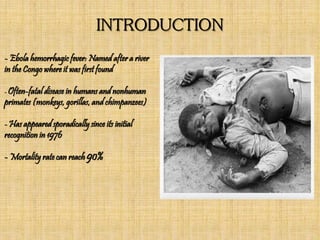
- Ebola hemorrhagic fever: Named after a river
in the Congo where it was first found
- Often-fatal disease in humans and nonhuman
primates (monkeys, gorillas, and chimpanzees)
- Has appeared sporadically since its initial
recognition in 1976
- Mortality rate can reach 90%
-Family: Filoviridae
-Order: Mononegavirales
-5 distinct sub-species
-Cote d’Ivorie(Ivory Coast) ebolavirus
-Reston ebolavirus
-Sudan ebolavirus
-Zaire ebloavirus
-Bundibugyo ebolavirus
- Characteristics of Filoviruses:
- Filamentous form with a uniform diameter of approximately 80 nm
but display great variation in length.
- Nonsegmented negative-stranded RNA genome containing 7
structural and regulatory genes.
FAMILY AND ORDER
WHERE IS EBOLA FOUND
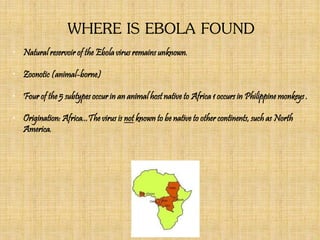
• Natural reservoir of the Ebola virus remains unknown.
• Zoonotic (animal-borne)
• Four of the 5 subtypes occur in an animal host native to Africa 1 occurs in Philippine monkeys .
• Origination: Africa...The virus is not known to be native to other continents, such as North
America.
SYMPTOMS
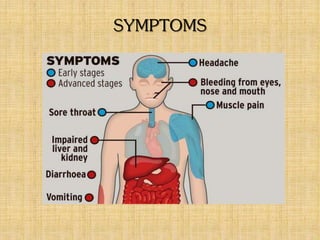
Incubation period is 2-21 days . Symptoms are :-
Arthritic pain
Backache (low-back pain)
Chills
Diarrhea
Fatigue
Fever
Headache
Malaise (general feeling of being unwell)
Nausea
Sore throat
Vomiting
EARLY SYMPTOMS
LATE SYMPTOMS
Late symptoms include:
• Bleeding from eyes, ears, and nose
• Bleeding from the mouth and rectum (gastrointestinal bleeding)
• Depression
• Eye inflammation (conjunctivitis)
• Genital swelling (labia and scrotum)
• Increased feeling of pain in skin
• Rash over the entire body that often contains blood (hemorrhagic)
• Roof of mouth looks red
• Seizures, coma, delirium
As many as 90% of patients die from the disease. Patients usually die from shock rather than from blood
loss.
HOW IT WORKS
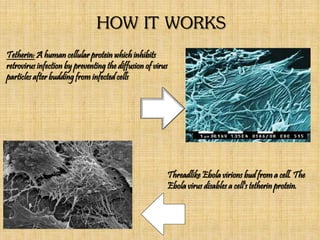
Threadlike Ebola virions bud from a cell. The
Ebola virus disables a cell's tetherin protein.
Tetherin: A human cellular protein which inhibits
retrovirus infection by preventing the diffusion of virus
particles after budding from infected cells
THANK YOU
Made by:-
N.V.Amruth

The Ebola Virus - Powerpoint Presentation

  • 1.
  • 2.
    INTRODUCTION - Ebola hemorrhagicfever: Named after a river in the Congo where it was first found - Often-fatal disease in humans and nonhuman primates (monkeys, gorillas, and chimpanzees) - Has appeared sporadically since its initial recognition in 1976 - Mortality rate can reach 90%
  • 3.
    -Family: Filoviridae -Order: Mononegavirales -5distinct sub-species -Cote d’Ivorie(Ivory Coast) ebolavirus -Reston ebolavirus -Sudan ebolavirus -Zaire ebloavirus -Bundibugyo ebolavirus - Characteristics of Filoviruses: - Filamentous form with a uniform diameter of approximately 80 nm but display great variation in length. - Nonsegmented negative-stranded RNA genome containing 7 structural and regulatory genes. FAMILY AND ORDER
  • 4.
    WHERE IS EBOLAFOUND • Natural reservoir of the Ebola virus remains unknown. • Zoonotic (animal-borne) • Four of the 5 subtypes occur in an animal host native to Africa 1 occurs in Philippine monkeys . • Origination: Africa...The virus is not known to be native to other continents, such as North America.
  • 5.
  • 6.
    Incubation period is2-21 days . Symptoms are :- Arthritic pain Backache (low-back pain) Chills Diarrhea Fatigue Fever Headache Malaise (general feeling of being unwell) Nausea Sore throat Vomiting EARLY SYMPTOMS
  • 7.
    LATE SYMPTOMS Late symptomsinclude: • Bleeding from eyes, ears, and nose • Bleeding from the mouth and rectum (gastrointestinal bleeding) • Depression • Eye inflammation (conjunctivitis) • Genital swelling (labia and scrotum) • Increased feeling of pain in skin • Rash over the entire body that often contains blood (hemorrhagic) • Roof of mouth looks red • Seizures, coma, delirium As many as 90% of patients die from the disease. Patients usually die from shock rather than from blood loss.
  • 8.
    HOW IT WORKS ThreadlikeEbola virions bud from a cell. The Ebola virus disables a cell's tetherin protein. Tetherin: A human cellular protein which inhibits retrovirus infection by preventing the diffusion of virus particles after budding from infected cells
  • 9.

Editor's Notes

  • #3 What is Ebola?: According CDC, Ebola hemorrhagic fever is a deadly disease in both humans and nonhuman primates (monkeys and chimpanzees) caused by the Ebola virus; characterized by high fever and severe internal bleeding; can be spread from person to person; is largely limited to Africa. First found in the area of the Democratic Republic of the Congo, near the River Congo in 1976 mortality rate: 90%, that’s why is called deadly disease.
  • #4  Highest fatality Rate is found in the Zaire sub-species. The only reported cases in the U.S., Italy and England were all part of the Reston sub-species.
  • #5  Natural reservoir of Ebola Virus still unknown until now. Its Zoonotic all 4 of 5 subtypes an animal Host in Africa
  • #9 The virus itself stores its nucleic acid in the form of a +mRNA genome and serves as a means of delivery of that genome into cells it targets as an obligate parasite (Cannot live independently of the Host cell), and constitutes the infection. Once in the host's cell, the RNA strands undergo reverse transcription in the cytoplasm and are integrated into the host's genome, at which point the retroviral DNA is referred to as a provirus (A provirus is a virus genome that is integrated into the DNA of a host cell). It is difficult to detect the virus until it has infected the host.