
Pauling electronegativity
Dr. Mithil Fal Desai
Shree Mallikarjun and Shri Chetan Manju Desai College
Canacona Goa
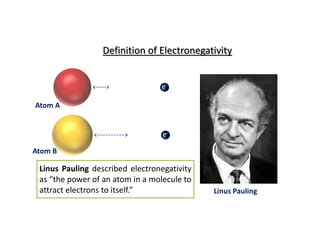
Linus Pauling described electronegativity
as “the power of an atom in a molecule to
attract electrons to itself.” Linus Pauling
Definition of Electronegativity
e-
e-
Atom A
Atom B
Calculating Electronegativity
A B
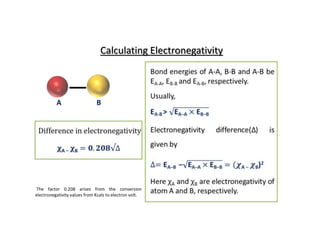
The factor 0.208 arises from the conversion
electronegativity values from Kcals to electron volt.
Calculating Electronegativity
A B
EA-B> EA-A or EB-B
EA-B(measured)> EA-B(theoretical)
Difference in the Bond Energies (Δ)
Δ = EA-B(measured) – EA-B(theoretical)
EA-B(theoretical) = energy for 100% covalent bond
EA-B(theoretical) = (EA-A X EB-B)1/2
Thus
Δ= EA-B(measured) – (EA-A X EB-B)½
δ+ δ-
If X(A) and X(B) are
electronegativity of individual
atoms A and B, respectively,
than
X(A) - X(B) = 0.1017(EA-A X EB-B)½ in kcal mol-1
X(A) - X(B) = 0.208 (EA-A X EB-B)½ in kJ mol-1
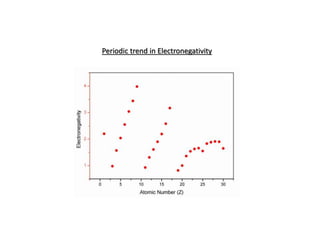
Periodic trend in Electronegativity
Summary
• F is most electronegative element
• If two element have similar(<1.7) electronegativity
values the bond is covalent or metallic.
• If two element have large (>1.7) difference in their
electronegativity values the bond is ionic
predominantly.
As Atomic number increases
• Electronegativity decreases down the group
• Electronegativity increases along the row

Pauling electronegativity

  • 1.
    Pauling electronegativity Dr. MithilFal Desai Shree Mallikarjun and Shri Chetan Manju Desai College Canacona Goa
  • 2.
    Linus Pauling describedelectronegativity as “the power of an atom in a molecule to attract electrons to itself.” Linus Pauling Definition of Electronegativity e- e- Atom A Atom B
  • 3.
    Calculating Electronegativity A B Thefactor 0.208 arises from the conversion electronegativity values from Kcals to electron volt.
  • 4.
    Calculating Electronegativity A B EA-B>EA-A or EB-B EA-B(measured)> EA-B(theoretical) Difference in the Bond Energies (Δ) Δ = EA-B(measured) – EA-B(theoretical) EA-B(theoretical) = energy for 100% covalent bond EA-B(theoretical) = (EA-A X EB-B)1/2 Thus Δ= EA-B(measured) – (EA-A X EB-B)½ δ+ δ- If X(A) and X(B) are electronegativity of individual atoms A and B, respectively, than X(A) - X(B) = 0.1017(EA-A X EB-B)½ in kcal mol-1 X(A) - X(B) = 0.208 (EA-A X EB-B)½ in kJ mol-1
  • 5.
    Periodic trend inElectronegativity
  • 6.
    Summary • F ismost electronegative element • If two element have similar(<1.7) electronegativity values the bond is covalent or metallic. • If two element have large (>1.7) difference in their electronegativity values the bond is ionic predominantly. As Atomic number increases • Electronegativity decreases down the group • Electronegativity increases along the row