Social & Entrepreneurial:
The paths to tomorrow’s journalism


                JD Lasica	 	 	 	 	 	 	
                Socialmedia.biz
                jd@socialmedia.biz	
                April 23, 2010
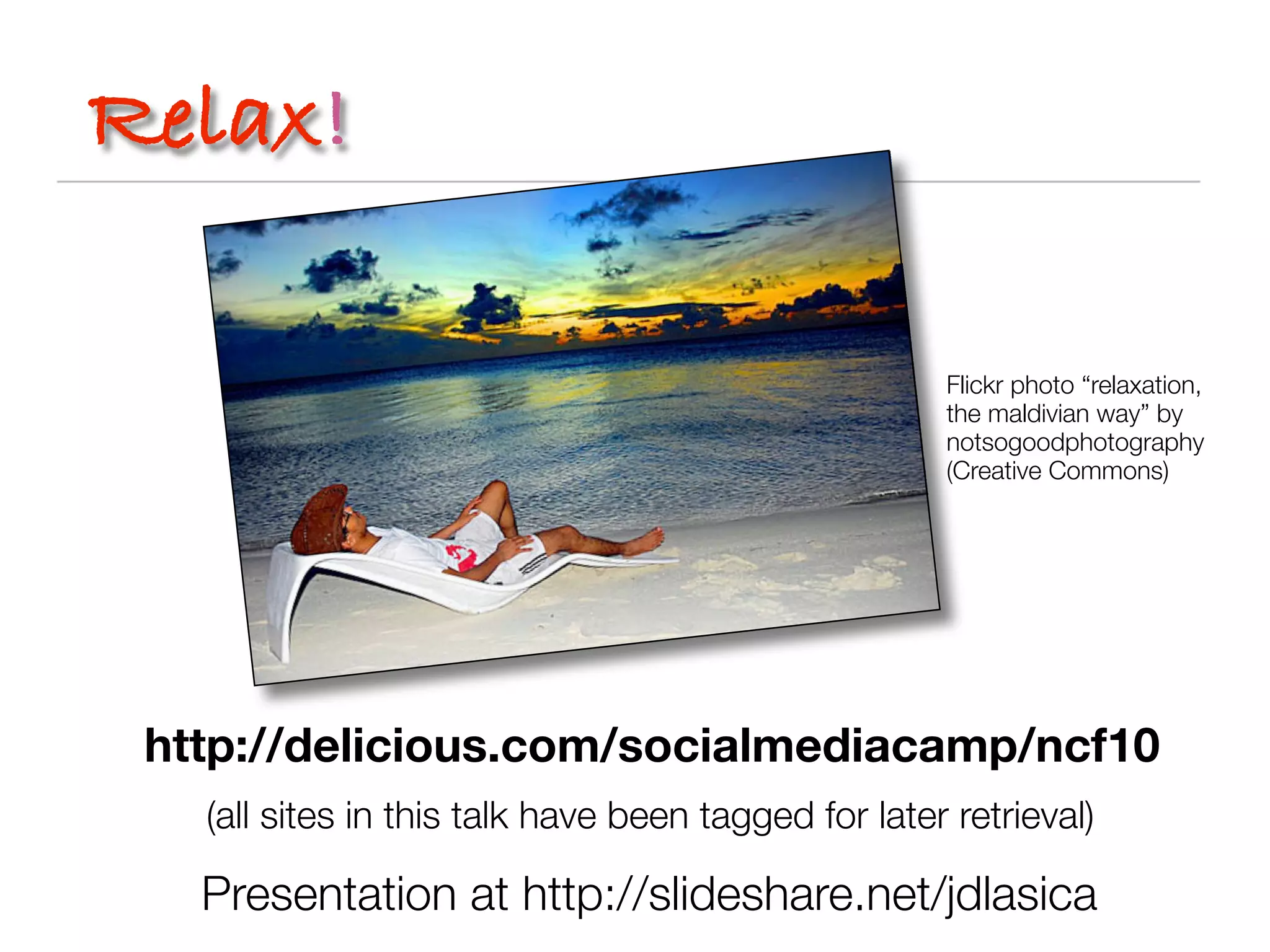
Relax!

                                                     Flickr photo “relaxation,
                                                     the maldivian way” by
                                                     notsogoodphotography
                                                     (Creative Commons)


 http://delicious.com/socialmediacamp/ncf10
   (all sites in this talk have been tagged for later retrieval)

   Presentation at http://slideshare.net/jdlasica
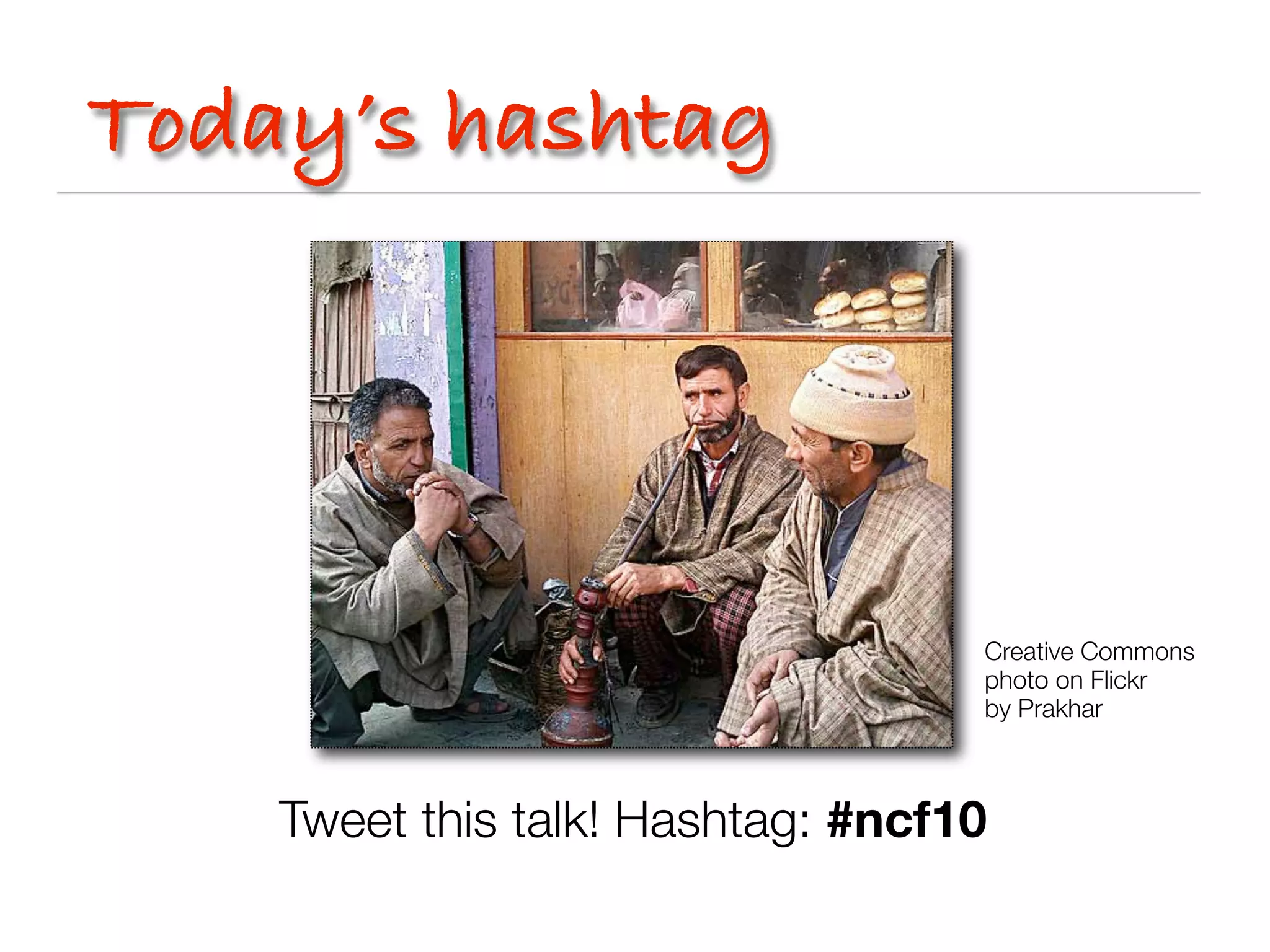
Today’s hashtag


                                   Creative Commons
                                   photo on Flickr
                                   by Prakhar


    Tweet this talk! Hashtag: #ncf10
What we’ll cover today
 2 simple propositions
 The new new news ecosystem
   • Social media overview & cultural norms
   • Rise of social media & impact on journalism
 Social journalism
 Entrepreneurial journalism
   • Innovation imperatives (take a page from Facebook)
   • New skills, new media forms
 Geolocation: New forms of visual storytelling
 Examples: Tomorrow’s news today
 Fearless predictions, closing thoughts
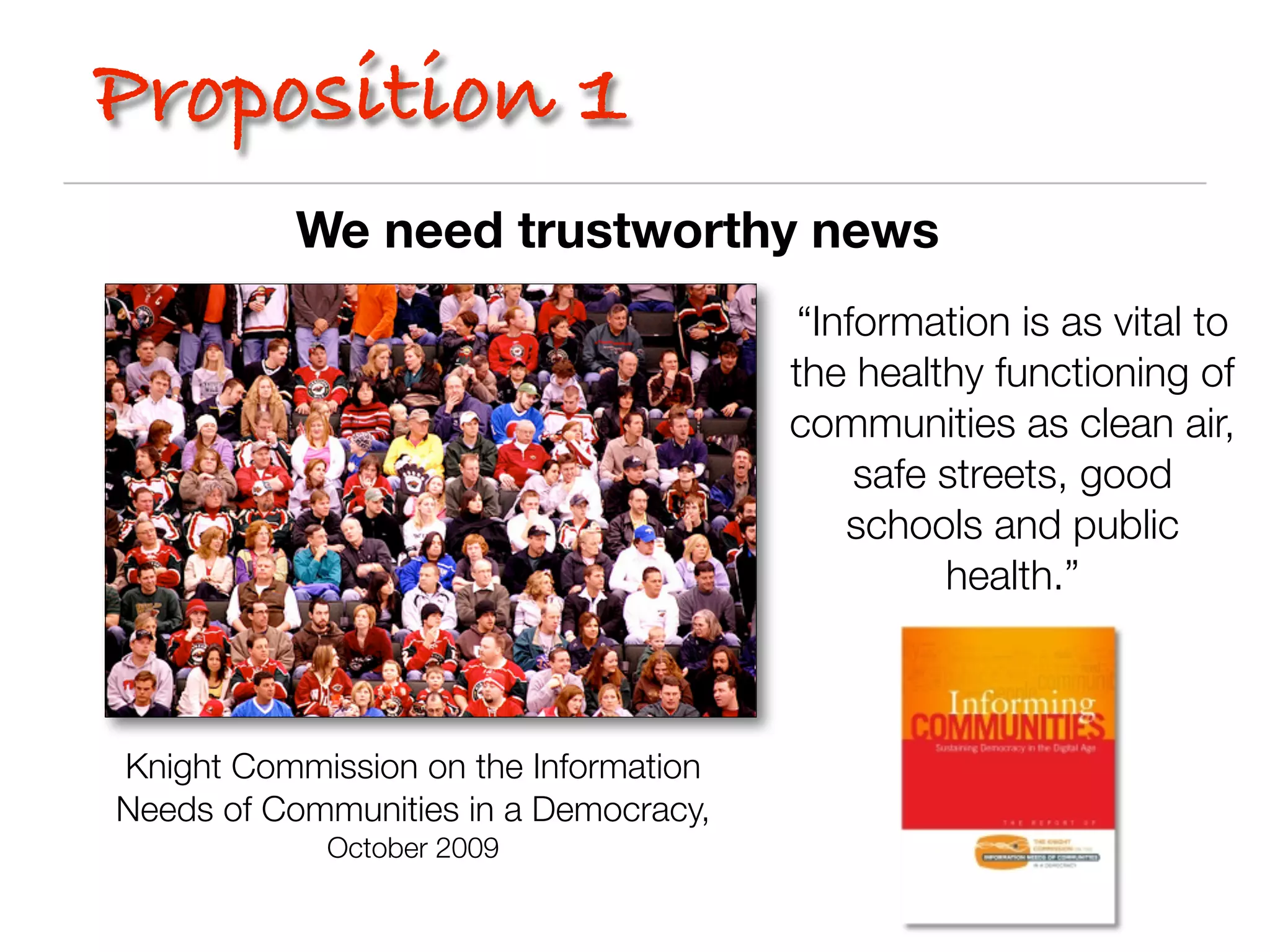
Proposition 1
          We need trustworthy news
                                        “Information is as vital to
                                       the healthy functioning of
                                       communities as clean air,
                                            safe streets, good
                                           schools and public
                                                 health.”


Knight Commission on the Information
Needs of Communities in a Democracy,
            October 2009
Proposition 2
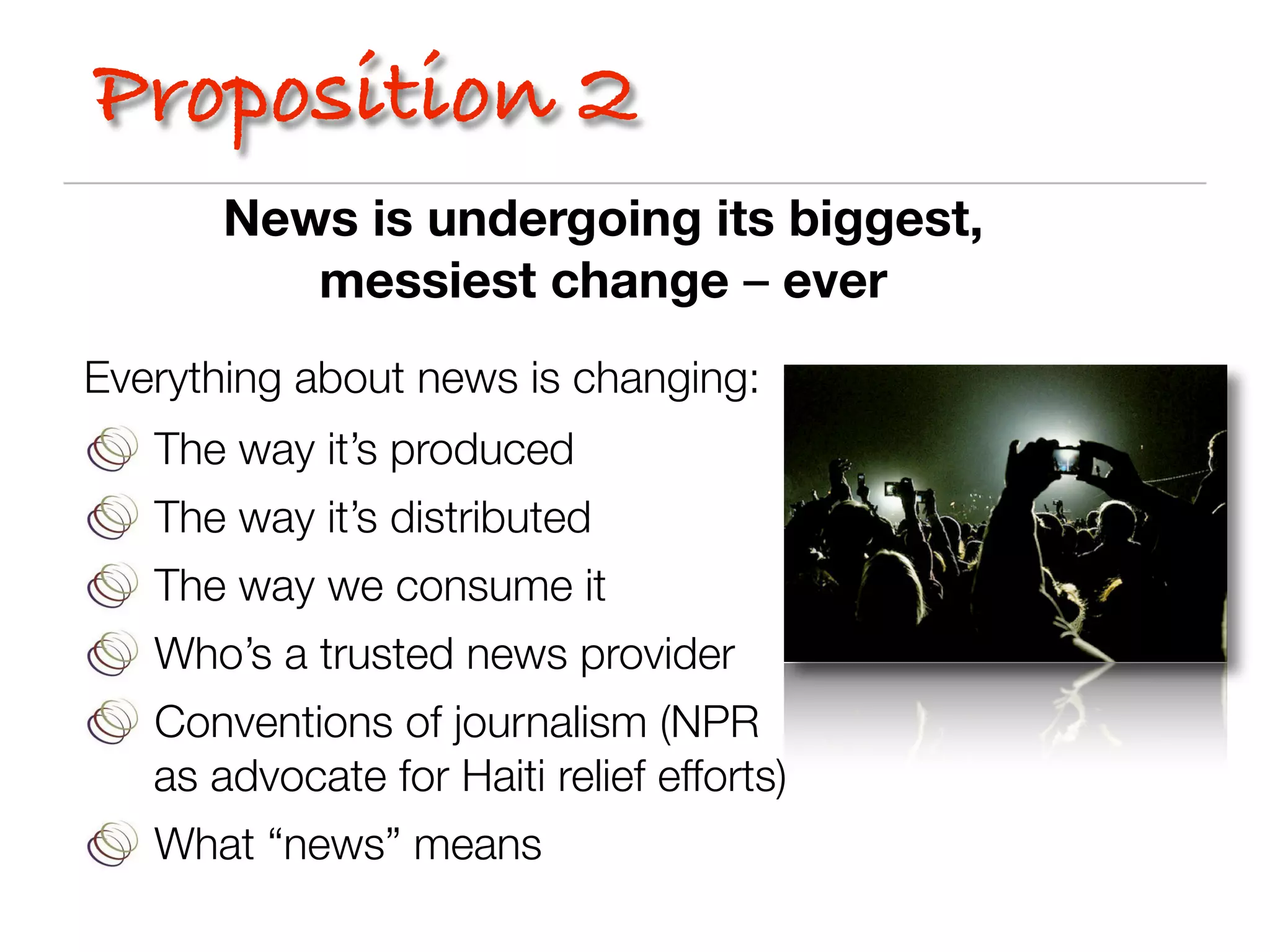
       News is undergoing its biggest,
          messiest change – ever
Everything about news is changing:
   The way it’s produced
   The way it’s distributed
   The way we consume it
   Who’s a trusted news provider
   Conventions of journalism (NPR
   as advocate for Haiti relief efforts)
   What “news” means
The new new news?
A contrast in fortunes


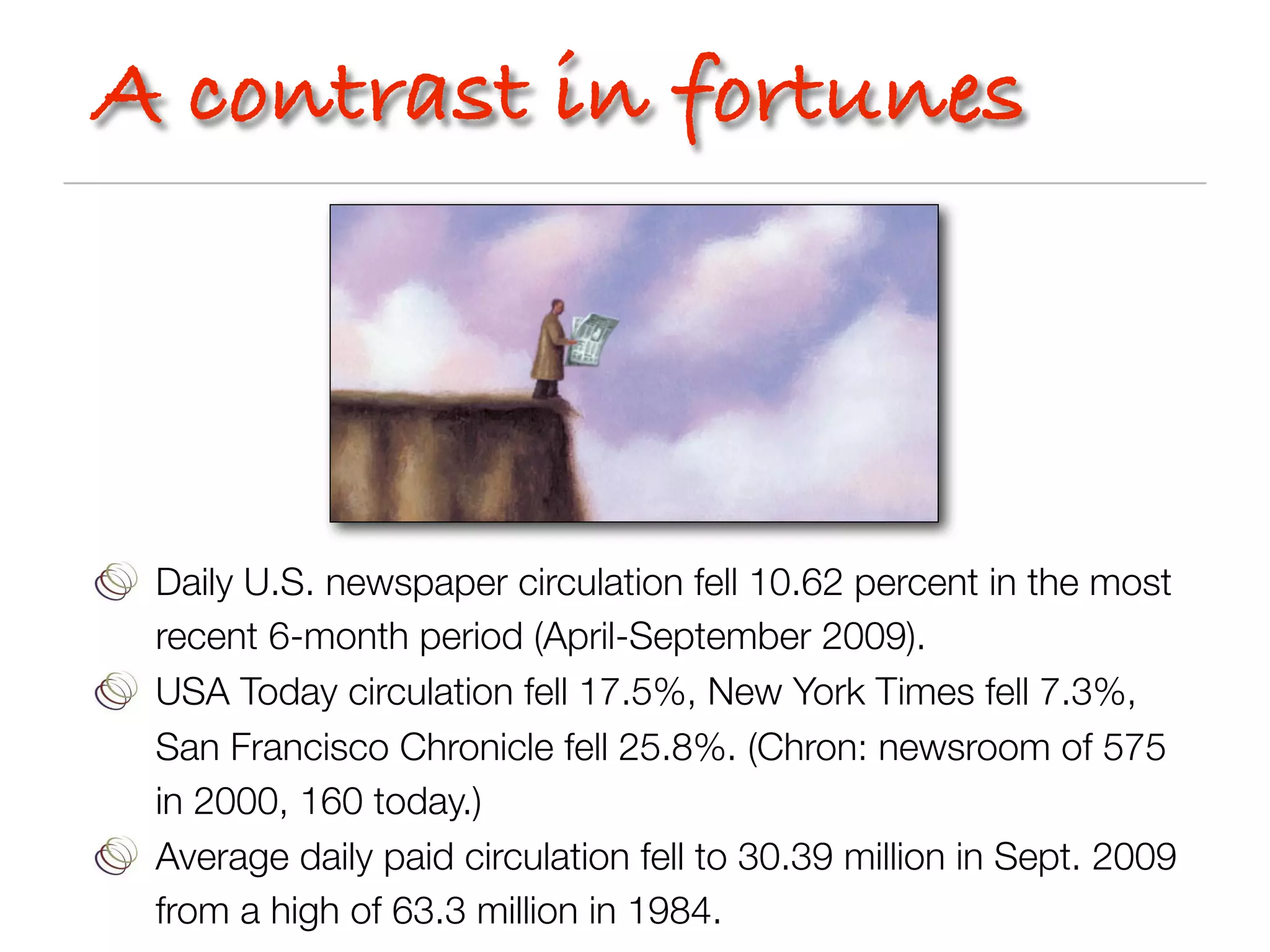
 Daily U.S. newspaper circulation fell 10.62 percent in the most
 recent 6-month period (April-September 2009).
 USA Today circulation fell 17.5%, New York Times fell 7.3%,
 San Francisco Chronicle fell 25.8%. (Chron: newsroom of 575
 in 2000, 160 today.)
 Average daily paid circulation fell to 30.39 million in Sept. 2009
 from a high of 63.3 million in 1984.
Social media’s ecosystem
Almost 1 million blog posts per day; over 346 million people
globally read blogs
6 of top 10 websites in US are social sites (YouTube,
Facebook, Wikipedia, MySpace, Blogger, Craigslist)
Twitter: 108 million registered users; 300,000 new users a day;
180 million unique visitors a month
Facebook: 400 million members
Flickr: 35 million people have posted &
tagged 3 billion-plus photos
Wikipedia: 10 million users have contributed
YouTube: 1 billion-plus videos served per day
Whenever someone opens a computer, 60% of time it’s for
social reasons
Cultural norms of social media
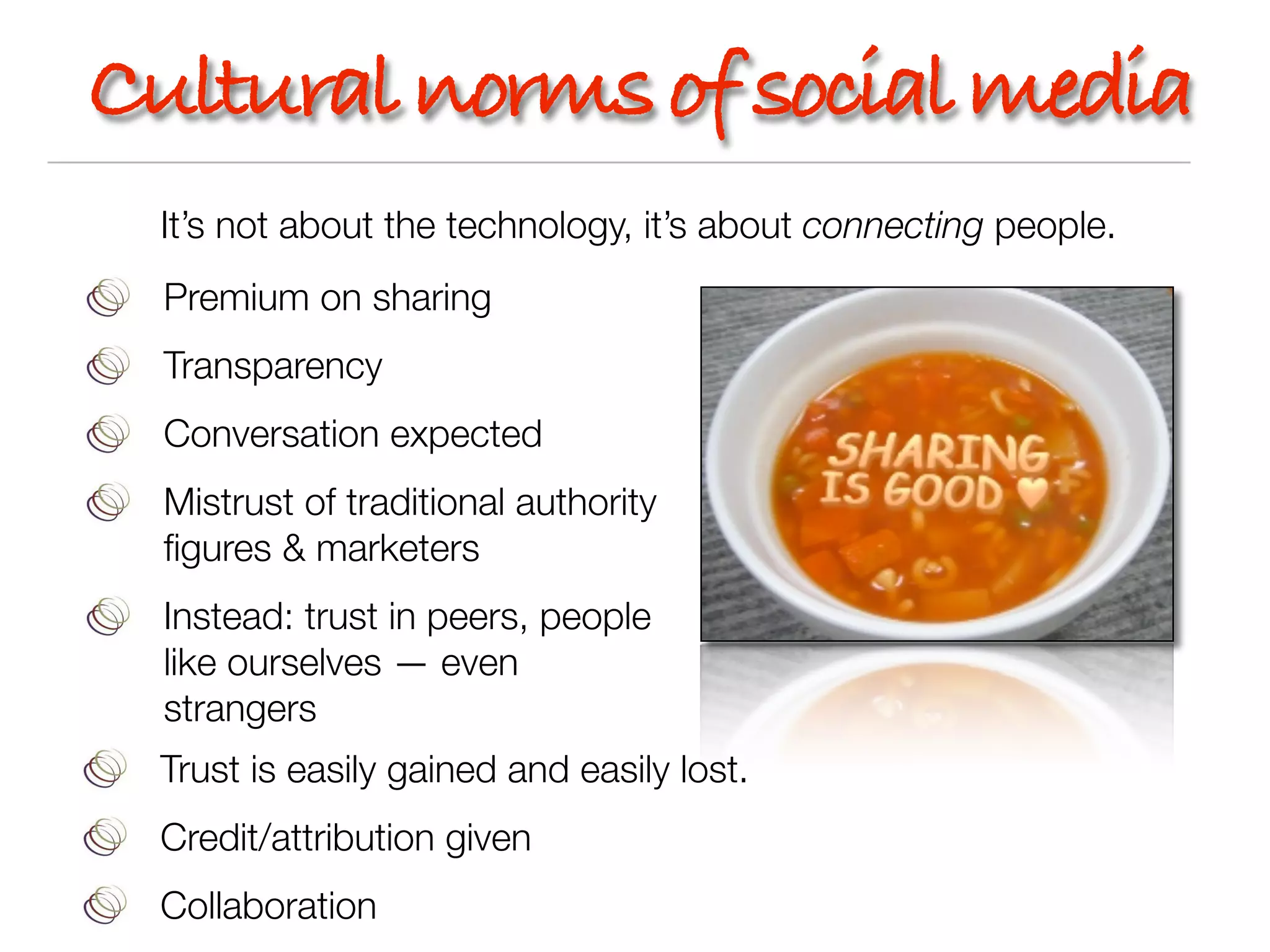
 It’s not about the technology, it’s about connecting people.
  Premium on sharing
  Transparency
  Conversation expected
  Mistrust of traditional authority
  figures & marketers
  Instead: trust in peers, people
  like ourselves — even
  strangers
 Trust is easily gained and easily lost.
 Credit/attribution given
 Collaboration
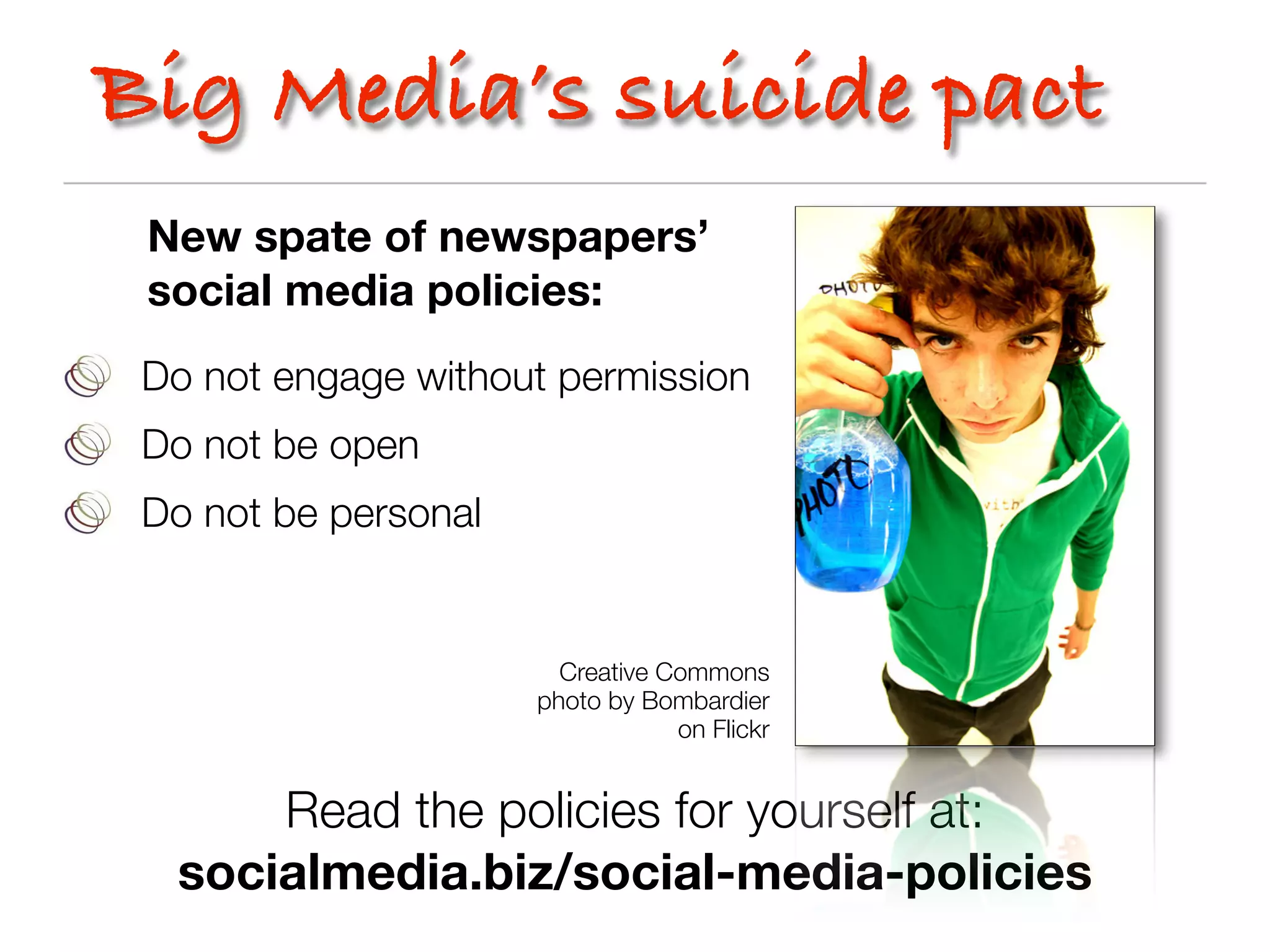
Big Media’s suicide pact
 New spate of newspapers’
 social media policies:
 Do not engage without permission
 Do not be open
 Do not be personal


                        Creative Commons
                      photo by Bombardier
                                  on Flickr


      Read the policies for yourself at:
  socialmedia.biz/social-media-policies
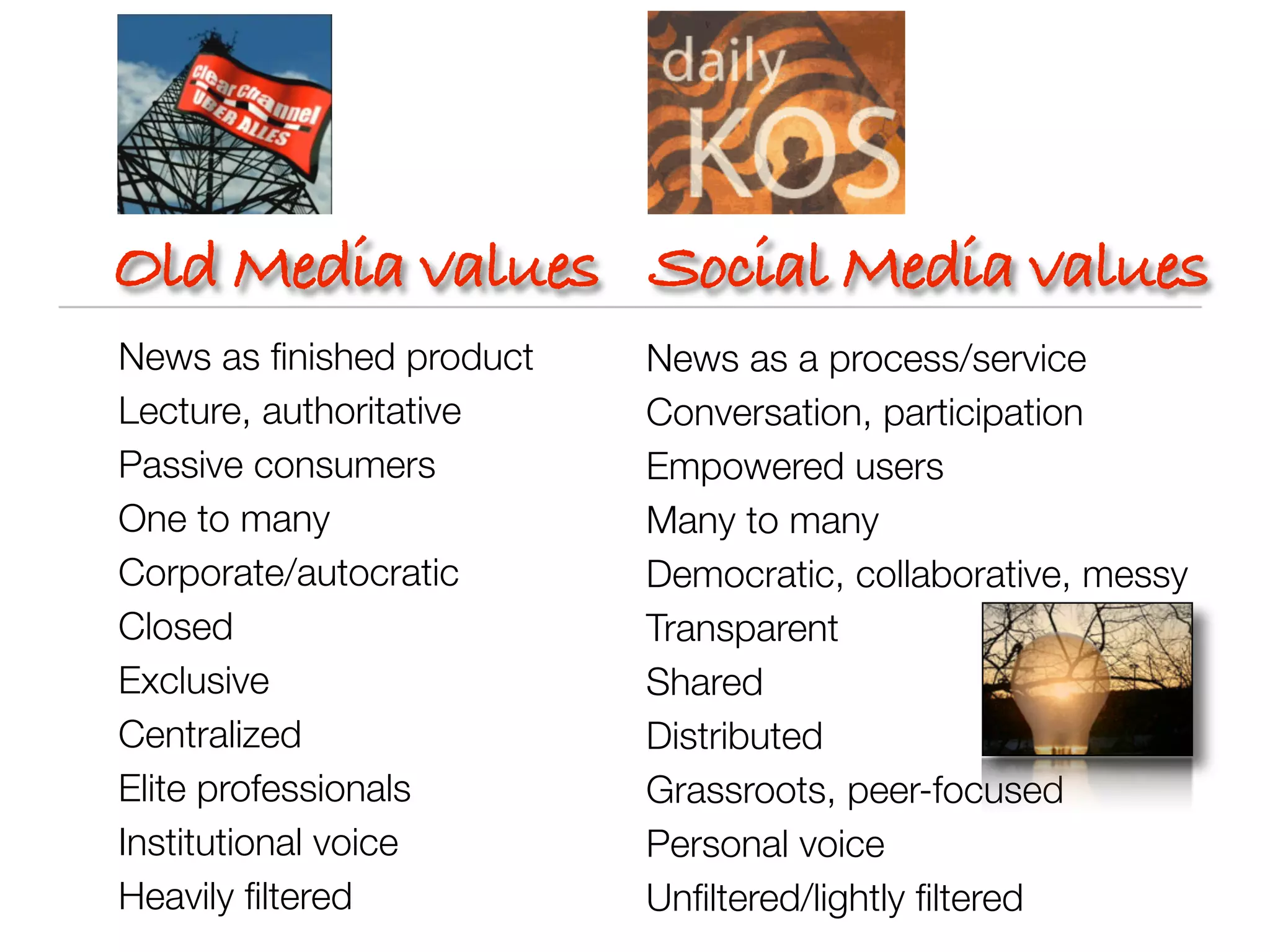
Old Media values Social Media values
News as finished product   News as a process/service
Lecture, authoritative    Conversation, participation
Passive consumers         Empowered users
One to many               Many to many
Corporate/autocratic      Democratic, collaborative, messy
Closed                    Transparent
Exclusive                 Shared
Centralized               Distributed
Elite professionals       Grassroots, peer-focused
Institutional voice       Personal voice
Heavily filtered           Unfiltered/lightly filtered
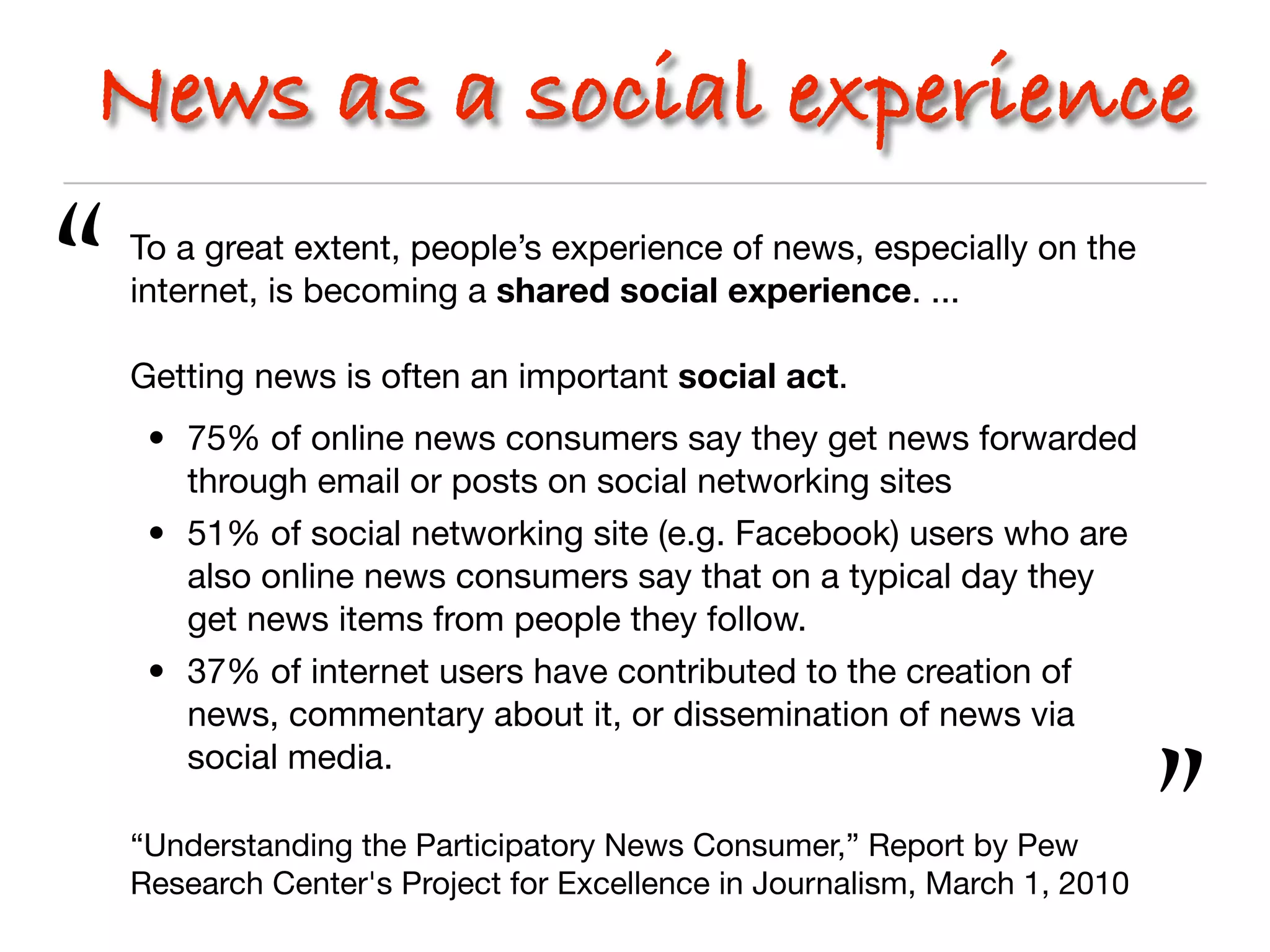
News as a social experience

“   To a great extent, people’s experience of news, especially on the
    internet, is becoming a shared social experience. ...

    Getting news is often an important social act.
     • 75% of online news consumers say they get news forwarded
       through email or posts on social networking sites
     • 51% of social networking site (e.g. Facebook) users who are
       also online news consumers say that on a typical day they
       get news items from people they follow.
     • 37% of internet users have contributed to the creation of
       news, commentary about it, or dissemination of news via
       social media.

    “Understanding the Participatory News Consumer,” Report by Pew
    Research Center's Project for Excellence in Journalism, March 1, 2010   ”
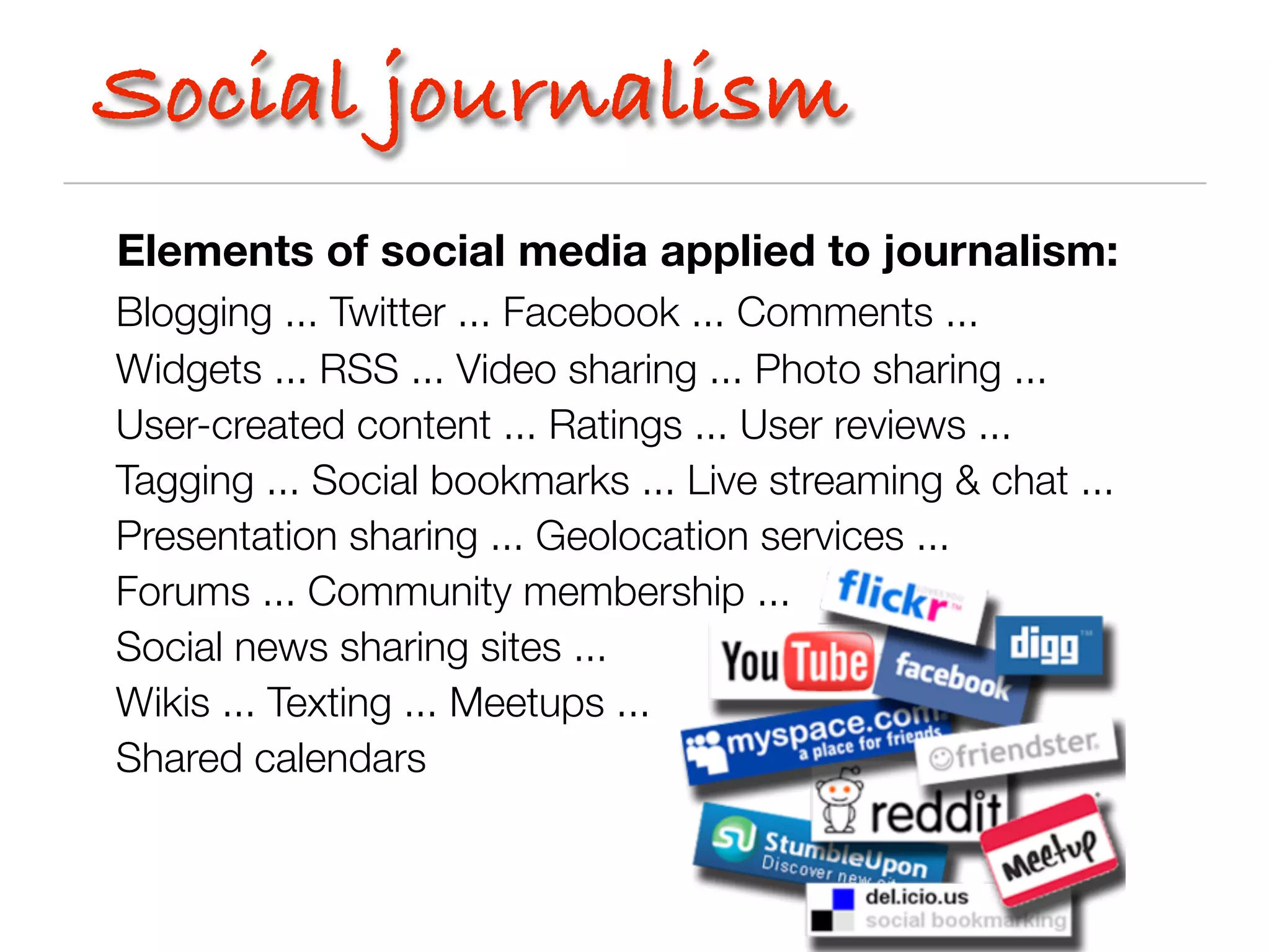
Social journalism
Elements of social media applied to journalism:
Blogging ... Twitter ... Facebook ... Comments ...
Widgets ... RSS ... Video sharing ... Photo sharing ...
User-created content ... Ratings ... User reviews ...
Tagging ... Social bookmarks ... Live streaming & chat ...
Presentation sharing ... Geolocation services ...
Forums ... Community membership ...
Social news sharing sites ...
Wikis ... Texting ... Meetups ...
Shared calendars
Entrepreneurial journalism
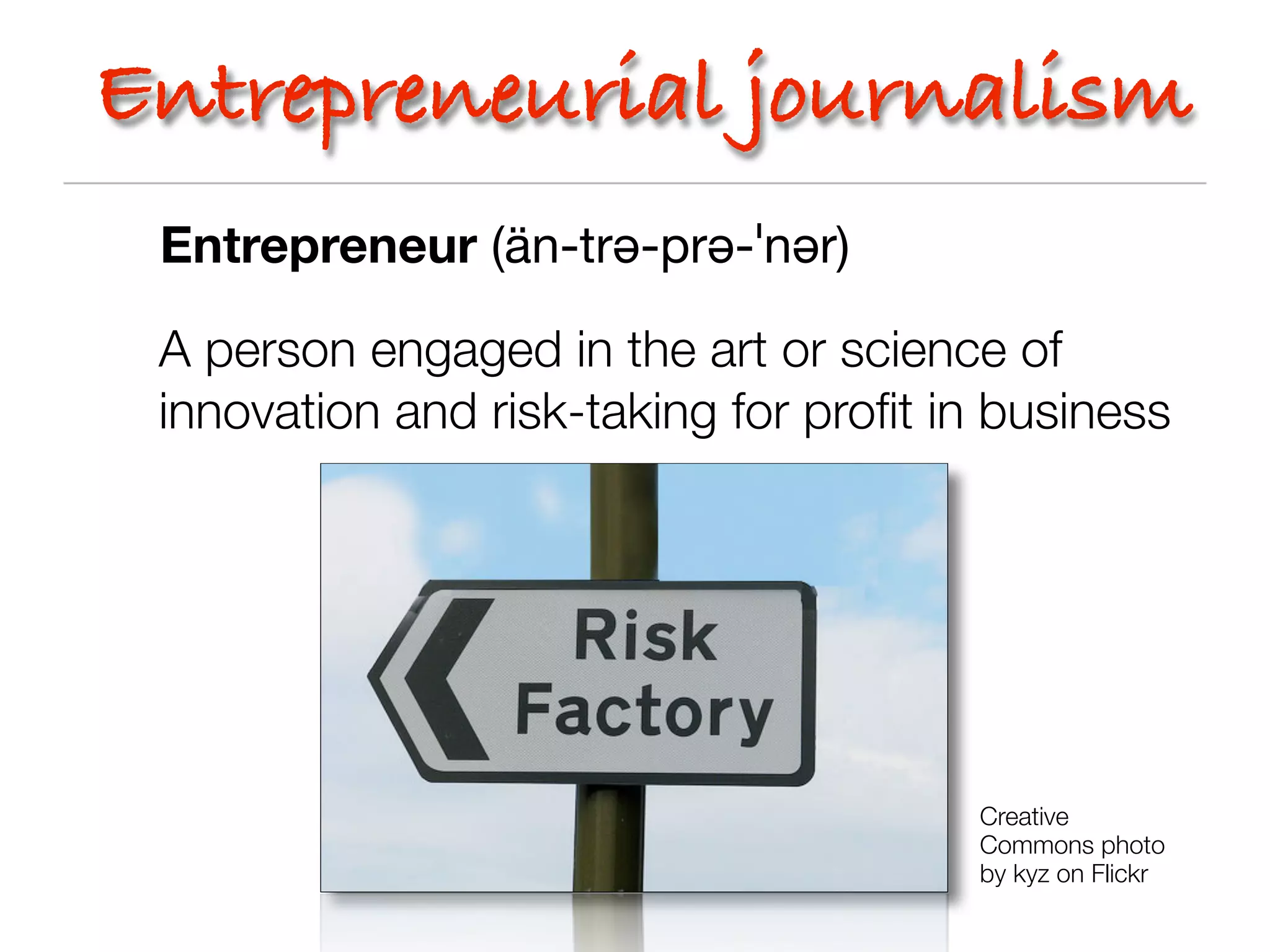
 Entrepreneur (än-trə-prə-ˈnər)

 A person engaged in the art or science of
 innovation and risk-taking for profit in business


                                       Creative
                                       Commons photo
                                       by kyz on Flickr
Entrepreneurial approach
 Build things that are useful & have value

 Study marketplace, define goals, write business plan

 Embrace risk

 Launch pilot projects

 Measure results

 Make tough choices

 Iterate! Iterate! Iterate!   Creative Commons photo by parl on Flickr


 Make mistakes, forgive yourself, move on
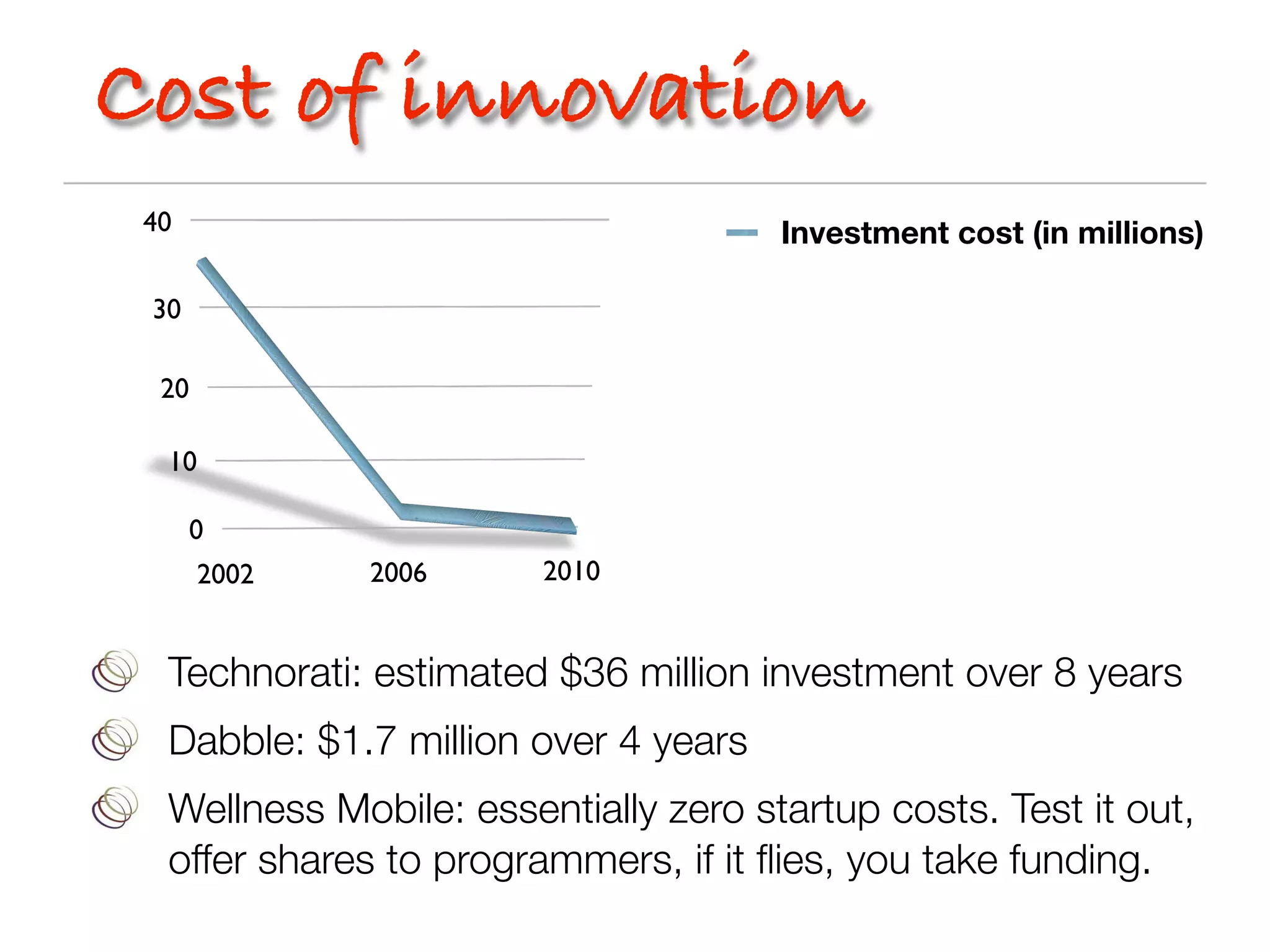
Cost of innovation
 40                                   Investment cost (in millions)

 30

  20

  10

      0
       2002   2006      2010


  Technorati: estimated $36 million investment over 8 years
  Dabble: $1.7 million over 4 years
  Wellness Mobile: essentially zero startup costs. Test it out,
  offer shares to programmers, if it flies, you take funding.
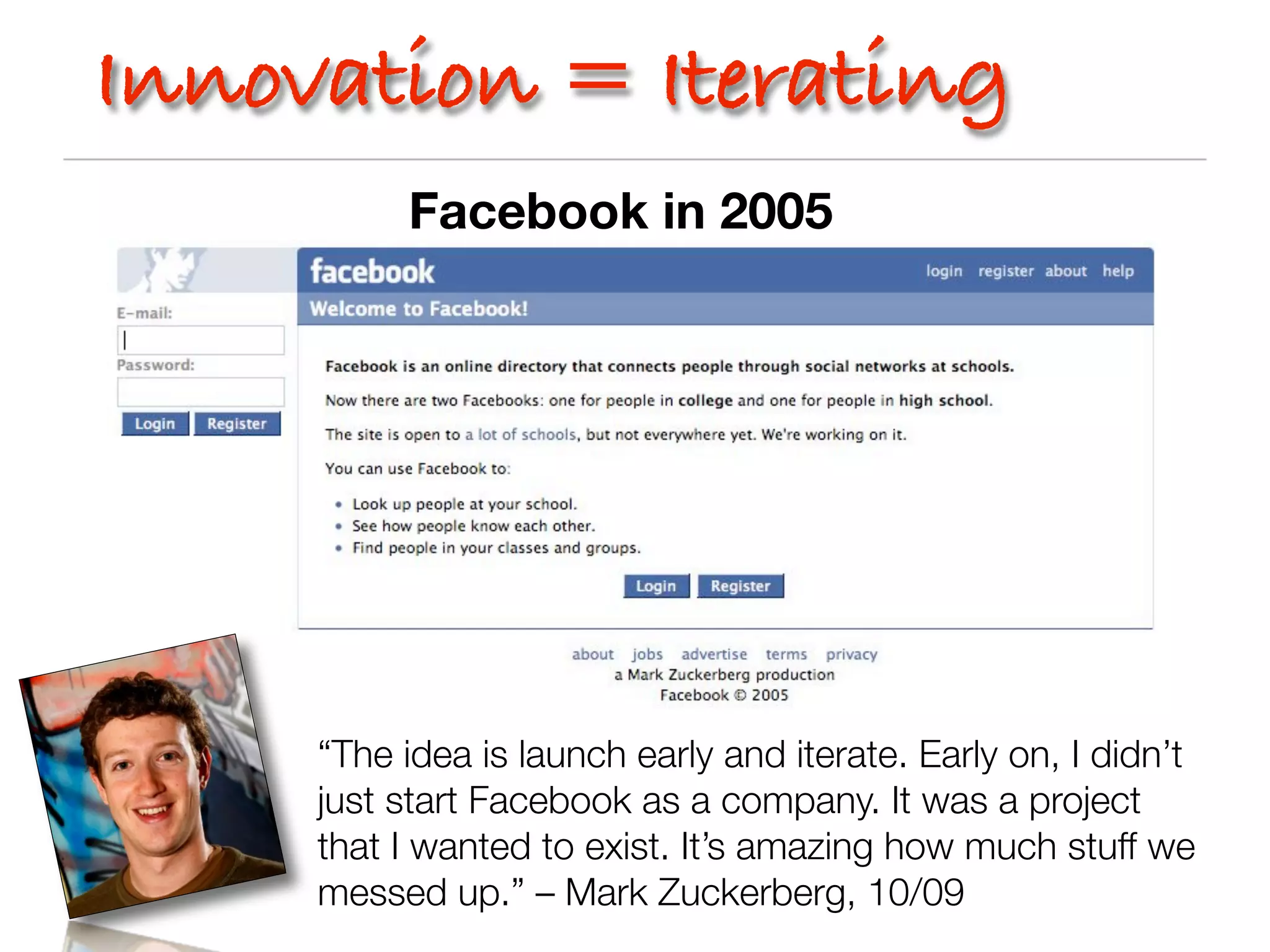
Innovation = Iterating
          Facebook in 2005


     “The idea is launch early and iterate. Early on, I didn’t
     just start Facebook as a company. It was a project
     that I wanted to exist. It’s amazing how much stuff we
     messed up.” – Mark Zuckerberg, 10/09
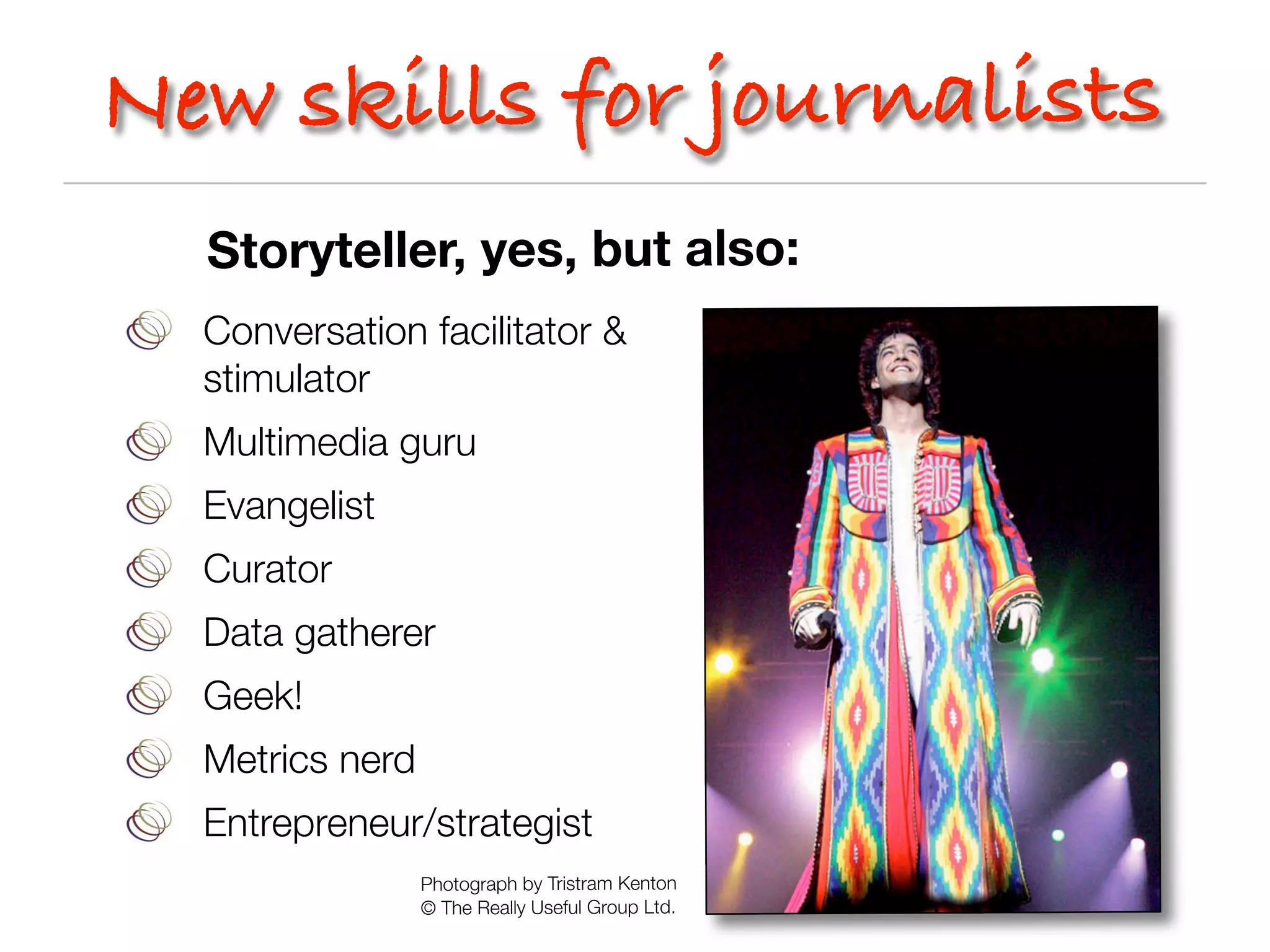
New skills for journalists
  Storyteller, yes, but also:
  Conversation facilitator &
  stimulator
  Multimedia guru
  Evangelist
  Curator
  Data gatherer
  Geek!
  Metrics nerd
  Entrepreneur/strategist
                 Photograph by Tristram Kenton
                 © The Really Useful Group Ltd.
If I were launching a news site
 It would contain these elements:
 Geo-targeted news
 Conversation
 Data-driven tools
 Open APIs
 Rewards & incentives
 for participation
 More attention to real-time Web
 Lots of real-world meet-ups
 Explore multiple verticals
Community brain
                                          Tagging the
                                          real world
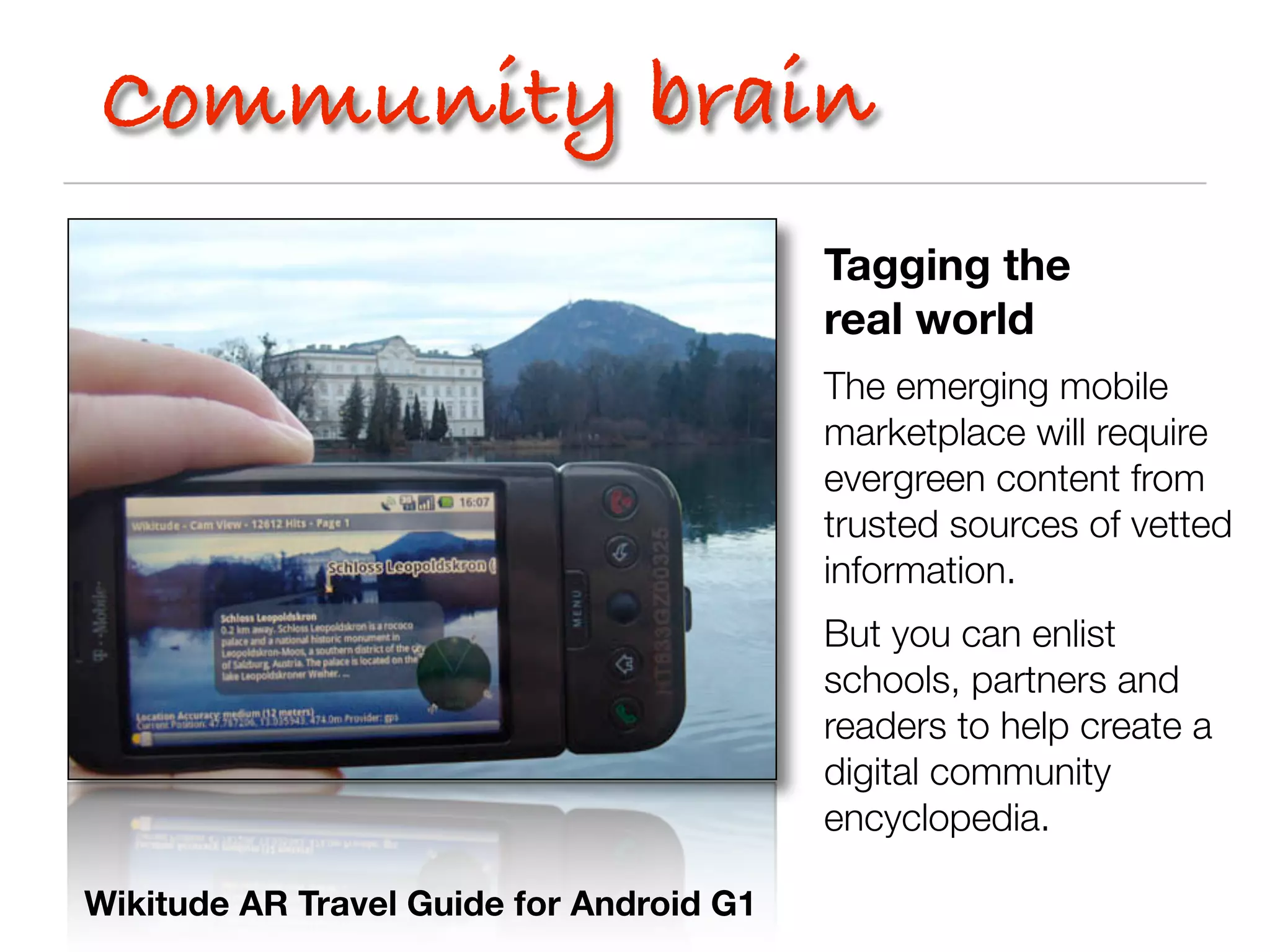
                                          The emerging mobile
                                          marketplace will require
                                          evergreen content from
                                          trusted sources of vetted
                                          information.
                                          But you can enlist
                                          schools, partners and
                                          readers to help create a
                                          digital community
                                          encyclopedia.

Wikitude AR Travel Guide for Android G1
The Web is a database
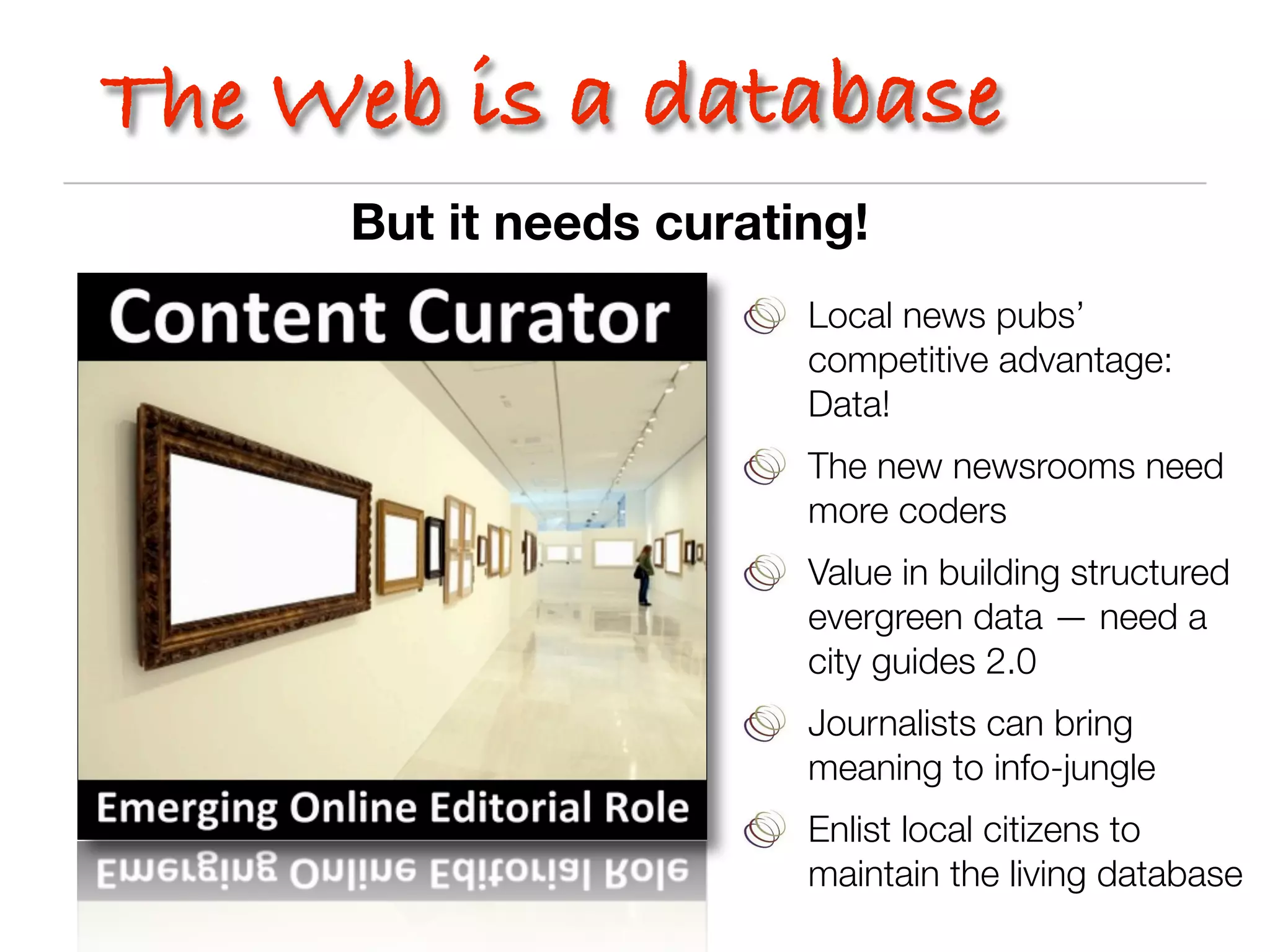
     But it needs curating!
                        Local news pubs’
                        competitive advantage:
                        Data!
                        The new newsrooms need
                        more coders
                        Value in building structured
                        evergreen data — need a
                        city guides 2.0
                        Journalists can bring
                        meaning to info-jungle
                        Enlist local citizens to
                        maintain the living database
The power of open APIs
Give the public access to public records
Open APIs = enlist
community to hack &
contextualize content
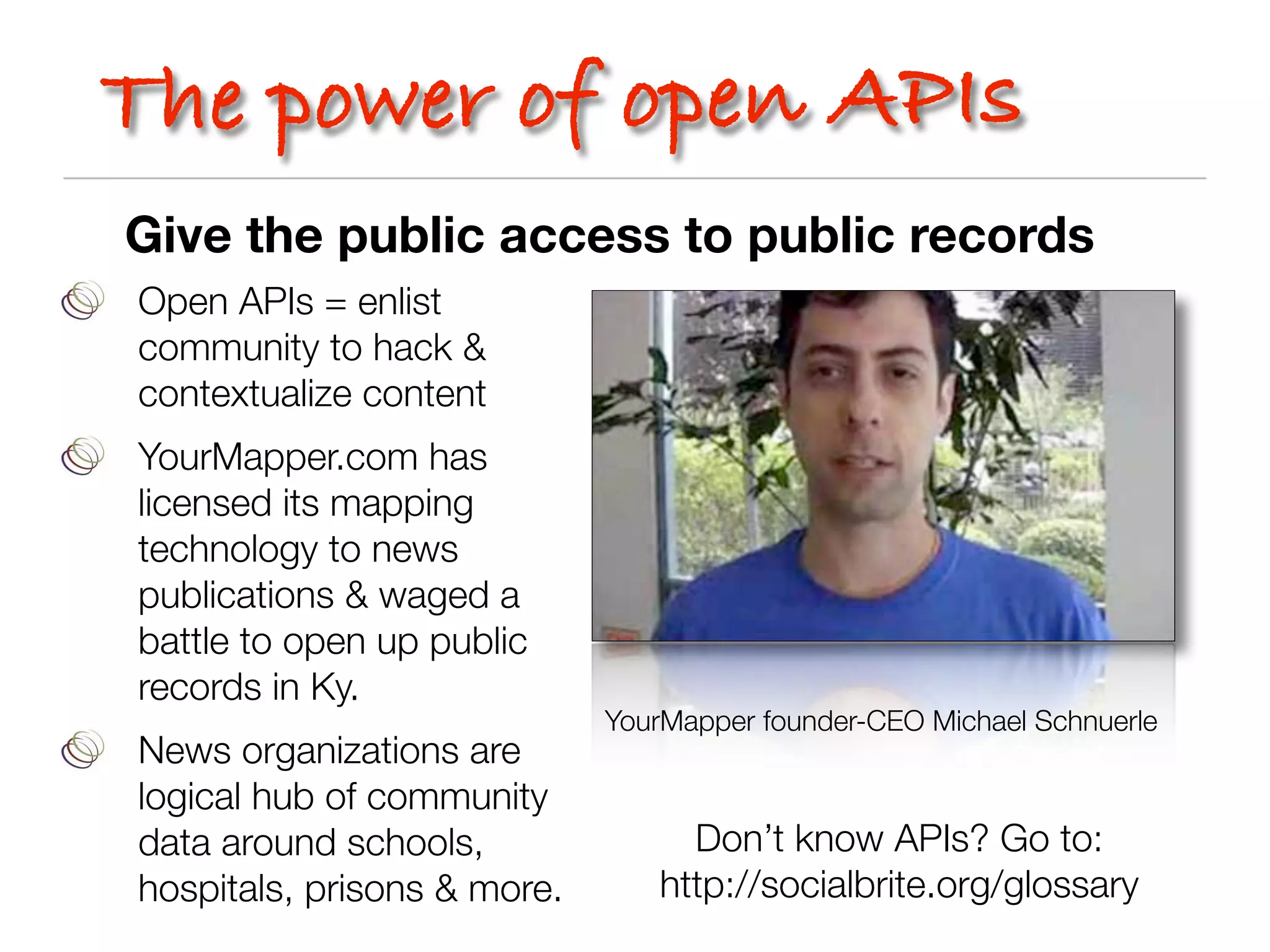
YourMapper.com has
licensed its mapping
technology to news
publications & waged a
battle to open up public
records in Ky.
                             YourMapper founder-CEO Michael Schnuerle
News organizations are
logical hub of community
data around schools,              Don’t know APIs? Go to:
hospitals, prisons & more.      http://socialbrite.org/glossary
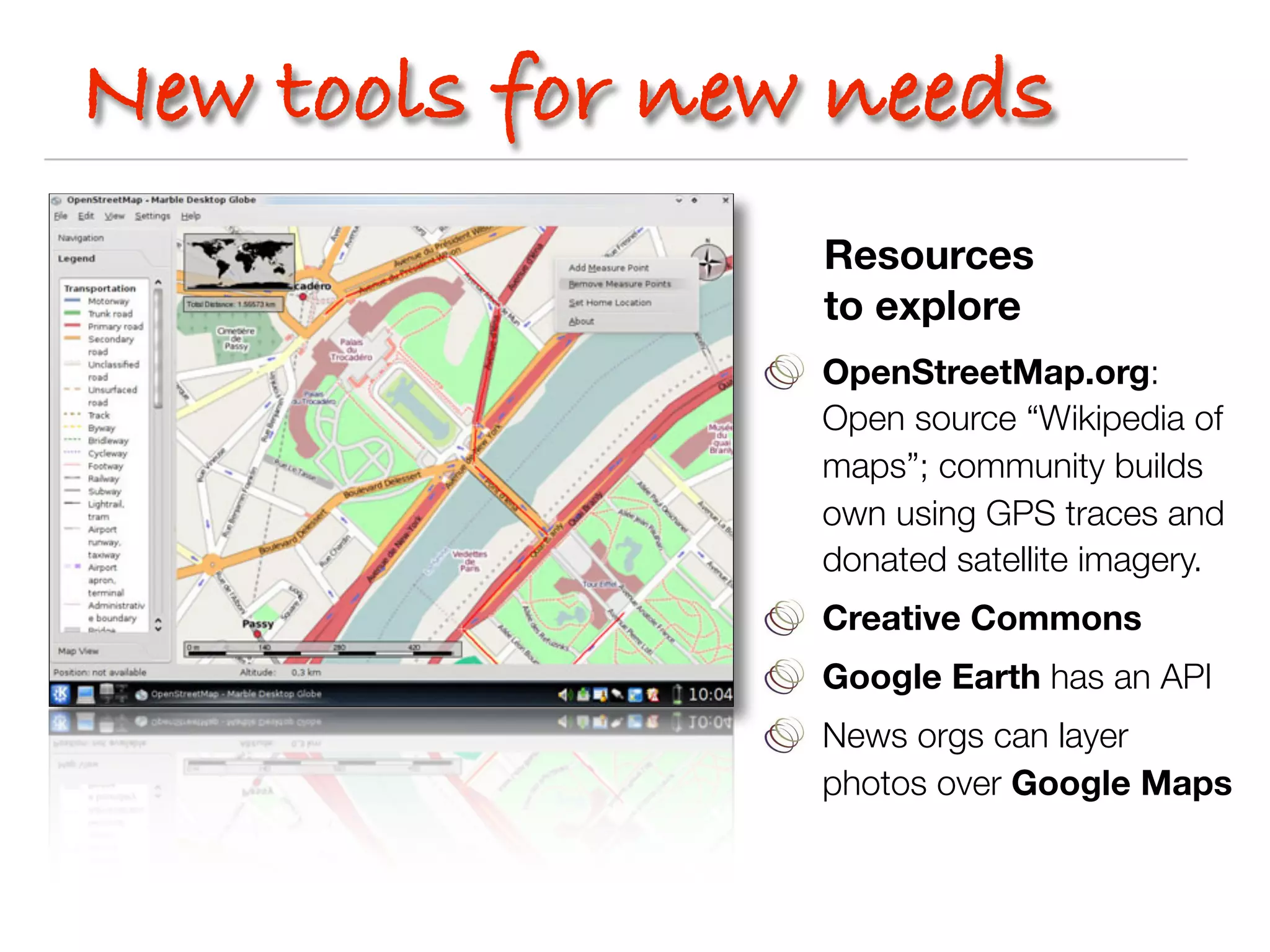
New tools for new needs
                 Resources
                 to explore
                 OpenStreetMap.org:
                 Open source “Wikipedia of
                 maps”; community builds
                 own using GPS traces and
                 donated satellite imagery.
                 Creative Commons
                 Google Earth has an API
                 News orgs can layer
                 photos over Google Maps
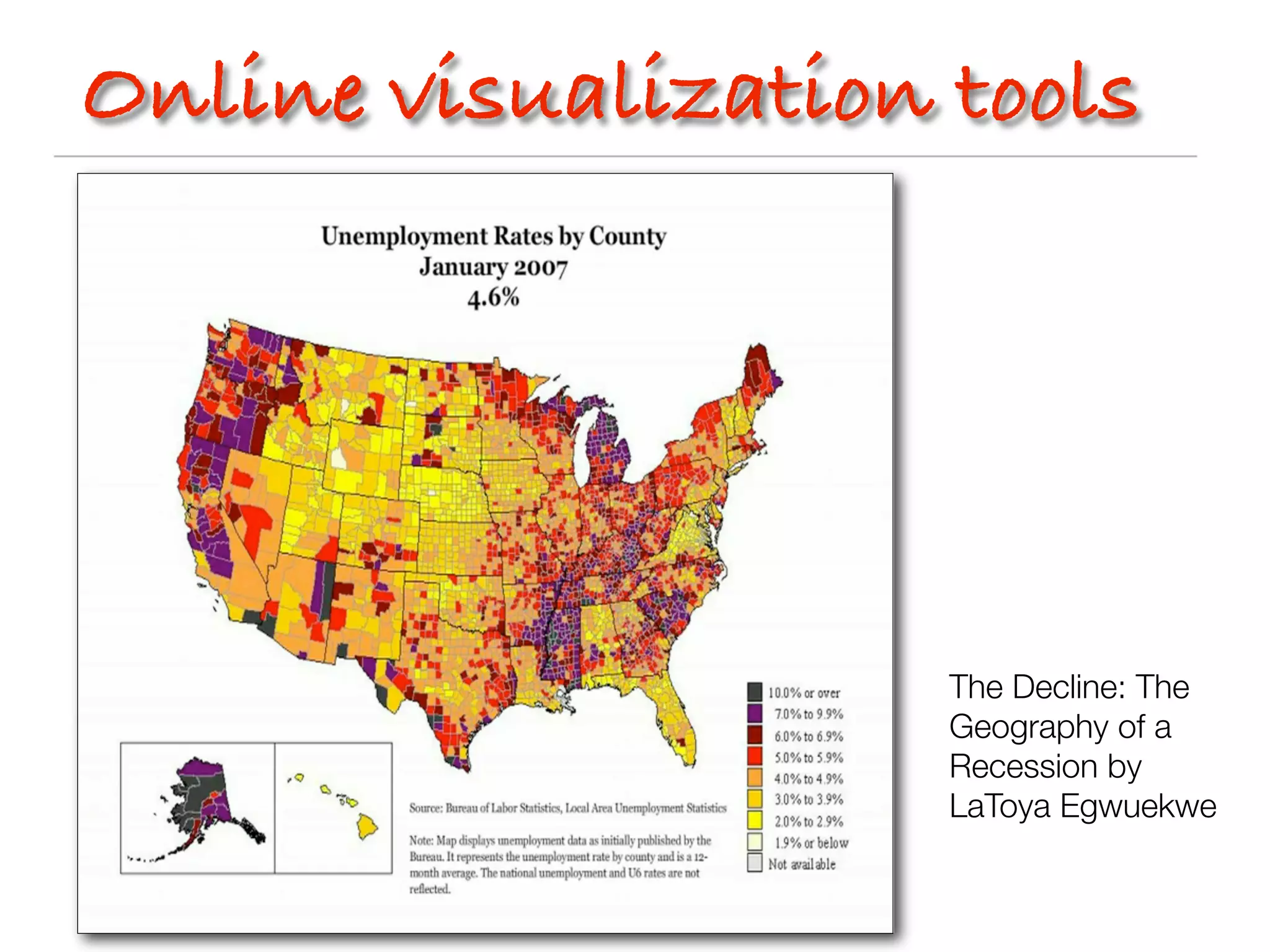
Online visualization tools


                     The Decline: The
                     Geography of a
                     Recession by
                     LaToya Egwuekwe
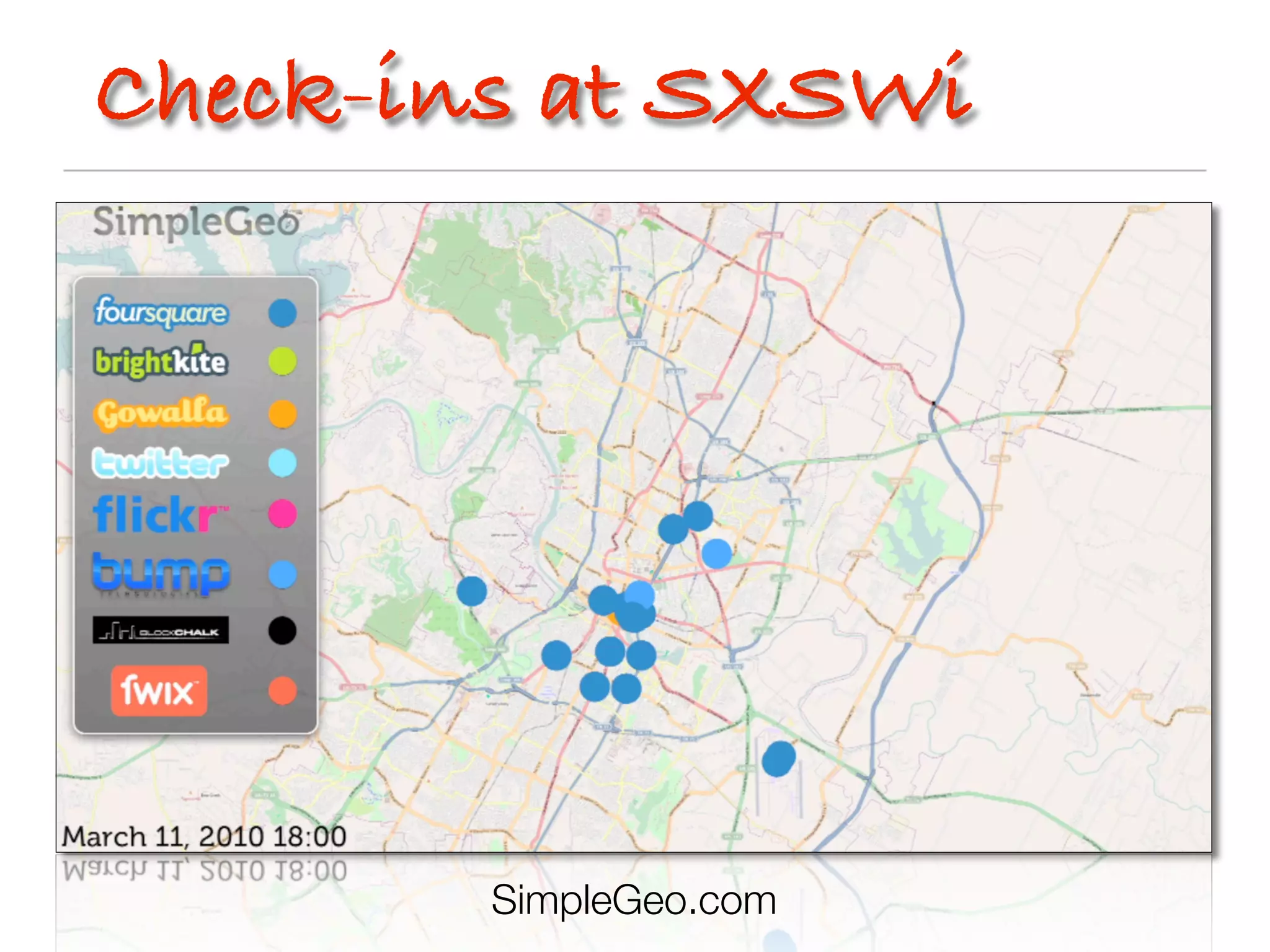
Check-ins at SXSWi


        SimpleGeo.com
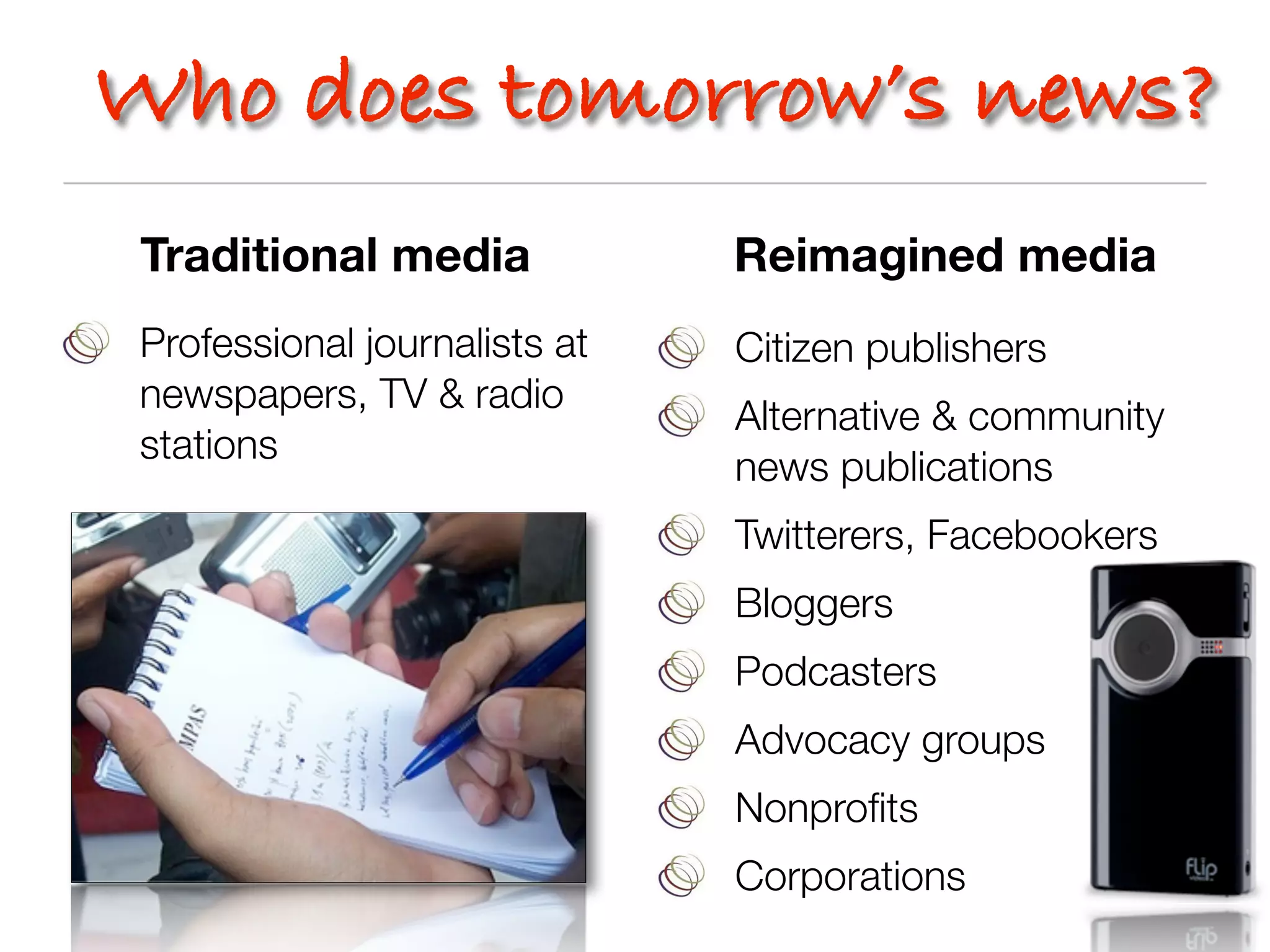
Who does tomorrow’s news?
 Traditional media             Reimagined media
 Professional journalists at   Citizen publishers
 newspapers, TV & radio
                               Alternative & community
 stations
                               news publications
                               Twitterers, Facebookers
                               Bloggers
                               Podcasters
                               Advocacy groups
                               Nonprofits
                               Corporations
Early trailblazers
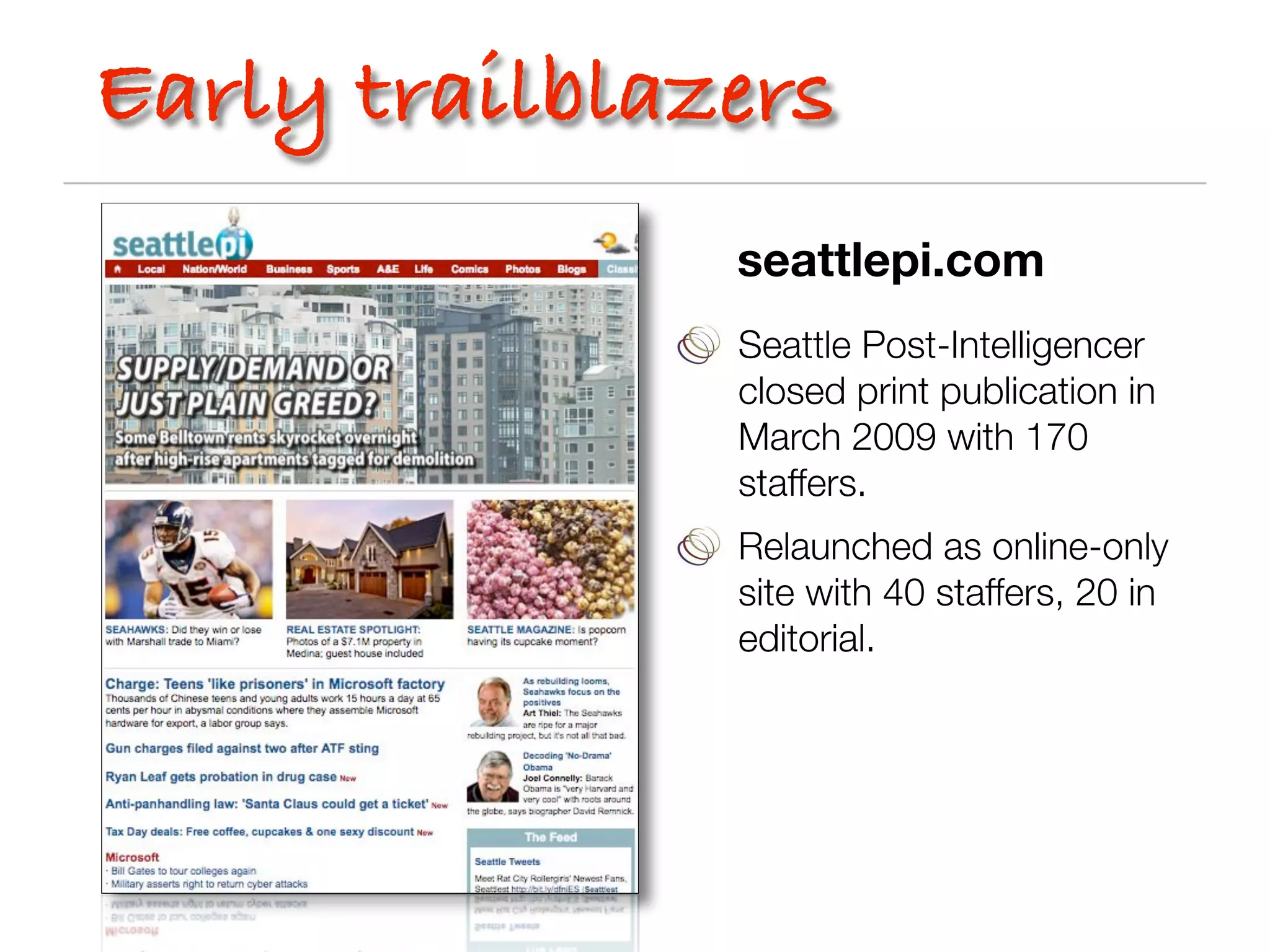
               seattlepi.com
               Seattle Post-Intelligencer
               closed print publication in
               March 2009 with 170
               staffers.
               Relaunched as online-only
               site with 40 staffers, 20 in
               editorial.
Early trailblazers
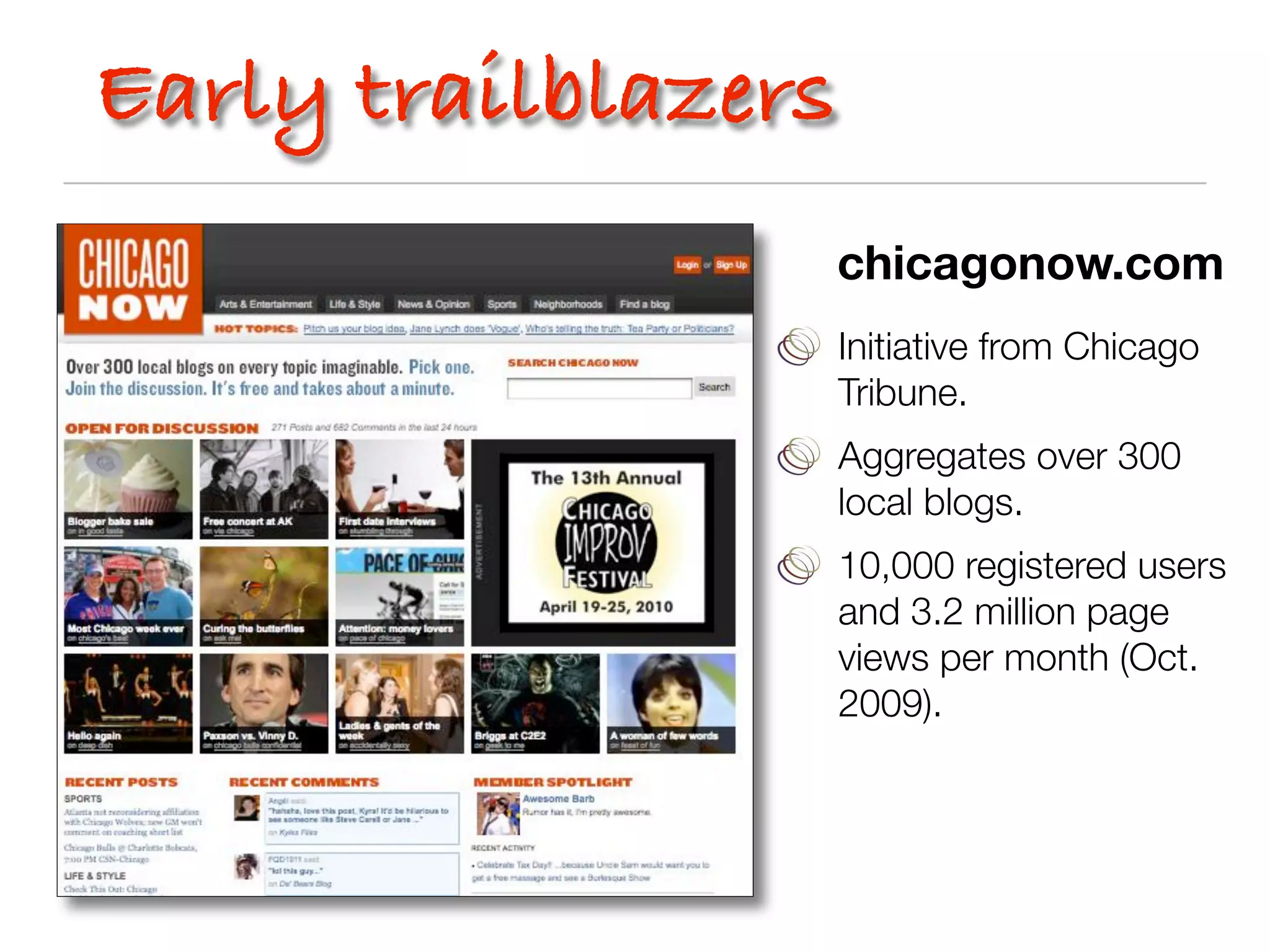
                     chicagonow.com
                     Initiative from Chicago
                     Tribune.
                     Aggregates over 300
                     local blogs.
                     10,000 registered users
                     and 3.2 million page
                     views per month (Oct.
                     2009).
Early trailblazers
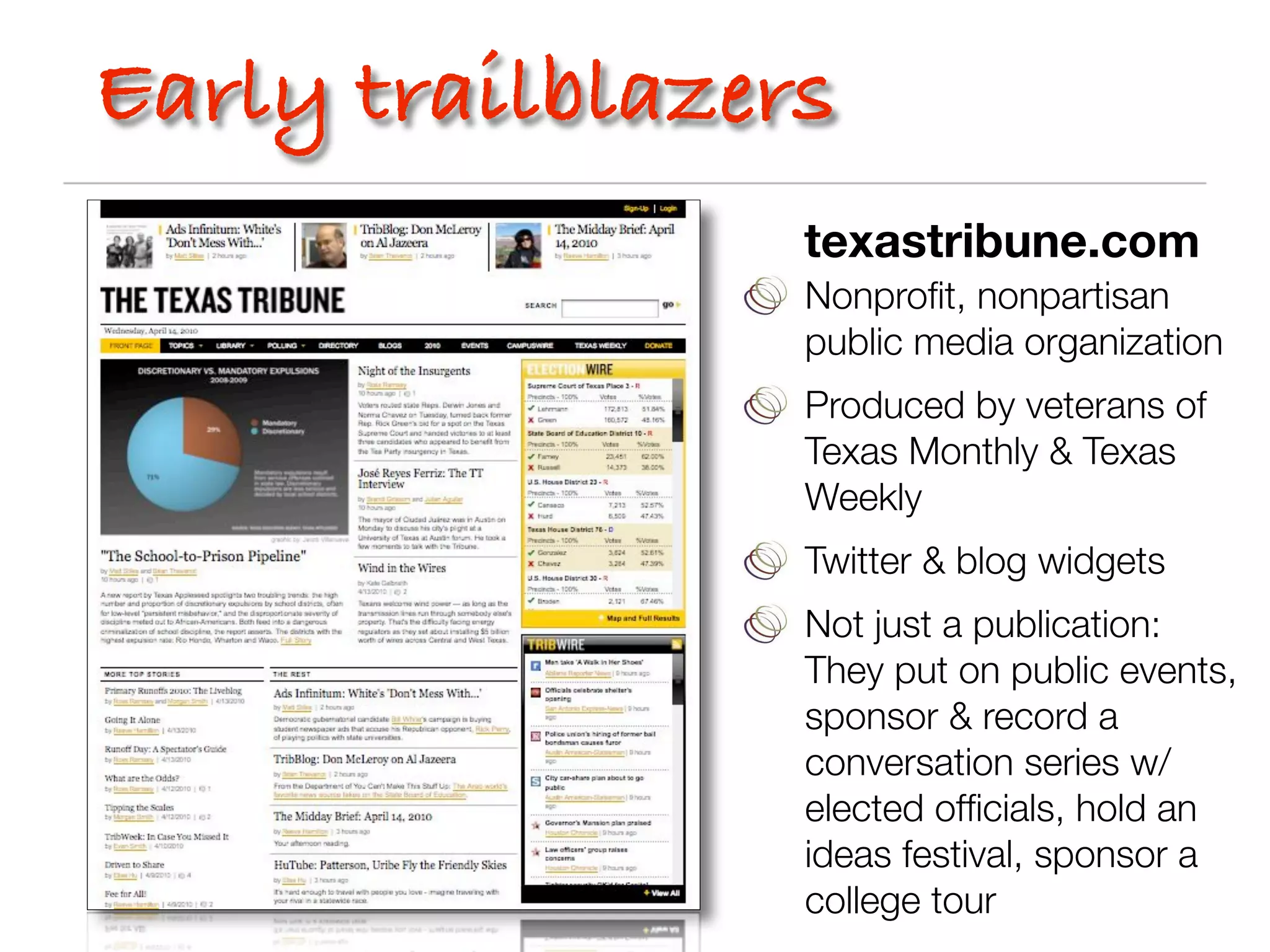
                 texastribune.com
                 Nonprofit, nonpartisan
                 public media organization
                 Produced by veterans of
                 Texas Monthly & Texas
                 Weekly
                 Twitter & blog widgets
                 Not just a publication:
                 They put on public events,
                 sponsor & record a
                 conversation series w/
                 elected officials, hold an
                 ideas festival, sponsor a
                 college tour
Early trailblazers
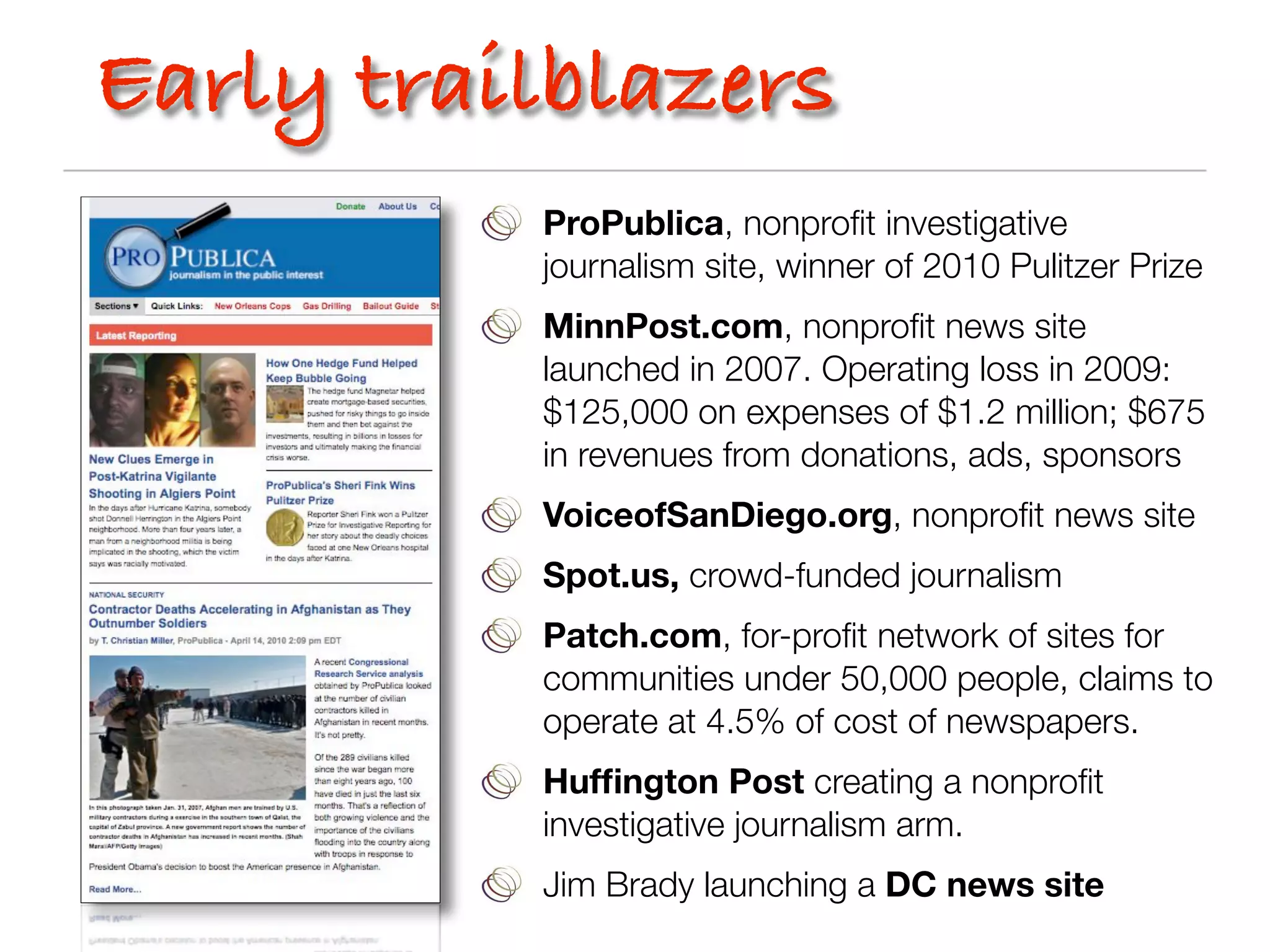
          ProPublica, nonprofit investigative
          journalism site, winner of 2010 Pulitzer Prize
          MinnPost.com, nonprofit news site
          launched in 2007. Operating loss in 2009:
          $125,000 on expenses of $1.2 million; $675
          in revenues from donations, ads, sponsors
          VoiceofSanDiego.org, nonprofit news site
          Spot.us, crowd-funded journalism
          Patch.com, for-profit network of sites for
          communities under 50,000 people, claims to
          operate at 4.5% of cost of newspapers.
          Huffington Post creating a nonprofit
          investigative journalism arm.
          Jim Brady launching a DC news site
Early trailblazers
        Groundreport.com
Community builder

      here’s an amazing
difference between building
an audience and building a
 community. An audience
   will watch you fall on a
sword. A community will fall
     on a sword for you.


     — Chris Brogan
   Author,“Trust Agents”
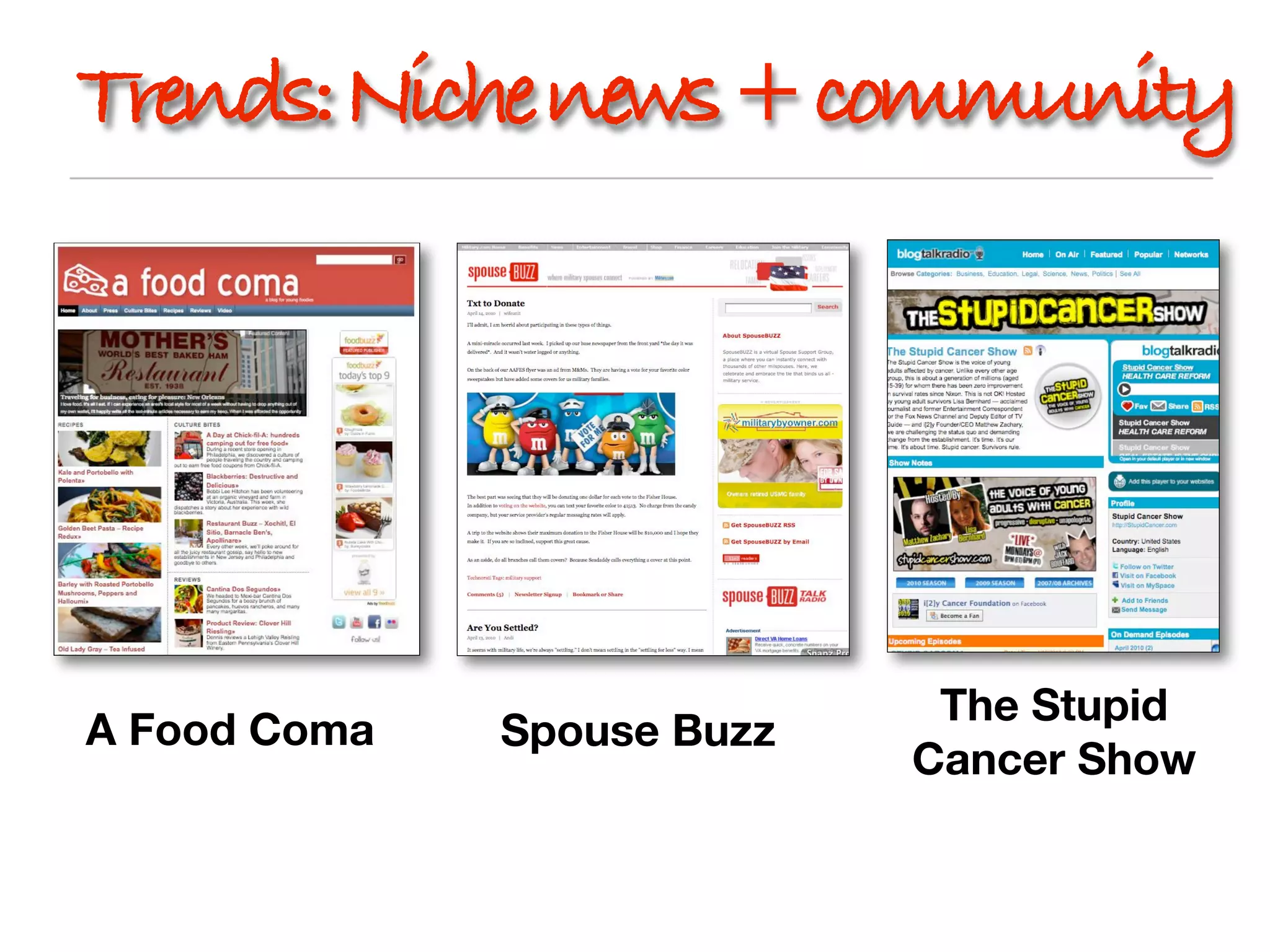
Trends: Niche news + community


                             The Stupid
A Food Coma   Spouse Buzz
                            Cancer Show
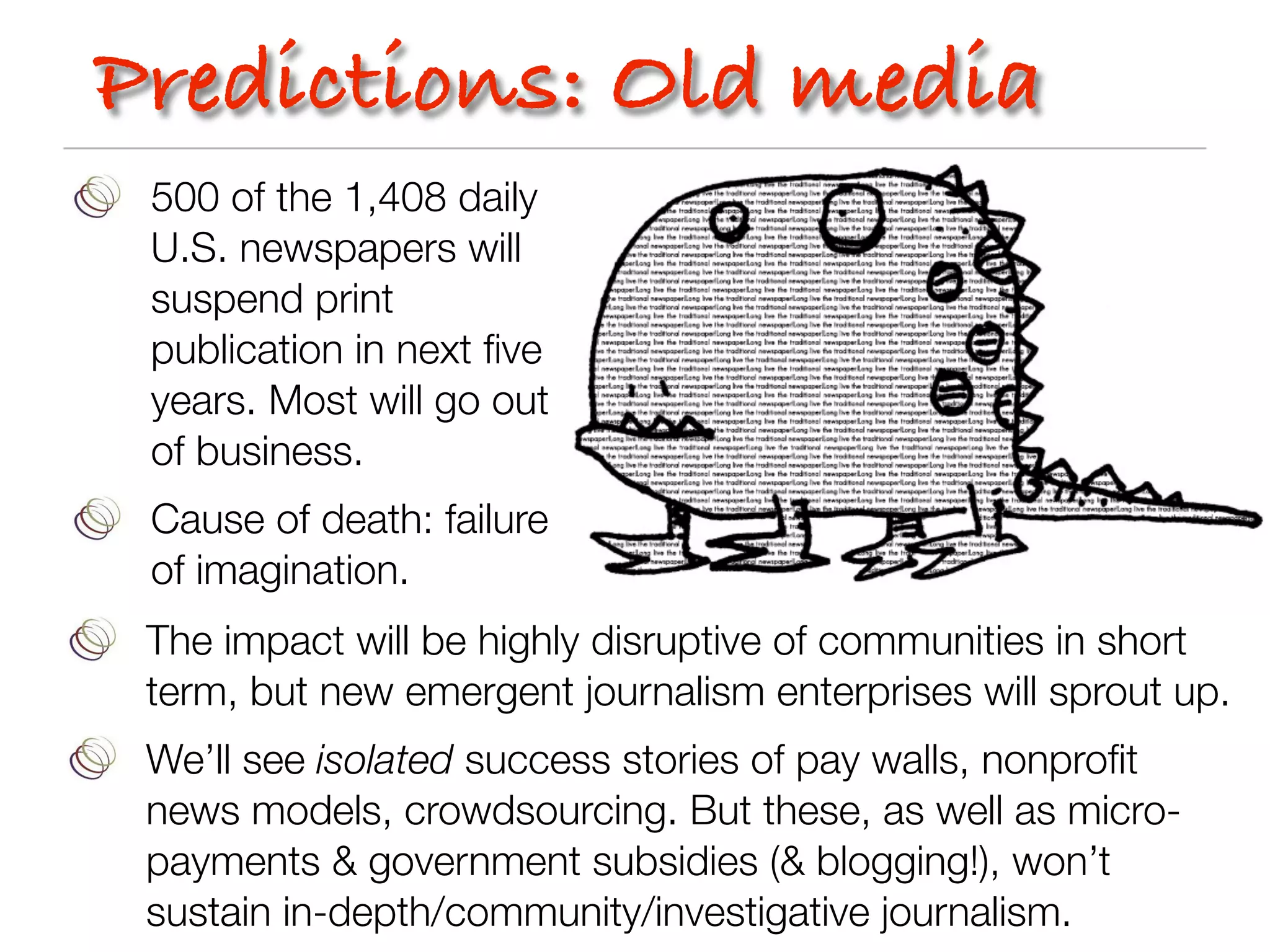
Predictions: Old media
 500 of the 1,408 daily
 U.S. newspapers will
 suspend print
 publication in next five
 years. Most will go out
 of business.
 Cause of death: failure
 of imagination.
 The impact will be highly disruptive of communities in short
 term, but new emergent journalism enterprises will sprout up.
 We’ll see isolated success stories of pay walls, nonprofit
 news models, crowdsourcing. But these, as well as micro-
 payments & government subsidies (& blogging!), won’t
 sustain in-depth/community/investigative journalism.
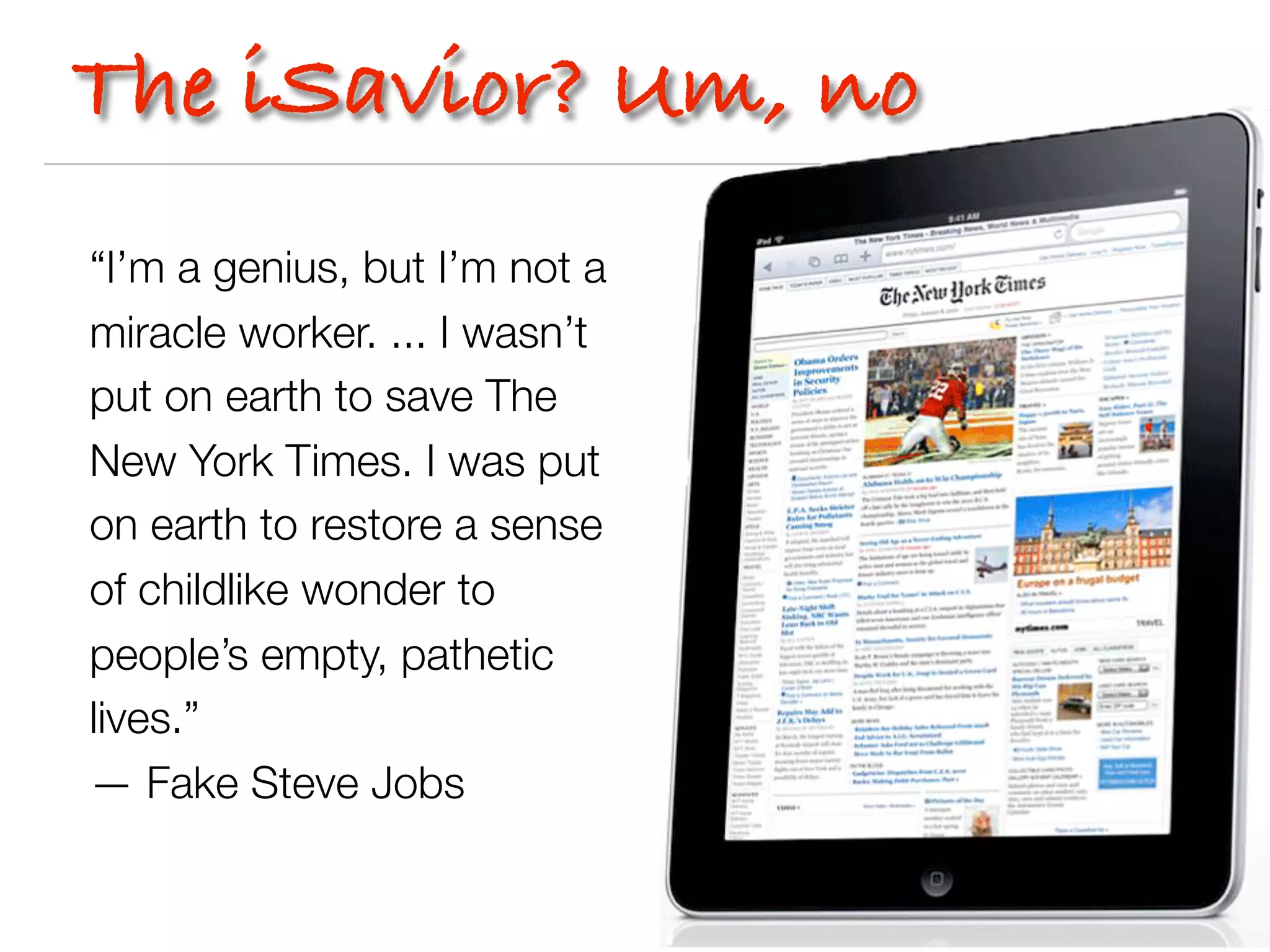
The iSavior? Um, no
“I’m a genius, but I’m not a
miracle worker. ... I wasn’t
put on earth to save The
New York Times. I was put
on earth to restore a sense
of childlike wonder to
people’s empty, pathetic
lives.”
— Fake Steve Jobs
Predictions: New media
 Emerging from ashes of the news industry will
 be a vibrant news ecosystem with smaller
 players that are more social & entrepreneurial.
 Blogging, crowdsourcing & nonprofit news
 sites cannot take place of newspapers by
 themselves — but they will be part of news
 ecosystem.
 We'll see hyperlocal news aggregators take
 slice of local advertising pie: EveryBlock,
 Outside.in, Fwix, Topix.net
 But: They don’t have resources to go deep.
 Legacy news publications should own
 hyperlocal markets — but largely won’t.
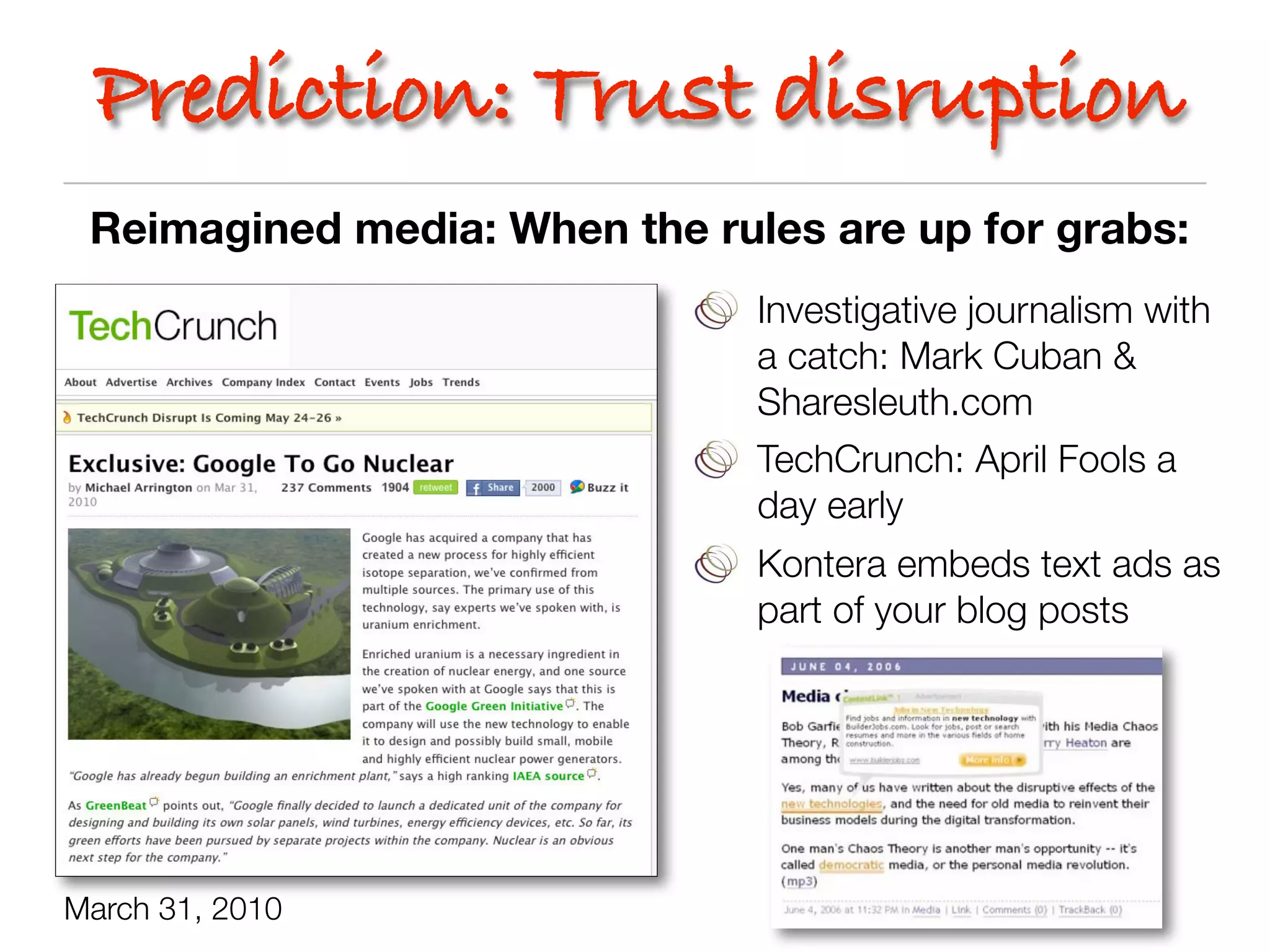
Prediction: Trust disruption
 Reimagined media: When the rules are up for grabs:
                               Investigative journalism with
                               a catch: Mark Cuban &
                               Sharesleuth.com
                               TechCrunch: April Fools a
                               day early
                               Kontera embeds text ads as
                               part of your blog posts


March 31, 2010
Closing thoughts
Young people don’t read newspapers, but they’re
enormous consumers & sharers of news. The Mobile
Generation: Hire them. Observe them. Listen to them.
If every business is a media business, do what no one
else can easily replicate in your community or region.
To be relevant in the new age, create a startup culture,
practice social journalism— and innovate!
Leverage the community. Retool focus to serve as
guide, curator, data jockey & aggregator as well as
content creator.
Bring journalistic standards & values into this new
space.
Help communities tell stories in authentic ways.
Thank you! Let’s talk!
JD Lasica
Founder, Socialbrite.org
SNCR senior fellow
email: jd@socialbrite.org
Twitter: @jdlasica
jdlasica.com/about/


    http://delicious.com/socialmediacamp/ncf10
    Presentation at http://slideshare.net/jdlasica

Paths to the new journalism

  • 1.
    Social & Entrepreneurial: Thepaths to tomorrow’s journalism JD Lasica Socialmedia.biz jd@socialmedia.biz April 23, 2010
  • 2.
    Relax! Flickr photo “relaxation, the maldivian way” by notsogoodphotography (Creative Commons) http://delicious.com/socialmediacamp/ncf10 (all sites in this talk have been tagged for later retrieval) Presentation at http://slideshare.net/jdlasica
  • 3.
    Today’s hashtag Creative Commons photo on Flickr by Prakhar Tweet this talk! Hashtag: #ncf10
  • 4.
    What we’ll covertoday 2 simple propositions The new new news ecosystem • Social media overview & cultural norms • Rise of social media & impact on journalism Social journalism Entrepreneurial journalism • Innovation imperatives (take a page from Facebook) • New skills, new media forms Geolocation: New forms of visual storytelling Examples: Tomorrow’s news today Fearless predictions, closing thoughts
  • 5.
    Proposition 1 We need trustworthy news “Information is as vital to the healthy functioning of communities as clean air, safe streets, good schools and public health.” Knight Commission on the Information Needs of Communities in a Democracy, October 2009
  • 6.
    Proposition 2 News is undergoing its biggest, messiest change – ever Everything about news is changing: The way it’s produced The way it’s distributed The way we consume it Who’s a trusted news provider Conventions of journalism (NPR as advocate for Haiti relief efforts) What “news” means
  • 7.
  • 8.
    A contrast infortunes Daily U.S. newspaper circulation fell 10.62 percent in the most recent 6-month period (April-September 2009). USA Today circulation fell 17.5%, New York Times fell 7.3%, San Francisco Chronicle fell 25.8%. (Chron: newsroom of 575 in 2000, 160 today.) Average daily paid circulation fell to 30.39 million in Sept. 2009 from a high of 63.3 million in 1984.
  • 9.
    Social media’s ecosystem Almost1 million blog posts per day; over 346 million people globally read blogs 6 of top 10 websites in US are social sites (YouTube, Facebook, Wikipedia, MySpace, Blogger, Craigslist) Twitter: 108 million registered users; 300,000 new users a day; 180 million unique visitors a month Facebook: 400 million members Flickr: 35 million people have posted & tagged 3 billion-plus photos Wikipedia: 10 million users have contributed YouTube: 1 billion-plus videos served per day Whenever someone opens a computer, 60% of time it’s for social reasons
  • 10.
    Cultural norms ofsocial media It’s not about the technology, it’s about connecting people. Premium on sharing Transparency Conversation expected Mistrust of traditional authority figures & marketers Instead: trust in peers, people like ourselves — even strangers Trust is easily gained and easily lost. Credit/attribution given Collaboration
  • 11.
    Big Media’s suicidepact New spate of newspapers’ social media policies: Do not engage without permission Do not be open Do not be personal Creative Commons photo by Bombardier on Flickr Read the policies for yourself at: socialmedia.biz/social-media-policies
  • 12.
    Old Media valuesSocial Media values News as finished product News as a process/service Lecture, authoritative Conversation, participation Passive consumers Empowered users One to many Many to many Corporate/autocratic Democratic, collaborative, messy Closed Transparent Exclusive Shared Centralized Distributed Elite professionals Grassroots, peer-focused Institutional voice Personal voice Heavily filtered Unfiltered/lightly filtered
  • 13.
    News as asocial experience “ To a great extent, people’s experience of news, especially on the internet, is becoming a shared social experience. ... Getting news is often an important social act. • 75% of online news consumers say they get news forwarded through email or posts on social networking sites • 51% of social networking site (e.g. Facebook) users who are also online news consumers say that on a typical day they get news items from people they follow. • 37% of internet users have contributed to the creation of news, commentary about it, or dissemination of news via social media. “Understanding the Participatory News Consumer,” Report by Pew Research Center's Project for Excellence in Journalism, March 1, 2010 ”
  • 14.
    Social journalism Elements ofsocial media applied to journalism: Blogging ... Twitter ... Facebook ... Comments ... Widgets ... RSS ... Video sharing ... Photo sharing ... User-created content ... Ratings ... User reviews ... Tagging ... Social bookmarks ... Live streaming & chat ... Presentation sharing ... Geolocation services ... Forums ... Community membership ... Social news sharing sites ... Wikis ... Texting ... Meetups ... Shared calendars
  • 15.
    Entrepreneurial journalism Entrepreneur(än-trə-prə-ˈnər) A person engaged in the art or science of innovation and risk-taking for profit in business Creative Commons photo by kyz on Flickr
  • 16.
    Entrepreneurial approach Buildthings that are useful & have value Study marketplace, define goals, write business plan Embrace risk Launch pilot projects Measure results Make tough choices Iterate! Iterate! Iterate! Creative Commons photo by parl on Flickr Make mistakes, forgive yourself, move on
  • 17.
    Cost of innovation 40 Investment cost (in millions) 30 20 10 0 2002 2006 2010 Technorati: estimated $36 million investment over 8 years Dabble: $1.7 million over 4 years Wellness Mobile: essentially zero startup costs. Test it out, offer shares to programmers, if it flies, you take funding.
  • 18.
    Innovation = Iterating Facebook in 2005 “The idea is launch early and iterate. Early on, I didn’t just start Facebook as a company. It was a project that I wanted to exist. It’s amazing how much stuff we messed up.” – Mark Zuckerberg, 10/09
  • 19.
    New skills forjournalists Storyteller, yes, but also: Conversation facilitator & stimulator Multimedia guru Evangelist Curator Data gatherer Geek! Metrics nerd Entrepreneur/strategist Photograph by Tristram Kenton © The Really Useful Group Ltd.
  • 20.
    If I werelaunching a news site It would contain these elements: Geo-targeted news Conversation Data-driven tools Open APIs Rewards & incentives for participation More attention to real-time Web Lots of real-world meet-ups Explore multiple verticals
  • 21.
    Community brain Tagging the real world The emerging mobile marketplace will require evergreen content from trusted sources of vetted information. But you can enlist schools, partners and readers to help create a digital community encyclopedia. Wikitude AR Travel Guide for Android G1
  • 22.
    The Web isa database But it needs curating! Local news pubs’ competitive advantage: Data! The new newsrooms need more coders Value in building structured evergreen data — need a city guides 2.0 Journalists can bring meaning to info-jungle Enlist local citizens to maintain the living database
  • 23.
    The power ofopen APIs Give the public access to public records Open APIs = enlist community to hack & contextualize content YourMapper.com has licensed its mapping technology to news publications & waged a battle to open up public records in Ky. YourMapper founder-CEO Michael Schnuerle News organizations are logical hub of community data around schools, Don’t know APIs? Go to: hospitals, prisons & more. http://socialbrite.org/glossary
  • 24.
    New tools fornew needs Resources to explore OpenStreetMap.org: Open source “Wikipedia of maps”; community builds own using GPS traces and donated satellite imagery. Creative Commons Google Earth has an API News orgs can layer photos over Google Maps
  • 25.
    Online visualization tools The Decline: The Geography of a Recession by LaToya Egwuekwe
  • 26.
    Check-ins at SXSWi SimpleGeo.com
  • 27.
    Who does tomorrow’snews? Traditional media Reimagined media Professional journalists at Citizen publishers newspapers, TV & radio Alternative & community stations news publications Twitterers, Facebookers Bloggers Podcasters Advocacy groups Nonprofits Corporations
  • 28.
    Early trailblazers seattlepi.com Seattle Post-Intelligencer closed print publication in March 2009 with 170 staffers. Relaunched as online-only site with 40 staffers, 20 in editorial.
  • 29.
    Early trailblazers chicagonow.com Initiative from Chicago Tribune. Aggregates over 300 local blogs. 10,000 registered users and 3.2 million page views per month (Oct. 2009).
  • 30.
    Early trailblazers texastribune.com Nonprofit, nonpartisan public media organization Produced by veterans of Texas Monthly & Texas Weekly Twitter & blog widgets Not just a publication: They put on public events, sponsor & record a conversation series w/ elected officials, hold an ideas festival, sponsor a college tour
  • 31.
    Early trailblazers ProPublica, nonprofit investigative journalism site, winner of 2010 Pulitzer Prize MinnPost.com, nonprofit news site launched in 2007. Operating loss in 2009: $125,000 on expenses of $1.2 million; $675 in revenues from donations, ads, sponsors VoiceofSanDiego.org, nonprofit news site Spot.us, crowd-funded journalism Patch.com, for-profit network of sites for communities under 50,000 people, claims to operate at 4.5% of cost of newspapers. Huffington Post creating a nonprofit investigative journalism arm. Jim Brady launching a DC news site
  • 32.
    Early trailblazers Groundreport.com
  • 33.
    Community builder here’s an amazing difference between building an audience and building a community. An audience will watch you fall on a sword. A community will fall on a sword for you. — Chris Brogan Author,“Trust Agents”
  • 34.
    Trends: Niche news+ community The Stupid A Food Coma Spouse Buzz Cancer Show
  • 35.
    Predictions: Old media 500 of the 1,408 daily U.S. newspapers will suspend print publication in next five years. Most will go out of business. Cause of death: failure of imagination. The impact will be highly disruptive of communities in short term, but new emergent journalism enterprises will sprout up. We’ll see isolated success stories of pay walls, nonprofit news models, crowdsourcing. But these, as well as micro- payments & government subsidies (& blogging!), won’t sustain in-depth/community/investigative journalism.
  • 36.
    The iSavior? Um,no “I’m a genius, but I’m not a miracle worker. ... I wasn’t put on earth to save The New York Times. I was put on earth to restore a sense of childlike wonder to people’s empty, pathetic lives.” — Fake Steve Jobs
  • 37.
    Predictions: New media Emerging from ashes of the news industry will be a vibrant news ecosystem with smaller players that are more social & entrepreneurial. Blogging, crowdsourcing & nonprofit news sites cannot take place of newspapers by themselves — but they will be part of news ecosystem. We'll see hyperlocal news aggregators take slice of local advertising pie: EveryBlock, Outside.in, Fwix, Topix.net But: They don’t have resources to go deep. Legacy news publications should own hyperlocal markets — but largely won’t.
  • 38.
    Prediction: Trust disruption Reimagined media: When the rules are up for grabs: Investigative journalism with a catch: Mark Cuban & Sharesleuth.com TechCrunch: April Fools a day early Kontera embeds text ads as part of your blog posts March 31, 2010
  • 39.
    Closing thoughts Young peopledon’t read newspapers, but they’re enormous consumers & sharers of news. The Mobile Generation: Hire them. Observe them. Listen to them. If every business is a media business, do what no one else can easily replicate in your community or region. To be relevant in the new age, create a startup culture, practice social journalism— and innovate! Leverage the community. Retool focus to serve as guide, curator, data jockey & aggregator as well as content creator. Bring journalistic standards & values into this new space. Help communities tell stories in authentic ways.
  • 40.
    Thank you! Let’stalk! JD Lasica Founder, Socialbrite.org SNCR senior fellow email: jd@socialbrite.org Twitter: @jdlasica jdlasica.com/about/ http://delicious.com/socialmediacamp/ncf10 Presentation at http://slideshare.net/jdlasica