Peptic Ulcer Disease (PUD)
Nowras Rahhal
Damascus University – 2014
Clinical and Hospital Pharmacy
What are we going to talk about ?
Definition
Symptoms
Complications
Risk factors
Etiology
Pathophysiology
Diagnostic Tests
Drug Therapy
History
Definition
 Peptic ulcer disease is characterized by the development of open sores on the
innerlining of the stomach, duodenum or esophagus.
 The combination of increased hydrochloric acid and pepsin and lower GI
mucosal defenses allows painful lesions to develop
 Types
- Gastric
- Duodenal
- Esophageal
What Causes Ulcers?
 No single cause has been found for ulcers. However, it is now clear that an ulcer is the end
result of an imbalance between digestive fluids in the stomach and duodenum. Ulcers can
be caused by :
- H pylori infection
- Drugs (NSAIDs, Clopidogrel, Potassium supplements, Chemotherapy)
- Lifestyle factors (Smoking, Alcohol and Caffeine)
- Severe physiologic stress (Burns, CNS trauma, surgery, and severe medical illness)
- Hypersecretory states (uncommon)
- Genetic factors
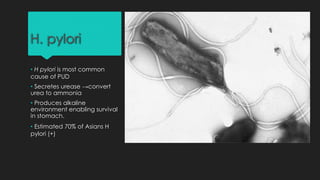
H. pylori
• H pylori is most common
cause of PUD
• Secretes urease →convert
urea to ammonia
• Produces alkaline
environment enabling survival
in stomach.
• Estimated 70% of Asians H
pylori (+)
Why NSAIDs
Cause PUD?  Risk factors:
previous PUD, Elder, female sex, high doses or
combinations of NSAIDs, long-term NSAID use,
use of anticoagulants.
 H pylori and NSAIDs are synergistic.
 Ulcers associated with H. pylori : more often in
duodenum, often superficial, less severe GI
bleeding.
 Ulcers associated with NSAIDs : more often in
stomach, often deep more severe, GI
bleeding.
• NSAIDs block the function
of COX-1, which is essential
for the production of
prostaglandins.
• COX-2 selective anti-
inflammatories )Celecoxib)
preferentially inhibit cox-2,
which is less essential in the
gastric mucosa.
What Are the Symptoms and Complications?
 An ulcer may or may not have symptoms.
When symptoms occur, they may include:
1. Dyspepsia.
2. Bloating and discomfort.
3. Heartburn.
4. Nausea or vomiting.
5. unexplained weight loss.
 In severe cases, symptoms can include:
1. Dark or black stool.
2. Vomiting blood.
3. Severe pain in the mid to upper abdomen.
 Complications of peptic ulcer:
1. Gastrointestinal bleeding .
2. Perforation.
3. Perforation and penetration.
4. Gastric outlet obstruction.
5. Cancer.
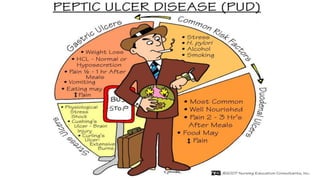
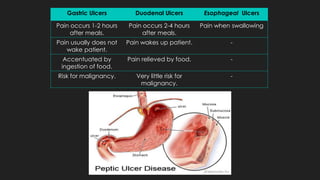
Gastric Ulcers Duodenal Ulcers Esophageal Ulcers
Pain occurs 1-2 hours
after meals.
Pain occurs 2-4 hours
after meals.
Pain when swallowing
Pain usually does not
wake patient.
Pain wakes up patient. -
Accentuated by
ingestion of food.
Pain relieved by food. -
Risk for malignancy. Very little risk for
malignancy.
-
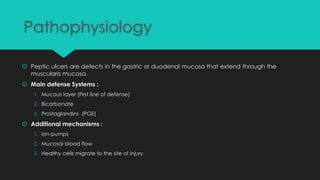
Pathophysiology
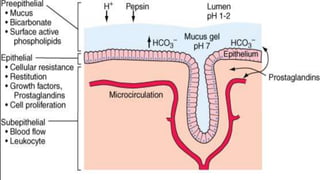
 Peptic ulcers are defects in the gastric or duodenal mucosa that extend through the
muscularis mucosa.
 Main defense Systems :
1. Mucous layer (First line of defense)
2. Bicarbonate
3. Prostaglandins (PGE)
 Additional mechanisms :
1. Ion pumps
2. Mucosal blood flow
3. Healthy cells migrate to the site of injury
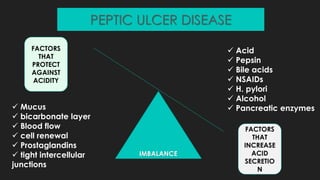
PEPTIC ULCER DISEASE
13
IMBALANCE
FACTORS
THAT
PROTECT
AGAINST
ACIDITY
FACTORS
THAT
INCREASE
ACID
SECRETIO
N
 Acid
 Pepsin
 Bile acids
 NSAIDs
 H. pylori
 Alcohol
 Pancreatic enzymes Mucus
 bicarbonate layer
 Blood flow
 cell renewal
 Prostaglandins
 tight intercellular
junctions
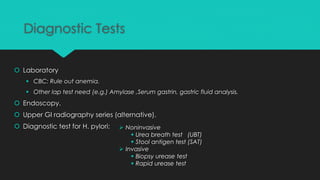
Diagnostic Tests
 Laboratory
 CBC: Rule out anemia.
 Other lap test need (e.g.) Amylase ,Serum gastrin, gastric fluid analysis.
 Endoscopy.
 Upper GI radiography series (alternative).
 Diagnostic test for H. pylori:  Noninvasive
 Urea breath test (UBT)
 Stool antigen test (SAT)
 Invasive
 Biopsy urease test
 Rapid urease test
Primary
treatment Goals
Relieve pain and reduce anxiety.
Relieve dyspepsia and heal the ulcer.
Prevent complications / recurrence.
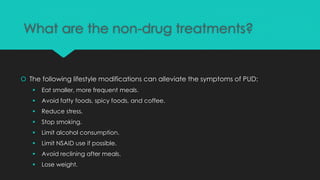
What are the non-drug treatments?
 The following lifestyle modifications can alleviate the symptoms of PUD:
 Eat smaller, more frequent meals.
 Avoid fatty foods, spicy foods, and coffee.
 Reduce stress.
 Stop smoking.
 Limit alcohol consumption.
 Limit NSAID use if possible.
 Avoid reclining after meals.
 Lose weight.
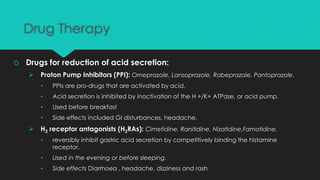
Drug Therapy
 Drugs for reduction of acid secretion:
 Proton Pump Inhibitors (PPI): Omeprazole, Lansoprazole, Rabeprazole, Pantoprazole.
• PPIs are pro-drugs that are activated by acid.
• Acid secretion is inhibited by inactivation of the H +/K+ ATPase, or acid pump.
• Used before breakfast
• Side effects included GI disturbances, headache.
 H2 receptor antagonists (H2RAs): Cimetidine, Ranitidine, Nizatidine,Famotidine.
• reversibly inhibit gastric acid secretion by competitively binding the histamine
receptor.
• Used in the evening or before sleeping.
• Side effects Diarrhoea , headache, dizziness and rash
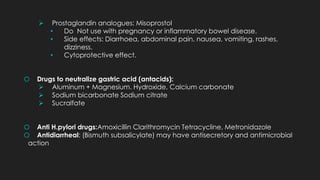
 Prostaglandin analogues: Misoprostol
• Do Not use with pregnancy or inflammatory bowel disease.
• Side effects: Diarrhoea, abdominal pain, nausea, vomiting, rashes,
dizziness.
• Cytoprotective effect.
o Drugs to neutralize gastric acid (antacids):
 Aluminum + Magnesium. Hydroxide, Calcium carbonate
 Sodium bicarbonate Sodium citrate
 Sucralfate
o Anti H.pylori drugs:Amoxicillin Clarithromycin Tetracycline, Metronidazole
o Antidiarrheal: (Bismuth subsalicylate) may have antisecretory and antimicrobial
action
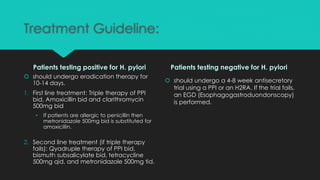
Treatment Guideline:
Patients testing positive for H. pylori
 should undergo eradication therapy for
10-14 days.
1. First line treatment: Triple therapy of PPI
bid, Amoxicillin bid and clarithromycin
500mg bid
• If patients are allergic to penicillin then
metronidazole 500mg bid is substituted for
amoxicillin.
2. Second line treatment (if triple therapy
fails): Qyadruple therapy of PPI bid,
bismuth subsalicylate bid, tetracycline
500mg qid, and metronidazole 500mg tid.
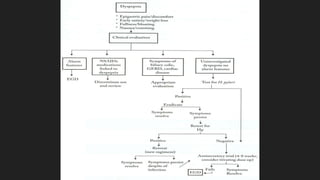
Patients testing negative for H. pylori
 should undergo a 4-8 week antisecretory
trial using a PPI or an H2RA. If the trial fails,
an EGD (Esophagogastroduondonscopy)
is performed.
What if patients had to take NSAIDs?
 To prevent NSAID-induced ulcers, pharmacists can make the following treatment
recommendations based on the patient's risk profile:
 Low risk (no risk factors): use lowest effective dose of NSAID
 Moderate risk (1-2 risk factors): use lowest effective dose of NSAID + Misoprostol, NSAID
+ PPI or H2RA or use a COX2 inhibitor
 High risk (multiple risk factors or patients using Concomitant steroids, anticoagulants, or
low-dose aspirin):
 Concomitant Steroids: COX-2 inhibitor alone
 Concomitant Warfarin: COX-2 inhibitor + misoprostol
 Concomitant Aspirin: COX - 2 inhibitor + PPI or misoprostol
History of disease
 Helicobacter pylori was rediscovered in 1982 by two Australian scientists, Robin Warren
and Barry J. Marshall as a causative factor for ulcers.
 In 2005, Dr. Marshall and Dr. Warren awarded the Nobel Prize in Physiology or
Medicine for their discovery of the bacterium Helicobacter pylori and its role in gastritis
and peptic ulcer disease
Peptic Ulcer _ Clinical Pharmacy

Peptic Ulcer _ Clinical Pharmacy

  • 1.
    Peptic Ulcer Disease(PUD) Nowras Rahhal Damascus University – 2014 Clinical and Hospital Pharmacy
  • 2.
    What are wegoing to talk about ? Definition Symptoms Complications Risk factors Etiology Pathophysiology Diagnostic Tests Drug Therapy History
  • 3.
    Definition  Peptic ulcerdisease is characterized by the development of open sores on the innerlining of the stomach, duodenum or esophagus.  The combination of increased hydrochloric acid and pepsin and lower GI mucosal defenses allows painful lesions to develop  Types - Gastric - Duodenal - Esophageal
  • 4.
    What Causes Ulcers? No single cause has been found for ulcers. However, it is now clear that an ulcer is the end result of an imbalance between digestive fluids in the stomach and duodenum. Ulcers can be caused by : - H pylori infection - Drugs (NSAIDs, Clopidogrel, Potassium supplements, Chemotherapy) - Lifestyle factors (Smoking, Alcohol and Caffeine) - Severe physiologic stress (Burns, CNS trauma, surgery, and severe medical illness) - Hypersecretory states (uncommon) - Genetic factors
  • 5.
    H. pylori • Hpylori is most common cause of PUD • Secretes urease →convert urea to ammonia • Produces alkaline environment enabling survival in stomach. • Estimated 70% of Asians H pylori (+)
  • 6.
    Why NSAIDs Cause PUD? Risk factors: previous PUD, Elder, female sex, high doses or combinations of NSAIDs, long-term NSAID use, use of anticoagulants.  H pylori and NSAIDs are synergistic.  Ulcers associated with H. pylori : more often in duodenum, often superficial, less severe GI bleeding.  Ulcers associated with NSAIDs : more often in stomach, often deep more severe, GI bleeding. • NSAIDs block the function of COX-1, which is essential for the production of prostaglandins. • COX-2 selective anti- inflammatories )Celecoxib) preferentially inhibit cox-2, which is less essential in the gastric mucosa.
  • 8.
    What Are theSymptoms and Complications?  An ulcer may or may not have symptoms. When symptoms occur, they may include: 1. Dyspepsia. 2. Bloating and discomfort. 3. Heartburn. 4. Nausea or vomiting. 5. unexplained weight loss.  In severe cases, symptoms can include: 1. Dark or black stool. 2. Vomiting blood. 3. Severe pain in the mid to upper abdomen.  Complications of peptic ulcer: 1. Gastrointestinal bleeding . 2. Perforation. 3. Perforation and penetration. 4. Gastric outlet obstruction. 5. Cancer.
  • 10.
    Gastric Ulcers DuodenalUlcers Esophageal Ulcers Pain occurs 1-2 hours after meals. Pain occurs 2-4 hours after meals. Pain when swallowing Pain usually does not wake patient. Pain wakes up patient. - Accentuated by ingestion of food. Pain relieved by food. - Risk for malignancy. Very little risk for malignancy. -
  • 11.
    Pathophysiology  Peptic ulcersare defects in the gastric or duodenal mucosa that extend through the muscularis mucosa.  Main defense Systems : 1. Mucous layer (First line of defense) 2. Bicarbonate 3. Prostaglandins (PGE)  Additional mechanisms : 1. Ion pumps 2. Mucosal blood flow 3. Healthy cells migrate to the site of injury
  • 13.
    PEPTIC ULCER DISEASE 13 IMBALANCE FACTORS THAT PROTECT AGAINST ACIDITY FACTORS THAT INCREASE ACID SECRETIO N Acid  Pepsin  Bile acids  NSAIDs  H. pylori  Alcohol  Pancreatic enzymes Mucus  bicarbonate layer  Blood flow  cell renewal  Prostaglandins  tight intercellular junctions
  • 14.
    Diagnostic Tests  Laboratory CBC: Rule out anemia.  Other lap test need (e.g.) Amylase ,Serum gastrin, gastric fluid analysis.  Endoscopy.  Upper GI radiography series (alternative).  Diagnostic test for H. pylori:  Noninvasive  Urea breath test (UBT)  Stool antigen test (SAT)  Invasive  Biopsy urease test  Rapid urease test
  • 15.
    Primary treatment Goals Relieve painand reduce anxiety. Relieve dyspepsia and heal the ulcer. Prevent complications / recurrence.
  • 16.
    What are thenon-drug treatments?  The following lifestyle modifications can alleviate the symptoms of PUD:  Eat smaller, more frequent meals.  Avoid fatty foods, spicy foods, and coffee.  Reduce stress.  Stop smoking.  Limit alcohol consumption.  Limit NSAID use if possible.  Avoid reclining after meals.  Lose weight.
  • 17.
    Drug Therapy  Drugsfor reduction of acid secretion:  Proton Pump Inhibitors (PPI): Omeprazole, Lansoprazole, Rabeprazole, Pantoprazole. • PPIs are pro-drugs that are activated by acid. • Acid secretion is inhibited by inactivation of the H +/K+ ATPase, or acid pump. • Used before breakfast • Side effects included GI disturbances, headache.  H2 receptor antagonists (H2RAs): Cimetidine, Ranitidine, Nizatidine,Famotidine. • reversibly inhibit gastric acid secretion by competitively binding the histamine receptor. • Used in the evening or before sleeping. • Side effects Diarrhoea , headache, dizziness and rash
  • 18.
     Prostaglandin analogues:Misoprostol • Do Not use with pregnancy or inflammatory bowel disease. • Side effects: Diarrhoea, abdominal pain, nausea, vomiting, rashes, dizziness. • Cytoprotective effect. o Drugs to neutralize gastric acid (antacids):  Aluminum + Magnesium. Hydroxide, Calcium carbonate  Sodium bicarbonate Sodium citrate  Sucralfate o Anti H.pylori drugs:Amoxicillin Clarithromycin Tetracycline, Metronidazole o Antidiarrheal: (Bismuth subsalicylate) may have antisecretory and antimicrobial action
  • 19.
    Treatment Guideline: Patients testingpositive for H. pylori  should undergo eradication therapy for 10-14 days. 1. First line treatment: Triple therapy of PPI bid, Amoxicillin bid and clarithromycin 500mg bid • If patients are allergic to penicillin then metronidazole 500mg bid is substituted for amoxicillin. 2. Second line treatment (if triple therapy fails): Qyadruple therapy of PPI bid, bismuth subsalicylate bid, tetracycline 500mg qid, and metronidazole 500mg tid. Patients testing negative for H. pylori  should undergo a 4-8 week antisecretory trial using a PPI or an H2RA. If the trial fails, an EGD (Esophagogastroduondonscopy) is performed.
  • 20.
    What if patientshad to take NSAIDs?  To prevent NSAID-induced ulcers, pharmacists can make the following treatment recommendations based on the patient's risk profile:  Low risk (no risk factors): use lowest effective dose of NSAID  Moderate risk (1-2 risk factors): use lowest effective dose of NSAID + Misoprostol, NSAID + PPI or H2RA or use a COX2 inhibitor  High risk (multiple risk factors or patients using Concomitant steroids, anticoagulants, or low-dose aspirin):  Concomitant Steroids: COX-2 inhibitor alone  Concomitant Warfarin: COX-2 inhibitor + misoprostol  Concomitant Aspirin: COX - 2 inhibitor + PPI or misoprostol
  • 22.
    History of disease Helicobacter pylori was rediscovered in 1982 by two Australian scientists, Robin Warren and Barry J. Marshall as a causative factor for ulcers.  In 2005, Dr. Marshall and Dr. Warren awarded the Nobel Prize in Physiology or Medicine for their discovery of the bacterium Helicobacter pylori and its role in gastritis and peptic ulcer disease