“ Never let the competition define you. Instead, you have to define yourself based on a point of view you care deeply about.”     – Tom Chappel
CPC 3.7 - Rheumatology “ I have very bad joint pain” Scenario 1:   Ms F.M.  19 year old student  Scenario 2:   Mr J.W.  52 year old publican  Scenario 3:   Mrs N. 69y retired Sports teacher. Notes to Tutors: Discuss DD - variety of clinical scenarios. Remember/revise serious causes of acute joint pain esp. septic arthritis and rheumatic fever (revise Jones criteria).  Differentials to include fibromyalgia, polymyalgia rheumatica,  SLE etc. Rheumatoid A. Gouty Arthritis. Osteoarthritis.
COMMON CLINICAL PROBLEMS OF  ARTHRITIS
Signs/Symp.  &  Pathogenesis Pain, fever Swelling Limited mobility Deformity High ESR Lymphadenopathy Fractures  Infl. Capsule & Syn. Synovial effusion. Fusion- Fibrosis, bony Cartilage damage. Inflam. Mediators –AI Chronic inflam - T cell  Osteoporosis.
"Thinking is progress. Non-thinking is stagnation of the individual, organisation and the country. Thinking leads to right action. Knowledge without action is useless and irrelevant. Knowledge with action, converts adversity into prosperity.” - -   APJ Abdul Kalam, President of India.
Pathology of Arthritis Dr. Venkatesh M. Shashidhar. Associate Professor & Head of  Pathology
Joints:  Anatomy & Physiology Mobility - Cranial sutures    Shoulder joint. Articular cartilage – hyaline – friction res. Synovial fluid – lubric/nutri, Type A & B synoviocytes. Hyaluronidase  Continuous production and absorption. Affected by Inflammation, immobility. Capsule, ligaments, menisci. Vascular, rich nerve supply  Art. Cartilage *
Arthritis - Introduction Joints: Use it or Loose it….! Inflammatory  &  Degenerative . Inflammation - Common Trauma, Infections & Autoimmune . Autoimmune injury (& Heart valves) Damage    Exposure of hidden antigens. Degeneration –  wear & tear  – Age / Stress / disease / life style
Arthritis – Clinical features: Pain  Inflammation - capsule, synovium, periosteum. Swelling: inflammation, effusion, proliferation. Restricted movement  pain, fluid, synovial swelling, damage. Deformity  mal-alignment, erosion, ankylosis
Arthritis Clinical Classification: Monoarthritis:   Local, asymmetric, secondary. Acute:  Bacterial ,  Trauma , Crystal, Reactive Chronic :Tuberculosis, Lyme, Fungal, Trauma, Tumors. Polyarthritis: Chronic, symmetric, systemic. Autoimmune ,  degenerative ,  Crystal . Rarely infective.
Polyarthritis Classification: Autoimmune:   Rheumatic, Rheumatoid, Ankylosing spondylitis, Reiter syndrome etc.  Degenerative :   Osteroarthritis Crystal   Deposition :   Gout  –  Monosodium   urate CPPD -   Pseudo Gout Infective  -  Septic ,  TB, Lyme etc. rare.
Rheumatoid  Arthritis
Epidemiology of RA Prevalence - ~ 1% of US population Female : Male ratio = 2:1 Strong association with HLA DR4. Concordance in identical twins only 30%. Genetic + Environmental + Autoimmune
RA - Definition: Chronic  Multisystem  autoimmune  inflammatory  disorder primarily affecting  joints  producing a proliferative  synovitis  that often progresses to destruction of the articular cartilage and ankylosis.
Etiology : Genetic Susceptibility: HLA DR4,  or DR1 in 65% to 80% cases. Microbial inciting agent: Epstein-Barr virus, Borrelia & Mycoplasma..? Autoimmunity: IGM anti IgG – RA Factor. Helper T cell (CD4) against  type II   collagen  &  cartilage glycoprotein-39
Immuno-dysregulation in RA T lymphocytes    type II collagen &  superantigen    releasing cytokines    inflammation. B cells    IgM Rheumatoid factor – anti IgG. Macrophages surround RF factor complex     type III  injury (immune complex)    cytokine release    inflammation damage.
Morphology - Synovitis : Proliferative  synovitis  with lymphocytes (CD4), plasma cell & macrophages  Pannus . Organizing fibrin ( rice bodies ). Neutrophils  on the joint surface and fluid. Juxta-articular  erosions, cysts & osteoporosis Fibrous  ankylosis .  Skin - Rheumatoid   nodules Vasculitis  (commonly of digital arteries)
Early Destruction in RA:
Cartilage Destruction in RA:
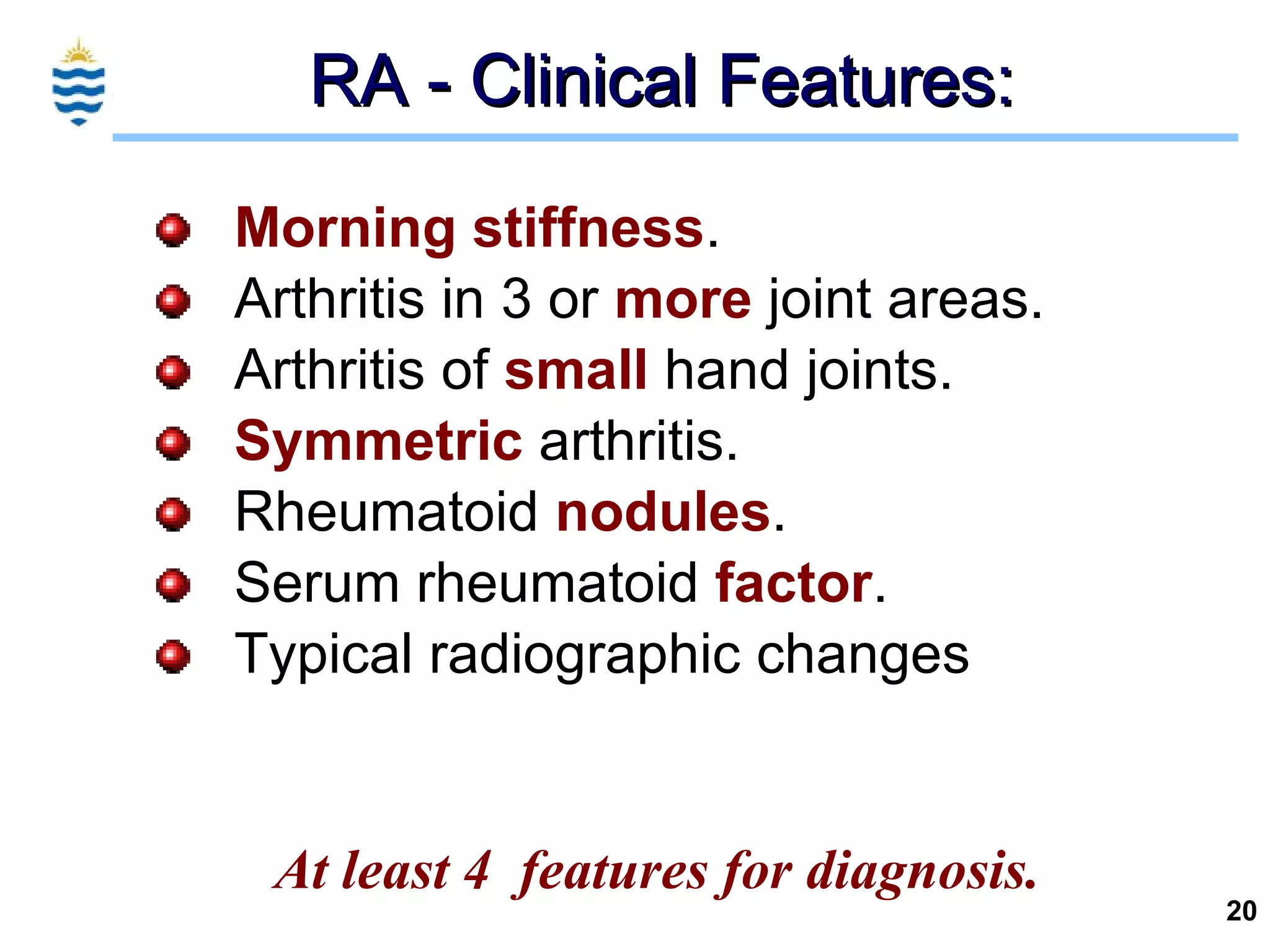
RA - Clinical Features: Morning   stiffness . Arthritis in 3 or  more  joint areas. Arthritis of  small  hand joints. Symmetric  arthritis. Rheumatoid  nodules . Serum rheumatoid  factor . Typical radiographic changes At least 4  features for diagnosis.
Normal  - Synovium  - R.A
RA-Pannus: Head of femur
RA - Pannus:
RA - Pannus:
RA - Pannus: Hyperplastic  inflammed  synovium
Extra-Articular RA Rheumatoid Nodules. Vasculitis. Pleuritis. Pericarditis. Tendonitis. Fibrosing alveolitis.
Skin RA Nodule:
Skin RA Nodule:
Rheumatoid Nodule (skin): Palisading Macrophages Central Fibrinoid Necrosis
Degenerative - Inflammatory Both sexes equal. Pain through the day No morning stiffness. Stiffness, less pain. Bony swelling. No soft tissue swelling Uni/Bilateral, Asymmetrical. Females more. Morning stiffness >1h. Less with movement. Pain & redness  Inflammation & swelling of soft tissue. Late bone swelling. Bilateral, Symmetrical.
Joint involvement in RA:
Swan Neck Deformity in RA:
Joint Destruction in RA: Swan Neck Deformity
RA Joint destruction, ankylosis:
RA Joint destruction, ankylosis: Subluxation deformities and severe osteopenia in chronic rheumatoid arthritis treated with corticosteroids
RA Muscle wasting. Polyarthritis and muscle atrophy in chronic juvenile rheumatoid arthritis.
Osteoarthritis Degenerative arthr osis . (Osteoarthrosis)
Osteoarthritis: Degenerative end result - (ageing)  >80% in >65y . (20% clinically significant) Progressive erosion & fibrillation of articular cartilage    forms Loose bodies. Large weight bearing joints. Hardened articular bone – eburnation. & Subarticular cyst formation in bone. Periarticular osteophyte formation.  Mild inflammation but painful, morning stiffness. Limited range of movements - Heberden nodes.
Factors affecting Osteoarthritis:
Normal  -- Femur Head --  OA Normal Osteoarthritis
Osteoarthritis: 1- Eburnation of bone 2- Subchondral cyst 3- Residual cartilage
Osteoarthritis:Cartilage deg.
OA: Ebernation & Osteophytes Exposed bone Osteophytes
Femur Osteroarthritis: Bone exposure Cartilage degeneration
Spine OA: Osteophytes:
Radiologic Features: nonuniform joint space loss,  osteophyte formation,  cyst formation  subchondral sclerosis Sclerosis, ankylosis & deformity.
Osteoarthritis: Narrow joint space Lipping – osteophyte Dislocation Osteoporosis.
Osteophyte formation:
Bone cysts in OA:
Osteoarthritis: Subchondral cysts  (solid arrowhead)
Osteoarthritis: Lateral view of the left knee shows sclerosis with marked osteophyte formation  (arrows).  The osteophytes are best seen in this view.
Osteoarthritis: Ankylosis varus deformity of the knee and collapse of the joint space with destruction of the medial cartilage and the subchondral cortex  (open arrowheads) .
OA Fingers:
OA Fingers:
OA Hip:
OA Hip:  1997, bilateral, joint space narrowing  (arrows)  at the hips that is worse on the left side
OA  Hip:  Subchondral sclerosis  (solid arrowhead)  and cyst  (arrow)  formation are also noted on the left side
OA Hip:left hip arthroplasty
OA - Clinical Features: pain worsens with activity & improves on rest. Instability of joints – Knee. Crepitus, limitation of motion. Muscle spasm, and tendon and capsular contractures. Early morning stiffness lasts 1 hour or more. bony overgrowth – interphalangeal joints distal(Heberden's) proximal (Bouchard's).
Differentiating Features: Rheumatoid Arthritis: Young, small joints Autoimmune. Synovial Inflammation synovium    Cartilage Osteoarthritis: Old, Large joints Degenerative. Cartilage degeneration. Cartilage    Synovium
OA  -  RA Deep, aching pain exacerbated by use,  morning stiffness, crepitus. Limited range of movement.  Sharp aching and stiffness of the joints,  Morning pain & stiffness.
RA OA
"Powered by intellect, Driven by Values..!” Life motto of Infosys founder and Chairman, Narayana Murthy.  INDIA Tip for Success in life….!
"When you speak, speak the truth; perform when you promise; discharge your trust... Withhold your hands from striking, and from taking that which is unlawful and bad...“ - -   APJ Abdul Kalam, President of India.
Arthritis  Other   Infective, traumatic, secondary to systemic diseases.
Seronegative arthropathies Ankylosing Spondylitis: Adolescent boys, HLA B27, axial joints (sacroiliac) Reiter Syndrome : Triad of arthritis, urethritis/cervicits & conjuctivitis Autoimmune but initiated by bacterial infection. Enteropathic Arthritis: Secondary to bowel infections (salmonella, shigella) HLA B27 positive Psoriatic Arthritis: 5% of patients, starts in DIP joints, similar to RA.
Septic Arthritis: ORGANISM  PEAK AGE INCIDENCE   GRAM STAIN   Hemophilus influenzae  Children  Gram negative coccobacilli  Neisseria   gonorrheae   Young adults  Gram negative diplococci  Salmonella   young with Sickle Cell An.  Gram negative rods  Staph. aureus  Adults  Gram positive cocci in clusters  Escherichia coli  Adults  Gram negative rods  Pseudomonas  Adults  Gram negative rods
Gonococcal Arthritis:
Juvenile Rheumatoid Arthritis: Before age 16 Multisystem involement - Spleenomegaly, Starts with systemic involvement unlike RA. No serum RA Factor – Seronegative Antinuclear Antibody ( ANA ) +ve    autoimmune.
Big Toe in Gout:
Fingers in Acute Gout:
Fingers in Gout: Acute Gout   Chronic Gout  
Joint destruction in Gout:
Gout Tophii (amputated toe)
Gout Tophi: Microscopy
Gouty Tophus – Giant cell granuloma
Urate Crystals (Birefringense):
Pseudo Gout Calcium PyroPhosphate Deposition disease CPPD Chondrocalcinosis.
CPPD – (Chondrocalcinosis) Type A  – Pseudo gout – Knee, men Type B  – Pseudo rheumatoid - polyarthritis Type C  – Pseudo OA + acute attacks, women Type D  – Pseudo OA - acute attacks, hands Type E  – Asymptomatic Type F  – Pseudoneuropathic
CPPD-Arthritis (pseudo gout): Crystal deposition within cartilage, tendons and ligaments
Pseudo Gout –  Calcium pyrophoshate
Ankylosing Spondylitis Young  males , 90%  HLA B27 +ve <1% Rheumatoid factor –  seronegative . >25% have iritis 10% Aortic insufficiency Strongly  familial , 100% concordance in monozygotic twins.
AS-Fusion of vertebrale (syndesmophytes)
Scoliosis in Ankylosing Spondylitis
Seronegative Arthritis Reiter’s, Psoriasis, Ulcerative colitis, Crohn’s disease etc.
Infection    immune Arthritis : Mainly asymmetrical, large joint spinal, or oligoarticular involvement. Seronegative. Other immune disorders: Ulcerative colitis, Crohns etc. Infections: Chlamydial urethritis (Reiter’s syndrome),  Bowel infection with yersinia, salmonella, shigella (enterpoathic arthritis).  Shigella Flexneri, others.
Arthritis Comparison:
&quot;The gem cannot be polished without friction, nor man perfected without trials or problems  (or exams) …!.&quot; --Chinese proverb
MCQ-  Apart from male sex, The presence of which of the following is helpful in the diagnosis of ankylosing spondylitis? A  Serum antinuclear antibodies B  Rheumatoid factor in the serum C  HLA-B27 D  Male sex  E  HLA-B8
40year old woman arthritis: A 40-year-old woman complains of morning stiffness in her hands. On physical examination, her finger joints are painful, swollen, and warm. X-ray examination of the hands shows narrowing of the joint spaces and erosion of joint surfaces of the metacarpal/phalangeal joints. The adjacent bones show osteoporosis.
Image shows synovial biopsy. Laboratory studies conducted on a blood sample from this patient will most likely show polyclonal antibodies directed against which of the following proteins?   Double-stranded DNA Fab2 portion of IgM Fc portion of IgG Ribonucleoprotein Topoisomerase 1 DISCUSSION:  Some 80% of patients with classic RA are positive for  rheumatoid factor (RF).  This factor actually represents multiple antibodies, principally IgM, but sometimes IgG or IgA, directed  against the Fc fragment of IgG.  Significant titers of RF are also found in patients with related collagen vascular diseases, such as SLE, progressive systemic sclerosis, and dermatomyositis.
Serological findings in patients with systemic lupus erythematosus (SLE) may include: A raised serum IgG level Antibodies to double-stranded DNA Decreased C3 and C4 levels A ‘positive’ VDRL Antibodies to platelets All of the above.
40year old man PAIN arm: A 55-year-old man presents with pain in the left arm. Laboratory studies show elevated serum levels of calcium and parathyroid hormone. An x-ray of the left arm reveals multiple small bone cysts and pathologic fractures. Biopsy of the affected bone discloses numerous giant cells in a cellular and fibrous stroma. The patient undergoes removal of a parathyroid adenoma.
Enhanced osteoblast activity Impaired mineralization of osteoid Increased bone resorption Increased mineralization of bone Osteoporosis Which of the following best describes the pathogenesis of bone pain and pathologic fractures in this patient?   DISCUSSION:  In patients with primary hyperparathyroidism, osteoclasts are stimulated to resorb bone. As the disease progresses, the trabecular bone is resorbed, and the marrow is replaced by loose fibrosis. Cystic degeneration ultimately occurs, leading to areas of fibrosis that contain reactive woven bone, and hemosiderin-laden macrophages often display many giant cells, which are actually osteoclasts. Because of its macroscopic appearance, this lesion has been termed a brown tumor. Impaired mineralization of osteoid (choice B) is a feature of osteomalacia. Osteoporosis (choice E) is characterized by decreased, but otherwise normally mineralized, bone. Diagnosis: Hyperparathyroidism, osteitis fibrosa cystica
MCQ-3  Which of the following statements about rheumatoid arthritis are true? Most patients progress to complete disability.  Oral corticosteroids form the basis of drug therapy.  Epstein-Barr virus is known to be the causative agent.  Always responds to plasma exchange therapy.  Serum C-reactive protein measurement is a useful measure of joint inflammation.
60y Man, history of recurrent arthritis since childhood. Multiple rubbery nodules on his hands (Image). Which of the following explains pathogenesis? Autoimmune relapsing polychondritis High dietary intake of purine-rich foods. Hypercalcemia & chondrocalcinosis Impaired renal excretion of uric acid Increased calcium hydroxyapatite deposition.
A 23y man, stiffness and pain in his lower back that causes him to awaken at night. He first noticed morning stiffness in his lower back during his college years. He also describes occasional pain in his right eye and sensitivity to light. An x-ray of the sacroiliac region shows fusion of the small joint spaces in the posterior spine and ossification of the intervertebral discs. Serologic tests for RF and antinuclear antibodies are negative. This patient most likely expresses which of the following human leukocyte antigen  (HLA) haplotypes?   B15 B19 B27 B31 B9
An 85-year-old man presents with a 3-week history of painful swelling of his right knee. Aspiration of joint fluid returns numerous neutrophils and crystals, which are described as rhomboid and “coffin-like.” Chemical analysis shows that these crystals are composed of calcium pyrophosphate. Which of the following is the most likely diagnosis?   Pseudogout Ankylosing spondylitis Gout Infectious arthritis Rheumatoid arthritis
A 28-year-old man complains of burning pain on urination, as well as pain in his fingers and left eye. He also relates a recent episode of bacillary diarrhea contracted during a visit to Mexico. Physical examination confirms arthritis and conjunctivitis. The patient responds well to treatment with NSAIDs. Which of the following is the most likely diagnosis?   Gout Pseudogout Ankylosing spondylitis Reiter’s syndrome Rheumatoid arthritis
A 10-year-old boy complains of pain in his hands and feet. His temperature is 38°C (101°F). Physical examination reveals a faint pericardial friction rub. His spleen, liver, and axillary lymph nodes are enlarged. Which of the following is the most likely diagnosis?   Rheumatoid arthritis  Gaucher’s disease Psoriatic arthritis Ankylosing spondylitis Juvenile arthritis
A 24-year-old man on chronic steroid therapy for severe asthma presents with a 6-month history of increasing hip pain. This patient most likely exhibits symptoms of which of the following metabolic bone diseases?   Osteopetrosis.  Osteomalacia Osteoporosis. Ankylosing spondylitis Paget’s disease
A 58-year-old woman fractures her hip after slipping on an icy sidewalk. An x-ray shows generalized osteopenia. Bone biopsy reveals attenuated bony trabeculae and a normal ratio of mineral-to-matrix. Serum calcium and phosphorus levels are normal. Which of the following best explains the pathogenesis of osteopenia in this postmenopausal woman?   Imapired mineralization. Increased osteoblast activity. Increased mineralization. Mosaic bone formation. Increased osteoclast activity. DISCUSSION:   Osteoporosis is a degenerative bone disease characterized by diffuse skeletal lesions in which  normally mineralized bone  is decreased in mass to the point that it no longer provides adequate mechanical support. The remaining bone exhibits a  normal ratio of mineralized to nonmineralized (osteoid) matrix  (therefore, not choices A and C). Bone loss and eventually fractures are the hallmarks of osteoporosis. Primary osteoporosis occurs principally in postmenopausal women (type 1) and elderly persons of both sexes (type 2). Type 1 primary osteoporosis is due to an absolute increase in osteoclast activity. The increased number of osteoclasts that appears in the early postmenopausal skeleton is the direct result of estrogen withdrawal. Type 2 osteoporosis reflects decreased osteoblast activity (therefore, not choice B). Mosaic bone formation (choice E) is a feature of Paget disease. Diagnosis: Osteoporosis, osteopenia    Read more…
&quot;Thinking should become your capital asset, no matter whatever ups and downs you come across in your life.“ - -   APJ Abdul Kalam, President of India.
Arthritis Case Studies:
Case 1 A  37-year -old  woman   gradually  developed  painful   wrists  over 3 months; she consulted her doctor only when the pain and  early   morning   stiffness  stopped her from gardening.  On examination, both wrists & metacarpophalangeal joints of  both hands  were swollen and tender but not deformed.  She had raised C-reactive protein ( CRP ) level (27mg/l) (NR <10) but a normal haemoglobin and white-cell count. A latex test for rheumatoid factor was negative and antinuclear antibodies were  not  detected.   ? Degenerative or Inflammatory  (morning / through the day) ? Mono or poly arthritis
Case 1-followup Diagnosis ? early rheumatoid arthritis  Treated with  ibuprofen . Despite some initial symptomatic improvement, the pain, stiffness and swelling of the hands  persisted  and 1 month later both knees became similarly affected. She was referred to a rheumatologist.
Case 1-followup This woman now had definite X-ray evidence of  rheumatoid arthritis  and, in view of the continuing arthropathy, her treatment was changed to weekly low-dose  methotrexate . This has controlled the arthritis for several years and no further erosions have developed.
Case 2 A  21y   man  presented with  acute  pain and swelling of  one   knee . On examination, the joint was tender and restricted in movement. X-ray of the knee showed periarticular osteoporosis. No history of trauma. He has had intermittent  backache  over the last 5 years, although daily exercises have limited the stiffness.  On investigation, he had a raised  ESR of 102mm/h , mild  anaemia  (Hb 106g/l) but no detectable serum rheumatoid factor. The knee effusion contained a polymorphonuclear  leucocytosis  but no organisms or rheumatoid factor. No diagnosis was made but he improved with empiric treatment with indomethacin.
Case 2 Fifteen months later he developed an  iritis  in his left eye, low  back   pain  and  stiffness .  His peripheral joints were normal but pain could be elicited in both sacroiliac joints. tissue typing revealed that he was  HLA-B27  positive.  X-rays of his pelvis showed the classic changes of  ankylosing spondylitis  and He has developed bony  ankylosis  between the lumbar vertabrae.
Case 2-followup Six months later, she developed two subcutaneous small, painless, firm immobile,  nodules  on the left elbow.  A test for  rheumatoid   factor  was now positive (titre 1/64). X-rays of the hands showed bony  erosions  in the metacarpal heads.  She still had a raised CRP (43mg/l) but normal serum complement ( C3 and C4 ) levels and, she had a biopsy which showed  pannus  histologically.
19y man, cannot pull his pants 2-month history of intermittent, lower back pain and stiffness. Worst in the morning, awakens him in night, relieved with exercise. Progressive inability to bend down to pull on his pants or tie his shoelaces.  He also reports a several month history of low-grade fever, malaise, and anorexia, weight loss of 10 pounds. Tenderness of both sacroiliac joints, other examination normal. Routine Lab investigations normal except ESR 62mm,  Rheumatoid Factor neg, HLA B27 +ve.
Syndesmophytes Osteitis SIJ-arthritis
Syndesmophytes (Bamboo spine) Osteitis (Shiny corners)
 
Ankylosing spondylitis: The anteroposterior and lateral radiographs of the spine demonstrate the classic bamboo-spine finding of AS. The images show sclerosis and erosions of the anterior surfaces of the vertebrae corners and margins (osteitis).  Bone formation extends across the anterior and lateral margins of the intervertebral disks of the lower thoracic and lumbar spine (syndesmophytosis).  The sacroiliac joints show extensive periarticular sclerosis and focal ankylosis.
 
Disorders of Bone Paget’s Disease
Paget’s Disease

Pathology of Arthritis

  • 1.
    “ Never letthe competition define you. Instead, you have to define yourself based on a point of view you care deeply about.” – Tom Chappel
  • 2.
    CPC 3.7 -Rheumatology “ I have very bad joint pain” Scenario 1: Ms F.M. 19 year old student Scenario 2: Mr J.W. 52 year old publican Scenario 3: Mrs N. 69y retired Sports teacher. Notes to Tutors: Discuss DD - variety of clinical scenarios. Remember/revise serious causes of acute joint pain esp. septic arthritis and rheumatic fever (revise Jones criteria). Differentials to include fibromyalgia, polymyalgia rheumatica, SLE etc. Rheumatoid A. Gouty Arthritis. Osteoarthritis.
  • 3.
  • 4.
    Signs/Symp. & Pathogenesis Pain, fever Swelling Limited mobility Deformity High ESR Lymphadenopathy Fractures Infl. Capsule & Syn. Synovial effusion. Fusion- Fibrosis, bony Cartilage damage. Inflam. Mediators –AI Chronic inflam - T cell Osteoporosis.
  • 5.
    &quot;Thinking is progress.Non-thinking is stagnation of the individual, organisation and the country. Thinking leads to right action. Knowledge without action is useless and irrelevant. Knowledge with action, converts adversity into prosperity.” - - APJ Abdul Kalam, President of India.
  • 6.
    Pathology of ArthritisDr. Venkatesh M. Shashidhar. Associate Professor & Head of Pathology
  • 7.
    Joints: Anatomy& Physiology Mobility - Cranial sutures  Shoulder joint. Articular cartilage – hyaline – friction res. Synovial fluid – lubric/nutri, Type A & B synoviocytes. Hyaluronidase Continuous production and absorption. Affected by Inflammation, immobility. Capsule, ligaments, menisci. Vascular, rich nerve supply Art. Cartilage *
  • 8.
    Arthritis - IntroductionJoints: Use it or Loose it….! Inflammatory & Degenerative . Inflammation - Common Trauma, Infections & Autoimmune . Autoimmune injury (& Heart valves) Damage  Exposure of hidden antigens. Degeneration – wear & tear – Age / Stress / disease / life style
  • 9.
    Arthritis – Clinicalfeatures: Pain Inflammation - capsule, synovium, periosteum. Swelling: inflammation, effusion, proliferation. Restricted movement pain, fluid, synovial swelling, damage. Deformity mal-alignment, erosion, ankylosis
  • 10.
    Arthritis Clinical Classification:Monoarthritis: Local, asymmetric, secondary. Acute: Bacterial , Trauma , Crystal, Reactive Chronic :Tuberculosis, Lyme, Fungal, Trauma, Tumors. Polyarthritis: Chronic, symmetric, systemic. Autoimmune , degenerative , Crystal . Rarely infective.
  • 11.
    Polyarthritis Classification: Autoimmune: Rheumatic, Rheumatoid, Ankylosing spondylitis, Reiter syndrome etc. Degenerative : Osteroarthritis Crystal Deposition : Gout – Monosodium urate CPPD - Pseudo Gout Infective - Septic , TB, Lyme etc. rare.
  • 12.
  • 13.
    Epidemiology of RAPrevalence - ~ 1% of US population Female : Male ratio = 2:1 Strong association with HLA DR4. Concordance in identical twins only 30%. Genetic + Environmental + Autoimmune
  • 14.
    RA - Definition:Chronic Multisystem autoimmune inflammatory disorder primarily affecting joints producing a proliferative synovitis that often progresses to destruction of the articular cartilage and ankylosis.
  • 15.
    Etiology : GeneticSusceptibility: HLA DR4, or DR1 in 65% to 80% cases. Microbial inciting agent: Epstein-Barr virus, Borrelia & Mycoplasma..? Autoimmunity: IGM anti IgG – RA Factor. Helper T cell (CD4) against type II collagen & cartilage glycoprotein-39
  • 16.
    Immuno-dysregulation in RAT lymphocytes  type II collagen & superantigen  releasing cytokines  inflammation. B cells  IgM Rheumatoid factor – anti IgG. Macrophages surround RF factor complex  type III injury (immune complex)  cytokine release  inflammation damage.
  • 17.
    Morphology - Synovitis: Proliferative synovitis with lymphocytes (CD4), plasma cell & macrophages Pannus . Organizing fibrin ( rice bodies ). Neutrophils on the joint surface and fluid. Juxta-articular erosions, cysts & osteoporosis Fibrous ankylosis . Skin - Rheumatoid nodules Vasculitis (commonly of digital arteries)
  • 18.
  • 19.
  • 20.
    RA - ClinicalFeatures: Morning stiffness . Arthritis in 3 or more joint areas. Arthritis of small hand joints. Symmetric arthritis. Rheumatoid nodules . Serum rheumatoid factor . Typical radiographic changes At least 4 features for diagnosis.
  • 21.
    Normal -Synovium - R.A
  • 22.
  • 23.
  • 24.
  • 25.
    RA - Pannus:Hyperplastic inflammed synovium
  • 26.
    Extra-Articular RA RheumatoidNodules. Vasculitis. Pleuritis. Pericarditis. Tendonitis. Fibrosing alveolitis.
  • 27.
  • 28.
  • 29.
    Rheumatoid Nodule (skin):Palisading Macrophages Central Fibrinoid Necrosis
  • 30.
    Degenerative - InflammatoryBoth sexes equal. Pain through the day No morning stiffness. Stiffness, less pain. Bony swelling. No soft tissue swelling Uni/Bilateral, Asymmetrical. Females more. Morning stiffness >1h. Less with movement. Pain & redness Inflammation & swelling of soft tissue. Late bone swelling. Bilateral, Symmetrical.
  • 31.
  • 32.
  • 33.
  • 34.
    Joint Destruction inRA: Swan Neck Deformity
  • 35.
  • 36.
    RA Joint destruction,ankylosis: Subluxation deformities and severe osteopenia in chronic rheumatoid arthritis treated with corticosteroids
  • 37.
    RA Muscle wasting.Polyarthritis and muscle atrophy in chronic juvenile rheumatoid arthritis.
  • 38.
    Osteoarthritis Degenerative arthrosis . (Osteoarthrosis)
  • 39.
    Osteoarthritis: Degenerative endresult - (ageing) >80% in >65y . (20% clinically significant) Progressive erosion & fibrillation of articular cartilage  forms Loose bodies. Large weight bearing joints. Hardened articular bone – eburnation. & Subarticular cyst formation in bone. Periarticular osteophyte formation. Mild inflammation but painful, morning stiffness. Limited range of movements - Heberden nodes.
  • 40.
  • 41.
    Normal --Femur Head -- OA Normal Osteoarthritis
  • 42.
    Osteoarthritis: 1- Eburnationof bone 2- Subchondral cyst 3- Residual cartilage
  • 43.
  • 44.
    OA: Ebernation &Osteophytes Exposed bone Osteophytes
  • 45.
    Femur Osteroarthritis: Boneexposure Cartilage degeneration
  • 46.
  • 47.
    Radiologic Features: nonuniformjoint space loss, osteophyte formation, cyst formation subchondral sclerosis Sclerosis, ankylosis & deformity.
  • 48.
    Osteoarthritis: Narrow jointspace Lipping – osteophyte Dislocation Osteoporosis.
  • 49.
  • 50.
  • 51.
  • 52.
    Osteoarthritis: Lateral viewof the left knee shows sclerosis with marked osteophyte formation (arrows). The osteophytes are best seen in this view.
  • 53.
    Osteoarthritis: Ankylosis varusdeformity of the knee and collapse of the joint space with destruction of the medial cartilage and the subchondral cortex (open arrowheads) .
  • 54.
  • 55.
  • 56.
  • 57.
    OA Hip: 1997, bilateral, joint space narrowing (arrows) at the hips that is worse on the left side
  • 58.
    OA Hip: Subchondral sclerosis (solid arrowhead) and cyst (arrow) formation are also noted on the left side
  • 59.
    OA Hip:left hiparthroplasty
  • 60.
    OA - ClinicalFeatures: pain worsens with activity & improves on rest. Instability of joints – Knee. Crepitus, limitation of motion. Muscle spasm, and tendon and capsular contractures. Early morning stiffness lasts 1 hour or more. bony overgrowth – interphalangeal joints distal(Heberden's) proximal (Bouchard's).
  • 61.
    Differentiating Features: RheumatoidArthritis: Young, small joints Autoimmune. Synovial Inflammation synovium  Cartilage Osteoarthritis: Old, Large joints Degenerative. Cartilage degeneration. Cartilage  Synovium
  • 62.
    OA - RA Deep, aching pain exacerbated by use, morning stiffness, crepitus. Limited range of movement. Sharp aching and stiffness of the joints, Morning pain & stiffness.
  • 63.
  • 64.
    &quot;Powered by intellect,Driven by Values..!” Life motto of Infosys founder and Chairman, Narayana Murthy. INDIA Tip for Success in life….!
  • 65.
    &quot;When you speak,speak the truth; perform when you promise; discharge your trust... Withhold your hands from striking, and from taking that which is unlawful and bad...“ - - APJ Abdul Kalam, President of India.
  • 66.
    Arthritis Other Infective, traumatic, secondary to systemic diseases.
  • 67.
    Seronegative arthropathies AnkylosingSpondylitis: Adolescent boys, HLA B27, axial joints (sacroiliac) Reiter Syndrome : Triad of arthritis, urethritis/cervicits & conjuctivitis Autoimmune but initiated by bacterial infection. Enteropathic Arthritis: Secondary to bowel infections (salmonella, shigella) HLA B27 positive Psoriatic Arthritis: 5% of patients, starts in DIP joints, similar to RA.
  • 68.
    Septic Arthritis: ORGANISM PEAK AGE INCIDENCE GRAM STAIN Hemophilus influenzae Children Gram negative coccobacilli Neisseria gonorrheae Young adults Gram negative diplococci Salmonella young with Sickle Cell An. Gram negative rods Staph. aureus Adults Gram positive cocci in clusters Escherichia coli Adults Gram negative rods Pseudomonas Adults Gram negative rods
  • 69.
  • 70.
    Juvenile Rheumatoid Arthritis:Before age 16 Multisystem involement - Spleenomegaly, Starts with systemic involvement unlike RA. No serum RA Factor – Seronegative Antinuclear Antibody ( ANA ) +ve  autoimmune.
  • 71.
  • 72.
  • 73.
    Fingers in Gout:Acute Gout  Chronic Gout 
  • 74.
  • 75.
  • 76.
  • 77.
    Gouty Tophus –Giant cell granuloma
  • 78.
  • 79.
    Pseudo Gout CalciumPyroPhosphate Deposition disease CPPD Chondrocalcinosis.
  • 80.
    CPPD – (Chondrocalcinosis)Type A – Pseudo gout – Knee, men Type B – Pseudo rheumatoid - polyarthritis Type C – Pseudo OA + acute attacks, women Type D – Pseudo OA - acute attacks, hands Type E – Asymptomatic Type F – Pseudoneuropathic
  • 81.
    CPPD-Arthritis (pseudo gout):Crystal deposition within cartilage, tendons and ligaments
  • 82.
    Pseudo Gout – Calcium pyrophoshate
  • 83.
    Ankylosing Spondylitis Young males , 90% HLA B27 +ve <1% Rheumatoid factor – seronegative . >25% have iritis 10% Aortic insufficiency Strongly familial , 100% concordance in monozygotic twins.
  • 84.
    AS-Fusion of vertebrale(syndesmophytes)
  • 85.
  • 86.
    Seronegative Arthritis Reiter’s,Psoriasis, Ulcerative colitis, Crohn’s disease etc.
  • 87.
    Infection  immune Arthritis : Mainly asymmetrical, large joint spinal, or oligoarticular involvement. Seronegative. Other immune disorders: Ulcerative colitis, Crohns etc. Infections: Chlamydial urethritis (Reiter’s syndrome), Bowel infection with yersinia, salmonella, shigella (enterpoathic arthritis). Shigella Flexneri, others.
  • 88.
  • 89.
    &quot;The gem cannotbe polished without friction, nor man perfected without trials or problems (or exams) …!.&quot; --Chinese proverb
  • 90.
    MCQ- Apartfrom male sex, The presence of which of the following is helpful in the diagnosis of ankylosing spondylitis? A  Serum antinuclear antibodies B  Rheumatoid factor in the serum C  HLA-B27 D  Male sex E  HLA-B8
  • 91.
    40year old womanarthritis: A 40-year-old woman complains of morning stiffness in her hands. On physical examination, her finger joints are painful, swollen, and warm. X-ray examination of the hands shows narrowing of the joint spaces and erosion of joint surfaces of the metacarpal/phalangeal joints. The adjacent bones show osteoporosis.
  • 92.
    Image shows synovialbiopsy. Laboratory studies conducted on a blood sample from this patient will most likely show polyclonal antibodies directed against which of the following proteins? Double-stranded DNA Fab2 portion of IgM Fc portion of IgG Ribonucleoprotein Topoisomerase 1 DISCUSSION: Some 80% of patients with classic RA are positive for rheumatoid factor (RF). This factor actually represents multiple antibodies, principally IgM, but sometimes IgG or IgA, directed against the Fc fragment of IgG. Significant titers of RF are also found in patients with related collagen vascular diseases, such as SLE, progressive systemic sclerosis, and dermatomyositis.
  • 93.
    Serological findings inpatients with systemic lupus erythematosus (SLE) may include: A raised serum IgG level Antibodies to double-stranded DNA Decreased C3 and C4 levels A ‘positive’ VDRL Antibodies to platelets All of the above.
  • 94.
    40year old manPAIN arm: A 55-year-old man presents with pain in the left arm. Laboratory studies show elevated serum levels of calcium and parathyroid hormone. An x-ray of the left arm reveals multiple small bone cysts and pathologic fractures. Biopsy of the affected bone discloses numerous giant cells in a cellular and fibrous stroma. The patient undergoes removal of a parathyroid adenoma.
  • 95.
    Enhanced osteoblast activityImpaired mineralization of osteoid Increased bone resorption Increased mineralization of bone Osteoporosis Which of the following best describes the pathogenesis of bone pain and pathologic fractures in this patient? DISCUSSION: In patients with primary hyperparathyroidism, osteoclasts are stimulated to resorb bone. As the disease progresses, the trabecular bone is resorbed, and the marrow is replaced by loose fibrosis. Cystic degeneration ultimately occurs, leading to areas of fibrosis that contain reactive woven bone, and hemosiderin-laden macrophages often display many giant cells, which are actually osteoclasts. Because of its macroscopic appearance, this lesion has been termed a brown tumor. Impaired mineralization of osteoid (choice B) is a feature of osteomalacia. Osteoporosis (choice E) is characterized by decreased, but otherwise normally mineralized, bone. Diagnosis: Hyperparathyroidism, osteitis fibrosa cystica
  • 96.
    MCQ-3 Whichof the following statements about rheumatoid arthritis are true? Most patients progress to complete disability. Oral corticosteroids form the basis of drug therapy. Epstein-Barr virus is known to be the causative agent. Always responds to plasma exchange therapy. Serum C-reactive protein measurement is a useful measure of joint inflammation.
  • 97.
    60y Man, historyof recurrent arthritis since childhood. Multiple rubbery nodules on his hands (Image). Which of the following explains pathogenesis? Autoimmune relapsing polychondritis High dietary intake of purine-rich foods. Hypercalcemia & chondrocalcinosis Impaired renal excretion of uric acid Increased calcium hydroxyapatite deposition.
  • 98.
    A 23y man,stiffness and pain in his lower back that causes him to awaken at night. He first noticed morning stiffness in his lower back during his college years. He also describes occasional pain in his right eye and sensitivity to light. An x-ray of the sacroiliac region shows fusion of the small joint spaces in the posterior spine and ossification of the intervertebral discs. Serologic tests for RF and antinuclear antibodies are negative. This patient most likely expresses which of the following human leukocyte antigen (HLA) haplotypes? B15 B19 B27 B31 B9
  • 99.
    An 85-year-old manpresents with a 3-week history of painful swelling of his right knee. Aspiration of joint fluid returns numerous neutrophils and crystals, which are described as rhomboid and “coffin-like.” Chemical analysis shows that these crystals are composed of calcium pyrophosphate. Which of the following is the most likely diagnosis? Pseudogout Ankylosing spondylitis Gout Infectious arthritis Rheumatoid arthritis
  • 100.
    A 28-year-old mancomplains of burning pain on urination, as well as pain in his fingers and left eye. He also relates a recent episode of bacillary diarrhea contracted during a visit to Mexico. Physical examination confirms arthritis and conjunctivitis. The patient responds well to treatment with NSAIDs. Which of the following is the most likely diagnosis? Gout Pseudogout Ankylosing spondylitis Reiter’s syndrome Rheumatoid arthritis
  • 101.
    A 10-year-old boycomplains of pain in his hands and feet. His temperature is 38°C (101°F). Physical examination reveals a faint pericardial friction rub. His spleen, liver, and axillary lymph nodes are enlarged. Which of the following is the most likely diagnosis? Rheumatoid arthritis Gaucher’s disease Psoriatic arthritis Ankylosing spondylitis Juvenile arthritis
  • 102.
    A 24-year-old manon chronic steroid therapy for severe asthma presents with a 6-month history of increasing hip pain. This patient most likely exhibits symptoms of which of the following metabolic bone diseases? Osteopetrosis. Osteomalacia Osteoporosis. Ankylosing spondylitis Paget’s disease
  • 103.
    A 58-year-old womanfractures her hip after slipping on an icy sidewalk. An x-ray shows generalized osteopenia. Bone biopsy reveals attenuated bony trabeculae and a normal ratio of mineral-to-matrix. Serum calcium and phosphorus levels are normal. Which of the following best explains the pathogenesis of osteopenia in this postmenopausal woman? Imapired mineralization. Increased osteoblast activity. Increased mineralization. Mosaic bone formation. Increased osteoclast activity. DISCUSSION: Osteoporosis is a degenerative bone disease characterized by diffuse skeletal lesions in which normally mineralized bone is decreased in mass to the point that it no longer provides adequate mechanical support. The remaining bone exhibits a normal ratio of mineralized to nonmineralized (osteoid) matrix (therefore, not choices A and C). Bone loss and eventually fractures are the hallmarks of osteoporosis. Primary osteoporosis occurs principally in postmenopausal women (type 1) and elderly persons of both sexes (type 2). Type 1 primary osteoporosis is due to an absolute increase in osteoclast activity. The increased number of osteoclasts that appears in the early postmenopausal skeleton is the direct result of estrogen withdrawal. Type 2 osteoporosis reflects decreased osteoblast activity (therefore, not choice B). Mosaic bone formation (choice E) is a feature of Paget disease. Diagnosis: Osteoporosis, osteopenia  Read more…
  • 104.
    &quot;Thinking should becomeyour capital asset, no matter whatever ups and downs you come across in your life.“ - - APJ Abdul Kalam, President of India.
  • 105.
  • 106.
    Case 1 A 37-year -old woman gradually developed painful wrists over 3 months; she consulted her doctor only when the pain and early morning stiffness stopped her from gardening. On examination, both wrists & metacarpophalangeal joints of both hands were swollen and tender but not deformed. She had raised C-reactive protein ( CRP ) level (27mg/l) (NR <10) but a normal haemoglobin and white-cell count. A latex test for rheumatoid factor was negative and antinuclear antibodies were not detected. ? Degenerative or Inflammatory (morning / through the day) ? Mono or poly arthritis
  • 107.
    Case 1-followup Diagnosis? early rheumatoid arthritis Treated with ibuprofen . Despite some initial symptomatic improvement, the pain, stiffness and swelling of the hands persisted and 1 month later both knees became similarly affected. She was referred to a rheumatologist.
  • 108.
    Case 1-followup Thiswoman now had definite X-ray evidence of rheumatoid arthritis and, in view of the continuing arthropathy, her treatment was changed to weekly low-dose methotrexate . This has controlled the arthritis for several years and no further erosions have developed.
  • 109.
    Case 2 A 21y man presented with acute pain and swelling of one knee . On examination, the joint was tender and restricted in movement. X-ray of the knee showed periarticular osteoporosis. No history of trauma. He has had intermittent backache over the last 5 years, although daily exercises have limited the stiffness. On investigation, he had a raised ESR of 102mm/h , mild anaemia (Hb 106g/l) but no detectable serum rheumatoid factor. The knee effusion contained a polymorphonuclear leucocytosis but no organisms or rheumatoid factor. No diagnosis was made but he improved with empiric treatment with indomethacin.
  • 110.
    Case 2 Fifteenmonths later he developed an iritis in his left eye, low back pain and stiffness . His peripheral joints were normal but pain could be elicited in both sacroiliac joints. tissue typing revealed that he was HLA-B27 positive. X-rays of his pelvis showed the classic changes of ankylosing spondylitis and He has developed bony ankylosis between the lumbar vertabrae.
  • 111.
    Case 2-followup Sixmonths later, she developed two subcutaneous small, painless, firm immobile, nodules on the left elbow. A test for rheumatoid factor was now positive (titre 1/64). X-rays of the hands showed bony erosions in the metacarpal heads. She still had a raised CRP (43mg/l) but normal serum complement ( C3 and C4 ) levels and, she had a biopsy which showed pannus histologically.
  • 112.
    19y man, cannotpull his pants 2-month history of intermittent, lower back pain and stiffness. Worst in the morning, awakens him in night, relieved with exercise. Progressive inability to bend down to pull on his pants or tie his shoelaces. He also reports a several month history of low-grade fever, malaise, and anorexia, weight loss of 10 pounds. Tenderness of both sacroiliac joints, other examination normal. Routine Lab investigations normal except ESR 62mm, Rheumatoid Factor neg, HLA B27 +ve.
  • 113.
  • 114.
    Syndesmophytes (Bamboo spine)Osteitis (Shiny corners)
  • 115.
  • 116.
    Ankylosing spondylitis: Theanteroposterior and lateral radiographs of the spine demonstrate the classic bamboo-spine finding of AS. The images show sclerosis and erosions of the anterior surfaces of the vertebrae corners and margins (osteitis). Bone formation extends across the anterior and lateral margins of the intervertebral disks of the lower thoracic and lumbar spine (syndesmophytosis). The sacroiliac joints show extensive periarticular sclerosis and focal ankylosis.
  • 117.
  • 118.
    Disorders of BonePaget’s Disease
  • 119.