Dental Management of
Patients with
Rheumatology Disorders
1
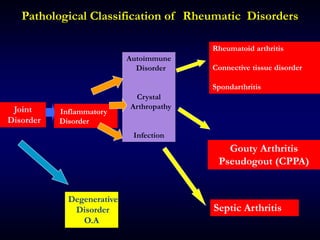
Joint
Disorder
Degenerative
Disorder
O.A
Inflammatory
Disorder
Rheumatoid arthritis
Connective tissue disorder
Spondarthritis
Autoimmune
Disorder
Crystal
Arthropathy
Infection
Pathological Classification of Rheumatic Disorders
Gouty Arthritis
Pseudogout (CPPA)
Septic Arthritis
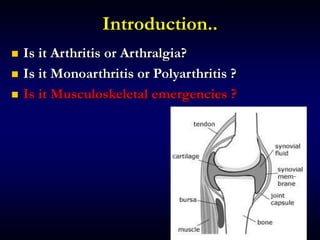
Introduction..
 Is it Arthritis or Arthralgia?
 Is it Monoarthritis or Polyarthritis ?
 Is it Musculoskeletal emergencies ?
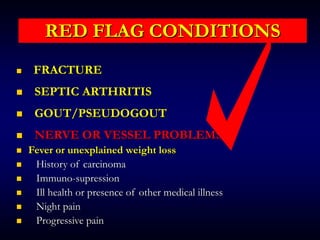
RED FLAG CONDITIONS
 FRACTURE
 SEPTIC ARTHRITIS
 GOUT/PSEUDOGOUT
 NERVE OR VESSEL PROBLEMS
 Fever or unexplained weight loss
 History of carcinoma
 Immuno-supression
 Ill health or presence of other medical illness
 Night pain
 Progressive pain
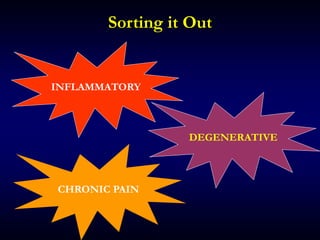
Sorting it Out
INFLAMMATORY
DEGENERATIVE
CHRONIC PAIN
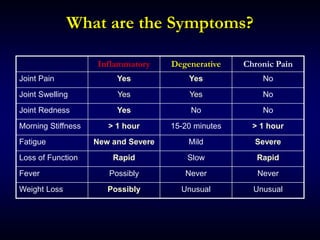
What are the Symptoms?
Unusual
Unusual
Possibly
Weight Loss
Never
Never
Possibly
Fever
Rapid
Slow
Rapid
Loss of Function
Severe
Mild
New and Severe
Fatigue
> 1 hour
15-20 minutes
> 1 hour
Morning Stiffness
No
No
Yes
Joint Redness
No
Yes
Yes
Joint Swelling
No
Yes
Yes
Joint Pain
Chronic Pain
Degenerative
Inflammatory
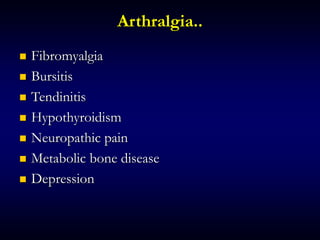
Arthralgia..
 Fibromyalgia
 Bursitis
 Tendinitis
 Hypothyroidism
 Neuropathic pain
 Metabolic bone disease
 Depression
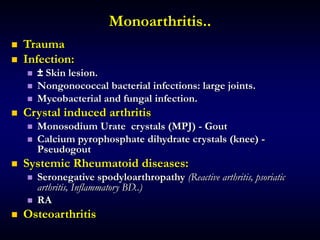
Monoarthritis..
 Trauma
 Infection:
 ± Skin lesion.
 Nongonococcal bacterial infections: large joints.
 Mycobacterial and fungal infection.
 Crystal induced arthritis
 Monosodium Urate crystals (MPJ) - Gout
 Calcium pyrophosphate dihydrate crystals (knee) -
Pseudogout
 Systemic Rheumatoid diseases:
 Seronegative spodyloarthropathy (Reactive arthritis, psoriatic
arthritis, Inflammatory BD..)
 RA
 Osteoarthritis
Polyarthritis..
 Rheumatoid Arthritis
 Systemic lupus Erythrematosus
 Viral arthritis
 Reiter’s disease
 Psoriatic arthritis
 Reactive arthritis
Migratory Arthritis..
 Differential diagnosis:
 Rheumatic fever
 Gonococcemia
 Meningococcemia
 Viral Arthritis
 SLE
 Acute Leukemia
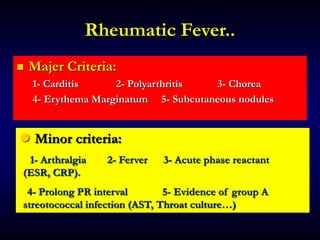
Rheumatic Fever..
 Majer Criteria:
1- Carditis 2- Polyarthritis 3- Chorea
4- Erythema Marginatum 5- Subcutaneous nodules
● Minor criteria:
1- Arthralgia 2- Ferver 3- Acute phase reactant
(ESR, CRP).
4- Prolong PR interval 5- Evidence of group A
streotococcal infection (AST, Throat culture…)
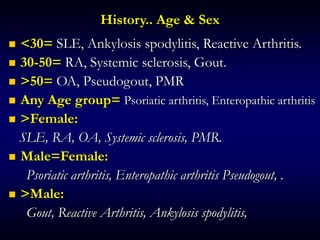
History.. Age & Sex
 <30= SLE, Ankylosis spodylitis, Reactive Arthritis.
 30-50= RA, Systemic sclerosis, Gout.
 >50= OA, Pseudogout, PMR
 Any Age group= Psoriatic arthritis, Enteropathic arthritis
 >Female:
SLE, RA, OA, Systemic sclerosis, PMR.
 Male=Female:
Psoriatic arthritis, Enteropathic arthritis Pseudogout, .
 >Male:
Gout, Reactive Arthritis, Ankylosis spodylitis,
History.. Symptoms
 Site:
 Symmetrical= RA, SLE, Systemic sclerosis
 Asymmetrical=OA
 Large joints= OA
 DIP= OA, Psoriatic arthritis
 MCP, PIP= RA, SLE
 1st MTP= Gout, OA
 Spine= OA, Ankylosis spodylitis, Psoriatic arthritis, Reactive
arthritis
 Shoulder= PMR
Physical Examination..
 Joint:
 Soft tissue swelling, warm, effusion…= Inflammation.
 Inflammation signs extended= Septic arthritis, crystal
induced arthritis, fracture.
 Passive motion (N), active(↓↓)= Bursitis, Tendinitis,
Muscle injury.
 Passive motion (↓↓), active(↓↓)= Synovitis
Physical Examination..
 General Examination:
 Parotid enlargement, oral ulceration, heart murmurs, pericardial or
pleural friction rubs, crackle…= systemic disease.
 Fever= Infection, reactive arthritis, RA, SLE, Crystal induced
arthritis…
 Subcutaneous nodules= RA, RHD, Gout (tophi)
 Skin manifestations= Psoriasis, RA, SLE…
 Eye disease (keratoconjunctivitis sicca, uveitis. Conjunctivitis,
episcleritis…)
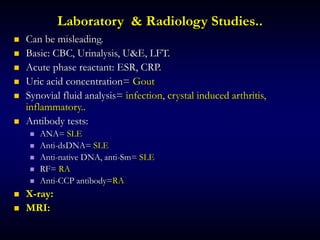
Laboratory & Radiology Studies..
 Can be misleading.
 Basic: CBC, Urinalysis, U&E, LFT.
 Acute phase reactant: ESR, CRP.
 Uric acid concentration= Gout
 Synovial fluid analysis= infection, crystal induced arthritis,
inflammatory..
 Antibody tests:
 ANA= SLE
 Anti-dsDNA= SLE
 Anti-native DNA, anti-Sm= SLE
 RF= RA
 Anti-CCP antibody=RA
 X-ray:
 MRI:
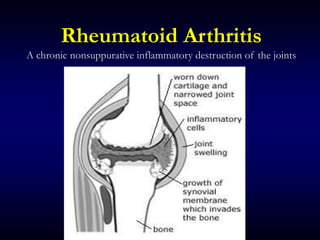
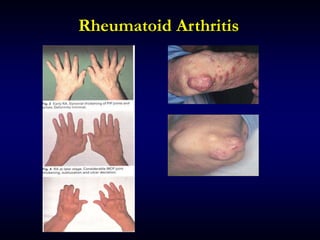
Rheumatoid Arthritis
A chronic nonsuppurative inflammatory destruction of the joints
Rheumatoid Arthritis..
 Incidence
 1-3% of general population
 Genetic predisposition
 Female to male ratio 3:1
 Average age of onset of 40 years
History..
 Malaise
 Fever
 Fatigue
 Weight loss
 Myalgias
 Difficulty performing activities of daily living
Examination..
 Joint affected
 swelling
 tenderness
 warmth
 decreased range of motion
 Atrophy of the interosseous muscles
 deformities
≥ 4 Diagnosis.. ACR Criteria criteria
present > 6 wks
 Morning stiffness > 1
hour
 Arthritis of ≥ 3 joints
areas (PIP, MCP, wrist,
elbow, knee, ankle, and
MTP)
 Arthritis of hand joints
(wrist, MCP, PIP)
 Symmetric arthritis
 Rheumatoid nodules
 RF+
 Radiographic changes
 Erosions
 Unequivocal periarticular
osteopenia
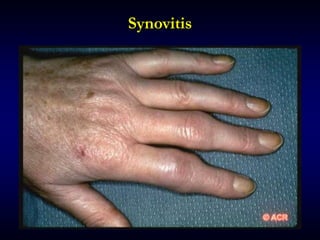
Synovitis
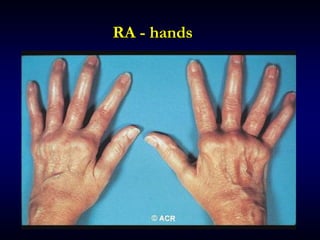
RA - hands
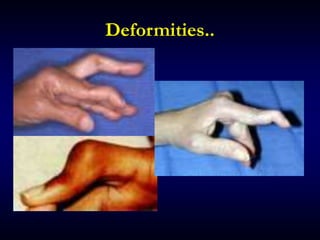
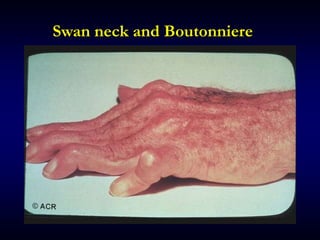
Deformities..
Swan neck and Boutonniere
Rheumatoid Arthritis
Extra-Articular Manifestations..
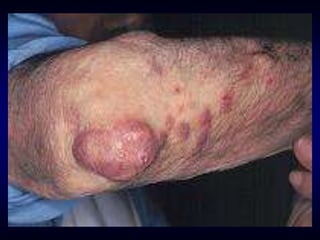
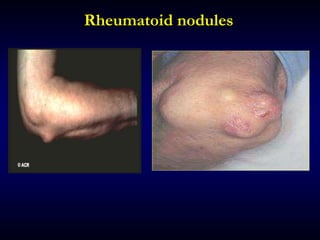
 Rheumatoid nodule
 Cardiovascular
 Pulmonary
 GI & Renal
 Hematological
 Skin
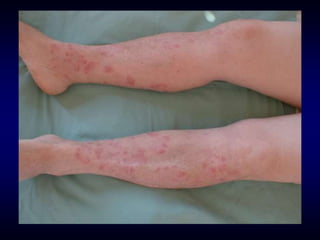
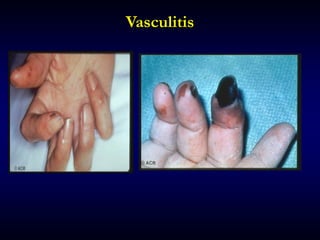
 Vasculitis
 Neurological
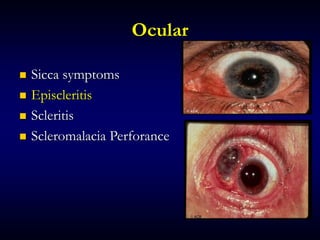
 Ocular
Rheumatoid nodules
Vasculitis
Ocular
 Sicca symptoms
 Episcleritis
 Scleritis
 Scleromalacia Perforance
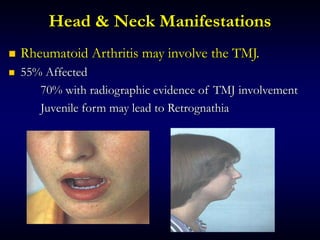
Head & Neck Manifestations
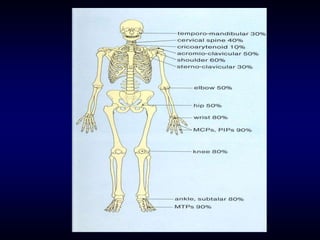
 Rheumatoid Arthritis may involve the TMJ.
 55% Affected
70% with radiographic evidence of TMJ involvement
Juvenile form may lead to Retrognathia
Head and Neck Manifestations
 Cricoarytenoid joint
 Most common cause of cricoarytenoid arthritis
 30% patients hoarse
 Exertional dyspnea, ear pain, globus
 Hoarseness
 Rheumatoid nodules, recurrent nerve involvement
 Stridor
 local/systemic steroids
 Conductive Hearing Loss
 Ossicular chain involvement
 Sensory Neural Hearing Loss
 Unexplained
 Assoc. with rheumatoid nodules
 Cervical spine
 Subluxation
Laboratory ..
 Hematologic parameters
 Anaemia
 Thrombocytosis
 ↓ Serum iron & IBC
 ↑ Serum globuline
 ↑ ALP
 ↑ Acute phase reactant ( ESR / CRP )
 Immunological parameters ( RF ) / ANF “50 % )
 Synovial fluid analysis (WBC > 2000/mm3 )
Laboratory
 Rheumatoid Factor
 Ig M Antibody against the Fc fragment of Ig G
 Not sensitive
 80% of RA patients
 RF+ patients more likely to have
 More severe disease
 Extraarticular manifestations
 Anti-cyclic citrullinated peptide (Anti-CCP )
 Specificity = 90%
 Sensitivity = 50-80%
RF is not specific for RA.
 Other autoimmune disease
 Sjogren’s syndrome , Systemic Lupus
 Chronic infection
 Hep B/C, SBE, Viral, Parasites, TB
 Pulmonary inflammation
 Sarcoid, IPF, Silicosis, Asbestosis
 Malignancy
 Healthy – 4% young; 5-25% > age 60
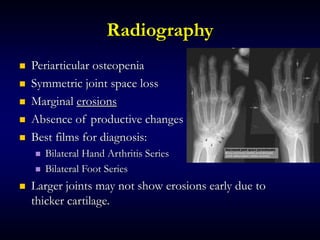
Radiography
 Periarticular osteopenia
 Symmetric joint space loss
 Marginal erosions
 Absence of productive changes
 Best films for diagnosis:
 Bilateral Hand Arthritis Series
 Bilateral Foot Series
 Larger joints may not show erosions early due to
thicker cartilage.
Treatment
 Aggressive Treatment Early!
 Physical therapy, daily exercise, splinting, joint protection
 Salicylates, NSAIDS, DMARDs , hydroxychloroquine,
immunosuppressive agents , Steroids
 Cyclosporin-A
 Prognosis
 10-15 yrs of disease
 50% fully employed
 10% incapacitated
 10-20% remission
 Persistent active cases more than 1 year likely to lead to joint
deformities.
 Periods of activity cases have better prognosis.
 Mortality rate 2.5 times than generalpopulation
Dental Management
 Short dental appointments
 Assess if Aspirin or NSAIDs are affecting platelet
function
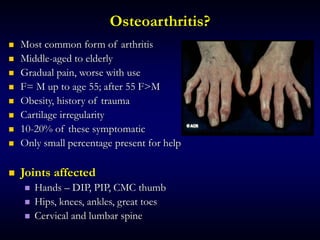
Osteoarthritis?
 Most common form of arthritis
 Middle-aged to elderly
 Gradual pain, worse with use
 F= M up to age 55; after 55 F>M
 Obesity, history of trauma
 Cartilage irregularity
 10-20% of these symptomatic
 Only small percentage present for help
 Joints affected
 Hands – DIP, PIP, CMC thumb
 Hips, knees, ankles, great toes
 Cervical and lumbar spine
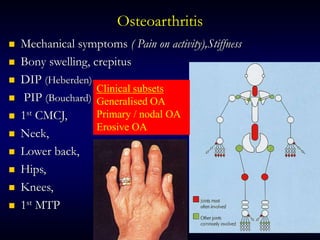
Osteoarthritis
 Mechanical symptoms ( Pain on activity),Stiffness
 Bony swelling, crepitus
 DIP (Heberden)
 PIP (Bouchard)
 1st CMCJ,
 Neck,
 Lower back,
 Hips,
 Knees,
 1st MTP
Clinical subsets
Generalised OA
Primary / nodal OA
Erosive OA
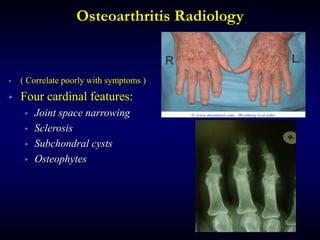
Osteoarthritis Radiology
 ( Correlate poorly with symptoms )
 Four cardinal features:
 Joint space narrowing
 Sclerosis
 Subchondral cysts
 Osteophytes
OA Management
 Pain Relief
 Simple/compound analgesics, exercises
 Glucosamine sulphate, patellar taping
 Topical capsaicin/NSAID; acupuncture
 Oral NSAIDs – COX2s, gastro-protection
 Injections – peri-articular, intra-articular
 Joint Replacement (Referral guidance hip/knee OA )
 ? Infection – same day
 Rapid deterioration/severe disability (2/52 hip, soon – ‘locally agreed’ knee)
 Symptoms impair QOL – routine
 Giving way despite Rx– soon (knee only)
 Acute inflammation (gout, haemarthrosis, pseudogout) – 2/52 (knee only)
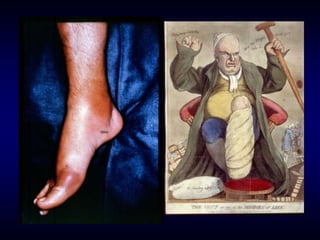
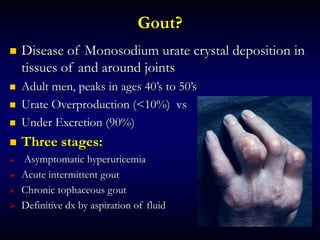
Gout?
 Disease of Monosodium urate crystal deposition in
tissues of and around joints
 Adult men, peaks in ages 40’s to 50’s
 Urate Overproduction (<10%) vs
 Under Excretion (90%)
 Three stages:
 Asymptomatic hyperuricemia
 Acute intermittent gout
 Chronic tophaceous gout
 Definitive dx by aspiration of fluid
Gout?
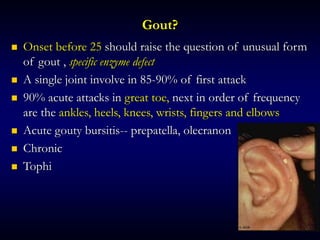
 Onset before 25 should raise the question of unusual form
of gout , specific enzyme defect
 A single joint involve in 85-90% of first attack
 90% acute attacks in great toe, next in order of frequency
are the ankles, heels, knees, wrists, fingers and elbows
 Acute gouty bursitis-- prepatella, olecranon
 Chronic
 Tophi
Septic Arthritis
 Septic arthritis is inflammation of a synovial
membrane with purulent effusion into the joint
capsule, usually due to bacterial infection.
 It is an emergency- it can destroy a joint extremely
quickly and (v.rarely) lead to sepsis and death
 Frequency:
 2-10 cases per 100,000 in the general population.
 30-70 cases per 100,000 in immunosuppressed/ joint
prosthesis

6256667.ppt

  • 1.
    Dental Management of Patientswith Rheumatology Disorders 1
  • 2.
    Joint Disorder Degenerative Disorder O.A Inflammatory Disorder Rheumatoid arthritis Connective tissuedisorder Spondarthritis Autoimmune Disorder Crystal Arthropathy Infection Pathological Classification of Rheumatic Disorders Gouty Arthritis Pseudogout (CPPA) Septic Arthritis
  • 3.
    Introduction..  Is itArthritis or Arthralgia?  Is it Monoarthritis or Polyarthritis ?  Is it Musculoskeletal emergencies ?
  • 4.
    RED FLAG CONDITIONS FRACTURE  SEPTIC ARTHRITIS  GOUT/PSEUDOGOUT  NERVE OR VESSEL PROBLEMS  Fever or unexplained weight loss  History of carcinoma  Immuno-supression  Ill health or presence of other medical illness  Night pain  Progressive pain
  • 5.
  • 6.
    What are theSymptoms? Unusual Unusual Possibly Weight Loss Never Never Possibly Fever Rapid Slow Rapid Loss of Function Severe Mild New and Severe Fatigue > 1 hour 15-20 minutes > 1 hour Morning Stiffness No No Yes Joint Redness No Yes Yes Joint Swelling No Yes Yes Joint Pain Chronic Pain Degenerative Inflammatory
  • 7.
    Arthralgia..  Fibromyalgia  Bursitis Tendinitis  Hypothyroidism  Neuropathic pain  Metabolic bone disease  Depression
  • 8.
    Monoarthritis..  Trauma  Infection: ± Skin lesion.  Nongonococcal bacterial infections: large joints.  Mycobacterial and fungal infection.  Crystal induced arthritis  Monosodium Urate crystals (MPJ) - Gout  Calcium pyrophosphate dihydrate crystals (knee) - Pseudogout  Systemic Rheumatoid diseases:  Seronegative spodyloarthropathy (Reactive arthritis, psoriatic arthritis, Inflammatory BD..)  RA  Osteoarthritis
  • 9.
    Polyarthritis..  Rheumatoid Arthritis Systemic lupus Erythrematosus  Viral arthritis  Reiter’s disease  Psoriatic arthritis  Reactive arthritis
  • 10.
    Migratory Arthritis..  Differentialdiagnosis:  Rheumatic fever  Gonococcemia  Meningococcemia  Viral Arthritis  SLE  Acute Leukemia
  • 11.
    Rheumatic Fever..  MajerCriteria: 1- Carditis 2- Polyarthritis 3- Chorea 4- Erythema Marginatum 5- Subcutaneous nodules ● Minor criteria: 1- Arthralgia 2- Ferver 3- Acute phase reactant (ESR, CRP). 4- Prolong PR interval 5- Evidence of group A streotococcal infection (AST, Throat culture…)
  • 12.
    History.. Age &Sex  <30= SLE, Ankylosis spodylitis, Reactive Arthritis.  30-50= RA, Systemic sclerosis, Gout.  >50= OA, Pseudogout, PMR  Any Age group= Psoriatic arthritis, Enteropathic arthritis  >Female: SLE, RA, OA, Systemic sclerosis, PMR.  Male=Female: Psoriatic arthritis, Enteropathic arthritis Pseudogout, .  >Male: Gout, Reactive Arthritis, Ankylosis spodylitis,
  • 13.
    History.. Symptoms  Site: Symmetrical= RA, SLE, Systemic sclerosis  Asymmetrical=OA  Large joints= OA  DIP= OA, Psoriatic arthritis  MCP, PIP= RA, SLE  1st MTP= Gout, OA  Spine= OA, Ankylosis spodylitis, Psoriatic arthritis, Reactive arthritis  Shoulder= PMR
  • 14.
    Physical Examination..  Joint: Soft tissue swelling, warm, effusion…= Inflammation.  Inflammation signs extended= Septic arthritis, crystal induced arthritis, fracture.  Passive motion (N), active(↓↓)= Bursitis, Tendinitis, Muscle injury.  Passive motion (↓↓), active(↓↓)= Synovitis
  • 15.
    Physical Examination..  GeneralExamination:  Parotid enlargement, oral ulceration, heart murmurs, pericardial or pleural friction rubs, crackle…= systemic disease.  Fever= Infection, reactive arthritis, RA, SLE, Crystal induced arthritis…  Subcutaneous nodules= RA, RHD, Gout (tophi)  Skin manifestations= Psoriasis, RA, SLE…  Eye disease (keratoconjunctivitis sicca, uveitis. Conjunctivitis, episcleritis…)
  • 19.
    Laboratory & RadiologyStudies..  Can be misleading.  Basic: CBC, Urinalysis, U&E, LFT.  Acute phase reactant: ESR, CRP.  Uric acid concentration= Gout  Synovial fluid analysis= infection, crystal induced arthritis, inflammatory..  Antibody tests:  ANA= SLE  Anti-dsDNA= SLE  Anti-native DNA, anti-Sm= SLE  RF= RA  Anti-CCP antibody=RA  X-ray:  MRI:
  • 20.
    Rheumatoid Arthritis A chronicnonsuppurative inflammatory destruction of the joints
  • 21.
    Rheumatoid Arthritis..  Incidence 1-3% of general population  Genetic predisposition  Female to male ratio 3:1  Average age of onset of 40 years
  • 22.
    History..  Malaise  Fever Fatigue  Weight loss  Myalgias  Difficulty performing activities of daily living
  • 23.
    Examination..  Joint affected swelling  tenderness  warmth  decreased range of motion  Atrophy of the interosseous muscles  deformities
  • 24.
    ≥ 4 Diagnosis..ACR Criteria criteria present > 6 wks  Morning stiffness > 1 hour  Arthritis of ≥ 3 joints areas (PIP, MCP, wrist, elbow, knee, ankle, and MTP)  Arthritis of hand joints (wrist, MCP, PIP)  Symmetric arthritis  Rheumatoid nodules  RF+  Radiographic changes  Erosions  Unequivocal periarticular osteopenia
  • 26.
  • 27.
  • 28.
  • 29.
    Swan neck andBoutonniere
  • 30.
  • 31.
    Extra-Articular Manifestations..  Rheumatoidnodule  Cardiovascular  Pulmonary  GI & Renal  Hematological  Skin  Vasculitis  Neurological  Ocular
  • 32.
  • 33.
  • 34.
    Ocular  Sicca symptoms Episcleritis  Scleritis  Scleromalacia Perforance
  • 35.
    Head & NeckManifestations  Rheumatoid Arthritis may involve the TMJ.  55% Affected 70% with radiographic evidence of TMJ involvement Juvenile form may lead to Retrognathia
  • 36.
    Head and NeckManifestations  Cricoarytenoid joint  Most common cause of cricoarytenoid arthritis  30% patients hoarse  Exertional dyspnea, ear pain, globus  Hoarseness  Rheumatoid nodules, recurrent nerve involvement  Stridor  local/systemic steroids  Conductive Hearing Loss  Ossicular chain involvement  Sensory Neural Hearing Loss  Unexplained  Assoc. with rheumatoid nodules  Cervical spine  Subluxation
  • 37.
    Laboratory ..  Hematologicparameters  Anaemia  Thrombocytosis  ↓ Serum iron & IBC  ↑ Serum globuline  ↑ ALP  ↑ Acute phase reactant ( ESR / CRP )  Immunological parameters ( RF ) / ANF “50 % )  Synovial fluid analysis (WBC > 2000/mm3 )
  • 38.
    Laboratory  Rheumatoid Factor Ig M Antibody against the Fc fragment of Ig G  Not sensitive  80% of RA patients  RF+ patients more likely to have  More severe disease  Extraarticular manifestations  Anti-cyclic citrullinated peptide (Anti-CCP )  Specificity = 90%  Sensitivity = 50-80%
  • 39.
    RF is notspecific for RA.  Other autoimmune disease  Sjogren’s syndrome , Systemic Lupus  Chronic infection  Hep B/C, SBE, Viral, Parasites, TB  Pulmonary inflammation  Sarcoid, IPF, Silicosis, Asbestosis  Malignancy  Healthy – 4% young; 5-25% > age 60
  • 40.
    Radiography  Periarticular osteopenia Symmetric joint space loss  Marginal erosions  Absence of productive changes  Best films for diagnosis:  Bilateral Hand Arthritis Series  Bilateral Foot Series  Larger joints may not show erosions early due to thicker cartilage.
  • 41.
    Treatment  Aggressive TreatmentEarly!  Physical therapy, daily exercise, splinting, joint protection  Salicylates, NSAIDS, DMARDs , hydroxychloroquine, immunosuppressive agents , Steroids  Cyclosporin-A  Prognosis  10-15 yrs of disease  50% fully employed  10% incapacitated  10-20% remission  Persistent active cases more than 1 year likely to lead to joint deformities.  Periods of activity cases have better prognosis.  Mortality rate 2.5 times than generalpopulation
  • 42.
    Dental Management  Shortdental appointments  Assess if Aspirin or NSAIDs are affecting platelet function
  • 43.
    Osteoarthritis?  Most commonform of arthritis  Middle-aged to elderly  Gradual pain, worse with use  F= M up to age 55; after 55 F>M  Obesity, history of trauma  Cartilage irregularity  10-20% of these symptomatic  Only small percentage present for help  Joints affected  Hands – DIP, PIP, CMC thumb  Hips, knees, ankles, great toes  Cervical and lumbar spine
  • 44.
    Osteoarthritis  Mechanical symptoms( Pain on activity),Stiffness  Bony swelling, crepitus  DIP (Heberden)  PIP (Bouchard)  1st CMCJ,  Neck,  Lower back,  Hips,  Knees,  1st MTP Clinical subsets Generalised OA Primary / nodal OA Erosive OA
  • 45.
    Osteoarthritis Radiology  (Correlate poorly with symptoms )  Four cardinal features:  Joint space narrowing  Sclerosis  Subchondral cysts  Osteophytes
  • 46.
    OA Management  PainRelief  Simple/compound analgesics, exercises  Glucosamine sulphate, patellar taping  Topical capsaicin/NSAID; acupuncture  Oral NSAIDs – COX2s, gastro-protection  Injections – peri-articular, intra-articular  Joint Replacement (Referral guidance hip/knee OA )  ? Infection – same day  Rapid deterioration/severe disability (2/52 hip, soon – ‘locally agreed’ knee)  Symptoms impair QOL – routine  Giving way despite Rx– soon (knee only)  Acute inflammation (gout, haemarthrosis, pseudogout) – 2/52 (knee only)
  • 48.
    Gout?  Disease ofMonosodium urate crystal deposition in tissues of and around joints  Adult men, peaks in ages 40’s to 50’s  Urate Overproduction (<10%) vs  Under Excretion (90%)  Three stages:  Asymptomatic hyperuricemia  Acute intermittent gout  Chronic tophaceous gout  Definitive dx by aspiration of fluid
  • 49.
    Gout?  Onset before25 should raise the question of unusual form of gout , specific enzyme defect  A single joint involve in 85-90% of first attack  90% acute attacks in great toe, next in order of frequency are the ankles, heels, knees, wrists, fingers and elbows  Acute gouty bursitis-- prepatella, olecranon  Chronic  Tophi
  • 50.
    Septic Arthritis  Septicarthritis is inflammation of a synovial membrane with purulent effusion into the joint capsule, usually due to bacterial infection.  It is an emergency- it can destroy a joint extremely quickly and (v.rarely) lead to sepsis and death  Frequency:  2-10 cases per 100,000 in the general population.  30-70 cases per 100,000 in immunosuppressed/ joint prosthesis