Assignment on
Campylobacteriosis and Erysipelas

           Submitted by
         Chanderkant Suthar
           Chavda Hardik
           Padher Nimesh
            Butani Jigar
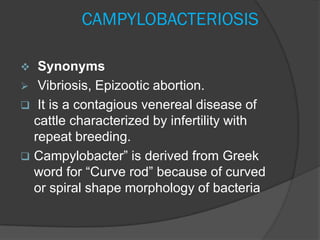
CAMPYLOBACTERIOSIS

  Synonyms
 Vibriosis, Epizootic abortion.
 It is a contagious venereal disease of
  cattle characterized by infertility with
  repeat breeding.
 Campylobacter” is derived from Greek
  word for “Curve rod” because of curved
  or spiral shape morphology of bacteria
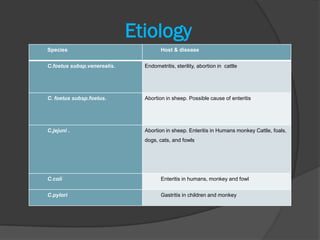
Etiology
Species                               Host & disease


C.foetus subsp.venerealis.     Endometritis, sterility, abortion in cattle


C. foetus subsp.foetus.        Abortion in sheep. Possible cause of enteritis


C.jejuni .                     Abortion in sheep. Enteritis in Humans monkey Cattle, foals,
                               dogs, cats, and fowls


C.coli                                Enteritis in humans, monkey and fowl


C.pylori                              Gastritis in children and monkey
Susceptible host

   Cattle
   Buffaloes
   Sheep
   Goat
   Man
Mode of transmission
 Faeco-oral
 Coital
 Ingestion of contaminated food
 Waterborne
 Contact with contaminated poultry,
  livestock, or household pets
Pathogenesis

   The organisms multiply in cervix

   Reach up to the uterine horn and
    oviduct

   Damage cilia of epithelial lining of
    oviduct

   Interfere with fertilization
Pathogenesis cont..
   Organisms have got obligatory respiratory
    mode


   Lowered dissolved      Lower supplies
    Oxygen tension         of required nutrients

   Interfere with implantation and
    development of embryo
Clinical findings

   Abortion in 2nd trimester(4-7months)
   In ewes abortion in last 6 weeks of
    pregnancy
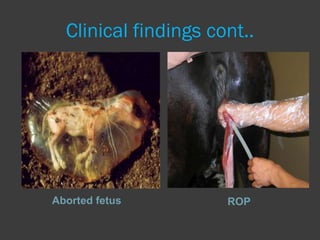
   Retention of placenta
   Slight mucopurtulent discharge
   Pyometra
   Aborted foetus shows autolytic changes
Clinical findings cont..


Aborted fetus         ROP
Clinical findings cont..
   Mucous-laden, watery, and/or bile-
    streaked diarrhea (with or without blood)
   Reduced appetite
   Occasional vomiting
   Fever and leukocytosis
   Body temperature may be normal
Lesions

 Mild endometritis and necrosis of
  cotyledons
 Separation of chorion with formation of
  hematomas
 Hypoxia due to placental damage
 Foetal death
Lesions cont..
   Congested and edematous colons in
    dogs
   Hyperplastic epithelial glands
   Thickened mucosa
   Hemorrhagic enteritis
   Edematous mesenteric lymph node
Diagnosis

1.   Demonstration of organism by Gram’s
     staining
2.   Culture and isolation
3.   Darkfield or phage-contrast microscopy
4.   Vaginal mucus aggulutination test
5.   Indirect haemaggutination test
6.   FAT
7.   Detection of serum antibodies by ELISA
Treatment

   Following antibiotics can be used
   Streptomycin
   Chloramphenicol
   Tetracycline
   Gentamicin,
   Furazolidone
   Doxycycline
Control and prevention

 Pasteurization of milk
 Chlorination of drinking water
 In cows and heifers the disease must be
  treated on herd basis
Prevention and Control Cont..
 Exposed female should be bred by AI.
 Infected bulls should not be kept in herd
 Addition of antibiotics with semen(1:25
  semen: yolk citrate 500 IU penicillin
  500mg streptomycin)
SWINE ERYSIPELAS

 Synonyms
 Diamond skin disease
 Rouget du proc
 Erysepela del cerdo
 Erysipelas (Greek—red skin)
 Ignissacer
 Holy fire
 St Anthony's fire
Cont..
 Erysipelas is an acute streptococcus
  bacterial infection of the dermis,
  resulting in inflammation
 worldwide in distribution
 Prevalence in India is scanty in nature
 Urticarial form of this disease recorded
  in Andhra Pradesh
Etiology
 Erysipelothrix rhusiopathiae
 Erysipelothrix insidiosa (old name)
 22 known serotypes
 Serotype 1 and 2 most common
Susceptible Host
   Pig (principal host )
   Sheep
   Carnivores
   Birds
   Human
Predisposing factors

   Age
   Genetics
   Immunity
   Non- infectious disease
   Stress due to environment or
    management
   Worm infestation
   Concurrent infection
   Alkaline soil
Source of Infection

 Domestic pigs
 Carrier animals’ excreta-faeces, urine
 Contaminated water and feed
 Body secretions-saliva, nasal
Mode of Transmission
   Ingestion
   Natural infection through skin wound
   Biting flies
   Intra-uterine infection
   Soil contaminated with organisms
Pathogenesis
   Acute septicemia and bacteraemia

   Localization of organisms in organ, joint, heart valves and
    synovial fluid

   Hyperaemia of synovial membrane

   Proliferation of synovial villi

   Thickening of joint capsule

   Amyloidosis in pigs
Clinical Findings

   Acute:-
   Sudden death
   High rise in temp.(104-106°F),
   Stilly gait and get up with difficult
   Suspended bowl material movement
   Pigs remain depressed and burrow in the
    bedding
   Conjunctivitis and vomition
Clinical findings Cont..
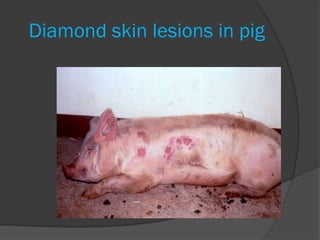
   Diamond skin lesions
   Slightly pink to dark purple area which
    raised and firm to touch
   Light to light purplish red lesions
   Dark purplish angry lesions may
    proceed to death.
   The course of acute form is 2-4 days
Diamond skin lesions in pig
Clinical findings cont..
   Subacute
   Less severe manifestations
   Skin lesions may or may not be noticed
   Chronic
   Arthritis
   Mainly involved joints are hock, stifles,
    knee, and elbow
   Joints are stiff, enlarged, hot and painful
   Sloughing of tip of the tail and ear.
Signs in cattle
 Non-suppurative arthritis
 Ulceration of cartilages
 Lameness
 Fluctuating joint capsule
Signs in sheep
   Acute or chronic form of arthritis
   Valvular endocarditis
   Cutanious infection
   Septicemia
   Multifocal necrotizing alveolitis
Signs in man
 Rise in temperature
 Pain in the hand and fingers
 Blisters
 Inflammation of lymph glands
Lesions

   Acute cases
   Rhomboid lesions
   Septicemia
   Lesions are centered around the smaller
    vessels of the dermis and hypodermis
   Intravascular fibrin coagulation or
    thrombosis
Lesions cont..
   Chronic cases
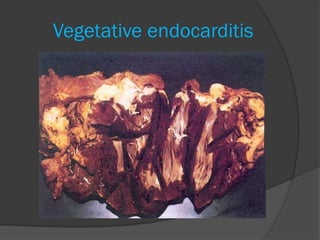
   Verrucose endocarditis
   Cauliflower like growth on the valves
   Mitral valve is more frequently affected
   Infarction of kidney and liver
Vegetative endocarditis
Lesions cont..
   Venous congestion of lungs
   Pulmonary oedema.
   Arthritis in limbs and vertebrae joints
   Clear amber colour fluid in joint capsule
   Swelling of adjoining lymph nodes
Diagnosis
   History
   Clinical findings
   Lesions
   Isolation and identification of organisms
   Animal inoculation test
Diagnosis cont..
   Serological diagnosis
   Agglutination test
   Avidin-biotin peroxidase technique
   Gel diffusion precipitation test
   Indirect immunoassay
   ELISA
   PCR
Diagnosis cont..
   Differential diagnosis:-
   Swine fever
   Salmonellosis
   Glasser’s disease
   Foot rot
   Streptococcal endocarditis
   Streptococcal septicemia and arthritis
Treatment

1.   Antiserum-
2.   Antibiotics
    Penicillins
    Clindamycin
    Erythromycin
3.   Anti inflammatory drugs
    Corticosteroids-betamethasone
Prevention and Control

 Dead carcasses should be burnt
  properly
 Pasture should be kept vacant following
  outbreak for a month
 Chronically affected carrier pigs should
  be culled
 The house and premises should be
  strictly disinfected
Prevention and control cont..
 Sound husbandry practices
 Replacement of stock should be made
  from clean sources.
 Recently purchased should be kept in
  isolation
Prevention and control cont..
   Immunization
   Attenuated vaccine
   Age of vaccination is 6 to 10 weeks.
   Second booster dose is given 2-4 weeks
    later after the first vaccination.
   Bacterins
   Formalin killed whole culture of
    organism adsorbed in aluminium
    hydroxide gel
KHAMMA GHANI

Campylobacteriosis

  • 1.
    Assignment on Campylobacteriosis andErysipelas Submitted by Chanderkant Suthar Chavda Hardik Padher Nimesh Butani Jigar
  • 2.
    CAMPYLOBACTERIOSIS  Synonyms Vibriosis, Epizootic abortion.  It is a contagious venereal disease of cattle characterized by infertility with repeat breeding.  Campylobacter” is derived from Greek word for “Curve rod” because of curved or spiral shape morphology of bacteria
  • 3.
    Etiology Species Host & disease C.foetus subsp.venerealis. Endometritis, sterility, abortion in cattle C. foetus subsp.foetus. Abortion in sheep. Possible cause of enteritis C.jejuni . Abortion in sheep. Enteritis in Humans monkey Cattle, foals, dogs, cats, and fowls C.coli Enteritis in humans, monkey and fowl C.pylori Gastritis in children and monkey
  • 4.
    Susceptible host  Cattle  Buffaloes  Sheep  Goat  Man
  • 5.
    Mode of transmission Faeco-oral  Coital  Ingestion of contaminated food  Waterborne  Contact with contaminated poultry, livestock, or household pets
  • 6.
    Pathogenesis  The organisms multiply in cervix  Reach up to the uterine horn and oviduct  Damage cilia of epithelial lining of oviduct  Interfere with fertilization
  • 7.
    Pathogenesis cont..  Organisms have got obligatory respiratory mode  Lowered dissolved Lower supplies Oxygen tension of required nutrients  Interfere with implantation and development of embryo
  • 8.
    Clinical findings  Abortion in 2nd trimester(4-7months)  In ewes abortion in last 6 weeks of pregnancy  Retention of placenta  Slight mucopurtulent discharge  Pyometra  Aborted foetus shows autolytic changes
  • 9.
  • 10.
    Clinical findings cont..  Mucous-laden, watery, and/or bile- streaked diarrhea (with or without blood)  Reduced appetite  Occasional vomiting  Fever and leukocytosis  Body temperature may be normal
  • 11.
    Lesions  Mild endometritisand necrosis of cotyledons  Separation of chorion with formation of hematomas  Hypoxia due to placental damage  Foetal death
  • 12.
    Lesions cont..  Congested and edematous colons in dogs  Hyperplastic epithelial glands  Thickened mucosa  Hemorrhagic enteritis  Edematous mesenteric lymph node
  • 13.
    Diagnosis 1. Demonstration of organism by Gram’s staining 2. Culture and isolation 3. Darkfield or phage-contrast microscopy 4. Vaginal mucus aggulutination test 5. Indirect haemaggutination test 6. FAT 7. Detection of serum antibodies by ELISA
  • 14.
    Treatment  Following antibiotics can be used  Streptomycin  Chloramphenicol  Tetracycline  Gentamicin,  Furazolidone  Doxycycline
  • 15.
    Control and prevention Pasteurization of milk  Chlorination of drinking water  In cows and heifers the disease must be treated on herd basis
  • 16.
    Prevention and ControlCont..  Exposed female should be bred by AI.  Infected bulls should not be kept in herd  Addition of antibiotics with semen(1:25 semen: yolk citrate 500 IU penicillin 500mg streptomycin)
  • 17.
    SWINE ERYSIPELAS  Synonyms Diamond skin disease  Rouget du proc  Erysepela del cerdo  Erysipelas (Greek—red skin)  Ignissacer  Holy fire  St Anthony's fire
  • 18.
    Cont..  Erysipelas isan acute streptococcus bacterial infection of the dermis, resulting in inflammation  worldwide in distribution  Prevalence in India is scanty in nature  Urticarial form of this disease recorded in Andhra Pradesh
  • 19.
    Etiology  Erysipelothrix rhusiopathiae Erysipelothrix insidiosa (old name)  22 known serotypes  Serotype 1 and 2 most common
  • 20.
    Susceptible Host  Pig (principal host )  Sheep  Carnivores  Birds  Human
  • 21.
    Predisposing factors  Age  Genetics  Immunity  Non- infectious disease  Stress due to environment or management  Worm infestation  Concurrent infection  Alkaline soil
  • 22.
    Source of Infection Domestic pigs  Carrier animals’ excreta-faeces, urine  Contaminated water and feed  Body secretions-saliva, nasal
  • 23.
    Mode of Transmission  Ingestion  Natural infection through skin wound  Biting flies  Intra-uterine infection  Soil contaminated with organisms
  • 24.
    Pathogenesis  Acute septicemia and bacteraemia  Localization of organisms in organ, joint, heart valves and synovial fluid  Hyperaemia of synovial membrane  Proliferation of synovial villi  Thickening of joint capsule  Amyloidosis in pigs
  • 25.
    Clinical Findings  Acute:-  Sudden death  High rise in temp.(104-106°F),  Stilly gait and get up with difficult  Suspended bowl material movement  Pigs remain depressed and burrow in the bedding  Conjunctivitis and vomition
  • 26.
    Clinical findings Cont..  Diamond skin lesions  Slightly pink to dark purple area which raised and firm to touch  Light to light purplish red lesions  Dark purplish angry lesions may proceed to death.  The course of acute form is 2-4 days
  • 27.
  • 28.
    Clinical findings cont..  Subacute  Less severe manifestations  Skin lesions may or may not be noticed  Chronic  Arthritis  Mainly involved joints are hock, stifles, knee, and elbow  Joints are stiff, enlarged, hot and painful  Sloughing of tip of the tail and ear.
  • 29.
    Signs in cattle Non-suppurative arthritis  Ulceration of cartilages  Lameness  Fluctuating joint capsule
  • 30.
    Signs in sheep  Acute or chronic form of arthritis  Valvular endocarditis  Cutanious infection  Septicemia  Multifocal necrotizing alveolitis
  • 31.
    Signs in man Rise in temperature  Pain in the hand and fingers  Blisters  Inflammation of lymph glands
  • 32.
    Lesions  Acute cases  Rhomboid lesions  Septicemia  Lesions are centered around the smaller vessels of the dermis and hypodermis  Intravascular fibrin coagulation or thrombosis
  • 33.
    Lesions cont..  Chronic cases  Verrucose endocarditis  Cauliflower like growth on the valves  Mitral valve is more frequently affected  Infarction of kidney and liver
  • 34.
  • 35.
    Lesions cont..  Venous congestion of lungs  Pulmonary oedema.  Arthritis in limbs and vertebrae joints  Clear amber colour fluid in joint capsule  Swelling of adjoining lymph nodes
  • 36.
    Diagnosis  History  Clinical findings  Lesions  Isolation and identification of organisms  Animal inoculation test
  • 37.
    Diagnosis cont..  Serological diagnosis  Agglutination test  Avidin-biotin peroxidase technique  Gel diffusion precipitation test  Indirect immunoassay  ELISA  PCR
  • 38.
    Diagnosis cont..  Differential diagnosis:-  Swine fever  Salmonellosis  Glasser’s disease  Foot rot  Streptococcal endocarditis  Streptococcal septicemia and arthritis
  • 39.
    Treatment 1. Antiserum- 2. Antibiotics  Penicillins  Clindamycin  Erythromycin 3. Anti inflammatory drugs  Corticosteroids-betamethasone
  • 40.
    Prevention and Control Dead carcasses should be burnt properly  Pasture should be kept vacant following outbreak for a month  Chronically affected carrier pigs should be culled  The house and premises should be strictly disinfected
  • 41.
    Prevention and controlcont..  Sound husbandry practices  Replacement of stock should be made from clean sources.  Recently purchased should be kept in isolation
  • 42.
    Prevention and controlcont..  Immunization  Attenuated vaccine  Age of vaccination is 6 to 10 weeks.  Second booster dose is given 2-4 weeks later after the first vaccination.  Bacterins  Formalin killed whole culture of organism adsorbed in aluminium hydroxide gel
  • 43.