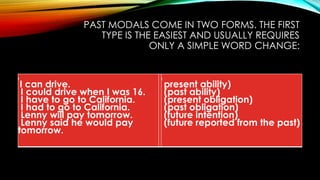







PAST MODALS COME IN TWO FORMS. THE FIRST
TYPE IS THE EASIEST AND USUALLY REQUIRES
ONLY A SIMPLE WORD CHANGE:
I
I can drive.
I could drive when I was 16.
I have to go to California.
I had to go to California.
Lenny will pay tomorrow.
Lenny said he would pay
tomorrow.
(
present ability)
(past ability)
(present obligation)
(past obligation)
(future intention)
(future reported from the past)
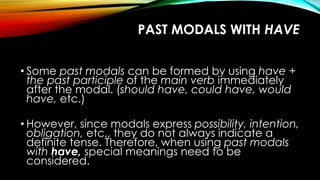
PAST MODALS WITH HAVE
• Some past modals can be formed by using have +
the past participle of the main verb immediately
after the modal. (should have, could have, would
have, etc.)
• However, since modals express possibility, intention,
obligation, etc., they do not always indicate a
definite tense. Therefore, when using past modals
with have, special meanings need to be
considered.
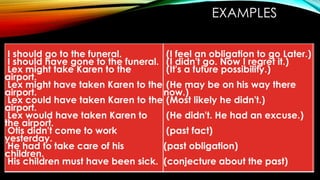
EXAMPLES
I should go to the funeral.
I should have gone to the funeral.
Lex might take Karen to the
airport.
Lex might have taken Karen to the
airport.
Lex could have taken Karen to the
airport.
Lex would have taken Karen to
the airport.
Otis didn't come to work
yesterday.
He had to take care of his
children.
His children must have been sick.
(I feel an obligation to go Later.)
(I didn't go. Now I regret it.)
(It's a future possibility.)
(He may be on his way there
now.)
(Most likely he didn't.)
(He didn't. He had an excuse.)
(past fact)
(past obligation)
(conjecture about the past)
NOW IT’S YOUR TURN TO WRITE EXAMPLES
ONE VOLUNTEER GRABS THE MARKER AND THEN GIVES IT TO ANOTHER CLASSMATE IN
ORDER TO WRITE EXAMPLES WITH ALL THE MODALS PRESENTED IN THE FOLLOWING SLIDES.
COULD
WOULD
SHOULD
MAY/MIGHT
MUST
Past modals presentation

Past modals presentation

  • 2.
    PAST MODALS COMEIN TWO FORMS. THE FIRST TYPE IS THE EASIEST AND USUALLY REQUIRES ONLY A SIMPLE WORD CHANGE: I I can drive. I could drive when I was 16. I have to go to California. I had to go to California. Lenny will pay tomorrow. Lenny said he would pay tomorrow. ( present ability) (past ability) (present obligation) (past obligation) (future intention) (future reported from the past)
  • 3.
    PAST MODALS WITHHAVE • Some past modals can be formed by using have + the past participle of the main verb immediately after the modal. (should have, could have, would have, etc.) • However, since modals express possibility, intention, obligation, etc., they do not always indicate a definite tense. Therefore, when using past modals with have, special meanings need to be considered.
  • 4.
    EXAMPLES I should goto the funeral. I should have gone to the funeral. Lex might take Karen to the airport. Lex might have taken Karen to the airport. Lex could have taken Karen to the airport. Lex would have taken Karen to the airport. Otis didn't come to work yesterday. He had to take care of his children. His children must have been sick. (I feel an obligation to go Later.) (I didn't go. Now I regret it.) (It's a future possibility.) (He may be on his way there now.) (Most likely he didn't.) (He didn't. He had an excuse.) (past fact) (past obligation) (conjecture about the past)
  • 5.
    NOW IT’S YOURTURN TO WRITE EXAMPLES ONE VOLUNTEER GRABS THE MARKER AND THEN GIVES IT TO ANOTHER CLASSMATE IN ORDER TO WRITE EXAMPLES WITH ALL THE MODALS PRESENTED IN THE FOLLOWING SLIDES.
  • 6.
  • 7.
  • 8.
  • 9.
  • 10.