By: JhoanM. Tagaban 
& 
RickaMae Tolentino
- Might/May/Could/+Perfect Infinitive 
We use might, may or could with the perfect infinitive to say 
that we think something was possible but we aren’t sure. 
Examples: 
The thieves might have escaped by car but we can’t be sure. 
He should be hour by now. He may have been delayed by a 
traffic jam or something. 
I can’t find my purse. I could have left in the supermarket but I 
just don’t know.
- Might/May/Could/+Perfect Infinitive 
We use might, may or could with the perfect infinitive to say 
that we think something was possible but we aren’t sure. 
Examples: 
The thieves might have escaped by car but we can’t be sure. 
He should be hour by now. He may have been delayed by a 
traffic jam or something. 
I can’t find my purse. I could have left in the supermarket but I 
just don’t know.
- Can’t + perfect infinitive 
we use can’t + perfect infinitive when we feel 
sure something didn’t happen in the past. 
Examples: 
I thought I saw John in town this morning but it 
- 
can’t have been him- he’s in Greece this week. 
I can’t have left in the supermarket- I had it on 
the bus on the way home. 
You can’t have read the instructions properly. 
They’re perfectly clear
-
Should Have 
Use should have to say that a different action was 
recommended in the past. 
Examples: 
If you arrive late to English class, you can say: 
“I should have left my house earlier.” 
If you regret an argument, you can say:“I shouldn’t 
have yelled at you yesterday. I’m sorry.” 
You can also use should have / shouldn’t have to tell 
other people that a different action in the past would 
have been better. If your son fails a test, you can say: 
“You should have studied. You shouldn’t have played 
video games all weekend.”
- 
Could Have 
Use could have to talk about possibilities if 
something had been different in the past. 
For example, someone who didn’t go to 
college can say: 
“If I had gone to college, I could have gotten a 
better job.” 
When talking about a gymnast who didn’t win 
a competition, you can say: 
“She could have won the gold medal if she 
hadn’t fallen three times.”
Could have is often used with “if + had + past 
participle” (If I had gone / if she hadn’t fallen) – 
these “if” phrases express the imaginary past 
situation. However, in some cases you can use 
- 
could have without the “if” phrase. Imagine 
you’re driving with a person who makes a 
dangerous maneuver on the road. You can say: 
“Are you crazy? We could have gotten into an 
accident.”
Would Have 
Use would have to imagine a result (if something 
had been different in the past): 
If you arrive late at the airport and miss your 
flight, you can say: 
- 
“If we had arrived earlier, we would have caught 
our flight.” 
If you forget your umbrella, and it starts to rain, 
and you get wet, you can say: 
“If I had brought my umbrella, I wouldn’t have 
gotten wet in the rain.”
- 
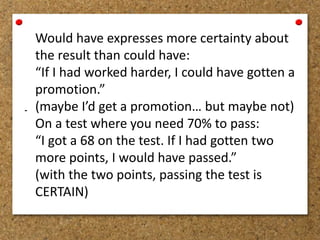
Would have expresses more certainty about 
the result than could have: 
“If I had worked harder, I could have gotten a 
promotion.” 
(maybe I’d get a promotion… but maybe not) 
On a test where you need 70% to pass: 
“I got a 68 on the test. If I had gotten two 
more points, I would have passed.” 
(with the two points, passing the test is 
CERTAIN)
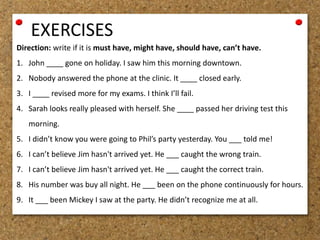
EXERCISES 
Direction: write if it is must have, might have, should have, can’t have. 
1. John ____ gone on holiday. I saw him this morning downtown. 
2. Nobody answered the phone at the clinic. It ____ closed early. 
3. I ____ revised more for my exams. I think I’ll fail. 
4. Sarah looks really pleased with herself. She ____ passed her driving test this 
morning. 
5. I didn’t know you were going to Phil’s party yesterday. You ___ told me! 
6. I can’t believe Jim hasn't arrived yet. He ___ caught the wrong train. 
7. I can’t believe Jim hasn't arrived yet. He ___ caught the correct train. 
8. His number was buy all night. He ___ been on the phone continuously for hours. 
9. It ___ been Mickey I saw at the party. He didn’t recognize me at all.
1. Bill hasn’t arrived for the meeting yet, he ____(get) stuck in traffic. There’s no other 
possibility. 
2. Sally’s car is still parked outside her house, she ___ (leave) for work yet because she 
always goes by car. 
3. His phone is out of battery, he ___ (forget) to charge it. I’m certain of it. 
4. I'm not sure where my keys have disappeared to, but I suppose I ____ (leave) them on 
my desk. It’s certainly a possibility. 
5. I'm not surprised you failed the job interview, you ____ (study) more!
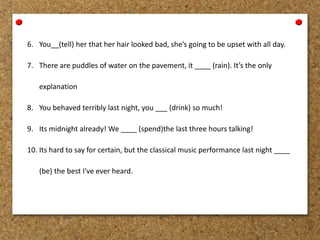
6. You__(tell) her that her hair looked bad, she’s going to be upset with all day. 
7. There are puddles of water on the pavement, it ____ (rain). It’s the only 
explanation 
8. You behaved terribly last night, you ___ (drink) so much! 
9. Its midnight already! We ____ (spend)the last three hours talking! 
10. Its hard to say for certain, but the classical music performance last night ____ 
(be) the best I've ever heard.
- 
11. There’s a mosquito in here, it _____ (come)in through the window. No doubt 
about it. 
12. The government ___ (do) something about the financial situation a long time 
ago. 
13. I can’t believe that you won the football match, your team is terrible. You ___ 
(have) a lot of luck. 
14. This soup is so thick and tastes so nice! They ___ (put) a lot of cream in it. 
15. I know it’s too late to say it now, but I ____ (waste) so much money on silly things 
last night.
Past modals

Past modals

  • 1.
    By: JhoanM. Tagaban & RickaMae Tolentino
  • 3.
    - Might/May/Could/+Perfect Infinitive We use might, may or could with the perfect infinitive to say that we think something was possible but we aren’t sure. Examples: The thieves might have escaped by car but we can’t be sure. He should be hour by now. He may have been delayed by a traffic jam or something. I can’t find my purse. I could have left in the supermarket but I just don’t know.
  • 4.
    - Might/May/Could/+Perfect Infinitive We use might, may or could with the perfect infinitive to say that we think something was possible but we aren’t sure. Examples: The thieves might have escaped by car but we can’t be sure. He should be hour by now. He may have been delayed by a traffic jam or something. I can’t find my purse. I could have left in the supermarket but I just don’t know.
  • 5.
    - Can’t +perfect infinitive we use can’t + perfect infinitive when we feel sure something didn’t happen in the past. Examples: I thought I saw John in town this morning but it - can’t have been him- he’s in Greece this week. I can’t have left in the supermarket- I had it on the bus on the way home. You can’t have read the instructions properly. They’re perfectly clear
  • 6.
  • 7.
    Should Have Useshould have to say that a different action was recommended in the past. Examples: If you arrive late to English class, you can say: “I should have left my house earlier.” If you regret an argument, you can say:“I shouldn’t have yelled at you yesterday. I’m sorry.” You can also use should have / shouldn’t have to tell other people that a different action in the past would have been better. If your son fails a test, you can say: “You should have studied. You shouldn’t have played video games all weekend.”
  • 8.
    - Could Have Use could have to talk about possibilities if something had been different in the past. For example, someone who didn’t go to college can say: “If I had gone to college, I could have gotten a better job.” When talking about a gymnast who didn’t win a competition, you can say: “She could have won the gold medal if she hadn’t fallen three times.”
  • 9.
    Could have isoften used with “if + had + past participle” (If I had gone / if she hadn’t fallen) – these “if” phrases express the imaginary past situation. However, in some cases you can use - could have without the “if” phrase. Imagine you’re driving with a person who makes a dangerous maneuver on the road. You can say: “Are you crazy? We could have gotten into an accident.”
  • 10.
    Would Have Usewould have to imagine a result (if something had been different in the past): If you arrive late at the airport and miss your flight, you can say: - “If we had arrived earlier, we would have caught our flight.” If you forget your umbrella, and it starts to rain, and you get wet, you can say: “If I had brought my umbrella, I wouldn’t have gotten wet in the rain.”
  • 11.
    - Would haveexpresses more certainty about the result than could have: “If I had worked harder, I could have gotten a promotion.” (maybe I’d get a promotion… but maybe not) On a test where you need 70% to pass: “I got a 68 on the test. If I had gotten two more points, I would have passed.” (with the two points, passing the test is CERTAIN)
  • 12.
    EXERCISES Direction: writeif it is must have, might have, should have, can’t have. 1. John ____ gone on holiday. I saw him this morning downtown. 2. Nobody answered the phone at the clinic. It ____ closed early. 3. I ____ revised more for my exams. I think I’ll fail. 4. Sarah looks really pleased with herself. She ____ passed her driving test this morning. 5. I didn’t know you were going to Phil’s party yesterday. You ___ told me! 6. I can’t believe Jim hasn't arrived yet. He ___ caught the wrong train. 7. I can’t believe Jim hasn't arrived yet. He ___ caught the correct train. 8. His number was buy all night. He ___ been on the phone continuously for hours. 9. It ___ been Mickey I saw at the party. He didn’t recognize me at all.
  • 13.
    1. Bill hasn’tarrived for the meeting yet, he ____(get) stuck in traffic. There’s no other possibility. 2. Sally’s car is still parked outside her house, she ___ (leave) for work yet because she always goes by car. 3. His phone is out of battery, he ___ (forget) to charge it. I’m certain of it. 4. I'm not sure where my keys have disappeared to, but I suppose I ____ (leave) them on my desk. It’s certainly a possibility. 5. I'm not surprised you failed the job interview, you ____ (study) more!
  • 14.
    6. You__(tell) herthat her hair looked bad, she’s going to be upset with all day. 7. There are puddles of water on the pavement, it ____ (rain). It’s the only explanation 8. You behaved terribly last night, you ___ (drink) so much! 9. Its midnight already! We ____ (spend)the last three hours talking! 10. Its hard to say for certain, but the classical music performance last night ____ (be) the best I've ever heard.
  • 15.
    - 11. There’sa mosquito in here, it _____ (come)in through the window. No doubt about it. 12. The government ___ (do) something about the financial situation a long time ago. 13. I can’t believe that you won the football match, your team is terrible. You ___ (have) a lot of luck. 14. This soup is so thick and tastes so nice! They ___ (put) a lot of cream in it. 15. I know it’s too late to say it now, but I ____ (waste) so much money on silly things last night.