
Passive voice
PATRICIA VIVAS
CONTRERAS
Use of passive
 Passive voice is used when the focus is on the action. It is not
important or not known, however, who or what is performing the
action.
 Example: My bike was stolen.
 In the example above, the focus is on the fact that my bike was
stolen. I do not know, however, who did it.
 Sometimes a statement in passive is more
polite than active voice, as the following
example shows:
 Example: A mistake was made.
 In this case, I focus on the fact that a mistake
was made, but I do not blame anyone (e.g.
You have made a mistake.).
FORM OF PASSIVE
 Subject + finite form of to be + Past Participle
(3rd column of irregular verbs)
 Example: A letter was written.
 When rewriting active sentences in passive
voice, note the following:
 The object of the active sentence becomes the
subject of the passive sentence
 The finite form of the verb is changed (to be +
past participle)
 The subject of the active sentence becomes the
object of the passive sentence (or is dropped)
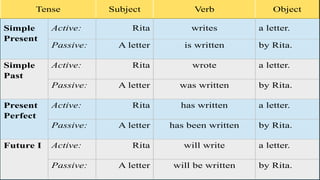
Tense Subject Verb Object
Simple
Present
Active: Rita writes a letter.
Passive: A letter is written by Rita.
Simple
Past
Active: Rita wrote a letter.
Passive: A letter was written by Rita.
Present
Perfect
Active: Rita has written a letter.
Passive: A letter has been written by Rita.
Future I Active: Rita will write a letter.
Passive: A letter will be written by Rita.
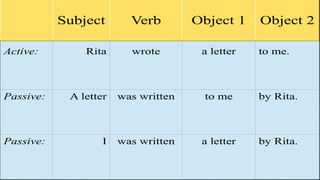
Subject Verb Object 1 Object 2
Active: Rita wrote a letter to me.
Passive: A letter was written to me by Rita.
Passive: I was written a letter by Rita.
Personal and
impersonal
passive
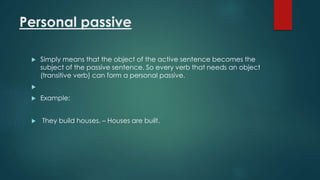
Personal passive
 Simply means that the object of the active sentence becomes the
subject of the passive sentence. So every verb that needs an object
(transitive verb) can form a personal passive.

 Example:
 They build houses. – Houses are built.
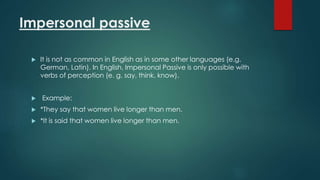
Impersonal passive
 It is not as common in English as in some other languages (e.g.
German, Latin). In English, Impersonal Passive is only possible with
verbs of perception (e. g. say, think, know).
 Example:
 *They say that women live longer than men.
 *It is said that women live longer than men.

Passive voice

  • 1.
  • 2.
    Use of passive Passive voice is used when the focus is on the action. It is not important or not known, however, who or what is performing the action.  Example: My bike was stolen.  In the example above, the focus is on the fact that my bike was stolen. I do not know, however, who did it.
  • 3.
     Sometimes astatement in passive is more polite than active voice, as the following example shows:  Example: A mistake was made.  In this case, I focus on the fact that a mistake was made, but I do not blame anyone (e.g. You have made a mistake.).
  • 4.
    FORM OF PASSIVE Subject + finite form of to be + Past Participle (3rd column of irregular verbs)  Example: A letter was written.  When rewriting active sentences in passive voice, note the following:
  • 5.
     The objectof the active sentence becomes the subject of the passive sentence  The finite form of the verb is changed (to be + past participle)  The subject of the active sentence becomes the object of the passive sentence (or is dropped)
  • 6.
    Tense Subject VerbObject Simple Present Active: Rita writes a letter. Passive: A letter is written by Rita. Simple Past Active: Rita wrote a letter. Passive: A letter was written by Rita. Present Perfect Active: Rita has written a letter. Passive: A letter has been written by Rita. Future I Active: Rita will write a letter. Passive: A letter will be written by Rita.
  • 7.
    Subject Verb Object1 Object 2 Active: Rita wrote a letter to me. Passive: A letter was written to me by Rita. Passive: I was written a letter by Rita.
  • 8.
  • 9.
    Personal passive  Simplymeans that the object of the active sentence becomes the subject of the passive sentence. So every verb that needs an object (transitive verb) can form a personal passive.   Example:  They build houses. – Houses are built.
  • 10.
    Impersonal passive  Itis not as common in English as in some other languages (e.g. German, Latin). In English, Impersonal Passive is only possible with verbs of perception (e. g. say, think, know).  Example:  *They say that women live longer than men.  *It is said that women live longer than men.