Good Morning !
Miss Gloria Meza
2021-2
Do you believe in luck?
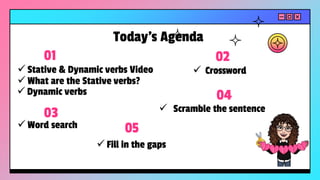
✓ Stative & Dynamic verbs Video
01
✓ Crossword
02
✓ Word search
03 ✓ Scramble the sentence
04
Today’s Agenda
✓ What are the Stative verbs?
✓ Dynamic verbs
05
✓ Fill in the gaps
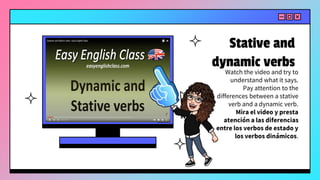
Stative and
dynamic verbs
Watch the video and try to
understand what it says.
Pay attention to the
differences between a stative
verb and a dynamic verb.
Mira el video y presta
atención a las diferencias
entre los verbos de estado y
los verbos dinámicos.
Stative Verbs
01
What are stative verbs?
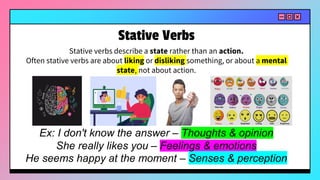
Stative verbs describe a state rather than an action.
Often stative verbs are about liking or disliking something, or about a mental
state, not about action.
Ex: I don't know the answer – Thoughts & opinion
She really likes you – Feelings & emotions
He seems happy at the moment – Senses & perception
Stative Verbs
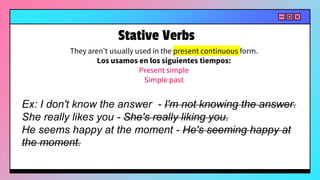
They aren't usually used in the present continuous form.
Los usamos en los siguientes tiempos:
Present simple
Simple past
Ex: I don't know the answer - I'm not knowing the answer.
She really likes you - She's really liking you.
He seems happy at the moment - He's seeming happy at
the moment.
Stative Verbs
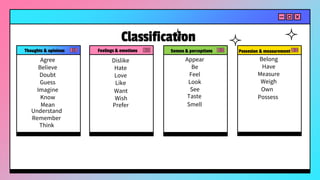
Thoughts & opinions
Agree
Believe
Doubt
Guess
Imagine
Know
Mean
Classification
Feelings & emotions
Dislike
Hate
Love
Like
Senses & perceptions
Appear
Be
Feel
Look
See
Possesion & measurement
Belong
Have
Measure
Weigh
Remember
Think
Understand
Want
Prefer
Wish Taste
Smell
Own
Possess
Your turn ! Crea oraciones usando verbos de estado.
Dynamic Verbs
01
What are dynamic verbs?
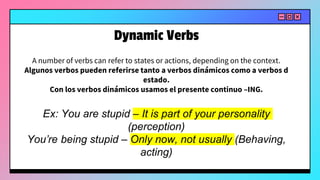
A number of verbs can refer to states or actions, depending on the context.
Algunos verbos pueden referirse tanto a verbos dinámicos como a verbos d
estado.
Con los verbos dinámicos usamos el presente continuo –ING.
Ex: You are stupid – It is part of your personality
(perception)
You’re being stupid – Only now, not usually (Behaving,
acting)
Dynamic Verbs
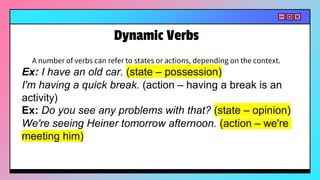
A number of verbs can refer to states or actions, depending on the context.
Ex: I have an old car. (state – possession)
I'm having a quick break. (action – having a break is an
activity)
Ex: Do you see any problems with that? (state – opinion)
We're seeing Heiner tomorrow afternoon. (action – we're
meeting him)
Dynamic Verbs
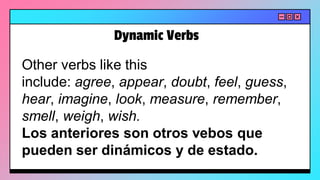
Other verbs like this
include: agree, appear, doubt, feel, guess,
hear, imagine, look, measure, remember,
smell, weigh, wish.
Los anteriores son otros vebos que
pueden ser dinámicos y de estado.
Dynamic Verbs
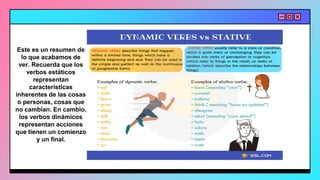
Este es un resumen de
lo que acabamos de
ver. Recuerda que los
verbos estáticos
representan
características
inherentes de las cosas
o personas, cosas que
no cambian. En cambio,
los verbos dinámicos
representan acciones
que tienen un comienzo
y un final.
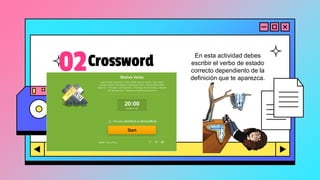
Crossword En esta actividad debes
escribir el verbo de estado
correcto dependiento de la
definición que te aparezca.
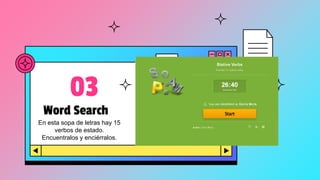
Word Search
03
En esta sopa de letras hay 15
verbos de estado.
Encuentralos y enciérralos.
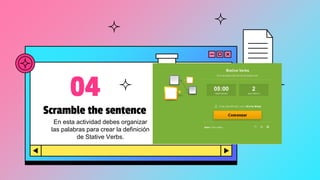
Scramble the sentence
04
En esta actividad debes organizar
las palabras para crear la definición
de Stative Verbs.
Fill in the blanks
05
En esta actividad debes escoger el
verbo de estado más apropiado
para completar la oración.
Any doubt about stative and dynamic
verbs?
CREDITS: This presentation template was created by Slidesgo, including icons by
Flaticon, and infographics & images by Freepik
Thanks for your attendance
and amazing participation
today
Please keep this slide for attribution

Stative and Dynamic Verbs

  • 1.
    Good Morning ! MissGloria Meza 2021-2
  • 2.
  • 3.
    ✓ Stative &Dynamic verbs Video 01 ✓ Crossword 02 ✓ Word search 03 ✓ Scramble the sentence 04 Today’s Agenda ✓ What are the Stative verbs? ✓ Dynamic verbs 05 ✓ Fill in the gaps
  • 4.
    Stative and dynamic verbs Watchthe video and try to understand what it says. Pay attention to the differences between a stative verb and a dynamic verb. Mira el video y presta atención a las diferencias entre los verbos de estado y los verbos dinámicos.
  • 5.
  • 6.
    Stative verbs describea state rather than an action. Often stative verbs are about liking or disliking something, or about a mental state, not about action. Ex: I don't know the answer – Thoughts & opinion She really likes you – Feelings & emotions He seems happy at the moment – Senses & perception Stative Verbs
  • 7.
    They aren't usuallyused in the present continuous form. Los usamos en los siguientes tiempos: Present simple Simple past Ex: I don't know the answer - I'm not knowing the answer. She really likes you - She's really liking you. He seems happy at the moment - He's seeming happy at the moment. Stative Verbs
  • 8.
    Thoughts & opinions Agree Believe Doubt Guess Imagine Know Mean Classification Feelings& emotions Dislike Hate Love Like Senses & perceptions Appear Be Feel Look See Possesion & measurement Belong Have Measure Weigh Remember Think Understand Want Prefer Wish Taste Smell Own Possess
  • 9.
    Your turn !Crea oraciones usando verbos de estado.
  • 10.
  • 11.
    A number ofverbs can refer to states or actions, depending on the context. Algunos verbos pueden referirse tanto a verbos dinámicos como a verbos d estado. Con los verbos dinámicos usamos el presente continuo –ING. Ex: You are stupid – It is part of your personality (perception) You’re being stupid – Only now, not usually (Behaving, acting) Dynamic Verbs
  • 12.
    A number ofverbs can refer to states or actions, depending on the context. Ex: I have an old car. (state – possession) I'm having a quick break. (action – having a break is an activity) Ex: Do you see any problems with that? (state – opinion) We're seeing Heiner tomorrow afternoon. (action – we're meeting him) Dynamic Verbs
  • 13.
    Other verbs likethis include: agree, appear, doubt, feel, guess, hear, imagine, look, measure, remember, smell, weigh, wish. Los anteriores son otros vebos que pueden ser dinámicos y de estado. Dynamic Verbs
  • 14.
    Este es unresumen de lo que acabamos de ver. Recuerda que los verbos estáticos representan características inherentes de las cosas o personas, cosas que no cambian. En cambio, los verbos dinámicos representan acciones que tienen un comienzo y un final.
  • 15.
    Crossword En estaactividad debes escribir el verbo de estado correcto dependiento de la definición que te aparezca.
  • 16.
    Word Search 03 En estasopa de letras hay 15 verbos de estado. Encuentralos y enciérralos.
  • 17.
    Scramble the sentence 04 Enesta actividad debes organizar las palabras para crear la definición de Stative Verbs.
  • 18.
    Fill in theblanks 05 En esta actividad debes escoger el verbo de estado más apropiado para completar la oración.
  • 19.
    Any doubt aboutstative and dynamic verbs?
  • 20.
    CREDITS: This presentationtemplate was created by Slidesgo, including icons by Flaticon, and infographics & images by Freepik Thanks for your attendance and amazing participation today Please keep this slide for attribution