Advanced English Grammar
Modals verbs
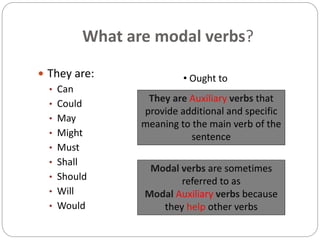
What are modal verbs?
 They are:
• Can
• Could
• May
• Might
• Must
• Shall
• Should
• Will
• Would
• Ought to
Modal verbs are sometimes
referred to as
Modal Auxiliary verbs because
they help other verbs
They are Auxiliary verbs that
provide additional and specific
meaning to the main verb of the
sentence
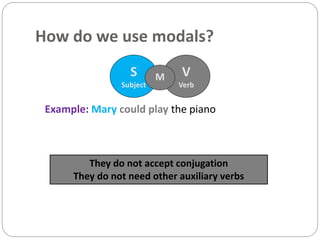
How do we use modals?
Example: Mary could play the piano
S
Subject
V
Verb
M
They do not accept conjugation
They do not need other auxiliary verbs
Form
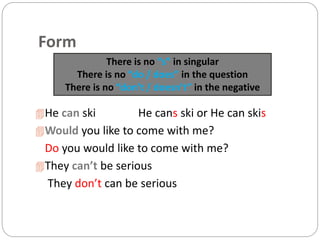
He can ski He cans ski or He can skis
Would you like to come with me?
Do you would like to come with me?
They can’t be serious
They don’t can be serious
There is no “s” in singular
There is no “do / does” in the question
There is no “don’t / doesn’t” in the negative
Form
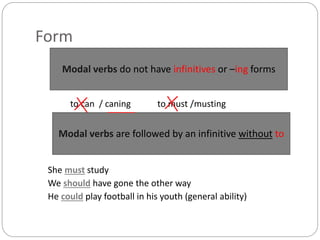
to can / caning to must /musting
She must study
We should have gone the other way
He could play football in his youth (general ability)
Modal verbs do not have infinitives or –ing forms
Modal verbs are followed by an infinitive without to
Form
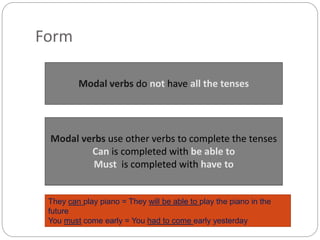
Modal verbs do not have all the tenses
Modal verbs use other verbs to complete the tenses
Can is completed with be able to
Must is completed with have to
They can play piano = They will be able to play the piano in the
future
You must come early = You had to come early yesterday
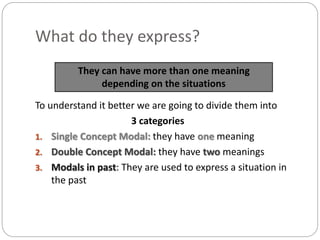
What do they express?
To understand it better we are going to divide them into
3 categories
1. Single Concept Modal: they have one meaning
2. Double Concept Modal: they have two meanings
3. Modals in past: They are used to express a situation in
the past
They can have more than one meaning
depending on the situations
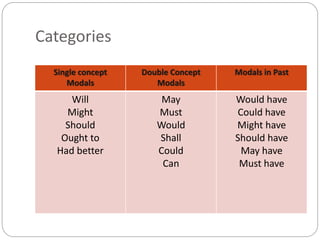
Categories
Single concept
Modals
Double Concept
Modals
Modals in Past
Will
Might
Should
Ought to
Had better
May
Must
Would
Shall
Could
Can
Would have
Could have
Might have
Should have
May have
Must have
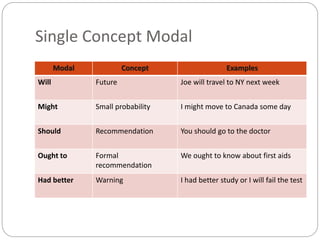
Single Concept Modal
Modal Concept Examples
Will Future Joe will travel to NY next week
Might Small probability I might move to Canada some day
Should Recommendation You should go to the doctor
Ought to Formal
recommendation
We ought to know about first aids
Had better Warning I had better study or I will fail the test
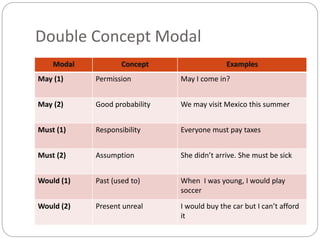
Double Concept Modal
Modal Concept Examples
May (1) Permission May I come in?
May (2) Good probability We may visit Mexico this summer
Must (1) Responsibility Everyone must pay taxes
Must (2) Assumption She didn’t arrive. She must be sick
Would (1) Past (used to) When I was young, I would play
soccer
Would (2) Present unreal I would buy the car but I can’t afford
it
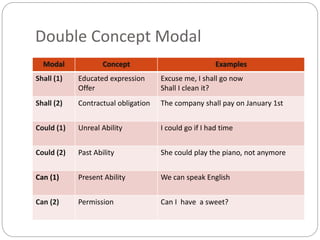
Double Concept Modal
Modal Concept Examples
Shall (1) Educated expression
Offer
Excuse me, I shall go now
Shall I clean it?
Shall (2) Contractual obligation The company shall pay on January 1st
Could (1) Unreal Ability I could go if I had time
Could (2) Past Ability She could play the piano, not anymore
Can (1) Present Ability We can speak English
Can (2) Permission Can I have a sweet?
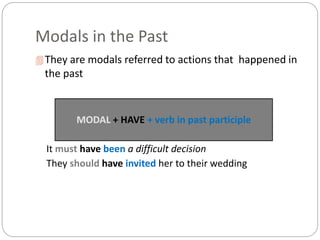
Modals in the Past
They are modals referred to actions that happened in
the past
It must have been a difficult decision
They should have invited her to their wedding
MODAL + HAVE + verb in past participle
MODALS: ABILITY
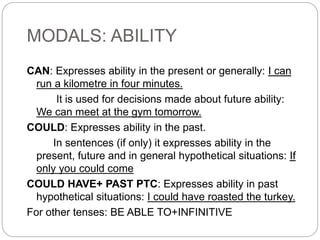
CAN: Expresses ability in the present or generally: I can
run a kilometre in four minutes.
It is used for decisions made about future ability:
We can meet at the gym tomorrow.
COULD: Expresses ability in the past.
In sentences (if only) it expresses ability in the
present, future and in general hypothetical situations: If
only you could come
COULD HAVE+ PAST PTC: Expresses ability in past
hypothetical situations: I could have roasted the turkey.
For other tenses: BE ABLE TO+INFINITIVE
MODALS- PERMISSION
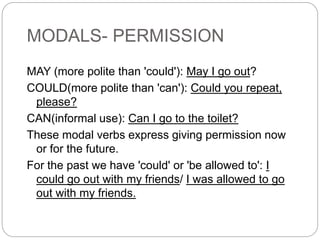
MAY (more polite than 'could'): May I go out?
COULD(more polite than 'can'): Could you repeat,
please?
CAN(informal use): Can I go to the toilet?
These modal verbs express giving permission now
or for the future.
For the past we have 'could' or 'be allowed to': I
could go out with my friends/ I was allowed to go
out with my friends.
MODALS- ADVICE
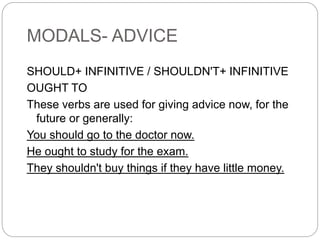
SHOULD+ INFINITIVE / SHOULDN'T+ INFINITIVE
OUGHT TO
These verbs are used for giving advice now, for the
future or generally:
You should go to the doctor now.
He ought to study for the exam.
They shouldn't buy things if they have little money.
MODALS- DEGREES OF
CERTAINTY
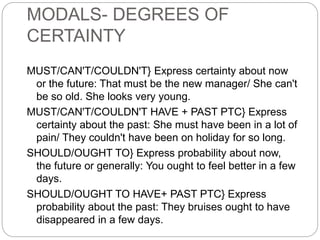
MUST/CAN'T/COULDN'T} Express certainty about now
or the future: That must be the new manager/ She can't
be so old. She looks very young.
MUST/CAN'T/COULDN'T HAVE + PAST PTC} Express
certainty about the past: She must have been in a lot of
pain/ They couldn't have been on holiday for so long.
SHOULD/OUGHT TO} Express probability about now,
the future or generally: You ought to feel better in a few
days.
SHOULD/OUGHT TO HAVE+ PAST PTC} Express
probability about the past: They bruises ought to have
disappeared in a few days.
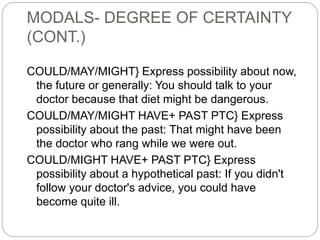
MODALS- DEGREE OF CERTAINTY
(CONT.)
COULD/MAY/MIGHT} Express possibility about now,
the future or generally: You should talk to your
doctor because that diet might be dangerous.
COULD/MAY/MIGHT HAVE+ PAST PTC} Express
possibility about the past: That might have been
the doctor who rang while we were out.
COULD/MIGHT HAVE+ PAST PTC} Express
possibility about a hypothetical past: If you didn't
follow your doctor's advice, you could have
become quite ill.
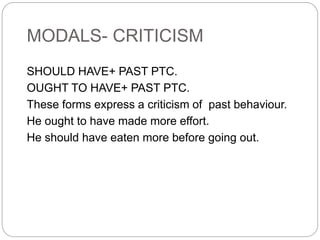
MODALS- CRITICISM
SHOULD HAVE+ PAST PTC.
OUGHT TO HAVE+ PAST PTC.
These forms express a criticism of past behaviour.
He ought to have made more effort.
He should have eaten more before going out.
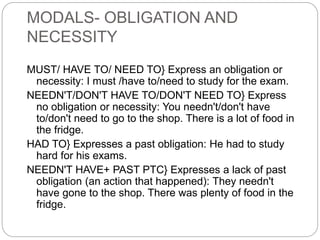
MODALS- OBLIGATION AND
NECESSITY
MUST/ HAVE TO/ NEED TO} Express an obligation or
necessity: I must /have to/need to study for the exam.
NEEDN'T/DON'T HAVE TO/DON'T NEED TO} Express
no obligation or necessity: You needn't/don't have
to/don't need to go to the shop. There is a lot of food in
the fridge.
HAD TO} Expresses a past obligation: He had to study
hard for his exams.
NEEDN'T HAVE+ PAST PTC} Expresses a lack of past
obligation (an action that happened): They needn't
have gone to the shop. There was plenty of food in the
fridge.
Thank You

Modals_verbs.ppt

  • 1.
  • 2.
    What are modalverbs?  They are: • Can • Could • May • Might • Must • Shall • Should • Will • Would • Ought to Modal verbs are sometimes referred to as Modal Auxiliary verbs because they help other verbs They are Auxiliary verbs that provide additional and specific meaning to the main verb of the sentence
  • 3.
    How do weuse modals? Example: Mary could play the piano S Subject V Verb M They do not accept conjugation They do not need other auxiliary verbs
  • 4.
    Form He can skiHe cans ski or He can skis Would you like to come with me? Do you would like to come with me? They can’t be serious They don’t can be serious There is no “s” in singular There is no “do / does” in the question There is no “don’t / doesn’t” in the negative
  • 5.
    Form to can /caning to must /musting She must study We should have gone the other way He could play football in his youth (general ability) Modal verbs do not have infinitives or –ing forms Modal verbs are followed by an infinitive without to
  • 6.
    Form Modal verbs donot have all the tenses Modal verbs use other verbs to complete the tenses Can is completed with be able to Must is completed with have to They can play piano = They will be able to play the piano in the future You must come early = You had to come early yesterday
  • 7.
    What do theyexpress? To understand it better we are going to divide them into 3 categories 1. Single Concept Modal: they have one meaning 2. Double Concept Modal: they have two meanings 3. Modals in past: They are used to express a situation in the past They can have more than one meaning depending on the situations
  • 8.
    Categories Single concept Modals Double Concept Modals Modalsin Past Will Might Should Ought to Had better May Must Would Shall Could Can Would have Could have Might have Should have May have Must have
  • 9.
    Single Concept Modal ModalConcept Examples Will Future Joe will travel to NY next week Might Small probability I might move to Canada some day Should Recommendation You should go to the doctor Ought to Formal recommendation We ought to know about first aids Had better Warning I had better study or I will fail the test
  • 10.
    Double Concept Modal ModalConcept Examples May (1) Permission May I come in? May (2) Good probability We may visit Mexico this summer Must (1) Responsibility Everyone must pay taxes Must (2) Assumption She didn’t arrive. She must be sick Would (1) Past (used to) When I was young, I would play soccer Would (2) Present unreal I would buy the car but I can’t afford it
  • 11.
    Double Concept Modal ModalConcept Examples Shall (1) Educated expression Offer Excuse me, I shall go now Shall I clean it? Shall (2) Contractual obligation The company shall pay on January 1st Could (1) Unreal Ability I could go if I had time Could (2) Past Ability She could play the piano, not anymore Can (1) Present Ability We can speak English Can (2) Permission Can I have a sweet?
  • 12.
    Modals in thePast They are modals referred to actions that happened in the past It must have been a difficult decision They should have invited her to their wedding MODAL + HAVE + verb in past participle
  • 13.
    MODALS: ABILITY CAN: Expressesability in the present or generally: I can run a kilometre in four minutes. It is used for decisions made about future ability: We can meet at the gym tomorrow. COULD: Expresses ability in the past. In sentences (if only) it expresses ability in the present, future and in general hypothetical situations: If only you could come COULD HAVE+ PAST PTC: Expresses ability in past hypothetical situations: I could have roasted the turkey. For other tenses: BE ABLE TO+INFINITIVE
  • 14.
    MODALS- PERMISSION MAY (morepolite than 'could'): May I go out? COULD(more polite than 'can'): Could you repeat, please? CAN(informal use): Can I go to the toilet? These modal verbs express giving permission now or for the future. For the past we have 'could' or 'be allowed to': I could go out with my friends/ I was allowed to go out with my friends.
  • 15.
    MODALS- ADVICE SHOULD+ INFINITIVE/ SHOULDN'T+ INFINITIVE OUGHT TO These verbs are used for giving advice now, for the future or generally: You should go to the doctor now. He ought to study for the exam. They shouldn't buy things if they have little money.
  • 16.
    MODALS- DEGREES OF CERTAINTY MUST/CAN'T/COULDN'T}Express certainty about now or the future: That must be the new manager/ She can't be so old. She looks very young. MUST/CAN'T/COULDN'T HAVE + PAST PTC} Express certainty about the past: She must have been in a lot of pain/ They couldn't have been on holiday for so long. SHOULD/OUGHT TO} Express probability about now, the future or generally: You ought to feel better in a few days. SHOULD/OUGHT TO HAVE+ PAST PTC} Express probability about the past: They bruises ought to have disappeared in a few days.
  • 17.
    MODALS- DEGREE OFCERTAINTY (CONT.) COULD/MAY/MIGHT} Express possibility about now, the future or generally: You should talk to your doctor because that diet might be dangerous. COULD/MAY/MIGHT HAVE+ PAST PTC} Express possibility about the past: That might have been the doctor who rang while we were out. COULD/MIGHT HAVE+ PAST PTC} Express possibility about a hypothetical past: If you didn't follow your doctor's advice, you could have become quite ill.
  • 18.
    MODALS- CRITICISM SHOULD HAVE+PAST PTC. OUGHT TO HAVE+ PAST PTC. These forms express a criticism of past behaviour. He ought to have made more effort. He should have eaten more before going out.
  • 19.
    MODALS- OBLIGATION AND NECESSITY MUST/HAVE TO/ NEED TO} Express an obligation or necessity: I must /have to/need to study for the exam. NEEDN'T/DON'T HAVE TO/DON'T NEED TO} Express no obligation or necessity: You needn't/don't have to/don't need to go to the shop. There is a lot of food in the fridge. HAD TO} Expresses a past obligation: He had to study hard for his exams. NEEDN'T HAVE+ PAST PTC} Expresses a lack of past obligation (an action that happened): They needn't have gone to the shop. There was plenty of food in the fridge.
  • 20.

Editor's Notes

  • #7 They can play piano = They will be able to play the piano in the future You must come early = You had to come early yesterday