ASKING QUESTIONS indirect ways
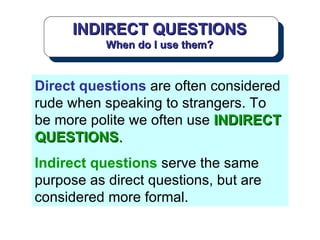
INDIRECT QUESTIONS When do I use them? Direct questions  are often considered rude when speaking to strangers. To be more polite we often use  INDIRECT QUESTIONS . Indirect questions  serve the same purpose as direct questions, but are considered more formal.
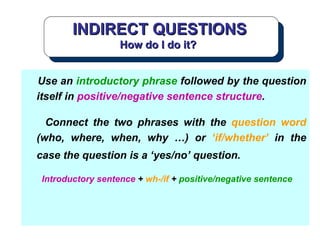
INDIRECT QUESTIONS How do I do it?  Use an  introductory phrase  followed by the question itself in  positive/negative sentence structure .  Connect the two phrases with the  question word  (who, where, when, why …) or  ‘if/whether’  in the case the question is a ‘yes/no’ question.   Introductory sentence  +  wh-/if  +  positive/negative sentence
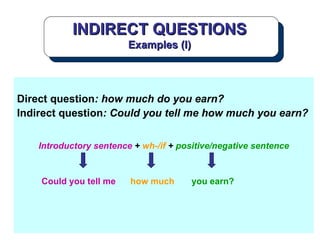
INDIRECT QUESTIONS Examples (I) Direct question : how much do you earn? Indirect question : Could you tell me how much you earn? Introductory sentence  +  wh-/if  +  positive/negative sentence Could you tell me  how much   you earn?
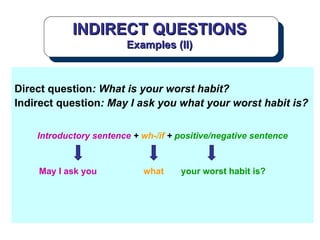
INDIRECT QUESTIONS Examples (II) Direct question : What is your worst habit?  Indirect question : May I ask you what your worst habit is? Introductory sentence  +  wh-/if  +  positive/negative sentence May I ask you  what   your worst habit is?
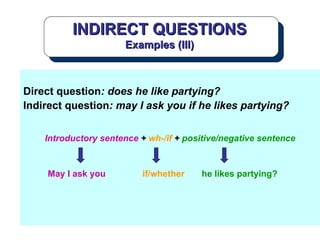
INDIRECT QUESTIONS Examples (III) Direct question : does he like partying? Indirect question : may I ask you if he likes partying? Introductory sentence  +  wh-/if  +  positive/negative sentence May I ask you  if/whether   he likes partying?
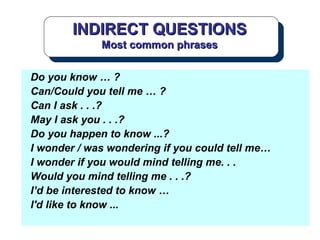
INDIRECT QUESTIONS Most common phrases Do you know … ? Can/Could you tell me … ?   Can I ask . . .? May I ask you . . .? Do you happen to know ...?   I wonder / was wondering if you could tell me… I wonder if you would mind telling me. . . Would you mind telling me . . .? I’d be interested to know … I'd like to know ...

Indirect questions

  • 1.
  • 2.
    INDIRECT QUESTIONS Whendo I use them? Direct questions are often considered rude when speaking to strangers. To be more polite we often use INDIRECT QUESTIONS . Indirect questions serve the same purpose as direct questions, but are considered more formal.
  • 3.
    INDIRECT QUESTIONS Howdo I do it? Use an introductory phrase followed by the question itself in positive/negative sentence structure . Connect the two phrases with the question word (who, where, when, why …) or ‘if/whether’ in the case the question is a ‘yes/no’ question. Introductory sentence + wh-/if + positive/negative sentence
  • 4.
    INDIRECT QUESTIONS Examples(I) Direct question : how much do you earn? Indirect question : Could you tell me how much you earn? Introductory sentence + wh-/if + positive/negative sentence Could you tell me how much you earn?
  • 5.
    INDIRECT QUESTIONS Examples(II) Direct question : What is your worst habit? Indirect question : May I ask you what your worst habit is? Introductory sentence + wh-/if + positive/negative sentence May I ask you what your worst habit is?
  • 6.
    INDIRECT QUESTIONS Examples(III) Direct question : does he like partying? Indirect question : may I ask you if he likes partying? Introductory sentence + wh-/if + positive/negative sentence May I ask you if/whether he likes partying?
  • 7.
    INDIRECT QUESTIONS Mostcommon phrases Do you know … ? Can/Could you tell me … ? Can I ask . . .? May I ask you . . .? Do you happen to know ...? I wonder / was wondering if you could tell me… I wonder if you would mind telling me. . . Would you mind telling me . . .? I’d be interested to know … I'd like to know ...