Active vs Passive Voice
Universidad Nacional de Chimborazo
Grammar VI
Names: Kerly Cabezas.
Gabriela García.
María Palacios.
David Buñay.
Active Voice
Active Voice – indicates that the
subject of the verb is acting
Because the subject does or
"acts upon" the verb in such
sentences, the sentences are
said to be in the active voice.
Active Voice
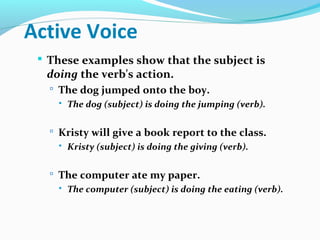
 These examples show that the subject is
doing the verb's action.
 The dog jumped onto the boy.
 The dog (subject) is doing the jumping (verb).
 Kristy will give a book report to the class.
 Kristy (subject) is doing the giving (verb).
 The computer ate my paper.
 The computer (subject) is doing the eating (verb).
Passive Voice
In a passive voice sentence, the subject and
object flip-flop. The subject becomes the passive
recipient of the action.
Because the subject is being "acted upon" (or is
passive), such sentences are said to be in the
passive voice.
Passive Voice
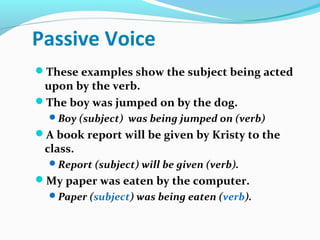
These examples show the subject being acted
upon by the verb.
The boy was jumped on by the dog.
Boy (subject) was being jumped on (verb)
A book report will be given by Kristy to the
class.
Report (subject) will be given (verb).
My paper was eaten by the computer.
Paper (subject) was being eaten (verb).
(A.) The teacher returned the exams on Monday.
(B.) The exams were returned on Monday.
The two sentences have basically the same
meaning, but the emphasis changes according to
which subject the writer uses. In sentence (A), the
writer focuses on the teacher, while in sentence
(B) the focus is on the exams.
Forming the Passive Voice
The passive voice is formed with the verb be + past
participle. The tense is shown by the form of the
verb be. The verb be must agree with the subject.
An outstanding student is awarded* the scholarship
every year.
Shannon was awarded* the scholarship last night.
*This is not a past tense –ed.
The Simple Present
am / is / are + past participle
The newspaper is read throughout the world.
The Present Progressive
am / is / are + being + past participle
The new library is being built.
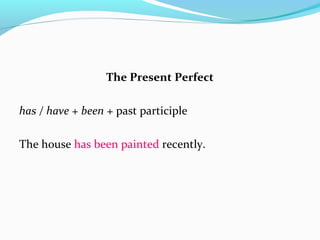
The Present Perfect
has / have + been + past participle
The house has been painted recently.
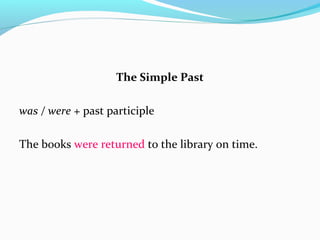
The Simple Past
was / were + past participle
The books were returned to the library on time.
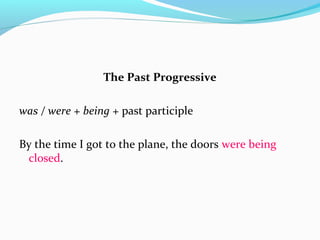
The Past Progressive
was / were + being + past participle
By the time I got to the plane, the doors were being
closed.
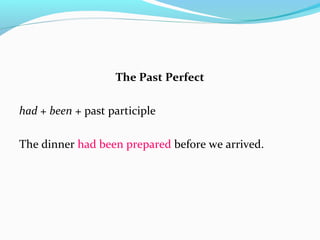
The Past Perfect
had + been + past participle
The dinner had been prepared before we arrived.
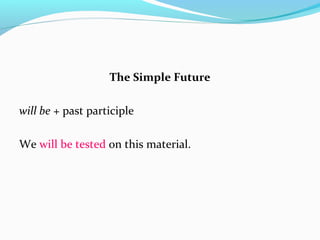
The Simple Future
will be + past participle
We will be tested on this material.
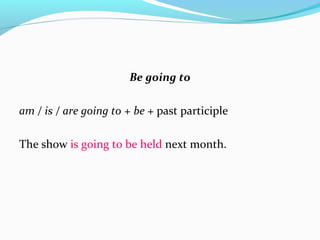
Be going to
am / is / are going to + be + past participle
The show is going to be held next month.
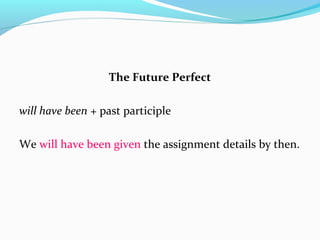
The Future Perfect
will have been + past participle
We will have been given the assignment details by then.
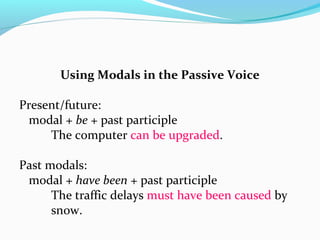
Using Modals in the Passive Voice
Present/future:
modal + be + past participle
The computer can be upgraded.
Past modals:
modal + have been + past participle
The traffic delays must have been caused by
snow.
Using Infinitive & Gerunds with the Passive Voice
verb + infinitives:
verb + to be + past participle
The children like to be kissed before going to bed.
verb + gerunds:
gerund + being + past participle
He dislikes being treated like a child.
The verb be is followed by –ing (the present participle) to
form the progressive.
We are planning our next vacation.
They were living in Guadalajara last year.
The verb be is followed by –ed (the past participle) to
form the passive.
Essays are turned in every Monday.
My essay was turned in yesterday.
Using the Passive Voice
Use the passive voice in the following
circumstances:
1. When the person or thing doing the action is
obvious, unknown, or unimportant.
 Many trees were planted to replace those lost in
the fire.
 The house was built in 1850.
 Tobacco is grown in the South.
2. When you don’t want to mention the person doing
the action.
 Several failing grades were received in ESL 184.
 The information was given to the police
investigator.
 The new law was passed without our knowledge.
3. When you want to emphasize the receiver of the
action or the result of the action.
 International students are housed in the homes
of local families.
 A new computer system is being installed to
improve our computer’s speed.
 Children can be taught good manners at an
early age.
4. When you are describing a process.
 The specimens were collected and placed on a slide.
 The eggs are beaten until they are creamy.
 The wheel is attached to the axle before the nuts
are tightened.
Only transitive verbs (verbs that take a direct object) can
be used in the passive voice. Intransitive verbs
cannot be made passive. Do not use these verbs in
the passive voice.
appear belong exist seem
arrive come happen sleep
be die occur rise
Correct the errors in the passive voice.
1. I was transfer to another math class.
2. Bacterial infections were existed before man.
3. Many new books are writing every year.
4. The award will be gave at the ceremony.
5. I hope to accept at this university.
Passive voice1

  • 1.
    Active vs PassiveVoice Universidad Nacional de Chimborazo Grammar VI Names: Kerly Cabezas. Gabriela García. María Palacios. David Buñay.
  • 2.
    Active Voice Active Voice– indicates that the subject of the verb is acting Because the subject does or "acts upon" the verb in such sentences, the sentences are said to be in the active voice.
  • 3.
    Active Voice  Theseexamples show that the subject is doing the verb's action.  The dog jumped onto the boy.  The dog (subject) is doing the jumping (verb).  Kristy will give a book report to the class.  Kristy (subject) is doing the giving (verb).  The computer ate my paper.  The computer (subject) is doing the eating (verb).
  • 4.
    Passive Voice In apassive voice sentence, the subject and object flip-flop. The subject becomes the passive recipient of the action. Because the subject is being "acted upon" (or is passive), such sentences are said to be in the passive voice.
  • 5.
    Passive Voice These examplesshow the subject being acted upon by the verb. The boy was jumped on by the dog. Boy (subject) was being jumped on (verb) A book report will be given by Kristy to the class. Report (subject) will be given (verb). My paper was eaten by the computer. Paper (subject) was being eaten (verb).
  • 6.
    (A.) The teacherreturned the exams on Monday. (B.) The exams were returned on Monday. The two sentences have basically the same meaning, but the emphasis changes according to which subject the writer uses. In sentence (A), the writer focuses on the teacher, while in sentence (B) the focus is on the exams.
  • 7.
    Forming the PassiveVoice The passive voice is formed with the verb be + past participle. The tense is shown by the form of the verb be. The verb be must agree with the subject. An outstanding student is awarded* the scholarship every year. Shannon was awarded* the scholarship last night. *This is not a past tense –ed.
  • 8.
    The Simple Present am/ is / are + past participle The newspaper is read throughout the world.
  • 9.
    The Present Progressive am/ is / are + being + past participle The new library is being built.
  • 10.
    The Present Perfect has/ have + been + past participle The house has been painted recently.
  • 11.
    The Simple Past was/ were + past participle The books were returned to the library on time.
  • 12.
    The Past Progressive was/ were + being + past participle By the time I got to the plane, the doors were being closed.
  • 13.
    The Past Perfect had+ been + past participle The dinner had been prepared before we arrived.
  • 14.
    The Simple Future willbe + past participle We will be tested on this material.
  • 15.
    Be going to am/ is / are going to + be + past participle The show is going to be held next month.
  • 16.
    The Future Perfect willhave been + past participle We will have been given the assignment details by then.
  • 17.
    Using Modals inthe Passive Voice Present/future: modal + be + past participle The computer can be upgraded. Past modals: modal + have been + past participle The traffic delays must have been caused by snow.
  • 18.
    Using Infinitive &Gerunds with the Passive Voice verb + infinitives: verb + to be + past participle The children like to be kissed before going to bed. verb + gerunds: gerund + being + past participle He dislikes being treated like a child.
  • 19.
    The verb beis followed by –ing (the present participle) to form the progressive. We are planning our next vacation. They were living in Guadalajara last year. The verb be is followed by –ed (the past participle) to form the passive. Essays are turned in every Monday. My essay was turned in yesterday.
  • 20.
    Using the PassiveVoice Use the passive voice in the following circumstances: 1. When the person or thing doing the action is obvious, unknown, or unimportant.  Many trees were planted to replace those lost in the fire.  The house was built in 1850.  Tobacco is grown in the South.
  • 21.
    2. When youdon’t want to mention the person doing the action.  Several failing grades were received in ESL 184.  The information was given to the police investigator.  The new law was passed without our knowledge.
  • 22.
    3. When youwant to emphasize the receiver of the action or the result of the action.  International students are housed in the homes of local families.  A new computer system is being installed to improve our computer’s speed.  Children can be taught good manners at an early age.
  • 23.
    4. When youare describing a process.  The specimens were collected and placed on a slide.  The eggs are beaten until they are creamy.  The wheel is attached to the axle before the nuts are tightened.
  • 24.
    Only transitive verbs(verbs that take a direct object) can be used in the passive voice. Intransitive verbs cannot be made passive. Do not use these verbs in the passive voice. appear belong exist seem arrive come happen sleep be die occur rise
  • 25.
    Correct the errorsin the passive voice. 1. I was transfer to another math class. 2. Bacterial infections were existed before man. 3. Many new books are writing every year. 4. The award will be gave at the ceremony. 5. I hope to accept at this university.