

Upper-intermediate
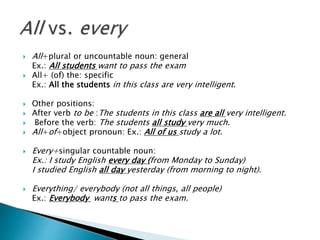
 All+plural or uncountable noun: general
Ex.: All students want to pass the exam
 All+ (of) the: specific
Ex.: All the students in this class are very intelligent.
 Other positions:
 After verb to be :The students in this class are all very intelligent.
 Before the verb: The students all study very much.
 All+of+object pronoun: Ex.: All of us study a lot.
 Every+singular countable noun:
Ex.: I study English every day (from Monday to Sunday)
I studied English all day yesterday (from morning to night).
 Everything/ everybody (not all things, all people)
Ex.: Everybody wants to pass the exam.
.
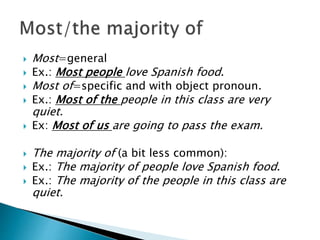
 Most=general
 Ex.: Most people love Spanish food.
 Most of=specific and with object pronoun.
 Ex.: Most of the people in this class are very
quiet.
 Ex: Most of us are going to pass the exam.
 The majority of (a bit less common):
 Ex.: The majority of people love Spanish food.
 Ex.: The majority of the people in this class are
quiet.
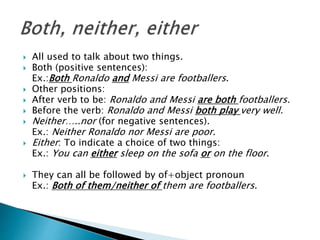
 All used to talk about two things.
 Both (positive sentences):
Ex.:Both Ronaldo and Messi are footballers.
 Other positions:
 After verb to be: Ronaldo and Messi are both footballers.
 Before the verb: Ronaldo and Messi both play very well.
 Neither…..nor (for negative sentences).
Ex.: Neither Ronaldo nor Messi are poor.
 Either: To indicate a choice of two things:
Ex.: You can either sleep on the sofa or on the floor.
 They can all be followed by of+object pronoun
Ex.: Both of them/neither of them are footballers.
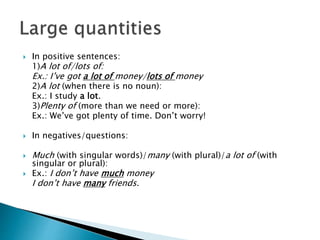
 In positive sentences:
1)A lot of/lots of:
Ex.: I’ve got a lot of money/lots of money
2)A lot (when there is no noun):
Ex.: I study a lot.
3)Plenty of (more than we need or more):
Ex.: We’ve got plenty of time. Don’t worry!
 In negatives/questions:
 Much (with singular words)/many (with plural)/a lot of (with
singular or plural):
 Ex.: I don’t have much money
I don’t have many friends.
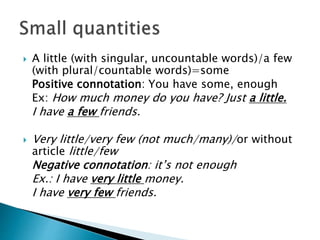
 A little (with singular, uncountable words)/a few
(with plural/countable words)=some
Positive connotation: You have some, enough
Ex: How much money do you have? Just a little.
I have a few friends.
 Very little/very few (not much/many)/or without
article little/few
Negative connotation: it’s not enough
Ex.: I have very little money.
I have very few friends.
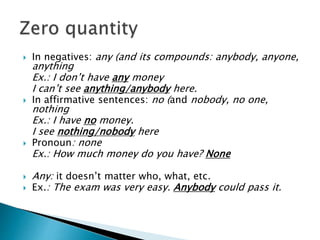
 In negatives: any (and its compounds: anybody, anyone,
anything
Ex.: I don’t have any money
I can’t see anything/anybody here.
 In affirmative sentences: no (and nobody, no one,
nothing
Ex.: I have no money.
I see nothing/nobody here
 Pronoun: none
Ex.: How much money do you have? None
 Any: it doesn’t matter who, what, etc.
 Ex.: The exam was very easy. Anybody could pass it.
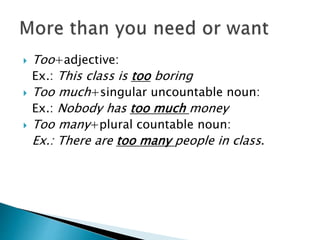
 Too+adjective:
Ex.: This class is too boring
 Too much+singular uncountable noun:
Ex.: Nobody has too much money
 Too many+plural countable noun:
Ex.: There are too many people in class.
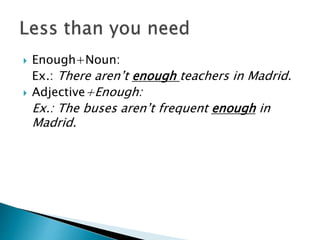
 Enough+Noun:
Ex.: There aren’t enough teachers in Madrid.
 Adjective+Enough:
Ex.: The buses aren’t frequent enough in
Madrid.

Quantifiers intermedio 2

  • 1.
  • 2.
     All+plural oruncountable noun: general Ex.: All students want to pass the exam  All+ (of) the: specific Ex.: All the students in this class are very intelligent.  Other positions:  After verb to be :The students in this class are all very intelligent.  Before the verb: The students all study very much.  All+of+object pronoun: Ex.: All of us study a lot.  Every+singular countable noun: Ex.: I study English every day (from Monday to Sunday) I studied English all day yesterday (from morning to night).  Everything/ everybody (not all things, all people) Ex.: Everybody wants to pass the exam. .
  • 3.
     Most=general  Ex.:Most people love Spanish food.  Most of=specific and with object pronoun.  Ex.: Most of the people in this class are very quiet.  Ex: Most of us are going to pass the exam.  The majority of (a bit less common):  Ex.: The majority of people love Spanish food.  Ex.: The majority of the people in this class are quiet.
  • 4.
     All usedto talk about two things.  Both (positive sentences): Ex.:Both Ronaldo and Messi are footballers.  Other positions:  After verb to be: Ronaldo and Messi are both footballers.  Before the verb: Ronaldo and Messi both play very well.  Neither…..nor (for negative sentences). Ex.: Neither Ronaldo nor Messi are poor.  Either: To indicate a choice of two things: Ex.: You can either sleep on the sofa or on the floor.  They can all be followed by of+object pronoun Ex.: Both of them/neither of them are footballers.
  • 5.
     In positivesentences: 1)A lot of/lots of: Ex.: I’ve got a lot of money/lots of money 2)A lot (when there is no noun): Ex.: I study a lot. 3)Plenty of (more than we need or more): Ex.: We’ve got plenty of time. Don’t worry!  In negatives/questions:  Much (with singular words)/many (with plural)/a lot of (with singular or plural):  Ex.: I don’t have much money I don’t have many friends.
  • 6.
     A little(with singular, uncountable words)/a few (with plural/countable words)=some Positive connotation: You have some, enough Ex: How much money do you have? Just a little. I have a few friends.  Very little/very few (not much/many)/or without article little/few Negative connotation: it’s not enough Ex.: I have very little money. I have very few friends.
  • 7.
     In negatives:any (and its compounds: anybody, anyone, anything Ex.: I don’t have any money I can’t see anything/anybody here.  In affirmative sentences: no (and nobody, no one, nothing Ex.: I have no money. I see nothing/nobody here  Pronoun: none Ex.: How much money do you have? None  Any: it doesn’t matter who, what, etc.  Ex.: The exam was very easy. Anybody could pass it.
  • 8.
     Too+adjective: Ex.: Thisclass is too boring  Too much+singular uncountable noun: Ex.: Nobody has too much money  Too many+plural countable noun: Ex.: There are too many people in class.
  • 9.
     Enough+Noun: Ex.: Therearen’t enough teachers in Madrid.  Adjective+Enough: Ex.: The buses aren’t frequent enough in Madrid.