The Simple Past Tense Regular and irregular forms
The Simple Past Tense. The simple past tense  describes actions and states that began and ended  at a specific time in the past . Example :  I lived in France  in 1980 .   He was sick  last week .   They were late  yesterday .
FORM There are  regular  verbs and  irregular  verbs.  All regular past tense verbs end in “ed” Regular :  study studi ed   live liv ed   stay stay ed Some verbs have irregular past tense forms : Irregular :  go went   be  was – were   do did These verbs don’t follow any spelling rules.   Irregular past verb forms must be learned.
Spelling of “ed” form Most verbs – add “ed”   Example:  walk walk ed   order order ed Verbs that end in “e” – add only “d”   Example:  live live d   decide decide d Verbs that end in consonant “y”- change y to i and add “ed”   Example: study stud ied   carry carr ied Verbs that end in  CVC [stressed vowel]  double the last consonant Example:  s hop sho pp ed   s top sto pp ed   per mit permi tt ed   ad mit admi tt ed Do not double the last consonant if the last syllable is not stressed:   lis ten liste n ed
Negative Statements To form negative statements:   did  + not (didn’t) +  base form   Example:  He  didn’t   call  me.   She  didn’t   study  French. Don’t use didn’t with the verb TO BE   use  to be + not :   Example:  He  wasn’t  there yesterday.   They  weren’t  happy.
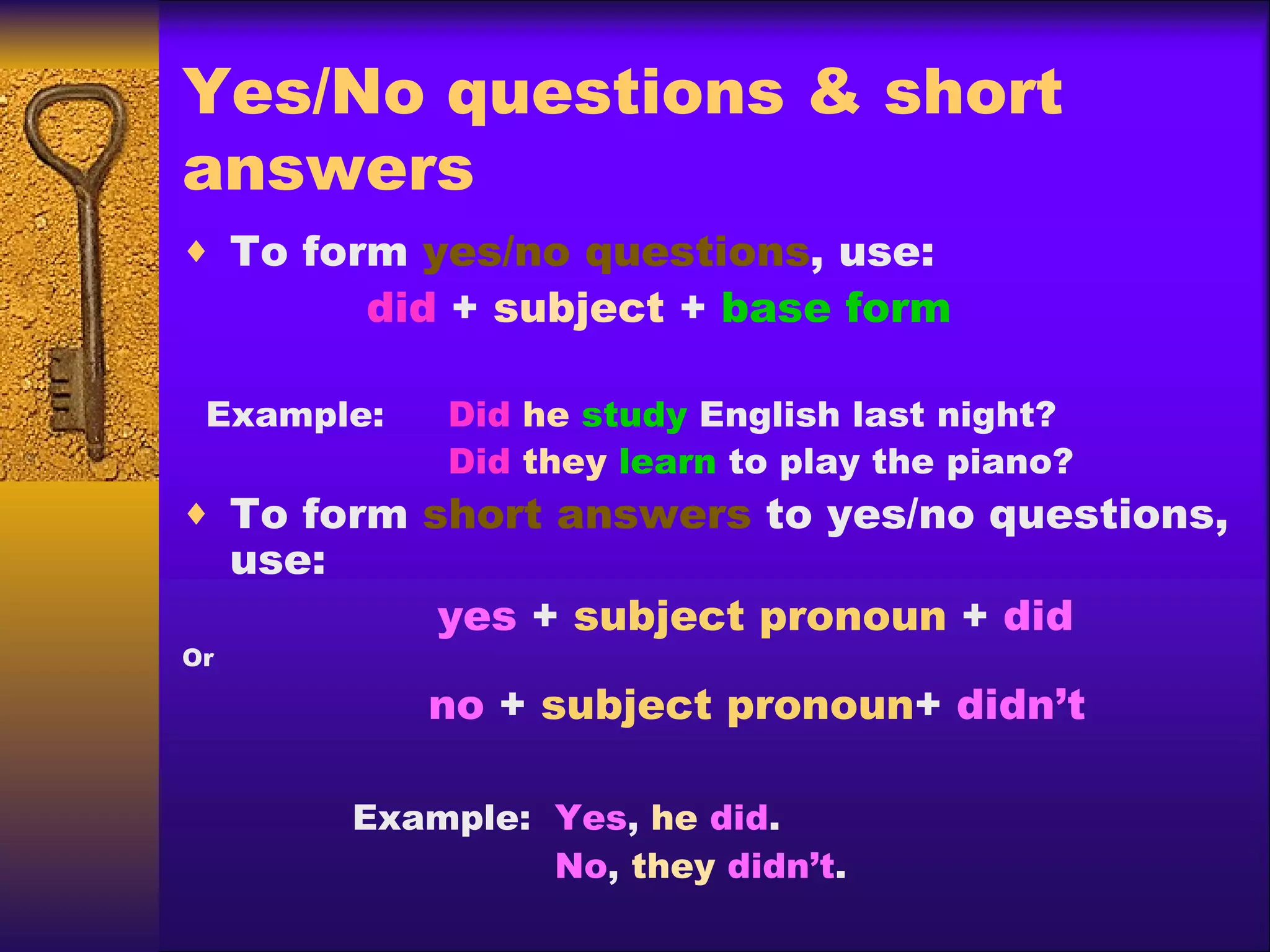
Yes/No questions & short answers To form  yes/no questions , use: did  +  subject  +  base form Example:    Did   he   study  English last night?   Did   they   learn  to play the piano? To form  short answers  to yes/no questions, use: yes  +  subject pronoun  +  did Or   no  +  subject pronoun +  didn’t Example:  Yes ,  he   did .   No ,  they   didn’t .
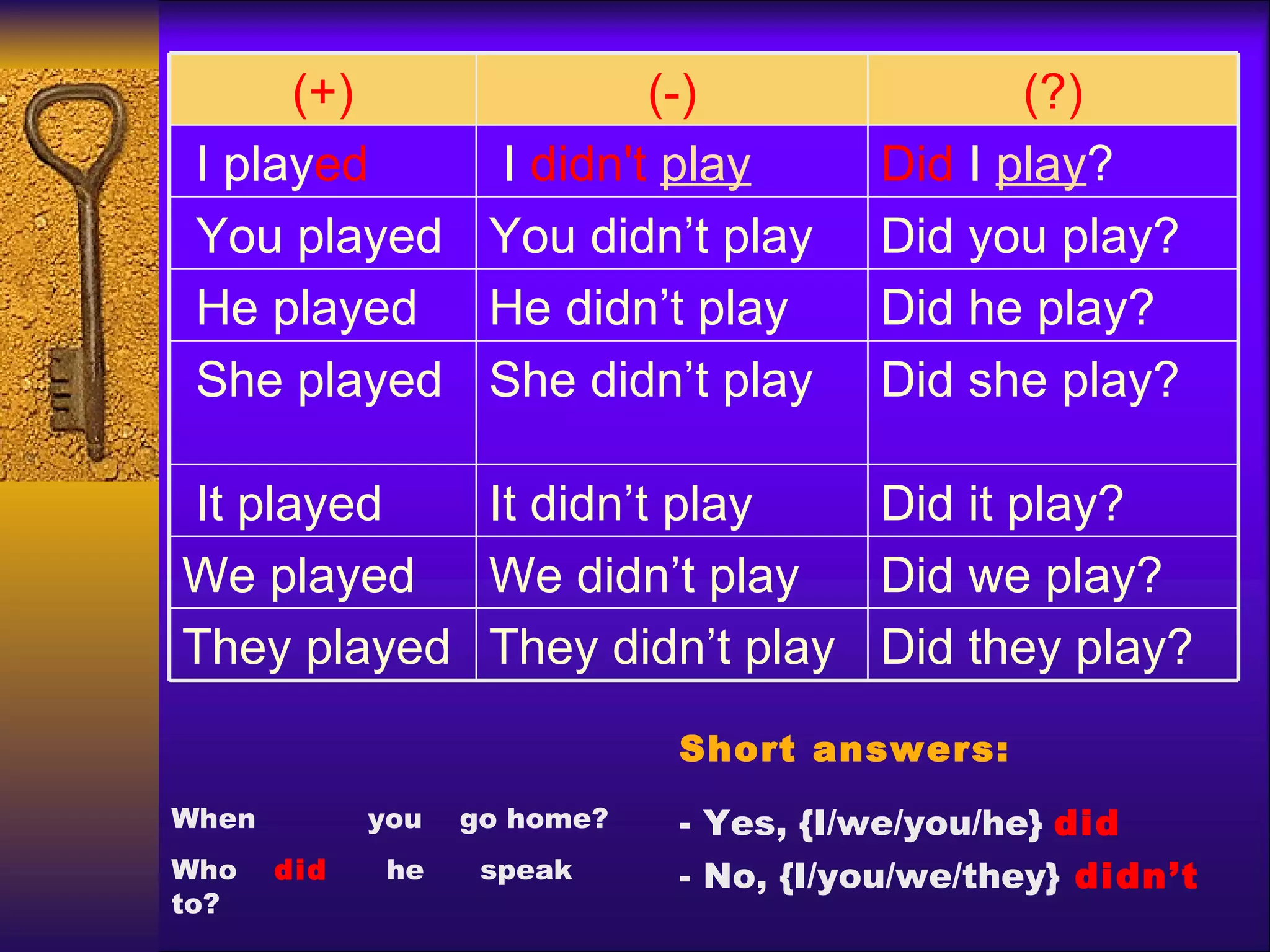
Short answers: - Yes, {I/we/you/he}  did - No, {I/you/we/they}   didn’t When  you  go home? Who  did   he  speak to? (+) (-) (?)   I play ed     I  didn't   play Did  I  play ?    You played You didn’t play Did you play?    He played He didn’t play Did he play?    She played She didn’t play Did she play?    It played It didn’t play Did it play?  We played  We didn’t play Did we play?  They played  They didn’t play Did they play? 
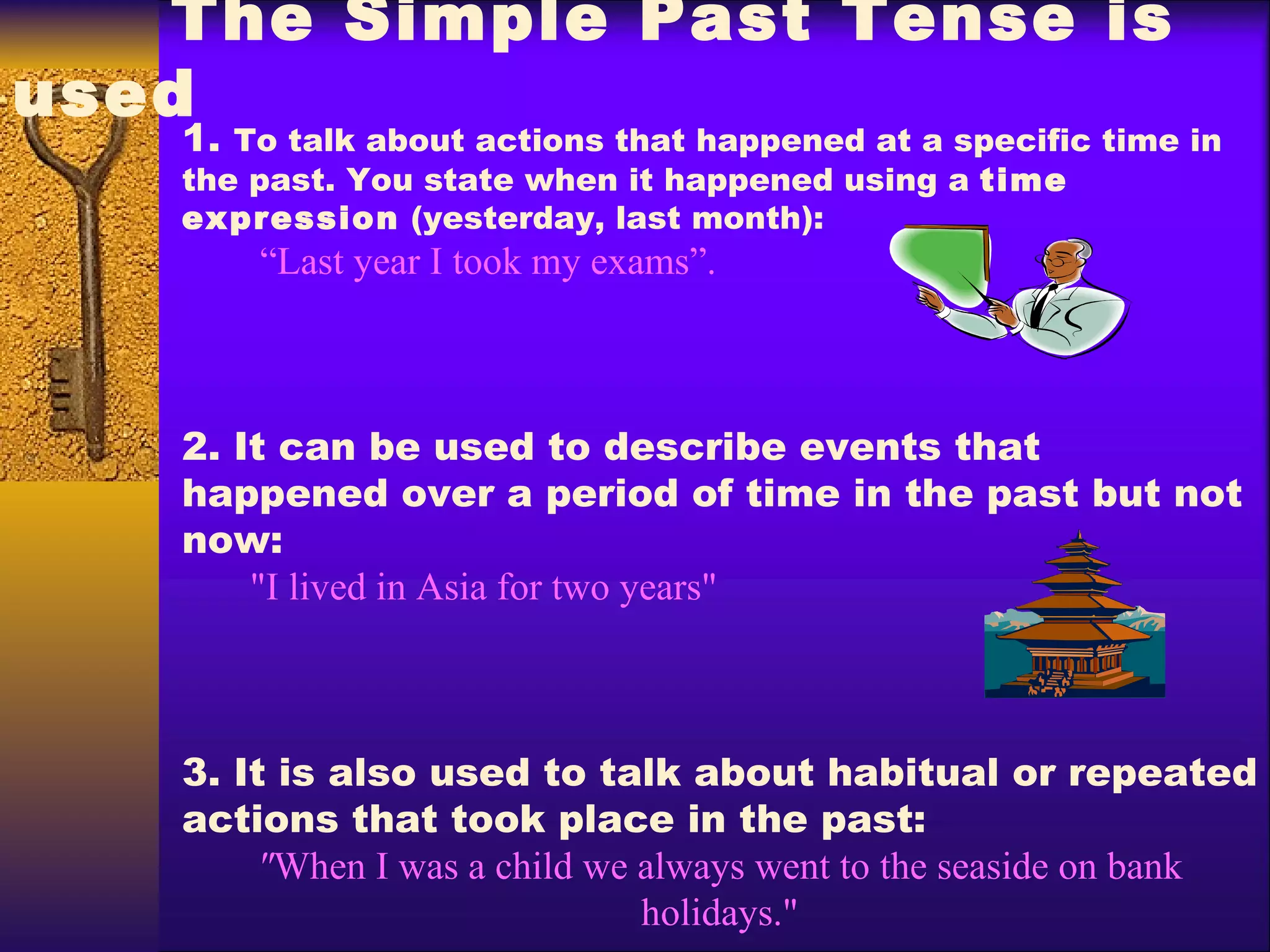
1.  T o talk about actions that happened at a specific time in the past. You state when it happened using a  time  expression  (yesterday,  last month): “ Last year I took my exams”.  2.  It can be used to describe events that happened over a period of time in the past but not now : "I lived in  Asia  for two years" 3. It  is also used to talk about habitual or repeated actions that took place in the past : " When I was a child we always went to the seaside on bank holidays." The Simple Past Tense  is used
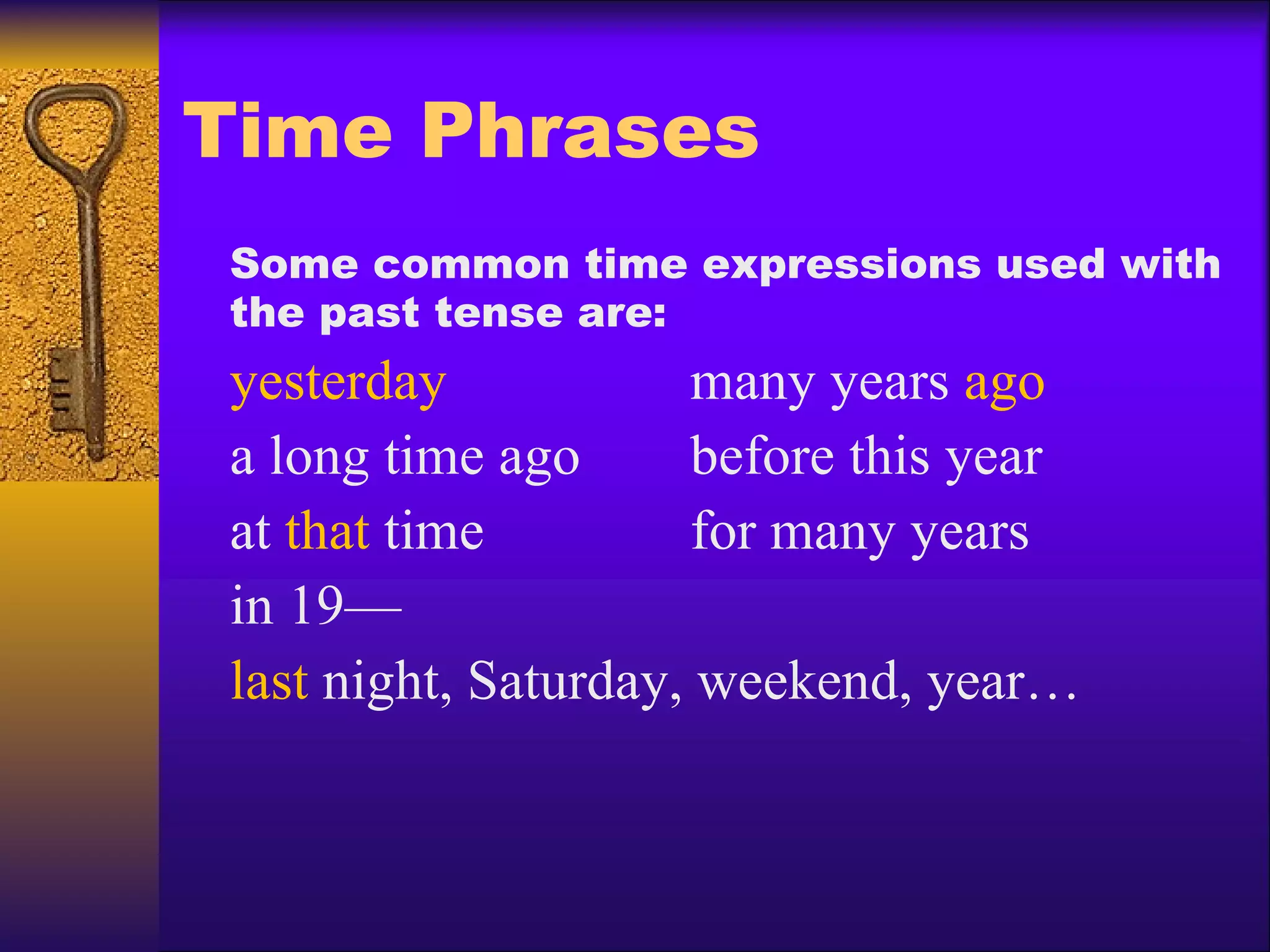
Time Phrases Some common time expressions used with the past tense are: yesterday many years  ago a long time ago before this year at  that  time for many years in 19— last  night, Saturday, weekend, year…
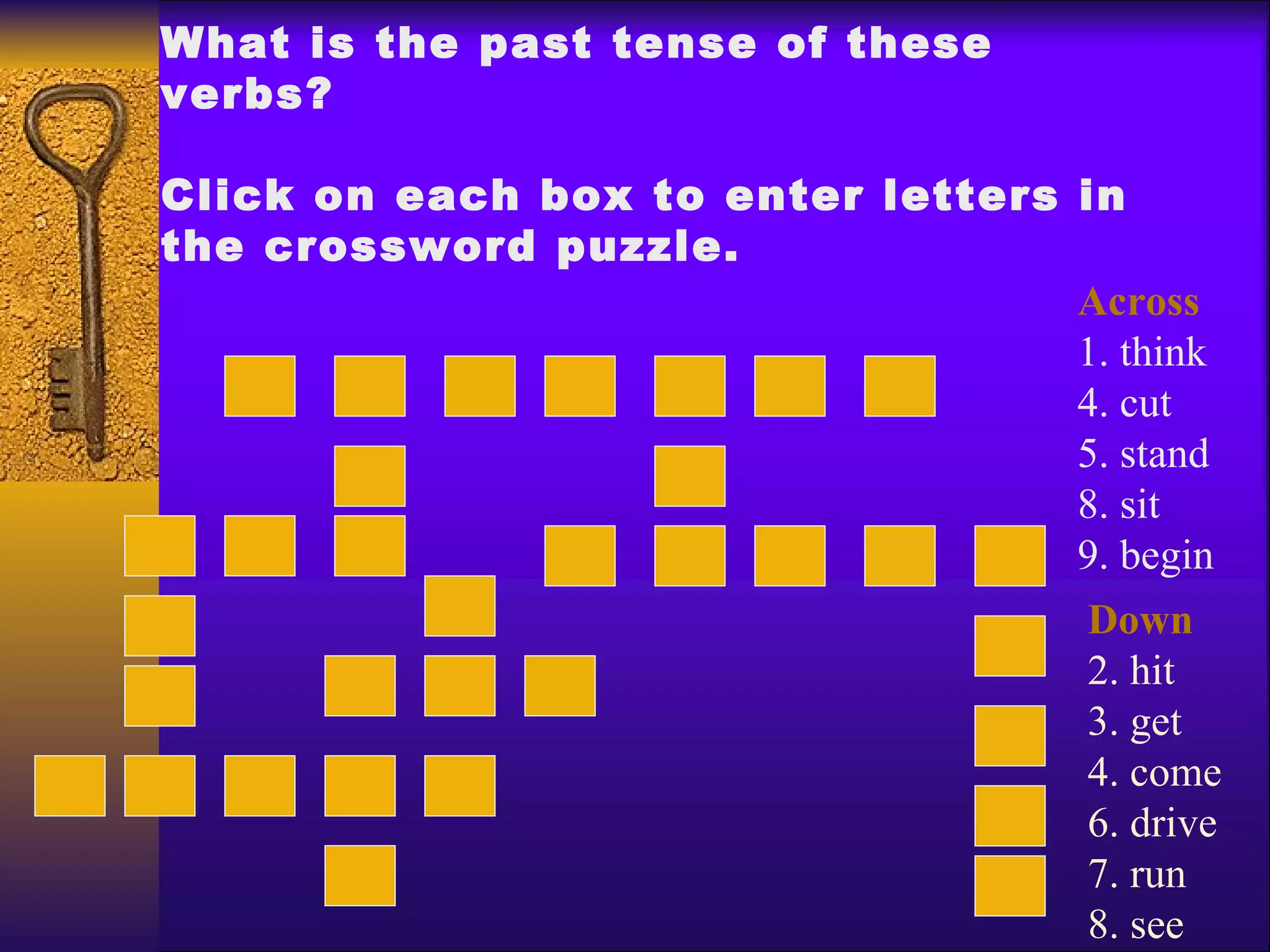
What is the past tense of these verbs? Click on each box to enter letters in the crossword puzzle. Across 1. think 4. cut 5. stand 8. sit 9. begin  Down 2. hit 3. get 4. come 6. drive 7. run 8. see
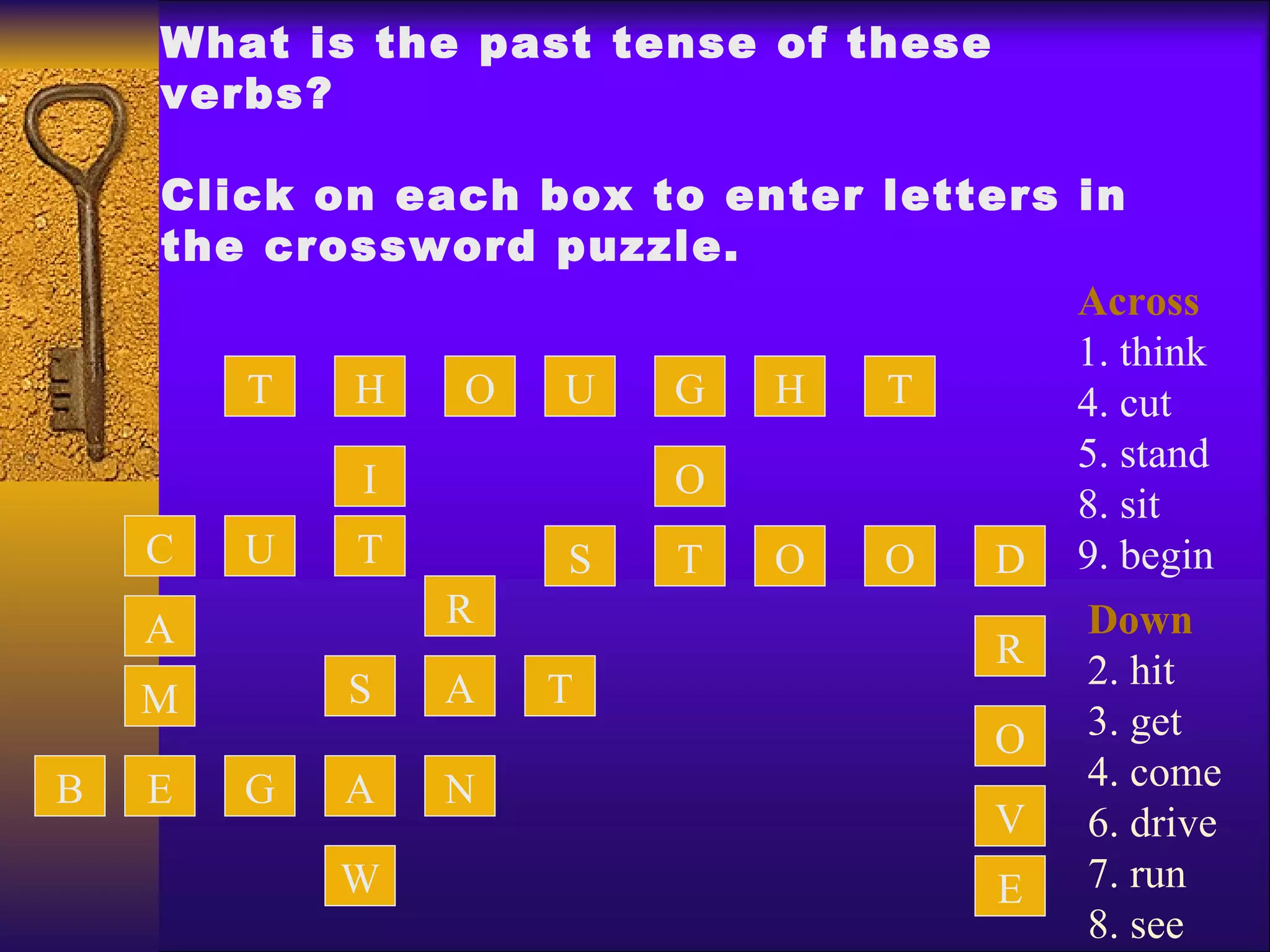
What is the past tense of these verbs? Click on each box to enter letters in the crossword puzzle. T H H O T G U I O C U T D O O T S E V O R E M A B S N A G A W R T Across 1. think 4. cut 5. stand 8. sit 9. begin  Down 2. hit 3. get 4. come 6. drive 7. run 8. see

Simple Past Tense

  • 1.
    The Simple PastTense Regular and irregular forms
  • 2.
    The Simple PastTense. The simple past tense describes actions and states that began and ended at a specific time in the past . Example : I lived in France in 1980 . He was sick last week . They were late yesterday .
  • 3.
    FORM There are regular verbs and irregular verbs. All regular past tense verbs end in “ed” Regular : study studi ed live liv ed stay stay ed Some verbs have irregular past tense forms : Irregular : go went be was – were do did These verbs don’t follow any spelling rules. Irregular past verb forms must be learned.
  • 4.
    Spelling of “ed”form Most verbs – add “ed” Example: walk walk ed order order ed Verbs that end in “e” – add only “d” Example: live live d decide decide d Verbs that end in consonant “y”- change y to i and add “ed” Example: study stud ied carry carr ied Verbs that end in CVC [stressed vowel] double the last consonant Example: s hop sho pp ed s top sto pp ed per mit permi tt ed ad mit admi tt ed Do not double the last consonant if the last syllable is not stressed: lis ten liste n ed
  • 5.
    Negative Statements Toform negative statements: did + not (didn’t) + base form Example: He didn’t call me. She didn’t study French. Don’t use didn’t with the verb TO BE use to be + not : Example: He wasn’t there yesterday. They weren’t happy.
  • 6.
    Yes/No questions &short answers To form yes/no questions , use: did + subject + base form Example: Did he study English last night? Did they learn to play the piano? To form short answers to yes/no questions, use: yes + subject pronoun + did Or no + subject pronoun + didn’t Example: Yes , he did . No , they didn’t .
  • 7.
    Short answers: -Yes, {I/we/you/he} did - No, {I/you/we/they} didn’t When you go home? Who did he speak to? (+) (-) (?)   I play ed   I didn't play Did I play ?    You played You didn’t play Did you play?    He played He didn’t play Did he play?    She played She didn’t play Did she play?    It played It didn’t play Did it play?  We played We didn’t play Did we play?  They played They didn’t play Did they play? 
  • 8.
    1. To talk about actions that happened at a specific time in the past. You state when it happened using a time expression (yesterday, last month): “ Last year I took my exams”. 2. It can be used to describe events that happened over a period of time in the past but not now : "I lived in Asia for two years" 3. It is also used to talk about habitual or repeated actions that took place in the past : " When I was a child we always went to the seaside on bank holidays." The Simple Past Tense is used
  • 9.
    Time Phrases Somecommon time expressions used with the past tense are: yesterday many years ago a long time ago before this year at that time for many years in 19— last night, Saturday, weekend, year…
  • 10.
    What is thepast tense of these verbs? Click on each box to enter letters in the crossword puzzle. Across 1. think 4. cut 5. stand 8. sit 9. begin Down 2. hit 3. get 4. come 6. drive 7. run 8. see
  • 11.
    What is thepast tense of these verbs? Click on each box to enter letters in the crossword puzzle. T H H O T G U I O C U T D O O T S E V O R E M A B S N A G A W R T Across 1. think 4. cut 5. stand 8. sit 9. begin Down 2. hit 3. get 4. come 6. drive 7. run 8. see