By: Mirla Mojica M.2010
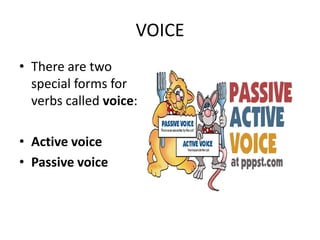
VOICEThere are two special forms for verbs called voice: Active voicePassive voice
ACTIVE VOICEThe active voice is the "normal" voice. This is the voice that we use most of the time. You are probably already familiar with the active voice.
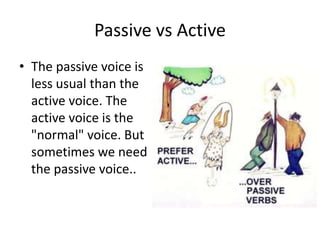
Passive vs ActiveThe passive voice is less usual than the active voice. The active voice is the "normal" voice. But sometimes we need the passive voice..   
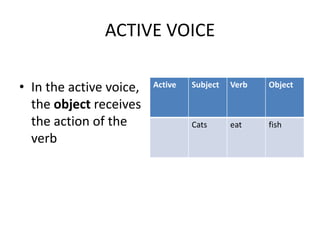
ACTIVE VOICEIn the active voice, the object receives the action of the verb
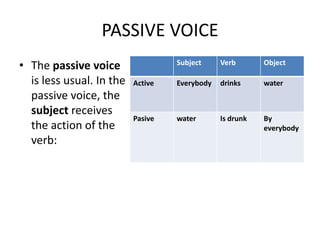
PASSIVE VOICEThe passive voice is less usual. In the passive voice, the subject receives the action of the verb:
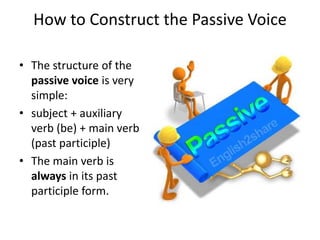
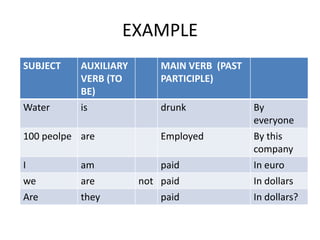
How to Construct the Passive VoiceThe structure of the passive voice is very simple:subject + auxiliary verb (be) + main verb (past participle)The main verb is always in its past participle form.
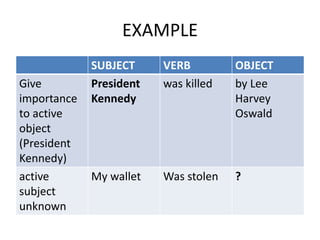
EXAMPLE
Use of The Passive VoiceWe use the passive when:we want to make the  object more important we do not know the active subject
EXAMPLE
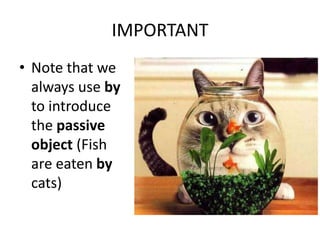
IMPORTANTNote that we always use by to introduce the passive object (Fish are eaten by cats)
CONJUGATION FOR THE PASSIVE VOICEWe can form the passive in any tense. In fact, conjugation of verbs in the passive tense is rather easy, as the main verb is always in past participle form and the auxiliary verb is always be.
CONJUGATION FOR THE PASSIVE VOICETo form the required tense, we conjugate the auxiliary verb.  But for the purpose of this lesson, we will only use the simple tense. For  example:Present simple: It is madePast simple: itwasmade
ACTIVE AND PASSIVE VOICE

ACTIVE AND PASSIVE VOICE

  • 1.
  • 2.
    VOICEThere are twospecial forms for verbs called voice: Active voicePassive voice
  • 3.
    ACTIVE VOICEThe activevoice is the "normal" voice. This is the voice that we use most of the time. You are probably already familiar with the active voice.
  • 4.
    Passive vs ActiveThepassive voice is less usual than the active voice. The active voice is the "normal" voice. But sometimes we need the passive voice..   
  • 5.
    ACTIVE VOICEIn theactive voice, the object receives the action of the verb
  • 6.
    PASSIVE VOICEThe passivevoice is less usual. In the passive voice, the subject receives the action of the verb:
  • 7.
    How to Constructthe Passive VoiceThe structure of the passive voice is very simple:subject + auxiliary verb (be) + main verb (past participle)The main verb is always in its past participle form.
  • 8.
  • 9.
    Use of ThePassive VoiceWe use the passive when:we want to make the object more important we do not know the active subject
  • 10.
  • 11.
    IMPORTANTNote that wealways use by to introduce the passive object (Fish are eaten by cats)
  • 12.
    CONJUGATION FOR THEPASSIVE VOICEWe can form the passive in any tense. In fact, conjugation of verbs in the passive tense is rather easy, as the main verb is always in past participle form and the auxiliary verb is always be.
  • 13.
    CONJUGATION FOR THEPASSIVE VOICETo form the required tense, we conjugate the auxiliary verb. But for the purpose of this lesson, we will only use the simple tense. For example:Present simple: It is madePast simple: itwasmade