Change of
voice
• When a sentence is written, it can either be
written in active voice or passive voice.
• Active voice is used when the subject performs
the action stated by the verb.
For example: Tom changed the flat tire.
• Passive voice is used when the subject is acted
upon by the verb.
For example: The tire was changed by Tom.
• In most cases, writing sentences in passive voice
is discouraged because it can obscure the
subject of the sentence and confuse the reader.
Defining
Active Voice
• Every sentence contains, at minimum, a subject and
an action. The subject is the person or thing the
sentence is about, and the action is what the subject
is doing.
• When a sentence is in active voice, the subject is
performing the action and the subject (typically)
comes before the action in the sentence. For
example:
• I swim.
I is the subject. Swim is the action. The subject doing
the action comes before the action, so it is
immediately clear to the reader who is doing what.
Defining
passive voice
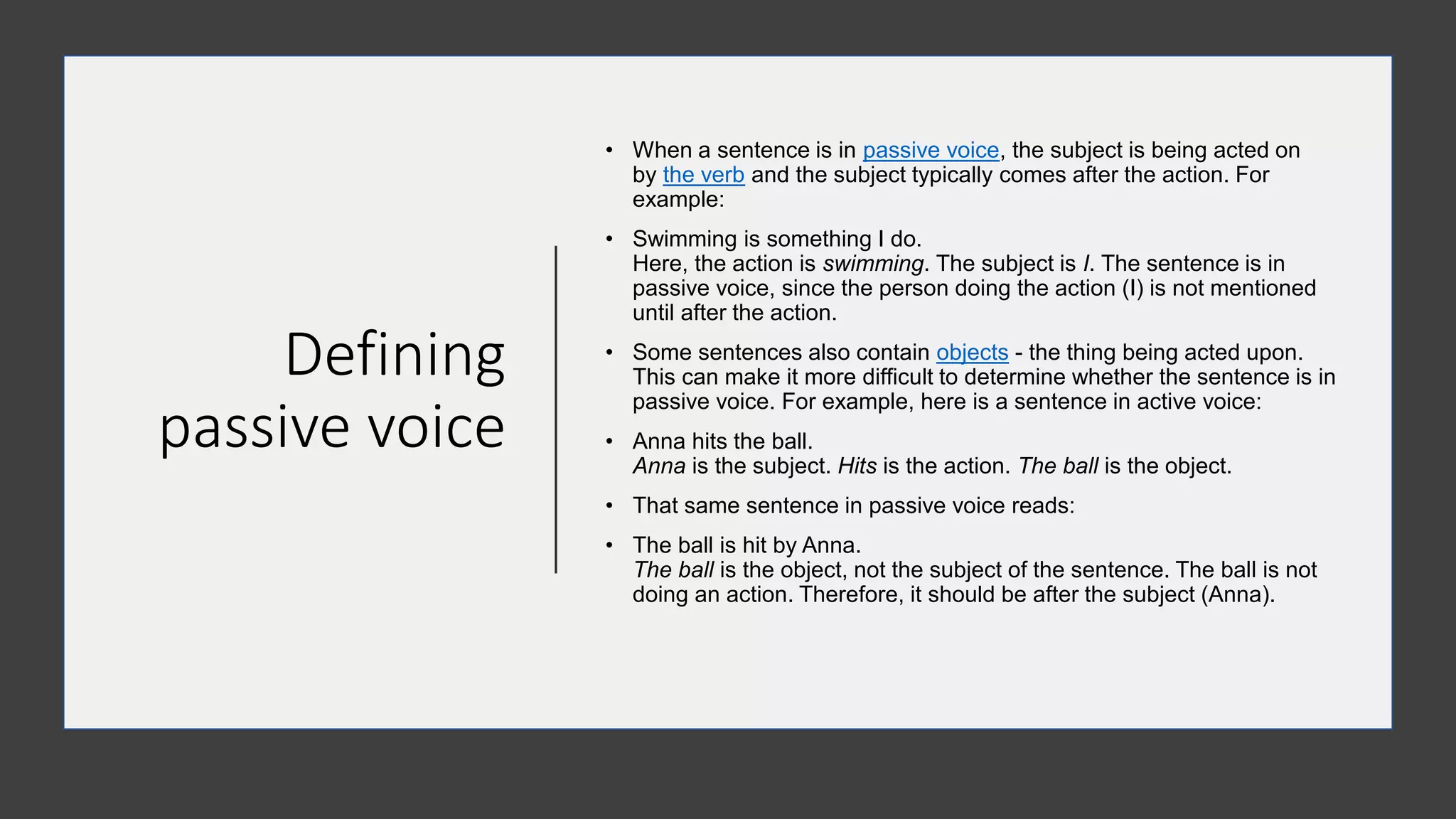
• When a sentence is in passive voice, the subject is being acted on
by the verb and the subject typically comes after the action. For
example:
• Swimming is something I do.
Here, the action is swimming. The subject is I. The sentence is in
passive voice, since the person doing the action (I) is not mentioned
until after the action.
• Some sentences also contain objects - the thing being acted upon.
This can make it more difficult to determine whether the sentence is in
passive voice. For example, here is a sentence in active voice:
• Anna hits the ball.
Anna is the subject. Hits is the action. The ball is the object.
• That same sentence in passive voice reads:
• The ball is hit by Anna.
The ball is the object, not the subject of the sentence. The ball is not
doing an action. Therefore, it should be after the subject (Anna).
Structure of
sentence
ACTIVE VOICE
Subject + Verb + Object
• Example:
I write articles.
PASSIVE VOICE
Object + be verb+ verb’s past participle + by+
subject
• Example:
Articles are written by me.
EXAMPLES
She praises me.
(Active)
I am praised by
her. (Passive)
She praised me.
(Active)
I was praised by
her. (Passive)
She will praise
me. (Active)
I shall be praised
by her. (Passive)
She is praising
me. (Active)
I am being
praised by her.
(Passive)
She is praising
him. (Active)
He is being
praised by her.
(Passive)
She was praising
me. (Active)
I was being
praised by her.
(Passive)
She will be
praising me.
(Active)
I shall be being
praised by her.
(Passive)
She has praised
him. (Active)
He has been
praised by her.
(Passive)
She had praised
me. (Active)
I had been
praised by her.
(Passive)
he will have
praised me.
(Active)
I shall have been
praised by her.
(Passive)
OTHER RULES
• If the sentence uses May/might/can/could/must/ought to/going
to then the passive sentence is formed as below
• Object’s subject+ may/might/can/could/ must/ought to/going to+
be+ Verb’s past participle+ by+ subject’s object
• Example:
• You must write the poem. (Active)
• The poem must be written by you. (Passive)
• She may help you. (Active)
• You may be helped by her. (Passive)
• We ought to obey our parents. (Active)
• Our parents ought to be obeyed by us. (Passive)
• We are going to organize a party. (Active)
• A party is going to be organized by us. (Passive)
Imperative
Sentence
• Main verb+ sentence
Let+ Object’s subject + be+ verb’s past participle
• Example:
• Write the article. (Active)
• Let the article be written. (Passive)
• Prepare the assignment. (Active)
• Let the assignment be prepared. (Passive)
• Do not
• Let not + Object’s subject + be+ verb’s past participle
• Example:
• Do not write the article. (Active)
• Let not the article be written. (Passive)
• Do not prepare the assignment. (Active)
• Let not the assignment be prepared. (Passive)
Imperative
sentences
• Sentence “Let” personal object + me/us/him/her/you/them
• Let+ Object’s subject + be + verb’s past participle+ personal object
• Example:
• Let me write the article. (Active)
• Let the article be written by me. (Passive)
• Let him write the letter. (Active)
• Let the letter be written by him. (Passive)
• Never sentences
• Let not + Object’s subject + ever be + verb’s past participle
• Example:
• Never deceive anyone. (Active)
• Let not anyone ever be deceived. (Passive)
• Never go there. (Active)
• Let not there ever be gone. (Passive)
Interrogative
Sentence
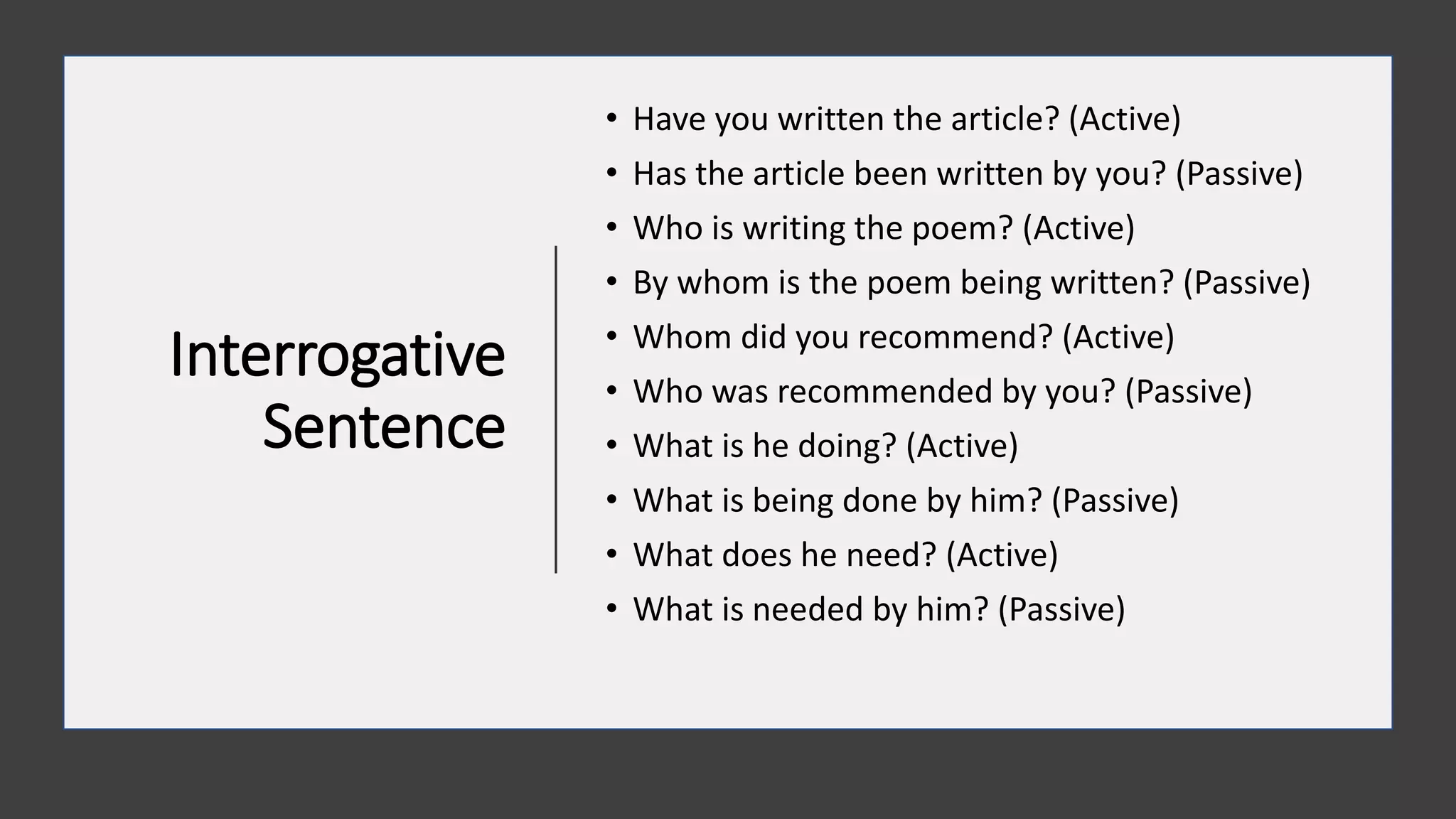
• Have you written the article? (Active)
• Has the article been written by you? (Passive)
• Who is writing the poem? (Active)
• By whom is the poem being written? (Passive)
• Whom did you recommend? (Active)
• Who was recommended by you? (Passive)
• What is he doing? (Active)
• What is being done by him? (Passive)
• What does he need? (Active)
• What is needed by him? (Passive)
EXERCISE
1.He usually buys the tickets.
2. We booked the flights.
3. He opened the bottle easily.
4. She cleans my shoes.
5. They arrested the burglars.
6. He wrote the note.
7. They washed the car.
8. She found the key.
9. He sold his coin collection.
10. We started a new system.
11. Someone stole his car.
12. They used the towels.
13. We turned on the TV.
14. She served tea at 4.
15. The rain flooded the camp.

Change of voice

  • 2.
    Change of voice • Whena sentence is written, it can either be written in active voice or passive voice. • Active voice is used when the subject performs the action stated by the verb. For example: Tom changed the flat tire. • Passive voice is used when the subject is acted upon by the verb. For example: The tire was changed by Tom. • In most cases, writing sentences in passive voice is discouraged because it can obscure the subject of the sentence and confuse the reader.
  • 3.
    Defining Active Voice • Everysentence contains, at minimum, a subject and an action. The subject is the person or thing the sentence is about, and the action is what the subject is doing. • When a sentence is in active voice, the subject is performing the action and the subject (typically) comes before the action in the sentence. For example: • I swim. I is the subject. Swim is the action. The subject doing the action comes before the action, so it is immediately clear to the reader who is doing what.
  • 4.
    Defining passive voice • Whena sentence is in passive voice, the subject is being acted on by the verb and the subject typically comes after the action. For example: • Swimming is something I do. Here, the action is swimming. The subject is I. The sentence is in passive voice, since the person doing the action (I) is not mentioned until after the action. • Some sentences also contain objects - the thing being acted upon. This can make it more difficult to determine whether the sentence is in passive voice. For example, here is a sentence in active voice: • Anna hits the ball. Anna is the subject. Hits is the action. The ball is the object. • That same sentence in passive voice reads: • The ball is hit by Anna. The ball is the object, not the subject of the sentence. The ball is not doing an action. Therefore, it should be after the subject (Anna).
  • 5.
    Structure of sentence ACTIVE VOICE Subject+ Verb + Object • Example: I write articles. PASSIVE VOICE Object + be verb+ verb’s past participle + by+ subject • Example: Articles are written by me.
  • 6.
    EXAMPLES She praises me. (Active) Iam praised by her. (Passive) She praised me. (Active) I was praised by her. (Passive) She will praise me. (Active) I shall be praised by her. (Passive) She is praising me. (Active) I am being praised by her. (Passive) She is praising him. (Active) He is being praised by her. (Passive) She was praising me. (Active) I was being praised by her. (Passive) She will be praising me. (Active) I shall be being praised by her. (Passive) She has praised him. (Active) He has been praised by her. (Passive) She had praised me. (Active) I had been praised by her. (Passive) he will have praised me. (Active) I shall have been praised by her. (Passive)
  • 7.
    OTHER RULES • Ifthe sentence uses May/might/can/could/must/ought to/going to then the passive sentence is formed as below • Object’s subject+ may/might/can/could/ must/ought to/going to+ be+ Verb’s past participle+ by+ subject’s object • Example: • You must write the poem. (Active) • The poem must be written by you. (Passive) • She may help you. (Active) • You may be helped by her. (Passive) • We ought to obey our parents. (Active) • Our parents ought to be obeyed by us. (Passive) • We are going to organize a party. (Active) • A party is going to be organized by us. (Passive)
  • 8.
    Imperative Sentence • Main verb+sentence Let+ Object’s subject + be+ verb’s past participle • Example: • Write the article. (Active) • Let the article be written. (Passive) • Prepare the assignment. (Active) • Let the assignment be prepared. (Passive) • Do not • Let not + Object’s subject + be+ verb’s past participle • Example: • Do not write the article. (Active) • Let not the article be written. (Passive) • Do not prepare the assignment. (Active) • Let not the assignment be prepared. (Passive)
  • 9.
    Imperative sentences • Sentence “Let”personal object + me/us/him/her/you/them • Let+ Object’s subject + be + verb’s past participle+ personal object • Example: • Let me write the article. (Active) • Let the article be written by me. (Passive) • Let him write the letter. (Active) • Let the letter be written by him. (Passive) • Never sentences • Let not + Object’s subject + ever be + verb’s past participle • Example: • Never deceive anyone. (Active) • Let not anyone ever be deceived. (Passive) • Never go there. (Active) • Let not there ever be gone. (Passive)
  • 10.
    Interrogative Sentence • Have youwritten the article? (Active) • Has the article been written by you? (Passive) • Who is writing the poem? (Active) • By whom is the poem being written? (Passive) • Whom did you recommend? (Active) • Who was recommended by you? (Passive) • What is he doing? (Active) • What is being done by him? (Passive) • What does he need? (Active) • What is needed by him? (Passive)
  • 11.
    EXERCISE 1.He usually buysthe tickets. 2. We booked the flights. 3. He opened the bottle easily. 4. She cleans my shoes. 5. They arrested the burglars. 6. He wrote the note. 7. They washed the car. 8. She found the key. 9. He sold his coin collection. 10. We started a new system. 11. Someone stole his car. 12. They used the towels. 13. We turned on the TV. 14. She served tea at 4. 15. The rain flooded the camp.