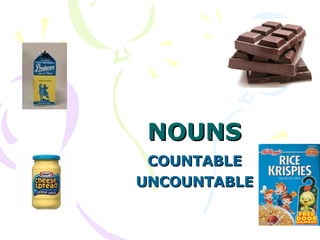
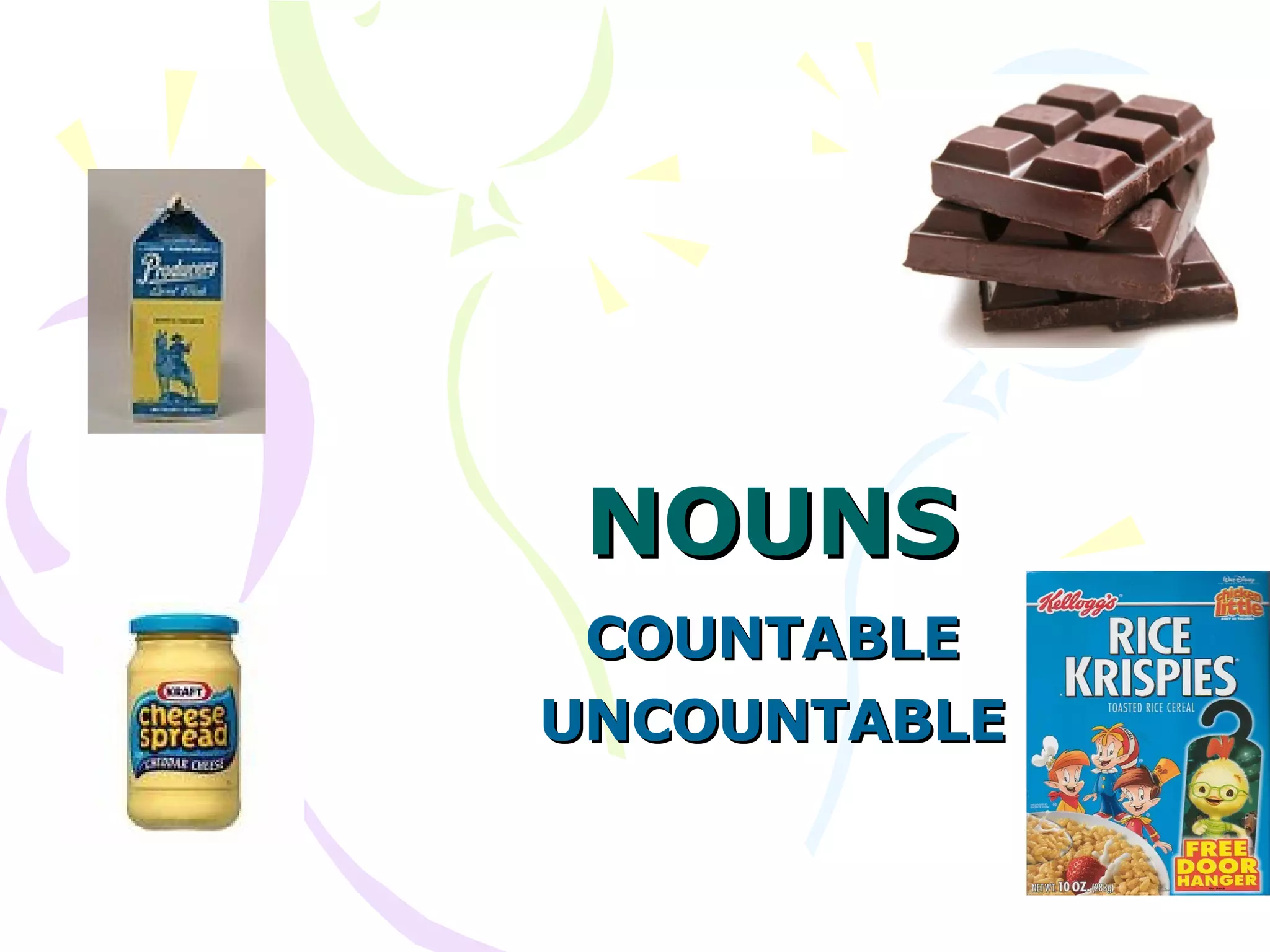
NOUNS COUNTABLE UNCOUNTABLE
COUNTABLE Countable nouns   are for things we can count Example:  dog, horse, man, shop, idea. They usually have a singular and plural form. Example:  two dogs, ten horses, a man, six men, the shops, a few ideas.
UNCOUNTABLE Uncountable nouns are for the things that we cannot count Example:  tea, sugar, water, air, rice. They are often the names for abstract ideas or qualities. Example:  knowledge, beauty, anger, fear, love . They are used with a singular verb. They usually do not have a plural form. We cannot say  sugars, angers, knowledges . Examples of common uncountable nouns : money, furniture, happiness, sadness, research, evidence, safety, beauty, knowledge.
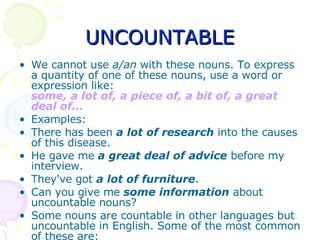
UNCOUNTABLE We cannot use  a/an  with these nouns. To express a quantity of one of these nouns, use a word or expression like: some, a lot of, a piece of, a bit of, a great deal of... Examples: There has been  a lot of research  into the causes of this disease.  He gave me   a great deal of advice  before my interview.  They've got  a lot of furniture .  Can you give me  some information  about uncountable nouns?  Some nouns are countable in other languages but uncountable in English. Some of the most common of these are:
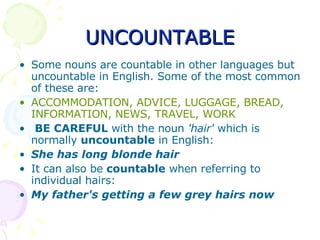
UNCOUNTABLE Some nouns are countable in other languages but uncountable in English. Some of the most common of these are: ACCOMMODATION, ADVICE, LUGGAGE, BREAD, INFORMATION, NEWS, TRAVEL, WORK BE CAREFUL  with the noun  'hair'  which is normally  uncountable  in English: She has long blonde   hair It can also be  countable  when referring to individual hairs: My father's getting a few grey   hairs   now
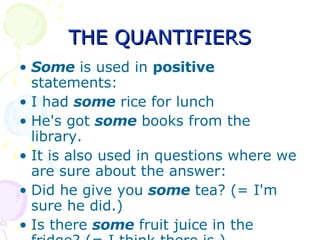
THE QUANTIFIERS Some  is used in  positive  statements: I had  some  rice for lunch  He's got  some  books from the library.  It is also used in questions where we are sure about the answer:  Did he give you  some  tea? (= I'm sure he did.)  Is there  some  fruit juice in the fridge? (= I think there is )
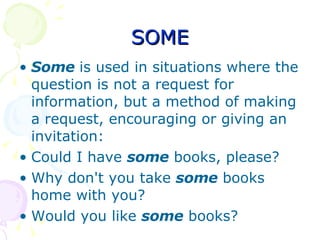
SOME Some  is used in situations where the question is not a request for information, but a method of making a request, encouraging or giving an invitation: Could I have  some  books, please?  Why don't you take  some  books home with you?  Would you like  some  books?
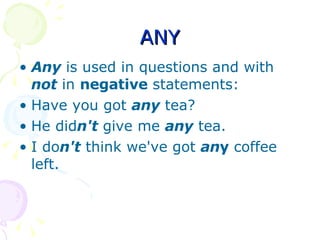
ANY Any  is used in questions and with  not  in  negative  statements: Have you got  any  tea?  He did n't  give me  any  tea.  I do n't  think we've got  an y  coffee left.
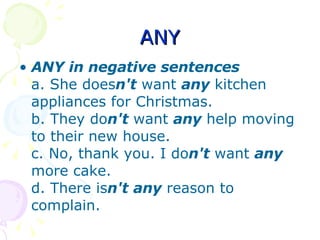
ANY ANY in negative sentences a. She does n't  want  any   kitchen appliances for Christmas. b. They do n't  want  any   help moving to their new house. c. No, thank you. I do n't  want  any   more cake. d. There is n't   any   reason to complain.
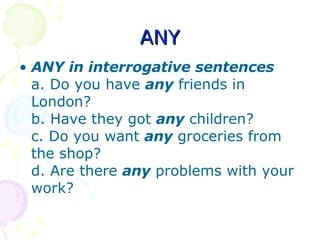
ANY ANY in interrogative sentences a. Do you have  any   friends in London? b. Have they got  any   children? c. Do you want  any  groceries from the shop? d. Are there  any   problems with your work?

some /any

  • 1.
  • 2.
    COUNTABLE Countable nouns are for things we can count Example: dog, horse, man, shop, idea. They usually have a singular and plural form. Example: two dogs, ten horses, a man, six men, the shops, a few ideas.
  • 3.
    UNCOUNTABLE Uncountable nounsare for the things that we cannot count Example: tea, sugar, water, air, rice. They are often the names for abstract ideas or qualities. Example: knowledge, beauty, anger, fear, love . They are used with a singular verb. They usually do not have a plural form. We cannot say sugars, angers, knowledges . Examples of common uncountable nouns : money, furniture, happiness, sadness, research, evidence, safety, beauty, knowledge.
  • 4.
    UNCOUNTABLE We cannotuse a/an with these nouns. To express a quantity of one of these nouns, use a word or expression like: some, a lot of, a piece of, a bit of, a great deal of... Examples: There has been a lot of research into the causes of this disease. He gave me a great deal of advice before my interview. They've got a lot of furniture . Can you give me some information about uncountable nouns? Some nouns are countable in other languages but uncountable in English. Some of the most common of these are:
  • 5.
    UNCOUNTABLE Some nounsare countable in other languages but uncountable in English. Some of the most common of these are: ACCOMMODATION, ADVICE, LUGGAGE, BREAD, INFORMATION, NEWS, TRAVEL, WORK BE CAREFUL with the noun 'hair' which is normally uncountable in English: She has long blonde hair It can also be countable when referring to individual hairs: My father's getting a few grey hairs now
  • 6.
    THE QUANTIFIERS Some is used in positive statements: I had some rice for lunch He's got some books from the library. It is also used in questions where we are sure about the answer: Did he give you some tea? (= I'm sure he did.) Is there some fruit juice in the fridge? (= I think there is )
  • 7.
    SOME Some is used in situations where the question is not a request for information, but a method of making a request, encouraging or giving an invitation: Could I have some books, please? Why don't you take some books home with you? Would you like some books?
  • 8.
    ANY Any is used in questions and with not in negative statements: Have you got any tea? He did n't give me any tea. I do n't think we've got an y coffee left.
  • 9.
    ANY ANY innegative sentences a. She does n't want any kitchen appliances for Christmas. b. They do n't want any help moving to their new house. c. No, thank you. I do n't want any more cake. d. There is n't any reason to complain.
  • 10.
    ANY ANY ininterrogative sentences a. Do you have any friends in London? b. Have they got any children? c. Do you want any groceries from the shop? d. Are there any problems with your work?