Making
Comparison
s
in English
We often use comparisons because we
want to talk about the differences
between people, places, and things.
Here is an example:
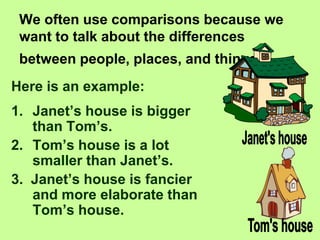
1. Janet’s house is bigger
than Tom’s.
2. Tom’s house is a lot
smaller than Janet’s.
3. Janet’s house is fancier
and more elaborate than
Tom’s house.
The comparative forms from the
previous example are:
-bigger than
-smaller than
-fancier than
-more elaborate than
So . . . When do we use “–er” and
when do we use “more?”
How many syllables are the words: “big” and “small?” 1
For 1-syllable adjectives,
JUST add “er” to the end.
Example: Tom is smarter than Joe.
*If the 1-syllable adjective ends with the letter “e,”
JUST add “r” to the end.
Examples: nicer wiser
**If the 1-syllable adjective has a C-V-C pattern,
Double the consonant and add “er.”
Examples: San Francisco is wetterthan San Diego.
San Diego is bigger than San
Francisco.
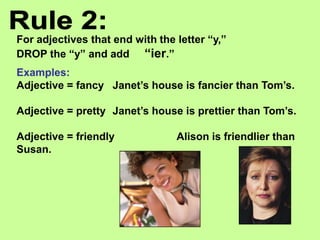
For adjectives that end with the letter “y,”
DROP the “y” and add “ier.”
Examples:
Adjective = fancy Janet’s house is fancier than Tom’s.
Adjective = pretty Janet’s house is prettier than Tom’s.
Adjective = friendly Alison is friendlier than
Susan.
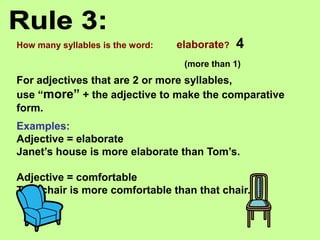
How many syllables is the word: elaborate? 4
(more than 1)
For adjectives that are 2 or more syllables,
use “more” + the adjective to make the comparative
form.
Examples:
Adjective = elaborate
Janet’s house is more elaborate than Tom’s.
Adjective = comfortable
This chair is more comfortable than that chair.
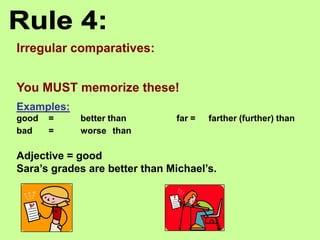
Irregular comparatives:
You MUST memorize these!
Examples:
good = better than far = farther (further) than
bad = worse than
Adjective = good
Sara’s grades are better than Michael’s.
Grammar Rule:
Never use both MORE and “ER!”
Incorrect:
Lisa’s job is more better than
mine.
Correct:
Lisa’s job is better than mine.
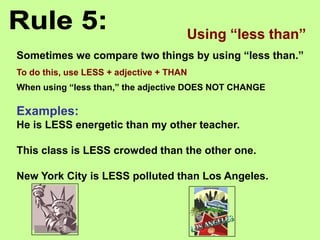
Using “less than”
Sometimes we compare two things by using “less than.”
To do this, use LESS + adjective + THAN
When using “less than,” the adjective DOES NOT CHANGE
Examples:
He is LESS energetic than my other teacher.
This class is LESS crowded than the other one.
New York City is LESS polluted than Los Angeles.
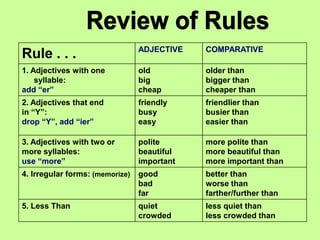
Rule . . . ADJECTIVE COMPARATIVE
1. Adjectives with one
syllable:
add “er”
old
big
cheap
older than
bigger than
cheaper than
2. Adjectives that end
in “Y”:
drop “Y”, add “ier”
friendly
busy
easy
friendlier than
busier than
easier than
3. Adjectives with two or
more syllables:
use “more”
polite
beautiful
important
more polite than
more beautiful than
more important than
4. Irregular forms: (memorize) good
bad
far
better than
worse than
farther/further than
5. Less Than quiet
crowded
less quiet than
less crowded than
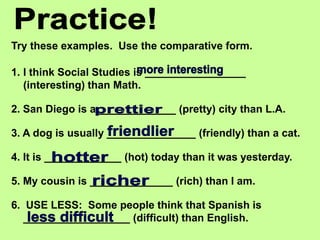
Try these examples. Use the comparative form.
1. I think Social Studies is _________________
(interesting) than Math.
2. San Diego is a _____________ (pretty) city than L.A.
3. A dog is usually _______________ (friendly) than a cat.
4. It is _____________ (hot) today than it was yesterday.
5. My cousin is ______________ (rich) than I am.
6. USE LESS: Some people think that Spanish is
__________________ (difficult) than English.

Comparative adjectives

  • 1.
  • 2.
    We often usecomparisons because we want to talk about the differences between people, places, and things. Here is an example: 1. Janet’s house is bigger than Tom’s. 2. Tom’s house is a lot smaller than Janet’s. 3. Janet’s house is fancier and more elaborate than Tom’s house.
  • 3.
    The comparative formsfrom the previous example are: -bigger than -smaller than -fancier than -more elaborate than So . . . When do we use “–er” and when do we use “more?”
  • 4.
    How many syllablesare the words: “big” and “small?” 1 For 1-syllable adjectives, JUST add “er” to the end. Example: Tom is smarter than Joe. *If the 1-syllable adjective ends with the letter “e,” JUST add “r” to the end. Examples: nicer wiser **If the 1-syllable adjective has a C-V-C pattern, Double the consonant and add “er.” Examples: San Francisco is wetterthan San Diego. San Diego is bigger than San Francisco.
  • 5.
    For adjectives thatend with the letter “y,” DROP the “y” and add “ier.” Examples: Adjective = fancy Janet’s house is fancier than Tom’s. Adjective = pretty Janet’s house is prettier than Tom’s. Adjective = friendly Alison is friendlier than Susan.
  • 6.
    How many syllablesis the word: elaborate? 4 (more than 1) For adjectives that are 2 or more syllables, use “more” + the adjective to make the comparative form. Examples: Adjective = elaborate Janet’s house is more elaborate than Tom’s. Adjective = comfortable This chair is more comfortable than that chair.
  • 7.
    Irregular comparatives: You MUSTmemorize these! Examples: good = better than far = farther (further) than bad = worse than Adjective = good Sara’s grades are better than Michael’s.
  • 8.
    Grammar Rule: Never useboth MORE and “ER!” Incorrect: Lisa’s job is more better than mine. Correct: Lisa’s job is better than mine.
  • 9.
    Using “less than” Sometimeswe compare two things by using “less than.” To do this, use LESS + adjective + THAN When using “less than,” the adjective DOES NOT CHANGE Examples: He is LESS energetic than my other teacher. This class is LESS crowded than the other one. New York City is LESS polluted than Los Angeles.
  • 10.
    Rule . .. ADJECTIVE COMPARATIVE 1. Adjectives with one syllable: add “er” old big cheap older than bigger than cheaper than 2. Adjectives that end in “Y”: drop “Y”, add “ier” friendly busy easy friendlier than busier than easier than 3. Adjectives with two or more syllables: use “more” polite beautiful important more polite than more beautiful than more important than 4. Irregular forms: (memorize) good bad far better than worse than farther/further than 5. Less Than quiet crowded less quiet than less crowded than
  • 11.
    Try these examples.Use the comparative form. 1. I think Social Studies is _________________ (interesting) than Math. 2. San Diego is a _____________ (pretty) city than L.A. 3. A dog is usually _______________ (friendly) than a cat. 4. It is _____________ (hot) today than it was yesterday. 5. My cousin is ______________ (rich) than I am. 6. USE LESS: Some people think that Spanish is __________________ (difficult) than English.