First Steps Second Edition is the result of over a decade of
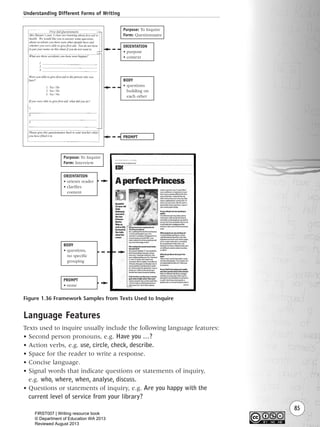
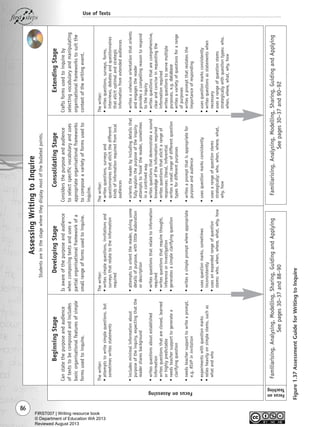
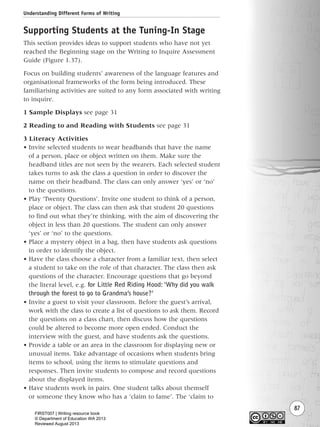
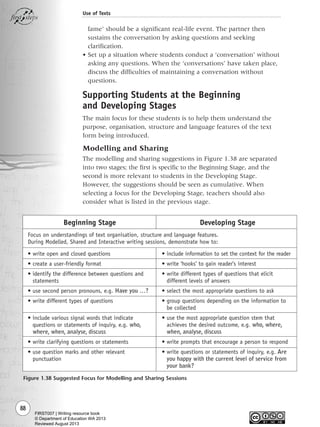
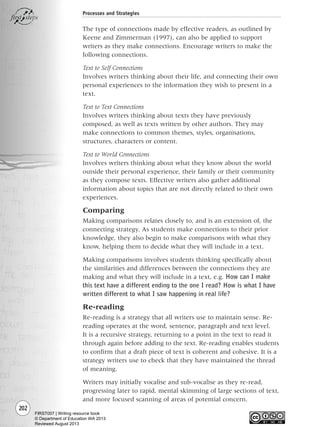
reflection by practising teachers. It draws upon contemporary
research and developments in the field of literacy learning
that have occurred since the release of the original First Steps
materials. First Steps Second Edition makes practical
connections between assessment, teaching and learning
and caters for diverse needs within a classroom.
The texts and professional development courses provide
a strategic whole-school approach to improving students’
literacy outcomes.
Each strand of First Steps Second Edition consists of two texts
and a CD-ROM.
The Maps of Development enable teachers to assess the
development of students and to link appropriate instruction
to phases of development. A comprehensive range of
practical teaching and learning experiences is provided
at each phase.
A Resource Book for each strand offers concise theory and
practical ideas for enhancing teaching practice.
CD-ROMs in each strand provide teachers with recording
sheets and a range of easily manipulated assessment,
teaching and learning formats as well as ideas to help
parents support their child’s literacy development.
The Linking Assessment, Teaching and Learning Book is a
companion to all texts within the First Steps resource and
includes information applicable to all strands of literacy,
together with practical support and ideas to help teachers
link assessment, teaching and learning.
Addressing Current Literacy Challenges
Writing
Resource Book
Writing
Resource Book
FirstStepsSecondEditionWritingResourceBook
ISBN 978-1-921321-12-2
9 781921 321122
Writing Resources Cover.indd 1 10/3/10 4.36.28 pm
FIRST007 | Writing resource book
© Department of Education WA 2013
Reviewed August 2013
Acknowledgements
The authors and the publishers would like to thank the following people and organisations for granting their
permission to reproduce copyright material.
For texts:
Association of Independent Schools of Western Australia for permission to reproduce a ‘brochure from the
Sustainability Conference’, p. 156; Australian Sports Commission for permission to reproduce ‘Your rating as a
coach’, p. 83 (bottom right); Avis Australia for permission to reproduce ‘Double Qantas Frequent Flyer Points’,
p. 103 (bottom right); City of Subiaco for permission to reproduce ‘Leadlight festival’, © City of Subiaco,
p. 129; Philip Gore and Australian Table for permission to reproduce ‘Movies’, ACP Publishing, p. 116
(top right); James Hasick, Antarctic Journal © 1993, first published by Era Publications, Australia, pp. 116 (top
left), 118 (top); John Curtin College of the Arts for permission to reproduce ‘A Circle in a Room Full of Squares
(2004), Western Australia, p. 151; King Features Syndicate Inc NY for permission to reproduce ‘The Phantom’
© King Features Syndicate Inc NY, 1951, 2005-09-19, p. 63; Murdoch Books Pty Limited for permission to
reproduce Little Aussie Cookbook, courtesy of Murdoch Books Pty Limited (cover), p. 93 (top left); ‘Newsday’
for permission to reproduce ‘A perfect princess’, © Newsday, p. 85 (bottom); PanMacmillan, Australia,
for permission to reproduce‘47 things you might not know about Morris Gleitzman’ © PanMacmillan,
Australia, p. 83 (left); Penguin Group Australia for permission to reproduce Unreal (cover) by Paul Jennings,
published by Penguin Group Australia, p. 61 (top right); Dr Paul Swan for permission to reproduce ‘Getting
Closer’, p. 94; Transperth for permission to reproduce the transperth timetable; the information regarding
Transperth services is effective as at 10/2005. To access up-to-date timetable information, please visit the
Transperth website at www.transperth.wa.gov.au or call Transperth InfoLine on 13 62 13 (TTY: 08 9428
1999), p. 74 (middle); WA Independent Grocers’ Association for permission to reproduce ‘The referendum on
longer shopping hours’, © WA Independent Grocers’ Association, p. 103 (top left); WA Institute of Sport for
permission to reproduce ‘Following big brother’, © WA Institute of Sport, p. 83 (top); West Australian Health
Department for permission to reproduce ‘Parent Questions 18–21 months’, © West Australian Health
Department, Child Care Record Card CH511 (2000), p. 84; The West Australian Newspapers Limited for
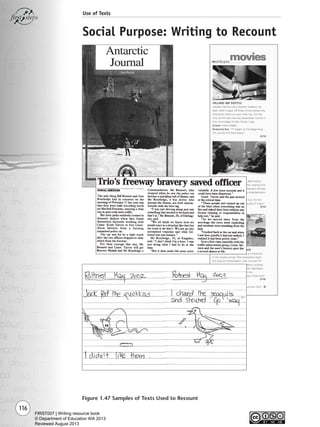
permission to reproduce ‘Trio’s freeway bravery saved officer’ by Daniel Emerson, p. 116 (middle)
For photographs:
Lindsay Edwards, pps. 3, 10, 13, 16, 19, 22, 26, 137, 159; all other photographs supplied by the Department
of Education of Western Australia
Every attempt has been made to trace and acknowledge copyright. Where an attempt has been unsuccessful,
the publisher would be pleased to hear from the copyright owner so any omission or error can be rectified.
Thank you to Hillsmeade Primary School.
WriteResource_intro_FINAL 6/29/06 10:27 AM Page ii
© Department of Education WA 2013
First steps. Writing resource book
ISBN: 978-0-7307-4517-4
SCIS: 1600421
FIRST007 | Writing resource book
© Department of Education WA 2013
Reviewed August 2013
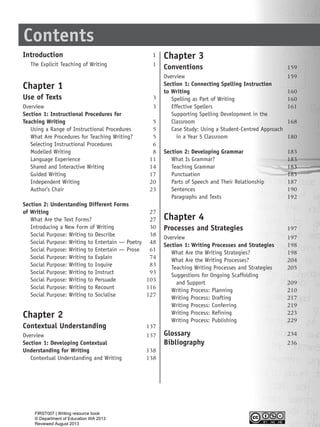
Contents
Introduction 1
The Explicit Teaching of Writing 1
Chapter 1
Use of Texts 3
Overview 3
Section 1: Instructional Procedures for
Teaching Writing 5
Using a Range of Instructional Procedures 5
What Are Procedures for Teaching Writing? 5
Selecting Instructional Procedures 6
Modelled Writing 8
Language Experience 11
Shared and Interactive Writing 14
Guided Writing 17
Independent Writing 20
Author’s Chair 23
Section 2: Understanding Different Forms
of Writing 27
What Are the Text Forms? 27
Introducing a New Form of Writing 30
Social Purpose: Writing to Describe 38
Social Purpose: Writing to Entertain — Poetry 48
Social Purpose: Writing to Entertain — Prose 61
Social Purpose: Writing to Explain 74
Social Purpose: Writing to Inquire 83
Social Purpose: Writing to Instruct 93
Social Purpose: Writing to Persuade 103
Social Purpose: Writing to Recount 116
Social Purpose: Writing to Socialise 127
Chapter 2
Contextual Understanding 137
Overview 137
Section 1: Developing Contextual
Understanding for Writing 138
Contextual Understanding and Writing 138
Chapter 3
Conventions 159
Overview 159
Section 1: Connecting Spelling Instruction
to Writing 160
Spelling as Part of Writing 160
Effective Spellers 161
Supporting Spelling Development in the
Classroom 168
Case Study: Using a Student-Centred Approach
in a Year 5 Classroom 180
Section 2: Developing Grammar 183
What Is Grammar? 183
Teaching Grammar 183
Punctuation 185
Parts of Speech and Their Relationship 187
Sentences 190
Paragraphs and Texts 192
Chapter 4
Processes and Strategies 197
Overview 197
Section 1: Writing Processes and Strategies 198
What Are the Writing Strategies? 198
What Are the Writing Processes? 204
Teaching Writing Processes and Strategies 205
Suggestions for Ongoing Scaffolding
and Support 209
Writing Process: Planning 210
Writing Process: Drafting 217
Writing Process: Conferring 219
Writing Process: Refining 223
Writing Process: Publishing 229
Glossary 234
Bibliography 236
WriteResource_intro_FINAL 6/29/06 10:27 AM Page iii
FIRST007 | Writing resource book
© Department of Education WA 2013
Reviewed August 2013
Authors’ Acknowledgements
The First Steps Team from STEPS Professional Development
acknowledges the contributions made by the following people.
We give our grateful thanks to:
All teachers and students who were involved in trialling the
materials and offering feedback, either as Critical Readers, Test Pilots
or Navigator Schools.
Those students and teachers who provided us with great samples
of work to enhance the text. A special thanks to Louise Swain for
her work in the creation and collection of many of these work
samples.
The authors of the original First Steps edition, developed by the
Education Department of Western Australia, and the efforts of the
many individuals who contributed to that resource.
WriteResource_intro_FINAL 6/29/06 10:27 AM Page iv
FIRST007 | Writing resource book
© Department of Education WA 2013
Reviewed August 2013
1
Introduction
The First Steps Writing Resource Book Second Edition builds on the
original First Steps writing text (formerly known as the Writing Resource
Book) by drawing on contemporary research and developments in
the field of writing instruction. The new Writing Resource Book, used
in conjunction with the First Steps Writing Map of Development Second
Edition, has a strong focus on supporting teachers as they implement
a multi-dimensional approach to teaching writing.
The First Steps Writing Resource Book will help teachers focus on the
explicit teaching of different forms of text; writing processes,
strategies and conventions; and the contextual aspects associated
with the act of composing texts. Teachers will find the information
relevant for all phases of writing development, and will be able to
apply the ideas and suggestions with all students in their classroom.
CD-ROM icons appear throughout the First Steps Writing Resource Book.
They indicate that a practical format is available on the Writing
Strand CD-ROM (included in the First Steps Writing Map of Development
Second Edition). The CD-ROM is an electronic treasure chest of
activity formats, recording sheets, resource lists and teaching, learning
and assessment frameworks. The First Steps Linking Assessment
Teaching and Learning book is also a useful companion resource.
The Explicit Teaching of Writing
Teaching students to become effective, lifelong writers cannot be
simplified into one method or a set of steps; the act of writing consists
of multiple processes, strategies and conventions that intertwine and
overlap. Teachers need to be explicit in demonstrating and talking
to students about what effective writers do. Teachers also need to
provide opportunities for students to apply new understandings in
their own authentic writing contexts.
A successful writing program requires a daily block of time, with
time allocated for explicit instruction on selected aspects of writing,
time for students to write independently, and opportunities for
students to receive and provide feedback.
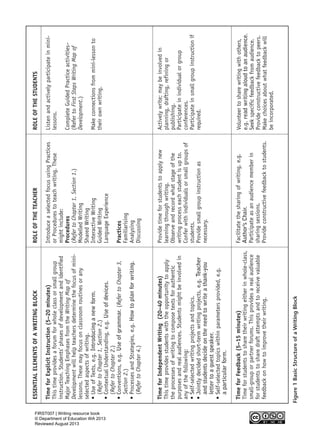
The table in Figure 1 provides a basic structure for examining
a block of time dedicated to the teaching of writing. The basic
structure is flexible and can change on a daily basis, as needed. The
needs of the students will drive decisions teachers make about how
much time to spend on each element in a day or a week.
WriteResource_intro_FINAL 6/29/06 10:27 AM Page 1
FIRST007 | Writing resource book
© Department of Education WA 2013
Reviewed August 2013
Figure1BasicStructureofaWritingBlock
ESSENTIALELEMENTSOFAWRITINGBLOCK
TimeforExplicitInstruction(5–20minutes)
Thistimeprovidesaforumforwholeclassorsmallgroup
instruction.Students’phasesofdevelopmentandidentified
MajorTeachingEmphasesfromtheWritingMapof
Developmentwillhelpteachersdeterminethefocusofmini-
lessons.Thesemayfocusonclassroomroutinesorany
selectedaspectsofwriting.
•UseofTexts,e.g.Introducinganewform.
(RefertoChapter1,Section2.)
•ContextualUnderstanding,e.g.Useofdevices.
(RefertoChapter2.)
•Conventions,e.g.Useofgrammar.(RefertoChapter3,
Section2.)
•ProcessesandStrategies,e.g.Howtoplanforwriting.
(RefertoChapter4.)
TimeforIndependentWriting(20–40minutes)
Thistimeprovidesstudentswiththeopportunitytoapply
theprocessesofwritingtocomposetextsforauthentic
purposesandrealaudiences.Studentsmightbeinvolvedin
anyofthefollowing:
•Self-selectedwritingprojectsandtopics.
•Jointlydecidedshort-termwritingprojects,e.g.Teacher
andstudentsdecideontheneedtowriteathank-you
lettertoaguestspeaker.
•Self-selectedtopicswithinparametersprovided,e.g.
aparticularform.
TimeforFeedback(5–15minutes)
Timeforstudentstosharetheirwritingeitherinwhole-class,
small-grouporpartnerforums.Thisprovidesarealaudience
forstudentstosharedraftattemptsandtoreceivevaluable
feedbackonhowtoimprovetheirwriting.
ROLEOFTHETEACHER
IntroduceaselectedfocususingPractices
orProcedurestoteachwriting.These
mightinclude:
Procedures
(RefertoChapter1,Section1.)
ModelledWriting
SharedWriting
InteractiveWriting
GuidedWriting
LanguageExperience
Practices
Familiarising
Analysing
Discussing
Providetimeforstudentstoapplynew
learningthroughwriting.
Observeandrecordwhatstageofthe
writingprocesseachstudentisupto.
Conferwithindividualsorsmallgroupsof
students.
Providesmallgroupinstructionas
necessary.
Facilitatethesharingofwriting,e.g.
Author’sChair.
Participateasanaudiencememberin
sharingsessions.
Provideconstructivefeedbacktostudents.
ROLEOFTHESTUDENTS
Listenandactivelyparticipateinmini-
lessons.
CompleteGuidedPracticeactivities–
(RefertoFirstStepsWritingMapof
Development.)
Makeconnectionsfrommini-lessonto
theirownwriting.
Activelywrite;maybeinvolvedin
planning,drafting,refiningor
publishing.
Participateinindividualorgroup
conferences.
Participateinsmallgroupinstructionif
required.
Volunteertosharewritingwithothers,
e.g.readwritingaloudtoanaudience.
Seekspecificfeedbackfromaudience.
Provideconstructivefeedbacktopeers.
Makechoicesaboutwhatfeedbackwill
beincorporated.
WriteResource_intro_FINAL 6/29/06 10:27 AM Page 2
FIRST007 | Writing resource book
© Department of Education WA 2013
Reviewed August 2013
3
Use of Texts
CHAPTER 1
Overview
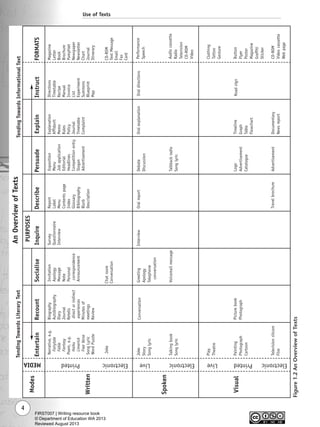
The Use of Texts aspect focuses on the composition of a range of texts.
Texts are defined as any form of communication from which meaning
is created. This can be spoken, written or visual.
Many categories are used to sort the enormous range of texts that
students might compose; for example, fiction and non-fiction,
narrative and informational, narrative and expository, literature and
mass media. Texts in the First Steps resource are classified in three
categories — written, spoken or visual. Each category can be further
separated into printed, live and electronic, with some texts falling into
one or more categories, e.g. a video is a combination of electronic,
spoken and visual text.
Students can become both composers and comprehenders of text if
they can identify the primary purpose of a text, rather than its category.
The overview in Figure 1.2 categorises texts according to their purpose.
This chapter provides information about ways to develop students’
knowledge and understandings of texts. The two sections are as
follows:
• Section 1 — Instructional Procedures for Teaching Writing
• Section 2 — Understanding Different Forms of Writing
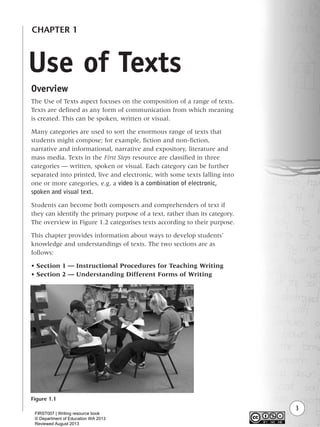
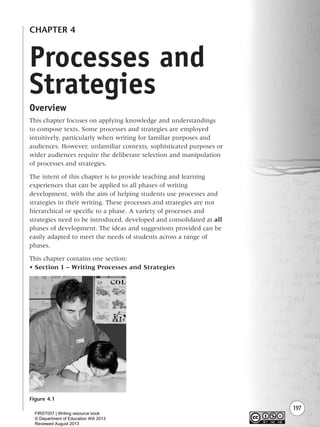
Figure 1.1
Writing Resource_chpt 1_FINAL 6/29/06 10:30 AM Page 3
FIRST007 | Writing resource book
© Department of Education WA 2013
Reviewed August 2013
4
Use of Texts
Biography
Autobiography
Diary
Journal
Retells
directorindirect
experiences
Minutesof
meetings
Review
Written
Modes
Visual
MEDIA Electronic
Invitation
Apology
Message
Note
Personal
correspondence
Announcement
PrintedLivePrinted
Survey
Questionnaire
Interview
Report
Label
Menu
Contentspage
Index
Glossary
Bibliography
Blurb
Description
Exposition
Menu
Jobapplication
Editorial
Headlines
Competitionentry
Slogan
Advertisement
Explanation
Affidavit
Memo
Rules
Policy
Journal
Timetable
Complaint
Directions
Timetable
Recipe
Manual
Invoice
List
Experiment
Summons
Blueprint
Map
Magazine
Letter
Book
Brochure
Pamphlet
Newspaper
Newsletter
Chart
Journal
Itinerary
PURPOSES
Play
Theatre
Painting
Photograph
Cartoon
Televisionsitcom
Film
Picturebook
Photograph
Travelbrochure
Logo
Advertisement
Catalogue
Advertisement
Timeline
Graph
Table
Flowchart
Documentary
Newsreport
Roadsign
Clothing
Tattoo
Gesture
Button
Flyer
Poster
Magazine
Graffiti
Sticker
CD-ROM
Videocassette
Webpage
TendingTowardsLiteraryTextTendingTowardsInformationalTextAnOverviewofTexts
Figure1.2AnOverviewofTexts
Narrative,e.g.
Fairytale
Fable
Fantasy
Poem,e.g.
Haiku
Limerick
FreeVerse
SongLyric
WordPuzzle
EntertainRecountSocialiseInquireDescribePersuadeExplainInstructFORMATS
JokeChatroomCD-ROM
ConversationTextMessage
Email
Fax
Card
Spoken
ElectronicLive
Joke
Story
Songlyric
Talkingbook
Songlyric
ConversationGreeting
Apology
Telephone
conversation
Voicemailmessage
InterviewOralreportDebate
Discussion
Talkbackradio
Songlyric
OralexplanationOraldirectionsPerformance
Speech
Audiocassette
Radio
Television
CD-ROM
Video
Electronic
Writing Resource_chpt 1_FINAL 6/29/06 10:30 AM Page 4
FIRST007 | Writing resource book
© Department of Education WA 2013
Reviewed August 2013
5
SECTION 1
Instructional Procedures
for Teaching Writing
Using a Range of Instructional Procedures
The strategic use of a range of instructional procedures creates a
strong foundation for a comprehensive approach to teaching writing.
Each procedure involves varying degrees of responsibility for both
the teacher and student. Using a selective range of teaching
procedures ensures that explicit instruction and guidance, when
needed, is balanced with regular opportunities for independent
application of understandings, strategies and processes. Once teachers
are familiar with a range of procedures, they can determine which
procedure will be the most effective to use according to students’
needs, familiarity with the task or the purpose of the writing.
What Are Procedures for Teaching Writing?
Instructional procedures provide meaningful contexts for focusing
on selected parts of the writing process. They are characterised by a
number of widely accepted steps or stages, conducted frequently
and are generally applicable to all phases of development. Six
procedures have been selected as a comprehensive approach to
writing. The six procedures are as follows:
• Modelled Writing
• Language Experience
• Shared and Interactive Writing
• Guided Writing
• Independent Writing
• Author’s Chair
The inclusion of each procedure has been influenced by the
Gradual Release of Responsibility Model (Pearson and Gallagher,
1983). Procedures such as Modelled Writing and Language
Experience allow the teacher to demonstrate how writing can be
used to construct texts for different purposes and audiences. Shared
and Interactive Writing and Guided Writing provide opportunities
for students to practise the process of writing with guidance and
support. Independent Writing sessions allow students to apply
Instructional Procedures for Teaching Writing
Writing Resource_chpt 1_FINAL 6/29/06 10:30 AM Page 5
FIRST007 | Writing resource book
© Department of Education WA 2013
Reviewed August 2013
6
Use of Texts
what they have learnt about writing, and Author’s Chair provides
opportunities for them to give and receive feedback on their writing.
Teachers need to be aware of the essential elements of each
procedure; this will ensure consistency in understanding and use.
This awareness will also allow teachers to select the most appropriate
instructional procedure to meet individual students’ needs.
Selecting Instructional Procedures
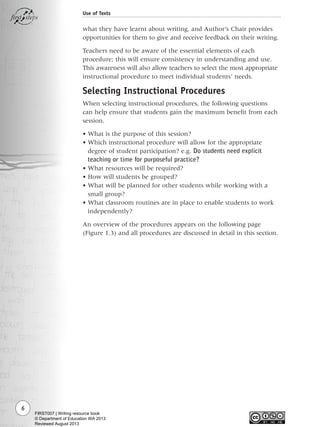
When selecting instructional procedures, the following questions
can help ensure that students gain the maximum benefit from each
session.
• What is the purpose of this session?
• Which instructional procedure will allow for the appropriate
degree of student participation? e.g. Do students need explicit
teaching or time for purposeful practice?
• What resources will be required?
• How will students be grouped?
• What will be planned for other students while working with a
small group?
• What classroom routines are in place to enable students to work
independently?
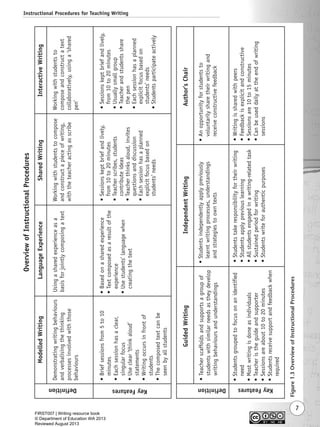
An overview of the procedures appears on the following page
(Figure 1.3) and all procedures are discussed in detail in this section.
Writing Resource_chpt 1_FINAL 6/29/06 10:30 AM Page 6
FIRST007 | Writing resource book
© Department of Education WA 2013
Reviewed August 2013
Demonstratingwritingbehaviours
andverbalisingthethinking
processesinvolvedwiththose
behaviours
Usingasharedexperienceasa
basisforjointlycomposingatext
Workingwithstudentstocompose
andconstructapieceofwriting,
withtheteacheractingasscribe
Workingwithstudentsto
composeandconstructatext
collaboratively,usinga‘shared
pen’
•Briefsessionsfrom5to10
minutes
•Eachsessionhasaclear,
singularfocus
•Useclear‘thinkaloud’
statements
•Writingoccursinfrontof
students
•Thecomposedtextcanbe
seenbyallstudents
•Sessionskeptbriefandlively,
from10to20minutes
•Teacherscribes,students
contributeideas
•Teacherthinksaloud,invites
questionsanddiscussion
•Eachsessionhasaplanned
explicitfocusbasedon
students’needs
•Sessionskeptbriefandlively,
from10to20minutes
•Usuallysmallgroup
•Teacherandstudentsshare
thepen
•Eachsessionhasaplanned
explicitfocusbasedon
students’needs
•Studentsparticipateactively
•Teacherscaffoldsandsupportsagroupof
studentswithsimilarneedsastheydevelop
writingbehavioursandunderstandings
•Studentsindependentlyapplypreviously
learntwritingprocesses,understandings
andstrategiestoowntexts
•Anopportunityforstudentsto
voluntarilysharetheirwritingand
receiveconstructivefeedback
ModelledWritingLanguageExperienceSharedWritingInteractiveWriting
•Studentsgroupedtofocusonanidentified
need
•Mostwritingisdoneasindividuals
•Teacheristheguideandsupporter
•Sessionsareabout10to20minutes
•Studentsreceivesupportandfeedbackwhen
required
•Studentstakeresponsibilityfortheirwriting
•Studentsapplypreviouslearning
•Allstudentsengagedinawriting-relatedtask
•Sustainedperiodforwriting
•Studentswriteforauthenticpurposes
•Writingissharedwithpeers
•Feedbackisexplicitandconstructive
•Sessionsare10to15minutes
•Canbeuseddailyattheendofwriting
sessions
GuidedWritingIndependentWritingAuthor’sChair
Definition KeyFeatures Definition KeyFeatures
Figure1.3OverviewofInstructionalProcedures
7
OverviewofInstructionalProcedures
Instructional Procedures for Teaching Writing
•Basedonasharedexperience
•Textcomposedasaresultofthe
experience
•Usestudents’languagewhen
creatingthetext
Writing Resource_chpt 1_FINAL 6/29/06 10:30 AM Page 7
FIRST007 | Writing resource book
© Department of Education WA 2013
Reviewed August 2013
8
Use of Texts
Modelled Writing
Definition: The explicit demonstration of writing behaviours and
the verbalisation of the thinking processes involved.
Description
The focus of Modelled Writing is on the explicit planning and
demonstration of selected writing behaviours. Demonstrating the
interactive nature of the writing process shows how writers
continually make decisions as they construct texts. The teacher holds
the pen and makes decisions about the writing; students observe
the process and the product, rather than contribute towards it.
Modelled Writing is most effective when the teaching focus is based
on observation of students’ learning needs, then builds on their
experiences, current understandings and prior knowledge. Students
might need many repeated demonstrations before they can apply
the understandings to their own writing.
It is important to explicitly model all aspects of writing. It may be
beneficial to work on the same text over several Modelled Writing
sessions, demonstrating the many interrelated processes associated
with writing.
Key Features
• Sessions are brief: five to ten minutes.
• Sessions have a clear, singular focus.
• Clear Think-Aloud statements are used.
• The writing is composed as the students watch.
• The text being composed can be seen by all students.
Benefits for Students
Modelled Writing helps students to:
• understand how effective writers compose texts
• understand that writing is composed for a specific audience and
purpose
• develop an understanding of the process of writing
• understand the relationship between spoken and written
language
• understand how particular text forms are explicitly constructed
• use a piece of writing as a reference point for their own writing.
Writing Resource_chpt 1_FINAL 6/29/06 10:30 AM Page 8
FIRST007 | Writing resource book
© Department of Education WA 2013
Reviewed August 2013
Instructional Procedures for Teaching Writing
9
Suggestions for Using Modelled Writing
in the Classroom
Planning for Modelled Writing
• Determine the purpose, audience and form for the writing.
• Determine an explicit focus for the session based on students’
needs.
• Decide on the explicit language that will be used during the
Think-Alouds.
• Select the required writing tools and materials, e.g. large sheet of
paper and a thick marker, overhead projector, interactive whiteboard,
large computer screen.
Conducting Modelled Writing Sessions
• Clearly explain the chosen writing focus, making links to
students’ experiences and prior learning.
• Explain the purpose, audience and form of the writing.
• Begin to write, pausing often to demonstrate the specific focus by
‘thinking aloud’. Students can ask questions and offer suggestions;
however, the teacher is in charge of the pen and thinking aloud is
the focal point of the session.
• Invite students to verbally rephrase the session focus.
• Display the Modelled Writing sample prominently to provide a
clear reference point for students’ own writing.
• Involve students in recording the Modelled Writing behaviours.
After Modelled Writing
• Provide opportunities for students to practise and apply their
understandings by taking part in Shared, Interactive, Guided or
Independent Writing sessions.
• Repeat Modelled Writing sessions on the same focus using
different contexts, as required, until students can independently
apply their understandings to their writing.
Ideas for Assessment
There are few opportunities to gather information about students
during a Modelled Writing session. It is sometimes possible to gauge
students’ understandings by the questions they ask, or through the
comments they make during demonstrations. Observe and monitor
students’ use of the modelled behaviours during Shared, Interactive,
Guided and Independent Writing.
Writing Resource_chpt 1_FINAL 6/29/06 10:30 AM Page 9
FIRST007 | Writing resource book
© Department of Education WA 2013
Reviewed August 2013
10
Use of Texts
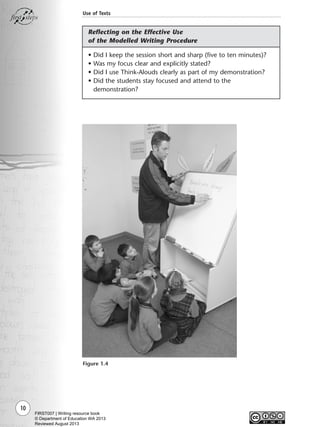
• Did I keep the session short and sharp (five to ten minutes)?
• Was my focus clear and explicitly stated?
• Did I use Think-Alouds clearly as part of my demonstration?
• Did the students stay focused and attend to the
demonstration?
Figure 1.4
Reflecting on the Effective Use
of the Modelled Writing Procedure
Writing Resource_chpt 1_FINAL 6/29/06 10:30 AM Page 10
FIRST007 | Writing resource book
© Department of Education WA 2013
Reviewed August 2013
Instructional Procedures for Teaching Writing
11
Language Experience
Definition: To use a shared experience as a basis for jointly
composing a text.
Description
The focus of Language Experience is to involve students in a shared
experience, then use students’ language to jointly construct a written
text. The teacher scribes the text and students are supported as active
participants in the writing process.
Language Experience opportunities can be created in a range of
ways.
• Planned activities inside the classroom, e.g. cooking, blowing
bubbles, hatching chickens, bringing in an animal or object to observe
and discuss, inviting a guest speaker.
• Planned activities outside the classroom, e.g. taking a trip to an
interesting location such as a park, museum or zoo.
• Unplanned events, e.g. a thunderstorm, a crane across the road.
Key Features
• Text composed is based on a shared experience.
• Students’ oral language forms the basis for the creation of the
written text.
• Use of Shared Writing procedure to compose the text.
• Participation of the whole class.
Benefits for Students
Language Experience helps students to:
• understand the similarities and differences between spoken and
written language
• talk and write about events in which they have participated
• develop understandings about print
• produce meaningful and supportive texts for reading
• have ownership of the texts produced
• develop vocabulary and expand concepts
• understand the relationship between thinking, speaking, writing
and reading.
Writing Resource_chpt 1_FINAL 6/29/06 10:30 AM Page 11
FIRST007 | Writing resource book
© Department of Education WA 2013
Reviewed August 2013
12
Use of Texts
Suggestions for Using Language Experience
in the Classroom
Planning for Language Experience
• Decide on a purposeful experience that will interest the students.
• Involve students in the planning, preparation and organisation of
the experience, where possible, e.g. writing invitations to parents
for a special class event, making bookings for an excursion, preparing
questions for a guest speaker.
Conducting Language Experience Sessions
• Share the experience. If appropriate, take photographs to record
the event.
• Ensure students are as involved as possible and that there are lots
of opportunities for conversations during the experience.
• After the experience, discuss the event as a whole class,
encouraging students to use vocabulary related to the experience.
• Involve students in a Shared Writing session to record the
experience. Use students’ ideas and language to demonstrate the
relationships between thinking, talking and writing.
• Jointly re-read the text as it is being constructed to check and
maintain its meaning.
• Refine the text together until it is ready to be published.
• Publish the text with photos or student drawings, e.g. make a big
book, a chart, a wall display.
• Involve students in purposeful reading and re-reading of the text.
• Make connections between this text and other texts that the class
has written or read together.
After Language Experience
• Display the text so that students can use it as a future writing
reference.
• Involve students in further writing activities related to the
experience, e.g. reports for school newsletter, thank-you letters.
• Use the text as a springboard for other writing and reading
activities.
• Use the text in Modelled, Shared or Guided Reading sessions.
Ideas for Assessment
Language Experience sessions allow the teacher to observe students
at work as part of the whole class. Teachers are able to gather
valuable information by observing individual students’ involvement
and contribution to the Shared Writing session.
Writing Resource_chpt 1_FINAL 6/29/06 10:30 AM Page 12
FIRST007 | Writing resource book
© Department of Education WA 2013
Reviewed August 2013
Instructional Procedures for Teaching Writing
13
Figure 1.5
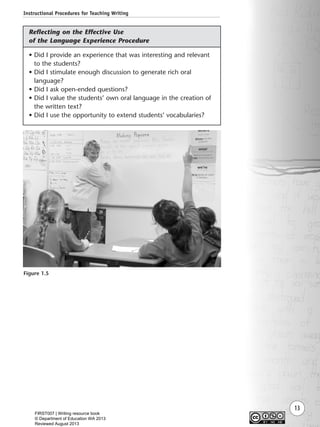
• Did I provide an experience that was interesting and relevant
to the students?
• Did I stimulate enough discussion to generate rich oral
language?
• Did I ask open-ended questions?
• Did I value the students’ own oral language in the creation of
the written text?
• Did I use the opportunity to extend students’ vocabularies?
Reflecting on the Effective Use
of the Language Experience Procedure
Writing Resource_chpt 1_FINAL 6/29/06 10:30 AM Page 13
FIRST007 | Writing resource book
© Department of Education WA 2013
Reviewed August 2013
14
Use of Texts
Shared and Interactive Writing
Definition: Teacher-managed process in which a piece of text is
composed and constructed collaboratively.
Description
Shared and Interactive Writing are supportive writing procedures
that involve the teacher and students working together to make
joint decisions about planning, drafting, refining and publishing
a text.
In Shared Writing, the teacher acts as the scribe, allowing students
to participate in the creation of a text without having to actually
write it. Students are actively involved, as they are invited to
contribute, develop and organise ideas. The teacher responds to
students’ contributions with comments and questions, using the
results to shape the written text.
In Interactive Writing, the teacher makes decisions about where
students can take over the pen to write parts of the text. Students
are invited to ‘share the pen’ at strategic points so that they can
actively participate at their instructional level. Interactive Writing
usually works best with a small group of students, as each student
has the opportunity to write; however, it can also be done with
individuals or the whole class.
Shared and Interactive Writing enable students to collaboratively
compose texts at a level beyond their normal independent writing.
Both procedures can be used to consolidate and extend students’
writing behaviours and understandings, and both can be adjusted
to meet individual needs.
A short text may be completed in a Shared or Interactive Writing
session; however, the same piece of writing might be worked on
over several sessions with a different focus each time. The texts can
then be used for a variety of follow-up writing and reading activities.
Key Features
• Sessions are most effective when kept brief and lively: ten to
twenty minutes.
• The teacher is the scribe during Shared Writing.
• The pen is shared between the teacher and students during
Interactive Writing.
• All students actively participate.
• Planned and explicit focus in a session is based on students’ needs.
Writing Resource_chpt 1_FINAL 6/29/06 10:30 AM Page 14
FIRST007 | Writing resource book
© Department of Education WA 2013
Reviewed August 2013
Instructional Procedures for Teaching Writing
15
• The teacher questions and ‘steers’ discussion to engage the
students.
• All students can see the text being composed.
• The text is re-read after composing.
Benefits for Students
Shared and Interactive Writing help students to:
• be actively involved in the process of writing in a supported way
• engage in the production of texts that may be beyond their
independent writing level
• transfer the behaviours and strategies used by competent writers
to their own writing
• develop confidence in writing
• understand how particular text forms are explicitly constructed
• be exposed to a range of text forms.
Suggestions for Using Shared and Interactive
Writing in the Classroom
Planning for Shared Writing and Interactive Writing
• Determine an explicit focus for the session based on students’
needs.
• Determine the purpose, audience and form of the writing.
• Select the writing tools and materials that will be used, e.g. a
large sheet of paper and a thick marker, a large computer screen,
interactive whiteboard.
• When conducting Interactive Writing, carefully consider at which
point in the text you can allow specific students to ‘share the pen’.
Conducting Shared Writing and Interactive Writing Sessions
• Explain the purpose, audience and form of the writing.
• Clearly explain the writing focus of the session.
• Explain that joint decisions will be made about the writing.
• Activate students’ prior knowledge and experiences of the topic
and task.
• Engage students in the construction of the text, e.g. word choices,
how to best express ideas, inviting students to ‘share the pen’ in
Interactive Writing.
• As a group, constantly re-read the text as it is constructed to check
its meaning.
• Invite students to refine the text, if appropriate.
• Review the selected focus at the end of the session.
Writing Resource_chpt 1_FINAL 6/29/06 10:30 AM Page 15
FIRST007 | Writing resource book
© Department of Education WA 2013
Reviewed August 2013
16
Use of Texts
After Shared and Interactive Writing
• Display the Shared or Interactive Writing text prominently.
Remind students to use it as a reference for their own writing.
• Provide opportunities for students to practise and apply the
understandings, processes and strategies shared.
• Make the composed text available for independent reading.
Ideas for Assessment
Shared and Interactive Writing sessions allow the teacher to
observe students working as part of a group or as part of the whole
class. Teachers are able to gather valuable information by observing
individual students’ participation and contributions during the
writing session, and by directing questions to specific students.
• Did students actively participate in the construction of the text?
• Was the session short and focused so that students were
attentive, engaged and eager to participate?
• Was the session paced so that a reasonable amount of print
was produced in a short time?
• What did students learn from this session that they will be able
to use in their own writing?
• Did I make the most appropriate teaching points for the
students?
• What do I need to do next to help students with their writing?
Reflecting on the Effective Use
of the Shared and Interactive Writing Procedures
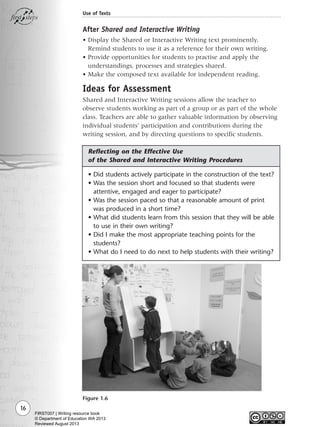
Figure 1.6
Writing Resource_chpt 1_FINAL 6/29/06 10:31 AM Page 16
FIRST007 | Writing resource book
© Department of Education WA 2013
Reviewed August 2013
Instructional Procedures for Teaching Writing
17
Guided Writing
Definition: The provision of scaffolded support to a group of
students with similar needs, as they develop writing behaviours
and understandings
Description
Guided Writing involves guiding and supporting students through
the process of writing, providing explicit instruction and feedback
through planned mini-lessons and conferences. It is based on
assessment of students’ needs and behaviours, and leads them
towards becoming independent writers. Texts that students write
through Guided Writing are usually more complex than texts they
would write on their own.
Guided Writing uses — and builds on — behaviours taught in
Modelled and Shared Writing. Students with similar needs (or at
similar phases of development) work together on a part of the
process of writing relevant to their learning needs. Students usually
‘hold the pen’ and ‘own’ the writing; however, explicit feedback is
given when needed and repeated demonstrations can be provided.
Key Features
• Students are grouped to focus on an identified need.
• Most writing is done as individuals.
• The teacher is the guide and supporter.
• Session length: ten to twenty minutes.
• Students receive support and feedback as required.
Benefits for Students
Guided Writing helps students to:
• independently write texts of increasing difficulty
• make choices and decisions about their writing in consultation
with peers and the teacher
• develop as individual writers by practising, exploring,
experimenting and taking risks in a supportive environment
• develop writing behaviours that they can apply to all writing
• experience success with writing by receiving immediate feedback
• develop the ability to self-monitor their writing and set writing
goals.
Writing Resource_chpt 1_FINAL 6/29/06 10:31 AM Page 17
FIRST007 | Writing resource book
© Department of Education WA 2013
Reviewed August 2013
18
Use of Texts
Suggestions for Using Guided Writing
in the Classroom
Planning for Guided Writing
• Identify a small group of students who have a similar need.
The identified need will become the focus of the session.
• Determine the purpose, audience and form of the writing event.
• Make sure students come organised and equipped with writing
tools, e.g. writing folder, pens, paper, personal dictionaries, laptop
computer.
• Organise other students to work independently.
Conducting Guided Writing Sessions
• Gather the group in an area where they can work easily.
• Tell students the session focus; make sure they understand the
purpose, audience and form of the writing event.
• Link the focus back to previous Modelled and Shared writing
sessions.
• Invite students to share their ideas or their first sentence before
writing. (This ensures students have grasped the focus of the
lesson.)
• Allow each student to start writing immediately after this brief
discussion.
• Interact with students to develop and clarify their ideas and
understandings as they write.
• Provide assistance and explicit feedback as required.
• Assess what students are doing, by observing, taking notes and
asking questions.
• Review the selected focus at the end of the session, linking it back
to students’ writing; reiterate the main points.
After Guided Writing
• During Independent Writing, encourage students to continue
working on the texts they produced in Guided Writing.
• Provide opportunities for students to share their writing.
• Have students reflect on the writing produced during Guided
Writing.
• Encourage students to apply what they learnt in Guided Writing
during Independent Writing.
• Use observations and notes taken to direct further teaching and
learning experiences.
Writing Resource_chpt 1_FINAL 6/29/06 10:31 AM Page 18
FIRST007 | Writing resource book
© Department of Education WA 2013
Reviewed August 2013
Instructional Procedures for Teaching Writing
19
Ideas for Assessment
Guided Writing allows teachers to question, observe and confer
with students as they write, and to note what students are able to
do when working with guidance. Use each student’s performance
to monitor their development, and for planning further teaching
and learning experiences that will support and extend each student.
• Did I select a small group of students with a similar need?
• Was my focus clear and explicitly stated?
• Did I provide explicit feedback and support to the students?
• Did I make the most appropriate teaching points during the
session?
• What do these students need next to support their writing?
• Did I see any evidence of students using what I have previously
modelled?
• Did I provide sufficient challenges to encourage further
development?
• Did the rest of the class stay on task with independent
activities?
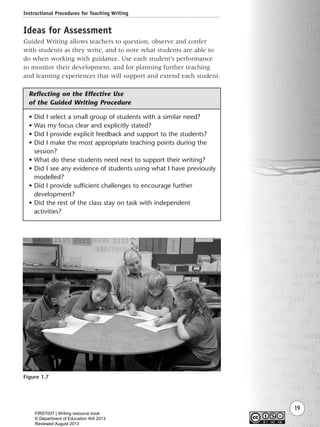
Figure 1.7
Reflecting on the Effective Use
of the Guided Writing Procedure
Writing Resource_chpt 1_FINAL 6/29/06 10:31 AM Page 19
FIRST007 | Writing resource book
© Department of Education WA 2013
Reviewed August 2013
20
Use of Texts
Independent Writing
Definition: The independent application of previously learnt
writing understandings, processes and strategies to compose own
texts.
Description
Independent Writing focuses on students taking charge of their own
writing. Students apply the understandings, processes and strategies
learnt through the supported teaching procedures, then take
responsibility for working through any challenges they encounter
in the process of writing.
During Independent Writing, the writing tasks may be:
• self-selected projects and topics
• jointly decided short-term writing projects
• self-selected topics within given parameters.
Students often refine texts they have previously written, and might
revisit them over an extended period to improve them for
publication. Ensure that students have sufficient time during
Independent Writing to work through processes, think deeply and
produce writing that is personally satisfying. Conduct conferences
during Independent Writing time to give guidance and feedback to
individuals or small groups. It is also possible to monitor and
observe students as they work.
Key Features
• Students take responsibility for their writing.
• Students apply previous learning.
• The whole class is engaged in a writing-related task.
• A sustained period is provided for writing.
• Students write for authentic purposes and audiences.
Benefits for Students
Independent Writing helps students to:
• apply writing understandings, processes and strategies in
meaningful contexts
• refine and consolidate their learning
• build fluency and confidence with the process of writing
• write for enjoyment, and for their own purposes
• polish texts for publication.
Writing Resource_chpt 1_FINAL 6/29/06 10:31 AM Page 20
FIRST007 | Writing resource book
© Department of Education WA 2013
Reviewed August 2013
Instructional Procedures for Teaching Writing
21
Suggestions for Using Independent Writing
in the Classroom
Planning for Independent Writing
• Provide adequate time for students to write, so that they are able
to think about their task and produce texts that satisfy them as
writers.
• Make sure that the understandings, processes and strategies
needed to undertake Independent Writing have been previously
modelled, shared and discussed.
• Provide a rich variety of writing materials and resources.
• Reinforce key elements of writing previously demonstrated by
displaying jointly constructed charts as models and prompts.
• Establish suitable areas for students and groups to work in.
• Establish any necessary routines, e.g. noise level, storage of work,
conferencing etiquette.
Conducting Independent Writing Sessions
• Reiterate the routines for Independent Writing.
• Make sure that students have a clear understanding of the
purpose and audience for writing events.
• Encourage students to refer to, and reflect upon, learning covered
in Modelled, Shared, Interactive and Guided Writing.
• Observe students and confer at the point of need by prompting,
responding as a reader, and extending their thinking.
• Work with individuals or small groups while the rest of the class
is writing.
After Independent Writing
• Provide opportunities for students to share their work and receive
feedback.
• Have students share published texts with their intended audience.
• Provide opportunities for students to reflect on their writing.
• Use observations and work samples to guide future teaching and
learning experiences.
Writing Resource_chpt 1_FINAL 6/29/06 10:31 AM Page 21
FIRST007 | Writing resource book
© Department of Education WA 2013
Reviewed August 2013
22
Use of Texts
Ideas for Assessment
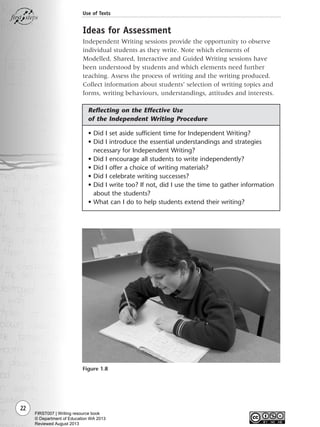
Independent Writing sessions provide the opportunity to observe
individual students as they write. Note which elements of
Modelled, Shared, Interactive and Guided Writing sessions have
been understood by students and which elements need further
teaching. Assess the process of writing and the writing produced.
Collect information about students’ selection of writing topics and
forms, writing behaviours, understandings, attitudes and interests.
• Did I set aside sufficient time for Independent Writing?
• Did I introduce the essential understandings and strategies
necessary for Independent Writing?
• Did I encourage all students to write independently?
• Did I offer a choice of writing materials?
• Did I celebrate writing successes?
• Did I write too? If not, did I use the time to gather information
about the students?
• What can I do to help students extend their writing?
Figure 1.8
Reflecting on the Effective Use
of the Independent Writing Procedure
Writing Resource_chpt 1_FINAL 6/29/06 10:31 AM Page 22
FIRST007 | Writing resource book
© Department of Education WA 2013
Reviewed August 2013
Instructional Procedures for Teaching Writing
23
Author’s Chair
Definition: An opportunity for students to voluntarily share their
writing and receive constructive feedback. (Author’s Chair is also
known as Author’s Circle.)
Description
The focus of Author’s Chair is for students to share their writing
with an audience and receive constructive feedback. They can then
incorporate their peers’ suggestions into their writing.
A special chair is designated as the ‘author’s chair’. A student sits in
the author’s chair and reads a piece of their writing aloud to a group
of peers. The writing should be current, and the group should listen
carefully and respectfully, then respond as critical friends. Each
student in the group thinks of an element of the writing they wish
to comment on or develops a question to ask the author. Students
in the group are asked to be specific about exactly what worked for
them in the writing. Authors are encouraged to respond to the
comments they receive or to reflect upon them.
The teacher’s initial role is to facilitate sessions and guide audience
responses. Model language that is useful for promoting constructive
criticism, such as using ‘I statements’, e.g. I wondered …, I think …,
I could picture …. Model how to ask questions about specific
elements of the writing, e.g. Why did you represent the character in
that way? Several groups can be operating in the classroom at the
same time once students know the procedure; when this happens,
the teacher no longer takes an active part, concentrating instead on
observing and conferring.
Key Features
• Writing is shared with peers.
• Feedback is explicit and constructive.
• Session length: ten to fifteen minutes.
• Can be used at the end of daily writing sessions.
Benefits for Students
Author’s Chair helps students to:
• develop reflective and critical thinking as they talk about their
writing with other writers
• give and receive feedback on writing
• develop active listening skills
• ask effective questions about their peers’ writing
Writing Resource_chpt 1_FINAL 6/29/06 10:31 AM Page 23
FIRST007 | Writing resource book
© Department of Education WA 2013
Reviewed August 2013
24
Use of Texts
• develop a sense of a community of writers
• improve their writing based on constructive feedback
• learn that their ideas are valued
• view themselves as authors who write for an audience and make
choices about their writing
• become perceptive readers and writers as they shift between
author and audience.
Suggestions for Using Author’s Chair
in the Classroom
Planning for Author’s Chair
• Establish a cooperative and caring environment that invites
students to share and respond constructively.
• Designate a special place in the room and a special chair for the
author.
• Model the procedure for Author’s Chair several times with the
whole class before attempting it with small groups. Use a ‘fishbowl’
technique, where students sit around the perimeter of the room
and observe a group trying out the Author’s Chair process. Then
discuss the strengths and weaknesses of the process.
• Decide how many students will participate, e.g. whole class, small
group.
• Select a student to be the author for the session.
Conducting Author’s Chair Sessions
• Review the procedure, if needed.
• The selected author sits in the special chair, reads their writing
and shares any accompanying illustrations or diagrams.
• On the first reading the audience listens respectfully, trying to get
a sense of the piece.
• The author invites the audience to listen as the work is read again
and to focus on a specific feature of the writing.
• The author invites the audience to make comments or suggestions,
and to ask questions about the specific feature of the writing
identified.
• The author can choose to listen to each comment, to respond or to
make notes. A second student could make notes on the discussion
to give to the author at the end, if required.
• The session ends with the author thanking the audience for their
feedback. The author has the final say in accepting or rejecting
any of the suggested changes to their text.
Writing Resource_chpt 1_FINAL 6/29/06 10:31 AM Page 24
FIRST007 | Writing resource book
© Department of Education WA 2013
Reviewed August 2013
Instructional Procedures for Teaching Writing
25
After Author’s Chair
• Gather the class together to reflect on their own involvement in
Author’s Chair. Discuss the successes of the session and any issues
arising from it.
• If needed, schedule an individual conference with the author to
discuss any suggested changes to their writing.
• Encourage all students to apply ideas and suggestions from the
session to their own writing.
• Record useful sentence stems for providing feedback to peers.
Jointly construct cumulative charts of the stems and display them
for future reference.
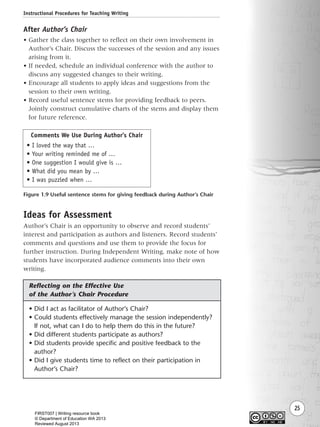
Figure 1.9 Useful sentence stems for giving feedback during Author’s Chair
Comments We Use During Author’s Chair
• I loved the way that …
• Your writing reminded me of …
• One suggestion I would give is …
• What did you mean by …
• I was puzzled when …
Ideas for Assessment
Author’s Chair is an opportunity to observe and record students’
interest and participation as authors and listeners. Record students’
comments and questions and use them to provide the focus for
further instruction. During Independent Writing, make note of how
students have incorporated audience comments into their own
writing.
• Did I act as facilitator of Author’s Chair?
• Could students effectively manage the session independently?
If not, what can I do to help them do this in the future?
• Did different students participate as authors?
• Did students provide specific and positive feedback to the
author?
• Did I give students time to reflect on their participation in
Author’s Chair?
Reflecting on the Effective Use
of the Author’s Chair Procedure
Writing Resource_chpt 1_FINAL 6/29/06 10:31 AM Page 25
FIRST007 | Writing resource book
© Department of Education WA 2013
Reviewed August 2013
26
Use of Texts
Figure 1.10
Writing Resource_chpt 1_FINAL 6/29/06 10:31 AM Page 26
FIRST007 | Writing resource book
© Department of Education WA 2013
Reviewed August 2013
Understanding Different Forms of Writing
27
SECTION 2
Understanding Different
Forms of Writing
What Are the Text Forms?
Each text form has a structure and an organisation that flows from
its purpose, and from its social and cultural context. Because
language is dynamic and fluid, the purpose and shape of different
text forms often merge into one another, e.g. a persuasive argument
presented in a narrative form.
Very few texts written today are ‘pure’, with features that
immediately identify them as having only one purpose. Most texts
are hybrids, because the writer has combined or manipulated forms,
formats, media or modes to suit a particular purpose. Being able to
identify texts by their primary purpose will allow students to take
into account the social and cultural context of the text.
The table below categorises text forms according to their purpose.
Purposes Example of Text Forms
To Describe Report Label Menu
Contents page Index Glossary
Bibliography Blurb Description
To Entertain — Narrative Poem Fable Song lyric
prose and poetry Word Puzzle Joke Fairytale
To Explain Explanation Affidavit Memo
Rules Policy Journal
Timetable Complaint
To Inquire Survey Questionnaire Interview
To Instruct Directions Invoice List
Manual Summons Blueprint
Experiment Recipe
To Persuade Exposition Job application Editorial
Headline Competition entry Slogan
To Recount Autobiography Diary Retell
Review Minutes of meeting Journal
To Socialise Invitation Apology Message
Note Greeting
Figure 1.11 Text Forms and Purposes
Writing Resource_chpt 1_FINAL 6/29/06 10:31 AM Page 27
FIRST007 | Writing resource book
© Department of Education WA 2013
Reviewed August 2013
28
Use of Texts
This section of the First Steps Writing Resource Book will focus on how
to assess students’ control of different text forms. It also provides
information about how to help students understand the purpose,
organisation and language features of common text forms, and to
help them consider how these forms can be shaped and adjusted to
account for variations in context. The goals for all students are to:
• expand the variety of text forms they compose
• enhance the control they exercise over a range of text forms
• adapt, combine and manipulate texts.
Although it is important for students to be continually involved in
composing a range of text forms for different purposes, it is also
appropriate to focus a unit of work on a selected text form. This
might involve students participating in speaking and listening
activities, reading and collecting samples of the text form, analysing
model texts, attending to multiple demonstrations, contributing to
shared demonstrations, listening to Think-Alouds, completing
guided practice activities or creating independent writing across
learning areas.
The following pages contain detailed information about the
assessment and teaching of different forms. They are organised
under eight major social purposes for writing, and will support
teachers in creating a unit of work around a selected form of text.
Each social purpose for writing contains the following support
information:
• Sample text forms
• Type of information included in text forms
• Sample organisational frameworks for a range of text forms
• Language features
• An assessment guide
• Support activities linked to stages of development.
Figure 1.12 illustrates a suggested pathway for using this
information to create a unit of work.
Writing Resource_chpt 1_FINAL 6/29/06 10:31 AM Page 28
FIRST007 | Writing resource book
© Department of Education WA 2013
Reviewed August 2013
Understanding Different Forms of Writing
29
Figure1.12SuggestedPathwayforDevelopingaUnitofWorkforaSelectedForm
Selectaform
fortheunit
ofwork.
Identifythe
purpose.
Usetheguide
providedto
assessstudents’
controlofthe
selectedform.
Determine
astageof
development.
See
FirstSteps
WritingCD-ROM
forrecording
format.
Describe
Entertain
Notyetdisplaying
mostbehavioursat
theBeginningStage
See‘TuningIn’
SupportPagesin
eachPurpose.
Familiarising
Familiarising
Analysing
Modelling
Sharing
Guiding
Applying
SeeBeginningand
DevelopingStages
SupportPagesin
eachPurpose.
SeeConsolidating
andExtendingStages
SupportPagesin
eachPurpose.
BeginningStage
DevelopingStage
ConsolidatingStage
ExtendingStage
Explain
Inquire
Instruct
Persuade
Recount
Socialise
Writing Resource_chpt 1_FINAL 6/29/06 10:31 AM Page 29
FIRST007 | Writing resource book
© Department of Education WA 2013
Reviewed August 2013
Introducing a New Form of Writing
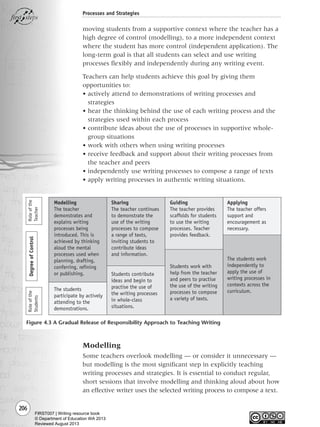
Figure 1.13 is based on The Gradual Release of Responsibility model
(Pearson and Gallagher, 1983). Using this model to introduce any
new form of text will help teachers to plan a balanced unit of work.
This model involves the sequential use of effective teaching
practices to introduce a new form of text. The use of different
teaching practices moves students from a supportive context where
the teacher has a high degree of responsibility for demonstrating
the creation of a text (such as modelling and sharing), to a more
independent context where the student takes on the responsibility
of creating their own text (guiding and applying).
30
Use of Texts
Modelling
The teacher
demonstrates and
explains the
composition of a
selected text form
being introduced.
This is achieved by
‘thinking aloud’ the
mental processes
used when writing
the form.
Familiarising
Studentsareimmersedinorexposedtomultiple
examplesoftheselectedtextforms.
Analysing
Studentsanalysetheorganisationofthetextformand
constructtheirownrulesforcreatingthistypeoftext.
Sharing
The teacher continues
to demonstrate the
composition of the
text form, inviting
students to contribute
ideas and information.
Guiding
The teacher provides
scaffolds for students
to use when composing
texts. The teacher
provides feedback.
Applying
The teacher offers
support and
encouragement,
as needed.
The students
participate by actively
attending to the
demonstrations.
Students contribute
ideas and begin to
collaboratively
compose texts in
whole-class or small-
group situations.
Students work with
help from the teacher
and peers to compose
a selected text form.
The students work
independently to
craft the text form.
Students adapt the
text form to suit
different purposes,
audience and contexts.
The Gradual Release of Responsibility to the Student
Figure 1.13 Introducing a New Form of Text Using a Gradual Release of Responsibility Model
Familiarising
Familiarising is a collective term. It describes the way in which
teachers raise students’ awareness and activate students’ prior
knowledge about a particular form of text. (Familiarising is also
known as immersing or exposing.) When introducing a new text form,
familiarising could involve students discussing, reading, listening to
or viewing samples of the new form. Familiarising is a critical
teaching practice for supporting students’ success in the writing of
a new text form. Teachers can familiarise students with a new text
form in any of the following ways.
Writing Resource_chpt 1_FINAL 6/29/06 10:31 AM Page 30
FIRST007 | Writing resource book
© Department of Education WA 2013
Reviewed August 2013
Understanding Different Forms of Writing
31
1 Sample Displays
Provide opportunities for students to read and view a variety of
examples of the chosen text form. These examples can be collected
from a range of sources, such as magazines, newspapers, brochures,
manuals, comics, catalogues, junk mail, literature, the Internet,
student samples from previous years, reading books used in the
classroom, books students are reading at home, text books from
across learning areas. Encourage students to collect further samples
from real-life contexts and contribute them to the display.
Collections of text forms should be discussed and compared, not
just displayed. The key to the display is to help students build an
awareness of the common features of the selected text form. This
can be done by:
• talking about the purpose, e.g. to entertain, to recount
• identifying the possible intended audience
• drawing attention to the text organisation, e.g. headings,
subheadings
• highlighting the type of language used, e.g. signal words,
adjectives, tense.
2 Reading to and Reading with Students
All writers need to see and hear how other writers compose
particular forms of texts. Students need to be read to, and to have
quality texts available for them to read independently. Students will
benefit from opportunities to discuss the texts read, critically
evaluating how real authors achieve their purpose.
An excellent way for the whole class to discuss and explore
examples of text forms is through shared reading of texts featuring
a specific text form. Students can collaboratively discuss the purpose,
use of the form, content presented, structure and organisation of
the text and the type of language used.
Guided Reading sessions will also provide a forum for teachers to
encourage students, through questioning, to discover the features
of the selected text forms.
3 Other Literacy Activities
A wide range of other literacy experiences will help students build
their text form knowledge. These could include activities such as:
• reconstructing texts that have been cut into individual paragraphs
• highlighting specific language features within a text, e.g. blue for
signal words, yellow for nouns, green for technical vocabulary
• innovating on a text form
Writing Resource_chpt 1_FINAL 6/29/06 10:31 AM Page 31
FIRST007 | Writing resource book
© Department of Education WA 2013
Reviewed August 2013
A variety of experiences across learning areas are suggested under
each writing purpose.
Analysing
Johnson (1988) advocated a problem-solving approach to teaching
writing, an approach that can be used effectively to introduce new
forms of texts. Analysing is the key practice used during a problem-
solving approach, resulting in students ‘discovering’ the framework
of a particular form of text.
Analysing involves students breaking texts into parts to:
• explore the organisation of the text form
• focus on the language features used in the text form
• construct their own rules for writing the text form
• modify and extend their rules in light of further experience.
There are two suggested models for involving students in analysing
text forms. Both models will result in the creation of a possible
organisational framework, list of rules for crafting that form, and
the identification of associated language features.
One-Text Model: one sample of the chosen text form is used.
Multi-Text Model: several samples of the chosen text form are
ranked.
One-Text Model
The One-Text Model involves students exploring one sample of the
chosen text form. Select a text that is an effective model of the form,
then follow these steps.
Step 1: Labelling
The aim of the first step is to arrive at a series of labels that begin
to identify the organisational framework of the text form. It is
important that students can later refer back to these labels, as they
produce their own text.
Discourage generic labels such as ‘Introduction’ or ‘Fact One’, as they
won’t provide much support for students later when they attempt
the text form for the first time. If students provide such generic
terms, have them clarify the label by stating what information has
been included in that part of the text. For example, Introduction
will be more explicit if it is labelled as Who, When, Where, What.
• Read the sample text with the students. Use an enlarged copy,
overhead transparency or big book to make sure that all students
can see the text.
32
Use of Texts
Writing Resource_chpt 1_FINAL 6/29/06 10:31 AM Page 32
FIRST007 | Writing resource book
© Department of Education WA 2013
Reviewed August 2013
Understanding Different Forms of Writing
33
• Work together to decide what each paragraph or section is trying
to achieve. Ask questions that encourage students to decide. For
example:
— What information has been included in this paragraph?
— What is this part of the text telling us? e.g. This part tells us
where the animal lives.
— Why has the author included this section?
• As students decide on the label for each paragraph, attach that
label to the sample text.
Step 2: Language Features
Once the framework is identified, provide time for students to
discuss the language features in the sample text. Students will
require a great deal of support to identify the language features and
use the metalanguage needed to discuss concepts such as verbs,
nouns, pronouns and signal words.
• Ask questions that encourage students to explore the language
features of the text form. For example:
— What adjectives are used?
— What tense is the text written in?
— What linking words are used?
• Attach labels of the language features to the sample text.
Figure 1.14 A Retell with Organisational Framework and Language
Features Labelled
Writing Resource_chpt 1_FINAL 6/29/06 10:31 AM Page 33
FIRST007 | Writing resource book
© Department of Education WA 2013
Reviewed August 2013
34
Use of Texts
Multi-Text Model
The Multi-Text Model of analysing involves students working with
more than one sample of the chosen text form. Students are asked
to rank samples of the text form in terms of effectiveness. Students
then use the information from their discussions about the rankings
to devise ‘rules’ and a framework for writing the selected form.
Step 1: Ranking
Provide students with up to four samples of the selected text form.
For the sake of comparison, it is helpful if the sample texts are
about the same topic.
• Discuss the purpose of the text form and the possible audience.
• Read or have students read each sample.
• Provide time for students to individually rank the samples in
order, from most effective to least effective.
• Have students work in small groups to discuss their rankings, and
to reach consensus about the order. Groups then record the reasons
for their choices.
• Record each group’s rankings.
Step 2: Justification of Ranking
• Direct students’ attention to the text that was ranked as the least
effective. Elicit reasons why this text was ranked as the least
effective; record students’ responses.
• Repeat; this time direct students’ attention to the text that was
ranked as the most effective. Elicit and record students’ reasons
for this ranking of this text.
Figure 1.15 Sample Ranking and Justifications
Writing Resource_chpt 1_FINAL 6/29/06 10:31 AM Page 34
FIRST007 | Writing resource book
© Department of Education WA 2013
Reviewed August 2013
Understanding Different Forms of Writing
35
Step 3: Language Features
• Provide time for students to discuss the key language features of
the text that was ranked most effective.
• Record the key language features with the justification
information above.
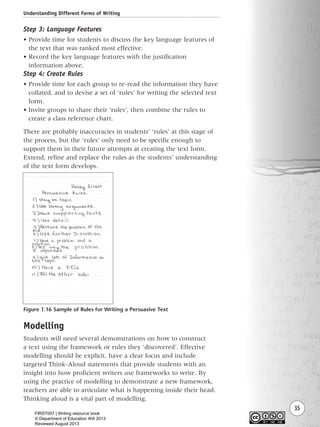
Step 4: Create Rules
• Provide time for each group to re-read the information they have
collated, and to devise a set of ‘rules’ for writing the selected text
form.
• Invite groups to share their ‘rules’, then combine the rules to
create a class reference chart.
There are probably inaccuracies in students’ ‘rules’ at this stage of
the process, but the ‘rules’ only need to be specific enough to
support them in their future attempts at creating the text form.
Extend, refine and replace the rules as the students’ understanding
of the text form develops.
Modelling
Students will need several demonstrations on how to construct
a text using the framework or rules they ‘discovered’. Effective
modelling should be explicit, have a clear focus and include
targeted Think-Aloud statements that provide students with an
insight into how proficient writers use frameworks to write. By
using the practice of modelling to demonstrate a new framework,
teachers are able to articulate what is happening inside their head.
Thinking aloud is a vital part of modelling.
Figure 1.16 Sample of Rules for Writing a Persuasive Text
Writing Resource_chpt 1_FINAL 6/29/06 10:31 AM Page 35
FIRST007 | Writing resource book
© Department of Education WA 2013
Reviewed August 2013
36
Use of Texts
The Modelled Writing procedure allows students to observe and
clarify their knowledge and understandings of the framework.
Before expecting students to apply their new learning, make sure
that they have been actively involved in several demonstrations on
how to use the framework.
Modelling sessions need to be carefully planned and thought out.
It is more effective to think through what needs to be modelled and
where in the text that might happen, than to make spontaneous
comments as the text is being written.
Display the texts composed during modelling sessions; this will allow
students to use them as examples when they are composing their
own texts.
Sharing
Follow the analysing and modelling sessions with many sharing
sessions, as sharing the accomplishment of a writing task is a
cooperative and supportive way of engaging students. These sessions
typically follow the procedure of Shared or Interactive Writing.
During the sharing sessions, it’s critical that teachers continue to
choose one specific focus to highlight.
Guiding
Guiding is a teaching practice that involves the teacher explicitly
scaffolding a writing task. Guiding sessions provide continued
support for students during their early stages of controlling a new
form of text. The student maintains control, but is able to request
assistance at any point.
Support for students can be provided in a number of ways:
• Allowing students to work with others to compose a text.
• Providing planning formats.
• Breaking the task into manageable parts.
• Providing practice on specific elements relevant to the form.
• Providing strategic assistance at key points.
• Creating opportunities to practise different forms across learning
areas. Teachers can consider which learning areas might provide
suitable contexts for writing different forms. A sample ‘Writing
Across Learning Areas’ planning format is provided on the First
Steps Writing CD-ROM.
Writing Resource_chpt 1_FINAL 6/29/06 10:31 AM Page 36
FIRST007 | Writing resource book
© Department of Education WA 2013
Reviewed August 2013
Understanding Different Forms of Writing
37
Applying
Applying refers to the context and purpose of writing. Such writing
tasks are whole and focused, with a purpose and audience, and
generally involve the student independently creating texts and
making ongoing decisions. During Independent Writing time,
students have the opportunity to apply and manipulate what they
have learnt about text forms to suit different purposes and
audiences. Access to teacher advice is not denied, but neither is it
planned or structured in a way that indicates reliance.
The ultimate goal is for students to function in society as literate
individuals who can use writing to communicate their ideas, share
information, stimulate thinking, formulate questions and influence
policy and action.
Writing Resource_chpt 1_FINAL 6/29/06 10:31 AM Page 37
FIRST007 | Writing resource book
© Department of Education WA 2013
Reviewed August 2013
Understanding Texts That Describe
In texts that describe, information is systematically organised and
recorded to classify and describe a whole class of things, e.g.
computers, lions, Life on the Victorian Goldfields. Texts that describe
can be text forms in their own right, such as reports, menus or
travel brochures. They can also be part of other overall texts, e.g.
indexes, glossaries, labels, descriptions and contents pages.
The following information is usually included in texts used to
describe.
1 Classification or Generalisation
This may take the form of a heading, e.g. Main Courses, or a
definition of the subject, e.g. Computers are programmable electronic
devices. This part of the text can also refer to the specific topic to be
described, e.g. Lions are one of the many carnivorous mammals that
inhabit the plains of Africa.
38
Use of Texts
Social Purpose: Writing to Describe
Figure 1.17 Samples of Texts Used to Describe
Writing Resource_chpt 1_FINAL 6/29/06 10:31 AM Page 38
FIRST007 | Writing resource book
© Department of Education WA 2013
Reviewed August 2013
Understanding Different Forms of Writing
39
2 Description
Provides a detailed description of various components of the topic.
These components are sequenced in a specific way, depending on
the text topic.
3 Concluding or Summarising Statements
May include an impersonal evaluative comment.
Organisational Frameworks
The information above is included in most texts used to describe;
however, the organisational framework used to construct each text
will vary, depending on the form and topic.
Purpose: To Describe
Form: Geographic Report
CONCLUDING OR
SUMMARISING STATEMENT
• impersonal evaluative
comment
CLASSIFICATION OR
GENERALISATION
• classification
DESCRIPTION
Includes facts about:
• location
• geography
• government
• special characteristics
• people
Purpose: To Describe
Form: Scientific Report
CONCLUDING OR
SUMMARISING STATEMENT
• impersonal evaluative
comment
CLASSIFICATION OR
GENERALISATION
• scientific name
DESCRIPTION
Includes:
• what it looks like
(physical description)
• what it eats
• where it lives
(habitat)
• special features
Writing Resource_chpt 1_FINAL 6/29/06 10:31 AM Page 39
FIRST007 | Writing resource book
© Department of Education WA 2013
Reviewed August 2013
40
Use of Texts
Language Features
Texts used to describe usually include these language features:
• Nouns and pronouns that refer to generalised participants, e.g.
lions, computers, they, it.
• Timeless present tense, e.g. are, have, exists, grows.
• Action verbs (behaviours), e.g. runs, hunts, erupts.
• Adjectives that are factual and precise, e.g. 5.6 megabytes, sandy
coloured.
• Technical vocabulary, e.g. marsupials, monotremes, information
processing system.
• Formal objective style, i.e. first-person pronouns and the writer’s
opinions are not generally appropriate.
• Signal words for classifying, defining, comparing and contrasting,
e.g. are called, belong to, are similar to, are more powerful than.
Adapted from Derewianka, B. (1990)
CONCLUDING OR
SUMMARISING STATEMENT
• not applicable to
this form
Purpose: To Describe
Form: Menu
CLASSIFICATION OR
GENERALISATION
• heading of each
section
Figure 1.18 Framework Samples from Texts Used to Describe
DESCRIPTION
Includes:
• description of each
item
• price
Writing Resource_chpt 1_FINAL 6/29/06 10:31 AM Page 40
FIRST007 | Writing resource book
© Department of Education WA 2013
Reviewed August 2013
Understanding Different Forms of Writing
41
Thewriter:
•sharesinformationaboutaknowntopic
•writesanobservationandcomment
•focusesonaspecificpartofawholeclass
ofthings,e.g.‘Mycateatsmeat’not
‘Catseatmeat’.
•describesfeaturesthatarenotnecessarily
importantorrelevant
•groupssimilarinformationtogether
•writesaconcludingstatementthatisa
personalcommentratherthanasummary,
e.g.Ilikecats.
•usespersonalorsubjectivelanguage,e.g.
‘Ireallylike...’
•usessimplevocabulary,e.g.big,little
•usesalimitedrangeofsignalwords,e.g.
and
Thewriter:
•provideslimitedfactualinformationabout
agiventopic
•usesalimitedrangeofformsandformats,
e.g.report,chart
•introducesthetopicbyprovidinga
classificationthatmaylackprecision,
e.g.Dogsareanimals.
•giveslimitedgeneralinformation,
e.g.size,colour,habitat
•includesinformationunderheadings
•writesaconcludingstatementwithsome
attempttosummarisewhathasbeen
written
•isbeginningtouseobjectivelanguage
•usessometechnicalorsubject-specific
vocabulary
•isbeginningtousetimelesspresenttense
e.g.are,hunt
•usessimplewordstosignalcompareand
contrast,e.g.like,asbigas…
Thewriter:
•providesdetailedfactualinformation
aboutagiventopic
•usesavarietyofformsandformats,e.g.
description,slideshow,encyclopaedia
entry
•introducesthetopicbyprovidingaprecise
classificationorgeneralisation
•includesdetailsthatareclearlyrelatedto
thetopicandelaboratesonspecial
features
•groupsrelatedinformationintoparagraphs
introducedbyatopicsentence
•writesasummaryorconcludingparagraph
thatreiteratesthekeypointsandmay
includeanevaluativecomment,e.g.This
inventionwillchangethecourseofhistory.
•maintainsobjectivelanguagethroughout
•usestechnicalandsubject-specific
vocabularyappropriately
•usestimelesspresenttense,e.g.fly,live,
suckle
•usesappropriatesignalwordstocompare,
contrast,defineandclassify,e.g.are
similarto,belongto
Thewriter:
•providesinformationthatisselected,
sortedandsynthesised
•adaptsformsandformatsforatarget
audience
•writesanintroductionthatsuccessfully
classifiesorgeneralisesinformation
essentialtothesubjectortopic
•includesdetailedinformationselected
becauseofitsrelevancetothesubjector
topic
•organisesinformationintoparagraphsthat
linkcohesivelytocomposeacoherenttext
•writesaconcludingparagraphthat
accuratelysummarisesthemainpoints
•usesformalobjectivestyletosuitpurpose
andaudience,e.g.humanityfaces
increasing...,thefamilyis...
•choosesprecisetechnicalandsubject
specificlanguagetosuitpurposeand
audience,e.g.carnivorous,mammals,
pollutants
•maintainsconsistentuseoftense
throughout
•writescohesivelyusingawiderangeof
signalwordstocompare,contrast,define
andclassify,e.g.morepowerfulthan,
nevertheless
FocusonAssessing
BeginningStage
Canstatethepurposeandaudienceof
textstobecomposedandincludes
basicorganisationalfeaturesofsimple
formsusedtodescribe.
DevelopingStage
Isawareofthepurposeandaudience
whencomposingtextsandusesa
partialorganisationalframeworkofa
smallrangeofformsusedtodescribe.
ConsolidatingStage
Considersthepurposeandaudienceto
selectspecificvocabularyanduses
appropriateorganisationalframeworks
tocomposeavarietyofformsusedto
describe.
ExtendingStage
Craftsformsusedtodescribeby
selectingvocabularyandmanipulating
organisationalframeworkstosuitthe
contextofthewritingevent.
AssessingWritingtoDescribe
Studentsareinthestagewheretheydisplaymostofthebulletedpoints.
Familiarising,Analysing,Modelling,Sharing,GuidingandApplying
Seepages30–37and43–45
Familiarising,Analysing,Modelling,Sharing,GuidingandApplying
Seepages30–37and46–47
Focuson
Teaching
Figure1.19AssessmentGuideforWritingtoDescribe
Writing Resource_chpt 1_FINAL 6/29/06 10:31 AM Page 41
FIRST007 | Writing resource book
© Department of Education WA 2013
Reviewed August 2013
Supporting Students at the Tuning-In Stage
This section provides ideas for supporting students who have not
yet reached the Beginning stage on the Writing to Describe
Assessment Guide (Figure 1.19).
Focus on building students’ awareness of the language features and
organisational frameworks of the form being introduced. The
following familiarising activities are suited to any form associated
with writing to describe.
1 Sample Displays see page 31
2 Reading with and Reading to Students see page 31
3 Literacy Activities
• Provide plenty of oral language activities. Give students
opportunities to focus on the language used to describe the
attributes of objects, e.g. Show and Tell, Barrier Games, picture talks.
Encourage students to consider questions such as:
— What is it called?
— What kind of thing is it?
— What does it look like?
— What noise does it make?
— Where is it found?
• Work together to build descriptive Word Webs around familiar
topics, e.g. chickens.
42
Use of Texts
Figure 1.20 Sample Word Web
fluffy
yellow
white
chickens
chirp
cheep
lay eggs
feathers
two legs
beak
hens
roosters
— What does it do?
— What special features does it have?
— What is it similar to?
— What is it different from?
• Play oral games, such as Who Am I?, What Am I?, I Spy, True or
False. Each game involves one student orally describing a person
or object, while other students try to guess who or what is being
described.
• Focus students’ attention on the language used to describe people,
characters, objects and places when the class is reading literary
and informational texts. Discuss words that indicate who or what
is being described. Record the descriptive words on a chart for
future reference.
Writing Resource_chpt 1_FINAL 6/29/06 10:31 AM Page 42
FIRST007 | Writing resource book
© Department of Education WA 2013
Reviewed August 2013
Understanding Different Forms of Writing
43
• Create meaningful contexts for displaying models of texts used
to describe, e.g. a science table with labelled exhibits, labels on
storage cupboards, descriptions of each student in the classroom.
• Play Definition Games where students are challenged to match
technical and subject-specific vocabulary to definitions, e.g. an
animal that suckles its young — mammal.
Supporting Students at the Beginning and
Developing Stages
The main focus for these students is to help them understand the
purpose, organisation, structure and language features of the text
form being introduced.
Modelling and Sharing
The following modelling and sharing suggestions are separated into
two stages; the first is specific to the Beginning Stage, and the second
is more relevant to students in the Developing Stage. However, the
suggestions should be seen as cumulative. When selecting a focus
for the Developing Stage, teachers should also consider what is
listed in the previous stage.
Beginning Stage
Focus on understandings of text organisation, structure and language features. During Modelled, Shared
and Interactive writing sessions demonstrate how to:
• collect information about a chosen topic
• decide on appropriate headings to organise
the text
• sort information under headings, e.g. food,
habitat, appearance, offspring
• introduce the topic
• write a concluding statement that summarises
the key points
• use objective language
• use subject specific and technical vocabulary
to provide more specific information, e.g. A
kangaroo is a marsupial.
• use signal words that compare and contrast
• use timeless present tense, e.g. The Dall
Porpoise has small flippers.
Developing Stage
• select information appropriate to the audience
• include details that are relevant to the topic
and audience
• select special features and elaborate on them
• introduce the topic by providing a precise
classification or generalisation
• list references used
• choose language that is objective
• include illustrations and diagrams to enhance
the writing, e.g. tables, graphs, charts, maps
• use signal words that compare, contrast, define
and classify
• combine paragraphs to build a description
of the topic.
Figure 1.21 Suggested Focus for Modelling and Sharing Sessions
Writing Resource_chpt 1_FINAL 6/29/06 10:31 AM Page 43
FIRST007 | Writing resource book
© Department of Education WA 2013
Reviewed August 2013
44
Use of Texts
Guiding
The following guided-practice activities are suitable for students in
the Beginning and Developing Stages, allowing them to build their
understandings about texts used to describe. Each activity should be
used in a meaningful context across different learning areas.
Word Webs
Have students construct Word Webs when they are collating facts
or key words about a topic. Provide opportunities for students to
take related facts and make them into one or more sentences.
Building Vocabulary
Have students brainstorm adjectives, technical terms and subject-
specific vocabulary related to the current topic. Display these words
in the classroom so that students can use them as a reference.
What Do You Want to Know?
Have students list everything they want to know about a specific
topic, leaving a line between each item on their list. Invite them to
share their list with a partner or small group to gather further
suggestions. Have students cut their lists into strips, organise them
into categories, then create a suitable heading for each category,
e.g. habitat, lifestyle, what it looks like. Students can then use their
personalised frameworks as a springboard for writing.
Guess What?
Students write several sentences to describe a common object,
e.g. This object was invented by Alexander Graham Bell as a means of
communication. In recent times they have become multimedia tools,
allowing photos to be taken. Encourage them to use detailed
descriptions and subject-specific language. Students then swap with
a partner who attempts to identify the object described.
Ask the Expert
Invite an expert to visit your classroom and speak on a topic that
is being studied, e.g. the zoo keeper in charge of orang-utans. Have
students prepare their questions prior to the talk to ensure that the
expert provides the information they want to know. This activity
could also be used with individual students acting as the ‘expert’
in an area of interest.
Writing Resource_chpt 1_FINAL 6/29/06 10:31 AM Page 44
FIRST007 | Writing resource book
© Department of Education WA 2013
Reviewed August 2013
Understanding Different Forms of Writing
45
Fact and Opinion
Provide small groups of students with a list of facts and opinions
about a specific topic. Have students discuss whether each written
statement is a fact or an opinion. Encourage students to identify the
vocabulary that indicates the difference.
Reporting the Essentials
Read students a text that describes facts about a topic being studied.
Have students record the key facts in diagrammatic form, e.g. Venn
diagram, tree diagram, mapping. Students can then use their
diagrams as springboards for writing, or as a stimulus for further
investigation of the topic.
Technical Terms
Students brainstorm a list of technical terms and subject-specific
words related to a chosen topic, then find definitions for any words
they don’t know. Encourage them to use the list-words in their
writing.
Referencing
Have students reference any texts they refer to in researching their
topic. Listing the author and the text title may be sufficient at the
Beginning and Developing Stages.
Glossary
Have students choose subject-specific words or technical terms
related to the current topic of study and use them to construct a
class glossary. Have students write their definitions of the terms,
then use references to find out if their definition is correct or needs
amending. Correct words and definitions can then be added to the
class glossary for future reference.
Across Learning Areas
Provide across learning areas opportunities for students to compose
texts used to describe, e.g.
Health and Physical Education Menu of healthy foods.
Society and Environment Report about a country.
Technology and Enterprise Labelled diagram of a model.
Science Scientific report about animals.
The Arts Contents page for a text on musical
instruments.
Writing Resource_chpt 1_FINAL 6/29/06 10:31 AM Page 45
FIRST007 | Writing resource book
© Department of Education WA 2013
Reviewed August 2013
46
Use of Texts
Supporting Students at the Consolidating
and Extending Stages
The main focus for these students is to help them to enhance their
control over the text form, including their ability to adapt and
manipulate the text.
Modelling and Sharing
When selecting a focus for the Consolidating and Extending Stages,
teachers should also consider what is listed in previous stages.
Focus on continuing to build students’ understandings of text
organisation, structure and language features, by demonstrating
how to:
• organise information to form a coherent text
• write a concluding paragraph that accurately summarises the
main points
• include references when appropriate
• include texts such as a table of contents, index or glossary within
other texts
• maintain consistent use of tense
• add illustrations, photographs, diagrams and labels that match
and enhance the writing
• select technical and subject-specific language appropriate to the
audience
• use objective language appropriate to the audience.
Guiding
The following guided-practice activities are suitable for students in
the Consolidating and Extending Stages, to further develop their
understandings about texts used to describe. Each activity should be
used in a meaningful context across different learning areas.
Vocabulary Development
Have students brainstorm vocabulary related to a specific topic.
Provide time for students to separate their words into subject-specific
language, e.g. primrose, and everyday language, e.g. flower.
Encourage them to research technical terms for selected words,
e.g. genus Primula.
A Picture is Worth 1000 Words
Have students look at a range of texts used to describe. Discuss how
photographs, illustrations, diagrams and maps have been included
to enhance the text. Encourage students to refine their own writing
by adding illustrations, photographs, maps or diagrams.
Writing Resource_chpt 1_FINAL 6/29/06 10:31 AM Page 46
FIRST007 | Writing resource book
© Department of Education WA 2013
Reviewed August 2013
Understanding Different Forms of Writing
47
Rapid Research
Invite small groups of students to select a topic of interest, e.g.
Sydney Harbour Bridge, mountain bikes. Encourage groups to gather
as many facts as they can in an allotted time, then have each group
report their findings to the class. Later, have students use the
assembled facts as the basis for writing texts that describe.
Who is the Audience?
Provide students with a text used to describe, e.g. a report. Ask
students to read the text and discuss who is the intended audience.
Jointly highlight those words that indicate the intended audience.
Allocate a new audience to each small group and provide time for
them to make necessary changes, e.g. add more details, simplify the
language. Have each group share their new audience and their new
text with the class.
Add the Missing Piece
Select an appropriate text used to describe, then delete the
conclusion or introduction. Have students work in small groups to
compose the missing piece. Provide time for students to compare
the piece they have written with other students’ ‘missing pieces’
and with the original text.
Citing References
Provide opportunities for students to discover how various
information sources are referenced in different ways e.g. website,
journal article, book. Encourage students to cite their references
when they create texts.
Across Learning Areas
Provide opportunities across learning areas for students to compose
texts used to describe, e.g.
Society and Environment Description of a landform.
Technology and Enterprise Index for a report about robots.
Mathematics Glossary to describe mathematical
terms.
Science Description of a specific plant.
The Arts Report on a period in art history.
Writing Resource_chpt 1_FINAL 6/29/06 10:31 AM Page 47
FIRST007 | Writing resource book
© Department of Education WA 2013
Reviewed August 2013
Social Purpose: Writing to
Entertain — Poetry
48
Use of Texts
Figure 1.22 Samples of Poetry Texts Used to Entertain
Understanding Texts That Entertain — Poetry
Fiction is a generic term given to a range of texts that seek to
entertain the reader, and includes poetry and prose. Poetry is a way
of manipulating and arranging words to create unique perspectives
of the world. The writer (or poet) combines words and images in
order to share personal thoughts and feelings about a subject.
Lines of poetry are usually short and concise. Writing poetry
requires the writer to be selective in choosing words that capture
their intended meaning.
Writing Resource_chpt 1_FINAL 6/29/06 10:32 AM Page 48
FIRST007 | Writing resource book
© Department of Education WA 2013
Reviewed August 2013
Understanding Different Forms of Writing
49
Figure 1.23 A Sample of Poetry Frameworks
Haiku
A Haiku is a form of Japanese poetry consisting of three
lines. Each line has a specific number of syllables.
1st line: 5 syllables, and tells where
2nd line: 7 syllables, and tells what
3rd line: 5 syllables, and tells when
Lantern Poem
This five-line poem is written in
the shape of a Japanese lantern.
Each line is limited by a specific
number of syllables.
1st line: 1 syllable
2nd line: 2 syllables
3rd line: 3 syllables
4th line: 4 syllables
5th line: 1 syllable
Cinquain
A cinquain is a poem derived from the haiku
and tanka forms. It consists of five lines,
each with a specific number of words.
A cinquain doesn’t rhyme.
1st line: one word (title)
2nd line: two adjectives
3rd line: three verbs
4th line: 4 words to describe a feeling
5th line: one word (refers to the title)
Acrostic Poems
In this form of poetry, the letters of the
topic are written vertically. Each letter of the
topic word therefore forms the first letter of
the word beginning each line. Some acrostic
poems use only single words for each line
while others use a phrase. Acrostic poems
can be rhymed or unrhymed.
List Poem
As the name suggests, a list poem is a list of
items written down the page. These can be
lists of single items, lists of phrases or a
combination of both. These poems can be
rhymed or unrhymed.
Poetry, in its broadest sense, cannot be described in generic terms,
even though some poems conform to specific structures, such as
haiku, limericks, cinquains and sonnets. The variation possible in
the organisation and structure of a poem is part of the essence of
poetry.
Organisational Frameworks
There are many different forms of poetry, and each form has its
own distinctive organisational framework. The following examples
provide a snapshot of some of the most common forms.
Writing Resource_chpt 1_FINAL 6/29/06 10:32 AM Page 49
FIRST007 | Writing resource book
© Department of Education WA 2013
Reviewed August 2013
50
Use of Texts
Diamantes
A diamond poem usually consists of seven lines. Lines one and seven are antonyms.
1st line: a one-word noun
2nd line: two adjectives to describe the noun
3rd line: three verbs that the noun does
4th line: four nouns that are things that the noun in line 1 and the noun in line 7 both have
5th line: three verbs that the noun in line 7 does
6th line: two adjectives that describe the noun in line 7
7th line: a one-word noun that is the opposite of line 1.
Limerick
A limerick is a humorous poem of five lines.
The poem is constrained by both the rhythm
and the rhyme.
In a limerick, the first and second lines
rhyme. The third and fourth lines (which are
shorter than the first two) rhyme, and the
fifth line rhymes with lines one and two. This
is called an AABBA rhyming pattern.
Most limericks are also constrained by syllabic
structures. For example:
1st line: 9 syllables
2nd line: 9 syllables
3rd line: 5 syllables
4th line: 5 syllables
5th line: 9 syllables
Sonnet
A sonnet is a poem of fourteen lines. The
English or Shakespearean sonnet begins with
three quatrains and finishes with a couplet.
The rhyming pattern is usually
ABABCDCDEFEFGG.
Most sonnets have a definite rhythm.
Free Verse
Free verse has no set conventions for
punctuation or structure. These poems need
not rhyme or have a distinctive rhythm. The
lines need not scan or conform to any
pattern. Words used should be those that
evoke strong images, moods and emotions.
Concrete (Shape) Poems
These poems use words and the physical formation of those words to convey meaning. This may be
done with colour, the shape of the letters or the arrangement of the words. The meaning of the
poem can be enhanced by manipulating the size, direction and placement of words and lines.
Couplets and Triplets
Couplets and triplets are, respectively, two-
and three-line poems. In this type of poetry,
the lines rhyme and contain the same number
of syllables, or have the same metre.
Tanka
A tanka is a form of Japanese poetry that
consists of five lines, each line constrained by
a specific number of syllables.
1st line: 5 syllables
2nd line: 7 syllables
3rd line: 5 syllables
4th line: 7 syllables
5th line: 7 syllables
Writing Resource_chpt 1_FINAL 6/29/06 10:32 AM Page 50
FIRST007 | Writing resource book
© Department of Education WA 2013
Reviewed August 2013
Understanding Different Forms of Writing
51
Language Features
Texts used to entertain through poetry usually include the
following language features:
• Nouns and verbs that refer to specific objects, events, emotions,
things or actions.
• Adjectives and adverbs that are more imaginative than factual
and precise, e.g. glistening, harmonious, rebelliously.
• Literary devices such as:
— alliteration: the repetition of consonant sounds, usually at the
beginning of words, to create effect
— assonance: the repetition of vowel sounds, e.g. Ousted from the
house …
— onomatopoeia: words that sound like the item being described
— imagery: the creation of likenesses through order and word choice
— simile: comparison of two items, made explicit by using ‘as’ or ‘like’
— metaphor: an implicit comparison between two items that are
not normally connected
— personification: using human characteristics to describe abstract
concepts and natural phenomena
— hyperbole: an obvious exaggeration used for effect
— symbolism: symbols used to represent feelings or objects
— rhetorical question: a question to which an answer is not expected
— rhyme: words that match in sound
— rhythm: the beat represented by stressed and unstressed syllables
— repetition: repeating words and phrases for effect.
Villanelle
A Villanelle is a French poem that consists of
19 lines, arranged in six stanzas.
The first five stanzas contain three lines and
rhyme in the pattern ABA.
The sixth stanza consists of a quatrain with a
rhyming pattern of ABAA.
In addition to the rhyming pattern, the first
and third lines alternatively repeat throughout
the poem, and are repeated as the last two
lines of the final quatrain.
Clerihew
Named after the British writer,
Edmund Clerihew Bentley, these short
humorous verses consist of two
rhyming couplets. Clerihews are
written about people and the person’s
name generally serves as one of the
rhymes. The first line usually ends
with the person’s name. The second
line ends with a word that rhymes
with the name.
Quatrain
A quatrain is a poem of four lines that rhymes in one of four ways. The rhyming patterns
for a quatrain are: AABB, ABAB, ABCB or ABBA.
Figure 1.23 Samples of Poetry Frameworks
Writing Resource_chpt 1_FINAL 6/29/06 10:32 AM Page 51
FIRST007 | Writing resource book
© Department of Education WA 2013
Reviewed August 2013
52
Use of Texts
Thewriter:
•writessimplepoemsthatinnovateona
givenstructure
•innovatesonagivenpattern,e.g.
Ilike…,Ilike….,Ilike.
•chooseswordsbasedonpersonalchoice
•attemptstousesimpleliterarydevices,
suchasalliteration
•givesmissingrhymingwordtocomplete
asimplerhyme,e.g.Isawafish,sitting
ona…..
Thewriter:
•writessimplerhymingandnon-rhyming
poemsoftenchoosinginappropriatewords
forthecontext
•experimentswitharangeofknownpoetry
forms,e.g.rhymingcouplets,freeverse
•isbeginningtoobservestructural
constraintsofdifferenttypesofpoetry,
e.g.rhymingcoupletshavetwolines
•isbeginningtoselectappropriatewords
toconveymeaning
•beginstousesomeliterarydevices,
althoughtheymaynotbeappropriatefor
thecontext
•whenappropriate,usesasimplerhyming
pattern,e.g.rhymingcouplets,ABAB
pattern
•isunabletomaintainrhythmicpatternin
ownpoetry
Thewriter:
•writesusingstructureofpoetrywithout
regardforpersonalvoice
•writespoetryinarangeofforms,e.g.
haiku,cinquains,shapepoems,limerick,
rap
•knowsandadherestostructural
constraintswhennecessary,e.g.syllable
patternsincinquains,haiku
•selectsspecificwordstoenhance
meaning,e.g.specificnouns,appropriate
adjectivesandadverbs
•usesliterarydevicesalthoughtheymay
seemcontrived
•whenappropriate,usesanexplicitrhyming
patternthathasbeenexplored,e.g.
limerick
•choosesknownrhythmicpatternsto
composeownpoetry
Thewriter:
•writesarangeofpoeticformsexpressing
complexconceptsincreativeways
•writespoetryinarangeofcomplexforms,
e.g.ballads,sonnets,odes
•chooseswhethertoconformormanipulate
structureforeffectandimpact
•selectswordsthatvividlyandprecisely
conveyimages,feelings,moodandtone
•choosestouseawiderangeofliterary
devices,e.g.metaphor,simile
•writesusingcomplexrhymingpatternsbut
choosestobefreedfromtheconstraints
ofrhymewhennecessary
•createsrhythmicpatternsforeffect,e.g.
wordssoundinglikeahorsegalloping
FocusonAssessing
BeginningStage
Canstatethepurposeandaudienceof
textstobecomposedandincludes
basicorganisationalfeaturesofsimple
formsusedtoentertainthroughpoetry.
DevelopingStage
Isawareofthepurposeandaudience
whencomposingtextsandusesa
partialorganisationalframeworkofa
smallrangeofformsusedtoentertain
throughpoetry.
ConsolidatingStage
Considersthepurposeandaudienceto
selectspecificvocabularyanduses
appropriateorganisationalframeworks
tocomposeavarietyofformsusedto
entertainthroughpoetry.
ExtendingStage
Craftsformsusedtoentertainthrough
poetrybyselectingvocabularyand
manipulatingorganisationalframeworks
tosuitthecontextofthewritingevent.
AssessingWritingtoEntertain—Poetry
Studentsareinthestagewheretheydisplaymostofthebulletedpoints.
Familiarising,Analysing,Modelling,Sharing,GuidingandApplying
Seepages30–37and54–57
Familiarising,Analysing,Modelling,Sharing,GuidingandApplying
Seepages30–37and58–60
Focuson
Teaching
Figure1.24AssessmentGuideforAssessingWritingtoEntertain—Poetry
Writing Resource_chpt 1_FINAL 6/29/06 10:32 AM Page 52
FIRST007 | Writing resource book
© Department of Education WA 2013
Reviewed August 2013
Understanding Different Forms of Writing
53
Supporting Students at the Tuning-In Stage
This section provides ideas to support students who have not yet
reached the Beginning stage on the Writing to Entertain — Poetry
Assessment Guide (Figure 1.24).
Focus on building students’ awareness of the language features
and organisational frameworks of the form being introduced. The
following familiarising activities are suited to any form associated
with writing to entertain—poetry.
1 Sample Displays see page 31
2 Reading to and Reading with Students see page 31
3 Literacy Activities
• Provide opportunities for students to read and recite rhymes,
poems, raps and chants.
• Encourage students to create actions to accompany familiar rhymes.
• Encourage students to retell or recite favourite poems for a
variety of audiences.
• Encourage students to join in with familiar parts or repetitive
refrains from known poems.
• Provide opportunities for students to reconstruct poems that have
been cut into individual stanzas. Invite them to share their
reasoning behind the final order.
• Talk about the purpose of writing poetry.
• Display charts of poems in the classroom. Model how to use these
charts as a resource, and provide opportunities to read the poem
charts on a regular basis.
• Provide opportunities for students to prepare Readers’ Theatre for
a familiar poem.
• Have a class poetry festival. Invite students to display or recite
their favourite poems.
• Encourage students to explore patterns of rhyme and rhythm by
reading poetry aloud. Discuss the difference between rhyme and
rhythm.
• Invite a poet to visit the classroom and read their poetry.
• Listen to poems on tape, CD or Internet sites.
• Highlight some of the literary devices used by poets.
• Involve students in brainstorming and charting descriptive words to
describe unique characteristics of objects, events, people or feelings.
• Introduce students to the terminology of poetry. This could include
generic terms such as rhyme, rhythm and alliteration, or specific
terms such as haiku, limerick and cinquain.
Writing Resource_chpt 1_FINAL 6/29/06 10:32 AM Page 53
FIRST007 | Writing resource book
© Department of Education WA 2013
Reviewed August 2013
54
Use of Texts
• Have students create word association webs, e.g. sky: planes,
clouds, rain, wind, flight, azure, clear, up and away
• Jointly create and display collections of interesting words, such as:
— words starting with the same sound
— words ending with the same sound
— words that describe the senses
— words that sound interesting, e.g. shemozzle, murmur, smidgin
— words for special purposes, e.g. people words, country words,
happy words
— words that are various parts of speech.
• Write a familiar poem or rhyme on a chart. Invite students to
identify words in the poem that could be replaced, then work
together to brainstorm a list of ‘replacement’ words. Write the
replacement words on cards and store them in a container near
the chart. Provide time for students to compose new poems by
placing replacement word cards over some of the poem’s original
words. Read the new poem aloud.
• Play word games and activities that use rhyme, e.g. Snap, Bingo,
Fish, Concentration.
• Involve students in activities to develop an awareness of rhythm,
such as:
— using students’ names to clap out syllables
— using percussion instruments to tap out the rhythm when
singing or reciting familiar rhymes
— using physical responses to demonstrate the rhythm,
e.g. snapping fingers, clapping, stomping feet.
• Involve students in text innovations involving familiar or
favourite poems.
• Compile students’ favourite rhymes to make a class big book;
encourage students to read the book for pleasure.
Supporting Students at the Beginning
and Developing Stages
The main focus for these students is to help them understand the
purpose, organisation, structure and language features of the text
form being introduced.
Writing Resource_chpt 1_FINAL 6/29/06 10:32 AM Page 54
FIRST007 | Writing resource book
© Department of Education WA 2013
Reviewed August 2013
Understanding Different Forms of Writing
55
Modelling and Sharing
The following modelling and sharing suggestions are separated into
two stages; the first is specific to the Beginning Stage, and the second
is more relevant to students in the Developing Stage. However, the
suggestions should be seen as cumulative. When selecting a focus
for the Developing Stage, teachers should also consider what is
listed in the previous stage.
Figure 1.25 Suggested Focus for Modelling and Sharing Sessions
Beginning Stage
Focus on understandings of text organisation, structure and language features.
During Modelled, Shared and Interactive writing sessions, demonstrate how to:
• write structured poetry, e.g. cinquain, acrostic
• write rhyming patterns, e.g. couplets
• write free verse
• create the ‘message’ or meaning of the poem
rather than the mechanics
• generate rhyming words
• select appropriate words to convey meaning
Developing Stage
• write a range of poetry, e.g. tanka, haiku
• use more sophisticated rhyming patterns,
e.g. limerick, quatrains
• apply the structural constraints when writing
different forms of poetry, e.g. lantern poems have
five lines
• choose specific words to enhance meaning
• use literary devices, e.g. onomatopoeia
• write rhythmic patterns
Guiding
The following guided-practice activities are suitable for students in
the Beginning and Developing Stages, allowing them to build their
understandings about texts used to entertain through poetry. Each
activity should be used in a meaningful context across different
learning areas.
The Minister’s Cat
During this game, each player repeats a sentence stem, ‘The
minister’s cat is a … cat and his/her name is …’. The first student begins
with the letter A, adding an adjective to the first space in the
sentence and adding a name for the cat to the second space, e.g.
‘The Minister’s cat is an angry cat and his name is Anthony’. The next
student repeats the sentence stem but adds words that begin with
the letter B, e.g. ‘The Minister’s cat is a beautiful cat and her name is
Bonny’. (This is not a memorisation game, so there’s no need for
students to repeat the previous sentence.) The game continues until
either a student is unable to add a word beginning with their letter,
Writing Resource_chpt 1_FINAL 6/29/06 10:32 AM Page 55
FIRST007 | Writing resource book
© Department of Education WA 2013
Reviewed August 2013
56
Use of Texts
or all the letters of the alphabet have been used. Allow some
creativity when students are adding words beginning with X,
e.g. EX-ceptional, EX-traordinary.
Alphabet Books
Write each letter of the alphabet on a separate slip of paper, then
put the slips into a container. Have students work in pairs. Each
pair selects a letter, then composes a sentence for ‘their’ letter.
For example, D is a dandelion wavering in the gentle breeze. Or a
sentence for R: Red roses ramble over the roof. Collate the sentences
to form a class alphabet book. As a variation, change the audience,
e.g. an alphabet book for younger students, car enthusiasts or football
fanatics.
Secret Sentences
Provide students with a sentence pattern that lists only the parts
of speech, e.g. adjective, adjective, noun, verb, adverb, adjective, noun.
Give out recording sheets that have a column for each part of
speech (i.e. six parts of speech = six columns). Students work in
small groups to brainstorm four or five words for the first part of
speech, and write these in the first column of the recording sheet.
They then fold back the paper to hide the words they’ve written in
the first column and brainstorm words for the second column.
Students continue in this way until they have filled all the columns.
Students then unfold the entire recording sheet and read out the
sentences, reading across the page. Allow some minor modifications
at this stage, to ensure that the sentences are properly constructed.
Leave sentences with wacky content, as these usually appeal to the
students.
Sensory Experiences
Provide students with a sensory stimulus, e.g. piece of music,
different smells, and have students list all the thoughts that come
into their mind during that sensory experience. Emphasise that
certain words students list may trigger other word associations, and
this is quite acceptable. After a specified time, have students stop
writing and read back over their list of words. They could use their
listed words to compose a poem using free verse or a known
structure.
First Liners
Students often have difficulty in starting to write a poem. Provide
several first lines and have students complete the line by providing
the action and elaborating on the details. Make sure that students
Writing Resource_chpt 1_FINAL 6/29/06 10:32 AM Page 56
FIRST007 | Writing resource book
© Department of Education WA 2013
Reviewed August 2013
Understanding Different Forms of Writing
57
have a choice of opening lines, as they will inevitably be inspired to
go in different directions. Encourage students to add other thoughts
so that the finished writing looks more like a poem and less like a
single sentence.
Possible opening lines:
A willy-wagtail darted … Did you ever see … ?
When I came home … I am me, and I …
Have you ever tasted … ? The wind blew …
The dog growled … My favourite …
Alliteration
Students often enjoy making up tongue twisters. However, there
are other forms of alliterative verse they might enjoy writing. Give
students a first line (see above) and have them complete the line
by adding alliterative words. Have students brainstorm a list of
alliterative words before they start writing; this frees them to
concentrate on choosing the best combination of words, e.g.
Have you ever seen
green grasshoppers making the most of summer?
beautiful butterflies hovering?
Text Innovation
Many poems lend themselves to text innovation. Provide time for
students to innovate on poems by replacing words but keeping a
given structure or rhythmic pattern.
Across Learning Areas
Provide opportunities across learning areas for students to compose
texts used to entertain through poetry, e.g.
English Limerick about a character.
Society and Environment Free verse about an historical event.
Physical Education Diamante about a sporting hero.
The Arts Acrostic about a painter.
Writing Resource_chpt 1_FINAL 6/29/06 10:32 AM Page 57
FIRST007 | Writing resource book
© Department of Education WA 2013
Reviewed August 2013
58
Use of Texts
Supporting Students at the Consolidating
and Extending Stages
The main focus for these students is to help them to enhance their
control over the text form, including their ability to adapt and
manipulate the text.
Modelling and Sharing
When selecting a focus for the Consolidating and Extending Stages,
teachers should also consider what is listed in previous stages.
Focus on continuing to build students’ understandings of text
organisation, structure and language features, by demonstrating
how to:
• write more complex rhyming poetry. e.g. villanelle
• write structured poetry, e.g. sonnets
• write free verse
• write alternative rhymes, e.g. end rhyme, internal rhyme
• use vocabulary to convey images, feelings, mood and tone
• use rhythmic patterns for effect
• refine poetry by choosing the most effective words
• use literary devices to create specific effects, e.g. metaphor, simile,
alliteration, assonance, personification, onomatopoeia.
Guiding
The following guided-practice activities are suitable for students in
the Consolidating and Extending Stages, to further develop their
understandings about texts used to entertain through poetry. Each
activity should be used in a meaningful context across different
learning areas.
Text Innovation
Continue providing opportunities for students to innovate on
familiar poetic forms. Innovating on a known text allows students
to concentrate on the selection of words, without also having to
think about poetic structure.
Concrete Concepts
Poetry often deals with abstract concepts, such as nature, devotion
and beauty. These are concepts that are difficult for students to
write about without becoming vague and ambiguous. Instead, have
students write a paragraph that focuses on the concrete details
associated with the concept. For example, if students were writing
about nature they could describe the sunset, the size of a tree, the
colour of the tree’s leaves, and any noises heard. Later, they could
take some of their written images and arrange them to form a poem.
Writing Resource_chpt 1_FINAL 6/29/06 10:32 AM Page 58
FIRST007 | Writing resource book
© Department of Education WA 2013
Reviewed August 2013
Understanding Different Forms of Writing
59
Something Different
This activity involves finding different ways to look at a familiar
item. Choose something familiar, such as a rock, then have students
think about different ways of describing it, e.g.
The Rock
a glass breaker
a crystal holder
a rainbow of colours
a hefty weight
worn to a grain of sand.
Prepositional Poetry (Brownjohn 1994)
Discuss prepositions. Have students brainstorm and record a list of
prepositions, e.g. behind, outside, around, up, down. Choose an object
in the class, e.g. the window. Ask each student to write a line about
that object, beginning with a preposition. Provide time for each
student to read their line, thus creating an instant poem.
Alphabetical Verbs (Brownjohn 1994)
This activity is a form of text innovation. Provide students with a
framework and a topic. The framework is a list created by using the
letters of the alphabet. Each line begins with a noun and a verb
starting with that letter of the alphabet. For example,
The School Excursion
Anthony ate his lunch on the bus
Bethany bought the picnic rug
Chang caught a frog by the pond
Dorian danced on her toes
Evan emptied his water bottle on the road
Felicia fell in the pond.
My Favourite Words (Mansutti 2004)
To improve students’ poetry writing, encourage them to ‘fall in love
with words’. Collect interesting words, then print each word on a
strip of card, e.g. pernickety, phenomenon, oozing, guffaw, joyousness.
Distribute a card to each student at random. Have students research
‘their’ word, e.g. meaning, derivation, and use it in their next poem.
Encourage students to begin making their own collection of words;
set aside a space in the classroom for displaying these favourite words.
Torn Apart (Mansutti 2004)
Collect several poems and make one copy of each. In front of the
class, tear the poems into several pieces and distribute the pieces
randomly around the room. Ask students to collect a piece of torn
Writing Resource_chpt 1_FINAL 6/29/06 10:32 AM Page 59
FIRST007 | Writing resource book
© Department of Education WA 2013
Reviewed August 2013
60
Use of Texts
poem and locate those students who have the other pieces of the
same poem. Make a chart for each poem, listing its title, e.g.
WANTED: A Poem Called …. When students are satisfied they have
all the pieces of their poem, they can glue their poem onto the
chart. Have students read through their poem as a group to check
that the pieces do actually fit together. As a whole class, discuss
how students decided which pieces of poem fitted together. To
make the task more challenging, retain two or three pieces of the
torn poems.
Whole-Class Poem
Revise the literary devices of onomatopoeia, personification and
alliteration. Brainstorm words or phrases on a selected topic that
use the devices, e.g. storm. Piece the words and phrases together
and revise for careful word selection, rhythm, rhyme and
repetition.
Across Learning Areas
Provide opportunities across learning areas for students to compose
texts used to entertain through poetry, e.g.
English Haiku about a text read.
Society and Environment Ballad about an historical event.
Maths Concrete (or shape) poem about a
mathematical shape.
The Arts Cinquain to accompany a piece of music.
Writing Resource_chpt 1_FINAL 6/29/06 10:32 AM Page 60
FIRST007 | Writing resource book
© Department of Education WA 2013
Reviewed August 2013
Understanding Different Forms of Writing
61
Social Purpose: Writing to
Entertain — Prose
Figure 1.26 Samples of Prose Texts Used to Entertain
Understanding Texts that Entertain — Prose
Fiction is a generic term given to a range of texts that seek to
entertain the reader, and includes poetry and prose. Prose takes
many forms: narratives, cartoons, song lyrics and jokes are all texts
designed to entertain through prose, and they can be presented on
paper, live or on screen. These texts are usually imaginative or
creative in nature, and provoke an emotional response through the
development of character, setting and plot.
The narrative form contains several different types. Students may
compose narratives such as fairytales, fables, legends, adventure
stories and historical or realistic fiction accounts.
The following information is usually included in texts used to
entertain through prose.
Writing Resource_chpt 1_FINAL 6/29/06 10:32 AM Page 61
FIRST007 | Writing resource book
© Department of Education WA 2013
Reviewed August 2013
62
Use of Texts
1 Orientation
This part of the text introduces the setting, time, main character —
and possibly some minor characters. The orientation also sets the
mood and tone, and invites the reader to continue reading. Details
that will be important later are often introduced in this part of the
text.
2 Event or Series of Events
This usually involves the main character and leads to a
‘complication’ in which the character is engaged in some conflict.
There are often minor conflicts that serve to frustrate or hamper
the main character from reaching their ambition or wish. These
conflicts serve to hold the reader’s interest and build the tension as
they lead to a major problem or climax.
3 Resolution
The complication is generally resolved and loose ends are tied up.
Some texts leave the reader to decide on the ending or resolution,
while others fill in all details.
Organisational Frameworks
There are many different forms of prose. Each form has its own
organisational framework that will vary depending on the form,
the text type and the topic.
ORIENTATION
• setting
• who
PURPOSE: To entertain
—Prose
FORM: fable
SERIES OF EVENTS
• complication
RESOLUTION
Writing Resource_chpt 1_FINAL 6/29/06 10:32 AM Page 62
FIRST007 | Writing resource book
© Department of Education WA 2013
Reviewed August 2013
Understanding Different Forms of Writing
63
Language Features
Texts used to entertain through prose usually include the following
language features:
• Nouns and pronouns that refer to specific participants, e.g. Harry
Potter, the farmer, he, she, they.
• Often written in past tense.
• Action verbs (behaviours), e.g. ran, runs, will run.
• Verbs that reveal what was said, felt or thought, e.g. replied,
empathised, contemplated.
• Imaginative adjectives used to create images, e.g. shimmering,
lustreless.
• Usually written in the first person, e.g. I, we or third person,
e.g. he, she, they.
• Linking words to indicate time, e.g. afterwards, the next day, much
later.
• Dialogue.
• Use of devices to create imagery, e.g. similes, metaphors,
onomatopoeia, personification.
ORIENTATION
• setting
• introduce characters
PURPOSE: To entertain
—Prose
FORM: Cartoon
SERIES OF EVENTS
• complication
RESOLUTION
Figure 1.27 Framework Examples of Prose Written to Entertain
Writing Resource_chpt 1_FINAL 6/29/06 10:32 AM Page 63
FIRST007 | Writing resource book
© Department of Education WA 2013
Reviewed August 2013
64
Use of Texts
Thewriter:
•writesaseriesoflooselyconnectedeventsor
actionsconcludingwithasimpleending
•attemptstoorientthereaderwithsome
detailsofsetting
•writesasequenceofeventsthatdonotseem
tobeleadingtoacomplication
•focusesononeortwocharacterswithno
elaborationordescription
•includescharactersthatonlyperformactions
butgenerallygivesnodetailsofreactions
•writesasimpleending,e.g.Iwokeup.
•useslimiteddescriptivevocabulary
•rarelyusesdirectspeech
•usessimplelinkingwords,e.g.and,then
•hassomedifficultyinmaintaining
consistenttense
Thewriter:
•introducesstereotypicalcharactersand
settingsandfocusesonaseriesofactions
thatleadtoacomplicationandsimple
resolution
•includesessentialsoftime,placeand
characterswithlittleelaborationor
description
•includesinitiatingeventleadingtolimited
developmentofcomplication
•copiescomplicationsfromwell-knowntexts,
eithervisualorprinted
•introducescharacterswithoutindicating
wheretheycamefromorwhytheyhave
appeared
•reliesalmostentirelyonactionsofthe
characterstodevelopplot
•attemptsresolutionofastory;endingis
oftenpredictableandnotverysuccessful,
e.g.Theygotmarried.
•usessomedescriptivevocabulary,focusingon
stereotypicalcharacteristics,e.g.handsome
prince,beautifulprincess
•writesconversation,butthereaderhas
difficultyindecidingwhosaidwhat
•useslinkingwordstodowithtime,e.g.
afterwards,thefollowingday
•usessimplepasttense
Thewriter:
•selectsdetailstoenhancethedevelopment
ofcharacters,setting,complicationand
resolution
•includesdetailsoftime,placeandcharacters
withelaborationtoestablishthecontextfor
thereader
•includesinitiatingeventdevelopedintoa
complication
•extendstheplotbyincludingmorethanone
complication
•developscharactersandgivesthem
substanceaccordingtotheirimportanceto
thethemeorplot
•withholdssomeinformationtobuildor
maintaintension
•attemptstotieelementstogethertodraw
thestorytowardsaconclusion
•usessimiles,adjectivalandadverbialclauses
andphrasestoprovideelaboratedescriptions
•usesdirectspeechtoenhancemeaningand
createatmosphere
•useslinkingwordstodowithtimeandcause
andeffect,e.g.subsequently,consequently
•maintainsconsistenttense
Thewriter:
•choosestouseandmanipulateconventional
frameworkstoachieveimpact
•providesappropriatedetailtoestablish
relationshipsbetweensetting,andmajorand
minorcharacters
•developsastorylinethatiscohesiveand
coherentandelaboratesandresolveseach
complicationinepisodes
•manipulatestheaudiencebytheuseof
suspense,selectivelydisclosinginformation
•fullydevelopscharacters,providinginsight
intocharacters’feelingsandactions
•tieselementstogethertodrawthestory
towardsaconclusion,showinginterplay
betweencharactersandconflictsand
resolvingconflicts
•carefullyselectsvocabularyandwritingstyle
toelicitemotionalresponses
•usesdevicessuchasimagery,metaphorand
symbolism
•makeseffectiveuseofdialoguetogive
insightsintocharactersandtheiractions,
andtoestablishthecontextforthereader
•writescohesivelyusingawiderangeof
linkingwords
•maintainsconsistenttenseormanipulates
tenseforeffect
FocusonAssessing
BeginningStage
Canstatethepurposeandaudienceof
textstobecomposedandincludes
basicorganisationalfeaturesofsimple
formsusedtoentertainthroughprose.
DevelopingStage
Isawareofthepurposeandaudience
whencomposingtextsandusesa
partialorganisationalframeworkofa
smallrangeofformsusedtoentertain
throughprose.
ConsolidatingStage
Considersthepurposeandaudienceto
selectspecificvocabularyanduses
appropriateorganisationalframeworks
tocomposeavarietyofformsusedto
entertainthroughprose.
ExtendingStage
Craftsformsusedtoentertainthrough
prosebyselectingvocabularyand
manipulatingorganisationalframeworks
tosuitthecontextofthewritingevent.
AssessingWritingtoEntertain—Prose
Studentsareinthestagewheretheydisplaymostofthebulletedpoints.
Familiarising,Analysing,Modelling,Sharing,GuidingandApplying
Seepages30–37and66–70
Familiarising,Analysing,Modelling,Sharing,GuidingandApplying
Seepages30–37and71–73
Focuson
Teaching
Figure1.28AssessmentGuideforWritingtoEntertain—Prose
Writing Resource_chpt 1_FINAL 6/29/06 10:32 AM Page 64
FIRST007 | Writing resource book
© Department of Education WA 2013
Reviewed August 2013
Understanding Different Forms of Writing
65
Supporting Students at the Tuning-In Stage
This section provides ideas to support students who have not yet
reached the Beginning stage on the Writing to Entertain — Prose
Assessment Guide (Figure 1.28).
Focus on building students’ awareness of the language features and
organisational frameworks of the form or text type being
introduced. The following familiarising activities are suited to any
form associated with writing to entertain—prose.
1 Sample Displays see page 31
2 Reading with and Reading to Students see page 31
3 Literacy Activities
• Discuss terminology related to texts that are used to entertain,
e.g. characters, setting, dialogue, problem.
• Cut prose texts into individual paragraphs, then have students
reconstruct the texts; invite students to share the reasoning
behind their final order.
• Prepare and participate in Readers’ Theatre sessions.
• Compare two or three texts by the same author, noting
similarities and differences.
• Invite an author to visit your classroom and read their texts.
• Listen to a range of texts that are used to entertain through prose,
e.g. tapes, CDs, Internet sites.
• Use puppets or props to dramatise familiar texts.
• Jointly retell familiar texts used to entertain through prose.
• Discuss the problem in a text and how it is solved.
• Discuss the use of language features.
• Have students collect and make class collections of interesting
words, such as:
— words to describe the senses
— words that sound interesting, e.g. shemozzle, murmur, smidgen
— words for special purposes, e.g. people words, country words,
happy words
— words that are various parts of speech, e.g. adjectives, adverbs,
verbs, prepositions.
• Involve students in cloze activities. Identify words in a text that
could be replaced, e.g. nouns. Have students brainstorm a selection
of replacement nouns. Write the replacement words on cards or
sticky notes and have students compose a text by placing the
cards over selected original words.
• Involve students in brainstorming and playing word games and
activities that build vocabulary used in narratives.
Writing Resource_chpt 1_FINAL 6/29/06 10:32 AM Page 65
FIRST007 | Writing resource book
© Department of Education WA 2013
Reviewed August 2013
66
Use of Texts
• Involve students in text innovations using familiar or favourite
texts.
• Select some unfamiliar texts and read out the descriptions of
characters from them, then ask students to draw the character
they heard described. Students could draw a picture of a setting
using the same method. Compare students’ drawings with those
in the text.
• Provide pictures of people, places or objects, then have students
prepare an oral description of their picture.
• Have students work in pairs to play a matching game. Provide
students with descriptive sentences on strips of paper and pictures
of characters (or settings). Have students read the sentences, then
choose the matching picture. Make sure there are more sentence
strips than pictures. Invite students to discuss how they found the
matching pairs.
• Provide students with a picture and a set of labels that describe
different parts of the picture. Have students match the labels with
the appropriate parts of the picture.
• Use story props to model how to compose a story, e.g. people, cars,
houses. Invite students to offer suggestions, and use these to help
compose the story. Have selected students retell the story. Keep the
props available in the classroom for free-play activities.
• Provide multiple sets of picture sequences from familiar texts.
Organise students into small groups, with as many students as
there are pictures in the sequence. Each group sits in a circle, with
each student assigned a number. Place the pictures in the middle
of the circle. Student 1 selects and describes the picture that shows
the first part of the story. If the group agrees, student 2 has a turn.
If the group does not agree, they discuss the order of the story
until they decide which is the correct picture. The game continues,
with students taking turns until all the pictures are in a logical
sequence. The group can then retell the story around the circle,
with each student telling their part.
Supporting Students at the Beginning
and Developing Stages
The main focus for these students is to help them understand the
purpose, organisation, structure and language features of the text
form being introduced.
Modelling and Sharing
The following modelling and sharing suggestions are separated into
two stages; the first is specific to the Beginning Stage, and the
Writing Resource_chpt 1_FINAL 6/29/06 10:32 AM Page 66
FIRST007 | Writing resource book
© Department of Education WA 2013
Reviewed August 2013
Understanding Different Forms of Writing
67
second is more relevant to students in the Developing Stage.
However, the suggestions should be seen as cumulative. When
selecting a focus for the Developing Stage, teachers should also
consider what is listed in the previous stage.
Figure 1.29 Suggested Focus for Modelling and Sharing Sessions
Beginning Stage
Focus on understandings of text organisation, structure and language features.
During Modelled, Shared and Interactive writing sessions, demonstrate how to:
• sequence a series of events so that they lead to
a complication
• write a complication and a resolution
• include information about when, where,
who
• introduce characters and their purpose
• use descriptive vocabulary to enhance characters
• use linking words associated with time,
e.g. afterwards, the following day
• use simple past tense, e.g. long time ago,
he left
Developing Stage
• write a variety of prose forms that entertain, e.g.
science fiction, adventure, song lyrics
• include relevant information to set the scene and
develop characters
• include details of when, where, and who in the
orientation to familiarise the reader
• initiate an event and develop it into a
complication
• include multiple complications to extend plot
• develop characters that are important to the plot
• build tension by withholding information
• write a conclusion tying elements together
• write a wide variety of sentences to enhance
descriptions
• use literary devices
• include dialogue, giving indications as to which
character is speaking
• use a variety of linking words, e.g. time order,
cause and effect
• maintain correct tense
Guiding
The following guided-practice activities are suitable for students in
the Beginning and Developing Stages, allowing them to build their
understandings about texts used to entertain through prose. Each
activity should be used in a meaningful context across different
learning areas.
Character Interviews
After sharing a narrative text with students, ask them to choose
their favourite part. Select a student to retell the event and to
Writing Resource_chpt 1_FINAL 6/29/06 10:32 AM Page 67
FIRST007 | Writing resource book
© Department of Education WA 2013
Reviewed August 2013
68
Use of Texts
describe the characters involved. Invite students to brainstorm
possible questions that they could ask one of the characters. Then
select a student to role-play that character, while other students
take turns to question the ‘character’. Character Interviews allow
students to discuss how authors construct their characters, and
allow them to infer certain details about the characters.
Map a Story
Model how to draw a map that captures the events in a story. The
map should show the important events and different settings of a
narrative text. After several demonstrations of story mapping, ask
students to make a map of a text that they have read. Provide time
for students to retell the text using their map.
Plot Profiles
After reading a narrative text several times, have students brainstorm
the main events. Record these events in order, then rate each event
on a scale from calm to exciting and graph the results. Involve the
students in a discussion about the plot profile and any patterns they
may see, e.g. Where does the climax of the story take place?
Picture Story Books
Share a Picture Story Book with the students — but show only the
pictures. Discuss the storyline as it is told through the pictures.
Have students work in pairs or small groups to tell the story orally,
as they perceive it from the pictures. Alternatively, read the text
without showing the pictures then have students draw pictures to
accompany the text.
Guiding Questions
Brainstorm and list questions that would be useful to consider
when planning a narrative text. Demonstrate how to use the list.
Have students plan their text by talking through their ideas with
others. For example:
Orientation
• How will you start your story in a way that makes the reader
want to keep reading?
• What will your first sentence be?
• When and where will your story begin?
• What will the setting look like?
• What words will you use to describe the setting?
• How can you help the reader paint a mind picture of the setting?
Characters
• Who are the most important characters in the story?
Writing Resource_chpt 1_FINAL 6/29/06 10:32 AM Page 68
FIRST007 | Writing resource book
© Department of Education WA 2013
Reviewed August 2013
Understanding Different Forms of Writing
69
• What are the characters like? What do they look like?
• What personalities do the characters have? How do they talk?
Complication
• What problems does the main character need to overcome?
Story Organisation
• What events happen first, next and last?
• What does the main character do?
• How will you describe the actions?
Resolution
• How will things work out?
• What loose ends will need to be tidied up?
• How will your story end?
Character Profiles
Help students develop multi-dimensional characters by constructing
character profiles. To construct a profile, they need to think broadly
about their character, e.g. What will the characters look like? What
are their interests? How will they act? What will they do when
something goes wrong? What sort of a person are they? How will the
character interact with other characters? What might they say?
Encourage students to keep adding to their profiles.
Pass it on
Have students sit in small groups. Ask them to write the first
sentence of a story to set the scene, and name two characters (one
male and one female), e.g. Once, long ago in a small country town,
Jessie and Tom were hiding in the shed near the farmhouse. Have
students fold back the section they have written on, hiding their
writing, and pass their paper to the next person in the group, who
writes a sentence that begins with ‘Suddenly’, e.g. Suddenly a large
brown snake slithered by. Have students repeat the procedure, folding,
passing and adding sentences. Begin subsequent sentences with
‘She said’, ‘After that’ and ‘In the end’. Students then unfold the
paper and read the text to the group.
Picture This
Provide assorted pictures of people, places and objects. Have
students compose a written description of one of the pictures, then
collect the descriptions and pictures and redistribute them at
random. Challenge students to find the picture that matches the
text (and vice versa).
Understanding Dialogue
Students often overuse dialogue to such an extent that their
written texts become hard to follow. Highlight passages of direct
Writing Resource_chpt 1_FINAL 6/29/06 10:32 AM Page 69
FIRST007 | Writing resource book
© Department of Education WA 2013
Reviewed August 2013
70
Use of Texts
speech during Shared Reading sessions and encourage students to
discuss the reasons for the inclusion of that dialogue, e.g. move the
story along, tell the reader more about a character. Allow students to
investigate the use of dialogue in different narrative text forms, and
to formulate some guidelines for its inclusion. Encourage them to
apply the guidelines when they are creating texts of their own.
Developing Dialogue
Select a narrative text that has several characters, but little or no
dialogue. During the reading of the text, stop and ask students
what the characters might say at this point. Record students’
dialogue and add it to the text. Reread the entire text and include
the new dialogue.
Substitutions
Many writers need practice at writing in first or third person, and
in maintaining the use of correct tense. Delete one particular part
of speech from a text, e.g. pronouns, words associated with tense,
then ask students to fill the blanks with words that would make
sense. Students then determine the types of words that are used
when writing in first or third person, and those used when writing
in past or present tense.
Change the Narrator
Provide opportunities for students to write texts from both first and
third person stance. Find a simple piece of connected text written
in either first or third person, then have students change the stance.
As a class, discuss the words that needed to be changed and why, e.g.
He was running away from the savage beast when his foot caught in a
tangled branch.
I was running away from the savage beast when my foot caught in a
tangled branch.
Across Learning Areas
Provide opportunities across learning areas for students to compose
texts used to entertain through prose, e.g.
English Fairytale of personal choice.
Society and Environment A play script about an historical event.
Health and Physical Education A joke about healthy eating.
Mathematics A cartoon about a mathematical
concept.
Writing Resource_chpt 1_FINAL 6/29/06 10:32 AM Page 70
FIRST007 | Writing resource book
© Department of Education WA 2013
Reviewed August 2013
Understanding Different Forms of Writing
71
Supporting Students at the Consolidating
and Extending Stages
The main focus for these students is to help them to enhance their
control over the text form, including their ability to adapt and
manipulate the text.
Modelling and Sharing
When selecting a focus for the Consolidating and Extending Stages,
teachers should also consider what is listed in previous stages.
Focus on continuing to build students’ understandings of text
organisation, structure and language features, by demonstrating
how to:
• write a variety of forms used to entertain through prose, e.g.
science fiction, adventure, song lyrics
• manipulate frameworks to achieve the greatest impact on the
audience
• create effective complications and resolutions in narratives to
build relationships between setting, characters and plot
• create cohesion and coherence within a text
• make use of words and literary devices to evoke the reader’s
emotions
• manipulate tense for effect
• include dialogue that develops the characters or moves the plot
along
• refine texts choosing the vocabulary and style that best suits the
audience.
Guiding
The following guided-practice activities are suitable for students in
the Consolidating and Extending Stages, to further develop their
understandings about texts used to entertain through prose. Each
activity should be used in a meaningful context across different
learning areas.
My World
Students’ real-life experiences are a rich source of ideas for texts
that entertain through prose. Have students bring an object or
photo of personal significance from home. The photograph could be
of a special person, place or event. Provide time for students to
describe their object or photograph, including the memories or
feelings that it evokes. Then encourage them to use their oral
description as the basis of a prose text.
Writing Resource_chpt 1_FINAL 6/29/06 10:32 AM Page 71
FIRST007 | Writing resource book
© Department of Education WA 2013
Reviewed August 2013
72
Use of Texts
Borrowed Blurbs
Support students as they develop their notion of ‘complication’ in
prose texts. Ask students to visit the library and collect several prose
texts they have not read, but which appeal to them. Have them read
the blurbs in search of a complication that could be used to create
their own text. The idea is to borrow only the complication — not
the supporting detail.
Five Alive
Teach students to heighten the use of their senses when creating
settings. Have students visualise being in a particular environment
and accurately record what they hear, see, smell, feel and taste, e.g.
in the school yard, in their bedroom. Students should also record their
reactions to the sensations. Provide time for students to write about
this setting, emphasising word choice and word order.
Get Real
This activity will help students to develop characters that seem to be
‘real’ people. Collect photos of a range of people from magazines,
newspapers and the Internet. Give a photo to each pair of students,
then have them study the photo and create a profile for that
character. Students can then include ‘their’ character in a prose text
of their own.
Figure 1.30 ‘Get Real’ Sample
Name:
Age:
Appearance:
Job:
Strengths:
Weaknesses:
Likes:
Dislikes:
Family:
Friends:
Personality Features:
Fears:
Hopes:
Writing Resource_chpt 1_FINAL 6/29/06 10:32 AM Page 72
FIRST007 | Writing resource book
© Department of Education WA 2013
Reviewed August 2013
Understanding Different Forms of Writing
73
Creating Characters
Have students select a character from a familiar text and write
a description of that character from two different points of view.
Or they could write a description intended to create a different
impression of that character.
Change the Point of View
Discuss a text with students and ask them to identify the point of
view it was written from. Then ask them to consider how the text
would change if it was written from a different point of view,
focusing discussion on possible alternative actions, behaviours and
events. After several discussions of this nature, have students take
an existing text and rewrite it from the perspective of a different
character.
Across Learning Areas
Provide opportunities across learning areas for students to compose
texts used to entertain through prose, e.g.
English Fable on a chosen topic.
Society and Environment Myth based on a local event.
Health and Physical Education Song lyrics about a health topic.
Science Word puzzle using topic words.
Writing Resource_chpt 1_FINAL 6/29/06 10:32 AM Page 73
FIRST007 | Writing resource book
© Department of Education WA 2013
Reviewed August 2013
74
Use of Texts
Figure 1.31 Samples of Texts Used to Explain
Social Purpose: Writing to Explain
Understanding Texts That Explain
Texts used to explain set out the stages involved in a process, rather
than a ‘thing’, e.g. how things work, how things come to be the way
they are. Information is usually presented in a sequential and logical
order; this requires the writer to analyse the process in order to
show the relationship between the parts. Text forms used to explain
include memos, rules, explanations, timetables, affidavits, complaints
and policy statements.
Writing Resource_chpt 1_FINAL 6/29/06 10:32 AM Page 74
FIRST007 | Writing resource book
© Department of Education WA 2013
Reviewed August 2013
Understanding Different Forms of Writing
75
The following information is usually included in texts used to
explain.
1 Heading Statement
This can be a definition written as a statement or question (an
explanation), the purpose (a policy) or details of the writer and the
subject (a memo).
2 Sequence of How, and Reasons Why
This can describe the components (or parts) and their application,
proposals, recommendations for further actions or conditions of
operation.
3 Summary
This section can state special features of the phenomenon, reiterate
main points — or simply be a signature.
Organisational Frameworks
There are many different forms of texts used to explain. Each text
has its own organisational framework that will vary depending on
the form and the topic.
HEADING STATEMENT
• details of the
subject
SUMMARY
• not evident
SUMMARY
• state further
information related
to main points
SEQUENCE OF HOW
(OR REASONS WHY)
• conditions of
operation
• reasons are
implied
Purpose: To Explain
Form: Rules
Purpose: To Explain
Form: Policy
HEADING STATEMENT
• includes purpose
SEQUENCE OF HOW
(OR REASONS WHY)
• conditions under which
the policy operates
• procedures to be followed
Writing Resource_chpt 1_FINAL 6/29/06 10:32 AM Page 75
FIRST007 | Writing resource book
© Department of Education WA 2013
Reviewed August 2013
76
Use of Texts
Language Features
Texts used to explain usually include the following language features:
• Nouns and pronouns that refer to generalised participants, e.g.
erosion, the water cycle, it.
• Linking words to indicate time, e.g. first, then, following, finally.
• Signal words to indicate cause and effect, e.g. if, then, because,
consequently, as a result.
• Action verbs, e.g. evaporates, increases, changes.
• Adjectives that are precise and factual, e.g. sedimentary, cellular,
atmospheric.
• Formal objective style, i.e. first-person pronouns and the writer’s
opinions are not generally appropriate.
• Technical terms, e.g. condensation, evaporation.
• Some passive verbs, e.g. are saturated, are changed.
• Timeless present tense, e.g. are, happens, turns.
Adapted from Derewianka, B. (1990)
HEADING STATEMENT
SEQUENCE OF HOW
AND REASONS WHY
• description of the
parts
• how and why it
works
Purpose: To Explain
Form: Explanation
Figure 1.32 Sample Text Form and Framework for Text Written to Explain
SUMMARY
• summarises how the eye works.
Writing Resource_chpt 1_FINAL 6/29/06 10:33 AM Page 76
FIRST007 | Writing resource book
© Department of Education WA 2013
Reviewed August 2013
Understanding Different Forms of Writing
77
Thewriter:
•writesasimpleobservationandcomment,
e.g.Snowismadefromwaterandit’s
cold.
•drawssimplepicturesordiagrams
•writesanopeningstatementthatis
personale.g.Iamgoingtotellhow…
•includesinformation,butnotnecessarily
insequence
•usessubjectivelanguage,e.g.Itmakes
mefeelcoldinsteadofItlowersbody
temperature
•mayincludeinappropriatevocabulary,e.g.
Itgoesasfastasarocket
•usessimplepresenttense,e.g.makes,
goes
•usescommonsignalwordstoshowcause
andeffect,e.g.and…then….
Thewriter:
•usesalimitedrangeofformsandformats
e.g.charts,explanations,toexplainhow
orwhysomethingworks
•writeslabelsrelatedtopicturesand
diagrams
•writesanintroductoryquestionortitle,
e.g.HowtheWaterCycleWorks
•groupsrelatedinformationtogether
•beginstouseobjectivelanguage
•usessomesubject-specificterms,
e.g.evaporation
•usessimplepresenttenseconsistently,
e.g.falls,evaporates
•usessignalwordstoshowcauseand
effect,e.g.if…,then…,because
Thewriter:
•usesavarietyofformsandformats
e.g.explanations,slideshow,toexplain
thewaythingsareorhowthingswork,
andtogivereasons
•createsdiagrams,picturesandflowcharts
withaccuratelabelsandcaptions
•writesanintroductorydefinitionor
statement,e.g.Igneousrockisformed
whenmoltenrockcoolsandsolidifies
•includesinformationinalogicalsequence
•usesobjectivelanguagethatincludes
someuseofpassiveverbs
•usessubject-specifictermsthatare
preciseandfactual,e.g.Acidrainis
precipitationcontainingharmfulnitric
andsulphuricacids
•usesappropriatetensetosuitthetext,
e.g.Theexplanationoftheapplication
maybewrittenusingpasttense
•usesmorecomplexsignalwordsthat
indicatecauseandeffect,e.g.
consequently,asaresult
Thewriter:
•usesthemostappropriateformandformat
toclearlyexplainprocesses
•providesdetailedreasonstosupportthe
processesexplained
•createsaccuratediagrams,picturescross-
sectionsandmagnifieddiagramsto
enhanceunderstandingofcontent
•writesaclear,preciseopeningparagraph
thatintroducesthetopictobeexplained
•sequencesinformationtoformacohesive
andcoherenttexttosuitthepurposeand
audience
•maintainsformalobjectivelanguagestyle
thatincludesappropriateuseofpassive
verbs
•usesappropriatesubject-specificterms
andtechnicalvocabularyandincludes
definitionsoftermsasrequired
•choosesappropriatesignalwordsand
tensetodevelopacoherenttext
•effectivelylinksinformationtoclearly
demonstratecauseandeffect
FocusonAssessing
BeginningStage
Canstatethepurposeandaudience
oftextstobecomposedandincludes
basicorganisationalfeaturesofsimple
formsusedtoexplain.
DevelopingStage
Isawareofthepurposeandaudience
whencomposingtextsandusesa
partialorganisationalframeworkofa
smallrangeofformsusedtoexplain.
ConsolidatingStage
Considersthepurposeandaudienceto
selectspecificvocabularyanduses
appropriateorganisationalframeworks
tocomposeavarietyofformsusedto
explain.
ExtendingStage
Craftsformsusedtoexplainby
selectingvocabularyandmanipulating
organisationalframeworkstosuitthe
contextofthewritingevent.
AssessingWritingtoExplain
Studentsareinthestagewheretheydisplaymostofthebulletedpoints.
Familiarising,Analysing,Modelling,Sharing,GuidingandApplying
Seepages30–37and79–81
Familiarising,Analysing,Modelling,Sharing,GuidingandApplying
Seepages30–37and81–82
Focuson
Teaching
Figure1.33AssessmentGuideforWritingtoExplain
Writing Resource_chpt 1_FINAL 6/29/06 10:33 AM Page 77
FIRST007 | Writing resource book
© Department of Education WA 2013
Reviewed August 2013
Supporting Students at the Tuning-In Stage
This section provides ideas to support students who have not yet
reached the Beginning stage on the Writing to Explain Assessment
Guide (Figure 1.33).
Focus on building students’ awareness of the language features and
organisational frameworks of the form being introduced. These
familiarising activities are suited to any form associated with writing
to explain.
1 Sample Displays see page 31
2 Reading with and Reading to Students see page 31
3 Literacy Activities
• Ask students informal questions that require oral explanations:
— How does your invention work?
— Why did the block tower fall down?
— Why did your boat float?
— How can you design a boat that floats?
— Why didn’t the wolf eat the third pig?
• Model questions for students to use as a guide when they are
sharing how something has been made and how it works:
— What is it called?
— What did you need to make it?
— How did you make it?
— How does it work? Why does it work?
— Did you have any problems? What did you do?
• Work together to build concept maps about selected topics.
Introduce additional technical language and record these words
on a class chart for future reference.
• Discuss signal words that indicate cause and effect, e.g. because,
so, as a result, consequently, due to. Encourage students to look for
signal words when they are reading; record the words on a class
chart for future reference.
• Display an object and have a student give an oral explanation of
how the object works. Encourage them to use specific vocabulary
rather than general terms. Record the explanation onto a cassette.
Remove the object from display and replay the explanation; this
time, invite students to decide whether or not the explanation
is clear.
• Provide each group of students with a graphic, e.g. diagram,
picture, flowchart, and the associated labels or captions. Ask
students to match the labels or captions to the relevant sections
78
Use of Texts
Writing Resource_chpt 1_FINAL 6/29/06 10:33 AM Page 78
FIRST007 | Writing resource book
© Department of Education WA 2013
Reviewed August 2013
Understanding Different Forms of Writing
79
Figure 1.34 Suggested Focus for Modelling and Sharing Sessions
Beginning Stage
Focus on understandings of text organisation, structure and language features.
During Modelled, Shared and Interactive writing sessions, demonstrate how to:
• write the title as either a statement or a
question, e.g. The Cause of Weather or What
Causes Weather?
• sequence the explanation of how or why
something occurs
• write labels for pictures and diagrams
• use subject-specific terms
• use linking words to indicate time, e.g. first,
then
• use objective language
• use different signal words to show cause
and effect
Developing Stage
• write an introductory definition or statement
• include reasons that explain why or how
• create pictures, diagrams and flowcharts with labels
and captions
• use precise and factual subject specific-terms,
e.g. igneous, volcanic
• create a glossary when necessary
• use objective language that includes some passive
verbs, e.g. is collected, was harvested
• use the appropriate tense
of the graphic. Discuss the decisions students had to make when
they were adding the labels.
• Give each student a diagram or picture sequence. Have students
work in pairs and take turns to explain the text to their partner
verbally, e.g. how erosion occurs, how the water cycle occurs.
• Work together to label diagrams, pictures and flowcharts using
the appropriate terms.
Supporting Students at the Beginning
and Developing Stages
The main focus for these students is to help them understand the
purpose, organisation, structure and language features of the text
form being introduced.
Modelling and Sharing
The following modelling and sharing suggestions are separated into
two stages; the first is specific to the Beginning Stage, and the
second is more relevant to students in the Developing Stage.
However, the suggestions should be seen as cumulative. When
selecting a focus for the Developing Stage, teachers should also
consider what is listed in the previous stage.
Writing Resource_chpt 1_FINAL 6/29/06 10:33 AM Page 79
FIRST007 | Writing resource book
© Department of Education WA 2013
Reviewed August 2013
Guiding
The following guided-practice activities are suitable for students in
the Beginning and Developing Stages, allowing them to build their
understandings about texts used to explain. Each activity should be
used in a meaningful context across different learning areas.
Defining Terms
Provide opportunities for students to practise writing definitions
and explanations of technical terms, e.g.
Term: microwave oven
Meaning: a household appliance used for cooking food
Features: has a turntable, digital display, found in the kitchen
Example: fan-forced microwave
Explanatory Sentence: A microwave oven is a household appliance
that cooks food and is usually found in the kitchen. An example is
a fan-forced microwave.
Developing Subject-Specific Vocabulary
Provide small groups of students with a general noun related to a
selected topic. Have students build lists of suitable adjectives and
adjectival phrases to accompany the word, e.g. gales: forceful, north-
easterly, on-shore. Compile a cumulative record of collected words
for later use.
Glossary
Allocate each student a subject-specific word or technical term
related to a current topic. Ask students to write their definition of
the word, then research to find whether their definition is correct
or needs changing. When the definitions are correct, use them to
create a class glossary.
Enhancing Texts
Diagrams, flow charts and pictures often accompany texts used to
explain. Give each small group of students a graphic and ask them
to write an explanation to accompany it. Alternatively, give students
a written explanation and ask them to draw the associated graphic.
Gleaning the Essentials
Read students an explanatory text. Ask them to identify key words
in the text, then use those words to create a pictorial representation
of the explanation. Compare students’ representations with the
original text.
80
Use of Texts
Writing Resource_chpt 1_FINAL 6/29/06 10:33 AM Page 80
FIRST007 | Writing resource book
© Department of Education WA 2013
Reviewed August 2013
Understanding Different Forms of Writing
81
Cloze
Create a cloze activity by deleting the signal words from an
explanatory text, e.g. as a result of, because. Then have students try
to fill in the missing words or phrases. Discuss and compare
students’ word choices.
Cause and Effect
Write assorted Causes and Effects on separate cards. Ask students
to find the matching cause and effect. Alternatively, give students a
Cause card and have them state the effect, e.g. It didn’t rain for
many months so …. Or give students an Effect card and ask them to
state the cause, e.g. The sun was blacked out because ….
Across Learning Areas
Provide opportunities across learning areas for students to compose
texts used to explain, e.g.
Health and Physical Education Rules for playing a sport.
English Timetable for use of the computer.
Science Explanation of ‘The Life Cycle of a
Frog’.
Society and Environment Classroom policy for school excursions.
Supporting Students at the Consolidating
and Extending Stages
The main focus for these students is to help them enhance their
control over the text form, including their ability to adapt and
manipulate the text.
Modelling and Sharing
When selecting focuses for the Consolidating and Extending Stages,
teachers should also consider what is listed in previous stages.
Focus on continuing to build students’ understandings of text
organisation, structure and language features, by demonstrating
how to:
• build personal knowledge as the topics become more technical
• write an opening that clearly and precisely introduces the topic
• sequence the explanation, and explain the relationships between
the parts
• write a summary appropriate to the form
• express cause and effect by using words other than conjunctions,
e.g. the effect (noun), this causes (verb)
• include definitions of technical vocabulary to enhance the reader’s
understanding
Writing Resource_chpt 1_FINAL 6/29/06 10:33 AM Page 81
FIRST007 | Writing resource book
© Department of Education WA 2013
Reviewed August 2013
• create magnified diagrams and cross-sections
• change verbs into nouns, e.g. Then the water begins to evaporate.
Evaporation begins …
• select the most appropriate signal words.
Guiding
The following guided-practice activities are suitable for students in
the Consolidating and Extending Stages, to further develop their
understandings about texts used to explain. Each activity should be
used in a meaningful context across different learning areas.
Glossary
Have students work individually to compose a glossary of the
technical terms used in a text. Discuss the completed glossaries,
emphasising how they help the reader to understand the content.
Organisation
Have students experiment with different ways of organising the
written and visual parts of texts. Compare the students’ layouts and
discuss which layout best assists the reader. Ideally, use word
processors for this activity.
Explaining What
Have students work in pairs. One student reads an explanation to
their partner, but omits the title. The partner then tries to work out
the explanation’s topic as quickly as possible. Discuss the results,
inviting students to identify the key words that helped them
identify the topic.
Restating
Provide a series of statements that have a related cause and effect.
Have students restate the initial relationship using an alternative
signal word, e.g. Attempts were made to cross the mountains because
there was limited fertile land. This could be restated using ‘so’,
e.g. There was limited fertile land so attempts were made to cross
the mountains.
Across Learning Areas
Provide opportunities across learning areas for students to compose
texts used to explain, e.g.
Society and Environment Complaint to local government.
Health and Physical Education Policy for playing outside.
Mathematics Rules to explain a mathematical
concept.
Science Explanation of a phenomenon,
e.g. Why Volcanoes Erupt.
82
Use of Texts
Writing Resource_chpt 1_FINAL 6/29/06 10:33 AM Page 82
FIRST007 | Writing resource book
© Department of Education WA 2013
Reviewed August 2013
Understanding Different Forms of Writing
83
Figure 1.35 Samples of Texts Used to Inquire
Social Purpose: Writing to Inquire
Writing Resource_chpt 1_FINAL 6/29/06 10:33 AM Page 83
FIRST007 | Writing resource book
© Department of Education WA 2013
Reviewed August 2013
84
Use of Texts
Understanding Texts That Inquire
Texts that inquire often focus on information gathering or data
collection. A question, in its simplest form, is a text designed to
inquire. Interviews, questionnaires and surveys are more substantial
examples of text forms that inquire. Each of these text forms varies
in the nature of the questions, how they are grouped and how they
are arranged.
The following information is usually included in texts used to inquire.
1 Orientation
The orientation creates a context for the reader by establishing the
time, place and purpose of the text. The context is sometimes
inferred, but should always give enough background information to
orient the reader and encourage them to keep reading.
2 Body
This section of the text consists of a question or a series of questions.
It is usually organised in a cohesive way, often in chronological
order or a logical sequence.
3 Prompt
The prompt is a call to action. It contains instructions about what
to do with the survey, questionnaire or form, and stresses the
importance of its correct completion. In some cases the prompt is
optional or implied.
Organisational Frameworks
The information outlined above is usually included in texts used to
inquire; however, the organisational framework used to construct
each text will vary depending on the form and topic.
PROMPT
• None
ORIENTATION
• sets purpose
BODY
• grouped questions
• multiple-choice
answers
Purpose: To Inquire
Form: Questionnare
Writing Resource_chpt 1_FINAL 6/29/06 10:33 AM Page 84
FIRST007 | Writing resource book
© Department of Education WA 2013
Reviewed August 2013
Understanding Different Forms of Writing
85
Language Features
Texts used to inquire usually include the following language features:
• Second person pronouns, e.g. Have you …?
• Action verbs, e.g. use, circle, check, describe.
• Space for the reader to write a response.
• Concise language.
• Signal words that indicate questions or statements of inquiry,
e.g. who, where, when, analyse, discuss.
• Questions or statements of inquiry, e.g. Are you happy with the
current level of service from your library?
Figure 1.36 Framework Samples from Texts Used to Inquire
ORIENTATION
• purpose
• context
BODY
• questions
building on
each other
PROMPT
Purpose: To Inquire
Form: Questionnaire
ORIENTATION
• orients reader
• clarifies
content
BODY
• questions,
no specific
grouping
PROMPT
• none
Purpose: To Inquire
Form: Interview
Writing Resource_chpt 1_FINAL 6/29/06 10:33 AM Page 85
FIRST007 | Writing resource book
© Department of Education WA 2013
Reviewed August 2013
86
Use of Texts
Thewriter:
•attemptstowritesimplequestions,but
sometimeswritesstatements
•includesminimalinformationabout
purposeoftheinquiry,expectingthatthe
readersharesbackground
•writesquestionsaboutestablished
information
•writesquestionsthatareclosed,learned
orhighlypredictable
•needsteachersupporttogeneratea
clarifyingquestion
•needsteachersupporttowriteaprompt,
e.g.RSVPininvitation
•experimentswithquestionmarks
•reliesheavilyonsimplestems,suchas
whatandwho
Thewriter:
•writessimplequestions,invitationsand
surveysthatrelatetotheinformation
required
•attemptstoorientthereader,givingsome
detailsofpurpose,withlittleelaboration
ordescription
•writesquestionsthatrelatetoinformation
required
•writesquestionsthatrequirethought,
inferenceorinvestigation
•generatesasimpleclarifyingquestion
•writesasimplepromptwhereappropriate
•usesquestionmarks,sometimes
inconsistently
•usesanexpandedrangeofquestion
stems:who,when,where,what,why,how
Thewriter:
•writesquestions,surveysand
questionnairesthatelicitthedifferent
kindsofinformationrequiredfromlocal
audiences
•orientsthereaderbyincludingdetailsthat
fullyexplainthepurposeoftheinquiry
•attemptsto‘hook’thereader,sometimes
inacontrivedway
•writesquestionsthatdemonstrateasound
knowledgeoftheinformationrequired
•writesquestionsthatelicitarangeof
responses:literal,inferential
•writesasmallrangeofdifferentquestion
typesfordifferentpurposes
•writesapromptthatisappropriatefor
purposeandaudience
•usesquestionmarksconsistently
•usesarangeofquestionstems
strategically:who,when,where,what,
why,how
Thewriter:
•writesquestions,surveys,forms,
interviews,debatesandquestionnaires
thatelicitoptimalandstrategic
informationfromextendedaudiences
•writesacohesiveorientationthatorients
andengagesthereader
•providesacompellingreasontorespond
totheinquiry
•writesquestionsthatarecomprehensive,
clearandconciseinrequestingthe
informationrequired
•writesquestionstoservemultiple
purposes,e.g.database
•writesavarietyofquestionsforarange
ofpurposes
•writesapromptthatrestatesthe
importanceofresponding
•usesquestionmarksconsistently
•writesquestionsasstatementswhen
necessary
•usesarangeofquestionstems
strategicallywithquestiontypes:who,
when,where,what,why,how
FocusonAssessing
BeginningStage
Canstatethepurposeandaudience
oftextstobecomposedandincludes
basicorganisationalfeaturesofsimple
formsusedtoinquire.
DevelopingStage
Isawareofthepurposeandaudience
whencomposingtextsandusesa
partialorganisationalframeworkofa
smallrangeofformsusedtoinquire.
ConsolidatingStage
Considersthepurposeandaudience
toselectspecificvocabularyanduses
appropriateorganisationalframeworks
tocomposeavarietyofformsusedto
inquire.
ExtendingStage
Craftsformsusedtoinquireby
selectingvocabularyandmanipulating
organisationalframeworkstosuitthe
contextofthewritingevent.
AssessingWritingtoInquire
Studentsareinthestagewheretheydisplaymostofthebulletedpoints.
Familiarising,Analysing,Modelling,Sharing,GuidingandApplying
Seepages30–37and88–90
Familiarising,Analysing,Modelling,Sharing,GuidingandApplying
Seepages30–37and90–92
Focuson
Teaching
Figure1.37AssessmentGuideforWritingtoInquire
Writing Resource_chpt 1_FINAL 6/29/06 10:33 AM Page 86
FIRST007 | Writing resource book
© Department of Education WA 2013
Reviewed August 2013
Understanding Different Forms of Writing
87
Supporting Students at the Tuning-In Stage
This section provides ideas to support students who have not yet
reached the Beginning stage on the Writing to Inquire Assessment
Guide (Figure 1.37).
Focus on building students’ awareness of the language features and
organisational frameworks of the form being introduced. These
familiarising activities are suited to any form associated with writing
to inquire.
1 Sample Displays see page 31
2 Reading to and Reading with Students see page 31
3 Literacy Activities
• Invite selected students to wear headbands that have the name
of a person, place or object written on them. Make sure the
headband titles are not seen by the wearers. Each selected student
takes turns to ask the class a question in order to discover the
name on their headband. The class can only answer ‘yes’ or ‘no’
to the questions.
• Play ‘Twenty Questions’. Invite one student to think of a person,
place or object. The class can then ask that student 20 questions
to find out what they’re thinking, with the aim of discovering the
object in less than 20 questions. The student can only answer
‘yes’ or ‘no’ to the questions.
• Place a mystery object in a bag, then have students ask questions
in order to identify the object.
• Have the class choose a character from a familiar text, then select
a student to take on the role of that character. The class then ask
questions of the character. Encourage questions that go beyond
the literal level, e.g. for Little Red Riding Hood: ‘Why did you walk
through the forest to go to Grandma’s house?’
• Invite a guest to visit your classroom. Before the guest’s arrival,
work with the class to create a list of questions to ask them. Record
the questions on a class chart, then discuss how the questions
could be altered to become more open ended. Conduct the
interview with the guest, and have students ask the questions.
• Provide a table or an area in the classroom for displaying new or
unusual items. Take advantage of occasions when students bring
items to school, using the items to stimulate questions and
responses. Then invite students to compose and record questions
about the displayed items.
• Have students work in pairs. One student talks about themself
or someone they know who has a ‘claim to fame’. The ‘claim to
Writing Resource_chpt 1_FINAL 6/29/06 10:33 AM Page 87
FIRST007 | Writing resource book
© Department of Education WA 2013
Reviewed August 2013
fame’ should be a significant real-life event. The partner then
sustains the conversation by asking questions and seeking
clarification.
• Set up a situation where students conduct a ‘conversation’ without
asking any questions. When the ‘conversations’ have taken place,
discuss the difficulties of maintaining a conversation without
questions.
Supporting Students at the Beginning
and Developing Stages
The main focus for these students is to help them understand the
purpose, organisation, structure and language features of the text
form being introduced.
Modelling and Sharing
The modelling and sharing suggestions in Figure 1.38 are separated
into two stages; the first is specific to the Beginning Stage, and the
second is more relevant to students in the Developing Stage.
However, the suggestions should be seen as cumulative. When
selecting a focus for the Developing Stage, teachers should also
consider what is listed in the previous stage.
88
Use of Texts
Figure 1.38 Suggested Focus for Modelling and Sharing Sessions
Beginning Stage
Focus on understandings of text organisation, structure and language features.
During Modelled, Shared and Interactive writing sessions, demonstrate how to:
• write open and closed questions
• create a user-friendly format
• identify the difference between questions and
statements
• use second person pronouns, e.g. Have you …?
• write different types of questions
• include various signal words that indicate
questions or statements of inquiry, e.g. who,
where, when, analyse, discuss
• write clarifying questions or statements
• use question marks and other relevant
punctuation
Developing Stage
• include information to set the context for the reader
• write ‘hooks’ to gain reader’s interest
• write different types of questions that elicit
different levels of answers
• select the most appropriate questions to ask
• group questions depending on the information to
be collected
• use the most appropriate question stem that
achieves the desired outcome, e.g. who, where,
when, analyse, discuss
• write prompts that encourage a person to respond
• write questions or statements of inquiry, e.g. Are
you happy with the current level of service from
your bank?
Writing Resource_chpt 1_FINAL 6/29/06 10:33 AM Page 88
FIRST007 | Writing resource book
© Department of Education WA 2013
Reviewed August 2013
Understanding Different Forms of Writing
89
Guiding
The following guided-practice activities are suitable for students in
the Beginning and Developing Stages, allowing them to build their
understandings about texts used to inquire. Each activity should be
used in a meaningful context across different learning areas.
Trivia Extravaganza
After playing several trivia games, analyse the questions used.
Divide students into groups of four and have each group select a
topic, e.g. whales, seals. Provide time for students to find interesting
facts about their topic, then have them turn each fact into a trivia
question. Collect all the questions and use them to play a game of
Trivia Extravaganza.
Key Words
Display the key words: who, what, when, where, why, how.
Emphasise that these are the key words used to compose questions.
Invite one student to introduce a topic of their choice, e.g. my cat.
Then have the other students in the class ask questions, using the
key words. Discuss the questions that were asked and the type of
information they elicited.
Picture Investigator
Provide a range of magazines, books, catalogues and brochures.
Ask each student to select a picture or photograph, then write three
questions about what is not shown in the picture. Have students
share their picture and their questions with a partner, and discuss
other possible questions.
Interview Questions
Organise a guest speaker to be interviewed by the class, e.g. a nurse.
Prior to the interview, have students brainstorm general categories
that they want information about, e.g. workplace, hours, qualifications.
Allocate a category to each small group of students, then have them
compose both open and closed questions; emphasise the use of the
key words in the questions: who, what, where, why, when and
how. Have an adult sit in as the ‘guest speaker’ and give students
time to practise asking their questions. As a class, evaluate the
responses given and refine the questions if needed. Use the refined
questions when the guest speaker visits.
Open Versus Closed
Provide opportunities for students to transform open questions into
closed questions, and, conversely, closed questions into open
Writing Resource_chpt 1_FINAL 6/29/06 10:33 AM Page 89
FIRST007 | Writing resource book
© Department of Education WA 2013
Reviewed August 2013
questions. For example, open: What did you do on your holidays?;
closed: Did you go away on your holidays? Discuss which questions
are more effective in different situations.
Buzz
This game will help students to develop an understanding of the
difference between open and closed questions. Select a student to
answer the questions asked by the class. The aim for the class is to
compose questions that are easily answered by saying ‘yes’ or ‘no’.
The aim for the student answering is to answer without using the
words ‘yes’ or ‘no’. If the student answers ‘yes’ or ‘no’ they are
buzzed out of the game and a new player is elected.
Across Learning Areas
Provide opportunities across learning areas for students to compose
texts used to inquire, e.g.
English Interview questions for an author.
Health and Physical Education Survey of dietary and exercise
habits.
Society and Environment Questionnaire about a local issue.
Technology and Enterprise Survey to ascertain needs before
designing a system.
Supporting Students at the Consolidating
and Extending Stages
The main focus for these students is to help them enhance their
control over the text form, including their ability to adapt and
manipulate the text.
Modelling and Sharing
When selecting focuses for the Consolidating and Extending Stages,
teachers should also consider what is listed in previous stages.
Focus on continuing to build students’ understandings of text
organisation, structure and language features, by demonstrating
how to:
• format various texts to gain the best information
• write a variety of questions for a range of purposes
• write an orientation that motivates the reader to respond
• write a title that arouses the reader’s interest
• determine what information will be essential to know, and what
information will be useful
• group questions or statements from general to specific
90
Use of Texts
Writing Resource_chpt 1_FINAL 6/29/06 10:33 AM Page 90
FIRST007 | Writing resource book
© Department of Education WA 2013
Reviewed August 2013
Understanding Different Forms of Writing
91
• reword the same question to elicit a more detailed response
• use concise language that is easily understood by all respondents
• use and refine questions or statements of inquiry, e.g. Courage,
cowardice, good and evil: what do these words mean to you?
• compose questions that use multiple-choice responses.
Guiding
The following guided-practice activities are suitable for students in
the Consolidating and Extending Stages, to further develop their
understandings about texts used to inquire. Each activity should be
used in a meaningful context across different learning areas.
Grouping Questions
Have students work in small groups. Give each group several
questions about the same topic, with each question written on a
separate card. Ask each group to cluster the questions according to
the type of information they will collect, e.g. tigers: physical features,
diet, habitat. Then have students order the questions within each
cluster. Invite students to place the clusters of questions in the
order they could occur in an interview.
Rating Scales
Provide opportunities for students to compose multiple-choice rating
scales for characters from familiar literary texts, e.g. Goldilocks was
perfect / good / bad. Rating scales could also be composed for people
from familiar informational texts, e.g. Anne Frank was heroic / brave /
cowardly.
Interviewing Characters
Select a particular event from a familiar text, then have students
brainstorm a list of questions they could ask the characters involved
in the event. Nominate students to take on the role of each
character and have them answer the questions from the point of
view of their character. Discuss how the same question can elicit
different responses.
Analysing Responses
Analyse a range of simple surveys or questionnaires related to
topics of interest e.g. horse riding, television programs watched, mode
of transport, favourite books. Have students work in small groups to
reword the questions so that they elicit more information. Students
could then answer the newly worded questions and discuss their
responses.
Writing Resource_chpt 1_FINAL 6/29/06 10:33 AM Page 91
FIRST007 | Writing resource book
© Department of Education WA 2013
Reviewed August 2013
Across Learning Areas
Provide opportunities across learning areas for students to compose
texts used to inquire, e.g.
The Arts Interview questions for an artist.
Health and Physical Education Survey of sports played by students.
Society and Environment A questionnaire to improve
community activities.
Science Interview questions for a local
conservationist.
92
Use of Texts
Writing Resource_chpt 1_FINAL 6/29/06 10:33 AM Page 92
FIRST007 | Writing resource book
© Department of Education WA 2013
Reviewed August 2013
Understanding Different Forms of Writing
93
Figure 1.39 Samples of Texts Used to Instruct
Social Purpose: Writing to Instruct
Understanding Texts That Instruct
Texts that instruct are often multi-modal. They can be used to guide
behaviour or to tell how something is done. For example, a STOP
sign is a simple text designed to instruct; a repair manual is a more
complex, extended series of steps written for the same purpose.
Other text forms that are used to instruct include recipes,
experiments, directions, manuals, timetables and blueprints.
Writing Resource_chpt 1_FINAL 6/29/06 10:33 AM Page 93
FIRST007 | Writing resource book
© Department of Education WA 2013
Reviewed August 2013
94
Use of Texts
The following information is usually included in texts used to instruct.
1 Goal or Aim
This part of the text states what is to be done, or it may outline
the situation that has arisen, e.g. How to change the batteries.
Sometimes the goal or the aim may form the title of the text,
e.g. Chocolate Chip Muffins.
2 Materials or Requirements
This part usually lists what is needed to complete the task. It can
include tools, instruments, utensils, ingredients, materials, parts or
data.
3 Method
This is often presented as a series of ordered steps. The steps might
be preceded by numbers, letters or bullets, or they might be written
as connected sentences or paragraphs. Headings, subheadings,
diagrams, and photographs are often used to help clarify this part
of the text.
4 Evaluation
This states how the success of the steps can be tested or evaluated.
Sometimes the evaluation is presented as a photograph or a drawing
of the completed item.
Organisational Frameworks
The information outlined above is usually included in texts used to
instruct; however, the organisational framework used to construct
each text will vary depending on the form and topic.
GOAL/AIM
• title
MATERIALS
• number of players
EVALUATION
METHOD
• rules
• how to play
• how to score
Purpose: To Instruct
Form: Instructions
Writing Resource_chpt 1_FINAL 6/29/06 10:33 AM Page 94
FIRST007 | Writing resource book
© Department of Education WA 2013
Reviewed August 2013
Understanding Different Forms of Writing
95
Language Features
Texts used to instruct usually include the use of the following
language features:
• Nouns and pronouns that refer to generalised and specific
participants, e.g. ingredients, utensils, the eggs, the rotor, it.
• The reader following the instructions is referred to in a general
way, e.g. each player, you. Sometimes the reader is not even
mentioned at all, e.g. Draw a 10 cm line.
• Signal words to do with time, e.g. first, then, when.
• Mainly action verbs, e.g. put, twist, hold, take.
• Simple present tense, often written as a ‘command’, e.g. stir, cut, mix.
• Adjectives that are detailed and factual, e.g. square, 6 cm, Phillips-
head screwdriver, 400 g.
• Adverbs that give detailed information on how, where and when
each action is completed, e.g. slowly, lightly, after you have folded
the serviette.
Adapted from Derewianka, B. (1990)
Figure 1.40 Framework Samples from Texts Used to Instruct
MATERIALS
• utensils
• food
METHOD
• numbered steps
EVALUATION
• eat
Purpose: To Instruct
Form: Recipe
GOAL/AIM
• title
GOAL/AIM
MATERIALS
EVALUATION
Purpose: To Instruct
Form: Report manual
METHOD
• numbered steps
Writing Resource_chpt 1_FINAL 6/29/06 10:33 AM Page 95
FIRST007 | Writing resource book
© Department of Education WA 2013
Reviewed August 2013
96
Use of Texts
Thewriter:
•writessimpletextformsthatinstruct,
e.g.lists
•writesanintroductorystatementwhich
maymentionthegoal,e.g.Thisishow
youmakeacake
•listssomematerials
•includesmainsteps
•mayillustrateornumbersomesteps
•hasdifficultymaintainingpresenttense
•usesgeneralised‘you’,e.g.Youputsome
bananasin,thenyoumashthem
•usessimplelinkingwords,e.g.and,then
•useslanguageclosetospeech,e.g.The
firstthingyoudoisputaneggin.
Thewriter:
•usesalimitedrangeofformsandformats
usedtoinstruct,e.g.scienceexperiment,
rules,recipes
•writesanintroductorystatementortitle
thatincludesthegoal
•listsallthematerialsrequired
•includesmostofthenecessarystepsin
sequence
•usessimplevisualaidstosupportthe
reader,e.g.illustrations,headings,
numberedsteps
•usessimplepresenttenseandaction
verbs,e.g.Stirthemixtureuntilitboils
•omits‘you’andstartssentenceswitha
verboradverb,e.g.Stir,Add,Cut,
Carefullyglue
•useslinkingwordstosignaltimeororder,
e.g.first,when,then,after
•includesvocabularyappropriatetothe
topic,e.g.plasticdrinkingstraw,nylon
string
Thewriter:
•usesavarietyofformsandformatsto
composetextsusedtoinstruct,e.g.
directions
•statesgoalpreciselyinanappropriate
way,e.g.title,statement
•listsallmaterialsandquantitiesrequired,
withsomeorder
•listsinstructionswithadequatedetailand
inthecorrectsequence
•usesappropriatevisualaidstoelaborate
andsupportthetext,e.g.subheadings,
diagrams,photographs,cross-sections
•maintainssimplepresenttenseandaction
verbsthroughout
•referstothereaderinanobjectiveway
ornotatall,e.g.eachplayer,turnthe
handle,addthewater
•useslinkingwordstopreciselysignaltime
ororder,e.g.aftertenminutes,
subsequently,finally
•usessubject-specificvocabulary,e.g.
Phillips-headscrewdriver,basmatirice
Thewriter:
•selects,sortsandsynthesisesinformation
topreciselyinstructatargetaudience,
usingaformthatisappropriatetothe
subjectandtopic
•whereappropriate,statesgoalusing
preciseterminologysuitabletotheform
andaudience
•listsallmaterialsandprecisequantitiesin
theorderofuse
•writesexplicitinstructionsforeachstepin
thesequence
•choosesthemostappropriatevisualaids
toelaborate,supportandenhancethetext
•maintainssimplepresenttenseandaction
verbsthroughout
•referstothereaderinageneralwayor
notatall
•ensurescohesionandcoherencethrough
useofappropriatelinkingwords
•guidesreaderaccuratelybyuseofsubject-
specificvocabularyandpreciseadverbsor
adjectives,e.g.slowlyunwindthelarger
spool,carefullycuta10cmwidestrip
fromtheleftside
FocusonAssessing
BeginningStage
Canstatethepurposeandaudience
oftextstobecomposedandincludes
basicorganisationalfeaturesofsimple
formsusedtoinstruct.
DevelopingStage
Isawareofthepurposeandaudience
whencomposingtextsandusesa
partialorganisationalframeworkofa
smallrangeofformsusedtoinstruct.
ConsolidatingStage
Considersthepurposeandaudience
toselectspecificvocabularyanduses
appropriateorganisationalframeworks
tocomposeavarietyofformsusedto
instruct.
ExtendingStage
Craftsformsusedtoinstructby
selectingvocabularyandmanipulating
organisationalframeworkstosuitthe
contextofthewritingevent.
AssessingWritingtoInstruct
Studentsareinthestagewheretheydisplaymostofthebulletedpoints.
Familiarising,Analysing,Modelling,Sharing,GuidingandApplying
Seepages30–37and98–100
Familiarising,Analysing,Modelling,Sharing,GuidingandApplying
Seepages30–37and100–102
Focuson
Teaching
Figure1.41AssessmentGuideforWritingtoInstruct
Writing Resource_chpt 1_FINAL 6/29/06 10:33 AM Page 96
FIRST007 | Writing resource book
© Department of Education WA 2013
Reviewed August 2013
Understanding Different Forms of Writing
97
Supporting Students at the Tuning-In Stage
This section provides ideas to support students who have not yet
reached the Beginning stage on the Writing to Instruct Assessment
Guide (Figure 1.41).
Focus on building students’ awareness of the language features and
organisational frameworks of the form being introduced. These
familiarising activities are suited to any form associated with writing
to instruct.
1 Sample Displays see page 31
2 Reading to and Reading with Students see page 31
3 Literacy Activities
• Provide opportunities for students to make or do things, then
share the process with the class. Guide students’ oral
presentations by asking a range of questions:
— What did you use to make it?
— What was the first thing you had to do?
— What did you do after that?
— If you had to tell someone who hadn’t done this before, what
is the main thing that you would tell them to remember?
• Provide opportunities for students to give oral directions on how
to play familiar games, e.g. computer games, board games,
playground games.
• Play games where students have to give or follow directions,
e.g. Simon Says, Snakes and Ladders, Barrier Games. Focus
students’ attention on the key words in the directions.
• Select a student. Send that student away for a moment while the
class decides on a ‘secret’ object or picture. Invite the student back
and have them draw the object, following the verbal directions
given by the class. Compare the drawing with the original object,
then discuss which directions were helpful and which were
misleading. Discuss the type of vocabulary used.
• Provide opportunities for students to take part in Language
Experience activities that lend themselves to writing to instruct,
e.g. baking a cake, planting seeds, building sandcastles. After the
experience students can:
— sequence photographs of the actions
— draw pictures to illustrate the steps
— match a set of directions with illustrations
— follow simple directions by reading a set of sequenced pictures
with labels
Writing Resource_chpt 1_FINAL 6/29/06 10:33 AM Page 97
FIRST007 | Writing resource book
© Department of Education WA 2013
Reviewed August 2013
— compile a class list of words related to the topic, e.g. flour, eggs,
stir, beat.
• Model writing directions, focusing on drawing and labelling the
steps involved. For example, if the class is going to plant seeds,
draw a pot, soil, packet of seeds and a watering can — and label
them ‘materials’. Draw and label each step required, then have
students follow the steps to plant their seeds.
• Make simple drawings of a procedure carried out in the class, e.g.
things to do in the morning when you arrive at school. Work together
to write the instructions that accompany each drawing. Distribute
the procedure as a jumbled text, keep drawing and text together,
then have students sequence the instructions correctly.
• Discuss how gestures add meaning when giving oral instructions.
Talk about words that could be used to replace the gestures when
writing the instructions down, e.g. quickly, slowly. Record these
words on a chart and have students use them when they are
writing forms used to instruct.
Supporting Students at the Beginning and
Developing Stages
The main focus for these students is to help them understand the
purpose, organisation, structure and language features of the text
form being introduced.
Modelling and Sharing
The modelling and sharing suggestions in Figure 1.42 are separated
into two stages; the first is specific to the Beginning Stage, and the
second is more relevant to students in the Developing Stage.
However, the suggestions should be seen as cumulative. When
selecting a focus for the Developing Stage, teachers should also
consider what is listed in the previous stage.
98
Use of Texts
Writing Resource_chpt 1_FINAL 6/29/06 10:33 AM Page 98
FIRST007 | Writing resource book
© Department of Education WA 2013
Reviewed August 2013
Understanding Different Forms of Writing
99
Figure 1.42 Suggested Focus for Modelling and Sharing Sessions
Beginning Stage
Focus on understandings of text organisation, structure and language features.
During Modelled, Shared and Interactive writing sessions, demonstrate how to:
• write a title that describes or sets a goal
• list all materials required
• include the necessary steps in sequence
• include labels, diagrams and illustrations to
assist the reader
• use action verbs to start each new step,
e.g. mix, add, stir
• use vocabulary appropriate to the topic
• use signal words that indicate time or order,
e.g. firstly, then, finally
Developing Stage
• write a succinct title or statement that states
the goal
• include specific information, e.g. quickly mix,
2-litre bottle
• sequence steps using various formatting devices,
e.g. numbers, bullets, dashes
• include visual aids that elaborate and support the
text, e.g. subheadings, photographs
• include accurate measurement, utensils and
materials in list form
• use subject-specific words, e.g. blanch, sauté,
conductor
• use abbreviations, e.g. tbsp, SW
• use signal words that detail time, place and
manner, e.g. bake in a hot oven for ten minutes,
half-fill a container, gently stir.
Guiding
The following guided-practice activities are suitable for students in
the Beginning and Developing Stages, allowing them to build their
understandings about texts used to instruct. Each activity should be
used in a meaningful context across different learning areas.
Jumbled Directions
Write directions for an appropriate task, e.g. a craft activity, with
each step on a separate sentence strip. Give the strips out to students
and have them place the strips in sequence. Read through the
sequence as a whole class, then have students carry out the task.
Finish the Directions
Give students a sequence of directions for a common task, e.g.
making a phone call. Omit one step — either the first or the last —
then have students write the missing step in the same style as the
other steps.
Writing Resource_chpt 1_FINAL 6/29/06 10:33 AM Page 99
FIRST007 | Writing resource book
© Department of Education WA 2013
Reviewed August 2013
Direction Cloze
Write out the directions for a familiar classroom task, but omit
selected words. Then have students supply appropriate words so that
the directions still make sense. Discuss the words students suggest.
Finding the Way
Give students a simple map of the classroom, the school or the
local area. Have them write directions on how to get from point A
to point B, e.g. How to get from our classroom to the library. Have
students follow the directions, then discuss which directions were
the easiest to follow, and why.
Changing the Form
Once students are familiar with the purpose and organisation of
writing forms used to instruct, have small groups change a retell
into a text used to instruct, e.g. change When I Made a Sandcastle
into How to Make a Sandcastle. Discuss the changes students needed
to make.
Supporting the Reader
Have students re-read a text that they have written and identify
where a visual aid would help the reader. Provide time for students
to add visual aids, e.g. headings, illustrations, numbered steps.
Across Learning Areas
Provide opportunities across learning areas for students to compose
texts used to instruct, e.g.
Studies of Society and Environment Directions to visit the local
cinema.
Science Experiments undertaken.
Mathematics Directions to play a game.
Health and Physical Education Recipes for favourite dishes.
Supporting Students at the Consolidating
and Extending Stages
The main focus for these students is to help them enhance their
control over the text form, including their ability to adapt and
manipulate the text.
Modelling and Sharing
When selecting focuses for the Consolidating and Extending Stages,
teachers should also consider what is listed in previous stages.
100
Use of Texts
Writing Resource_chpt 1_FINAL 6/29/06 10:33 AM Page 100
FIRST007 | Writing resource book
© Department of Education WA 2013
Reviewed August 2013
Understanding Different Forms of Writing
101
Focus on continuing to build students’ understandings of text
organisation, structure and language features, by demonstrating
how to:
• state a goal using precise terminology
• write steps that are explicit, but have sufficient detail
• include exact details such as weight, size, quantities, types of tools
• include cautions to warn readers of difficult or dangerous steps
• include reasons for doing things e.g. The fly on the tent must be
secure otherwise it might blow away
• make commands active or passive, e.g. Active: Add the sugar to the
cup; Passive: The sugar is added to the cup
• use adverbial clauses to indicate reason, e.g. so that, in order to
• use adverbial clauses to indicate time, e.g. until, when.
Guiding
The following guided-practice activities are suitable for students in
the Consolidating and Extending Stages, to further develop their
understandings about texts used to instruct. Each activity should be
used in a meaningful context across different learning areas.
Instructions for Games
Have students create board games that include written directions.
Provide headings that will help students to write the directions, e.g.
Numbers of Players, Equipment Needed, How to Score. Students could
create Snakes and Ladders games based on a literary or informational
text they have read, e.g. Bridge to Terabithia. They would need to
identify several good events and several bad events in the text, then
decide on a suitable reward or punishment for each event.
User-Friendly Directions
Have students work in groups of three or four. Ask each group to
write a set of directions for the same activity — but give each group
a different audience, e.g. How to Use the Photocopier: instructions for
parents, students and teachers. Invite students to share their completed
directions with the class and discuss the differences they had to
make for each audience.
Effective Visuals
Provide students with a variety of texts composed to instruct and
have them evaluate the effectiveness of the visuals in the texts. Then
provide texts that lack visuals and have students create suitable
visuals to enhance the clarity of the text.
Writing Resource_chpt 1_FINAL 6/29/06 10:33 AM Page 101
FIRST007 | Writing resource book
© Department of Education WA 2013
Reviewed August 2013
Comparisons
Provide opportunities for students to view different formats of texts
that instruct, e.g. a cooking show on TV and a recipe book. Have students
compare the televised directions with the written instructions.
Discuss similarities and differences between both formats, as well as
the prior knowledge required of the reader or the viewer. Have
students compose instructions on the same topic but using different
media, e.g. printed, live, electronic.
Manipulations
Provide students with a text that instructs that has active
commands, e.g. Break the eggs into a bowl. Discuss the commands,
then have students rewrite the text so that the instructions are
passive, e.g. The eggs are broken into a bowl. Discuss how the text
change affects the reader.
Across Learning Areas
Provide opportunities across learning areas for students to compose
texts used to instruct, e.g.
Science Directions for handling chemicals.
The Arts Manual for operating the kiln.
Mathematics Directions for a mathematical game
or task.
Health and Physical Education Directions for administering first aid.
102
Use of Texts
Writing Resource_chpt 1_FINAL 6/29/06 10:33 AM Page 102
FIRST007 | Writing resource book
© Department of Education WA 2013
Reviewed August 2013
Understanding Different Forms of Writing
103
Figure 1.43 Samples of Texts Used to Persuade
Social Purpose: Writing to Persuade
Understanding Texts That Persuade
A text written to persuade expresses an opinion about a topic.
Writing to persuade involves the critical evaluation of ideas, and
can include discussion, argument, persuasion or debate. All texts
that persuade contain arguments and assertions, although these
may be presented in different ways:
Writing Resource_chpt 1_FINAL 6/29/06 10:34 AM Page 103
FIRST007 | Writing resource book
© Department of Education WA 2013
Reviewed August 2013
104
Use of Texts
• A single perspective, in order to persuade readers to agree with a
particular point of view.
• A compare and contrast perspective, developing a case that aims
to persuade the reader that the writer’s premise is correct.
• An analysis of a topic perspective, where all points of view are
presented and a logical conclusion is stated. The writer’s aim is
that the reader, having read the information provided, will form
the same conclusion.
Different forms of texts that persuade include expositions,
discussion papers, job applications, editorials and advertisements.
The following information is usually included in texts used to
persuade.
1 Thesis
This part of the text generally provides an overview of the topic or
question and a statement of the basic position to be taken.
2 Arguments or Assertions
The subsequent paragraphs of the text contain arguments or
assertions. Generally, the arguments ‘for’ are stated first and the
arguments ‘against’ are stated last. Supporting evidence is usually
provided for each argument or assertion.
3 Conclusion or Summary
This may be in the form of an evaluation, a reiteration of the
position or a re-defining of the arguments or assertions.
Organisational Frameworks
The information outlined above is usually included in texts used to
persuade; however, the organisational framework used to construct
each text will vary depending on the form and topic.
Writing Resource_chpt 1_FINAL 6/29/06 10:34 AM Page 104
FIRST007 | Writing resource book
© Department of Education WA 2013
Reviewed August 2013
Understanding Different Forms of Writing
105
fFigure 1.44 Framework Samples from Texts Used to Persuade
THESIS
• overview of the basic
position to be taken
ARGUMENTS/ASSERTIONS
• arguments for, and
supporting evidence
• arguments against
CONCLUSION
• reiteration of position
Purpose: To persuade
Form: Exposition
THESIS
• statement
ASSERTIONS
• supporting evidence
CONCLUSION
• request for action
Purpose: To Persuade
Form: Advertisement
Writing Resource_chpt 1_FINAL 6/29/06 10:34 AM Page 105
FIRST007 | Writing resource book
© Department of Education WA 2013
Reviewed August 2013
106
Use of Texts
Language Features
Texts used to persuade usually include the following language
features:
• Nouns and pronouns that refer to generalised participants; these
are sometimes human, but are often abstract ideas, e.g. smoking,
pollution.
• Technical terms, e.g. carcinogens, contamination, algal bloom.
• Generally use timeless present tense when presenting their position
and points in the argument, but might change according to the
stage of the text, e.g. if historical background is being given, the
tense will change to the past; if predictions are being made, the tense
might change to the future.
• Frequent use of passives, e.g. are polluted by, is caused by, is a
result of.
• Verbs are often changed into nouns to make the argument sound
more objective, e.g. to pollute becomes pollution.
• Signal words to indicate cause and effect, problem and solution,
compare and contrast, conclusions, e.g. as a result of, one reason
for this, on the other hand, in conclusion.
• Formal objective styles, i.e. first-person pronouns are not generally
appropriate, personal opinions are disguised as facts. Emotive but
impersonal language, e.g. It must surely be a catastrophe,
endangering civilisation as we know it.
Adapted from Derewianka, B. (1990)
Writing Resource_chpt 1_FINAL 6/29/06 10:34 AM Page 106
FIRST007 | Writing resource book
© Department of Education WA 2013
Reviewed August 2013
Understanding Different Forms of Writing
107
Thewriter:
•writesanopeningsentencethatstatesa
personalposition
•presentsinformationthatmaynot
maintainthestatedposition
•provideslittleornojustificationfor
viewpoint,e.g.Idon’tthinktheyshould
chopdowntrees
•includesinformationthatismorepersonal
opinionthanevidence
•writesafinalstatementthatmaynotrefer
tothepositiontaken
•useslanguageclosetospeech,
e.g.Ireckonit’snotfair…
•usesvaguevocabulary,e.g.good,bad,
nice
•usesalimitedvarietyoflinkingwords,
e.g.and,then,but
Thewriter:
•writesanintroductionthatstatesa
position
•includesargumentsinanarbitrarymanner
providingsomesupportingevidence,
e.g.Idon’tthinktheyshouldchopdown
treesbecause…
•attemptstogeneralise;howeverincludes
somepersonalstatements
•concludeswithapersonalstatement,
e.g.ThereforeIdon’tthinkitisfair
because…
•usespersonalorsubjectivelanguage
•beginstochoosevocabularyforeffect
•usesalimitedrangeoflinkingwordsto
dowithproblemandsolutionorcause
andeffect,e.g.however,although,onthe
otherhand
Thewriter:
•writesanintroductionthatclearlystates
thepositiontobetaken
•presentsreasonedargumentsinsome
plannedorsystematicway,butwith
limitedsupportingevidenceforeach
assertionmade
•attemptstoconcealasubjectiveviewpoint
•isabletogeneraliseinformation
•attemptstosummarisewithaparagraph
thatsubstantiatesthepositionadopted
•usesanimpersonalstyle,e.g.Trees
shouldnotbechoppeddown.Trees
provide…
•choosesvocabularyforimpact,
e.g.remarkable,evil
•usesarangeoflinkingwordstoindicate
causeandeffect;problemandsolution;
compareandcontrast
Thewriter:
•writesaclear,precisethesisthatstates
thepositiontakenandpreviewsthe
argumentsthatwillfollow
•presentsawell-researchedargument
selectingassertionsandevidenceinan
attempttoinfluencethereader
•generalisestoauthenticatetheargument,
e.g.Vehiclespollutetheair
•writesafinalparagraphthatreiteratesthe
mainpointswithanevaluativeconclusion
•usesformalobjectivestyletosuitpurpose
andaudience,e.g.usesnominalisationto
makeargumentseemmoreobjective
•selectsvocabularytoinfluencethereader
•writescohesivelyusingappropriate
linkingwords
FocusonAssessing
BeginningStage
Canstatethepurposeandaudience
oftextstobecomposedandincludes
basicorganisationalfeaturesofsimple
formsusedtopersuade.
DevelopingStage
Isawareofthepurposeandaudience
whencomposingtextsandusesa
partialorganisationalframeworkofa
smallrangeofformsusedtopersuade.
ConsolidatingStage
Considersthepurposeandaudience
toselectspecificvocabularyanduses
appropriateorganisationalframeworks
tocomposeavarietyofformsusedto
persuade.
ExtendingStage
Craftsformsusedtopersuadeby
selectingvocabularyandmanipulating
organisationalframeworkstosuitthe
contextofthewritingevent.
AssessingWritingtoPersuade
Studentsareinthestagewheretheydisplaymostofthebulletedpoints.
Familiarising,Analysing,Modelling,Sharing,GuidingandApplying
Seepages30–37and109–112
Familiarising,Analysing,Modelling,Sharing,GuidingandApplying
Seepages30–37and113–115
Focuson
Teaching
Figure1.45AssessmentGuideforWritingtoPersuade
Writing Resource_chpt 1_FINAL 6/29/06 10:34 AM Page 107
FIRST007 | Writing resource book
© Department of Education WA 2013
Reviewed August 2013
108
Use of Texts
Supporting Students at the Tuning-In Stage
This section provides ideas to support students who have not yet
reached the Beginning stage on the Writing to Persuade Assessment
Guide (Figure 1.45).
Focus on building students’ awareness of the language features and
organisational frameworks of the form being introduced. These
familiarising activities are suited to any form associated with writing
to explain.
1 Sample Displays see page 31
2 Reading to and Reading with Students see page 31
3 Literacy Activities
• Have students create a display or poster of their likes and dislikes.
Then have them use the display to give an oral presentation
expressing their likes and dislikes, e.g. I like … because … ; I don’t
like … because … .
• Create a line on the floor; label one end ‘Yes’ and the other end
‘No’. Pose a question or statement that requires an affirmative or
negative response. Have students stand along the line in a
position that matches their opinion. Encourage them to explain
why they are standing in that position, e.g. I’m standing at the
‘Yes’ end because …; I’m standing in the middle because ….
• Invite students to discuss local, national or international issues,
and to share their opinions. Write an issue on the board, draw up
columns on the board marked ‘for’ and ‘against’, then scribe
students’ oral responses in the columns.
• Have students work in groups of four. Present each group with a
topic or issue for discussion. One pair works on arguments ‘for’
the issue, while the other pair focuses on arguments ‘against’.
Have each pair present their case. Finally, as a group of four, have
the students summarise the discussion.
• Have students role-play situations where they need to take on
different points of view. For example, a child has gone into a shop
and accidentally broken an expensive item. Have students explain
the situation, and what they feel should be the outcome, from
different points of view, e.g. child, parent, shop owner.
• Provide time for students to conduct a weekly class meeting
where they discuss class or school issues. Encourage them to use
questions that invite responses, e.g. Who else thinks …? Who
doesn’t agree with …? Who has a different thought about …?
Writing Resource_chpt 1_FINAL 6/29/06 10:34 AM Page 108
FIRST007 | Writing resource book
© Department of Education WA 2013
Reviewed August 2013
Understanding Different Forms of Writing
109
• Teach students how to conduct interviews as a means of obtaining
information and varying opinions about an issue or a topic.
• Have class debates on issues from literary texts, e.g. Was
Goldilocks an innocent child or a burglar? Encourage students to
provide supporting evidence for their opinions.
• Provide opportunities for students to participate in informal
debates. Arrange students into small groups. Have them discuss
the debate topic, decide on their position (affirmative or
negative), then generate reasons for choosing that position. Have
students present their case to the whole group, substantiating
their opinions and evaluating the arguments that have been
presented by other groups.
• Invite a guest speaker to talk to students about a current issue. At
the conclusion of the presentation, have students review the topic
and summarise the speaker’s arguments.
• Provide a range of catalogues. Have students review the
catalogues and select what they would like to buy. Then have
them identify the text features and any devices used to persuade
the reader.
• Have students select a character or person from a text they
have heard. Explain that the author needs to delete one of
the characters from the text, then have students prepare a
justification as to why ‘their’ character should be retained.
Invite students to give an oral presentation of their case.
Supporting Students at the Beginning
and Developing Stages
The main focus for these students is to help them understand the
purpose, organisation, structure and language features of the text
form being introduced.
Modelling and Sharing
The following modelling and sharing suggestions are separated into
two stages; the first is specific to the Beginning Stage, and the
second is more relevant to students in the Developing Stage.
However, the suggestions should be seen as cumulative. When
selecting a focus for the Developing Stage, teachers should also
consider what is listed in the previous stage.
Writing Resource_chpt 1_FINAL 6/29/06 10:34 AM Page 109
FIRST007 | Writing resource book
© Department of Education WA 2013
Reviewed August 2013
Guiding
The following guided-practice activities are suitable for students in
the Beginning and Developing Stages, allowing them to build their
understandings about texts used to persuade. Each activity should
be used in a meaningful context across different learning areas.
Thumbs Up or Thumbs Down
Have students read texts that provide arguments for and against an
issue. As a class, discuss the issue and the case for and against. Re-
read the text to the students and have them put their thumbs up
when they hear a statement that supports the thesis, or thumbs
down if the statement refutes the thesis. Use sticky notes to mark
each statement in the text; at the conclusion of the reading, identify
how the information was organised, e.g. the information for each
argument was grouped together.
Sorting Activity
Provide students with an envelope that contains a discussion topic,
e.g. Homework should be abolished. Also provide a series of strips
containing arguments for and against that topic. Have students read
the strips and sort them into the affirmative and negative points.
Encourage students to form an opinion based on the arguments
presented, then have them share their opinion.
110
Use of Texts
Figure 1.46 Suggested Focus for Modelling and Sharing Sessions
Beginning Stage
Focus on understandings of text organisation, structure and language features.
During Modelled, Shared and Interactive writing sessions, demonstrate how to:
• develop a definite point of view before
attempting to write the text
• write an introduction that states the position to
be taken
• locate and collate evidence to support an
argument
• structure sentences that include justification of
opinions, e.g. I think …, because…
• select vocabulary to create a particular effect
• use linking words about problem and solution or
cause and effect
• use language that represents fact and opinion,
e.g. It is reported rather than I think
Developing Stage
• order arguments for effect, e.g. positioning the
strongest first
• write a summary that substantiates the position
adopted
• make a point and effectively elaborate on it
• use general rather than personal statements of
opinion to develop credibility
• write positive and negative statements
• use the language of opinion in a more neutral tone,
e.g. many argue that …., it seems that …
Writing Resource_chpt 1_FINAL 6/29/06 10:34 AM Page 110
FIRST007 | Writing resource book
© Department of Education WA 2013
Reviewed August 2013
Understanding Different Forms of Writing
111
Flip Side
Provide students with an issue and one side of the argument. Have
them use the information provided to compose a list of arguments
representing the other point of view.
Text Response
Have students write opinions about characters, actions or events in
a literary text, then have them provide justification for their opinion.
Students’ opinions should be based on evidence in the text, as well
as on their personal experience.
Rate It
Invite students to use a rating scale to rank their level of reaction
to an issue, e.g. strongly agree, agree, undecided, disagree, strongly
disagree. Then have them read a text on that issue; when they
finish, have them review their rating to see if it needs to be changed.
Discuss the information that caused students to change their
opinions, and have them cite examples from the text.
Word Cline
Select a word, then have students generate synonyms for that
word, e.g. some: several, various, countless, innumerable. Then select a
criterion to apply to the word (such as size: most to least), and have
students arrange the words in rising intensity. Discuss the word
range, and emphasise how the language the writer chooses has an
impact on the text.
Cloze Activity
Have students complete cloze activities where particular words have
been deleted, e.g. linking words. Allow time for students to discuss
their word choice and its effect on the text.
Finish This
Provide a series of sentence stems for students to complete, e.g.
We should be allowed to wear casual clothes to school because … ;
Another reason for casual clothes at school is …. Have students provide
a reason or justification to complete each sentence.
Behaviour Posters
Have students create posters that present desired school behaviours
in a positive way, e.g. Place all rubbish in the bin so that our school
remains pest free and pleasant to look at.
Writing Resource_chpt 1_FINAL 6/29/06 10:34 AM Page 111
FIRST007 | Writing resource book
© Department of Education WA 2013
Reviewed August 2013
From Questions to Statements
Provide a series of questions, then have students turn the questions
into statements and justifications, e.g. Question: Should logging be
allowed in old-growth forests? Response: Logging of old-growth forests
should never be allowed because …
Make it Stronger
Give students a piece of text that has several statements in it.
Ask them to replace selected words to make the statements even
stronger, e.g. change ‘could’ to ‘should’ or ‘must’; change ‘a few’ to
‘many’; change ‘some’ to ‘most’.
Ranking
Provide students with a series of arguments in support of a specific
issue. (Or have students generate the arguments.) Then have
students rank the arguments in order from strongest to weakest,
providing justification for their ranking. Invite students to reflect on
how the order could change if the audience changed.
Fact or Opinion
Provide students with a series of statements, then have them sort
the statements into two categories: those that are facts, and those
that are opinions. Have students justify their sorting. Discuss what
would be required to turn the opinions into factual statements.
Picture This
Have students collect the words used in advertisements to describe
certain product lines, e.g. diet soft drinks, cars, holidays, mobile phones.
Have student work in pairs to analyse and discuss the images the
advertisers are trying to create. Students can then consider the
audience to which the advertisers are trying to appeal.
Across Learning Areas
Provide opportunities across learning areas for students to compose
texts used to persuade, e.g.
English A job application for school or class
council.
Society and Environment A slogan about a local issue.
Health and Physical Education An exposition about drug use.
Science An advertisement to promote
recycling.
112
Use of Texts
Writing Resource_chpt 1_FINAL 6/29/06 10:34 AM Page 112
FIRST007 | Writing resource book
© Department of Education WA 2013
Reviewed August 2013
Understanding Different Forms of Writing
113
Supporting Students at the Consolidating
and Extending Stages
The main focus for these students is to help them enhance their
control over the text form, including their ability to adapt and
manipulate the text.
Modelling and Sharing
When selecting focuses for the Consolidating and Extending Stages,
teachers should also consider what is listed in previous stages.
Focus on continuing to build students’ understandings of text
organisation, structure and language features, by demonstrating
how to:
• capitalise on the background knowledge and possible opinions of
the target audience when constructing text
• present a case by appealing to emotions while still sounding
objective
• reinforce arguments by including diagrams, tables and statistical
data
• present an argument that includes a number of perspectives,
e.g. fishermen, conservationists, local shop owners
• generalise information to substantiate an argument, e.g. Smoking
is dangerous
• influence the reader to take a particular point of view, e.g. present
more arguments for one side than the other, quote authorities, use
technical language, include data and statistical analysis
• conclude the text in an appropriate way, e.g. with a
recommendation, a summary, a final or overall argument, reiteration
of writer’s belief
• use signal words to guide the reader through the reasoning behind
the argument, e.g. firstly, however, on the other hand
• engage the reader by using devices such as rhetorical questions,
preview of arguments or an appeal for reader response
• select words specifically for their nuance of meaning, e.g. ‘criminal’
or ‘felon’ rather than ‘thief’.
Guiding
The following guided-practice activities are suitable for students in
the Consolidating and Extending Stages, to further develop their
understandings about texts used to persuade. Each activity should
be used in a meaningful context across different learning areas.
Writing Resource_chpt 1_FINAL 6/29/06 10:34 AM Page 113
FIRST007 | Writing resource book
© Department of Education WA 2013
Reviewed August 2013
Who’s the Audience?
Provide several texts written to persuade; have students review the
texts, then ask them to identify the possible audience for each text.
Have students highlight those words or phrases that alerted them to
the possible target audience.
You Heard it Here
Have students listen to (or view) a debate, TV interview or
documentary. Provide time for students to summarise the text by
recording the issue, arguments for, arguments against and any
recommendations that were given.
Buy, Buy, Buy!
Provide a range of catalogues. Have students select a catalogue
item that they would like to own. Then have students design an
advertisement for that item, aimed at persuading buyers that it is a
‘must have’ item.
Cartoons
Collect a range of cartoons that comment on current issues.
Have students discuss the message being portrayed through the
illustrations and through the text. Encourage speculation on why
the cartoonist has presented the information in cartoon form, then
go on to discuss different portrayals of the same issue.
Infomercials and Advertising
Collect a variety of advertisements and infomercials. Have students
identify the persuasive devices used by the advertiser to get their
message across. Discuss the effectiveness of different devices.
Character Home
Provide a variety of real-estate advertisements. Have students select
an advertisement, read it, then rewrite it, stating what they think is
implied, e.g. ‘A real fixer-upper’ might mean ‘This house needs major
renovation work’;‘Has old world charm’ might mean ‘It lacks modern
conveniences’.
Elect Me
Invite students to write a nomination speech for certain elected
positions to become available in the classroom or school, e.g. sports
monitor, class-meeting chairperson. Each speech should include
statements, and provide supporting evidence about why that
student is the most suitable representative for the position.
114
Use of Texts
Writing Resource_chpt 1_FINAL 6/29/06 10:34 AM Page 114
FIRST007 | Writing resource book
© Department of Education WA 2013
Reviewed August 2013
Understanding Different Forms of Writing
115
Be the Expert
As a class, select a topic of interest, e.g. Mobile phone use at school.
Brainstorm a list of parties (or stakeholders) who might have a
vested interest in the topic, e.g. teachers, students, parents, mobile
phone company representative. Allocate one stakeholder to each
small group of students, and ask each group to prepare a position
statement from their stakeholder’s point of view. Re-form the
groups so that each group contains a representative from every
stakeholder. Have students take turns to present the case from their
stakeholder’s point of view. Provide time for students to ask
questions after the presentations have taken place.
Alternatively, groups could design a poster representing their
stakeholder’s perspective. Display the posters, inviting students to
discuss which information on the poster helps them to identify the
stakeholder.
Across Learning Areas
Provide opportunities across learning areas for students to compose
texts used to persuade, e.g.
English An exposition on the worst character in a selected text.
The Arts An advertisement promoting a forthcoming production.
Science An editorial about land conservation.
Writing Resource_chpt 1_FINAL 6/29/06 10:34 AM Page 115
FIRST007 | Writing resource book
© Department of Education WA 2013
Reviewed August 2013
116
Use of Texts
Figure 1.47 Samples of Texts Used to Recount
Social Purpose: Writing to Recount
Writing Resource_chpt 1_FINAL 6/29/06 10:34 AM Page 116
FIRST007 | Writing resource book
© Department of Education WA 2013
Reviewed August 2013
Understanding Different Forms of Writing
117
Understanding Texts That Recount
Texts that recount involve the writer retelling or recounting past
experiences or events. The audience is given an insight into an
experience, when it happened, who was involved, what happened
and why. Writing to recount can be direct or indirect.
Direct Recounting: writers recount experiences in which they
have been directly involved. Recounts are probably the most
common form of this type of writing. Young students often write
recount texts directly after being involved in oral Newstelling or
Show and Tell.
Indirect Recounting: writers document events, incidents or
particulars outside their direct experiences. Students are involved in
this form of writing when they investigate historical people, for
instance, to write a biography.
Different text forms used to recount include diary entries, journal
entries, autobiographies, biographies, reviews, minutes of meetings
and retells.
The following information is usually included in texts used
to recount.
1 Setting or Orientation
Includes background information to assist the reader establish the
context of the text. Details about who, where, when, what, why
and how are described in this part of the text.
2 Events
Important events are usually arranged in chronological order, then
elaborated upon.
3 Concluding Statement
The concluding statement depends on the purpose and audience of
the text. It could include an evaluative comment; reflect the author’s
feelings, e.g. We were all tired and very full; or be an evaluation of
the significance of the events described, e.g. Captain Cook’s voyage
brought many benefits to the English government of the time.
Organisational Frameworks
The information outlined above is usually included in texts used to
recount; however, the organisational framework used to construct
each text will vary depending on the form and topic.
Writing Resource_chpt 1_FINAL 6/29/06 10:34 AM Page 117
FIRST007 | Writing resource book
© Department of Education WA 2013
Reviewed August 2013
118
Use of Texts
Figure 1.48 Samples of Texts Used to Recount
Language Features
Texts used to recount usually include the following language
features:
• Nouns and pronouns that refer to specific participants, e.g.
My family, Captain Cook, she, we, they.
• Simple past tense, e.g. went, swam, sailed.
• Mainly action verbs, e.g. went, discovered, led.
• Linking words to do with time or sequence, e.g. then, next, firstly,
after that.
• Adverbs to indicate time and place, e.g. across the Pacific Ocean,
down the street, in 1776.
• Reported and direct speech, e.g. The fire chief reported that the fire
had been deliberately lit; Dad said,‘Here we go.’
Adapted from Derewianka, B. (1990)
SETTING OR ORIENTATION
• when
• where
EVENTS
• key events listed in time order
CONCLUDING STATEMENT
• not evident on this sample
Purpose: To Recount
Form: Diary entry
SETTING OR ORIENTATION
• when
• where
EVENTS
• key events listed in time order
CONCLUDING STATEMENT
• reflects the author’s feelings
Purpose: To Recount
Form: Retell
Writing Resource_chpt 1_FINAL 6/29/06 10:34 AM Page 118
FIRST007 | Writing resource book
© Department of Education WA 2013
Reviewed August 2013
Understanding Different Forms of Writing
119
Thewriter:
•retellspersonalexperiences
•provideslittleinformationaboutsettingor
thecontextinwhichtheeventshappened,
e.g.tellswhoandwherebutnotwhen
•includesonlythoseeventsthathave
personalsignificance
•includessomeeventsinsequence
•concludeswithapersonalcomment,
e.g.Ihadfun
•usessimplepasttense
•usesmainlysimpleactionverbs,e.g.
Iwent,Isaw,Idid
•useslittlevarietyoflinkingwords,
e.g.and,then
Thewriter:
•reconstructspersonalexperiencesor
eventsusingalimitedrangeofformsand
formats,e.g.recount,letter,email
•providessufficientinformationtoorient
thereader,givingsimpledetailsabout
who,when,where,what,whyandhow
•differentiatesbetweeneventsbyincluding
additionalinformationaboutthemore
importantevents
•listsalleventsinchronologicalorder
•concludeswithapersonalevaluative
comment,e.g.Wearrivedhome,tired
buthappy
•usessimplepasttensecorrectly
•usesactionverbs,e.g.Iplayed,wevisited
•usesalimitednumberoflinkingwordsto
dowithtimeorsequence,e.g.afterthat,
next
Thewriter:
•reconstructspersonalandfactual
experiencesandeventsusingavarietyof
formsandformats,e.g.biographies,
diaries,pamphlets
•providesanorientationthatincludes
contextualandenvironmentaldetailsthat
impactonthewayeventsunfold
•elaboratesimportantevents
•elaboratesaspectsofparticipantsthat
affectevents,e.g.HelenKeller’s
perseveranceinthefaceofadversity
•givescredibilitybytheuseofdialogue
•concludeswithanevaluativeor
summarisingcommentappropriatetothe
form
•maintainsconsistenttense
•usesavarietyofactionverbs,e.g.I
glimpsed,Itravelled
•useslinkingwordstoindicatetime,
e.g.before,laterintheday
•usesbothfirstandthirdperson
Thewriter:
•recountstosuitpurposeandtarget
audience,choosingthemostappropriate
formandformat
•providesanorientationthatbothsetsthe
sceneandaimstointerestthereader
•includessignificanteventschosentoadd
interestandimpact
•elaboratesoneventssothatthereader
canvisualisetheexperience
•choosestoincludedialogueorreported
speechforimpact
•manipulatestimeorderofeventsfor
impact
•concludeswithapersonalreflection,
evaluativecommentorsummarisesthe
text,appropriatetotheform
•maintainsconsistenttenseormanipulates
tenseforeffect
•writescohesivelyusingalargevarietyof
actionverbsandlinkingwords
•manipulatesfirstandthirdpersonfor
impact
FocusonAssessing
BeginningStage
Canstatethepurposeandaudience
oftextstobecomposedandincludes
basicorganisationalfeaturesofsimple
formsusedtorecount.
DevelopingStage
Isawareofthepurposeandaudience
whencomposingtextsandusesa
partialorganisationalframeworkofa
smallrangeofformsusedtorecount.
ConsolidatingStage
Considersthepurposeandaudience
toselectspecificvocabularyanduses
appropriateorganisationalframeworks
tocomposeavarietyofformsusedto
recount.
ExtendingStage
Craftsformsusedtorecountby
selectingvocabularyandmanipulating
organisationalframeworkstosuitthe
contextofthewritingevent.
AssessingWritingtoRecount
Studentsareinthestagewheretheydisplaymostofthebulletedpoints.
Familiarising,Analysing,Modelling,Sharing,GuidingandApplying
Seepages30–37and121–124
Familiarising,Analysing,Modelling,Sharing,GuidingandApplying
Seepages30–37and124–126
Focuson
Teaching
Figure1.49AssessmentGuideforWritingtoRecount
Writing Resource_chpt 1_FINAL 6/29/06 10:34 AM Page 119
FIRST007 | Writing resource book
© Department of Education WA 2013
Reviewed August 2013
120
Use of Texts
Supporting Students at the Tuning-In Stage
This section provides ideas to support students who have not yet
reached the Beginning stage on the Writing to Recount Assessment
Guide (Figure 1.49).
Focus on building students’ awareness of the language features and
organisational frameworks of the form being introduced. These
familiarising activities are suited to any form associated with writing
to recount.
1 Sample Displays see page 31
2 Reading to and Reading with Students see page 31
3 Literacy Activities
• Read students a variety of texts used to recount, including
newspaper reports, letters, diaries, journals, retells,
autobiographies and biographies. Discuss the following:
Orientation: who, what, where, when, why, how
Events: time sequence
Ending: personal comment or evaluation
Purpose: Why has this recount been written?
Audience: Who is this recount written for?
• Newstelling is an ideal opportunity to familiarise students with
the oral form of retelling. Provide opportunities for students to
share personal or shared experiences with other class members,
concentrating on the key components. Provide time for partner
activities and small-group sessions as variations to whole-class
sharing.
• Provide experiences that lend themselves to retelling:
— Involve students in orally recalling information, e.g. from a
language-experience activity, an art and craft activity, after playing
a game.
— Have students retell shared experiences with a partner, to a
small group or onto a tape.
— Encourage students to retell picture books.
— Encourage students to use the class-writing bag to retell
personal experiences.
— Involve students in interviews with their peers or special guests.
— Involve students in retelling a class experience or excursion to
another class.
— Record students’ dramatic play on video and have them retell
it to others.
Writing Resource_chpt 1_FINAL 6/29/06 10:34 AM Page 120
FIRST007 | Writing resource book
© Department of Education WA 2013
Reviewed August 2013
Understanding Different Forms of Writing
121
• Provide experiences that encourage students to sequence events.
— Provide pictures or photos of a shared experience, then have
students put them in order.
— Have students recall a class event and work in small groups to
write each event onto a sentence strip, then have another
group sequence the strips correctly.
— Have students use pictures or sentence strips to reconstruct
familiar stories that have obvious time-ordered events.
— Provide opportunities for students to represent experiences or
texts they have read or heard in different ways: pictorial
timelines, flowcharts, story maps, acting out.
Supporting Students at the Beginning
and Developing Stages
The main focus for these students is to help them understand the
purpose, organisation, structure and language features of the text
form being introduced.
Modelling and Sharing
The following modelling and sharing suggestions are separated into
two stages; the first is specific to the Beginning Stage, and the second
is more relevant to students in the Developing Stage. However, the
suggestions should be seen as cumulative. When selecting a focus
for the Developing Stage, teachers should also consider what is
listed in the previous stage.
Writing Resource_chpt 1_FINAL 6/29/06 10:34 AM Page 121
FIRST007 | Writing resource book
© Department of Education WA 2013
Reviewed August 2013
Guiding
The following guided-practice activities are suitable for students in
the Beginning and Developing Stages, allowing them to build their
understandings about texts used to recount. Each activity should be
used in a meaningful context across different learning areas.
Vocabulary Development
Work together to create class charts that focus on specific
vocabulary used to write the orientation of texts used to recount:
When: yesterday, on the weekend, last night
Where: at the beach, in the playground
Who: Dad, my sister, the Premier.
122
Use of Texts
Figure 1.50 Suggested Focus for Modelling and Sharing Sessions
Beginning Stage
Focus on understandings of text organisation, structure and language features.
During Modelled, Shared and Interactive writing sessions, demonstrate how to:
• include information in the orientation about
who, what, where, when and why
• sequence events in chronological order
• include information that relates to specific
events or people, rather than general topics
• select the events that require more detail
• use action verbs, e.g. walked, discovered
• use linking words that indicate time or
sequence, e.g. before, after that
• use past tense correctly, e.g. I arrived, she
explained
• write a personal evaluative comment as
a conclusion
• use adjectives to build description
• use words and phrases that indicate feelings and
opinions
Developing Stage
• write a title that gives an insight into the text
that follows
• include sufficient background information in the
orientation to familiarise the reader
• include specific details, e.g. At 5 pm on the corner
of Myrtle and Collins Street …
• include details about events or people that are
important
• vary the action verbs used, e.g. instead of ‘said’
use ‘shouted’,‘whispered’,‘yelled’
• use a variety of linking words that indicate time
or sequence, e.g. secondly, later in the day
• use dialogue to give credibility
• write an evaluative or summarising comment as
a conclusion
• use first person, e.g. I, we, when writing about
personal experiences and third person at other
times, e.g. Princess Mary, James Brown
Writing Resource_chpt 1_FINAL 6/29/06 10:34 AM Page 122
FIRST007 | Writing resource book
© Department of Education WA 2013
Reviewed August 2013
Understanding Different Forms of Writing
123
News Plan
A News Plan can help students make the connections between
what is spoken and what is written. Have students write key words
under the headings of who, where, when, what, why. They can
then use the information to help construct an oral or written
recount of their news.
Word Hunts
Have students read texts and search for specific words that indicate:
— the orientation, e.g. who, when, where, what, why, how.
— the time sequence, e.g. yesterday, today, tomorrow, first, next, after
that, lastly.
— past events (time or content), e.g. A year ago, last night, horse and
buggy, gramophone, telegram.
— the action, e.g. screamed, swam, chased.
Work together to collate and chart the groups of words. Encourage
students to use the charts as a reference when writing.
Highlighting
Have students read texts that recount and underline or highlight
where specific information has been included. This activity helps
students focus on the key information in texts used to recount:
who, where, when, what, why. Students can also use highlighting
when they are refining their own writing, allowing them to add
missing information, re-order information or add more detail.
when who where what
Last week our family went to Margaret River for a holiday.
We wanted to spend time surfing and swimming.
why
Figure 1.51 Sample News Plan
MY NEWS PLAN
Who Where When What Why
Writing Resource_chpt 1_FINAL 6/29/06 10:34 AM Page 123
FIRST007 | Writing resource book
© Department of Education WA 2013
Reviewed August 2013
Newshound
Provide students with a list of key words that cover the who, where,
when, what and why of a news story. Challenge students to use the
notes to construct a news report for the next edition of the
newspaper.
Carlton Subiaco oval
won by 46 points
defeated West Coast through to grand final
Adding Dialogue
Including dialogue in a personal retell will help students to add
credibility to their writing. Have students re-read a personal retell
they have previously composed. As students read the text, ask them
to write anything that they can recall being said at the time of the
event, e.g. When the event was over, Mum said,‘Time to collect your
gear and get in the car’. Allow students to experiment with adding
dialogue to their personal retells. Discuss how the dialogue helps to
enhance the retell.
Across Learning Areas
Provide opportunities across learning areas for students to compose
texts used to recount, e.g.
Society and Environment A biography of a famous person.
Health and Physical Education A personal recount of a sporting event.
Mathematics A retell of a maths activity.
The Arts A review of a play.
Supporting Students at the Consolidating
and Extending Stages
The main focus for these students is to help them enhance their
control over the text form, including their ability to adapt and
manipulate the text.
Modelling and Sharing
When selecting focuses for the Consolidating and Extending Stages,
teachers should also consider what is listed in previous stages.
Focus on continuing to build students’ understandings of text
organisation, structure and language features, by demonstrating
how to:
• write an orientation that sets the scene and interests the reader
• manipulate the time order of events for impact, e.g. flashback
• select details to help the reader accurately reconstruct the event
• choose events that add interest and impact
124
Use of Texts
Writing Resource_chpt 1_FINAL 6/29/06 10:34 AM Page 124
FIRST007 | Writing resource book
© Department of Education WA 2013
Reviewed August 2013
Understanding Different Forms of Writing
125
• write appropriate conclusions, e.g. personal reflection, evaluative
comment, summary
• manipulate the use of first and third person for impact
• include dialogue or reported speech
• use words and phrases that indicate time and location of events,
e.g. Police radar indicated that the car was doing 146 kph on Ocean
Highway at 10.16 p.m.
Guiding
The following guided-practice activities are suitable for students in
the Consolidating and Extending Stages, to further develop their
understandings about texts used to recount. Each activity should be
used in a meaningful context across different learning areas.
Similarities and Differences
Provide retells of the same event, written by different authors.
Have students read the retells, then work together to construct a list
of their similarities and differences e.g. publication dates, audience,
omissions, inclusions, use of language. Discuss the impact the differences
could have on the reader of the retell.
Purpose and Audience
Discuss how texts that recount can be changed or modified
according to their purpose and audience e.g. How would your retell
change if you were going to present it at assembly rather than write it
for the school newsletter? Focus on elements such as:
• use of language
• inclusion of details
• choice of format
• changing from first to third person
• changing from active to passive voice.
Have students work together to construct a modified retell that
takes the elements above into consideration.
Changing Formats
Have students research and compose texts used to recount in
different formats, e.g. a personal retell as a newspaper article; a
biography as a pamphlet. Invite students to discuss what they need
to consider when recounting in a different format.
Point of View
Provide opportunities for students to write factual recounts from
different points of view, e.g. diary entries from Gallipoli for a Turkish
soldier and an Australian soldier.
Writing Resource_chpt 1_FINAL 6/29/06 10:34 AM Page 125
FIRST007 | Writing resource book
© Department of Education WA 2013
Reviewed August 2013
Sound Bite
Provide opportunities for students to research and report news from
the school, local community or current world events. Have students
organise and summarise their information into a thirty-second
broadcast that could be put at the beginning or end of the news.
Recount Detective
Provide students with assorted samples of texts used to recount.
Allocate different groups of students to search for words and
phrases that indicate either time, location, action or dialogue. Have
students create charts of the different language used, then use the
charts as a reference when they are writing.
Joint Refining
Provide students with a text used to recount. Focus on improving
different elements of the text by having students:
• manipulate the time order of events for effect
• add words or phrases that describe people, events or location in
more detail
• write concluding paragraphs that summarise and evaluate events
• use different linking words.
Across Learning Areas
Provide opportunities across learning areas for students to compose
texts used to recount, e.g.
English Review of a book, film or theatre
production.
Society and Environment Diary of exploration.
Health and Physical Education Retell of a sporting event.
Science Journal of a science experiment.
126
Use of Texts
Writing Resource_chpt 1_FINAL 6/29/06 10:34 AM Page 126
FIRST007 | Writing resource book
© Department of Education WA 2013
Reviewed August 2013
Understanding Different Forms of Writing
127
Social Purpose: Writing to Socialise
Figure 1.52 Samples of Texts Used to Socialise
Understanding Texts That Socialise
Texts used to socialise help writers to maintain or enhance
relationships. These forms of writing can be formal or informal in
tone, depending on the relationship between the writer and the
audience. Different text forms used to socialise include apologies,
thank you notes, invitations, greetings, notes and messages.
The following information is usually included in texts used to
socialise.
Writing Resource_chpt 1_FINAL 6/29/06 10:34 AM Page 127
FIRST007 | Writing resource book
© Department of Education WA 2013
Reviewed August 2013
1 Orientation
This part of the text establishes the purpose, and may include the
time and place. These factors can also be inferred, especially if both
the writer and the reader share the same context. The orientation
may include a greeting.
2 Body
The body of the text consists of the ‘message’, stating the details of
the communication.
3 Prompt
The prompt is often a call to action and involves instructions about
what to do, e.g. RSVP. It may include how, by when and where that
information is to be passed on. If the prompt is not a call to action,
it is most likely to be a formal farewell, e.g. Yours sincerely, or an
affectionate parting gesture, e.g. Best wishes always.
Organisational Frameworks
The information outlined above is usually included in texts used to
socialise; however, the organisational framework used to construct
each text will vary depending on the form and topic.
128
Use of Texts
ORIENTATION
• one-word greeting
BODY
• message
PROMPT
• parting, informal farewell
Purpose: To Socialise
Form: SMS message
ORIENTATION
• sender and
receiver of message
• topic of
communication
BODY
• details of the
communication
PROMPT
• informal farewell
Purpose: To Socialise
Form: Apology
Writing Resource_chpt 1_FINAL 6/29/06 10:34 AM Page 128
FIRST007 | Writing resource book
© Department of Education WA 2013
Reviewed August 2013
Understanding Different Forms of Writing
129
Figure 1.53 Framework Samples from Texts Used to Socialise
Language Features
Texts used to socialise usually include the following language
features:
• First- and second-person pronouns, e.g. I, me, you, your.
• Specific participants, e.g. Mrs Smith, Li Chin, Grandma.
• Questions or statements of inquiry, e.g. Are you happy in your new
house?
• Concise language.
• Simple past tense (although future tense for invitations).
• May contain a call to action, e.g. RSVP by 5th July.
• May include personal endearments, e.g. pet names.
• Action verbs.
• Signal words to show time.
• Formal or informal tone depending on the audience.
• May include statements of sentiment.
• May include abbreviations or pictograms, e.g. gr8, :).
ORIENTATION
• who, what
BODY
• includes detail
• time, place
PROMPT
• call to action
Purpose: To Socialise
Form: Announcement
Writing Resource_chpt 1_FINAL 6/29/06 10:34 AM Page 129
FIRST007 | Writing resource book
© Department of Education WA 2013
Reviewed August 2013
130
Use of Texts
Thewriter:
•writestosocialisewithfamiliaraudiences,
e.g.familymembers
•mayleavethereaderindoubtastowho
thewriteris
•writesasimplemessagewithno
orientationorprompt,e.g.cometomy
party
•omitsmanyoftheappropriatedetails
regardinganevent
•usesthesamefewlinkingwords,e.g.and,
then
•consistentlyusesaninformaltone
•beginstousevocabularythatreflects
socialconventions,e.g.thankyou,dear
Thewriter:
•writestosocialisewithalimitedaudience,
e.g.relations,peers
•introducesselfbutgivesnofurtherdetails
•usesageneralorientationandprompt,
e.g.to…,from…
•statesseveralofthedetailsregardingan
event,butnotall
•usesalimitednumberofsignalwordsto
dowithtimeorsequence,e.g.firstly,
afterthat,next
•mayusebothinformalandformaltones
withinatext
•usesvocabularythatreflectssocial
conventions,e.g.RSVP,Yourssincerely
Thewriter:
•writestosocialisewithunfamiliar
audiences
•introducesselfandexplainsthegroup
theyrepresentbutnottheirspecificrole
•usesappropriateorientationandprompt
tosuittheaudience
•statesalltheappropriatedetailsregarding
anevent,butmaynotincludeelaboration
•usessignalwordstoindicatetimeand
sequence,e.g.before,afterthat,laterin
theday
•usesinformalorformaltoneappropriately
•usesappropriatevocabularytosupportor
clarifythemessage,e.g.withdeepest
sympathy
Thewriter:
•considerspurposeandaudience,most
appropriatestyle,formandformatwhen
writingtosocialise
•introducesselfandclearlyoutlinesthe
grouptheyrepresentandtherolethey
play
•opensandconcludeswithappropriate
socialconventions,e.g.inanticipation
ofyourfavourableresponse
•clearlystatesallappropriatedetails,
includinganyspecialconsiderations,in
asuccinctway
•manipulatestenseforeffect
•writescohesivelyusingalargevarietyof
signalwordstodowithtimeandsequence
•selectsandmanipulatestoneappropriate
totheaudienceandpurpose
•selectsandadaptsvocabularytosuit
audienceandpurpose
FocusonAssessing
BeginningStage
Canstatethepurposeandaudience
oftextstobecomposedandincludes
basicorganisationalfeaturesofsimple
formsusedtosocialise.
DevelopingStage
Isawareofthepurposeandaudience
whencomposingtextsandusesa
partialorganisationalframeworkofa
smallrangeofformsusedtosocialise.
ConsolidatingStage
Considersthepurposeandaudience
toselectspecificvocabularyanduses
appropriateorganisationalframeworks
tocomposeavarietyofformsusedto
socialise.
ExtendingStage
Craftsformsusedtosocialiseby
selectingvocabularyandmanipulating
organisationalframeworkstosuitthe
contextofthewritingevent.
AssessingWritingtoSocialise
Studentsareinthestagewheretheydisplaymostofthebulletedpoints.
Familiarising,Analysing,Modelling,Sharing,GuidingandApplying
Seepages30–37and133–134
Familiarising,Analysing,Modelling,Sharing,GuidingandApplying
Seepages30–37and135–136
Focuson
Teaching
Figure1.54AssessmentGuideforWritingtoSocialise
Writing Resource_chpt 1_FINAL 6/29/06 10:34 AM Page 130
FIRST007 | Writing resource book
© Department of Education WA 2013
Reviewed August 2013
Understanding Different Forms of Writing
131
Supporting Students at the Tuning-In Stage
This section provides ideas to support students who have not yet
reached the Beginning stage on the Writing to Socialise Assessment
Guide (Figure 1.54).
Focus on building students’ awareness of the language features and
organisational frameworks of the form being introduced. These
familiarising activities are suited to any form associated with writing
to socialise.
1 Sample Displays see page 31
2 Reading to and Reading with Students see page 31
3 Literacy Activities
• Talk about the purpose of writing to socialise.
• Provide texts cut into individual paragraphs and have students
reconstruct them. Invite students to share their reasoning behind
the final text order.
• Provide authentic contexts for students to role-play writing to
socialise, e.g. Letterbox, message pads, notice boards, cards.
• Share electronic postcards.
• Play ‘Getting To Know You’ to introduce the formal language of
social courtesies. Have students stand in a circle and select one
student to start. Have the ‘game starter’ walk around the outside
of the circle, stop behind another student and say, ‘Hi, I’m Peter.
How do you do?’ That student turns around and says, ‘Hi, I’m
Trudi. I’m very pleased to meet you.’ They then shake hands.
Each then runs in opposite directions around the circle. The first
one back to the empty spot has the next turn to walk around the
circle.
• Have students role-play conversations that would occur in
classroom interest areas, e.g. shopkeeper, home corner. Reinforce
the use of courteous language and behaviours, e.g. greeting, thank
you. Work together to construct a class chart of the language used.
• Use puppets to model the language of socialising used during
conversations. Provide opportunities for students to practise role-
playing social conventions using the puppets.
• Provide opportunities for students to put themselves in someone
else’s position and speak and behave as they would. Ensure that
students can relate the situation to their own experiences:
— Answering the telephone (as Mum or Dad)
— Giving messages (as an older sibling)
— Thanking others for sharing (as the teacher).
Writing Resource_chpt 1_FINAL 6/29/06 10:34 AM Page 131
FIRST007 | Writing resource book
© Department of Education WA 2013
Reviewed August 2013
132
Use of Texts
• Asking questions of other class members helps students to build
relationships and develop the associated language. Give each
student a recording format (see Figure 1.55) and a set of questions.
Students write the name of each class member down the left-hand
side and place the questions or pictures across the top. They then
ask the questions, using stickers or check marks to record the
answers.
— Do you have a dog at home?
— Do you have a cat at home?
— Do you have a computer at home?
• Discuss how the audience determines the style of speaking and
writing. Provide opportunities for students to interact with a
variety of people, e.g. peers, parents, older students, grandparents.
Discuss the type of language students used in each situation.
• Use classroom routines to reinforce the importance of social
courtesies. Draw students’ attention to correct behaviours and
reinforce appropriate interactions. Provide time for students to
role-play conversations related to appropriate and inappropriate
behaviour:
— Apologising for rudeness, forgetting, being late
— Borrowing and returning items
— Inviting and accepting invitations
— Thanking and receiving compliments.
• Jointly construct written messages to send to other classes,
teachers and other staff. Work together to construct a response
when messages are received from other classes. Discuss the form
and language used.
• Invite a guest speaker to visit the classroom. Before the visit, jointly
construct invitations and introductions. Send out thank you cards
after the event.
Figure 1.55 Sample Question Format
Name
Julie ✓ ✓
Phuong ✓ ✓
Writing Resource_chpt 1_FINAL 6/29/06 10:34 AM Page 132
FIRST007 | Writing resource book
© Department of Education WA 2013
Reviewed August 2013
Understanding Different Forms of Writing
133
Supporting Students at the Beginning
and Developing Stages
The main focus for these students is to help them understand the
purpose, organisation, structure and language features of the text
form being introduced.
Modelling and Sharing
The following modelling and sharing suggestions are separated into
two stages; the first is specific to the Beginning Stage, and the second
is more relevant to students in the Developing Stage. However, the
suggestions should be seen as cumulative. When selecting a focus
for the Developing Stage, teachers should also consider what is listed
in the previous stage.
Beginning Stage
Focus on understandings of text organisation, structure and language features.
During Modelled, Shared and Interactive writing sessions, demonstrate how to:
• use different prompts, e.g. personal
endearments
• write an orientation that introduces themselves
• include information when there is not a shared
context, e.g. who, when, where, what
• use informal and formal language
• use different signal words to show time
• use abbreviations, e.g. RSVP, St
Developing Stage
• use the most appropriate orientation and closure
to suit the audience
• write an orientation that introduces self and the
group they represent
• include essential details needed to suit the
audience, e.g. why
• use concise language, e.g. date, time, place
• select appropriate vocabulary
Figure 1.56 Suggested Focus for Modelling and Sharing Sessions
Guiding
The following guided-practice activities are suitable for students in
the Beginning and Developing Stages, allowing them to build their
understandings about texts used to socialise. Each activity should be
used in a meaningful context across different learning areas.
Literary Encounters
Have students select two characters from a familiar text and write a
greeting, invitation or apology from one character to the other, then
write the reply, e.g. an apology from Professor Snape to Harry Potter.
Writing Resource_chpt 1_FINAL 6/29/06 10:34 AM Page 133
FIRST007 | Writing resource book
© Department of Education WA 2013
Reviewed August 2013
134
Use of Texts
Paper Chain
Have each student randomly select the name of a class member,
then write a positive note to that student on a strip of paper. Each
student responds to their note on a different coloured strip of paper.
Connect all the strips to make a paper chain.
Brown Bag ME
Place several items in a large paper bag prior to the class, with each
item representing some aspect of yourself, e.g. picture of your dog,
favourite CD, menu from your favourite restaurant. Take the items out
of the bag one at a time and explain to the students the significance
of each item. Then have each student compose their own Brown
Bag ME, providing time for every student to share their brown bag.
Use these sessions as a springboard to having students write notes
and messages to each other.
Vocabulary Development
Jointly create class charts that focus on specific vocabulary used
when using writing to socialise. For example:
When: yesterday, on the weekend, last night
Where: at the beach, in the playground
Who: Dad, my sister, the Premier.
Planning an Invite
Have students write key words under these headings: who, where,
when, what, why. Then have them use the information to construct
a written invitation. Once students are familiar with creating a
plan, they can use it as a guide to write their own invitations.
Highlighting
Have students read texts used to socialise and underline or highlight
where specific information has been included. This activity helps
students focus on the key information in texts used to socialise: who,
where, when, what, why. Students can also use highlighting when
they are refining their own writing, allowing them to add missing
information, re-order information or add more detail.
Across Learning Areas
Provide opportunities across learning areas for students to compose
texts used to socialise, e.g.
Health and Physical Education A thank–you note to a visitor.
Society and Environment An invitation to view a display.
Science A note of apology to the cleaner.
The Arts An invitation to view an exhibition.
Writing Resource_chpt 1_FINAL 6/29/06 10:34 AM Page 134
FIRST007 | Writing resource book
© Department of Education WA 2013
Reviewed August 2013
Understanding Different Forms of Writing
135
Supporting Students at the Consolidating
and Extending Stages
The main focus for these students is to help them enhance their
control over the text form, including their ability to adapt and
manipulate the text.
Modelling and Sharing
When selecting focuses for the Consolidating and Extending Stages,
teachers should also consider what is listed in previous stages.
Focus on continuing to build students’ understandings of text
organisation, structure and language features, by demonstrating
how to:
• include information to establish the context
• select the form and format to suit the purpose and audience
• elaborate on details when necessary
• manipulate the tense for effect
• change from an informal to a formal tone when required (and
vice versa)
• adapt vocabulary to suit the audience and purpose.
Guiding
The following guided-practice activities are suitable for students in
the Consolidating and Extending Stages, to further develop their
understandings about texts used to socialise. Each activity should be
used in a meaningful context across different learning areas.
Greeting Cards
Provide opportunities for students to compose a greeting card from
a selected character in a text to another character. Have students
provide justification as to why the card would be sent, then discuss
the receiver’s possible reactions.
Conversational Journals
Provide a ‘conversational journal’ for each pair of students, who
will become become ‘conversation buddies’. Allow time for one
student in each pair to write an introduction that ends with a
question. The initial entry can be related to a literary experience, e.g.
When Lockie Leonard went surfing for the first time, he embarrassed
himself greatly. I could certainly relate to Lockie as I have had many
embarrassing moments. Can you tell me about one of your embarrassing
moments? Students pass on the journal to their ‘conversation buddy’
and wait for a response. Responses should always end with another
question that will allow the written conversation to continue.
Writing Resource_chpt 1_FINAL 6/29/06 10:34 AM Page 135
FIRST007 | Writing resource book
© Department of Education WA 2013
Reviewed August 2013
136
Use of Texts
Consider the Audience
Discuss how texts used to socialise can be changed or modified
according to the audience, e.g. How would your text change if you
were going to invite the principal to the party, instead of your friend?
Focus on elements such as:
• use of language
• inclusion of details
• choice of format
• changing from informal to formal tone.
Provide opportunities for students to jointly construct and compare
texts for the different audiences, taking the above elements into
consideration.
Joint Refining
Provide students with a text used to socialise. Focus on improving
different elements of the text by having students:
• change from informal to formal tone
• manipulate order of information for effect
• add words or phrases that give more detail and clarify the message.
Excursions and Visiting Speakers
Excursions and visiting speakers give students authentic reasons to
write texts used to socialise.
• Thank you notes to visiting speakers.
• Invitations to guests to visit the school or classroom.
• Requests to outside agencies for information.
• Messages or notes to other classes, principal, other staff members.
Message Board
Provide materials and an area in the classroom where students can
communicate through notes and messages.
Across Learning Areas
Provide opportunities across learning areas for students to compose
texts used to socialise, e.g.
English A greeting card for a special event.
Health and Physical Education A message to another class.
Technology and Enterprise An invitation to attend awards night.
Mathematics A note to parents for container
collection.
The Arts An apology for missing rehearsal.
Writing Resource_chpt 1_FINAL 6/29/06 10:34 AM Page 136
FIRST007 | Writing resource book
© Department of Education WA 2013
Reviewed August 2013
137
CHAPTER 2
Overview
This chapter focuses on how the interpretation, choice of language
and the shaping of a text vary according to the context in which it
is created — and the context in which it will be used.
When writers compose texts, several factors will influence their
choice of language and the way they shape the text. It’s important
for writers to understand these factors. They include:
• the purpose of the communication
• the subject matter
• the mode of communication: spoken, written, visual
• the roles of, and relationships between, those communicating
• the physical situation in which the writing takes place
• socio-cultural beliefs, values and assumptions.
Students intuitively gain some understanding of situational and
socio-cultural context by imitation, observation and repetition.
However, it is important not to leave this to chance. Students need
to be provided with explicit opportunities to reflect on how language
varies — and how it needs to be amended according to purpose,
subject, mode of communication and roles.
This chapter has one section:
• Section 1 — Developing Contextual Understanding for
Writing
Figure 2.1
Contextual
Understanding
Writing Resource_chpt 2-3FINAL 6/29/06 10:45 AM Page 137
FIRST007 | Writing resource book
© Department of Education WA 2013
Reviewed August 2013
SECTION 1
Developing Contextual
Understanding for Writing
Contextual Understanding and
Writing
To become effective writers, students need to see writing as a social
practice with a purpose and an intended audience. They need to
understand how writers influence and affect their readers. They
need to be aware of how their own socio-cultural context affects
the way they use language, and that as writers they will often be
making decisions for specific purposes.
Students also need to understand that the texts they write will be
interpreted differently by various readers. Writers have the power
to define, analyse and change the world (even in small ways) by
influencing readers.
The ultimate goal is for students to use writing in real-life settings
to communicate their ideas, share information, raise awareness,
stimulate thinking, and influence and change social issues that
concern them. The teacher’s role is to introduce students to the idea
that writing can be used as a way of interacting with others to bring
about social change, and to set up situations in the classroom that
allow this to happen.
All writing happens in a context. Context refers to the immediate
situation, as well as the broader socio-cultural influences that
influence all writing. Context influences what and how a text is
written, and how the composed text is perceived. Writers need to
be taught about situational context and socio-cultural context, to
gain an understanding of how their own world view — and their
social and cultural lives — impacts on the texts they write.
Situational Context
The decisions writers make about their writing vary according to
the context of the writing event. These decisions are influenced by
factors that guide the writer, and help them decide what to include
and what to omit. These factors include:
138
Contextual Understanding
Writing Resource_chpt 2-3FINAL 6/29/06 10:45 AM Page 138
FIRST007 | Writing resource book
© Department of Education WA 2013
Reviewed August 2013
Developing Contextual Understanding for Writing
139
• the situation or setting in which the writing takes place
• the writer’s purpose for communicating
• the subject matter
• the language mode, i.e. more like spoken language, or more like
written language
• the format of the communication, e.g. email, letter, brochure
• the roles and relationships between the writer and the audience,
e.g. email from a company director to the employees, email from one
friend to another
• the interactions with others while writing.
Changing any of these factors will impact on the choices a writer
has to make. Similar factors influence how a reader uses and
interprets a text.
Socio-cultural Context
Writers operate as members of a socio-cultural group, not as
solitary individuals. All texts, to some extent, reflect the beliefs,
views, expectations and values of the social and cultural groups of
the time they were written. There are many factors that make up
the socio-cultural context of a text:
• The choices that writers make reflect and shape their outlook.
• Writers are strongly influenced by their gender, ethnicity and
status.
• Writers approach writing differently, according to their socio-
cultural backgrounds.
• Writing is crafted, communicated and manipulated to influence
others. This is often done to maintain or challenge existing power
relationships between groups, such as employers and employees,
businesses and consumers, governments and citizens.
• There are different varieties of English around the world, including
varieties of standard English. Each variety reflects and shapes socio-
cultural attitudes and assumptions.
What Students Need to Know
For students to write effectively and powerfully for various
purposes and audiences, they need to be aware of the following:
• Writers make critical decisions when composing texts.
• Writers consciously choose to represent characters, people, events
and ideas in different ways in literary and informational texts.
• Writers consciously select and use linguistic and print devices to
enhance impact, or to influence particular audiences.
• Writers understand that their knowledge, experiences and
perspectives influence the creation of texts.
Writing Resource_chpt 2-3FINAL 6/29/06 10:45 AM Page 139
FIRST007 | Writing resource book
© Department of Education WA 2013
Reviewed August 2013
140
Contextual Understanding
• Writers use writing to influence change about social issues that
concern them.
1 Writers make critical decisions when composing
texts
Writers make informed choices about purpose, audience, form,
content and language to meet specific situations. They evaluate the
effectiveness of their writing by crafting and adjusting texts to suit
the needs and expectations of their intended audience — and to
influence them. Sometimes writers combine and subvert certain
forms of texts, composing hybrid texts for specific effects.
Students need opportunities to examine a variety of texts, and to
discuss some of the writing decisions authors have made and why
they made them. Encourage students to reflect upon their own
writing decisions, before, during and after writing.
Select and frame questions from the list in Figure 2.2 to stimulate
discussion and reflection about the decisions that writers make.
Figure 2.2 Decisions That Writers Make
Decisions Writers Make When Composing Texts
Questions about Purpose and Audience
• Why am I writing this text, rather than speaking or drawing?
• Who is the particular audience for this piece of writing?
• What does the audience already know?
• What do I know about my audience? e.g. age, gender, interests
• What does my audience want or need to know about my topic?
• What will my audience expect to see in this text?
• What will I do to appeal to my audience?
• How will I publish this text in a way that best suits my audience and purpose?
Questions about Form and Organisation
• What is the best way to get my message across?
• How will I organise my ideas?
• What text form will I choose?
• How will I set the text out? What organisational features will I use? e.g. headings, subheadings, diagrams
• How will the reader expect to see this set out?
• What is the best way to present or publish this information?
Questions about Content
• What do I want to tell them?
• What message do I want to give?
• What information needs to be included or left out?
• What points do I want to make?
• From what or whose point of view shall I write?
• What is the most appropriate language to use?
• Do I need to find further information?
• What resources could I use to find relevant information?
• What devices will I use to best suit my audience and purpose?
Writing Resource_chpt 2-3FINAL 6/29/06 10:45 AM Page 140
FIRST007 | Writing resource book
© Department of Education WA 2013
Reviewed August 2013
141
2 Writers consciously choose to represent
characters, people, events and ideas in different
ways in literary and informational texts
Characters and events in literary texts are not real. They are
constructed by writers as a means of presenting something and to
invoke a particular response. When writers create informational
texts they are presenting a particular view on a topic, selecting or
rejecting facts and information to fit their view.
Students need opportunities to discuss how authors represent
characters, people, events and ideas; this will allow students to
transfer some of these understandings into their own writing.
Choose and frame questions from the list in Figure 2.3 to support
students as they make decisions about how to represent characters,
people, events and ideas.
Developing Contextual Understanding for Writing
How Will I Represent Characters and Events in Literary Texts?
• What words will I use to represent my characters?
• How will I describe the appearance of my characters?
• Will it matter what gender I choose for my characters?
• What names will I choose for my characters?
• Do I know any real people like the characters I am representing? How are they the same?
How are they different?
• How do I want the reader to feel about my characters?
• What events will happen in this text?
• How will my text end?
• What special effects do I want to create in this text? e.g. humour, italics
• If I include illustrations, how will they support the text?
How Will I Represent People and Ideas in Informational Texts?
• What is the purpose of writing this text?
• Who is my audience for this text?
• What do I already know about the topic? What does my audience know?
• Where will I look for more information on this topic?
• What is my point of view on this topic?
• What do I want my audience to think and feel about this topic?
• What facts and ideas will I include in this text to support my view?
• What facts and ideas will I exclude to support my view?
• How will I represent the people or ideas?
• Will I include illustrations, photographs or diagrams to support my text?
Where will I include them?
Figure 2.3 Making Decisions About Characters, Events, People and Ideas
Writing Resource_chpt 2-3FINAL 6/29/06 10:45 AM Page 141
FIRST007 | Writing resource book
© Department of Education WA 2013
Reviewed August 2013
142
Contextual Understanding
3 Writers consciously select and use linguistic and
print devices to enhance impact or to influence
particular audiences
There are many different linguistic and print devices that writers
can use to enhance their texts. Writers select from these devices
depending on their purpose for writing and the needs of their
audience. Writers evaluate the effectiveness of their choices and
adjust their decisions throughout the writing process. Writers’ use
of devices often reflects their socio-cultural background.
Students need to become aware of how linguistic and print devices
work when they are reading — this will allow them to use these
devices to create impact in their own texts. Invite students to
speculate on an author’s reasons for choosing particular devices,
and discuss their effectiveness.
Model the linguistic and print devices that writers use, and discuss
their use. Encourage students to experiment with devices and
reflect upon their effects. The main linguistic and print devices are
outlined below.
Linguistic and Print Devices Used by Writers
Alliteration
Alliteration is the repetition of the initial letters or sounds in words
that are close together, e.g. the soft surge of the sea on the shore.
Allusion
Allusion is an indirect reference to something outside the current
literary work, e.g. She was as mysterious as Mona Lisa. The reference
may be to a person, place or object in literature, history, modern
culture, or another area. Allusion is often difficult for students to
recognise and use, as they lack the necessary background knowledge.
Analogy
An analogy involves comparing one thing with another. It is often
used to explain something unknown by comparing it to something
known. Analogy can provide insights into similarities that would
otherwise not be apparent, e.g. The operations of a computer can be
compared to the workings of the brain.
Assonance
Assonance is the repetition of vowel sounds in words that are close
together, e.g. The owl swept out of the woods and howled around the
house.
Writing Resource_chpt 2-3FINAL 6/29/06 10:45 AM Page 142
FIRST007 | Writing resource book
© Department of Education WA 2013
Reviewed August 2013
143
Authorial Intrusion
Authorial intrusion occurs when the writer breaks into the text to
directly address the reader, e.g. As you can well imagine, dear reader …
Bribery
Bribery is a persuasive device commonly used in advertising.
Bonuses, free products, discounts and privileges are offered to the
reader, e.g. Buy one pair of shoes and get the second pair at 50% off.
Choice of Language
The author can choose to use descriptive, technical or emotive
language, e.g.
Descriptive: The golden sun shone softly through the thin white clouds.
Technical: At the moment of solar eclipse, the Sun ….
Emotive: The blazing sun glowered down on the scorched earth.
The author can also choose to use formal or informal language,
e.g. We had a most enjoyable excursion to the aquatic centre, rather
than, It was wicked fun at the pool.
Colloquialism
A colloquialism is a word used in everyday writing, but not in
formal or literary texts. Colloquialisms are usually found in
narrative texts. Slang words are colloquial and are usually
culturally specific, e.g. He was as crook as a dog.
Connotation
Connotation is suggesting a meaning beyond a word’s literal meaning.
The suggestion can create positive or negative influences, e.g.
Professor Darcy Oliver had a reputation for being wise.
Professor Darcy Oliver had a reputation for being shrewd.
Professor Darcy Oliver had a reputation for being judicious.
Professor Darcy Oliver had a reputation for being a smart alec.
Consonance
Consonance is the repetition of consonant sounds in words that are
close together, e.g. A dark, deep dread crept into Derek’s daydreams.
Emoticon
An emoticon is a small icon composed of keyboard characters. It is a
hybrid of the words emotion and icon. Emoticons are used in e-mails
and instant messaging; they indicate the writer’s mood and indicate
to the reader how to interpret a message, e.g. :-) = smile; :-( = sad.
Figurative Language
Figurative language refers to using words in a non-literal way.
The understanding of figurative language is often determined by a
Developing Contextual Understanding for Writing
Writing Resource_chpt 2-3FINAL 6/29/06 10:45 AM Page 143
FIRST007 | Writing resource book
© Department of Education WA 2013
Reviewed August 2013
144
Contextual Understanding
shared socio-cultural context. Figurative language is used by writers
to express difficult ideas more clearly, by comparing them to
something that the reader is already familiar with. Devices used
figuratively include:
• Euphemism is the use of an expression that is a milder or less
direct way of saying something, e.g. The old lady passed away,
rather than, The old lady died.
• Hyperbole is an exaggerated statement, e.g. He was scared out of
his wits. Hyperbole Understatement is the opposite, e.g. She was a
bit miffed when she found out she had lost her job.
• An Idiom is a phrase with a meaning that has been established
by common usage, but it is not evident from the actual words
used, e.g. It was a storm in a teacup.
• Imagery is often used in literary texts to ‘paint a picture’ in the
reader’s mind. The image can be visual (creating a picture),
auditory (creating a sound), tactile (how it would feel) or
olfactory (how it would smell or taste).
• A Metaphor is an implied comparison between two things that
are unlike, without using the words like or as. Rather than
describing one thing as being like another, that thing becomes
another. Words that indicate the metaphor are is and are,
e.g. Graham is a slimy toad.
• Metonymy is substituting the name of something with the name
of an attribute or object associated with it, e.g. She gave him her
heart (love).
• Personification is giving human qualities to animals, non-
human beings or inanimate objects and abstract ideas, e.g. The fog
crept over the sleeping village.
• Proverbs are concise sayings that express a general truth,
e.g. A rolling stone gathers no moss.
• Rhetorical questions are questions that are asked for effect,
without expecting an answer, e.g. Bank charges have gone up
again. Don’t you think they’re making enough profits?
• Similes are direct comparisons between two things to show their
similarity. Words use to construct a simile are like or as,
e.g. That model is as skinny as a rake.
Flashback
Flashbacks are commonly used in literary texts to explore events
that occurred previously, explaining their impact on the current
situation. They can be used to create a sense of nostalgia or to
increase the reader’s understanding. Flashbacks can be achieved
using dream sequences, by a character reflecting on their memories,
or by a character’s narration.
Writing Resource_chpt 2-3FINAL 6/29/06 10:45 AM Page 144
FIRST007 | Writing resource book
© Department of Education WA 2013
Reviewed August 2013
145
Flattery
Flattery involves an appeal to the reader’s self image, including
the need to belong or the need for prestige, e.g. Every good parent
knows …. Flattery also includes association, which is discrediting
or enhancing a position by association with some other person,
group or idea, e.g. Leading scientists throughout the world agree on
the importance of ….
Foreshadowing
Foreshadowing is a device commonly used in literary texts to hint
at what is to come, e.g. As she sat watching television, there was a
loud bang outside.
Formatting
Writers make decisions about layout, text format and design. This is
common with electronic texts, which can even involve using purpose-
designed templates, e.g. The use of a letter wizard in word processing
software. Writers use organisational units, such as headings, sub-
headings, chapters, paragraphs and page breaks. These units add
structure to the texts, signal important information and denote
pauses and movements in plots and narratives.
Inclusion or Omission of Details
The author selects only those details that support their chosen
perspective. Other details that contradict that perspective are
omitted. In electronic texts, the author can choose to use
hypermedia devices of symbols, images and sounds to focus and
juxtapose views. Details can be added to texts by inserting
hypertext to connect to other documents of any kind, including
audio and film clips. The multi-modal text created is interactive,
designed to enhance the reader’s experience of the topic and to
offer the reader some choice and control. However, the links used
by the reader can modify or even disrupt the author’s intended
meaning.
Intertextual Devices
Kristeva (1984) describes intertexuality as the interdependence of
texts, the relationship between two or more texts that quote from,
refer to or connect to one another in some way. Intertextual devices
are like ‘in jokes’, and are used by writers to attract and appeal to
their readers. They will only be understood if the writer and the
reader have a shared socio-cultural context. Intertextual devices are
not always used consciously by writers; students, in particular, may
not even be aware that they are using them. Some examples from
Harris, McKenzie, Fitzsimmons and Turbill (2003) are:
Developing Contextual Understanding for Writing
Writing Resource_chpt 2-3FINAL 6/29/06 10:45 AM Page 145
FIRST007 | Writing resource book
© Department of Education WA 2013
Reviewed August 2013
146
Contextual Understanding
• Confirming or Disrupting Established Themes The writer
incorporates themes that support or contradict established
archetypes, e.g. In Hutchins’ Rosie’s Walk (1968), Rosie and the fox
appear at first to assume traditional roles as timid, defenceless prey
and wily predator, but this is disrupted continually as Rosie outwits
the hapless fox.
• Parody Parody is a humorous imitation of another text when
an established text is ‘sent up’, e.g. Babette Cole’s Prince Cinders
(1987) is a parody of the original Cinderella fairy tale.
• Pastiche Pastiche is where elements of other texts are combined
in writing a new text, e.g. Ahlberg’s The Jolly Postman (1996) uses
characters and events from nursery rhymes and fairy tales to create a
new narrative. Anthony Browne’s Into the Forest (2004) also makes
references to fairy tale characters to add further depth to the story.
• Versions of Earlier Texts With or Without a Twist This might
involve retelling a fairy tale from another point of view, e.g.
Scieszka’s The True Story of the Three Pigs (1989), told from the
wolf’s point of view, or creating contemporary versions of
traditional tales to give texts a twist, e.g. Fiona French’s Snow
White in New York (1989).
• Versions of Other Texts in Different Media This often
involves reworking books into movies, e.g. Making the movie
Shrek from William Steig’s picture book Shrek! (1990).
Irony, Wit, Humour
Irony, wit and humour rely heavily on a shared socio-cultural
context to achieve the author’s purpose.
• Irony contrasts the reality and the expectation, what is written
and what is meant, e.g. While he watched the rain coming,Tim
remarked,‘Lovely day for a picnic’.
• Wit refers to the perception and expression of a relationship
between seemingly incompatible or different things in a cleverly
amusing way.
• Humour is the perception, enjoyment or expression of
something that is amusing, comical, incongruous or absurd.
Irrelevance
Irrelevance is including points or arguments that do not contribute
to the main idea, with the aim of distracting the reader.
Jargon
Jargon (or technical language) is using words that are specific to a
particular subject.
Neologism
Neologism is the creation of a new word or expression, e.g. ‘brillig’
in Lewis Carroll’s Jabberwocky.
Writing Resource_chpt 2-3FINAL 6/29/06 10:45 AM Page 146
FIRST007 | Writing resource book
© Department of Education WA 2013
Reviewed August 2013
147
Onomatopoeia
Onomatopoeia is the use of words that sound like the action they
represent, e.g. the swish of a skirt, the click of high heels.
Overgeneralisation
This is the use of a statement that encompasses a wide group of
people or situations, and is not necessarily based on fact, e.g. Girls in
kindergarten settings engage more in dramatic role-play than boys do.
Oversimplification
This occurs when a simple (and often single) statement is used to
explain a situation that is the result of a number of complex and
interwoven factors, e.g. He was unable to make a commitment in
relationships because his parents had divorced when he was young.
Personalisation
Personalisation involves adopting a tone of intimacy through the
use of first person or personal pronouns, e.g. We all know that what
you said is just not true. It can include commands, e.g. Your country
needs you! and rhetorical questions, e.g. Where have you been all
my life?
Print Size, Colour and Font
Authors make decisions about print size, colour and font selection
to suit their texts. Choosing specific words to be displayed in bold
type, italics, underlined or in colour — or using a particular font
size — can indicate what the author feels is important for the
reader to notice. Different fonts can be used for different reasons.
For instance, using a handwriting font to suggest a familiar or
informal relationship between the author and reader. Certain fonts
are deliberately selected by authors to match or enhance their texts,
e.g. A Funny Story. A Chilling Tale.
Pun
A pun is a play on words where a word is used to suggest different
meanings, e.g. Why did the teacher wear glasses? To control her
pupils. Puns are generally found in humorous texts, such as jokes.
Quoting someone out of context
Authors often select a single part of a written or spoken text and
use this part to present a different impression or point of view.
Quoting someone out of context to mislead or influence the reader
can create bias, and often appears in texts used to persuade.
Repetition
Repetition (or repeating words or phrases) puts emphasis on
particular parts of a text; it can also be used to create dramatic
tension, e.g. In the dark, dark house there was a dark, dark room.
Developing Contextual Understanding for Writing
Writing Resource_chpt 2-3FINAL 6/29/06 10:45 AM Page 147
FIRST007 | Writing resource book
© Department of Education WA 2013
Reviewed August 2013
148
Contextual Understanding
Rhyme
Rhyme is repeating the same sound, and usually involves the final
syllables, e.g. My little boy is now asleep. Into his room I softly creep.
Each breath he takes is quiet and deep. Beside his bed, I kneel and weep.
Internal rhyme occurs when a sound is repeated within a line,
e.g. Walking along, singing a song.
Rhythm
Rhythm is the recurring flow of strong and weak beats in a phrase,
e.g. Chicka, chicka, boom, boom! Listen to the trombone.
Sarcasm and Satire
Sarcasm is scathing language that is intended to offend or ridicule.
Satire ridicules human weaknesses, vices or follies with the intention
of bringing about social reform. Sarcasm and satire rely heavily on
a shared socio-cultural context to achieve the author’s purpose.
Stream of Consciousness
This is a narrative method where the writer describes the
continuous thoughts and feelings from ‘inside’ a character’s mind.
A classic example is Ulysses (1922), by James Joyce.
Symbolism
A symbol is a person, object, image, word or event that is used to
represent or suggest something beyond its literal significance.
Symbols are often used to add additional depth and meaning to
writing, e.g. Using the season of spring as a narrative setting often
suggests renewal. Many symbols are culturally specific and the
reader needs to share a similar cultural background to the writer to
understand them. The same symbolic meaning will not always
transfer between cultures, e.g. The colour white is associated with
weddings in Europe but with funerals in many parts of Asia.
Testimony
Testimony is the use of quotations from experts or people positively
associated with a situation or product. It is used to state opinions
disguised as facts. Testimony also includes the use of statistics, and
is often found in advertising, e.g. Nine out of ten pharmacists
recommend … .
Understatement
Understatement is used when trying to downplay the gravity of
a situation or event, e.g. I only have a small lump in my lung.
Writing Resource_chpt 2-3FINAL 6/29/06 10:45 AM Page 148
FIRST007 | Writing resource book
© Department of Education WA 2013
Reviewed August 2013
149
Devices Used by Illustrators and Designers
Illustrators and designers use visual devices to influence the reader
and to support and elaborate upon the text. Sometimes writers
illustrate their own texts or collaborate with the illustrator of their
text. But most of the time, the writer and the illustrator work
separately. When students are publishing their writing, provide
stimulus by having them examine and discuss picture books,
informational books, magazines, advertisements, posters and other
illustrated texts. Encourage students to experiment with the
following illustrators’ and designers’ devices when they are
publishing their own writing.
Amount of Detail
Illustrators include varying amounts of detail to enhance and
complement the written text. Details can provide, in a single picture,
an impression that would take the writer many sentences. Details
may also give a more realistic feel to the illustrations.
Artistic Style
Artistic style refers to the way the illustrations are done, and it can
tend towards realistic or representational. Subjects and objects are
portrayed with detailed accuracy in realistic art, as they would be in
real life. But the illustrator makes no attempt to make the art appear
realistic in representational art. Each artistic style conveys a different
message to the reader and is chosen to support the text.
Colour
Colours have symbolic meaning. Illustrators often choose colours
to create certain effects or to support ideas in the text, e.g. Red can
indicate passion or violence, while green and blue suggest calm and
tranquillity.
Composition and Page Design
Placement is another device used by illustrators and designers. It
refers to the use of visual elements on a page or within a text. Objects
placed in the foreground have more prominence than objects in the
background. Visual elements placed on the right-hand page of a
text have greater prominence than those on the left-hand page.
Illustrators and designers often include white space in a design to
draw the reader’s attention to certain aspects of the page.
Medium
Medium refers to the material or technique used by an illustrator,
e.g. collage, charcoal, watercolours, photographs. An illustrator’s
choice of medium can provide readers with clues about the message
or purpose of the text, e.g. photographs suggest the text is realistic.
Developing Contextual Understanding for Writing
Writing Resource_chpt 2-3FINAL 6/29/06 10:45 AM Page 149
FIRST007 | Writing resource book
© Department of Education WA 2013
Reviewed August 2013
150
Contextual Understanding
Size
Writers and designers make choices about the relative size of each
illustration, table, photograph and diagram. The relative size of visual
elements can change at different places in a text to emphasise
different points. Illustrators sometimes indicate the most important
characters or people by making them larger than others.
4 Writers understand that their knowledge,
experiences and perspectives influence the creation
of texts
Writing is a social activity for most students; the interactions they
have with each other as they write impact upon the texts they compose,
by triggering and influencing ideas. Students need opportunities to
discuss how their knowledge, experiences and perspectives influence
the texts they compose. They need time to share and discuss their
experiences before, during and after writing. Teachers need to
consider how to bring students’ home and community experiences
into classroom writing experiences. The following examples
describe how two teachers linked home and community.
A Circle in a Room Full of Squares
In the introduction to her student writing anthology A Circle in a
Room Full of Squares, Suzanne Covich (2003, p.5) describes a project
in which Years 8 and 9 students in a port city school in Western
Australia were asked to ‘write from the heart about what they knew
well’ about their lives and experiences at school and in the world.
The students could use pseudonyms, fictionalise experience, remain
anonymous or give their own names to their work. The resulting
writing was edited by Suzanne and published professionally. Issues
described included bullying, teasing, family relationships, ethnicity,
sexuality, body image, difference, death, disability, illness, exclusion
and being ‘cool’.
In the foreword to the anthology, Wayne Martino explains how
Suzanne created a ‘public space’ for students ‘to write about what
matters to them in terms and a language which is their own’. The
result was writing that showed ‘the power of student voices’ with a
‘capacity to inform our understanding and deep knowledge of these
young people’s lives or views of the world’. This sort of writing had
the power to ‘disrupt the stereotypes’ and the ‘capacity to transform
dominant understandings’ (Martino in Covich, 2003, p.4).
Writing Resource_chpt 2-3FINAL 6/29/06 10:45 AM Page 150
FIRST007 | Writing resource book
© Department of Education WA 2013
Reviewed August 2013
151
Lives of Love and Hope
Students have a lot of expertise in ‘home literacy’. Identifying
language forms used and valued at home — such as storytelling,
popular magazines and television programs — and giving them a
place in a writing program is one way to give students more
confidence and incentive to write.
Chris Searle in Knobel and Healy (1998) describes a writing project
undertaken by 11-year-old students living on a housing estate in
Sheffield, UK. The students interviewed their mothers, grandmothers
and aunts in their own ‘mother tongue’, then translated the
interviews into English. With the teacher’s help, the interviews were
written up as recounts. They were then edited and published as an
anthology of stories documenting family and cultural histories, and
stories of migration, racism and struggles in a new country. The
recounts were published as Lives of Love and Hope: A Sheffield Herstory.
Publication of the book gave crucial recognition to students’ own
languages, home experiences and validity in the school writing
program, and became a powerful community resource.
Community Elders
A remote indigenous community in Western Australia invited
community elders to come to school and record stories from their
oral tradition in their community language. These stories were then
transcribed by students and teachers into bilingual texts, illustrated
by community artists and students and published professionally for
use as school and community reading resources. The texts became
Developing Contextual Understanding for Writing
Figure 2.4 Samples of Students’ Writing
Writing Resource_chpt 2-3FINAL 6/29/06 10:45 AM Page 151
FIRST007 | Writing resource book
© Department of Education WA 2013
Reviewed August 2013
152
Contextual Understanding
community treasures and useful reading resources for other schools
in the region.
Class Anthology
To engage students in writing tasks, it’s important to provide them
with opportunities to write in their own words as experts about
topics of personal significance.
A Year 5 class in an inner city Perth school identified knowledge
and skills they had as individuals that they felt comfortable sharing
with the class — and which they thought their peers might find
interesting. These included kite flying, making pizzas, spinning
Tazos, making earrings, playing rugby, playing chess, dressing teddy
bears, fishing and soap making. Students gave talks or
demonstrations on their area of expertise to small groups of their
peers, then wrote procedural texts. The texts were collated into a
class anthology and shared with the school community.
The class later went on to compile a ‘Yellow Pages’ phone book (or
class directory) advertising the skills and special knowledge of its
members. This directory became a popular resource for students
when researching topics or seeking assistance with projects.
The questions listed in Figure 2.5 relate to a writer’s world view.
They can be used to stimulate discussions before, during or after
writing. Choose and frame the questions according to students’ needs.
Figure 2.5 Discussing a Writer’s World View
Discussing a Writer’s World View
• What do you know about the topic?
• What do you need to research or further explore?
• What experiences have you drawn upon to compose this text?
• What texts have you read, heard or viewed which have influenced your text?
• What expertise or authority do you have for writing about this topic?
• Why did you choose to represent (a character, setting, event) in (a realistic, humorous, historical) way?
• From whose point of view have you written the text? Why?
• From what other point of view could the text have been written? How would the text change then?
• How do you think your background has affected the way you wrote the text?
• How might the reader’s background, experience and perspective influence their reading of this text?
• What have you done that will assist your reader to understand and navigate the text?
• Which readers would find your text most appealing?
• Are there any groups of readers who would dislike or disagree with what you have written?
Reflecting on Your Writing Style
• Do you have a preferred writing style?
• What types of characters do you tend to create?
• What types of settings do you tend to use?
• Do you suggest certain values? e.g. It’s okay to be different.
Writing Resource_chpt 2-3FINAL 6/29/06 10:45 AM Page 152
FIRST007 | Writing resource book
© Department of Education WA 2013
Reviewed August 2013
153
5 Writers use writing to influence change about
social issues that concern them
The ultimate aim of any comprehensive approach to teaching
writing is to produce confident, competent and independent writers
who ‘write for people … write to make a difference … write to do
good work in the world’ (Harwayne, 2000, p.55).
Bringing critical literacy practices into the writing process involves
students in writing about social issues in their world from their
perspective, and using their writing to have a real influence on the
community.
Social-action writing begins when students share learning and ideas
about ‘issues’ they see as relevant to their world. Home, family,
neighbourhood, school and local community all offer relevant
contexts. Such contexts allow students to identify and act on issues
and problems that are important to them, and to collectively find
solutions that bring about change in their own lives.
There is almost always some way students can make some
contribution to change when topics are selected that are relevant
to their lives, and to their local or global community (Murdoch,
1998). Even younger students can engage in this sort of writing
collaboratively, using joint construction to develop an understanding
that writing has the power to influence others – the pen is mightier
than the sword!
There are numerous opportunities to use writing for social action
in the classroom. The following examples have been collated from
many teachers.
Social Action in the Classroom
• Using class-meeting times to identify issues the class is facing,
then posting possible solutions in a suggestion box.
• Writing a note to the cleaner requesting the replacement of a
flickering light bulb. Then writing a thank-you note when the
light bulb was replaced.
• Using bulletin boards as a forum for students to post lost and
found notes, or writing on class, local and global issues.
• Surveying students about their favourite books, then writing to
the school librarian to request their purchase.
• Inviting a favourite author to talk to the class. Writing to an
author with suggestions for future books.
• Creating posters and articles for the school newsletter to promote
fundraising events, such as a cake stall to raise money for a school
camp.
Developing Contextual Understanding for Writing
Writing Resource_chpt 2-3FINAL 6/29/06 10:45 AM Page 153
FIRST007 | Writing resource book
© Department of Education WA 2013
Reviewed August 2013
154
Contextual Understanding
• Writing suggestions to the class and teacher for the best way to
communicate with parents and the school community about
learning projects.
• Writing captions, signs, posters and catalogues for class exhibitions
that highlight learning projects.
• Writing invitations to parents and the community to attend class
events.
• Creating a website to represent the class to the school community.
• Writing and self-publishing books and poems about social issues
or scripting plays and performing them.
Social Action in the School
• Producing a catalogue of lost property items to send home.
• Writing a letter of complaint to the school council about the
cleanliness of the school buildings.
• Devising questionnaires and surveys to evaluate the school PE
program and making recommendations to the school council.
Writing to the PE teacher to suggest new events or formats for the
athletics carnival.
• Surveying students on ideas for a new canteen menu. Creating a
petition and writing a protest letter to the canteen manager about
the current menu, with recommendations for changes based on
the survey.
• Devising a code of behaviour for playground areas. Designing
posters to promote this code.
• Surveying other students to determine the play equipment they
would most like. Writing to the P&C Association requesting new
playground equipment based on the survey.
• Creating a website to promote the school and to share events with
the school community. Providing protected spaces on the site for
message boards, e-zines and blogs on school and community issues.
• Writing to the school radio station to request that they play
students’ favourite songs.
• Writing to the principal and school council to request changes to
the school uniform. Creating a petition on the issue. Designing
new uniforms. Writing a speech to present to the school council
on the issue.
• Surveying students on experiences of bullying and writing
suggestions to the principal and teachers for dealing with any issues.
• Analysing the school’s use of renewable resources such as paper
and water, and developing an action plan for recycling or
conserving materials. Writing a news report for local newspapers
describing the development of the action plan.
Writing Resource_chpt 2-3FINAL 6/29/06 10:45 AM Page 154
FIRST007 | Writing resource book
© Department of Education WA 2013
Reviewed August 2013
155
• Writing speeches and slogans, and producing posters, bumper
stickers and badges during campaigns for student leadership.
Developing Contextual Understanding for Writing
Social Action Beyond School
• Writing posters or banners or designing T-shirts with slogans for
use in community events, such as street parades or festivals.
• Organising fundraising efforts to sponsor a child in a developing
country or in response to a community, national or global
disaster.
• Writing to or e-mailing local councillors to request improved
community resources for young people, such as a new skatepark
or playground. Devising surveys and petitions and compiling a
report with suggestions.
• Creating surveys and petitions, then writing letters to companies
involved in the pollution of local waterways. Writing to
politicians, councillors and community organisations to highlight
issues. Writing articles for newspapers. Making posters and
banners for protests.
• Writing to TV stations to request coverage of particular sporting
events.
• Writing letters to newspapers in support of (or against) local or
global issues.
Figure 2.6 Social Action in the School
Writing Resource_chpt 2-3FINAL 6/29/06 10:45 AM Page 155
FIRST007 | Writing resource book
© Department of Education WA 2013
Reviewed August 2013
156
Contextual Understanding
• Writing to toy manufacturers regarding stereotyping of particular
toys and suggesting alternative representations.
• Using the Internet to engage in social-action projects around the
world. Examples of such projects include collecting data on rare
and endangered species, assisting schools in disadvantaged
communities, adopting zoo animals, working with other indigenous
students from around the world on collaborative projects, writing
exchanges and various humanitarian efforts.
• Publishing personal work in e-zines in support of social action
projects.
Figure 2.7
Figure 2.8 Brochure from the Sustainability Conference
SNAPSHOT # 1 Conference on Sustainability
Seth Yeoman in Dougan and Gorman (2005) describes how a year 6/7 class
at an inner-city port school in Western Australia worked with a local university
to plan, organise and present a conference on Sustainability. This involved
producing posters and pamphlets, devising a program and timetables, writing
signs, writing letters, preparing oral and multimedia presentations, e-mailing
university lecturers and other speakers, designing evaluation forms, writing
reports for the local newspapers and writing reflections on their learning.
The day was a huge success and generated an enormous amount of pride
within the class.
Writing Resource_chpt 2-3FINAL 6/29/06 10:45 AM Page 156
FIRST007 | Writing resource book
© Department of Education WA 2013
Reviewed August 2013
157
Developing Contextual Understanding for Writing
Figure 2.9
Figure 2.10
SNAPSHOT # 2 Recycling for the Local Community
The students in Sarah Cuthbertson’s Years 1, 2 and 3 class in Victoria
wondered why their community did not have recycling facilities (Murdoch
and Wilson, 2004). After writing to their local council and receiving a
response that the cost was too great, the students created a survey about
waste and recycling, which they sent home to their families. The results were
tallied and graphed, and solutions proposed. Letters were sent to relevant
people and companies in the community summarising the data and the
proposals. After a month, the general manager of Vincent Industries visited
the students; he was so impressed with their work that he agreed to install a
recycling station of six wheelie bins for glass, cans and plastics at the school
by the end of the week. The students’ learning had a great result for their
community.
SNAPSHOT # 3 Toxic Waste
Barbara Lewis (1998) and her sixth-grade students from Utah found 50000
corroded and leaking barrels in a dump near their school. After researching
the importance of ground water and how easily it can be contaminated, they
approached state health officials, who said nothing could be done. The class
produced a neighbourhood survey, made a map of old wells in the community
for testing, then wrote to the EPA, the site’s owner and the mayor. They
wrote public service announcements, created flyers, published articles in
local and national papers and magazines, wrote and gave speeches to civic
groups, and appeared on radio and TV.
They were finally successful in persuading the state to remove the barrels
and conduct testing, which revealed a serious level of contamination by
toxic waste. The students created a clean-up fund and lobbied successfully
for the passing of a state Superfund clean-up law. Inspired by the power of
their actions, they took on other projects involving writing for social action,
such as pushing through a state law funding grants for kids to plant trees,
organising a national kids’ petition that resulted in a federal budget for
youth neighbourhood improvement projects, hosting an anti-crime night for
parents, lobbying police to have a nearby drug dealer’s house bulldozed and
replaced with a low-cost dwelling for a new family, creating a hotline for kids
who had been abused or who wanted information about abuse, and designing
an anti-abuse advertisement that was played on TV and displayed on
billboards. These students had no doubt at all about the powerful effects
of their writing.
Writing Resource_chpt 2-3FINAL 6/29/06 10:45 AM Page 157
FIRST007 | Writing resource book
© Department of Education WA 2013
Reviewed August 2013
158
Contextual Understanding
SNAPSHOT # 4 Behind the News
Bronwyn Twining in Dougan and Gorman (2005) describes how her Year 6/7
class in Perth were avid viewers of the current affairs program Behind the
News (BTN), produced for schools by the ABC. They would regularly have
intense discussions about the issues that arose each week. Hearing that the
program was to be axed due to Government funding cuts, the students wrote
to their local Federal member outlining their disappointment. Some weeks
later, everybody received a reply from the Federal member outlining his own
disappointment and explaining that he had spoken about it in Parliament
and raised the issue with the ABC. There were many articles and letters in
the newspapers about the demise of BTN, and although it was taken off air
for a period, it has since been returned to the ABC schedule. The students
felt very empowered by the effect their actions may have had on this decision.
Figure 2.12 A student’s letter, and the response
Figure 2.11
Writing Resource_chpt 2-3FINAL 6/29/06 10:45 AM Page 158
FIRST007 | Writing resource book
© Department of Education WA 2013
Reviewed August 2013
159
Overview
This chapter focuses on building students’ knowledge and use of
written conventions, such as spelling, grammar, punctuation, text
structure and vocabulary. Students must be aware of the structures
and features of Standard Australian English; this will allow them to
communicate effectively through writing in a range of settings.
Knowledge of language structures and features enables students to
make choices about the mode of communication, the type of text,
the grammatical structures, the presentation style and the most
appropriate words for a particular setting. They are able to talk
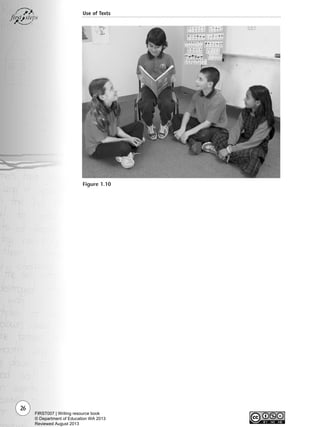
about the choices they have made and the language structures and
features they can recognise in their daily encounters with language.
For example, students preparing a recount of a school event for a
local newspaper might conclude, after reading several newspaper
articles, that they need to use a particular text structure and its
grammatical conventions to meet the expectations of the paper’s
readers.
This chapter includes information on developing students’
knowledge and understandings of conventions. The two sections
are as follows:
• Section 1 — Connecting Spelling Instruction to Writing
• Section 2 — Developing Grammar.
CHAPTER 3
Conventions
Figure 3.1
Writing Resource_chpt 2-3FINAL 6/29/06 10:45 AM Page 159
FIRST007 | Writing resource book
© Department of Education WA 2013
Reviewed August 2013
160
Conventions
SECTION 1
Connecting Spelling
Instruction to Writing
Spelling as Part of Writing
Learning to spell is part of learning to write. Writing provides the
context for spelling development, as spelling is one of the tools a
writer uses to communicate effectively. Writing gives spelling its
context; without writing, spelling has no purpose and no audience.
Conventional spelling helps writers express themselves to a range
of audiences in a way that is clearly understood. It is vital that
students see the connection between spelling and being able to
communicate effectively through writing. Students need to
understand that adults will sometimes judge other people’s
intelligence and level of literacy on the accuracy of their spelling —
and this is why students need to use conventional spelling.
One of the best ways way to help students acquire spelling
proficiency is to teach spelling within the context of everyday
writing. Addressing individual spelling needs during writing tasks is
an effective way to individualise instruction and teach at the point
of need. However, a comprehensive approach to teaching spelling
also needs to provide explicit teaching, frequent opportunities to
investigate and analyse words, and daily opportunities for authentic
writing. Authentic writing allows students to practise and apply
their new understandings.
This section outlines six characteristics of effective spellers. These
characteristics will help teachers consider what to teach those
students who are less proficient at spelling. The section also explores
how to support spelling development in the classroom, focusing on
the organisation and management of a student-centred approach.
This approach helps teachers support students’ different needs in
the classroom and connects spelling instruction to writing. Each
student creates their own individualised list of words to learn each
week. The list is based on the spelling errors they made in their
writing, and on choices they have made about which words are
important to learn.
Writing Resource_chpt 2-3FINAL 6/29/06 10:45 AM Page 160
FIRST007 | Writing resource book
© Department of Education WA 2013
Reviewed August 2013
161
Effective Spellers
It is important for students to build knowledge and understandings
that enable them to become effective spellers. The following
characteristics are typical of effective spellers, and can provide a
focus for whole-class, small-group and individualised instruction at
all phases of development.
Characteristics of Effective Spellers
Effective spellers:
• use a variety of spelling strategies to spell and learn new words
• automatically recall high-frequency words, personally significant
words, and topic and signal words
• continually build their vocabulary
• understand the English orthographic system
• understand and apply spelling generalisations
• self monitor and generate alternative spellings for unknown words.
Effective Spellers Use a Variety of Spelling
Strategies to Spell and Learn New Words
Effective spellers use a range of strategies interactively when they
are spelling unknown words and learning new words. The explicit
teaching of a range of spelling strategies is an important part of
supporting students’ spelling development. Strategies are most
effectively introduced through teaching practices such as modelling,
sharing and guiding, and through opportunities for students to
apply their use in meaningful contexts. Having control of a wide
range of spelling strategies is vital to successful writing, as it enables
students to take control of their spelling.
The following spelling strategies are detailed in Chapter 4, pages
203 – 204:
• Sounding out
• Chunking
• Using spelling generalisations
• Using analogy
• Consulting an authority
• Using meaning
• Using memory aids
• Using visual memory.
Connecting Spelling Instruction to Writing
Writing Resource_chpt 2-3FINAL 6/29/06 10:45 AM Page 161
FIRST007 | Writing resource book
© Department of Education WA 2013
Reviewed August 2013
162
Conventions
Effective Spellers Automatically Recall High-
Frequency Words, Personally Significant Words,
Topic and Signal Words
Students copy, recall or have-a-go at spelling words during
independent writing at all phases of development. Effective spellers
continually add to the number of words they can spell
automatically. The ‘bank’ of words that students can automatically
spell and use can be made up of:
• high-frequency words: words that occur frequently in texts
• personally significant words: words that are significant to each
student
• topic or theme words: words related to topics, themes or subject
areas being studied
• signal words: words that are associated with text forms and text
structures and signal the relationships between ideas in the text,
e.g. therefore, before, although, because.
Once students explore and use these words in their own reading
and writing, it will reinforce their ability to recognise, spell and use
the words. Some students need ongoing systematic instruction to
develop the ability to spell automatically. Other students develop
the ability to automatically spell a bank of words from repeated
reading and writing of texts. Being able to write a large bank of
words quickly and correctly allows students to focus their attention
on other aspects of writing.
Effective Spellers Continually Build Their Vocabulary
Effective spellers continually expand their vocabulary so they can
express meaning precisely in their own writing by using rich and
varied language. Invite students to use new and varied vocabulary
in their writing, rather than only using words they know how to
spell. Broaden students’ vocabularies by having them read and
discuss a wide variety of texts, focusing on interesting words, and
participating in word studies and word games.
Before students can write across a range of learning areas, they need
to have built up their vocabularies across a broad range of contexts
and experiences. Explicitly teaching subject-specific vocabulary that
students need to spell and use frequently will assist this process.
Effective Spellers Understand the English
Orthographic System
Orthography refers to the system of assigning graphic symbols to
the sounds of a language, i.e. spelling. The English language has
Writing Resource_chpt 2-3FINAL 6/29/06 10:45 AM Page 162
FIRST007 | Writing resource book
© Department of Education WA 2013
Reviewed August 2013
163
approximately half a million words; these words are spelt using
twenty-six letters that singularly or in combination make about
forty-four sounds. However, due to the history of the language,
many words are not spelt the way they sound. Learning to spell is
a lifelong process of working out the systems and patterns of the
English language, then applying this knowledge to new words.
To build understandings about the English orthographic system,
students need to develop phonological awareness, graphophonic
knowledge, morphemic and etymological knowledge.
Phonological Awareness
Phonological awareness is the ability to hear, recognise, combine
and manipulate the different sound units of spoken words. The
main understandings to be developed are:
• Word Awareness: Spoken language is made up of words.
• Syllable Awareness: Some words have a single syllable while other
words have more than one.
• Onset and Rime Awareness: Single syllable words are made up of
onsets and rimes, e.g. train: ‘tr’ is the onset,‘ain’ is the rime. A list
of common onsets and rimes is available on the First Steps Writing
CD-ROM.
• Phonemic Awareness: Words are made up of individual sounds or
phonemes.
There is no evidence to suggest that all students acquire phonological
awareness in a particular developmental sequence. However, there
seems to be agreement that some elements of phonological awareness
appear to be more difficult than others (Stahl and Murray, 1994;
Stanovich, Cunningham and Cramer 1984). Table 3.2 summarises
the phonological elements and the levels of difficulty within each
element.
Connecting Spelling Instruction to Writing
Writing Resource_chpt 2-3FINAL 6/29/06 10:45 AM Page 163
FIRST007 | Writing resource book
© Department of Education WA 2013
Reviewed August 2013
164
Conventions
Graphophonic Knowledge
Graphophonics is the study of how sound/symbol relationships
apply to the alphabetic principle of written language. It is important
for students to understand that letters have a name and represent
sounds in words. Letters can represent a number of different
sounds, depending on their position in a word and the surrounding
letters. For example, the letter ‘a’ represents different sounds in the
words ‘apple’, ‘was’, and ‘lady’. Students will gradually discover the
range of sounds and their representations as their experience of the
written language increases.
Students need to develop the following graphophonic understandings:
• Letter names are constant, whereas sounds vary. Students need to
know the names of the letters of the alphabet so that they can talk
about which letters represent particular sounds, and vice versa.
• Letters can represent different sounds, e.g. Andrew, Amy, Audrey.
• Letters sometimes work alone and sometimes work in groups,
e.g. me, bread, sheet team.
• The sound that a letter or group of letters represents in a word
depends on where that letter is, and what other letters surround
it, e.g. cat, city, Christmas, chop.
• The same sound can be represented by different letters, e.g. beach,
me, key, ski, thief.
• The same letter or letters can represent different sounds, e.g. rough,
cough, dough, plough.
Figure 3.2
Phonological Elements and Levels of Difficulty
Element Easier More difficult
Size of the word awareness syllable onset and rime phonemic
Phonological awareness awareness awareness
Unit
Phoneme initial final medial
Position
Number of 1–3 phonemes More than 3
Phonemes phonemes
Phonological continuants, e.g. stop sounds, e.g.
Properties /m/, /r/, /f/ /t/, /d/, /p/
Phonological isolating blending segmenting manipulating
Dimension
Phonological identifying matching oddity producing
Task
(Illustrated
with rhyming)
Does dog rhyme
with log?
Which one
rhymes with dog?
(cat, log)
Which one
doesn’t rhyme:
toy, cat, boy?
Give me a word
that rhymes with
dog.
Writing Resource_chpt 2-3FINAL 6/29/06 10:46 AM Page 164
FIRST007 | Writing resource book
© Department of Education WA 2013
Reviewed August 2013
165
The First Steps Writing CD-ROM has a range of teacher reference lists
related to teaching graphophonics. These include:
• suggestions for the sequence of introducing graphophonic
understandings
• multiple possibilities — common visual patterns and pronunciations
• multiple possibilities — different letter/s used to represent the
same sound.
Morphemic Knowledge
Morphemes are the smallest units of meaning in words. For
example, the word ‘dissolve’ contains two morphemes: ‘dis’ and
‘solve’. If students understand how words can be separated into
morphemes, it will help them to spell unknown words.
Most English words that have the same meaning base have the
same spelling base, e.g. music and musician. If the meaning is
different, then the spelling is different, e.g. seen and scenery.
To develop morphemic knowledge, students can explore:
• plurals, e.g. s, es
• comparatives, e.g. er, est
• prefixes
• suffixes
• base words
• compound words.
Etymological Knowledge
Etymology is the study of word origins. Building etymological
knowledge is closely linked to building morphemic knowledge, as
studying the meaning and origins of non-phonetic words can be a
guide for spelling.
Students’ curiosity will be enhanced by studying the origins of
words — and it will help them to understand why words in the
English language are spelt the way they are. Students benefit from
knowing that the spelling of words can reflect the origin of that
word, e.g. ‘bouquet’ has a French origin, and ‘et’ is a common letter
pattern used in French words.
The First Steps Writing CD-ROM has a range of teacher reference lists
related to morphemic and etymological knowledge. These include:
• common prefixes and their meaning
• common suffixes and their meaning
• root or base words from foreign languages and their meaning.
Connecting Spelling Instruction to Writing
Writing Resource_chpt 2-3FINAL 6/29/06 10:46 AM Page 165
FIRST007 | Writing resource book
© Department of Education WA 2013
Reviewed August 2013
166
Conventions
Effective Spellers Understand and
Apply Spelling Generalisations
By participating in open-ended activities, students can discover
patterns, make observations and construct hypotheses about how
words are spelt. If students are given continual opportunities to
refine these hypotheses, they will be able to make generalisations
and apply these to their own writing. See the First Steps Writing
CD-ROM for a list of spelling generalisations related to the English
Language.
Challenge students to discover spelling generalisations by finding
the answer to a specific question, e.g. What happens to a ‘y’ at the
end of a word when the word is extended? Give students time to
collect as many examples as possible, examine the evidence and
develop a generalisation.
Display the list of collected words, then discuss them as a whole
class. Invite students to collaboratively suggest a generalisation or
‘rule’ that applies to the investigation. The generalisation may not
always be accurate or adequate; however, students can alter or
amend it after collecting further evidence. Involving students in the
discovery of generalisations is one way to help them apply new
learning to writing tasks.
Figure 3.3 Class Spelling Investigation Chart
Writing Resource_chpt 2-3FINAL 6/29/06 10:46 AM Page 166
FIRST007 | Writing resource book
© Department of Education WA 2013
Reviewed August 2013
167
Effective Spellers Self-Monitor and Generate
Reasonable Alternative Spellings for Unknown
Words
It is important for students to know that correct spelling enhances
the communication between a writer and a reader. There is usually
an expectation for the use of conventional spelling in most texts.
This usually depends upon the purpose and audience of writing,
and the stage of the writing process, e.g. first draft, published piece.
Effective spellers are not necessarily perfect spellers. However, they
can identify when a word is incorrect and use a variety of strategies
to generate alternative spellings. Effective spellers have developed a
‘spelling conscience’ and take responsibility for the use of
conventional spelling when appropriate.
Students need to have confidence when they are writing to
experiment with using words they may not be able to automatically
spell. Encourage them to have their best attempt at spelling these
words, then to continue writing. Students’ attempts at spelling
should reflect their phase of development. Rather than ‘writing it
any way you can’, encourage students to have-a-go based on their
knowledge of letters, sounds, patterns and meaning.
When students have completed a draft, encourage them to return
to the words they attempted to spell and generate
alternative spellings for selected words.
Have-a-Go Pads are a tool often used to
encourage students to generate alternative
spellings to words they misspelt in their writing.
Students identify words, select words and then
record their alternative attempts on a Have-a Go
Pad. Figures 3.3a and 3.3b shows the relationship
between students’ writing and the use of a Have-
a Go-Pad. See First Steps Writing CD-ROM for
Have-a-Go Pad Formats and Instructions.
Connecting Spelling Instruction to Writing
Figure 3.3a Student Writing Sample
Writing Resource_chpt 2-3FINAL 6/29/06 10:46 AM Page 167
FIRST007 | Writing resource book
© Department of Education WA 2013
Reviewed August 2013
168
Conventions
After composing a draft text, the student has underlined words that
are not spelt correctly. They then selected three to five words to try
again on their Have-a-Go Pad.
Figure 3.3b Have-a-Go Pad
The student has made an alternative attempt at spelling the
unknown words using a Have-a-Go Pad. They then sourced the
correct spelling from the teacher or another authority, e.g. chart,
friend, word wall.
Supporting Spelling Development
in the Classroom
Teaching spelling as part of writing — and through explicit and
systematic teaching — provides opportunities for students to
investigate, discuss, practise and apply spelling knowledge and
strategies. It also allows them to learn the words they need to use
in their writing. A combination of whole-class, small-group and
individual approaches to teaching spelling will enable teachers to
support a range of student needs.
Use whole-class mini-lessons to focus on the introduction and
modelling of vocabulary, spelling strategies and ways to learn new
words. These lessons also provide a forum where you can challenge
students to investigate spelling generalisations and patterns.
Small-group sessions allow for more specific instruction and
investigations related to students’ phases of development.
Providing time for individual work allows students to
independently practise what they have learnt in whole-class and
small-group sessions and apply it to their personalised spelling lists.
Writing Resource_chpt 2-3FINAL 6/29/06 10:46 AM Page 168
FIRST007 | Writing resource book
© Department of Education WA 2013
Reviewed August 2013
169
Reflection time allows students to share what they have discovered
during lessons and, when appropriate, to collaboratively construct
class charts that represent their new learning.
The following pages explore how to support spelling development
in the classroom, with a particular focus on the organisation and
management of a student-centred approach.
Using a Student-Centred Approach to Teach
Spelling
Using personalised spelling lists is an effective way to meet a range
of spelling needs in one classroom. It also helps students to view
spelling as an important part of writing. A student-centred approach
involves students learning a variety of words, including those words
misspelt in their own writing. Words of personal interest can be
added to the personalised list, as can class focus words related to a
topic or specific learning area.
The structure of a student-centred approach is very flexible.
It generally involves students in:
• selecting words they need (or want) to learn to spell
• transferring words into some type of journal
• learning selected words in a variety of ways
• monitoring their own progress and reflecting on spelling strategies
used
• accumulating a bank of words that they can automatically spell,
then use the words for writing.
Getting Started with a Student-Centred Approach
The successful implementation of a student-centred approach to
spelling depends on the following considerations.
Connecting Spelling Instruction to Writing
Figure 3.4 Supporting a Range of Student Needs
Whole-class Mini-lesson
Small Group Work
Individual Personal List
Whole-class Reflection
Writing Resource_chpt 2-3FINAL 6/29/06 10:46 AM Page 169
FIRST007 | Writing resource book
© Department of Education WA 2013
Reviewed August 2013
170
Conventions
1 Select Formats and Create Student Journals.
2 Establish Routines.
3 Introduce a Daily Process.
1 Select Formats and Create Student Journals
Before introducing personalised spelling lists, decide on the type of
formats the students will use. A selection of formats is provided on
the First Steps Writing CD-ROM. These formats can be used or adapted
to suit different year levels, student needs and personal preferences.
A personal spelling journal for each student can be created by
collating the selected formats into a booklet.
Figure 3.5 Pages from a Sample Personalised Journal
Writing Resource_chpt 2-3FINAL 6/29/06 10:46 AM Page 170
FIRST007 | Writing resource book
© Department of Education WA 2013
Reviewed August 2013
171
Collecting Words Formats
These formats can be used to record words collected from a range
of contexts. Students can then build an ongoing list of words that
they want or need to learn to spell.
Connecting Spelling Instruction to Writing
Figure 3.6 Sample Formats for Collecting Words
Personal List Formats
These formats can be used to record words that will be
learnt for the week. These words are selected from
students’ individual collections.
Figure 3.7 Sample Personal List Formats
Writing Resource_chpt 2-3FINAL 6/29/06 10:46 AM Page 171
FIRST007 | Writing resource book
© Department of Education WA 2013
Reviewed August 2013
172
Conventions
Ways to Learn Words Formats
These formats can be used to remind students about the different
strategies and activities they can use to learn words.
Figures 3.8 Samples of Ways to Learn Word Formats
Testing Words Format
This format can be used to record personal test results.
Figures 3.9 Format for Testing Words
Writing Resource_chpt 2-3FINAL 6/29/06 10:46 AM Page 172
FIRST007 | Writing resource book
© Department of Education WA 2013
Reviewed August 2013
173
Recording Progress Formats
These formats can be used for keeping a record of the words
students have learnt.
Connecting Spelling Instruction to Writing
Figures 3.10 Sample Formats for Recording Progress
Routine Formats
These formats can be used to help students remember the routines
that have been established for using a personalised spelling list.
Figures 3.11 Sample Routine Formats
Writing Resource_chpt 2-3FINAL 6/29/06 10:46 AM Page 173
FIRST007 | Writing resource book
© Department of Education WA 2013
Reviewed August 2013
174
Conventions
2 Establish Routines
When introducing personalised spelling lists, students need to learn
the procedures and routines associated with collecting, selecting,
transferring, learning, testing and recording words. Repeated
whole-class modelling, discussion and practice time will help
students to become independent learners during individualised
spelling sessions. Introduce clear routines for the following:
• Collecting Words to Learn
• Selecting and Transferring Words
• Learning New Words
• Testing Words
• Recording Progress.
Collecting Words to Learn
Teaching students how and where to select the most appropriate
words to learn is a critical step in using personalised spelling lists.
Identifying and selecting words is an ongoing process as students
build a cumulative list of words to learn. Make sure that cumulative
lists do not become too long or overwhelming for students.
How?
Students need to have the chance to select words that they want to
learn to spell, but the teacher must also be able to indicate words
that a student may need to learn. This could include high-frequency
words, subject-area specific words or words related to a current topic
or theme. The teacher might have a large degree of control over the
words selected at first, with the student making limited choices.
Responsibility for selecting words to learn can be gradually released
to students as they become more familiar with the process.
Where?
Words for personal lists can come from a wide range of sources.
They could include words from a Have-a-Go pad, words misspelt in
writing from different learning areas, words noticed in literature,
pre-tests of high-frequency words, or words of interest heard or
seen in real-life events.
It is important that the words on students’ personal lists will actually
be used by them in future writing events. Students who use a varied
and rich vocabulary, and spell accurately when writing, might not
benefit from the process of collecting words they need to learn to
spell. Instead, challenge these students to explore and play with
words through puzzles, crosswords or vocabulary games. See the
‘Conventional’ and ‘Proficient’ Phases on the First Steps Writing Map
of Development.
Writing Resource_chpt 2-3FINAL 6/29/06 10:46 AM Page 174
FIRST007 | Writing resource book
© Department of Education WA 2013
Reviewed August 2013
175
Selecting and Transferring Words
On a weekly basis, have students select words from their cumulative
lists and transfer them to a list of words to learn. The number of
words students select to learn each week will vary, depending on
their age and level of spelling development. Initially limit new words
to no more than five per week. Some students may need a list of
only two or three words. As students become familiar with the
routines and are capable of learning more words, increase the lists
to ten words or more.
Provide a designated time for students to select and transfer words
onto a ‘words to learn’ list in their journal. This could take place at
any time and doesn’t need to be part of the spelling lesson.
It is important to teach students how to accurately transfer words
into their journal. A variety of processes should be used to monitor
the accuracy of each student’s spelling list. This could be done by:
• having the teacher sight and sign each word
• establishing a ‘checking buddy’ for each student
• having random list checks
• self-checking.
Learning New Words
Personalised spelling lists help students to build a repertoire of ways
they can use independently to learn new words. This is one of the
most important features of personalised spelling lists. Learning how
to learn words is critical, as is helping students reach the point
where they are able to make decisions about the most effective way
to learn different words. Not all students will learn a word the same
way, and not all words can be learnt in the same manner, so it’s
important to incorporate a multi-sensory approach to the learning
of words.
Use whole-class sessions to introduce, explicitly model and
discuss different ways to learn new words. List developmentally
appropriate ways to learn new words on a chart, so that it becomes
a reference that students can use during independent study time.
The following activities will provide students with a strong
foundation for learning new words. Further suggestions can be
found in the First Steps Writing Map of Development for each phase
of development.
Connecting Spelling Instruction to Writing
Writing Resource_chpt 2-3FINAL 6/29/06 10:46 AM Page 175
FIRST007 | Writing resource book
© Department of Education WA 2013
Reviewed August 2013
176
Conventions
Critical Features
Have students circle or tick those parts of the word they can spell
correctly and highlight the part of the word that causes them trouble.
Have students decide how they can remember the ‘tricky’ part of
the word.
Break Words into Parts
Have students break words into meaningful parts, such as:
• individual sounds
• onset and rime
• syllables
• compound words.
Say the Word as it Is Spelt
Have students play around with words, saying them as they are
spelt rather than how they are pronounced, e.g. enunciating the
silent k in knife; breaking Wednesday into sections: Wed / nes / day.
Word Shapes
Have students draw boxes around the word to show its shape.
Figure 3.12
Create Mnemonics
Have students create a mnemonic that will help them remember
a word. Some mnemonics are a creative sentence or phrase, e.g.
because—big elephants can always understand small elephants;
accommodation—two caravans, two motels and one tent. Other
mnemonics use the meanings of the words to provide a clue for the
correct spelling, e.g. fourth—the fourth number is four. Sometimes a
class-generated mnemonic is helpful; at other times a personal
mnemonic is more useful. A list of mnemonics can be found on the
First Steps Writing CD-ROM.
Use the Senses
Provide opportunities for students to take part in multi-sensory
activities.
• Trace over words with their finger.
Writing Resource_chpt 2-3FINAL 6/29/06 10:46 AM Page 176
FIRST007 | Writing resource book
© Department of Education WA 2013
Reviewed August 2013
177
• Place paper on top of sandpaper and trace over it with a crayon.
• Write into shaving cream or paint.
• Make letters out of clay or playdough.
• Manipulate magnetic letters.
• Write the word and trace over it in different colours.
• Decorate or illustrate the word.
Cut it Out
Students write a word on graph paper, one letter per cell. They can
then cut out the letters separately, cut the word into the onset and
rime, or cut it so that a letter pattern stays as one unit. They then
put the word back together.
Connecting Spelling Instruction to Writing
Figure 3.13
Make Connections (Analogies)
Have students make connections between words that have similar
visual or sound patterns, e.g. could, should, would.
Build New Words
Have students see if they can make new words by adding prefixes or
suffixes to any of their list words, e.g. heat: reheat, heater, heating.
Apply Spelling Generalisations
Have students determine if there are any spelling generalisations
they know that they can apply to their new word.
Writing Resource_chpt 2-3FINAL 6/29/06 10:46 AM Page 177
FIRST007 | Writing resource book
© Department of Education WA 2013
Reviewed August 2013
178
Conventions
Write the Word in a Sentence
Have students write homophones in a sentence that clarifies their
meaning, e.g. I saw the shark. My arm is sore. The eagle can soar
above us.
Origin of the Word
Have students research the etymology of the word. There are often
clues to the spelling of a word in its origin, e.g. The words aeroplane,
aerosol and aerobatics have the spelling ‘aero’, as that is the Greek
word for air.
Meanings of the Word
Have students examine the word meanings, as there is often a visual
link between the spelling of related words, e.g. please and pleasant;
sign and signature.
Look, Say, Cover, Visualise, Write, Check Process
Teach students the following process.
• Look at the word, focusing on any critical features.
• Say the word aloud.
• Cover the word so it can’t be seen.
• Visualise the word, imagining it on a blank computer screen or
behind their eyelids.
• Write the word on a piece of paper.
• Check that the word has been spelt correctly.
Additional steps can be included, e.g. trace the word, say the word
as you write it, spell the word out loud.
Games and Activities
The First Steps Writing Map of Development has further activities
appropriate to each phase. They are listed in the Conventions
aspect of each phase.
Testing Words
Once students have completed learning activities for their list of
words, provide time for some form of testing. Testing can be done
in a range of ways, including:
• Self-testing
• Partner testing
• Teacher testing (or testing by another adult).
Testing involves checking the list of words that students are
currently studying. Students should check their own work to
analyse misspellings. This is a critical element of the testing process,
as it supports students as they develop a spelling conscience and
allows them to monitor their own development.
Writing Resource_chpt 2-3FINAL 6/29/06 10:46 AM Page 178
FIRST007 | Writing resource book
© Department of Education WA 2013
Reviewed August 2013
179
Recording Progress
An important part of record keeping is encouraging students to
keep a record of their progress. When students have spelt a word
accurately at least three times during a self-test or partner-test, have
them highlight that word or draw a single line through it. They
then record the word onto a ‘Words I Know’ list. These records can
be used for a range of purposes. They provide parents with a clear
picture of the words their child has been studying, and a list of words
learnt over a period of time. The records will also provide teachers
with a tool for monitoring each student’s progress and their success
in using a personalised spelling list. Teachers can use the collection
of words recorded in each student’s ‘Words I Know’ list as a basis
for a ‘teacher test’, if required
3 Introduce a Daily Process
Ideally, students should have time every day to work on their
personalised spelling lists. What students do on a daily or weekly
basis during this individualised spelling time can be decided
collaboratively with the class. The following steps are suggestions of
what students might do as they work on a personalised spelling list.
Connecting Spelling Instruction to Writing
Figures 3.14 Sample of a Daily Process
1 Select your new words
and write them onto your
personalised spelling list.
Weekly
2 Have the teacher or
‘spelling buddy’ check
that you have spelt the
words correctly.
Weekly 3 Learn each word
using a selected activity.
Daily 4 Organise a test on
your words. Record your
results.
Daily
5 When you spell a word
correctly three times in a
row, highlight the whole
word and transfer it onto
your ‘Words I Know List’.
Weekly
6 If you spell a word
incorrectly a number of
times in a row, transfer
the word back to your
cumulative list.
Writing Resource_chpt 2-3FINAL 6/29/06 10:46 AM Page 179
FIRST007 | Writing resource book
© Department of Education WA 2013
Reviewed August 2013
180
Conventions
Case Study: Using a Student-Centred Approach
in a Year 5 Classroom
Teacher: Rebecca Hough-Neilson
Context: Pasir Ridge International School (9- and 10-year-olds)
I chose a student-centred approach to teach spelling for the
following reasons:
• There was a wide range of student spelling ability in my classroom.
• The students were spelling well during ‘spelling tests’ but not
when they were writing.
• It demonstrated the interconnectedness of writing and spelling.
• It catered for individuals.
• It gave me the opportunity to work one-on-one or with small groups.
What I Did to Introduce a Student-Centred Approach
First I reviewed a range of personalised list formats, selected the
formats I was going to use and made these into a folder. I then
identified what the students needed to be able to do in order to use
a student-centred approach. I progressively introduced, modelled
and provided time for students to practise the routines, use the
folder and learn to work collaboratively with a partner.
1 I talked with the students about the purpose of a personal list. I
thought it was really important to let the students know why I had
decided to do things a certain way. This helped students
understand why a student-centred approach was being
implemented.
Figure 3.15 Samples from a Personal Spelling Folder
Writing Resource_chpt 2-3FINAL 6/29/06 10:47 AM Page 180
FIRST007 | Writing resource book
© Department of Education WA 2013
Reviewed August 2013
181
2 I then introduced the folder that we were going to use. This
folder included a ‘Words to Learn’ list, a space for students to
write their personal list and a space to record test results. It also
included a space for students to record the spelling strategies
they were using.
3 I talked with students about where the words to be learnt would
be selected. Initially I administered a test of high-frequency
words because I wanted to assist the students to identify words
that they should be spelling correctly. The misspelt high-
frequency words became the basis for their ‘Words to Learn’ list.
Words could also be selected from topic words, class words,
words misspelt in previous writing and their Have-a-Go pads.
4 I modelled how to enter words onto the ‘Words to Learn’ list.
Students then entered their words onto their ‘Words to Learn’ list.
I found that it was important for students not to enter too many
words, as having a long list was daunting for some students. I
initially restricted them to having no more than twenty words on
their list at any one time.
5 I modelled how to select and transfer words from the ‘Words to
Learn’ list onto ‘My Personal List’. Initially students transferred
five words but later the number varied for each student. We
discussed the importance of entering the words correctly. I
regularly checked each student’s folder to ensure they had spelt
each word correctly.
6 I modelled how to learn words. I started with teaching students
to look for critical features and then to follow a look-say-cover-
visualise-write-check process. We kept a record of different ways
to learn words on a class chart. As I introduced new ways to
learn words, I had students keep a record of these with their
folder as a constant reminder.
7 I chose to use partner testing as a way for students to monitor
their learning. Three days a week students worked with a partner
to test each other on their current list. I had to model this a
number of times before students could do it independently.
8 I also had to model how to record results. In my class, students
had to spell the word correctly three times and then highlight it.
Once they had ten words highlighted I administered a teacher
test. All words that were spelt correctly in the teacher test were
then transferred to their ‘Words I Can Spell Correctly’ list.
To assist the implementation, we reviewed the steps and made a
class chart to represent what we were going to do each day of the
week. This was as much for me as it was for the students!
Connecting Spelling Instruction to Writing
Writing Resource_chpt 2-3FINAL 6/29/06 10:47 AM Page 181
FIRST007 | Writing resource book
© Department of Education WA 2013
Reviewed August 2013
182
Conventions
Things I Learnt
• Not all students understood each routine at the same time.
• I had to check that words to be learnt had been entered correctly.
• I needed to help students select developmentally appropriate
words.
• I had to teach a range of ways to learn words, and help students
select the most suitable way for them to learn each word.
• If I identified words that students had spelt incorrectly in other
learning areas, this made it easier for them to find words for them
to enter on their ‘Words To Learn’ list.
Where a Student-Centred Approach is Used in My Class
Once we were familiar with using personalised spelling lists, I
worked on ensuring that it became part of my whole spelling
program. I continued addressing Major Teaching Emphases with
the whole class and also managed to work with small groups twice
a week. My spelling program was made up of the following elements:
• Whole Class Mini-Lesson with follow-up activity
• Activity from mini-lesson to be completed while teacher works
with small group
• Individualised Spelling
• Reflection.
The time allocated to the different elements changed on a daily
basis, depending on students’ needs.
Conclusions
I found that by using personalised spelling lists, my students:
• developed a spelling conscience and could identify errors in their
own writing
• increased the bank of words that they could spell
• entered words that they couldn’t spell into their folders on a
regular basis
• transferred new learning to their writing
• used varied and rich vocabulary in their writing
• experienced success
• worked at their own level and were being challenged
• shared their learning with each other.
Figure 3.16 Weekly Class Timetable
Day 1
Check you have
words to learn on
your Personal List.
Have teacher check
the spelling.
Choose the most
appropriate way to
learn each word.
Day 2
Learn the words.
Partner Test.
Record the results.
Day 3
Learn the words.
Partner Test.
Record the results.
Day 4
Learn the words.
Partner Test.
Record the results.
Day 5
Highlight words
3 × correct.
Request a Teacher-
Test, if ready.
Transfer words to
your ‘Words I Can
Spell Correctly’ list.
Writing Resource_chpt 2-3FINAL 6/29/06 10:47 AM Page 182
FIRST007 | Writing resource book
© Department of Education WA 2013
Reviewed August 2013
183
SECTION 2
Developing Grammar
What Is Grammar?
Grammar refers to the rules and systematic relationships that are
used to organise a language and its meaning. Grammar is used to
make meaning during reading, writing, speaking, listening and
viewing.
Although it is widely agreed that grammar needs to be taught in
schools and that students need to be able to use Standard Australian
English more effectively, there are varied approaches to consider.
The comprehensive approach to grammar reflected in this chapter
focuses on the way spoken and written language is structured to
suit the context, purpose and audience. It recognises that English is
a rich and varied language, and that people use and are exposed to
many varieties of English. Those varieties reflect the range of regional
and social dialects, as well as different registers used within each
context. Each variety of English has its own value and purpose; the
most appropriate variation in each context is usually determined by
the situation.
Teaching Grammar
Most students come to school having already acquired the basic
syntactic, semantic and pragmatic elements of their home language
through using oral language on a daily basis. In order for students
to build on their understandings and use of grammar, it is
important that teachers:
• value the language each student brings to school
• help students become competent users of Standard Australian
English
• assist students to construct texts that achieve the intended purpose.
It is important to link the teaching of grammar to the teaching of
text forms and to students’ needs. This is achieved through reading
and discussing a wide range of texts and having students write for
authentic purposes. Teaching grammar through writing involves
explicit teaching through mini-lessons, providing frequent
opportunities to investigate and analyse texts, and giving students
daily opportunities to practise and apply new understandings.
Developing Grammar
Writing Resource_chpt 2-3FINAL 6/29/06 10:47 AM Page 183
FIRST007 | Writing resource book
© Department of Education WA 2013
Reviewed August 2013
184
Conventions
It is not necessary for students to learn technical grammatical terms
for them to communicate effectively and efficiently. However,
students benefit from knowing the metalanguage associated with
the functions of language. For example, students need to be able to
use the word ‘noun’, articulate its use and use a noun correctly
during their own writing.
‘You know English grammar if you can read and understand this
sentence.
‘You understand English grammar if you can discuss the ways the
language works and check whether your writing can be made
clearer by rearranging words, phrases, clauses and sentences that
make up the text’.
(Martin, 2000, Young Writers Guide, page 175)
It is important at all phases of development to draw attention to
the conventions of grammar used in a range of texts. This includes
conventions associated with punctuation, parts of speech and their
relationships, sentence structure and overall text construction.
These conventions need to be introduced, re-visited and practised
in meaningful contexts. The explicit teaching of these conventions
can occur during a writing mini-lesson. Modelled and Shared
Reading and Writing provide a springboard for exploring many of
these conventions. Independent Writing allows time for students to
apply these understandings in their own writing.
The conventions in Figure 3.17 are outlined on the following pages.
Figure 3.17 Conventions Grid
Punctuation Parts of Speech Sentences Paragraphs
and their and Texts
Relationships
Types of Parts of Speech Different Types Grouping Related
Punctuation of Sentences Information
Relationships How Sentences Writing a
Between Parts are Constructed Cohesive
of Speech Paragraph
How Sentences Writing Cohesive
are Manipulated Paragraphs to
Compose a
Coherent Text
Writing Resource_chpt 2-3FINAL 6/29/06 10:47 AM Page 184
FIRST007 | Writing resource book
© Department of Education WA 2013
Reviewed August 2013
185
Punctuation
Punctuation is the use of certain marks to break words into groups
to clarify the meaning and make the writing readable. It is
important to expose students to a range of texts at all phases of
development, and to draw their attention to punctuation. Give
students time to investigate and analyse the use of punctuation, as
this helps them to discover how it is used. Encourage students to
apply their discoveries about punctuation when they are creating
their own texts.
What Students Need to Know
It is important for writers to be able to talk about, understand and
use the following types of punctuation.
Types of Punctuation
Capital Letters are used:
• to begin sentences
• for proper nouns
• for adjectives derived from proper nouns, e.g. Australian
• for the pronoun ‘I’
• for emphasis
• for names of special days, titles
• for acronyms, e.g. QANTAS, CSIRO.
Full Stops are used:
• to end statements
• in initials
• in abbreviations that do not end in the final letter of the word,
e.g. Mon., Dec.
Question Marks are used at the end of sentences that ask for
information. Question marks are not needed when using indirect
speech, e.g. I was asked if I wanted to report the incident, or when a
sentence is a request, e.g. Can you please hurry.
Exclamation Marks are used to show volume or strong feelings,
e.g. What a noise!
Commas are used:
• to separate items in a series, e.g. They collected buttons, needles,
material and cotton.
• to separate a word or words used in a sentence for further
explanation, e.g. Dean, the tallest boy in the class, helped to put up
the poster.
Developing Grammar
Writing Resource_chpt 2-3FINAL 6/29/06 10:47 AM Page 185
FIRST007 | Writing resource book
© Department of Education WA 2013
Reviewed August 2013
186
Conventions
• before conjunctions that join two independent clauses, e.g. Graham
wanted to travel to Japan, but he wanted to learn the language first.
• to separate independent and dependent clauses, e.g. When they
heard the final siren, the players leapt into the air.
• to separate the person spoken to from the rest of the sentence,
e.g. Roger, look where you are going.
• after introductory words such as ‘oh’, ‘yes’ and ‘no’ at the
beginning of a sentence, e.g. No, I don’t like those shoes. Oh, I
didn’t know that.
• to follow signal words at the beginning of sentences, e.g. However,
I think that … .
• in front of a direct quotation in the middle of a sentence, e.g. She
asked,‘Where did you get those shoes?’
• where the quotation is a statement at the beginning of a sentence,
e.g. ‘Today is Friday,’ said Jenny.
Apostrophes are used:
• for contractions
• to show ownership
• to indicate that letters or numbers have been omitted,
e.g. ’04, o’clock.
Quotation Marks (single or double) are used:
• for words spoken in direct speech
• to show quotations within quotations
• before and after titles
• before and after words that have been used in an unorthodox
way, e.g. slang, the word being explained.
Colons are used:
• to introduce a list
• to introduce a long direct quotation
• to introduce an explanation, summary or elaboration of the first
half of a sentence
• after the headings in memos, journals and faxes
• after the name of a character in a play script, to indicate who is
speaking.
Semi-colons are used:
• to join sentences with two or more main clauses
• in a series of three or more items when commas are used within
the items
• to separate the main ideas in dictionary and glossary definitions.
Writing Resource_chpt 2-3FINAL 6/29/06 10:47 AM Page 186
FIRST007 | Writing resource book
© Department of Education WA 2013
Reviewed August 2013
187
Hyphens are used:
• to show that two words should be read as a single word,
e.g. one-way
• to join a group of words to form an expression, e.g. Have-a-Go
Card
• to write numbers and fractions that consist of more than one word,
e.g. one-third.
Dashes are used:
• to introduce a list
• to add or emphasise information
• to add extra details to a sentence (used in the same way as a
bracket or comma).
Brackets always appear in pairs and are used:
• to enclose additional non-essential information, e.g. You are
required to attend the meeting in Joondalup (avoid the freeway if
possible).
Ellipses are used:
• to show incomplete lines of text, e.g. To be or not to be …
• to show words that have been omitted from quotations.
Parts of Speech and Their
Relationship
Writers don’t just put down words on the page at random; the words
are organised in specific ways to convey meaning. By learning about
the parts of speech and their relationships, students can begin to
understand the use and function of words, and how to use words
for meaningful communication.
What Students Need to Know
Developing and refining the following knowledge will help students
to make decisions when they are composing texts.
• Parts of Speech
• Relationship Between Parts of Speech
1 Parts of Speech
Each word can be categorised as a part of speech. However, the same
word can serve at different times as two or more parts of speech,
depending on the context. A word can be a noun in one sentence
and a verb or adjective in the next, e.g. I just love roses. Growing
them is my love.
Developing Grammar
Writing Resource_chpt 2-3FINAL 6/29/06 10:47 AM Page 187
FIRST007 | Writing resource book
© Department of Education WA 2013
Reviewed August 2013
188
Conventions
It is possible to learn a language without knowing the parts of
speech, but knowing about the parts of speech makes things easier.
There are eight parts of speech in the English Language.
Noun
A noun is a word or phrase that names a person, place, thing,
quality or act, e.g. Michelle, New York, table, beauty, execution.
Verb
A verb is a word or phrase that expresses action or existence. Verbs
are the heart of a sentence. Unlike other parts of language, verbs
change their form, e.g. endings are added or the word itself changes.
Verbs are closely related to time and tell if something has already
happened, if it will happen later or if it is happening now.
Adjective
An adjective is a word that describes or gives more information
about a noun or pronoun. Adjectives describe nouns in qualities
such as size, colour, number and type.
Adverb
An adverb is a word that gives more information about a verb, an
adjective or another adverb. Adverbs describe qualities such as time,
frequency and manner. Adverbs often end in ly.
Pronoun
A pronoun is a word that is substituted for a noun. It refers to a
person, place, thing, idea or act that was mentioned previously or
that can be inferred from the context of the sentence, e.g. he, she,
they, it.
Preposition
A preposition is a word that shows the relationship between words
in a sentence. The relationships include direction (to); time (at);
place (under); and manner (by).
Conjunction
A conjunction is a word that connects other words, phrases or
sentences, e.g. and, but, or, because.
Interjection
An interjection is a word, phrase or sound used as an exclamation
and capable of standing by itself, e.g. Oh, my goodness.
Article
One of three words that are always used in the presence of a noun:
a, an, the.
Writing Resource_chpt 2-3FINAL 6/29/06 10:47 AM Page 188
FIRST007 | Writing resource book
© Department of Education WA 2013
Reviewed August 2013
189
2 Relationship Between Parts of Speech
As well as knowing how to use the parts of speech, students need
to know the relationships that govern their use.
Noun/pronoun agreement is linking written ideas by using
pronouns that refer to preceding nouns. The pronoun needs to
agree in number (singular or plural), in person (first, second or
third) and in gender (masculine, feminine or neutral).
Subject/verb agreement: The subject in a sentence must agree
in number and in person with the verb to which it is attached,
e.g. John and Marilyn were the first to arrive at the party.
Tense: There are three basic verb tenses in English: present, past and
future. When using standard English, the tenses fit together in a
consistent manner to avoid confusing the reader.
Present tense expresses an unchanging or recurring action or
situation that exists now. It can also represent a widespread truth,
e.g. The mountains are tall. The council elects a new leader each year.
Past tense expresses an action or situation that began and finished
in the past. Most past tense verbs end in ‘ed’, e.g. The shop closed at
6 pm.
Future tense expresses an action or situation that will occur in the
future. This tense is formed by using ‘will’ or ‘shall’ or by using ‘am
going to’, ‘is going to’ or ‘are going to’, e.g. We are going to finish
writing the book by the end of March.
Person is determined by whether writers are referring to
themselves; to their readers; or to objects, ideas or persons other
than themselves and their readers.
First person is the writer speaking, e.g. I, we, me, us, my, mine, our,
ours.
Second person is the person spoken to, e.g. you, your, yours.
Third person is the person or thing spoken about, e.g. he, she, it, his,
hers, him, its, they, them, their.
The ultimate aim is for writers to be able to make decisions about
their use of punctuation and parts of speech and the relationships
between parts of speech. While they are making these decisions,
writers need to be reminded of their social obligations to the reader.
Developing Grammar
Writing Resource_chpt 2-3FINAL 6/29/06 10:47 AM Page 189
FIRST007 | Writing resource book
© Department of Education WA 2013
Reviewed August 2013
190
Conventions
Sentences
It is important for students to build knowledge and understandings
of the basic types and structure of sentences. Once students have
these understandings, they can ‘write more syntactically
sophisticated and rhetorically effective sentences’ (Weaver, 1998)
to suit the purpose and audience.
What Students Need To Know
Developing and refining the following understandings will help
students decide which sentences to use when composing texts.
• Different Types of Sentences.
• How Sentences are Constructed.
• How Sentences are Manipulated.
1 Different Types of Sentences
It is important to provide many opportunities for students to read
and write a variety of sentences, as this will help them to identify
different sentence types. There are four basic types of sentences; it’s
important to model the functions of each sentence, even though
students do not need to know the sentence names.
A statement declares or states something. Statements are used to
provide information, or to make remarks and assertions, e.g. It’s my
turn next. The dog ran down the street. Written texts consist mainly of
statements, unless deliberate interaction with the reader is intended.
A question is used to inquire about something, request information
or to gain further information, e.g. Is it lunchtime? Where is the train
station?
A command directs or gives orders. Commands are used to get
things done, to obtain services or goods, e.g. Mix flour and butter on
high.Two tickets to Paris, please.
An exclamation expresses strong feelings. Exclamations are often
used to express emotions, including surprise, fear, excitement and
happiness, e.g. Very exciting! I have just won the lottery!
2 How Sentences Are Constructed
A sentence is defined as a group of words that expresses a complete
thought, begins with a capital letter and ends with some form of
punctuation.
Writing Resource_chpt 2-3FINAL 6/29/06 10:47 AM Page 190
FIRST007 | Writing resource book
© Department of Education WA 2013
Reviewed August 2013
191
Subject and Predicate: A sentence has two parts: the subject and
the predicate.
The subject tells what the sentence is about. The subject can be made
up of a word, words or phrases, e.g. The duck swam in the pond.
The predicate contains a verb and tells the reader about the subject,
e.g. The duck swam in the pond.
A clause is a group of words that contain a verb; it is often referred
to as the basic unit of meaning in the English Language. Students
need to understand clauses to be able to construct sentences.
Clauses fall into two main categories: independent and dependent.
An independent clause makes sense on its own, e.g. The principal is sick.
A dependent clause does not make sense on its own and needs the
independent clause to complete it, e.g. with the flu.
Sentence Structure
The number of clauses in a sentence helps students to identify
the sentence structure. Understanding the structures of different
sentences allows students to write more interesting sentences,
constructing writing that is more interesting and suitable to their
purpose and audience. The three main sentence structures are
simple, compound and complex.
A simple sentence contains one independent clause, e.g. We went to
the zoo.
Compound sentences contain two or more independent clauses. Each
clause must be able to stand alone in conveying a complete
message, e.g. We went to the zoo and we saw a tiger.
Complex sentences contain at least one independent clause and one
dependent clause, e.g. When we were on holidays we went to the zoo
and saw a tiger.
Voice: Sentences can be written in active or passive voice. Students
need to be aware of how they can make their sentences active or
passive.
Active voice: The subject performs the action, when writing with
active voice, e.g. Kerry hit the ball.
Passive voice: The action is performed on the subject, when writing
with passive voice, e.g. The ball was hit by Kerry.
Developing Grammar
Writing Resource_chpt 2-3FINAL 6/29/06 10:47 AM Page 191
FIRST007 | Writing resource book
© Department of Education WA 2013
Reviewed August 2013
192
Conventions
3 How Sentences Are Manipulated
Once students have an understanding of the different sentence
types and structures, model how to combine, expand, reduce and
transform sentences. This will help students learn how to manipulate
sentences for specific effects.
Sentence Combining
Sentence combining is when students are given simple sentences on
a topic, then given time to link the sentences using conjunctions,
commas or other punctuation devices. The aim is to compose more
complex sentences. Students then compare their sentences with
other students’ sentences.
Sentence Expanding
Sentence-expanding activities help students to add words and
details to existing sentences.
Sentence Reducing
Sentence reducing helps students to compose concise sentences that
don’t contain any irrelevant details. Challenge students to see if they
can take away any parts of the sentence without losing meaning or
important information. This activity will help students to
understand different structures.
Sentence Transforming
Sentence transforming involves students in rewriting sentences to
make their meaning clearer.
Paragraphs and Texts
Just as punctuation helps readers understand what has been
written, the organisation of sentences helps the reader to
understand the meaning of the text. Once students have an
understanding of writing a simple sentence and begin to write for
different purposes, the focus is on composing coherent texts.
What Students Need to Know
Students need to develop an understanding of how to compose
paragraphs and whole texts by:
• grouping related information
• writing a cohesive paragraph
• writing cohesive paragraphs to compose a coherent text.
Writing Resource_chpt 2-3FINAL 6/29/06 10:47 AM Page 192
FIRST007 | Writing resource book
© Department of Education WA 2013
Reviewed August 2013
193
1 Grouping Related Information
Students don’t initially write texts that are long enough to require
paragraphs, although they do develop an awareness of paragraphs
through Shared Reading. As a precursor to paragraph writing,
provide students with many opportunities to group sentences that
contain related information. For example, when writing a scientific
report about an animal, students need to be able to sort the gathered
information into categories. These categories could be information
about where it lives, what it eats, what it looks like, how it moves,
how it reproduces and how it protects itself. Once students become
familiar with grouping related information together, move the focus
to creating paragraphs.
2 Writing a Cohesive Paragraph
A paragraph is a group of sentences that contain related
information and work together to clarify the organisation of a text.
By constructing paragraphs, the writer assists the reader to ‘chunk’
ideas and information. There is no one correct way to compose a
paragraph; however, the following outline provides a useful
structure.
Topic Sentences
A topic sentence expresses the main idea, and is usually found at
the beginning of a paragraph.
Supporting Sentences
Supporting sentences explain, expand, illustrate or prove the main
point.
Concluding Sentences
Concluding sentences draw a conclusion from what has been said,
or provide a summary. The conclusion is left to the very end of the
text in texts that are longer than one paragraph.
Paragraph Layout
A new paragraph signals to the reader that there will be a change
of focus, a change of time, a change of place or a change of speaker.
The break between paragraphs gives the reader time to take in each
idea.
A new paragraph can be indicated in two ways.
• Leave a one-line gap. This has become more common since the use
of word processors.
Developing Grammar
Writing Resource_chpt 2-3FINAL 6/29/06 10:47 AM Page 193
FIRST007 | Writing resource book
© Department of Education WA 2013
Reviewed August 2013
194
Conventions
• Indent. The first line of the new paragraph is set slightly in from
the left-hand margin. All following lines are set against the left-
hand margin. The text is indented each time a new person or
character speaks when writing dialogue.
Paragraph Length
The length of a paragraph cannot be specifically defined — except
that there should be enough text to fully explore the topic. If
paragraphs are too short, there may not seem to be enough detail.
If paragraphs are too long, the reader might have difficulty
maintaining focus. Sometimes one-sentence paragraphs are used to
create a special effect. Use class-generated charts (as shown in
Figure 3.18) to help students check and monitor their own writing.
Figure 3.18 Class-generated Paragraph Chart
• Is the topic sentence clear?
• Does the topic sentence clearly relate to the whole paragraph?
• Do the details and examples develop the topic sentence?
• Have I provided sufficient detail or support?
• Have I presented the detail or support in some sort of logical
sequence?
• Does the concluding sentence summarise or restate the main point
of the paragraph?
Writing Resource_chpt 2-3FINAL 6/29/06 10:47 AM Page 194
FIRST007 | Writing resource book
© Department of Education WA 2013
Reviewed August 2013
195
3 Writing Cohesive Paragraphs to Compose
a Coherent Text
Once students are able to write paragraphs, they need to develop
and refine their understanding of the characteristics of cohesive
paragraphs. This will help them to construct coherent texts. A
cohesive paragraph is one that ‘hangs together’. Cohesion can be
created through the use of conjunctions and signal words and
phrases.
It is important for students to understand that different sentence
connectors or conjunctions are used to link and organise information.
These include words and phrases related to:
• Compare and Contrast These involve attempting to explain how
two or more objects, events or arguments are similar or different.
• Cause and Effect These involve showing causal relationships
between events.
• Problem and Solution These involve identifying a problem, then
attempting to generate solutions or ways of overcoming the
problem.
• Listing Involves explaining characteristics of people, animals,
objects or places by drawing on lists, collections of details and
sequences.
Developing Grammar
COMPARE AND CONTRAST
• similarly
• on the other hand
• otherwise
• but
• yet
• the opposing view
• not only … but also …
• in spite of
• in contrast
• instead
• however
• meanwhile
• although
• compared with
PROBLEM AND SOLUTION
• one reason for that
• a solution to this
• the problem is
• one response is
• this leads to
• to prevent
• question
• answer
• trouble
• difficulty
• solved
• propose
CAUSE AND EFFECT
• because
• as a result of
• then
• so
• therefore
• accordingly
• due to
• consequently
• nevertheless
• this resulted in
• if
• cause
• effect
LISTING
Collection of Details:
• an example
• for instance
• such as
• another
• in fact
• several
Sequence:
• earlier
• finally
• after this
• next
• firstly
• in addition
• eventually
• to begin with
• on (date)
• below
Figure 3.19 Sentence Connectors Table
Writing Resource_chpt 2-3FINAL 6/29/06 10:47 AM Page 195
FIRST007 | Writing resource book
© Department of Education WA 2013
Reviewed August 2013
196
Conventions
Another way to form coherent texts is to use words that refer back
to other parts of the text. This includes the use of synonyms,
pronouns and repetition.
Synonyms: Substituting words with similar meanings for words
already used, e.g. Honey Bees collect nectar from flowers to make
honey. These insects travel many miles to gather the nectar.
Pronouns: A pronoun is used to refer to a previously used noun,
e.g. Denise was having a coffee. She had ordered a latte.
Repetition: Deliberately repeating key words or related words.
A cohesive text can use synonyms, pronouns and repetition but still
lack coherence. In a coherent text, the evidence and examples
relate to the rest of the text and the reader can easily follow its
meaning. For a text to be coherent, it has to maintain a topic, use
appropriate text organisation and structure a logical sequence of
sentences and paragraphs. Consistency in point of view, verb tense
and number are also important aspects of coherence.
Coherence is one of the most important aspects of a text and one of
the most difficult for writers to manage. A writer may believe that a
text is coherent because of their closeness to it, whereas a reader
might not make the same connections without considerable
thought.
Writing Resource_chpt 2-3FINAL 6/29/06 10:47 AM Page 196
FIRST007 | Writing resource book
© Department of Education WA 2013
Reviewed August 2013
197
CHAPTER 4
Overview
This chapter focuses on applying knowledge and understandings
to compose texts. Some processes and strategies are employed
intuitively, particularly when writing for familiar purposes and
audiences. However, unfamiliar contexts, sophisticated purposes or
wider audiences require the deliberate selection and manipulation
of processes and strategies.
The intent of this chapter is to provide teaching and learning
experiences that can be applied to all phases of writing
development, with the aim of helping students use processes and
strategies in their writing. These processes and strategies are not
hierarchical or specific to a phase. A variety of processes and
strategies need to be introduced, developed and consolidated at all
phases of development. The ideas and suggestions provided can be
easily adapted to meet the needs of students across a range of
phases.
This chapter contains one section:
• Section 1 – Writing Processes and Strategies
Figure 4.1
Processes and
Strategies
Writing Resource_chpt 4 FINAL 6/29/06 10:53 AM Page 197
FIRST007 | Writing resource book
© Department of Education WA 2013
Reviewed August 2013
198
SECTION 1
Writing Processes and
Strategies
Effective teachers understand how writing occurs; they plan
learning experiences and instruction that support students, helping
them to become more successful writers. A variety of writing
processes and strategies need to be introduced, developed and
consolidated at all phases of development. This chapter is designed
to support the Major Teaching Emphases listed under the Processes
and Strategies aspect at each phase of development in the First Steps
Writing Map of Development.
Teachers play an important role in ensuring that all students build
up a bank of knowledge they can access when they are crafting
texts. Instruction should be planned so that students have
knowledge of:
• a growing list of sight words
• graphophonic elements
• grammatical features of the English language
• text structures and organisation
• topics and concepts
• cultural and world matters.
Explicit teaching of the processes and strategies used when
composing texts is an important element in supporting writing
development. Teaching writing processes provides students with a
structure they can follow to help them craft text from beginning to
end. The writing processes include planning, drafting, conferring,
refining and publishing. Strategies can be introduced for students to
use and apply as they plan, draft, confer, refine and publish texts
for a range of social purposes.
What Are the Writing Strategies?
Being able to control a wide range of strategies is vital to successful
writing. Writers use various strategies as they compose texts and spell
unknown words. Students need to understand that some strategies
will be more appropriate to use during planning or drafting, while
others will be more suited when conferring, refining or publishing.
Students should apply writing strategies as needed, throughout the
Processes and Strategies
Writing Resource_chpt 4 FINAL 6/29/06 10:53 AM Page 198
FIRST007 | Writing resource book
© Department of Education WA 2013
Reviewed August 2013
199
process of writing. For example, students may use the Determining
Importance strategy during planning, drafting or refining.
The following seventeen writing strategies are not phase-specific
or hierarchical. During any part of the writing process, a number of
strategies can be used simultaneously to compose texts and spell
unknown words.
• Predicting
• Self-questioning
• Creating Images
• Determining Importance
• Paraphrasing/Summarising
• Connecting
• Comparing
• Re-reading
• Synthesising
• Sounding Out
• Chunking
• Using Visual Memory
• Using Spelling Generalisations
• Using Analogy
• Using Meaning
• Consulting an Authority
• Using Memory Aids.
Predicting
Writers predict which content, form, format and conventions are
appropriate for their audience, purpose and context. For example,
they anticipate whether:
• the content of their text will be too easy or too hard for the
audience
• a narrative form will best suit the purpose of entertaining a reader
• a joke they heard can be effectively shared as a text message or
whether it would be more suited to email
• colloquial language will be suitable in a job application.
Writers made predictions on a cyclic, ongoing basis as they consider
word choices and sequences, and the impact they might have on a
reader. Following reflection, initial predictions are often rejected or
refined, requiring alterations to drafts — and sometimes even
abandonment of the writing task.
Students in the early phases of development often display a limited
capacity to predict. For example, they may include characters
Writing Processes and Strategies
Writing Resource_chpt 4 FINAL 6/29/06 10:53 AM Page 199
FIRST007 | Writing resource book
© Department of Education WA 2013
Reviewed August 2013
200
Processes and Strategies
without introduction, not anticipating that the audience is unfamiliar
with them.
Self-questioning
Effective writers continually form questions in their mind before,
during and after writing. They use these questions to help them
confirm or reject their predictions, and to compose text. Often these
questions are formed spontaneously and naturally, with one
question leading to the next.
As they make more sense of how language is used, young writers
ask more questions with increasing sophistication. They initially
might ask themselves:
• will my reader understand this?
• does this sound right?
• will this achieve my purpose?
Later they may ask:
• is there a better word I can use?
• is a limerick the best form for persuading Dad to let me go to the
movies?
• is it appropriate to fax this to Mum’s workplace?
Helping students to become aware of questions they naturally ask is
an important part of supporting writing.
Creating Images
Writers use all five senses to create images in their mind; they then
use these images to describe characters, events and phenomena in a
wide range of forms. The images that individuals create are based
on their prior knowledge. They visualise detail and sequence as a
means of selecting appropriate words and phrases. Often writers
draw on visualised images to create powerful similes, metaphors
and analogies.
Students in the early phases of development regularly use images to
underpin their writing. They become motivated by television and
computer images they have seen, then draw their own pictures as a
rehearsal for, and an accompaniment to, their first writing attempts.
Writers in later phases benefit from being able to mentally create
images that can work in a similar way. It is important to give
students the opportunity to share their images, and to talk about
how creating images helps them compose better texts.
Writing Resource_chpt 4 FINAL 6/29/06 10:53 AM Page 200
FIRST007 | Writing resource book
© Department of Education WA 2013
Reviewed August 2013
201
Determining Importance
The key to effective writing is making the greatest impact with the
fewest possible words. To achieve this, writers need to master the
strategy of determining importance. Determining Importance in
writing extends far beyond word choice; it includes selecting content,
form, format and conventions to suit the intended purpose and
audience. The impact of information and communications technology
also demands that writers make choices about sequence, positioning
and linking.
Students in early phases of development display a limited ability
to determine importance and often include irrelevant details, e.g.
Giving all elements of description equal prominence in a retell.
Teaching students about text organisation and text structure makes
patterns of writing explicit — and helps developing writers
determine the importance of different parts of the text, including
paragraphs, sentences and words.
Paraphrasing and Summarising
As developing writers assume greater control of the Determining
Importance strategy, they become more able to paraphrase and
summarise. Paraphrasing is the strategy writers use to restate a text
(or part of a text) in a way that retains the sense and meaning of
the original.
Paraphrasing often requires the writer to summarise, or to restate
the gist of the original text in a more concise form. Determining
Importance is one strategy that a writer can use to paraphrase and
summarise; they can also use others, such as the predicting and
synthesising strategies.
There are many strategies that underpin Paraphrasing and
Summarising, making it a complex strategy to learn. However, the
incredible volume of text in a growing range of modes, multi-modes
and formats students are exposed to which make this strategy an
essential part of writing.
Connecting
Effective writers often compose text about subjects and topics they
know and care about. This allows them to make strong connections
between their prior knowledge and the information they present in
their texts. Activating each student’s prior knowledge before writing
allows them to consider what they know about the content, form,
format and conventions to be used.
Writing Processes and Strategies
Writing Resource_chpt 4 FINAL 6/29/06 10:53 AM Page 201
FIRST007 | Writing resource book
© Department of Education WA 2013
Reviewed August 2013
202
Processes and Strategies
The type of connections made by effective readers, as outlined by
Keene and Zimmerman (1997), can also be applied to support
writers as they make connections. Encourage writers to make the
following connections.
Text to Self Connections
Involves writers thinking about their life, and connecting their own
personal experiences to the information they wish to present in a
text.
Text to Text Connections
Involves writers thinking about texts they have previously
composed, as well as texts written by other authors. They may
make connections to common themes, styles, organisations,
structures, characters or content.
Text to World Connections
Involves writers thinking about what they know about the world
outside their personal experience, their family or their community
as they compose texts. Effective writers also gather additional
information about topics that are not directly related to their own
experiences.
Comparing
Making comparisons relates closely to, and is an extension of, the
connecting strategy. As students make connections to their prior
knowledge, they also begin to make comparisons with what they
know, helping them to decide what they will include in a text.
Making comparisons involves students thinking specifically about
the similarities and differences between the connections they are
making and what they will include in a text, e.g. How can I make
this text have a different ending to the one I read? How is what I have
written different to what I saw happening in real life?
Re-reading
Re-reading is a strategy that all writers use to maintain sense. Re-
reading operates at the word, sentence, paragraph and text level.
It is a recursive strategy, returning to a point in the text to read it
through again before adding to the text. Re-reading enables students
to confirm that a draft piece of text is coherent and cohesive. It is a
strategy writers use to check that they have maintained the thread
of meaning.
Writers may initially vocalise and sub-vocalise as they re-read,
progressing later to rapid, mental skimming of large sections of text,
and more focused scanning of areas of potential concern.
Writing Resource_chpt 4 FINAL 6/29/06 10:53 AM Page 202
FIRST007 | Writing resource book
© Department of Education WA 2013
Reviewed August 2013
203
Synthesising
When composing text, effective writers use synthesising to bring
together information from a variety of sources. Synthesising
involves piecing information together, much like putting together a
jigsaw. As students write, they synthesise by stopping at selected
places in their text and thinking about what has been written; this
allows them to keep track of what is happening in their text.
Students who are consciously aware of using the synthesising
strategy are able to continually monitor the meaning being created
in their text. When synthesising, students may be re-reading,
connecting, comparing, determining importance, self-questioning
and creating images.
Sounding Out
Writers use their knowledge of letter/sound relationships to take
words apart, attach sounds to the parts and blend the parts back
together to spell unknown words. Sounding out phonemes is a
strategy students often use to spell unknown words in the early
phases of development.
Chunking
As students encounter greater numbers of multi-syllabic words,
they need to be encouraged to break words into units that are
larger than individual phonemes. Writers chunk words by
pronouncing word parts such as onset and rime, letter
combinations, syllables, or parts of the word that carry meaning.
Using Visual Memory
Students need to understand that words not only need to sound
right but also need to look right. Writers who recall the visual
features of a word are using visual memory as a strategy to spell
unknown words. Students use graphic patterns, critical features,
length of words, little words within big words or word shapes when
using visual memory. The ‘look, say, cover, visualise, write, check’
routine is based on improving students’ visual memory for words
and letter strings.
Using Spelling Generalisations
Using spelling generalisations is a strategy that can be used to spell
unknown words during writing. However, students are often
confused by the many exceptions to spelling ‘rules’. Encourage
students to explore words and to make their own self-generated
spelling hypotheses; this is an effective way to lead students to
make spelling generalisations and apply them in their own writing.
Writing Processes and Strategies
Writing Resource_chpt 4 FINAL 6/29/06 10:53 AM Page 203
FIRST007 | Writing resource book
© Department of Education WA 2013
Reviewed August 2013
204
Processes and Strategies
Using Analogy
When writers manipulate or think about words they already know
how to spell in order to spell unknown words, they are using
analogy. They transfer what they know about familiar words to
help them identify unfamiliar words. When using analogy, students
transfer their knowledge of common letter sequences, onset and
rimes, letter clusters, base words, word parts or whole words that
carry meaning.
Using Meaning
Most English words that have the same meaning base are spelt the
same, e.g. nation, nationality. When the meanings of the words are
different then the spelling is different, e.g. seen and scenery. Using
knowledge of word meanings is an effective strategy for spelling
unknown words.
Writers are also using meaning as a strategy when they use
knowledge of the function of different parts of words, e.g. past tense
can be represented by ‘ed’ or ‘t’.
Consulting an Authority
This strategy supports students as they unlock the spelling of
unknown words. Consulting an authority is a secondary strategy;
encourage students to use other strategies prior to consulting an
authority. Teach students how to use resources such as a dictionary,
Word Wall or spellchecker, and how to consult a human resource,
such as an adult helper.
Using Memory Aids
Memory aids, such as mnemonics, help writers to remember the
correct spelling of particular words. Creating rhymes or making
personal associations are simple but effective ways that could help
students memorise the spelling of words.
What Are the Writing Processes?
Writing processes are the ‘how’ of writing. There is not, as is
sometimes thought, one ‘process approach’. There are many useful
writing processes that feed into a recursive cycle. Consciously or
not, all writers go through a series of stages or use predictable paths
to compose a text. Writers move back and forth between stages,
making the process fluid and dynamic.
The number and type of processes that are documented may vary,
but they usually reflect a similar outcome. This resource presents
the following writing processes.
Writing Resource_chpt 4 FINAL 6/29/06 10:53 AM Page 204
FIRST007 | Writing resource book
© Department of Education WA 2013
Reviewed August 2013
205
• Planning
• Drafting
• Conferring
• Refining
• Publishing.
Effective writers understand that writing occurs over time, and that
a single final copy is not always produced immediately. They also
understand that some writing may not go through all processes.
The need for multiple drafts, refining and publishing may vary from
writer to writer, or vary according to the purpose and audience of
the writing event. Sometimes a first draft is the final piece of text
and does not go through any further processes, e.g. shopping list,
greeting card message.
Writing Processes and Strategies
Figure 4.2 Processes Used During Writing
PLANNING
gathering ideas,
brainstorming, reading,
discussing
PUBLISHING
preparing the writing
for presentation to an
audience
DRAFTING
sustained writing to
produce a first version,
focusing on ideas
REFINING
Revising, Editing and
Proofreading
taking another look at
the writing and making
corrections and changes
CONFERRING
getting advice,
gathering feedback
Teaching Writing Processes and Strategies
At all phases of development, the processes of writing — and the
strategies used within those processes — are most effectively
introduced through the sequential and recursive use of four effective
teaching practices. These teaching practices are modelling, sharing,
guiding and applying.
Figure 4.3 is based on The Gradual Release of Responsibility model
originally presented by Pearson and Gallagher (1983). Teachers can
use this framework to help them plan for the effective introduction
of the writing processes and strategies. The framework involves
Writing Resource_chpt 4 FINAL 6/29/06 10:53 AM Page 205
FIRST007 | Writing resource book
© Department of Education WA 2013
Reviewed August 2013
206
Processes and Strategies
moving students from a supportive context where the teacher has a
high degree of control (modelling), to a more independent context
where the student has more control (independent application). The
long-term goal is that all students can select and use writing
processes flexibly and independently during any writing event.
Teachers can help students achieve this goal by giving them
opportunities to:
• actively attend to demonstrations of writing processes and
strategies
• hear the thinking behind the use of each writing process and the
strategies used within each process
• contribute ideas about the use of processes in supportive whole-
group situations
• work with others when using writing processes
• receive feedback and support about their writing processes from
the teacher and peers
• independently use writing processes to compose a range of texts
• apply writing processes in authentic writing situations.
Modelling
The teacher
demonstrates and
explains writing
processes being
introduced. This is
achieved by thinking
aloud the mental
processes used when
planning, drafting,
conferring, refining
or publishing.
DegreeofControlRoleofthe
Students
Roleofthe
Teacher
Sharing
The teacher continues
to demonstrate the
use of the writing
processes to compose
a range of texts,
inviting students to
contribute ideas
and information.
Guiding
The teacher provides
scaffolds for students
to use the writing
processes. Teacher
provides feedback.
Applying
The teacher offers
support and
encouragement as
necessary.
The students
participate by actively
attending to the
demonstrations.
Students contribute
ideas and begin to
practise the use of
the writing processes
in whole-class
situations.
Students work with
help from the teacher
and peers to practise
the use of the writing
processes to compose
a variety of texts.
The students work
independently to
apply the use of
writing processes in
contexts across the
curriculum.
Figure 4.3 A Gradual Release of Responsibility Approach to Teaching Writing
Modelling
Some teachers overlook modelling — or consider it unnecessary —
but modelling is the most significant step in explicitly teaching
writing processes and strategies. It is essential to conduct regular,
short sessions that involve modelling and thinking aloud about how
an effective writer uses the selected writing process to compose a text.
Writing Resource_chpt 4 FINAL 6/29/06 10:53 AM Page 206
FIRST007 | Writing resource book
© Department of Education WA 2013
Reviewed August 2013
207
Using modelling to introduce writing processes allows teachers to
articulate what is happening inside their heads, making the strategies
used throughout the processes evident. This ‘thinking aloud’ is a vital
part of the modelling process. Teachers need to plan for multiple
demonstrations when introducing writing processes.
Modelling sessions need to be well planned and thought out. It is
more effective to think through what needs to be modelled than to
make spontaneous comments as the text is being composed.
It is essential to compose a variety of texts used for different
purposes during modelling sessions.
Planning Modelling Sessions
Consider these questions before modelling for students, to ensure
that the sessions are deliberate and effective.
• How do I use this process in my own writing?
• What strategies do I use throughout this process?
• What is important for students to know about this process?
• What language can I use to best describe what I am doing and
thinking?
Sharing
Sharing sessions give students and teachers opportunities to think
through texts together. Sharing allows the teacher to continue to
demonstrate the use of the selected writing process. The major
difference between modelling sessions and sharing sessions is that
students are now invited to contribute ideas and information.
Thinking aloud during sharing sessions allows the teacher to
demonstrate the use of the selected processes and strategies. It is
also a time when individual students can be invited to have a go.
Use ongoing sharing sessions to work collaboratively with students,
composing a variety of texts used for different purposes.
Planning Sharing Sessions
Consider these questions before sharing sessions, to provide a focus
for the session.
• What facets of the process do I need to demonstrate further?
• What strategies are used during this process that need further
demonstration?
• What type of text might be the most appropriate to reinforce this
facet of the process?
• What language associated with this process do I want to review?
Writing Processes and Strategies
Writing Resource_chpt 4 FINAL 6/29/06 10:53 AM Page 207
FIRST007 | Writing resource book
© Department of Education WA 2013
Reviewed August 2013
208
Processes and Strategies
• What’s the best way to get students to contribute to the
demonstrations?
Guiding
Guiding sessions give students the opportunity to use writing
processes to compose a variety of texts. Guiding sessions involve the
teacher providing scaffolds as students use the process. Make sure
that ongoing feedback and support is provided to students as they
move towards taking responsibility for the use of the processes.
Planning Guiding Sessions
Consider these questions before students complete any practice
activity, to ensure that the sessions are deliberate and effective.
• Have I provided multiple demonstrations, thinking aloud about
the use of the process?
• Have I provided many opportunities for sharing sessions where
students and I have discussed and used the process?
• What texts do I want the students to compose so they can use
the process?
• What grouping arrangements will be most suitable for the
students?
• How will I provide feedback to the students during the writing
event?
• How will I provide the opportunity for students to reflect on and
share their learning?
Applying
It is essential that students have opportunities to work
independently and apply the writing processes. It is also important
to encourage students to use writing processes when working in
other learning areas. Continue to talk about and demonstrate the
application of writing processes when creating texts together in
other learning areas. Encourage students to use the processes
beyond planned classroom writing activities.
Writing Resource_chpt 4 FINAL 6/29/06 10:53 AM Page 208
FIRST007 | Writing resource book
© Department of Education WA 2013
Reviewed August 2013
209
Suggestions for Ongoing Scaffolding
and Support
The remainder of this section focuses on each of the writing
processes. Each process contains information outlining what
effective writers do, as well as suggestions for providing ongoing
scaffolding and support.
Writing Processes and Strategies
Figure 4.4 Suggestions for Ongoing Scaffolding and Support
Suggestions for Ongoing
Scaffolding and Support
Make a List (page 211) ✔
Ideas Journal (page 212) ✔
Brainstorming (page 212) ✔
Storyboarding (page 212–213) ✔
Start at the Beginning (page 213) ✔
Roll the Dice (page 213) ✔
What’s Important? (page 214) ✔
Graphic Organisers (page 214–216) ✔
Partner Sharing (page 221) ✔
Teacher Conferencing (page 221) ✔
Sharing Circle (page 221) ✔
Whole Class Sharing (page 222) ✔
Highlighting (page 224–225) ✔
Have I Captured the Action? (page 225) ✔
Remove the Rubble (page 225) ✔
Let’s Hear It (page 225–226) ✔
Using a Spellchecker or Grammar Checker (page 226) ✔
Collaboratively Created Charts (page 226–228) ✔
What’s Included? (page 230) ✔
Setting it Out (page 230) ✔
Design This! (page 231) ✔
Publisher’s Palette (page 231) ✔
That Catches My Eye (page 232) ✔
Screen-Based Publications (page 232–233) ✔
How Can I Publish? (page 233) ✔
Planning
Drafting
Conferring
Refining
Publishing
Writing Resource_chpt 4 FINAL 6/29/06 10:53 AM Page 209
FIRST007 | Writing resource book
© Department of Education WA 2013
Reviewed August 2013
210
Processes and Strategies
Writing Process: Planning
All writers face a series of decisions before they begin writing.
Planning involves writers considering their topic for writing, the
purpose and audience for their text and making some choices about
the form that the writing will take. It also involves anything that
helps writers figure out what they will say and how they will say it.
Effective writers don’t always use formal pre-writing activities to
plan prior to writing. This is particularly true in cases such as writing
a personal letter or greeting card. However, larger texts often involve
some level of planning and thinking before starting. Invite students
to consider and record their thinking before writing an initial draft;
this helps them to organise their thoughts. Students can plan for
writing in a wide range of ways. This might include simple
techniques, such as recording by sketching or writing random
thoughts, to more complex techniques such as creating word webs
or note making.
Effective Writers Know How to Plan
Effective writers are able to make choices about how to plan,
depending on the purpose, audience and context of their writing.
Effective writers are able to do the following.
• Select a topic.
• Identify the purpose and audience for the text.
• Select the most appropriate form and format to suit the purpose,
audience and context.
• Build their own knowledge about the topic.
• Gather and record possible ideas about a topic, e.g. take notes from
a variety of sources.
• Talk with others about what might be written.
• Use a variety of techniques to organise ideas before writing,
e.g. brainstorming, drawing, listing, using graphic organisers.
• Consider the writing processes that will be used to complete
the text.
Supporting Writers to Plan
It is important to expose students to a range of planning techniques;
these techniques can be introduced and experimented with over a
period of time. When focusing on the different facets of planning,
include a combination of demonstrations, think-alouds and
opportunities for students to apply the techniques in real planning
situations.
Writing Resource_chpt 4 FINAL 6/29/06 10:53 AM Page 210
FIRST007 | Writing resource book
© Department of Education WA 2013
Reviewed August 2013
211
The goal is for all students to be able to select from a large
repertoire of techniques to suit the specific needs of each writing
event. The following planning techniques will help students to
make informed choices about how to plan when they are
composing texts independently.
• Make a List
• Ideas Journal
• Brainstorming
• Storyboarding
• Start at the Beginning
• Roll the Dice
• What’s Important?
• Graphic Organisers
— Mapping
— Clustering
— Retrieval Charts
— Venn Diagrams
— Tree Diagrams.
1 Make a List
Make a List is a technique that students can use for
developing a list of topics to write about (www.ttms.org).
Provide students with a stimulus heading to consider, then
have them write a list of associated thoughts about it. They
can use these ideas as a springboard for future writing events.
• Provide students with a selected stimulus heading, e.g.
— Things I Like/Things I Dislike
— Things I’m Good At and Things I’m Not Good At
— Things That Are Easy and Things That Are Hard
— Things That Make Me Laugh/Things That Make Me Cry
— Things I’m Scared Of/Things I’m Not Scared Of
— Things That Bother Me/Things That Don’t Bother Me
— The Person I Most Admire
— Places I’ve Been
• Provide time for students to write a list of associated thoughts.
They could record their thoughts in an Ideas Journal.
• Encourage students to refer to their recorded ideas as a springboard
for future writing events.
• Encourage students to create further lists based on their own
criteria.
Writing Processes and Strategies
Figure 4.5 A Student’s ‘Make a
List’ Sample
Writing Resource_chpt 4 FINAL 6/29/06 10:53 AM Page 211
FIRST007 | Writing resource book
© Department of Education WA 2013
Reviewed August 2013
212
Processes and Strategies
2 Ideas Journal
An Ideas Journal is a personal notebook or journal in which
students record their thoughts, feelings, responses, sketches,
observations, conversations, and interesting or unusual words or
opinions. The Ideas Journal becomes an ongoing planning
document, and may become the stimulus for future writing events.
• Talk with students about the purpose of an Ideas Journal.
• Share a personal Ideas Journal and discuss the types of entries
that can be made. Alternatively, provide examples from previous
students’ journals.
• Provide opportunities for students to notice the world around
them, e.g. sit outside and take note of what they hear; discuss
community issues.
• Provide time for students to share what they have noticed.
• Encourage students to write in their journal on an ongoing basis.
• Invite students to share their recordings at regular intervals.
3 Brainstorming
Brainstorming is a technique used to record, in a limited time, all
that is known about a topic. Ideas are written down immediately
they spring to mind, and there is no need to categorise what is
written. All ideas should be accepted and recorded. Brainstorming
is a technique that can be used with the whole class, small groups
or on an individual basis.
• Discuss the selected topic.
• Provide time for students to record anything they know about
the topic.
• Invite students to share brainstormed ideas.
• Have students use the brainstormed ideas as either a springboard
for further research or as the impetus to write.
4 Storyboarding
Storyboarding involves identifying the main ideas to be included in
a text, then using them to plan. Storyboarding helps students to
consider what pieces they want as the key parts of the text.
• Provide time for students to think about their topic. Some
students will find it useful to talk about their ideas with a peer.
• Have students write down words associated with their topic, or
sketch images.
• Ask students to categorise their words or images into related
information. Each category should then be labelled to indicate the
main idea.
• Have students place the main idea labels to make a storyboard
sequence.
Writing Resource_chpt 4 FINAL 6/29/06 10:53 AM Page 212
FIRST007 | Writing resource book
© Department of Education WA 2013
Reviewed August 2013
213
• Ask students to consider if there are any missing pieces.
• Provide time for students to find further supporting information
for each category, if necessary.
• Encourage students to use the storyboard as a plan when they
begin their draft.
5 Start at the Beginning
This is a planning technique where students consider purpose,
audience, form, specific vocabulary and ideas prior to writing.
• Give students a copy of the Start at the Beginning format from
the First Steps Writing CD-ROM.
• Have students consider the purpose, audience, form and topic for
their writing, and record this information.
• Allow time for students to record initial ideas and specific
vocabulary they could use in their writing.
• Direct students to consider the outline of their text, recording the
possible sequence of information.
• Remind students that the ideas and outline can be changed and
adapted as they compose their text.
6 Roll the Dice
Roll the Dice is a planning technique that helps students think about
what information needs to be included in their writing. Create a
dice by listing questions or statements on each face of the dice. The
questions and statements should be related to that particular form.
Students throw the dice, then plan responses to the questions. This
technique helps students begin investigating and planning their text.
• Provide students with a Roll the Dice format from the First Steps
Writing CD-ROM. Make sure the questions are applicable to the
form the students are writing, e.g. A Roll the Dice format for a
scientific report could include questions or statements related to the
classification, description (where it is found, what it looks like, what
it eats, special characteristics) and a concluding statement.
• Have students use the questions as a basis for planning their text.
Writing Processes and Strategies
Figures 4.6a and 4.6b Student Samples From ‘Roll the Dice’
Writing Resource_chpt 4 FINAL 6/29/06 10:53 AM Page 213
FIRST007 | Writing resource book
© Department of Education WA 2013
Reviewed August 2013
8 Graphic Organisers
Graphic Organisers are visual representations of information. They
are a useful planning technique, helping students to identify key
information and interrelationships between the ideas they are
presenting in their writing. Students need to be introduced to a
wide range of graphic organisers; this allows them to select the
most appropriate way to record information for a particular writing
purpose. Types of graphic organisers that support students’ plans for
writing include:
• Mapping
• Clustering
• Retrieval Charts
• Venn Diagrams
• Tree Diagrams.
Mapping
Mapping uses strong single words and meaningful phrases to help
students focus clearly on the idea being developed.
• In the middle of their page, have students write the most
214
Processes and Strategies
7 What’s Important?
What’s Important? is a technique that helps students determine what
information is important to include in the text, and what is not.
It works most successfully when creating informational texts. This
technique gives students the opportunity to consider and record the
most relevant and irrelevant information prior to writing.
• Provide students with a What’s Important? format from the First
Steps Writing CD-ROM. Have them record the purpose and
audience for writing on the format.
• Provide time for students
to consider their ideas
about their topic. Each
idea should be considered
for its level of importance.
• Students should record
each idea in either the
relevant or irrelevant
column.
• Encourage students to
refer to their What’s
Important? format when
composing their text.
Figure 4.7 Student ‘What’s Important?’ Sample
Writing Resource_chpt 4 FINAL 6/29/06 10:53 AM Page 214
FIRST007 | Writing resource book
© Department of Education WA 2013
Reviewed August 2013
215
Writing Processes and Strategies
important word, short phrase or symbol to represent the idea they
are writing about, then draw a circle around it. The circle forms
the centre of their map.
• Encourage students to write single words and simple phrases (or
draw pictures) that relate to the concept in the circle. The new
ideas should be written around the outside of the circle, using
different colours to represent different ideas.
• Direct students to draw lines to show the links between different
ideas. This will help students see how one part affects another.
• Have students reflect on their map to decide if they have grouped
things together correctly and make any necessary changes.
• Have students number the order in which they will introduce
ideas into their writing.
• Allow time for students to use their map to begin composing their
text.
Clustering
Clustering is a graphic organiser that helps students focus on and
develop particular sub-topics of a piece of writing. It requires
students to explore a sub-topic until all options have been
exhausted, then to move onto another sub-topic.
• Have students write the topic, using a word or phrase, in the
middle of a page and draw a heavy circle
around it.
• Provide time for students to look at the word or phrase
and write another associated word close to the centre
circle.
• Encourage students to continue to add to the associated
word in a string leading out from the centre. This
should continue until all options are exhausted.
• Students then look back at the centre word again and
produce another string of words related to a new sub-
topic.
• Ask students to continue with their sub-topic strings
until they have no more ideas.
• Have students review their clustering of sub-topic ideas,
then have them use the clustering to begin composing
their text.
Retrieval Charts
A Retrieval Chart is used to organise information about a topic
according to a number of categories. This information can be used
to make comparisons and to help students compose texts that
compare and contrast.
Figure 4.8 Student Sample of Clustering
Writing Resource_chpt 4 FINAL 6/29/06 10:53 AM Page 215
FIRST007 | Writing resource book
© Department of Education WA 2013
Reviewed August 2013
216
Processes and Strategies
• Provide time for students to construct the appropriate headings
for their Retrieval Chart, based on the type of information being
sought, e.g. where it lives, what it eats.
• Allow time for students to collect relevant information, recording
it as key words on the Retrieval Chart.
• Encourage students to use the Retrieval Chart to verbalise the
similarities and differences within categories.
• Have students use the recorded information as they compose
their compare and contrast text.
Venn Diagrams
Venn Diagrams consist of two or more overlapping circles. They can
be used as a planning technique to consider how events, people,
characters or ideas might be represented in a text. Considering the
similarities and differences of an element helps students choose
how to represent that element in the text.
• Have students identify the element they wish to consider,
e.g. characters.
• Have students consider the two options for comparison, e.g. boy
or girl.
• Direct students to identify what the options have in common and
record the common elements in the intersecting oval.
• Provide time for students to identify the differences between the
options and record these in the non-intersecting portions.
• Complete this process for further elements of the text, e.g. setting.
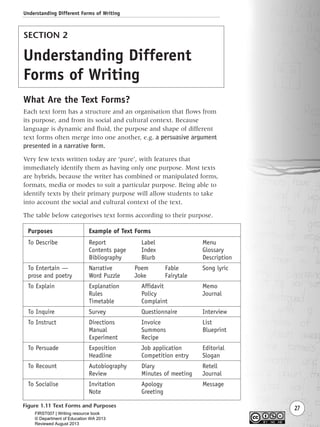
• Encourage students to use the completed Venn Diagram to make
choices and decisions about the text to be composed.
Tree Diagrams
Tree Diagrams are used to record information that might be
included in a text and show how this information might be linked.
Tree Diagrams start with a focal point, e.g. main idea or main
character or person. Subordinate (or lesser-order) information then
branches out from this point.
• Have students determine the topic for their writing. This should
be recorded at the focal point of the tree diagram, e.g. firemen.
• Students then need to consider some subheadings about the topic,
e.g. clothing, equipment, training, dangers.
• Direct students to brainstorm their sub-topics with additional detail,
e.g. hard hat, boots, jackets, glove, goggles.
• Have students use their completed Tree Diagrams as a framework
for composing their text.
Writing Resource_chpt 4 FINAL 6/29/06 10:53 AM Page 216
FIRST007 | Writing resource book
© Department of Education WA 2013
Reviewed August 2013
217
Writing Process: Drafting
Drafting is the process of transferring initial ideas or plans into
texts. The focus when drafting is on content, rather than the
mechanics or conventions of writing. It is important that students
have the freedom to get down their initial thoughts and ideas
fluently without being too preoccupied with neat handwriting,
perfect spelling or precise grammar. Students continue to plan what
ideas might be included or deleted from the text during the drafting
process, but they do not need to formally proofread or edit the text.
The notion of sustained writing is important when creating a first
draft, as it allows students to capture the main ideas, maintain
fluency in their thinking and create meaning.
Effective Writers Know How to Draft
Effective writers are able to make decisions about the number of
drafts that are necessary, depending on the purpose, audience and
context of their writing. Effective writers are able to do the
following.
• Consider audience and purpose.
• Generate, explore and develop topics and ideas.
• Record ideas rapidly in order to capture the essence of what it is
they want to say.
• Explore additional ideas during drafting.
• Use planning notes to support drafting.
• Make critical choices about which content to include.
• Experiment with style, tone and voice.
• Read and re-read as part of drafting.
• Add to or delete from the text during drafting.
• Use strategies to spell unknown words within the text.
Writing Processes and Strategies
Figure 4.9
Writing Resource_chpt 4 FINAL 6/29/06 10:53 AM Page 217
FIRST007 | Writing resource book
© Department of Education WA 2013
Reviewed August 2013
218
Processes and Strategies
Supporting Writers to Draft
It is important to provide students with multiple opportunities to
use drafting for real writing situations. A unit of work focusing on
the different facets of drafting is also appropriate, and might consist
of a combination of demonstrations and think-alouds. These
demonstrations should focus on getting ideas down as quickly and
as fluently as possible, rather than the mechanics of writing.
Activities such as ‘Ready, Steady, Write’ or ‘Drop Everything and
Write’ are designed to encourage students to write on a selected
topic for five to ten minutes. Using such activities on a regular basis
supports students to focus on getting their ideas down on paper.
Collaborative charts can also be created to help students with the
process of drafting.
Figure 4.10 Teacher Chart Supporting Writers as They Draft
Writing Resource_chpt 4 FINAL 6/29/06 10:53 AM Page 218
FIRST007 | Writing resource book
© Department of Education WA 2013
Reviewed August 2013
219
Writing Process: Conferring
An important goal of conferring is receiving feedback from others;
this feedback can then be used to help improve and polish drafts.
Discussing drafts with others helps students to move their draft
closer to a final version of text. Collaborative efforts play an
important part in this process. Students benefit from both formal
and informal opportunities to provide and receive feedback. Peer
sharing, teacher conferences or short small-group sharing sessions
all help students to obtain constructive feedback.
Feedback helps students to reflect upon initial drafts and to confirm
or adjust the direction of their writing. Obtaining feedback often
generates new ideas. Peers, teachers, parents or other adults can
provide feedback about students’ writing.
Effective Writers Know How to Confer
Effective writers are able to respond helpfully to others’ writing
by providing positive comments and constructive suggestions for
improvement. Effective writers can also identify those areas of their
own writing that they would like to receive feedback about.
Effective writers are able to do the following.
• Identify areas in their own writing that they want feedback about.
• Share their writing with others.
• Request and obtain constructive feedback from others.
• Listen to and keep track of suggestions made by others.
• Make decisions about what feedback to incorporate.
• Read others’ writing with a critical eye.
• Identify and share the strengths of others’ writing.
• Provide constructive feedback in an appropriate way.
• Ask probing questions that help other writers reflect on their text.
Writing Processes and Strategies
Figure 4.11
Writing Resource_chpt 4 FINAL 6/29/06 10:53 AM Page 219
FIRST007 | Writing resource book
© Department of Education WA 2013
Reviewed August 2013
220
Processes and Strategies
Supporting Writers to Confer
The goal is for all students to be able to select from a variety of
sharing forums to suit their needs and the needs of other writers.
These forums might include partner sharing, small-group
conversations, teacher conferences or whole-class sessions. Students
need to be able to participate successfully in each of these forums.
When focusing on the different facets of conferring, include a
combination of demonstrations, think-alouds and opportunities to
apply the techniques in real sharing sessions.
It is important to expose students to a range of questions and
statements that will help them to give and receive constructive
feedback. Collaboratively created charts will provide support to
students as they work in a variety of sharing forums.
Figure 4.12 Sample Charts Supporting Students as They Share Their Writing
Get the Background Information From the Writer
• What form are you writing in?
• Who is your audience?
• What reaction do you want your reader to have?
• How do you feel about what you have written so far?
• What is the part that you like the most / least? Why?
• Do you think you have got your message across clearly?
• How can I help you?
• What would you like me to listen for?
Provide some Constructive
Suggestions for Improvements
• I’d like to suggest …
• I think you need to …?
• Have you thought about …?
• One idea you may like to think about is …
• What do you mean by … ?
• Can you explain more about …
• Does this sentence, word or phrase make
sense to you?
Asking for Constructive Feedback
• Today I’d like you to help me with …
• My writing is about …
• The purpose of my writing is …
• The audience for this piece is …
• I’d like you to listen for …
• Can you suggest how …
• I’m not sure about this point …
• I’m stuck on …
• Do you think I’m showing or telling?
• Should I include …?
• Where do you think I need to …?
Make Some Positive
Comments
• I really like the way …
• I enjoyed …
• You have used a great hook to
get people interested here …
• This sentence clearly explains …
• This section reminded me of…
Writing Resource_chpt 4 FINAL 6/29/06 10:53 AM Page 220
FIRST007 | Writing resource book
© Department of Education WA 2013
Reviewed August 2013
221
Forums for Sharing Writing
1 Partner Sharing
Partner sharing is an opportunity for students to talk about their
writing with a peer.
• Have the writer decide how to share their text with their
conference partner. They might decide to read the piece aloud. Or
they might give it to their partner to read either silently or aloud.
• Have the writer tell their partner what they want to focus on
during the sharing time.
• Provide time for the partner to ask open-ended questions that
help the writer talk about their writing and consider possible
changes.
• Encourage the writer to take notes about the partner’s feedback
so that they can refer back to it when making changes during the
refining process.
• Have the writer thank their partner for their feedback and
sharing.
2 Teacher Conferencing
Teacher conferences provide an opportunity for students to receive
feedback from an adult. They operate in a very similar manner to
partner sharing.
• Ask the student to identify the focus for the conference.
• Invite students to read their work aloud as you listen.
• Comment on the overall message of the writing, identifying any
strengths.
• Ask questions and talk about the selected focus area.
• Provide suggestions that will help the student improve their writing.
• Record notes if necessary.
3 Sharing Circle
Sharing Circle gives students an opportunity to talk about their
writing with a small group of peers.
• Organise students into groups of four or five.
• If appropriate, give students a Sharing Circle format from the First
Steps Writing CD-ROM for recording the group’s feedback.
• Together, review the appropriate way to respond to others’ writing.
• Provide time for students seeking feedback to share their writing.
• Encourage the writer to record their feedback.
• Have students use the feedback when they begin to refine their
work.
Writing Processes and Strategies
Writing Resource_chpt 4 FINAL 6/29/06 10:54 AM Page 221
FIRST007 | Writing resource book
© Department of Education WA 2013
Reviewed August 2013
222
Processes and Strategies
4 Whole Class Sharing
Whole Class Sharing is an opportunity for students to share their
writing and receive feedback in a whole class forum. This type of
forum benefits all students, as they can adapt the feedback given
to others and apply it in their own writing.
• Select a student. Invite them to identify the area they would like
feedback about.
• Have the student read their writing aloud while the class listens.
• Invite class members to ask questions, provide praise and give
constructive feedback.
• Summarise the major suggestions given that will help the writer
improve their work.
• Invite another student to share.
For further information, see Author’s Chair on pages 23–25.
Two Stars and a Wish
The Two Stars and a Wish format gives students a simple framework
for recording feedback for others. It provides the opportunity to
reflect on positives (the stars), as well as making suggestions for
improvement (the wish).
• Give students a Two Stars and a Wish format from the First Steps
Writing CD-ROM for recording feedback.
Writing Resource_chpt 4 FINAL 6/29/06 10:54 AM Page 222
FIRST007 | Writing resource book
© Department of Education WA 2013
Reviewed August 2013
223
Writing Process: Refining
After creating a draft and receiving helpful feedback from a range
of sources, students need to work at bringing their text closer to
completion. This process is referred to as refining; students take a
closer look at their drafts to make decisions about whether to move
text, add text, cut text or leave things alone. The refining process
consists of revising, editing and proofreading.
Revising
Revising generally refers to changes made to ideas and organisation
at the text level. This could involve students rearranging the order
of paragraphs or sentences to improve the text sequence.
Editing
Editing involves clarifying meaning at the sentence level. Students
might add, change, delete or rearrange words to enhance meaning.
Proofreading
This involves reading to check conventions, rather than the
content. Proofreading involves rereading a draft to check on the use
of punctuation, spelling and grammar.
It is important to help students build a positive attitude towards the
refining process, and to help them value the time they spend in
improving their own writing. Developing a revision consciousness
(Routman, 2005) involves students looking at their writing from a
reader’s point of view. Students consider their audience needs as a
priority for making changes to their draft texts.
Writing Processes and Strategies
Figure 4.13
Writing Resource_chpt 4 FINAL 6/29/06 10:54 AM Page 223
FIRST007 | Writing resource book
© Department of Education WA 2013
Reviewed August 2013
224
Processes and Strategies
Effective Writers Know How to Refine
Effective writers are able to identify the types of changes they wish
to make; they also have the techniques that allow them to make
those changes in a text. Effective writers are able to do the following.
• See writing from a reader’s point of view.
• Know the difference between revising, editing and proofreading.
• Identify changes to be made.
• Demonstrate an awareness of audience.
• Revise ideas and organisation.
• Rearrange paragraphs to produce a more convincing order.
• Remove unimportant details.
• Add missing information.
• Rearrange or add words, phrases and sentences for shades of
meaning.
• Add dialogue, if appropriate to the form.
• Re-read and then re-write for clarity and detail.
• Use appropriate tools to adjust punctuation, grammar or spelling.
• Use a proofreading guide or editors’ checklist to refine their own
writing.
• Continue refining until satisfied.
Supporting Writers to Refine
It is important to expose students to a range of refining techniques;
these techniques can be introduced and experimented with over a
period of time. When focusing on the different facets of refining,
include a combination of demonstrations, think-alouds and
opportunities to apply the techniques in real refining situations.
The goal is for all students to be able to select from a large
repertoire of techniques to suit the specific needs of each writing
event. The following refining techniques will help students make
informed choices about how to improve their texts.
• Highlighting
• Have I Captured the Action?
• Remove the Rubble
• Let’s Hear It
• Using Spellcheckers and Grammar Checkers
• Collaboratively Created Charts
1 Highlighting
Highlighting is a technique students can use to consider what
information needs to be added to their text. Students highlight
specific parts of their text, then review it to add further detail or
any information that has been omitted.
Writing Resource_chpt 4 FINAL 6/29/06 10:54 AM Page 224
FIRST007 | Writing resource book
© Department of Education WA 2013
Reviewed August 2013
225
• Have students read and re-read their texts to highlight where
specific information has been included. For example, in a retell,
students could highlight the setting, events, and conclusion.
• Have students consider what further information and details
could be added.
• Have students check the order of the information, e.g. Are the
events listed in the order they happened?
• Discuss how adding information has improved the text.
2 Have I Captured the Action?
This technique helps students to consider and refine how they have
described actions in a text.
• Have students choose a piece of text they have previously
composed. The text should contain events with some kind of
action occurring.
• Ask students to read the text, highlighting any sentences that
describe an action.
• Provide time for students to consider whether the words
effectively convey what or how something happened.
• Encourage students to add words that help to describe the event
more effectively, e.g. adding adverbs.
• Provide time for students to make changes, then talk about how
the changes have made the action pieces clearer.
3 Remove the Rubble
Remove the Rubble is a technique students can use to delete excess
information from their texts.
• Have students choose a piece of text they have previously
composed.
• Arrange students in pairs. Ask them to re-read each text to help
each other identify any ‘rubble’, or unnecessary information.
• Students then work individually to delete any repeated or excess
information.
• Compare the final text to the original piece.
• Together, discuss how students decided what to delete from their
texts.
4 Let’s Hear It
Let’s Hear It is a technique that supports students as they refine their
writing. The teacher reads the text aloud, then the class contributes
ideas to help the selected student revise, edit or proofread. It is best
to focus on one or two selected areas, e.g. use of punctuation, use of
verbs.
• Select a student who has a piece of text to be refined.
Writing Processes and Strategies
Writing Resource_chpt 4 FINAL 6/29/06 10:54 AM Page 225
FIRST007 | Writing resource book
© Department of Education WA 2013
Reviewed August 2013
226
Processes and Strategies
• Enlarge the text so that all students can see it, e.g. overhead
projector, chart paper.
• Identify the focus for the session, e.g. proofreading for punctuation.
• Read the text aloud, inviting the class and the writer to make
suggestions for refining.
• Have the writer act as editor to change the text according to class
recommendations.
5 Using a Spellchecker or Grammar Checker
Spellcheckers and Grammar Checkers are tools that writers can use
when using word-processing programs to compose texts. Students
using word-processing programs should be taught to use a
spellchecker and a grammar checker as proofreading tools.
Make sure the spellcheck and grammar checker functions are
switched off while students are composing, as they are a distraction.
Turn these functions back on when students are ready to refine
their texts.
As spellcheckers often list suggestions for misspelt words, students
will need to draw upon their spelling knowledge in order to choose
the correct word. Students will also need to be aware that
spellcheckers will not recognise certain errors, e.g. homophones;
unknown words, such as place or family names; American spellings;
typographical errors, such as use and sue.
Grammar checkers also offer suggestions. However, students need
to read their work carefully before deciding whether to accept the
suggestions. Teach students that the green squiggly line suggests
that there might be a problem with the structure of the sentence,
but that it is up to them to determine if the sentence makes sense
or requires changes.
Students also need to understand that spellcheckers and grammar
checkers are not totally foolproof — they should not be relied on as
the only form of proofreading.
6 Collaboratively Created Charts
Collaboratively created charts remind students of the routines
and questions they need to consider during revising, editing and
proofreading. These charts can be compiled progressively. The charts
help students work through the refining process in a logical way.
• Work with students to create charts they can use during
independent refining.
• Ask students to suggest questions they could ask when revising,
Writing Resource_chpt 4 FINAL 6/29/06 10:54 AM Page 226
FIRST007 | Writing resource book
© Department of Education WA 2013
Reviewed August 2013
227
editing or proofreading.
• Record the questions on a chart. Progressively add to the chart as
students discover new ideas and further questions.
• Encourage students to use the questions as a guide when refining
their texts.
Writing Processes and Strategies
Figure 4.14 Sample Revising and Editing Chart
When revising and editing we concentrate on the ‘big picture’. This is the time to see if you need to add,
cut, move, change or leave things alone to make the piece of text the best it can be.
Look at the whole text
• Have I read my writing aloud to myself or
to someone else?
• Does my writing make sense?
• Does my writing flow?
Look at words
• Have I used a variety of words?
• Have I used words that convey exactly
what I mean?
• Can I substitute a more interesting word?
Look at sentences
• Does each sentence make sense?
• Are there any sentences that are too long
and need to be broken up?
• Can I combine any sentences?
• Can I add more detail to any sentences to
make them more interesting?
• Do I need to delete words to make my
writing clearer?
Look at paragraphs
• Do I start with a strong hook that will get
people interested?
• Do I have an interesting topic sentence?
• Do the other sentences have relevant details?
• Are the ideas in a logical sequence?
Revising and Editing Our Writing
Figure 4.15 Sample Proofreading Chart
Proofreading My Work
Concentrate on the ‘little details’ when you proofread. This is the time to
check spelling, punctuation and grammar.
• Did I underline the words I’m not sure I spelt correctly?
• Have I checked the spelling?
• Does every sentence begin with a capital letter?
• Does every sentence finish with a full stop, question mark or exclamation
mark?
• Have I used punctuation correctly, e.g. commas, speech marks?
• Have I used the right grammatical structures, e.g. verb-subject agreement?
• Have I been consistent with the use of tense?
Writing Resource_chpt 4 FINAL 6/29/06 10:54 AM Page 227
FIRST007 | Writing resource book
© Department of Education WA 2013
Reviewed August 2013
228
Processes and Strategies
Figure 4.16 Editor’s Code
Writing Resource_chpt 4 FINAL 6/29/06 10:54 AM Page 228
FIRST007 | Writing resource book
© Department of Education WA 2013
Reviewed August 2013
229
Writing Process: Publishing
Publishing is the process of preparing a text for final presentation to
(or sharing with) the intended audience. For the publishing process
to be meaningful, students need to be writing for real purposes and
authentic audiences. Not every piece of text students compose
needs to be published; texts written for purely personal reasons
might never be shared with an audience.
Modern technology makes it much easier for students to publish
their work — and it also makes it possible to reach audiences
beyond classroom boundaries. The Internet enables students to
publish their writing for real audiences worldwide.
Effective Writers Know How to Publish
Effective writers are able to make choices about how to publish,
depending on the purpose and audience of their text. Effective
writers are able to do the following.
• Use a variety of publishing formats, e.g. books, pamphlets, cards,
posters, electronic.
• Identify the most appropriate format for purpose and audience.
• Use word-processing programs or legible handwriting to prepare
published work.
• Compose a piece of writing which is both readable and appealing
to an audience.
• Add artwork, graphics or photographs to enhance texts.
Supporting Writers to Publish
It is important to expose students to a range of publishing techniques;
these techniques can be introduced and experimented with over a
period of time. When focusing on the different facets of publishing,
include a combination of demonstrations, think-alouds and
opportunities for students to publish their writing in a variety of ways.
The following experiences will help to build students’ understandings
about publishing options. The most powerful way for students to
build this understanding is by analysing a variety of formats,
exploring features such as layout, design, use of colour, font size
and type, and use of graphics. Analysing different examples of the
same format will enable students to develop guidelines that they
can refer to as they publish their own texts. The following are
suggested analysing experiences.
• What’s Included?
• Setting It Out
• Design This!
Writing Processes and Strategies
Writing Resource_chpt 4 FINAL 6/29/06 10:54 AM Page 229
FIRST007 | Writing resource book
© Department of Education WA 2013
Reviewed August 2013
230
Processes and Strategies
• Publisher’s Palette
• That Catches My Eye
• Screen-based Publications
• How Can I Publish?
1 What’s Included?
What’s Included provides students with the opportunity to analyse
published texts and make decisions about what is important to
include when publishing texts in a book format.
• Have students gather a range of texts published in book format,
including commercially published texts and texts published by
students.
• Invite small groups of students to examine the texts and list all
the features of the published books. These could include:
— Cover or jacket (with illustration or photograph)
— Title page
— Publication details
— Dedication page
— Information about the author
— Contents page
— Index
— Bibliography.
• Have students discuss the features that should be included when
publishing in a book format.
• Create a class chart of features for future reference.
This outline can also be used to explore the features of other
publishing formats.
2 Setting It Out
Setting It Out gives students an opportunity to investigate a variety
of publishing formats, and to compare how their layout impacts on
the audience.
• Provide students with a variety of texts published in the same
format, e.g. posters. These could be commercially bought posters
or posters published by students.
• Have students work in small groups to examine each text, ranking
them according to the level of visual appeal. Ask questions such
as the following to assist students examine and rank the texts.
— Where has print been positioned?
— Where have illustrations been positioned?
— What lettering or font style has been used?
— What do you notice about the size of the font, typeface, headings,
illustrations?
— How have diagrams or illustrations been labelled?
Writing Resource_chpt 4 FINAL 6/29/06 10:54 AM Page 230
FIRST007 | Writing resource book
© Department of Education WA 2013
Reviewed August 2013
231
— How are the pages numbered (or labelled)?
• Provide time for the whole class to discuss each group’s rankings
and justifications.
• Create a class chart of features to include when publishing in the
chosen format.
3 Design This!
Design This! encourages students to add graphics to a piece of text
and to design an appealing layout for a given audience.
• Provide groups of students with a cut-up piece of text, with
organisational features such as headings and graphics removed.
• Have students organise the text into an appropriate order, then
work on designing the layout of the text to suit the given audience.
Students will need to consider:
— where the text should be positioned
— where illustrations, diagrams or pictures should be positioned
— the size and position of titles, headings, labels and captions.
• Have students add headings, graphics and other text features that
will enhance the appeal and readability for their audience.
• Have students share their text with the whole class. Invite them
to discuss their rationale for design features and text alterations.
4 Publisher’s Palette
Publisher’s Palette helps students to think about the use of colour
when publishing texts. Students need to understand how the use of
colour can impact on the reader.
• Ask students to think about the feelings or moods that different
colours create, e.g. yellow: bright, sunny; blue: calm.
• Have students analyse a variety of texts that have been published
in the same format, looking specifically at which colours have
been used and how many of them.
• Encourage students to look for any colours that:
— are difficult to read
— are used to emphasise a point
— create a particular feeling
— distract the reader.
• Encourage students to discuss and determine the most effective
use of colour in the chosen format. Suggestions could include the
use of colour in:
— the cover page or title block
— large initial letters
— quotes pulled from the text, e.g. in flyers or newspaper stories
— borders
— graphics, e.g. illustrations, graphs or logos.
Writing Processes and Strategies
Writing Resource_chpt 4 FINAL 6/29/06 10:54 AM Page 231
FIRST007 | Writing resource book
© Department of Education WA 2013
Reviewed August 2013
232
Processes and Strategies
• Challenge students to publish a piece of text in the chosen format
using only black, white and three other colours.
• Invite students to share and discuss where they used colour, and
its effect on the readability and visual appeal of the text.
5 That Catches My Eye
That Catches My Eye is an opportunity for students to experiment
with different lettering and font styles. It helps students to consider
what is the most effective and suitable style to use for title pages
and headings.
• Invite each student to select a title from something they have
written.
• Challenge students to use different lettering and font styles to
create several different designs for the same title.
• Encourage students to experiment with different media and
materials. This could include:
— using word-processing software
— using stencils
— creating their own alphabet design
— cutting letters from different materials, e.g. fabric, paper,
cardboard, plastic
— incorporating materials or objects related to the title, e.g. if the
title was ‘gold’ students might use golden glitter to fill each letter;
a title related to the sea might incorporate shells or sand.
— using different drawing implements, e.g. pens, markers, crayons,
chalk.
• Display all designs. Invite students to comment on which designs
they think are the most effective, and why.
• Remind students about these discussions when they are publishing
their own texts.
6 Screen-based Publications
Provide time for students to explore a range of screen-based
publications; this will help them to understand how different
features are used to help or hinder the readability of texts.
• Provide students with web addresses of a range of suitable
websites.
• Provide time for small groups of students to examine each
homepage, and to discuss the following questions.
— What is the focal point? How do you know this?
— How has emphasis been achieved? e.g. use of bold or italicised
font, white space, colour.
— How have text or graphics been aligned?
— How have items been grouped?
Writing Resource_chpt 4 FINAL 6/29/06 10:54 AM Page 232
FIRST007 | Writing resource book
© Department of Education WA 2013
Reviewed August 2013
233
— What font or lettering style and size has been used? Is it easy
to read?
— How does the spacing between words (and between letters in
a word) help you to read the text?
— How many different fonts or lettering styles have been used in
the same piece? Why do you think this has been done?
— What colours have been used?
• Encourage students to apply their discoveries when creating their
own screen-based texts.
7 How Can I Publish?
How Can I Publish? is an opportunity for students to publish the
same text in a variety of formats. Students can then compare the
different publications and determine which is the most effective
and why.
• Divide students into groups.
• Select a piece of text that has been composed as part of a class
session.
• Allocate each group a different format for publication, e.g. letter,
poster, electronic presentation, newspaper, book, pamphlet.
• Provide time for students to complete their group publication.
• Have each group present their publication.
• Discuss the effectiveness of each publication of the text.
Sample Publishing Charts created collaboratively in a Year 6 Class
are shown in Figures 4.17 and 4.18.
Writing Processes and Strategies
Figure 4.17 Sample Publishing Chart
How Will I Publish My Work?
• Book
• Newspaper
• Electronic Bulletin Board
• Screen Saver
• Magazine
• Web Page
• Brochure
• Letter
• Pamphlet
• Chart
• Journal
• Card
• Display Board
• Multimedia Presentation
• Game Board
• Mobile
• Internet
When I Publish My Work I Need to Think About …
• Who is the audience for my text?
• What is the purpose of my text?
• What would be the most effective publishing format to use?
• What features will I include to enhance my publication?
— objects related to the theme or subject of the text
— special effects, e.g. fold outs or pop ups
— borders that relate to the theme of subject, e.g. shade
or singe the edges for an historical look
— multimedia, e.g. animation, 3-D models, video or
audiotape
• What colours and typographical elements will I use?
e.g. font style and size
• Do I have a time line for creating my publication?
Figure 4.18 Sample Publishing Chart
Writing Resource_chpt 4 FINAL 6/29/06 10:54 AM Page 233
FIRST007 | Writing resource book
© Department of Education WA 2013
Reviewed August 2013
234
Glossary
Glossary
affidavit a statement in writing made under oath or before an
authorised officer
autobiography the biography of a person, narrated by themselves
automaticity bringing information to mind with little or no effort because
a skill or understanding is so well known
ballad narrative poem composed of short verses intended to be
sung or recited, frequently of unknown authorship
bias a prejudiced view or one-sided perspective
biography an account of someone’s life written by another person
blurb a short piece of writing, often on the cover or jacket of a
text, designed to interest the reader in the text
brochure a format for writing, containing descriptive or advertising
material
contents page a list of what is included in a book; usually at the front of
the book
context the broad linguistic, social and cultural experiences that are
brought to a situation
dialect a variety of a language which belongs to a particular social
group or geographical area
editorial an explanatory form of writing used in newspapers and
magazines to discuss current news events and express
opinions
epitaph text added to an inscription on a tombstone to tell
something more about the deceased
eulogy a speech, oral or written, that praises someone or something
experiment an operation carried out under controlled conditions in
order to discover an unknown effect or law, to test or
establish a hypothesis, or to illustrate a known law
explanation factual writing that explains how something works or happens
exposition a text that intends to persuade or gives an argument
fable a short tale in prose or verse that teaches a moral, often
with animals and inanimate objects as characters
fantasy an imaginative story about characters, places and events that
do not exist
homographs words that are spelt the same but pronounced differently
and have different meanings, e.g. tear and tear, minute and
minute
homonyms words that are spelt the same and pronounced the same but
have different meanings, e.g. scale (fish), scale (music)
homophones words that are pronounced the same but spelt differently
and have different meanings, e.g. here and hear; aisle and I’ll
hybrid text using a combination of forms in one text
Writing Resource_chpt 4 FINAL 6/29/06 10:54 AM Page 234
FIRST007 | Writing resource book
© Department of Education WA 2013
Reviewed August 2013
235
hyperlink a link from a hypertext file to another location or file,
usually activated by a highlighted word or icon
hypertext machine-readable text that is not sequential, but is
organised so that related items of information are connected
legend a traditional tale handed down initially in oral form before
later becoming a written form
memo an informal record; also a written reminder
memoir an account of one’s personal experiences and observations
metalanguage language used to describe and analyse natural language;
language about language
minutes an official record of the proceedings of a meeting
multi-modal texts utilising more than one mode of text, i.e. visual, spoken
or written
narrative a story, actual or fictional, expressed orally or in writing
phrase two or more words in sequence forming a grammatical
expression, but not containing a finite verb, e.g. in the
kitchen
policy a plan of action adopted by an individual or group
sidebar a short news story, often boxed, printed alongside a longer
article; typically presents additional, contrasting or late-
breaking news
site map a textual or visual index of a website’s contents
summons to command to appear in court
synopsis a brief summary
travelogue a text about travel; can be written, spoken or visual
word stem the part of a word to which a suffix is or can be added
Glossary
Writing Resource_chpt 4 FINAL 6/29/06 10:54 AM Page 235
FIRST007 | Writing resource book
© Department of Education WA 2013
Reviewed August 2013
236
Bibliography
Bibliography
Atwell, N., 1998, In the Middle—New Understandings About Writing, Reading, and
Learning, 2nd Edition, Boynton/Cook, Portsmouth New Hampshire, USA
Barratt-Pugh, C., Rohl, M., 2001, Literacy Learning in the Early Years, Allen and
Unwin, Crows Nest, Australia
Bear, D.R., Invernizzi, M., Templeton, S., Johnston, F., 2000, Words Their Way,
Word Study for Phonics, Vocabulary and Spelling Instruction, 2nd Edition, Prentice-
Hall, New Jersey, USA
Booth, D., 2001, Reading and Writing in the Middle Years, Pembroke Publishers,
Ontario, Canada
Brand, M., 2004, Word Savvy, Stenhouse, Portland, Maine, USA
Brownjohn, S., 1994, To Rhyme or Not to Rhyme? Teaching Children to Write Poetry,
Hodder and Stoughton, Abingdon, UK
Bruce, B.C., (ed.) 2003, Literacy in the Information Age: Inquiries into Meaning Making
with New Technologies, International Reading Association, Newark, Delaware, USA
––––– 2001, Illuminating Texts, Heinemann, Portsmouth, New Hampshire, USA
––––– 2003, Writing Reminders, Heinemann, Portsmouth, New Hampshire, USA
Buss, K., and Karnowski, L., 2002, Reading and Writing Nonfiction Genres,
International Reading Association, Newark, Delaware USA
Collerson, J., 1997, Grammar in Teaching, PETA, New South Wales, Australia
Covich, S., (ed.) 2003, 2004, A Circle in a Room Full of Squares, John Curtin
College of the Arts, Fremantle, Western Australia
Cunningham, P., Moore, S., Cunningham, J., Moore, D., 2004, Reading and
Writing in Elementary Classrooms, Pearson, Boston, MA
Derewianka, B., 1990, Exploring How Texts Work, Maryborough, Victoria, Australia
Dougan, J., & Gorman, R., (eds.) 2005, Critical Literacy and Inquiry Learning in
Action, AISWA, Perth, Western Australia
Downes, T., & Fatouros, C., 1996, Learning in an Electronic World: Computers and the
Language Arts Classroom, Heinemann, Portsmouth, NH, USA
Education Department of Western Australia, 1997, Writing Resource Book, Rigby
Heinemann, Port Melbourne, Victoria, Australia
Fay, K., & Whaley, S., 2004, Becoming One Community—Reading and Writing with
English Language Learners, Stenhouse Publishers, Portland, Maine, USA
Fehring, H., & Green, P., (eds.) 2001 Critical Literacy: A Collection of Articles from the
Australian Literacy Educators’ Association, International Reading Association, Newark,
Delaware, USA
Gee, R., & Watson, C., 1990, The Usborne Book of Better English, Usborne
Publishers, London, UK
Graves, D.H., 1994, A Fresh Look at Writing, Heinemann, Portsmouth, NH, USA
Gentry, J.R., 2004, The Science of Spelling, Heinemann, Portsmouth, NH, USA
Glazer, S.M., 1998, Phonics, Spelling and Word Study: A Sensible Approach,
Christopher-Gordon Publishers, Inc, Norwood, Massachusetts, USA
Harris, P., McKenzie, B., Fitzsimmons, P., & Turbill, 2003, Writing in the Primary
School Years, Social Science Press, Australia
Writing Resource_chpt 4 FINAL 6/29/06 10:54 AM Page 236
FIRST007 | Writing resource book
© Department of Education WA 2013
Reviewed August 2013
237
Harwayne, S. 2000, Lifetime Guarantees: Towards Ambitious Literacy Teaching,
Heinemann, Portsmouth, New Hampshire, USA
Healy, A., & Honan, E., 2004, Text Next: New Resources for Literacy Learning, Primary
English Teachers Association, NSW, Australia
Heffernan, L., 2004, Critical Literacy and Writer’s Workshop: Bringing Purpose and
Passion to Student Writing, International Reading Association, Newark, Delaware,
USA
http://as1.seattleschools.org/alt_ed/social_action.htm
http://curry.edschool.virginia.edu/go/clic/nrrc/reinking.html
http://nadabs.tripod.com/ghaith-writing.html
http://www.sasked.gov.sk.ca/docs/ela20/teach4.html
http://www.sasked.gov.sk.ca/docs/mla/write.html#write
http://www.ttms.org/PDFs/04%20Writing%20Process%20v001%20(Full).pdf
Jago, C., 2002, Cohesive Writing — Why Concept Is Not Enough, Heinemann,
Portsmouth, New Hampshire, USA
Johnson, T.D., 1988, Unriddling The World, Western Australian College of
Advanced Education, Mount Lawley, Western Australia
Keene, E.O., Zimmerman. S., 1997, Mosaic of Thought — Teaching Comprehension in
a Reader’s Workshop, Heinemann, Portsmouth, New Hampshire, USA
Knobel, M., & Healy, A. (eds.) 1998, Critical Literacies in the Primary Classroom,
PETA, Newton, NSW, Australia
Lankshear, C., & Knobel, M., 2003, New Literacies: Changing Knowledge and
Classroom Learning, Open University Press, Buckingham, UK
Lazar, A., 2004, Learning to be Literacy Teachers in Urban Schools, International
Reading Association, Delaware, USA
Lewis, B., 1998, The Kid’s Guide to Social Action: How to Solve the Social Problems You
Choose and Turn Creative Thinking into Positive Action, Free Spirit Publishing,
Minneapolis, Minnesota, USA
Lyon, A. & Moore, P., 2003, Sound Systems, Stenhouse Publishers, Portland,
Maine, USA
Mansutti, E., 2004, The Poetry Detectives, Oral Presentation, Australian Literacy
Educators’ Association, State Conference, Perth, Western Australia
Marten, C., 2003, Word Crafting, Heinemann, Portsmouth New Hampshire, USA
Martin, R.D., 2000, Young Writers Guide, 3rd Edition, Era Publications, Flinders
Park, South Australia
McCarrier, A., Pinnell, G.S., & Fountas, I.C., 2000, Interactive Writing: How
Language and Literacy Come Together, K-2, Heinemann, Portsmouth, New
Hampshire, USA
Mooney, M. E., 2001, Text Forms and Features, Richard C. Owen Publishers Inc.,
Katonah, New York, USA
Murdoch, K., & Wilson, J., 2004, Learning Links: Strategic Teaching for the Learner-
Centred Classroom, Curriculum Corporation, Carlton South, Victoria, Australia
Olness, R., 2005, Using Literature to Enhance Writing Instruction, International
Reading Association, Delaware, USA
Bibliography
Writing Resource_chpt 4 FINAL 6/29/06 10:54 AM Page 237
FIRST007 | Writing resource book
© Department of Education WA 2013
Reviewed August 2013
238
Bibliography
Parsons, L., 1992, Poetry Themes and Activities Exploring the Fun and Fantasy of
Language, Pembroke Publishers Ltd., Ontario, Canada
Pearson, P.D., and Gallagher, M.C., 1983, ‘The Instruction of Reading
Comprehension’, Contemporary Educational Psychology, 8: 317–344
Pinnell, G.S., & Fountas, I.C., 1998, Word Matters: Teaching Phonics and Spelling in
the Reading/Writing Classroom, Heinemann, Portsmouth, New Hampshire, USA
Rogovin, P., 2001, The Research Workshop: Bringing the World into Your Classroom,
Heinemann, Portsmouth, New Hampshire, USA
Romano, T., 2004, Crafting Authentic Voice, Heinemann, Portsmouth, New
Hampshire, USA
Routman, 2005, Writing Essentials, Heinemann, Portsmouth, New Hampshire,
USA
––––– 2000, Conversations: Strategies for Teaching, Learning and Evaluating,
Heinemann, Portsmouth, New Hampshire, USA
Simon, L., 2004, Strategic Spelling, Heinemann, Portsmouth, New Hampshire, USA
Snowball, D., & Bolton, F., 1999, Spelling K–8, Stenhouse Publishers, York, Maine,
USA
Stahl, S.A., & Murray, B.A., 1994, ‘Defining Phonological Awareness and its
Relationship to Early Reading’, Journal of Educational Psychology, 86, 221–234
Stanovich, K.E., Cunningham, A.E, & Cramer, B., 1984, ‘Assessing Phonological
Awareness in Kindergarten Children: issues of task comparability’, Journal of
Experimental Child Psychology, 38, 175–190
Stead, T., 2001, Is That a Fact? Teaching Nonfiction Writing K–3, Stenhouse, Portland,
Maine, USA
Tannenbaum, J., 2000, Teeth, Wiggly as Earthquakes: Writing Poetry in the Primary
Grades, Stenhouse Publishers, Portland, Maine, USA
Tiedt, I., 2002, Tiger Lilies, Toadstools, and Thunderbolts: Engaging K-8 Students with
Poetry, International Reading Association, Newark, USA
Tompkins, G.E., & Collom, C., 2004, Sharing the Pen: Interactive Writing With Young
Children, Pearson, Merrill Prentice Hall, Upper Saddle River, New Jersey, USA
Tompkins, G.E., 2004, Literacy for the 21st Century: Teaching Reading and Writing in
Grades 4 Through 8, Pearson Education Inc., Upper Saddle River, New Jersey, USA
Weaver, C., 1998, Lessons to Share—On Teaching Grammar in Context, Boynton/Cook
Publishers, Heinemann, Portsmouth New Hampshire, USA
Wepner, S., Valmont, W., Thurlow, R., 2000, Linking Literacy and Technology A
Guide for K-8 Classrooms, International Reading Association, Delaware, USA
Westwood, P., 1999, Spelling — Approaches to Teaching and Assessment, ACER Press,
Victoria, Australia
Whitehead, D., 2003, Writing Frameworks, Pembroke Publishers, Ontario, Canada
Wilson, L., 1994, Write me a Poem: Reading, Writing and Performing Poetry, Eleanor
Curtin Publishing, Armadale, Australia
Writing Resource_chpt 4 FINAL 6/29/06 10:54 AM Page 238
FIRST007 | Writing resource book
© Department of Education WA 2013
Reviewed August 2013

First steps - Writing resource book

  • 1.
    First Steps SecondEdition is the result of over a decade of reflection by practising teachers. It draws upon contemporary research and developments in the field of literacy learning that have occurred since the release of the original First Steps materials. First Steps Second Edition makes practical connections between assessment, teaching and learning and caters for diverse needs within a classroom. The texts and professional development courses provide a strategic whole-school approach to improving students’ literacy outcomes. Each strand of First Steps Second Edition consists of two texts and a CD-ROM. The Maps of Development enable teachers to assess the development of students and to link appropriate instruction to phases of development. A comprehensive range of practical teaching and learning experiences is provided at each phase. A Resource Book for each strand offers concise theory and practical ideas for enhancing teaching practice. CD-ROMs in each strand provide teachers with recording sheets and a range of easily manipulated assessment, teaching and learning formats as well as ideas to help parents support their child’s literacy development. The Linking Assessment, Teaching and Learning Book is a companion to all texts within the First Steps resource and includes information applicable to all strands of literacy, together with practical support and ideas to help teachers link assessment, teaching and learning. Addressing Current Literacy Challenges Writing Resource Book Writing Resource Book FirstStepsSecondEditionWritingResourceBook ISBN 978-1-921321-12-2 9 781921 321122 Writing Resources Cover.indd 1 10/3/10 4.36.28 pm FIRST007 | Writing resource book © Department of Education WA 2013 Reviewed August 2013
  • 2.
    Acknowledgements The authors andthe publishers would like to thank the following people and organisations for granting their permission to reproduce copyright material. For texts: Association of Independent Schools of Western Australia for permission to reproduce a ‘brochure from the Sustainability Conference’, p. 156; Australian Sports Commission for permission to reproduce ‘Your rating as a coach’, p. 83 (bottom right); Avis Australia for permission to reproduce ‘Double Qantas Frequent Flyer Points’, p. 103 (bottom right); City of Subiaco for permission to reproduce ‘Leadlight festival’, © City of Subiaco, p. 129; Philip Gore and Australian Table for permission to reproduce ‘Movies’, ACP Publishing, p. 116 (top right); James Hasick, Antarctic Journal © 1993, first published by Era Publications, Australia, pp. 116 (top left), 118 (top); John Curtin College of the Arts for permission to reproduce ‘A Circle in a Room Full of Squares (2004), Western Australia, p. 151; King Features Syndicate Inc NY for permission to reproduce ‘The Phantom’ © King Features Syndicate Inc NY, 1951, 2005-09-19, p. 63; Murdoch Books Pty Limited for permission to reproduce Little Aussie Cookbook, courtesy of Murdoch Books Pty Limited (cover), p. 93 (top left); ‘Newsday’ for permission to reproduce ‘A perfect princess’, © Newsday, p. 85 (bottom); PanMacmillan, Australia, for permission to reproduce‘47 things you might not know about Morris Gleitzman’ © PanMacmillan, Australia, p. 83 (left); Penguin Group Australia for permission to reproduce Unreal (cover) by Paul Jennings, published by Penguin Group Australia, p. 61 (top right); Dr Paul Swan for permission to reproduce ‘Getting Closer’, p. 94; Transperth for permission to reproduce the transperth timetable; the information regarding Transperth services is effective as at 10/2005. To access up-to-date timetable information, please visit the Transperth website at www.transperth.wa.gov.au or call Transperth InfoLine on 13 62 13 (TTY: 08 9428 1999), p. 74 (middle); WA Independent Grocers’ Association for permission to reproduce ‘The referendum on longer shopping hours’, © WA Independent Grocers’ Association, p. 103 (top left); WA Institute of Sport for permission to reproduce ‘Following big brother’, © WA Institute of Sport, p. 83 (top); West Australian Health Department for permission to reproduce ‘Parent Questions 18–21 months’, © West Australian Health Department, Child Care Record Card CH511 (2000), p. 84; The West Australian Newspapers Limited for permission to reproduce ‘Trio’s freeway bravery saved officer’ by Daniel Emerson, p. 116 (middle) For photographs: Lindsay Edwards, pps. 3, 10, 13, 16, 19, 22, 26, 137, 159; all other photographs supplied by the Department of Education of Western Australia Every attempt has been made to trace and acknowledge copyright. Where an attempt has been unsuccessful, the publisher would be pleased to hear from the copyright owner so any omission or error can be rectified. Thank you to Hillsmeade Primary School. WriteResource_intro_FINAL 6/29/06 10:27 AM Page ii © Department of Education WA 2013 First steps. Writing resource book ISBN: 978-0-7307-4517-4 SCIS: 1600421 FIRST007 | Writing resource book © Department of Education WA 2013 Reviewed August 2013
  • 3.
    Contents Introduction 1 The ExplicitTeaching of Writing 1 Chapter 1 Use of Texts 3 Overview 3 Section 1: Instructional Procedures for Teaching Writing 5 Using a Range of Instructional Procedures 5 What Are Procedures for Teaching Writing? 5 Selecting Instructional Procedures 6 Modelled Writing 8 Language Experience 11 Shared and Interactive Writing 14 Guided Writing 17 Independent Writing 20 Author’s Chair 23 Section 2: Understanding Different Forms of Writing 27 What Are the Text Forms? 27 Introducing a New Form of Writing 30 Social Purpose: Writing to Describe 38 Social Purpose: Writing to Entertain — Poetry 48 Social Purpose: Writing to Entertain — Prose 61 Social Purpose: Writing to Explain 74 Social Purpose: Writing to Inquire 83 Social Purpose: Writing to Instruct 93 Social Purpose: Writing to Persuade 103 Social Purpose: Writing to Recount 116 Social Purpose: Writing to Socialise 127 Chapter 2 Contextual Understanding 137 Overview 137 Section 1: Developing Contextual Understanding for Writing 138 Contextual Understanding and Writing 138 Chapter 3 Conventions 159 Overview 159 Section 1: Connecting Spelling Instruction to Writing 160 Spelling as Part of Writing 160 Effective Spellers 161 Supporting Spelling Development in the Classroom 168 Case Study: Using a Student-Centred Approach in a Year 5 Classroom 180 Section 2: Developing Grammar 183 What Is Grammar? 183 Teaching Grammar 183 Punctuation 185 Parts of Speech and Their Relationship 187 Sentences 190 Paragraphs and Texts 192 Chapter 4 Processes and Strategies 197 Overview 197 Section 1: Writing Processes and Strategies 198 What Are the Writing Strategies? 198 What Are the Writing Processes? 204 Teaching Writing Processes and Strategies 205 Suggestions for Ongoing Scaffolding and Support 209 Writing Process: Planning 210 Writing Process: Drafting 217 Writing Process: Conferring 219 Writing Process: Refining 223 Writing Process: Publishing 229 Glossary 234 Bibliography 236 WriteResource_intro_FINAL 6/29/06 10:27 AM Page iii FIRST007 | Writing resource book © Department of Education WA 2013 Reviewed August 2013
  • 4.
    Authors’ Acknowledgements The FirstSteps Team from STEPS Professional Development acknowledges the contributions made by the following people. We give our grateful thanks to: All teachers and students who were involved in trialling the materials and offering feedback, either as Critical Readers, Test Pilots or Navigator Schools. Those students and teachers who provided us with great samples of work to enhance the text. A special thanks to Louise Swain for her work in the creation and collection of many of these work samples. The authors of the original First Steps edition, developed by the Education Department of Western Australia, and the efforts of the many individuals who contributed to that resource. WriteResource_intro_FINAL 6/29/06 10:27 AM Page iv FIRST007 | Writing resource book © Department of Education WA 2013 Reviewed August 2013
  • 5.
    1 Introduction The First StepsWriting Resource Book Second Edition builds on the original First Steps writing text (formerly known as the Writing Resource Book) by drawing on contemporary research and developments in the field of writing instruction. The new Writing Resource Book, used in conjunction with the First Steps Writing Map of Development Second Edition, has a strong focus on supporting teachers as they implement a multi-dimensional approach to teaching writing. The First Steps Writing Resource Book will help teachers focus on the explicit teaching of different forms of text; writing processes, strategies and conventions; and the contextual aspects associated with the act of composing texts. Teachers will find the information relevant for all phases of writing development, and will be able to apply the ideas and suggestions with all students in their classroom. CD-ROM icons appear throughout the First Steps Writing Resource Book. They indicate that a practical format is available on the Writing Strand CD-ROM (included in the First Steps Writing Map of Development Second Edition). The CD-ROM is an electronic treasure chest of activity formats, recording sheets, resource lists and teaching, learning and assessment frameworks. The First Steps Linking Assessment Teaching and Learning book is also a useful companion resource. The Explicit Teaching of Writing Teaching students to become effective, lifelong writers cannot be simplified into one method or a set of steps; the act of writing consists of multiple processes, strategies and conventions that intertwine and overlap. Teachers need to be explicit in demonstrating and talking to students about what effective writers do. Teachers also need to provide opportunities for students to apply new understandings in their own authentic writing contexts. A successful writing program requires a daily block of time, with time allocated for explicit instruction on selected aspects of writing, time for students to write independently, and opportunities for students to receive and provide feedback. The table in Figure 1 provides a basic structure for examining a block of time dedicated to the teaching of writing. The basic structure is flexible and can change on a daily basis, as needed. The needs of the students will drive decisions teachers make about how much time to spend on each element in a day or a week. WriteResource_intro_FINAL 6/29/06 10:27 AM Page 1 FIRST007 | Writing resource book © Department of Education WA 2013 Reviewed August 2013
  • 6.
    Figure1BasicStructureofaWritingBlock ESSENTIALELEMENTSOFAWRITINGBLOCK TimeforExplicitInstruction(5–20minutes) Thistimeprovidesaforumforwholeclassorsmallgroup instruction.Students’phasesofdevelopmentandidentified MajorTeachingEmphasesfromtheWritingMapof Developmentwillhelpteachersdeterminethefocusofmini- lessons.Thesemayfocusonclassroomroutinesorany selectedaspectsofwriting. •UseofTexts,e.g.Introducinganewform. (RefertoChapter1,Section2.) •ContextualUnderstanding,e.g.Useofdevices. (RefertoChapter2.) •Conventions,e.g.Useofgrammar.(RefertoChapter3, Section2.) •ProcessesandStrategies,e.g.Howtoplanforwriting. (RefertoChapter4.) TimeforIndependentWriting(20–40minutes) Thistimeprovidesstudentswiththeopportunitytoapply theprocessesofwritingtocomposetextsforauthentic purposesandrealaudiences.Studentsmightbeinvolvedin anyofthefollowing: •Self-selectedwritingprojectsandtopics. •Jointlydecidedshort-termwritingprojects,e.g.Teacher andstudentsdecideontheneedtowriteathank-you lettertoaguestspeaker. •Self-selectedtopicswithinparametersprovided,e.g. aparticularform. TimeforFeedback(5–15minutes) Timeforstudentstosharetheirwritingeitherinwhole-class, small-grouporpartnerforums.Thisprovidesarealaudience forstudentstosharedraftattemptsandtoreceivevaluable feedbackonhowtoimprovetheirwriting. ROLEOFTHETEACHER IntroduceaselectedfocususingPractices orProcedurestoteachwriting.These mightinclude: Procedures (RefertoChapter1,Section1.) ModelledWriting SharedWriting InteractiveWriting GuidedWriting LanguageExperience Practices Familiarising Analysing Discussing Providetimeforstudentstoapplynew learningthroughwriting. Observeandrecordwhatstageofthe writingprocesseachstudentisupto. Conferwithindividualsorsmallgroupsof students. Providesmallgroupinstructionas necessary. Facilitatethesharingofwriting,e.g. Author’sChair. Participateasanaudiencememberin sharingsessions. Provideconstructivefeedbacktostudents. ROLEOFTHESTUDENTS Listenandactivelyparticipateinmini- lessons. CompleteGuidedPracticeactivities– (RefertoFirstStepsWritingMapof Development.) Makeconnectionsfrommini-lessonto theirownwriting. Activelywrite;maybeinvolvedin planning,drafting,refiningor publishing. Participateinindividualorgroup conferences. Participateinsmallgroupinstructionif required. Volunteertosharewritingwithothers, e.g.readwritingaloudtoanaudience. Seekspecificfeedbackfromaudience. Provideconstructivefeedbacktopeers. Makechoicesaboutwhatfeedbackwill beincorporated. WriteResource_intro_FINAL 6/29/06 10:27AM Page 2 FIRST007 | Writing resource book © Department of Education WA 2013 Reviewed August 2013
  • 7.
    3 Use of Texts CHAPTER1 Overview The Use of Texts aspect focuses on the composition of a range of texts. Texts are defined as any form of communication from which meaning is created. This can be spoken, written or visual. Many categories are used to sort the enormous range of texts that students might compose; for example, fiction and non-fiction, narrative and informational, narrative and expository, literature and mass media. Texts in the First Steps resource are classified in three categories — written, spoken or visual. Each category can be further separated into printed, live and electronic, with some texts falling into one or more categories, e.g. a video is a combination of electronic, spoken and visual text. Students can become both composers and comprehenders of text if they can identify the primary purpose of a text, rather than its category. The overview in Figure 1.2 categorises texts according to their purpose. This chapter provides information about ways to develop students’ knowledge and understandings of texts. The two sections are as follows: • Section 1 — Instructional Procedures for Teaching Writing • Section 2 — Understanding Different Forms of Writing Figure 1.1 Writing Resource_chpt 1_FINAL 6/29/06 10:30 AM Page 3 FIRST007 | Writing resource book © Department of Education WA 2013 Reviewed August 2013
  • 8.
    4 Use of Texts Biography Autobiography Diary Journal Retells directorindirect experiences Minutesof meetings Review Written Modes Visual MEDIAElectronic Invitation Apology Message Note Personal correspondence Announcement PrintedLivePrinted Survey Questionnaire Interview Report Label Menu Contentspage Index Glossary Bibliography Blurb Description Exposition Menu Jobapplication Editorial Headlines Competitionentry Slogan Advertisement Explanation Affidavit Memo Rules Policy Journal Timetable Complaint Directions Timetable Recipe Manual Invoice List Experiment Summons Blueprint Map Magazine Letter Book Brochure Pamphlet Newspaper Newsletter Chart Journal Itinerary PURPOSES Play Theatre Painting Photograph Cartoon Televisionsitcom Film Picturebook Photograph Travelbrochure Logo Advertisement Catalogue Advertisement Timeline Graph Table Flowchart Documentary Newsreport Roadsign Clothing Tattoo Gesture Button Flyer Poster Magazine Graffiti Sticker CD-ROM Videocassette Webpage TendingTowardsLiteraryTextTendingTowardsInformationalTextAnOverviewofTexts Figure1.2AnOverviewofTexts Narrative,e.g. Fairytale Fable Fantasy Poem,e.g. Haiku Limerick FreeVerse SongLyric WordPuzzle EntertainRecountSocialiseInquireDescribePersuadeExplainInstructFORMATS JokeChatroomCD-ROM ConversationTextMessage Email Fax Card Spoken ElectronicLive Joke Story Songlyric Talkingbook Songlyric ConversationGreeting Apology Telephone conversation Voicemailmessage InterviewOralreportDebate Discussion Talkbackradio Songlyric OralexplanationOraldirectionsPerformance Speech Audiocassette Radio Television CD-ROM Video Electronic Writing Resource_chpt 1_FINAL 6/29/06 10:30 AM Page 4 FIRST007 | Writing resource book © Department of Education WA 2013 Reviewed August 2013
  • 9.
    5 SECTION 1 Instructional Procedures forTeaching Writing Using a Range of Instructional Procedures The strategic use of a range of instructional procedures creates a strong foundation for a comprehensive approach to teaching writing. Each procedure involves varying degrees of responsibility for both the teacher and student. Using a selective range of teaching procedures ensures that explicit instruction and guidance, when needed, is balanced with regular opportunities for independent application of understandings, strategies and processes. Once teachers are familiar with a range of procedures, they can determine which procedure will be the most effective to use according to students’ needs, familiarity with the task or the purpose of the writing. What Are Procedures for Teaching Writing? Instructional procedures provide meaningful contexts for focusing on selected parts of the writing process. They are characterised by a number of widely accepted steps or stages, conducted frequently and are generally applicable to all phases of development. Six procedures have been selected as a comprehensive approach to writing. The six procedures are as follows: • Modelled Writing • Language Experience • Shared and Interactive Writing • Guided Writing • Independent Writing • Author’s Chair The inclusion of each procedure has been influenced by the Gradual Release of Responsibility Model (Pearson and Gallagher, 1983). Procedures such as Modelled Writing and Language Experience allow the teacher to demonstrate how writing can be used to construct texts for different purposes and audiences. Shared and Interactive Writing and Guided Writing provide opportunities for students to practise the process of writing with guidance and support. Independent Writing sessions allow students to apply Instructional Procedures for Teaching Writing Writing Resource_chpt 1_FINAL 6/29/06 10:30 AM Page 5 FIRST007 | Writing resource book © Department of Education WA 2013 Reviewed August 2013
  • 10.
    6 Use of Texts whatthey have learnt about writing, and Author’s Chair provides opportunities for them to give and receive feedback on their writing. Teachers need to be aware of the essential elements of each procedure; this will ensure consistency in understanding and use. This awareness will also allow teachers to select the most appropriate instructional procedure to meet individual students’ needs. Selecting Instructional Procedures When selecting instructional procedures, the following questions can help ensure that students gain the maximum benefit from each session. • What is the purpose of this session? • Which instructional procedure will allow for the appropriate degree of student participation? e.g. Do students need explicit teaching or time for purposeful practice? • What resources will be required? • How will students be grouped? • What will be planned for other students while working with a small group? • What classroom routines are in place to enable students to work independently? An overview of the procedures appears on the following page (Figure 1.3) and all procedures are discussed in detail in this section. Writing Resource_chpt 1_FINAL 6/29/06 10:30 AM Page 6 FIRST007 | Writing resource book © Department of Education WA 2013 Reviewed August 2013
  • 11.
    Demonstratingwritingbehaviours andverbalisingthethinking processesinvolvedwiththose behaviours Usingasharedexperienceasa basisforjointlycomposingatext Workingwithstudentstocompose andconstructapieceofwriting, withtheteacheractingasscribe Workingwithstudentsto composeandconstructatext collaboratively,usinga‘shared pen’ •Briefsessionsfrom5to10 minutes •Eachsessionhasaclear, singularfocus •Useclear‘thinkaloud’ statements •Writingoccursinfrontof students •Thecomposedtextcanbe seenbyallstudents •Sessionskeptbriefandlively, from10to20minutes •Teacherscribes,students contributeideas •Teacherthinksaloud,invites questionsanddiscussion •Eachsessionhasaplanned explicitfocusbasedon students’needs •Sessionskeptbriefandlively, from10to20minutes •Usuallysmallgroup •Teacherandstudentsshare thepen •Eachsessionhasaplanned explicitfocusbasedon students’needs •Studentsparticipateactively •Teacherscaffoldsandsupportsagroupof studentswithsimilarneedsastheydevelop writingbehavioursandunderstandings •Studentsindependentlyapplypreviously learntwritingprocesses,understandings andstrategiestoowntexts •Anopportunityforstudentsto voluntarilysharetheirwritingand receiveconstructivefeedback ModelledWritingLanguageExperienceSharedWritingInteractiveWriting •Studentsgroupedtofocusonanidentified need •Mostwritingisdoneasindividuals •Teacheristheguideandsupporter •Sessionsareabout10to20minutes •Studentsreceivesupportandfeedbackwhen required •Studentstakeresponsibilityfortheirwriting •Studentsapplypreviouslearning •Allstudentsengagedinawriting-relatedtask •Sustainedperiodforwriting •Studentswriteforauthenticpurposes •Writingissharedwithpeers •Feedbackisexplicitandconstructive •Sessionsare10to15minutes •Canbeuseddailyattheendofwriting sessions GuidedWritingIndependentWritingAuthor’sChair Definition KeyFeatures DefinitionKeyFeatures Figure1.3OverviewofInstructionalProcedures 7 OverviewofInstructionalProcedures Instructional Procedures for Teaching Writing •Basedonasharedexperience •Textcomposedasaresultofthe experience •Usestudents’languagewhen creatingthetext Writing Resource_chpt 1_FINAL 6/29/06 10:30 AM Page 7 FIRST007 | Writing resource book © Department of Education WA 2013 Reviewed August 2013
  • 12.
    8 Use of Texts ModelledWriting Definition: The explicit demonstration of writing behaviours and the verbalisation of the thinking processes involved. Description The focus of Modelled Writing is on the explicit planning and demonstration of selected writing behaviours. Demonstrating the interactive nature of the writing process shows how writers continually make decisions as they construct texts. The teacher holds the pen and makes decisions about the writing; students observe the process and the product, rather than contribute towards it. Modelled Writing is most effective when the teaching focus is based on observation of students’ learning needs, then builds on their experiences, current understandings and prior knowledge. Students might need many repeated demonstrations before they can apply the understandings to their own writing. It is important to explicitly model all aspects of writing. It may be beneficial to work on the same text over several Modelled Writing sessions, demonstrating the many interrelated processes associated with writing. Key Features • Sessions are brief: five to ten minutes. • Sessions have a clear, singular focus. • Clear Think-Aloud statements are used. • The writing is composed as the students watch. • The text being composed can be seen by all students. Benefits for Students Modelled Writing helps students to: • understand how effective writers compose texts • understand that writing is composed for a specific audience and purpose • develop an understanding of the process of writing • understand the relationship between spoken and written language • understand how particular text forms are explicitly constructed • use a piece of writing as a reference point for their own writing. Writing Resource_chpt 1_FINAL 6/29/06 10:30 AM Page 8 FIRST007 | Writing resource book © Department of Education WA 2013 Reviewed August 2013
  • 13.
    Instructional Procedures forTeaching Writing 9 Suggestions for Using Modelled Writing in the Classroom Planning for Modelled Writing • Determine the purpose, audience and form for the writing. • Determine an explicit focus for the session based on students’ needs. • Decide on the explicit language that will be used during the Think-Alouds. • Select the required writing tools and materials, e.g. large sheet of paper and a thick marker, overhead projector, interactive whiteboard, large computer screen. Conducting Modelled Writing Sessions • Clearly explain the chosen writing focus, making links to students’ experiences and prior learning. • Explain the purpose, audience and form of the writing. • Begin to write, pausing often to demonstrate the specific focus by ‘thinking aloud’. Students can ask questions and offer suggestions; however, the teacher is in charge of the pen and thinking aloud is the focal point of the session. • Invite students to verbally rephrase the session focus. • Display the Modelled Writing sample prominently to provide a clear reference point for students’ own writing. • Involve students in recording the Modelled Writing behaviours. After Modelled Writing • Provide opportunities for students to practise and apply their understandings by taking part in Shared, Interactive, Guided or Independent Writing sessions. • Repeat Modelled Writing sessions on the same focus using different contexts, as required, until students can independently apply their understandings to their writing. Ideas for Assessment There are few opportunities to gather information about students during a Modelled Writing session. It is sometimes possible to gauge students’ understandings by the questions they ask, or through the comments they make during demonstrations. Observe and monitor students’ use of the modelled behaviours during Shared, Interactive, Guided and Independent Writing. Writing Resource_chpt 1_FINAL 6/29/06 10:30 AM Page 9 FIRST007 | Writing resource book © Department of Education WA 2013 Reviewed August 2013
  • 14.
    10 Use of Texts •Did I keep the session short and sharp (five to ten minutes)? • Was my focus clear and explicitly stated? • Did I use Think-Alouds clearly as part of my demonstration? • Did the students stay focused and attend to the demonstration? Figure 1.4 Reflecting on the Effective Use of the Modelled Writing Procedure Writing Resource_chpt 1_FINAL 6/29/06 10:30 AM Page 10 FIRST007 | Writing resource book © Department of Education WA 2013 Reviewed August 2013
  • 15.
    Instructional Procedures forTeaching Writing 11 Language Experience Definition: To use a shared experience as a basis for jointly composing a text. Description The focus of Language Experience is to involve students in a shared experience, then use students’ language to jointly construct a written text. The teacher scribes the text and students are supported as active participants in the writing process. Language Experience opportunities can be created in a range of ways. • Planned activities inside the classroom, e.g. cooking, blowing bubbles, hatching chickens, bringing in an animal or object to observe and discuss, inviting a guest speaker. • Planned activities outside the classroom, e.g. taking a trip to an interesting location such as a park, museum or zoo. • Unplanned events, e.g. a thunderstorm, a crane across the road. Key Features • Text composed is based on a shared experience. • Students’ oral language forms the basis for the creation of the written text. • Use of Shared Writing procedure to compose the text. • Participation of the whole class. Benefits for Students Language Experience helps students to: • understand the similarities and differences between spoken and written language • talk and write about events in which they have participated • develop understandings about print • produce meaningful and supportive texts for reading • have ownership of the texts produced • develop vocabulary and expand concepts • understand the relationship between thinking, speaking, writing and reading. Writing Resource_chpt 1_FINAL 6/29/06 10:30 AM Page 11 FIRST007 | Writing resource book © Department of Education WA 2013 Reviewed August 2013
  • 16.
    12 Use of Texts Suggestionsfor Using Language Experience in the Classroom Planning for Language Experience • Decide on a purposeful experience that will interest the students. • Involve students in the planning, preparation and organisation of the experience, where possible, e.g. writing invitations to parents for a special class event, making bookings for an excursion, preparing questions for a guest speaker. Conducting Language Experience Sessions • Share the experience. If appropriate, take photographs to record the event. • Ensure students are as involved as possible and that there are lots of opportunities for conversations during the experience. • After the experience, discuss the event as a whole class, encouraging students to use vocabulary related to the experience. • Involve students in a Shared Writing session to record the experience. Use students’ ideas and language to demonstrate the relationships between thinking, talking and writing. • Jointly re-read the text as it is being constructed to check and maintain its meaning. • Refine the text together until it is ready to be published. • Publish the text with photos or student drawings, e.g. make a big book, a chart, a wall display. • Involve students in purposeful reading and re-reading of the text. • Make connections between this text and other texts that the class has written or read together. After Language Experience • Display the text so that students can use it as a future writing reference. • Involve students in further writing activities related to the experience, e.g. reports for school newsletter, thank-you letters. • Use the text as a springboard for other writing and reading activities. • Use the text in Modelled, Shared or Guided Reading sessions. Ideas for Assessment Language Experience sessions allow the teacher to observe students at work as part of the whole class. Teachers are able to gather valuable information by observing individual students’ involvement and contribution to the Shared Writing session. Writing Resource_chpt 1_FINAL 6/29/06 10:30 AM Page 12 FIRST007 | Writing resource book © Department of Education WA 2013 Reviewed August 2013
  • 17.
    Instructional Procedures forTeaching Writing 13 Figure 1.5 • Did I provide an experience that was interesting and relevant to the students? • Did I stimulate enough discussion to generate rich oral language? • Did I ask open-ended questions? • Did I value the students’ own oral language in the creation of the written text? • Did I use the opportunity to extend students’ vocabularies? Reflecting on the Effective Use of the Language Experience Procedure Writing Resource_chpt 1_FINAL 6/29/06 10:30 AM Page 13 FIRST007 | Writing resource book © Department of Education WA 2013 Reviewed August 2013
  • 18.
    14 Use of Texts Sharedand Interactive Writing Definition: Teacher-managed process in which a piece of text is composed and constructed collaboratively. Description Shared and Interactive Writing are supportive writing procedures that involve the teacher and students working together to make joint decisions about planning, drafting, refining and publishing a text. In Shared Writing, the teacher acts as the scribe, allowing students to participate in the creation of a text without having to actually write it. Students are actively involved, as they are invited to contribute, develop and organise ideas. The teacher responds to students’ contributions with comments and questions, using the results to shape the written text. In Interactive Writing, the teacher makes decisions about where students can take over the pen to write parts of the text. Students are invited to ‘share the pen’ at strategic points so that they can actively participate at their instructional level. Interactive Writing usually works best with a small group of students, as each student has the opportunity to write; however, it can also be done with individuals or the whole class. Shared and Interactive Writing enable students to collaboratively compose texts at a level beyond their normal independent writing. Both procedures can be used to consolidate and extend students’ writing behaviours and understandings, and both can be adjusted to meet individual needs. A short text may be completed in a Shared or Interactive Writing session; however, the same piece of writing might be worked on over several sessions with a different focus each time. The texts can then be used for a variety of follow-up writing and reading activities. Key Features • Sessions are most effective when kept brief and lively: ten to twenty minutes. • The teacher is the scribe during Shared Writing. • The pen is shared between the teacher and students during Interactive Writing. • All students actively participate. • Planned and explicit focus in a session is based on students’ needs. Writing Resource_chpt 1_FINAL 6/29/06 10:30 AM Page 14 FIRST007 | Writing resource book © Department of Education WA 2013 Reviewed August 2013
  • 19.
    Instructional Procedures forTeaching Writing 15 • The teacher questions and ‘steers’ discussion to engage the students. • All students can see the text being composed. • The text is re-read after composing. Benefits for Students Shared and Interactive Writing help students to: • be actively involved in the process of writing in a supported way • engage in the production of texts that may be beyond their independent writing level • transfer the behaviours and strategies used by competent writers to their own writing • develop confidence in writing • understand how particular text forms are explicitly constructed • be exposed to a range of text forms. Suggestions for Using Shared and Interactive Writing in the Classroom Planning for Shared Writing and Interactive Writing • Determine an explicit focus for the session based on students’ needs. • Determine the purpose, audience and form of the writing. • Select the writing tools and materials that will be used, e.g. a large sheet of paper and a thick marker, a large computer screen, interactive whiteboard. • When conducting Interactive Writing, carefully consider at which point in the text you can allow specific students to ‘share the pen’. Conducting Shared Writing and Interactive Writing Sessions • Explain the purpose, audience and form of the writing. • Clearly explain the writing focus of the session. • Explain that joint decisions will be made about the writing. • Activate students’ prior knowledge and experiences of the topic and task. • Engage students in the construction of the text, e.g. word choices, how to best express ideas, inviting students to ‘share the pen’ in Interactive Writing. • As a group, constantly re-read the text as it is constructed to check its meaning. • Invite students to refine the text, if appropriate. • Review the selected focus at the end of the session. Writing Resource_chpt 1_FINAL 6/29/06 10:30 AM Page 15 FIRST007 | Writing resource book © Department of Education WA 2013 Reviewed August 2013
  • 20.
    16 Use of Texts AfterShared and Interactive Writing • Display the Shared or Interactive Writing text prominently. Remind students to use it as a reference for their own writing. • Provide opportunities for students to practise and apply the understandings, processes and strategies shared. • Make the composed text available for independent reading. Ideas for Assessment Shared and Interactive Writing sessions allow the teacher to observe students working as part of a group or as part of the whole class. Teachers are able to gather valuable information by observing individual students’ participation and contributions during the writing session, and by directing questions to specific students. • Did students actively participate in the construction of the text? • Was the session short and focused so that students were attentive, engaged and eager to participate? • Was the session paced so that a reasonable amount of print was produced in a short time? • What did students learn from this session that they will be able to use in their own writing? • Did I make the most appropriate teaching points for the students? • What do I need to do next to help students with their writing? Reflecting on the Effective Use of the Shared and Interactive Writing Procedures Figure 1.6 Writing Resource_chpt 1_FINAL 6/29/06 10:31 AM Page 16 FIRST007 | Writing resource book © Department of Education WA 2013 Reviewed August 2013
  • 21.
    Instructional Procedures forTeaching Writing 17 Guided Writing Definition: The provision of scaffolded support to a group of students with similar needs, as they develop writing behaviours and understandings Description Guided Writing involves guiding and supporting students through the process of writing, providing explicit instruction and feedback through planned mini-lessons and conferences. It is based on assessment of students’ needs and behaviours, and leads them towards becoming independent writers. Texts that students write through Guided Writing are usually more complex than texts they would write on their own. Guided Writing uses — and builds on — behaviours taught in Modelled and Shared Writing. Students with similar needs (or at similar phases of development) work together on a part of the process of writing relevant to their learning needs. Students usually ‘hold the pen’ and ‘own’ the writing; however, explicit feedback is given when needed and repeated demonstrations can be provided. Key Features • Students are grouped to focus on an identified need. • Most writing is done as individuals. • The teacher is the guide and supporter. • Session length: ten to twenty minutes. • Students receive support and feedback as required. Benefits for Students Guided Writing helps students to: • independently write texts of increasing difficulty • make choices and decisions about their writing in consultation with peers and the teacher • develop as individual writers by practising, exploring, experimenting and taking risks in a supportive environment • develop writing behaviours that they can apply to all writing • experience success with writing by receiving immediate feedback • develop the ability to self-monitor their writing and set writing goals. Writing Resource_chpt 1_FINAL 6/29/06 10:31 AM Page 17 FIRST007 | Writing resource book © Department of Education WA 2013 Reviewed August 2013
  • 22.
    18 Use of Texts Suggestionsfor Using Guided Writing in the Classroom Planning for Guided Writing • Identify a small group of students who have a similar need. The identified need will become the focus of the session. • Determine the purpose, audience and form of the writing event. • Make sure students come organised and equipped with writing tools, e.g. writing folder, pens, paper, personal dictionaries, laptop computer. • Organise other students to work independently. Conducting Guided Writing Sessions • Gather the group in an area where they can work easily. • Tell students the session focus; make sure they understand the purpose, audience and form of the writing event. • Link the focus back to previous Modelled and Shared writing sessions. • Invite students to share their ideas or their first sentence before writing. (This ensures students have grasped the focus of the lesson.) • Allow each student to start writing immediately after this brief discussion. • Interact with students to develop and clarify their ideas and understandings as they write. • Provide assistance and explicit feedback as required. • Assess what students are doing, by observing, taking notes and asking questions. • Review the selected focus at the end of the session, linking it back to students’ writing; reiterate the main points. After Guided Writing • During Independent Writing, encourage students to continue working on the texts they produced in Guided Writing. • Provide opportunities for students to share their writing. • Have students reflect on the writing produced during Guided Writing. • Encourage students to apply what they learnt in Guided Writing during Independent Writing. • Use observations and notes taken to direct further teaching and learning experiences. Writing Resource_chpt 1_FINAL 6/29/06 10:31 AM Page 18 FIRST007 | Writing resource book © Department of Education WA 2013 Reviewed August 2013
  • 23.
    Instructional Procedures forTeaching Writing 19 Ideas for Assessment Guided Writing allows teachers to question, observe and confer with students as they write, and to note what students are able to do when working with guidance. Use each student’s performance to monitor their development, and for planning further teaching and learning experiences that will support and extend each student. • Did I select a small group of students with a similar need? • Was my focus clear and explicitly stated? • Did I provide explicit feedback and support to the students? • Did I make the most appropriate teaching points during the session? • What do these students need next to support their writing? • Did I see any evidence of students using what I have previously modelled? • Did I provide sufficient challenges to encourage further development? • Did the rest of the class stay on task with independent activities? Figure 1.7 Reflecting on the Effective Use of the Guided Writing Procedure Writing Resource_chpt 1_FINAL 6/29/06 10:31 AM Page 19 FIRST007 | Writing resource book © Department of Education WA 2013 Reviewed August 2013
  • 24.
    20 Use of Texts IndependentWriting Definition: The independent application of previously learnt writing understandings, processes and strategies to compose own texts. Description Independent Writing focuses on students taking charge of their own writing. Students apply the understandings, processes and strategies learnt through the supported teaching procedures, then take responsibility for working through any challenges they encounter in the process of writing. During Independent Writing, the writing tasks may be: • self-selected projects and topics • jointly decided short-term writing projects • self-selected topics within given parameters. Students often refine texts they have previously written, and might revisit them over an extended period to improve them for publication. Ensure that students have sufficient time during Independent Writing to work through processes, think deeply and produce writing that is personally satisfying. Conduct conferences during Independent Writing time to give guidance and feedback to individuals or small groups. It is also possible to monitor and observe students as they work. Key Features • Students take responsibility for their writing. • Students apply previous learning. • The whole class is engaged in a writing-related task. • A sustained period is provided for writing. • Students write for authentic purposes and audiences. Benefits for Students Independent Writing helps students to: • apply writing understandings, processes and strategies in meaningful contexts • refine and consolidate their learning • build fluency and confidence with the process of writing • write for enjoyment, and for their own purposes • polish texts for publication. Writing Resource_chpt 1_FINAL 6/29/06 10:31 AM Page 20 FIRST007 | Writing resource book © Department of Education WA 2013 Reviewed August 2013
  • 25.
    Instructional Procedures forTeaching Writing 21 Suggestions for Using Independent Writing in the Classroom Planning for Independent Writing • Provide adequate time for students to write, so that they are able to think about their task and produce texts that satisfy them as writers. • Make sure that the understandings, processes and strategies needed to undertake Independent Writing have been previously modelled, shared and discussed. • Provide a rich variety of writing materials and resources. • Reinforce key elements of writing previously demonstrated by displaying jointly constructed charts as models and prompts. • Establish suitable areas for students and groups to work in. • Establish any necessary routines, e.g. noise level, storage of work, conferencing etiquette. Conducting Independent Writing Sessions • Reiterate the routines for Independent Writing. • Make sure that students have a clear understanding of the purpose and audience for writing events. • Encourage students to refer to, and reflect upon, learning covered in Modelled, Shared, Interactive and Guided Writing. • Observe students and confer at the point of need by prompting, responding as a reader, and extending their thinking. • Work with individuals or small groups while the rest of the class is writing. After Independent Writing • Provide opportunities for students to share their work and receive feedback. • Have students share published texts with their intended audience. • Provide opportunities for students to reflect on their writing. • Use observations and work samples to guide future teaching and learning experiences. Writing Resource_chpt 1_FINAL 6/29/06 10:31 AM Page 21 FIRST007 | Writing resource book © Department of Education WA 2013 Reviewed August 2013
  • 26.
    22 Use of Texts Ideasfor Assessment Independent Writing sessions provide the opportunity to observe individual students as they write. Note which elements of Modelled, Shared, Interactive and Guided Writing sessions have been understood by students and which elements need further teaching. Assess the process of writing and the writing produced. Collect information about students’ selection of writing topics and forms, writing behaviours, understandings, attitudes and interests. • Did I set aside sufficient time for Independent Writing? • Did I introduce the essential understandings and strategies necessary for Independent Writing? • Did I encourage all students to write independently? • Did I offer a choice of writing materials? • Did I celebrate writing successes? • Did I write too? If not, did I use the time to gather information about the students? • What can I do to help students extend their writing? Figure 1.8 Reflecting on the Effective Use of the Independent Writing Procedure Writing Resource_chpt 1_FINAL 6/29/06 10:31 AM Page 22 FIRST007 | Writing resource book © Department of Education WA 2013 Reviewed August 2013
  • 27.
    Instructional Procedures forTeaching Writing 23 Author’s Chair Definition: An opportunity for students to voluntarily share their writing and receive constructive feedback. (Author’s Chair is also known as Author’s Circle.) Description The focus of Author’s Chair is for students to share their writing with an audience and receive constructive feedback. They can then incorporate their peers’ suggestions into their writing. A special chair is designated as the ‘author’s chair’. A student sits in the author’s chair and reads a piece of their writing aloud to a group of peers. The writing should be current, and the group should listen carefully and respectfully, then respond as critical friends. Each student in the group thinks of an element of the writing they wish to comment on or develops a question to ask the author. Students in the group are asked to be specific about exactly what worked for them in the writing. Authors are encouraged to respond to the comments they receive or to reflect upon them. The teacher’s initial role is to facilitate sessions and guide audience responses. Model language that is useful for promoting constructive criticism, such as using ‘I statements’, e.g. I wondered …, I think …, I could picture …. Model how to ask questions about specific elements of the writing, e.g. Why did you represent the character in that way? Several groups can be operating in the classroom at the same time once students know the procedure; when this happens, the teacher no longer takes an active part, concentrating instead on observing and conferring. Key Features • Writing is shared with peers. • Feedback is explicit and constructive. • Session length: ten to fifteen minutes. • Can be used at the end of daily writing sessions. Benefits for Students Author’s Chair helps students to: • develop reflective and critical thinking as they talk about their writing with other writers • give and receive feedback on writing • develop active listening skills • ask effective questions about their peers’ writing Writing Resource_chpt 1_FINAL 6/29/06 10:31 AM Page 23 FIRST007 | Writing resource book © Department of Education WA 2013 Reviewed August 2013
  • 28.
    24 Use of Texts •develop a sense of a community of writers • improve their writing based on constructive feedback • learn that their ideas are valued • view themselves as authors who write for an audience and make choices about their writing • become perceptive readers and writers as they shift between author and audience. Suggestions for Using Author’s Chair in the Classroom Planning for Author’s Chair • Establish a cooperative and caring environment that invites students to share and respond constructively. • Designate a special place in the room and a special chair for the author. • Model the procedure for Author’s Chair several times with the whole class before attempting it with small groups. Use a ‘fishbowl’ technique, where students sit around the perimeter of the room and observe a group trying out the Author’s Chair process. Then discuss the strengths and weaknesses of the process. • Decide how many students will participate, e.g. whole class, small group. • Select a student to be the author for the session. Conducting Author’s Chair Sessions • Review the procedure, if needed. • The selected author sits in the special chair, reads their writing and shares any accompanying illustrations or diagrams. • On the first reading the audience listens respectfully, trying to get a sense of the piece. • The author invites the audience to listen as the work is read again and to focus on a specific feature of the writing. • The author invites the audience to make comments or suggestions, and to ask questions about the specific feature of the writing identified. • The author can choose to listen to each comment, to respond or to make notes. A second student could make notes on the discussion to give to the author at the end, if required. • The session ends with the author thanking the audience for their feedback. The author has the final say in accepting or rejecting any of the suggested changes to their text. Writing Resource_chpt 1_FINAL 6/29/06 10:31 AM Page 24 FIRST007 | Writing resource book © Department of Education WA 2013 Reviewed August 2013
  • 29.
    Instructional Procedures forTeaching Writing 25 After Author’s Chair • Gather the class together to reflect on their own involvement in Author’s Chair. Discuss the successes of the session and any issues arising from it. • If needed, schedule an individual conference with the author to discuss any suggested changes to their writing. • Encourage all students to apply ideas and suggestions from the session to their own writing. • Record useful sentence stems for providing feedback to peers. Jointly construct cumulative charts of the stems and display them for future reference. Figure 1.9 Useful sentence stems for giving feedback during Author’s Chair Comments We Use During Author’s Chair • I loved the way that … • Your writing reminded me of … • One suggestion I would give is … • What did you mean by … • I was puzzled when … Ideas for Assessment Author’s Chair is an opportunity to observe and record students’ interest and participation as authors and listeners. Record students’ comments and questions and use them to provide the focus for further instruction. During Independent Writing, make note of how students have incorporated audience comments into their own writing. • Did I act as facilitator of Author’s Chair? • Could students effectively manage the session independently? If not, what can I do to help them do this in the future? • Did different students participate as authors? • Did students provide specific and positive feedback to the author? • Did I give students time to reflect on their participation in Author’s Chair? Reflecting on the Effective Use of the Author’s Chair Procedure Writing Resource_chpt 1_FINAL 6/29/06 10:31 AM Page 25 FIRST007 | Writing resource book © Department of Education WA 2013 Reviewed August 2013
  • 30.
    26 Use of Texts Figure1.10 Writing Resource_chpt 1_FINAL 6/29/06 10:31 AM Page 26 FIRST007 | Writing resource book © Department of Education WA 2013 Reviewed August 2013
  • 31.
    Understanding Different Formsof Writing 27 SECTION 2 Understanding Different Forms of Writing What Are the Text Forms? Each text form has a structure and an organisation that flows from its purpose, and from its social and cultural context. Because language is dynamic and fluid, the purpose and shape of different text forms often merge into one another, e.g. a persuasive argument presented in a narrative form. Very few texts written today are ‘pure’, with features that immediately identify them as having only one purpose. Most texts are hybrids, because the writer has combined or manipulated forms, formats, media or modes to suit a particular purpose. Being able to identify texts by their primary purpose will allow students to take into account the social and cultural context of the text. The table below categorises text forms according to their purpose. Purposes Example of Text Forms To Describe Report Label Menu Contents page Index Glossary Bibliography Blurb Description To Entertain — Narrative Poem Fable Song lyric prose and poetry Word Puzzle Joke Fairytale To Explain Explanation Affidavit Memo Rules Policy Journal Timetable Complaint To Inquire Survey Questionnaire Interview To Instruct Directions Invoice List Manual Summons Blueprint Experiment Recipe To Persuade Exposition Job application Editorial Headline Competition entry Slogan To Recount Autobiography Diary Retell Review Minutes of meeting Journal To Socialise Invitation Apology Message Note Greeting Figure 1.11 Text Forms and Purposes Writing Resource_chpt 1_FINAL 6/29/06 10:31 AM Page 27 FIRST007 | Writing resource book © Department of Education WA 2013 Reviewed August 2013
  • 32.
    28 Use of Texts Thissection of the First Steps Writing Resource Book will focus on how to assess students’ control of different text forms. It also provides information about how to help students understand the purpose, organisation and language features of common text forms, and to help them consider how these forms can be shaped and adjusted to account for variations in context. The goals for all students are to: • expand the variety of text forms they compose • enhance the control they exercise over a range of text forms • adapt, combine and manipulate texts. Although it is important for students to be continually involved in composing a range of text forms for different purposes, it is also appropriate to focus a unit of work on a selected text form. This might involve students participating in speaking and listening activities, reading and collecting samples of the text form, analysing model texts, attending to multiple demonstrations, contributing to shared demonstrations, listening to Think-Alouds, completing guided practice activities or creating independent writing across learning areas. The following pages contain detailed information about the assessment and teaching of different forms. They are organised under eight major social purposes for writing, and will support teachers in creating a unit of work around a selected form of text. Each social purpose for writing contains the following support information: • Sample text forms • Type of information included in text forms • Sample organisational frameworks for a range of text forms • Language features • An assessment guide • Support activities linked to stages of development. Figure 1.12 illustrates a suggested pathway for using this information to create a unit of work. Writing Resource_chpt 1_FINAL 6/29/06 10:31 AM Page 28 FIRST007 | Writing resource book © Department of Education WA 2013 Reviewed August 2013
  • 33.
    Understanding Different Formsof Writing 29 Figure1.12SuggestedPathwayforDevelopingaUnitofWorkforaSelectedForm Selectaform fortheunit ofwork. Identifythe purpose. Usetheguide providedto assessstudents’ controlofthe selectedform. Determine astageof development. See FirstSteps WritingCD-ROM forrecording format. Describe Entertain Notyetdisplaying mostbehavioursat theBeginningStage See‘TuningIn’ SupportPagesin eachPurpose. Familiarising Familiarising Analysing Modelling Sharing Guiding Applying SeeBeginningand DevelopingStages SupportPagesin eachPurpose. SeeConsolidating andExtendingStages SupportPagesin eachPurpose. BeginningStage DevelopingStage ConsolidatingStage ExtendingStage Explain Inquire Instruct Persuade Recount Socialise Writing Resource_chpt 1_FINAL 6/29/06 10:31 AM Page 29 FIRST007 | Writing resource book © Department of Education WA 2013 Reviewed August 2013
  • 34.
    Introducing a NewForm of Writing Figure 1.13 is based on The Gradual Release of Responsibility model (Pearson and Gallagher, 1983). Using this model to introduce any new form of text will help teachers to plan a balanced unit of work. This model involves the sequential use of effective teaching practices to introduce a new form of text. The use of different teaching practices moves students from a supportive context where the teacher has a high degree of responsibility for demonstrating the creation of a text (such as modelling and sharing), to a more independent context where the student takes on the responsibility of creating their own text (guiding and applying). 30 Use of Texts Modelling The teacher demonstrates and explains the composition of a selected text form being introduced. This is achieved by ‘thinking aloud’ the mental processes used when writing the form. Familiarising Studentsareimmersedinorexposedtomultiple examplesoftheselectedtextforms. Analysing Studentsanalysetheorganisationofthetextformand constructtheirownrulesforcreatingthistypeoftext. Sharing The teacher continues to demonstrate the composition of the text form, inviting students to contribute ideas and information. Guiding The teacher provides scaffolds for students to use when composing texts. The teacher provides feedback. Applying The teacher offers support and encouragement, as needed. The students participate by actively attending to the demonstrations. Students contribute ideas and begin to collaboratively compose texts in whole-class or small- group situations. Students work with help from the teacher and peers to compose a selected text form. The students work independently to craft the text form. Students adapt the text form to suit different purposes, audience and contexts. The Gradual Release of Responsibility to the Student Figure 1.13 Introducing a New Form of Text Using a Gradual Release of Responsibility Model Familiarising Familiarising is a collective term. It describes the way in which teachers raise students’ awareness and activate students’ prior knowledge about a particular form of text. (Familiarising is also known as immersing or exposing.) When introducing a new text form, familiarising could involve students discussing, reading, listening to or viewing samples of the new form. Familiarising is a critical teaching practice for supporting students’ success in the writing of a new text form. Teachers can familiarise students with a new text form in any of the following ways. Writing Resource_chpt 1_FINAL 6/29/06 10:31 AM Page 30 FIRST007 | Writing resource book © Department of Education WA 2013 Reviewed August 2013
  • 35.
    Understanding Different Formsof Writing 31 1 Sample Displays Provide opportunities for students to read and view a variety of examples of the chosen text form. These examples can be collected from a range of sources, such as magazines, newspapers, brochures, manuals, comics, catalogues, junk mail, literature, the Internet, student samples from previous years, reading books used in the classroom, books students are reading at home, text books from across learning areas. Encourage students to collect further samples from real-life contexts and contribute them to the display. Collections of text forms should be discussed and compared, not just displayed. The key to the display is to help students build an awareness of the common features of the selected text form. This can be done by: • talking about the purpose, e.g. to entertain, to recount • identifying the possible intended audience • drawing attention to the text organisation, e.g. headings, subheadings • highlighting the type of language used, e.g. signal words, adjectives, tense. 2 Reading to and Reading with Students All writers need to see and hear how other writers compose particular forms of texts. Students need to be read to, and to have quality texts available for them to read independently. Students will benefit from opportunities to discuss the texts read, critically evaluating how real authors achieve their purpose. An excellent way for the whole class to discuss and explore examples of text forms is through shared reading of texts featuring a specific text form. Students can collaboratively discuss the purpose, use of the form, content presented, structure and organisation of the text and the type of language used. Guided Reading sessions will also provide a forum for teachers to encourage students, through questioning, to discover the features of the selected text forms. 3 Other Literacy Activities A wide range of other literacy experiences will help students build their text form knowledge. These could include activities such as: • reconstructing texts that have been cut into individual paragraphs • highlighting specific language features within a text, e.g. blue for signal words, yellow for nouns, green for technical vocabulary • innovating on a text form Writing Resource_chpt 1_FINAL 6/29/06 10:31 AM Page 31 FIRST007 | Writing resource book © Department of Education WA 2013 Reviewed August 2013
  • 36.
    A variety ofexperiences across learning areas are suggested under each writing purpose. Analysing Johnson (1988) advocated a problem-solving approach to teaching writing, an approach that can be used effectively to introduce new forms of texts. Analysing is the key practice used during a problem- solving approach, resulting in students ‘discovering’ the framework of a particular form of text. Analysing involves students breaking texts into parts to: • explore the organisation of the text form • focus on the language features used in the text form • construct their own rules for writing the text form • modify and extend their rules in light of further experience. There are two suggested models for involving students in analysing text forms. Both models will result in the creation of a possible organisational framework, list of rules for crafting that form, and the identification of associated language features. One-Text Model: one sample of the chosen text form is used. Multi-Text Model: several samples of the chosen text form are ranked. One-Text Model The One-Text Model involves students exploring one sample of the chosen text form. Select a text that is an effective model of the form, then follow these steps. Step 1: Labelling The aim of the first step is to arrive at a series of labels that begin to identify the organisational framework of the text form. It is important that students can later refer back to these labels, as they produce their own text. Discourage generic labels such as ‘Introduction’ or ‘Fact One’, as they won’t provide much support for students later when they attempt the text form for the first time. If students provide such generic terms, have them clarify the label by stating what information has been included in that part of the text. For example, Introduction will be more explicit if it is labelled as Who, When, Where, What. • Read the sample text with the students. Use an enlarged copy, overhead transparency or big book to make sure that all students can see the text. 32 Use of Texts Writing Resource_chpt 1_FINAL 6/29/06 10:31 AM Page 32 FIRST007 | Writing resource book © Department of Education WA 2013 Reviewed August 2013
  • 37.
    Understanding Different Formsof Writing 33 • Work together to decide what each paragraph or section is trying to achieve. Ask questions that encourage students to decide. For example: — What information has been included in this paragraph? — What is this part of the text telling us? e.g. This part tells us where the animal lives. — Why has the author included this section? • As students decide on the label for each paragraph, attach that label to the sample text. Step 2: Language Features Once the framework is identified, provide time for students to discuss the language features in the sample text. Students will require a great deal of support to identify the language features and use the metalanguage needed to discuss concepts such as verbs, nouns, pronouns and signal words. • Ask questions that encourage students to explore the language features of the text form. For example: — What adjectives are used? — What tense is the text written in? — What linking words are used? • Attach labels of the language features to the sample text. Figure 1.14 A Retell with Organisational Framework and Language Features Labelled Writing Resource_chpt 1_FINAL 6/29/06 10:31 AM Page 33 FIRST007 | Writing resource book © Department of Education WA 2013 Reviewed August 2013
  • 38.
    34 Use of Texts Multi-TextModel The Multi-Text Model of analysing involves students working with more than one sample of the chosen text form. Students are asked to rank samples of the text form in terms of effectiveness. Students then use the information from their discussions about the rankings to devise ‘rules’ and a framework for writing the selected form. Step 1: Ranking Provide students with up to four samples of the selected text form. For the sake of comparison, it is helpful if the sample texts are about the same topic. • Discuss the purpose of the text form and the possible audience. • Read or have students read each sample. • Provide time for students to individually rank the samples in order, from most effective to least effective. • Have students work in small groups to discuss their rankings, and to reach consensus about the order. Groups then record the reasons for their choices. • Record each group’s rankings. Step 2: Justification of Ranking • Direct students’ attention to the text that was ranked as the least effective. Elicit reasons why this text was ranked as the least effective; record students’ responses. • Repeat; this time direct students’ attention to the text that was ranked as the most effective. Elicit and record students’ reasons for this ranking of this text. Figure 1.15 Sample Ranking and Justifications Writing Resource_chpt 1_FINAL 6/29/06 10:31 AM Page 34 FIRST007 | Writing resource book © Department of Education WA 2013 Reviewed August 2013
  • 39.
    Understanding Different Formsof Writing 35 Step 3: Language Features • Provide time for students to discuss the key language features of the text that was ranked most effective. • Record the key language features with the justification information above. Step 4: Create Rules • Provide time for each group to re-read the information they have collated, and to devise a set of ‘rules’ for writing the selected text form. • Invite groups to share their ‘rules’, then combine the rules to create a class reference chart. There are probably inaccuracies in students’ ‘rules’ at this stage of the process, but the ‘rules’ only need to be specific enough to support them in their future attempts at creating the text form. Extend, refine and replace the rules as the students’ understanding of the text form develops. Modelling Students will need several demonstrations on how to construct a text using the framework or rules they ‘discovered’. Effective modelling should be explicit, have a clear focus and include targeted Think-Aloud statements that provide students with an insight into how proficient writers use frameworks to write. By using the practice of modelling to demonstrate a new framework, teachers are able to articulate what is happening inside their head. Thinking aloud is a vital part of modelling. Figure 1.16 Sample of Rules for Writing a Persuasive Text Writing Resource_chpt 1_FINAL 6/29/06 10:31 AM Page 35 FIRST007 | Writing resource book © Department of Education WA 2013 Reviewed August 2013
  • 40.
    36 Use of Texts TheModelled Writing procedure allows students to observe and clarify their knowledge and understandings of the framework. Before expecting students to apply their new learning, make sure that they have been actively involved in several demonstrations on how to use the framework. Modelling sessions need to be carefully planned and thought out. It is more effective to think through what needs to be modelled and where in the text that might happen, than to make spontaneous comments as the text is being written. Display the texts composed during modelling sessions; this will allow students to use them as examples when they are composing their own texts. Sharing Follow the analysing and modelling sessions with many sharing sessions, as sharing the accomplishment of a writing task is a cooperative and supportive way of engaging students. These sessions typically follow the procedure of Shared or Interactive Writing. During the sharing sessions, it’s critical that teachers continue to choose one specific focus to highlight. Guiding Guiding is a teaching practice that involves the teacher explicitly scaffolding a writing task. Guiding sessions provide continued support for students during their early stages of controlling a new form of text. The student maintains control, but is able to request assistance at any point. Support for students can be provided in a number of ways: • Allowing students to work with others to compose a text. • Providing planning formats. • Breaking the task into manageable parts. • Providing practice on specific elements relevant to the form. • Providing strategic assistance at key points. • Creating opportunities to practise different forms across learning areas. Teachers can consider which learning areas might provide suitable contexts for writing different forms. A sample ‘Writing Across Learning Areas’ planning format is provided on the First Steps Writing CD-ROM. Writing Resource_chpt 1_FINAL 6/29/06 10:31 AM Page 36 FIRST007 | Writing resource book © Department of Education WA 2013 Reviewed August 2013
  • 41.
    Understanding Different Formsof Writing 37 Applying Applying refers to the context and purpose of writing. Such writing tasks are whole and focused, with a purpose and audience, and generally involve the student independently creating texts and making ongoing decisions. During Independent Writing time, students have the opportunity to apply and manipulate what they have learnt about text forms to suit different purposes and audiences. Access to teacher advice is not denied, but neither is it planned or structured in a way that indicates reliance. The ultimate goal is for students to function in society as literate individuals who can use writing to communicate their ideas, share information, stimulate thinking, formulate questions and influence policy and action. Writing Resource_chpt 1_FINAL 6/29/06 10:31 AM Page 37 FIRST007 | Writing resource book © Department of Education WA 2013 Reviewed August 2013
  • 42.
    Understanding Texts ThatDescribe In texts that describe, information is systematically organised and recorded to classify and describe a whole class of things, e.g. computers, lions, Life on the Victorian Goldfields. Texts that describe can be text forms in their own right, such as reports, menus or travel brochures. They can also be part of other overall texts, e.g. indexes, glossaries, labels, descriptions and contents pages. The following information is usually included in texts used to describe. 1 Classification or Generalisation This may take the form of a heading, e.g. Main Courses, or a definition of the subject, e.g. Computers are programmable electronic devices. This part of the text can also refer to the specific topic to be described, e.g. Lions are one of the many carnivorous mammals that inhabit the plains of Africa. 38 Use of Texts Social Purpose: Writing to Describe Figure 1.17 Samples of Texts Used to Describe Writing Resource_chpt 1_FINAL 6/29/06 10:31 AM Page 38 FIRST007 | Writing resource book © Department of Education WA 2013 Reviewed August 2013
  • 43.
    Understanding Different Formsof Writing 39 2 Description Provides a detailed description of various components of the topic. These components are sequenced in a specific way, depending on the text topic. 3 Concluding or Summarising Statements May include an impersonal evaluative comment. Organisational Frameworks The information above is included in most texts used to describe; however, the organisational framework used to construct each text will vary, depending on the form and topic. Purpose: To Describe Form: Geographic Report CONCLUDING OR SUMMARISING STATEMENT • impersonal evaluative comment CLASSIFICATION OR GENERALISATION • classification DESCRIPTION Includes facts about: • location • geography • government • special characteristics • people Purpose: To Describe Form: Scientific Report CONCLUDING OR SUMMARISING STATEMENT • impersonal evaluative comment CLASSIFICATION OR GENERALISATION • scientific name DESCRIPTION Includes: • what it looks like (physical description) • what it eats • where it lives (habitat) • special features Writing Resource_chpt 1_FINAL 6/29/06 10:31 AM Page 39 FIRST007 | Writing resource book © Department of Education WA 2013 Reviewed August 2013
  • 44.
    40 Use of Texts LanguageFeatures Texts used to describe usually include these language features: • Nouns and pronouns that refer to generalised participants, e.g. lions, computers, they, it. • Timeless present tense, e.g. are, have, exists, grows. • Action verbs (behaviours), e.g. runs, hunts, erupts. • Adjectives that are factual and precise, e.g. 5.6 megabytes, sandy coloured. • Technical vocabulary, e.g. marsupials, monotremes, information processing system. • Formal objective style, i.e. first-person pronouns and the writer’s opinions are not generally appropriate. • Signal words for classifying, defining, comparing and contrasting, e.g. are called, belong to, are similar to, are more powerful than. Adapted from Derewianka, B. (1990) CONCLUDING OR SUMMARISING STATEMENT • not applicable to this form Purpose: To Describe Form: Menu CLASSIFICATION OR GENERALISATION • heading of each section Figure 1.18 Framework Samples from Texts Used to Describe DESCRIPTION Includes: • description of each item • price Writing Resource_chpt 1_FINAL 6/29/06 10:31 AM Page 40 FIRST007 | Writing resource book © Department of Education WA 2013 Reviewed August 2013
  • 45.
    Understanding Different Formsof Writing 41 Thewriter: •sharesinformationaboutaknowntopic •writesanobservationandcomment •focusesonaspecificpartofawholeclass ofthings,e.g.‘Mycateatsmeat’not ‘Catseatmeat’. •describesfeaturesthatarenotnecessarily importantorrelevant •groupssimilarinformationtogether •writesaconcludingstatementthatisa personalcommentratherthanasummary, e.g.Ilikecats. •usespersonalorsubjectivelanguage,e.g. ‘Ireallylike...’ •usessimplevocabulary,e.g.big,little •usesalimitedrangeofsignalwords,e.g. and Thewriter: •provideslimitedfactualinformationabout agiventopic •usesalimitedrangeofformsandformats, e.g.report,chart •introducesthetopicbyprovidinga classificationthatmaylackprecision, e.g.Dogsareanimals. •giveslimitedgeneralinformation, e.g.size,colour,habitat •includesinformationunderheadings •writesaconcludingstatementwithsome attempttosummarisewhathasbeen written •isbeginningtouseobjectivelanguage •usessometechnicalorsubject-specific vocabulary •isbeginningtousetimelesspresenttense e.g.are,hunt •usessimplewordstosignalcompareand contrast,e.g.like,asbigas… Thewriter: •providesdetailedfactualinformation aboutagiventopic •usesavarietyofformsandformats,e.g. description,slideshow,encyclopaedia entry •introducesthetopicbyprovidingaprecise classificationorgeneralisation •includesdetailsthatareclearlyrelatedto thetopicandelaboratesonspecial features •groupsrelatedinformationintoparagraphs introducedbyatopicsentence •writesasummaryorconcludingparagraph thatreiteratesthekeypointsandmay includeanevaluativecomment,e.g.This inventionwillchangethecourseofhistory. •maintainsobjectivelanguagethroughout •usestechnicalandsubject-specific vocabularyappropriately •usestimelesspresenttense,e.g.fly,live, suckle •usesappropriatesignalwordstocompare, contrast,defineandclassify,e.g.are similarto,belongto Thewriter: •providesinformationthatisselected, sortedandsynthesised •adaptsformsandformatsforatarget audience •writesanintroductionthatsuccessfully classifiesorgeneralisesinformation essentialtothesubjectortopic •includesdetailedinformationselected becauseofitsrelevancetothesubjector topic •organisesinformationintoparagraphsthat linkcohesivelytocomposeacoherenttext •writesaconcludingparagraphthat accuratelysummarisesthemainpoints •usesformalobjectivestyletosuitpurpose andaudience,e.g.humanityfaces increasing...,thefamilyis... •choosesprecisetechnicalandsubject specificlanguagetosuitpurposeand audience,e.g.carnivorous,mammals, pollutants •maintainsconsistentuseoftense throughout •writescohesivelyusingawiderangeof signalwordstocompare,contrast,define andclassify,e.g.morepowerfulthan, nevertheless FocusonAssessing BeginningStage Canstatethepurposeandaudienceof textstobecomposedandincludes basicorganisationalfeaturesofsimple formsusedtodescribe. DevelopingStage Isawareofthepurposeandaudience whencomposingtextsandusesa partialorganisationalframeworkofa smallrangeofformsusedtodescribe. ConsolidatingStage Considersthepurposeandaudienceto selectspecificvocabularyanduses appropriateorganisationalframeworks tocomposeavarietyofformsusedto describe. ExtendingStage Craftsformsusedtodescribeby selectingvocabularyandmanipulating organisationalframeworkstosuitthe contextofthewritingevent. AssessingWritingtoDescribe Studentsareinthestagewheretheydisplaymostofthebulletedpoints. Familiarising,Analysing,Modelling,Sharing,GuidingandApplying Seepages30–37and43–45 Familiarising,Analysing,Modelling,Sharing,GuidingandApplying Seepages30–37and46–47 Focuson Teaching Figure1.19AssessmentGuideforWritingtoDescribe Writing Resource_chpt 1_FINAL 6/29/06 10:31 AM Page 41 FIRST007 | Writing resource book © Department of Education WA 2013 Reviewed August 2013
  • 46.
    Supporting Students atthe Tuning-In Stage This section provides ideas for supporting students who have not yet reached the Beginning stage on the Writing to Describe Assessment Guide (Figure 1.19). Focus on building students’ awareness of the language features and organisational frameworks of the form being introduced. The following familiarising activities are suited to any form associated with writing to describe. 1 Sample Displays see page 31 2 Reading with and Reading to Students see page 31 3 Literacy Activities • Provide plenty of oral language activities. Give students opportunities to focus on the language used to describe the attributes of objects, e.g. Show and Tell, Barrier Games, picture talks. Encourage students to consider questions such as: — What is it called? — What kind of thing is it? — What does it look like? — What noise does it make? — Where is it found? • Work together to build descriptive Word Webs around familiar topics, e.g. chickens. 42 Use of Texts Figure 1.20 Sample Word Web fluffy yellow white chickens chirp cheep lay eggs feathers two legs beak hens roosters — What does it do? — What special features does it have? — What is it similar to? — What is it different from? • Play oral games, such as Who Am I?, What Am I?, I Spy, True or False. Each game involves one student orally describing a person or object, while other students try to guess who or what is being described. • Focus students’ attention on the language used to describe people, characters, objects and places when the class is reading literary and informational texts. Discuss words that indicate who or what is being described. Record the descriptive words on a chart for future reference. Writing Resource_chpt 1_FINAL 6/29/06 10:31 AM Page 42 FIRST007 | Writing resource book © Department of Education WA 2013 Reviewed August 2013
  • 47.
    Understanding Different Formsof Writing 43 • Create meaningful contexts for displaying models of texts used to describe, e.g. a science table with labelled exhibits, labels on storage cupboards, descriptions of each student in the classroom. • Play Definition Games where students are challenged to match technical and subject-specific vocabulary to definitions, e.g. an animal that suckles its young — mammal. Supporting Students at the Beginning and Developing Stages The main focus for these students is to help them understand the purpose, organisation, structure and language features of the text form being introduced. Modelling and Sharing The following modelling and sharing suggestions are separated into two stages; the first is specific to the Beginning Stage, and the second is more relevant to students in the Developing Stage. However, the suggestions should be seen as cumulative. When selecting a focus for the Developing Stage, teachers should also consider what is listed in the previous stage. Beginning Stage Focus on understandings of text organisation, structure and language features. During Modelled, Shared and Interactive writing sessions demonstrate how to: • collect information about a chosen topic • decide on appropriate headings to organise the text • sort information under headings, e.g. food, habitat, appearance, offspring • introduce the topic • write a concluding statement that summarises the key points • use objective language • use subject specific and technical vocabulary to provide more specific information, e.g. A kangaroo is a marsupial. • use signal words that compare and contrast • use timeless present tense, e.g. The Dall Porpoise has small flippers. Developing Stage • select information appropriate to the audience • include details that are relevant to the topic and audience • select special features and elaborate on them • introduce the topic by providing a precise classification or generalisation • list references used • choose language that is objective • include illustrations and diagrams to enhance the writing, e.g. tables, graphs, charts, maps • use signal words that compare, contrast, define and classify • combine paragraphs to build a description of the topic. Figure 1.21 Suggested Focus for Modelling and Sharing Sessions Writing Resource_chpt 1_FINAL 6/29/06 10:31 AM Page 43 FIRST007 | Writing resource book © Department of Education WA 2013 Reviewed August 2013
  • 48.
    44 Use of Texts Guiding Thefollowing guided-practice activities are suitable for students in the Beginning and Developing Stages, allowing them to build their understandings about texts used to describe. Each activity should be used in a meaningful context across different learning areas. Word Webs Have students construct Word Webs when they are collating facts or key words about a topic. Provide opportunities for students to take related facts and make them into one or more sentences. Building Vocabulary Have students brainstorm adjectives, technical terms and subject- specific vocabulary related to the current topic. Display these words in the classroom so that students can use them as a reference. What Do You Want to Know? Have students list everything they want to know about a specific topic, leaving a line between each item on their list. Invite them to share their list with a partner or small group to gather further suggestions. Have students cut their lists into strips, organise them into categories, then create a suitable heading for each category, e.g. habitat, lifestyle, what it looks like. Students can then use their personalised frameworks as a springboard for writing. Guess What? Students write several sentences to describe a common object, e.g. This object was invented by Alexander Graham Bell as a means of communication. In recent times they have become multimedia tools, allowing photos to be taken. Encourage them to use detailed descriptions and subject-specific language. Students then swap with a partner who attempts to identify the object described. Ask the Expert Invite an expert to visit your classroom and speak on a topic that is being studied, e.g. the zoo keeper in charge of orang-utans. Have students prepare their questions prior to the talk to ensure that the expert provides the information they want to know. This activity could also be used with individual students acting as the ‘expert’ in an area of interest. Writing Resource_chpt 1_FINAL 6/29/06 10:31 AM Page 44 FIRST007 | Writing resource book © Department of Education WA 2013 Reviewed August 2013
  • 49.
    Understanding Different Formsof Writing 45 Fact and Opinion Provide small groups of students with a list of facts and opinions about a specific topic. Have students discuss whether each written statement is a fact or an opinion. Encourage students to identify the vocabulary that indicates the difference. Reporting the Essentials Read students a text that describes facts about a topic being studied. Have students record the key facts in diagrammatic form, e.g. Venn diagram, tree diagram, mapping. Students can then use their diagrams as springboards for writing, or as a stimulus for further investigation of the topic. Technical Terms Students brainstorm a list of technical terms and subject-specific words related to a chosen topic, then find definitions for any words they don’t know. Encourage them to use the list-words in their writing. Referencing Have students reference any texts they refer to in researching their topic. Listing the author and the text title may be sufficient at the Beginning and Developing Stages. Glossary Have students choose subject-specific words or technical terms related to the current topic of study and use them to construct a class glossary. Have students write their definitions of the terms, then use references to find out if their definition is correct or needs amending. Correct words and definitions can then be added to the class glossary for future reference. Across Learning Areas Provide across learning areas opportunities for students to compose texts used to describe, e.g. Health and Physical Education Menu of healthy foods. Society and Environment Report about a country. Technology and Enterprise Labelled diagram of a model. Science Scientific report about animals. The Arts Contents page for a text on musical instruments. Writing Resource_chpt 1_FINAL 6/29/06 10:31 AM Page 45 FIRST007 | Writing resource book © Department of Education WA 2013 Reviewed August 2013
  • 50.
    46 Use of Texts SupportingStudents at the Consolidating and Extending Stages The main focus for these students is to help them to enhance their control over the text form, including their ability to adapt and manipulate the text. Modelling and Sharing When selecting a focus for the Consolidating and Extending Stages, teachers should also consider what is listed in previous stages. Focus on continuing to build students’ understandings of text organisation, structure and language features, by demonstrating how to: • organise information to form a coherent text • write a concluding paragraph that accurately summarises the main points • include references when appropriate • include texts such as a table of contents, index or glossary within other texts • maintain consistent use of tense • add illustrations, photographs, diagrams and labels that match and enhance the writing • select technical and subject-specific language appropriate to the audience • use objective language appropriate to the audience. Guiding The following guided-practice activities are suitable for students in the Consolidating and Extending Stages, to further develop their understandings about texts used to describe. Each activity should be used in a meaningful context across different learning areas. Vocabulary Development Have students brainstorm vocabulary related to a specific topic. Provide time for students to separate their words into subject-specific language, e.g. primrose, and everyday language, e.g. flower. Encourage them to research technical terms for selected words, e.g. genus Primula. A Picture is Worth 1000 Words Have students look at a range of texts used to describe. Discuss how photographs, illustrations, diagrams and maps have been included to enhance the text. Encourage students to refine their own writing by adding illustrations, photographs, maps or diagrams. Writing Resource_chpt 1_FINAL 6/29/06 10:31 AM Page 46 FIRST007 | Writing resource book © Department of Education WA 2013 Reviewed August 2013
  • 51.
    Understanding Different Formsof Writing 47 Rapid Research Invite small groups of students to select a topic of interest, e.g. Sydney Harbour Bridge, mountain bikes. Encourage groups to gather as many facts as they can in an allotted time, then have each group report their findings to the class. Later, have students use the assembled facts as the basis for writing texts that describe. Who is the Audience? Provide students with a text used to describe, e.g. a report. Ask students to read the text and discuss who is the intended audience. Jointly highlight those words that indicate the intended audience. Allocate a new audience to each small group and provide time for them to make necessary changes, e.g. add more details, simplify the language. Have each group share their new audience and their new text with the class. Add the Missing Piece Select an appropriate text used to describe, then delete the conclusion or introduction. Have students work in small groups to compose the missing piece. Provide time for students to compare the piece they have written with other students’ ‘missing pieces’ and with the original text. Citing References Provide opportunities for students to discover how various information sources are referenced in different ways e.g. website, journal article, book. Encourage students to cite their references when they create texts. Across Learning Areas Provide opportunities across learning areas for students to compose texts used to describe, e.g. Society and Environment Description of a landform. Technology and Enterprise Index for a report about robots. Mathematics Glossary to describe mathematical terms. Science Description of a specific plant. The Arts Report on a period in art history. Writing Resource_chpt 1_FINAL 6/29/06 10:31 AM Page 47 FIRST007 | Writing resource book © Department of Education WA 2013 Reviewed August 2013
  • 52.
    Social Purpose: Writingto Entertain — Poetry 48 Use of Texts Figure 1.22 Samples of Poetry Texts Used to Entertain Understanding Texts That Entertain — Poetry Fiction is a generic term given to a range of texts that seek to entertain the reader, and includes poetry and prose. Poetry is a way of manipulating and arranging words to create unique perspectives of the world. The writer (or poet) combines words and images in order to share personal thoughts and feelings about a subject. Lines of poetry are usually short and concise. Writing poetry requires the writer to be selective in choosing words that capture their intended meaning. Writing Resource_chpt 1_FINAL 6/29/06 10:32 AM Page 48 FIRST007 | Writing resource book © Department of Education WA 2013 Reviewed August 2013
  • 53.
    Understanding Different Formsof Writing 49 Figure 1.23 A Sample of Poetry Frameworks Haiku A Haiku is a form of Japanese poetry consisting of three lines. Each line has a specific number of syllables. 1st line: 5 syllables, and tells where 2nd line: 7 syllables, and tells what 3rd line: 5 syllables, and tells when Lantern Poem This five-line poem is written in the shape of a Japanese lantern. Each line is limited by a specific number of syllables. 1st line: 1 syllable 2nd line: 2 syllables 3rd line: 3 syllables 4th line: 4 syllables 5th line: 1 syllable Cinquain A cinquain is a poem derived from the haiku and tanka forms. It consists of five lines, each with a specific number of words. A cinquain doesn’t rhyme. 1st line: one word (title) 2nd line: two adjectives 3rd line: three verbs 4th line: 4 words to describe a feeling 5th line: one word (refers to the title) Acrostic Poems In this form of poetry, the letters of the topic are written vertically. Each letter of the topic word therefore forms the first letter of the word beginning each line. Some acrostic poems use only single words for each line while others use a phrase. Acrostic poems can be rhymed or unrhymed. List Poem As the name suggests, a list poem is a list of items written down the page. These can be lists of single items, lists of phrases or a combination of both. These poems can be rhymed or unrhymed. Poetry, in its broadest sense, cannot be described in generic terms, even though some poems conform to specific structures, such as haiku, limericks, cinquains and sonnets. The variation possible in the organisation and structure of a poem is part of the essence of poetry. Organisational Frameworks There are many different forms of poetry, and each form has its own distinctive organisational framework. The following examples provide a snapshot of some of the most common forms. Writing Resource_chpt 1_FINAL 6/29/06 10:32 AM Page 49 FIRST007 | Writing resource book © Department of Education WA 2013 Reviewed August 2013
  • 54.
    50 Use of Texts Diamantes Adiamond poem usually consists of seven lines. Lines one and seven are antonyms. 1st line: a one-word noun 2nd line: two adjectives to describe the noun 3rd line: three verbs that the noun does 4th line: four nouns that are things that the noun in line 1 and the noun in line 7 both have 5th line: three verbs that the noun in line 7 does 6th line: two adjectives that describe the noun in line 7 7th line: a one-word noun that is the opposite of line 1. Limerick A limerick is a humorous poem of five lines. The poem is constrained by both the rhythm and the rhyme. In a limerick, the first and second lines rhyme. The third and fourth lines (which are shorter than the first two) rhyme, and the fifth line rhymes with lines one and two. This is called an AABBA rhyming pattern. Most limericks are also constrained by syllabic structures. For example: 1st line: 9 syllables 2nd line: 9 syllables 3rd line: 5 syllables 4th line: 5 syllables 5th line: 9 syllables Sonnet A sonnet is a poem of fourteen lines. The English or Shakespearean sonnet begins with three quatrains and finishes with a couplet. The rhyming pattern is usually ABABCDCDEFEFGG. Most sonnets have a definite rhythm. Free Verse Free verse has no set conventions for punctuation or structure. These poems need not rhyme or have a distinctive rhythm. The lines need not scan or conform to any pattern. Words used should be those that evoke strong images, moods and emotions. Concrete (Shape) Poems These poems use words and the physical formation of those words to convey meaning. This may be done with colour, the shape of the letters or the arrangement of the words. The meaning of the poem can be enhanced by manipulating the size, direction and placement of words and lines. Couplets and Triplets Couplets and triplets are, respectively, two- and three-line poems. In this type of poetry, the lines rhyme and contain the same number of syllables, or have the same metre. Tanka A tanka is a form of Japanese poetry that consists of five lines, each line constrained by a specific number of syllables. 1st line: 5 syllables 2nd line: 7 syllables 3rd line: 5 syllables 4th line: 7 syllables 5th line: 7 syllables Writing Resource_chpt 1_FINAL 6/29/06 10:32 AM Page 50 FIRST007 | Writing resource book © Department of Education WA 2013 Reviewed August 2013
  • 55.
    Understanding Different Formsof Writing 51 Language Features Texts used to entertain through poetry usually include the following language features: • Nouns and verbs that refer to specific objects, events, emotions, things or actions. • Adjectives and adverbs that are more imaginative than factual and precise, e.g. glistening, harmonious, rebelliously. • Literary devices such as: — alliteration: the repetition of consonant sounds, usually at the beginning of words, to create effect — assonance: the repetition of vowel sounds, e.g. Ousted from the house … — onomatopoeia: words that sound like the item being described — imagery: the creation of likenesses through order and word choice — simile: comparison of two items, made explicit by using ‘as’ or ‘like’ — metaphor: an implicit comparison between two items that are not normally connected — personification: using human characteristics to describe abstract concepts and natural phenomena — hyperbole: an obvious exaggeration used for effect — symbolism: symbols used to represent feelings or objects — rhetorical question: a question to which an answer is not expected — rhyme: words that match in sound — rhythm: the beat represented by stressed and unstressed syllables — repetition: repeating words and phrases for effect. Villanelle A Villanelle is a French poem that consists of 19 lines, arranged in six stanzas. The first five stanzas contain three lines and rhyme in the pattern ABA. The sixth stanza consists of a quatrain with a rhyming pattern of ABAA. In addition to the rhyming pattern, the first and third lines alternatively repeat throughout the poem, and are repeated as the last two lines of the final quatrain. Clerihew Named after the British writer, Edmund Clerihew Bentley, these short humorous verses consist of two rhyming couplets. Clerihews are written about people and the person’s name generally serves as one of the rhymes. The first line usually ends with the person’s name. The second line ends with a word that rhymes with the name. Quatrain A quatrain is a poem of four lines that rhymes in one of four ways. The rhyming patterns for a quatrain are: AABB, ABAB, ABCB or ABBA. Figure 1.23 Samples of Poetry Frameworks Writing Resource_chpt 1_FINAL 6/29/06 10:32 AM Page 51 FIRST007 | Writing resource book © Department of Education WA 2013 Reviewed August 2013
  • 56.
    52 Use of Texts Thewriter: •writessimplepoemsthatinnovateona givenstructure •innovatesonagivenpattern,e.g. Ilike…,Ilike….,Ilike. •chooseswordsbasedonpersonalchoice •attemptstousesimpleliterarydevices, suchasalliteration •givesmissingrhymingwordtocomplete asimplerhyme,e.g.Isawafish,sitting ona….. Thewriter: •writessimplerhymingandnon-rhyming poemsoftenchoosinginappropriatewords forthecontext •experimentswitharangeofknownpoetry forms,e.g.rhymingcouplets,freeverse •isbeginningtoobservestructural constraintsofdifferenttypesofpoetry, e.g.rhymingcoupletshavetwolines •isbeginningtoselectappropriatewords toconveymeaning •beginstousesomeliterarydevices, althoughtheymaynotbeappropriatefor thecontext •whenappropriate,usesasimplerhyming pattern,e.g.rhymingcouplets,ABAB pattern •isunabletomaintainrhythmicpatternin ownpoetry Thewriter: •writesusingstructureofpoetrywithout regardforpersonalvoice •writespoetryinarangeofforms,e.g. haiku,cinquains,shapepoems,limerick, rap •knowsandadherestostructural constraintswhennecessary,e.g.syllable patternsincinquains,haiku •selectsspecificwordstoenhance meaning,e.g.specificnouns,appropriate adjectivesandadverbs •usesliterarydevicesalthoughtheymay seemcontrived •whenappropriate,usesanexplicitrhyming patternthathasbeenexplored,e.g. limerick •choosesknownrhythmicpatternsto composeownpoetry Thewriter: •writesarangeofpoeticformsexpressing complexconceptsincreativeways •writespoetryinarangeofcomplexforms, e.g.ballads,sonnets,odes •chooseswhethertoconformormanipulate structureforeffectandimpact •selectswordsthatvividlyandprecisely conveyimages,feelings,moodandtone •choosestouseawiderangeofliterary devices,e.g.metaphor,simile •writesusingcomplexrhymingpatternsbut choosestobefreedfromtheconstraints ofrhymewhennecessary •createsrhythmicpatternsforeffect,e.g. wordssoundinglikeahorsegalloping FocusonAssessing BeginningStage Canstatethepurposeandaudienceof textstobecomposedandincludes basicorganisationalfeaturesofsimple formsusedtoentertainthroughpoetry. DevelopingStage Isawareofthepurposeandaudience whencomposingtextsandusesa partialorganisationalframeworkofa smallrangeofformsusedtoentertain throughpoetry. ConsolidatingStage Considersthepurposeandaudienceto selectspecificvocabularyanduses appropriateorganisationalframeworks tocomposeavarietyofformsusedto entertainthroughpoetry. ExtendingStage Craftsformsusedtoentertainthrough poetrybyselectingvocabularyand manipulatingorganisationalframeworks tosuitthecontextofthewritingevent. AssessingWritingtoEntertain—Poetry Studentsareinthestagewheretheydisplaymostofthebulletedpoints. Familiarising,Analysing,Modelling,Sharing,GuidingandApplying Seepages30–37and54–57 Familiarising,Analysing,Modelling,Sharing,GuidingandApplying Seepages30–37and58–60 Focuson Teaching Figure1.24AssessmentGuideforAssessingWritingtoEntertain—Poetry WritingResource_chpt 1_FINAL 6/29/06 10:32 AM Page 52 FIRST007 | Writing resource book © Department of Education WA 2013 Reviewed August 2013
  • 57.
    Understanding Different Formsof Writing 53 Supporting Students at the Tuning-In Stage This section provides ideas to support students who have not yet reached the Beginning stage on the Writing to Entertain — Poetry Assessment Guide (Figure 1.24). Focus on building students’ awareness of the language features and organisational frameworks of the form being introduced. The following familiarising activities are suited to any form associated with writing to entertain—poetry. 1 Sample Displays see page 31 2 Reading to and Reading with Students see page 31 3 Literacy Activities • Provide opportunities for students to read and recite rhymes, poems, raps and chants. • Encourage students to create actions to accompany familiar rhymes. • Encourage students to retell or recite favourite poems for a variety of audiences. • Encourage students to join in with familiar parts or repetitive refrains from known poems. • Provide opportunities for students to reconstruct poems that have been cut into individual stanzas. Invite them to share their reasoning behind the final order. • Talk about the purpose of writing poetry. • Display charts of poems in the classroom. Model how to use these charts as a resource, and provide opportunities to read the poem charts on a regular basis. • Provide opportunities for students to prepare Readers’ Theatre for a familiar poem. • Have a class poetry festival. Invite students to display or recite their favourite poems. • Encourage students to explore patterns of rhyme and rhythm by reading poetry aloud. Discuss the difference between rhyme and rhythm. • Invite a poet to visit the classroom and read their poetry. • Listen to poems on tape, CD or Internet sites. • Highlight some of the literary devices used by poets. • Involve students in brainstorming and charting descriptive words to describe unique characteristics of objects, events, people or feelings. • Introduce students to the terminology of poetry. This could include generic terms such as rhyme, rhythm and alliteration, or specific terms such as haiku, limerick and cinquain. Writing Resource_chpt 1_FINAL 6/29/06 10:32 AM Page 53 FIRST007 | Writing resource book © Department of Education WA 2013 Reviewed August 2013
  • 58.
    54 Use of Texts •Have students create word association webs, e.g. sky: planes, clouds, rain, wind, flight, azure, clear, up and away • Jointly create and display collections of interesting words, such as: — words starting with the same sound — words ending with the same sound — words that describe the senses — words that sound interesting, e.g. shemozzle, murmur, smidgin — words for special purposes, e.g. people words, country words, happy words — words that are various parts of speech. • Write a familiar poem or rhyme on a chart. Invite students to identify words in the poem that could be replaced, then work together to brainstorm a list of ‘replacement’ words. Write the replacement words on cards and store them in a container near the chart. Provide time for students to compose new poems by placing replacement word cards over some of the poem’s original words. Read the new poem aloud. • Play word games and activities that use rhyme, e.g. Snap, Bingo, Fish, Concentration. • Involve students in activities to develop an awareness of rhythm, such as: — using students’ names to clap out syllables — using percussion instruments to tap out the rhythm when singing or reciting familiar rhymes — using physical responses to demonstrate the rhythm, e.g. snapping fingers, clapping, stomping feet. • Involve students in text innovations involving familiar or favourite poems. • Compile students’ favourite rhymes to make a class big book; encourage students to read the book for pleasure. Supporting Students at the Beginning and Developing Stages The main focus for these students is to help them understand the purpose, organisation, structure and language features of the text form being introduced. Writing Resource_chpt 1_FINAL 6/29/06 10:32 AM Page 54 FIRST007 | Writing resource book © Department of Education WA 2013 Reviewed August 2013
  • 59.
    Understanding Different Formsof Writing 55 Modelling and Sharing The following modelling and sharing suggestions are separated into two stages; the first is specific to the Beginning Stage, and the second is more relevant to students in the Developing Stage. However, the suggestions should be seen as cumulative. When selecting a focus for the Developing Stage, teachers should also consider what is listed in the previous stage. Figure 1.25 Suggested Focus for Modelling and Sharing Sessions Beginning Stage Focus on understandings of text organisation, structure and language features. During Modelled, Shared and Interactive writing sessions, demonstrate how to: • write structured poetry, e.g. cinquain, acrostic • write rhyming patterns, e.g. couplets • write free verse • create the ‘message’ or meaning of the poem rather than the mechanics • generate rhyming words • select appropriate words to convey meaning Developing Stage • write a range of poetry, e.g. tanka, haiku • use more sophisticated rhyming patterns, e.g. limerick, quatrains • apply the structural constraints when writing different forms of poetry, e.g. lantern poems have five lines • choose specific words to enhance meaning • use literary devices, e.g. onomatopoeia • write rhythmic patterns Guiding The following guided-practice activities are suitable for students in the Beginning and Developing Stages, allowing them to build their understandings about texts used to entertain through poetry. Each activity should be used in a meaningful context across different learning areas. The Minister’s Cat During this game, each player repeats a sentence stem, ‘The minister’s cat is a … cat and his/her name is …’. The first student begins with the letter A, adding an adjective to the first space in the sentence and adding a name for the cat to the second space, e.g. ‘The Minister’s cat is an angry cat and his name is Anthony’. The next student repeats the sentence stem but adds words that begin with the letter B, e.g. ‘The Minister’s cat is a beautiful cat and her name is Bonny’. (This is not a memorisation game, so there’s no need for students to repeat the previous sentence.) The game continues until either a student is unable to add a word beginning with their letter, Writing Resource_chpt 1_FINAL 6/29/06 10:32 AM Page 55 FIRST007 | Writing resource book © Department of Education WA 2013 Reviewed August 2013
  • 60.
    56 Use of Texts orall the letters of the alphabet have been used. Allow some creativity when students are adding words beginning with X, e.g. EX-ceptional, EX-traordinary. Alphabet Books Write each letter of the alphabet on a separate slip of paper, then put the slips into a container. Have students work in pairs. Each pair selects a letter, then composes a sentence for ‘their’ letter. For example, D is a dandelion wavering in the gentle breeze. Or a sentence for R: Red roses ramble over the roof. Collate the sentences to form a class alphabet book. As a variation, change the audience, e.g. an alphabet book for younger students, car enthusiasts or football fanatics. Secret Sentences Provide students with a sentence pattern that lists only the parts of speech, e.g. adjective, adjective, noun, verb, adverb, adjective, noun. Give out recording sheets that have a column for each part of speech (i.e. six parts of speech = six columns). Students work in small groups to brainstorm four or five words for the first part of speech, and write these in the first column of the recording sheet. They then fold back the paper to hide the words they’ve written in the first column and brainstorm words for the second column. Students continue in this way until they have filled all the columns. Students then unfold the entire recording sheet and read out the sentences, reading across the page. Allow some minor modifications at this stage, to ensure that the sentences are properly constructed. Leave sentences with wacky content, as these usually appeal to the students. Sensory Experiences Provide students with a sensory stimulus, e.g. piece of music, different smells, and have students list all the thoughts that come into their mind during that sensory experience. Emphasise that certain words students list may trigger other word associations, and this is quite acceptable. After a specified time, have students stop writing and read back over their list of words. They could use their listed words to compose a poem using free verse or a known structure. First Liners Students often have difficulty in starting to write a poem. Provide several first lines and have students complete the line by providing the action and elaborating on the details. Make sure that students Writing Resource_chpt 1_FINAL 6/29/06 10:32 AM Page 56 FIRST007 | Writing resource book © Department of Education WA 2013 Reviewed August 2013
  • 61.
    Understanding Different Formsof Writing 57 have a choice of opening lines, as they will inevitably be inspired to go in different directions. Encourage students to add other thoughts so that the finished writing looks more like a poem and less like a single sentence. Possible opening lines: A willy-wagtail darted … Did you ever see … ? When I came home … I am me, and I … Have you ever tasted … ? The wind blew … The dog growled … My favourite … Alliteration Students often enjoy making up tongue twisters. However, there are other forms of alliterative verse they might enjoy writing. Give students a first line (see above) and have them complete the line by adding alliterative words. Have students brainstorm a list of alliterative words before they start writing; this frees them to concentrate on choosing the best combination of words, e.g. Have you ever seen green grasshoppers making the most of summer? beautiful butterflies hovering? Text Innovation Many poems lend themselves to text innovation. Provide time for students to innovate on poems by replacing words but keeping a given structure or rhythmic pattern. Across Learning Areas Provide opportunities across learning areas for students to compose texts used to entertain through poetry, e.g. English Limerick about a character. Society and Environment Free verse about an historical event. Physical Education Diamante about a sporting hero. The Arts Acrostic about a painter. Writing Resource_chpt 1_FINAL 6/29/06 10:32 AM Page 57 FIRST007 | Writing resource book © Department of Education WA 2013 Reviewed August 2013
  • 62.
    58 Use of Texts SupportingStudents at the Consolidating and Extending Stages The main focus for these students is to help them to enhance their control over the text form, including their ability to adapt and manipulate the text. Modelling and Sharing When selecting a focus for the Consolidating and Extending Stages, teachers should also consider what is listed in previous stages. Focus on continuing to build students’ understandings of text organisation, structure and language features, by demonstrating how to: • write more complex rhyming poetry. e.g. villanelle • write structured poetry, e.g. sonnets • write free verse • write alternative rhymes, e.g. end rhyme, internal rhyme • use vocabulary to convey images, feelings, mood and tone • use rhythmic patterns for effect • refine poetry by choosing the most effective words • use literary devices to create specific effects, e.g. metaphor, simile, alliteration, assonance, personification, onomatopoeia. Guiding The following guided-practice activities are suitable for students in the Consolidating and Extending Stages, to further develop their understandings about texts used to entertain through poetry. Each activity should be used in a meaningful context across different learning areas. Text Innovation Continue providing opportunities for students to innovate on familiar poetic forms. Innovating on a known text allows students to concentrate on the selection of words, without also having to think about poetic structure. Concrete Concepts Poetry often deals with abstract concepts, such as nature, devotion and beauty. These are concepts that are difficult for students to write about without becoming vague and ambiguous. Instead, have students write a paragraph that focuses on the concrete details associated with the concept. For example, if students were writing about nature they could describe the sunset, the size of a tree, the colour of the tree’s leaves, and any noises heard. Later, they could take some of their written images and arrange them to form a poem. Writing Resource_chpt 1_FINAL 6/29/06 10:32 AM Page 58 FIRST007 | Writing resource book © Department of Education WA 2013 Reviewed August 2013
  • 63.
    Understanding Different Formsof Writing 59 Something Different This activity involves finding different ways to look at a familiar item. Choose something familiar, such as a rock, then have students think about different ways of describing it, e.g. The Rock a glass breaker a crystal holder a rainbow of colours a hefty weight worn to a grain of sand. Prepositional Poetry (Brownjohn 1994) Discuss prepositions. Have students brainstorm and record a list of prepositions, e.g. behind, outside, around, up, down. Choose an object in the class, e.g. the window. Ask each student to write a line about that object, beginning with a preposition. Provide time for each student to read their line, thus creating an instant poem. Alphabetical Verbs (Brownjohn 1994) This activity is a form of text innovation. Provide students with a framework and a topic. The framework is a list created by using the letters of the alphabet. Each line begins with a noun and a verb starting with that letter of the alphabet. For example, The School Excursion Anthony ate his lunch on the bus Bethany bought the picnic rug Chang caught a frog by the pond Dorian danced on her toes Evan emptied his water bottle on the road Felicia fell in the pond. My Favourite Words (Mansutti 2004) To improve students’ poetry writing, encourage them to ‘fall in love with words’. Collect interesting words, then print each word on a strip of card, e.g. pernickety, phenomenon, oozing, guffaw, joyousness. Distribute a card to each student at random. Have students research ‘their’ word, e.g. meaning, derivation, and use it in their next poem. Encourage students to begin making their own collection of words; set aside a space in the classroom for displaying these favourite words. Torn Apart (Mansutti 2004) Collect several poems and make one copy of each. In front of the class, tear the poems into several pieces and distribute the pieces randomly around the room. Ask students to collect a piece of torn Writing Resource_chpt 1_FINAL 6/29/06 10:32 AM Page 59 FIRST007 | Writing resource book © Department of Education WA 2013 Reviewed August 2013
  • 64.
    60 Use of Texts poemand locate those students who have the other pieces of the same poem. Make a chart for each poem, listing its title, e.g. WANTED: A Poem Called …. When students are satisfied they have all the pieces of their poem, they can glue their poem onto the chart. Have students read through their poem as a group to check that the pieces do actually fit together. As a whole class, discuss how students decided which pieces of poem fitted together. To make the task more challenging, retain two or three pieces of the torn poems. Whole-Class Poem Revise the literary devices of onomatopoeia, personification and alliteration. Brainstorm words or phrases on a selected topic that use the devices, e.g. storm. Piece the words and phrases together and revise for careful word selection, rhythm, rhyme and repetition. Across Learning Areas Provide opportunities across learning areas for students to compose texts used to entertain through poetry, e.g. English Haiku about a text read. Society and Environment Ballad about an historical event. Maths Concrete (or shape) poem about a mathematical shape. The Arts Cinquain to accompany a piece of music. Writing Resource_chpt 1_FINAL 6/29/06 10:32 AM Page 60 FIRST007 | Writing resource book © Department of Education WA 2013 Reviewed August 2013
  • 65.
    Understanding Different Formsof Writing 61 Social Purpose: Writing to Entertain — Prose Figure 1.26 Samples of Prose Texts Used to Entertain Understanding Texts that Entertain — Prose Fiction is a generic term given to a range of texts that seek to entertain the reader, and includes poetry and prose. Prose takes many forms: narratives, cartoons, song lyrics and jokes are all texts designed to entertain through prose, and they can be presented on paper, live or on screen. These texts are usually imaginative or creative in nature, and provoke an emotional response through the development of character, setting and plot. The narrative form contains several different types. Students may compose narratives such as fairytales, fables, legends, adventure stories and historical or realistic fiction accounts. The following information is usually included in texts used to entertain through prose. Writing Resource_chpt 1_FINAL 6/29/06 10:32 AM Page 61 FIRST007 | Writing resource book © Department of Education WA 2013 Reviewed August 2013
  • 66.
    62 Use of Texts 1Orientation This part of the text introduces the setting, time, main character — and possibly some minor characters. The orientation also sets the mood and tone, and invites the reader to continue reading. Details that will be important later are often introduced in this part of the text. 2 Event or Series of Events This usually involves the main character and leads to a ‘complication’ in which the character is engaged in some conflict. There are often minor conflicts that serve to frustrate or hamper the main character from reaching their ambition or wish. These conflicts serve to hold the reader’s interest and build the tension as they lead to a major problem or climax. 3 Resolution The complication is generally resolved and loose ends are tied up. Some texts leave the reader to decide on the ending or resolution, while others fill in all details. Organisational Frameworks There are many different forms of prose. Each form has its own organisational framework that will vary depending on the form, the text type and the topic. ORIENTATION • setting • who PURPOSE: To entertain —Prose FORM: fable SERIES OF EVENTS • complication RESOLUTION Writing Resource_chpt 1_FINAL 6/29/06 10:32 AM Page 62 FIRST007 | Writing resource book © Department of Education WA 2013 Reviewed August 2013
  • 67.
    Understanding Different Formsof Writing 63 Language Features Texts used to entertain through prose usually include the following language features: • Nouns and pronouns that refer to specific participants, e.g. Harry Potter, the farmer, he, she, they. • Often written in past tense. • Action verbs (behaviours), e.g. ran, runs, will run. • Verbs that reveal what was said, felt or thought, e.g. replied, empathised, contemplated. • Imaginative adjectives used to create images, e.g. shimmering, lustreless. • Usually written in the first person, e.g. I, we or third person, e.g. he, she, they. • Linking words to indicate time, e.g. afterwards, the next day, much later. • Dialogue. • Use of devices to create imagery, e.g. similes, metaphors, onomatopoeia, personification. ORIENTATION • setting • introduce characters PURPOSE: To entertain —Prose FORM: Cartoon SERIES OF EVENTS • complication RESOLUTION Figure 1.27 Framework Examples of Prose Written to Entertain Writing Resource_chpt 1_FINAL 6/29/06 10:32 AM Page 63 FIRST007 | Writing resource book © Department of Education WA 2013 Reviewed August 2013
  • 68.
    64 Use of Texts Thewriter: •writesaseriesoflooselyconnectedeventsor actionsconcludingwithasimpleending •attemptstoorientthereaderwithsome detailsofsetting •writesasequenceofeventsthatdonotseem tobeleadingtoacomplication •focusesononeortwocharacterswithno elaborationordescription •includescharactersthatonlyperformactions butgenerallygivesnodetailsofreactions •writesasimpleending,e.g.Iwokeup. •useslimiteddescriptivevocabulary •rarelyusesdirectspeech •usessimplelinkingwords,e.g.and,then •hassomedifficultyinmaintaining consistenttense Thewriter: •introducesstereotypicalcharactersand settingsandfocusesonaseriesofactions thatleadtoacomplicationandsimple resolution •includesessentialsoftime,placeand characterswithlittleelaborationor description •includesinitiatingeventleadingtolimited developmentofcomplication •copiescomplicationsfromwell-knowntexts, eithervisualorprinted •introducescharacterswithoutindicating wheretheycamefromorwhytheyhave appeared •reliesalmostentirelyonactionsofthe characterstodevelopplot •attemptsresolutionofastory;endingis oftenpredictableandnotverysuccessful, e.g.Theygotmarried. •usessomedescriptivevocabulary,focusingon stereotypicalcharacteristics,e.g.handsome prince,beautifulprincess •writesconversation,butthereaderhas difficultyindecidingwhosaidwhat •useslinkingwordstodowithtime,e.g. afterwards,thefollowingday •usessimplepasttense Thewriter: •selectsdetailstoenhancethedevelopment ofcharacters,setting,complicationand resolution •includesdetailsoftime,placeandcharacters withelaborationtoestablishthecontextfor thereader •includesinitiatingeventdevelopedintoa complication •extendstheplotbyincludingmorethanone complication •developscharactersandgivesthem substanceaccordingtotheirimportanceto thethemeorplot •withholdssomeinformationtobuildor maintaintension •attemptstotieelementstogethertodraw thestorytowardsaconclusion •usessimiles,adjectivalandadverbialclauses andphrasestoprovideelaboratedescriptions •usesdirectspeechtoenhancemeaningand createatmosphere •useslinkingwordstodowithtimeandcause andeffect,e.g.subsequently,consequently •maintainsconsistenttense Thewriter: •choosestouseandmanipulateconventional frameworkstoachieveimpact •providesappropriatedetailtoestablish relationshipsbetweensetting,andmajorand minorcharacters •developsastorylinethatiscohesiveand coherentandelaboratesandresolveseach complicationinepisodes •manipulatestheaudiencebytheuseof suspense,selectivelydisclosinginformation •fullydevelopscharacters,providinginsight intocharacters’feelingsandactions •tieselementstogethertodrawthestory towardsaconclusion,showinginterplay betweencharactersandconflictsand resolvingconflicts •carefullyselectsvocabularyandwritingstyle toelicitemotionalresponses •usesdevicessuchasimagery,metaphorand symbolism •makeseffectiveuseofdialoguetogive insightsintocharactersandtheiractions, andtoestablishthecontextforthereader •writescohesivelyusingawiderangeof linkingwords •maintainsconsistenttenseormanipulates tenseforeffect FocusonAssessing BeginningStage Canstatethepurposeandaudienceof textstobecomposedandincludes basicorganisationalfeaturesofsimple formsusedtoentertainthroughprose. DevelopingStage Isawareofthepurposeandaudience whencomposingtextsandusesa partialorganisationalframeworkofa smallrangeofformsusedtoentertain throughprose. ConsolidatingStage Considersthepurposeandaudienceto selectspecificvocabularyanduses appropriateorganisationalframeworks tocomposeavarietyofformsusedto entertainthroughprose. ExtendingStage Craftsformsusedtoentertainthrough prosebyselectingvocabularyand manipulatingorganisationalframeworks tosuitthecontextofthewritingevent. AssessingWritingtoEntertain—Prose Studentsareinthestagewheretheydisplaymostofthebulletedpoints. Familiarising,Analysing,Modelling,Sharing,GuidingandApplying Seepages30–37and66–70 Familiarising,Analysing,Modelling,Sharing,GuidingandApplying Seepages30–37and71–73 Focuson Teaching Figure1.28AssessmentGuideforWritingtoEntertain—Prose WritingResource_chpt 1_FINAL 6/29/06 10:32 AM Page 64 FIRST007 | Writing resource book © Department of Education WA 2013 Reviewed August 2013
  • 69.
    Understanding Different Formsof Writing 65 Supporting Students at the Tuning-In Stage This section provides ideas to support students who have not yet reached the Beginning stage on the Writing to Entertain — Prose Assessment Guide (Figure 1.28). Focus on building students’ awareness of the language features and organisational frameworks of the form or text type being introduced. The following familiarising activities are suited to any form associated with writing to entertain—prose. 1 Sample Displays see page 31 2 Reading with and Reading to Students see page 31 3 Literacy Activities • Discuss terminology related to texts that are used to entertain, e.g. characters, setting, dialogue, problem. • Cut prose texts into individual paragraphs, then have students reconstruct the texts; invite students to share the reasoning behind their final order. • Prepare and participate in Readers’ Theatre sessions. • Compare two or three texts by the same author, noting similarities and differences. • Invite an author to visit your classroom and read their texts. • Listen to a range of texts that are used to entertain through prose, e.g. tapes, CDs, Internet sites. • Use puppets or props to dramatise familiar texts. • Jointly retell familiar texts used to entertain through prose. • Discuss the problem in a text and how it is solved. • Discuss the use of language features. • Have students collect and make class collections of interesting words, such as: — words to describe the senses — words that sound interesting, e.g. shemozzle, murmur, smidgen — words for special purposes, e.g. people words, country words, happy words — words that are various parts of speech, e.g. adjectives, adverbs, verbs, prepositions. • Involve students in cloze activities. Identify words in a text that could be replaced, e.g. nouns. Have students brainstorm a selection of replacement nouns. Write the replacement words on cards or sticky notes and have students compose a text by placing the cards over selected original words. • Involve students in brainstorming and playing word games and activities that build vocabulary used in narratives. Writing Resource_chpt 1_FINAL 6/29/06 10:32 AM Page 65 FIRST007 | Writing resource book © Department of Education WA 2013 Reviewed August 2013
  • 70.
    66 Use of Texts •Involve students in text innovations using familiar or favourite texts. • Select some unfamiliar texts and read out the descriptions of characters from them, then ask students to draw the character they heard described. Students could draw a picture of a setting using the same method. Compare students’ drawings with those in the text. • Provide pictures of people, places or objects, then have students prepare an oral description of their picture. • Have students work in pairs to play a matching game. Provide students with descriptive sentences on strips of paper and pictures of characters (or settings). Have students read the sentences, then choose the matching picture. Make sure there are more sentence strips than pictures. Invite students to discuss how they found the matching pairs. • Provide students with a picture and a set of labels that describe different parts of the picture. Have students match the labels with the appropriate parts of the picture. • Use story props to model how to compose a story, e.g. people, cars, houses. Invite students to offer suggestions, and use these to help compose the story. Have selected students retell the story. Keep the props available in the classroom for free-play activities. • Provide multiple sets of picture sequences from familiar texts. Organise students into small groups, with as many students as there are pictures in the sequence. Each group sits in a circle, with each student assigned a number. Place the pictures in the middle of the circle. Student 1 selects and describes the picture that shows the first part of the story. If the group agrees, student 2 has a turn. If the group does not agree, they discuss the order of the story until they decide which is the correct picture. The game continues, with students taking turns until all the pictures are in a logical sequence. The group can then retell the story around the circle, with each student telling their part. Supporting Students at the Beginning and Developing Stages The main focus for these students is to help them understand the purpose, organisation, structure and language features of the text form being introduced. Modelling and Sharing The following modelling and sharing suggestions are separated into two stages; the first is specific to the Beginning Stage, and the Writing Resource_chpt 1_FINAL 6/29/06 10:32 AM Page 66 FIRST007 | Writing resource book © Department of Education WA 2013 Reviewed August 2013
  • 71.
    Understanding Different Formsof Writing 67 second is more relevant to students in the Developing Stage. However, the suggestions should be seen as cumulative. When selecting a focus for the Developing Stage, teachers should also consider what is listed in the previous stage. Figure 1.29 Suggested Focus for Modelling and Sharing Sessions Beginning Stage Focus on understandings of text organisation, structure and language features. During Modelled, Shared and Interactive writing sessions, demonstrate how to: • sequence a series of events so that they lead to a complication • write a complication and a resolution • include information about when, where, who • introduce characters and their purpose • use descriptive vocabulary to enhance characters • use linking words associated with time, e.g. afterwards, the following day • use simple past tense, e.g. long time ago, he left Developing Stage • write a variety of prose forms that entertain, e.g. science fiction, adventure, song lyrics • include relevant information to set the scene and develop characters • include details of when, where, and who in the orientation to familiarise the reader • initiate an event and develop it into a complication • include multiple complications to extend plot • develop characters that are important to the plot • build tension by withholding information • write a conclusion tying elements together • write a wide variety of sentences to enhance descriptions • use literary devices • include dialogue, giving indications as to which character is speaking • use a variety of linking words, e.g. time order, cause and effect • maintain correct tense Guiding The following guided-practice activities are suitable for students in the Beginning and Developing Stages, allowing them to build their understandings about texts used to entertain through prose. Each activity should be used in a meaningful context across different learning areas. Character Interviews After sharing a narrative text with students, ask them to choose their favourite part. Select a student to retell the event and to Writing Resource_chpt 1_FINAL 6/29/06 10:32 AM Page 67 FIRST007 | Writing resource book © Department of Education WA 2013 Reviewed August 2013
  • 72.
    68 Use of Texts describethe characters involved. Invite students to brainstorm possible questions that they could ask one of the characters. Then select a student to role-play that character, while other students take turns to question the ‘character’. Character Interviews allow students to discuss how authors construct their characters, and allow them to infer certain details about the characters. Map a Story Model how to draw a map that captures the events in a story. The map should show the important events and different settings of a narrative text. After several demonstrations of story mapping, ask students to make a map of a text that they have read. Provide time for students to retell the text using their map. Plot Profiles After reading a narrative text several times, have students brainstorm the main events. Record these events in order, then rate each event on a scale from calm to exciting and graph the results. Involve the students in a discussion about the plot profile and any patterns they may see, e.g. Where does the climax of the story take place? Picture Story Books Share a Picture Story Book with the students — but show only the pictures. Discuss the storyline as it is told through the pictures. Have students work in pairs or small groups to tell the story orally, as they perceive it from the pictures. Alternatively, read the text without showing the pictures then have students draw pictures to accompany the text. Guiding Questions Brainstorm and list questions that would be useful to consider when planning a narrative text. Demonstrate how to use the list. Have students plan their text by talking through their ideas with others. For example: Orientation • How will you start your story in a way that makes the reader want to keep reading? • What will your first sentence be? • When and where will your story begin? • What will the setting look like? • What words will you use to describe the setting? • How can you help the reader paint a mind picture of the setting? Characters • Who are the most important characters in the story? Writing Resource_chpt 1_FINAL 6/29/06 10:32 AM Page 68 FIRST007 | Writing resource book © Department of Education WA 2013 Reviewed August 2013
  • 73.
    Understanding Different Formsof Writing 69 • What are the characters like? What do they look like? • What personalities do the characters have? How do they talk? Complication • What problems does the main character need to overcome? Story Organisation • What events happen first, next and last? • What does the main character do? • How will you describe the actions? Resolution • How will things work out? • What loose ends will need to be tidied up? • How will your story end? Character Profiles Help students develop multi-dimensional characters by constructing character profiles. To construct a profile, they need to think broadly about their character, e.g. What will the characters look like? What are their interests? How will they act? What will they do when something goes wrong? What sort of a person are they? How will the character interact with other characters? What might they say? Encourage students to keep adding to their profiles. Pass it on Have students sit in small groups. Ask them to write the first sentence of a story to set the scene, and name two characters (one male and one female), e.g. Once, long ago in a small country town, Jessie and Tom were hiding in the shed near the farmhouse. Have students fold back the section they have written on, hiding their writing, and pass their paper to the next person in the group, who writes a sentence that begins with ‘Suddenly’, e.g. Suddenly a large brown snake slithered by. Have students repeat the procedure, folding, passing and adding sentences. Begin subsequent sentences with ‘She said’, ‘After that’ and ‘In the end’. Students then unfold the paper and read the text to the group. Picture This Provide assorted pictures of people, places and objects. Have students compose a written description of one of the pictures, then collect the descriptions and pictures and redistribute them at random. Challenge students to find the picture that matches the text (and vice versa). Understanding Dialogue Students often overuse dialogue to such an extent that their written texts become hard to follow. Highlight passages of direct Writing Resource_chpt 1_FINAL 6/29/06 10:32 AM Page 69 FIRST007 | Writing resource book © Department of Education WA 2013 Reviewed August 2013
  • 74.
    70 Use of Texts speechduring Shared Reading sessions and encourage students to discuss the reasons for the inclusion of that dialogue, e.g. move the story along, tell the reader more about a character. Allow students to investigate the use of dialogue in different narrative text forms, and to formulate some guidelines for its inclusion. Encourage them to apply the guidelines when they are creating texts of their own. Developing Dialogue Select a narrative text that has several characters, but little or no dialogue. During the reading of the text, stop and ask students what the characters might say at this point. Record students’ dialogue and add it to the text. Reread the entire text and include the new dialogue. Substitutions Many writers need practice at writing in first or third person, and in maintaining the use of correct tense. Delete one particular part of speech from a text, e.g. pronouns, words associated with tense, then ask students to fill the blanks with words that would make sense. Students then determine the types of words that are used when writing in first or third person, and those used when writing in past or present tense. Change the Narrator Provide opportunities for students to write texts from both first and third person stance. Find a simple piece of connected text written in either first or third person, then have students change the stance. As a class, discuss the words that needed to be changed and why, e.g. He was running away from the savage beast when his foot caught in a tangled branch. I was running away from the savage beast when my foot caught in a tangled branch. Across Learning Areas Provide opportunities across learning areas for students to compose texts used to entertain through prose, e.g. English Fairytale of personal choice. Society and Environment A play script about an historical event. Health and Physical Education A joke about healthy eating. Mathematics A cartoon about a mathematical concept. Writing Resource_chpt 1_FINAL 6/29/06 10:32 AM Page 70 FIRST007 | Writing resource book © Department of Education WA 2013 Reviewed August 2013
  • 75.
    Understanding Different Formsof Writing 71 Supporting Students at the Consolidating and Extending Stages The main focus for these students is to help them to enhance their control over the text form, including their ability to adapt and manipulate the text. Modelling and Sharing When selecting a focus for the Consolidating and Extending Stages, teachers should also consider what is listed in previous stages. Focus on continuing to build students’ understandings of text organisation, structure and language features, by demonstrating how to: • write a variety of forms used to entertain through prose, e.g. science fiction, adventure, song lyrics • manipulate frameworks to achieve the greatest impact on the audience • create effective complications and resolutions in narratives to build relationships between setting, characters and plot • create cohesion and coherence within a text • make use of words and literary devices to evoke the reader’s emotions • manipulate tense for effect • include dialogue that develops the characters or moves the plot along • refine texts choosing the vocabulary and style that best suits the audience. Guiding The following guided-practice activities are suitable for students in the Consolidating and Extending Stages, to further develop their understandings about texts used to entertain through prose. Each activity should be used in a meaningful context across different learning areas. My World Students’ real-life experiences are a rich source of ideas for texts that entertain through prose. Have students bring an object or photo of personal significance from home. The photograph could be of a special person, place or event. Provide time for students to describe their object or photograph, including the memories or feelings that it evokes. Then encourage them to use their oral description as the basis of a prose text. Writing Resource_chpt 1_FINAL 6/29/06 10:32 AM Page 71 FIRST007 | Writing resource book © Department of Education WA 2013 Reviewed August 2013
  • 76.
    72 Use of Texts BorrowedBlurbs Support students as they develop their notion of ‘complication’ in prose texts. Ask students to visit the library and collect several prose texts they have not read, but which appeal to them. Have them read the blurbs in search of a complication that could be used to create their own text. The idea is to borrow only the complication — not the supporting detail. Five Alive Teach students to heighten the use of their senses when creating settings. Have students visualise being in a particular environment and accurately record what they hear, see, smell, feel and taste, e.g. in the school yard, in their bedroom. Students should also record their reactions to the sensations. Provide time for students to write about this setting, emphasising word choice and word order. Get Real This activity will help students to develop characters that seem to be ‘real’ people. Collect photos of a range of people from magazines, newspapers and the Internet. Give a photo to each pair of students, then have them study the photo and create a profile for that character. Students can then include ‘their’ character in a prose text of their own. Figure 1.30 ‘Get Real’ Sample Name: Age: Appearance: Job: Strengths: Weaknesses: Likes: Dislikes: Family: Friends: Personality Features: Fears: Hopes: Writing Resource_chpt 1_FINAL 6/29/06 10:32 AM Page 72 FIRST007 | Writing resource book © Department of Education WA 2013 Reviewed August 2013
  • 77.
    Understanding Different Formsof Writing 73 Creating Characters Have students select a character from a familiar text and write a description of that character from two different points of view. Or they could write a description intended to create a different impression of that character. Change the Point of View Discuss a text with students and ask them to identify the point of view it was written from. Then ask them to consider how the text would change if it was written from a different point of view, focusing discussion on possible alternative actions, behaviours and events. After several discussions of this nature, have students take an existing text and rewrite it from the perspective of a different character. Across Learning Areas Provide opportunities across learning areas for students to compose texts used to entertain through prose, e.g. English Fable on a chosen topic. Society and Environment Myth based on a local event. Health and Physical Education Song lyrics about a health topic. Science Word puzzle using topic words. Writing Resource_chpt 1_FINAL 6/29/06 10:32 AM Page 73 FIRST007 | Writing resource book © Department of Education WA 2013 Reviewed August 2013
  • 78.
    74 Use of Texts Figure1.31 Samples of Texts Used to Explain Social Purpose: Writing to Explain Understanding Texts That Explain Texts used to explain set out the stages involved in a process, rather than a ‘thing’, e.g. how things work, how things come to be the way they are. Information is usually presented in a sequential and logical order; this requires the writer to analyse the process in order to show the relationship between the parts. Text forms used to explain include memos, rules, explanations, timetables, affidavits, complaints and policy statements. Writing Resource_chpt 1_FINAL 6/29/06 10:32 AM Page 74 FIRST007 | Writing resource book © Department of Education WA 2013 Reviewed August 2013
  • 79.
    Understanding Different Formsof Writing 75 The following information is usually included in texts used to explain. 1 Heading Statement This can be a definition written as a statement or question (an explanation), the purpose (a policy) or details of the writer and the subject (a memo). 2 Sequence of How, and Reasons Why This can describe the components (or parts) and their application, proposals, recommendations for further actions or conditions of operation. 3 Summary This section can state special features of the phenomenon, reiterate main points — or simply be a signature. Organisational Frameworks There are many different forms of texts used to explain. Each text has its own organisational framework that will vary depending on the form and the topic. HEADING STATEMENT • details of the subject SUMMARY • not evident SUMMARY • state further information related to main points SEQUENCE OF HOW (OR REASONS WHY) • conditions of operation • reasons are implied Purpose: To Explain Form: Rules Purpose: To Explain Form: Policy HEADING STATEMENT • includes purpose SEQUENCE OF HOW (OR REASONS WHY) • conditions under which the policy operates • procedures to be followed Writing Resource_chpt 1_FINAL 6/29/06 10:32 AM Page 75 FIRST007 | Writing resource book © Department of Education WA 2013 Reviewed August 2013
  • 80.
    76 Use of Texts LanguageFeatures Texts used to explain usually include the following language features: • Nouns and pronouns that refer to generalised participants, e.g. erosion, the water cycle, it. • Linking words to indicate time, e.g. first, then, following, finally. • Signal words to indicate cause and effect, e.g. if, then, because, consequently, as a result. • Action verbs, e.g. evaporates, increases, changes. • Adjectives that are precise and factual, e.g. sedimentary, cellular, atmospheric. • Formal objective style, i.e. first-person pronouns and the writer’s opinions are not generally appropriate. • Technical terms, e.g. condensation, evaporation. • Some passive verbs, e.g. are saturated, are changed. • Timeless present tense, e.g. are, happens, turns. Adapted from Derewianka, B. (1990) HEADING STATEMENT SEQUENCE OF HOW AND REASONS WHY • description of the parts • how and why it works Purpose: To Explain Form: Explanation Figure 1.32 Sample Text Form and Framework for Text Written to Explain SUMMARY • summarises how the eye works. Writing Resource_chpt 1_FINAL 6/29/06 10:33 AM Page 76 FIRST007 | Writing resource book © Department of Education WA 2013 Reviewed August 2013
  • 81.
    Understanding Different Formsof Writing 77 Thewriter: •writesasimpleobservationandcomment, e.g.Snowismadefromwaterandit’s cold. •drawssimplepicturesordiagrams •writesanopeningstatementthatis personale.g.Iamgoingtotellhow… •includesinformation,butnotnecessarily insequence •usessubjectivelanguage,e.g.Itmakes mefeelcoldinsteadofItlowersbody temperature •mayincludeinappropriatevocabulary,e.g. Itgoesasfastasarocket •usessimplepresenttense,e.g.makes, goes •usescommonsignalwordstoshowcause andeffect,e.g.and…then…. Thewriter: •usesalimitedrangeofformsandformats e.g.charts,explanations,toexplainhow orwhysomethingworks •writeslabelsrelatedtopicturesand diagrams •writesanintroductoryquestionortitle, e.g.HowtheWaterCycleWorks •groupsrelatedinformationtogether •beginstouseobjectivelanguage •usessomesubject-specificterms, e.g.evaporation •usessimplepresenttenseconsistently, e.g.falls,evaporates •usessignalwordstoshowcauseand effect,e.g.if…,then…,because Thewriter: •usesavarietyofformsandformats e.g.explanations,slideshow,toexplain thewaythingsareorhowthingswork, andtogivereasons •createsdiagrams,picturesandflowcharts withaccuratelabelsandcaptions •writesanintroductorydefinitionor statement,e.g.Igneousrockisformed whenmoltenrockcoolsandsolidifies •includesinformationinalogicalsequence •usesobjectivelanguagethatincludes someuseofpassiveverbs •usessubject-specifictermsthatare preciseandfactual,e.g.Acidrainis precipitationcontainingharmfulnitric andsulphuricacids •usesappropriatetensetosuitthetext, e.g.Theexplanationoftheapplication maybewrittenusingpasttense •usesmorecomplexsignalwordsthat indicatecauseandeffect,e.g. consequently,asaresult Thewriter: •usesthemostappropriateformandformat toclearlyexplainprocesses •providesdetailedreasonstosupportthe processesexplained •createsaccuratediagrams,picturescross- sectionsandmagnifieddiagramsto enhanceunderstandingofcontent •writesaclear,preciseopeningparagraph thatintroducesthetopictobeexplained •sequencesinformationtoformacohesive andcoherenttexttosuitthepurposeand audience •maintainsformalobjectivelanguagestyle thatincludesappropriateuseofpassive verbs •usesappropriatesubject-specificterms andtechnicalvocabularyandincludes definitionsoftermsasrequired •choosesappropriatesignalwordsand tensetodevelopacoherenttext •effectivelylinksinformationtoclearly demonstratecauseandeffect FocusonAssessing BeginningStage Canstatethepurposeandaudience oftextstobecomposedandincludes basicorganisationalfeaturesofsimple formsusedtoexplain. DevelopingStage Isawareofthepurposeandaudience whencomposingtextsandusesa partialorganisationalframeworkofa smallrangeofformsusedtoexplain. ConsolidatingStage Considersthepurposeandaudienceto selectspecificvocabularyanduses appropriateorganisationalframeworks tocomposeavarietyofformsusedto explain. ExtendingStage Craftsformsusedtoexplainby selectingvocabularyandmanipulating organisationalframeworkstosuitthe contextofthewritingevent. AssessingWritingtoExplain Studentsareinthestagewheretheydisplaymostofthebulletedpoints. Familiarising,Analysing,Modelling,Sharing,GuidingandApplying Seepages30–37and79–81 Familiarising,Analysing,Modelling,Sharing,GuidingandApplying Seepages30–37and81–82 Focuson Teaching Figure1.33AssessmentGuideforWritingtoExplain Writing Resource_chpt 1_FINAL 6/29/06 10:33 AM Page 77 FIRST007 | Writing resource book © Department of Education WA 2013 Reviewed August 2013
  • 82.
    Supporting Students atthe Tuning-In Stage This section provides ideas to support students who have not yet reached the Beginning stage on the Writing to Explain Assessment Guide (Figure 1.33). Focus on building students’ awareness of the language features and organisational frameworks of the form being introduced. These familiarising activities are suited to any form associated with writing to explain. 1 Sample Displays see page 31 2 Reading with and Reading to Students see page 31 3 Literacy Activities • Ask students informal questions that require oral explanations: — How does your invention work? — Why did the block tower fall down? — Why did your boat float? — How can you design a boat that floats? — Why didn’t the wolf eat the third pig? • Model questions for students to use as a guide when they are sharing how something has been made and how it works: — What is it called? — What did you need to make it? — How did you make it? — How does it work? Why does it work? — Did you have any problems? What did you do? • Work together to build concept maps about selected topics. Introduce additional technical language and record these words on a class chart for future reference. • Discuss signal words that indicate cause and effect, e.g. because, so, as a result, consequently, due to. Encourage students to look for signal words when they are reading; record the words on a class chart for future reference. • Display an object and have a student give an oral explanation of how the object works. Encourage them to use specific vocabulary rather than general terms. Record the explanation onto a cassette. Remove the object from display and replay the explanation; this time, invite students to decide whether or not the explanation is clear. • Provide each group of students with a graphic, e.g. diagram, picture, flowchart, and the associated labels or captions. Ask students to match the labels or captions to the relevant sections 78 Use of Texts Writing Resource_chpt 1_FINAL 6/29/06 10:33 AM Page 78 FIRST007 | Writing resource book © Department of Education WA 2013 Reviewed August 2013
  • 83.
    Understanding Different Formsof Writing 79 Figure 1.34 Suggested Focus for Modelling and Sharing Sessions Beginning Stage Focus on understandings of text organisation, structure and language features. During Modelled, Shared and Interactive writing sessions, demonstrate how to: • write the title as either a statement or a question, e.g. The Cause of Weather or What Causes Weather? • sequence the explanation of how or why something occurs • write labels for pictures and diagrams • use subject-specific terms • use linking words to indicate time, e.g. first, then • use objective language • use different signal words to show cause and effect Developing Stage • write an introductory definition or statement • include reasons that explain why or how • create pictures, diagrams and flowcharts with labels and captions • use precise and factual subject specific-terms, e.g. igneous, volcanic • create a glossary when necessary • use objective language that includes some passive verbs, e.g. is collected, was harvested • use the appropriate tense of the graphic. Discuss the decisions students had to make when they were adding the labels. • Give each student a diagram or picture sequence. Have students work in pairs and take turns to explain the text to their partner verbally, e.g. how erosion occurs, how the water cycle occurs. • Work together to label diagrams, pictures and flowcharts using the appropriate terms. Supporting Students at the Beginning and Developing Stages The main focus for these students is to help them understand the purpose, organisation, structure and language features of the text form being introduced. Modelling and Sharing The following modelling and sharing suggestions are separated into two stages; the first is specific to the Beginning Stage, and the second is more relevant to students in the Developing Stage. However, the suggestions should be seen as cumulative. When selecting a focus for the Developing Stage, teachers should also consider what is listed in the previous stage. Writing Resource_chpt 1_FINAL 6/29/06 10:33 AM Page 79 FIRST007 | Writing resource book © Department of Education WA 2013 Reviewed August 2013
  • 84.
    Guiding The following guided-practiceactivities are suitable for students in the Beginning and Developing Stages, allowing them to build their understandings about texts used to explain. Each activity should be used in a meaningful context across different learning areas. Defining Terms Provide opportunities for students to practise writing definitions and explanations of technical terms, e.g. Term: microwave oven Meaning: a household appliance used for cooking food Features: has a turntable, digital display, found in the kitchen Example: fan-forced microwave Explanatory Sentence: A microwave oven is a household appliance that cooks food and is usually found in the kitchen. An example is a fan-forced microwave. Developing Subject-Specific Vocabulary Provide small groups of students with a general noun related to a selected topic. Have students build lists of suitable adjectives and adjectival phrases to accompany the word, e.g. gales: forceful, north- easterly, on-shore. Compile a cumulative record of collected words for later use. Glossary Allocate each student a subject-specific word or technical term related to a current topic. Ask students to write their definition of the word, then research to find whether their definition is correct or needs changing. When the definitions are correct, use them to create a class glossary. Enhancing Texts Diagrams, flow charts and pictures often accompany texts used to explain. Give each small group of students a graphic and ask them to write an explanation to accompany it. Alternatively, give students a written explanation and ask them to draw the associated graphic. Gleaning the Essentials Read students an explanatory text. Ask them to identify key words in the text, then use those words to create a pictorial representation of the explanation. Compare students’ representations with the original text. 80 Use of Texts Writing Resource_chpt 1_FINAL 6/29/06 10:33 AM Page 80 FIRST007 | Writing resource book © Department of Education WA 2013 Reviewed August 2013
  • 85.
    Understanding Different Formsof Writing 81 Cloze Create a cloze activity by deleting the signal words from an explanatory text, e.g. as a result of, because. Then have students try to fill in the missing words or phrases. Discuss and compare students’ word choices. Cause and Effect Write assorted Causes and Effects on separate cards. Ask students to find the matching cause and effect. Alternatively, give students a Cause card and have them state the effect, e.g. It didn’t rain for many months so …. Or give students an Effect card and ask them to state the cause, e.g. The sun was blacked out because …. Across Learning Areas Provide opportunities across learning areas for students to compose texts used to explain, e.g. Health and Physical Education Rules for playing a sport. English Timetable for use of the computer. Science Explanation of ‘The Life Cycle of a Frog’. Society and Environment Classroom policy for school excursions. Supporting Students at the Consolidating and Extending Stages The main focus for these students is to help them enhance their control over the text form, including their ability to adapt and manipulate the text. Modelling and Sharing When selecting focuses for the Consolidating and Extending Stages, teachers should also consider what is listed in previous stages. Focus on continuing to build students’ understandings of text organisation, structure and language features, by demonstrating how to: • build personal knowledge as the topics become more technical • write an opening that clearly and precisely introduces the topic • sequence the explanation, and explain the relationships between the parts • write a summary appropriate to the form • express cause and effect by using words other than conjunctions, e.g. the effect (noun), this causes (verb) • include definitions of technical vocabulary to enhance the reader’s understanding Writing Resource_chpt 1_FINAL 6/29/06 10:33 AM Page 81 FIRST007 | Writing resource book © Department of Education WA 2013 Reviewed August 2013
  • 86.
    • create magnifieddiagrams and cross-sections • change verbs into nouns, e.g. Then the water begins to evaporate. Evaporation begins … • select the most appropriate signal words. Guiding The following guided-practice activities are suitable for students in the Consolidating and Extending Stages, to further develop their understandings about texts used to explain. Each activity should be used in a meaningful context across different learning areas. Glossary Have students work individually to compose a glossary of the technical terms used in a text. Discuss the completed glossaries, emphasising how they help the reader to understand the content. Organisation Have students experiment with different ways of organising the written and visual parts of texts. Compare the students’ layouts and discuss which layout best assists the reader. Ideally, use word processors for this activity. Explaining What Have students work in pairs. One student reads an explanation to their partner, but omits the title. The partner then tries to work out the explanation’s topic as quickly as possible. Discuss the results, inviting students to identify the key words that helped them identify the topic. Restating Provide a series of statements that have a related cause and effect. Have students restate the initial relationship using an alternative signal word, e.g. Attempts were made to cross the mountains because there was limited fertile land. This could be restated using ‘so’, e.g. There was limited fertile land so attempts were made to cross the mountains. Across Learning Areas Provide opportunities across learning areas for students to compose texts used to explain, e.g. Society and Environment Complaint to local government. Health and Physical Education Policy for playing outside. Mathematics Rules to explain a mathematical concept. Science Explanation of a phenomenon, e.g. Why Volcanoes Erupt. 82 Use of Texts Writing Resource_chpt 1_FINAL 6/29/06 10:33 AM Page 82 FIRST007 | Writing resource book © Department of Education WA 2013 Reviewed August 2013
  • 87.
    Understanding Different Formsof Writing 83 Figure 1.35 Samples of Texts Used to Inquire Social Purpose: Writing to Inquire Writing Resource_chpt 1_FINAL 6/29/06 10:33 AM Page 83 FIRST007 | Writing resource book © Department of Education WA 2013 Reviewed August 2013
  • 88.
    84 Use of Texts UnderstandingTexts That Inquire Texts that inquire often focus on information gathering or data collection. A question, in its simplest form, is a text designed to inquire. Interviews, questionnaires and surveys are more substantial examples of text forms that inquire. Each of these text forms varies in the nature of the questions, how they are grouped and how they are arranged. The following information is usually included in texts used to inquire. 1 Orientation The orientation creates a context for the reader by establishing the time, place and purpose of the text. The context is sometimes inferred, but should always give enough background information to orient the reader and encourage them to keep reading. 2 Body This section of the text consists of a question or a series of questions. It is usually organised in a cohesive way, often in chronological order or a logical sequence. 3 Prompt The prompt is a call to action. It contains instructions about what to do with the survey, questionnaire or form, and stresses the importance of its correct completion. In some cases the prompt is optional or implied. Organisational Frameworks The information outlined above is usually included in texts used to inquire; however, the organisational framework used to construct each text will vary depending on the form and topic. PROMPT • None ORIENTATION • sets purpose BODY • grouped questions • multiple-choice answers Purpose: To Inquire Form: Questionnare Writing Resource_chpt 1_FINAL 6/29/06 10:33 AM Page 84 FIRST007 | Writing resource book © Department of Education WA 2013 Reviewed August 2013
  • 89.
    Understanding Different Formsof Writing 85 Language Features Texts used to inquire usually include the following language features: • Second person pronouns, e.g. Have you …? • Action verbs, e.g. use, circle, check, describe. • Space for the reader to write a response. • Concise language. • Signal words that indicate questions or statements of inquiry, e.g. who, where, when, analyse, discuss. • Questions or statements of inquiry, e.g. Are you happy with the current level of service from your library? Figure 1.36 Framework Samples from Texts Used to Inquire ORIENTATION • purpose • context BODY • questions building on each other PROMPT Purpose: To Inquire Form: Questionnaire ORIENTATION • orients reader • clarifies content BODY • questions, no specific grouping PROMPT • none Purpose: To Inquire Form: Interview Writing Resource_chpt 1_FINAL 6/29/06 10:33 AM Page 85 FIRST007 | Writing resource book © Department of Education WA 2013 Reviewed August 2013
  • 90.
    86 Use of Texts Thewriter: •attemptstowritesimplequestions,but sometimeswritesstatements •includesminimalinformationabout purposeoftheinquiry,expectingthatthe readersharesbackground •writesquestionsaboutestablished information •writesquestionsthatareclosed,learned orhighlypredictable •needsteachersupporttogeneratea clarifyingquestion •needsteachersupporttowriteaprompt, e.g.RSVPininvitation •experimentswithquestionmarks •reliesheavilyonsimplestems,suchas whatandwho Thewriter: •writessimplequestions,invitationsand surveysthatrelatetotheinformation required •attemptstoorientthereader,givingsome detailsofpurpose,withlittleelaboration ordescription •writesquestionsthatrelatetoinformation required •writesquestionsthatrequirethought, inferenceorinvestigation •generatesasimpleclarifyingquestion •writesasimplepromptwhereappropriate •usesquestionmarks,sometimes inconsistently •usesanexpandedrangeofquestion stems:who,when,where,what,why,how Thewriter: •writesquestions,surveysand questionnairesthatelicitthedifferent kindsofinformationrequiredfromlocal audiences •orientsthereaderbyincludingdetailsthat fullyexplainthepurposeoftheinquiry •attemptsto‘hook’thereader,sometimes inacontrivedway •writesquestionsthatdemonstrateasound knowledgeoftheinformationrequired •writesquestionsthatelicitarangeof responses:literal,inferential •writesasmallrangeofdifferentquestion typesfordifferentpurposes •writesapromptthatisappropriatefor purposeandaudience •usesquestionmarksconsistently •usesarangeofquestionstems strategically:who,when,where,what, why,how Thewriter: •writesquestions,surveys,forms, interviews,debatesandquestionnaires thatelicitoptimalandstrategic informationfromextendedaudiences •writesacohesiveorientationthatorients andengagesthereader •providesacompellingreasontorespond totheinquiry •writesquestionsthatarecomprehensive, clearandconciseinrequestingthe informationrequired •writesquestionstoservemultiple purposes,e.g.database •writesavarietyofquestionsforarange ofpurposes •writesapromptthatrestatesthe importanceofresponding •usesquestionmarksconsistently •writesquestionsasstatementswhen necessary •usesarangeofquestionstems strategicallywithquestiontypes:who, when,where,what,why,how FocusonAssessing BeginningStage Canstatethepurposeandaudience oftextstobecomposedandincludes basicorganisationalfeaturesofsimple formsusedtoinquire. DevelopingStage Isawareofthepurposeandaudience whencomposingtextsandusesa partialorganisationalframeworkofa smallrangeofformsusedtoinquire. ConsolidatingStage Considersthepurposeandaudience toselectspecificvocabularyanduses appropriateorganisationalframeworks tocomposeavarietyofformsusedto inquire. ExtendingStage Craftsformsusedtoinquireby selectingvocabularyandmanipulating organisationalframeworkstosuitthe contextofthewritingevent. AssessingWritingtoInquire Studentsareinthestagewheretheydisplaymostofthebulletedpoints. Familiarising,Analysing,Modelling,Sharing,GuidingandApplying Seepages30–37and88–90 Familiarising,Analysing,Modelling,Sharing,GuidingandApplying Seepages30–37and90–92 Focuson Teaching Figure1.37AssessmentGuideforWritingtoInquire WritingResource_chpt 1_FINAL 6/29/06 10:33 AM Page 86 FIRST007 | Writing resource book © Department of Education WA 2013 Reviewed August 2013
  • 91.
    Understanding Different Formsof Writing 87 Supporting Students at the Tuning-In Stage This section provides ideas to support students who have not yet reached the Beginning stage on the Writing to Inquire Assessment Guide (Figure 1.37). Focus on building students’ awareness of the language features and organisational frameworks of the form being introduced. These familiarising activities are suited to any form associated with writing to inquire. 1 Sample Displays see page 31 2 Reading to and Reading with Students see page 31 3 Literacy Activities • Invite selected students to wear headbands that have the name of a person, place or object written on them. Make sure the headband titles are not seen by the wearers. Each selected student takes turns to ask the class a question in order to discover the name on their headband. The class can only answer ‘yes’ or ‘no’ to the questions. • Play ‘Twenty Questions’. Invite one student to think of a person, place or object. The class can then ask that student 20 questions to find out what they’re thinking, with the aim of discovering the object in less than 20 questions. The student can only answer ‘yes’ or ‘no’ to the questions. • Place a mystery object in a bag, then have students ask questions in order to identify the object. • Have the class choose a character from a familiar text, then select a student to take on the role of that character. The class then ask questions of the character. Encourage questions that go beyond the literal level, e.g. for Little Red Riding Hood: ‘Why did you walk through the forest to go to Grandma’s house?’ • Invite a guest to visit your classroom. Before the guest’s arrival, work with the class to create a list of questions to ask them. Record the questions on a class chart, then discuss how the questions could be altered to become more open ended. Conduct the interview with the guest, and have students ask the questions. • Provide a table or an area in the classroom for displaying new or unusual items. Take advantage of occasions when students bring items to school, using the items to stimulate questions and responses. Then invite students to compose and record questions about the displayed items. • Have students work in pairs. One student talks about themself or someone they know who has a ‘claim to fame’. The ‘claim to Writing Resource_chpt 1_FINAL 6/29/06 10:33 AM Page 87 FIRST007 | Writing resource book © Department of Education WA 2013 Reviewed August 2013
  • 92.
    fame’ should bea significant real-life event. The partner then sustains the conversation by asking questions and seeking clarification. • Set up a situation where students conduct a ‘conversation’ without asking any questions. When the ‘conversations’ have taken place, discuss the difficulties of maintaining a conversation without questions. Supporting Students at the Beginning and Developing Stages The main focus for these students is to help them understand the purpose, organisation, structure and language features of the text form being introduced. Modelling and Sharing The modelling and sharing suggestions in Figure 1.38 are separated into two stages; the first is specific to the Beginning Stage, and the second is more relevant to students in the Developing Stage. However, the suggestions should be seen as cumulative. When selecting a focus for the Developing Stage, teachers should also consider what is listed in the previous stage. 88 Use of Texts Figure 1.38 Suggested Focus for Modelling and Sharing Sessions Beginning Stage Focus on understandings of text organisation, structure and language features. During Modelled, Shared and Interactive writing sessions, demonstrate how to: • write open and closed questions • create a user-friendly format • identify the difference between questions and statements • use second person pronouns, e.g. Have you …? • write different types of questions • include various signal words that indicate questions or statements of inquiry, e.g. who, where, when, analyse, discuss • write clarifying questions or statements • use question marks and other relevant punctuation Developing Stage • include information to set the context for the reader • write ‘hooks’ to gain reader’s interest • write different types of questions that elicit different levels of answers • select the most appropriate questions to ask • group questions depending on the information to be collected • use the most appropriate question stem that achieves the desired outcome, e.g. who, where, when, analyse, discuss • write prompts that encourage a person to respond • write questions or statements of inquiry, e.g. Are you happy with the current level of service from your bank? Writing Resource_chpt 1_FINAL 6/29/06 10:33 AM Page 88 FIRST007 | Writing resource book © Department of Education WA 2013 Reviewed August 2013
  • 93.
    Understanding Different Formsof Writing 89 Guiding The following guided-practice activities are suitable for students in the Beginning and Developing Stages, allowing them to build their understandings about texts used to inquire. Each activity should be used in a meaningful context across different learning areas. Trivia Extravaganza After playing several trivia games, analyse the questions used. Divide students into groups of four and have each group select a topic, e.g. whales, seals. Provide time for students to find interesting facts about their topic, then have them turn each fact into a trivia question. Collect all the questions and use them to play a game of Trivia Extravaganza. Key Words Display the key words: who, what, when, where, why, how. Emphasise that these are the key words used to compose questions. Invite one student to introduce a topic of their choice, e.g. my cat. Then have the other students in the class ask questions, using the key words. Discuss the questions that were asked and the type of information they elicited. Picture Investigator Provide a range of magazines, books, catalogues and brochures. Ask each student to select a picture or photograph, then write three questions about what is not shown in the picture. Have students share their picture and their questions with a partner, and discuss other possible questions. Interview Questions Organise a guest speaker to be interviewed by the class, e.g. a nurse. Prior to the interview, have students brainstorm general categories that they want information about, e.g. workplace, hours, qualifications. Allocate a category to each small group of students, then have them compose both open and closed questions; emphasise the use of the key words in the questions: who, what, where, why, when and how. Have an adult sit in as the ‘guest speaker’ and give students time to practise asking their questions. As a class, evaluate the responses given and refine the questions if needed. Use the refined questions when the guest speaker visits. Open Versus Closed Provide opportunities for students to transform open questions into closed questions, and, conversely, closed questions into open Writing Resource_chpt 1_FINAL 6/29/06 10:33 AM Page 89 FIRST007 | Writing resource book © Department of Education WA 2013 Reviewed August 2013
  • 94.
    questions. For example,open: What did you do on your holidays?; closed: Did you go away on your holidays? Discuss which questions are more effective in different situations. Buzz This game will help students to develop an understanding of the difference between open and closed questions. Select a student to answer the questions asked by the class. The aim for the class is to compose questions that are easily answered by saying ‘yes’ or ‘no’. The aim for the student answering is to answer without using the words ‘yes’ or ‘no’. If the student answers ‘yes’ or ‘no’ they are buzzed out of the game and a new player is elected. Across Learning Areas Provide opportunities across learning areas for students to compose texts used to inquire, e.g. English Interview questions for an author. Health and Physical Education Survey of dietary and exercise habits. Society and Environment Questionnaire about a local issue. Technology and Enterprise Survey to ascertain needs before designing a system. Supporting Students at the Consolidating and Extending Stages The main focus for these students is to help them enhance their control over the text form, including their ability to adapt and manipulate the text. Modelling and Sharing When selecting focuses for the Consolidating and Extending Stages, teachers should also consider what is listed in previous stages. Focus on continuing to build students’ understandings of text organisation, structure and language features, by demonstrating how to: • format various texts to gain the best information • write a variety of questions for a range of purposes • write an orientation that motivates the reader to respond • write a title that arouses the reader’s interest • determine what information will be essential to know, and what information will be useful • group questions or statements from general to specific 90 Use of Texts Writing Resource_chpt 1_FINAL 6/29/06 10:33 AM Page 90 FIRST007 | Writing resource book © Department of Education WA 2013 Reviewed August 2013
  • 95.
    Understanding Different Formsof Writing 91 • reword the same question to elicit a more detailed response • use concise language that is easily understood by all respondents • use and refine questions or statements of inquiry, e.g. Courage, cowardice, good and evil: what do these words mean to you? • compose questions that use multiple-choice responses. Guiding The following guided-practice activities are suitable for students in the Consolidating and Extending Stages, to further develop their understandings about texts used to inquire. Each activity should be used in a meaningful context across different learning areas. Grouping Questions Have students work in small groups. Give each group several questions about the same topic, with each question written on a separate card. Ask each group to cluster the questions according to the type of information they will collect, e.g. tigers: physical features, diet, habitat. Then have students order the questions within each cluster. Invite students to place the clusters of questions in the order they could occur in an interview. Rating Scales Provide opportunities for students to compose multiple-choice rating scales for characters from familiar literary texts, e.g. Goldilocks was perfect / good / bad. Rating scales could also be composed for people from familiar informational texts, e.g. Anne Frank was heroic / brave / cowardly. Interviewing Characters Select a particular event from a familiar text, then have students brainstorm a list of questions they could ask the characters involved in the event. Nominate students to take on the role of each character and have them answer the questions from the point of view of their character. Discuss how the same question can elicit different responses. Analysing Responses Analyse a range of simple surveys or questionnaires related to topics of interest e.g. horse riding, television programs watched, mode of transport, favourite books. Have students work in small groups to reword the questions so that they elicit more information. Students could then answer the newly worded questions and discuss their responses. Writing Resource_chpt 1_FINAL 6/29/06 10:33 AM Page 91 FIRST007 | Writing resource book © Department of Education WA 2013 Reviewed August 2013
  • 96.
    Across Learning Areas Provideopportunities across learning areas for students to compose texts used to inquire, e.g. The Arts Interview questions for an artist. Health and Physical Education Survey of sports played by students. Society and Environment A questionnaire to improve community activities. Science Interview questions for a local conservationist. 92 Use of Texts Writing Resource_chpt 1_FINAL 6/29/06 10:33 AM Page 92 FIRST007 | Writing resource book © Department of Education WA 2013 Reviewed August 2013
  • 97.
    Understanding Different Formsof Writing 93 Figure 1.39 Samples of Texts Used to Instruct Social Purpose: Writing to Instruct Understanding Texts That Instruct Texts that instruct are often multi-modal. They can be used to guide behaviour or to tell how something is done. For example, a STOP sign is a simple text designed to instruct; a repair manual is a more complex, extended series of steps written for the same purpose. Other text forms that are used to instruct include recipes, experiments, directions, manuals, timetables and blueprints. Writing Resource_chpt 1_FINAL 6/29/06 10:33 AM Page 93 FIRST007 | Writing resource book © Department of Education WA 2013 Reviewed August 2013
  • 98.
    94 Use of Texts Thefollowing information is usually included in texts used to instruct. 1 Goal or Aim This part of the text states what is to be done, or it may outline the situation that has arisen, e.g. How to change the batteries. Sometimes the goal or the aim may form the title of the text, e.g. Chocolate Chip Muffins. 2 Materials or Requirements This part usually lists what is needed to complete the task. It can include tools, instruments, utensils, ingredients, materials, parts or data. 3 Method This is often presented as a series of ordered steps. The steps might be preceded by numbers, letters or bullets, or they might be written as connected sentences or paragraphs. Headings, subheadings, diagrams, and photographs are often used to help clarify this part of the text. 4 Evaluation This states how the success of the steps can be tested or evaluated. Sometimes the evaluation is presented as a photograph or a drawing of the completed item. Organisational Frameworks The information outlined above is usually included in texts used to instruct; however, the organisational framework used to construct each text will vary depending on the form and topic. GOAL/AIM • title MATERIALS • number of players EVALUATION METHOD • rules • how to play • how to score Purpose: To Instruct Form: Instructions Writing Resource_chpt 1_FINAL 6/29/06 10:33 AM Page 94 FIRST007 | Writing resource book © Department of Education WA 2013 Reviewed August 2013
  • 99.
    Understanding Different Formsof Writing 95 Language Features Texts used to instruct usually include the use of the following language features: • Nouns and pronouns that refer to generalised and specific participants, e.g. ingredients, utensils, the eggs, the rotor, it. • The reader following the instructions is referred to in a general way, e.g. each player, you. Sometimes the reader is not even mentioned at all, e.g. Draw a 10 cm line. • Signal words to do with time, e.g. first, then, when. • Mainly action verbs, e.g. put, twist, hold, take. • Simple present tense, often written as a ‘command’, e.g. stir, cut, mix. • Adjectives that are detailed and factual, e.g. square, 6 cm, Phillips- head screwdriver, 400 g. • Adverbs that give detailed information on how, where and when each action is completed, e.g. slowly, lightly, after you have folded the serviette. Adapted from Derewianka, B. (1990) Figure 1.40 Framework Samples from Texts Used to Instruct MATERIALS • utensils • food METHOD • numbered steps EVALUATION • eat Purpose: To Instruct Form: Recipe GOAL/AIM • title GOAL/AIM MATERIALS EVALUATION Purpose: To Instruct Form: Report manual METHOD • numbered steps Writing Resource_chpt 1_FINAL 6/29/06 10:33 AM Page 95 FIRST007 | Writing resource book © Department of Education WA 2013 Reviewed August 2013
  • 100.
    96 Use of Texts Thewriter: •writessimpletextformsthatinstruct, e.g.lists •writesanintroductorystatementwhich maymentionthegoal,e.g.Thisishow youmakeacake •listssomematerials •includesmainsteps •mayillustrateornumbersomesteps •hasdifficultymaintainingpresenttense •usesgeneralised‘you’,e.g.Youputsome bananasin,thenyoumashthem •usessimplelinkingwords,e.g.and,then •useslanguageclosetospeech,e.g.The firstthingyoudoisputaneggin. Thewriter: •usesalimitedrangeofformsandformats usedtoinstruct,e.g.scienceexperiment, rules,recipes •writesanintroductorystatementortitle thatincludesthegoal •listsallthematerialsrequired •includesmostofthenecessarystepsin sequence •usessimplevisualaidstosupportthe reader,e.g.illustrations,headings, numberedsteps •usessimplepresenttenseandaction verbs,e.g.Stirthemixtureuntilitboils •omits‘you’andstartssentenceswitha verboradverb,e.g.Stir,Add,Cut, Carefullyglue •useslinkingwordstosignaltimeororder, e.g.first,when,then,after •includesvocabularyappropriatetothe topic,e.g.plasticdrinkingstraw,nylon string Thewriter: •usesavarietyofformsandformatsto composetextsusedtoinstruct,e.g. directions •statesgoalpreciselyinanappropriate way,e.g.title,statement •listsallmaterialsandquantitiesrequired, withsomeorder •listsinstructionswithadequatedetailand inthecorrectsequence •usesappropriatevisualaidstoelaborate andsupportthetext,e.g.subheadings, diagrams,photographs,cross-sections •maintainssimplepresenttenseandaction verbsthroughout •referstothereaderinanobjectiveway ornotatall,e.g.eachplayer,turnthe handle,addthewater •useslinkingwordstopreciselysignaltime ororder,e.g.aftertenminutes, subsequently,finally •usessubject-specificvocabulary,e.g. Phillips-headscrewdriver,basmatirice Thewriter: •selects,sortsandsynthesisesinformation topreciselyinstructatargetaudience, usingaformthatisappropriatetothe subjectandtopic •whereappropriate,statesgoalusing preciseterminologysuitabletotheform andaudience •listsallmaterialsandprecisequantitiesin theorderofuse •writesexplicitinstructionsforeachstepin thesequence •choosesthemostappropriatevisualaids toelaborate,supportandenhancethetext •maintainssimplepresenttenseandaction verbsthroughout •referstothereaderinageneralwayor notatall •ensurescohesionandcoherencethrough useofappropriatelinkingwords •guidesreaderaccuratelybyuseofsubject- specificvocabularyandpreciseadverbsor adjectives,e.g.slowlyunwindthelarger spool,carefullycuta10cmwidestrip fromtheleftside FocusonAssessing BeginningStage Canstatethepurposeandaudience oftextstobecomposedandincludes basicorganisationalfeaturesofsimple formsusedtoinstruct. DevelopingStage Isawareofthepurposeandaudience whencomposingtextsandusesa partialorganisationalframeworkofa smallrangeofformsusedtoinstruct. ConsolidatingStage Considersthepurposeandaudience toselectspecificvocabularyanduses appropriateorganisationalframeworks tocomposeavarietyofformsusedto instruct. ExtendingStage Craftsformsusedtoinstructby selectingvocabularyandmanipulating organisationalframeworkstosuitthe contextofthewritingevent. AssessingWritingtoInstruct Studentsareinthestagewheretheydisplaymostofthebulletedpoints. Familiarising,Analysing,Modelling,Sharing,GuidingandApplying Seepages30–37and98–100 Familiarising,Analysing,Modelling,Sharing,GuidingandApplying Seepages30–37and100–102 Focuson Teaching Figure1.41AssessmentGuideforWritingtoInstruct WritingResource_chpt 1_FINAL 6/29/06 10:33 AM Page 96 FIRST007 | Writing resource book © Department of Education WA 2013 Reviewed August 2013
  • 101.
    Understanding Different Formsof Writing 97 Supporting Students at the Tuning-In Stage This section provides ideas to support students who have not yet reached the Beginning stage on the Writing to Instruct Assessment Guide (Figure 1.41). Focus on building students’ awareness of the language features and organisational frameworks of the form being introduced. These familiarising activities are suited to any form associated with writing to instruct. 1 Sample Displays see page 31 2 Reading to and Reading with Students see page 31 3 Literacy Activities • Provide opportunities for students to make or do things, then share the process with the class. Guide students’ oral presentations by asking a range of questions: — What did you use to make it? — What was the first thing you had to do? — What did you do after that? — If you had to tell someone who hadn’t done this before, what is the main thing that you would tell them to remember? • Provide opportunities for students to give oral directions on how to play familiar games, e.g. computer games, board games, playground games. • Play games where students have to give or follow directions, e.g. Simon Says, Snakes and Ladders, Barrier Games. Focus students’ attention on the key words in the directions. • Select a student. Send that student away for a moment while the class decides on a ‘secret’ object or picture. Invite the student back and have them draw the object, following the verbal directions given by the class. Compare the drawing with the original object, then discuss which directions were helpful and which were misleading. Discuss the type of vocabulary used. • Provide opportunities for students to take part in Language Experience activities that lend themselves to writing to instruct, e.g. baking a cake, planting seeds, building sandcastles. After the experience students can: — sequence photographs of the actions — draw pictures to illustrate the steps — match a set of directions with illustrations — follow simple directions by reading a set of sequenced pictures with labels Writing Resource_chpt 1_FINAL 6/29/06 10:33 AM Page 97 FIRST007 | Writing resource book © Department of Education WA 2013 Reviewed August 2013
  • 102.
    — compile aclass list of words related to the topic, e.g. flour, eggs, stir, beat. • Model writing directions, focusing on drawing and labelling the steps involved. For example, if the class is going to plant seeds, draw a pot, soil, packet of seeds and a watering can — and label them ‘materials’. Draw and label each step required, then have students follow the steps to plant their seeds. • Make simple drawings of a procedure carried out in the class, e.g. things to do in the morning when you arrive at school. Work together to write the instructions that accompany each drawing. Distribute the procedure as a jumbled text, keep drawing and text together, then have students sequence the instructions correctly. • Discuss how gestures add meaning when giving oral instructions. Talk about words that could be used to replace the gestures when writing the instructions down, e.g. quickly, slowly. Record these words on a chart and have students use them when they are writing forms used to instruct. Supporting Students at the Beginning and Developing Stages The main focus for these students is to help them understand the purpose, organisation, structure and language features of the text form being introduced. Modelling and Sharing The modelling and sharing suggestions in Figure 1.42 are separated into two stages; the first is specific to the Beginning Stage, and the second is more relevant to students in the Developing Stage. However, the suggestions should be seen as cumulative. When selecting a focus for the Developing Stage, teachers should also consider what is listed in the previous stage. 98 Use of Texts Writing Resource_chpt 1_FINAL 6/29/06 10:33 AM Page 98 FIRST007 | Writing resource book © Department of Education WA 2013 Reviewed August 2013
  • 103.
    Understanding Different Formsof Writing 99 Figure 1.42 Suggested Focus for Modelling and Sharing Sessions Beginning Stage Focus on understandings of text organisation, structure and language features. During Modelled, Shared and Interactive writing sessions, demonstrate how to: • write a title that describes or sets a goal • list all materials required • include the necessary steps in sequence • include labels, diagrams and illustrations to assist the reader • use action verbs to start each new step, e.g. mix, add, stir • use vocabulary appropriate to the topic • use signal words that indicate time or order, e.g. firstly, then, finally Developing Stage • write a succinct title or statement that states the goal • include specific information, e.g. quickly mix, 2-litre bottle • sequence steps using various formatting devices, e.g. numbers, bullets, dashes • include visual aids that elaborate and support the text, e.g. subheadings, photographs • include accurate measurement, utensils and materials in list form • use subject-specific words, e.g. blanch, sauté, conductor • use abbreviations, e.g. tbsp, SW • use signal words that detail time, place and manner, e.g. bake in a hot oven for ten minutes, half-fill a container, gently stir. Guiding The following guided-practice activities are suitable for students in the Beginning and Developing Stages, allowing them to build their understandings about texts used to instruct. Each activity should be used in a meaningful context across different learning areas. Jumbled Directions Write directions for an appropriate task, e.g. a craft activity, with each step on a separate sentence strip. Give the strips out to students and have them place the strips in sequence. Read through the sequence as a whole class, then have students carry out the task. Finish the Directions Give students a sequence of directions for a common task, e.g. making a phone call. Omit one step — either the first or the last — then have students write the missing step in the same style as the other steps. Writing Resource_chpt 1_FINAL 6/29/06 10:33 AM Page 99 FIRST007 | Writing resource book © Department of Education WA 2013 Reviewed August 2013
  • 104.
    Direction Cloze Write outthe directions for a familiar classroom task, but omit selected words. Then have students supply appropriate words so that the directions still make sense. Discuss the words students suggest. Finding the Way Give students a simple map of the classroom, the school or the local area. Have them write directions on how to get from point A to point B, e.g. How to get from our classroom to the library. Have students follow the directions, then discuss which directions were the easiest to follow, and why. Changing the Form Once students are familiar with the purpose and organisation of writing forms used to instruct, have small groups change a retell into a text used to instruct, e.g. change When I Made a Sandcastle into How to Make a Sandcastle. Discuss the changes students needed to make. Supporting the Reader Have students re-read a text that they have written and identify where a visual aid would help the reader. Provide time for students to add visual aids, e.g. headings, illustrations, numbered steps. Across Learning Areas Provide opportunities across learning areas for students to compose texts used to instruct, e.g. Studies of Society and Environment Directions to visit the local cinema. Science Experiments undertaken. Mathematics Directions to play a game. Health and Physical Education Recipes for favourite dishes. Supporting Students at the Consolidating and Extending Stages The main focus for these students is to help them enhance their control over the text form, including their ability to adapt and manipulate the text. Modelling and Sharing When selecting focuses for the Consolidating and Extending Stages, teachers should also consider what is listed in previous stages. 100 Use of Texts Writing Resource_chpt 1_FINAL 6/29/06 10:33 AM Page 100 FIRST007 | Writing resource book © Department of Education WA 2013 Reviewed August 2013
  • 105.
    Understanding Different Formsof Writing 101 Focus on continuing to build students’ understandings of text organisation, structure and language features, by demonstrating how to: • state a goal using precise terminology • write steps that are explicit, but have sufficient detail • include exact details such as weight, size, quantities, types of tools • include cautions to warn readers of difficult or dangerous steps • include reasons for doing things e.g. The fly on the tent must be secure otherwise it might blow away • make commands active or passive, e.g. Active: Add the sugar to the cup; Passive: The sugar is added to the cup • use adverbial clauses to indicate reason, e.g. so that, in order to • use adverbial clauses to indicate time, e.g. until, when. Guiding The following guided-practice activities are suitable for students in the Consolidating and Extending Stages, to further develop their understandings about texts used to instruct. Each activity should be used in a meaningful context across different learning areas. Instructions for Games Have students create board games that include written directions. Provide headings that will help students to write the directions, e.g. Numbers of Players, Equipment Needed, How to Score. Students could create Snakes and Ladders games based on a literary or informational text they have read, e.g. Bridge to Terabithia. They would need to identify several good events and several bad events in the text, then decide on a suitable reward or punishment for each event. User-Friendly Directions Have students work in groups of three or four. Ask each group to write a set of directions for the same activity — but give each group a different audience, e.g. How to Use the Photocopier: instructions for parents, students and teachers. Invite students to share their completed directions with the class and discuss the differences they had to make for each audience. Effective Visuals Provide students with a variety of texts composed to instruct and have them evaluate the effectiveness of the visuals in the texts. Then provide texts that lack visuals and have students create suitable visuals to enhance the clarity of the text. Writing Resource_chpt 1_FINAL 6/29/06 10:33 AM Page 101 FIRST007 | Writing resource book © Department of Education WA 2013 Reviewed August 2013
  • 106.
    Comparisons Provide opportunities forstudents to view different formats of texts that instruct, e.g. a cooking show on TV and a recipe book. Have students compare the televised directions with the written instructions. Discuss similarities and differences between both formats, as well as the prior knowledge required of the reader or the viewer. Have students compose instructions on the same topic but using different media, e.g. printed, live, electronic. Manipulations Provide students with a text that instructs that has active commands, e.g. Break the eggs into a bowl. Discuss the commands, then have students rewrite the text so that the instructions are passive, e.g. The eggs are broken into a bowl. Discuss how the text change affects the reader. Across Learning Areas Provide opportunities across learning areas for students to compose texts used to instruct, e.g. Science Directions for handling chemicals. The Arts Manual for operating the kiln. Mathematics Directions for a mathematical game or task. Health and Physical Education Directions for administering first aid. 102 Use of Texts Writing Resource_chpt 1_FINAL 6/29/06 10:33 AM Page 102 FIRST007 | Writing resource book © Department of Education WA 2013 Reviewed August 2013
  • 107.
    Understanding Different Formsof Writing 103 Figure 1.43 Samples of Texts Used to Persuade Social Purpose: Writing to Persuade Understanding Texts That Persuade A text written to persuade expresses an opinion about a topic. Writing to persuade involves the critical evaluation of ideas, and can include discussion, argument, persuasion or debate. All texts that persuade contain arguments and assertions, although these may be presented in different ways: Writing Resource_chpt 1_FINAL 6/29/06 10:34 AM Page 103 FIRST007 | Writing resource book © Department of Education WA 2013 Reviewed August 2013
  • 108.
    104 Use of Texts •A single perspective, in order to persuade readers to agree with a particular point of view. • A compare and contrast perspective, developing a case that aims to persuade the reader that the writer’s premise is correct. • An analysis of a topic perspective, where all points of view are presented and a logical conclusion is stated. The writer’s aim is that the reader, having read the information provided, will form the same conclusion. Different forms of texts that persuade include expositions, discussion papers, job applications, editorials and advertisements. The following information is usually included in texts used to persuade. 1 Thesis This part of the text generally provides an overview of the topic or question and a statement of the basic position to be taken. 2 Arguments or Assertions The subsequent paragraphs of the text contain arguments or assertions. Generally, the arguments ‘for’ are stated first and the arguments ‘against’ are stated last. Supporting evidence is usually provided for each argument or assertion. 3 Conclusion or Summary This may be in the form of an evaluation, a reiteration of the position or a re-defining of the arguments or assertions. Organisational Frameworks The information outlined above is usually included in texts used to persuade; however, the organisational framework used to construct each text will vary depending on the form and topic. Writing Resource_chpt 1_FINAL 6/29/06 10:34 AM Page 104 FIRST007 | Writing resource book © Department of Education WA 2013 Reviewed August 2013
  • 109.
    Understanding Different Formsof Writing 105 fFigure 1.44 Framework Samples from Texts Used to Persuade THESIS • overview of the basic position to be taken ARGUMENTS/ASSERTIONS • arguments for, and supporting evidence • arguments against CONCLUSION • reiteration of position Purpose: To persuade Form: Exposition THESIS • statement ASSERTIONS • supporting evidence CONCLUSION • request for action Purpose: To Persuade Form: Advertisement Writing Resource_chpt 1_FINAL 6/29/06 10:34 AM Page 105 FIRST007 | Writing resource book © Department of Education WA 2013 Reviewed August 2013
  • 110.
    106 Use of Texts LanguageFeatures Texts used to persuade usually include the following language features: • Nouns and pronouns that refer to generalised participants; these are sometimes human, but are often abstract ideas, e.g. smoking, pollution. • Technical terms, e.g. carcinogens, contamination, algal bloom. • Generally use timeless present tense when presenting their position and points in the argument, but might change according to the stage of the text, e.g. if historical background is being given, the tense will change to the past; if predictions are being made, the tense might change to the future. • Frequent use of passives, e.g. are polluted by, is caused by, is a result of. • Verbs are often changed into nouns to make the argument sound more objective, e.g. to pollute becomes pollution. • Signal words to indicate cause and effect, problem and solution, compare and contrast, conclusions, e.g. as a result of, one reason for this, on the other hand, in conclusion. • Formal objective styles, i.e. first-person pronouns are not generally appropriate, personal opinions are disguised as facts. Emotive but impersonal language, e.g. It must surely be a catastrophe, endangering civilisation as we know it. Adapted from Derewianka, B. (1990) Writing Resource_chpt 1_FINAL 6/29/06 10:34 AM Page 106 FIRST007 | Writing resource book © Department of Education WA 2013 Reviewed August 2013
  • 111.
    Understanding Different Formsof Writing 107 Thewriter: •writesanopeningsentencethatstatesa personalposition •presentsinformationthatmaynot maintainthestatedposition •provideslittleornojustificationfor viewpoint,e.g.Idon’tthinktheyshould chopdowntrees •includesinformationthatismorepersonal opinionthanevidence •writesafinalstatementthatmaynotrefer tothepositiontaken •useslanguageclosetospeech, e.g.Ireckonit’snotfair… •usesvaguevocabulary,e.g.good,bad, nice •usesalimitedvarietyoflinkingwords, e.g.and,then,but Thewriter: •writesanintroductionthatstatesa position •includesargumentsinanarbitrarymanner providingsomesupportingevidence, e.g.Idon’tthinktheyshouldchopdown treesbecause… •attemptstogeneralise;howeverincludes somepersonalstatements •concludeswithapersonalstatement, e.g.ThereforeIdon’tthinkitisfair because… •usespersonalorsubjectivelanguage •beginstochoosevocabularyforeffect •usesalimitedrangeoflinkingwordsto dowithproblemandsolutionorcause andeffect,e.g.however,although,onthe otherhand Thewriter: •writesanintroductionthatclearlystates thepositiontobetaken •presentsreasonedargumentsinsome plannedorsystematicway,butwith limitedsupportingevidenceforeach assertionmade •attemptstoconcealasubjectiveviewpoint •isabletogeneraliseinformation •attemptstosummarisewithaparagraph thatsubstantiatesthepositionadopted •usesanimpersonalstyle,e.g.Trees shouldnotbechoppeddown.Trees provide… •choosesvocabularyforimpact, e.g.remarkable,evil •usesarangeoflinkingwordstoindicate causeandeffect;problemandsolution; compareandcontrast Thewriter: •writesaclear,precisethesisthatstates thepositiontakenandpreviewsthe argumentsthatwillfollow •presentsawell-researchedargument selectingassertionsandevidenceinan attempttoinfluencethereader •generalisestoauthenticatetheargument, e.g.Vehiclespollutetheair •writesafinalparagraphthatreiteratesthe mainpointswithanevaluativeconclusion •usesformalobjectivestyletosuitpurpose andaudience,e.g.usesnominalisationto makeargumentseemmoreobjective •selectsvocabularytoinfluencethereader •writescohesivelyusingappropriate linkingwords FocusonAssessing BeginningStage Canstatethepurposeandaudience oftextstobecomposedandincludes basicorganisationalfeaturesofsimple formsusedtopersuade. DevelopingStage Isawareofthepurposeandaudience whencomposingtextsandusesa partialorganisationalframeworkofa smallrangeofformsusedtopersuade. ConsolidatingStage Considersthepurposeandaudience toselectspecificvocabularyanduses appropriateorganisationalframeworks tocomposeavarietyofformsusedto persuade. ExtendingStage Craftsformsusedtopersuadeby selectingvocabularyandmanipulating organisationalframeworkstosuitthe contextofthewritingevent. AssessingWritingtoPersuade Studentsareinthestagewheretheydisplaymostofthebulletedpoints. Familiarising,Analysing,Modelling,Sharing,GuidingandApplying Seepages30–37and109–112 Familiarising,Analysing,Modelling,Sharing,GuidingandApplying Seepages30–37and113–115 Focuson Teaching Figure1.45AssessmentGuideforWritingtoPersuade Writing Resource_chpt 1_FINAL 6/29/06 10:34 AM Page 107 FIRST007 | Writing resource book © Department of Education WA 2013 Reviewed August 2013
  • 112.
    108 Use of Texts SupportingStudents at the Tuning-In Stage This section provides ideas to support students who have not yet reached the Beginning stage on the Writing to Persuade Assessment Guide (Figure 1.45). Focus on building students’ awareness of the language features and organisational frameworks of the form being introduced. These familiarising activities are suited to any form associated with writing to explain. 1 Sample Displays see page 31 2 Reading to and Reading with Students see page 31 3 Literacy Activities • Have students create a display or poster of their likes and dislikes. Then have them use the display to give an oral presentation expressing their likes and dislikes, e.g. I like … because … ; I don’t like … because … . • Create a line on the floor; label one end ‘Yes’ and the other end ‘No’. Pose a question or statement that requires an affirmative or negative response. Have students stand along the line in a position that matches their opinion. Encourage them to explain why they are standing in that position, e.g. I’m standing at the ‘Yes’ end because …; I’m standing in the middle because …. • Invite students to discuss local, national or international issues, and to share their opinions. Write an issue on the board, draw up columns on the board marked ‘for’ and ‘against’, then scribe students’ oral responses in the columns. • Have students work in groups of four. Present each group with a topic or issue for discussion. One pair works on arguments ‘for’ the issue, while the other pair focuses on arguments ‘against’. Have each pair present their case. Finally, as a group of four, have the students summarise the discussion. • Have students role-play situations where they need to take on different points of view. For example, a child has gone into a shop and accidentally broken an expensive item. Have students explain the situation, and what they feel should be the outcome, from different points of view, e.g. child, parent, shop owner. • Provide time for students to conduct a weekly class meeting where they discuss class or school issues. Encourage them to use questions that invite responses, e.g. Who else thinks …? Who doesn’t agree with …? Who has a different thought about …? Writing Resource_chpt 1_FINAL 6/29/06 10:34 AM Page 108 FIRST007 | Writing resource book © Department of Education WA 2013 Reviewed August 2013
  • 113.
    Understanding Different Formsof Writing 109 • Teach students how to conduct interviews as a means of obtaining information and varying opinions about an issue or a topic. • Have class debates on issues from literary texts, e.g. Was Goldilocks an innocent child or a burglar? Encourage students to provide supporting evidence for their opinions. • Provide opportunities for students to participate in informal debates. Arrange students into small groups. Have them discuss the debate topic, decide on their position (affirmative or negative), then generate reasons for choosing that position. Have students present their case to the whole group, substantiating their opinions and evaluating the arguments that have been presented by other groups. • Invite a guest speaker to talk to students about a current issue. At the conclusion of the presentation, have students review the topic and summarise the speaker’s arguments. • Provide a range of catalogues. Have students review the catalogues and select what they would like to buy. Then have them identify the text features and any devices used to persuade the reader. • Have students select a character or person from a text they have heard. Explain that the author needs to delete one of the characters from the text, then have students prepare a justification as to why ‘their’ character should be retained. Invite students to give an oral presentation of their case. Supporting Students at the Beginning and Developing Stages The main focus for these students is to help them understand the purpose, organisation, structure and language features of the text form being introduced. Modelling and Sharing The following modelling and sharing suggestions are separated into two stages; the first is specific to the Beginning Stage, and the second is more relevant to students in the Developing Stage. However, the suggestions should be seen as cumulative. When selecting a focus for the Developing Stage, teachers should also consider what is listed in the previous stage. Writing Resource_chpt 1_FINAL 6/29/06 10:34 AM Page 109 FIRST007 | Writing resource book © Department of Education WA 2013 Reviewed August 2013
  • 114.
    Guiding The following guided-practiceactivities are suitable for students in the Beginning and Developing Stages, allowing them to build their understandings about texts used to persuade. Each activity should be used in a meaningful context across different learning areas. Thumbs Up or Thumbs Down Have students read texts that provide arguments for and against an issue. As a class, discuss the issue and the case for and against. Re- read the text to the students and have them put their thumbs up when they hear a statement that supports the thesis, or thumbs down if the statement refutes the thesis. Use sticky notes to mark each statement in the text; at the conclusion of the reading, identify how the information was organised, e.g. the information for each argument was grouped together. Sorting Activity Provide students with an envelope that contains a discussion topic, e.g. Homework should be abolished. Also provide a series of strips containing arguments for and against that topic. Have students read the strips and sort them into the affirmative and negative points. Encourage students to form an opinion based on the arguments presented, then have them share their opinion. 110 Use of Texts Figure 1.46 Suggested Focus for Modelling and Sharing Sessions Beginning Stage Focus on understandings of text organisation, structure and language features. During Modelled, Shared and Interactive writing sessions, demonstrate how to: • develop a definite point of view before attempting to write the text • write an introduction that states the position to be taken • locate and collate evidence to support an argument • structure sentences that include justification of opinions, e.g. I think …, because… • select vocabulary to create a particular effect • use linking words about problem and solution or cause and effect • use language that represents fact and opinion, e.g. It is reported rather than I think Developing Stage • order arguments for effect, e.g. positioning the strongest first • write a summary that substantiates the position adopted • make a point and effectively elaborate on it • use general rather than personal statements of opinion to develop credibility • write positive and negative statements • use the language of opinion in a more neutral tone, e.g. many argue that …., it seems that … Writing Resource_chpt 1_FINAL 6/29/06 10:34 AM Page 110 FIRST007 | Writing resource book © Department of Education WA 2013 Reviewed August 2013
  • 115.
    Understanding Different Formsof Writing 111 Flip Side Provide students with an issue and one side of the argument. Have them use the information provided to compose a list of arguments representing the other point of view. Text Response Have students write opinions about characters, actions or events in a literary text, then have them provide justification for their opinion. Students’ opinions should be based on evidence in the text, as well as on their personal experience. Rate It Invite students to use a rating scale to rank their level of reaction to an issue, e.g. strongly agree, agree, undecided, disagree, strongly disagree. Then have them read a text on that issue; when they finish, have them review their rating to see if it needs to be changed. Discuss the information that caused students to change their opinions, and have them cite examples from the text. Word Cline Select a word, then have students generate synonyms for that word, e.g. some: several, various, countless, innumerable. Then select a criterion to apply to the word (such as size: most to least), and have students arrange the words in rising intensity. Discuss the word range, and emphasise how the language the writer chooses has an impact on the text. Cloze Activity Have students complete cloze activities where particular words have been deleted, e.g. linking words. Allow time for students to discuss their word choice and its effect on the text. Finish This Provide a series of sentence stems for students to complete, e.g. We should be allowed to wear casual clothes to school because … ; Another reason for casual clothes at school is …. Have students provide a reason or justification to complete each sentence. Behaviour Posters Have students create posters that present desired school behaviours in a positive way, e.g. Place all rubbish in the bin so that our school remains pest free and pleasant to look at. Writing Resource_chpt 1_FINAL 6/29/06 10:34 AM Page 111 FIRST007 | Writing resource book © Department of Education WA 2013 Reviewed August 2013
  • 116.
    From Questions toStatements Provide a series of questions, then have students turn the questions into statements and justifications, e.g. Question: Should logging be allowed in old-growth forests? Response: Logging of old-growth forests should never be allowed because … Make it Stronger Give students a piece of text that has several statements in it. Ask them to replace selected words to make the statements even stronger, e.g. change ‘could’ to ‘should’ or ‘must’; change ‘a few’ to ‘many’; change ‘some’ to ‘most’. Ranking Provide students with a series of arguments in support of a specific issue. (Or have students generate the arguments.) Then have students rank the arguments in order from strongest to weakest, providing justification for their ranking. Invite students to reflect on how the order could change if the audience changed. Fact or Opinion Provide students with a series of statements, then have them sort the statements into two categories: those that are facts, and those that are opinions. Have students justify their sorting. Discuss what would be required to turn the opinions into factual statements. Picture This Have students collect the words used in advertisements to describe certain product lines, e.g. diet soft drinks, cars, holidays, mobile phones. Have student work in pairs to analyse and discuss the images the advertisers are trying to create. Students can then consider the audience to which the advertisers are trying to appeal. Across Learning Areas Provide opportunities across learning areas for students to compose texts used to persuade, e.g. English A job application for school or class council. Society and Environment A slogan about a local issue. Health and Physical Education An exposition about drug use. Science An advertisement to promote recycling. 112 Use of Texts Writing Resource_chpt 1_FINAL 6/29/06 10:34 AM Page 112 FIRST007 | Writing resource book © Department of Education WA 2013 Reviewed August 2013
  • 117.
    Understanding Different Formsof Writing 113 Supporting Students at the Consolidating and Extending Stages The main focus for these students is to help them enhance their control over the text form, including their ability to adapt and manipulate the text. Modelling and Sharing When selecting focuses for the Consolidating and Extending Stages, teachers should also consider what is listed in previous stages. Focus on continuing to build students’ understandings of text organisation, structure and language features, by demonstrating how to: • capitalise on the background knowledge and possible opinions of the target audience when constructing text • present a case by appealing to emotions while still sounding objective • reinforce arguments by including diagrams, tables and statistical data • present an argument that includes a number of perspectives, e.g. fishermen, conservationists, local shop owners • generalise information to substantiate an argument, e.g. Smoking is dangerous • influence the reader to take a particular point of view, e.g. present more arguments for one side than the other, quote authorities, use technical language, include data and statistical analysis • conclude the text in an appropriate way, e.g. with a recommendation, a summary, a final or overall argument, reiteration of writer’s belief • use signal words to guide the reader through the reasoning behind the argument, e.g. firstly, however, on the other hand • engage the reader by using devices such as rhetorical questions, preview of arguments or an appeal for reader response • select words specifically for their nuance of meaning, e.g. ‘criminal’ or ‘felon’ rather than ‘thief’. Guiding The following guided-practice activities are suitable for students in the Consolidating and Extending Stages, to further develop their understandings about texts used to persuade. Each activity should be used in a meaningful context across different learning areas. Writing Resource_chpt 1_FINAL 6/29/06 10:34 AM Page 113 FIRST007 | Writing resource book © Department of Education WA 2013 Reviewed August 2013
  • 118.
    Who’s the Audience? Provideseveral texts written to persuade; have students review the texts, then ask them to identify the possible audience for each text. Have students highlight those words or phrases that alerted them to the possible target audience. You Heard it Here Have students listen to (or view) a debate, TV interview or documentary. Provide time for students to summarise the text by recording the issue, arguments for, arguments against and any recommendations that were given. Buy, Buy, Buy! Provide a range of catalogues. Have students select a catalogue item that they would like to own. Then have students design an advertisement for that item, aimed at persuading buyers that it is a ‘must have’ item. Cartoons Collect a range of cartoons that comment on current issues. Have students discuss the message being portrayed through the illustrations and through the text. Encourage speculation on why the cartoonist has presented the information in cartoon form, then go on to discuss different portrayals of the same issue. Infomercials and Advertising Collect a variety of advertisements and infomercials. Have students identify the persuasive devices used by the advertiser to get their message across. Discuss the effectiveness of different devices. Character Home Provide a variety of real-estate advertisements. Have students select an advertisement, read it, then rewrite it, stating what they think is implied, e.g. ‘A real fixer-upper’ might mean ‘This house needs major renovation work’;‘Has old world charm’ might mean ‘It lacks modern conveniences’. Elect Me Invite students to write a nomination speech for certain elected positions to become available in the classroom or school, e.g. sports monitor, class-meeting chairperson. Each speech should include statements, and provide supporting evidence about why that student is the most suitable representative for the position. 114 Use of Texts Writing Resource_chpt 1_FINAL 6/29/06 10:34 AM Page 114 FIRST007 | Writing resource book © Department of Education WA 2013 Reviewed August 2013
  • 119.
    Understanding Different Formsof Writing 115 Be the Expert As a class, select a topic of interest, e.g. Mobile phone use at school. Brainstorm a list of parties (or stakeholders) who might have a vested interest in the topic, e.g. teachers, students, parents, mobile phone company representative. Allocate one stakeholder to each small group of students, and ask each group to prepare a position statement from their stakeholder’s point of view. Re-form the groups so that each group contains a representative from every stakeholder. Have students take turns to present the case from their stakeholder’s point of view. Provide time for students to ask questions after the presentations have taken place. Alternatively, groups could design a poster representing their stakeholder’s perspective. Display the posters, inviting students to discuss which information on the poster helps them to identify the stakeholder. Across Learning Areas Provide opportunities across learning areas for students to compose texts used to persuade, e.g. English An exposition on the worst character in a selected text. The Arts An advertisement promoting a forthcoming production. Science An editorial about land conservation. Writing Resource_chpt 1_FINAL 6/29/06 10:34 AM Page 115 FIRST007 | Writing resource book © Department of Education WA 2013 Reviewed August 2013
  • 120.
    116 Use of Texts Figure1.47 Samples of Texts Used to Recount Social Purpose: Writing to Recount Writing Resource_chpt 1_FINAL 6/29/06 10:34 AM Page 116 FIRST007 | Writing resource book © Department of Education WA 2013 Reviewed August 2013
  • 121.
    Understanding Different Formsof Writing 117 Understanding Texts That Recount Texts that recount involve the writer retelling or recounting past experiences or events. The audience is given an insight into an experience, when it happened, who was involved, what happened and why. Writing to recount can be direct or indirect. Direct Recounting: writers recount experiences in which they have been directly involved. Recounts are probably the most common form of this type of writing. Young students often write recount texts directly after being involved in oral Newstelling or Show and Tell. Indirect Recounting: writers document events, incidents or particulars outside their direct experiences. Students are involved in this form of writing when they investigate historical people, for instance, to write a biography. Different text forms used to recount include diary entries, journal entries, autobiographies, biographies, reviews, minutes of meetings and retells. The following information is usually included in texts used to recount. 1 Setting or Orientation Includes background information to assist the reader establish the context of the text. Details about who, where, when, what, why and how are described in this part of the text. 2 Events Important events are usually arranged in chronological order, then elaborated upon. 3 Concluding Statement The concluding statement depends on the purpose and audience of the text. It could include an evaluative comment; reflect the author’s feelings, e.g. We were all tired and very full; or be an evaluation of the significance of the events described, e.g. Captain Cook’s voyage brought many benefits to the English government of the time. Organisational Frameworks The information outlined above is usually included in texts used to recount; however, the organisational framework used to construct each text will vary depending on the form and topic. Writing Resource_chpt 1_FINAL 6/29/06 10:34 AM Page 117 FIRST007 | Writing resource book © Department of Education WA 2013 Reviewed August 2013
  • 122.
    118 Use of Texts Figure1.48 Samples of Texts Used to Recount Language Features Texts used to recount usually include the following language features: • Nouns and pronouns that refer to specific participants, e.g. My family, Captain Cook, she, we, they. • Simple past tense, e.g. went, swam, sailed. • Mainly action verbs, e.g. went, discovered, led. • Linking words to do with time or sequence, e.g. then, next, firstly, after that. • Adverbs to indicate time and place, e.g. across the Pacific Ocean, down the street, in 1776. • Reported and direct speech, e.g. The fire chief reported that the fire had been deliberately lit; Dad said,‘Here we go.’ Adapted from Derewianka, B. (1990) SETTING OR ORIENTATION • when • where EVENTS • key events listed in time order CONCLUDING STATEMENT • not evident on this sample Purpose: To Recount Form: Diary entry SETTING OR ORIENTATION • when • where EVENTS • key events listed in time order CONCLUDING STATEMENT • reflects the author’s feelings Purpose: To Recount Form: Retell Writing Resource_chpt 1_FINAL 6/29/06 10:34 AM Page 118 FIRST007 | Writing resource book © Department of Education WA 2013 Reviewed August 2013
  • 123.
    Understanding Different Formsof Writing 119 Thewriter: •retellspersonalexperiences •provideslittleinformationaboutsettingor thecontextinwhichtheeventshappened, e.g.tellswhoandwherebutnotwhen •includesonlythoseeventsthathave personalsignificance •includessomeeventsinsequence •concludeswithapersonalcomment, e.g.Ihadfun •usessimplepasttense •usesmainlysimpleactionverbs,e.g. Iwent,Isaw,Idid •useslittlevarietyoflinkingwords, e.g.and,then Thewriter: •reconstructspersonalexperiencesor eventsusingalimitedrangeofformsand formats,e.g.recount,letter,email •providessufficientinformationtoorient thereader,givingsimpledetailsabout who,when,where,what,whyandhow •differentiatesbetweeneventsbyincluding additionalinformationaboutthemore importantevents •listsalleventsinchronologicalorder •concludeswithapersonalevaluative comment,e.g.Wearrivedhome,tired buthappy •usessimplepasttensecorrectly •usesactionverbs,e.g.Iplayed,wevisited •usesalimitednumberoflinkingwordsto dowithtimeorsequence,e.g.afterthat, next Thewriter: •reconstructspersonalandfactual experiencesandeventsusingavarietyof formsandformats,e.g.biographies, diaries,pamphlets •providesanorientationthatincludes contextualandenvironmentaldetailsthat impactonthewayeventsunfold •elaboratesimportantevents •elaboratesaspectsofparticipantsthat affectevents,e.g.HelenKeller’s perseveranceinthefaceofadversity •givescredibilitybytheuseofdialogue •concludeswithanevaluativeor summarisingcommentappropriatetothe form •maintainsconsistenttense •usesavarietyofactionverbs,e.g.I glimpsed,Itravelled •useslinkingwordstoindicatetime, e.g.before,laterintheday •usesbothfirstandthirdperson Thewriter: •recountstosuitpurposeandtarget audience,choosingthemostappropriate formandformat •providesanorientationthatbothsetsthe sceneandaimstointerestthereader •includessignificanteventschosentoadd interestandimpact •elaboratesoneventssothatthereader canvisualisetheexperience •choosestoincludedialogueorreported speechforimpact •manipulatestimeorderofeventsfor impact •concludeswithapersonalreflection, evaluativecommentorsummarisesthe text,appropriatetotheform •maintainsconsistenttenseormanipulates tenseforeffect •writescohesivelyusingalargevarietyof actionverbsandlinkingwords •manipulatesfirstandthirdpersonfor impact FocusonAssessing BeginningStage Canstatethepurposeandaudience oftextstobecomposedandincludes basicorganisationalfeaturesofsimple formsusedtorecount. DevelopingStage Isawareofthepurposeandaudience whencomposingtextsandusesa partialorganisationalframeworkofa smallrangeofformsusedtorecount. ConsolidatingStage Considersthepurposeandaudience toselectspecificvocabularyanduses appropriateorganisationalframeworks tocomposeavarietyofformsusedto recount. ExtendingStage Craftsformsusedtorecountby selectingvocabularyandmanipulating organisationalframeworkstosuitthe contextofthewritingevent. AssessingWritingtoRecount Studentsareinthestagewheretheydisplaymostofthebulletedpoints. Familiarising,Analysing,Modelling,Sharing,GuidingandApplying Seepages30–37and121–124 Familiarising,Analysing,Modelling,Sharing,GuidingandApplying Seepages30–37and124–126 Focuson Teaching Figure1.49AssessmentGuideforWritingtoRecount Writing Resource_chpt 1_FINAL 6/29/06 10:34 AM Page 119 FIRST007 | Writing resource book © Department of Education WA 2013 Reviewed August 2013
  • 124.
    120 Use of Texts SupportingStudents at the Tuning-In Stage This section provides ideas to support students who have not yet reached the Beginning stage on the Writing to Recount Assessment Guide (Figure 1.49). Focus on building students’ awareness of the language features and organisational frameworks of the form being introduced. These familiarising activities are suited to any form associated with writing to recount. 1 Sample Displays see page 31 2 Reading to and Reading with Students see page 31 3 Literacy Activities • Read students a variety of texts used to recount, including newspaper reports, letters, diaries, journals, retells, autobiographies and biographies. Discuss the following: Orientation: who, what, where, when, why, how Events: time sequence Ending: personal comment or evaluation Purpose: Why has this recount been written? Audience: Who is this recount written for? • Newstelling is an ideal opportunity to familiarise students with the oral form of retelling. Provide opportunities for students to share personal or shared experiences with other class members, concentrating on the key components. Provide time for partner activities and small-group sessions as variations to whole-class sharing. • Provide experiences that lend themselves to retelling: — Involve students in orally recalling information, e.g. from a language-experience activity, an art and craft activity, after playing a game. — Have students retell shared experiences with a partner, to a small group or onto a tape. — Encourage students to retell picture books. — Encourage students to use the class-writing bag to retell personal experiences. — Involve students in interviews with their peers or special guests. — Involve students in retelling a class experience or excursion to another class. — Record students’ dramatic play on video and have them retell it to others. Writing Resource_chpt 1_FINAL 6/29/06 10:34 AM Page 120 FIRST007 | Writing resource book © Department of Education WA 2013 Reviewed August 2013
  • 125.
    Understanding Different Formsof Writing 121 • Provide experiences that encourage students to sequence events. — Provide pictures or photos of a shared experience, then have students put them in order. — Have students recall a class event and work in small groups to write each event onto a sentence strip, then have another group sequence the strips correctly. — Have students use pictures or sentence strips to reconstruct familiar stories that have obvious time-ordered events. — Provide opportunities for students to represent experiences or texts they have read or heard in different ways: pictorial timelines, flowcharts, story maps, acting out. Supporting Students at the Beginning and Developing Stages The main focus for these students is to help them understand the purpose, organisation, structure and language features of the text form being introduced. Modelling and Sharing The following modelling and sharing suggestions are separated into two stages; the first is specific to the Beginning Stage, and the second is more relevant to students in the Developing Stage. However, the suggestions should be seen as cumulative. When selecting a focus for the Developing Stage, teachers should also consider what is listed in the previous stage. Writing Resource_chpt 1_FINAL 6/29/06 10:34 AM Page 121 FIRST007 | Writing resource book © Department of Education WA 2013 Reviewed August 2013
  • 126.
    Guiding The following guided-practiceactivities are suitable for students in the Beginning and Developing Stages, allowing them to build their understandings about texts used to recount. Each activity should be used in a meaningful context across different learning areas. Vocabulary Development Work together to create class charts that focus on specific vocabulary used to write the orientation of texts used to recount: When: yesterday, on the weekend, last night Where: at the beach, in the playground Who: Dad, my sister, the Premier. 122 Use of Texts Figure 1.50 Suggested Focus for Modelling and Sharing Sessions Beginning Stage Focus on understandings of text organisation, structure and language features. During Modelled, Shared and Interactive writing sessions, demonstrate how to: • include information in the orientation about who, what, where, when and why • sequence events in chronological order • include information that relates to specific events or people, rather than general topics • select the events that require more detail • use action verbs, e.g. walked, discovered • use linking words that indicate time or sequence, e.g. before, after that • use past tense correctly, e.g. I arrived, she explained • write a personal evaluative comment as a conclusion • use adjectives to build description • use words and phrases that indicate feelings and opinions Developing Stage • write a title that gives an insight into the text that follows • include sufficient background information in the orientation to familiarise the reader • include specific details, e.g. At 5 pm on the corner of Myrtle and Collins Street … • include details about events or people that are important • vary the action verbs used, e.g. instead of ‘said’ use ‘shouted’,‘whispered’,‘yelled’ • use a variety of linking words that indicate time or sequence, e.g. secondly, later in the day • use dialogue to give credibility • write an evaluative or summarising comment as a conclusion • use first person, e.g. I, we, when writing about personal experiences and third person at other times, e.g. Princess Mary, James Brown Writing Resource_chpt 1_FINAL 6/29/06 10:34 AM Page 122 FIRST007 | Writing resource book © Department of Education WA 2013 Reviewed August 2013
  • 127.
    Understanding Different Formsof Writing 123 News Plan A News Plan can help students make the connections between what is spoken and what is written. Have students write key words under the headings of who, where, when, what, why. They can then use the information to help construct an oral or written recount of their news. Word Hunts Have students read texts and search for specific words that indicate: — the orientation, e.g. who, when, where, what, why, how. — the time sequence, e.g. yesterday, today, tomorrow, first, next, after that, lastly. — past events (time or content), e.g. A year ago, last night, horse and buggy, gramophone, telegram. — the action, e.g. screamed, swam, chased. Work together to collate and chart the groups of words. Encourage students to use the charts as a reference when writing. Highlighting Have students read texts that recount and underline or highlight where specific information has been included. This activity helps students focus on the key information in texts used to recount: who, where, when, what, why. Students can also use highlighting when they are refining their own writing, allowing them to add missing information, re-order information or add more detail. when who where what Last week our family went to Margaret River for a holiday. We wanted to spend time surfing and swimming. why Figure 1.51 Sample News Plan MY NEWS PLAN Who Where When What Why Writing Resource_chpt 1_FINAL 6/29/06 10:34 AM Page 123 FIRST007 | Writing resource book © Department of Education WA 2013 Reviewed August 2013
  • 128.
    Newshound Provide students witha list of key words that cover the who, where, when, what and why of a news story. Challenge students to use the notes to construct a news report for the next edition of the newspaper. Carlton Subiaco oval won by 46 points defeated West Coast through to grand final Adding Dialogue Including dialogue in a personal retell will help students to add credibility to their writing. Have students re-read a personal retell they have previously composed. As students read the text, ask them to write anything that they can recall being said at the time of the event, e.g. When the event was over, Mum said,‘Time to collect your gear and get in the car’. Allow students to experiment with adding dialogue to their personal retells. Discuss how the dialogue helps to enhance the retell. Across Learning Areas Provide opportunities across learning areas for students to compose texts used to recount, e.g. Society and Environment A biography of a famous person. Health and Physical Education A personal recount of a sporting event. Mathematics A retell of a maths activity. The Arts A review of a play. Supporting Students at the Consolidating and Extending Stages The main focus for these students is to help them enhance their control over the text form, including their ability to adapt and manipulate the text. Modelling and Sharing When selecting focuses for the Consolidating and Extending Stages, teachers should also consider what is listed in previous stages. Focus on continuing to build students’ understandings of text organisation, structure and language features, by demonstrating how to: • write an orientation that sets the scene and interests the reader • manipulate the time order of events for impact, e.g. flashback • select details to help the reader accurately reconstruct the event • choose events that add interest and impact 124 Use of Texts Writing Resource_chpt 1_FINAL 6/29/06 10:34 AM Page 124 FIRST007 | Writing resource book © Department of Education WA 2013 Reviewed August 2013
  • 129.
    Understanding Different Formsof Writing 125 • write appropriate conclusions, e.g. personal reflection, evaluative comment, summary • manipulate the use of first and third person for impact • include dialogue or reported speech • use words and phrases that indicate time and location of events, e.g. Police radar indicated that the car was doing 146 kph on Ocean Highway at 10.16 p.m. Guiding The following guided-practice activities are suitable for students in the Consolidating and Extending Stages, to further develop their understandings about texts used to recount. Each activity should be used in a meaningful context across different learning areas. Similarities and Differences Provide retells of the same event, written by different authors. Have students read the retells, then work together to construct a list of their similarities and differences e.g. publication dates, audience, omissions, inclusions, use of language. Discuss the impact the differences could have on the reader of the retell. Purpose and Audience Discuss how texts that recount can be changed or modified according to their purpose and audience e.g. How would your retell change if you were going to present it at assembly rather than write it for the school newsletter? Focus on elements such as: • use of language • inclusion of details • choice of format • changing from first to third person • changing from active to passive voice. Have students work together to construct a modified retell that takes the elements above into consideration. Changing Formats Have students research and compose texts used to recount in different formats, e.g. a personal retell as a newspaper article; a biography as a pamphlet. Invite students to discuss what they need to consider when recounting in a different format. Point of View Provide opportunities for students to write factual recounts from different points of view, e.g. diary entries from Gallipoli for a Turkish soldier and an Australian soldier. Writing Resource_chpt 1_FINAL 6/29/06 10:34 AM Page 125 FIRST007 | Writing resource book © Department of Education WA 2013 Reviewed August 2013
  • 130.
    Sound Bite Provide opportunitiesfor students to research and report news from the school, local community or current world events. Have students organise and summarise their information into a thirty-second broadcast that could be put at the beginning or end of the news. Recount Detective Provide students with assorted samples of texts used to recount. Allocate different groups of students to search for words and phrases that indicate either time, location, action or dialogue. Have students create charts of the different language used, then use the charts as a reference when they are writing. Joint Refining Provide students with a text used to recount. Focus on improving different elements of the text by having students: • manipulate the time order of events for effect • add words or phrases that describe people, events or location in more detail • write concluding paragraphs that summarise and evaluate events • use different linking words. Across Learning Areas Provide opportunities across learning areas for students to compose texts used to recount, e.g. English Review of a book, film or theatre production. Society and Environment Diary of exploration. Health and Physical Education Retell of a sporting event. Science Journal of a science experiment. 126 Use of Texts Writing Resource_chpt 1_FINAL 6/29/06 10:34 AM Page 126 FIRST007 | Writing resource book © Department of Education WA 2013 Reviewed August 2013
  • 131.
    Understanding Different Formsof Writing 127 Social Purpose: Writing to Socialise Figure 1.52 Samples of Texts Used to Socialise Understanding Texts That Socialise Texts used to socialise help writers to maintain or enhance relationships. These forms of writing can be formal or informal in tone, depending on the relationship between the writer and the audience. Different text forms used to socialise include apologies, thank you notes, invitations, greetings, notes and messages. The following information is usually included in texts used to socialise. Writing Resource_chpt 1_FINAL 6/29/06 10:34 AM Page 127 FIRST007 | Writing resource book © Department of Education WA 2013 Reviewed August 2013
  • 132.
    1 Orientation This partof the text establishes the purpose, and may include the time and place. These factors can also be inferred, especially if both the writer and the reader share the same context. The orientation may include a greeting. 2 Body The body of the text consists of the ‘message’, stating the details of the communication. 3 Prompt The prompt is often a call to action and involves instructions about what to do, e.g. RSVP. It may include how, by when and where that information is to be passed on. If the prompt is not a call to action, it is most likely to be a formal farewell, e.g. Yours sincerely, or an affectionate parting gesture, e.g. Best wishes always. Organisational Frameworks The information outlined above is usually included in texts used to socialise; however, the organisational framework used to construct each text will vary depending on the form and topic. 128 Use of Texts ORIENTATION • one-word greeting BODY • message PROMPT • parting, informal farewell Purpose: To Socialise Form: SMS message ORIENTATION • sender and receiver of message • topic of communication BODY • details of the communication PROMPT • informal farewell Purpose: To Socialise Form: Apology Writing Resource_chpt 1_FINAL 6/29/06 10:34 AM Page 128 FIRST007 | Writing resource book © Department of Education WA 2013 Reviewed August 2013
  • 133.
    Understanding Different Formsof Writing 129 Figure 1.53 Framework Samples from Texts Used to Socialise Language Features Texts used to socialise usually include the following language features: • First- and second-person pronouns, e.g. I, me, you, your. • Specific participants, e.g. Mrs Smith, Li Chin, Grandma. • Questions or statements of inquiry, e.g. Are you happy in your new house? • Concise language. • Simple past tense (although future tense for invitations). • May contain a call to action, e.g. RSVP by 5th July. • May include personal endearments, e.g. pet names. • Action verbs. • Signal words to show time. • Formal or informal tone depending on the audience. • May include statements of sentiment. • May include abbreviations or pictograms, e.g. gr8, :). ORIENTATION • who, what BODY • includes detail • time, place PROMPT • call to action Purpose: To Socialise Form: Announcement Writing Resource_chpt 1_FINAL 6/29/06 10:34 AM Page 129 FIRST007 | Writing resource book © Department of Education WA 2013 Reviewed August 2013
  • 134.
    130 Use of Texts Thewriter: •writestosocialisewithfamiliaraudiences, e.g.familymembers •mayleavethereaderindoubtastowho thewriteris •writesasimplemessagewithno orientationorprompt,e.g.cometomy party •omitsmanyoftheappropriatedetails regardinganevent •usesthesamefewlinkingwords,e.g.and, then •consistentlyusesaninformaltone •beginstousevocabularythatreflects socialconventions,e.g.thankyou,dear Thewriter: •writestosocialisewithalimitedaudience, e.g.relations,peers •introducesselfbutgivesnofurtherdetails •usesageneralorientationandprompt, e.g.to…,from… •statesseveralofthedetailsregardingan event,butnotall •usesalimitednumberofsignalwordsto dowithtimeorsequence,e.g.firstly, afterthat,next •mayusebothinformalandformaltones withinatext •usesvocabularythatreflectssocial conventions,e.g.RSVP,Yourssincerely Thewriter: •writestosocialisewithunfamiliar audiences •introducesselfandexplainsthegroup theyrepresentbutnottheirspecificrole •usesappropriateorientationandprompt tosuittheaudience •statesalltheappropriatedetailsregarding anevent,butmaynotincludeelaboration •usessignalwordstoindicatetimeand sequence,e.g.before,afterthat,laterin theday •usesinformalorformaltoneappropriately •usesappropriatevocabularytosupportor clarifythemessage,e.g.withdeepest sympathy Thewriter: •considerspurposeandaudience,most appropriatestyle,formandformatwhen writingtosocialise •introducesselfandclearlyoutlinesthe grouptheyrepresentandtherolethey play •opensandconcludeswithappropriate socialconventions,e.g.inanticipation ofyourfavourableresponse •clearlystatesallappropriatedetails, includinganyspecialconsiderations,in asuccinctway •manipulatestenseforeffect •writescohesivelyusingalargevarietyof signalwordstodowithtimeandsequence •selectsandmanipulatestoneappropriate totheaudienceandpurpose •selectsandadaptsvocabularytosuit audienceandpurpose FocusonAssessing BeginningStage Canstatethepurposeandaudience oftextstobecomposedandincludes basicorganisationalfeaturesofsimple formsusedtosocialise. DevelopingStage Isawareofthepurposeandaudience whencomposingtextsandusesa partialorganisationalframeworkofa smallrangeofformsusedtosocialise. ConsolidatingStage Considersthepurposeandaudience toselectspecificvocabularyanduses appropriateorganisationalframeworks tocomposeavarietyofformsusedto socialise. ExtendingStage Craftsformsusedtosocialiseby selectingvocabularyandmanipulating organisationalframeworkstosuitthe contextofthewritingevent. AssessingWritingtoSocialise Studentsareinthestagewheretheydisplaymostofthebulletedpoints. Familiarising,Analysing,Modelling,Sharing,GuidingandApplying Seepages30–37and133–134 Familiarising,Analysing,Modelling,Sharing,GuidingandApplying Seepages30–37and135–136 Focuson Teaching Figure1.54AssessmentGuideforWritingtoSocialise WritingResource_chpt 1_FINAL 6/29/06 10:34 AM Page 130 FIRST007 | Writing resource book © Department of Education WA 2013 Reviewed August 2013
  • 135.
    Understanding Different Formsof Writing 131 Supporting Students at the Tuning-In Stage This section provides ideas to support students who have not yet reached the Beginning stage on the Writing to Socialise Assessment Guide (Figure 1.54). Focus on building students’ awareness of the language features and organisational frameworks of the form being introduced. These familiarising activities are suited to any form associated with writing to socialise. 1 Sample Displays see page 31 2 Reading to and Reading with Students see page 31 3 Literacy Activities • Talk about the purpose of writing to socialise. • Provide texts cut into individual paragraphs and have students reconstruct them. Invite students to share their reasoning behind the final text order. • Provide authentic contexts for students to role-play writing to socialise, e.g. Letterbox, message pads, notice boards, cards. • Share electronic postcards. • Play ‘Getting To Know You’ to introduce the formal language of social courtesies. Have students stand in a circle and select one student to start. Have the ‘game starter’ walk around the outside of the circle, stop behind another student and say, ‘Hi, I’m Peter. How do you do?’ That student turns around and says, ‘Hi, I’m Trudi. I’m very pleased to meet you.’ They then shake hands. Each then runs in opposite directions around the circle. The first one back to the empty spot has the next turn to walk around the circle. • Have students role-play conversations that would occur in classroom interest areas, e.g. shopkeeper, home corner. Reinforce the use of courteous language and behaviours, e.g. greeting, thank you. Work together to construct a class chart of the language used. • Use puppets to model the language of socialising used during conversations. Provide opportunities for students to practise role- playing social conventions using the puppets. • Provide opportunities for students to put themselves in someone else’s position and speak and behave as they would. Ensure that students can relate the situation to their own experiences: — Answering the telephone (as Mum or Dad) — Giving messages (as an older sibling) — Thanking others for sharing (as the teacher). Writing Resource_chpt 1_FINAL 6/29/06 10:34 AM Page 131 FIRST007 | Writing resource book © Department of Education WA 2013 Reviewed August 2013
  • 136.
    132 Use of Texts •Asking questions of other class members helps students to build relationships and develop the associated language. Give each student a recording format (see Figure 1.55) and a set of questions. Students write the name of each class member down the left-hand side and place the questions or pictures across the top. They then ask the questions, using stickers or check marks to record the answers. — Do you have a dog at home? — Do you have a cat at home? — Do you have a computer at home? • Discuss how the audience determines the style of speaking and writing. Provide opportunities for students to interact with a variety of people, e.g. peers, parents, older students, grandparents. Discuss the type of language students used in each situation. • Use classroom routines to reinforce the importance of social courtesies. Draw students’ attention to correct behaviours and reinforce appropriate interactions. Provide time for students to role-play conversations related to appropriate and inappropriate behaviour: — Apologising for rudeness, forgetting, being late — Borrowing and returning items — Inviting and accepting invitations — Thanking and receiving compliments. • Jointly construct written messages to send to other classes, teachers and other staff. Work together to construct a response when messages are received from other classes. Discuss the form and language used. • Invite a guest speaker to visit the classroom. Before the visit, jointly construct invitations and introductions. Send out thank you cards after the event. Figure 1.55 Sample Question Format Name Julie ✓ ✓ Phuong ✓ ✓ Writing Resource_chpt 1_FINAL 6/29/06 10:34 AM Page 132 FIRST007 | Writing resource book © Department of Education WA 2013 Reviewed August 2013
  • 137.
    Understanding Different Formsof Writing 133 Supporting Students at the Beginning and Developing Stages The main focus for these students is to help them understand the purpose, organisation, structure and language features of the text form being introduced. Modelling and Sharing The following modelling and sharing suggestions are separated into two stages; the first is specific to the Beginning Stage, and the second is more relevant to students in the Developing Stage. However, the suggestions should be seen as cumulative. When selecting a focus for the Developing Stage, teachers should also consider what is listed in the previous stage. Beginning Stage Focus on understandings of text organisation, structure and language features. During Modelled, Shared and Interactive writing sessions, demonstrate how to: • use different prompts, e.g. personal endearments • write an orientation that introduces themselves • include information when there is not a shared context, e.g. who, when, where, what • use informal and formal language • use different signal words to show time • use abbreviations, e.g. RSVP, St Developing Stage • use the most appropriate orientation and closure to suit the audience • write an orientation that introduces self and the group they represent • include essential details needed to suit the audience, e.g. why • use concise language, e.g. date, time, place • select appropriate vocabulary Figure 1.56 Suggested Focus for Modelling and Sharing Sessions Guiding The following guided-practice activities are suitable for students in the Beginning and Developing Stages, allowing them to build their understandings about texts used to socialise. Each activity should be used in a meaningful context across different learning areas. Literary Encounters Have students select two characters from a familiar text and write a greeting, invitation or apology from one character to the other, then write the reply, e.g. an apology from Professor Snape to Harry Potter. Writing Resource_chpt 1_FINAL 6/29/06 10:34 AM Page 133 FIRST007 | Writing resource book © Department of Education WA 2013 Reviewed August 2013
  • 138.
    134 Use of Texts PaperChain Have each student randomly select the name of a class member, then write a positive note to that student on a strip of paper. Each student responds to their note on a different coloured strip of paper. Connect all the strips to make a paper chain. Brown Bag ME Place several items in a large paper bag prior to the class, with each item representing some aspect of yourself, e.g. picture of your dog, favourite CD, menu from your favourite restaurant. Take the items out of the bag one at a time and explain to the students the significance of each item. Then have each student compose their own Brown Bag ME, providing time for every student to share their brown bag. Use these sessions as a springboard to having students write notes and messages to each other. Vocabulary Development Jointly create class charts that focus on specific vocabulary used when using writing to socialise. For example: When: yesterday, on the weekend, last night Where: at the beach, in the playground Who: Dad, my sister, the Premier. Planning an Invite Have students write key words under these headings: who, where, when, what, why. Then have them use the information to construct a written invitation. Once students are familiar with creating a plan, they can use it as a guide to write their own invitations. Highlighting Have students read texts used to socialise and underline or highlight where specific information has been included. This activity helps students focus on the key information in texts used to socialise: who, where, when, what, why. Students can also use highlighting when they are refining their own writing, allowing them to add missing information, re-order information or add more detail. Across Learning Areas Provide opportunities across learning areas for students to compose texts used to socialise, e.g. Health and Physical Education A thank–you note to a visitor. Society and Environment An invitation to view a display. Science A note of apology to the cleaner. The Arts An invitation to view an exhibition. Writing Resource_chpt 1_FINAL 6/29/06 10:34 AM Page 134 FIRST007 | Writing resource book © Department of Education WA 2013 Reviewed August 2013
  • 139.
    Understanding Different Formsof Writing 135 Supporting Students at the Consolidating and Extending Stages The main focus for these students is to help them enhance their control over the text form, including their ability to adapt and manipulate the text. Modelling and Sharing When selecting focuses for the Consolidating and Extending Stages, teachers should also consider what is listed in previous stages. Focus on continuing to build students’ understandings of text organisation, structure and language features, by demonstrating how to: • include information to establish the context • select the form and format to suit the purpose and audience • elaborate on details when necessary • manipulate the tense for effect • change from an informal to a formal tone when required (and vice versa) • adapt vocabulary to suit the audience and purpose. Guiding The following guided-practice activities are suitable for students in the Consolidating and Extending Stages, to further develop their understandings about texts used to socialise. Each activity should be used in a meaningful context across different learning areas. Greeting Cards Provide opportunities for students to compose a greeting card from a selected character in a text to another character. Have students provide justification as to why the card would be sent, then discuss the receiver’s possible reactions. Conversational Journals Provide a ‘conversational journal’ for each pair of students, who will become become ‘conversation buddies’. Allow time for one student in each pair to write an introduction that ends with a question. The initial entry can be related to a literary experience, e.g. When Lockie Leonard went surfing for the first time, he embarrassed himself greatly. I could certainly relate to Lockie as I have had many embarrassing moments. Can you tell me about one of your embarrassing moments? Students pass on the journal to their ‘conversation buddy’ and wait for a response. Responses should always end with another question that will allow the written conversation to continue. Writing Resource_chpt 1_FINAL 6/29/06 10:34 AM Page 135 FIRST007 | Writing resource book © Department of Education WA 2013 Reviewed August 2013
  • 140.
    136 Use of Texts Considerthe Audience Discuss how texts used to socialise can be changed or modified according to the audience, e.g. How would your text change if you were going to invite the principal to the party, instead of your friend? Focus on elements such as: • use of language • inclusion of details • choice of format • changing from informal to formal tone. Provide opportunities for students to jointly construct and compare texts for the different audiences, taking the above elements into consideration. Joint Refining Provide students with a text used to socialise. Focus on improving different elements of the text by having students: • change from informal to formal tone • manipulate order of information for effect • add words or phrases that give more detail and clarify the message. Excursions and Visiting Speakers Excursions and visiting speakers give students authentic reasons to write texts used to socialise. • Thank you notes to visiting speakers. • Invitations to guests to visit the school or classroom. • Requests to outside agencies for information. • Messages or notes to other classes, principal, other staff members. Message Board Provide materials and an area in the classroom where students can communicate through notes and messages. Across Learning Areas Provide opportunities across learning areas for students to compose texts used to socialise, e.g. English A greeting card for a special event. Health and Physical Education A message to another class. Technology and Enterprise An invitation to attend awards night. Mathematics A note to parents for container collection. The Arts An apology for missing rehearsal. Writing Resource_chpt 1_FINAL 6/29/06 10:34 AM Page 136 FIRST007 | Writing resource book © Department of Education WA 2013 Reviewed August 2013
  • 141.
    137 CHAPTER 2 Overview This chapterfocuses on how the interpretation, choice of language and the shaping of a text vary according to the context in which it is created — and the context in which it will be used. When writers compose texts, several factors will influence their choice of language and the way they shape the text. It’s important for writers to understand these factors. They include: • the purpose of the communication • the subject matter • the mode of communication: spoken, written, visual • the roles of, and relationships between, those communicating • the physical situation in which the writing takes place • socio-cultural beliefs, values and assumptions. Students intuitively gain some understanding of situational and socio-cultural context by imitation, observation and repetition. However, it is important not to leave this to chance. Students need to be provided with explicit opportunities to reflect on how language varies — and how it needs to be amended according to purpose, subject, mode of communication and roles. This chapter has one section: • Section 1 — Developing Contextual Understanding for Writing Figure 2.1 Contextual Understanding Writing Resource_chpt 2-3FINAL 6/29/06 10:45 AM Page 137 FIRST007 | Writing resource book © Department of Education WA 2013 Reviewed August 2013
  • 142.
    SECTION 1 Developing Contextual Understandingfor Writing Contextual Understanding and Writing To become effective writers, students need to see writing as a social practice with a purpose and an intended audience. They need to understand how writers influence and affect their readers. They need to be aware of how their own socio-cultural context affects the way they use language, and that as writers they will often be making decisions for specific purposes. Students also need to understand that the texts they write will be interpreted differently by various readers. Writers have the power to define, analyse and change the world (even in small ways) by influencing readers. The ultimate goal is for students to use writing in real-life settings to communicate their ideas, share information, raise awareness, stimulate thinking, and influence and change social issues that concern them. The teacher’s role is to introduce students to the idea that writing can be used as a way of interacting with others to bring about social change, and to set up situations in the classroom that allow this to happen. All writing happens in a context. Context refers to the immediate situation, as well as the broader socio-cultural influences that influence all writing. Context influences what and how a text is written, and how the composed text is perceived. Writers need to be taught about situational context and socio-cultural context, to gain an understanding of how their own world view — and their social and cultural lives — impacts on the texts they write. Situational Context The decisions writers make about their writing vary according to the context of the writing event. These decisions are influenced by factors that guide the writer, and help them decide what to include and what to omit. These factors include: 138 Contextual Understanding Writing Resource_chpt 2-3FINAL 6/29/06 10:45 AM Page 138 FIRST007 | Writing resource book © Department of Education WA 2013 Reviewed August 2013
  • 143.
    Developing Contextual Understandingfor Writing 139 • the situation or setting in which the writing takes place • the writer’s purpose for communicating • the subject matter • the language mode, i.e. more like spoken language, or more like written language • the format of the communication, e.g. email, letter, brochure • the roles and relationships between the writer and the audience, e.g. email from a company director to the employees, email from one friend to another • the interactions with others while writing. Changing any of these factors will impact on the choices a writer has to make. Similar factors influence how a reader uses and interprets a text. Socio-cultural Context Writers operate as members of a socio-cultural group, not as solitary individuals. All texts, to some extent, reflect the beliefs, views, expectations and values of the social and cultural groups of the time they were written. There are many factors that make up the socio-cultural context of a text: • The choices that writers make reflect and shape their outlook. • Writers are strongly influenced by their gender, ethnicity and status. • Writers approach writing differently, according to their socio- cultural backgrounds. • Writing is crafted, communicated and manipulated to influence others. This is often done to maintain or challenge existing power relationships between groups, such as employers and employees, businesses and consumers, governments and citizens. • There are different varieties of English around the world, including varieties of standard English. Each variety reflects and shapes socio- cultural attitudes and assumptions. What Students Need to Know For students to write effectively and powerfully for various purposes and audiences, they need to be aware of the following: • Writers make critical decisions when composing texts. • Writers consciously choose to represent characters, people, events and ideas in different ways in literary and informational texts. • Writers consciously select and use linguistic and print devices to enhance impact, or to influence particular audiences. • Writers understand that their knowledge, experiences and perspectives influence the creation of texts. Writing Resource_chpt 2-3FINAL 6/29/06 10:45 AM Page 139 FIRST007 | Writing resource book © Department of Education WA 2013 Reviewed August 2013
  • 144.
    140 Contextual Understanding • Writersuse writing to influence change about social issues that concern them. 1 Writers make critical decisions when composing texts Writers make informed choices about purpose, audience, form, content and language to meet specific situations. They evaluate the effectiveness of their writing by crafting and adjusting texts to suit the needs and expectations of their intended audience — and to influence them. Sometimes writers combine and subvert certain forms of texts, composing hybrid texts for specific effects. Students need opportunities to examine a variety of texts, and to discuss some of the writing decisions authors have made and why they made them. Encourage students to reflect upon their own writing decisions, before, during and after writing. Select and frame questions from the list in Figure 2.2 to stimulate discussion and reflection about the decisions that writers make. Figure 2.2 Decisions That Writers Make Decisions Writers Make When Composing Texts Questions about Purpose and Audience • Why am I writing this text, rather than speaking or drawing? • Who is the particular audience for this piece of writing? • What does the audience already know? • What do I know about my audience? e.g. age, gender, interests • What does my audience want or need to know about my topic? • What will my audience expect to see in this text? • What will I do to appeal to my audience? • How will I publish this text in a way that best suits my audience and purpose? Questions about Form and Organisation • What is the best way to get my message across? • How will I organise my ideas? • What text form will I choose? • How will I set the text out? What organisational features will I use? e.g. headings, subheadings, diagrams • How will the reader expect to see this set out? • What is the best way to present or publish this information? Questions about Content • What do I want to tell them? • What message do I want to give? • What information needs to be included or left out? • What points do I want to make? • From what or whose point of view shall I write? • What is the most appropriate language to use? • Do I need to find further information? • What resources could I use to find relevant information? • What devices will I use to best suit my audience and purpose? Writing Resource_chpt 2-3FINAL 6/29/06 10:45 AM Page 140 FIRST007 | Writing resource book © Department of Education WA 2013 Reviewed August 2013
  • 145.
    141 2 Writers consciouslychoose to represent characters, people, events and ideas in different ways in literary and informational texts Characters and events in literary texts are not real. They are constructed by writers as a means of presenting something and to invoke a particular response. When writers create informational texts they are presenting a particular view on a topic, selecting or rejecting facts and information to fit their view. Students need opportunities to discuss how authors represent characters, people, events and ideas; this will allow students to transfer some of these understandings into their own writing. Choose and frame questions from the list in Figure 2.3 to support students as they make decisions about how to represent characters, people, events and ideas. Developing Contextual Understanding for Writing How Will I Represent Characters and Events in Literary Texts? • What words will I use to represent my characters? • How will I describe the appearance of my characters? • Will it matter what gender I choose for my characters? • What names will I choose for my characters? • Do I know any real people like the characters I am representing? How are they the same? How are they different? • How do I want the reader to feel about my characters? • What events will happen in this text? • How will my text end? • What special effects do I want to create in this text? e.g. humour, italics • If I include illustrations, how will they support the text? How Will I Represent People and Ideas in Informational Texts? • What is the purpose of writing this text? • Who is my audience for this text? • What do I already know about the topic? What does my audience know? • Where will I look for more information on this topic? • What is my point of view on this topic? • What do I want my audience to think and feel about this topic? • What facts and ideas will I include in this text to support my view? • What facts and ideas will I exclude to support my view? • How will I represent the people or ideas? • Will I include illustrations, photographs or diagrams to support my text? Where will I include them? Figure 2.3 Making Decisions About Characters, Events, People and Ideas Writing Resource_chpt 2-3FINAL 6/29/06 10:45 AM Page 141 FIRST007 | Writing resource book © Department of Education WA 2013 Reviewed August 2013
  • 146.
    142 Contextual Understanding 3 Writersconsciously select and use linguistic and print devices to enhance impact or to influence particular audiences There are many different linguistic and print devices that writers can use to enhance their texts. Writers select from these devices depending on their purpose for writing and the needs of their audience. Writers evaluate the effectiveness of their choices and adjust their decisions throughout the writing process. Writers’ use of devices often reflects their socio-cultural background. Students need to become aware of how linguistic and print devices work when they are reading — this will allow them to use these devices to create impact in their own texts. Invite students to speculate on an author’s reasons for choosing particular devices, and discuss their effectiveness. Model the linguistic and print devices that writers use, and discuss their use. Encourage students to experiment with devices and reflect upon their effects. The main linguistic and print devices are outlined below. Linguistic and Print Devices Used by Writers Alliteration Alliteration is the repetition of the initial letters or sounds in words that are close together, e.g. the soft surge of the sea on the shore. Allusion Allusion is an indirect reference to something outside the current literary work, e.g. She was as mysterious as Mona Lisa. The reference may be to a person, place or object in literature, history, modern culture, or another area. Allusion is often difficult for students to recognise and use, as they lack the necessary background knowledge. Analogy An analogy involves comparing one thing with another. It is often used to explain something unknown by comparing it to something known. Analogy can provide insights into similarities that would otherwise not be apparent, e.g. The operations of a computer can be compared to the workings of the brain. Assonance Assonance is the repetition of vowel sounds in words that are close together, e.g. The owl swept out of the woods and howled around the house. Writing Resource_chpt 2-3FINAL 6/29/06 10:45 AM Page 142 FIRST007 | Writing resource book © Department of Education WA 2013 Reviewed August 2013
  • 147.
    143 Authorial Intrusion Authorial intrusionoccurs when the writer breaks into the text to directly address the reader, e.g. As you can well imagine, dear reader … Bribery Bribery is a persuasive device commonly used in advertising. Bonuses, free products, discounts and privileges are offered to the reader, e.g. Buy one pair of shoes and get the second pair at 50% off. Choice of Language The author can choose to use descriptive, technical or emotive language, e.g. Descriptive: The golden sun shone softly through the thin white clouds. Technical: At the moment of solar eclipse, the Sun …. Emotive: The blazing sun glowered down on the scorched earth. The author can also choose to use formal or informal language, e.g. We had a most enjoyable excursion to the aquatic centre, rather than, It was wicked fun at the pool. Colloquialism A colloquialism is a word used in everyday writing, but not in formal or literary texts. Colloquialisms are usually found in narrative texts. Slang words are colloquial and are usually culturally specific, e.g. He was as crook as a dog. Connotation Connotation is suggesting a meaning beyond a word’s literal meaning. The suggestion can create positive or negative influences, e.g. Professor Darcy Oliver had a reputation for being wise. Professor Darcy Oliver had a reputation for being shrewd. Professor Darcy Oliver had a reputation for being judicious. Professor Darcy Oliver had a reputation for being a smart alec. Consonance Consonance is the repetition of consonant sounds in words that are close together, e.g. A dark, deep dread crept into Derek’s daydreams. Emoticon An emoticon is a small icon composed of keyboard characters. It is a hybrid of the words emotion and icon. Emoticons are used in e-mails and instant messaging; they indicate the writer’s mood and indicate to the reader how to interpret a message, e.g. :-) = smile; :-( = sad. Figurative Language Figurative language refers to using words in a non-literal way. The understanding of figurative language is often determined by a Developing Contextual Understanding for Writing Writing Resource_chpt 2-3FINAL 6/29/06 10:45 AM Page 143 FIRST007 | Writing resource book © Department of Education WA 2013 Reviewed August 2013
  • 148.
    144 Contextual Understanding shared socio-culturalcontext. Figurative language is used by writers to express difficult ideas more clearly, by comparing them to something that the reader is already familiar with. Devices used figuratively include: • Euphemism is the use of an expression that is a milder or less direct way of saying something, e.g. The old lady passed away, rather than, The old lady died. • Hyperbole is an exaggerated statement, e.g. He was scared out of his wits. Hyperbole Understatement is the opposite, e.g. She was a bit miffed when she found out she had lost her job. • An Idiom is a phrase with a meaning that has been established by common usage, but it is not evident from the actual words used, e.g. It was a storm in a teacup. • Imagery is often used in literary texts to ‘paint a picture’ in the reader’s mind. The image can be visual (creating a picture), auditory (creating a sound), tactile (how it would feel) or olfactory (how it would smell or taste). • A Metaphor is an implied comparison between two things that are unlike, without using the words like or as. Rather than describing one thing as being like another, that thing becomes another. Words that indicate the metaphor are is and are, e.g. Graham is a slimy toad. • Metonymy is substituting the name of something with the name of an attribute or object associated with it, e.g. She gave him her heart (love). • Personification is giving human qualities to animals, non- human beings or inanimate objects and abstract ideas, e.g. The fog crept over the sleeping village. • Proverbs are concise sayings that express a general truth, e.g. A rolling stone gathers no moss. • Rhetorical questions are questions that are asked for effect, without expecting an answer, e.g. Bank charges have gone up again. Don’t you think they’re making enough profits? • Similes are direct comparisons between two things to show their similarity. Words use to construct a simile are like or as, e.g. That model is as skinny as a rake. Flashback Flashbacks are commonly used in literary texts to explore events that occurred previously, explaining their impact on the current situation. They can be used to create a sense of nostalgia or to increase the reader’s understanding. Flashbacks can be achieved using dream sequences, by a character reflecting on their memories, or by a character’s narration. Writing Resource_chpt 2-3FINAL 6/29/06 10:45 AM Page 144 FIRST007 | Writing resource book © Department of Education WA 2013 Reviewed August 2013
  • 149.
    145 Flattery Flattery involves anappeal to the reader’s self image, including the need to belong or the need for prestige, e.g. Every good parent knows …. Flattery also includes association, which is discrediting or enhancing a position by association with some other person, group or idea, e.g. Leading scientists throughout the world agree on the importance of …. Foreshadowing Foreshadowing is a device commonly used in literary texts to hint at what is to come, e.g. As she sat watching television, there was a loud bang outside. Formatting Writers make decisions about layout, text format and design. This is common with electronic texts, which can even involve using purpose- designed templates, e.g. The use of a letter wizard in word processing software. Writers use organisational units, such as headings, sub- headings, chapters, paragraphs and page breaks. These units add structure to the texts, signal important information and denote pauses and movements in plots and narratives. Inclusion or Omission of Details The author selects only those details that support their chosen perspective. Other details that contradict that perspective are omitted. In electronic texts, the author can choose to use hypermedia devices of symbols, images and sounds to focus and juxtapose views. Details can be added to texts by inserting hypertext to connect to other documents of any kind, including audio and film clips. The multi-modal text created is interactive, designed to enhance the reader’s experience of the topic and to offer the reader some choice and control. However, the links used by the reader can modify or even disrupt the author’s intended meaning. Intertextual Devices Kristeva (1984) describes intertexuality as the interdependence of texts, the relationship between two or more texts that quote from, refer to or connect to one another in some way. Intertextual devices are like ‘in jokes’, and are used by writers to attract and appeal to their readers. They will only be understood if the writer and the reader have a shared socio-cultural context. Intertextual devices are not always used consciously by writers; students, in particular, may not even be aware that they are using them. Some examples from Harris, McKenzie, Fitzsimmons and Turbill (2003) are: Developing Contextual Understanding for Writing Writing Resource_chpt 2-3FINAL 6/29/06 10:45 AM Page 145 FIRST007 | Writing resource book © Department of Education WA 2013 Reviewed August 2013
  • 150.
    146 Contextual Understanding • Confirmingor Disrupting Established Themes The writer incorporates themes that support or contradict established archetypes, e.g. In Hutchins’ Rosie’s Walk (1968), Rosie and the fox appear at first to assume traditional roles as timid, defenceless prey and wily predator, but this is disrupted continually as Rosie outwits the hapless fox. • Parody Parody is a humorous imitation of another text when an established text is ‘sent up’, e.g. Babette Cole’s Prince Cinders (1987) is a parody of the original Cinderella fairy tale. • Pastiche Pastiche is where elements of other texts are combined in writing a new text, e.g. Ahlberg’s The Jolly Postman (1996) uses characters and events from nursery rhymes and fairy tales to create a new narrative. Anthony Browne’s Into the Forest (2004) also makes references to fairy tale characters to add further depth to the story. • Versions of Earlier Texts With or Without a Twist This might involve retelling a fairy tale from another point of view, e.g. Scieszka’s The True Story of the Three Pigs (1989), told from the wolf’s point of view, or creating contemporary versions of traditional tales to give texts a twist, e.g. Fiona French’s Snow White in New York (1989). • Versions of Other Texts in Different Media This often involves reworking books into movies, e.g. Making the movie Shrek from William Steig’s picture book Shrek! (1990). Irony, Wit, Humour Irony, wit and humour rely heavily on a shared socio-cultural context to achieve the author’s purpose. • Irony contrasts the reality and the expectation, what is written and what is meant, e.g. While he watched the rain coming,Tim remarked,‘Lovely day for a picnic’. • Wit refers to the perception and expression of a relationship between seemingly incompatible or different things in a cleverly amusing way. • Humour is the perception, enjoyment or expression of something that is amusing, comical, incongruous or absurd. Irrelevance Irrelevance is including points or arguments that do not contribute to the main idea, with the aim of distracting the reader. Jargon Jargon (or technical language) is using words that are specific to a particular subject. Neologism Neologism is the creation of a new word or expression, e.g. ‘brillig’ in Lewis Carroll’s Jabberwocky. Writing Resource_chpt 2-3FINAL 6/29/06 10:45 AM Page 146 FIRST007 | Writing resource book © Department of Education WA 2013 Reviewed August 2013
  • 151.
    147 Onomatopoeia Onomatopoeia is theuse of words that sound like the action they represent, e.g. the swish of a skirt, the click of high heels. Overgeneralisation This is the use of a statement that encompasses a wide group of people or situations, and is not necessarily based on fact, e.g. Girls in kindergarten settings engage more in dramatic role-play than boys do. Oversimplification This occurs when a simple (and often single) statement is used to explain a situation that is the result of a number of complex and interwoven factors, e.g. He was unable to make a commitment in relationships because his parents had divorced when he was young. Personalisation Personalisation involves adopting a tone of intimacy through the use of first person or personal pronouns, e.g. We all know that what you said is just not true. It can include commands, e.g. Your country needs you! and rhetorical questions, e.g. Where have you been all my life? Print Size, Colour and Font Authors make decisions about print size, colour and font selection to suit their texts. Choosing specific words to be displayed in bold type, italics, underlined or in colour — or using a particular font size — can indicate what the author feels is important for the reader to notice. Different fonts can be used for different reasons. For instance, using a handwriting font to suggest a familiar or informal relationship between the author and reader. Certain fonts are deliberately selected by authors to match or enhance their texts, e.g. A Funny Story. A Chilling Tale. Pun A pun is a play on words where a word is used to suggest different meanings, e.g. Why did the teacher wear glasses? To control her pupils. Puns are generally found in humorous texts, such as jokes. Quoting someone out of context Authors often select a single part of a written or spoken text and use this part to present a different impression or point of view. Quoting someone out of context to mislead or influence the reader can create bias, and often appears in texts used to persuade. Repetition Repetition (or repeating words or phrases) puts emphasis on particular parts of a text; it can also be used to create dramatic tension, e.g. In the dark, dark house there was a dark, dark room. Developing Contextual Understanding for Writing Writing Resource_chpt 2-3FINAL 6/29/06 10:45 AM Page 147 FIRST007 | Writing resource book © Department of Education WA 2013 Reviewed August 2013
  • 152.
    148 Contextual Understanding Rhyme Rhyme isrepeating the same sound, and usually involves the final syllables, e.g. My little boy is now asleep. Into his room I softly creep. Each breath he takes is quiet and deep. Beside his bed, I kneel and weep. Internal rhyme occurs when a sound is repeated within a line, e.g. Walking along, singing a song. Rhythm Rhythm is the recurring flow of strong and weak beats in a phrase, e.g. Chicka, chicka, boom, boom! Listen to the trombone. Sarcasm and Satire Sarcasm is scathing language that is intended to offend or ridicule. Satire ridicules human weaknesses, vices or follies with the intention of bringing about social reform. Sarcasm and satire rely heavily on a shared socio-cultural context to achieve the author’s purpose. Stream of Consciousness This is a narrative method where the writer describes the continuous thoughts and feelings from ‘inside’ a character’s mind. A classic example is Ulysses (1922), by James Joyce. Symbolism A symbol is a person, object, image, word or event that is used to represent or suggest something beyond its literal significance. Symbols are often used to add additional depth and meaning to writing, e.g. Using the season of spring as a narrative setting often suggests renewal. Many symbols are culturally specific and the reader needs to share a similar cultural background to the writer to understand them. The same symbolic meaning will not always transfer between cultures, e.g. The colour white is associated with weddings in Europe but with funerals in many parts of Asia. Testimony Testimony is the use of quotations from experts or people positively associated with a situation or product. It is used to state opinions disguised as facts. Testimony also includes the use of statistics, and is often found in advertising, e.g. Nine out of ten pharmacists recommend … . Understatement Understatement is used when trying to downplay the gravity of a situation or event, e.g. I only have a small lump in my lung. Writing Resource_chpt 2-3FINAL 6/29/06 10:45 AM Page 148 FIRST007 | Writing resource book © Department of Education WA 2013 Reviewed August 2013
  • 153.
    149 Devices Used byIllustrators and Designers Illustrators and designers use visual devices to influence the reader and to support and elaborate upon the text. Sometimes writers illustrate their own texts or collaborate with the illustrator of their text. But most of the time, the writer and the illustrator work separately. When students are publishing their writing, provide stimulus by having them examine and discuss picture books, informational books, magazines, advertisements, posters and other illustrated texts. Encourage students to experiment with the following illustrators’ and designers’ devices when they are publishing their own writing. Amount of Detail Illustrators include varying amounts of detail to enhance and complement the written text. Details can provide, in a single picture, an impression that would take the writer many sentences. Details may also give a more realistic feel to the illustrations. Artistic Style Artistic style refers to the way the illustrations are done, and it can tend towards realistic or representational. Subjects and objects are portrayed with detailed accuracy in realistic art, as they would be in real life. But the illustrator makes no attempt to make the art appear realistic in representational art. Each artistic style conveys a different message to the reader and is chosen to support the text. Colour Colours have symbolic meaning. Illustrators often choose colours to create certain effects or to support ideas in the text, e.g. Red can indicate passion or violence, while green and blue suggest calm and tranquillity. Composition and Page Design Placement is another device used by illustrators and designers. It refers to the use of visual elements on a page or within a text. Objects placed in the foreground have more prominence than objects in the background. Visual elements placed on the right-hand page of a text have greater prominence than those on the left-hand page. Illustrators and designers often include white space in a design to draw the reader’s attention to certain aspects of the page. Medium Medium refers to the material or technique used by an illustrator, e.g. collage, charcoal, watercolours, photographs. An illustrator’s choice of medium can provide readers with clues about the message or purpose of the text, e.g. photographs suggest the text is realistic. Developing Contextual Understanding for Writing Writing Resource_chpt 2-3FINAL 6/29/06 10:45 AM Page 149 FIRST007 | Writing resource book © Department of Education WA 2013 Reviewed August 2013
  • 154.
    150 Contextual Understanding Size Writers anddesigners make choices about the relative size of each illustration, table, photograph and diagram. The relative size of visual elements can change at different places in a text to emphasise different points. Illustrators sometimes indicate the most important characters or people by making them larger than others. 4 Writers understand that their knowledge, experiences and perspectives influence the creation of texts Writing is a social activity for most students; the interactions they have with each other as they write impact upon the texts they compose, by triggering and influencing ideas. Students need opportunities to discuss how their knowledge, experiences and perspectives influence the texts they compose. They need time to share and discuss their experiences before, during and after writing. Teachers need to consider how to bring students’ home and community experiences into classroom writing experiences. The following examples describe how two teachers linked home and community. A Circle in a Room Full of Squares In the introduction to her student writing anthology A Circle in a Room Full of Squares, Suzanne Covich (2003, p.5) describes a project in which Years 8 and 9 students in a port city school in Western Australia were asked to ‘write from the heart about what they knew well’ about their lives and experiences at school and in the world. The students could use pseudonyms, fictionalise experience, remain anonymous or give their own names to their work. The resulting writing was edited by Suzanne and published professionally. Issues described included bullying, teasing, family relationships, ethnicity, sexuality, body image, difference, death, disability, illness, exclusion and being ‘cool’. In the foreword to the anthology, Wayne Martino explains how Suzanne created a ‘public space’ for students ‘to write about what matters to them in terms and a language which is their own’. The result was writing that showed ‘the power of student voices’ with a ‘capacity to inform our understanding and deep knowledge of these young people’s lives or views of the world’. This sort of writing had the power to ‘disrupt the stereotypes’ and the ‘capacity to transform dominant understandings’ (Martino in Covich, 2003, p.4). Writing Resource_chpt 2-3FINAL 6/29/06 10:45 AM Page 150 FIRST007 | Writing resource book © Department of Education WA 2013 Reviewed August 2013
  • 155.
    151 Lives of Loveand Hope Students have a lot of expertise in ‘home literacy’. Identifying language forms used and valued at home — such as storytelling, popular magazines and television programs — and giving them a place in a writing program is one way to give students more confidence and incentive to write. Chris Searle in Knobel and Healy (1998) describes a writing project undertaken by 11-year-old students living on a housing estate in Sheffield, UK. The students interviewed their mothers, grandmothers and aunts in their own ‘mother tongue’, then translated the interviews into English. With the teacher’s help, the interviews were written up as recounts. They were then edited and published as an anthology of stories documenting family and cultural histories, and stories of migration, racism and struggles in a new country. The recounts were published as Lives of Love and Hope: A Sheffield Herstory. Publication of the book gave crucial recognition to students’ own languages, home experiences and validity in the school writing program, and became a powerful community resource. Community Elders A remote indigenous community in Western Australia invited community elders to come to school and record stories from their oral tradition in their community language. These stories were then transcribed by students and teachers into bilingual texts, illustrated by community artists and students and published professionally for use as school and community reading resources. The texts became Developing Contextual Understanding for Writing Figure 2.4 Samples of Students’ Writing Writing Resource_chpt 2-3FINAL 6/29/06 10:45 AM Page 151 FIRST007 | Writing resource book © Department of Education WA 2013 Reviewed August 2013
  • 156.
    152 Contextual Understanding community treasuresand useful reading resources for other schools in the region. Class Anthology To engage students in writing tasks, it’s important to provide them with opportunities to write in their own words as experts about topics of personal significance. A Year 5 class in an inner city Perth school identified knowledge and skills they had as individuals that they felt comfortable sharing with the class — and which they thought their peers might find interesting. These included kite flying, making pizzas, spinning Tazos, making earrings, playing rugby, playing chess, dressing teddy bears, fishing and soap making. Students gave talks or demonstrations on their area of expertise to small groups of their peers, then wrote procedural texts. The texts were collated into a class anthology and shared with the school community. The class later went on to compile a ‘Yellow Pages’ phone book (or class directory) advertising the skills and special knowledge of its members. This directory became a popular resource for students when researching topics or seeking assistance with projects. The questions listed in Figure 2.5 relate to a writer’s world view. They can be used to stimulate discussions before, during or after writing. Choose and frame the questions according to students’ needs. Figure 2.5 Discussing a Writer’s World View Discussing a Writer’s World View • What do you know about the topic? • What do you need to research or further explore? • What experiences have you drawn upon to compose this text? • What texts have you read, heard or viewed which have influenced your text? • What expertise or authority do you have for writing about this topic? • Why did you choose to represent (a character, setting, event) in (a realistic, humorous, historical) way? • From whose point of view have you written the text? Why? • From what other point of view could the text have been written? How would the text change then? • How do you think your background has affected the way you wrote the text? • How might the reader’s background, experience and perspective influence their reading of this text? • What have you done that will assist your reader to understand and navigate the text? • Which readers would find your text most appealing? • Are there any groups of readers who would dislike or disagree with what you have written? Reflecting on Your Writing Style • Do you have a preferred writing style? • What types of characters do you tend to create? • What types of settings do you tend to use? • Do you suggest certain values? e.g. It’s okay to be different. Writing Resource_chpt 2-3FINAL 6/29/06 10:45 AM Page 152 FIRST007 | Writing resource book © Department of Education WA 2013 Reviewed August 2013
  • 157.
    153 5 Writers usewriting to influence change about social issues that concern them The ultimate aim of any comprehensive approach to teaching writing is to produce confident, competent and independent writers who ‘write for people … write to make a difference … write to do good work in the world’ (Harwayne, 2000, p.55). Bringing critical literacy practices into the writing process involves students in writing about social issues in their world from their perspective, and using their writing to have a real influence on the community. Social-action writing begins when students share learning and ideas about ‘issues’ they see as relevant to their world. Home, family, neighbourhood, school and local community all offer relevant contexts. Such contexts allow students to identify and act on issues and problems that are important to them, and to collectively find solutions that bring about change in their own lives. There is almost always some way students can make some contribution to change when topics are selected that are relevant to their lives, and to their local or global community (Murdoch, 1998). Even younger students can engage in this sort of writing collaboratively, using joint construction to develop an understanding that writing has the power to influence others – the pen is mightier than the sword! There are numerous opportunities to use writing for social action in the classroom. The following examples have been collated from many teachers. Social Action in the Classroom • Using class-meeting times to identify issues the class is facing, then posting possible solutions in a suggestion box. • Writing a note to the cleaner requesting the replacement of a flickering light bulb. Then writing a thank-you note when the light bulb was replaced. • Using bulletin boards as a forum for students to post lost and found notes, or writing on class, local and global issues. • Surveying students about their favourite books, then writing to the school librarian to request their purchase. • Inviting a favourite author to talk to the class. Writing to an author with suggestions for future books. • Creating posters and articles for the school newsletter to promote fundraising events, such as a cake stall to raise money for a school camp. Developing Contextual Understanding for Writing Writing Resource_chpt 2-3FINAL 6/29/06 10:45 AM Page 153 FIRST007 | Writing resource book © Department of Education WA 2013 Reviewed August 2013
  • 158.
    154 Contextual Understanding • Writingsuggestions to the class and teacher for the best way to communicate with parents and the school community about learning projects. • Writing captions, signs, posters and catalogues for class exhibitions that highlight learning projects. • Writing invitations to parents and the community to attend class events. • Creating a website to represent the class to the school community. • Writing and self-publishing books and poems about social issues or scripting plays and performing them. Social Action in the School • Producing a catalogue of lost property items to send home. • Writing a letter of complaint to the school council about the cleanliness of the school buildings. • Devising questionnaires and surveys to evaluate the school PE program and making recommendations to the school council. Writing to the PE teacher to suggest new events or formats for the athletics carnival. • Surveying students on ideas for a new canteen menu. Creating a petition and writing a protest letter to the canteen manager about the current menu, with recommendations for changes based on the survey. • Devising a code of behaviour for playground areas. Designing posters to promote this code. • Surveying other students to determine the play equipment they would most like. Writing to the P&C Association requesting new playground equipment based on the survey. • Creating a website to promote the school and to share events with the school community. Providing protected spaces on the site for message boards, e-zines and blogs on school and community issues. • Writing to the school radio station to request that they play students’ favourite songs. • Writing to the principal and school council to request changes to the school uniform. Creating a petition on the issue. Designing new uniforms. Writing a speech to present to the school council on the issue. • Surveying students on experiences of bullying and writing suggestions to the principal and teachers for dealing with any issues. • Analysing the school’s use of renewable resources such as paper and water, and developing an action plan for recycling or conserving materials. Writing a news report for local newspapers describing the development of the action plan. Writing Resource_chpt 2-3FINAL 6/29/06 10:45 AM Page 154 FIRST007 | Writing resource book © Department of Education WA 2013 Reviewed August 2013
  • 159.
    155 • Writing speechesand slogans, and producing posters, bumper stickers and badges during campaigns for student leadership. Developing Contextual Understanding for Writing Social Action Beyond School • Writing posters or banners or designing T-shirts with slogans for use in community events, such as street parades or festivals. • Organising fundraising efforts to sponsor a child in a developing country or in response to a community, national or global disaster. • Writing to or e-mailing local councillors to request improved community resources for young people, such as a new skatepark or playground. Devising surveys and petitions and compiling a report with suggestions. • Creating surveys and petitions, then writing letters to companies involved in the pollution of local waterways. Writing to politicians, councillors and community organisations to highlight issues. Writing articles for newspapers. Making posters and banners for protests. • Writing to TV stations to request coverage of particular sporting events. • Writing letters to newspapers in support of (or against) local or global issues. Figure 2.6 Social Action in the School Writing Resource_chpt 2-3FINAL 6/29/06 10:45 AM Page 155 FIRST007 | Writing resource book © Department of Education WA 2013 Reviewed August 2013
  • 160.
    156 Contextual Understanding • Writingto toy manufacturers regarding stereotyping of particular toys and suggesting alternative representations. • Using the Internet to engage in social-action projects around the world. Examples of such projects include collecting data on rare and endangered species, assisting schools in disadvantaged communities, adopting zoo animals, working with other indigenous students from around the world on collaborative projects, writing exchanges and various humanitarian efforts. • Publishing personal work in e-zines in support of social action projects. Figure 2.7 Figure 2.8 Brochure from the Sustainability Conference SNAPSHOT # 1 Conference on Sustainability Seth Yeoman in Dougan and Gorman (2005) describes how a year 6/7 class at an inner-city port school in Western Australia worked with a local university to plan, organise and present a conference on Sustainability. This involved producing posters and pamphlets, devising a program and timetables, writing signs, writing letters, preparing oral and multimedia presentations, e-mailing university lecturers and other speakers, designing evaluation forms, writing reports for the local newspapers and writing reflections on their learning. The day was a huge success and generated an enormous amount of pride within the class. Writing Resource_chpt 2-3FINAL 6/29/06 10:45 AM Page 156 FIRST007 | Writing resource book © Department of Education WA 2013 Reviewed August 2013
  • 161.
    157 Developing Contextual Understandingfor Writing Figure 2.9 Figure 2.10 SNAPSHOT # 2 Recycling for the Local Community The students in Sarah Cuthbertson’s Years 1, 2 and 3 class in Victoria wondered why their community did not have recycling facilities (Murdoch and Wilson, 2004). After writing to their local council and receiving a response that the cost was too great, the students created a survey about waste and recycling, which they sent home to their families. The results were tallied and graphed, and solutions proposed. Letters were sent to relevant people and companies in the community summarising the data and the proposals. After a month, the general manager of Vincent Industries visited the students; he was so impressed with their work that he agreed to install a recycling station of six wheelie bins for glass, cans and plastics at the school by the end of the week. The students’ learning had a great result for their community. SNAPSHOT # 3 Toxic Waste Barbara Lewis (1998) and her sixth-grade students from Utah found 50000 corroded and leaking barrels in a dump near their school. After researching the importance of ground water and how easily it can be contaminated, they approached state health officials, who said nothing could be done. The class produced a neighbourhood survey, made a map of old wells in the community for testing, then wrote to the EPA, the site’s owner and the mayor. They wrote public service announcements, created flyers, published articles in local and national papers and magazines, wrote and gave speeches to civic groups, and appeared on radio and TV. They were finally successful in persuading the state to remove the barrels and conduct testing, which revealed a serious level of contamination by toxic waste. The students created a clean-up fund and lobbied successfully for the passing of a state Superfund clean-up law. Inspired by the power of their actions, they took on other projects involving writing for social action, such as pushing through a state law funding grants for kids to plant trees, organising a national kids’ petition that resulted in a federal budget for youth neighbourhood improvement projects, hosting an anti-crime night for parents, lobbying police to have a nearby drug dealer’s house bulldozed and replaced with a low-cost dwelling for a new family, creating a hotline for kids who had been abused or who wanted information about abuse, and designing an anti-abuse advertisement that was played on TV and displayed on billboards. These students had no doubt at all about the powerful effects of their writing. Writing Resource_chpt 2-3FINAL 6/29/06 10:45 AM Page 157 FIRST007 | Writing resource book © Department of Education WA 2013 Reviewed August 2013
  • 162.
    158 Contextual Understanding SNAPSHOT #4 Behind the News Bronwyn Twining in Dougan and Gorman (2005) describes how her Year 6/7 class in Perth were avid viewers of the current affairs program Behind the News (BTN), produced for schools by the ABC. They would regularly have intense discussions about the issues that arose each week. Hearing that the program was to be axed due to Government funding cuts, the students wrote to their local Federal member outlining their disappointment. Some weeks later, everybody received a reply from the Federal member outlining his own disappointment and explaining that he had spoken about it in Parliament and raised the issue with the ABC. There were many articles and letters in the newspapers about the demise of BTN, and although it was taken off air for a period, it has since been returned to the ABC schedule. The students felt very empowered by the effect their actions may have had on this decision. Figure 2.12 A student’s letter, and the response Figure 2.11 Writing Resource_chpt 2-3FINAL 6/29/06 10:45 AM Page 158 FIRST007 | Writing resource book © Department of Education WA 2013 Reviewed August 2013
  • 163.
    159 Overview This chapter focuseson building students’ knowledge and use of written conventions, such as spelling, grammar, punctuation, text structure and vocabulary. Students must be aware of the structures and features of Standard Australian English; this will allow them to communicate effectively through writing in a range of settings. Knowledge of language structures and features enables students to make choices about the mode of communication, the type of text, the grammatical structures, the presentation style and the most appropriate words for a particular setting. They are able to talk about the choices they have made and the language structures and features they can recognise in their daily encounters with language. For example, students preparing a recount of a school event for a local newspaper might conclude, after reading several newspaper articles, that they need to use a particular text structure and its grammatical conventions to meet the expectations of the paper’s readers. This chapter includes information on developing students’ knowledge and understandings of conventions. The two sections are as follows: • Section 1 — Connecting Spelling Instruction to Writing • Section 2 — Developing Grammar. CHAPTER 3 Conventions Figure 3.1 Writing Resource_chpt 2-3FINAL 6/29/06 10:45 AM Page 159 FIRST007 | Writing resource book © Department of Education WA 2013 Reviewed August 2013
  • 164.
    160 Conventions SECTION 1 Connecting Spelling Instructionto Writing Spelling as Part of Writing Learning to spell is part of learning to write. Writing provides the context for spelling development, as spelling is one of the tools a writer uses to communicate effectively. Writing gives spelling its context; without writing, spelling has no purpose and no audience. Conventional spelling helps writers express themselves to a range of audiences in a way that is clearly understood. It is vital that students see the connection between spelling and being able to communicate effectively through writing. Students need to understand that adults will sometimes judge other people’s intelligence and level of literacy on the accuracy of their spelling — and this is why students need to use conventional spelling. One of the best ways way to help students acquire spelling proficiency is to teach spelling within the context of everyday writing. Addressing individual spelling needs during writing tasks is an effective way to individualise instruction and teach at the point of need. However, a comprehensive approach to teaching spelling also needs to provide explicit teaching, frequent opportunities to investigate and analyse words, and daily opportunities for authentic writing. Authentic writing allows students to practise and apply their new understandings. This section outlines six characteristics of effective spellers. These characteristics will help teachers consider what to teach those students who are less proficient at spelling. The section also explores how to support spelling development in the classroom, focusing on the organisation and management of a student-centred approach. This approach helps teachers support students’ different needs in the classroom and connects spelling instruction to writing. Each student creates their own individualised list of words to learn each week. The list is based on the spelling errors they made in their writing, and on choices they have made about which words are important to learn. Writing Resource_chpt 2-3FINAL 6/29/06 10:45 AM Page 160 FIRST007 | Writing resource book © Department of Education WA 2013 Reviewed August 2013
  • 165.
    161 Effective Spellers It isimportant for students to build knowledge and understandings that enable them to become effective spellers. The following characteristics are typical of effective spellers, and can provide a focus for whole-class, small-group and individualised instruction at all phases of development. Characteristics of Effective Spellers Effective spellers: • use a variety of spelling strategies to spell and learn new words • automatically recall high-frequency words, personally significant words, and topic and signal words • continually build their vocabulary • understand the English orthographic system • understand and apply spelling generalisations • self monitor and generate alternative spellings for unknown words. Effective Spellers Use a Variety of Spelling Strategies to Spell and Learn New Words Effective spellers use a range of strategies interactively when they are spelling unknown words and learning new words. The explicit teaching of a range of spelling strategies is an important part of supporting students’ spelling development. Strategies are most effectively introduced through teaching practices such as modelling, sharing and guiding, and through opportunities for students to apply their use in meaningful contexts. Having control of a wide range of spelling strategies is vital to successful writing, as it enables students to take control of their spelling. The following spelling strategies are detailed in Chapter 4, pages 203 – 204: • Sounding out • Chunking • Using spelling generalisations • Using analogy • Consulting an authority • Using meaning • Using memory aids • Using visual memory. Connecting Spelling Instruction to Writing Writing Resource_chpt 2-3FINAL 6/29/06 10:45 AM Page 161 FIRST007 | Writing resource book © Department of Education WA 2013 Reviewed August 2013
  • 166.
    162 Conventions Effective Spellers AutomaticallyRecall High- Frequency Words, Personally Significant Words, Topic and Signal Words Students copy, recall or have-a-go at spelling words during independent writing at all phases of development. Effective spellers continually add to the number of words they can spell automatically. The ‘bank’ of words that students can automatically spell and use can be made up of: • high-frequency words: words that occur frequently in texts • personally significant words: words that are significant to each student • topic or theme words: words related to topics, themes or subject areas being studied • signal words: words that are associated with text forms and text structures and signal the relationships between ideas in the text, e.g. therefore, before, although, because. Once students explore and use these words in their own reading and writing, it will reinforce their ability to recognise, spell and use the words. Some students need ongoing systematic instruction to develop the ability to spell automatically. Other students develop the ability to automatically spell a bank of words from repeated reading and writing of texts. Being able to write a large bank of words quickly and correctly allows students to focus their attention on other aspects of writing. Effective Spellers Continually Build Their Vocabulary Effective spellers continually expand their vocabulary so they can express meaning precisely in their own writing by using rich and varied language. Invite students to use new and varied vocabulary in their writing, rather than only using words they know how to spell. Broaden students’ vocabularies by having them read and discuss a wide variety of texts, focusing on interesting words, and participating in word studies and word games. Before students can write across a range of learning areas, they need to have built up their vocabularies across a broad range of contexts and experiences. Explicitly teaching subject-specific vocabulary that students need to spell and use frequently will assist this process. Effective Spellers Understand the English Orthographic System Orthography refers to the system of assigning graphic symbols to the sounds of a language, i.e. spelling. The English language has Writing Resource_chpt 2-3FINAL 6/29/06 10:45 AM Page 162 FIRST007 | Writing resource book © Department of Education WA 2013 Reviewed August 2013
  • 167.
    163 approximately half amillion words; these words are spelt using twenty-six letters that singularly or in combination make about forty-four sounds. However, due to the history of the language, many words are not spelt the way they sound. Learning to spell is a lifelong process of working out the systems and patterns of the English language, then applying this knowledge to new words. To build understandings about the English orthographic system, students need to develop phonological awareness, graphophonic knowledge, morphemic and etymological knowledge. Phonological Awareness Phonological awareness is the ability to hear, recognise, combine and manipulate the different sound units of spoken words. The main understandings to be developed are: • Word Awareness: Spoken language is made up of words. • Syllable Awareness: Some words have a single syllable while other words have more than one. • Onset and Rime Awareness: Single syllable words are made up of onsets and rimes, e.g. train: ‘tr’ is the onset,‘ain’ is the rime. A list of common onsets and rimes is available on the First Steps Writing CD-ROM. • Phonemic Awareness: Words are made up of individual sounds or phonemes. There is no evidence to suggest that all students acquire phonological awareness in a particular developmental sequence. However, there seems to be agreement that some elements of phonological awareness appear to be more difficult than others (Stahl and Murray, 1994; Stanovich, Cunningham and Cramer 1984). Table 3.2 summarises the phonological elements and the levels of difficulty within each element. Connecting Spelling Instruction to Writing Writing Resource_chpt 2-3FINAL 6/29/06 10:45 AM Page 163 FIRST007 | Writing resource book © Department of Education WA 2013 Reviewed August 2013
  • 168.
    164 Conventions Graphophonic Knowledge Graphophonics isthe study of how sound/symbol relationships apply to the alphabetic principle of written language. It is important for students to understand that letters have a name and represent sounds in words. Letters can represent a number of different sounds, depending on their position in a word and the surrounding letters. For example, the letter ‘a’ represents different sounds in the words ‘apple’, ‘was’, and ‘lady’. Students will gradually discover the range of sounds and their representations as their experience of the written language increases. Students need to develop the following graphophonic understandings: • Letter names are constant, whereas sounds vary. Students need to know the names of the letters of the alphabet so that they can talk about which letters represent particular sounds, and vice versa. • Letters can represent different sounds, e.g. Andrew, Amy, Audrey. • Letters sometimes work alone and sometimes work in groups, e.g. me, bread, sheet team. • The sound that a letter or group of letters represents in a word depends on where that letter is, and what other letters surround it, e.g. cat, city, Christmas, chop. • The same sound can be represented by different letters, e.g. beach, me, key, ski, thief. • The same letter or letters can represent different sounds, e.g. rough, cough, dough, plough. Figure 3.2 Phonological Elements and Levels of Difficulty Element Easier More difficult Size of the word awareness syllable onset and rime phonemic Phonological awareness awareness awareness Unit Phoneme initial final medial Position Number of 1–3 phonemes More than 3 Phonemes phonemes Phonological continuants, e.g. stop sounds, e.g. Properties /m/, /r/, /f/ /t/, /d/, /p/ Phonological isolating blending segmenting manipulating Dimension Phonological identifying matching oddity producing Task (Illustrated with rhyming) Does dog rhyme with log? Which one rhymes with dog? (cat, log) Which one doesn’t rhyme: toy, cat, boy? Give me a word that rhymes with dog. Writing Resource_chpt 2-3FINAL 6/29/06 10:46 AM Page 164 FIRST007 | Writing resource book © Department of Education WA 2013 Reviewed August 2013
  • 169.
    165 The First StepsWriting CD-ROM has a range of teacher reference lists related to teaching graphophonics. These include: • suggestions for the sequence of introducing graphophonic understandings • multiple possibilities — common visual patterns and pronunciations • multiple possibilities — different letter/s used to represent the same sound. Morphemic Knowledge Morphemes are the smallest units of meaning in words. For example, the word ‘dissolve’ contains two morphemes: ‘dis’ and ‘solve’. If students understand how words can be separated into morphemes, it will help them to spell unknown words. Most English words that have the same meaning base have the same spelling base, e.g. music and musician. If the meaning is different, then the spelling is different, e.g. seen and scenery. To develop morphemic knowledge, students can explore: • plurals, e.g. s, es • comparatives, e.g. er, est • prefixes • suffixes • base words • compound words. Etymological Knowledge Etymology is the study of word origins. Building etymological knowledge is closely linked to building morphemic knowledge, as studying the meaning and origins of non-phonetic words can be a guide for spelling. Students’ curiosity will be enhanced by studying the origins of words — and it will help them to understand why words in the English language are spelt the way they are. Students benefit from knowing that the spelling of words can reflect the origin of that word, e.g. ‘bouquet’ has a French origin, and ‘et’ is a common letter pattern used in French words. The First Steps Writing CD-ROM has a range of teacher reference lists related to morphemic and etymological knowledge. These include: • common prefixes and their meaning • common suffixes and their meaning • root or base words from foreign languages and their meaning. Connecting Spelling Instruction to Writing Writing Resource_chpt 2-3FINAL 6/29/06 10:46 AM Page 165 FIRST007 | Writing resource book © Department of Education WA 2013 Reviewed August 2013
  • 170.
    166 Conventions Effective Spellers Understandand Apply Spelling Generalisations By participating in open-ended activities, students can discover patterns, make observations and construct hypotheses about how words are spelt. If students are given continual opportunities to refine these hypotheses, they will be able to make generalisations and apply these to their own writing. See the First Steps Writing CD-ROM for a list of spelling generalisations related to the English Language. Challenge students to discover spelling generalisations by finding the answer to a specific question, e.g. What happens to a ‘y’ at the end of a word when the word is extended? Give students time to collect as many examples as possible, examine the evidence and develop a generalisation. Display the list of collected words, then discuss them as a whole class. Invite students to collaboratively suggest a generalisation or ‘rule’ that applies to the investigation. The generalisation may not always be accurate or adequate; however, students can alter or amend it after collecting further evidence. Involving students in the discovery of generalisations is one way to help them apply new learning to writing tasks. Figure 3.3 Class Spelling Investigation Chart Writing Resource_chpt 2-3FINAL 6/29/06 10:46 AM Page 166 FIRST007 | Writing resource book © Department of Education WA 2013 Reviewed August 2013
  • 171.
    167 Effective Spellers Self-Monitorand Generate Reasonable Alternative Spellings for Unknown Words It is important for students to know that correct spelling enhances the communication between a writer and a reader. There is usually an expectation for the use of conventional spelling in most texts. This usually depends upon the purpose and audience of writing, and the stage of the writing process, e.g. first draft, published piece. Effective spellers are not necessarily perfect spellers. However, they can identify when a word is incorrect and use a variety of strategies to generate alternative spellings. Effective spellers have developed a ‘spelling conscience’ and take responsibility for the use of conventional spelling when appropriate. Students need to have confidence when they are writing to experiment with using words they may not be able to automatically spell. Encourage them to have their best attempt at spelling these words, then to continue writing. Students’ attempts at spelling should reflect their phase of development. Rather than ‘writing it any way you can’, encourage students to have-a-go based on their knowledge of letters, sounds, patterns and meaning. When students have completed a draft, encourage them to return to the words they attempted to spell and generate alternative spellings for selected words. Have-a-Go Pads are a tool often used to encourage students to generate alternative spellings to words they misspelt in their writing. Students identify words, select words and then record their alternative attempts on a Have-a Go Pad. Figures 3.3a and 3.3b shows the relationship between students’ writing and the use of a Have- a Go-Pad. See First Steps Writing CD-ROM for Have-a-Go Pad Formats and Instructions. Connecting Spelling Instruction to Writing Figure 3.3a Student Writing Sample Writing Resource_chpt 2-3FINAL 6/29/06 10:46 AM Page 167 FIRST007 | Writing resource book © Department of Education WA 2013 Reviewed August 2013
  • 172.
    168 Conventions After composing adraft text, the student has underlined words that are not spelt correctly. They then selected three to five words to try again on their Have-a-Go Pad. Figure 3.3b Have-a-Go Pad The student has made an alternative attempt at spelling the unknown words using a Have-a-Go Pad. They then sourced the correct spelling from the teacher or another authority, e.g. chart, friend, word wall. Supporting Spelling Development in the Classroom Teaching spelling as part of writing — and through explicit and systematic teaching — provides opportunities for students to investigate, discuss, practise and apply spelling knowledge and strategies. It also allows them to learn the words they need to use in their writing. A combination of whole-class, small-group and individual approaches to teaching spelling will enable teachers to support a range of student needs. Use whole-class mini-lessons to focus on the introduction and modelling of vocabulary, spelling strategies and ways to learn new words. These lessons also provide a forum where you can challenge students to investigate spelling generalisations and patterns. Small-group sessions allow for more specific instruction and investigations related to students’ phases of development. Providing time for individual work allows students to independently practise what they have learnt in whole-class and small-group sessions and apply it to their personalised spelling lists. Writing Resource_chpt 2-3FINAL 6/29/06 10:46 AM Page 168 FIRST007 | Writing resource book © Department of Education WA 2013 Reviewed August 2013
  • 173.
    169 Reflection time allowsstudents to share what they have discovered during lessons and, when appropriate, to collaboratively construct class charts that represent their new learning. The following pages explore how to support spelling development in the classroom, with a particular focus on the organisation and management of a student-centred approach. Using a Student-Centred Approach to Teach Spelling Using personalised spelling lists is an effective way to meet a range of spelling needs in one classroom. It also helps students to view spelling as an important part of writing. A student-centred approach involves students learning a variety of words, including those words misspelt in their own writing. Words of personal interest can be added to the personalised list, as can class focus words related to a topic or specific learning area. The structure of a student-centred approach is very flexible. It generally involves students in: • selecting words they need (or want) to learn to spell • transferring words into some type of journal • learning selected words in a variety of ways • monitoring their own progress and reflecting on spelling strategies used • accumulating a bank of words that they can automatically spell, then use the words for writing. Getting Started with a Student-Centred Approach The successful implementation of a student-centred approach to spelling depends on the following considerations. Connecting Spelling Instruction to Writing Figure 3.4 Supporting a Range of Student Needs Whole-class Mini-lesson Small Group Work Individual Personal List Whole-class Reflection Writing Resource_chpt 2-3FINAL 6/29/06 10:46 AM Page 169 FIRST007 | Writing resource book © Department of Education WA 2013 Reviewed August 2013
  • 174.
    170 Conventions 1 Select Formatsand Create Student Journals. 2 Establish Routines. 3 Introduce a Daily Process. 1 Select Formats and Create Student Journals Before introducing personalised spelling lists, decide on the type of formats the students will use. A selection of formats is provided on the First Steps Writing CD-ROM. These formats can be used or adapted to suit different year levels, student needs and personal preferences. A personal spelling journal for each student can be created by collating the selected formats into a booklet. Figure 3.5 Pages from a Sample Personalised Journal Writing Resource_chpt 2-3FINAL 6/29/06 10:46 AM Page 170 FIRST007 | Writing resource book © Department of Education WA 2013 Reviewed August 2013
  • 175.
    171 Collecting Words Formats Theseformats can be used to record words collected from a range of contexts. Students can then build an ongoing list of words that they want or need to learn to spell. Connecting Spelling Instruction to Writing Figure 3.6 Sample Formats for Collecting Words Personal List Formats These formats can be used to record words that will be learnt for the week. These words are selected from students’ individual collections. Figure 3.7 Sample Personal List Formats Writing Resource_chpt 2-3FINAL 6/29/06 10:46 AM Page 171 FIRST007 | Writing resource book © Department of Education WA 2013 Reviewed August 2013
  • 176.
    172 Conventions Ways to LearnWords Formats These formats can be used to remind students about the different strategies and activities they can use to learn words. Figures 3.8 Samples of Ways to Learn Word Formats Testing Words Format This format can be used to record personal test results. Figures 3.9 Format for Testing Words Writing Resource_chpt 2-3FINAL 6/29/06 10:46 AM Page 172 FIRST007 | Writing resource book © Department of Education WA 2013 Reviewed August 2013
  • 177.
    173 Recording Progress Formats Theseformats can be used for keeping a record of the words students have learnt. Connecting Spelling Instruction to Writing Figures 3.10 Sample Formats for Recording Progress Routine Formats These formats can be used to help students remember the routines that have been established for using a personalised spelling list. Figures 3.11 Sample Routine Formats Writing Resource_chpt 2-3FINAL 6/29/06 10:46 AM Page 173 FIRST007 | Writing resource book © Department of Education WA 2013 Reviewed August 2013
  • 178.
    174 Conventions 2 Establish Routines Whenintroducing personalised spelling lists, students need to learn the procedures and routines associated with collecting, selecting, transferring, learning, testing and recording words. Repeated whole-class modelling, discussion and practice time will help students to become independent learners during individualised spelling sessions. Introduce clear routines for the following: • Collecting Words to Learn • Selecting and Transferring Words • Learning New Words • Testing Words • Recording Progress. Collecting Words to Learn Teaching students how and where to select the most appropriate words to learn is a critical step in using personalised spelling lists. Identifying and selecting words is an ongoing process as students build a cumulative list of words to learn. Make sure that cumulative lists do not become too long or overwhelming for students. How? Students need to have the chance to select words that they want to learn to spell, but the teacher must also be able to indicate words that a student may need to learn. This could include high-frequency words, subject-area specific words or words related to a current topic or theme. The teacher might have a large degree of control over the words selected at first, with the student making limited choices. Responsibility for selecting words to learn can be gradually released to students as they become more familiar with the process. Where? Words for personal lists can come from a wide range of sources. They could include words from a Have-a-Go pad, words misspelt in writing from different learning areas, words noticed in literature, pre-tests of high-frequency words, or words of interest heard or seen in real-life events. It is important that the words on students’ personal lists will actually be used by them in future writing events. Students who use a varied and rich vocabulary, and spell accurately when writing, might not benefit from the process of collecting words they need to learn to spell. Instead, challenge these students to explore and play with words through puzzles, crosswords or vocabulary games. See the ‘Conventional’ and ‘Proficient’ Phases on the First Steps Writing Map of Development. Writing Resource_chpt 2-3FINAL 6/29/06 10:46 AM Page 174 FIRST007 | Writing resource book © Department of Education WA 2013 Reviewed August 2013
  • 179.
    175 Selecting and TransferringWords On a weekly basis, have students select words from their cumulative lists and transfer them to a list of words to learn. The number of words students select to learn each week will vary, depending on their age and level of spelling development. Initially limit new words to no more than five per week. Some students may need a list of only two or three words. As students become familiar with the routines and are capable of learning more words, increase the lists to ten words or more. Provide a designated time for students to select and transfer words onto a ‘words to learn’ list in their journal. This could take place at any time and doesn’t need to be part of the spelling lesson. It is important to teach students how to accurately transfer words into their journal. A variety of processes should be used to monitor the accuracy of each student’s spelling list. This could be done by: • having the teacher sight and sign each word • establishing a ‘checking buddy’ for each student • having random list checks • self-checking. Learning New Words Personalised spelling lists help students to build a repertoire of ways they can use independently to learn new words. This is one of the most important features of personalised spelling lists. Learning how to learn words is critical, as is helping students reach the point where they are able to make decisions about the most effective way to learn different words. Not all students will learn a word the same way, and not all words can be learnt in the same manner, so it’s important to incorporate a multi-sensory approach to the learning of words. Use whole-class sessions to introduce, explicitly model and discuss different ways to learn new words. List developmentally appropriate ways to learn new words on a chart, so that it becomes a reference that students can use during independent study time. The following activities will provide students with a strong foundation for learning new words. Further suggestions can be found in the First Steps Writing Map of Development for each phase of development. Connecting Spelling Instruction to Writing Writing Resource_chpt 2-3FINAL 6/29/06 10:46 AM Page 175 FIRST007 | Writing resource book © Department of Education WA 2013 Reviewed August 2013
  • 180.
    176 Conventions Critical Features Have studentscircle or tick those parts of the word they can spell correctly and highlight the part of the word that causes them trouble. Have students decide how they can remember the ‘tricky’ part of the word. Break Words into Parts Have students break words into meaningful parts, such as: • individual sounds • onset and rime • syllables • compound words. Say the Word as it Is Spelt Have students play around with words, saying them as they are spelt rather than how they are pronounced, e.g. enunciating the silent k in knife; breaking Wednesday into sections: Wed / nes / day. Word Shapes Have students draw boxes around the word to show its shape. Figure 3.12 Create Mnemonics Have students create a mnemonic that will help them remember a word. Some mnemonics are a creative sentence or phrase, e.g. because—big elephants can always understand small elephants; accommodation—two caravans, two motels and one tent. Other mnemonics use the meanings of the words to provide a clue for the correct spelling, e.g. fourth—the fourth number is four. Sometimes a class-generated mnemonic is helpful; at other times a personal mnemonic is more useful. A list of mnemonics can be found on the First Steps Writing CD-ROM. Use the Senses Provide opportunities for students to take part in multi-sensory activities. • Trace over words with their finger. Writing Resource_chpt 2-3FINAL 6/29/06 10:46 AM Page 176 FIRST007 | Writing resource book © Department of Education WA 2013 Reviewed August 2013
  • 181.
    177 • Place paperon top of sandpaper and trace over it with a crayon. • Write into shaving cream or paint. • Make letters out of clay or playdough. • Manipulate magnetic letters. • Write the word and trace over it in different colours. • Decorate or illustrate the word. Cut it Out Students write a word on graph paper, one letter per cell. They can then cut out the letters separately, cut the word into the onset and rime, or cut it so that a letter pattern stays as one unit. They then put the word back together. Connecting Spelling Instruction to Writing Figure 3.13 Make Connections (Analogies) Have students make connections between words that have similar visual or sound patterns, e.g. could, should, would. Build New Words Have students see if they can make new words by adding prefixes or suffixes to any of their list words, e.g. heat: reheat, heater, heating. Apply Spelling Generalisations Have students determine if there are any spelling generalisations they know that they can apply to their new word. Writing Resource_chpt 2-3FINAL 6/29/06 10:46 AM Page 177 FIRST007 | Writing resource book © Department of Education WA 2013 Reviewed August 2013
  • 182.
    178 Conventions Write the Wordin a Sentence Have students write homophones in a sentence that clarifies their meaning, e.g. I saw the shark. My arm is sore. The eagle can soar above us. Origin of the Word Have students research the etymology of the word. There are often clues to the spelling of a word in its origin, e.g. The words aeroplane, aerosol and aerobatics have the spelling ‘aero’, as that is the Greek word for air. Meanings of the Word Have students examine the word meanings, as there is often a visual link between the spelling of related words, e.g. please and pleasant; sign and signature. Look, Say, Cover, Visualise, Write, Check Process Teach students the following process. • Look at the word, focusing on any critical features. • Say the word aloud. • Cover the word so it can’t be seen. • Visualise the word, imagining it on a blank computer screen or behind their eyelids. • Write the word on a piece of paper. • Check that the word has been spelt correctly. Additional steps can be included, e.g. trace the word, say the word as you write it, spell the word out loud. Games and Activities The First Steps Writing Map of Development has further activities appropriate to each phase. They are listed in the Conventions aspect of each phase. Testing Words Once students have completed learning activities for their list of words, provide time for some form of testing. Testing can be done in a range of ways, including: • Self-testing • Partner testing • Teacher testing (or testing by another adult). Testing involves checking the list of words that students are currently studying. Students should check their own work to analyse misspellings. This is a critical element of the testing process, as it supports students as they develop a spelling conscience and allows them to monitor their own development. Writing Resource_chpt 2-3FINAL 6/29/06 10:46 AM Page 178 FIRST007 | Writing resource book © Department of Education WA 2013 Reviewed August 2013
  • 183.
    179 Recording Progress An importantpart of record keeping is encouraging students to keep a record of their progress. When students have spelt a word accurately at least three times during a self-test or partner-test, have them highlight that word or draw a single line through it. They then record the word onto a ‘Words I Know’ list. These records can be used for a range of purposes. They provide parents with a clear picture of the words their child has been studying, and a list of words learnt over a period of time. The records will also provide teachers with a tool for monitoring each student’s progress and their success in using a personalised spelling list. Teachers can use the collection of words recorded in each student’s ‘Words I Know’ list as a basis for a ‘teacher test’, if required 3 Introduce a Daily Process Ideally, students should have time every day to work on their personalised spelling lists. What students do on a daily or weekly basis during this individualised spelling time can be decided collaboratively with the class. The following steps are suggestions of what students might do as they work on a personalised spelling list. Connecting Spelling Instruction to Writing Figures 3.14 Sample of a Daily Process 1 Select your new words and write them onto your personalised spelling list. Weekly 2 Have the teacher or ‘spelling buddy’ check that you have spelt the words correctly. Weekly 3 Learn each word using a selected activity. Daily 4 Organise a test on your words. Record your results. Daily 5 When you spell a word correctly three times in a row, highlight the whole word and transfer it onto your ‘Words I Know List’. Weekly 6 If you spell a word incorrectly a number of times in a row, transfer the word back to your cumulative list. Writing Resource_chpt 2-3FINAL 6/29/06 10:46 AM Page 179 FIRST007 | Writing resource book © Department of Education WA 2013 Reviewed August 2013
  • 184.
    180 Conventions Case Study: Usinga Student-Centred Approach in a Year 5 Classroom Teacher: Rebecca Hough-Neilson Context: Pasir Ridge International School (9- and 10-year-olds) I chose a student-centred approach to teach spelling for the following reasons: • There was a wide range of student spelling ability in my classroom. • The students were spelling well during ‘spelling tests’ but not when they were writing. • It demonstrated the interconnectedness of writing and spelling. • It catered for individuals. • It gave me the opportunity to work one-on-one or with small groups. What I Did to Introduce a Student-Centred Approach First I reviewed a range of personalised list formats, selected the formats I was going to use and made these into a folder. I then identified what the students needed to be able to do in order to use a student-centred approach. I progressively introduced, modelled and provided time for students to practise the routines, use the folder and learn to work collaboratively with a partner. 1 I talked with the students about the purpose of a personal list. I thought it was really important to let the students know why I had decided to do things a certain way. This helped students understand why a student-centred approach was being implemented. Figure 3.15 Samples from a Personal Spelling Folder Writing Resource_chpt 2-3FINAL 6/29/06 10:47 AM Page 180 FIRST007 | Writing resource book © Department of Education WA 2013 Reviewed August 2013
  • 185.
    181 2 I thenintroduced the folder that we were going to use. This folder included a ‘Words to Learn’ list, a space for students to write their personal list and a space to record test results. It also included a space for students to record the spelling strategies they were using. 3 I talked with students about where the words to be learnt would be selected. Initially I administered a test of high-frequency words because I wanted to assist the students to identify words that they should be spelling correctly. The misspelt high- frequency words became the basis for their ‘Words to Learn’ list. Words could also be selected from topic words, class words, words misspelt in previous writing and their Have-a-Go pads. 4 I modelled how to enter words onto the ‘Words to Learn’ list. Students then entered their words onto their ‘Words to Learn’ list. I found that it was important for students not to enter too many words, as having a long list was daunting for some students. I initially restricted them to having no more than twenty words on their list at any one time. 5 I modelled how to select and transfer words from the ‘Words to Learn’ list onto ‘My Personal List’. Initially students transferred five words but later the number varied for each student. We discussed the importance of entering the words correctly. I regularly checked each student’s folder to ensure they had spelt each word correctly. 6 I modelled how to learn words. I started with teaching students to look for critical features and then to follow a look-say-cover- visualise-write-check process. We kept a record of different ways to learn words on a class chart. As I introduced new ways to learn words, I had students keep a record of these with their folder as a constant reminder. 7 I chose to use partner testing as a way for students to monitor their learning. Three days a week students worked with a partner to test each other on their current list. I had to model this a number of times before students could do it independently. 8 I also had to model how to record results. In my class, students had to spell the word correctly three times and then highlight it. Once they had ten words highlighted I administered a teacher test. All words that were spelt correctly in the teacher test were then transferred to their ‘Words I Can Spell Correctly’ list. To assist the implementation, we reviewed the steps and made a class chart to represent what we were going to do each day of the week. This was as much for me as it was for the students! Connecting Spelling Instruction to Writing Writing Resource_chpt 2-3FINAL 6/29/06 10:47 AM Page 181 FIRST007 | Writing resource book © Department of Education WA 2013 Reviewed August 2013
  • 186.
    182 Conventions Things I Learnt •Not all students understood each routine at the same time. • I had to check that words to be learnt had been entered correctly. • I needed to help students select developmentally appropriate words. • I had to teach a range of ways to learn words, and help students select the most suitable way for them to learn each word. • If I identified words that students had spelt incorrectly in other learning areas, this made it easier for them to find words for them to enter on their ‘Words To Learn’ list. Where a Student-Centred Approach is Used in My Class Once we were familiar with using personalised spelling lists, I worked on ensuring that it became part of my whole spelling program. I continued addressing Major Teaching Emphases with the whole class and also managed to work with small groups twice a week. My spelling program was made up of the following elements: • Whole Class Mini-Lesson with follow-up activity • Activity from mini-lesson to be completed while teacher works with small group • Individualised Spelling • Reflection. The time allocated to the different elements changed on a daily basis, depending on students’ needs. Conclusions I found that by using personalised spelling lists, my students: • developed a spelling conscience and could identify errors in their own writing • increased the bank of words that they could spell • entered words that they couldn’t spell into their folders on a regular basis • transferred new learning to their writing • used varied and rich vocabulary in their writing • experienced success • worked at their own level and were being challenged • shared their learning with each other. Figure 3.16 Weekly Class Timetable Day 1 Check you have words to learn on your Personal List. Have teacher check the spelling. Choose the most appropriate way to learn each word. Day 2 Learn the words. Partner Test. Record the results. Day 3 Learn the words. Partner Test. Record the results. Day 4 Learn the words. Partner Test. Record the results. Day 5 Highlight words 3 × correct. Request a Teacher- Test, if ready. Transfer words to your ‘Words I Can Spell Correctly’ list. Writing Resource_chpt 2-3FINAL 6/29/06 10:47 AM Page 182 FIRST007 | Writing resource book © Department of Education WA 2013 Reviewed August 2013
  • 187.
    183 SECTION 2 Developing Grammar WhatIs Grammar? Grammar refers to the rules and systematic relationships that are used to organise a language and its meaning. Grammar is used to make meaning during reading, writing, speaking, listening and viewing. Although it is widely agreed that grammar needs to be taught in schools and that students need to be able to use Standard Australian English more effectively, there are varied approaches to consider. The comprehensive approach to grammar reflected in this chapter focuses on the way spoken and written language is structured to suit the context, purpose and audience. It recognises that English is a rich and varied language, and that people use and are exposed to many varieties of English. Those varieties reflect the range of regional and social dialects, as well as different registers used within each context. Each variety of English has its own value and purpose; the most appropriate variation in each context is usually determined by the situation. Teaching Grammar Most students come to school having already acquired the basic syntactic, semantic and pragmatic elements of their home language through using oral language on a daily basis. In order for students to build on their understandings and use of grammar, it is important that teachers: • value the language each student brings to school • help students become competent users of Standard Australian English • assist students to construct texts that achieve the intended purpose. It is important to link the teaching of grammar to the teaching of text forms and to students’ needs. This is achieved through reading and discussing a wide range of texts and having students write for authentic purposes. Teaching grammar through writing involves explicit teaching through mini-lessons, providing frequent opportunities to investigate and analyse texts, and giving students daily opportunities to practise and apply new understandings. Developing Grammar Writing Resource_chpt 2-3FINAL 6/29/06 10:47 AM Page 183 FIRST007 | Writing resource book © Department of Education WA 2013 Reviewed August 2013
  • 188.
    184 Conventions It is notnecessary for students to learn technical grammatical terms for them to communicate effectively and efficiently. However, students benefit from knowing the metalanguage associated with the functions of language. For example, students need to be able to use the word ‘noun’, articulate its use and use a noun correctly during their own writing. ‘You know English grammar if you can read and understand this sentence. ‘You understand English grammar if you can discuss the ways the language works and check whether your writing can be made clearer by rearranging words, phrases, clauses and sentences that make up the text’. (Martin, 2000, Young Writers Guide, page 175) It is important at all phases of development to draw attention to the conventions of grammar used in a range of texts. This includes conventions associated with punctuation, parts of speech and their relationships, sentence structure and overall text construction. These conventions need to be introduced, re-visited and practised in meaningful contexts. The explicit teaching of these conventions can occur during a writing mini-lesson. Modelled and Shared Reading and Writing provide a springboard for exploring many of these conventions. Independent Writing allows time for students to apply these understandings in their own writing. The conventions in Figure 3.17 are outlined on the following pages. Figure 3.17 Conventions Grid Punctuation Parts of Speech Sentences Paragraphs and their and Texts Relationships Types of Parts of Speech Different Types Grouping Related Punctuation of Sentences Information Relationships How Sentences Writing a Between Parts are Constructed Cohesive of Speech Paragraph How Sentences Writing Cohesive are Manipulated Paragraphs to Compose a Coherent Text Writing Resource_chpt 2-3FINAL 6/29/06 10:47 AM Page 184 FIRST007 | Writing resource book © Department of Education WA 2013 Reviewed August 2013
  • 189.
    185 Punctuation Punctuation is theuse of certain marks to break words into groups to clarify the meaning and make the writing readable. It is important to expose students to a range of texts at all phases of development, and to draw their attention to punctuation. Give students time to investigate and analyse the use of punctuation, as this helps them to discover how it is used. Encourage students to apply their discoveries about punctuation when they are creating their own texts. What Students Need to Know It is important for writers to be able to talk about, understand and use the following types of punctuation. Types of Punctuation Capital Letters are used: • to begin sentences • for proper nouns • for adjectives derived from proper nouns, e.g. Australian • for the pronoun ‘I’ • for emphasis • for names of special days, titles • for acronyms, e.g. QANTAS, CSIRO. Full Stops are used: • to end statements • in initials • in abbreviations that do not end in the final letter of the word, e.g. Mon., Dec. Question Marks are used at the end of sentences that ask for information. Question marks are not needed when using indirect speech, e.g. I was asked if I wanted to report the incident, or when a sentence is a request, e.g. Can you please hurry. Exclamation Marks are used to show volume or strong feelings, e.g. What a noise! Commas are used: • to separate items in a series, e.g. They collected buttons, needles, material and cotton. • to separate a word or words used in a sentence for further explanation, e.g. Dean, the tallest boy in the class, helped to put up the poster. Developing Grammar Writing Resource_chpt 2-3FINAL 6/29/06 10:47 AM Page 185 FIRST007 | Writing resource book © Department of Education WA 2013 Reviewed August 2013
  • 190.
    186 Conventions • before conjunctionsthat join two independent clauses, e.g. Graham wanted to travel to Japan, but he wanted to learn the language first. • to separate independent and dependent clauses, e.g. When they heard the final siren, the players leapt into the air. • to separate the person spoken to from the rest of the sentence, e.g. Roger, look where you are going. • after introductory words such as ‘oh’, ‘yes’ and ‘no’ at the beginning of a sentence, e.g. No, I don’t like those shoes. Oh, I didn’t know that. • to follow signal words at the beginning of sentences, e.g. However, I think that … . • in front of a direct quotation in the middle of a sentence, e.g. She asked,‘Where did you get those shoes?’ • where the quotation is a statement at the beginning of a sentence, e.g. ‘Today is Friday,’ said Jenny. Apostrophes are used: • for contractions • to show ownership • to indicate that letters or numbers have been omitted, e.g. ’04, o’clock. Quotation Marks (single or double) are used: • for words spoken in direct speech • to show quotations within quotations • before and after titles • before and after words that have been used in an unorthodox way, e.g. slang, the word being explained. Colons are used: • to introduce a list • to introduce a long direct quotation • to introduce an explanation, summary or elaboration of the first half of a sentence • after the headings in memos, journals and faxes • after the name of a character in a play script, to indicate who is speaking. Semi-colons are used: • to join sentences with two or more main clauses • in a series of three or more items when commas are used within the items • to separate the main ideas in dictionary and glossary definitions. Writing Resource_chpt 2-3FINAL 6/29/06 10:47 AM Page 186 FIRST007 | Writing resource book © Department of Education WA 2013 Reviewed August 2013
  • 191.
    187 Hyphens are used: •to show that two words should be read as a single word, e.g. one-way • to join a group of words to form an expression, e.g. Have-a-Go Card • to write numbers and fractions that consist of more than one word, e.g. one-third. Dashes are used: • to introduce a list • to add or emphasise information • to add extra details to a sentence (used in the same way as a bracket or comma). Brackets always appear in pairs and are used: • to enclose additional non-essential information, e.g. You are required to attend the meeting in Joondalup (avoid the freeway if possible). Ellipses are used: • to show incomplete lines of text, e.g. To be or not to be … • to show words that have been omitted from quotations. Parts of Speech and Their Relationship Writers don’t just put down words on the page at random; the words are organised in specific ways to convey meaning. By learning about the parts of speech and their relationships, students can begin to understand the use and function of words, and how to use words for meaningful communication. What Students Need to Know Developing and refining the following knowledge will help students to make decisions when they are composing texts. • Parts of Speech • Relationship Between Parts of Speech 1 Parts of Speech Each word can be categorised as a part of speech. However, the same word can serve at different times as two or more parts of speech, depending on the context. A word can be a noun in one sentence and a verb or adjective in the next, e.g. I just love roses. Growing them is my love. Developing Grammar Writing Resource_chpt 2-3FINAL 6/29/06 10:47 AM Page 187 FIRST007 | Writing resource book © Department of Education WA 2013 Reviewed August 2013
  • 192.
    188 Conventions It is possibleto learn a language without knowing the parts of speech, but knowing about the parts of speech makes things easier. There are eight parts of speech in the English Language. Noun A noun is a word or phrase that names a person, place, thing, quality or act, e.g. Michelle, New York, table, beauty, execution. Verb A verb is a word or phrase that expresses action or existence. Verbs are the heart of a sentence. Unlike other parts of language, verbs change their form, e.g. endings are added or the word itself changes. Verbs are closely related to time and tell if something has already happened, if it will happen later or if it is happening now. Adjective An adjective is a word that describes or gives more information about a noun or pronoun. Adjectives describe nouns in qualities such as size, colour, number and type. Adverb An adverb is a word that gives more information about a verb, an adjective or another adverb. Adverbs describe qualities such as time, frequency and manner. Adverbs often end in ly. Pronoun A pronoun is a word that is substituted for a noun. It refers to a person, place, thing, idea or act that was mentioned previously or that can be inferred from the context of the sentence, e.g. he, she, they, it. Preposition A preposition is a word that shows the relationship between words in a sentence. The relationships include direction (to); time (at); place (under); and manner (by). Conjunction A conjunction is a word that connects other words, phrases or sentences, e.g. and, but, or, because. Interjection An interjection is a word, phrase or sound used as an exclamation and capable of standing by itself, e.g. Oh, my goodness. Article One of three words that are always used in the presence of a noun: a, an, the. Writing Resource_chpt 2-3FINAL 6/29/06 10:47 AM Page 188 FIRST007 | Writing resource book © Department of Education WA 2013 Reviewed August 2013
  • 193.
    189 2 Relationship BetweenParts of Speech As well as knowing how to use the parts of speech, students need to know the relationships that govern their use. Noun/pronoun agreement is linking written ideas by using pronouns that refer to preceding nouns. The pronoun needs to agree in number (singular or plural), in person (first, second or third) and in gender (masculine, feminine or neutral). Subject/verb agreement: The subject in a sentence must agree in number and in person with the verb to which it is attached, e.g. John and Marilyn were the first to arrive at the party. Tense: There are three basic verb tenses in English: present, past and future. When using standard English, the tenses fit together in a consistent manner to avoid confusing the reader. Present tense expresses an unchanging or recurring action or situation that exists now. It can also represent a widespread truth, e.g. The mountains are tall. The council elects a new leader each year. Past tense expresses an action or situation that began and finished in the past. Most past tense verbs end in ‘ed’, e.g. The shop closed at 6 pm. Future tense expresses an action or situation that will occur in the future. This tense is formed by using ‘will’ or ‘shall’ or by using ‘am going to’, ‘is going to’ or ‘are going to’, e.g. We are going to finish writing the book by the end of March. Person is determined by whether writers are referring to themselves; to their readers; or to objects, ideas or persons other than themselves and their readers. First person is the writer speaking, e.g. I, we, me, us, my, mine, our, ours. Second person is the person spoken to, e.g. you, your, yours. Third person is the person or thing spoken about, e.g. he, she, it, his, hers, him, its, they, them, their. The ultimate aim is for writers to be able to make decisions about their use of punctuation and parts of speech and the relationships between parts of speech. While they are making these decisions, writers need to be reminded of their social obligations to the reader. Developing Grammar Writing Resource_chpt 2-3FINAL 6/29/06 10:47 AM Page 189 FIRST007 | Writing resource book © Department of Education WA 2013 Reviewed August 2013
  • 194.
    190 Conventions Sentences It is importantfor students to build knowledge and understandings of the basic types and structure of sentences. Once students have these understandings, they can ‘write more syntactically sophisticated and rhetorically effective sentences’ (Weaver, 1998) to suit the purpose and audience. What Students Need To Know Developing and refining the following understandings will help students decide which sentences to use when composing texts. • Different Types of Sentences. • How Sentences are Constructed. • How Sentences are Manipulated. 1 Different Types of Sentences It is important to provide many opportunities for students to read and write a variety of sentences, as this will help them to identify different sentence types. There are four basic types of sentences; it’s important to model the functions of each sentence, even though students do not need to know the sentence names. A statement declares or states something. Statements are used to provide information, or to make remarks and assertions, e.g. It’s my turn next. The dog ran down the street. Written texts consist mainly of statements, unless deliberate interaction with the reader is intended. A question is used to inquire about something, request information or to gain further information, e.g. Is it lunchtime? Where is the train station? A command directs or gives orders. Commands are used to get things done, to obtain services or goods, e.g. Mix flour and butter on high.Two tickets to Paris, please. An exclamation expresses strong feelings. Exclamations are often used to express emotions, including surprise, fear, excitement and happiness, e.g. Very exciting! I have just won the lottery! 2 How Sentences Are Constructed A sentence is defined as a group of words that expresses a complete thought, begins with a capital letter and ends with some form of punctuation. Writing Resource_chpt 2-3FINAL 6/29/06 10:47 AM Page 190 FIRST007 | Writing resource book © Department of Education WA 2013 Reviewed August 2013
  • 195.
    191 Subject and Predicate:A sentence has two parts: the subject and the predicate. The subject tells what the sentence is about. The subject can be made up of a word, words or phrases, e.g. The duck swam in the pond. The predicate contains a verb and tells the reader about the subject, e.g. The duck swam in the pond. A clause is a group of words that contain a verb; it is often referred to as the basic unit of meaning in the English Language. Students need to understand clauses to be able to construct sentences. Clauses fall into two main categories: independent and dependent. An independent clause makes sense on its own, e.g. The principal is sick. A dependent clause does not make sense on its own and needs the independent clause to complete it, e.g. with the flu. Sentence Structure The number of clauses in a sentence helps students to identify the sentence structure. Understanding the structures of different sentences allows students to write more interesting sentences, constructing writing that is more interesting and suitable to their purpose and audience. The three main sentence structures are simple, compound and complex. A simple sentence contains one independent clause, e.g. We went to the zoo. Compound sentences contain two or more independent clauses. Each clause must be able to stand alone in conveying a complete message, e.g. We went to the zoo and we saw a tiger. Complex sentences contain at least one independent clause and one dependent clause, e.g. When we were on holidays we went to the zoo and saw a tiger. Voice: Sentences can be written in active or passive voice. Students need to be aware of how they can make their sentences active or passive. Active voice: The subject performs the action, when writing with active voice, e.g. Kerry hit the ball. Passive voice: The action is performed on the subject, when writing with passive voice, e.g. The ball was hit by Kerry. Developing Grammar Writing Resource_chpt 2-3FINAL 6/29/06 10:47 AM Page 191 FIRST007 | Writing resource book © Department of Education WA 2013 Reviewed August 2013
  • 196.
    192 Conventions 3 How SentencesAre Manipulated Once students have an understanding of the different sentence types and structures, model how to combine, expand, reduce and transform sentences. This will help students learn how to manipulate sentences for specific effects. Sentence Combining Sentence combining is when students are given simple sentences on a topic, then given time to link the sentences using conjunctions, commas or other punctuation devices. The aim is to compose more complex sentences. Students then compare their sentences with other students’ sentences. Sentence Expanding Sentence-expanding activities help students to add words and details to existing sentences. Sentence Reducing Sentence reducing helps students to compose concise sentences that don’t contain any irrelevant details. Challenge students to see if they can take away any parts of the sentence without losing meaning or important information. This activity will help students to understand different structures. Sentence Transforming Sentence transforming involves students in rewriting sentences to make their meaning clearer. Paragraphs and Texts Just as punctuation helps readers understand what has been written, the organisation of sentences helps the reader to understand the meaning of the text. Once students have an understanding of writing a simple sentence and begin to write for different purposes, the focus is on composing coherent texts. What Students Need to Know Students need to develop an understanding of how to compose paragraphs and whole texts by: • grouping related information • writing a cohesive paragraph • writing cohesive paragraphs to compose a coherent text. Writing Resource_chpt 2-3FINAL 6/29/06 10:47 AM Page 192 FIRST007 | Writing resource book © Department of Education WA 2013 Reviewed August 2013
  • 197.
    193 1 Grouping RelatedInformation Students don’t initially write texts that are long enough to require paragraphs, although they do develop an awareness of paragraphs through Shared Reading. As a precursor to paragraph writing, provide students with many opportunities to group sentences that contain related information. For example, when writing a scientific report about an animal, students need to be able to sort the gathered information into categories. These categories could be information about where it lives, what it eats, what it looks like, how it moves, how it reproduces and how it protects itself. Once students become familiar with grouping related information together, move the focus to creating paragraphs. 2 Writing a Cohesive Paragraph A paragraph is a group of sentences that contain related information and work together to clarify the organisation of a text. By constructing paragraphs, the writer assists the reader to ‘chunk’ ideas and information. There is no one correct way to compose a paragraph; however, the following outline provides a useful structure. Topic Sentences A topic sentence expresses the main idea, and is usually found at the beginning of a paragraph. Supporting Sentences Supporting sentences explain, expand, illustrate or prove the main point. Concluding Sentences Concluding sentences draw a conclusion from what has been said, or provide a summary. The conclusion is left to the very end of the text in texts that are longer than one paragraph. Paragraph Layout A new paragraph signals to the reader that there will be a change of focus, a change of time, a change of place or a change of speaker. The break between paragraphs gives the reader time to take in each idea. A new paragraph can be indicated in two ways. • Leave a one-line gap. This has become more common since the use of word processors. Developing Grammar Writing Resource_chpt 2-3FINAL 6/29/06 10:47 AM Page 193 FIRST007 | Writing resource book © Department of Education WA 2013 Reviewed August 2013
  • 198.
    194 Conventions • Indent. Thefirst line of the new paragraph is set slightly in from the left-hand margin. All following lines are set against the left- hand margin. The text is indented each time a new person or character speaks when writing dialogue. Paragraph Length The length of a paragraph cannot be specifically defined — except that there should be enough text to fully explore the topic. If paragraphs are too short, there may not seem to be enough detail. If paragraphs are too long, the reader might have difficulty maintaining focus. Sometimes one-sentence paragraphs are used to create a special effect. Use class-generated charts (as shown in Figure 3.18) to help students check and monitor their own writing. Figure 3.18 Class-generated Paragraph Chart • Is the topic sentence clear? • Does the topic sentence clearly relate to the whole paragraph? • Do the details and examples develop the topic sentence? • Have I provided sufficient detail or support? • Have I presented the detail or support in some sort of logical sequence? • Does the concluding sentence summarise or restate the main point of the paragraph? Writing Resource_chpt 2-3FINAL 6/29/06 10:47 AM Page 194 FIRST007 | Writing resource book © Department of Education WA 2013 Reviewed August 2013
  • 199.
    195 3 Writing CohesiveParagraphs to Compose a Coherent Text Once students are able to write paragraphs, they need to develop and refine their understanding of the characteristics of cohesive paragraphs. This will help them to construct coherent texts. A cohesive paragraph is one that ‘hangs together’. Cohesion can be created through the use of conjunctions and signal words and phrases. It is important for students to understand that different sentence connectors or conjunctions are used to link and organise information. These include words and phrases related to: • Compare and Contrast These involve attempting to explain how two or more objects, events or arguments are similar or different. • Cause and Effect These involve showing causal relationships between events. • Problem and Solution These involve identifying a problem, then attempting to generate solutions or ways of overcoming the problem. • Listing Involves explaining characteristics of people, animals, objects or places by drawing on lists, collections of details and sequences. Developing Grammar COMPARE AND CONTRAST • similarly • on the other hand • otherwise • but • yet • the opposing view • not only … but also … • in spite of • in contrast • instead • however • meanwhile • although • compared with PROBLEM AND SOLUTION • one reason for that • a solution to this • the problem is • one response is • this leads to • to prevent • question • answer • trouble • difficulty • solved • propose CAUSE AND EFFECT • because • as a result of • then • so • therefore • accordingly • due to • consequently • nevertheless • this resulted in • if • cause • effect LISTING Collection of Details: • an example • for instance • such as • another • in fact • several Sequence: • earlier • finally • after this • next • firstly • in addition • eventually • to begin with • on (date) • below Figure 3.19 Sentence Connectors Table Writing Resource_chpt 2-3FINAL 6/29/06 10:47 AM Page 195 FIRST007 | Writing resource book © Department of Education WA 2013 Reviewed August 2013
  • 200.
    196 Conventions Another way toform coherent texts is to use words that refer back to other parts of the text. This includes the use of synonyms, pronouns and repetition. Synonyms: Substituting words with similar meanings for words already used, e.g. Honey Bees collect nectar from flowers to make honey. These insects travel many miles to gather the nectar. Pronouns: A pronoun is used to refer to a previously used noun, e.g. Denise was having a coffee. She had ordered a latte. Repetition: Deliberately repeating key words or related words. A cohesive text can use synonyms, pronouns and repetition but still lack coherence. In a coherent text, the evidence and examples relate to the rest of the text and the reader can easily follow its meaning. For a text to be coherent, it has to maintain a topic, use appropriate text organisation and structure a logical sequence of sentences and paragraphs. Consistency in point of view, verb tense and number are also important aspects of coherence. Coherence is one of the most important aspects of a text and one of the most difficult for writers to manage. A writer may believe that a text is coherent because of their closeness to it, whereas a reader might not make the same connections without considerable thought. Writing Resource_chpt 2-3FINAL 6/29/06 10:47 AM Page 196 FIRST007 | Writing resource book © Department of Education WA 2013 Reviewed August 2013
  • 201.
    197 CHAPTER 4 Overview This chapterfocuses on applying knowledge and understandings to compose texts. Some processes and strategies are employed intuitively, particularly when writing for familiar purposes and audiences. However, unfamiliar contexts, sophisticated purposes or wider audiences require the deliberate selection and manipulation of processes and strategies. The intent of this chapter is to provide teaching and learning experiences that can be applied to all phases of writing development, with the aim of helping students use processes and strategies in their writing. These processes and strategies are not hierarchical or specific to a phase. A variety of processes and strategies need to be introduced, developed and consolidated at all phases of development. The ideas and suggestions provided can be easily adapted to meet the needs of students across a range of phases. This chapter contains one section: • Section 1 – Writing Processes and Strategies Figure 4.1 Processes and Strategies Writing Resource_chpt 4 FINAL 6/29/06 10:53 AM Page 197 FIRST007 | Writing resource book © Department of Education WA 2013 Reviewed August 2013
  • 202.
    198 SECTION 1 Writing Processesand Strategies Effective teachers understand how writing occurs; they plan learning experiences and instruction that support students, helping them to become more successful writers. A variety of writing processes and strategies need to be introduced, developed and consolidated at all phases of development. This chapter is designed to support the Major Teaching Emphases listed under the Processes and Strategies aspect at each phase of development in the First Steps Writing Map of Development. Teachers play an important role in ensuring that all students build up a bank of knowledge they can access when they are crafting texts. Instruction should be planned so that students have knowledge of: • a growing list of sight words • graphophonic elements • grammatical features of the English language • text structures and organisation • topics and concepts • cultural and world matters. Explicit teaching of the processes and strategies used when composing texts is an important element in supporting writing development. Teaching writing processes provides students with a structure they can follow to help them craft text from beginning to end. The writing processes include planning, drafting, conferring, refining and publishing. Strategies can be introduced for students to use and apply as they plan, draft, confer, refine and publish texts for a range of social purposes. What Are the Writing Strategies? Being able to control a wide range of strategies is vital to successful writing. Writers use various strategies as they compose texts and spell unknown words. Students need to understand that some strategies will be more appropriate to use during planning or drafting, while others will be more suited when conferring, refining or publishing. Students should apply writing strategies as needed, throughout the Processes and Strategies Writing Resource_chpt 4 FINAL 6/29/06 10:53 AM Page 198 FIRST007 | Writing resource book © Department of Education WA 2013 Reviewed August 2013
  • 203.
    199 process of writing.For example, students may use the Determining Importance strategy during planning, drafting or refining. The following seventeen writing strategies are not phase-specific or hierarchical. During any part of the writing process, a number of strategies can be used simultaneously to compose texts and spell unknown words. • Predicting • Self-questioning • Creating Images • Determining Importance • Paraphrasing/Summarising • Connecting • Comparing • Re-reading • Synthesising • Sounding Out • Chunking • Using Visual Memory • Using Spelling Generalisations • Using Analogy • Using Meaning • Consulting an Authority • Using Memory Aids. Predicting Writers predict which content, form, format and conventions are appropriate for their audience, purpose and context. For example, they anticipate whether: • the content of their text will be too easy or too hard for the audience • a narrative form will best suit the purpose of entertaining a reader • a joke they heard can be effectively shared as a text message or whether it would be more suited to email • colloquial language will be suitable in a job application. Writers made predictions on a cyclic, ongoing basis as they consider word choices and sequences, and the impact they might have on a reader. Following reflection, initial predictions are often rejected or refined, requiring alterations to drafts — and sometimes even abandonment of the writing task. Students in the early phases of development often display a limited capacity to predict. For example, they may include characters Writing Processes and Strategies Writing Resource_chpt 4 FINAL 6/29/06 10:53 AM Page 199 FIRST007 | Writing resource book © Department of Education WA 2013 Reviewed August 2013
  • 204.
    200 Processes and Strategies withoutintroduction, not anticipating that the audience is unfamiliar with them. Self-questioning Effective writers continually form questions in their mind before, during and after writing. They use these questions to help them confirm or reject their predictions, and to compose text. Often these questions are formed spontaneously and naturally, with one question leading to the next. As they make more sense of how language is used, young writers ask more questions with increasing sophistication. They initially might ask themselves: • will my reader understand this? • does this sound right? • will this achieve my purpose? Later they may ask: • is there a better word I can use? • is a limerick the best form for persuading Dad to let me go to the movies? • is it appropriate to fax this to Mum’s workplace? Helping students to become aware of questions they naturally ask is an important part of supporting writing. Creating Images Writers use all five senses to create images in their mind; they then use these images to describe characters, events and phenomena in a wide range of forms. The images that individuals create are based on their prior knowledge. They visualise detail and sequence as a means of selecting appropriate words and phrases. Often writers draw on visualised images to create powerful similes, metaphors and analogies. Students in the early phases of development regularly use images to underpin their writing. They become motivated by television and computer images they have seen, then draw their own pictures as a rehearsal for, and an accompaniment to, their first writing attempts. Writers in later phases benefit from being able to mentally create images that can work in a similar way. It is important to give students the opportunity to share their images, and to talk about how creating images helps them compose better texts. Writing Resource_chpt 4 FINAL 6/29/06 10:53 AM Page 200 FIRST007 | Writing resource book © Department of Education WA 2013 Reviewed August 2013
  • 205.
    201 Determining Importance The keyto effective writing is making the greatest impact with the fewest possible words. To achieve this, writers need to master the strategy of determining importance. Determining Importance in writing extends far beyond word choice; it includes selecting content, form, format and conventions to suit the intended purpose and audience. The impact of information and communications technology also demands that writers make choices about sequence, positioning and linking. Students in early phases of development display a limited ability to determine importance and often include irrelevant details, e.g. Giving all elements of description equal prominence in a retell. Teaching students about text organisation and text structure makes patterns of writing explicit — and helps developing writers determine the importance of different parts of the text, including paragraphs, sentences and words. Paraphrasing and Summarising As developing writers assume greater control of the Determining Importance strategy, they become more able to paraphrase and summarise. Paraphrasing is the strategy writers use to restate a text (or part of a text) in a way that retains the sense and meaning of the original. Paraphrasing often requires the writer to summarise, or to restate the gist of the original text in a more concise form. Determining Importance is one strategy that a writer can use to paraphrase and summarise; they can also use others, such as the predicting and synthesising strategies. There are many strategies that underpin Paraphrasing and Summarising, making it a complex strategy to learn. However, the incredible volume of text in a growing range of modes, multi-modes and formats students are exposed to which make this strategy an essential part of writing. Connecting Effective writers often compose text about subjects and topics they know and care about. This allows them to make strong connections between their prior knowledge and the information they present in their texts. Activating each student’s prior knowledge before writing allows them to consider what they know about the content, form, format and conventions to be used. Writing Processes and Strategies Writing Resource_chpt 4 FINAL 6/29/06 10:53 AM Page 201 FIRST007 | Writing resource book © Department of Education WA 2013 Reviewed August 2013
  • 206.
    202 Processes and Strategies Thetype of connections made by effective readers, as outlined by Keene and Zimmerman (1997), can also be applied to support writers as they make connections. Encourage writers to make the following connections. Text to Self Connections Involves writers thinking about their life, and connecting their own personal experiences to the information they wish to present in a text. Text to Text Connections Involves writers thinking about texts they have previously composed, as well as texts written by other authors. They may make connections to common themes, styles, organisations, structures, characters or content. Text to World Connections Involves writers thinking about what they know about the world outside their personal experience, their family or their community as they compose texts. Effective writers also gather additional information about topics that are not directly related to their own experiences. Comparing Making comparisons relates closely to, and is an extension of, the connecting strategy. As students make connections to their prior knowledge, they also begin to make comparisons with what they know, helping them to decide what they will include in a text. Making comparisons involves students thinking specifically about the similarities and differences between the connections they are making and what they will include in a text, e.g. How can I make this text have a different ending to the one I read? How is what I have written different to what I saw happening in real life? Re-reading Re-reading is a strategy that all writers use to maintain sense. Re- reading operates at the word, sentence, paragraph and text level. It is a recursive strategy, returning to a point in the text to read it through again before adding to the text. Re-reading enables students to confirm that a draft piece of text is coherent and cohesive. It is a strategy writers use to check that they have maintained the thread of meaning. Writers may initially vocalise and sub-vocalise as they re-read, progressing later to rapid, mental skimming of large sections of text, and more focused scanning of areas of potential concern. Writing Resource_chpt 4 FINAL 6/29/06 10:53 AM Page 202 FIRST007 | Writing resource book © Department of Education WA 2013 Reviewed August 2013
  • 207.
    203 Synthesising When composing text,effective writers use synthesising to bring together information from a variety of sources. Synthesising involves piecing information together, much like putting together a jigsaw. As students write, they synthesise by stopping at selected places in their text and thinking about what has been written; this allows them to keep track of what is happening in their text. Students who are consciously aware of using the synthesising strategy are able to continually monitor the meaning being created in their text. When synthesising, students may be re-reading, connecting, comparing, determining importance, self-questioning and creating images. Sounding Out Writers use their knowledge of letter/sound relationships to take words apart, attach sounds to the parts and blend the parts back together to spell unknown words. Sounding out phonemes is a strategy students often use to spell unknown words in the early phases of development. Chunking As students encounter greater numbers of multi-syllabic words, they need to be encouraged to break words into units that are larger than individual phonemes. Writers chunk words by pronouncing word parts such as onset and rime, letter combinations, syllables, or parts of the word that carry meaning. Using Visual Memory Students need to understand that words not only need to sound right but also need to look right. Writers who recall the visual features of a word are using visual memory as a strategy to spell unknown words. Students use graphic patterns, critical features, length of words, little words within big words or word shapes when using visual memory. The ‘look, say, cover, visualise, write, check’ routine is based on improving students’ visual memory for words and letter strings. Using Spelling Generalisations Using spelling generalisations is a strategy that can be used to spell unknown words during writing. However, students are often confused by the many exceptions to spelling ‘rules’. Encourage students to explore words and to make their own self-generated spelling hypotheses; this is an effective way to lead students to make spelling generalisations and apply them in their own writing. Writing Processes and Strategies Writing Resource_chpt 4 FINAL 6/29/06 10:53 AM Page 203 FIRST007 | Writing resource book © Department of Education WA 2013 Reviewed August 2013
  • 208.
    204 Processes and Strategies UsingAnalogy When writers manipulate or think about words they already know how to spell in order to spell unknown words, they are using analogy. They transfer what they know about familiar words to help them identify unfamiliar words. When using analogy, students transfer their knowledge of common letter sequences, onset and rimes, letter clusters, base words, word parts or whole words that carry meaning. Using Meaning Most English words that have the same meaning base are spelt the same, e.g. nation, nationality. When the meanings of the words are different then the spelling is different, e.g. seen and scenery. Using knowledge of word meanings is an effective strategy for spelling unknown words. Writers are also using meaning as a strategy when they use knowledge of the function of different parts of words, e.g. past tense can be represented by ‘ed’ or ‘t’. Consulting an Authority This strategy supports students as they unlock the spelling of unknown words. Consulting an authority is a secondary strategy; encourage students to use other strategies prior to consulting an authority. Teach students how to use resources such as a dictionary, Word Wall or spellchecker, and how to consult a human resource, such as an adult helper. Using Memory Aids Memory aids, such as mnemonics, help writers to remember the correct spelling of particular words. Creating rhymes or making personal associations are simple but effective ways that could help students memorise the spelling of words. What Are the Writing Processes? Writing processes are the ‘how’ of writing. There is not, as is sometimes thought, one ‘process approach’. There are many useful writing processes that feed into a recursive cycle. Consciously or not, all writers go through a series of stages or use predictable paths to compose a text. Writers move back and forth between stages, making the process fluid and dynamic. The number and type of processes that are documented may vary, but they usually reflect a similar outcome. This resource presents the following writing processes. Writing Resource_chpt 4 FINAL 6/29/06 10:53 AM Page 204 FIRST007 | Writing resource book © Department of Education WA 2013 Reviewed August 2013
  • 209.
    205 • Planning • Drafting •Conferring • Refining • Publishing. Effective writers understand that writing occurs over time, and that a single final copy is not always produced immediately. They also understand that some writing may not go through all processes. The need for multiple drafts, refining and publishing may vary from writer to writer, or vary according to the purpose and audience of the writing event. Sometimes a first draft is the final piece of text and does not go through any further processes, e.g. shopping list, greeting card message. Writing Processes and Strategies Figure 4.2 Processes Used During Writing PLANNING gathering ideas, brainstorming, reading, discussing PUBLISHING preparing the writing for presentation to an audience DRAFTING sustained writing to produce a first version, focusing on ideas REFINING Revising, Editing and Proofreading taking another look at the writing and making corrections and changes CONFERRING getting advice, gathering feedback Teaching Writing Processes and Strategies At all phases of development, the processes of writing — and the strategies used within those processes — are most effectively introduced through the sequential and recursive use of four effective teaching practices. These teaching practices are modelling, sharing, guiding and applying. Figure 4.3 is based on The Gradual Release of Responsibility model originally presented by Pearson and Gallagher (1983). Teachers can use this framework to help them plan for the effective introduction of the writing processes and strategies. The framework involves Writing Resource_chpt 4 FINAL 6/29/06 10:53 AM Page 205 FIRST007 | Writing resource book © Department of Education WA 2013 Reviewed August 2013
  • 210.
    206 Processes and Strategies movingstudents from a supportive context where the teacher has a high degree of control (modelling), to a more independent context where the student has more control (independent application). The long-term goal is that all students can select and use writing processes flexibly and independently during any writing event. Teachers can help students achieve this goal by giving them opportunities to: • actively attend to demonstrations of writing processes and strategies • hear the thinking behind the use of each writing process and the strategies used within each process • contribute ideas about the use of processes in supportive whole- group situations • work with others when using writing processes • receive feedback and support about their writing processes from the teacher and peers • independently use writing processes to compose a range of texts • apply writing processes in authentic writing situations. Modelling The teacher demonstrates and explains writing processes being introduced. This is achieved by thinking aloud the mental processes used when planning, drafting, conferring, refining or publishing. DegreeofControlRoleofthe Students Roleofthe Teacher Sharing The teacher continues to demonstrate the use of the writing processes to compose a range of texts, inviting students to contribute ideas and information. Guiding The teacher provides scaffolds for students to use the writing processes. Teacher provides feedback. Applying The teacher offers support and encouragement as necessary. The students participate by actively attending to the demonstrations. Students contribute ideas and begin to practise the use of the writing processes in whole-class situations. Students work with help from the teacher and peers to practise the use of the writing processes to compose a variety of texts. The students work independently to apply the use of writing processes in contexts across the curriculum. Figure 4.3 A Gradual Release of Responsibility Approach to Teaching Writing Modelling Some teachers overlook modelling — or consider it unnecessary — but modelling is the most significant step in explicitly teaching writing processes and strategies. It is essential to conduct regular, short sessions that involve modelling and thinking aloud about how an effective writer uses the selected writing process to compose a text. Writing Resource_chpt 4 FINAL 6/29/06 10:53 AM Page 206 FIRST007 | Writing resource book © Department of Education WA 2013 Reviewed August 2013
  • 211.
    207 Using modelling tointroduce writing processes allows teachers to articulate what is happening inside their heads, making the strategies used throughout the processes evident. This ‘thinking aloud’ is a vital part of the modelling process. Teachers need to plan for multiple demonstrations when introducing writing processes. Modelling sessions need to be well planned and thought out. It is more effective to think through what needs to be modelled than to make spontaneous comments as the text is being composed. It is essential to compose a variety of texts used for different purposes during modelling sessions. Planning Modelling Sessions Consider these questions before modelling for students, to ensure that the sessions are deliberate and effective. • How do I use this process in my own writing? • What strategies do I use throughout this process? • What is important for students to know about this process? • What language can I use to best describe what I am doing and thinking? Sharing Sharing sessions give students and teachers opportunities to think through texts together. Sharing allows the teacher to continue to demonstrate the use of the selected writing process. The major difference between modelling sessions and sharing sessions is that students are now invited to contribute ideas and information. Thinking aloud during sharing sessions allows the teacher to demonstrate the use of the selected processes and strategies. It is also a time when individual students can be invited to have a go. Use ongoing sharing sessions to work collaboratively with students, composing a variety of texts used for different purposes. Planning Sharing Sessions Consider these questions before sharing sessions, to provide a focus for the session. • What facets of the process do I need to demonstrate further? • What strategies are used during this process that need further demonstration? • What type of text might be the most appropriate to reinforce this facet of the process? • What language associated with this process do I want to review? Writing Processes and Strategies Writing Resource_chpt 4 FINAL 6/29/06 10:53 AM Page 207 FIRST007 | Writing resource book © Department of Education WA 2013 Reviewed August 2013
  • 212.
    208 Processes and Strategies •What’s the best way to get students to contribute to the demonstrations? Guiding Guiding sessions give students the opportunity to use writing processes to compose a variety of texts. Guiding sessions involve the teacher providing scaffolds as students use the process. Make sure that ongoing feedback and support is provided to students as they move towards taking responsibility for the use of the processes. Planning Guiding Sessions Consider these questions before students complete any practice activity, to ensure that the sessions are deliberate and effective. • Have I provided multiple demonstrations, thinking aloud about the use of the process? • Have I provided many opportunities for sharing sessions where students and I have discussed and used the process? • What texts do I want the students to compose so they can use the process? • What grouping arrangements will be most suitable for the students? • How will I provide feedback to the students during the writing event? • How will I provide the opportunity for students to reflect on and share their learning? Applying It is essential that students have opportunities to work independently and apply the writing processes. It is also important to encourage students to use writing processes when working in other learning areas. Continue to talk about and demonstrate the application of writing processes when creating texts together in other learning areas. Encourage students to use the processes beyond planned classroom writing activities. Writing Resource_chpt 4 FINAL 6/29/06 10:53 AM Page 208 FIRST007 | Writing resource book © Department of Education WA 2013 Reviewed August 2013
  • 213.
    209 Suggestions for OngoingScaffolding and Support The remainder of this section focuses on each of the writing processes. Each process contains information outlining what effective writers do, as well as suggestions for providing ongoing scaffolding and support. Writing Processes and Strategies Figure 4.4 Suggestions for Ongoing Scaffolding and Support Suggestions for Ongoing Scaffolding and Support Make a List (page 211) ✔ Ideas Journal (page 212) ✔ Brainstorming (page 212) ✔ Storyboarding (page 212–213) ✔ Start at the Beginning (page 213) ✔ Roll the Dice (page 213) ✔ What’s Important? (page 214) ✔ Graphic Organisers (page 214–216) ✔ Partner Sharing (page 221) ✔ Teacher Conferencing (page 221) ✔ Sharing Circle (page 221) ✔ Whole Class Sharing (page 222) ✔ Highlighting (page 224–225) ✔ Have I Captured the Action? (page 225) ✔ Remove the Rubble (page 225) ✔ Let’s Hear It (page 225–226) ✔ Using a Spellchecker or Grammar Checker (page 226) ✔ Collaboratively Created Charts (page 226–228) ✔ What’s Included? (page 230) ✔ Setting it Out (page 230) ✔ Design This! (page 231) ✔ Publisher’s Palette (page 231) ✔ That Catches My Eye (page 232) ✔ Screen-Based Publications (page 232–233) ✔ How Can I Publish? (page 233) ✔ Planning Drafting Conferring Refining Publishing Writing Resource_chpt 4 FINAL 6/29/06 10:53 AM Page 209 FIRST007 | Writing resource book © Department of Education WA 2013 Reviewed August 2013
  • 214.
    210 Processes and Strategies WritingProcess: Planning All writers face a series of decisions before they begin writing. Planning involves writers considering their topic for writing, the purpose and audience for their text and making some choices about the form that the writing will take. It also involves anything that helps writers figure out what they will say and how they will say it. Effective writers don’t always use formal pre-writing activities to plan prior to writing. This is particularly true in cases such as writing a personal letter or greeting card. However, larger texts often involve some level of planning and thinking before starting. Invite students to consider and record their thinking before writing an initial draft; this helps them to organise their thoughts. Students can plan for writing in a wide range of ways. This might include simple techniques, such as recording by sketching or writing random thoughts, to more complex techniques such as creating word webs or note making. Effective Writers Know How to Plan Effective writers are able to make choices about how to plan, depending on the purpose, audience and context of their writing. Effective writers are able to do the following. • Select a topic. • Identify the purpose and audience for the text. • Select the most appropriate form and format to suit the purpose, audience and context. • Build their own knowledge about the topic. • Gather and record possible ideas about a topic, e.g. take notes from a variety of sources. • Talk with others about what might be written. • Use a variety of techniques to organise ideas before writing, e.g. brainstorming, drawing, listing, using graphic organisers. • Consider the writing processes that will be used to complete the text. Supporting Writers to Plan It is important to expose students to a range of planning techniques; these techniques can be introduced and experimented with over a period of time. When focusing on the different facets of planning, include a combination of demonstrations, think-alouds and opportunities for students to apply the techniques in real planning situations. Writing Resource_chpt 4 FINAL 6/29/06 10:53 AM Page 210 FIRST007 | Writing resource book © Department of Education WA 2013 Reviewed August 2013
  • 215.
    211 The goal isfor all students to be able to select from a large repertoire of techniques to suit the specific needs of each writing event. The following planning techniques will help students to make informed choices about how to plan when they are composing texts independently. • Make a List • Ideas Journal • Brainstorming • Storyboarding • Start at the Beginning • Roll the Dice • What’s Important? • Graphic Organisers — Mapping — Clustering — Retrieval Charts — Venn Diagrams — Tree Diagrams. 1 Make a List Make a List is a technique that students can use for developing a list of topics to write about (www.ttms.org). Provide students with a stimulus heading to consider, then have them write a list of associated thoughts about it. They can use these ideas as a springboard for future writing events. • Provide students with a selected stimulus heading, e.g. — Things I Like/Things I Dislike — Things I’m Good At and Things I’m Not Good At — Things That Are Easy and Things That Are Hard — Things That Make Me Laugh/Things That Make Me Cry — Things I’m Scared Of/Things I’m Not Scared Of — Things That Bother Me/Things That Don’t Bother Me — The Person I Most Admire — Places I’ve Been • Provide time for students to write a list of associated thoughts. They could record their thoughts in an Ideas Journal. • Encourage students to refer to their recorded ideas as a springboard for future writing events. • Encourage students to create further lists based on their own criteria. Writing Processes and Strategies Figure 4.5 A Student’s ‘Make a List’ Sample Writing Resource_chpt 4 FINAL 6/29/06 10:53 AM Page 211 FIRST007 | Writing resource book © Department of Education WA 2013 Reviewed August 2013
  • 216.
    212 Processes and Strategies 2Ideas Journal An Ideas Journal is a personal notebook or journal in which students record their thoughts, feelings, responses, sketches, observations, conversations, and interesting or unusual words or opinions. The Ideas Journal becomes an ongoing planning document, and may become the stimulus for future writing events. • Talk with students about the purpose of an Ideas Journal. • Share a personal Ideas Journal and discuss the types of entries that can be made. Alternatively, provide examples from previous students’ journals. • Provide opportunities for students to notice the world around them, e.g. sit outside and take note of what they hear; discuss community issues. • Provide time for students to share what they have noticed. • Encourage students to write in their journal on an ongoing basis. • Invite students to share their recordings at regular intervals. 3 Brainstorming Brainstorming is a technique used to record, in a limited time, all that is known about a topic. Ideas are written down immediately they spring to mind, and there is no need to categorise what is written. All ideas should be accepted and recorded. Brainstorming is a technique that can be used with the whole class, small groups or on an individual basis. • Discuss the selected topic. • Provide time for students to record anything they know about the topic. • Invite students to share brainstormed ideas. • Have students use the brainstormed ideas as either a springboard for further research or as the impetus to write. 4 Storyboarding Storyboarding involves identifying the main ideas to be included in a text, then using them to plan. Storyboarding helps students to consider what pieces they want as the key parts of the text. • Provide time for students to think about their topic. Some students will find it useful to talk about their ideas with a peer. • Have students write down words associated with their topic, or sketch images. • Ask students to categorise their words or images into related information. Each category should then be labelled to indicate the main idea. • Have students place the main idea labels to make a storyboard sequence. Writing Resource_chpt 4 FINAL 6/29/06 10:53 AM Page 212 FIRST007 | Writing resource book © Department of Education WA 2013 Reviewed August 2013
  • 217.
    213 • Ask studentsto consider if there are any missing pieces. • Provide time for students to find further supporting information for each category, if necessary. • Encourage students to use the storyboard as a plan when they begin their draft. 5 Start at the Beginning This is a planning technique where students consider purpose, audience, form, specific vocabulary and ideas prior to writing. • Give students a copy of the Start at the Beginning format from the First Steps Writing CD-ROM. • Have students consider the purpose, audience, form and topic for their writing, and record this information. • Allow time for students to record initial ideas and specific vocabulary they could use in their writing. • Direct students to consider the outline of their text, recording the possible sequence of information. • Remind students that the ideas and outline can be changed and adapted as they compose their text. 6 Roll the Dice Roll the Dice is a planning technique that helps students think about what information needs to be included in their writing. Create a dice by listing questions or statements on each face of the dice. The questions and statements should be related to that particular form. Students throw the dice, then plan responses to the questions. This technique helps students begin investigating and planning their text. • Provide students with a Roll the Dice format from the First Steps Writing CD-ROM. Make sure the questions are applicable to the form the students are writing, e.g. A Roll the Dice format for a scientific report could include questions or statements related to the classification, description (where it is found, what it looks like, what it eats, special characteristics) and a concluding statement. • Have students use the questions as a basis for planning their text. Writing Processes and Strategies Figures 4.6a and 4.6b Student Samples From ‘Roll the Dice’ Writing Resource_chpt 4 FINAL 6/29/06 10:53 AM Page 213 FIRST007 | Writing resource book © Department of Education WA 2013 Reviewed August 2013
  • 218.
    8 Graphic Organisers GraphicOrganisers are visual representations of information. They are a useful planning technique, helping students to identify key information and interrelationships between the ideas they are presenting in their writing. Students need to be introduced to a wide range of graphic organisers; this allows them to select the most appropriate way to record information for a particular writing purpose. Types of graphic organisers that support students’ plans for writing include: • Mapping • Clustering • Retrieval Charts • Venn Diagrams • Tree Diagrams. Mapping Mapping uses strong single words and meaningful phrases to help students focus clearly on the idea being developed. • In the middle of their page, have students write the most 214 Processes and Strategies 7 What’s Important? What’s Important? is a technique that helps students determine what information is important to include in the text, and what is not. It works most successfully when creating informational texts. This technique gives students the opportunity to consider and record the most relevant and irrelevant information prior to writing. • Provide students with a What’s Important? format from the First Steps Writing CD-ROM. Have them record the purpose and audience for writing on the format. • Provide time for students to consider their ideas about their topic. Each idea should be considered for its level of importance. • Students should record each idea in either the relevant or irrelevant column. • Encourage students to refer to their What’s Important? format when composing their text. Figure 4.7 Student ‘What’s Important?’ Sample Writing Resource_chpt 4 FINAL 6/29/06 10:53 AM Page 214 FIRST007 | Writing resource book © Department of Education WA 2013 Reviewed August 2013
  • 219.
    215 Writing Processes andStrategies important word, short phrase or symbol to represent the idea they are writing about, then draw a circle around it. The circle forms the centre of their map. • Encourage students to write single words and simple phrases (or draw pictures) that relate to the concept in the circle. The new ideas should be written around the outside of the circle, using different colours to represent different ideas. • Direct students to draw lines to show the links between different ideas. This will help students see how one part affects another. • Have students reflect on their map to decide if they have grouped things together correctly and make any necessary changes. • Have students number the order in which they will introduce ideas into their writing. • Allow time for students to use their map to begin composing their text. Clustering Clustering is a graphic organiser that helps students focus on and develop particular sub-topics of a piece of writing. It requires students to explore a sub-topic until all options have been exhausted, then to move onto another sub-topic. • Have students write the topic, using a word or phrase, in the middle of a page and draw a heavy circle around it. • Provide time for students to look at the word or phrase and write another associated word close to the centre circle. • Encourage students to continue to add to the associated word in a string leading out from the centre. This should continue until all options are exhausted. • Students then look back at the centre word again and produce another string of words related to a new sub- topic. • Ask students to continue with their sub-topic strings until they have no more ideas. • Have students review their clustering of sub-topic ideas, then have them use the clustering to begin composing their text. Retrieval Charts A Retrieval Chart is used to organise information about a topic according to a number of categories. This information can be used to make comparisons and to help students compose texts that compare and contrast. Figure 4.8 Student Sample of Clustering Writing Resource_chpt 4 FINAL 6/29/06 10:53 AM Page 215 FIRST007 | Writing resource book © Department of Education WA 2013 Reviewed August 2013
  • 220.
    216 Processes and Strategies •Provide time for students to construct the appropriate headings for their Retrieval Chart, based on the type of information being sought, e.g. where it lives, what it eats. • Allow time for students to collect relevant information, recording it as key words on the Retrieval Chart. • Encourage students to use the Retrieval Chart to verbalise the similarities and differences within categories. • Have students use the recorded information as they compose their compare and contrast text. Venn Diagrams Venn Diagrams consist of two or more overlapping circles. They can be used as a planning technique to consider how events, people, characters or ideas might be represented in a text. Considering the similarities and differences of an element helps students choose how to represent that element in the text. • Have students identify the element they wish to consider, e.g. characters. • Have students consider the two options for comparison, e.g. boy or girl. • Direct students to identify what the options have in common and record the common elements in the intersecting oval. • Provide time for students to identify the differences between the options and record these in the non-intersecting portions. • Complete this process for further elements of the text, e.g. setting. • Encourage students to use the completed Venn Diagram to make choices and decisions about the text to be composed. Tree Diagrams Tree Diagrams are used to record information that might be included in a text and show how this information might be linked. Tree Diagrams start with a focal point, e.g. main idea or main character or person. Subordinate (or lesser-order) information then branches out from this point. • Have students determine the topic for their writing. This should be recorded at the focal point of the tree diagram, e.g. firemen. • Students then need to consider some subheadings about the topic, e.g. clothing, equipment, training, dangers. • Direct students to brainstorm their sub-topics with additional detail, e.g. hard hat, boots, jackets, glove, goggles. • Have students use their completed Tree Diagrams as a framework for composing their text. Writing Resource_chpt 4 FINAL 6/29/06 10:53 AM Page 216 FIRST007 | Writing resource book © Department of Education WA 2013 Reviewed August 2013
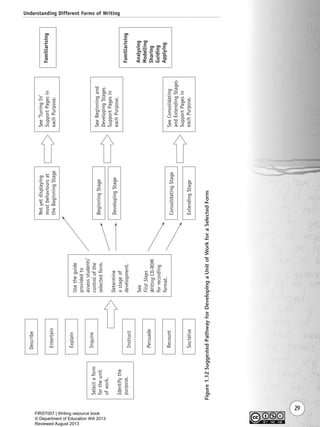
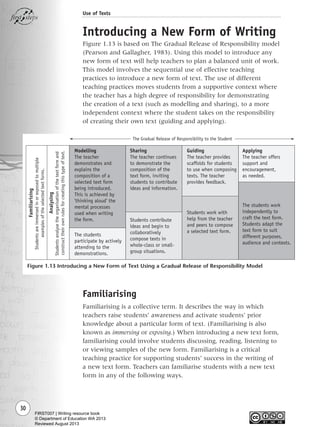
  • 221.
    217 Writing Process: Drafting Draftingis the process of transferring initial ideas or plans into texts. The focus when drafting is on content, rather than the mechanics or conventions of writing. It is important that students have the freedom to get down their initial thoughts and ideas fluently without being too preoccupied with neat handwriting, perfect spelling or precise grammar. Students continue to plan what ideas might be included or deleted from the text during the drafting process, but they do not need to formally proofread or edit the text. The notion of sustained writing is important when creating a first draft, as it allows students to capture the main ideas, maintain fluency in their thinking and create meaning. Effective Writers Know How to Draft Effective writers are able to make decisions about the number of drafts that are necessary, depending on the purpose, audience and context of their writing. Effective writers are able to do the following. • Consider audience and purpose. • Generate, explore and develop topics and ideas. • Record ideas rapidly in order to capture the essence of what it is they want to say. • Explore additional ideas during drafting. • Use planning notes to support drafting. • Make critical choices about which content to include. • Experiment with style, tone and voice. • Read and re-read as part of drafting. • Add to or delete from the text during drafting. • Use strategies to spell unknown words within the text. Writing Processes and Strategies Figure 4.9 Writing Resource_chpt 4 FINAL 6/29/06 10:53 AM Page 217 FIRST007 | Writing resource book © Department of Education WA 2013 Reviewed August 2013
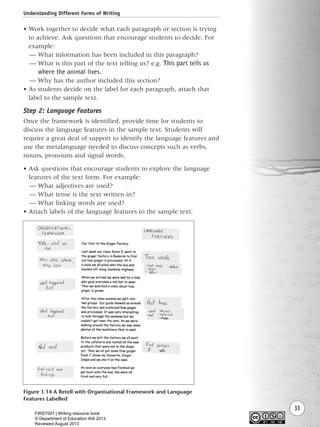
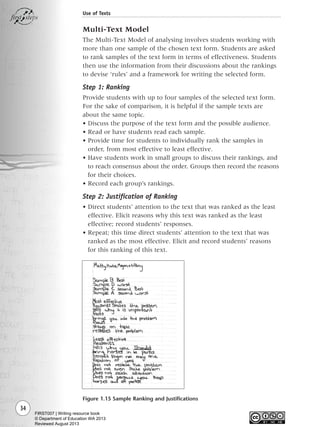
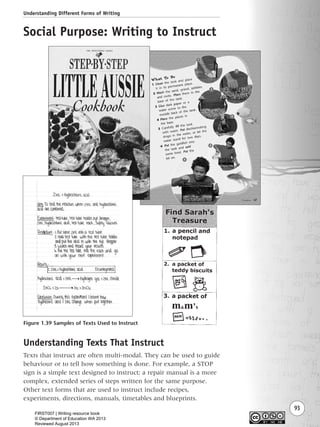
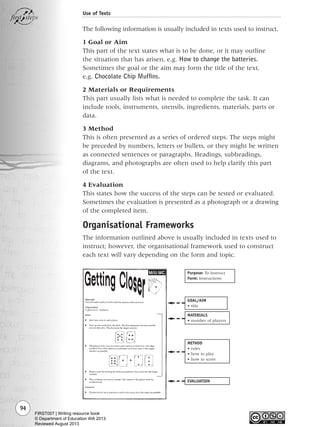
  • 222.
    218 Processes and Strategies SupportingWriters to Draft It is important to provide students with multiple opportunities to use drafting for real writing situations. A unit of work focusing on the different facets of drafting is also appropriate, and might consist of a combination of demonstrations and think-alouds. These demonstrations should focus on getting ideas down as quickly and as fluently as possible, rather than the mechanics of writing. Activities such as ‘Ready, Steady, Write’ or ‘Drop Everything and Write’ are designed to encourage students to write on a selected topic for five to ten minutes. Using such activities on a regular basis supports students to focus on getting their ideas down on paper. Collaborative charts can also be created to help students with the process of drafting. Figure 4.10 Teacher Chart Supporting Writers as They Draft Writing Resource_chpt 4 FINAL 6/29/06 10:53 AM Page 218 FIRST007 | Writing resource book © Department of Education WA 2013 Reviewed August 2013
  • 223.
    219 Writing Process: Conferring Animportant goal of conferring is receiving feedback from others; this feedback can then be used to help improve and polish drafts. Discussing drafts with others helps students to move their draft closer to a final version of text. Collaborative efforts play an important part in this process. Students benefit from both formal and informal opportunities to provide and receive feedback. Peer sharing, teacher conferences or short small-group sharing sessions all help students to obtain constructive feedback. Feedback helps students to reflect upon initial drafts and to confirm or adjust the direction of their writing. Obtaining feedback often generates new ideas. Peers, teachers, parents or other adults can provide feedback about students’ writing. Effective Writers Know How to Confer Effective writers are able to respond helpfully to others’ writing by providing positive comments and constructive suggestions for improvement. Effective writers can also identify those areas of their own writing that they would like to receive feedback about. Effective writers are able to do the following. • Identify areas in their own writing that they want feedback about. • Share their writing with others. • Request and obtain constructive feedback from others. • Listen to and keep track of suggestions made by others. • Make decisions about what feedback to incorporate. • Read others’ writing with a critical eye. • Identify and share the strengths of others’ writing. • Provide constructive feedback in an appropriate way. • Ask probing questions that help other writers reflect on their text. Writing Processes and Strategies Figure 4.11 Writing Resource_chpt 4 FINAL 6/29/06 10:53 AM Page 219 FIRST007 | Writing resource book © Department of Education WA 2013 Reviewed August 2013
  • 224.
    220 Processes and Strategies SupportingWriters to Confer The goal is for all students to be able to select from a variety of sharing forums to suit their needs and the needs of other writers. These forums might include partner sharing, small-group conversations, teacher conferences or whole-class sessions. Students need to be able to participate successfully in each of these forums. When focusing on the different facets of conferring, include a combination of demonstrations, think-alouds and opportunities to apply the techniques in real sharing sessions. It is important to expose students to a range of questions and statements that will help them to give and receive constructive feedback. Collaboratively created charts will provide support to students as they work in a variety of sharing forums. Figure 4.12 Sample Charts Supporting Students as They Share Their Writing Get the Background Information From the Writer • What form are you writing in? • Who is your audience? • What reaction do you want your reader to have? • How do you feel about what you have written so far? • What is the part that you like the most / least? Why? • Do you think you have got your message across clearly? • How can I help you? • What would you like me to listen for? Provide some Constructive Suggestions for Improvements • I’d like to suggest … • I think you need to …? • Have you thought about …? • One idea you may like to think about is … • What do you mean by … ? • Can you explain more about … • Does this sentence, word or phrase make sense to you? Asking for Constructive Feedback • Today I’d like you to help me with … • My writing is about … • The purpose of my writing is … • The audience for this piece is … • I’d like you to listen for … • Can you suggest how … • I’m not sure about this point … • I’m stuck on … • Do you think I’m showing or telling? • Should I include …? • Where do you think I need to …? Make Some Positive Comments • I really like the way … • I enjoyed … • You have used a great hook to get people interested here … • This sentence clearly explains … • This section reminded me of… Writing Resource_chpt 4 FINAL 6/29/06 10:53 AM Page 220 FIRST007 | Writing resource book © Department of Education WA 2013 Reviewed August 2013
  • 225.
    221 Forums for SharingWriting 1 Partner Sharing Partner sharing is an opportunity for students to talk about their writing with a peer. • Have the writer decide how to share their text with their conference partner. They might decide to read the piece aloud. Or they might give it to their partner to read either silently or aloud. • Have the writer tell their partner what they want to focus on during the sharing time. • Provide time for the partner to ask open-ended questions that help the writer talk about their writing and consider possible changes. • Encourage the writer to take notes about the partner’s feedback so that they can refer back to it when making changes during the refining process. • Have the writer thank their partner for their feedback and sharing. 2 Teacher Conferencing Teacher conferences provide an opportunity for students to receive feedback from an adult. They operate in a very similar manner to partner sharing. • Ask the student to identify the focus for the conference. • Invite students to read their work aloud as you listen. • Comment on the overall message of the writing, identifying any strengths. • Ask questions and talk about the selected focus area. • Provide suggestions that will help the student improve their writing. • Record notes if necessary. 3 Sharing Circle Sharing Circle gives students an opportunity to talk about their writing with a small group of peers. • Organise students into groups of four or five. • If appropriate, give students a Sharing Circle format from the First Steps Writing CD-ROM for recording the group’s feedback. • Together, review the appropriate way to respond to others’ writing. • Provide time for students seeking feedback to share their writing. • Encourage the writer to record their feedback. • Have students use the feedback when they begin to refine their work. Writing Processes and Strategies Writing Resource_chpt 4 FINAL 6/29/06 10:54 AM Page 221 FIRST007 | Writing resource book © Department of Education WA 2013 Reviewed August 2013
  • 226.
    222 Processes and Strategies 4Whole Class Sharing Whole Class Sharing is an opportunity for students to share their writing and receive feedback in a whole class forum. This type of forum benefits all students, as they can adapt the feedback given to others and apply it in their own writing. • Select a student. Invite them to identify the area they would like feedback about. • Have the student read their writing aloud while the class listens. • Invite class members to ask questions, provide praise and give constructive feedback. • Summarise the major suggestions given that will help the writer improve their work. • Invite another student to share. For further information, see Author’s Chair on pages 23–25. Two Stars and a Wish The Two Stars and a Wish format gives students a simple framework for recording feedback for others. It provides the opportunity to reflect on positives (the stars), as well as making suggestions for improvement (the wish). • Give students a Two Stars and a Wish format from the First Steps Writing CD-ROM for recording feedback. Writing Resource_chpt 4 FINAL 6/29/06 10:54 AM Page 222 FIRST007 | Writing resource book © Department of Education WA 2013 Reviewed August 2013
  • 227.
    223 Writing Process: Refining Aftercreating a draft and receiving helpful feedback from a range of sources, students need to work at bringing their text closer to completion. This process is referred to as refining; students take a closer look at their drafts to make decisions about whether to move text, add text, cut text or leave things alone. The refining process consists of revising, editing and proofreading. Revising Revising generally refers to changes made to ideas and organisation at the text level. This could involve students rearranging the order of paragraphs or sentences to improve the text sequence. Editing Editing involves clarifying meaning at the sentence level. Students might add, change, delete or rearrange words to enhance meaning. Proofreading This involves reading to check conventions, rather than the content. Proofreading involves rereading a draft to check on the use of punctuation, spelling and grammar. It is important to help students build a positive attitude towards the refining process, and to help them value the time they spend in improving their own writing. Developing a revision consciousness (Routman, 2005) involves students looking at their writing from a reader’s point of view. Students consider their audience needs as a priority for making changes to their draft texts. Writing Processes and Strategies Figure 4.13 Writing Resource_chpt 4 FINAL 6/29/06 10:54 AM Page 223 FIRST007 | Writing resource book © Department of Education WA 2013 Reviewed August 2013
  • 228.
    224 Processes and Strategies EffectiveWriters Know How to Refine Effective writers are able to identify the types of changes they wish to make; they also have the techniques that allow them to make those changes in a text. Effective writers are able to do the following. • See writing from a reader’s point of view. • Know the difference between revising, editing and proofreading. • Identify changes to be made. • Demonstrate an awareness of audience. • Revise ideas and organisation. • Rearrange paragraphs to produce a more convincing order. • Remove unimportant details. • Add missing information. • Rearrange or add words, phrases and sentences for shades of meaning. • Add dialogue, if appropriate to the form. • Re-read and then re-write for clarity and detail. • Use appropriate tools to adjust punctuation, grammar or spelling. • Use a proofreading guide or editors’ checklist to refine their own writing. • Continue refining until satisfied. Supporting Writers to Refine It is important to expose students to a range of refining techniques; these techniques can be introduced and experimented with over a period of time. When focusing on the different facets of refining, include a combination of demonstrations, think-alouds and opportunities to apply the techniques in real refining situations. The goal is for all students to be able to select from a large repertoire of techniques to suit the specific needs of each writing event. The following refining techniques will help students make informed choices about how to improve their texts. • Highlighting • Have I Captured the Action? • Remove the Rubble • Let’s Hear It • Using Spellcheckers and Grammar Checkers • Collaboratively Created Charts 1 Highlighting Highlighting is a technique students can use to consider what information needs to be added to their text. Students highlight specific parts of their text, then review it to add further detail or any information that has been omitted. Writing Resource_chpt 4 FINAL 6/29/06 10:54 AM Page 224 FIRST007 | Writing resource book © Department of Education WA 2013 Reviewed August 2013
  • 229.
    225 • Have studentsread and re-read their texts to highlight where specific information has been included. For example, in a retell, students could highlight the setting, events, and conclusion. • Have students consider what further information and details could be added. • Have students check the order of the information, e.g. Are the events listed in the order they happened? • Discuss how adding information has improved the text. 2 Have I Captured the Action? This technique helps students to consider and refine how they have described actions in a text. • Have students choose a piece of text they have previously composed. The text should contain events with some kind of action occurring. • Ask students to read the text, highlighting any sentences that describe an action. • Provide time for students to consider whether the words effectively convey what or how something happened. • Encourage students to add words that help to describe the event more effectively, e.g. adding adverbs. • Provide time for students to make changes, then talk about how the changes have made the action pieces clearer. 3 Remove the Rubble Remove the Rubble is a technique students can use to delete excess information from their texts. • Have students choose a piece of text they have previously composed. • Arrange students in pairs. Ask them to re-read each text to help each other identify any ‘rubble’, or unnecessary information. • Students then work individually to delete any repeated or excess information. • Compare the final text to the original piece. • Together, discuss how students decided what to delete from their texts. 4 Let’s Hear It Let’s Hear It is a technique that supports students as they refine their writing. The teacher reads the text aloud, then the class contributes ideas to help the selected student revise, edit or proofread. It is best to focus on one or two selected areas, e.g. use of punctuation, use of verbs. • Select a student who has a piece of text to be refined. Writing Processes and Strategies Writing Resource_chpt 4 FINAL 6/29/06 10:54 AM Page 225 FIRST007 | Writing resource book © Department of Education WA 2013 Reviewed August 2013
  • 230.
    226 Processes and Strategies •Enlarge the text so that all students can see it, e.g. overhead projector, chart paper. • Identify the focus for the session, e.g. proofreading for punctuation. • Read the text aloud, inviting the class and the writer to make suggestions for refining. • Have the writer act as editor to change the text according to class recommendations. 5 Using a Spellchecker or Grammar Checker Spellcheckers and Grammar Checkers are tools that writers can use when using word-processing programs to compose texts. Students using word-processing programs should be taught to use a spellchecker and a grammar checker as proofreading tools. Make sure the spellcheck and grammar checker functions are switched off while students are composing, as they are a distraction. Turn these functions back on when students are ready to refine their texts. As spellcheckers often list suggestions for misspelt words, students will need to draw upon their spelling knowledge in order to choose the correct word. Students will also need to be aware that spellcheckers will not recognise certain errors, e.g. homophones; unknown words, such as place or family names; American spellings; typographical errors, such as use and sue. Grammar checkers also offer suggestions. However, students need to read their work carefully before deciding whether to accept the suggestions. Teach students that the green squiggly line suggests that there might be a problem with the structure of the sentence, but that it is up to them to determine if the sentence makes sense or requires changes. Students also need to understand that spellcheckers and grammar checkers are not totally foolproof — they should not be relied on as the only form of proofreading. 6 Collaboratively Created Charts Collaboratively created charts remind students of the routines and questions they need to consider during revising, editing and proofreading. These charts can be compiled progressively. The charts help students work through the refining process in a logical way. • Work with students to create charts they can use during independent refining. • Ask students to suggest questions they could ask when revising, Writing Resource_chpt 4 FINAL 6/29/06 10:54 AM Page 226 FIRST007 | Writing resource book © Department of Education WA 2013 Reviewed August 2013
  • 231.
    227 editing or proofreading. •Record the questions on a chart. Progressively add to the chart as students discover new ideas and further questions. • Encourage students to use the questions as a guide when refining their texts. Writing Processes and Strategies Figure 4.14 Sample Revising and Editing Chart When revising and editing we concentrate on the ‘big picture’. This is the time to see if you need to add, cut, move, change or leave things alone to make the piece of text the best it can be. Look at the whole text • Have I read my writing aloud to myself or to someone else? • Does my writing make sense? • Does my writing flow? Look at words • Have I used a variety of words? • Have I used words that convey exactly what I mean? • Can I substitute a more interesting word? Look at sentences • Does each sentence make sense? • Are there any sentences that are too long and need to be broken up? • Can I combine any sentences? • Can I add more detail to any sentences to make them more interesting? • Do I need to delete words to make my writing clearer? Look at paragraphs • Do I start with a strong hook that will get people interested? • Do I have an interesting topic sentence? • Do the other sentences have relevant details? • Are the ideas in a logical sequence? Revising and Editing Our Writing Figure 4.15 Sample Proofreading Chart Proofreading My Work Concentrate on the ‘little details’ when you proofread. This is the time to check spelling, punctuation and grammar. • Did I underline the words I’m not sure I spelt correctly? • Have I checked the spelling? • Does every sentence begin with a capital letter? • Does every sentence finish with a full stop, question mark or exclamation mark? • Have I used punctuation correctly, e.g. commas, speech marks? • Have I used the right grammatical structures, e.g. verb-subject agreement? • Have I been consistent with the use of tense? Writing Resource_chpt 4 FINAL 6/29/06 10:54 AM Page 227 FIRST007 | Writing resource book © Department of Education WA 2013 Reviewed August 2013
  • 232.
    228 Processes and Strategies Figure4.16 Editor’s Code Writing Resource_chpt 4 FINAL 6/29/06 10:54 AM Page 228 FIRST007 | Writing resource book © Department of Education WA 2013 Reviewed August 2013
  • 233.
    229 Writing Process: Publishing Publishingis the process of preparing a text for final presentation to (or sharing with) the intended audience. For the publishing process to be meaningful, students need to be writing for real purposes and authentic audiences. Not every piece of text students compose needs to be published; texts written for purely personal reasons might never be shared with an audience. Modern technology makes it much easier for students to publish their work — and it also makes it possible to reach audiences beyond classroom boundaries. The Internet enables students to publish their writing for real audiences worldwide. Effective Writers Know How to Publish Effective writers are able to make choices about how to publish, depending on the purpose and audience of their text. Effective writers are able to do the following. • Use a variety of publishing formats, e.g. books, pamphlets, cards, posters, electronic. • Identify the most appropriate format for purpose and audience. • Use word-processing programs or legible handwriting to prepare published work. • Compose a piece of writing which is both readable and appealing to an audience. • Add artwork, graphics or photographs to enhance texts. Supporting Writers to Publish It is important to expose students to a range of publishing techniques; these techniques can be introduced and experimented with over a period of time. When focusing on the different facets of publishing, include a combination of demonstrations, think-alouds and opportunities for students to publish their writing in a variety of ways. The following experiences will help to build students’ understandings about publishing options. The most powerful way for students to build this understanding is by analysing a variety of formats, exploring features such as layout, design, use of colour, font size and type, and use of graphics. Analysing different examples of the same format will enable students to develop guidelines that they can refer to as they publish their own texts. The following are suggested analysing experiences. • What’s Included? • Setting It Out • Design This! Writing Processes and Strategies Writing Resource_chpt 4 FINAL 6/29/06 10:54 AM Page 229 FIRST007 | Writing resource book © Department of Education WA 2013 Reviewed August 2013
  • 234.
    230 Processes and Strategies •Publisher’s Palette • That Catches My Eye • Screen-based Publications • How Can I Publish? 1 What’s Included? What’s Included provides students with the opportunity to analyse published texts and make decisions about what is important to include when publishing texts in a book format. • Have students gather a range of texts published in book format, including commercially published texts and texts published by students. • Invite small groups of students to examine the texts and list all the features of the published books. These could include: — Cover or jacket (with illustration or photograph) — Title page — Publication details — Dedication page — Information about the author — Contents page — Index — Bibliography. • Have students discuss the features that should be included when publishing in a book format. • Create a class chart of features for future reference. This outline can also be used to explore the features of other publishing formats. 2 Setting It Out Setting It Out gives students an opportunity to investigate a variety of publishing formats, and to compare how their layout impacts on the audience. • Provide students with a variety of texts published in the same format, e.g. posters. These could be commercially bought posters or posters published by students. • Have students work in small groups to examine each text, ranking them according to the level of visual appeal. Ask questions such as the following to assist students examine and rank the texts. — Where has print been positioned? — Where have illustrations been positioned? — What lettering or font style has been used? — What do you notice about the size of the font, typeface, headings, illustrations? — How have diagrams or illustrations been labelled? Writing Resource_chpt 4 FINAL 6/29/06 10:54 AM Page 230 FIRST007 | Writing resource book © Department of Education WA 2013 Reviewed August 2013
  • 235.
    231 — How arethe pages numbered (or labelled)? • Provide time for the whole class to discuss each group’s rankings and justifications. • Create a class chart of features to include when publishing in the chosen format. 3 Design This! Design This! encourages students to add graphics to a piece of text and to design an appealing layout for a given audience. • Provide groups of students with a cut-up piece of text, with organisational features such as headings and graphics removed. • Have students organise the text into an appropriate order, then work on designing the layout of the text to suit the given audience. Students will need to consider: — where the text should be positioned — where illustrations, diagrams or pictures should be positioned — the size and position of titles, headings, labels and captions. • Have students add headings, graphics and other text features that will enhance the appeal and readability for their audience. • Have students share their text with the whole class. Invite them to discuss their rationale for design features and text alterations. 4 Publisher’s Palette Publisher’s Palette helps students to think about the use of colour when publishing texts. Students need to understand how the use of colour can impact on the reader. • Ask students to think about the feelings or moods that different colours create, e.g. yellow: bright, sunny; blue: calm. • Have students analyse a variety of texts that have been published in the same format, looking specifically at which colours have been used and how many of them. • Encourage students to look for any colours that: — are difficult to read — are used to emphasise a point — create a particular feeling — distract the reader. • Encourage students to discuss and determine the most effective use of colour in the chosen format. Suggestions could include the use of colour in: — the cover page or title block — large initial letters — quotes pulled from the text, e.g. in flyers or newspaper stories — borders — graphics, e.g. illustrations, graphs or logos. Writing Processes and Strategies Writing Resource_chpt 4 FINAL 6/29/06 10:54 AM Page 231 FIRST007 | Writing resource book © Department of Education WA 2013 Reviewed August 2013
  • 236.
    232 Processes and Strategies •Challenge students to publish a piece of text in the chosen format using only black, white and three other colours. • Invite students to share and discuss where they used colour, and its effect on the readability and visual appeal of the text. 5 That Catches My Eye That Catches My Eye is an opportunity for students to experiment with different lettering and font styles. It helps students to consider what is the most effective and suitable style to use for title pages and headings. • Invite each student to select a title from something they have written. • Challenge students to use different lettering and font styles to create several different designs for the same title. • Encourage students to experiment with different media and materials. This could include: — using word-processing software — using stencils — creating their own alphabet design — cutting letters from different materials, e.g. fabric, paper, cardboard, plastic — incorporating materials or objects related to the title, e.g. if the title was ‘gold’ students might use golden glitter to fill each letter; a title related to the sea might incorporate shells or sand. — using different drawing implements, e.g. pens, markers, crayons, chalk. • Display all designs. Invite students to comment on which designs they think are the most effective, and why. • Remind students about these discussions when they are publishing their own texts. 6 Screen-based Publications Provide time for students to explore a range of screen-based publications; this will help them to understand how different features are used to help or hinder the readability of texts. • Provide students with web addresses of a range of suitable websites. • Provide time for small groups of students to examine each homepage, and to discuss the following questions. — What is the focal point? How do you know this? — How has emphasis been achieved? e.g. use of bold or italicised font, white space, colour. — How have text or graphics been aligned? — How have items been grouped? Writing Resource_chpt 4 FINAL 6/29/06 10:54 AM Page 232 FIRST007 | Writing resource book © Department of Education WA 2013 Reviewed August 2013
  • 237.
    233 — What fontor lettering style and size has been used? Is it easy to read? — How does the spacing between words (and between letters in a word) help you to read the text? — How many different fonts or lettering styles have been used in the same piece? Why do you think this has been done? — What colours have been used? • Encourage students to apply their discoveries when creating their own screen-based texts. 7 How Can I Publish? How Can I Publish? is an opportunity for students to publish the same text in a variety of formats. Students can then compare the different publications and determine which is the most effective and why. • Divide students into groups. • Select a piece of text that has been composed as part of a class session. • Allocate each group a different format for publication, e.g. letter, poster, electronic presentation, newspaper, book, pamphlet. • Provide time for students to complete their group publication. • Have each group present their publication. • Discuss the effectiveness of each publication of the text. Sample Publishing Charts created collaboratively in a Year 6 Class are shown in Figures 4.17 and 4.18. Writing Processes and Strategies Figure 4.17 Sample Publishing Chart How Will I Publish My Work? • Book • Newspaper • Electronic Bulletin Board • Screen Saver • Magazine • Web Page • Brochure • Letter • Pamphlet • Chart • Journal • Card • Display Board • Multimedia Presentation • Game Board • Mobile • Internet When I Publish My Work I Need to Think About … • Who is the audience for my text? • What is the purpose of my text? • What would be the most effective publishing format to use? • What features will I include to enhance my publication? — objects related to the theme or subject of the text — special effects, e.g. fold outs or pop ups — borders that relate to the theme of subject, e.g. shade or singe the edges for an historical look — multimedia, e.g. animation, 3-D models, video or audiotape • What colours and typographical elements will I use? e.g. font style and size • Do I have a time line for creating my publication? Figure 4.18 Sample Publishing Chart Writing Resource_chpt 4 FINAL 6/29/06 10:54 AM Page 233 FIRST007 | Writing resource book © Department of Education WA 2013 Reviewed August 2013
  • 238.
    234 Glossary Glossary affidavit a statementin writing made under oath or before an authorised officer autobiography the biography of a person, narrated by themselves automaticity bringing information to mind with little or no effort because a skill or understanding is so well known ballad narrative poem composed of short verses intended to be sung or recited, frequently of unknown authorship bias a prejudiced view or one-sided perspective biography an account of someone’s life written by another person blurb a short piece of writing, often on the cover or jacket of a text, designed to interest the reader in the text brochure a format for writing, containing descriptive or advertising material contents page a list of what is included in a book; usually at the front of the book context the broad linguistic, social and cultural experiences that are brought to a situation dialect a variety of a language which belongs to a particular social group or geographical area editorial an explanatory form of writing used in newspapers and magazines to discuss current news events and express opinions epitaph text added to an inscription on a tombstone to tell something more about the deceased eulogy a speech, oral or written, that praises someone or something experiment an operation carried out under controlled conditions in order to discover an unknown effect or law, to test or establish a hypothesis, or to illustrate a known law explanation factual writing that explains how something works or happens exposition a text that intends to persuade or gives an argument fable a short tale in prose or verse that teaches a moral, often with animals and inanimate objects as characters fantasy an imaginative story about characters, places and events that do not exist homographs words that are spelt the same but pronounced differently and have different meanings, e.g. tear and tear, minute and minute homonyms words that are spelt the same and pronounced the same but have different meanings, e.g. scale (fish), scale (music) homophones words that are pronounced the same but spelt differently and have different meanings, e.g. here and hear; aisle and I’ll hybrid text using a combination of forms in one text Writing Resource_chpt 4 FINAL 6/29/06 10:54 AM Page 234 FIRST007 | Writing resource book © Department of Education WA 2013 Reviewed August 2013
  • 239.
    235 hyperlink a linkfrom a hypertext file to another location or file, usually activated by a highlighted word or icon hypertext machine-readable text that is not sequential, but is organised so that related items of information are connected legend a traditional tale handed down initially in oral form before later becoming a written form memo an informal record; also a written reminder memoir an account of one’s personal experiences and observations metalanguage language used to describe and analyse natural language; language about language minutes an official record of the proceedings of a meeting multi-modal texts utilising more than one mode of text, i.e. visual, spoken or written narrative a story, actual or fictional, expressed orally or in writing phrase two or more words in sequence forming a grammatical expression, but not containing a finite verb, e.g. in the kitchen policy a plan of action adopted by an individual or group sidebar a short news story, often boxed, printed alongside a longer article; typically presents additional, contrasting or late- breaking news site map a textual or visual index of a website’s contents summons to command to appear in court synopsis a brief summary travelogue a text about travel; can be written, spoken or visual word stem the part of a word to which a suffix is or can be added Glossary Writing Resource_chpt 4 FINAL 6/29/06 10:54 AM Page 235 FIRST007 | Writing resource book © Department of Education WA 2013 Reviewed August 2013
  • 240.
    236 Bibliography Bibliography Atwell, N., 1998,In the Middle—New Understandings About Writing, Reading, and Learning, 2nd Edition, Boynton/Cook, Portsmouth New Hampshire, USA Barratt-Pugh, C., Rohl, M., 2001, Literacy Learning in the Early Years, Allen and Unwin, Crows Nest, Australia Bear, D.R., Invernizzi, M., Templeton, S., Johnston, F., 2000, Words Their Way, Word Study for Phonics, Vocabulary and Spelling Instruction, 2nd Edition, Prentice- Hall, New Jersey, USA Booth, D., 2001, Reading and Writing in the Middle Years, Pembroke Publishers, Ontario, Canada Brand, M., 2004, Word Savvy, Stenhouse, Portland, Maine, USA Brownjohn, S., 1994, To Rhyme or Not to Rhyme? Teaching Children to Write Poetry, Hodder and Stoughton, Abingdon, UK Bruce, B.C., (ed.) 2003, Literacy in the Information Age: Inquiries into Meaning Making with New Technologies, International Reading Association, Newark, Delaware, USA ––––– 2001, Illuminating Texts, Heinemann, Portsmouth, New Hampshire, USA ––––– 2003, Writing Reminders, Heinemann, Portsmouth, New Hampshire, USA Buss, K., and Karnowski, L., 2002, Reading and Writing Nonfiction Genres, International Reading Association, Newark, Delaware USA Collerson, J., 1997, Grammar in Teaching, PETA, New South Wales, Australia Covich, S., (ed.) 2003, 2004, A Circle in a Room Full of Squares, John Curtin College of the Arts, Fremantle, Western Australia Cunningham, P., Moore, S., Cunningham, J., Moore, D., 2004, Reading and Writing in Elementary Classrooms, Pearson, Boston, MA Derewianka, B., 1990, Exploring How Texts Work, Maryborough, Victoria, Australia Dougan, J., & Gorman, R., (eds.) 2005, Critical Literacy and Inquiry Learning in Action, AISWA, Perth, Western Australia Downes, T., & Fatouros, C., 1996, Learning in an Electronic World: Computers and the Language Arts Classroom, Heinemann, Portsmouth, NH, USA Education Department of Western Australia, 1997, Writing Resource Book, Rigby Heinemann, Port Melbourne, Victoria, Australia Fay, K., & Whaley, S., 2004, Becoming One Community—Reading and Writing with English Language Learners, Stenhouse Publishers, Portland, Maine, USA Fehring, H., & Green, P., (eds.) 2001 Critical Literacy: A Collection of Articles from the Australian Literacy Educators’ Association, International Reading Association, Newark, Delaware, USA Gee, R., & Watson, C., 1990, The Usborne Book of Better English, Usborne Publishers, London, UK Graves, D.H., 1994, A Fresh Look at Writing, Heinemann, Portsmouth, NH, USA Gentry, J.R., 2004, The Science of Spelling, Heinemann, Portsmouth, NH, USA Glazer, S.M., 1998, Phonics, Spelling and Word Study: A Sensible Approach, Christopher-Gordon Publishers, Inc, Norwood, Massachusetts, USA Harris, P., McKenzie, B., Fitzsimmons, P., & Turbill, 2003, Writing in the Primary School Years, Social Science Press, Australia Writing Resource_chpt 4 FINAL 6/29/06 10:54 AM Page 236 FIRST007 | Writing resource book © Department of Education WA 2013 Reviewed August 2013
  • 241.
    237 Harwayne, S. 2000,Lifetime Guarantees: Towards Ambitious Literacy Teaching, Heinemann, Portsmouth, New Hampshire, USA Healy, A., & Honan, E., 2004, Text Next: New Resources for Literacy Learning, Primary English Teachers Association, NSW, Australia Heffernan, L., 2004, Critical Literacy and Writer’s Workshop: Bringing Purpose and Passion to Student Writing, International Reading Association, Newark, Delaware, USA http://as1.seattleschools.org/alt_ed/social_action.htm http://curry.edschool.virginia.edu/go/clic/nrrc/reinking.html http://nadabs.tripod.com/ghaith-writing.html http://www.sasked.gov.sk.ca/docs/ela20/teach4.html http://www.sasked.gov.sk.ca/docs/mla/write.html#write http://www.ttms.org/PDFs/04%20Writing%20Process%20v001%20(Full).pdf Jago, C., 2002, Cohesive Writing — Why Concept Is Not Enough, Heinemann, Portsmouth, New Hampshire, USA Johnson, T.D., 1988, Unriddling The World, Western Australian College of Advanced Education, Mount Lawley, Western Australia Keene, E.O., Zimmerman. S., 1997, Mosaic of Thought — Teaching Comprehension in a Reader’s Workshop, Heinemann, Portsmouth, New Hampshire, USA Knobel, M., & Healy, A. (eds.) 1998, Critical Literacies in the Primary Classroom, PETA, Newton, NSW, Australia Lankshear, C., & Knobel, M., 2003, New Literacies: Changing Knowledge and Classroom Learning, Open University Press, Buckingham, UK Lazar, A., 2004, Learning to be Literacy Teachers in Urban Schools, International Reading Association, Delaware, USA Lewis, B., 1998, The Kid’s Guide to Social Action: How to Solve the Social Problems You Choose and Turn Creative Thinking into Positive Action, Free Spirit Publishing, Minneapolis, Minnesota, USA Lyon, A. & Moore, P., 2003, Sound Systems, Stenhouse Publishers, Portland, Maine, USA Mansutti, E., 2004, The Poetry Detectives, Oral Presentation, Australian Literacy Educators’ Association, State Conference, Perth, Western Australia Marten, C., 2003, Word Crafting, Heinemann, Portsmouth New Hampshire, USA Martin, R.D., 2000, Young Writers Guide, 3rd Edition, Era Publications, Flinders Park, South Australia McCarrier, A., Pinnell, G.S., & Fountas, I.C., 2000, Interactive Writing: How Language and Literacy Come Together, K-2, Heinemann, Portsmouth, New Hampshire, USA Mooney, M. E., 2001, Text Forms and Features, Richard C. Owen Publishers Inc., Katonah, New York, USA Murdoch, K., & Wilson, J., 2004, Learning Links: Strategic Teaching for the Learner- Centred Classroom, Curriculum Corporation, Carlton South, Victoria, Australia Olness, R., 2005, Using Literature to Enhance Writing Instruction, International Reading Association, Delaware, USA Bibliography Writing Resource_chpt 4 FINAL 6/29/06 10:54 AM Page 237 FIRST007 | Writing resource book © Department of Education WA 2013 Reviewed August 2013
  • 242.
    238 Bibliography Parsons, L., 1992,Poetry Themes and Activities Exploring the Fun and Fantasy of Language, Pembroke Publishers Ltd., Ontario, Canada Pearson, P.D., and Gallagher, M.C., 1983, ‘The Instruction of Reading Comprehension’, Contemporary Educational Psychology, 8: 317–344 Pinnell, G.S., & Fountas, I.C., 1998, Word Matters: Teaching Phonics and Spelling in the Reading/Writing Classroom, Heinemann, Portsmouth, New Hampshire, USA Rogovin, P., 2001, The Research Workshop: Bringing the World into Your Classroom, Heinemann, Portsmouth, New Hampshire, USA Romano, T., 2004, Crafting Authentic Voice, Heinemann, Portsmouth, New Hampshire, USA Routman, 2005, Writing Essentials, Heinemann, Portsmouth, New Hampshire, USA ––––– 2000, Conversations: Strategies for Teaching, Learning and Evaluating, Heinemann, Portsmouth, New Hampshire, USA Simon, L., 2004, Strategic Spelling, Heinemann, Portsmouth, New Hampshire, USA Snowball, D., & Bolton, F., 1999, Spelling K–8, Stenhouse Publishers, York, Maine, USA Stahl, S.A., & Murray, B.A., 1994, ‘Defining Phonological Awareness and its Relationship to Early Reading’, Journal of Educational Psychology, 86, 221–234 Stanovich, K.E., Cunningham, A.E, & Cramer, B., 1984, ‘Assessing Phonological Awareness in Kindergarten Children: issues of task comparability’, Journal of Experimental Child Psychology, 38, 175–190 Stead, T., 2001, Is That a Fact? Teaching Nonfiction Writing K–3, Stenhouse, Portland, Maine, USA Tannenbaum, J., 2000, Teeth, Wiggly as Earthquakes: Writing Poetry in the Primary Grades, Stenhouse Publishers, Portland, Maine, USA Tiedt, I., 2002, Tiger Lilies, Toadstools, and Thunderbolts: Engaging K-8 Students with Poetry, International Reading Association, Newark, USA Tompkins, G.E., & Collom, C., 2004, Sharing the Pen: Interactive Writing With Young Children, Pearson, Merrill Prentice Hall, Upper Saddle River, New Jersey, USA Tompkins, G.E., 2004, Literacy for the 21st Century: Teaching Reading and Writing in Grades 4 Through 8, Pearson Education Inc., Upper Saddle River, New Jersey, USA Weaver, C., 1998, Lessons to Share—On Teaching Grammar in Context, Boynton/Cook Publishers, Heinemann, Portsmouth New Hampshire, USA Wepner, S., Valmont, W., Thurlow, R., 2000, Linking Literacy and Technology A Guide for K-8 Classrooms, International Reading Association, Delaware, USA Westwood, P., 1999, Spelling — Approaches to Teaching and Assessment, ACER Press, Victoria, Australia Whitehead, D., 2003, Writing Frameworks, Pembroke Publishers, Ontario, Canada Wilson, L., 1994, Write me a Poem: Reading, Writing and Performing Poetry, Eleanor Curtin Publishing, Armadale, Australia Writing Resource_chpt 4 FINAL 6/29/06 10:54 AM Page 238 FIRST007 | Writing resource book © Department of Education WA 2013 Reviewed August 2013