The Power of Collaboration:
Digital Literacy and Personal Inquiry
Julie Coiro and Renee Hobbs
jcoiro@uri.edu hobbs@uri.edu
University of Rhode Island
Literacy is expanding
• As we all grapple with changes in literacy,
teaching, and learning in a digital world…
• What does digital literacy mean to us (and you)?
• How can we learn and lead together, while
leveraging our strengths and differences?
Some beliefs we share
• Learning involves active meaning making through a
process of inquiry and discovery (Bruner, 1960;
Dewey, 1976)
• Meaning making involves examining the content and
form of messages as well as affordances and
limitations of technologies used to create them
(McLuhan, 1964).
• Literacy practices are situated, contextual cultural
practices (Vygotsky, 1978) that use multimodality
(Kress, 2010) to activate multiple modes of knowing
(Gardner, 1983).
• Digital participation promotes personal and social
reflection, personal autonomy, and collaboration
(Hobbs, 2010; Jenkins, 2006).
• Learning outcomes support literacy practices by
reshaping relationships between teachers and
learners and between learners and their culture
(Freire, 1970).
Some beliefs we share
“Two sides of life;
Two sides of the literacy coin”
Texts of the Classroom …
Doing School & Learning
Information Access & Consumption
New Literacies and
Online Reading
Comprehension
Question, locate, evaluate,
synthesize, &
communicate information
JULIE
Texts of the Culture …
Doing Life & Citizenship
Information Analysis & Production
Media Literacy & Digital
Authorship
Examine mass media &
popular culture and
respond in diverse ways
RENEE
LIFE
LITERACY
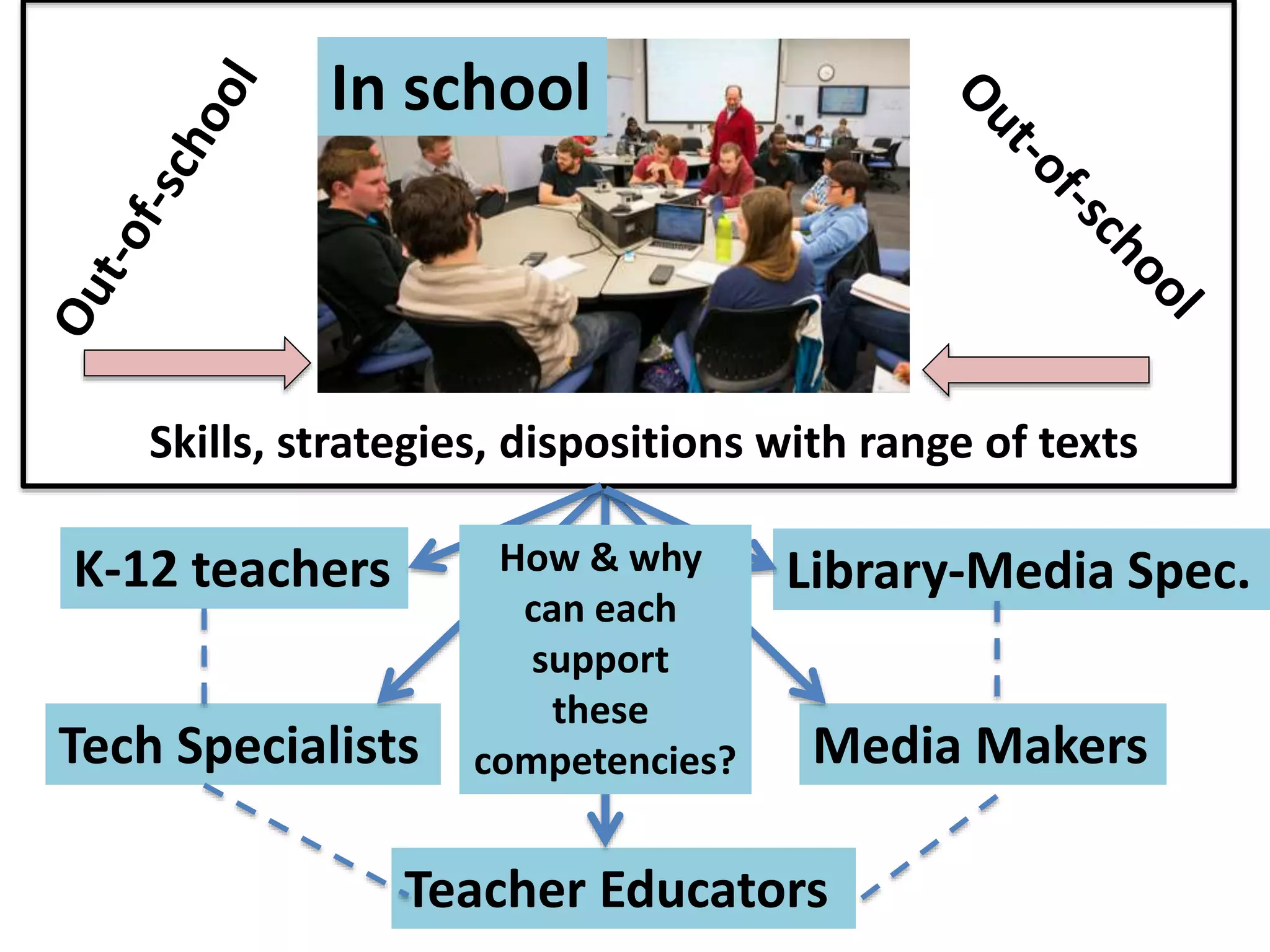
In school
K-12 teachers Library-Media Spec.
Tech Specialists
Teacher Educators
Media Makers
Skills, strategies, dispositions with range of texts
How & why
can each
support
these
competencies?
Weaving Our Ideas Together
The power of COLLABORATION (2015)
Journal of Adolescent & Adult Literacy
Digital & Media
Literacy Competencies
(AACRA - Renee)
Classroom Inquiry
Practices
(PDI - Julie)
PERSONAL emphasizes the significance of the
personal relationship between teachers and
students, and the roles that students have in
the learning process.
DIGITAL reflects the important role that
digital texts and tools have come to play
in both learning and teaching with inquiry.
INQUIRY lies at the core of PDI, because
learners grow and change with relevant and
authentic opportunities to identify problems
and generate solutions
What is Personal Digital Inquiry?
What is Digital & Media Literacy?
Personal Digital Inquiry for Digital and Media Literacy
(PDI-DML)
Literacy
Competencies
Teaching
Practices
DIGITAL Texts & Tools = Increased
Agency for Learners & Teachers
Voice Choice
Reading
Authorship
Inquiry
Analysis
Collaboration
Creation
Reflection
Social Action
Transformation
DIGITAL =
Increased Agency
(Voice & Choice)
I can make a
difference…
Teachers
• Freedom and
Autonomy to
Explore
• Collaboration
• Curriculum Design
• Leadership
Learners
• Ask own questions, choose their
own topics & texts
• Talk through meaning together
• Choose their tools to creatively
express and take action;
• Analyze texts & Reflect on action
Increased interest,
motivation, sense
of belonging,
confidence, and
engagement!
Wider range
of texts, tools,
& ways to
express ideas
Building agency within constraints of
school-based learning spaces….
• Personal vs. Personalized: Foster teacher agency to
design own structures for inquiry-based digital
learning (rather than de-skilling teachers to be
monitors of digital playlists)
– The power to support and
scaffold (guided inquiry)
– The power to back off and
invite creative open inquiry
How have we turned our new knowledge about
digital literacy into action?
• Summer Institute Tier 1
(Voice & Choice for Teachers)
• Seminar in Digital Literacy
(Online Reading Comprehension)
• Seminar in Digital Authorship
(Purpose, Audience, and
Implications)
• Summer Institute Tier 2
(Leading to Inspire Others – The
Leadership Challenge)
• Freedom/Exploration
• Collaboration
• Curriculum Design
• Leadership
• Digital Literacy
Competencies
• Digital Texts & Tools
• Digital Teaching
Practices
Graduate Certificate in Digital Literacy
What does this look like in action?
Renee Hobbs and Julie Coiro
Inquiry Question: How can we create a hands-on, minds-on learning
experience that continues to grow a strong community of
digital literacy leaders?
It all begins with a question!
What will yours be?
Wonder & DiscoverWONDER & DISCOVERWONDER & DISCOVER
COLLABORATE & DISCUSS
Access
Knowledge
Build
Knowledge
Express
Knowledge
Reflect On
Knowledge
Act On
Knowledge
Learners
passively receive
[digital]
information
given or
modeled by
others
Learners [use
technology
to] connect
new
information
to prior
knowledge
Learners [use
technology
to] share
their new
knowledge
with others
Learners [use
technology
to] reflect on
and evaluate
their inquiry
processes and
products
Learners [use
technology to]
translate their
knowledge
into action for
real-world
purpose
Lower Order
Thinking
Higher Order
Thinking
Purposeful Technology Use
How can technologydeepen learning and enhance engagement?
…to enrich
Knowledge Building
(more teacher guided)
…to enrich
Knowledge Creation
(more learner guided)
• Opportunities to actively engage and participate in
turning new knowledge and ideas into creative action…
• Collaborate
• Start conversations
• Raise awareness
• Take action
• Change Minds
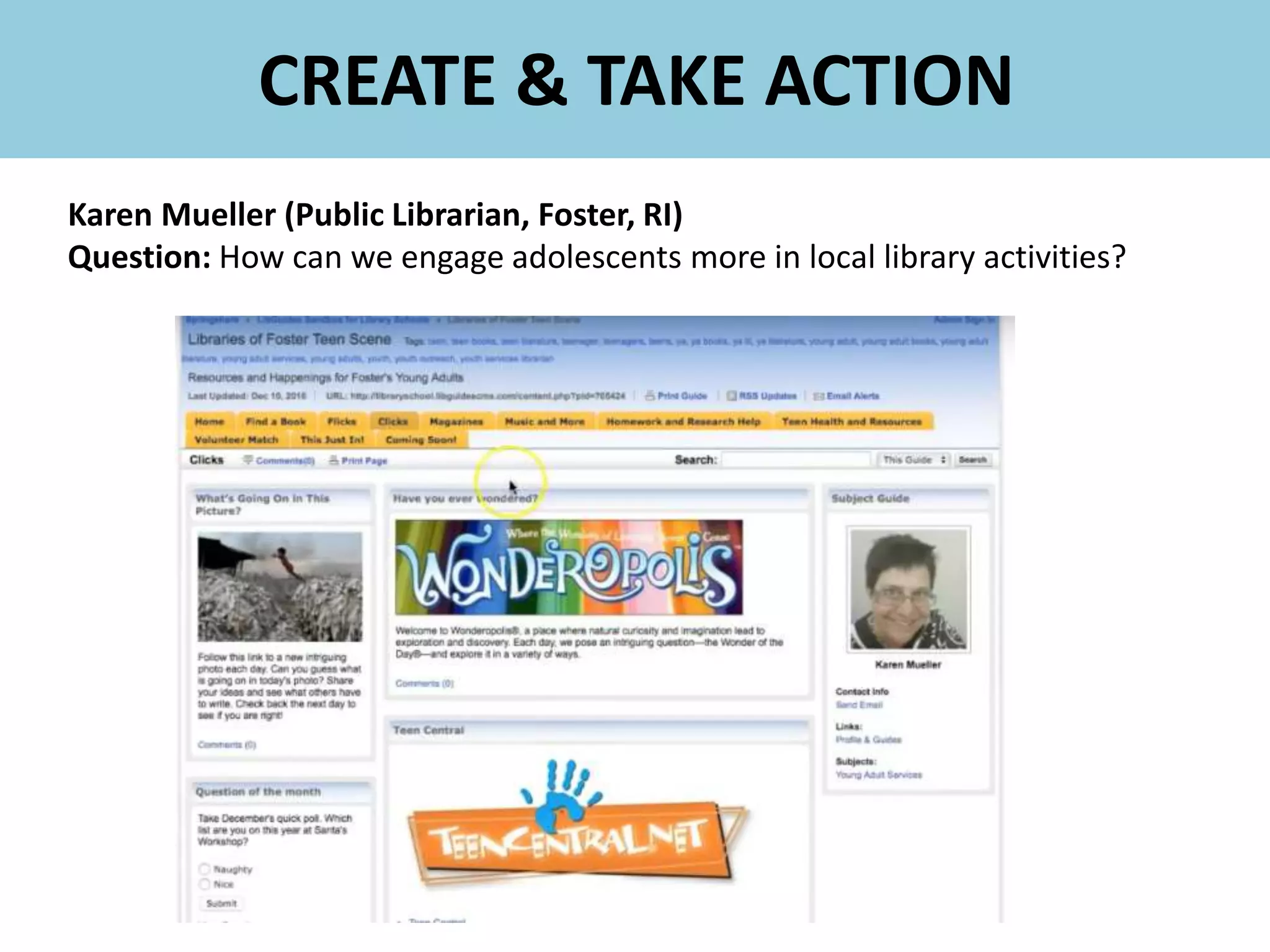
CREATE & TAKE ACTION
Karen Mueller (Public Librarian, Foster, RI)
Question: How can we engage adolescents more in local library activities?
CREATE & TAKE ACTION
Mary Wallace: Educational Technology Coordinator, Pennsylvania
How can I create a media center that fosters innovation at my school?
https://goo.gl/Grc7sM
CREATE & TAKE ACTION
Kara Clayton (Michigan)
Stephanie Branson (Florida)
Amanda Murphy (Rhode Island)
Question: How do SIDL participants enact digital and media literacies back
in their own contexts?
digiuri.wordpress.com/
CREATE & TAKE ACTION
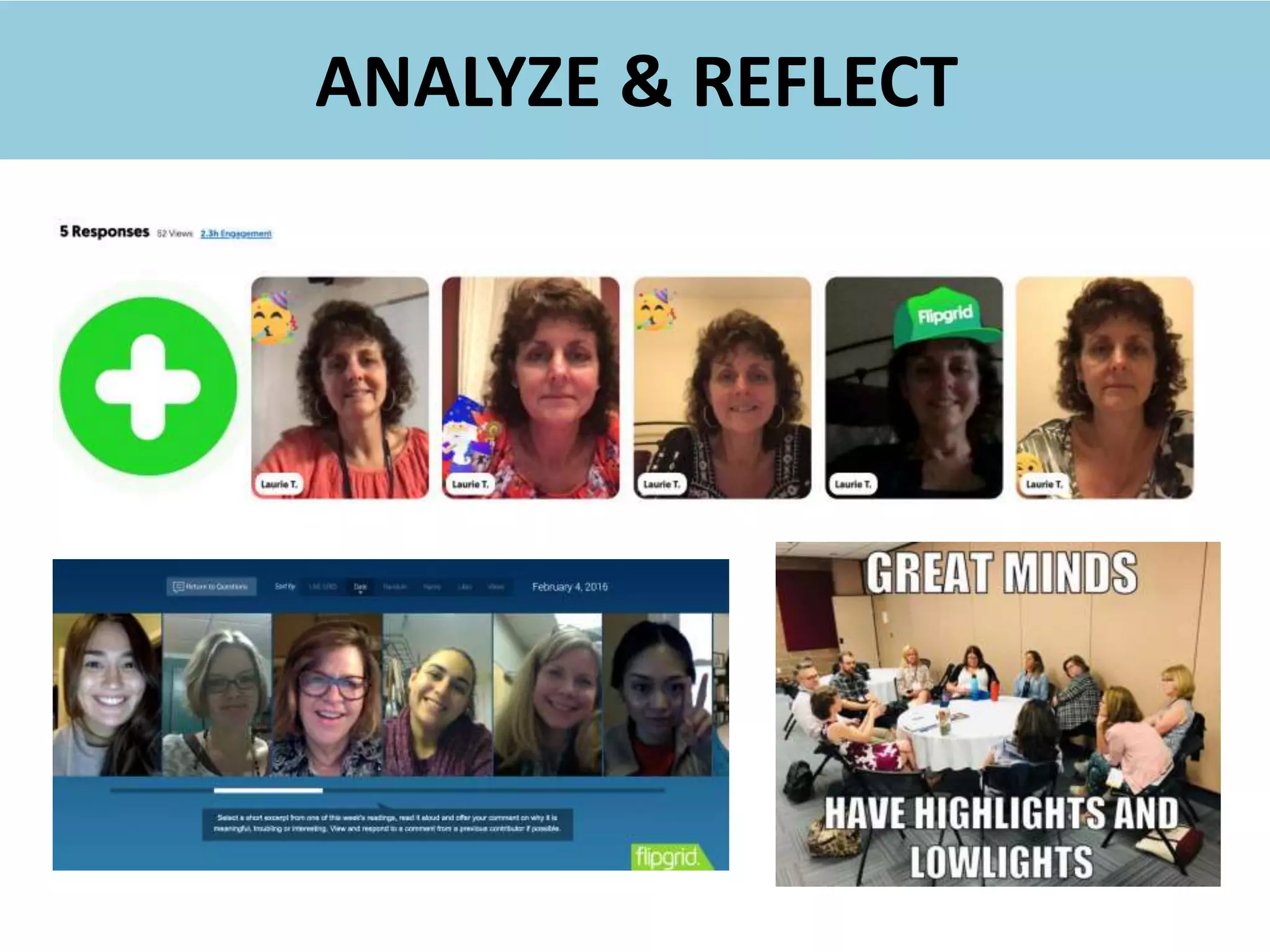
ANALYZE & REFLECT
What informed your design of your Inquiry Project?
ANALYZE & REFLECT
Build digital literacy skills as you WONDER, DISCOVER,
COLLABORATE, DSICUSS, ANALYZE, REFLECT, CREATE AND
TAKE ACTION….
Literacy is expanding…How can we learn and
lead together, while leveraging our strengths
and differences?
FOR MORE INFORMATION: http://digiuri.com
Related Publications
• Hobbs, R., & Coiro, J. (2016). Everyone learns from everyone:
Collaborative and interdisciplinary professional development
in digital literacy. Journal of Adolescent and Adult Literacy,
59(6), 546-549.
• Coiro, J. & Hobbs, R. (2017, April). Digital literacy as
collaborative, transdisciplinary, and applied. Paper presented
in A. Stornaiulo (Chair), Interrogating the multiple meanings
of digital literacies. Symposium presented at the annual
meeting of the American Educational Research Association,
San Antonio, TX. Available at https://goo.gl/aucGqj
• Hobbs, R. & Coiro, J. (2018). Design features of a professional
development program in digital literacy. Journal of Adolescent
& Adult Literacy, 62(4), 401-409.
More ideas..
In Grades K-5 or Higher Education

Power of Collaboration: Digital Literacy and Personal Inquiry

  • 1.
    The Power ofCollaboration: Digital Literacy and Personal Inquiry Julie Coiro and Renee Hobbs jcoiro@uri.edu hobbs@uri.edu University of Rhode Island
  • 2.
    Literacy is expanding •As we all grapple with changes in literacy, teaching, and learning in a digital world… • What does digital literacy mean to us (and you)? • How can we learn and lead together, while leveraging our strengths and differences?
  • 3.
    Some beliefs weshare • Learning involves active meaning making through a process of inquiry and discovery (Bruner, 1960; Dewey, 1976) • Meaning making involves examining the content and form of messages as well as affordances and limitations of technologies used to create them (McLuhan, 1964). • Literacy practices are situated, contextual cultural practices (Vygotsky, 1978) that use multimodality (Kress, 2010) to activate multiple modes of knowing (Gardner, 1983).
  • 4.
    • Digital participationpromotes personal and social reflection, personal autonomy, and collaboration (Hobbs, 2010; Jenkins, 2006). • Learning outcomes support literacy practices by reshaping relationships between teachers and learners and between learners and their culture (Freire, 1970). Some beliefs we share
  • 5.
    “Two sides oflife; Two sides of the literacy coin” Texts of the Classroom … Doing School & Learning Information Access & Consumption New Literacies and Online Reading Comprehension Question, locate, evaluate, synthesize, & communicate information JULIE Texts of the Culture … Doing Life & Citizenship Information Analysis & Production Media Literacy & Digital Authorship Examine mass media & popular culture and respond in diverse ways RENEE LIFE LITERACY
  • 6.
    In school K-12 teachersLibrary-Media Spec. Tech Specialists Teacher Educators Media Makers Skills, strategies, dispositions with range of texts How & why can each support these competencies?
  • 7.
    Weaving Our IdeasTogether The power of COLLABORATION (2015) Journal of Adolescent & Adult Literacy Digital & Media Literacy Competencies (AACRA - Renee) Classroom Inquiry Practices (PDI - Julie)
  • 8.
    PERSONAL emphasizes thesignificance of the personal relationship between teachers and students, and the roles that students have in the learning process. DIGITAL reflects the important role that digital texts and tools have come to play in both learning and teaching with inquiry. INQUIRY lies at the core of PDI, because learners grow and change with relevant and authentic opportunities to identify problems and generate solutions What is Personal Digital Inquiry?
  • 9.
    What is Digital& Media Literacy?
  • 10.
    Personal Digital Inquiryfor Digital and Media Literacy (PDI-DML) Literacy Competencies Teaching Practices DIGITAL Texts & Tools = Increased Agency for Learners & Teachers Voice Choice Reading Authorship Inquiry Analysis Collaboration Creation Reflection Social Action Transformation
  • 11.
    DIGITAL = Increased Agency (Voice& Choice) I can make a difference… Teachers • Freedom and Autonomy to Explore • Collaboration • Curriculum Design • Leadership Learners • Ask own questions, choose their own topics & texts • Talk through meaning together • Choose their tools to creatively express and take action; • Analyze texts & Reflect on action Increased interest, motivation, sense of belonging, confidence, and engagement! Wider range of texts, tools, & ways to express ideas
  • 12.
    Building agency withinconstraints of school-based learning spaces…. • Personal vs. Personalized: Foster teacher agency to design own structures for inquiry-based digital learning (rather than de-skilling teachers to be monitors of digital playlists) – The power to support and scaffold (guided inquiry) – The power to back off and invite creative open inquiry
  • 13.
    How have weturned our new knowledge about digital literacy into action? • Summer Institute Tier 1 (Voice & Choice for Teachers) • Seminar in Digital Literacy (Online Reading Comprehension) • Seminar in Digital Authorship (Purpose, Audience, and Implications) • Summer Institute Tier 2 (Leading to Inspire Others – The Leadership Challenge) • Freedom/Exploration • Collaboration • Curriculum Design • Leadership • Digital Literacy Competencies • Digital Texts & Tools • Digital Teaching Practices Graduate Certificate in Digital Literacy
  • 14.
    What does thislook like in action? Renee Hobbs and Julie Coiro Inquiry Question: How can we create a hands-on, minds-on learning experience that continues to grow a strong community of digital literacy leaders?
  • 15.
    It all beginswith a question! What will yours be?
  • 16.
    Wonder & DiscoverWONDER& DISCOVERWONDER & DISCOVER
  • 18.
  • 19.
    Access Knowledge Build Knowledge Express Knowledge Reflect On Knowledge Act On Knowledge Learners passivelyreceive [digital] information given or modeled by others Learners [use technology to] connect new information to prior knowledge Learners [use technology to] share their new knowledge with others Learners [use technology to] reflect on and evaluate their inquiry processes and products Learners [use technology to] translate their knowledge into action for real-world purpose Lower Order Thinking Higher Order Thinking Purposeful Technology Use How can technologydeepen learning and enhance engagement? …to enrich Knowledge Building (more teacher guided) …to enrich Knowledge Creation (more learner guided)
  • 20.
    • Opportunities toactively engage and participate in turning new knowledge and ideas into creative action… • Collaborate • Start conversations • Raise awareness • Take action • Change Minds CREATE & TAKE ACTION
  • 21.
    Karen Mueller (PublicLibrarian, Foster, RI) Question: How can we engage adolescents more in local library activities? CREATE & TAKE ACTION
  • 22.
    Mary Wallace: EducationalTechnology Coordinator, Pennsylvania How can I create a media center that fosters innovation at my school? https://goo.gl/Grc7sM CREATE & TAKE ACTION
  • 23.
    Kara Clayton (Michigan) StephanieBranson (Florida) Amanda Murphy (Rhode Island) Question: How do SIDL participants enact digital and media literacies back in their own contexts? digiuri.wordpress.com/ CREATE & TAKE ACTION
  • 24.
  • 25.
    What informed yourdesign of your Inquiry Project? ANALYZE & REFLECT
  • 26.
    Build digital literacyskills as you WONDER, DISCOVER, COLLABORATE, DSICUSS, ANALYZE, REFLECT, CREATE AND TAKE ACTION…. Literacy is expanding…How can we learn and lead together, while leveraging our strengths and differences?
  • 27.
    FOR MORE INFORMATION:http://digiuri.com
  • 28.
    Related Publications • Hobbs,R., & Coiro, J. (2016). Everyone learns from everyone: Collaborative and interdisciplinary professional development in digital literacy. Journal of Adolescent and Adult Literacy, 59(6), 546-549. • Coiro, J. & Hobbs, R. (2017, April). Digital literacy as collaborative, transdisciplinary, and applied. Paper presented in A. Stornaiulo (Chair), Interrogating the multiple meanings of digital literacies. Symposium presented at the annual meeting of the American Educational Research Association, San Antonio, TX. Available at https://goo.gl/aucGqj • Hobbs, R. & Coiro, J. (2018). Design features of a professional development program in digital literacy. Journal of Adolescent & Adult Literacy, 62(4), 401-409.
  • 29.
    More ideas.. In GradesK-5 or Higher Education

Editor's Notes

  • #2 Main Message: through collaborating, we are learning in ways that are advancing both our theory and our practice -
  • #6 THEORETICAL IDEAS: Information consumption and production Julie: focused on how learners encountered the content and the subjects of school – the kinds of reading they had to do to be successful for school (TEXTS OF THE CLASSROOM) – DOING SCHOOL Renee: media literacy (texts people encounter outside of school) TEXTS OF THE CULTURE – DOING LIFE AND CITIZENSHIP
  • #7 Our ideas about digital literacy are situated in the context of… Formal education: Focus on developing learner’s skills, strategies, and competencies – there’s an important place for a wide range of digital texts (webpages, blog points, formal and academic scholarly sources) in school Instructional/pedagogical practices: As we work with educators at the institute, there’s an increasing need to tease out details about how, why, and who (K-12 teacher, librarian, tech specialist, teacher educator, media maker) can best support and facilitate these learner competencies (Rather than informal learning, digital tools, information literacy, or criticality per se)
  • #12 Wider range of texts, tools, and ways to express themselves Voice & choice (agency) – Renee: digital tools make it possible for everyone to be a communicator and have the potential to reach everyone and express in different modes/ways Agency and structure (media literacy) – who is the author and what is the purpose? always situated in these two things (sense of agency – having a voice and being able to choose) – autonomy/critical autonomy – you don’t have to reproduce exactly what your teachers taught you; what your parents told you to do when you’re old; students have the freedom and autonomy to interpret meaning from text; BUT agency only exists within institutional structures (have voice and choice on facebook, but still constrains and it has rules for how you express yourself) One distinction – between digital literacy and digital literacy education – Renee – we are promoting a set of philosophical principles about pedagogy (rooted in constructiivism) there are a lot of paradigms for digital literacy and not of them are respectful toward school and schooling (dismissive and trivializing) – kids are going to stay in their niche with their personal interest –
  • #13 BUT agency only exists within institutional structures (have voice and choice on facebook, but still constrains and it has rules for how you express yourself) Personal and personalized: we want to be direct and explicit (station rotation and using apps to learn skills; and that’s going to lead to the deskilling of teaching = we are opposed and that’s why we are so focused on teacher agency – structure for inquiry)
  • #14 Leadership: digital deliberations – the biggest challenge that leaders face is how to move people through the change process – we’re taking some of the real –world problems that schools have to figure out – (if we do a kids video documentary, does not short change writing an essay; typing shortchange handwriting) – messy real world problem and the answer involves context and involves dialogue – modeling this process of not being afraid of messy question – research will not have an answer, it will inform people’s thinking but through the dialogue and collaboration, we can come to consensus we can be able to make decisions and create change
  • #19 Diane Use the narrative
  • #26 https://spark.adobe.com/video/uJxS3GytHWr2a