Opportunities
Extended Project
Qualification
John.iona@oasisenfield.org
@jionalibrarian
Session Objectives
Plan for the session
• Know how EPQ is run at OAE.
• Have an overview of what EPQ is.
• Have an understanding of the assessment objectives.
• Look at examples of student projects.
• Apply assessment objectives to a project.
• Discuss opportunities for how you might get involved.
Talk-time and sharing
• Discuss with each other, share ideas and experiences.
• Have time to ask questions, discuss ideas and explore issues.
What is EPQ?
A stand-alone qualification aimed at allowing
students to demonstrate their skills including
planning, researching, time-management and
evaluation.
Offered with AQA and Edexcel.
Levels available
Extended Project – Level 3 (A2-level equivalent)
– A* = 70 UCAS points
– A = 60
– B = 50
– C = 40
– D = 30
– E = 20
Higher Project – Level 2 (GCSE grades A*-C)
Foundation Project – Level 1 (GCSE grades C-G)
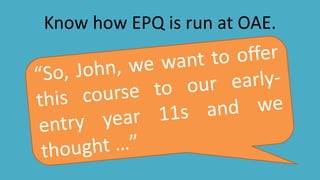
Know how EPQ is run at OAE.
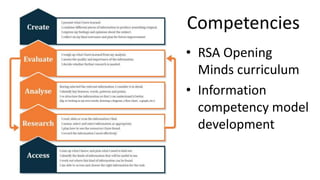
Competencies
• RSA Opening
Minds curriculum
• Information
competency model
development
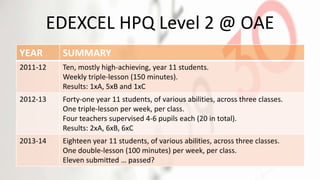
EDEXCEL HPQ Level 2 @ OAE
YEAR SUMMARY
2011-12 Ten, mostly high-achieving, year 11 students.
Weekly triple-lesson (150 minutes).
Results: 1xA, 5xB and 1xC
2012-13 Forty-one year 11 students, of various abilities, across three classes.
One triple-lesson per week, per class.
Four teachers supervised 4-6 pupils each (20 in total).
Results: 2xA, 6xB, 6xC
2013-14 Eighteen year 11 students, of various abilities, across three classes.
One double-lesson (100 minutes) per week, per class.
Eleven submitted … passed?
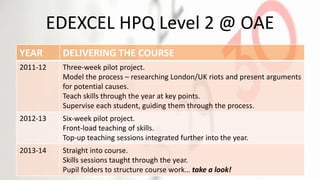
EDEXCEL HPQ Level 2 @ OAE
YEAR DELIVERING THE COURSE
2011-12 Three-week pilot project.
Model the process – researching London/UK riots and present arguments
for potential causes.
Teach skills through the year at key points.
Supervise each student, guiding them through the process.
2012-13 Six-week pilot project.
Front-load teaching of skills.
Top-up teaching sessions integrated further into the year.
2013-14 Straight into course.
Skills sessions taught through the year.
Pupil folders to structure course work… take a look!
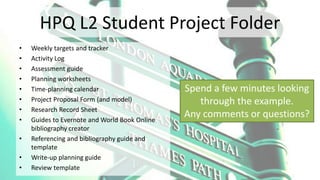
HPQ L2 Student Project Folder
• Weekly targets and tracker
• Activity Log
• Assessment guide
• Planning worksheets
• Time-planning calendar
• Project Proposal Form (and model)
• Research Record Sheet
• Guides to Evernote and World Book Online
bibliography creator
• Referencing and bibliography guide and
template
• Write-up planning guide
• Review template
Spend a few minutes looking
through the example.
Any comments or questions?
AQA EPQ Level 3 @ OAE
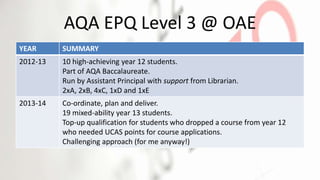
YEAR SUMMARY
2012-13 10 high-achieving year 12 students.
Part of AQA Baccalaureate.
Run by Assistant Principal with support from Librarian.
2xA, 2xB, 4xC, 1xD and 1xE
2013-14 Co-ordinate, plan and deliver.
19 mixed-ability year 13 students.
Top-up qualification for students who dropped a course from year 12
who needed UCAS points for course applications.
Challenging approach (for me anyway!)
AQA EPQ Level 3 @ OAE
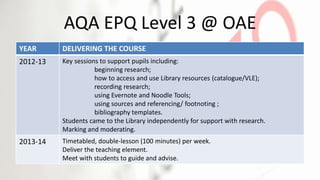
YEAR DELIVERING THE COURSE
2012-13 Key sessions to support pupils including:
beginning research;
how to access and use Library resources (catalogue/VLE);
recording research;
using Evernote and Noodle Tools;
using sources and referencing/ footnoting ;
bibliography templates.
Students came to the Library independently for support with research.
Marking and moderating.
2013-14 Timetabled, double-lesson (100 minutes) per week.
Deliver the teaching element.
Meet with students to guide and advise.
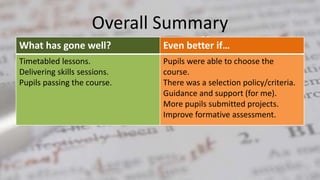
Overall Summary
What has gone well? Even better if…
Timetabled lessons.
Delivering skills sessions.
Pupils passing the course.
Pupils were able to choose the
course.
There was a selection policy/criteria.
Guidance and support (for me).
More pupils submitted projects.
Improve formative assessment.
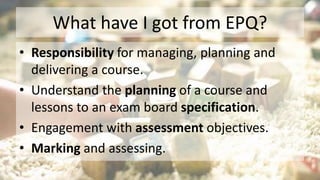
What have I got from EPQ?
• Responsibility for managing, planning and
delivering a course.
• Understand the planning of a course and
lessons to an exam board specification.
• Engagement with assessment objectives.
• Marking and assessing.
What else have I got from EPQ?
• Raised the profile (to an extent) of the Library
and Librarian among ALT, staff and pupils.
• Collaboration with, and management of,
teaching staff.
• Insight into information literacy skills within a
course/qualification.
Next …
Understand the course/assessment
=
Leverage for raising attainment
=
Key to showing importance
Have a rest from listening to me…
Talk with the people around you:
• Is EPQ offered in your school?
• How is it offered/run?
• Do you any input/involvement?
• How does this compare with what you have
heard so far?
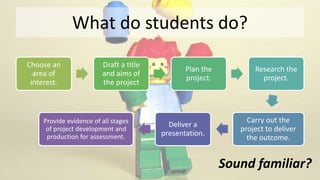
What do students do?
Choose an
area of
interest.
Draft a title
and aims of
the project
Plan the
project.
Research the
project.
Carry out the
project to deliver
the outcome.
Deliver a
presentation.
Provide evidence of all stages
of project development and
production for assessment.
Sound familiar?
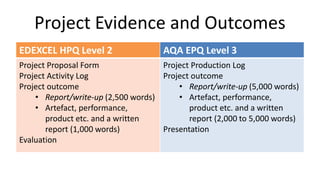
Project Evidence and Outcomes
EDEXCEL HPQ Level 2 AQA EPQ Level 3
Project Proposal Form
Project Activity Log
Project outcome
• Report/write-up (2,500 words)
• Artefact, performance,
product etc. and a written
report (1,000 words)
Evaluation
Project Production Log
Project outcome
• Report/write-up (5,000 words)
• Artefact, performance,
product etc. and a written
report (2,000 to 5,000 words)
Presentation
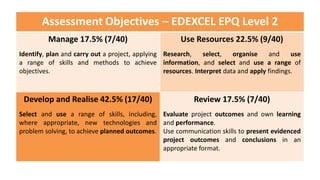
AssessmentAssessment Objectives – EDEXCEL EPQ Level 2
Manage 17.5% (7/40)
Identify, plan and carry out a project, applying
a range of skills and methods to achieve
objectives.
Use Resources 22.5% (9/40)
Research, select, organise and use
information, and select and use a range of
resources. Interpret data and apply findings.
Develop and Realise 42.5% (17/40)
Select and use a range of skills, including,
where appropriate, new technologies and
problem solving, to achieve planned outcomes.
Review 17.5% (7/40)
Evaluate project outcomes and own learning
and performance.
Use communication skills to present evidenced
project outcomes and conclusions in an
appropriate format.
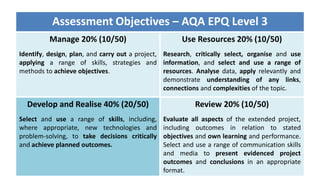
AssessmentAssessment Objectives – AQA EPQ Level 3
Manage 20% (10/50)
Identify, design, plan, and carry out a project,
applying a range of skills, strategies and
methods to achieve objectives.
Use Resources 20% (10/50)
Research, critically select, organise and use
information, and select and use a range of
resources. Analyse data, apply relevantly and
demonstrate understanding of any links,
connections and complexities of the topic.
Develop and Realise 40% (20/50)
Select and use a range of skills, including,
where appropriate, new technologies and
problem-solving, to take decisions critically
and achieve planned outcomes.
Review 20% (10/50)
Evaluate all aspects of the extended project,
including outcomes in relation to stated
objectives and own learning and performance.
Select and use a range of communication skills
and media to present evidenced project
outcomes and conclusions in an appropriate
format.
ACTIVITY: Where could you have the
most to offer?
Look at the AOs for AQA EPQ (level 3) or EDEXCEL
HPQ (level 2) (choose the one most appropriate)
• Which criteria seem most relevant to y/our role?
• Can you identify opportunities to support the
meeting of specific criteria?
• What do you notice about the difference
between higher and lower bands/marks?
Five minutes and then feedback ideas
What you might
have picked out …?
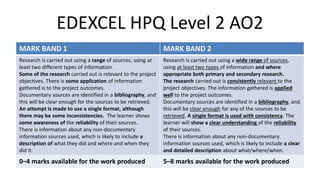
EDEXCEL HPQ Level 2 AO2
MARK BAND 1 MARK BAND 2
Research is carried out using a range of sources, using at
least two different types of information.
Some of the research carried out is relevant to the project
objectives. There is some application of information
gathered is to the project outcomes.
Documentary sources are identified in a bibliography, and
this will be clear enough for the sources to be retrieved.
An attempt is made to use a single format, although
there may be some inconsistencies. The learner shows
some awareness of the reliability of their sources.
There is information about any non-documentary
information sources used, which is likely to include a
description of what they did and where and when they
did it.
Research is carried out using a wide range of sources,
using at least two types of information and where
appropriate both primary and secondary research.
The research carried out is consistently relevant to the
project objectives. The information gathered is applied
well to the project outcomes.
Documentary sources are identified in a bibliography, and
this will be clear enough for any of the sources to be
retrieved. A single format is used with consistency. The
learner will show a clear understanding of the reliability
of their sources.
There is information about any non-documentary
information sources used, which is likely to include a clear
and detailed description about what/where/when.
0–4 marks available for the work produced 5–8 marks available for the work produced
Can you apply AO2 to a
project?
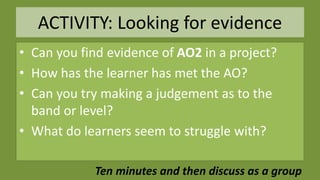
ACTIVITY: Looking for evidence
• Can you find evidence of AO2 in a project?
• How has the learner has met the AO?
• Can you try making a judgement as to the
band or level?
• What do learners seem to struggle with?
Ten minutes and then discuss as a group
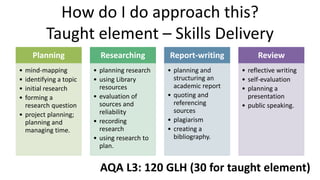
How do I do approach this?
Taught element – Skills Delivery
Planning
• mind-mapping
• identifying a topic
• initial research
• forming a
research question
• project planning;
planning and
managing time.
Researching
• planning research
• using Library
resources
• evaluation of
sources and
reliability
• recording
research
• using research to
plan.
Report-writing
• planning and
structuring an
academic report
• quoting and
referencing
sources
• plagiarism
• creating a
bibliography.
Review
• reflective writing
• self-evaluation
• planning a
presentation
• public speaking.
AQA L3: 120 GLH (30 for taught element)
Activity Summary
Understand the course/assessment
=
Leverage for raising attainment
=
Key to showing importance
Ways you can get involved:
levels of involvement
+ Run the course.
+ Deliver & plan skills lessons.
+ Be a Supervisor.
+ Arrange drop-in (voluntary) sessions/surgery
+ Offer one-to-one tutorials/research interview.
+Deliver resources:
– Physical (books, journals etc.)
– VLE/Netvibes
– Guide/leaflet
– Online database collections.
In what ways could you get involved?
Discuss with the people around you,
what would you feel comfortable
doing? What could you offer?
Look for ammunition for starting
conversations with staff (and students)
“I can help to guide/teach
your students in these key
areas…”
“I can help you identify
what the progression
might look like…”
“We can structure
and scaffold their
work in these areas…”
“We can begin to
improve achievement in
these AOs…”
EPQ Assessor at recent AQA Co-ordinator training:
“If you are not working
with your Librarian, you
really ought to”
More information?
• EDEXCEL and AQA both publish resources and guides for staff and students.
• The exam boards have pages with more information, specifications etc. on the
following URLs:
– http://www.edexcel.com/quals/project/Pages/default.aspx
– http://www.aqa.org.uk/subjects/projects
• There are some very useful resources from Universities, listed at:
http://www.aqa.org.uk/subjects/projects/aqa-certificate/EPQ-7993/why-
choose/support-from-higher-education-institutions
– Manchester University at http://www.manchester.ac.uk/connect/teachers/students/post-
16/extended-project/resources/
– Southampton Uni guide to research
http://www.learnwithus.southampton.ac.uk/extendedProject/
• Two very good free e-books of resources at
http://getrevising.co.uk/pages/extended_project_resources
• Debating Matters at http://www.debatingmatters.com/ for good topic ideas and
resources
Any further questions?
Activities and information Talk-time and sharing
• Know how EPQ is run at OAE.
• Have an overview of what EPQ is.
• Have an understanding of the
assessment objectives.
• Look at examples of student
projects.
• Apply assessment objectives to a
project.
• Discuss opportunities for how you
might get involved.
• Discuss with each other, share
ideas and experiences.
• Have time to ask questions,
discuss ideas and explore issues.
John.iona@oasisenfield.org
@jionalibrarian

Opportunities: Supporting the extended project qualification

  • 1.
  • 2.
    Session Objectives Plan forthe session • Know how EPQ is run at OAE. • Have an overview of what EPQ is. • Have an understanding of the assessment objectives. • Look at examples of student projects. • Apply assessment objectives to a project. • Discuss opportunities for how you might get involved. Talk-time and sharing • Discuss with each other, share ideas and experiences. • Have time to ask questions, discuss ideas and explore issues.
  • 3.
    What is EPQ? Astand-alone qualification aimed at allowing students to demonstrate their skills including planning, researching, time-management and evaluation. Offered with AQA and Edexcel.
  • 4.
    Levels available Extended Project– Level 3 (A2-level equivalent) – A* = 70 UCAS points – A = 60 – B = 50 – C = 40 – D = 30 – E = 20 Higher Project – Level 2 (GCSE grades A*-C) Foundation Project – Level 1 (GCSE grades C-G)
  • 5.
    Know how EPQis run at OAE.
  • 6.
    Competencies • RSA Opening Mindscurriculum • Information competency model development
  • 7.
    EDEXCEL HPQ Level2 @ OAE YEAR SUMMARY 2011-12 Ten, mostly high-achieving, year 11 students. Weekly triple-lesson (150 minutes). Results: 1xA, 5xB and 1xC 2012-13 Forty-one year 11 students, of various abilities, across three classes. One triple-lesson per week, per class. Four teachers supervised 4-6 pupils each (20 in total). Results: 2xA, 6xB, 6xC 2013-14 Eighteen year 11 students, of various abilities, across three classes. One double-lesson (100 minutes) per week, per class. Eleven submitted … passed?
  • 8.
    EDEXCEL HPQ Level2 @ OAE YEAR DELIVERING THE COURSE 2011-12 Three-week pilot project. Model the process – researching London/UK riots and present arguments for potential causes. Teach skills through the year at key points. Supervise each student, guiding them through the process. 2012-13 Six-week pilot project. Front-load teaching of skills. Top-up teaching sessions integrated further into the year. 2013-14 Straight into course. Skills sessions taught through the year. Pupil folders to structure course work… take a look!
  • 9.
    HPQ L2 StudentProject Folder • Weekly targets and tracker • Activity Log • Assessment guide • Planning worksheets • Time-planning calendar • Project Proposal Form (and model) • Research Record Sheet • Guides to Evernote and World Book Online bibliography creator • Referencing and bibliography guide and template • Write-up planning guide • Review template Spend a few minutes looking through the example. Any comments or questions?
  • 10.
    AQA EPQ Level3 @ OAE YEAR SUMMARY 2012-13 10 high-achieving year 12 students. Part of AQA Baccalaureate. Run by Assistant Principal with support from Librarian. 2xA, 2xB, 4xC, 1xD and 1xE 2013-14 Co-ordinate, plan and deliver. 19 mixed-ability year 13 students. Top-up qualification for students who dropped a course from year 12 who needed UCAS points for course applications. Challenging approach (for me anyway!)
  • 11.
    AQA EPQ Level3 @ OAE YEAR DELIVERING THE COURSE 2012-13 Key sessions to support pupils including: beginning research; how to access and use Library resources (catalogue/VLE); recording research; using Evernote and Noodle Tools; using sources and referencing/ footnoting ; bibliography templates. Students came to the Library independently for support with research. Marking and moderating. 2013-14 Timetabled, double-lesson (100 minutes) per week. Deliver the teaching element. Meet with students to guide and advise.
  • 12.
    Overall Summary What hasgone well? Even better if… Timetabled lessons. Delivering skills sessions. Pupils passing the course. Pupils were able to choose the course. There was a selection policy/criteria. Guidance and support (for me). More pupils submitted projects. Improve formative assessment.
  • 13.
    What have Igot from EPQ? • Responsibility for managing, planning and delivering a course. • Understand the planning of a course and lessons to an exam board specification. • Engagement with assessment objectives. • Marking and assessing.
  • 14.
    What else haveI got from EPQ? • Raised the profile (to an extent) of the Library and Librarian among ALT, staff and pupils. • Collaboration with, and management of, teaching staff. • Insight into information literacy skills within a course/qualification.
  • 15.
    Next … Understand thecourse/assessment = Leverage for raising attainment = Key to showing importance
  • 16.
    Have a restfrom listening to me… Talk with the people around you: • Is EPQ offered in your school? • How is it offered/run? • Do you any input/involvement? • How does this compare with what you have heard so far?
  • 19.
    What do studentsdo? Choose an area of interest. Draft a title and aims of the project Plan the project. Research the project. Carry out the project to deliver the outcome. Deliver a presentation. Provide evidence of all stages of project development and production for assessment. Sound familiar?
  • 20.
    Project Evidence andOutcomes EDEXCEL HPQ Level 2 AQA EPQ Level 3 Project Proposal Form Project Activity Log Project outcome • Report/write-up (2,500 words) • Artefact, performance, product etc. and a written report (1,000 words) Evaluation Project Production Log Project outcome • Report/write-up (5,000 words) • Artefact, performance, product etc. and a written report (2,000 to 5,000 words) Presentation
  • 22.
    AssessmentAssessment Objectives –EDEXCEL EPQ Level 2 Manage 17.5% (7/40) Identify, plan and carry out a project, applying a range of skills and methods to achieve objectives. Use Resources 22.5% (9/40) Research, select, organise and use information, and select and use a range of resources. Interpret data and apply findings. Develop and Realise 42.5% (17/40) Select and use a range of skills, including, where appropriate, new technologies and problem solving, to achieve planned outcomes. Review 17.5% (7/40) Evaluate project outcomes and own learning and performance. Use communication skills to present evidenced project outcomes and conclusions in an appropriate format.
  • 23.
    AssessmentAssessment Objectives –AQA EPQ Level 3 Manage 20% (10/50) Identify, design, plan, and carry out a project, applying a range of skills, strategies and methods to achieve objectives. Use Resources 20% (10/50) Research, critically select, organise and use information, and select and use a range of resources. Analyse data, apply relevantly and demonstrate understanding of any links, connections and complexities of the topic. Develop and Realise 40% (20/50) Select and use a range of skills, including, where appropriate, new technologies and problem-solving, to take decisions critically and achieve planned outcomes. Review 20% (10/50) Evaluate all aspects of the extended project, including outcomes in relation to stated objectives and own learning and performance. Select and use a range of communication skills and media to present evidenced project outcomes and conclusions in an appropriate format.
  • 25.
    ACTIVITY: Where couldyou have the most to offer? Look at the AOs for AQA EPQ (level 3) or EDEXCEL HPQ (level 2) (choose the one most appropriate) • Which criteria seem most relevant to y/our role? • Can you identify opportunities to support the meeting of specific criteria? • What do you notice about the difference between higher and lower bands/marks? Five minutes and then feedback ideas
  • 26.
    What you might havepicked out …?
  • 28.
    EDEXCEL HPQ Level2 AO2 MARK BAND 1 MARK BAND 2 Research is carried out using a range of sources, using at least two different types of information. Some of the research carried out is relevant to the project objectives. There is some application of information gathered is to the project outcomes. Documentary sources are identified in a bibliography, and this will be clear enough for the sources to be retrieved. An attempt is made to use a single format, although there may be some inconsistencies. The learner shows some awareness of the reliability of their sources. There is information about any non-documentary information sources used, which is likely to include a description of what they did and where and when they did it. Research is carried out using a wide range of sources, using at least two types of information and where appropriate both primary and secondary research. The research carried out is consistently relevant to the project objectives. The information gathered is applied well to the project outcomes. Documentary sources are identified in a bibliography, and this will be clear enough for any of the sources to be retrieved. A single format is used with consistency. The learner will show a clear understanding of the reliability of their sources. There is information about any non-documentary information sources used, which is likely to include a clear and detailed description about what/where/when. 0–4 marks available for the work produced 5–8 marks available for the work produced
  • 29.
    Can you applyAO2 to a project?
  • 30.
    ACTIVITY: Looking forevidence • Can you find evidence of AO2 in a project? • How has the learner has met the AO? • Can you try making a judgement as to the band or level? • What do learners seem to struggle with? Ten minutes and then discuss as a group
  • 31.
    How do Ido approach this? Taught element – Skills Delivery Planning • mind-mapping • identifying a topic • initial research • forming a research question • project planning; planning and managing time. Researching • planning research • using Library resources • evaluation of sources and reliability • recording research • using research to plan. Report-writing • planning and structuring an academic report • quoting and referencing sources • plagiarism • creating a bibliography. Review • reflective writing • self-evaluation • planning a presentation • public speaking. AQA L3: 120 GLH (30 for taught element)
  • 32.
    Activity Summary Understand thecourse/assessment = Leverage for raising attainment = Key to showing importance
  • 33.
    Ways you canget involved: levels of involvement + Run the course. + Deliver & plan skills lessons. + Be a Supervisor. + Arrange drop-in (voluntary) sessions/surgery + Offer one-to-one tutorials/research interview. +Deliver resources: – Physical (books, journals etc.) – VLE/Netvibes – Guide/leaflet – Online database collections. In what ways could you get involved? Discuss with the people around you, what would you feel comfortable doing? What could you offer?
  • 34.
    Look for ammunitionfor starting conversations with staff (and students) “I can help to guide/teach your students in these key areas…” “I can help you identify what the progression might look like…” “We can structure and scaffold their work in these areas…” “We can begin to improve achievement in these AOs…”
  • 35.
    EPQ Assessor atrecent AQA Co-ordinator training: “If you are not working with your Librarian, you really ought to”
  • 36.
    More information? • EDEXCELand AQA both publish resources and guides for staff and students. • The exam boards have pages with more information, specifications etc. on the following URLs: – http://www.edexcel.com/quals/project/Pages/default.aspx – http://www.aqa.org.uk/subjects/projects • There are some very useful resources from Universities, listed at: http://www.aqa.org.uk/subjects/projects/aqa-certificate/EPQ-7993/why- choose/support-from-higher-education-institutions – Manchester University at http://www.manchester.ac.uk/connect/teachers/students/post- 16/extended-project/resources/ – Southampton Uni guide to research http://www.learnwithus.southampton.ac.uk/extendedProject/ • Two very good free e-books of resources at http://getrevising.co.uk/pages/extended_project_resources • Debating Matters at http://www.debatingmatters.com/ for good topic ideas and resources
  • 37.
    Any further questions? Activitiesand information Talk-time and sharing • Know how EPQ is run at OAE. • Have an overview of what EPQ is. • Have an understanding of the assessment objectives. • Look at examples of student projects. • Apply assessment objectives to a project. • Discuss opportunities for how you might get involved. • Discuss with each other, share ideas and experiences. • Have time to ask questions, discuss ideas and explore issues. John.iona@oasisenfield.org @jionalibrarian