Welcome to the Summer
Institute in Digital Literacy
“Education is not the filling of a bucket…but the
lighting of a fire.” ~ W.B. Yeats
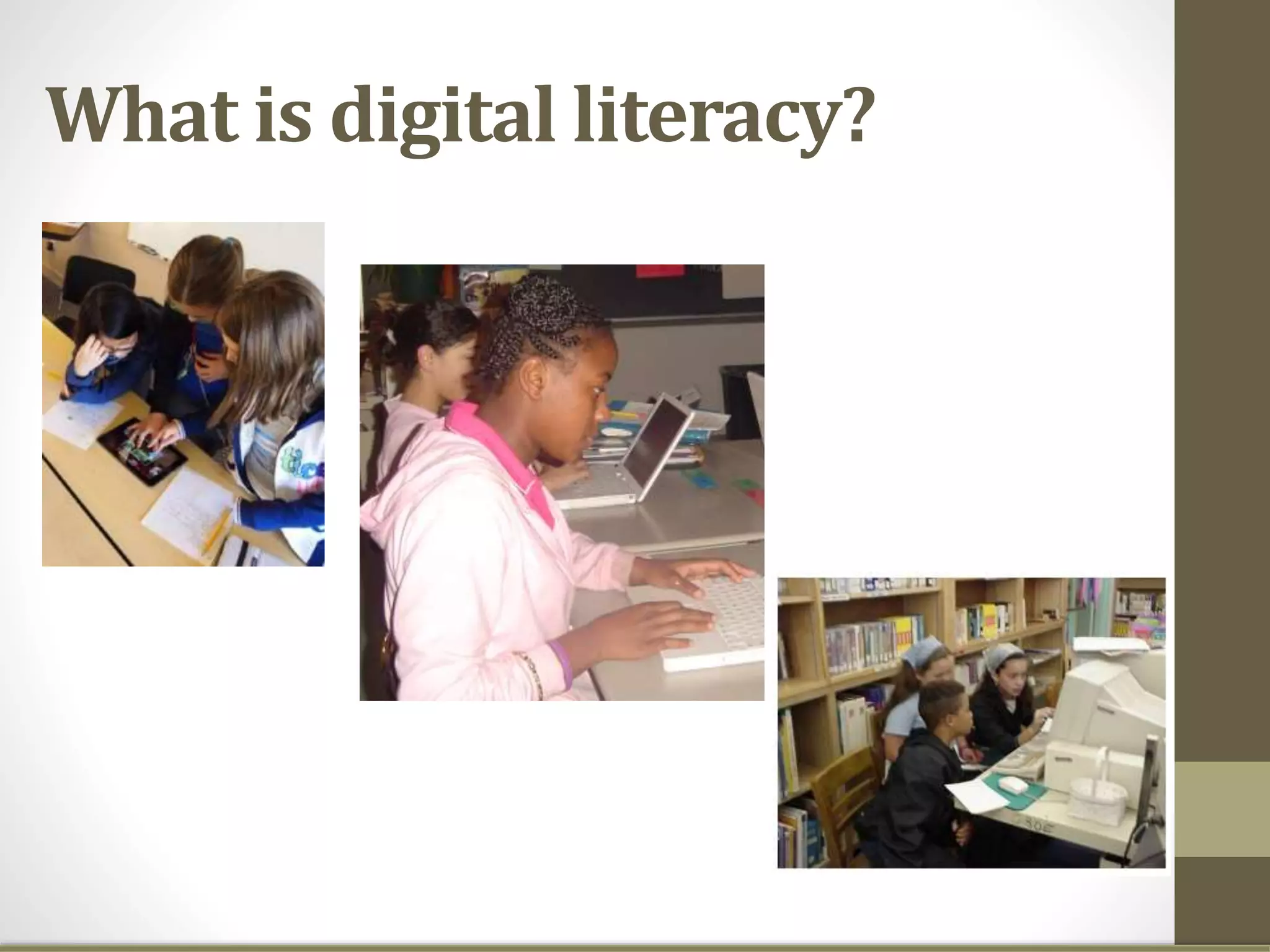
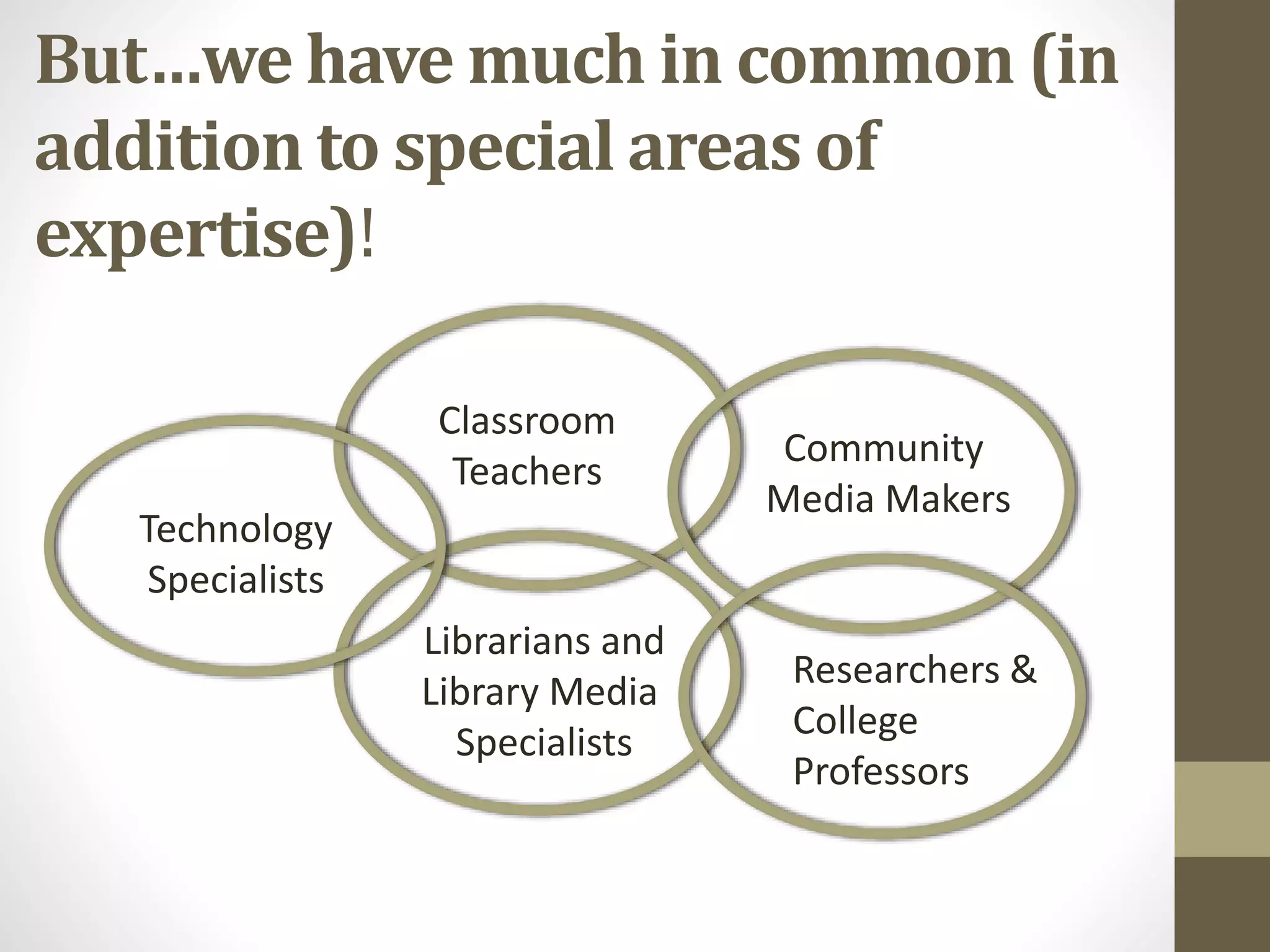
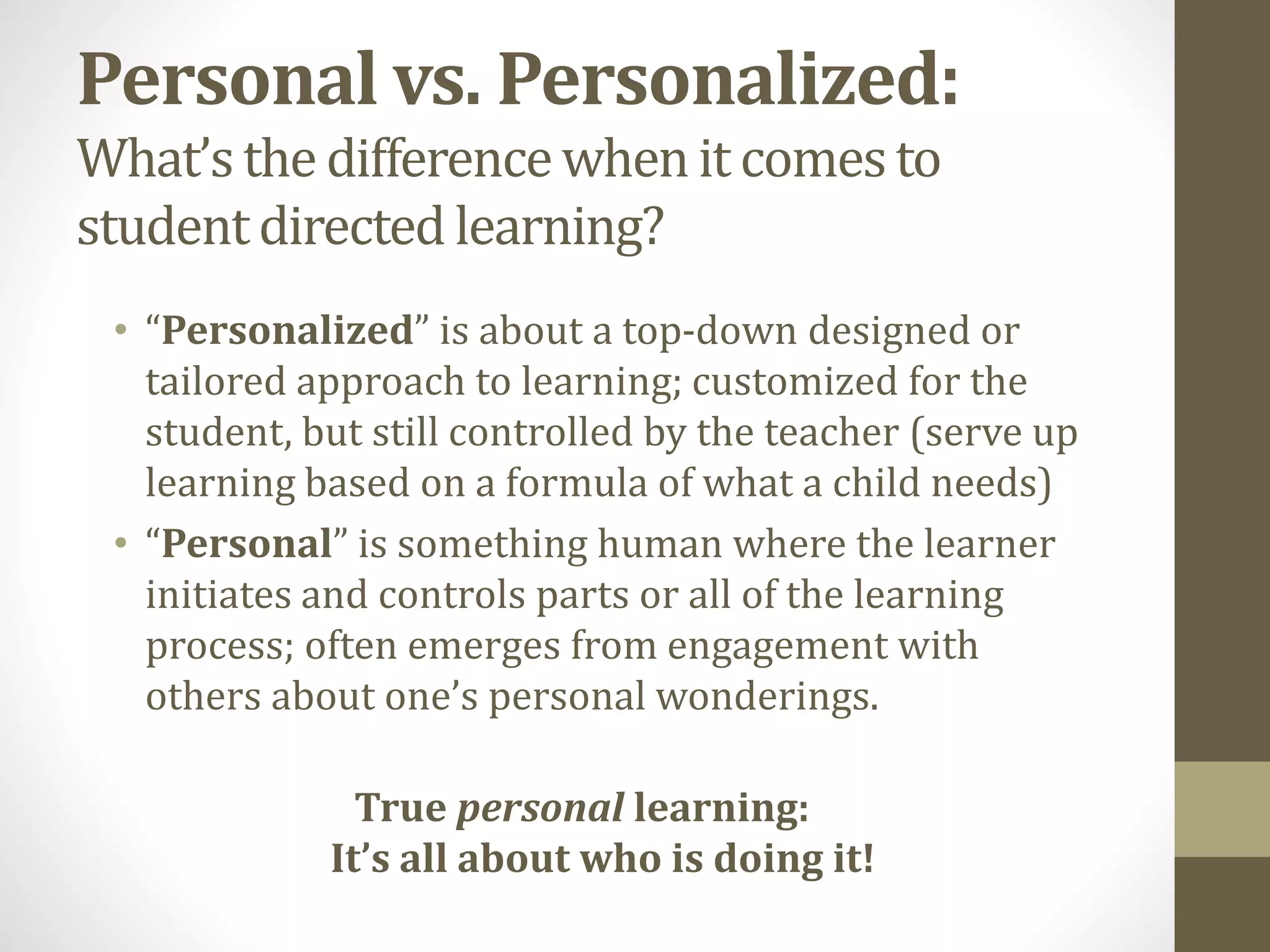
What is digital literacy?
I define digital literacyas having the
skills,strategies,and dispositions to use
the Internet productively to:
• Generate useful questions to solve problems
• Locate information
• Critically evaluate information
• Synthesize information
• Communicate answers/solutions
Leu, Kinzer, Coiro, Castek & Henry (2013). New literacies: A dual-level theory of
the changing nature of literacy, instruction, and assessment. Theoretical Models
and Processes of Reading, Sixth Edition.
Others define digital literacy in
slightly different ways
Doug Belshaw
Civic-minded citizens able to…
generate their own questions;
listen in order to understand;
actively co-create their learning
community; critically analyze and
reflect on their practices
Chris Lehmann
Renee Hobbs
Michael Eisenberg
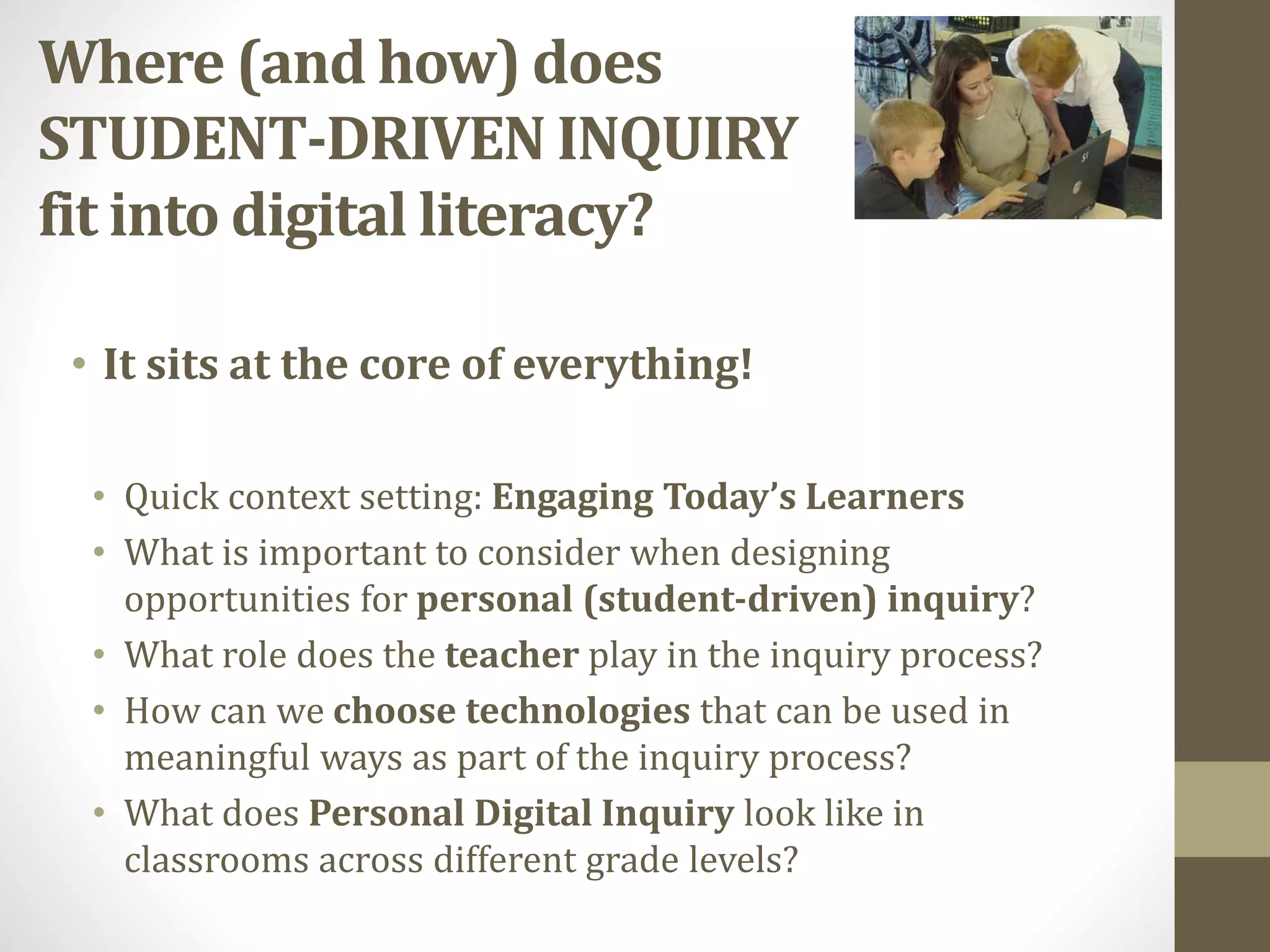
Often, these varied definitions
reflect our varied roles in teaching
and learning
Technology
Specialists
Librarians and
Library Media
Specialists
Community
Media Makers
Researchers &
College Professors
Classroom
Teachers
But…we have much in common (in
addition to special areas of
expertise)!
Classroom
Teachers
Community
Media Makers
Librarians and
Library Media
Specialists
Researchers &
College
Professors
Technology
Specialists
Turn and Talk (5 minutes)
• Introduce yourself and identify your role/work context
• What does digital literacy mean to you?
• Identify a similarity and a difference compared to your
partner’s definition.
Is there enough in common to support each other in
designing productive learning experiences?
How might you capitalize on your individual areas of expertise?
The Only Tools You Really Need
“A camera and the openness for questions. From there,
it’s hard to imagine anything standing in the way of
learning.” ~ Chris Lehmann (Wed. Keynote Speaker)
PersonalInquiryand
OnlineResearch:
ConnectingLearners
inWaysThatMatter
Julie Coiro, PhD
School of Education
University of Rhode Island
jcoiro@uri.edu
uri.academia.edu/JulieCoiro/Papers
Monday Keynote (on wiki)
Personal vs. Personalized:
What’s the differencewhenit comesto
studentdirected learning?
• “Personalized” is about a top-down designed or
tailored approach to learning; customized for the
student, but still controlled by the teacher (serve up
learning based on a formula of what a child needs)
• “Personal” is something human where the learner
initiates and controls parts or all of the learning
process; often emerges from engagement with
others about one’s personal wonderings.
True personal learning:
It’s all about who is doing it!
Where (and how) does
STUDENT-DRIVEN INQUIRY
fit into digital literacy?
• Quick context setting: Engaging Today’s Learners
• What is important to consider when designing
opportunities for personal (student-driven) inquiry?
• What role does the teacher play in the inquiry process?
• How can we choose technologies that can be used in
meaningful ways as part of the inquiry process?
• What does Personal Digital Inquiry look like in
classrooms across different grade levels?
• It sits at the core of everything!
The Challenge:Connecting Learnersin Ways
That Matter
Gallup Poll (2012) - 500,000 US students, Gr. 5-12
Students’ Sense of Belonging (2003 - 2012)
Move beyond industrial model of universal school toward new era focused
on lifelong learning and individual choice – or lose learners emotionally &
physically (Collins & Halverson, 2009: Rethinking Education in the Age of Technology)
• If we engage learners with rigorous academic content
and expect them to know why, when, and how to apply
knowledge to answer questions & solve problems
(National Research Council, 2012)
• We can “lessen the achievement gap in ways that lead to
positive adult outcomes for more young people”
• High school students engaged in deep, relevant, and
personal (student-driven) learning opportunities:
• Demonstrated higher levels of interpersonal and
intrapersonal skills (American Institutes for Research, 2014)
• Achieved better outcomes in every aspect of life, including
academic, career, civic, and health (Center for Public Education,
2009)
Optimistic Findings
Sohowcanweusetechnology(and
goodteaching)to designpersonal,student
directedspacesforlearning?
(JulieCoiro,JillCastek,&DavidQuinn,2016,TheReadingTeacher)
This applies to how we design the Institute experience in ways
that model and engage you in the same practices
we hope you will apply to your own projects.
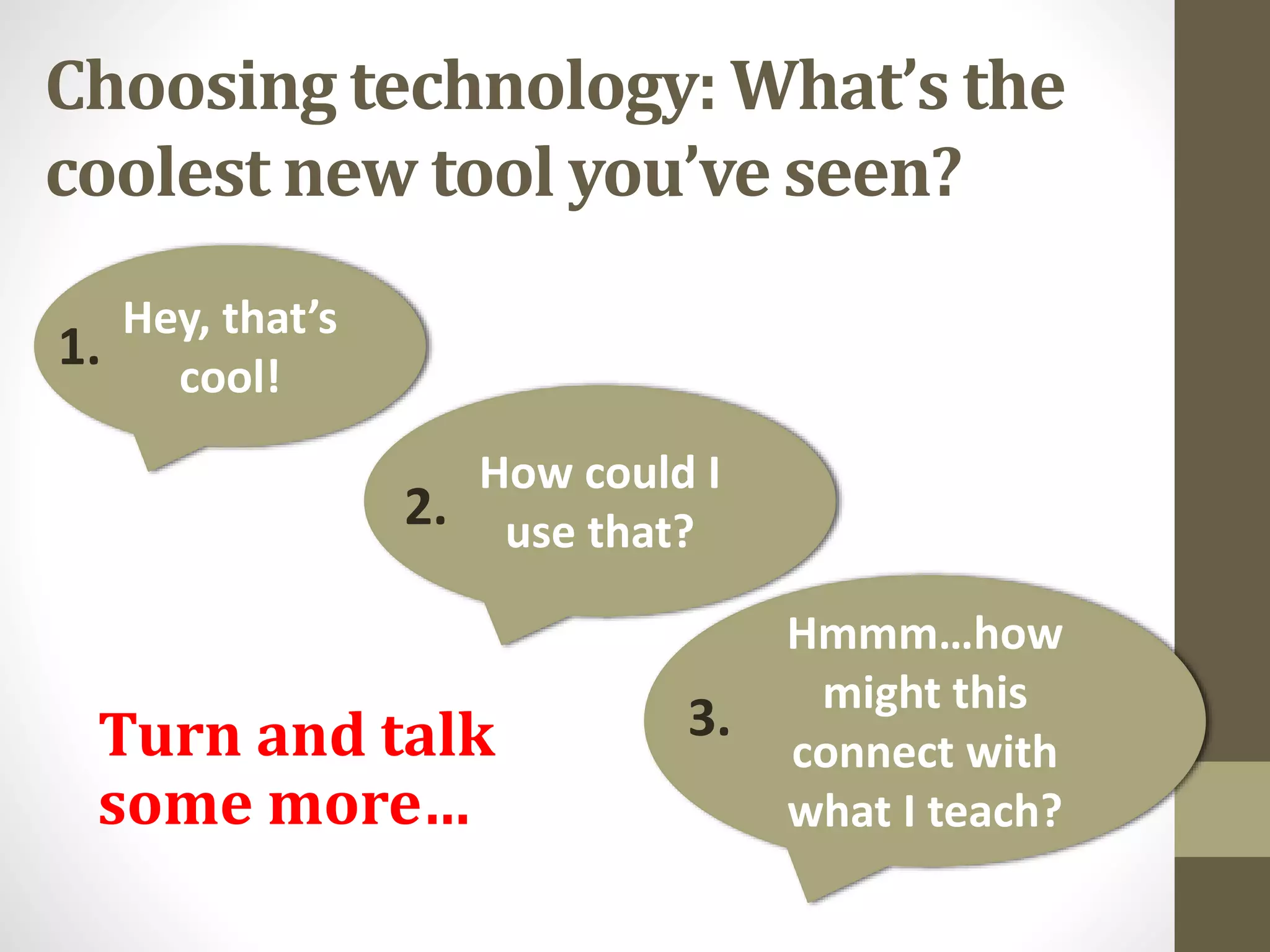
Choosing technology: What’s the
coolest new tool you’ve seen?
Hey, that’s
cool!
1.
How could I
use that?2.
Hmmm…how
might this
connect with
what I teach?
3.
Choosing technology: What’s the
coolest new tool you’ve seen?
Hey, that’s
cool!
1.
How could I
use that?2.
Hmmm…how
might this
connect with
what I teach?
3.Turn and talk
some more…
Are we asking the right questions?
Hey, that’s
cool!
1.
How could
I use that?2.
Hmmm…how
might this
connect with
what I teach?
3.
But how? Which
parts and why?
For whom? In
which contexts?
How will your students
actively engaged with
this tool? To what end?
What will your
students know,
understand,
and be able to do
before/during/after
using this tool?
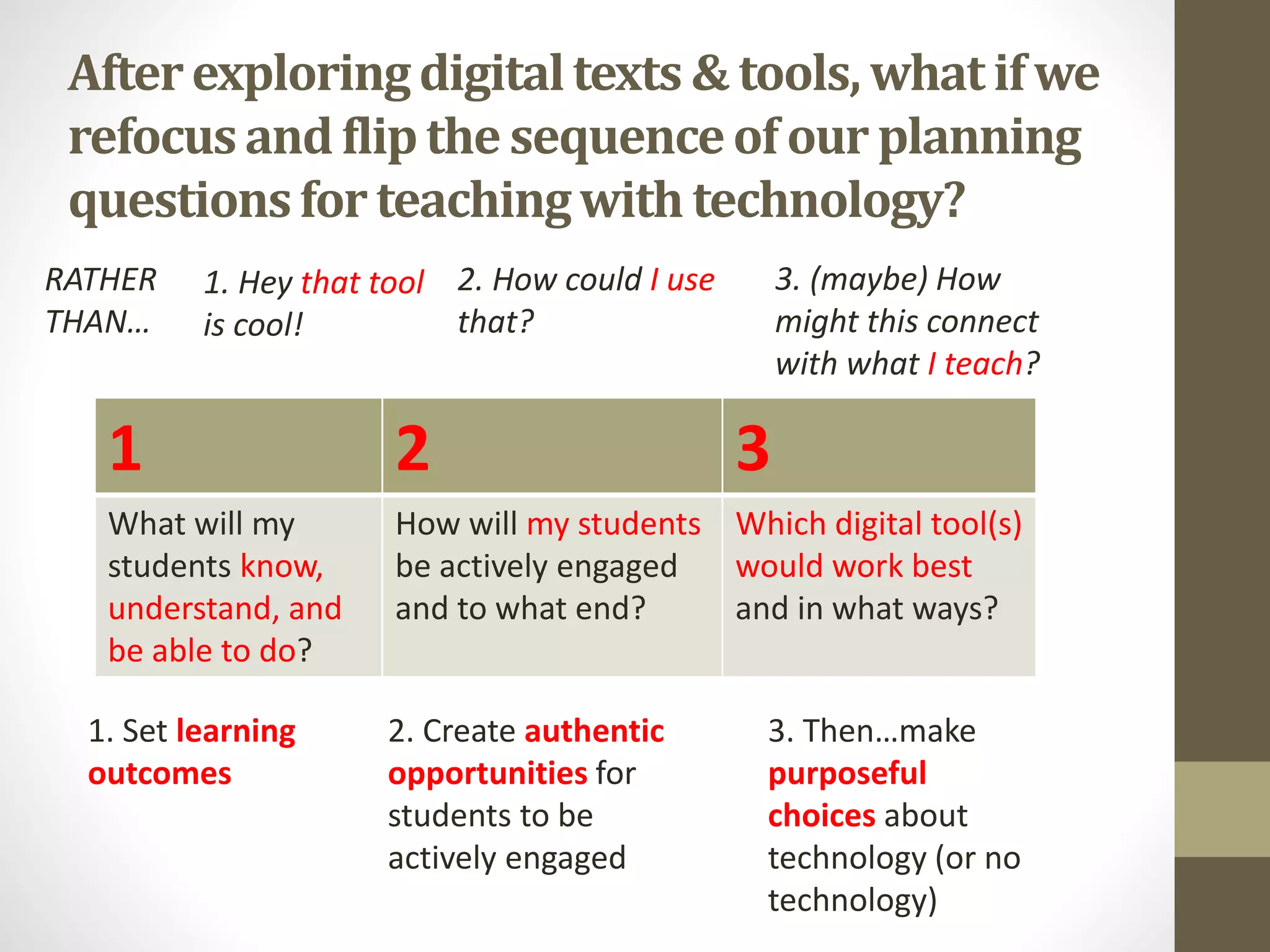
Afterexploringdigitaltexts & tools, whatifwe
refocusandflipthe sequenceof our planning
questionsfor teachingwith technology?
1 2 3
What will my
students know,
understand, and
be able to do?
How will my students
be actively engaged
and to what end?
Which digital tool(s)
would work best
and in what ways?
1. Set learning
outcomes
2. Create authentic
opportunities for
students to be
actively engaged
3. Then…make
purposeful
choices about
technology (or no
technology)
1. Hey that tool
is cool!
2. How could I use
that?
3. (maybe) How
might this connect
with what I teach?
RATHER
THAN…
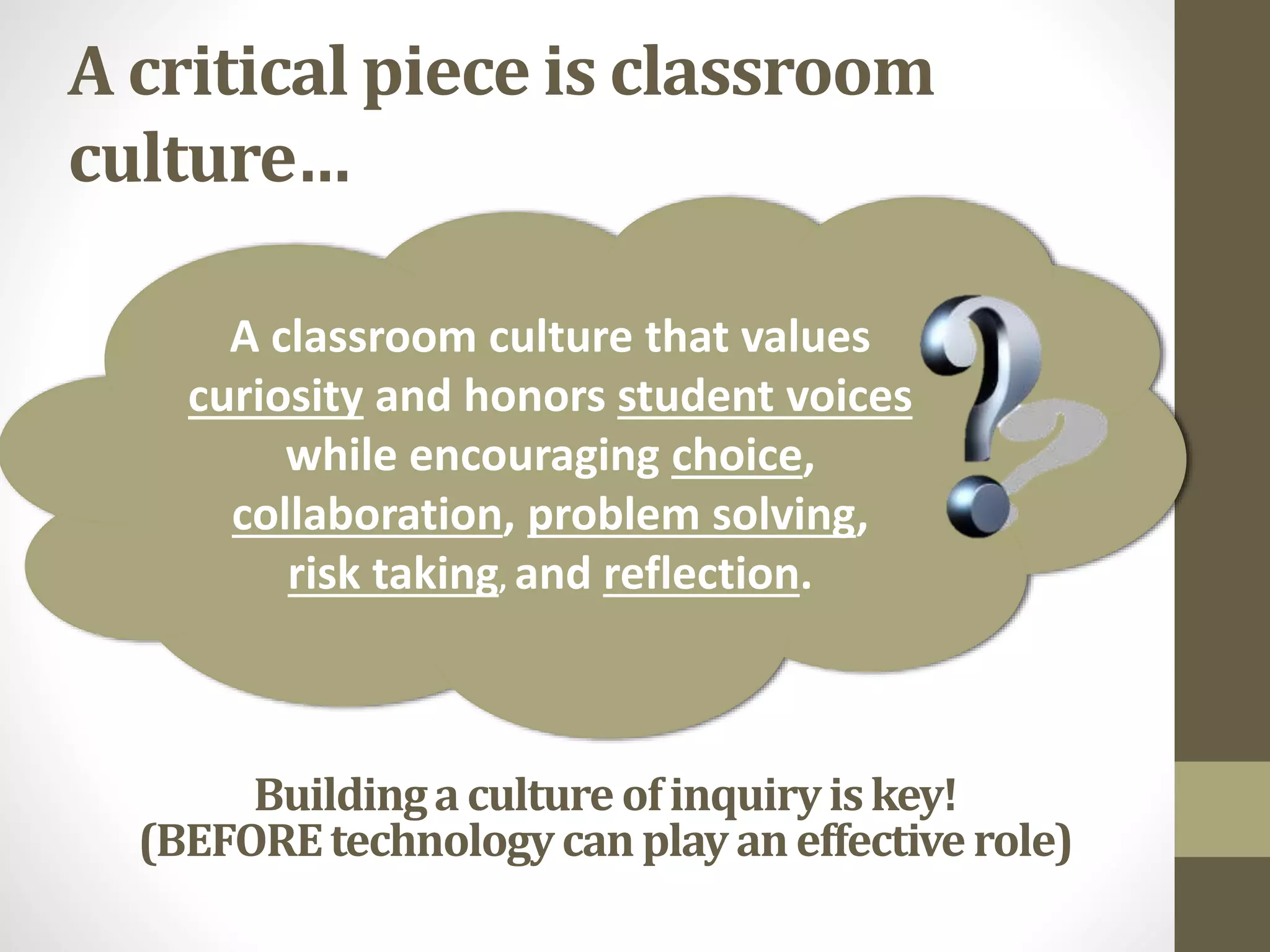
A critical piece is classroom
culture…
A classroom culture that values
curiosity and honors student voices
while encouraging choice,
collaboration, problem solving,
risk taking, and reflection.
Buildingacultureofinquiryiskey!
(BEFOREtechnologycanplay aneffectiverole)
1. Set learning
outcomes
2. Create authentic
opportunities for
students to be actively
engaged
3. Then…make purposeful
choices about technology
(or no technology)
trust and respect
risk-taking
problem-solving
collaboration
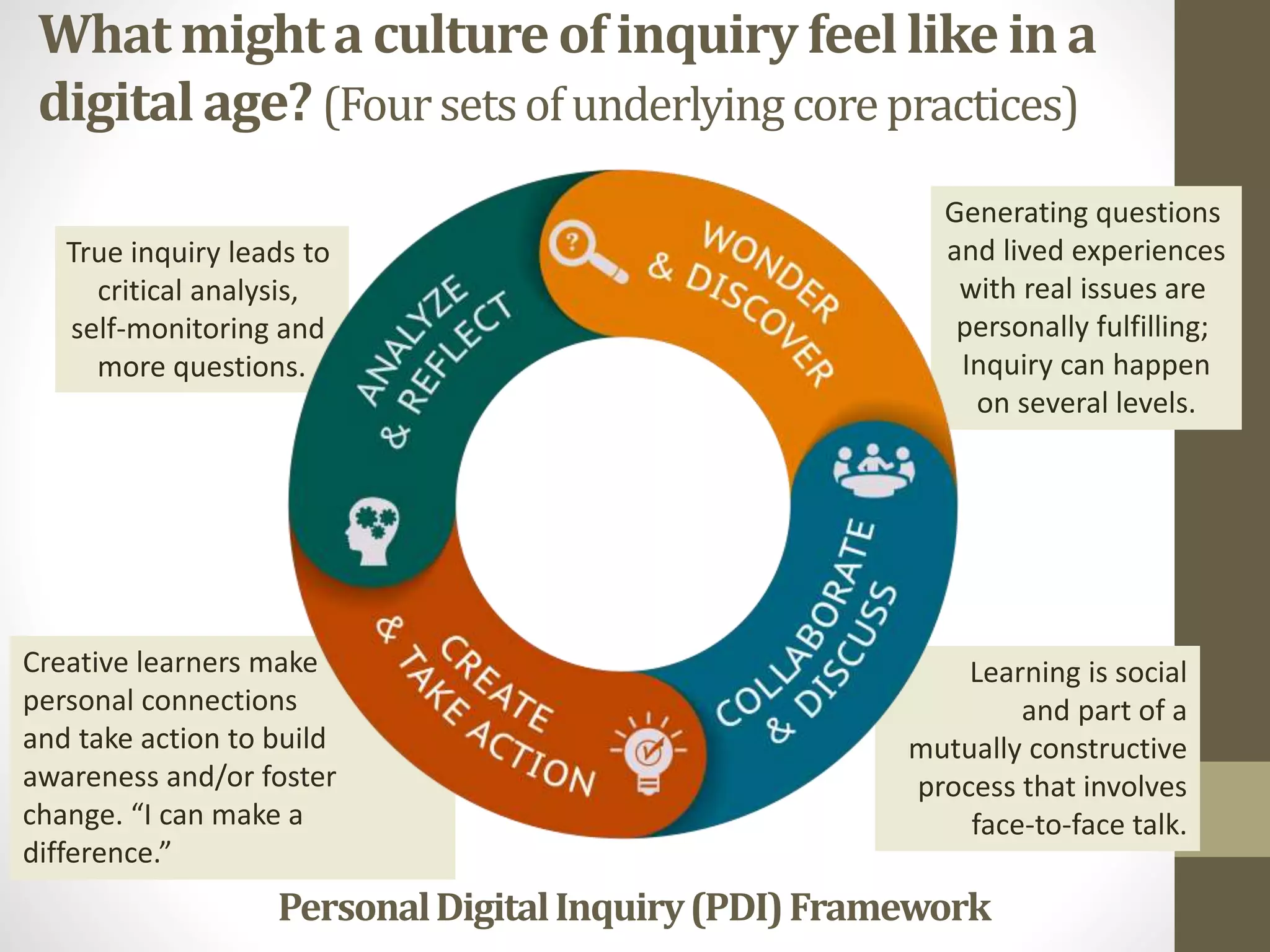
Learning is social
and part of a
mutually constructive
process that involves
face-to-face talk.
What might a culture of inquiry feel like in a
digitalage? (Foursetsofunderlyingcorepractices)
Generating questions
and lived experiences
with real issues are
personally fulfilling;
Inquiry can happen
on several levels.
Creative learners make
personal connections
and take action to build
awareness and/or foster
change. “I can make a
difference.”
True inquiry leads to
critical analysis,
self-monitoring and
more questions.
PersonalDigitalInquiry(PDI)Framework
Wonder & Discover
VariedLevels of [Digital]Inquiry
• Modeled inquiry: Students observe models of how
the leader asks questions and makes decisions.
• Structured Inquiry: Students make choices which
are dependent upon guidelines and structure given
by the leader (may vary).
• Guided Inquiry: Students make choices during
inquiry that lead to deeper understanding guided
by some structure given by the leader.
• Open Inquiry: Students make all of the decisions.
There is little to no guidance.
Alberta Inquiry Model of Inquiry Based Learning (2004)
Shaping your own inquiries this
week. Fertile questions are…
• Open: There are several different or competing
answers.
• Undermining: Makes learners question their basic
assumptions.
• Rich: Can only be answered with careful and lengthy
research; usually able to break into sub-questions.
• Connected: relevant to the learners
• Charged: has an ethical dimension
• Practical: is able to be researched given available
time and resources
~ Harpez & Lefstein (2000) Communities of Thinking
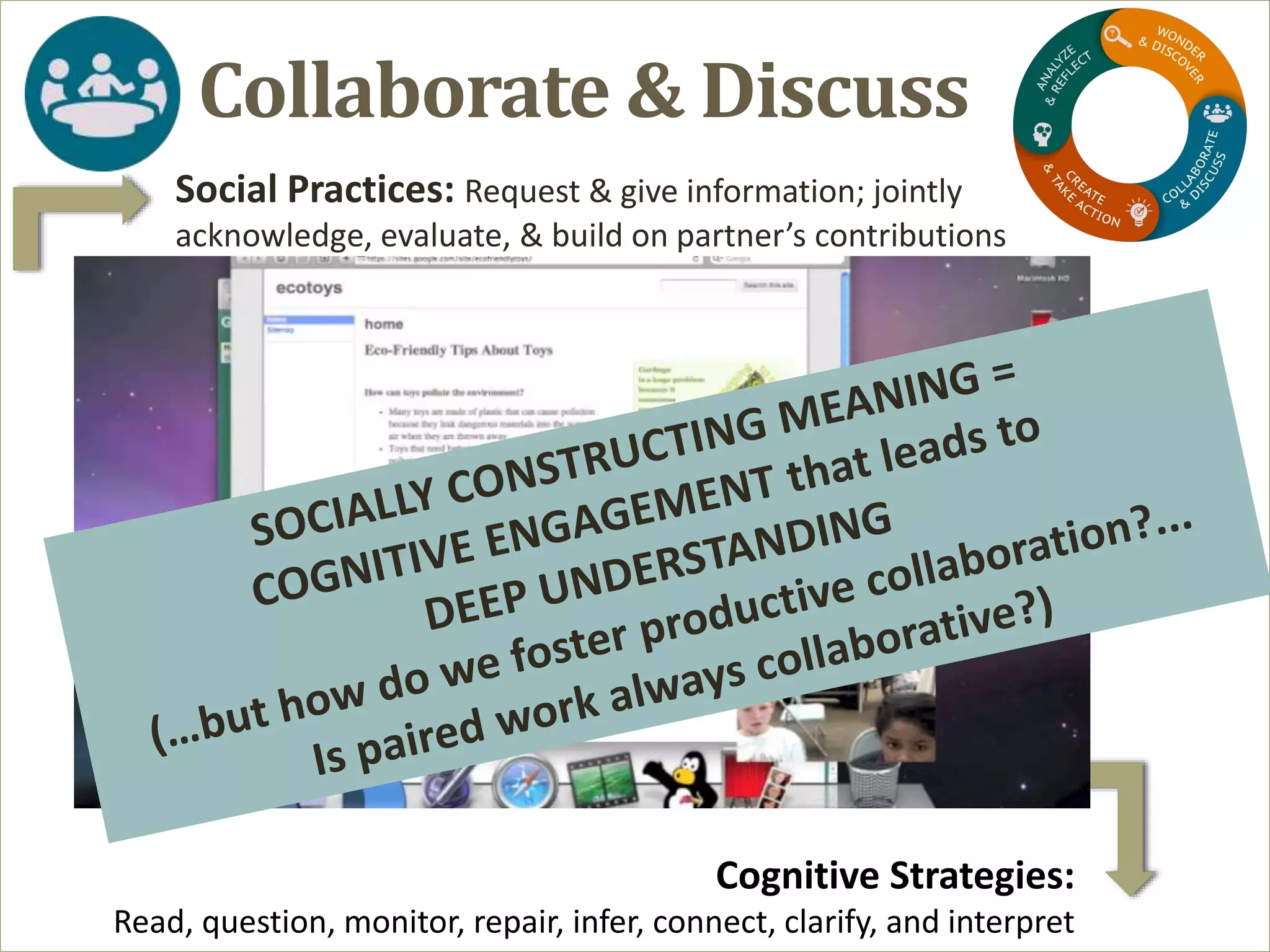
Social Practices: Request & give information; jointly
acknowledge, evaluate, & build on partner’s contributions
Cognitive Strategies:
Read, question, monitor, repair, infer, connect, clarify, and interpret
Collaborate & Discuss
ReneeHobbs(2013)
The Life Of A
Homeless Person
(after a photo walk
Discovery)
Discussion…
Research….
Composition…
Revision…
10 page
Comic book
Create&
Take Action
Analyze & Reflect
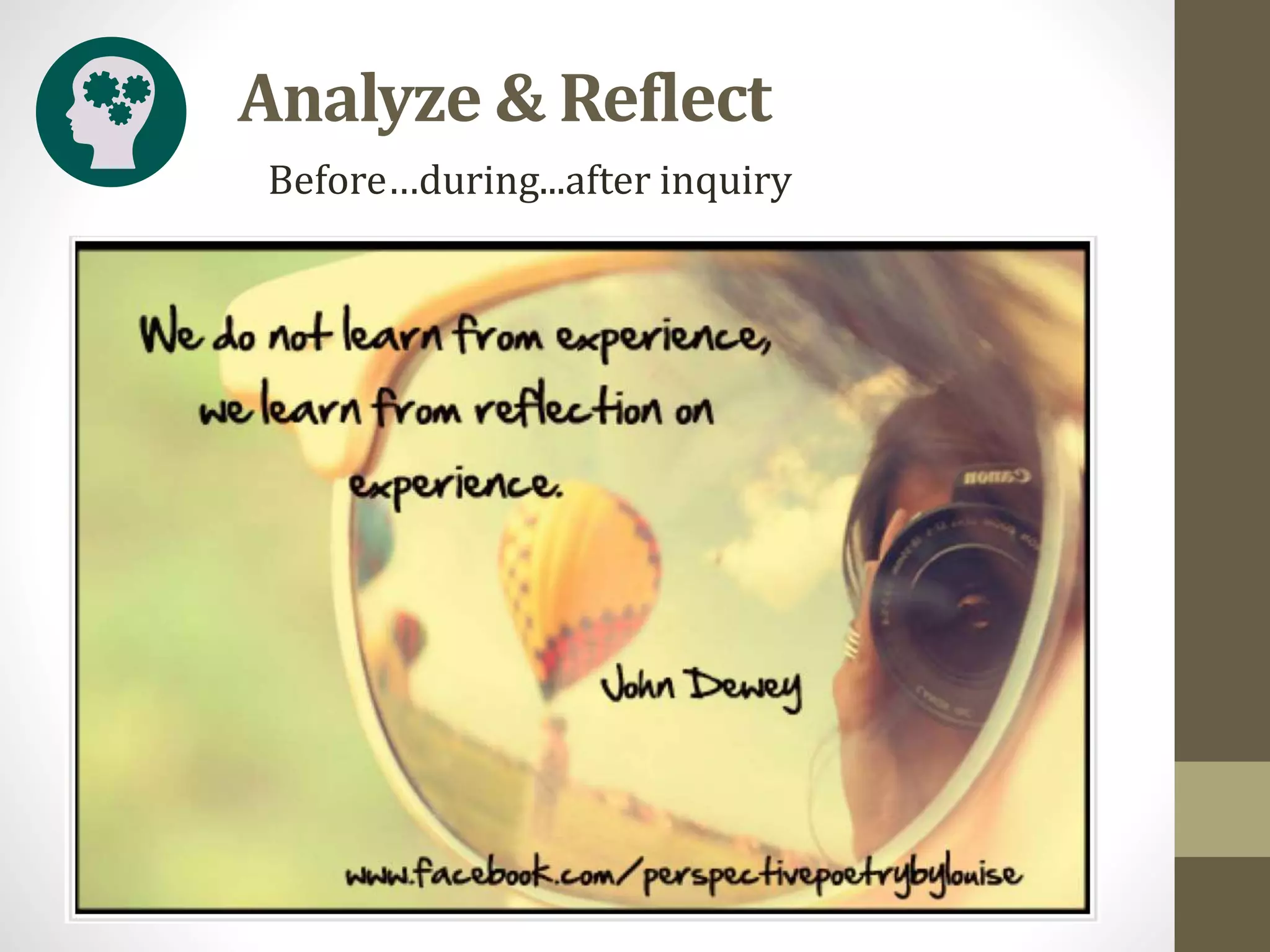
Before…during...after inquiry
Analyze & Reflect
Building conceptual understanding
Analyze & Reflect
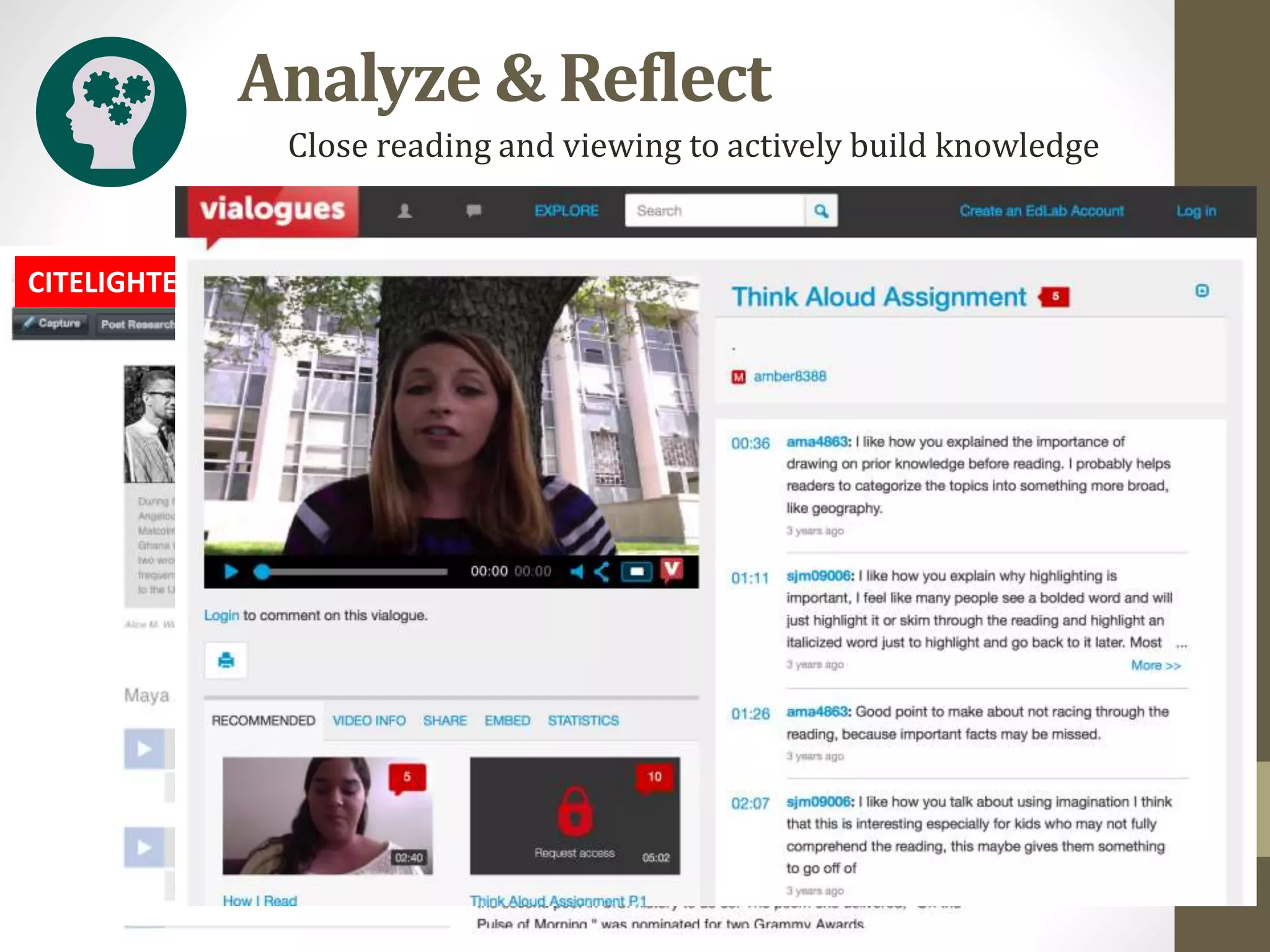
CITELIGHTER:
Close reading and viewing to actively build knowledge
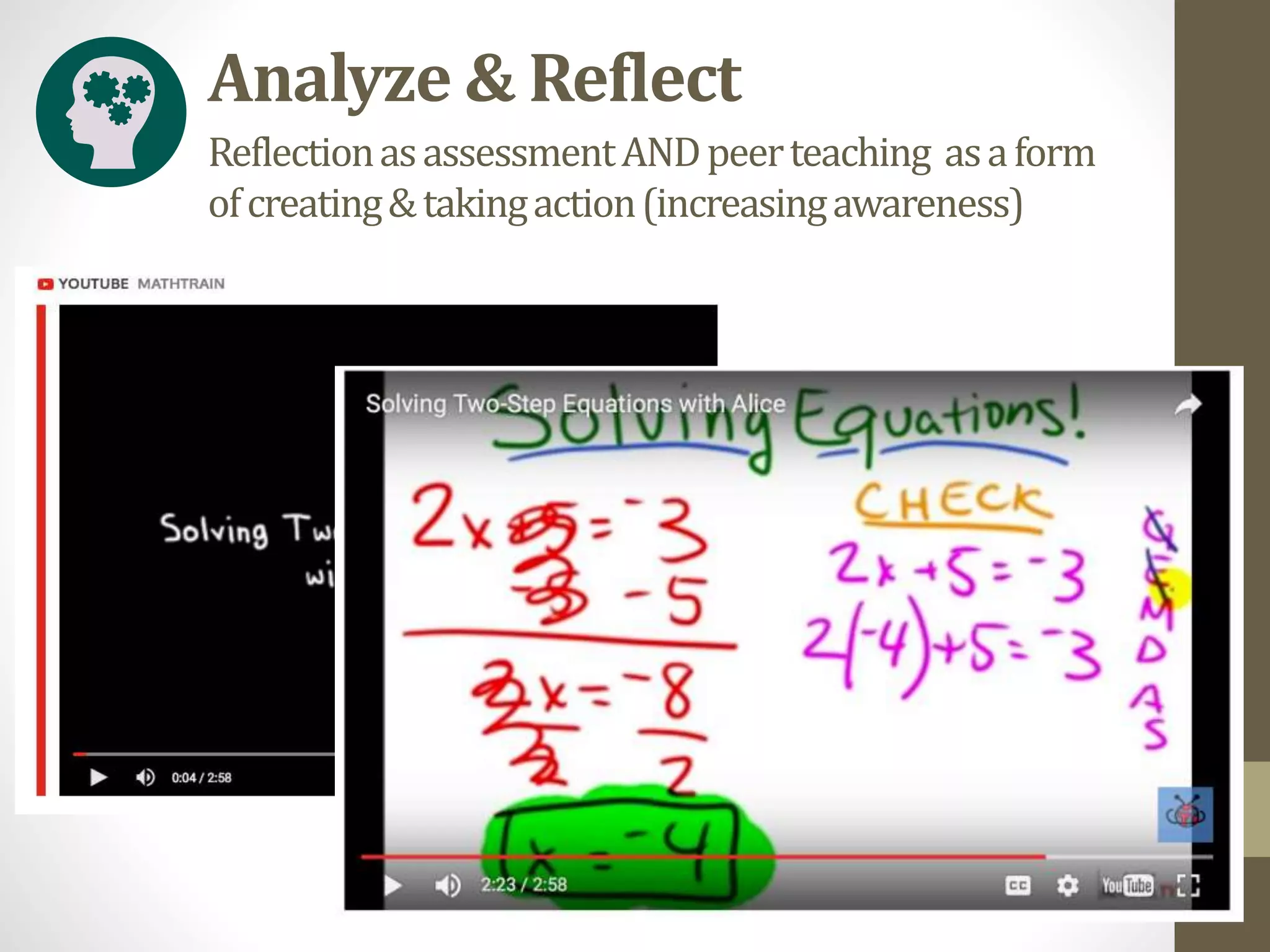
ReflectionasassessmentANDpeerteaching asaform
ofcreating&takingaction(increasingawareness)
Analyze & Reflect
What decisions informed your design of your Wonder Project?
Analyze & Reflect
Analyze & Reflect
What’s important to you?
(student agency, sense of belonging & personal voice)
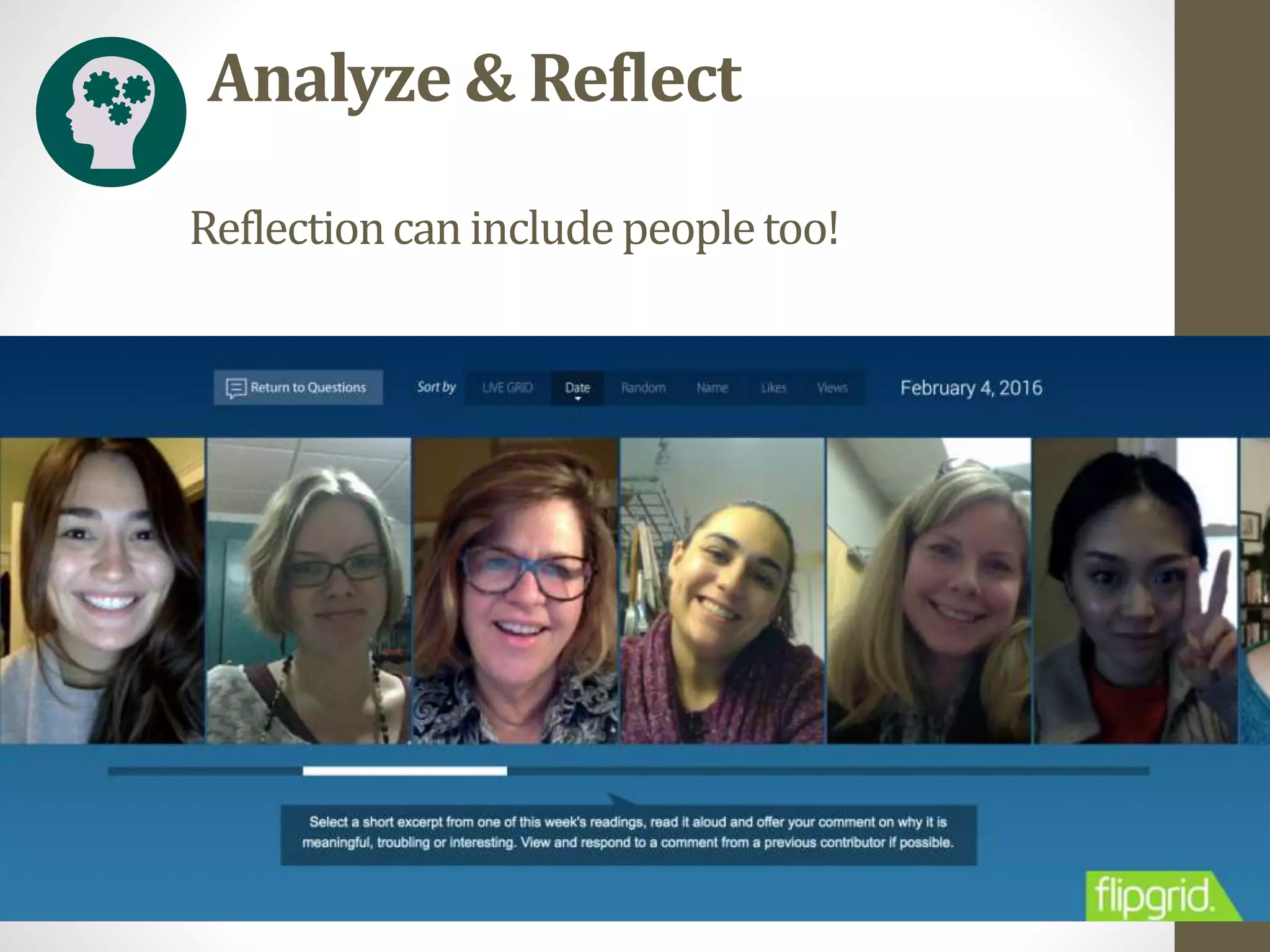
Reflectioncanincludepeopletoo!
Analyze & Reflect
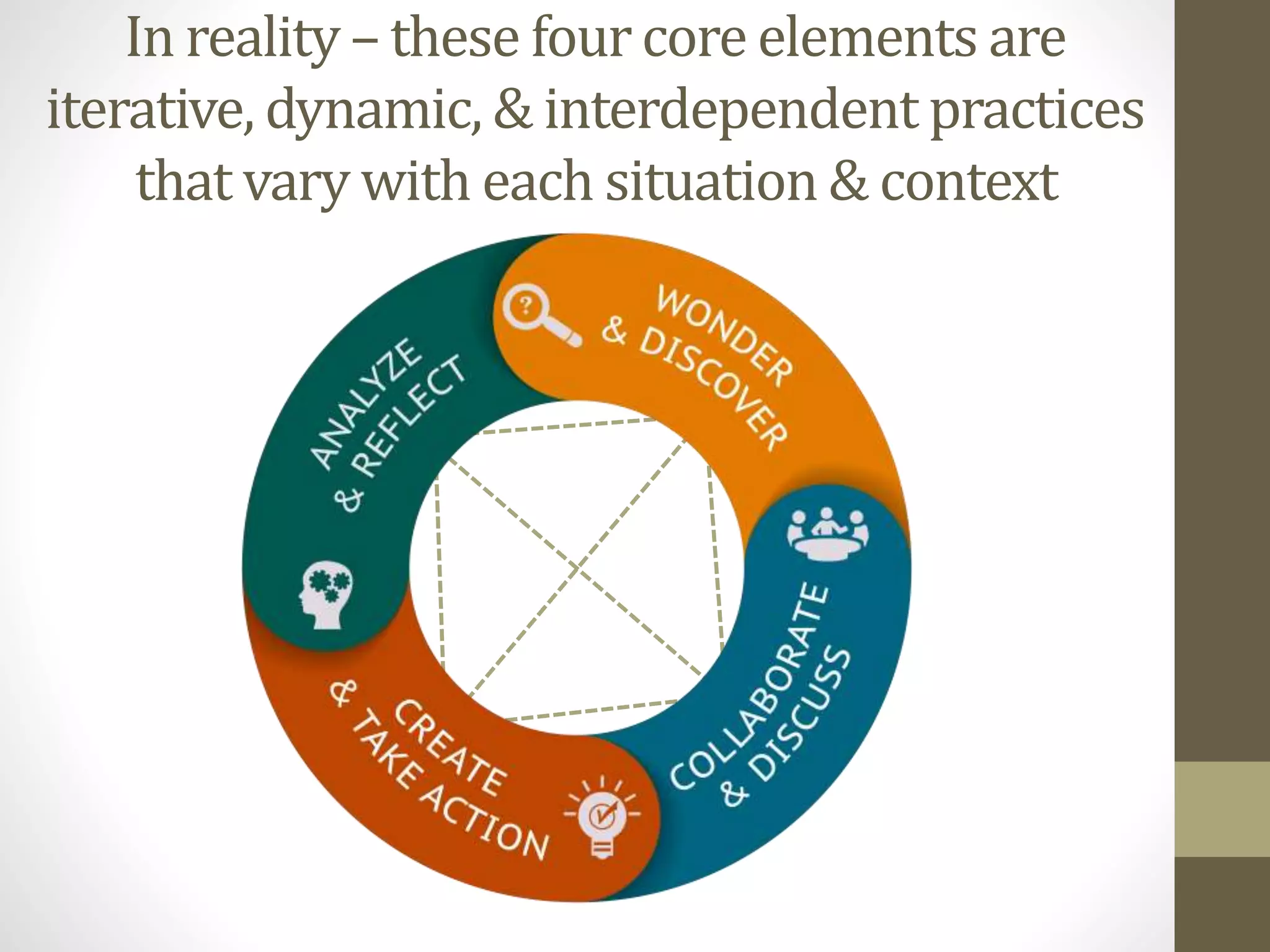
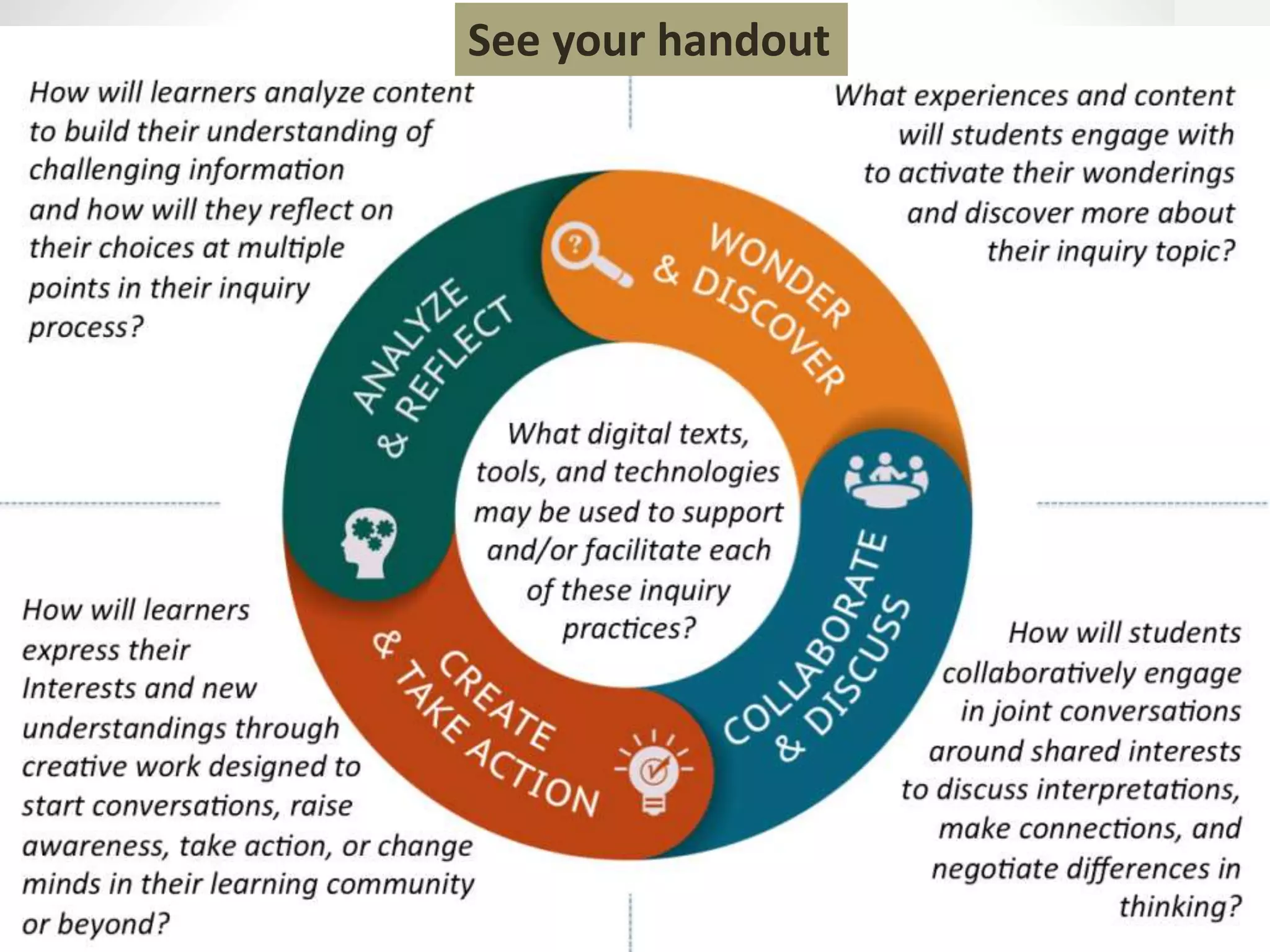
In reality – these four core elements are
iterative, dynamic, & interdependent practices
that vary with each situation & context
1. Set learning
outcomes
2. Create authentic
opportunities for
students to be
actively engaged
3. Then…make
purposeful
choices about
technology (or no
technology)
WONDER &
DISCOVER
COLLABORATE
& DISCUSS
CREATE &
TAKE ACTION
ANALYZE
& REFLECT
Withinthe culture of thosefourinquiry practices,
Knowledge-Based Learning Outcomes
How will studentsuse their knowledge?
Acquire
Knowledge
Students acquire knowledge as a first
step toward knowledge building
Build
Knowledge
Students build their content &
process knowledge
Express
Knowledge
Students express/share convergent or
divergent understanding of content
Act on
Knowledge
Students translate knowledge into
action for real-world purpose
Assess
Knowledge
Students publicly or privately discuss
what they brought to the content and
what ideas they constructed
Adapted from Harris & Hofer (2009)
Student-Centered Inquiry Practices
How will studentsactivelyengage with learning
outcomes acrossdifferent stages of inquiry?
Wonder &
Discover
Generate personal wonderings and
discover more about the topic
Collaborate
& Discuss
Co-construct understanding and/or
new knowledge (which type?)
Create &
Take Action
Express knowledge to build awareness
and/or make positive changes
Analyze &
Reflect
Analyze content and reflect on action
during and/or after
Adapted from Coiro, Castek, & Quinn (2016)
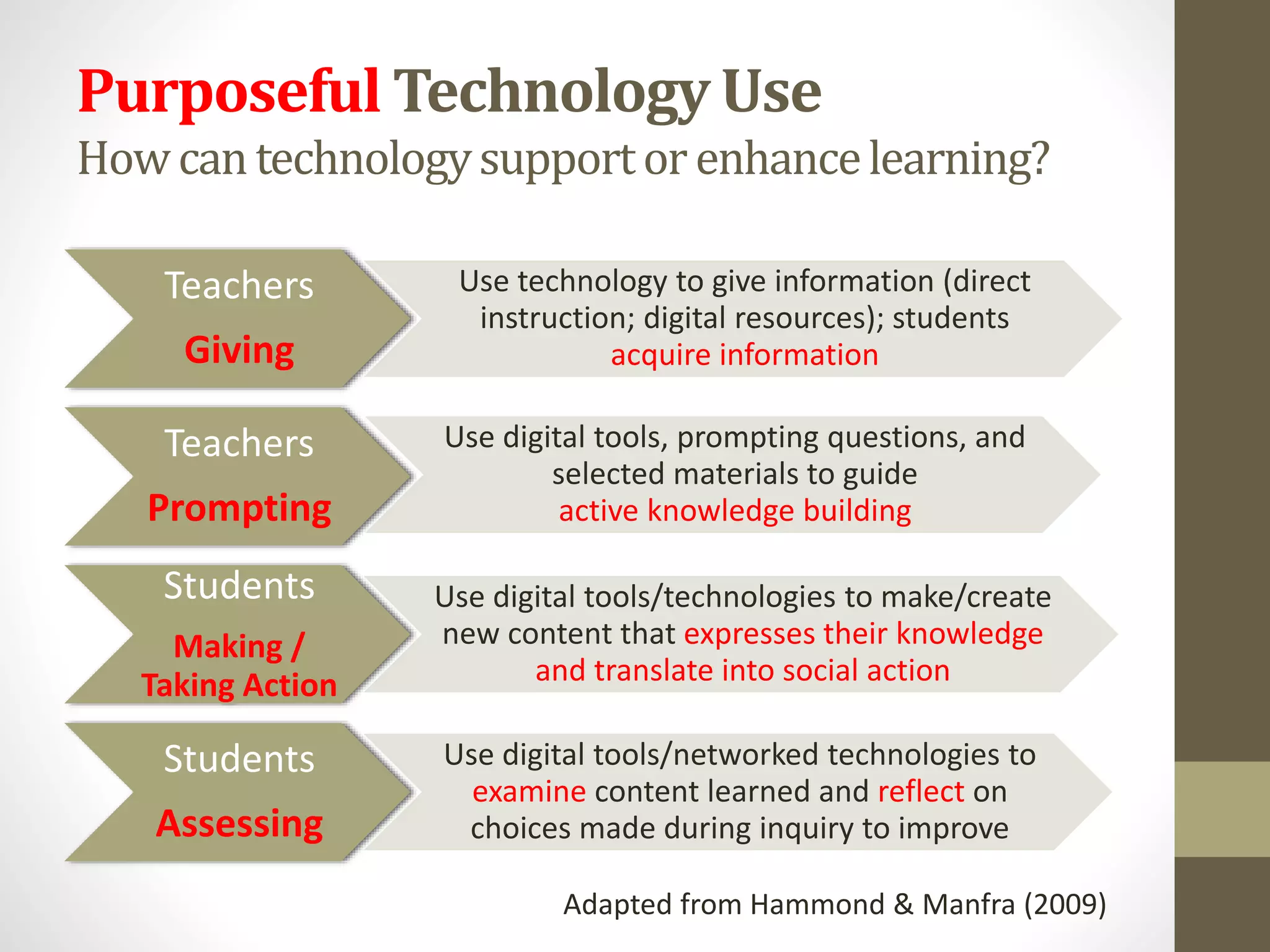
Purposeful Technology Use
Howcantechnologysupportorenhancelearning?
Teachers
Giving
Use technology to give information (direct
instruction; digital resources); students
acquire information
Teachers
Prompting
Use digital tools, prompting questions, and
selected materials to guide
active knowledge building
Students
Making /
Taking Action
Use digital tools/technologies to make/create
new content that expresses their knowledge
and translate into social action
Students
Assessing
Use digital tools/networked technologies to
examine content learned and reflect on
choices made during inquiry to improve
Adapted from Hammond & Manfra (2009)
VariedPurposesfor Using Technologyto
Support DigitalInquiry
Knowledge-Based Learning
Outcome (adapted from
Harris & Hofer, 2009)
Curricular-Related Purposes of
Technology Use (adapted from
Hammond & Manfra 2009)
Acquire Knowledge Teachers Giving
Build Knowledge Teachers Prompting
Express Knowledge Students Making
Assess Knowledge Students Reflecting
 DEPENDING ON THE CONTEXT & PURPOSE, choices in
inquiry-based learning can move from teachers using
technology for giving information and prompting deeper
thinking toward students actively using technology to make
and reflect on new content
Wonder &
Discover
Create &
Take Action
Analyze &
Reflect
Collaborate
& Discuss
Personal Digital Inquiry (PDI) involves
designing opportunities for….
TEACHER
DIRECTED
INQUIRY
STUDENT
DIRECTED
INQUIRY
Modeled
Inquiry
Guided
Inquiry
Open
Inquir
y
Structured
Inquiry
Technology for Knowledge Expression
Giving
Prompting
Making
Assessing
Technology for Knowledge Building
and making choices about…
PersonalDigitalInquiry Planning Guide
Learning Outcomes Student-Centered Inquiry
Practices
(modeled > prompted >
guided > open)
Purposes of
Technology Use for
Teaching and/or
Learning
Curricular/Knowledge
Type:
(subject-specific or
multidisciplinary)
Participatory: (join
partners, start
conversations, raise
awareness, take action,
change minds)
Wonder & Discover:
Collaborate & Discuss:
Create & Take Action:
Analyze & Reflect:
Giving:
Prompting:
Making:
Assessing:
 Useful for building curriculum-based models of how personal
inquiry, online research, and digital tools can connect and engage
learners in ways that matter
1 2 3> >
To help you visualize core elements of your inquiry
project before you create all of the details…
• What are the key learning and participatory outcomes?
• How will your students actively engage in each of the
four sets of inquiry practices to accomplish these
outcomes?
• What level(s) of support will you provide during their
inquiry? (model > structure > guide > open)
• Which digital texts and tools might work best to support
learners and increase their personal engagement?
• What questions remain to guide the next steps of your
own inquiry during the week?
PersonalDigitalInquiry Planning Guide
Some examples
(see Monday Keynote on wiki to
explore more carefully)
STRUCTURED INQUIRY GRADE 1: THE PLANT CYCLE
GUIDED INQUIRY GRADE 4: THE HUMAN BODY
Reflecting on learning products
(AmberWhite,TheReadingTeacher,2015)
Highlighting to clarify misunderstandings
GUIDED INQUIRY GRADE 4
Reflecting on reading & analysis strategies
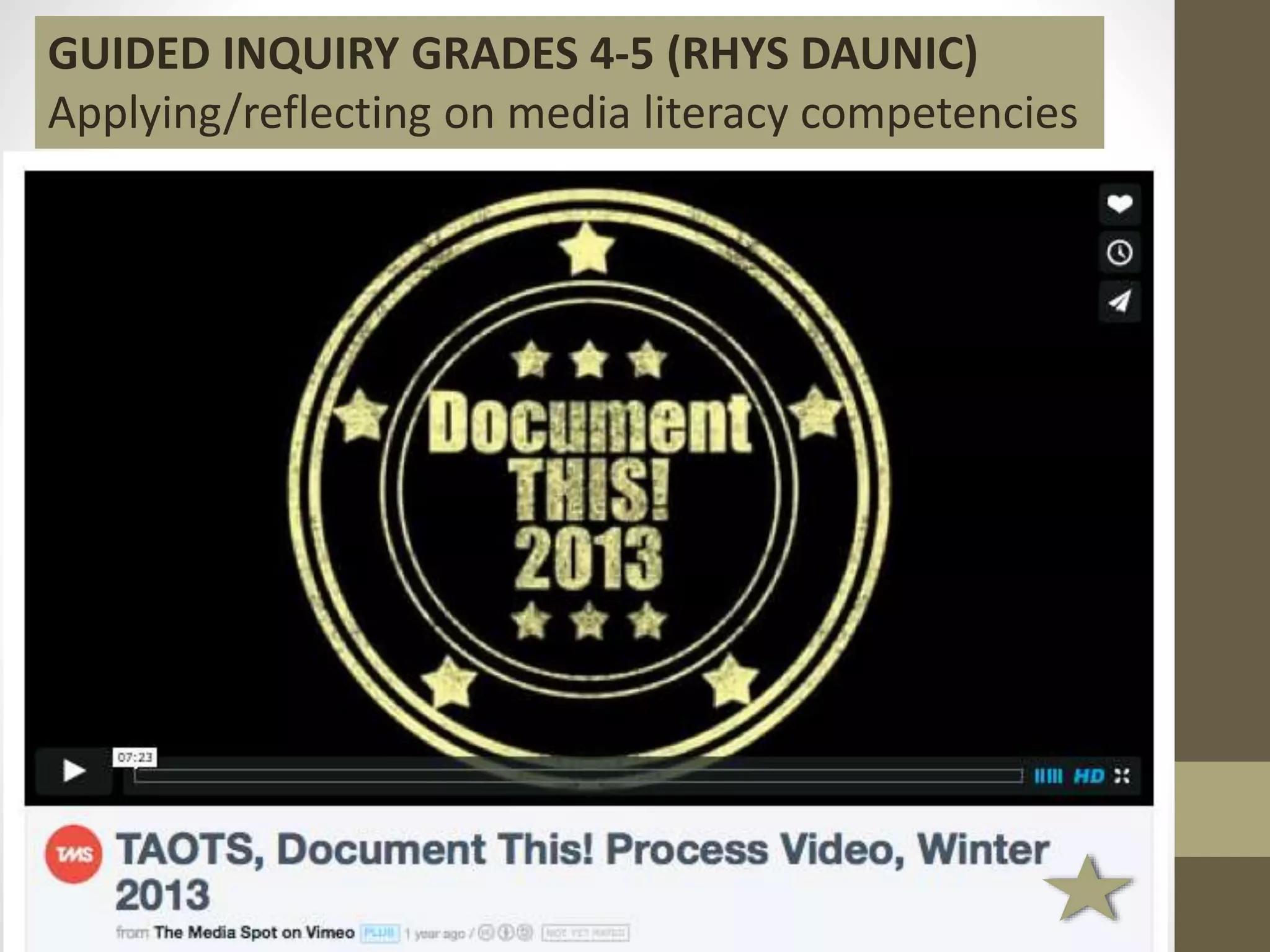
GUIDED INQUIRY GRADES 4-5 (RHYS DAUNIC)
Applying/reflecting on media literacy competencies
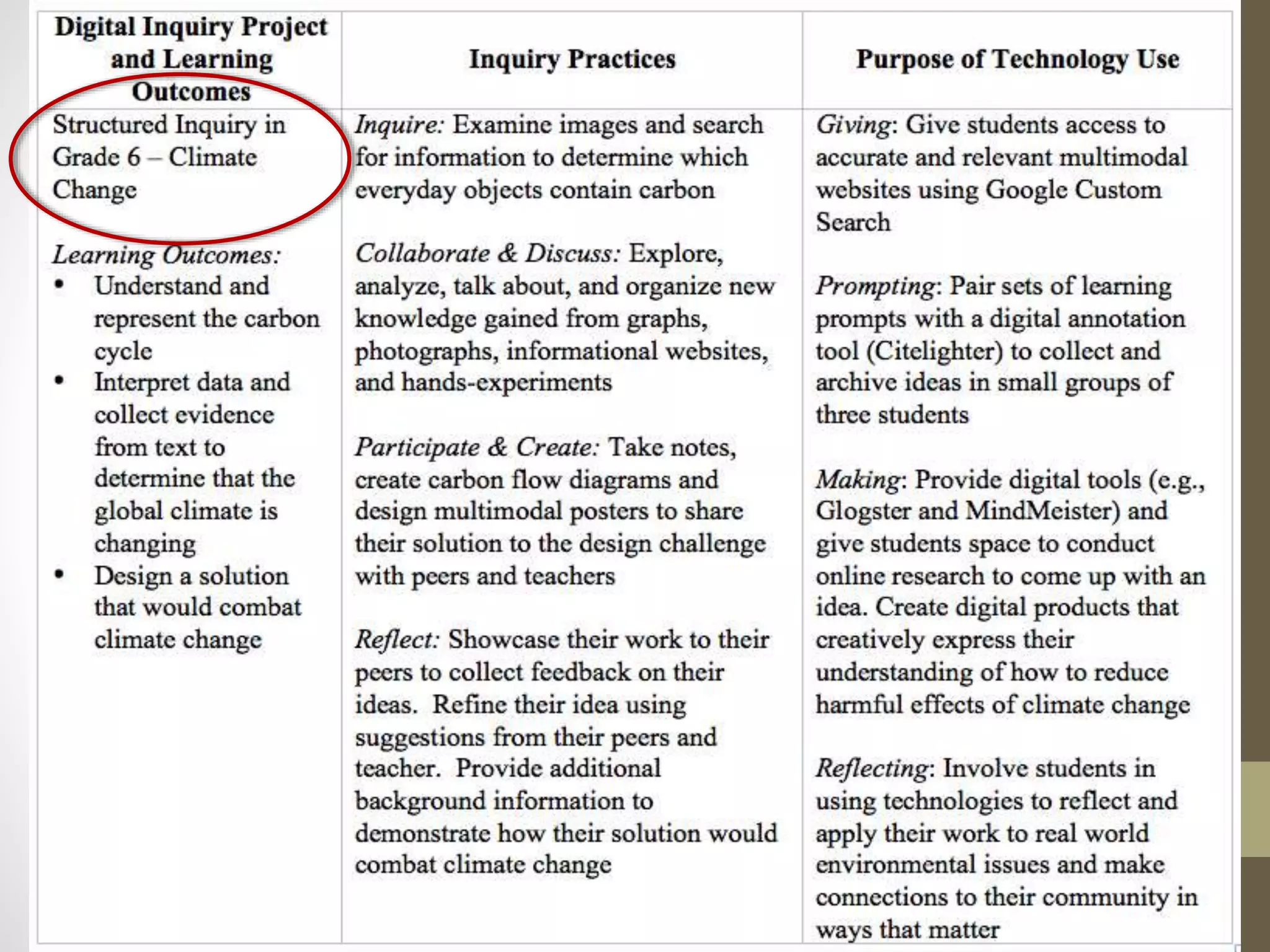
STRUCTURED INQUIRY GRADE 6: Climate Change
Creating/Taking Action with Glogster Design Challenge
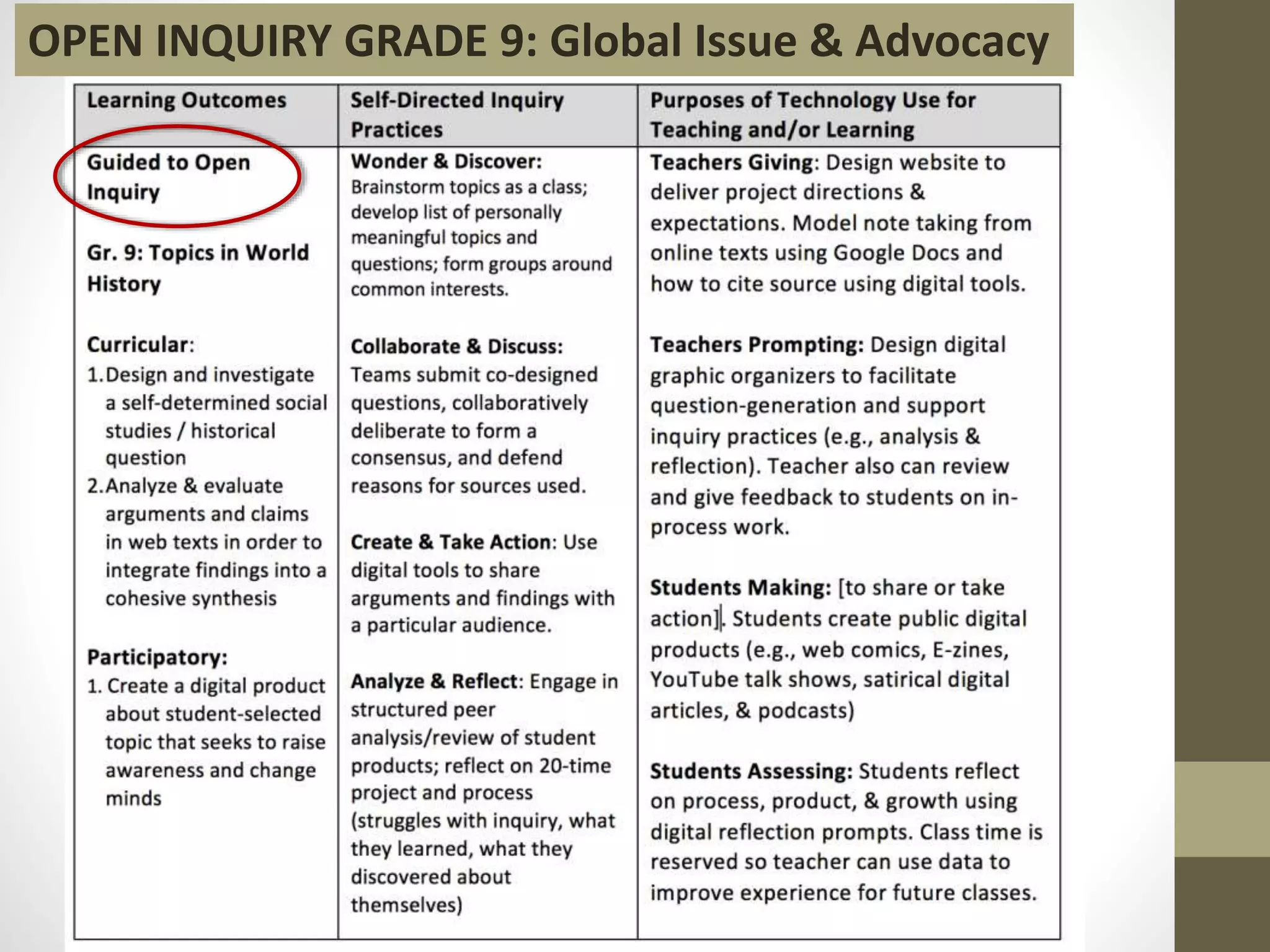
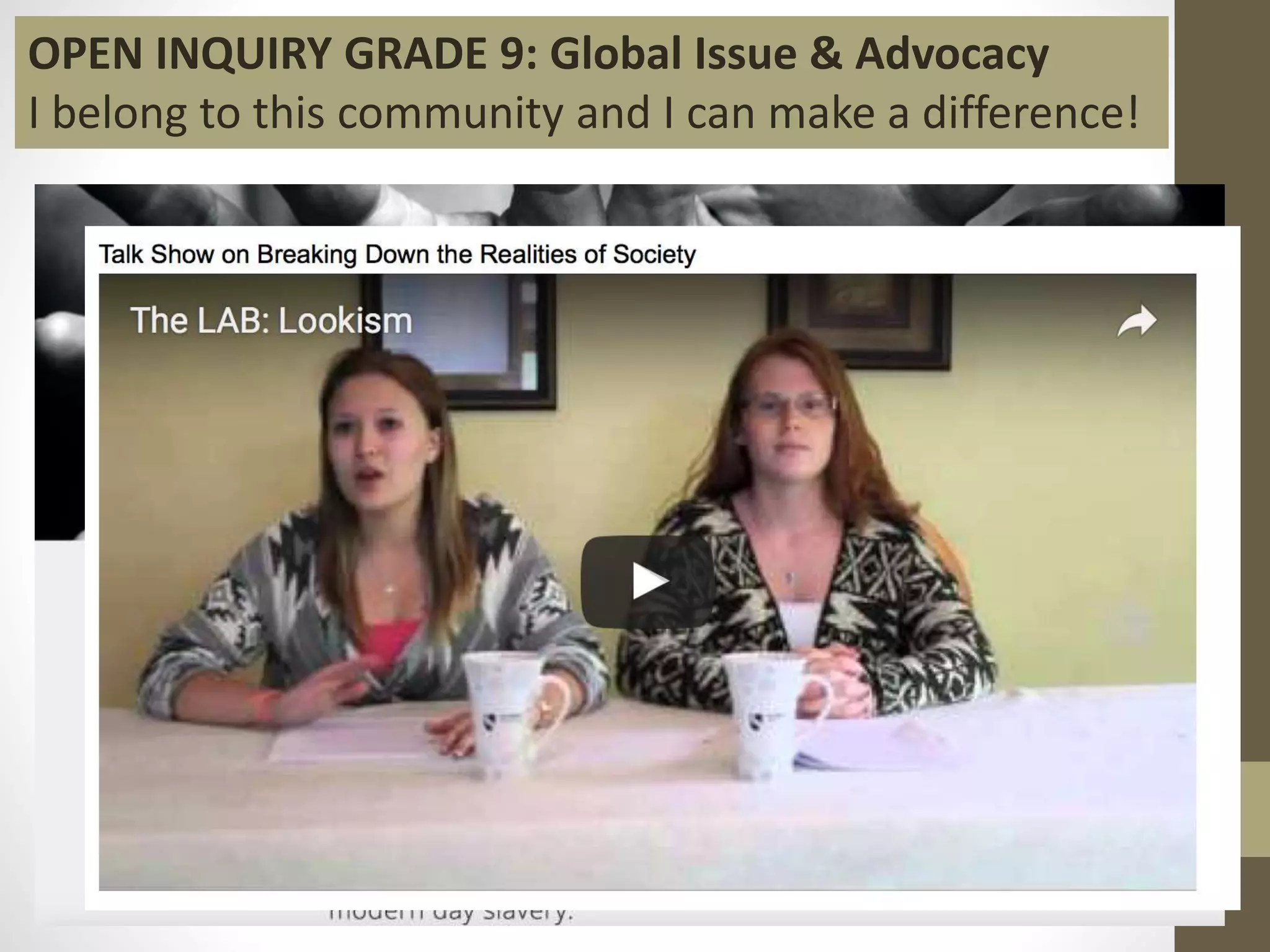
OPEN INQUIRY GRADE 9: Global Issue & Advocacy
I belong to this community and I can make a difference!
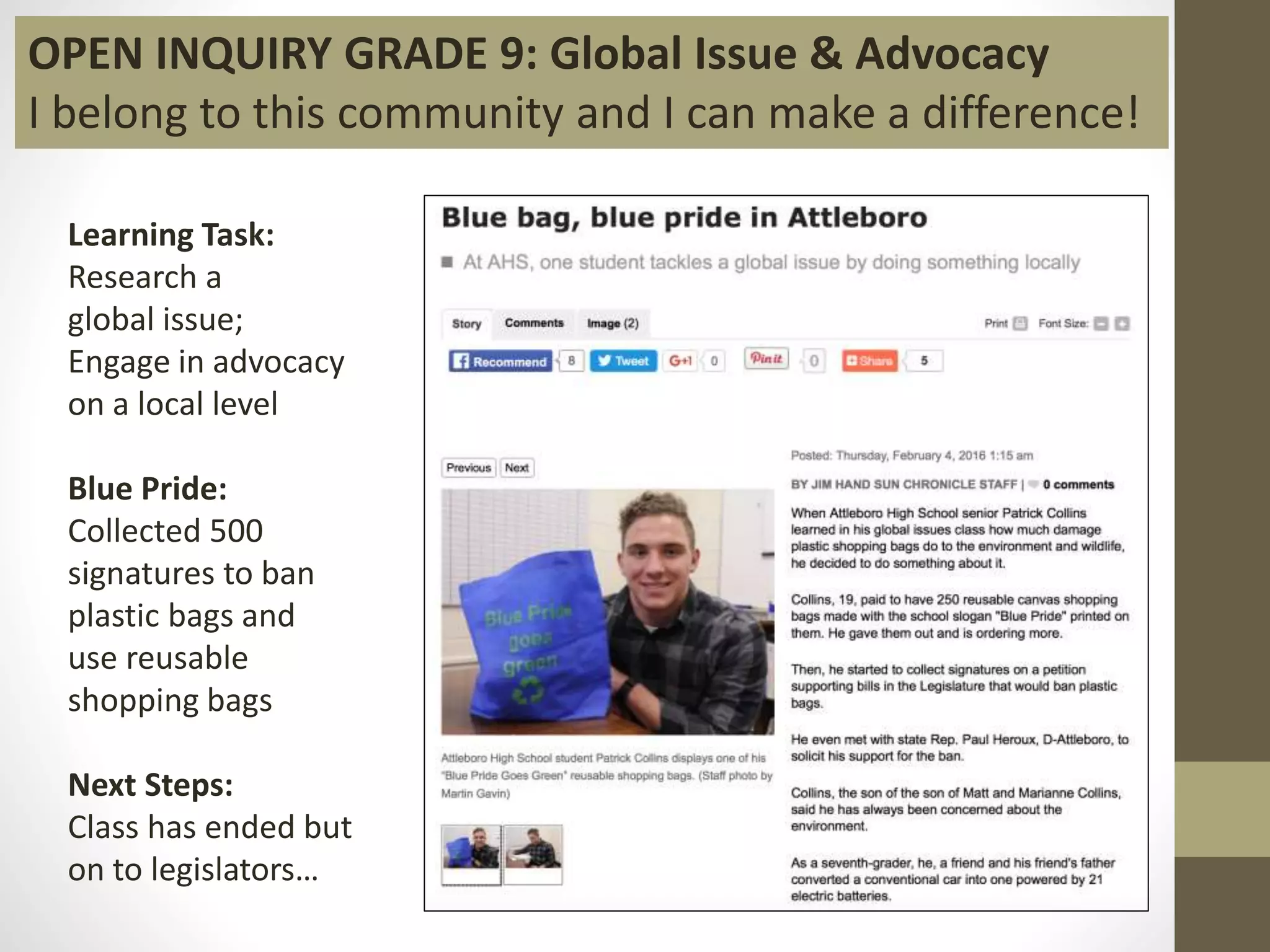
Learning Task:
Research a
global issue;
Engage in advocacy
on a local level
Blue Pride:
Collected 500
signatures to ban
plastic bags and
use reusable
shopping bags
Next Steps:
Class has ended but
on to legislators…
OPEN INQUIRY GRADE 9: Global Issue & Advocacy
I belong to this community and I can make a difference!
In Summary
• The Personal Digital Inquiry (PDI) Framework
and Planning Guide can serve as a springboard to
inspire ideas for engaging learners in the full range of
digital inquiry practices while intentionally planning for
how students use technology to acquire, build, express, and
assess the knowledge gained during their inquiry.
Learning
Outcomes
Self-Directed Inquiry
Practices
Purposes of Technology
Use for Teaching and/or
Learning
Curricular:
Participatory:
Wonder & Discover:
Collaborate & Discuss:
Create & Take Action:
Analyze & Reflect:
Giving:
Prompting:
Making:
Assessing:
Possibilities: Using Inquiry and Technology
to Enhance Wondering, Discussion,
Creation & Reflection in Kindergarten
Two minute stretch & gab…
1
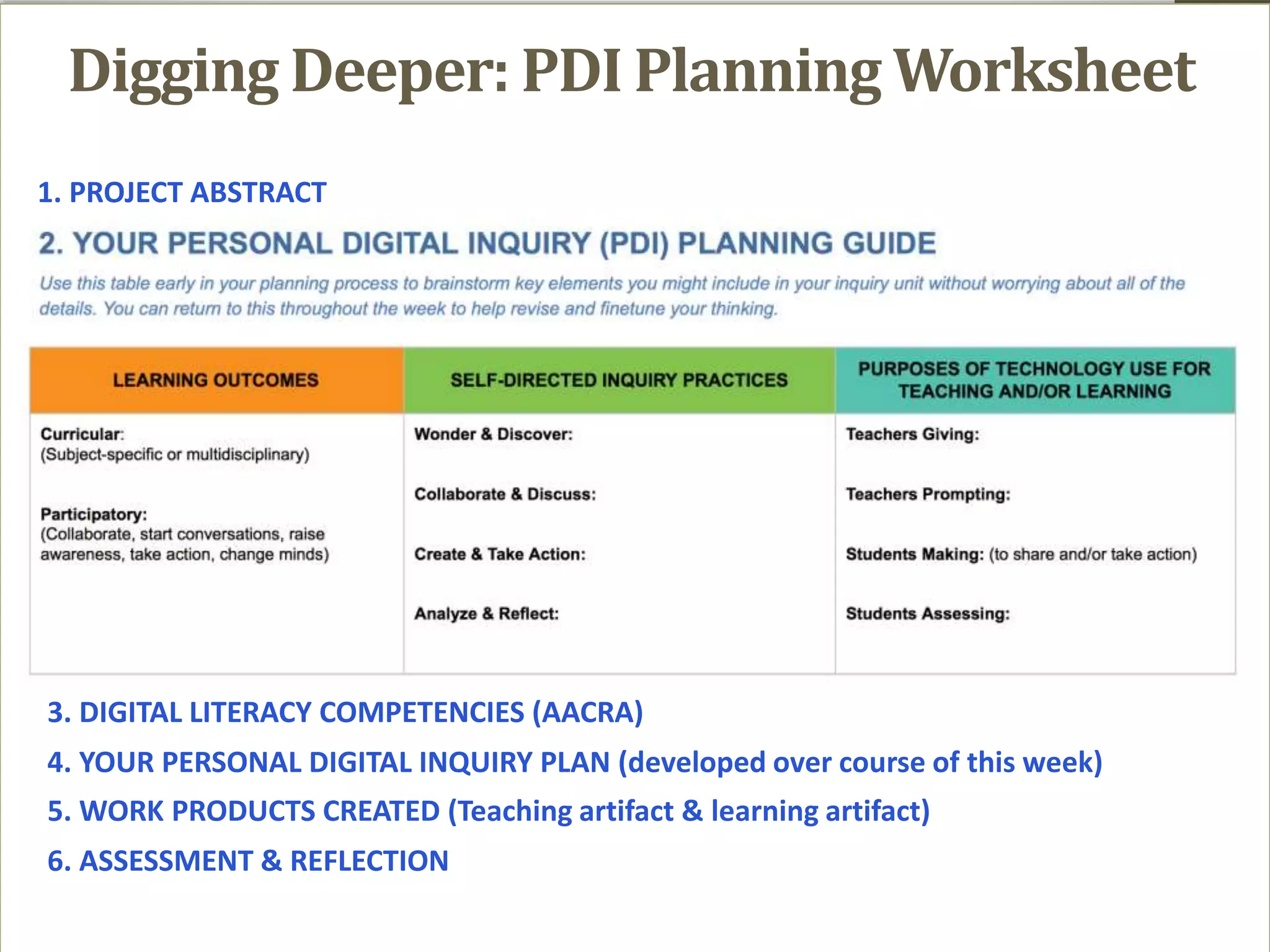
Digging Deeper: PDI Planning Worksheet
1. PROJECT ABSTRACT
3. DIGITAL LITERACY COMPETENCIES (AACRA)
4. YOUR PERSONAL DIGITAL INQUIRY PLAN (developed over course of this week)
5. WORK PRODUCTS CREATED (Teaching artifact & learning artifact)
6. ASSESSMENT & REFLECTION
ToaccessthePDI
worksheettemplate:
(onceyou have formed
your dyad)
See your handout
See your handout
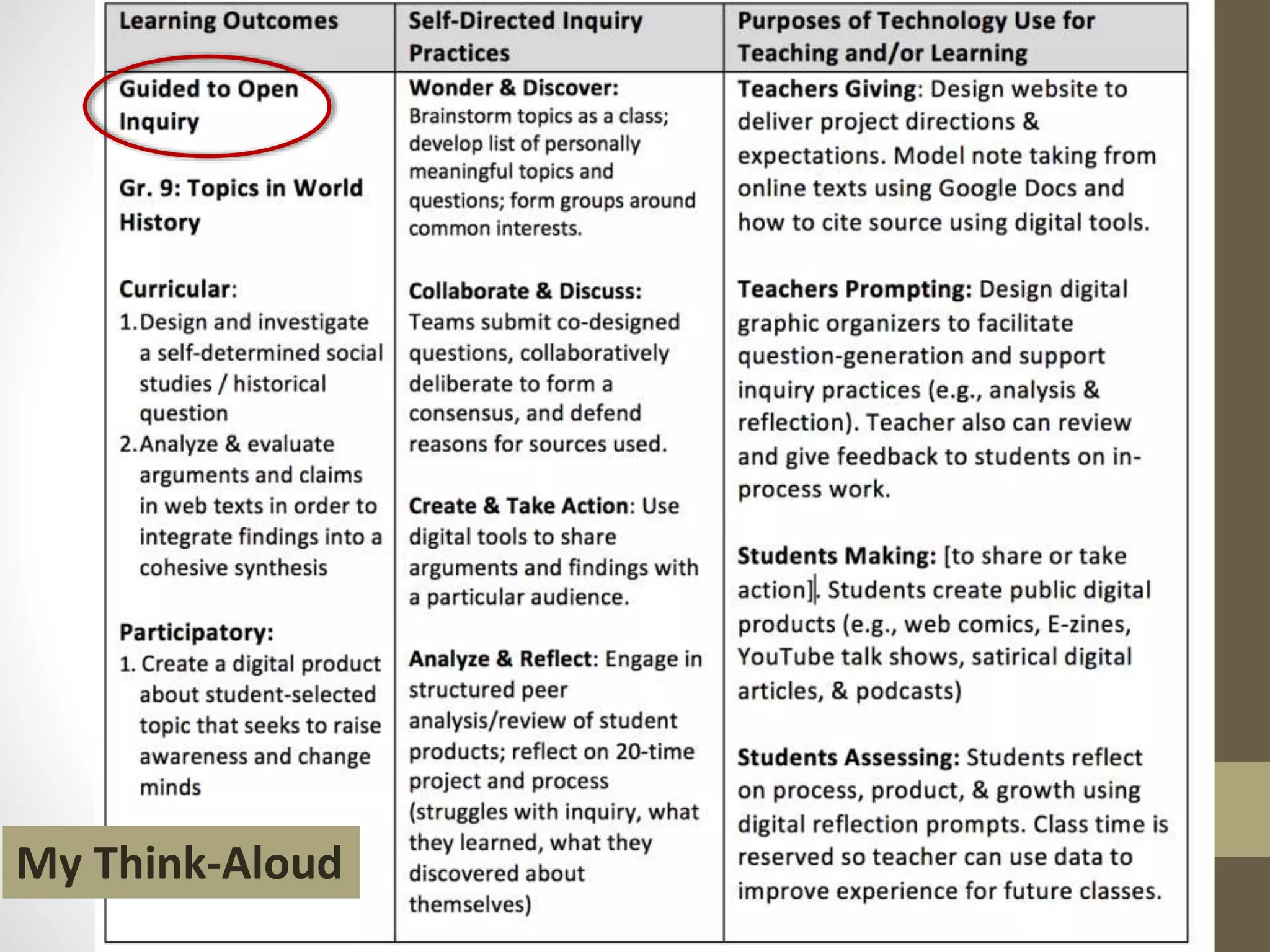
My Think-Aloud
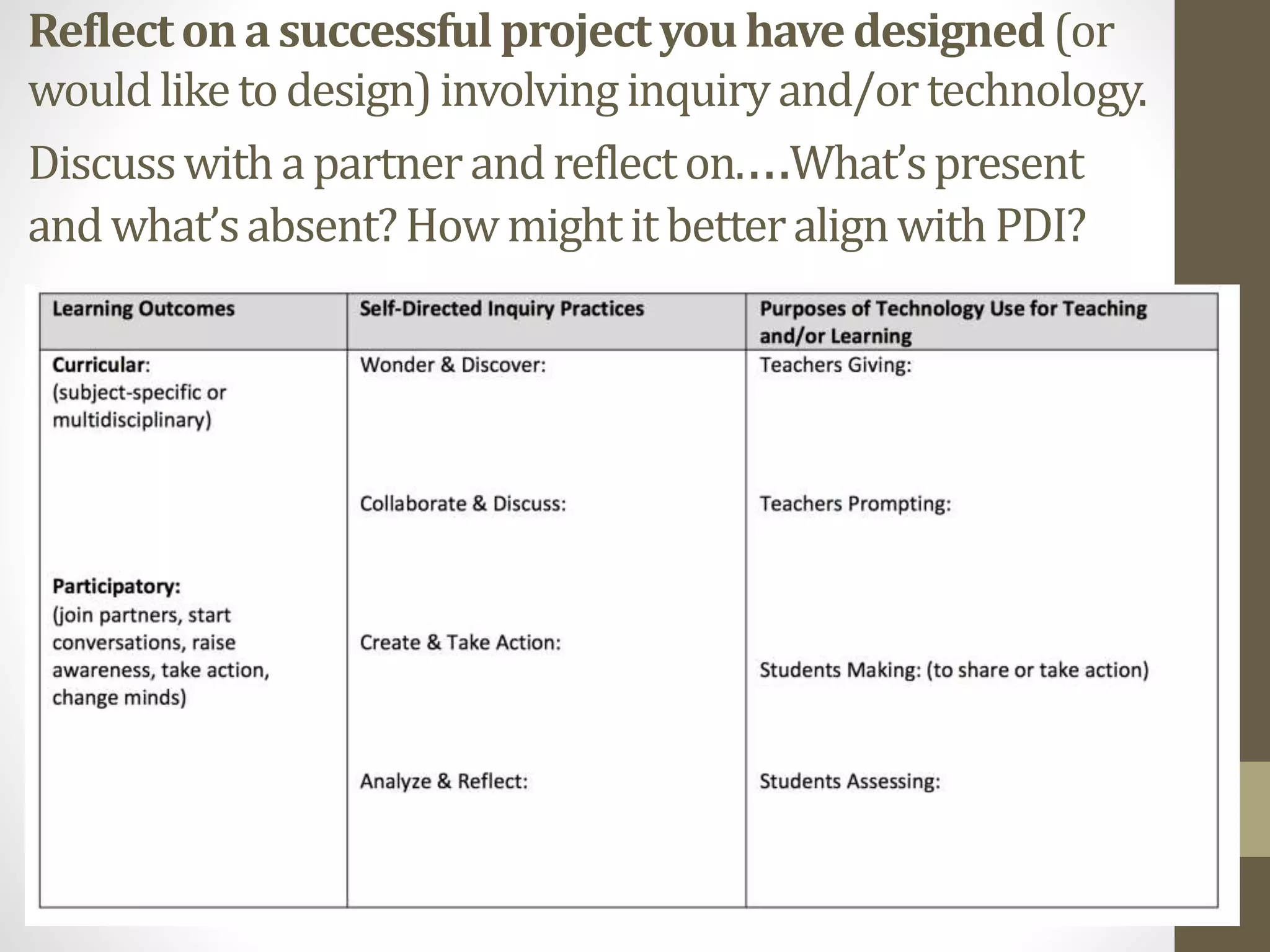
Reflectonasuccessfulprojectyou havedesigned(or
wouldliketodesign)involving inquiryand/ortechnology.
Discusswithapartnerandreflecton.…What’spresent
andwhat’sabsent?HowmightitbetteralignwithPDI?
Yourtaskthis week: Whatmight acultureofpersonal
digitalinquirylooklikeinYOURworkcontext?
PersonalInquiryand
OnlineResearch:
ConnectingLearners
inWaysThatMatter
Julie Coiro, PhD
School of Education
University of Rhode Island
jcoiro@uri.edu
uri.academia.edu/JulieCoiro/Papers
Monday Keynote (on wiki)
Design Studio Process
Digital Literacy Competencies
Building a Culture of Inquiry Practices
Planning for Personal Digital Inquiry
Design Studio Products

Personal digital inquiry slides 2016 keynote final

  • 1.
    Welcome to theSummer Institute in Digital Literacy “Education is not the filling of a bucket…but the lighting of a fire.” ~ W.B. Yeats
  • 2.
    What is digitalliteracy?
  • 3.
    I define digitalliteracyas having the skills,strategies,and dispositions to use the Internet productively to: • Generate useful questions to solve problems • Locate information • Critically evaluate information • Synthesize information • Communicate answers/solutions Leu, Kinzer, Coiro, Castek & Henry (2013). New literacies: A dual-level theory of the changing nature of literacy, instruction, and assessment. Theoretical Models and Processes of Reading, Sixth Edition.
  • 4.
    Others define digitalliteracy in slightly different ways Doug Belshaw Civic-minded citizens able to… generate their own questions; listen in order to understand; actively co-create their learning community; critically analyze and reflect on their practices Chris Lehmann Renee Hobbs Michael Eisenberg
  • 5.
    Often, these varieddefinitions reflect our varied roles in teaching and learning Technology Specialists Librarians and Library Media Specialists Community Media Makers Researchers & College Professors Classroom Teachers
  • 6.
    But…we have muchin common (in addition to special areas of expertise)! Classroom Teachers Community Media Makers Librarians and Library Media Specialists Researchers & College Professors Technology Specialists
  • 7.
    Turn and Talk(5 minutes) • Introduce yourself and identify your role/work context • What does digital literacy mean to you? • Identify a similarity and a difference compared to your partner’s definition. Is there enough in common to support each other in designing productive learning experiences? How might you capitalize on your individual areas of expertise?
  • 8.
    The Only ToolsYou Really Need “A camera and the openness for questions. From there, it’s hard to imagine anything standing in the way of learning.” ~ Chris Lehmann (Wed. Keynote Speaker)
  • 9.
    PersonalInquiryand OnlineResearch: ConnectingLearners inWaysThatMatter Julie Coiro, PhD Schoolof Education University of Rhode Island jcoiro@uri.edu uri.academia.edu/JulieCoiro/Papers Monday Keynote (on wiki)
  • 10.
    Personal vs. Personalized: What’sthe differencewhenit comesto studentdirected learning? • “Personalized” is about a top-down designed or tailored approach to learning; customized for the student, but still controlled by the teacher (serve up learning based on a formula of what a child needs) • “Personal” is something human where the learner initiates and controls parts or all of the learning process; often emerges from engagement with others about one’s personal wonderings. True personal learning: It’s all about who is doing it!
  • 11.
    Where (and how)does STUDENT-DRIVEN INQUIRY fit into digital literacy? • Quick context setting: Engaging Today’s Learners • What is important to consider when designing opportunities for personal (student-driven) inquiry? • What role does the teacher play in the inquiry process? • How can we choose technologies that can be used in meaningful ways as part of the inquiry process? • What does Personal Digital Inquiry look like in classrooms across different grade levels? • It sits at the core of everything!
  • 12.
    The Challenge:Connecting LearnersinWays That Matter Gallup Poll (2012) - 500,000 US students, Gr. 5-12 Students’ Sense of Belonging (2003 - 2012) Move beyond industrial model of universal school toward new era focused on lifelong learning and individual choice – or lose learners emotionally & physically (Collins & Halverson, 2009: Rethinking Education in the Age of Technology)
  • 13.
    • If weengage learners with rigorous academic content and expect them to know why, when, and how to apply knowledge to answer questions & solve problems (National Research Council, 2012) • We can “lessen the achievement gap in ways that lead to positive adult outcomes for more young people” • High school students engaged in deep, relevant, and personal (student-driven) learning opportunities: • Demonstrated higher levels of interpersonal and intrapersonal skills (American Institutes for Research, 2014) • Achieved better outcomes in every aspect of life, including academic, career, civic, and health (Center for Public Education, 2009) Optimistic Findings
  • 14.
    Sohowcanweusetechnology(and goodteaching)to designpersonal,student directedspacesforlearning? (JulieCoiro,JillCastek,&DavidQuinn,2016,TheReadingTeacher) This appliesto how we design the Institute experience in ways that model and engage you in the same practices we hope you will apply to your own projects.
  • 15.
    Choosing technology: What’sthe coolest new tool you’ve seen? Hey, that’s cool! 1. How could I use that?2. Hmmm…how might this connect with what I teach? 3.
  • 16.
    Choosing technology: What’sthe coolest new tool you’ve seen? Hey, that’s cool! 1. How could I use that?2. Hmmm…how might this connect with what I teach? 3.Turn and talk some more…
  • 17.
    Are we askingthe right questions? Hey, that’s cool! 1. How could I use that?2. Hmmm…how might this connect with what I teach? 3. But how? Which parts and why? For whom? In which contexts? How will your students actively engaged with this tool? To what end? What will your students know, understand, and be able to do before/during/after using this tool?
  • 18.
    Afterexploringdigitaltexts & tools,whatifwe refocusandflipthe sequenceof our planning questionsfor teachingwith technology? 1 2 3 What will my students know, understand, and be able to do? How will my students be actively engaged and to what end? Which digital tool(s) would work best and in what ways? 1. Set learning outcomes 2. Create authentic opportunities for students to be actively engaged 3. Then…make purposeful choices about technology (or no technology) 1. Hey that tool is cool! 2. How could I use that? 3. (maybe) How might this connect with what I teach? RATHER THAN…
  • 19.
    A critical pieceis classroom culture… A classroom culture that values curiosity and honors student voices while encouraging choice, collaboration, problem solving, risk taking, and reflection. Buildingacultureofinquiryiskey! (BEFOREtechnologycanplay aneffectiverole)
  • 20.
    1. Set learning outcomes 2.Create authentic opportunities for students to be actively engaged 3. Then…make purposeful choices about technology (or no technology) trust and respect risk-taking problem-solving collaboration
  • 21.
    Learning is social andpart of a mutually constructive process that involves face-to-face talk. What might a culture of inquiry feel like in a digitalage? (Foursetsofunderlyingcorepractices) Generating questions and lived experiences with real issues are personally fulfilling; Inquiry can happen on several levels. Creative learners make personal connections and take action to build awareness and/or foster change. “I can make a difference.” True inquiry leads to critical analysis, self-monitoring and more questions. PersonalDigitalInquiry(PDI)Framework
  • 22.
  • 23.
    VariedLevels of [Digital]Inquiry •Modeled inquiry: Students observe models of how the leader asks questions and makes decisions. • Structured Inquiry: Students make choices which are dependent upon guidelines and structure given by the leader (may vary). • Guided Inquiry: Students make choices during inquiry that lead to deeper understanding guided by some structure given by the leader. • Open Inquiry: Students make all of the decisions. There is little to no guidance. Alberta Inquiry Model of Inquiry Based Learning (2004)
  • 24.
    Shaping your owninquiries this week. Fertile questions are… • Open: There are several different or competing answers. • Undermining: Makes learners question their basic assumptions. • Rich: Can only be answered with careful and lengthy research; usually able to break into sub-questions. • Connected: relevant to the learners • Charged: has an ethical dimension • Practical: is able to be researched given available time and resources ~ Harpez & Lefstein (2000) Communities of Thinking
  • 25.
    Social Practices: Request& give information; jointly acknowledge, evaluate, & build on partner’s contributions Cognitive Strategies: Read, question, monitor, repair, infer, connect, clarify, and interpret Collaborate & Discuss
  • 26.
    ReneeHobbs(2013) The Life OfA Homeless Person (after a photo walk Discovery) Discussion… Research…. Composition… Revision… 10 page Comic book Create& Take Action
  • 27.
  • 28.
    Analyze & Reflect Buildingconceptual understanding
  • 29.
    Analyze & Reflect CITELIGHTER: Closereading and viewing to actively build knowledge
  • 30.
  • 31.
    What decisions informedyour design of your Wonder Project? Analyze & Reflect
  • 32.
    Analyze & Reflect What’simportant to you? (student agency, sense of belonging & personal voice)
  • 33.
  • 34.
    In reality –these four core elements are iterative, dynamic, & interdependent practices that vary with each situation & context
  • 35.
    1. Set learning outcomes 2.Create authentic opportunities for students to be actively engaged 3. Then…make purposeful choices about technology (or no technology) WONDER & DISCOVER COLLABORATE & DISCUSS CREATE & TAKE ACTION ANALYZE & REFLECT Withinthe culture of thosefourinquiry practices,
  • 36.
    Knowledge-Based Learning Outcomes Howwill studentsuse their knowledge? Acquire Knowledge Students acquire knowledge as a first step toward knowledge building Build Knowledge Students build their content & process knowledge Express Knowledge Students express/share convergent or divergent understanding of content Act on Knowledge Students translate knowledge into action for real-world purpose Assess Knowledge Students publicly or privately discuss what they brought to the content and what ideas they constructed Adapted from Harris & Hofer (2009)
  • 37.
    Student-Centered Inquiry Practices Howwill studentsactivelyengage with learning outcomes acrossdifferent stages of inquiry? Wonder & Discover Generate personal wonderings and discover more about the topic Collaborate & Discuss Co-construct understanding and/or new knowledge (which type?) Create & Take Action Express knowledge to build awareness and/or make positive changes Analyze & Reflect Analyze content and reflect on action during and/or after Adapted from Coiro, Castek, & Quinn (2016)
  • 38.
    Purposeful Technology Use Howcantechnologysupportorenhancelearning? Teachers Giving Usetechnology to give information (direct instruction; digital resources); students acquire information Teachers Prompting Use digital tools, prompting questions, and selected materials to guide active knowledge building Students Making / Taking Action Use digital tools/technologies to make/create new content that expresses their knowledge and translate into social action Students Assessing Use digital tools/networked technologies to examine content learned and reflect on choices made during inquiry to improve Adapted from Hammond & Manfra (2009)
  • 39.
    VariedPurposesfor Using Technologyto SupportDigitalInquiry Knowledge-Based Learning Outcome (adapted from Harris & Hofer, 2009) Curricular-Related Purposes of Technology Use (adapted from Hammond & Manfra 2009) Acquire Knowledge Teachers Giving Build Knowledge Teachers Prompting Express Knowledge Students Making Assess Knowledge Students Reflecting  DEPENDING ON THE CONTEXT & PURPOSE, choices in inquiry-based learning can move from teachers using technology for giving information and prompting deeper thinking toward students actively using technology to make and reflect on new content
  • 40.
    Wonder & Discover Create & TakeAction Analyze & Reflect Collaborate & Discuss Personal Digital Inquiry (PDI) involves designing opportunities for…. TEACHER DIRECTED INQUIRY STUDENT DIRECTED INQUIRY Modeled Inquiry Guided Inquiry Open Inquir y Structured Inquiry Technology for Knowledge Expression Giving Prompting Making Assessing Technology for Knowledge Building and making choices about…
  • 41.
    PersonalDigitalInquiry Planning Guide LearningOutcomes Student-Centered Inquiry Practices (modeled > prompted > guided > open) Purposes of Technology Use for Teaching and/or Learning Curricular/Knowledge Type: (subject-specific or multidisciplinary) Participatory: (join partners, start conversations, raise awareness, take action, change minds) Wonder & Discover: Collaborate & Discuss: Create & Take Action: Analyze & Reflect: Giving: Prompting: Making: Assessing:  Useful for building curriculum-based models of how personal inquiry, online research, and digital tools can connect and engage learners in ways that matter 1 2 3> >
  • 42.
    To help youvisualize core elements of your inquiry project before you create all of the details… • What are the key learning and participatory outcomes? • How will your students actively engage in each of the four sets of inquiry practices to accomplish these outcomes? • What level(s) of support will you provide during their inquiry? (model > structure > guide > open) • Which digital texts and tools might work best to support learners and increase their personal engagement? • What questions remain to guide the next steps of your own inquiry during the week? PersonalDigitalInquiry Planning Guide
  • 43.
    Some examples (see MondayKeynote on wiki to explore more carefully)
  • 45.
    STRUCTURED INQUIRY GRADE1: THE PLANT CYCLE
  • 47.
    GUIDED INQUIRY GRADE4: THE HUMAN BODY Reflecting on learning products
  • 48.
    (AmberWhite,TheReadingTeacher,2015) Highlighting to clarifymisunderstandings GUIDED INQUIRY GRADE 4 Reflecting on reading & analysis strategies
  • 50.
    GUIDED INQUIRY GRADES4-5 (RHYS DAUNIC) Applying/reflecting on media literacy competencies
  • 52.
    STRUCTURED INQUIRY GRADE6: Climate Change Creating/Taking Action with Glogster Design Challenge
  • 53.
    OPEN INQUIRY GRADE9: Global Issue & Advocacy
  • 54.
    OPEN INQUIRY GRADE9: Global Issue & Advocacy I belong to this community and I can make a difference!
  • 55.
    Learning Task: Research a globalissue; Engage in advocacy on a local level Blue Pride: Collected 500 signatures to ban plastic bags and use reusable shopping bags Next Steps: Class has ended but on to legislators… OPEN INQUIRY GRADE 9: Global Issue & Advocacy I belong to this community and I can make a difference!
  • 56.
    In Summary • ThePersonal Digital Inquiry (PDI) Framework and Planning Guide can serve as a springboard to inspire ideas for engaging learners in the full range of digital inquiry practices while intentionally planning for how students use technology to acquire, build, express, and assess the knowledge gained during their inquiry. Learning Outcomes Self-Directed Inquiry Practices Purposes of Technology Use for Teaching and/or Learning Curricular: Participatory: Wonder & Discover: Collaborate & Discuss: Create & Take Action: Analyze & Reflect: Giving: Prompting: Making: Assessing:
  • 57.
    Possibilities: Using Inquiryand Technology to Enhance Wondering, Discussion, Creation & Reflection in Kindergarten
  • 58.
  • 59.
    1 Digging Deeper: PDIPlanning Worksheet 1. PROJECT ABSTRACT 3. DIGITAL LITERACY COMPETENCIES (AACRA) 4. YOUR PERSONAL DIGITAL INQUIRY PLAN (developed over course of this week) 5. WORK PRODUCTS CREATED (Teaching artifact & learning artifact) 6. ASSESSMENT & REFLECTION
  • 60.
  • 61.
  • 62.
  • 63.
  • 64.
  • 65.
    Yourtaskthis week: Whatmightacultureofpersonal digitalinquirylooklikeinYOURworkcontext?
  • 66.
    PersonalInquiryand OnlineResearch: ConnectingLearners inWaysThatMatter Julie Coiro, PhD Schoolof Education University of Rhode Island jcoiro@uri.edu uri.academia.edu/JulieCoiro/Papers Monday Keynote (on wiki)
  • 67.
    Design Studio Process DigitalLiteracy Competencies Building a Culture of Inquiry Practices Planning for Personal Digital Inquiry
  • 68.

Editor's Notes

  • #5 Prior to Mozilla, Doug worked at Jisc infoNet and is a former teacher and Senior Leader in UK schools. Doug holds a BA (Hons) in Philosophy from the University of Sheffield, an MA in Modern History from Durham University, and an Ed.D. (also from Durham). His doctoral thesis is online at http://neverendingthesis.com and his personal website is at http://dougbelshaw.com.
  • #6 Take a quick poll to see how many in each area
  • #13 Collins & Halverson: Rethinking education in the age of technology
  • #14 Collins & Halverson: Rethinking education in the age of technology
  • #16 Learning outcomes Active, engaged self-directed learners Purpose driven use of technology SITS WITHIN A CULTURE of Inquiry
  • #17 Learning outcomes Active, engaged self-directed learners Purpose driven use of technology SITS WITHIN A CULTURE of Inquiry
  • #18 Learning outcomes Active, engaged self-directed learners Purpose driven use of technology SITS WITHIN A CULTURE of Inquiry
  • #20 Learning outcomes Active, engaged self-directed learners Purpose driven use of technology SITS WITHIN A CULTURE of Inquiry
  • #22 Schon: Reflection in action; Reflection on action - http://mycourse.solent.ac.uk/mod/book/view.php?id=2732&chapterid=1113
  • #24 http://education.alberta.ca/teachers/aisi/themes/inquiry.aspx
  • #26 Diane Use the narrative
  • #28 Actual website: http://goo.gl/0g33nz
  • #32 Actual website: http://goo.gl/0g33nz
  • #48 Actual website: http://goo.gl/0g33nz
  • #58 Ask questions; do “research” offline and online; brainstorm how to create and share what they learned with others
  • #66 Schon: Reflection in action; Reflection on action - http://mycourse.solent.ac.uk/mod/book/view.php?id=2732&chapterid=1113