Method
• Floated between sessions
• Made it to four of the five breakouts
• Listened to six of the research presentations
• Wrote down what I was hearing verbatim
without adding my impressions
• Asked questions to pull out more information
Knowing Our Students-
Understanding Their Needs
• Know your students
• Be fluent in their culture and speak their
language.
• Build relationships
• Meet the needs of the students
• Be flexible in meeting the needs of your
students
– How do they prefer to be communicated with?
– Do not offer core subjects first period
Knowing Our Students-
Understanding Their Needs
• Meet them where they are and leverage their
strengths
• Journaling is a non threatening way to get
certain children to open up and share
• First Nation children are just like all children,
they love technology.
• Can you answer the question- “What are you
doing for our students?”
Knowing Our Students-
Understanding Their Needs
• Observe students, consider how they learn,
bring that information to the teachers and
plan together to change teaching.
• Elevate student voice- in passive and active
ways
• Traditional ways were not working- we need
to know more to serve better
• - Needs of Learners - Needs of Community
Knowing Our Students-
Understanding Their Needs
• Do you know how do these kids tick?
• Become a learner of student learning.
• Study children and determine how they
get their needs met. Almost like creating
an independent learning plan for each
kid.
• Make it personal for kids. Consider their
ideas, needs, passion. Inspire students.
Knowing Our Students-
Understanding Their Needs
• Make learning authentic.
• Help kids connect with subject matter experts
• Help kids do something -- accomplish
something.
• Give children rich and robust tasks with real
world problems to solve
• Use technology with a purpose and include
learning activities that feature student voice.
Knowing Our Students-
Understanding Their Needs
• We need to be up to our elbows in deep
learning with kids.
• You need to be in the middle of the learning
with the kids- not stand and deliver
• Curriculum should be organized so that it is
sustained, embedded and just in time
learning.
• Work should focus on good pedagogy and
21st C learning.
Knowing Our Students-
Understanding Their Needs
• How can we engage students?
• As freedom increased (with student choice)
achievement increased.
• Special needs kids felt included and like
everyone else when they had the iPad.
• Rhythm (musical and cadence helps kids learn)
• Even when we are on the technology - need each
other present to learn
• Need IT to be supportive of children’s needs.
Knowing Our Faculty-
Understand Their Needs
• Effective professional learning needs to be
relevant to the needs of teachers and their
students while providing opportunities for
application, practice, reflection, and practice.
• Professional learning is most effective when you
immerse teachers in the work.
• Traditional ways were not working- we need to
know more to serve better
• - Needs of Staff
• - Needs of System
Knowing Our Faculty-
Understand Their Needs
• Are you differentiating your professional
learning?
– Innovators come and leave.
– Don’t Spend all your effort on the laggards.
– Develop leaders in the group.
– Empower those who get it to share what they know
with others
• Professional learning should not be one size fits
all.
• Help teachers see the path forward.
Knowing Our Faculty-
Understand Their Needs
• Teachers need release time to plan -- not just be
given technology and be expected to use it.
• As teachers planned for and used the technology
collaboratively for teaching they gained expertise
and went from learner to mentor to facilitator
and eventually lead learner.
• Tell teachers that TLLP grants are available-
encourage them to apply
Knowing Our Faculty-
Understand Their Needs
• Help teacher understand that 21st Century skills
has nothing to do with technology.
• Need technology support there when it is
needed.
• IT staff has to be a collaborator with any
professional learning plan
• Do you have a plan for getting reluctant staff or
faculty on board with the shifts and change?
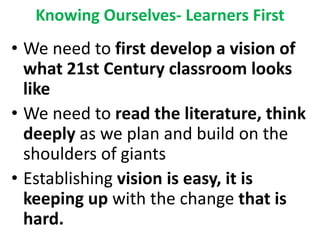
Knowing Ourselves- Learners First
• We need to first develop a vision of
what 21st Century classroom looks
like
• We need to read the literature, think
deeply as we plan and build on the
shoulders of giants
• Establishing vision is easy, it is
keeping up with the change that is
hard.
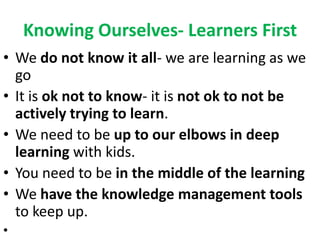
Knowing Ourselves- Learners First
• We do not know it all- we are learning as we
go
• It is ok not to know- it is not ok to not be
actively trying to learn.
• We need to be up to our elbows in deep
learning with kids.
• You need to be in the middle of the learning
• We have the knowledge management tools
to keep up.
•
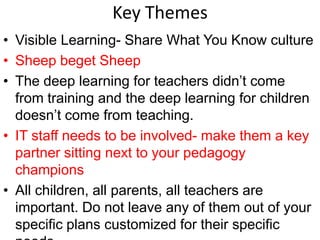
Key Themes
• Visible Learning- Share What You Know culture
• Sheep beget Sheep
• The deep learning for teachers didn’t come
from training and the deep learning for children
doesn’t come from teaching.
• IT staff needs to be involved- make them a key
partner sitting next to your pedagogy
champions
• All children, all parents, all teachers are
important. Do not leave any of them out of your
specific plans customized for their specific

Noel summation

  • 2.
    Method • Floated betweensessions • Made it to four of the five breakouts • Listened to six of the research presentations • Wrote down what I was hearing verbatim without adding my impressions • Asked questions to pull out more information
  • 3.
    Knowing Our Students- UnderstandingTheir Needs • Know your students • Be fluent in their culture and speak their language. • Build relationships • Meet the needs of the students • Be flexible in meeting the needs of your students – How do they prefer to be communicated with? – Do not offer core subjects first period
  • 4.
    Knowing Our Students- UnderstandingTheir Needs • Meet them where they are and leverage their strengths • Journaling is a non threatening way to get certain children to open up and share • First Nation children are just like all children, they love technology. • Can you answer the question- “What are you doing for our students?”
  • 5.
    Knowing Our Students- UnderstandingTheir Needs • Observe students, consider how they learn, bring that information to the teachers and plan together to change teaching. • Elevate student voice- in passive and active ways • Traditional ways were not working- we need to know more to serve better • - Needs of Learners - Needs of Community
  • 6.
    Knowing Our Students- UnderstandingTheir Needs • Do you know how do these kids tick? • Become a learner of student learning. • Study children and determine how they get their needs met. Almost like creating an independent learning plan for each kid. • Make it personal for kids. Consider their ideas, needs, passion. Inspire students.
  • 7.
    Knowing Our Students- UnderstandingTheir Needs • Make learning authentic. • Help kids connect with subject matter experts • Help kids do something -- accomplish something. • Give children rich and robust tasks with real world problems to solve • Use technology with a purpose and include learning activities that feature student voice.
  • 8.
    Knowing Our Students- UnderstandingTheir Needs • We need to be up to our elbows in deep learning with kids. • You need to be in the middle of the learning with the kids- not stand and deliver • Curriculum should be organized so that it is sustained, embedded and just in time learning. • Work should focus on good pedagogy and 21st C learning.
  • 9.
    Knowing Our Students- UnderstandingTheir Needs • How can we engage students? • As freedom increased (with student choice) achievement increased. • Special needs kids felt included and like everyone else when they had the iPad. • Rhythm (musical and cadence helps kids learn) • Even when we are on the technology - need each other present to learn • Need IT to be supportive of children’s needs.
  • 13.
    Knowing Our Faculty- UnderstandTheir Needs • Effective professional learning needs to be relevant to the needs of teachers and their students while providing opportunities for application, practice, reflection, and practice. • Professional learning is most effective when you immerse teachers in the work. • Traditional ways were not working- we need to know more to serve better • - Needs of Staff • - Needs of System
  • 14.
    Knowing Our Faculty- UnderstandTheir Needs • Are you differentiating your professional learning? – Innovators come and leave. – Don’t Spend all your effort on the laggards. – Develop leaders in the group. – Empower those who get it to share what they know with others • Professional learning should not be one size fits all. • Help teachers see the path forward.
  • 15.
    Knowing Our Faculty- UnderstandTheir Needs • Teachers need release time to plan -- not just be given technology and be expected to use it. • As teachers planned for and used the technology collaboratively for teaching they gained expertise and went from learner to mentor to facilitator and eventually lead learner. • Tell teachers that TLLP grants are available- encourage them to apply
  • 16.
    Knowing Our Faculty- UnderstandTheir Needs • Help teacher understand that 21st Century skills has nothing to do with technology. • Need technology support there when it is needed. • IT staff has to be a collaborator with any professional learning plan • Do you have a plan for getting reluctant staff or faculty on board with the shifts and change?
  • 19.
    Knowing Ourselves- LearnersFirst • We need to first develop a vision of what 21st Century classroom looks like • We need to read the literature, think deeply as we plan and build on the shoulders of giants • Establishing vision is easy, it is keeping up with the change that is hard.
  • 20.
    Knowing Ourselves- LearnersFirst • We do not know it all- we are learning as we go • It is ok not to know- it is not ok to not be actively trying to learn. • We need to be up to our elbows in deep learning with kids. • You need to be in the middle of the learning • We have the knowledge management tools to keep up. •
  • 23.
    Key Themes • VisibleLearning- Share What You Know culture • Sheep beget Sheep • The deep learning for teachers didn’t come from training and the deep learning for children doesn’t come from teaching. • IT staff needs to be involved- make them a key partner sitting next to your pedagogy champions • All children, all parents, all teachers are important. Do not leave any of them out of your specific plans customized for their specific