NEW DIRECTIONS IN ASSESSMENT
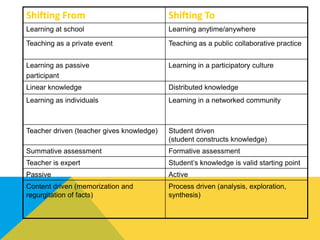
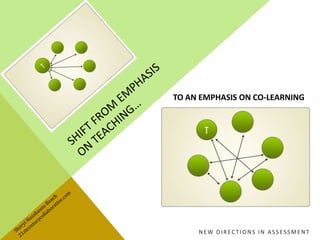
Shifting From Shifting To
Learning at school Learning anytime/anywhere
Teaching as a private event Teaching as a public collaborative practice
Learning as passive
participant
Learning in a participatory culture
Linear knowledge Distributed knowledge
Learning as individuals Learning in a networked community
Teacher driven (teacher gives knowledge) Student driven
(student constructs knowledge)
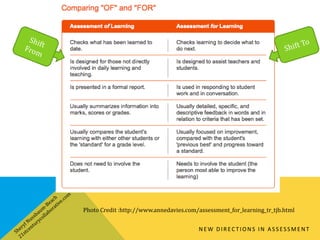
Summative assessment Formative assessment
Teacher is expert Student’s knowledge is valid starting point
Passive Active
Content driven (memorization and
regurgitation of facts)
Process driven (analysis, exploration,
synthesis)
NEW DIRECTIONS IN ASSESSMENT
TO AN EMPHASIS ON CO-LEARNING
NEW DIRECTIONS IN ASSESSMENT
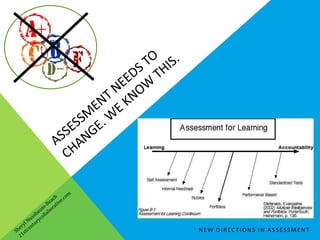
Photo Credit :http://www.annedavies.com/assessment_for_learning_tr_tjb.html
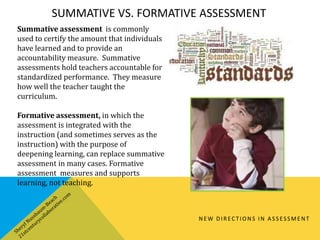
SUMMATIVE VS. FORMATIVE ASSESSMENT
NEW DIRECTIONS IN ASSESSMENT
Summative assessment is commonly
used to certify the amount that individuals
have learned and to provide an
accountability measure. Summative
assessments hold teachers accountable for
standardized performance. They measure
how well the teacher taught the
curriculum.
Formative assessment, in which the
assessment is integrated with the
instruction (and sometimes serves as the
instruction) with the purpose of
deepening learning, can replace summative
assessment in many cases. Formative
assessment measures and supports
learning, not teaching.
NEW DIRECTIONS IN ASSESSMENT
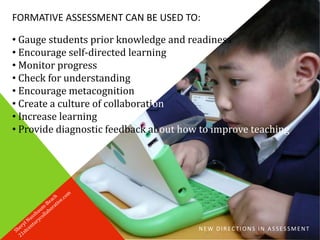
FORMATIVE ASSESSMENT CAN BE USED TO:
• Gauge students prior knowledge and readiness
• Encourage self-directed learning
• Monitor progress
• Check for understanding
• Encourage metacognition
• Create a culture of collaboration
• Increase learning
• Provide diagnostic feedback about how to improve teaching
TECHNOLOGICAL CHANGE IS NOT ADDITIVE, ITS
ECOLOGICAL. A NEW TECHNOLOGY DOES NOT
CHANGE SOMETHING, IT CHANGES
EVERYTHING"
Source: Mark Treadwell - http://www.i-learnt.com
[Neil Postman]
NEW DIRECTIONS IN ASSESSMENT
EDUCATION WEEK PD WEBINAR
Change is inevitable: Growth is optional
Change produces tension- it pushes us out
of our comfort zone.
“Creative tension- the force
that comes into play at the moment
we acknowledge our vision
is at odds with the current
reality.” --Senge
1
0
Free range learners
Free-range learners choose
how and what they learn.
Self-service is less expensive
and more timely than the
alternative. Informal
learning has no need for the
busywork, chrome, and
bureaucracy that accompany
typical classroom
instruction.
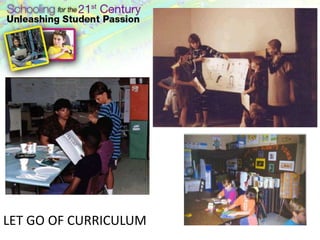
LET GO OF CURRICULUM
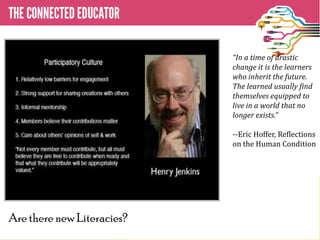
Are there new Literacies?
“In a time of drastic
change it is the learners
who inherit the future.
The learned usually find
themselves equipped to
live in a world that no
longer exists.”
--Eric Hoffer, Reflections
on the Human Condition
Play — the capacity to experiment with one’s surroundings as a form of
problem-solving
Performance — the ability to adopt alternative identities for the purpose of
improvisation and discovery
Simulation — the ability to interpret and construct dynamic models of real-
world processes
Appropriation — the ability to meaningfully sample and remix media
content
Multitasking — the ability to scan one’s environment and shift focus as
needed to salient details.
Distributed Cognition — the ability to interact meaningfully with tools that
expand mental capacities
.
Collective Intelligence — the ability to pool knowledge and compare notes
with others toward a common goal
Judgment — the ability to evaluate the reliability and credibility of different
information sources
Transmedia Navigation — the ability to follow the flow of stories and
information across multiple modalities
Networking — the ability to search for, synthesize, and disseminate
information
Negotiation — the ability to travel across diverse communities, discerning
and respecting multiple perspectives, and grasping and following alternative
norms.
.
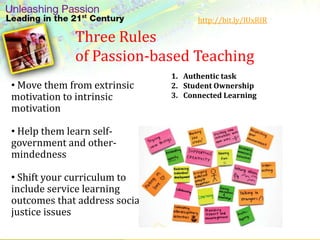
Three Rules
of Passion-based Teaching
• Move them from extrinsic
motivation to intrinsic
motivation
• Help them learn self-
government and other-
mindedness
• Shift your curriculum to
include service learning
outcomes that address social
justice issues
1. Authentic task
2. Student Ownership
3. Connected Learning
http://bit.ly/lUxRIR
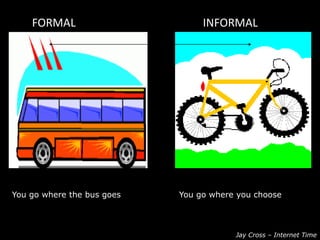
FORMAL INFORMAL
You go where the bus goes You go where you choose
Jay Cross – Internet Time
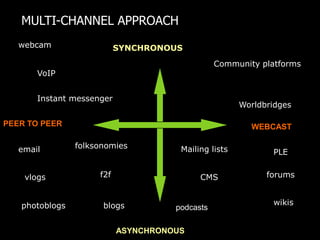
MULTI-CHANNEL APPROACH
SYNCHRONOUS
ASYNCHRONOUS
PEER TO PEER WEBCAST
Instant messenger
forumsf2f
blogsphotoblogs
vlogs
wikis
folksonomies
Conference rooms
email Mailing lists
CMS
Community platforms
VoIP
webcam
podcasts
PLE
Worldbridges
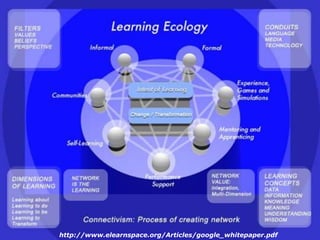
http://www.elearnspace.org/Articles/google_whitepaper.pdf
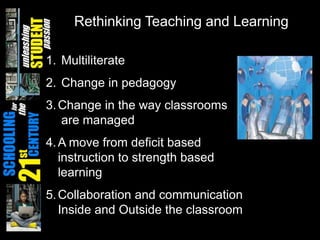
Rethinking Teaching and Learning
1. Multiliterate
2. Change in pedagogy
3.Change in the way classrooms
are managed
4.A move from deficit based
instruction to strength based
learning
5.Collaboration and communication
Inside and Outside the classroom
6.
20
EDUCATION FOR CITIZENSHIP
“A capable and productive citizen doesn’t simply
turn up for jury service. Rather, she is capable of
serving impartially on trials that may require
learning unfamiliar facts and concepts and new ways
to communicate and reach decisions with her fellow
jurors…. Jurors may be called on to decide complex
matters that require the verbal, reasoning, math,
science, and socialization skills that should be
imparted in public schools. Jurors today must
determine questions of fact concerning DNA
evidence, statistical analyses, and convoluted
financial fraud, to name only three topics.”
Justice Leland DeGrasse, 2001
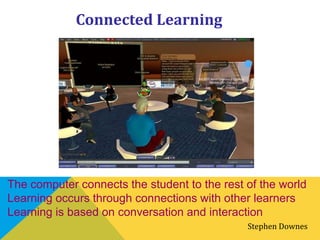
Connected Learning
The computer connects the student to the rest of the world
Learning occurs through connections with other learners
Learning is based on conversation and interaction
Stephen Downes
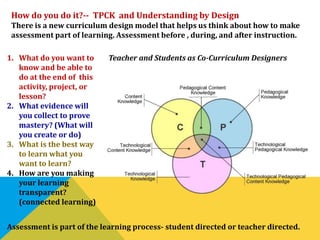
How do you do it?-- TPCK and Understanding by Design
There is a new curriculum design model that helps us think about how to make
assessment part of learning. Assessment before , during, and after instruction.
Teacher and Students as Co-Curriculum Designers
Assessment is part of the learning process- student directed or teacher directed.
1. What do you want to
know and be able to
do at the end of this
activity, project, or
lesson?
2. What evidence will
you collect to prove
mastery? (What will
you create or do)
3. What is the best way
to learn what you
want to learn?
4. How are you making
your learning
transparent?
(connected learning)
WHY TPACK?
Learning how to use technology is much
different than knowing what to do with it for
instructional purposes
Redesigning instruction requires an
understanding of how knowledge about
content, pedagogy, and technology overlap to
inform your choices for curriculum and
instruction
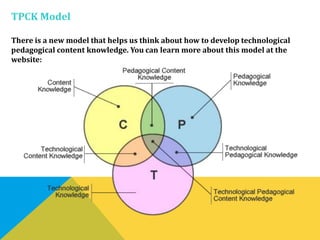
TPCK Model
There is a new model that helps us think about how to develop technological
pedagogical content knowledge. You can learn more about this model at the
website:
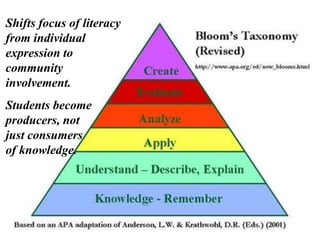
Shifts focus of literacy
from individual
expression to
community
involvement.
Students become
producers, not
just consumers
of knowledge.
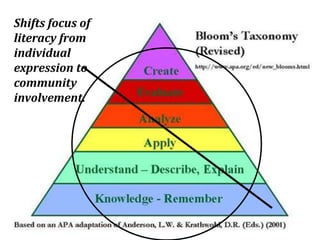
Shifts focus of
literacy from
individual
expression to
community
involvement.
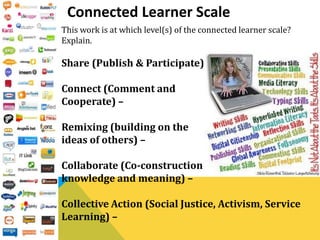
Connected Learner Scale
This work is at which level(s) of the connected learner scale?
Explain.
Share (Publish & Participate) –
Connect (Comment and
Cooperate) –
Remixing (building on the
ideas of others) –
Collaborate (Co-construction of
knowledge and meaning) –
Collective Action (Social Justice, Activism, Service
Learning) –
7 PIECES OF THE TPACK PIE
Content [CK]: subject matter to be learned
Technology [TK]: foundational and new technologies
Pedagogy [PK]: purpose, values & methods used to teach
and evaluate learning
PCK: What pedagogical strategies make concepts difficult or
easy to learn?
TCK: How is content represented and transformed by the
application of technology?
TPK: What pedagogical strategies enable you to get the
most out of existing technologies for teaching &
evaluating learning?
TPCK:Understanding the relationship between elements --
“a change in any one factor has to be ‘compensated’ by
changes in the other two”
• Content focus: What content does this lesson focus on?
• Pedagogical focus: What pedagogical practices are
employed in this lesson?
• Technology used: What technologies are used?
• PCK: Do these pedagogical practices make concepts
clearer and/or foster deeper learning?
• TCK: Does the use of technology help represent the
content in diverse ways or maximize opportunities to
transform the content in ways that make sense to the
learner?
• TPK: Do the pedagogical practices maximize the use of
existing technologies for teaching and evaluating
learning?
• TPCK:How might things need to change if one aspect of
the lesson were to be different or not available?
TPACK GUIDELINES
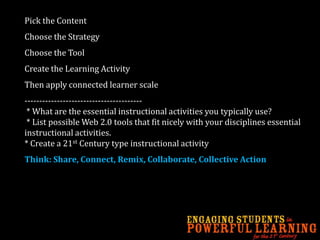
Pick the Content
Choose the Strategy
Choose the Tool
Create the Learning Activity
Then apply connected learner scale
----------------------------------------
* What are the essential instructional activities you typically use?
* List possible Web 2.0 tools that fit nicely with your disciplines essential
instructional activities.
* Create a 21st Century type instructional activity
Think: Share, Connect, Remix, Collaborate, Collective Action
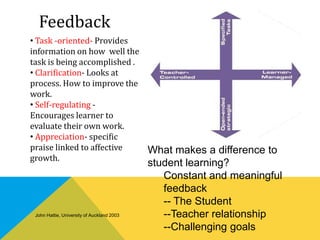
Feedback
• Task -oriented- Provides
information on how well the
task is being accomplished .
• Clarification- Looks at
process. How to improve the
work.
• Self-regulating -
Encourages learner to
evaluate their own work.
• Appreciation- specific
praise linked to affective
growth.
What makes a difference to
student learning?
Constant and meaningful
feedback
-- The Student
--Teacher relationship
--Challenging goals
John Hattie, University of Auckland 2003
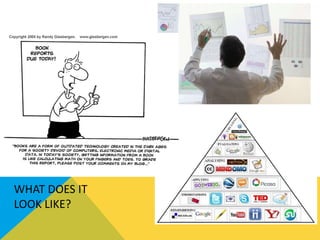
WHAT DOES IT
LOOK LIKE?
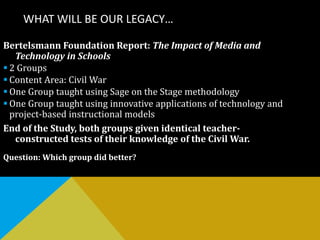
WHAT WILL BE OUR LEGACY…
Bertelsmann Foundation Report: The Impact of Media and
Technology in Schools
 2 Groups
 Content Area: Civil War
 One Group taught using Sage on the Stage methodology
 One Group taught using innovative applications of technology and
project-based instructional models
End of the Study, both groups given identical teacher-
constructed tests of their knowledge of the Civil War.
Question: Which group did better?
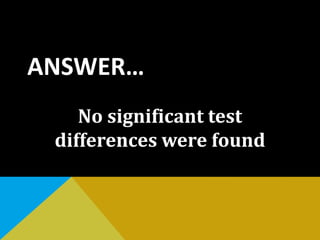
ANSWER…
No significant test
differences were found
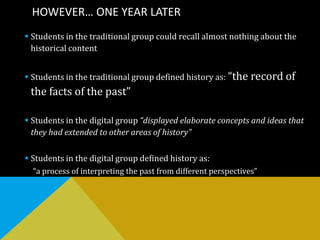
HOWEVER… ONE YEAR LATER
 Students in the traditional group could recall almost nothing about the
historical content
 Students in the traditional group defined history as: “the record of
the facts of the past”
 Students in the digital group “displayed elaborate concepts and ideas that
they had extended to other areas of history”
 Students in the digital group defined history as:
“a process of interpreting the past from different perspectives”
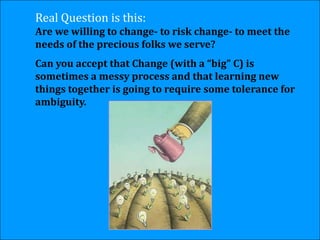
Real Question is this:
Are we willing to change- to risk change- to meet the
needs of the precious folks we serve?
Can you accept that Change (with a “big” C) is
sometimes a messy process and that learning new
things together is going to require some tolerance for
ambiguity.
Last Generation

New directions

  • 2.
  • 3.
    Shifting From ShiftingTo Learning at school Learning anytime/anywhere Teaching as a private event Teaching as a public collaborative practice Learning as passive participant Learning in a participatory culture Linear knowledge Distributed knowledge Learning as individuals Learning in a networked community Teacher driven (teacher gives knowledge) Student driven (student constructs knowledge) Summative assessment Formative assessment Teacher is expert Student’s knowledge is valid starting point Passive Active Content driven (memorization and regurgitation of facts) Process driven (analysis, exploration, synthesis)
  • 4.
    NEW DIRECTIONS INASSESSMENT TO AN EMPHASIS ON CO-LEARNING
  • 5.
    NEW DIRECTIONS INASSESSMENT Photo Credit :http://www.annedavies.com/assessment_for_learning_tr_tjb.html
  • 6.
    SUMMATIVE VS. FORMATIVEASSESSMENT NEW DIRECTIONS IN ASSESSMENT Summative assessment is commonly used to certify the amount that individuals have learned and to provide an accountability measure. Summative assessments hold teachers accountable for standardized performance. They measure how well the teacher taught the curriculum. Formative assessment, in which the assessment is integrated with the instruction (and sometimes serves as the instruction) with the purpose of deepening learning, can replace summative assessment in many cases. Formative assessment measures and supports learning, not teaching.
  • 7.
    NEW DIRECTIONS INASSESSMENT FORMATIVE ASSESSMENT CAN BE USED TO: • Gauge students prior knowledge and readiness • Encourage self-directed learning • Monitor progress • Check for understanding • Encourage metacognition • Create a culture of collaboration • Increase learning • Provide diagnostic feedback about how to improve teaching
  • 8.
    TECHNOLOGICAL CHANGE ISNOT ADDITIVE, ITS ECOLOGICAL. A NEW TECHNOLOGY DOES NOT CHANGE SOMETHING, IT CHANGES EVERYTHING" Source: Mark Treadwell - http://www.i-learnt.com [Neil Postman]
  • 9.
    NEW DIRECTIONS INASSESSMENT EDUCATION WEEK PD WEBINAR Change is inevitable: Growth is optional Change produces tension- it pushes us out of our comfort zone. “Creative tension- the force that comes into play at the moment we acknowledge our vision is at odds with the current reality.” --Senge
  • 10.
    1 0 Free range learners Free-rangelearners choose how and what they learn. Self-service is less expensive and more timely than the alternative. Informal learning has no need for the busywork, chrome, and bureaucracy that accompany typical classroom instruction.
  • 11.
    LET GO OFCURRICULUM
  • 12.
    Are there newLiteracies? “In a time of drastic change it is the learners who inherit the future. The learned usually find themselves equipped to live in a world that no longer exists.” --Eric Hoffer, Reflections on the Human Condition
  • 13.
    Play — thecapacity to experiment with one’s surroundings as a form of problem-solving Performance — the ability to adopt alternative identities for the purpose of improvisation and discovery Simulation — the ability to interpret and construct dynamic models of real- world processes Appropriation — the ability to meaningfully sample and remix media content Multitasking — the ability to scan one’s environment and shift focus as needed to salient details. Distributed Cognition — the ability to interact meaningfully with tools that expand mental capacities .
  • 14.
    Collective Intelligence —the ability to pool knowledge and compare notes with others toward a common goal Judgment — the ability to evaluate the reliability and credibility of different information sources Transmedia Navigation — the ability to follow the flow of stories and information across multiple modalities Networking — the ability to search for, synthesize, and disseminate information Negotiation — the ability to travel across diverse communities, discerning and respecting multiple perspectives, and grasping and following alternative norms. .
  • 15.
    Three Rules of Passion-basedTeaching • Move them from extrinsic motivation to intrinsic motivation • Help them learn self- government and other- mindedness • Shift your curriculum to include service learning outcomes that address social justice issues 1. Authentic task 2. Student Ownership 3. Connected Learning http://bit.ly/lUxRIR
  • 16.
    FORMAL INFORMAL You gowhere the bus goes You go where you choose Jay Cross – Internet Time
  • 17.
    MULTI-CHANNEL APPROACH SYNCHRONOUS ASYNCHRONOUS PEER TOPEER WEBCAST Instant messenger forumsf2f blogsphotoblogs vlogs wikis folksonomies Conference rooms email Mailing lists CMS Community platforms VoIP webcam podcasts PLE Worldbridges
  • 18.
  • 19.
    Rethinking Teaching andLearning 1. Multiliterate 2. Change in pedagogy 3.Change in the way classrooms are managed 4.A move from deficit based instruction to strength based learning 5.Collaboration and communication Inside and Outside the classroom 6.
  • 20.
    20 EDUCATION FOR CITIZENSHIP “Acapable and productive citizen doesn’t simply turn up for jury service. Rather, she is capable of serving impartially on trials that may require learning unfamiliar facts and concepts and new ways to communicate and reach decisions with her fellow jurors…. Jurors may be called on to decide complex matters that require the verbal, reasoning, math, science, and socialization skills that should be imparted in public schools. Jurors today must determine questions of fact concerning DNA evidence, statistical analyses, and convoluted financial fraud, to name only three topics.” Justice Leland DeGrasse, 2001
  • 21.
    Connected Learning The computerconnects the student to the rest of the world Learning occurs through connections with other learners Learning is based on conversation and interaction Stephen Downes
  • 22.
    How do youdo it?-- TPCK and Understanding by Design There is a new curriculum design model that helps us think about how to make assessment part of learning. Assessment before , during, and after instruction. Teacher and Students as Co-Curriculum Designers Assessment is part of the learning process- student directed or teacher directed. 1. What do you want to know and be able to do at the end of this activity, project, or lesson? 2. What evidence will you collect to prove mastery? (What will you create or do) 3. What is the best way to learn what you want to learn? 4. How are you making your learning transparent? (connected learning)
  • 23.
    WHY TPACK? Learning howto use technology is much different than knowing what to do with it for instructional purposes Redesigning instruction requires an understanding of how knowledge about content, pedagogy, and technology overlap to inform your choices for curriculum and instruction
  • 24.
    TPCK Model There isa new model that helps us think about how to develop technological pedagogical content knowledge. You can learn more about this model at the website:
  • 25.
    Shifts focus ofliteracy from individual expression to community involvement. Students become producers, not just consumers of knowledge.
  • 26.
    Shifts focus of literacyfrom individual expression to community involvement.
  • 27.
    Connected Learner Scale Thiswork is at which level(s) of the connected learner scale? Explain. Share (Publish & Participate) – Connect (Comment and Cooperate) – Remixing (building on the ideas of others) – Collaborate (Co-construction of knowledge and meaning) – Collective Action (Social Justice, Activism, Service Learning) –
  • 28.
    7 PIECES OFTHE TPACK PIE Content [CK]: subject matter to be learned Technology [TK]: foundational and new technologies Pedagogy [PK]: purpose, values & methods used to teach and evaluate learning PCK: What pedagogical strategies make concepts difficult or easy to learn? TCK: How is content represented and transformed by the application of technology? TPK: What pedagogical strategies enable you to get the most out of existing technologies for teaching & evaluating learning? TPCK:Understanding the relationship between elements -- “a change in any one factor has to be ‘compensated’ by changes in the other two”
  • 29.
    • Content focus:What content does this lesson focus on? • Pedagogical focus: What pedagogical practices are employed in this lesson? • Technology used: What technologies are used? • PCK: Do these pedagogical practices make concepts clearer and/or foster deeper learning? • TCK: Does the use of technology help represent the content in diverse ways or maximize opportunities to transform the content in ways that make sense to the learner? • TPK: Do the pedagogical practices maximize the use of existing technologies for teaching and evaluating learning? • TPCK:How might things need to change if one aspect of the lesson were to be different or not available? TPACK GUIDELINES
  • 31.
    Pick the Content Choosethe Strategy Choose the Tool Create the Learning Activity Then apply connected learner scale ---------------------------------------- * What are the essential instructional activities you typically use? * List possible Web 2.0 tools that fit nicely with your disciplines essential instructional activities. * Create a 21st Century type instructional activity Think: Share, Connect, Remix, Collaborate, Collective Action
  • 32.
    Feedback • Task -oriented-Provides information on how well the task is being accomplished . • Clarification- Looks at process. How to improve the work. • Self-regulating - Encourages learner to evaluate their own work. • Appreciation- specific praise linked to affective growth. What makes a difference to student learning? Constant and meaningful feedback -- The Student --Teacher relationship --Challenging goals John Hattie, University of Auckland 2003
  • 33.
  • 34.
    WHAT WILL BEOUR LEGACY… Bertelsmann Foundation Report: The Impact of Media and Technology in Schools  2 Groups  Content Area: Civil War  One Group taught using Sage on the Stage methodology  One Group taught using innovative applications of technology and project-based instructional models End of the Study, both groups given identical teacher- constructed tests of their knowledge of the Civil War. Question: Which group did better?
  • 35.
  • 36.
    HOWEVER… ONE YEARLATER  Students in the traditional group could recall almost nothing about the historical content  Students in the traditional group defined history as: “the record of the facts of the past”  Students in the digital group “displayed elaborate concepts and ideas that they had extended to other areas of history”  Students in the digital group defined history as: “a process of interpreting the past from different perspectives”
  • 37.
    Real Question isthis: Are we willing to change- to risk change- to meet the needs of the precious folks we serve? Can you accept that Change (with a “big” C) is sometimes a messy process and that learning new things together is going to require some tolerance for ambiguity.
  • 38.