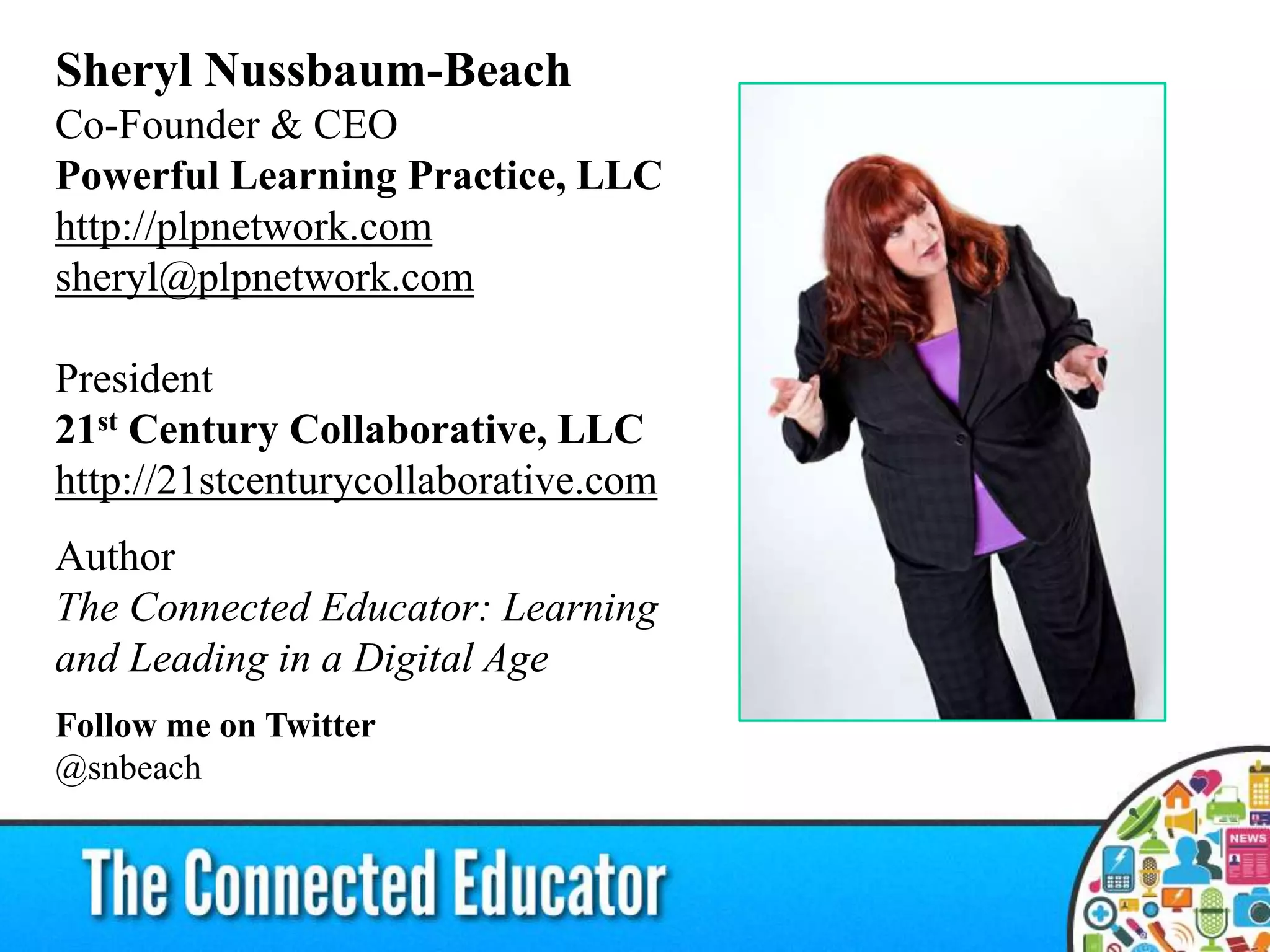
Sheryl Nussbaum-Beach
Co-Founder & CEO
Powerful Learning Practice, LLC
http://plpnetwork.com
sheryl@plpnetwork.com
President
21st Century Collaborative, LLC
http://21stcenturycollaborative.com
Author
The Connected Educator: Learning
and Leading in a Digital Age
Follow me on Twitter
@snbeach
• THE CONNECTED EDUCATOR
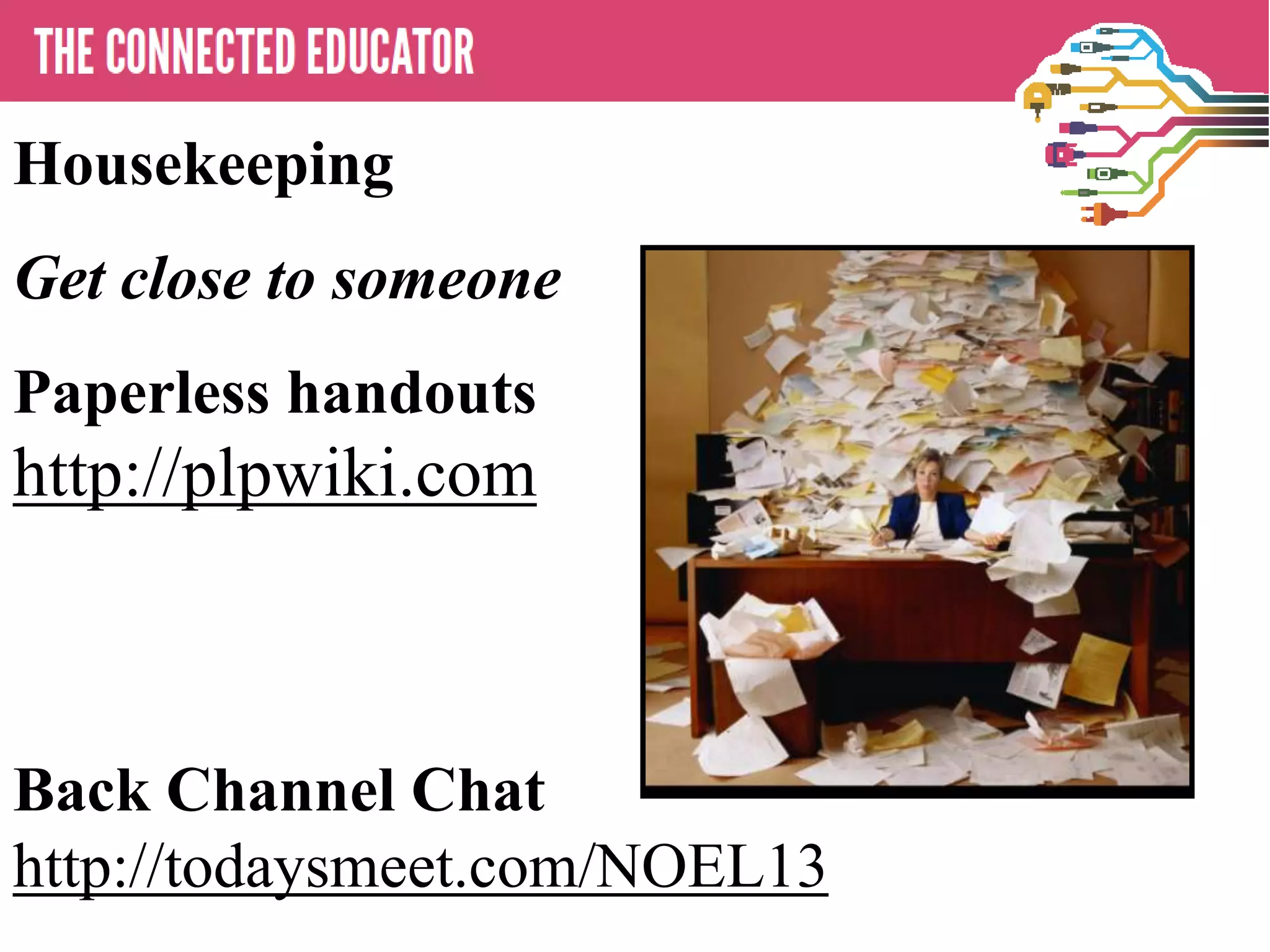
Housekeeping
Get close to someone
Paperless handouts
http://plpwiki.com
Back Channel Chat
http://todaysmeet.com/NOEL13
All of October
Free professional learning
Free for you– free for your staff
http://connectededucators.org/
edConnectr
• Robust matchmaking tool for
learning & innovation
• Uses tags to make it easy to
create rich, action-oriented
profiles
• Uses maps to make it easy
and fun to find others
• Helps educators find
collaborators, get help, or just
connect
District and State Support
• District toolkit, Part 1
– Support for participation in CEM
– Examples of district at different
levels, with videos and links
– Links to tools and resources at each
level
• District toolkit, Part 2
– Support for integrating informal and
formal professional learning year
round
– Readiness assessment, planning,
implementation, and evaluation
tools
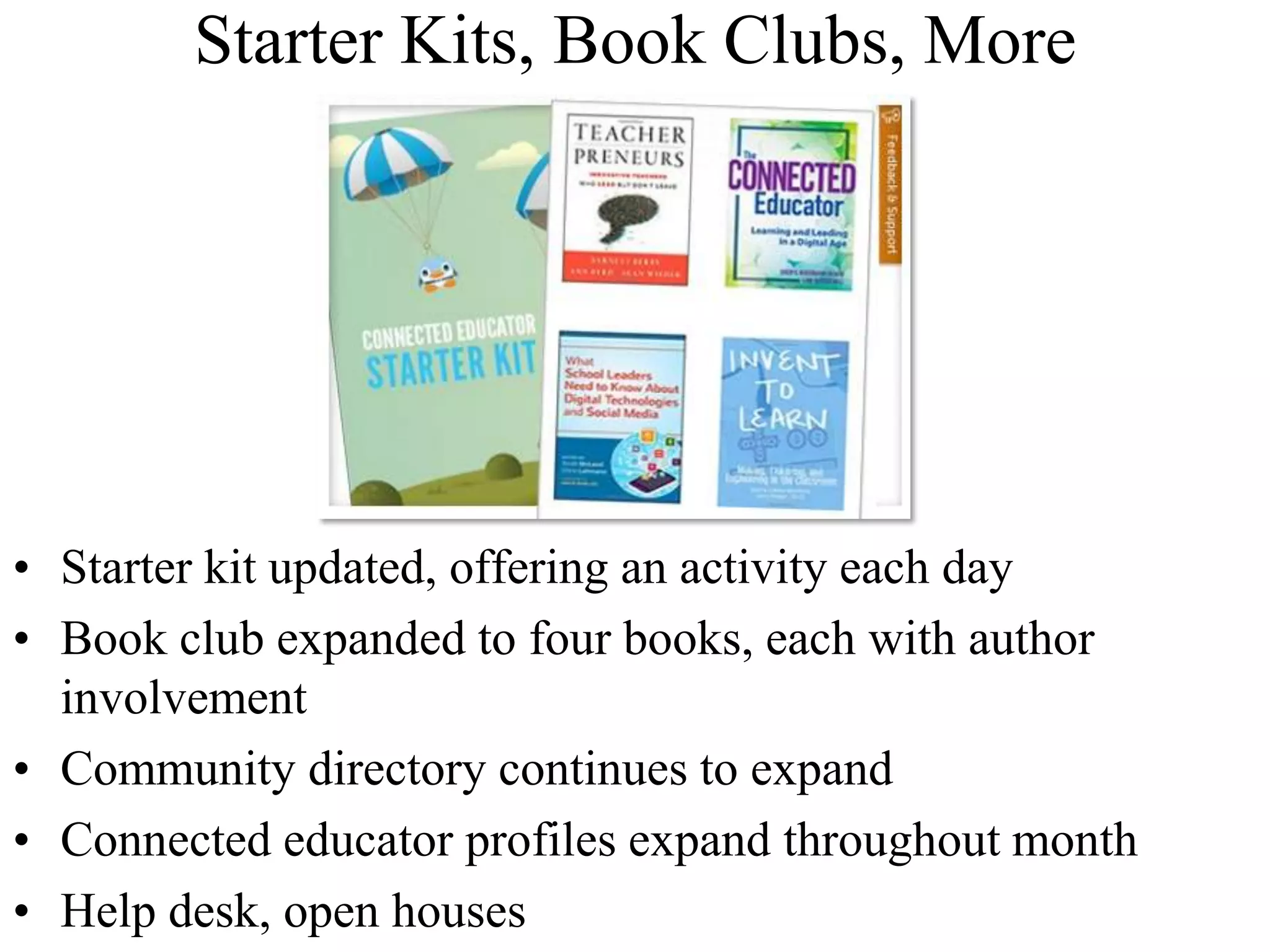
Starter Kits, Book Clubs, More
• Starter kit updated, offering an activity each day
• Book club expanded to four books, each with author
involvement
• Community directory continues to expand
• Connected educator profiles expand throughout month
• Help desk, open houses
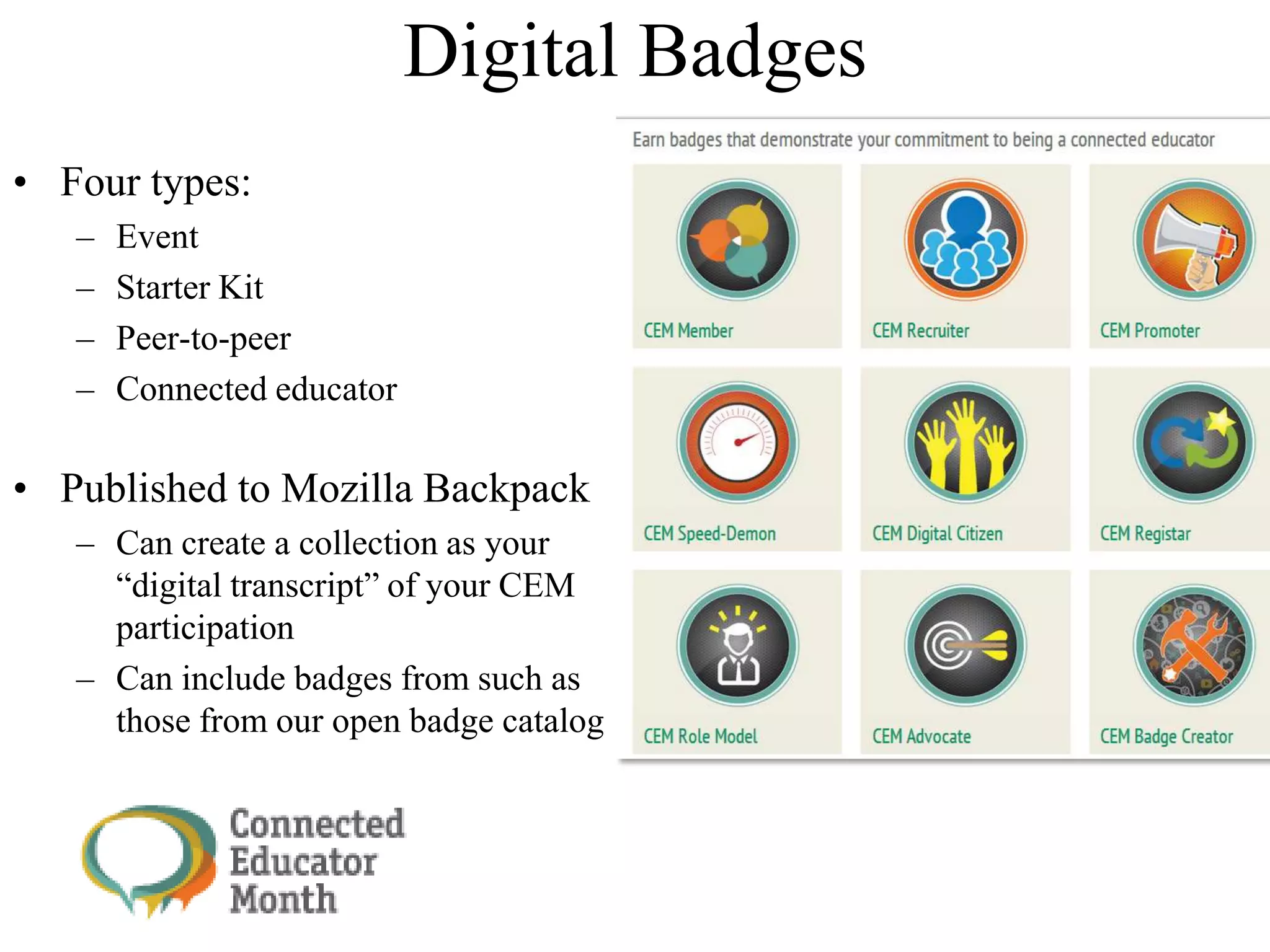
Digital Badges
• Four types:
– Event
– Starter Kit
– Peer-to-peer
– Connected educator
• Published to Mozilla Backpack
– Can create a collection as your
―digital transcript‖ of your CEM
participation
– Can include badges from such as
those from our open badge catalog
Learner First—
Educator Second
Introduce yourselves to each
other and brag a little. Talk
about (in 2 min or less) the
most recent or compelling
connected learning project you
have recently
led, discovered, or been
involved in.
Emerson and Thoreau
reunited would ask-
―What has
become clearer to
you since we last
met?‖
Mantra for today’s keynote…
We are stronger together than apart.
None of us is as smart, creative, good or
interesting as all of us.
• THE CONNECTED EDUCATOR
Things do not change; we change.
—Henry David Thoreau
What are you doing to contextualize and
mobilize what you are learning?
How will you leverage, how will you enable
your teachers or your students to leverage-
collective intelligence?
Are you Ready for Learning and
Leading in the 21st Century?
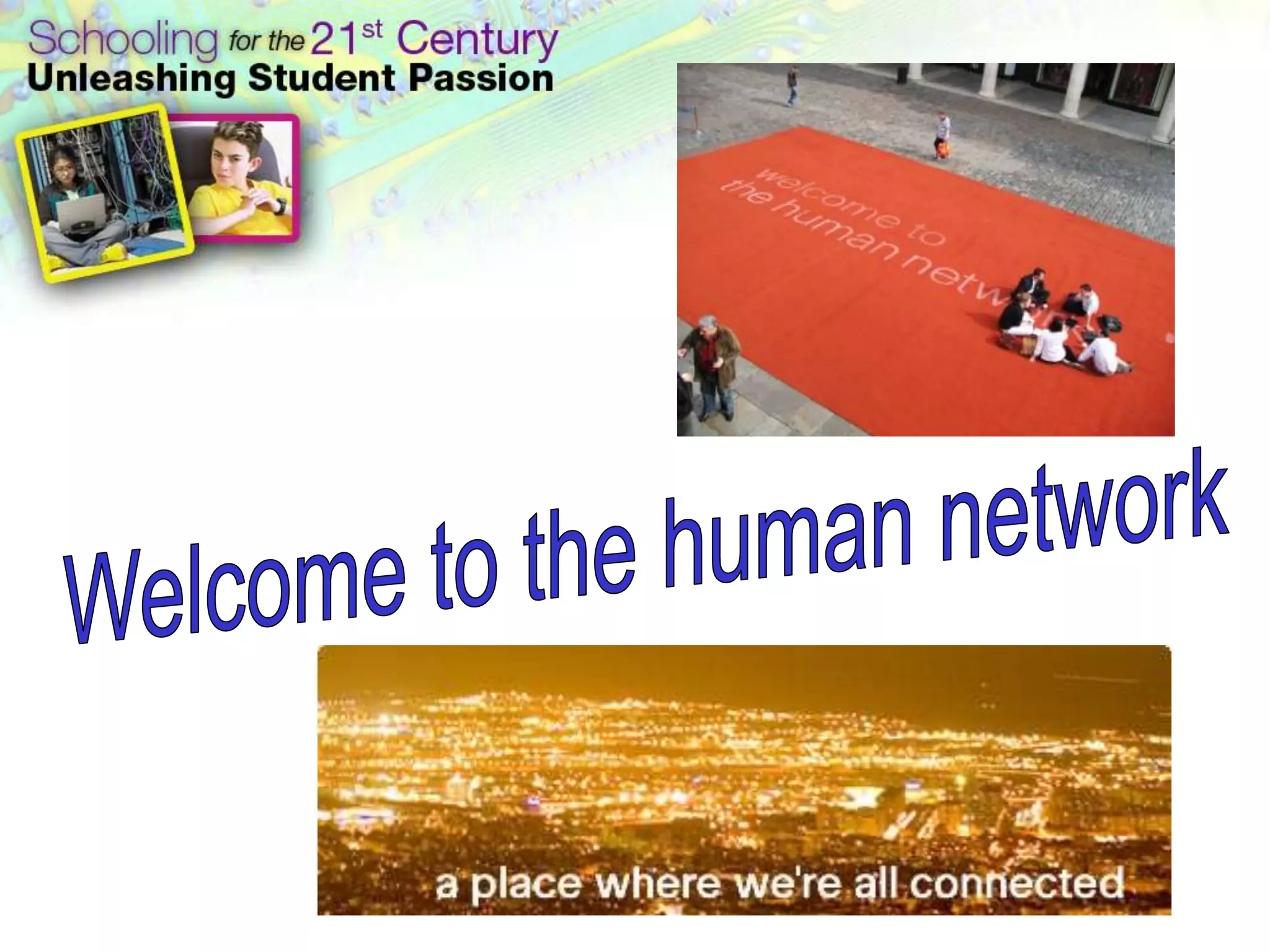
It isn’t just ―coming‖… it has arrived! And schools
who aren’t redefining themselves, risk becoming
irrelevant in preparing students for the future.
The world is changing...
By the year 2011 80% of all Fortune 500
companies will be using immersive worlds –
Gartner Vice President Jackie Fenn
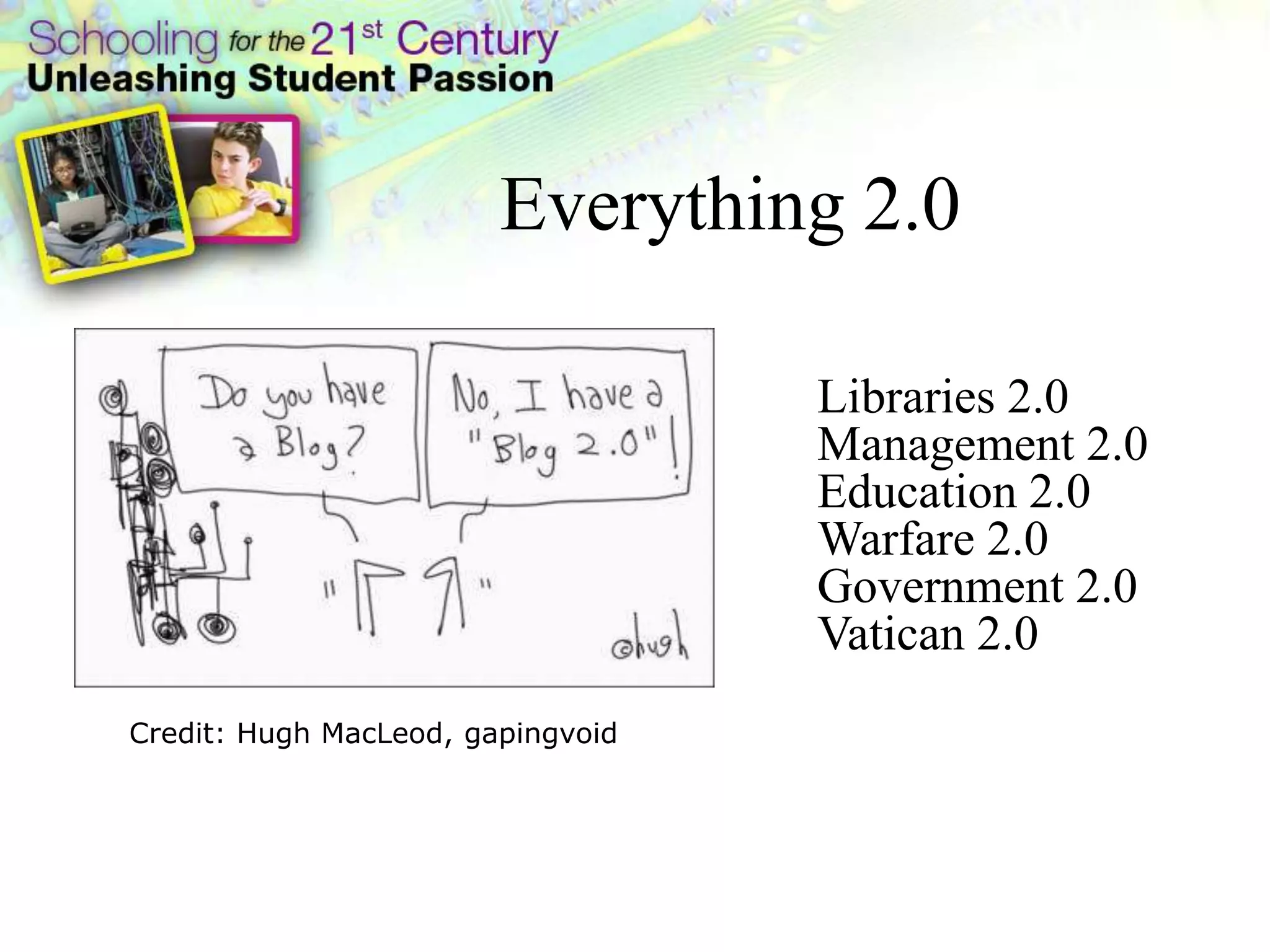
Libraries 2.0
Management 2.0
Education 2.0
Warfare 2.0
Government 2.0
Vatican 2.0
Credit: Hugh MacLeod, gapingvoid
Everything 2.0
6 Trends for the digital age
Analogue Digital
Tethered Mobile
Closed Open
Isolated Connected
Generic Personal
Consuming Creating
Source: David Wiley: Openness and the disaggregated
future of higher education
―We are tethered to
our always on/
always on us
communication
devices and the
people and things we
reach through them.‖
~ Sherry Turkle
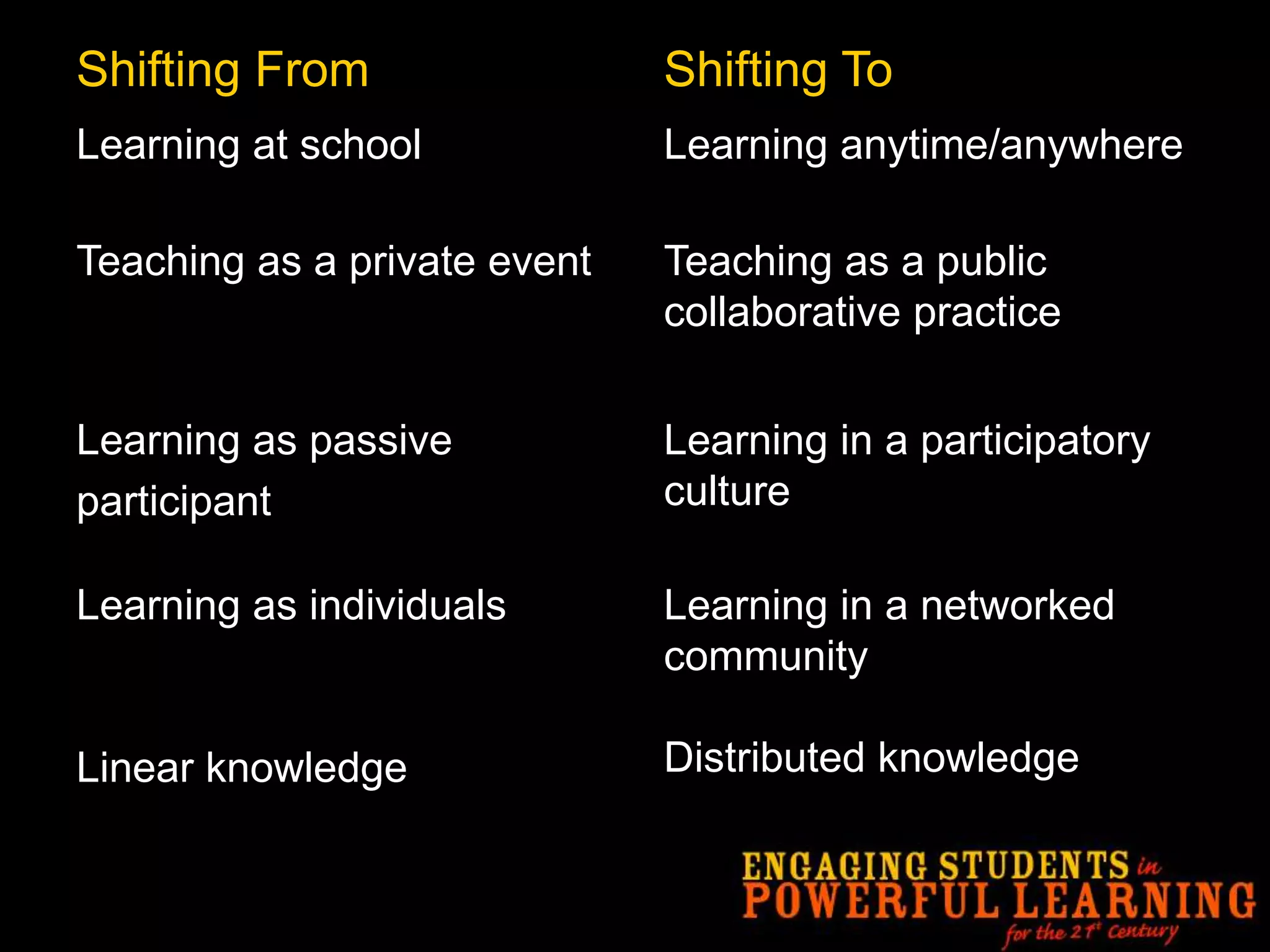
Shifting From Shifting To
Learning at school Learning anytime/anywhere
Teaching as a private event Teaching as a public
collaborative practice
Learning as passive
participant
Learning in a participatory
culture
Learning as individuals
Linear knowledge
Learning in a networked
community
Distributed knowledge
Shift in Learning – The Possibilities
Rethinking teaching and learning…
1. Multiliterate
2. Changing Demographic
3. Active Content Creators
4. Global Collaboration and
Communication
We are in the midst of seeing education transform
from a book-based, linear system with a focus on
individual achievement to an web-based, divergent
system with a focus on community building.
dangeuslyirrelevant.org
Our kids have tasted the honey.
http://www.dangerouslyirrelevant.org/2009/02/a-taste-of-honey.html
22
Free range learners
Free-range learners choose
how and what they learn. Self-
service is less expensive and
more timely than the
alternative. Informal learning
has no need for the
busywork, chrome, and
bureaucracy that accompany
typical classroom instruction.
• THE CONNECTED EDUCATOR
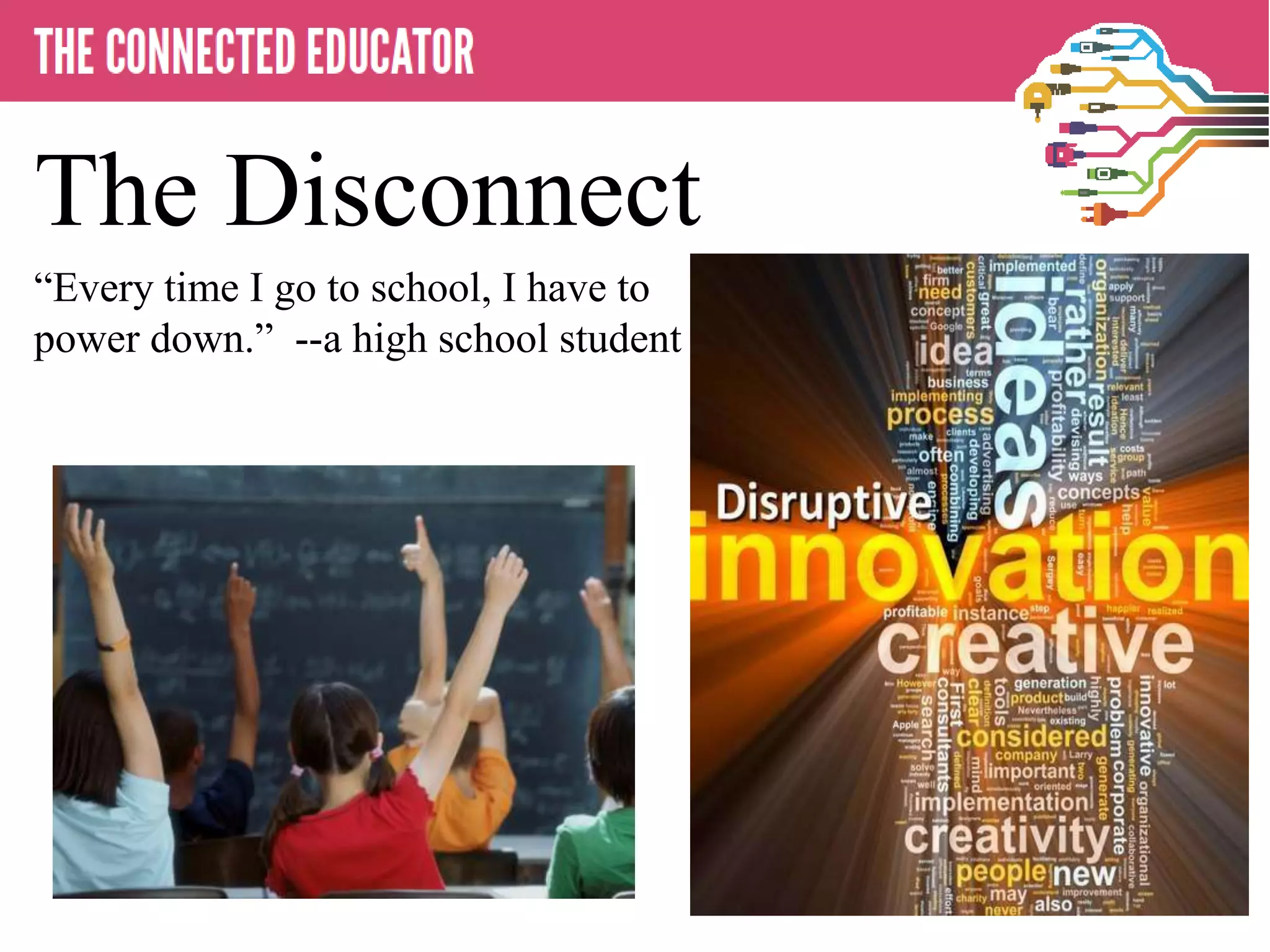
The Disconnect
―Every time I go to school, I have to
power down.‖ --a high school student
The pace of change is
accelerating
It is estimated that
1.5 exabytes of unique new information
will be generated
worldwide this year.
That’s estimated to be
more than in the
previous 5,000 years.
Knowledge Creation
For students starting a four-year
education degree, this means that . . .
half of what they learn in their first year
of study will be outdated by their third
year of study.
Time Travel
Lewis Perelman, author of School's Out (1992). Perelman argues that
schools are out of sync with technological change:
...the technological gap between the school environment and the "real
world" is growing so wide, so fast that the classroom experience is on
the way to becoming not merely unproductive but increasingly
irrelevant to normal human existence (p.215).
Seymour Papert (1993)
In the wake of the startling growth of science and technology in our
recent past, some areas of human activity have undergone
megachange. Telecommunications, entertainment and
transportation, as well as medicine, are among them. School is a
notable example of an area that has not(p.2).
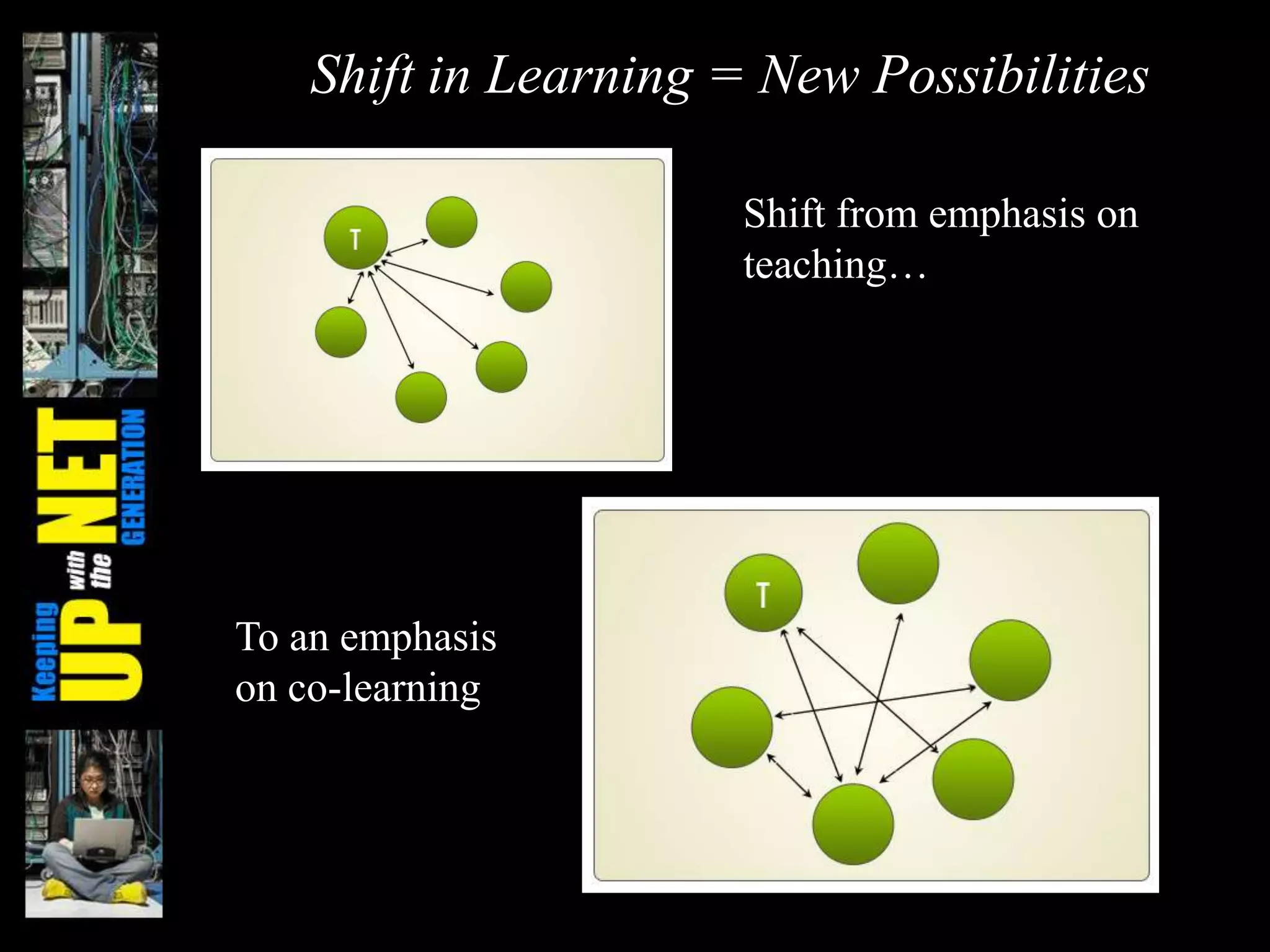
Shift in Learning = New Possibilities
Shift from emphasis on
teaching…
To an emphasis
on co-learning
Shifts focus of literacy
from individual
expression to
community
involvement.
Shifts focus of literacy
from individual
expression to
community
involvement.
Connected Learning
The computer connects the student to the rest of the world
Learning occurs through connections with other learners
Learning is based on conversation and interaction
Stephen Downes
Share
Cooperate
Collaborate
Collective Action
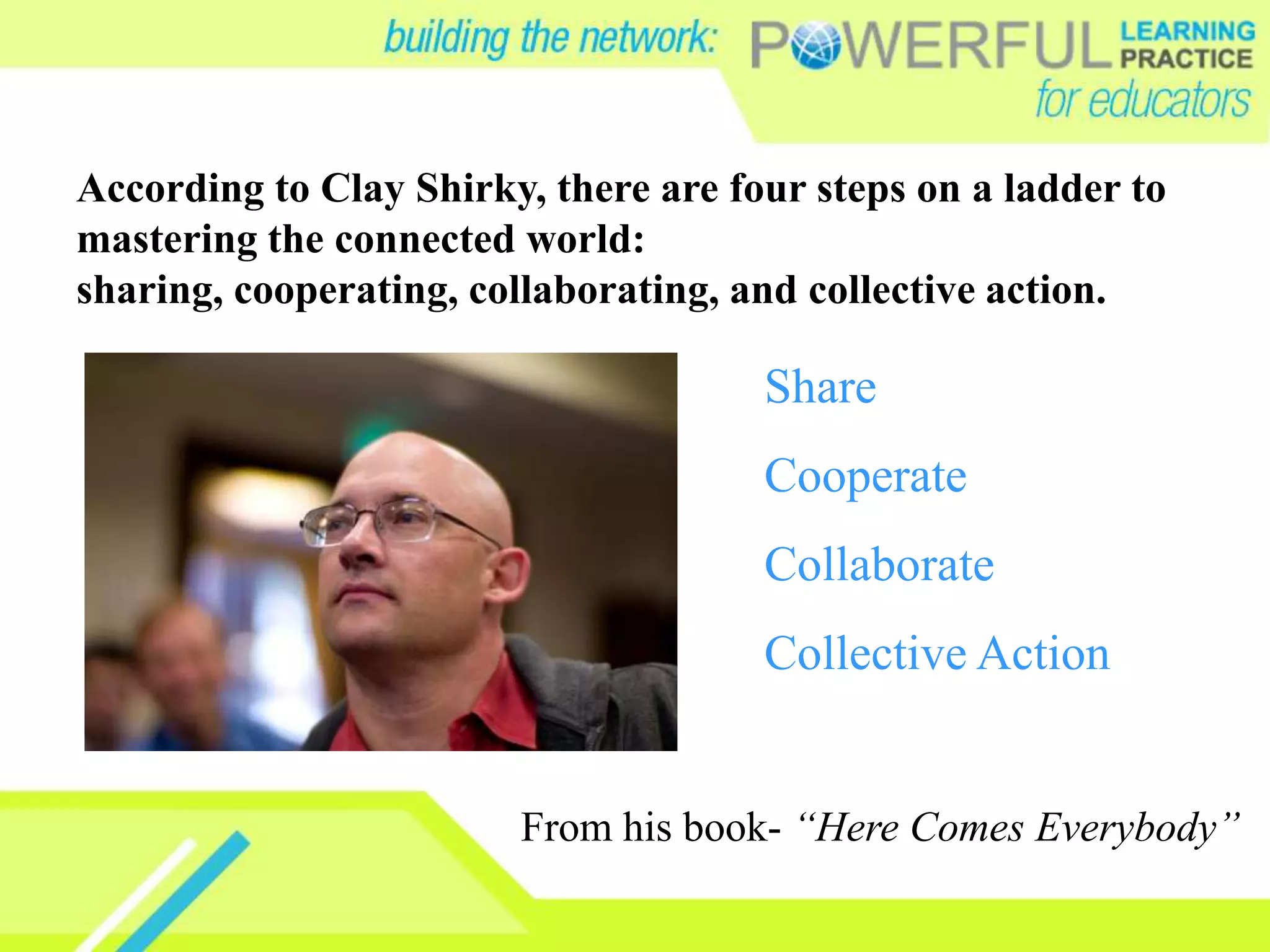
According to Clay Shirky, there are four steps on a ladder to
mastering the connected world:
sharing, cooperating, collaborating, and collective action.
From his book- “Here Comes Everybody”
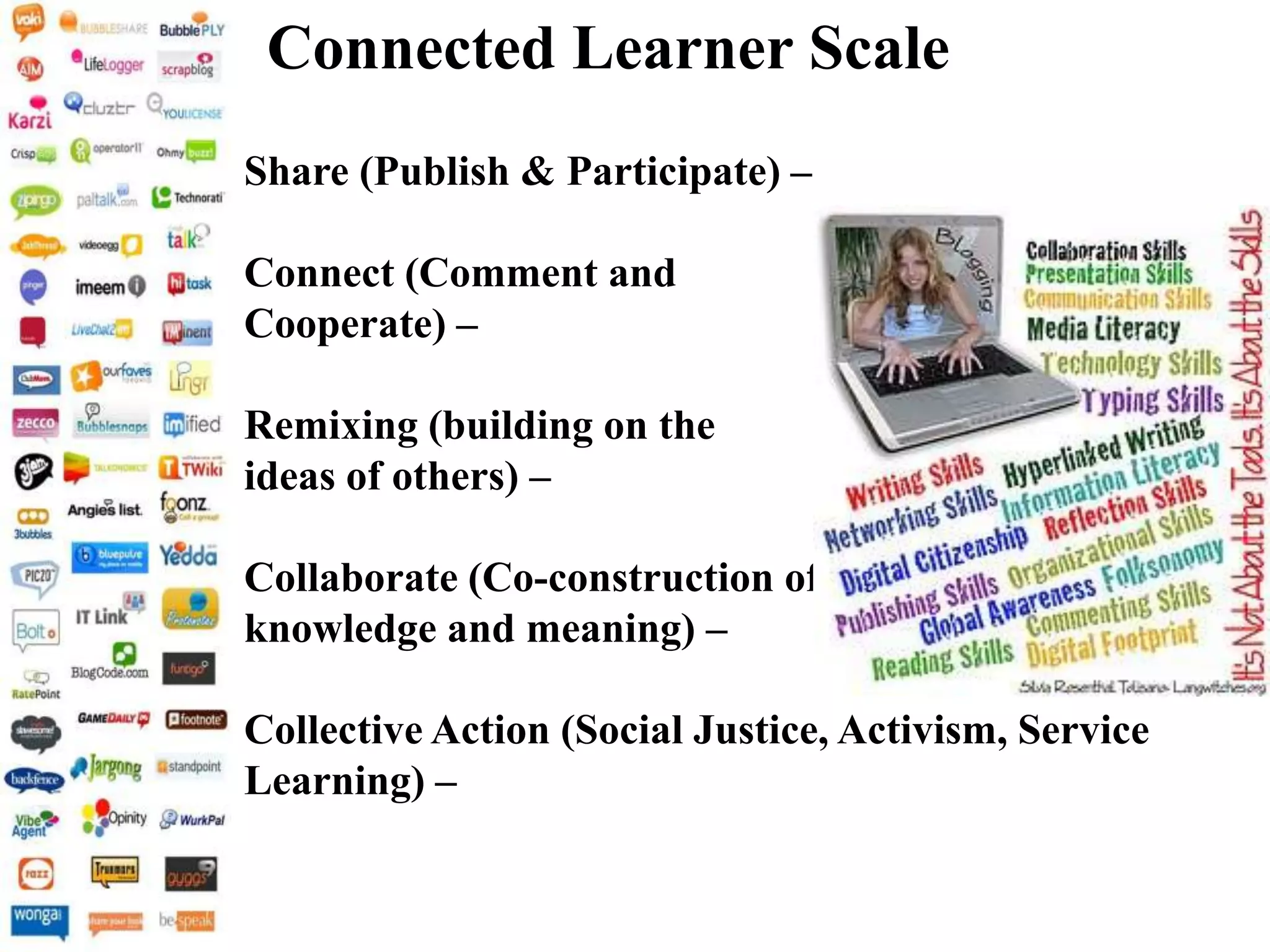
Connected Learner Scale
Share (Publish & Participate) –
Connect (Comment and
Cooperate) –
Remixing (building on the
ideas of others) –
Collaborate (Co-construction of
knowledge and meaning) –
Collective Action (Social Justice, Activism, Service
Learning) –
34
Education for Citizenship
―A capable and productive citizen doesn’t simply turn up
for jury service. Rather, she is capable of serving
impartially on trials that may require learning unfamiliar
facts and concepts and new ways to communicate and
reach decisions with her fellow jurors…. Jurors may be
called on to decide complex matters that require the verbal,
reasoning, math, science, and socialization skills that
should be imparted in public schools. Jurors today must
determine questions of fact concerning DNA evidence,
statistical analyses, and convoluted financial fraud, to
name only three topics.‖
Justice Leland DeGrasse, 2001
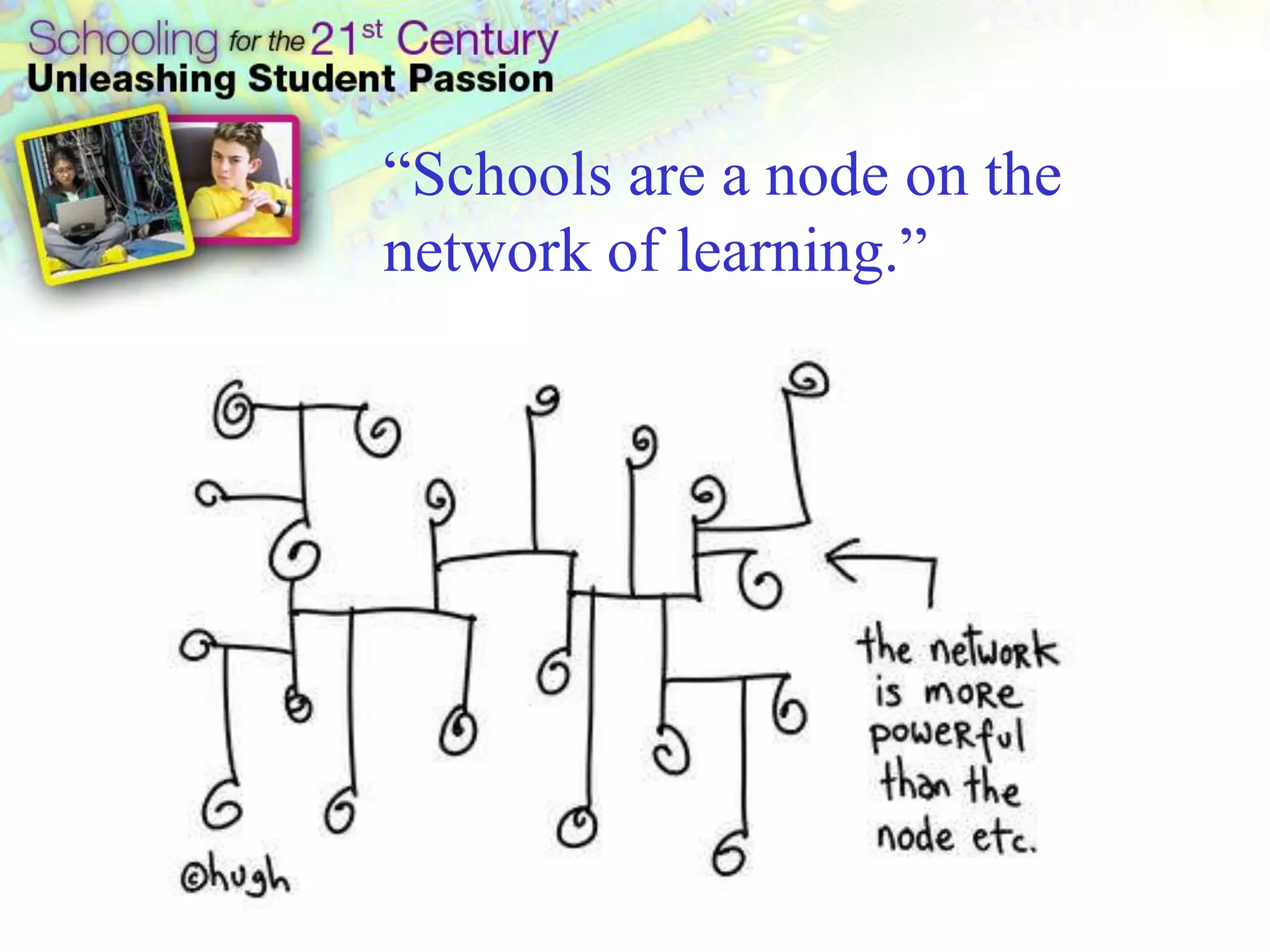
―Schools are a node on the
network of learning.‖
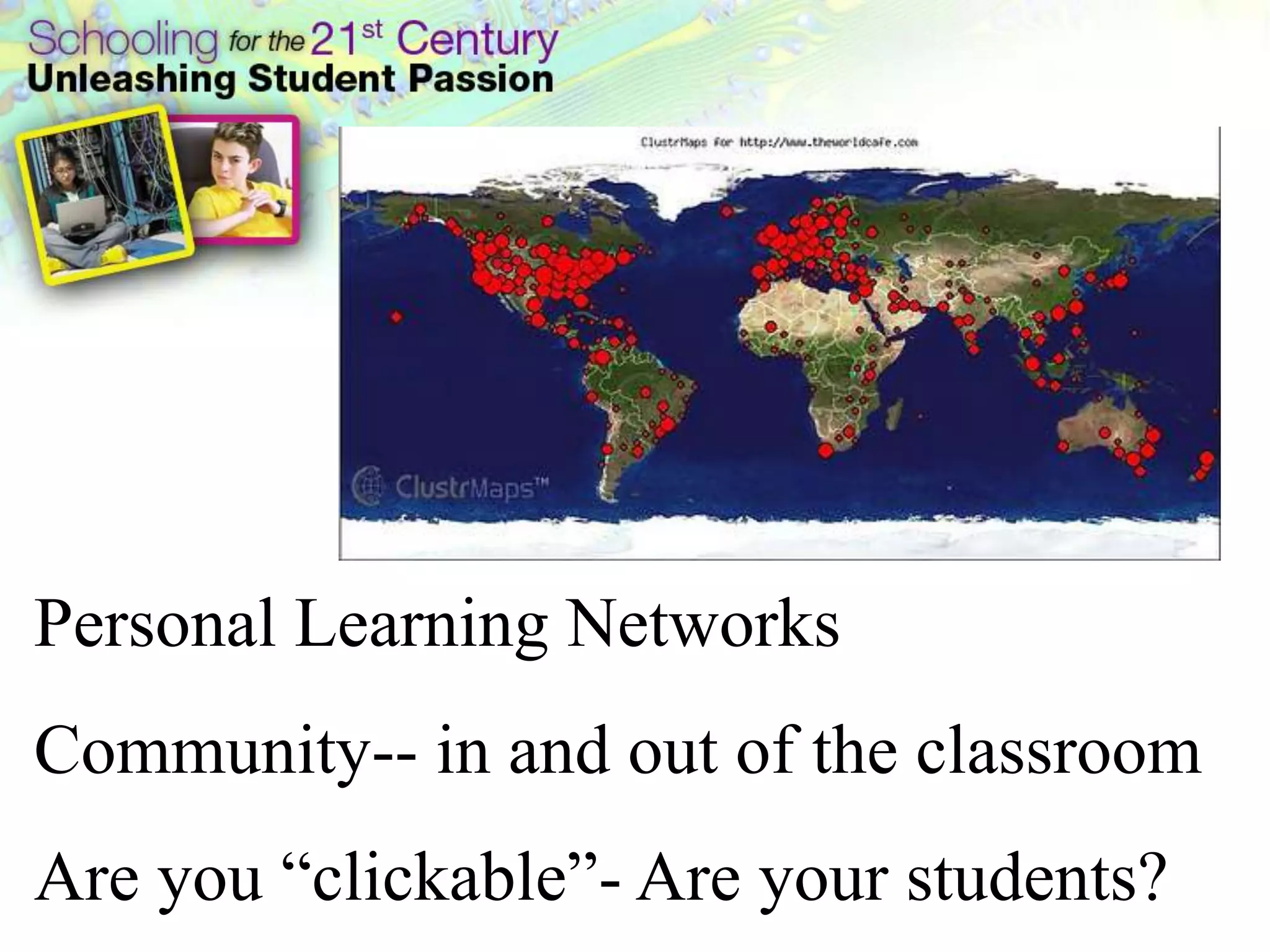
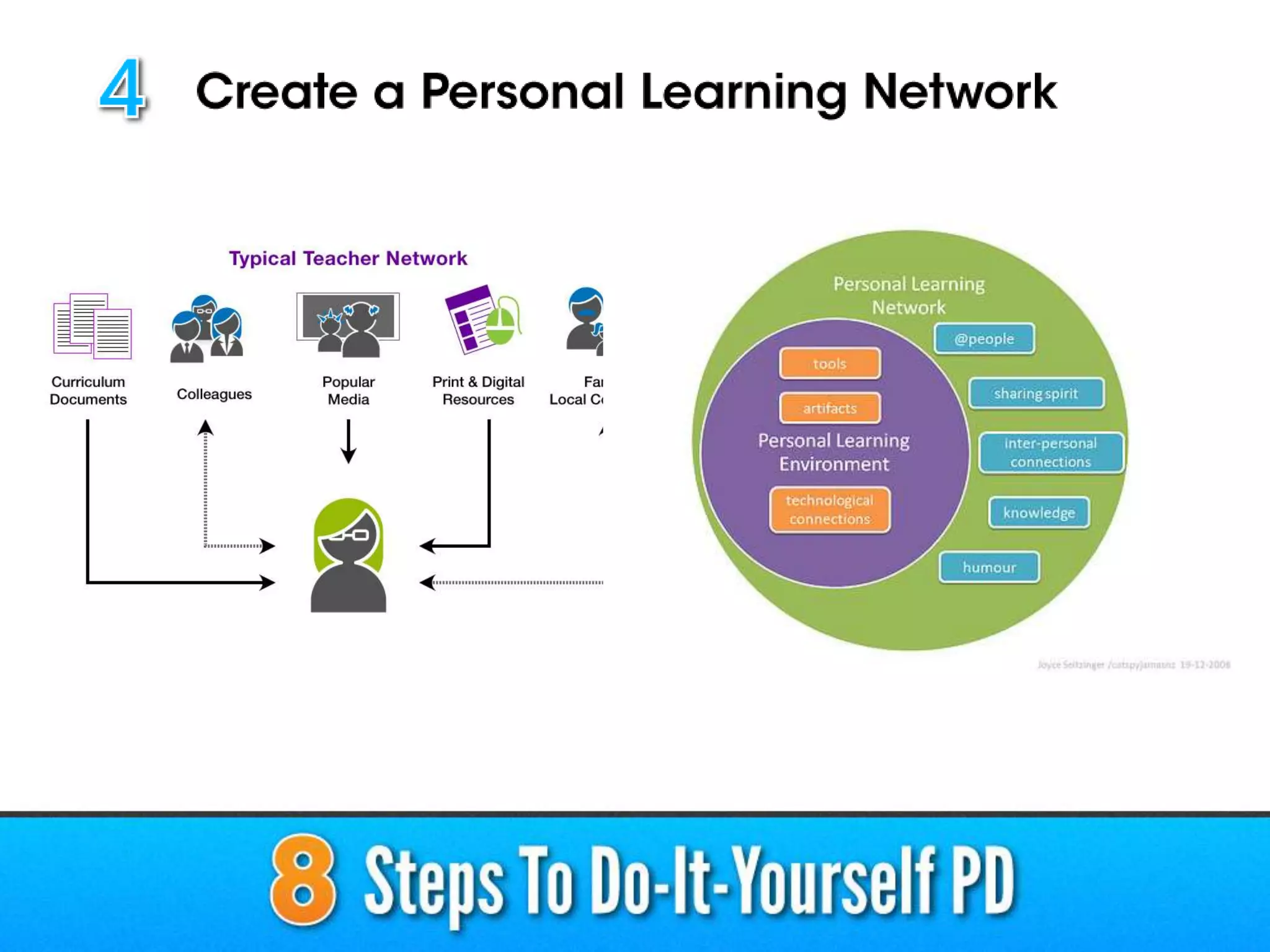
Personal Learning Networks
Community-- in and out of the classroom
Are you ―clickable‖- Are your students?
• THE CONNECTED EDUCATOR
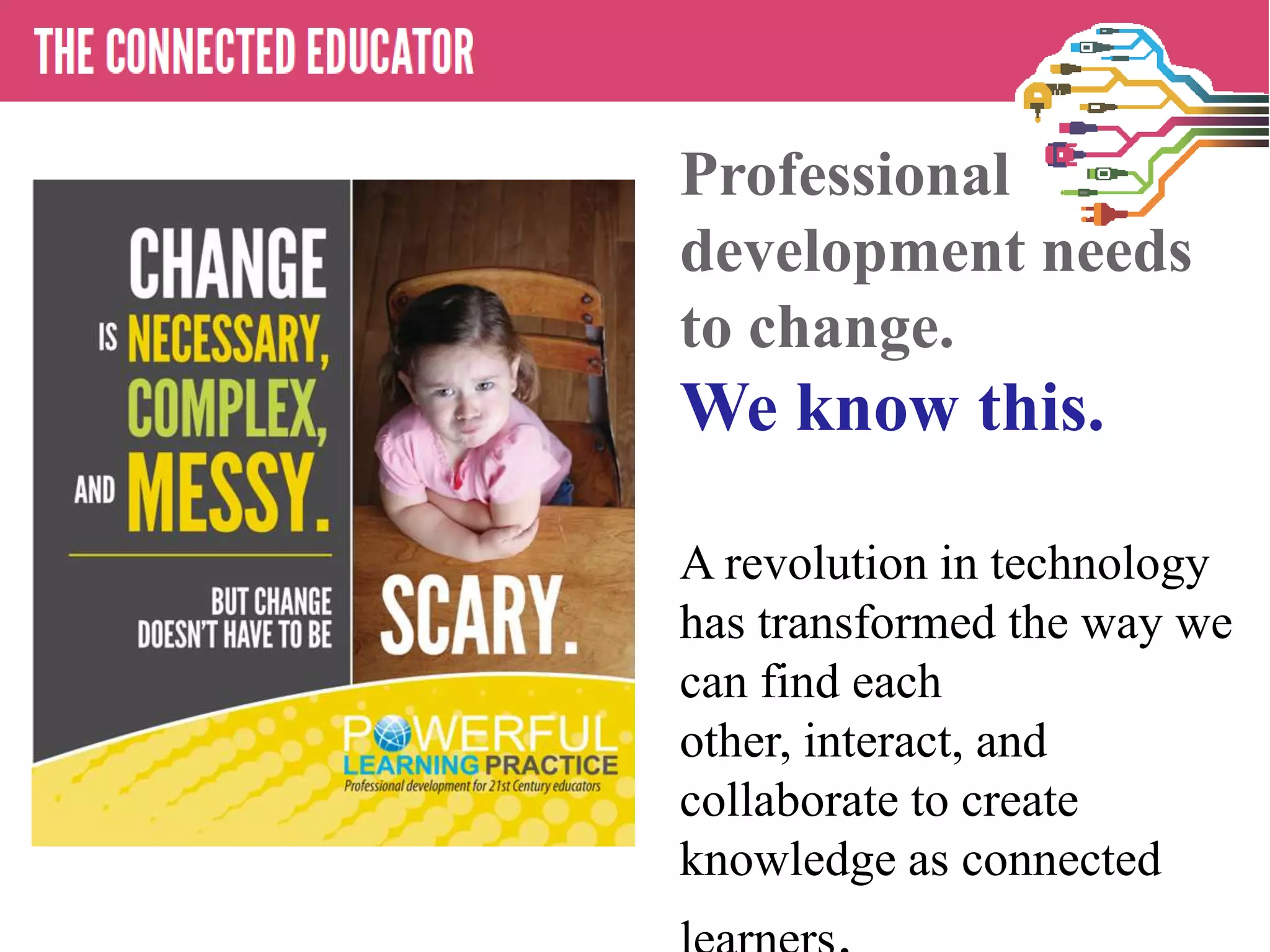
Professional
development needs
to change.
We know this.
A revolution in technology
has transformed the way we
can find each
other, interact, and
collaborate to create
knowledge as connected
Do it Yourself PD
A revolution in technology has transformed the way
we can find each other, interact, and collaborate to
create knowledge as connected learners.
What are connected learners?
Learners who collaborate online; learners who use
social media to connect with others around the globe;
learners who engage in conversations in safe online
spaces; learners who bring what they learn online back
to their classrooms, schools, and districts.
What is Do -It- Yourself Learning ?
What do you wonder…
About leading a connected school?
What is connected learning?
How do you define the terms?
Let’s build a common language.
• THE CONNECTED EDUCATOR
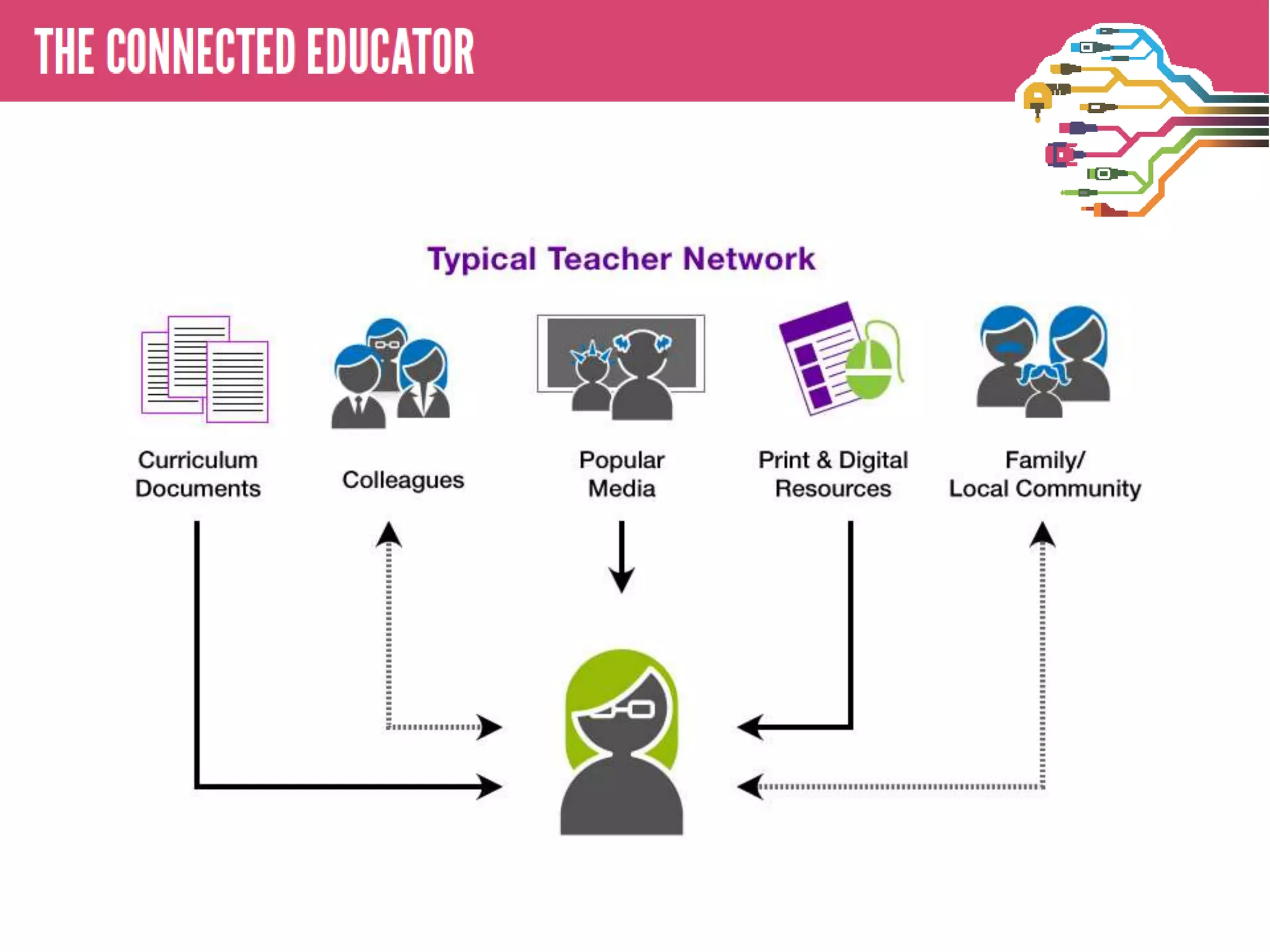
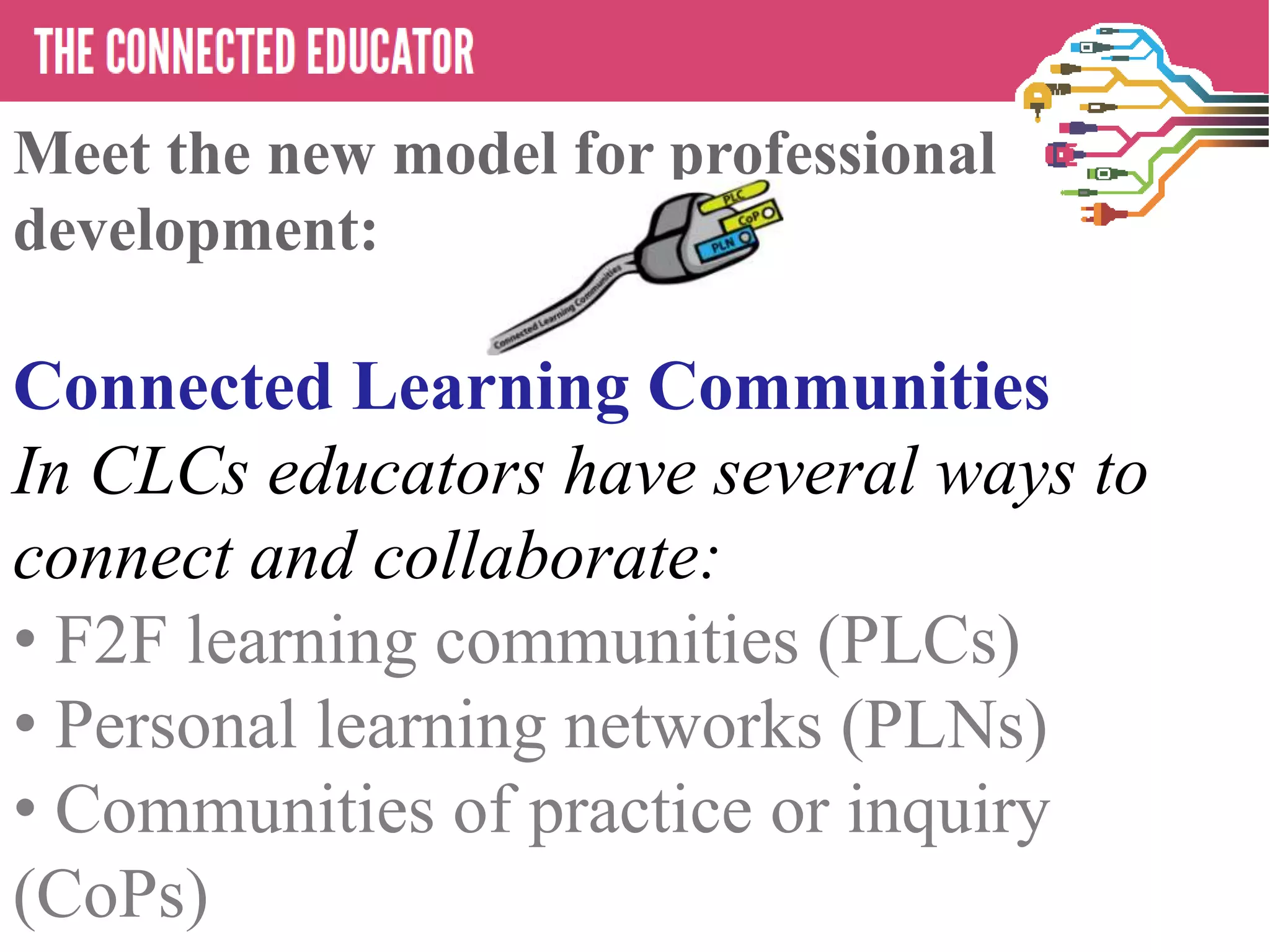
Meet the new model for professional
development:
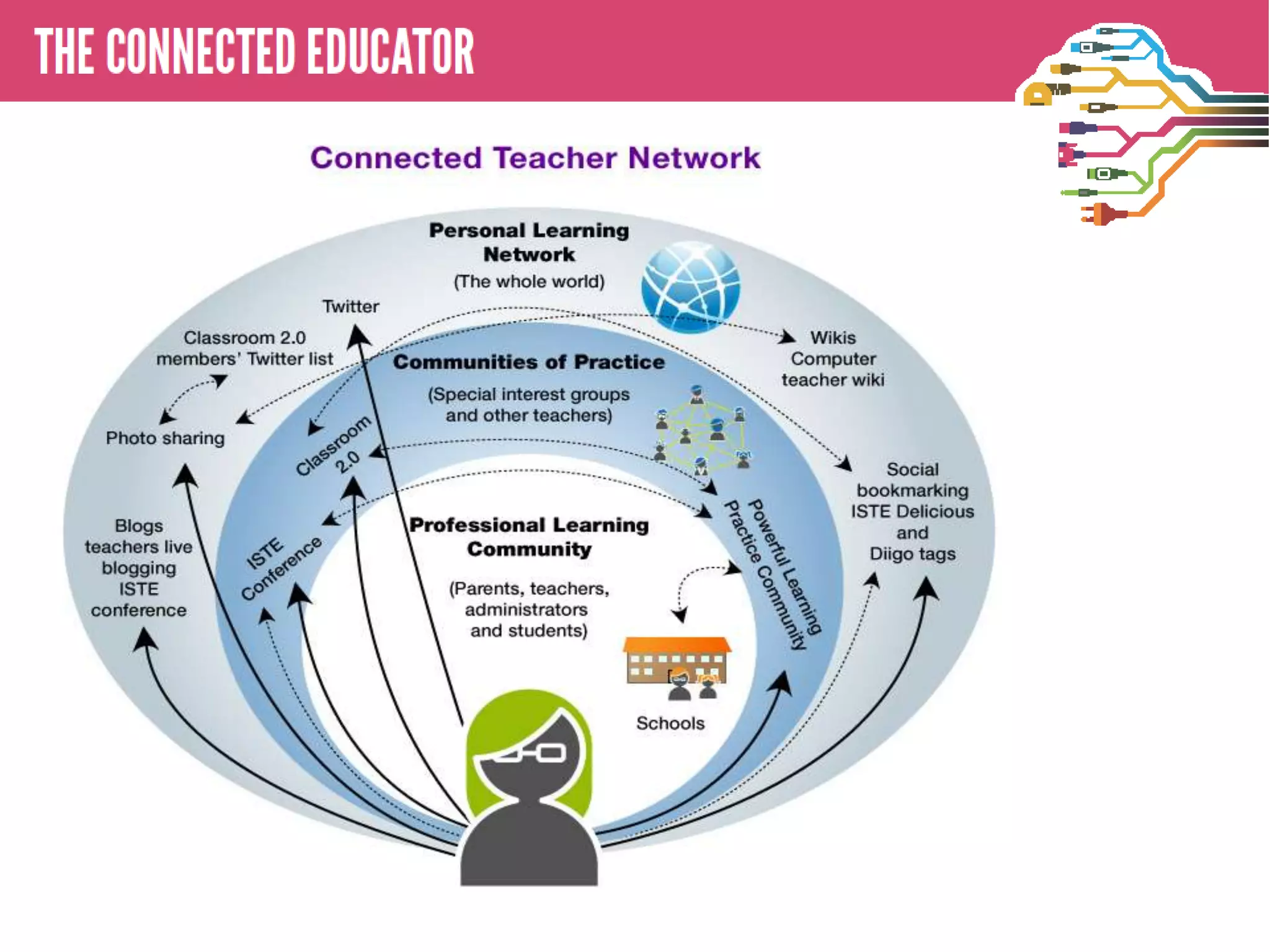
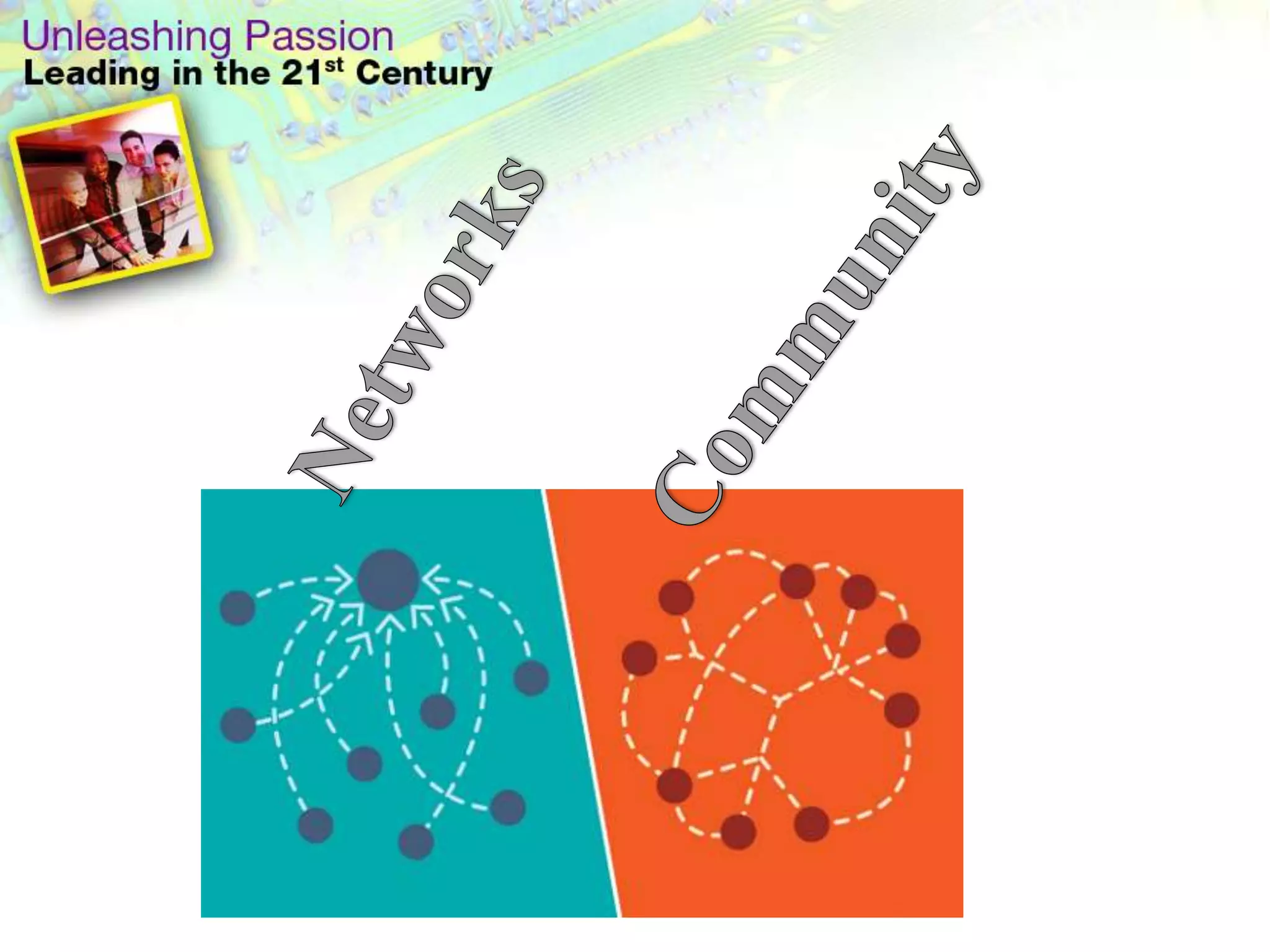
Connected Learning Communities
In CLCs educators have several ways to
connect and collaborate:
• F2F learning communities (PLCs)
• Personal learning networks (PLNs)
• Communities of practice or inquiry
(CoPs)
• THE CONNECTED EDUCATOR
1. Local community: Purposeful, face-to-face
connections among members of a committed group—
a professional learning community (PLC)
2. Global network: Individually chosen, online
connections with a diverse collection of people and
resources from around the world—a personal learning
network (PLN)
3. Bounded community: A committed, collective, and
often global group of individuals who have
overlapping interests and recognize a need for
connections that go deeper than the personal learning
network or the professional learning community can
provide—a community of practice or inquiry (CoP)
• THE CONNECTED EDUCATOR
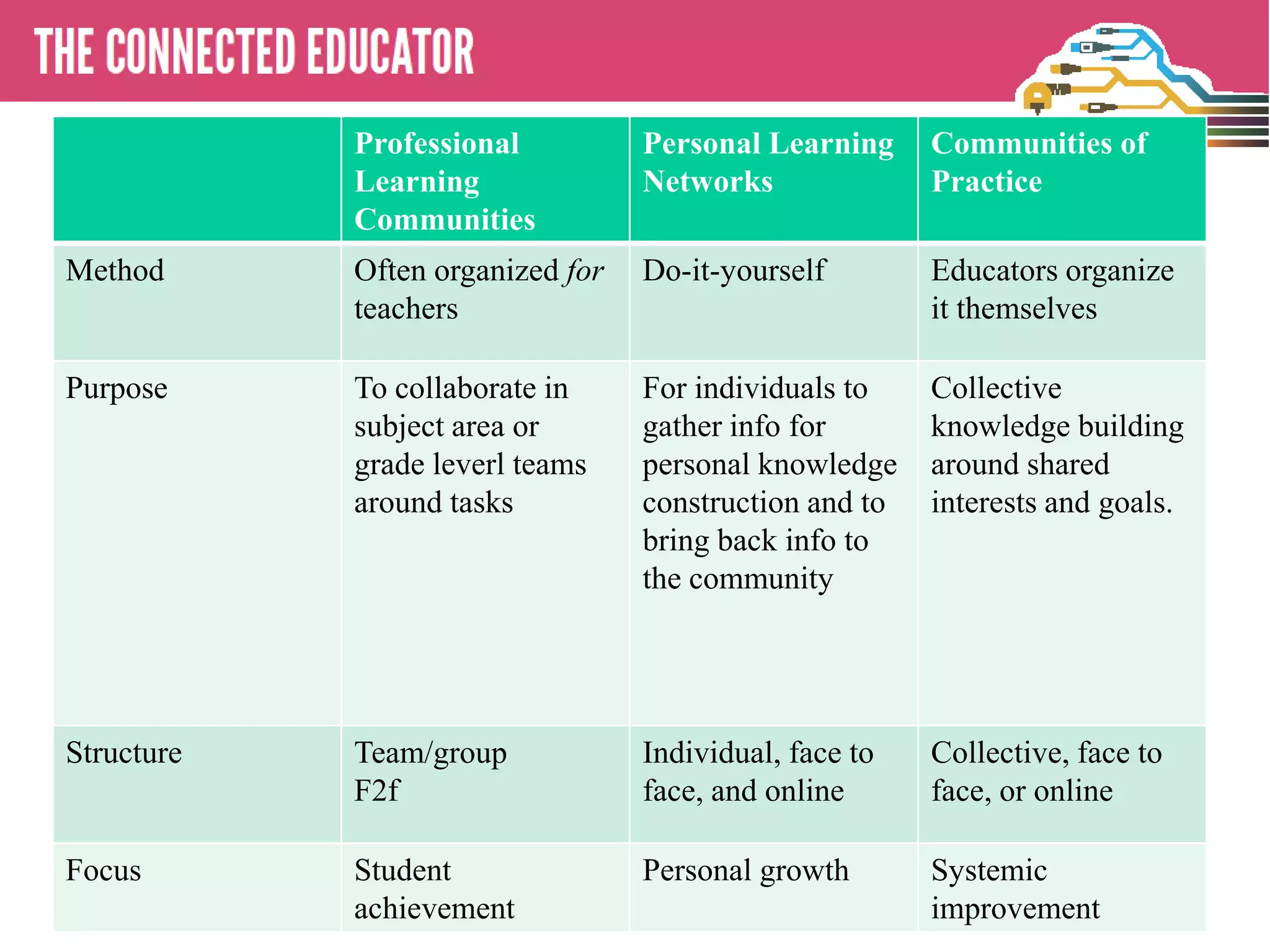
Professional
Learning
Communities
Personal Learning
Networks
Communities of
Practice
Method Often organized for
teachers
Do-it-yourself Educators organize
it themselves
Purpose To collaborate in
subject area or
grade leverl teams
around tasks
For individuals to
gather info for
personal knowledge
construction and to
bring back info to
the community
Collective
knowledge building
around shared
interests and goals.
Structure Team/group
F2f
Individual, face to
face, and online
Collective, face to
face, or online
Focus Student
achievement
Personal growth Systemic
improvement
Community is the New Professional Development
Cochran-Smith and Lytle (1999a) describe three ways of knowing and constructing
knowledge…
Knowledge for Practice is often reflected in traditional PD efforts when a trainer shares
with teachers information produced by educational researchers. This knowledge presumes
a commonly accepted degree of correctness about what is being shared. The learner is
typically passive in this kind of "sit and get" experience. This kind of knowledge is
difficult for teachers to transfer to classrooms without support and follow through. After a
workshop, much of what was useful gets lost in the daily grind, pressures and isolation of
teaching.
Knowledge in Practice recognizes the importance of teacher experience and practical
knowledge in improving classroom practice. As a teacher tests out new strategies and
assimilates them into teaching routines they construct knowledge in practice. They learn
by doing. This knowledge is strengthened when teachers reflect and share with one
another lessons learned during specific teaching sessions and describe the tacit
knowledge embedded in their experiences.
Community is the New Professional Development
Knowledge of Practice believes that systematic inquiry where teachers create
knowledge as they focus on raising questions about and systematically studying
their own classroom teaching practices collaboratively, allows educators to
construct knowledge of practice in ways that move beyond the basics of
classroom practice to a more systemic view of learning.
I believe that by attending to the development of knowledge for, in and of
practice, we can enhance professional growth that leads to real change.
Cochran-Smith, M., & Lytle, S.L. (1999a). Relationships of knowledge and
practice: Teaching learning in communities. Review of Research in
Education, 24, 249-305.
Passive, active, and reflective knowledge
building in local (PLC), global (CoP) and
contextual (PLN) learning spaces.
Dedication to the
ongoing development
of expertise
Shares and contributes
Engages in strength-based approaches
and appreciative inquiry
Demonstrates mindfulness
Willingness to leaving one's comfort
zone to experiment with new strategies
and taking on new responsibilities
Dispositions and Values
Commitment to understanding
asking good questions
Explores ideas and
concepts, rethinking, revising, and
continuously repacks and
unpacks, resisting
urges to finish prematurely
Co-learner, Co-leader, Co-creator
Self directed, open minded
Commits to deep reflection
Transparent in thinking
Values and engages in a culture of
collegiality
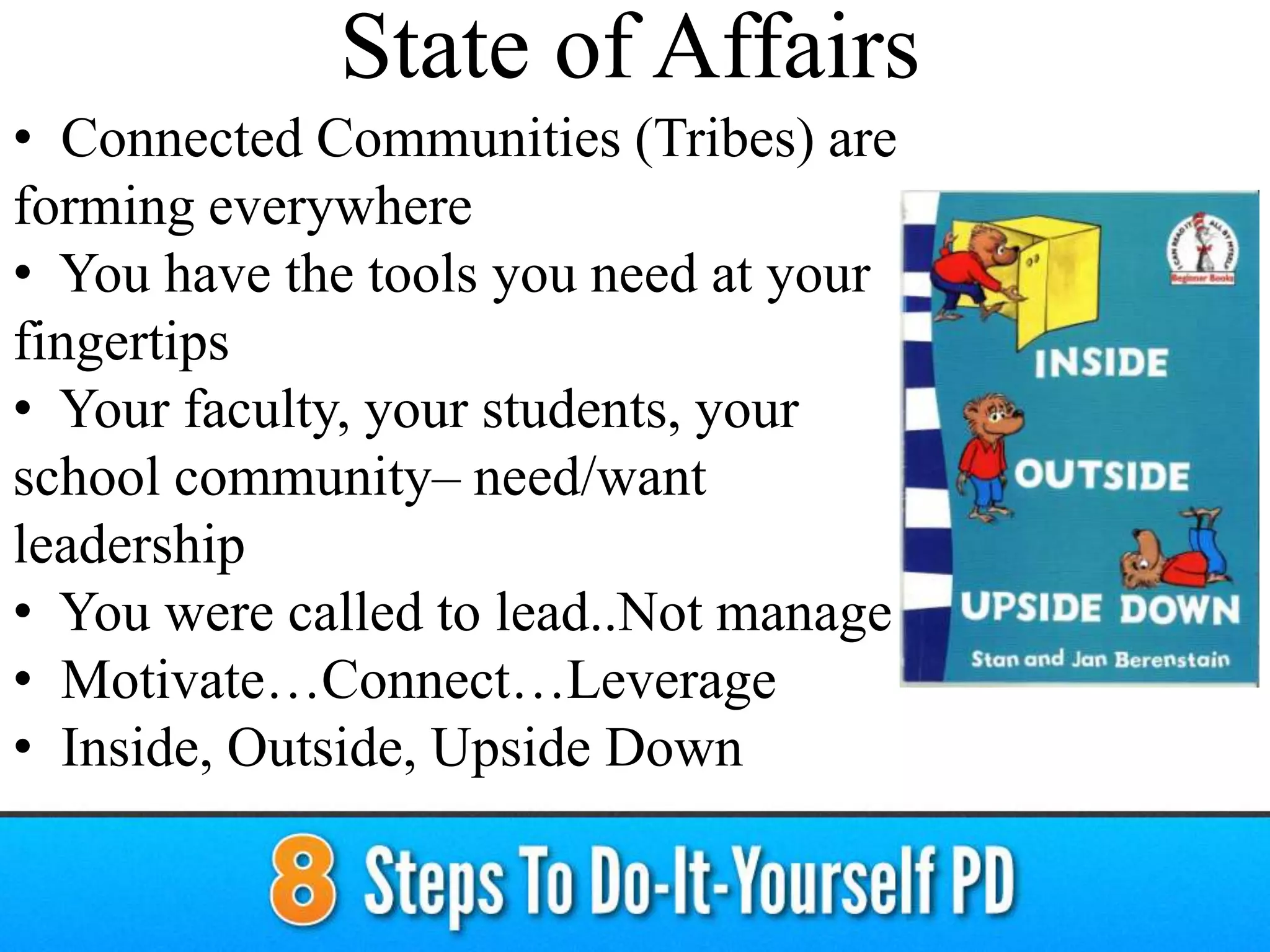
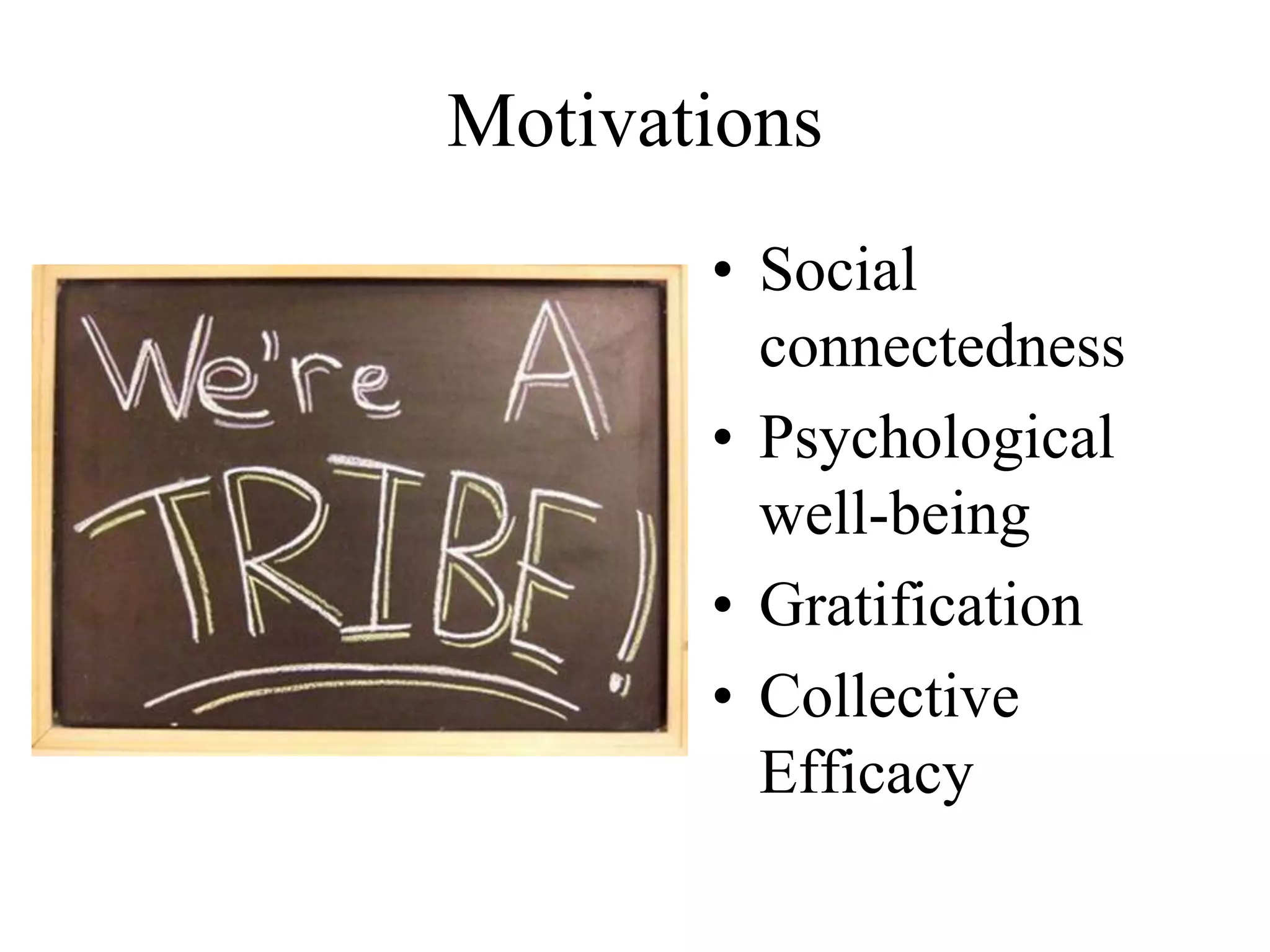
• Connected Communities (Tribes) are
forming everywhere
• You have the tools you need at your
fingertips
• Your faculty, your students, your
school community– need/want
leadership
• You were called to lead..Not manage
• Motivate…Connect…Leverage
• Inside, Outside, Upside Down
State of Affairs
Status Quo-- Things are working well most of the time.
THEN
Something happens that creates a sense of urgency to change.
A desire to learn something new. You are presented with
evidence that makes you feel something. It touches you in some
way.
Maybe…
- a disturbing look at a problem
- a hopeful glimpse of the future
- a sobering self reflection
One of three things happen:
1. Complacency - You are moved but fail act - telling yourself or
others, "Everything is fine."
2. False urgency - You are busy, working-working-working and
never reflect or move yourself to action. You talk and it scratches the
itch.
3. True urgency or passion- You are clearly focused on making real
progress every single day. Urgent behavior is driven by a belief that
the world contains great opportunities and great hazards. It inspires a
gut-level determination to move, and win, now.
You see it. You feel it and you are moved to change or act or learn
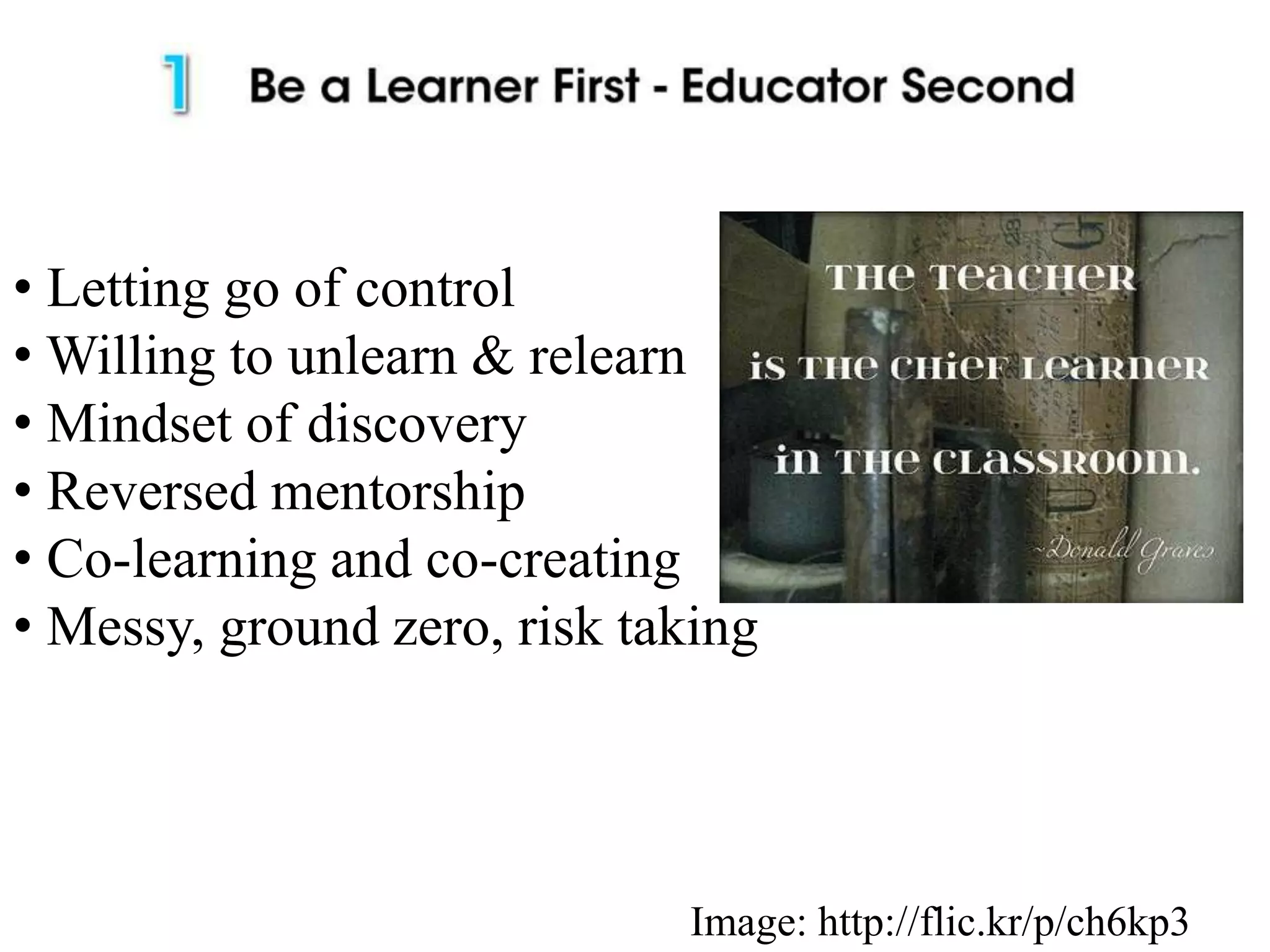
• Letting go of control
• Willing to unlearn & relearn
• Mindset of discovery
• Reversed mentorship
• Co-learning and co-creating
• Messy, ground zero, risk taking
Image: http://flic.kr/p/ch6kp3
Be a learner first—leader second
• It's all about asking hard questions and then listening deeply
• A connected learner isn’t afraid to admit that they don’t know the answer
to a question or problem, and willingly invite others into a dialogue to
explore, discuss, debate, or generate more questions. (@barb_english)
• Asking our questions out in the open in connected ways @lisaneale
• I believe that being a connected learner leads to more questions than
answers and that is good. I also believe that connected learners have to
learn to take risks - exposing your learning and thoughts can be challenging
@ccoffa
• Lurkers become learners. Learners become contributors. @sjhayes8
Wonder is both a
sense of awe and
capacity for
contemplation.
It also helps to ask questions like:
1) Why am I planning to do this?
2) How will I initiate this change?
3) Who can I connect with online in my network that can help me?
4) How will I measure our progress?
Or how will I know if we are learning?
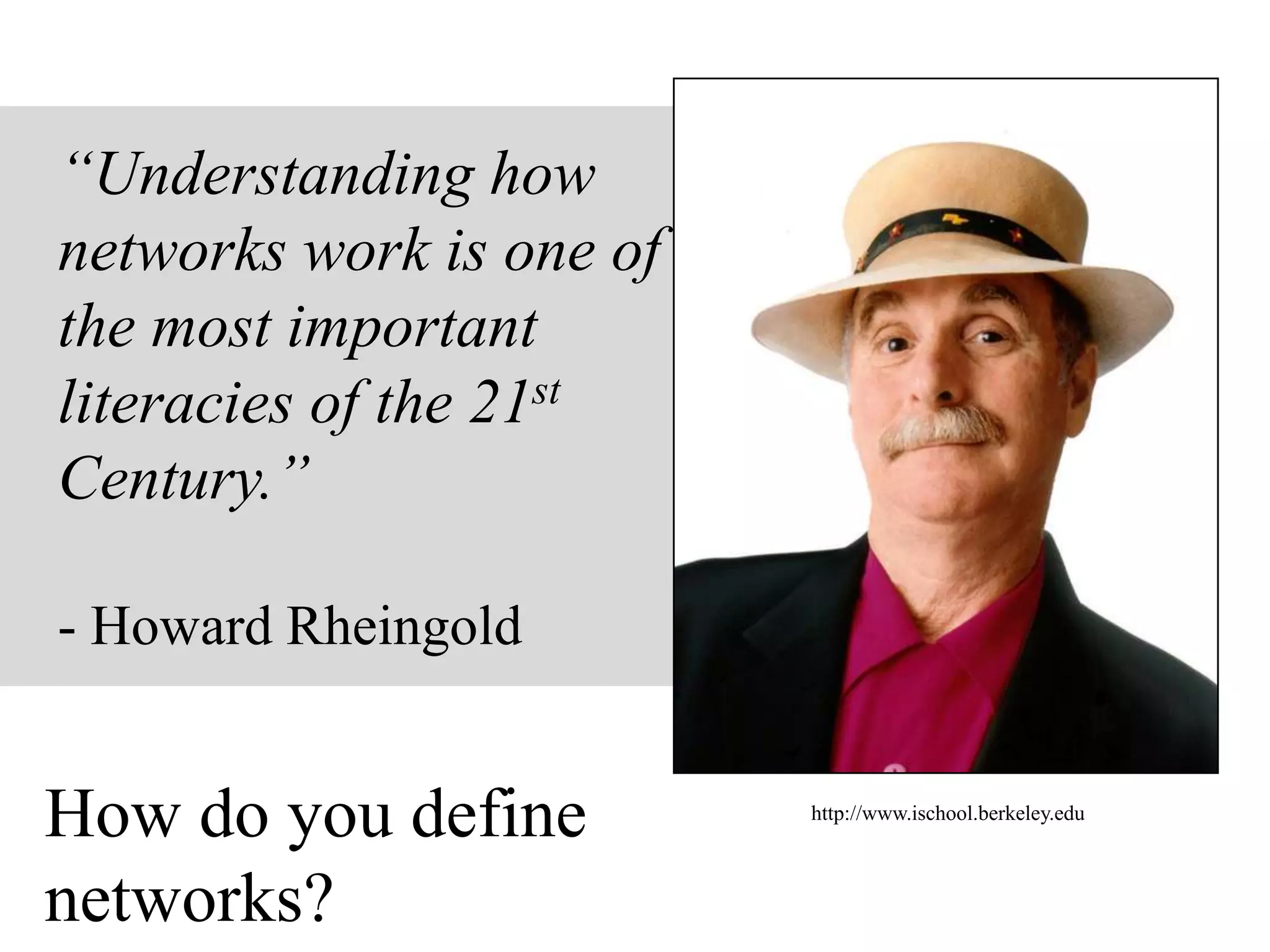
“Understanding how
networks work is one of
the most important
literacies of the 21st
Century.”
- Howard Rheingold
http://www.ischool.berkeley.edu
How do you define
networks?
In
connectivism, learnin
g involves creating
connections and
developing a network.
It is a theory for the
digital age drawing
upon chaos, emergent
properties, and self
organized learning.
Photo credit: Cogdogblog
George Siemens
Image: http://epltt.coe.uga.edu/images/2/24/Connectivism_chart.gif
Personal Learning
Networks
FOCUS: Individual, Connecting to Learning Objects, Resources
and People – Social Network Driven
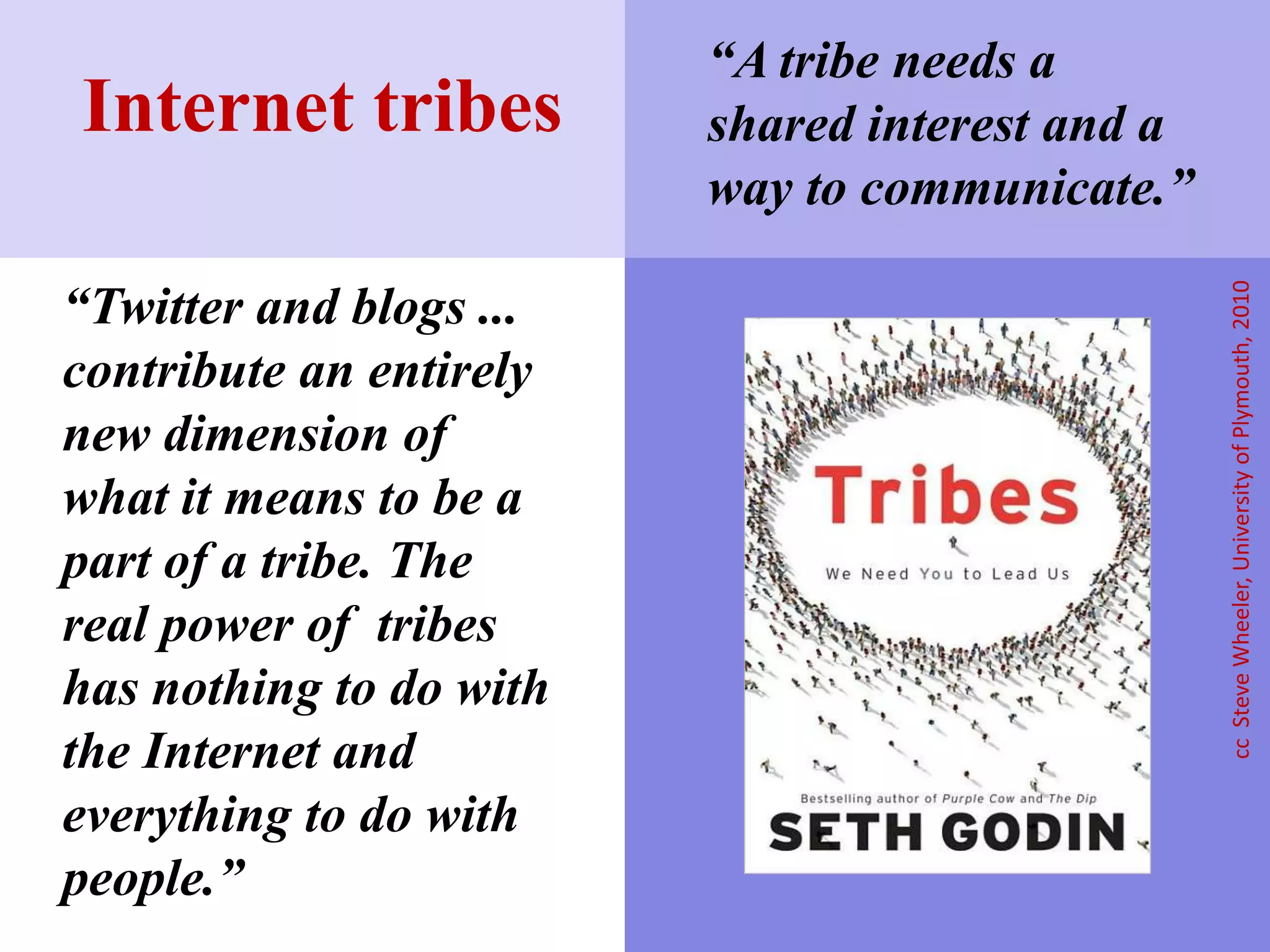
“Twitter and blogs ...
contribute an entirely
new dimension of
what it means to be a
part of a tribe. The
real power of tribes
has nothing to do with
the Internet and
everything to do with
people.”
Internet tribes
ccSteveWheeler,UniversityofPlymouth,2010
“A tribe needs a
shared interest and a
way to communicate.”
Connected Learning Communities provide the personal
learning environment (PLE) to do the nudging
Motivations
• Social
connectedness
• Psychological
well-being
• Gratification
• Collective
Efficacy
Use a 3-pronged
Approach
What
is community, really?
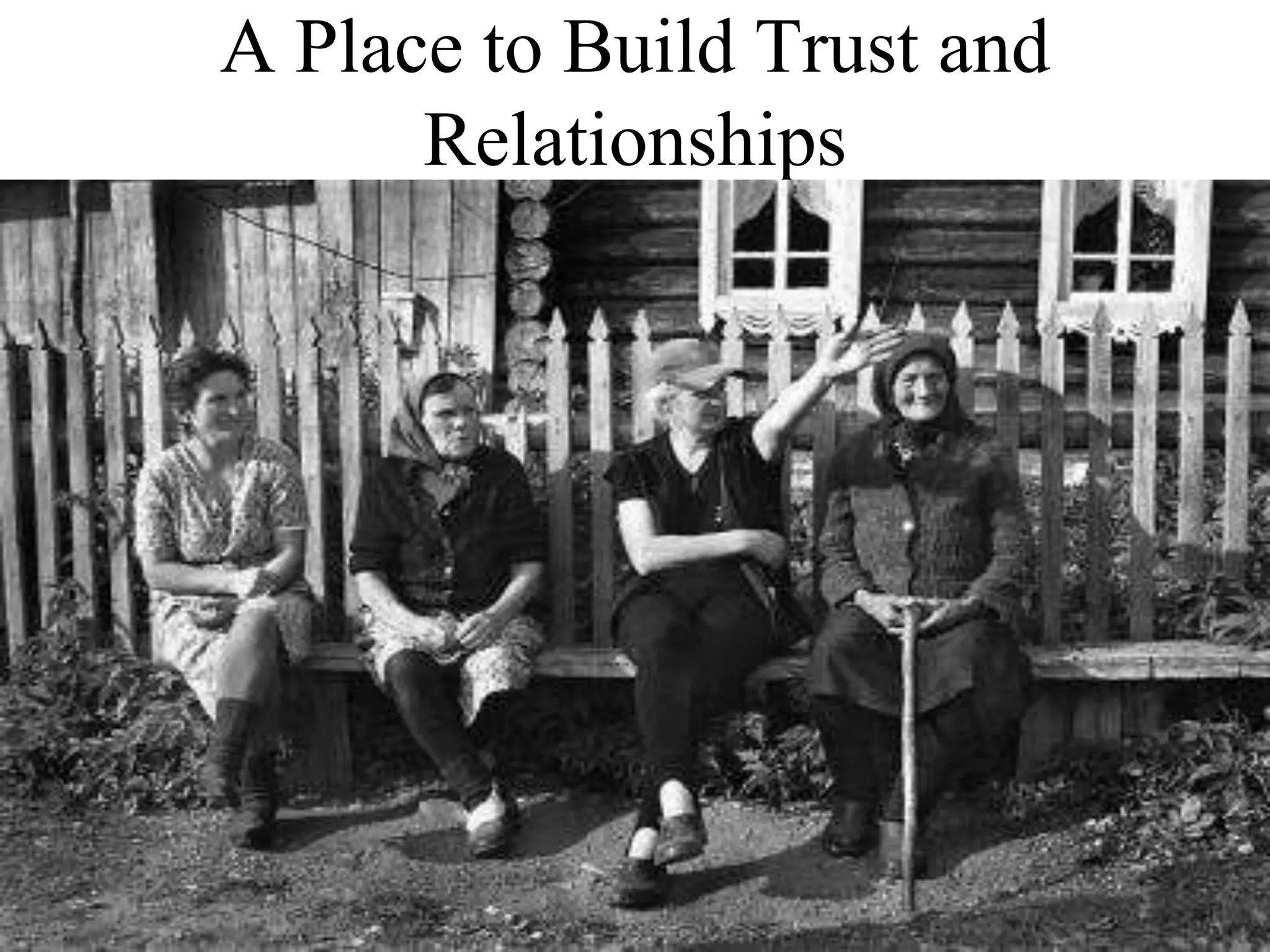
A Place to Build Trust and
Relationships
A Domain of Interest
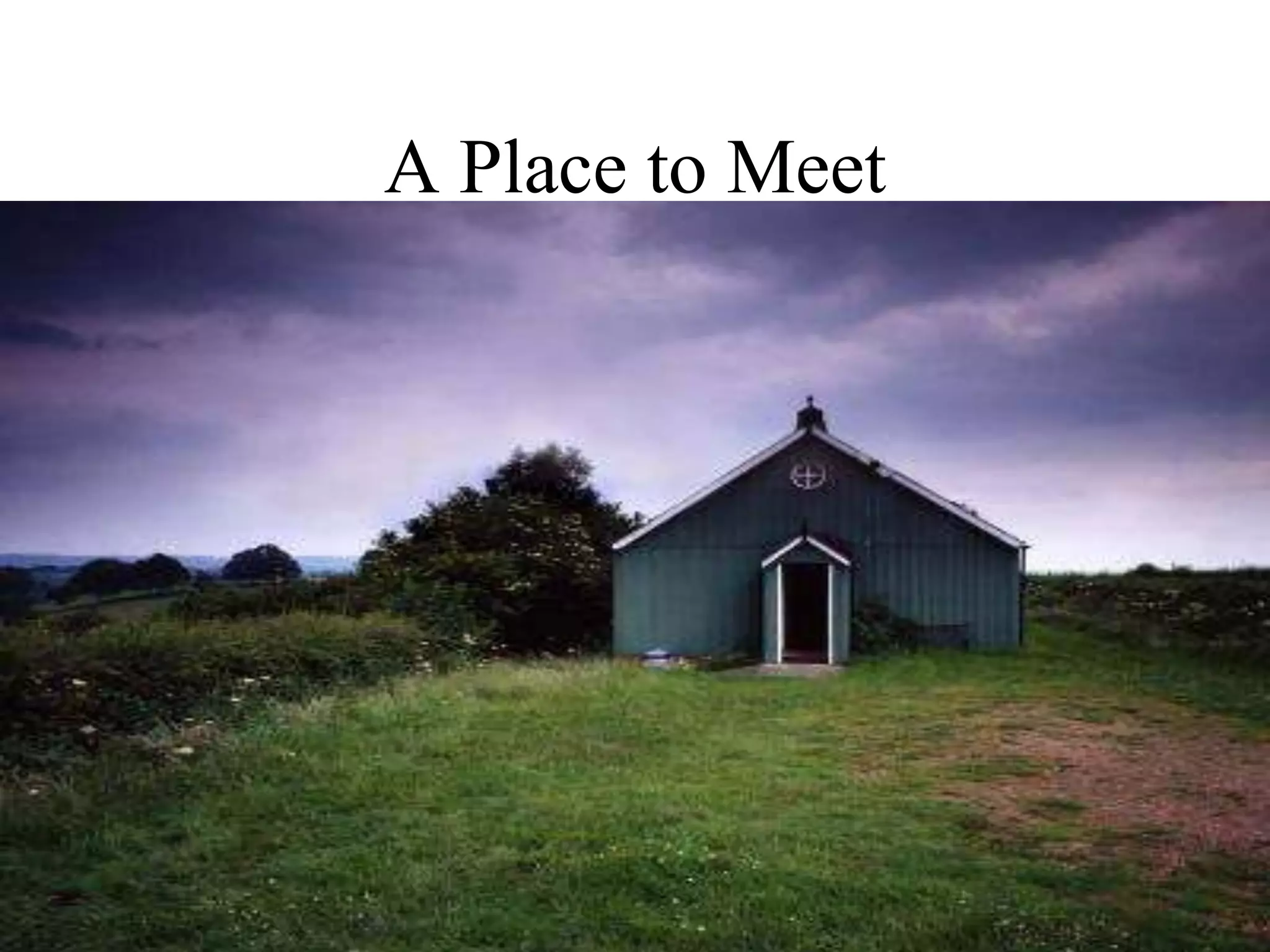
A Place to Meet
A Place to Construct Knowledge
Collaboratively
CelebrationCelebration
A Community of Practice is a network of individuals with common
problems or interests who get together to explore ways of
working, identify common solutions, and share good practice and
ideas.
• puts you in touch with like-minded colleagues and peers
• allows you to share your experiences and learn from others
• allows you to collaborate and achieve common outcomes
• accelerates your learning
• Improves student achievement
• validates and builds on existing knowledge and good practice
• provides the opportunity to innovate and create new ideas
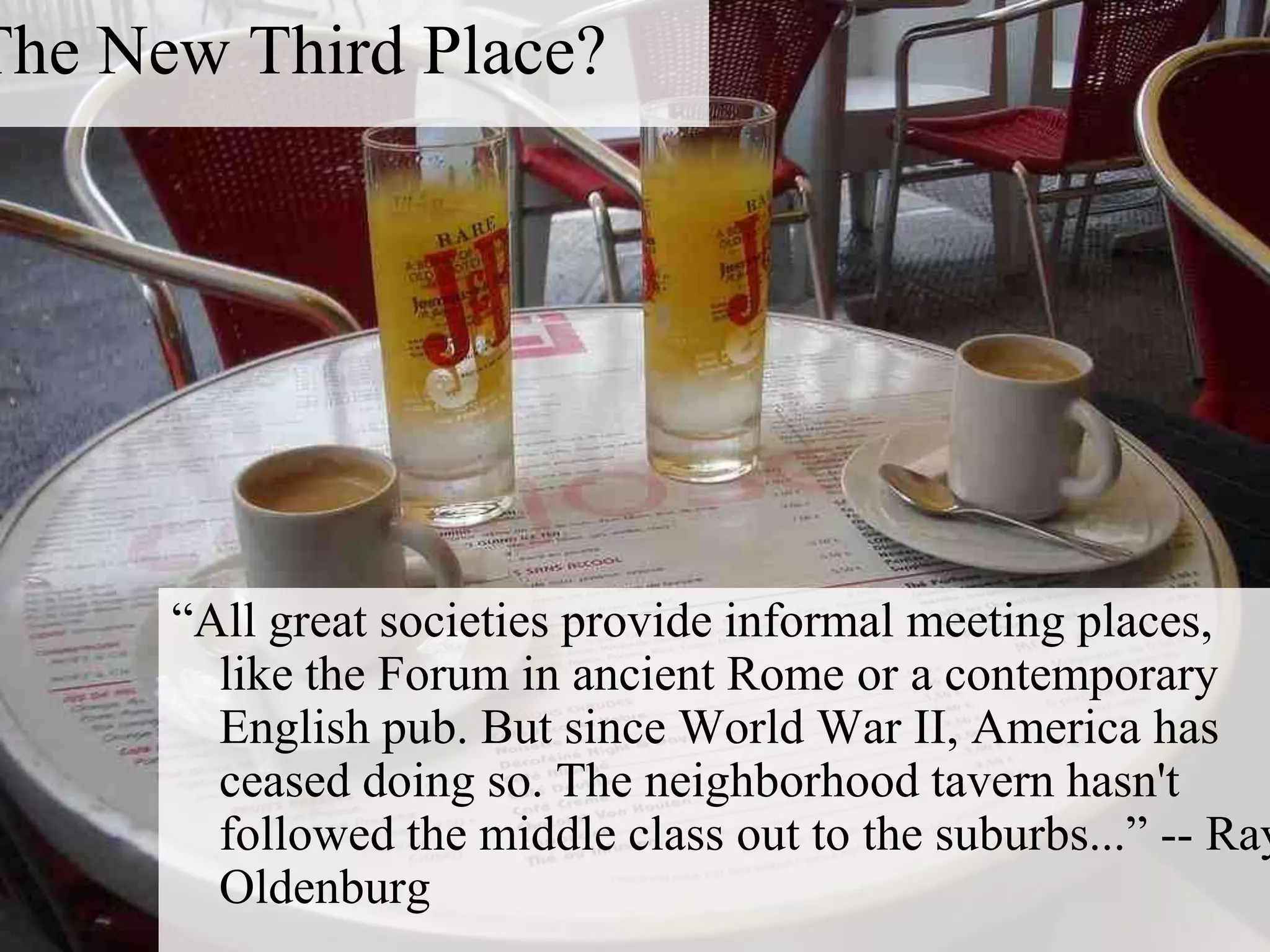
The New Third Place?
―All great societies provide informal meeting places,
like the Forum in ancient Rome or a contemporary
English pub. But since World War II, America has
ceased doing so. The neighborhood tavern hasn't
followed the middle class out to the suburbs...‖ -- Ray
Oldenburg
― Do you know what who you know knows?‖ H. Rheingold
Critical friends: Form a professional learning team who come together
voluntarily at least once a month. Have members commit to improving
their practice through collaborative learning. Use protocols to examine
each other’s teaching or leadership activities and share both warm and
cool feedback in respectful ways.
Curriculum review or mapping groups: Meet regularly in teams to
review what team members are teaching, to reflect together on the
impact of assumptions that underlie the curriculum, and to make
collaborative decisions. Teams often study lesson plans together.
Action research groups: Do active, collaborative research focused
on improvement around a possibility or problem in a classroom,
school, district, or state.
Book study groups: Collaboratively read and discuss a book in an
online space.
Case studies: Analyze in detail specific situations and their
relationship to current thinking and pedagogy. Write, discuss, and
reflect on cases using a 21st century lens to produce collaborative
reflection and improve practice.
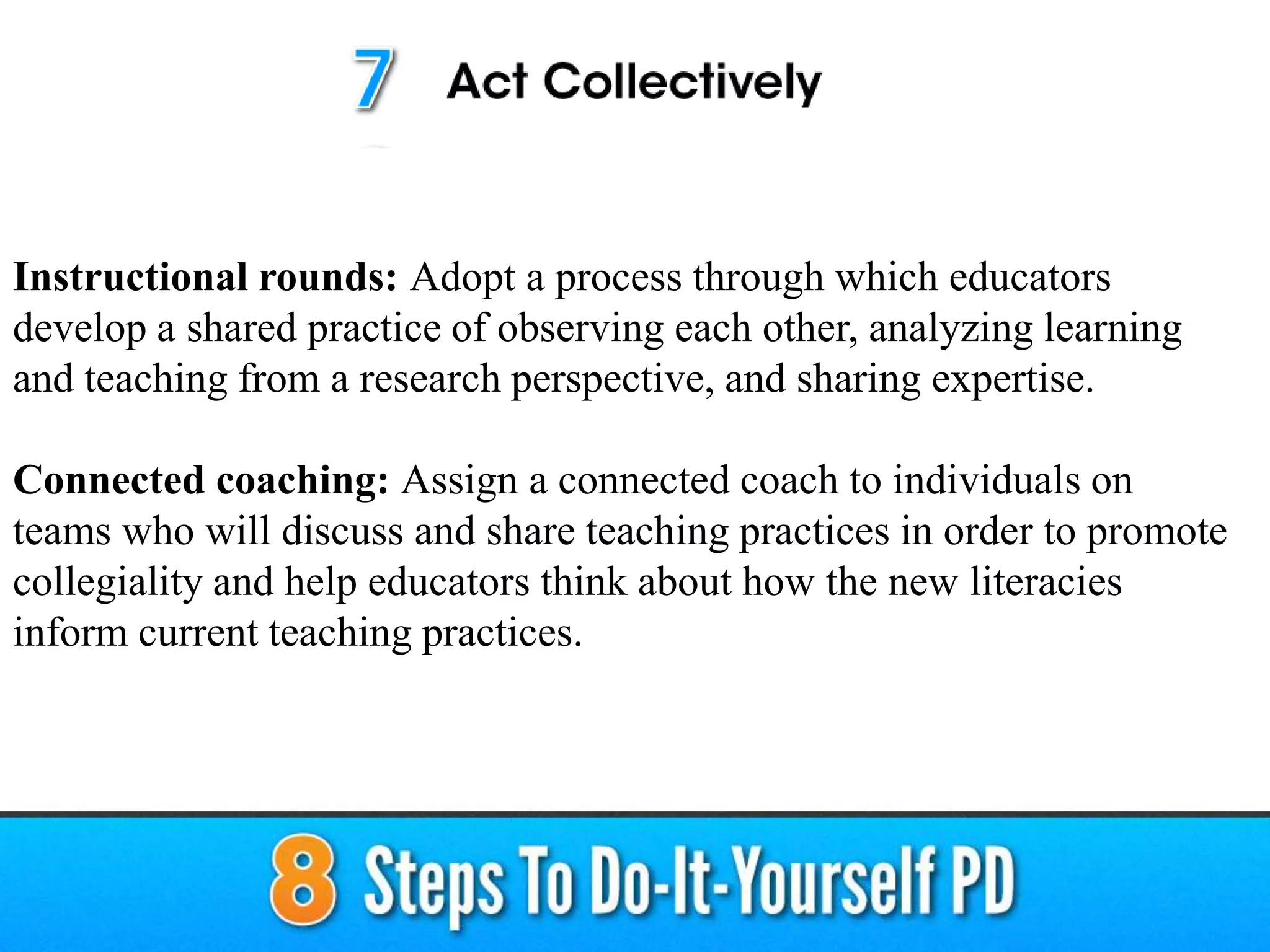
Instructional rounds: Adopt a process through which educators
develop a shared practice of observing each other, analyzing learning
and teaching from a research perspective, and sharing expertise.
Connected coaching: Assign a connected coach to individuals on
teams who will discuss and share teaching practices in order to promote
collegiality and help educators think about how the new literacies
inform current teaching practices.
"Imagine an organization with an employee who can accurately see
the truth, understand the situation, and understand the potential
outcomes of various decisions. And now imagine that this person is
able to make something happen." ~ Seth Godin.
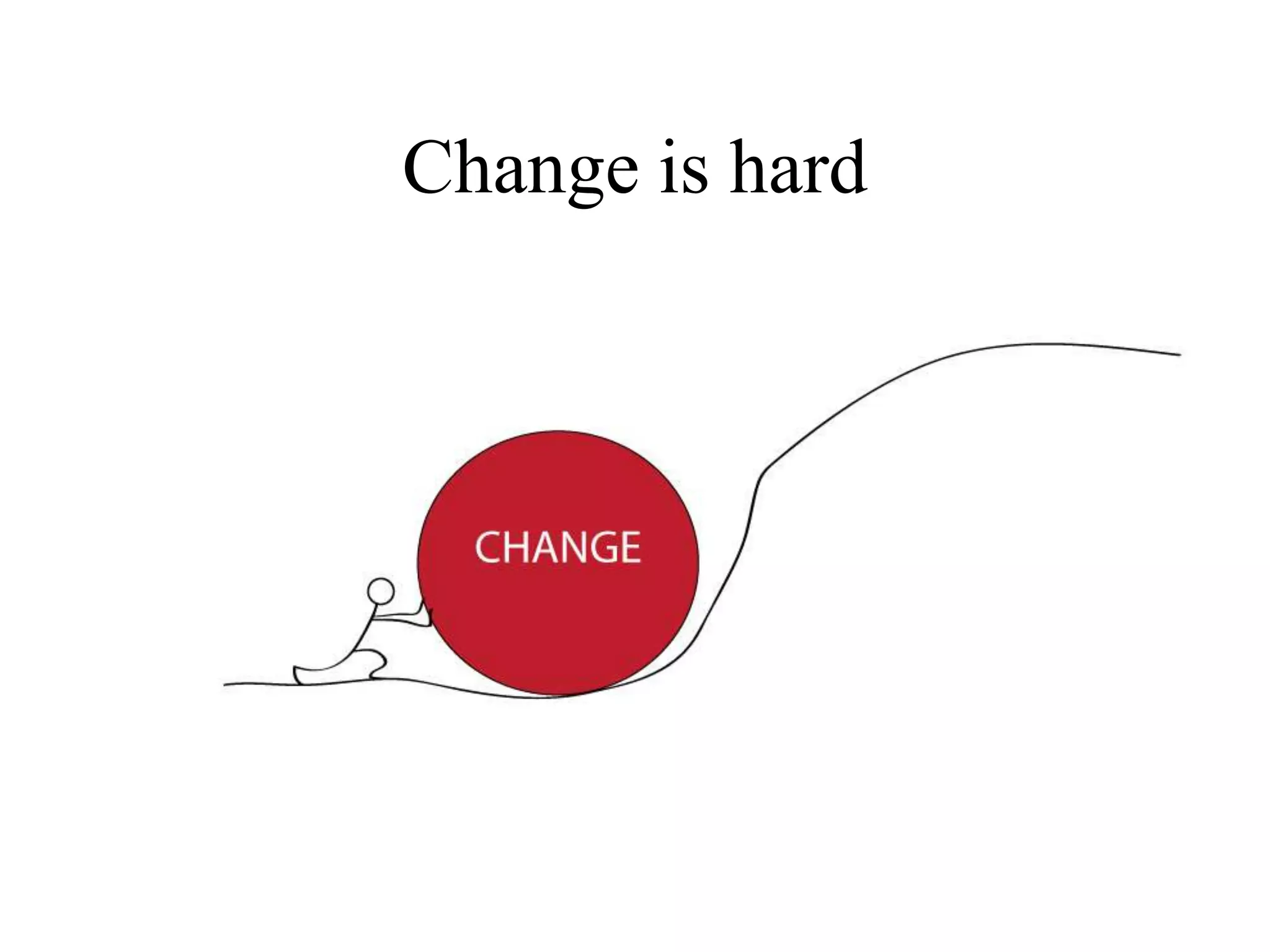
Change is hard
Connected learners are more
effective change agents

Noel13

  • 2.
    Sheryl Nussbaum-Beach Co-Founder &CEO Powerful Learning Practice, LLC http://plpnetwork.com sheryl@plpnetwork.com President 21st Century Collaborative, LLC http://21stcenturycollaborative.com Author The Connected Educator: Learning and Leading in a Digital Age Follow me on Twitter @snbeach
  • 4.
    • THE CONNECTEDEDUCATOR Housekeeping Get close to someone Paperless handouts http://plpwiki.com Back Channel Chat http://todaysmeet.com/NOEL13
  • 5.
    All of October Freeprofessional learning Free for you– free for your staff http://connectededucators.org/
  • 6.
    edConnectr • Robust matchmakingtool for learning & innovation • Uses tags to make it easy to create rich, action-oriented profiles • Uses maps to make it easy and fun to find others • Helps educators find collaborators, get help, or just connect
  • 7.
    District and StateSupport • District toolkit, Part 1 – Support for participation in CEM – Examples of district at different levels, with videos and links – Links to tools and resources at each level • District toolkit, Part 2 – Support for integrating informal and formal professional learning year round – Readiness assessment, planning, implementation, and evaluation tools
  • 8.
    Starter Kits, BookClubs, More • Starter kit updated, offering an activity each day • Book club expanded to four books, each with author involvement • Community directory continues to expand • Connected educator profiles expand throughout month • Help desk, open houses
  • 9.
    Digital Badges • Fourtypes: – Event – Starter Kit – Peer-to-peer – Connected educator • Published to Mozilla Backpack – Can create a collection as your ―digital transcript‖ of your CEM participation – Can include badges from such as those from our open badge catalog
  • 10.
    Learner First— Educator Second Introduceyourselves to each other and brag a little. Talk about (in 2 min or less) the most recent or compelling connected learning project you have recently led, discovered, or been involved in. Emerson and Thoreau reunited would ask- ―What has become clearer to you since we last met?‖
  • 11.
    Mantra for today’skeynote… We are stronger together than apart. None of us is as smart, creative, good or interesting as all of us.
  • 12.
    • THE CONNECTEDEDUCATOR Things do not change; we change. —Henry David Thoreau What are you doing to contextualize and mobilize what you are learning? How will you leverage, how will you enable your teachers or your students to leverage- collective intelligence?
  • 14.
    Are you Readyfor Learning and Leading in the 21st Century? It isn’t just ―coming‖… it has arrived! And schools who aren’t redefining themselves, risk becoming irrelevant in preparing students for the future.
  • 15.
    The world ischanging...
  • 16.
    By the year2011 80% of all Fortune 500 companies will be using immersive worlds – Gartner Vice President Jackie Fenn Libraries 2.0 Management 2.0 Education 2.0 Warfare 2.0 Government 2.0 Vatican 2.0 Credit: Hugh MacLeod, gapingvoid Everything 2.0
  • 17.
    6 Trends forthe digital age Analogue Digital Tethered Mobile Closed Open Isolated Connected Generic Personal Consuming Creating Source: David Wiley: Openness and the disaggregated future of higher education
  • 18.
    ―We are tetheredto our always on/ always on us communication devices and the people and things we reach through them.‖ ~ Sherry Turkle
  • 19.
    Shifting From ShiftingTo Learning at school Learning anytime/anywhere Teaching as a private event Teaching as a public collaborative practice Learning as passive participant Learning in a participatory culture Learning as individuals Linear knowledge Learning in a networked community Distributed knowledge
  • 20.
    Shift in Learning– The Possibilities Rethinking teaching and learning… 1. Multiliterate 2. Changing Demographic 3. Active Content Creators 4. Global Collaboration and Communication We are in the midst of seeing education transform from a book-based, linear system with a focus on individual achievement to an web-based, divergent system with a focus on community building.
  • 21.
    dangeuslyirrelevant.org Our kids havetasted the honey. http://www.dangerouslyirrelevant.org/2009/02/a-taste-of-honey.html
  • 22.
    22 Free range learners Free-rangelearners choose how and what they learn. Self- service is less expensive and more timely than the alternative. Informal learning has no need for the busywork, chrome, and bureaucracy that accompany typical classroom instruction.
  • 23.
    • THE CONNECTEDEDUCATOR The Disconnect ―Every time I go to school, I have to power down.‖ --a high school student
  • 24.
    The pace ofchange is accelerating
  • 25.
    It is estimatedthat 1.5 exabytes of unique new information will be generated worldwide this year. That’s estimated to be more than in the previous 5,000 years. Knowledge Creation
  • 26.
    For students startinga four-year education degree, this means that . . . half of what they learn in their first year of study will be outdated by their third year of study.
  • 27.
    Time Travel Lewis Perelman,author of School's Out (1992). Perelman argues that schools are out of sync with technological change: ...the technological gap between the school environment and the "real world" is growing so wide, so fast that the classroom experience is on the way to becoming not merely unproductive but increasingly irrelevant to normal human existence (p.215). Seymour Papert (1993) In the wake of the startling growth of science and technology in our recent past, some areas of human activity have undergone megachange. Telecommunications, entertainment and transportation, as well as medicine, are among them. School is a notable example of an area that has not(p.2).
  • 28.
    Shift in Learning= New Possibilities Shift from emphasis on teaching… To an emphasis on co-learning
  • 29.
    Shifts focus ofliteracy from individual expression to community involvement.
  • 30.
    Shifts focus ofliteracy from individual expression to community involvement.
  • 31.
    Connected Learning The computerconnects the student to the rest of the world Learning occurs through connections with other learners Learning is based on conversation and interaction Stephen Downes
  • 32.
    Share Cooperate Collaborate Collective Action According toClay Shirky, there are four steps on a ladder to mastering the connected world: sharing, cooperating, collaborating, and collective action. From his book- “Here Comes Everybody”
  • 33.
    Connected Learner Scale Share(Publish & Participate) – Connect (Comment and Cooperate) – Remixing (building on the ideas of others) – Collaborate (Co-construction of knowledge and meaning) – Collective Action (Social Justice, Activism, Service Learning) –
  • 34.
    34 Education for Citizenship ―Acapable and productive citizen doesn’t simply turn up for jury service. Rather, she is capable of serving impartially on trials that may require learning unfamiliar facts and concepts and new ways to communicate and reach decisions with her fellow jurors…. Jurors may be called on to decide complex matters that require the verbal, reasoning, math, science, and socialization skills that should be imparted in public schools. Jurors today must determine questions of fact concerning DNA evidence, statistical analyses, and convoluted financial fraud, to name only three topics.‖ Justice Leland DeGrasse, 2001
  • 35.
    ―Schools are anode on the network of learning.‖
  • 36.
    Personal Learning Networks Community--in and out of the classroom Are you ―clickable‖- Are your students?
  • 37.
    • THE CONNECTEDEDUCATOR Professional development needs to change. We know this. A revolution in technology has transformed the way we can find each other, interact, and collaborate to create knowledge as connected
  • 38.
    Do it YourselfPD A revolution in technology has transformed the way we can find each other, interact, and collaborate to create knowledge as connected learners. What are connected learners? Learners who collaborate online; learners who use social media to connect with others around the globe; learners who engage in conversations in safe online spaces; learners who bring what they learn online back to their classrooms, schools, and districts.
  • 39.
    What is Do-It- Yourself Learning ?
  • 40.
    What do youwonder… About leading a connected school? What is connected learning? How do you define the terms? Let’s build a common language.
  • 41.
  • 42.
  • 43.
    • THE CONNECTEDEDUCATOR Meet the new model for professional development: Connected Learning Communities In CLCs educators have several ways to connect and collaborate: • F2F learning communities (PLCs) • Personal learning networks (PLNs) • Communities of practice or inquiry (CoPs)
  • 44.
    • THE CONNECTEDEDUCATOR 1. Local community: Purposeful, face-to-face connections among members of a committed group— a professional learning community (PLC) 2. Global network: Individually chosen, online connections with a diverse collection of people and resources from around the world—a personal learning network (PLN) 3. Bounded community: A committed, collective, and often global group of individuals who have overlapping interests and recognize a need for connections that go deeper than the personal learning network or the professional learning community can provide—a community of practice or inquiry (CoP)
  • 45.
    • THE CONNECTEDEDUCATOR Professional Learning Communities Personal Learning Networks Communities of Practice Method Often organized for teachers Do-it-yourself Educators organize it themselves Purpose To collaborate in subject area or grade leverl teams around tasks For individuals to gather info for personal knowledge construction and to bring back info to the community Collective knowledge building around shared interests and goals. Structure Team/group F2f Individual, face to face, and online Collective, face to face, or online Focus Student achievement Personal growth Systemic improvement
  • 46.
    Community is theNew Professional Development Cochran-Smith and Lytle (1999a) describe three ways of knowing and constructing knowledge… Knowledge for Practice is often reflected in traditional PD efforts when a trainer shares with teachers information produced by educational researchers. This knowledge presumes a commonly accepted degree of correctness about what is being shared. The learner is typically passive in this kind of "sit and get" experience. This kind of knowledge is difficult for teachers to transfer to classrooms without support and follow through. After a workshop, much of what was useful gets lost in the daily grind, pressures and isolation of teaching. Knowledge in Practice recognizes the importance of teacher experience and practical knowledge in improving classroom practice. As a teacher tests out new strategies and assimilates them into teaching routines they construct knowledge in practice. They learn by doing. This knowledge is strengthened when teachers reflect and share with one another lessons learned during specific teaching sessions and describe the tacit knowledge embedded in their experiences.
  • 47.
    Community is theNew Professional Development Knowledge of Practice believes that systematic inquiry where teachers create knowledge as they focus on raising questions about and systematically studying their own classroom teaching practices collaboratively, allows educators to construct knowledge of practice in ways that move beyond the basics of classroom practice to a more systemic view of learning. I believe that by attending to the development of knowledge for, in and of practice, we can enhance professional growth that leads to real change. Cochran-Smith, M., & Lytle, S.L. (1999a). Relationships of knowledge and practice: Teaching learning in communities. Review of Research in Education, 24, 249-305. Passive, active, and reflective knowledge building in local (PLC), global (CoP) and contextual (PLN) learning spaces.
  • 48.
    Dedication to the ongoingdevelopment of expertise Shares and contributes Engages in strength-based approaches and appreciative inquiry Demonstrates mindfulness Willingness to leaving one's comfort zone to experiment with new strategies and taking on new responsibilities Dispositions and Values Commitment to understanding asking good questions Explores ideas and concepts, rethinking, revising, and continuously repacks and unpacks, resisting urges to finish prematurely Co-learner, Co-leader, Co-creator Self directed, open minded Commits to deep reflection Transparent in thinking Values and engages in a culture of collegiality
  • 49.
    • Connected Communities(Tribes) are forming everywhere • You have the tools you need at your fingertips • Your faculty, your students, your school community– need/want leadership • You were called to lead..Not manage • Motivate…Connect…Leverage • Inside, Outside, Upside Down State of Affairs
  • 50.
    Status Quo-- Thingsare working well most of the time. THEN Something happens that creates a sense of urgency to change. A desire to learn something new. You are presented with evidence that makes you feel something. It touches you in some way. Maybe… - a disturbing look at a problem - a hopeful glimpse of the future - a sobering self reflection
  • 51.
    One of threethings happen: 1. Complacency - You are moved but fail act - telling yourself or others, "Everything is fine." 2. False urgency - You are busy, working-working-working and never reflect or move yourself to action. You talk and it scratches the itch. 3. True urgency or passion- You are clearly focused on making real progress every single day. Urgent behavior is driven by a belief that the world contains great opportunities and great hazards. It inspires a gut-level determination to move, and win, now. You see it. You feel it and you are moved to change or act or learn
  • 53.
    • Letting goof control • Willing to unlearn & relearn • Mindset of discovery • Reversed mentorship • Co-learning and co-creating • Messy, ground zero, risk taking Image: http://flic.kr/p/ch6kp3
  • 54.
    Be a learnerfirst—leader second • It's all about asking hard questions and then listening deeply • A connected learner isn’t afraid to admit that they don’t know the answer to a question or problem, and willingly invite others into a dialogue to explore, discuss, debate, or generate more questions. (@barb_english) • Asking our questions out in the open in connected ways @lisaneale • I believe that being a connected learner leads to more questions than answers and that is good. I also believe that connected learners have to learn to take risks - exposing your learning and thoughts can be challenging @ccoffa • Lurkers become learners. Learners become contributors. @sjhayes8
  • 55.
    Wonder is botha sense of awe and capacity for contemplation.
  • 56.
    It also helpsto ask questions like: 1) Why am I planning to do this? 2) How will I initiate this change? 3) Who can I connect with online in my network that can help me? 4) How will I measure our progress? Or how will I know if we are learning?
  • 58.
    “Understanding how networks workis one of the most important literacies of the 21st Century.” - Howard Rheingold http://www.ischool.berkeley.edu How do you define networks?
  • 59.
    In connectivism, learnin g involvescreating connections and developing a network. It is a theory for the digital age drawing upon chaos, emergent properties, and self organized learning. Photo credit: Cogdogblog George Siemens
  • 60.
  • 61.
    Personal Learning Networks FOCUS: Individual,Connecting to Learning Objects, Resources and People – Social Network Driven
  • 62.
    “Twitter and blogs... contribute an entirely new dimension of what it means to be a part of a tribe. The real power of tribes has nothing to do with the Internet and everything to do with people.” Internet tribes ccSteveWheeler,UniversityofPlymouth,2010 “A tribe needs a shared interest and a way to communicate.”
  • 64.
    Connected Learning Communitiesprovide the personal learning environment (PLE) to do the nudging
  • 65.
  • 67.
  • 69.
  • 70.
    A Place toBuild Trust and Relationships
  • 71.
    A Domain ofInterest
  • 72.
  • 73.
    A Place toConstruct Knowledge Collaboratively
  • 74.
  • 75.
    A Community ofPractice is a network of individuals with common problems or interests who get together to explore ways of working, identify common solutions, and share good practice and ideas. • puts you in touch with like-minded colleagues and peers • allows you to share your experiences and learn from others • allows you to collaborate and achieve common outcomes • accelerates your learning • Improves student achievement • validates and builds on existing knowledge and good practice • provides the opportunity to innovate and create new ideas
  • 76.
    The New ThirdPlace? ―All great societies provide informal meeting places, like the Forum in ancient Rome or a contemporary English pub. But since World War II, America has ceased doing so. The neighborhood tavern hasn't followed the middle class out to the suburbs...‖ -- Ray Oldenburg
  • 78.
    ― Do youknow what who you know knows?‖ H. Rheingold
  • 79.
    Critical friends: Forma professional learning team who come together voluntarily at least once a month. Have members commit to improving their practice through collaborative learning. Use protocols to examine each other’s teaching or leadership activities and share both warm and cool feedback in respectful ways. Curriculum review or mapping groups: Meet regularly in teams to review what team members are teaching, to reflect together on the impact of assumptions that underlie the curriculum, and to make collaborative decisions. Teams often study lesson plans together.
  • 80.
    Action research groups:Do active, collaborative research focused on improvement around a possibility or problem in a classroom, school, district, or state. Book study groups: Collaboratively read and discuss a book in an online space. Case studies: Analyze in detail specific situations and their relationship to current thinking and pedagogy. Write, discuss, and reflect on cases using a 21st century lens to produce collaborative reflection and improve practice.
  • 81.
    Instructional rounds: Adopta process through which educators develop a shared practice of observing each other, analyzing learning and teaching from a research perspective, and sharing expertise. Connected coaching: Assign a connected coach to individuals on teams who will discuss and share teaching practices in order to promote collegiality and help educators think about how the new literacies inform current teaching practices.
  • 82.
    "Imagine an organizationwith an employee who can accurately see the truth, understand the situation, and understand the potential outcomes of various decisions. And now imagine that this person is able to make something happen." ~ Seth Godin.
  • 83.
  • 84.
    Connected learners aremore effective change agents

Editor's Notes

  • #7 CEM is about connecting, making connections
  • #22 Licensed under a Creative Commons attribution-share alike license.http://creativecommons.org/licenses/by-sa/3.0Scott McLeod, J.D., Ph.D.scottmcleod.net/contactdangerouslyirrelevant.orgschooltechleadership.orgOur kids have tasted the honey.www.flickr.com/photos/jahansell/251755048