- a short reflection about educational challenges for 2013 -
Up to a 5 star
learning environment!
Check out with me 5 major changes/suggestions to create
a future proof instructional and curriculum design…
Is this familiar to you?
Honestly, I’m bored… to hear about learning outcomes. For too many
years now, people have been focusing on this as if it is or can be the
(only) drive for good education!
From the Ministry of Education to universities to headmasters and
teacher trainers... everybody worries about refining, updating,
implementing learning outcomes.
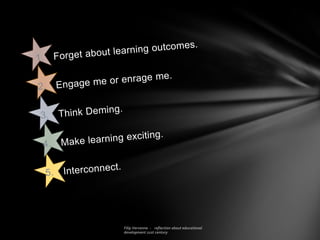
Well, enough,… forget about learning outcomes!
FORGET ABOUT…
In my opinion,
learning outcomes are
• pretentious
• unrealistic
• endless listed
• useless
• and simply creepy for students
Why forget about…?
What is feasible…?
Not everything that can be counted, counts.
Not everything that counts, can be counted.
ALBERT EINSTEIN
Competences/learning outcomes:
Don’t waste your time and
just draw some general competences
based on the well-known BLOOM-matrix: goals, aims for knowledge,
skills, attitudes…
linked to your discipline / course / training.
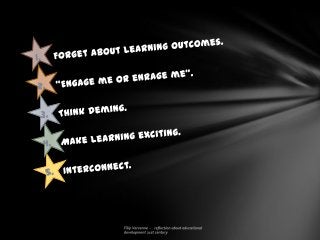
Put your energy in what really matters, the next stars,…
… so what’s up?
Try to engage the learner
in the whole cycle of the learning process.
Nowadays it’s very common to engage the learner in the learning
activities with assignments, group work, collaborative tools and
tasks.
Good! Of course!
“ENGAGE ME OR ENRAGE ME”
However, 3 interesting challenges remain
and they are situated,
where you would less expect them:
in the preparation and the tail of the learning
event*…
* let’s call it an event: the course, training, methodology, interaction,…
Engage…
Take your time to draw together,
at least:
1. some essential competences / L.O.
2. the design of the learning event
3. the assessment
Engage…
• Use the Deming circle,
Plan Do Check Act/Adjust, to design the
curriculum and to engage the learner in each step
you make.
• This model for reflection is well known in its
applications of Quality Management but it is a
perfect and in fact a wonderful basic tool for the
instructional designer.Think PDCA!
THINK DEMING
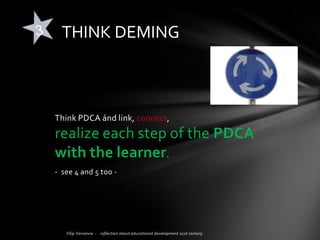
Think PDCA ánd link, connect,
realize each step of the PDCA
with the learner.
- see 4 and 5 too -
THINK DEMING
Creativity is the drive to
establish an attractive
learning environment.
MAKE LEARNING EXCITING
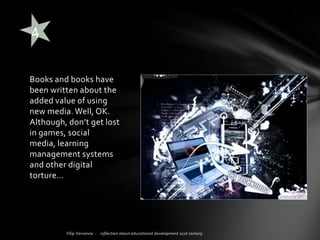
Books and books have
been written about the
added value of using
new media. Well, OK.
Although, don’t get lost
in games, social media,
learning management
systems and other
digital torture…
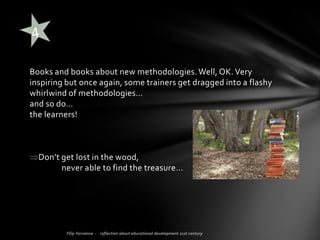
Books and books about new methodologies.Well, OK. Very
inspiring but once again, some trainers get dragged into a flashy
whirlwind of methodologies…
and so do…
the learners!
Don’t get lost in the wood,
never able to find the treasure…
• is not about trying out as much as possible, using loads of
tools and methodologies you don’t connect with…
• is all about the right and well-balanced
cocktail of approaches and methodologies!
not flashy but eclectic
So… making learning exciting …
Try to connect.. or even more: interconnect!
Star 1 – 4 are about connecting too, but there is more…
INTERCONNECT
There are 2 dimensions
and 3 different layers in this connection.
That’s how it became… an interconnection.
Connect with the learners’
1) Experience:
what are the experiences related to…
2) Talents*:
what are his/her strengths, natural talents/gifts,…
3) Learning style:
how he/she learns the best
Interconnecting, dimension 1…
* Recommended literature: Luk Dewulf
Connect with the learners’
1) Experience:
what are the experiences related to…
=> is obvious, it is basically
thought in every teacher training
Connect with the learners’
2) Talents*:
what are his/her strengths, natural talents/gifts,…
* Recommended literature: Luk Dewulf
Nature x nurture
But… “use it or loose it”…
=> Do we use this in education?!
Competence based vss a talent orientated education
Connect with the learners’
3) Learning style:
how he/she learns the best
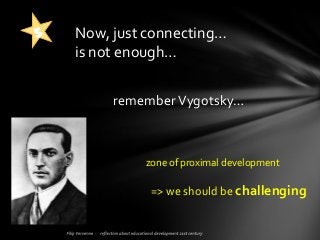
rememberVygotsky…
Now, just connecting…
is not enough…
zone of proximal development
=> we should be challenging
… let’s put him
in a slightly updated version…
zone of proximal development
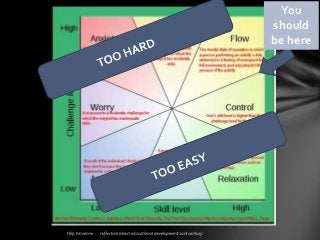
You
should
be here
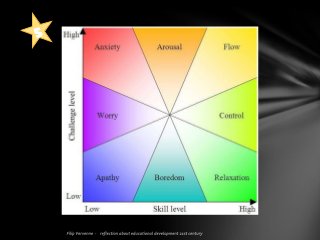
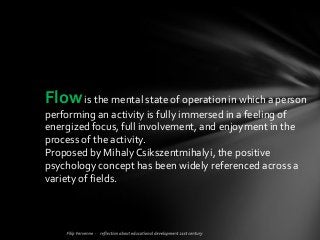
Flowis the mental state of operation in which a person
performing an activity is fully immersed in a feeling of
energized focus, full involvement, and enjoyment in the
process of the activity.
Proposed by Mihaly Csikszentmihalyi, the positive
psychology concept has been widely referenced across a
variety of fields.
Vygotsky,
Mihaly,
AND the theory of connectivity, dimension 1,
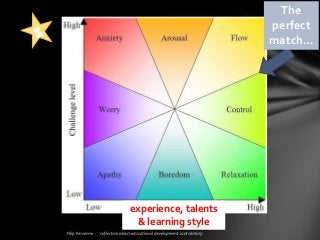
We can replace the skills in this model,
relating the challenges
to the experience, talents and learning style
summarising
experience, talents
& learning style
The
perfect
match…
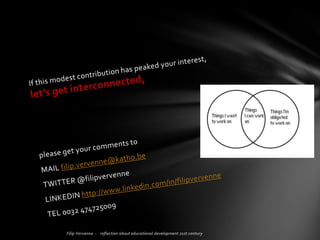
Connect with your own
1) experience
2) talents
3) learning style
Interconnecting, dimension 2…
Relating and macro connecting star 1 – 5 we can summarize that the right way to
a 5 star learning experience involves also
connecting your strengths
to those of the learners
This will generate the best basic conditions for learning:
support, feedback and challenges
in search of the right learning leverage
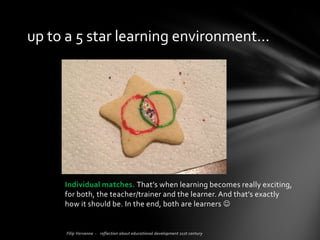
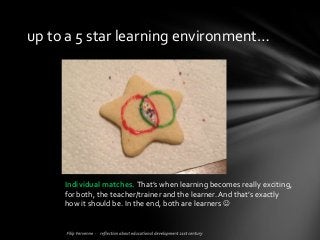
Individual matches. That’s when learning becomes really exciting,
for both, the teacher/trainer and the learner. And that’s exactly
how it should be. In the end, both are learners 
up to a 5 star learning environment…
Reflected?!
Tune Up Your Learning Environment

Tune Up Your Learning Environment

  • 1.
    - a shortreflection about educational challenges for 2013 - Up to a 5 star learning environment!
  • 2.
    Check out withme 5 major changes/suggestions to create a future proof instructional and curriculum design…
  • 4.
  • 5.
    Honestly, I’m bored…to hear about learning outcomes. For too many years now, people have been focusing on this as if it is or can be the (only) drive for good education! From the Ministry of Education to universities to headmasters and teacher trainers... everybody worries about refining, updating, implementing learning outcomes. Well, enough,… forget about learning outcomes! FORGET ABOUT…
  • 6.
    In my opinion, learningoutcomes are • pretentious • unrealistic • endless listed • useless • and simply creepy for students Why forget about…?
  • 7.
    What is feasible…? Noteverything that can be counted, counts. Not everything that counts, can be counted. ALBERT EINSTEIN Competences/learning outcomes:
  • 8.
    Don’t waste yourtime and just draw some general competences based on the well-known BLOOM-matrix: goals, aims for knowledge, skills, attitudes… linked to your discipline / course / training. Put your energy in what really matters, the next stars,… … so what’s up?

  • 9.
    Try to engagethe learner in the whole cycle of the learning process. Nowadays it’s very common to engage the learner in the learning activities with assignments, group work, collaborative tools and tasks. Good! Of course! “ENGAGE ME OR ENRAGE ME”
  • 10.
    However, 3 interestingchallenges remain and they are situated, where you would less expect them: in the preparation and the tail of the learning event*… * let’s call it an event: the course, training, methodology, interaction,… Engage…
  • 11.
    Take your timeto draw together, at least: 1. some essential competences / L.O. 2. the design of the learning event 3. the assessment Engage…
  • 12.
    • Use theDeming circle, Plan Do Check Act/Adjust, to design the curriculum and to engage the learner in each step you make. • This model for reflection is well known in its applications of Quality Management but it is a perfect and in fact a wonderful basic tool for the instructional designer.Think PDCA! THINK DEMING
  • 13.
    Think PDCA ándlink, connect, realize each step of the PDCA with the learner. - see 4 and 5 too - THINK DEMING
  • 14.
    Creativity is thedrive to establish an attractive learning environment. MAKE LEARNING EXCITING
  • 15.
    Books and bookshave been written about the added value of using new media. Well, OK. Although, don’t get lost in games, social media, learning management systems and other digital torture…
  • 16.
    Books and booksabout new methodologies.Well, OK. Very inspiring but once again, some trainers get dragged into a flashy whirlwind of methodologies… and so do… the learners! Don’t get lost in the wood, never able to find the treasure…
  • 17.
    • is notabout trying out as much as possible, using loads of tools and methodologies you don’t connect with… • is all about the right and well-balanced cocktail of approaches and methodologies! not flashy but eclectic So… making learning exciting …
  • 18.
    Try to connect..or even more: interconnect! Star 1 – 4 are about connecting too, but there is more… INTERCONNECT There are 2 dimensions and 3 different layers in this connection. That’s how it became… an interconnection.
  • 19.
    Connect with thelearners’ 1) Experience: what are the experiences related to… 2) Talents*: what are his/her strengths, natural talents/gifts,… 3) Learning style: how he/she learns the best Interconnecting, dimension 1… * Recommended literature: Luk Dewulf
  • 20.
    Connect with thelearners’ 1) Experience: what are the experiences related to… => is obvious, it is basically thought in every teacher training
  • 21.
    Connect with thelearners’ 2) Talents*: what are his/her strengths, natural talents/gifts,… * Recommended literature: Luk Dewulf
  • 22.
    Nature x nurture But…“use it or loose it”… => Do we use this in education?! Competence based vss a talent orientated education
  • 23.
    Connect with thelearners’ 3) Learning style: how he/she learns the best
  • 24.
    rememberVygotsky… Now, just connecting… isnot enough… zone of proximal development => we should be challenging
  • 25.
    … let’s puthim in a slightly updated version… zone of proximal development
  • 27.
  • 28.
    Flowis the mentalstate of operation in which a person performing an activity is fully immersed in a feeling of energized focus, full involvement, and enjoyment in the process of the activity. Proposed by Mihaly Csikszentmihalyi, the positive psychology concept has been widely referenced across a variety of fields.
  • 29.
    Vygotsky, Mihaly, AND the theoryof connectivity, dimension 1, We can replace the skills in this model, relating the challenges to the experience, talents and learning style summarising
  • 30.
    experience, talents & learningstyle The perfect match…
  • 31.
    Connect with yourown 1) experience 2) talents 3) learning style Interconnecting, dimension 2…
  • 33.
    Relating and macroconnecting star 1 – 5 we can summarize that the right way to a 5 star learning experience involves also connecting your strengths to those of the learners This will generate the best basic conditions for learning: support, feedback and challenges in search of the right learning leverage
  • 34.
    Individual matches. That’swhen learning becomes really exciting, for both, the teacher/trainer and the learner. And that’s exactly how it should be. In the end, both are learners  up to a 5 star learning environment…
  • 36.