FIZIKMOZAC
1
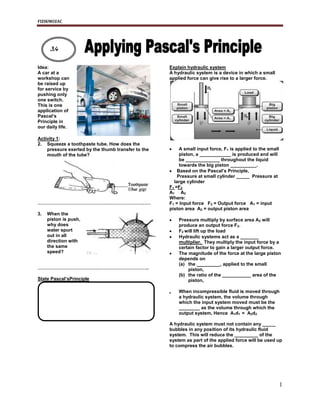
Idea:
A car at a
workshop can
be raised up
for service by
pushing only
one switch.
This is one
application of
Pascal’s
Principle in
our daily life.
Activity 1:
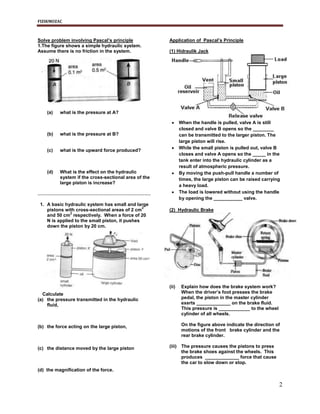
2. Squeeze a toothpaste tube. How does the
pressure exerted by the thumb transfer to the
mouth of the tube?
………………………………………………………………
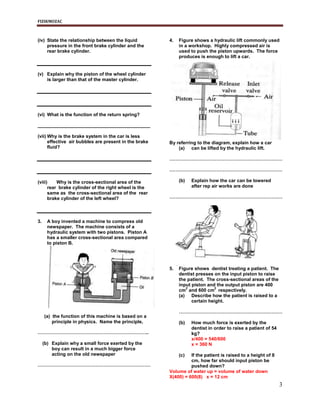
3. When the
piston is push,
why does
water spurt
out in all
direction with
the same
speed?
……………………………………………………………..
State Pascal’sPrinciple
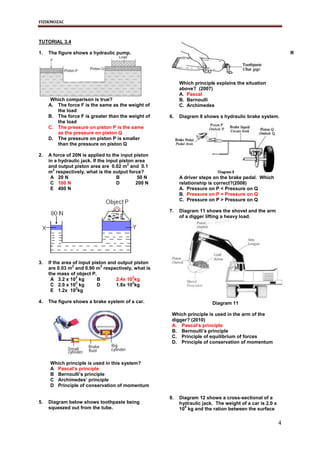
Explain hydraulic system
A hydraulic system is a device in which a small
applied force can give rise to a larger force.
A small input force, F1 is applied to the small
piston, a ____________ is produced and will
be _____________ throughout the liquid
towards the big piston __________.
Based on the Pascal’s Principle,
Pressure at small cylinder _____ Pressure at
large cylinder
F1 =F2
A1 A2
Where:
F1 = Input force F2 = Output force A1 = input
piston area A2 = output piston area
Pressure multiply by surface area A2 will
produce an output force F2.
F2 will lift up the load
Hydraulic systems act as a _______
multiplier. They multiply the input force by a
certain factor to gain a larger output force.
The magnitude of the force at the large piston
depends on
(a) the _________, applied to the small
piston,
(b) the ratio of the ___________ area of the
piston,
When incompressible fluid is moved through
a hydraulic system, the volume through
which the input system moved must be the
________ as the volume through which the
output system, Hence A1d1 = A2d2
A hydraulic system must not contain any _____
bubbles in any position of its hydraulic fluid
system. This will reduce the _________ of the
system as part of the applied force will be used up
to compress the air bubbles.
3.4
FIZIKMOZAC
2
Solve problem involving Pascal’s principle
1.The figure shows a simple hydraulic system.
Assume there is no friction in the system.
(a) what is the pressure at A?
(b) what is the pressure at B?
(c) what is the upward force produced?
(d) What is the effect on the hydraulic
system if the cross-sectional area of the
large piston is increase?
………………………………………………………………
1. A basic hydraulic system has small and large
pistons with cross-sectional areas of 2 cm
2
and 50 cm
2
respectively. When a force of 20
N is applied to the small piston, it pushes
down the piston by 20 cm.
Calculate
(a) the pressure transmitted in the hydraulic
fluid,
(b) the force acting on the large piston,
(c) the distance moved by the large piston
(d) the magnification of the force.
Application of Pascal’s Principle
(1) Hidraulik Jack
When the handle is pulled, valve A is still
closed and valve B opens so the ________
can be transmitted to the larger piston. The
large piston will rise.
While the small piston is pulled out, valve B
closes and valve A opens so the _____ in the
tank enter into the hydraulic cylinder as a
result of atmospheric pressure.
By moving the push-pull handle a number of
times, the large piston can be raised carrying
a heavy load.
The load is lowered without using the handle
by opening the ___________ valve.
(2) Hydraulic Brake
(ii) Explain how does the brake system work?
When the driver’s foot presses the brake
pedal, the piston in the master cylinder
exerts _____________ on the brake fluid.
This pressure is ____________ to the wheel
cylinder of all wheels.
On the figure above indicate the direction of
motions of the front brake cylinder and the
rear brake cylinder.
(iii) The pressure causes the pistons to press
the brake shoes against the wheels. This
produces _____________ force that cause
the car to slow down or stop.
FIZIKMOZAC
3
(iv) State the relationship between the liquid
pressure in the front brake cylinder and the
rear brake cylinder.
(v) Explain why the piston of the wheel cylinder
is larger than that of the master cylinder.
(vi) What is the function of the return spring?
___________________________________________
(vii) Why is the brake system in the car is less
effective air bubbles are present in the brake
fluid?
(viii) Why is the cross-sectional area of the
rear brake cylinder of the right wheel is the
same as the cross-sectional area of the rear
brake cylinder of the left wheel?
3. A boy invented a machine to compress old
newspaper. The machine consists of a
hydraulic system with two pistons. Piston A
has a smaller cross-sectional area compared
to piston B.
(a) the function of this machine is based on a
principle in physics. Name the principle,
……………………………………………………………..
(b) Explain why a small force exerted by the
boy can result in a much bigger force
acting on the old newspaper
………………………………………………………………
4. Figure shows a hydraulic lift commonly used
in a workshop. Highly compressed air is
used to push the piston upwards. The force
produces is enough to lift a car.
By referring to the diagram, explain how a car
(a) can be lifted by the hydraulic lift.
………………………………………………………………
………………………………………………………………
(b) Explain how the car can be lowered
after rep air works are done
………………………………………………………………
5. Figure shows dentist treating a patient. The
dentist presses on the input piston to raise
the patient. The cross-sectional areas of the
input piston and the output piston are 400
cm
2
and 600 cm
2
respectively.
(a) Describe how the patient is raised to a
certain height.
…………………………………………………………
(b) How much force is exerted by the
dentist in order to raise a patient of 54
kg?
x/400 = 540/600
x = 360 N
(c) If the patient is raised to a height of 8
cm, how far should input piston be
pushed down?
Volume of water up = volume of water down
X(400) = 600(8) x = 12 cm
FIZIKMOZAC
4
TUTORIAL 3.4
1. The figure shows a hydraulic pump. R
Which comparison is true?
A. The force F is the same as the weight of
the load
B. The force F is greater than the weight of
the load
C. The pressure on piston P is the same
as the pressure on piston Q
D. The pressure on piston P is smaller
than the pressure on piston Q
2. A force of 20N is applied to the input piston
in a hydraulic jack. If the input piston area
and output piston area are 0.02 m
2
and 0.1
m
2
respectively, what is the output force?
A 20 N B 50 N
C 100 N D 200 N
E 400 N
3. If the area of input piston and output piston
are 0.03 m
2
and 0.90 m
2
respectively, what is
the mass of object P.
A 3.2 x 10
2
kg B 2.4x 10
2
kg
C 2.0 x 10
2
kg D 1.8x 10
2
kg
E 1.2x 10
2
kg
4. The figure shows a brake system of a car.
Which principle is used in this system?
A Pascal’s principle
B Bernoulli’s principle
C Archimedes’ principle
D Principle of conservation of momentum
5. Diagram below shows toothpaste being
squeezed out from the tube.
Which principle explains the situation
above? (2007)
A. Pascal
B. Bernoulli
C. Archimedes
6. Diagram 8 shows a hydraulic brake system.
A driver steps on the brake pedal. Which
relationship is correct?(2008)
A. Pressure on P < Pressure on Q
B. Pressure on P = Pressure on Q
C. Pressure on P > Pressure on Q
7. Diagram 11 shows the shovel and the arm
of a digger lifting a heavy load.
Diagram 11
Which principle is used in the arm of the
digger? (2010)
A. Pascal’s principle
B. Bernoulli’s principle
C. Principle of equilibrium of forces
D. Principle of conservation of momentum
8. Diagram 12 shows a cross-sectional of a
hydraulic jack. The weight of a car is 2.0 x
10
6
kg and the ration between the surface
FIZIKMOZAC
5
areas of the master piston to the slave
piston is 1:15.
What is the force exerted on the master
piston? (2012)
A. 1.3 x 10
6
N
B. 1.3 x 10
7
N
C. 3.0 x 10
6
N
D. 3.0 x 10
7
N
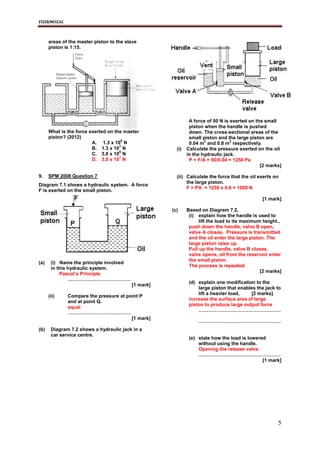
9. SPM 2008 Question 7
Diagram 7.1 shows a hydraulic system. A force
F is exerted on the small piston.
(a) (i) Name the principle involved
in this hydraulic system.
Pascal’s Principle
…………………………………
[1 mark]
(ii) Compare the pressure at point P
and at point Q.
equal
…………………………………
[1 mark]
(b) Diagram 7.2 shows a hydraulic jack in a
car service centre.
A force of 50 N is exerted on the small
piston when the handle is pushed
down. The cross-sectional areas of the
small piston and the large piston are
0.04 m
2
and 0.8 m
2
respectively.
(i) Calculate the pressure exerted on the oil
in the hydraulic jack.
P = F/A = 50/0.04 = 1250 Pa
[2 marks]
(ii) Calculate the force that the oil exerts on
the large piston.
F = PA = 1250 x 0.8 = 1000 N
[1 mark]
(c) Based on Diagram 7.2,
(i) explain how the handle is used to
lift the load to its maximum height.,
push down the handle, valve B open,
valve A closes. Pressure is transmitted
and the oil enter the large piston. The
large piston raise up.
Pull up the handle, valve B closes,
valve opens, oil from the reservoir enter
the small piston.
The process is repeated.
[2 marks]
(d) explain one modification to the
large piston that enables the jack to
lift a heavier load, [2 marks]
increase the surface area of large
piston to produce large output force
……………………………………………
……………………………………………
(e) state how the load is lowered
without using the handle.
Opening the release valve.
……………………………………………
[1 mark]