PASCAL’S PRINCIPLE Chapter 11 Section 3
Lets Review… What is pressure?  What is the equation for pressure?  What causes fluid pressure? When you catch a deep-sea fish, why does its eyes pop-out? Why do your ears pop on an airplane or up in the mountains?
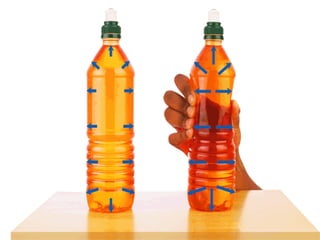
Pascal’s Principle When force is applied to a confined liquid, the change in pressure is transmitted equally to all parts of the fluid. Draw a bottle of water with arrows to illustrate the regular exerted pressure.  Then draw a water bottle that you squeeze.  What happens to the pressure?  What happens if you open the top? How does Pascal’s Principle explain what happens if you squeeze a water bottle?
 
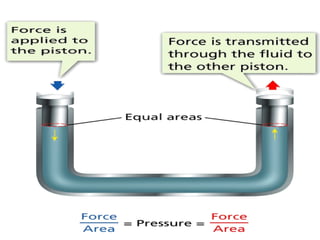
A force applied to one section of an enclosed liquid at rest will be transferred to the entire liquid with the same amount of force.
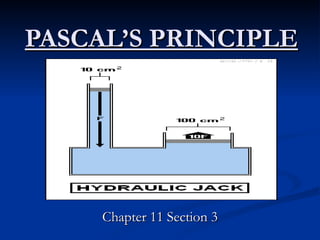
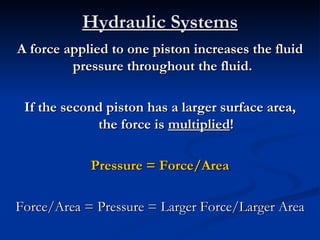
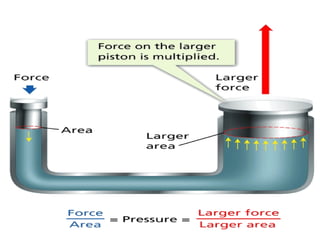
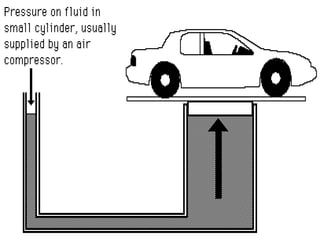
Hydraulic Systems A force applied to one piston increases the fluid pressure throughout the fluid.   If the second piston has a larger surface area, the force is  multiplied ! Pressure = Force/Area Force/Area = Pressure = Larger Force/Larger Area


Pascal's principle

  • 1.
  • 2.
    Lets Review… Whatis pressure? What is the equation for pressure? What causes fluid pressure? When you catch a deep-sea fish, why does its eyes pop-out? Why do your ears pop on an airplane or up in the mountains?
  • 3.
    Pascal’s Principle Whenforce is applied to a confined liquid, the change in pressure is transmitted equally to all parts of the fluid. Draw a bottle of water with arrows to illustrate the regular exerted pressure. Then draw a water bottle that you squeeze. What happens to the pressure? What happens if you open the top? How does Pascal’s Principle explain what happens if you squeeze a water bottle?
  • 4.
  • 5.
    A force appliedto one section of an enclosed liquid at rest will be transferred to the entire liquid with the same amount of force.
  • 6.
    Hydraulic Systems Aforce applied to one piston increases the fluid pressure throughout the fluid. If the second piston has a larger surface area, the force is multiplied ! Pressure = Force/Area Force/Area = Pressure = Larger Force/Larger Area
  • 7.
  • 8.
  • 9.