KENDRIYA VIDYALAYA, VIKAS PURI ,
NEW DELHI -110059
PHYSICS INVESTIGATORY PROJECT
ELECTROMAGNETIC INDUCTION
2017-18
SUBMITTED BY:
AJAYKUMAR
XII – A
CBSE Roll No. -
1
Certificate
This is to certify that this “Physics
Investigatory Project” on the topic
“Electromagnetic Induction” has been
successfully completed by AJAY KUMAR of
class XII–A under the guidance of Mr. A. K.
SINGH in particular fulfilment of the
curriculum of Central Board of Secondary
Education [CBSE] leading to the award of
annual examination of the year 2017-18.
Teacher-In-Charge External Examiner
2
Acknowledgements
I have taken efforts in this project. However, it would not
have been possible without the kind support and help of
many individuals.
I would like to thank my principal MR. DEVENDER
KUMAR and school for providing me with facilities
required to do my project.
I am highly indebted to my Physics teacher, Mr. A.K.
SINGH, for his invaluable guidance which has sustained
my efforts in all the stages of this project work.
I would also like to thank my parents for their continuous
support and encouragement.
My thanks and appreciations also go to my fellow
classmates and the laboratory assistant in developing the
project and to the people who have willingly helped me
out with their abilities.
3
INDEX
Certificate
Acknowledgements
Aim
Apparatus
Introduction
Theory
Conclusion
Bibliography
End of project
4
AIM
To determine the
faraday’s law of
electromagnetic
induction using a copper
wire wound over an iron
rod and a strong magnet.
5
APPARATUS
1. Insulated copper wire
2. An iron rod
3. A strong magnet and
4. A light emitting diode (LED)
6
INTRODUCTION
7
8
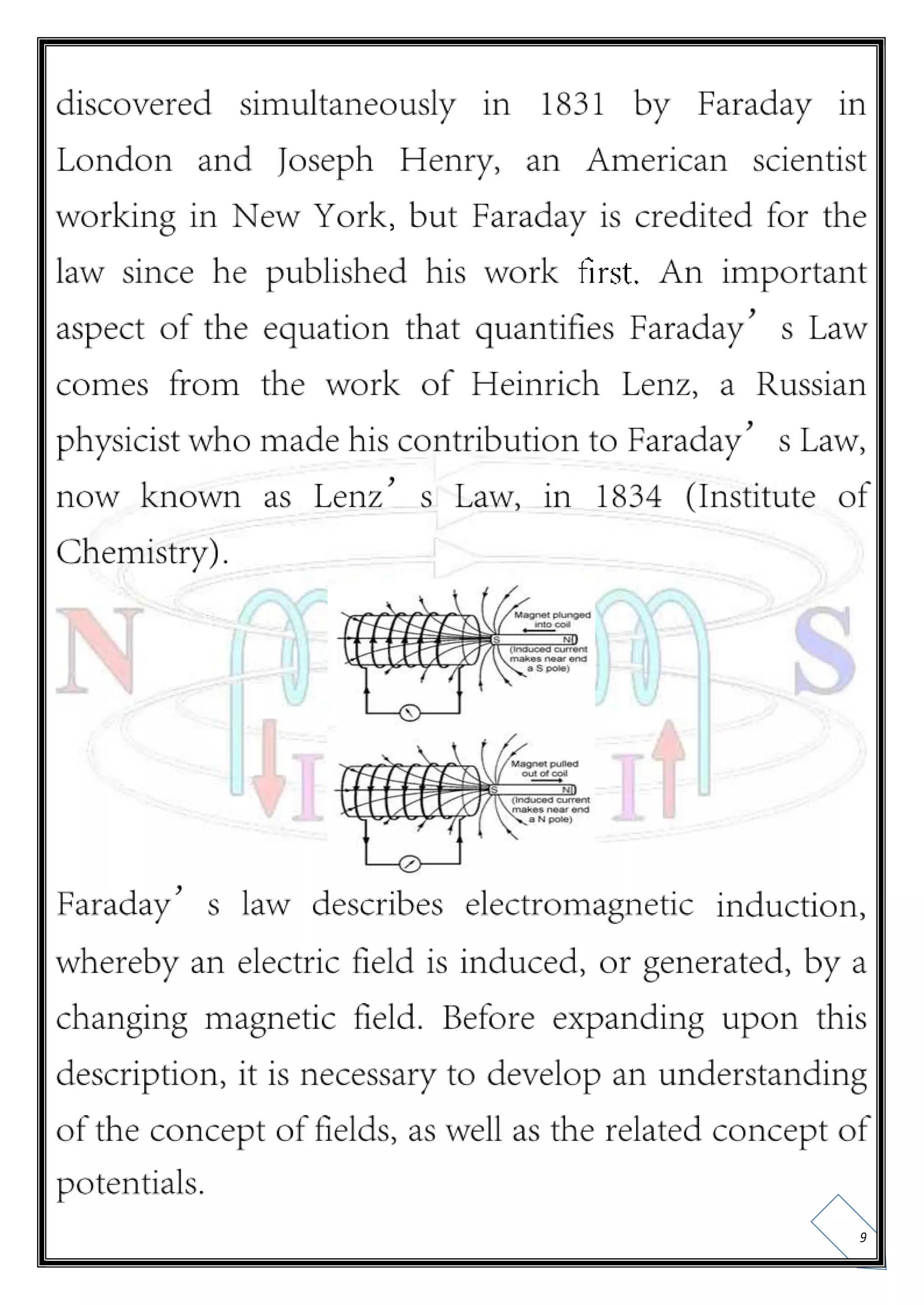
9
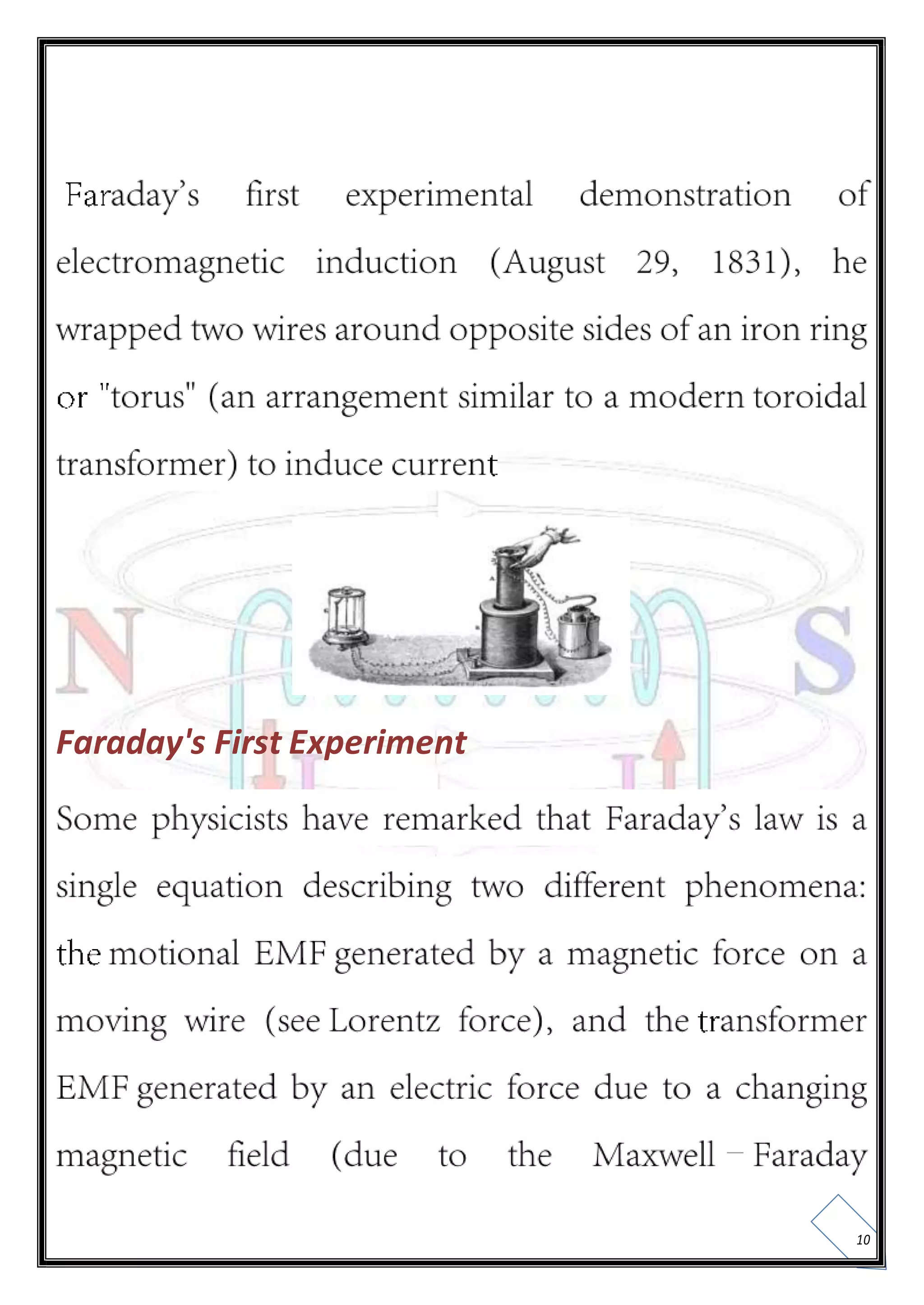
Faraday's First Experiment
10
11
THEORY
Magnetic flux:
12
13
∂
14
LAW
15
ℓ
16
17
CONCLUSION
Faraday’s Law of Electromagnetic Induction, first
observed and published by Michael Faraday in the
mid-nineteenth century, describes a very
important electromagnetic concept. Although its
mathematical representations are cryptic, the
essence of Faraday’s is not hard to grasp: it relates
an induced electric potential or voltage to a
dynamic magnetic field. This concept has many
far-reaching ramifications that touch our lives in
many ways: from the shining of the sun to the
convenience of mobile communications, to
electricity to power our homes. We can all
appreciate the profound impact Faraday’s Law has
on us.
18
BIBLIOGRAPHY
https://en.wikipedia.org
https://www.google.co.in
Class 12 Physics Lab Manual
Class 12 NCERT Textbook
Physics for you blogs
https://www.vaibhavkandwal.com
19
EXPERIMENT PHOTOS
20
End of
Project
Thank you!
21

FARADAY LAW OF ELECTROMAGNETIC INDUCTION CLASS 12 PROJECT

  • 1.
    KENDRIYA VIDYALAYA, VIKASPURI , NEW DELHI -110059 PHYSICS INVESTIGATORY PROJECT ELECTROMAGNETIC INDUCTION 2017-18 SUBMITTED BY: AJAYKUMAR XII – A CBSE Roll No. - 1
  • 2.
    Certificate This is tocertify that this “Physics Investigatory Project” on the topic “Electromagnetic Induction” has been successfully completed by AJAY KUMAR of class XII–A under the guidance of Mr. A. K. SINGH in particular fulfilment of the curriculum of Central Board of Secondary Education [CBSE] leading to the award of annual examination of the year 2017-18. Teacher-In-Charge External Examiner 2
  • 3.
    Acknowledgements I have takenefforts in this project. However, it would not have been possible without the kind support and help of many individuals. I would like to thank my principal MR. DEVENDER KUMAR and school for providing me with facilities required to do my project. I am highly indebted to my Physics teacher, Mr. A.K. SINGH, for his invaluable guidance which has sustained my efforts in all the stages of this project work. I would also like to thank my parents for their continuous support and encouragement. My thanks and appreciations also go to my fellow classmates and the laboratory assistant in developing the project and to the people who have willingly helped me out with their abilities. 3
  • 4.
  • 5.
    AIM To determine the faraday’slaw of electromagnetic induction using a copper wire wound over an iron rod and a strong magnet. 5
  • 6.
    APPARATUS 1. Insulated copperwire 2. An iron rod 3. A strong magnet and 4. A light emitting diode (LED) 6
  • 7.
  • 8.
  • 9.
  • 10.
  • 11.
  • 12.
  • 13.
  • 14.
  • 15.
  • 16.
  • 17.
  • 18.
    CONCLUSION Faraday’s Law ofElectromagnetic Induction, first observed and published by Michael Faraday in the mid-nineteenth century, describes a very important electromagnetic concept. Although its mathematical representations are cryptic, the essence of Faraday’s is not hard to grasp: it relates an induced electric potential or voltage to a dynamic magnetic field. This concept has many far-reaching ramifications that touch our lives in many ways: from the shining of the sun to the convenience of mobile communications, to electricity to power our homes. We can all appreciate the profound impact Faraday’s Law has on us. 18
  • 19.
    BIBLIOGRAPHY https://en.wikipedia.org https://www.google.co.in Class 12 PhysicsLab Manual Class 12 NCERT Textbook Physics for you blogs https://www.vaibhavkandwal.com 19
  • 20.
  • 21.