Physics
Pascal’s Law and it’s Applications
S.N.B.P International School
Affiliation no.-1130522
Submitted to:-
Ruchita Tibdewal
(Physics Subject
Teacher)
Submitted by:-
Vansh Patil
Class/Section-
11th/C
Certificate
It is hereby certified that original and
genuine research work is carried out
to investigate about the subject matter
and the related data collection has
been completely solely and satisfied
by
Vansh Patil
regarding the project titled
Study on Pascal’s Law and its
Applications
I owe my thanks to our principal for providing
laboratory facilities and for her valuable guidance.
A lot of thanks to my Physics Teacher
Ruchita Ma’am
who encouraged me in doing this project successfully
and provided the required apparatus
to perform my project work.
Name : Vansh
Acknowledgement
Index
Aim
About Blaise Pascal
Materials Required
Theory
Procedure
Observation
Result
Applications
Aim
To study Pascal’s Law and
its Applications.
About Blaise Pascal
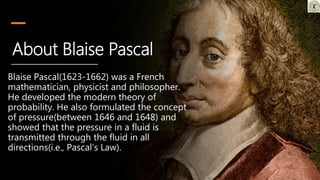
Blaise Pascal(1623-1662) was a French
mathematician, physicist and philosopher.
He developed the modern theory of
probability. He also formulated the concept
of pressure(between 1646 and 1648) and
showed that the pressure in a fluid is
transmitted through the fluid in all
directions(i.e., Pascal’s Law).
Materials
Required
Matchsticks
Bottle
Rubber Balloon
Twine
Theory
The pressure always acts normal to the
surface. The pressure force has no
component tangential to the surface.
The pressure force acting on the surface of
finite area which is in contact with the fluid is
distributed over the surface. The resultant
force is obtained by integration:
𝑭𝒑 = 𝑷 ⅆ𝑨
where A is the surface area.
Procedure
Prepare the matchsticks by cutting off the
heads of the matches and discarding the tail
ends.
Fill the bottle to the brim with water.
Drop the matchstick-heads into the bottle.
Cover the mouth of the balloon tightly over
the bottle opening.
Press your finger on the balloon ‘diaphragm’
covering the mouth of the bottle.
Observation
The match heads will float on
the top of the water initially
but as soon as the finger is
pressed on the balloon
diaphragm, they will begin to
sink slowly to the bottom.
However, when the finger is
lifted, the matchstick-heads
float up again.
Result
The match heads move down owing to the
pressure that is transmitted through the water.
When the finger is pressed down on the balloon
diaphragm, a small quantity of water penetrates
each match head, which adds enough weight it
causing it to sink. When the finger is removed,
there is ample air pressure inside the match heads
to force out the water and make the match heads
rise again.
Pascal’s Law is proven hence.
Applications
Hydraulic Lift: The image you saw at the
beginning of this article is a simple line
diagram of the hydraulic lift. This is the
principle of the working of hydraulic lift. It
works based on the principle of equal pressure
transmission throughout a fluid.
The construction is such that the narrow
cylinder is connected to a wider cylinder. They
are fitted with airtight pistons on either end.
The inside of the cylinders is filled with fluid
that cannot be compressed.
Pressure applied at piston A is transmitted
equally to piston B without diminishing the use
of the fluid that cannot be compressed. Thus,
piston B effectively serves as a platform to lift
heavy objects like big machines or vehicles.
Pascal's Law and it's Applications

Pascal's Law and it's Applications

  • 1.
    Physics Pascal’s Law andit’s Applications S.N.B.P International School Affiliation no.-1130522 Submitted to:- Ruchita Tibdewal (Physics Subject Teacher) Submitted by:- Vansh Patil Class/Section- 11th/C
  • 2.
    Certificate It is herebycertified that original and genuine research work is carried out to investigate about the subject matter and the related data collection has been completely solely and satisfied by Vansh Patil regarding the project titled Study on Pascal’s Law and its Applications
  • 3.
    I owe mythanks to our principal for providing laboratory facilities and for her valuable guidance. A lot of thanks to my Physics Teacher Ruchita Ma’am who encouraged me in doing this project successfully and provided the required apparatus to perform my project work. Name : Vansh Acknowledgement
  • 4.
    Index Aim About Blaise Pascal MaterialsRequired Theory Procedure Observation Result Applications
  • 5.
    Aim To study Pascal’sLaw and its Applications.
  • 6.
    About Blaise Pascal BlaisePascal(1623-1662) was a French mathematician, physicist and philosopher. He developed the modern theory of probability. He also formulated the concept of pressure(between 1646 and 1648) and showed that the pressure in a fluid is transmitted through the fluid in all directions(i.e., Pascal’s Law).
  • 7.
  • 8.
    Theory The pressure alwaysacts normal to the surface. The pressure force has no component tangential to the surface. The pressure force acting on the surface of finite area which is in contact with the fluid is distributed over the surface. The resultant force is obtained by integration: 𝑭𝒑 = 𝑷 ⅆ𝑨 where A is the surface area.
  • 9.
    Procedure Prepare the matchsticksby cutting off the heads of the matches and discarding the tail ends. Fill the bottle to the brim with water. Drop the matchstick-heads into the bottle. Cover the mouth of the balloon tightly over the bottle opening. Press your finger on the balloon ‘diaphragm’ covering the mouth of the bottle.
  • 10.
    Observation The match headswill float on the top of the water initially but as soon as the finger is pressed on the balloon diaphragm, they will begin to sink slowly to the bottom. However, when the finger is lifted, the matchstick-heads float up again.
  • 11.
    Result The match headsmove down owing to the pressure that is transmitted through the water. When the finger is pressed down on the balloon diaphragm, a small quantity of water penetrates each match head, which adds enough weight it causing it to sink. When the finger is removed, there is ample air pressure inside the match heads to force out the water and make the match heads rise again. Pascal’s Law is proven hence.
  • 12.
    Applications Hydraulic Lift: Theimage you saw at the beginning of this article is a simple line diagram of the hydraulic lift. This is the principle of the working of hydraulic lift. It works based on the principle of equal pressure transmission throughout a fluid. The construction is such that the narrow cylinder is connected to a wider cylinder. They are fitted with airtight pistons on either end. The inside of the cylinders is filled with fluid that cannot be compressed. Pressure applied at piston A is transmitted equally to piston B without diminishing the use of the fluid that cannot be compressed. Thus, piston B effectively serves as a platform to lift heavy objects like big machines or vehicles.