By
Gulshad Ahmad
Department of Chemical & Polymer Engineering
University of Engineering & Technology Lahore (FSD Campus)
 It is defined as the selective sorting of solid
species by means of utilizing forces acting on
charged of polarized body in an electrical
field.
 Selective sorting: on the basis of charge
 Solid species: smoke, dust, oil
 Utilizing forces: electrostatic forces.
2
 An electrostatic separators (ESS) or
electrostatic precipitator (ESP) is a
particulate collection device that removes
particles from a flowing gas such as air using
the force of an induced electrostatic charge.
3
4
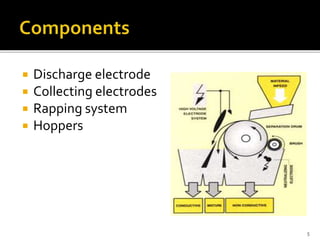
 Discharge electrode
 Collecting electrodes
 Rapping system
 Hoppers
5
 Ionization
 Migration particles
 Collection particles
 Charge dissipation
 Particle dislodging
 Particle removal
6
 Role type electrostatic separators
 Plate type electrostatic separators
 Free fall electrostatic separators
7
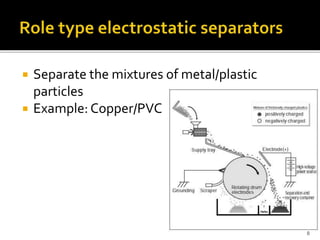
 Separate the mixtures of metal/plastic
particles
 Example: Copper/PVC
8
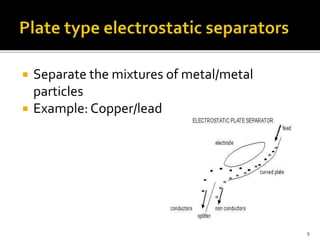
 Separate the mixtures of metal/metal
particles
 Example: Copper/lead
9
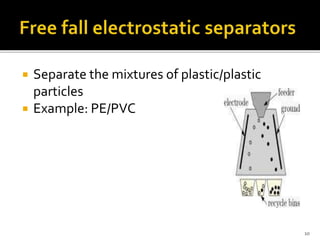
 Separate the mixtures of plastic/plastic
particles
 Example: PE/PVC
10
 Dry Electrostatic precipitator
 Wet Electrostatic precipitator
11
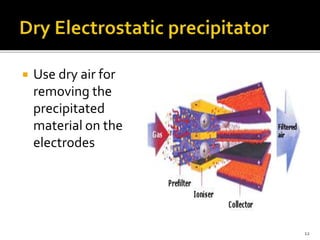
 Use dry air for
removing the
precipitated
material on the
electrodes
12
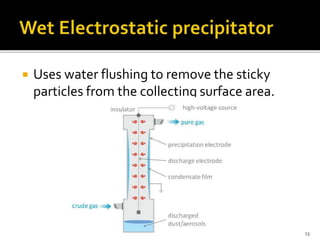
 Uses water flushing to remove the sticky
particles from the collecting surface area.
13

electrostatic separation

  • 1.
    By Gulshad Ahmad Department ofChemical & Polymer Engineering University of Engineering & Technology Lahore (FSD Campus)
  • 2.
     It isdefined as the selective sorting of solid species by means of utilizing forces acting on charged of polarized body in an electrical field.  Selective sorting: on the basis of charge  Solid species: smoke, dust, oil  Utilizing forces: electrostatic forces. 2
  • 3.
     An electrostaticseparators (ESS) or electrostatic precipitator (ESP) is a particulate collection device that removes particles from a flowing gas such as air using the force of an induced electrostatic charge. 3
  • 4.
  • 5.
     Discharge electrode Collecting electrodes  Rapping system  Hoppers 5
  • 6.
     Ionization  Migrationparticles  Collection particles  Charge dissipation  Particle dislodging  Particle removal 6
  • 7.
     Role typeelectrostatic separators  Plate type electrostatic separators  Free fall electrostatic separators 7
  • 8.
     Separate themixtures of metal/plastic particles  Example: Copper/PVC 8
  • 9.
     Separate themixtures of metal/metal particles  Example: Copper/lead 9
  • 10.
     Separate themixtures of plastic/plastic particles  Example: PE/PVC 10
  • 11.
     Dry Electrostaticprecipitator  Wet Electrostatic precipitator 11
  • 12.
     Use dryair for removing the precipitated material on the electrodes 12
  • 13.
     Uses waterflushing to remove the sticky particles from the collecting surface area. 13