








Things
                  That
                  Make
                 Ya Go,
                 Hmmm!


Learning about Phrases
A phrase is a group of words
       that acts as a part of speech
                rather than as a complete
                   sentence. You already
know the               function of a noun,
adjective, or adverb—a phrase simply
takes on one     of those functions. A
phrase does not have a subject or a
verb. The two main kinds of phrases are
prepositional phrases and verbal phrases.
!Adios!
Things
                  That
                  Make
                 Ya Go,
                 Hmmm!


Learning about Phrases
Another kind of phrase is the verbal—
infinitive, gerunds, & participles.
        As you can tell from the name,
                they are related to verbs.
They                      look verby—yes,
that’s a word                 —but never
act as verbs.                   Instead they
act as nouns, adjectives,                  or
adverbs. There are three types of verbals
we’ll study: participial phrases, infinitive
phrases, and gerund phrases.
I’m outta
  here!
Things
                         That
                         Make
                        Ya Go,
                        Hmmm!


Learning about Participial Phrases
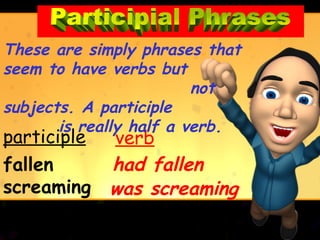
These are simply phrases that
seem to have verbs but
                         not
subjects. A participle
       is really half a verb.
participle   verb
fallen       had fallen
screaming    was screaming
    screaming
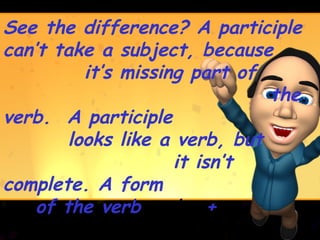
See the difference? A participle
can’t take a subject, because
          it’s missing part of
                               the
verb. A participle
        looks like a verb, but
                     it isn’t
complete. A form
    of the verb to be + a
        participle = a verb.
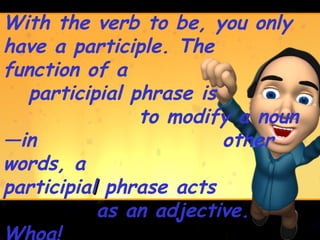
With the verb to be, you only
have a participle. The
function of a
   participial phrase is
                to modify a noun
—in                      other
words, a
participial phrase acts
           as an adjective.
!Hasta la
vista, baby!
Things
                          That
                          Make
                         Ya Go,
                         Hmmm!


Learning about Participial Phrases
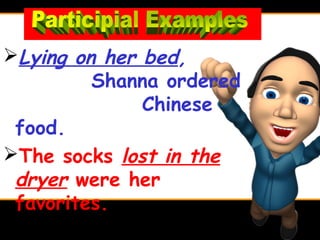
Lying on her bed,
         Shanna ordered
              Chinese
 food.
The socks lost in the
 dryer were her
 favorites.
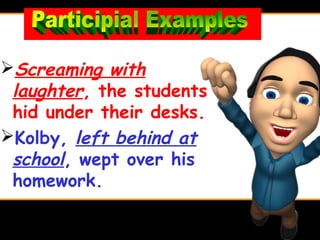
Screaming with
 laughter, the students
 hid under their desks.
Kolby, left behind at
 school, wept over his
 homework.
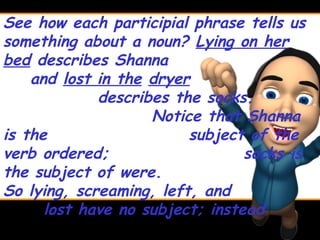
See how each participial phrase tells us
something about a noun? Lying on her
bed describes Shanna
    and lost in the dryer
             describes the socks.
                    Notice that Shanna
is the                   subject of the
verb ordered;                    socks is
the subject of were.
So lying, screaming, left, and
      lost have no subject; instead
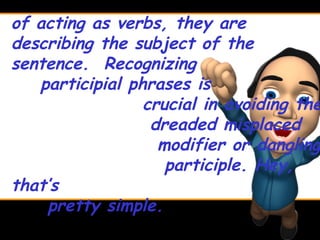
of acting as verbs, they are
describing the subject of the
sentence. Recognizing
   participial phrases is
                 crucial in avoiding the
                  dreaded misplaced
                   modifier or dangling
                    participle. Hey,
that’s
    pretty simple.
Well,
that’s it!
Things
                         That
                         Make
                        Ya Go,
                        Hmmm!


Learning about Dangling Modifiers
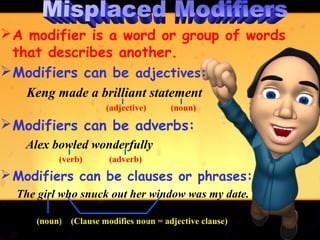
 A modifier is a word or group of words
  that describes another.
 Modifiers can be adjectives:
   Keng made a brilliant statement
                       (adjective)      (noun)

 Modifiers can be adverbs:
   Alex bowled wonderfully
          (verb)        (adverb)
 Modifiers can be clauses or phrases:
  The girl who snuck out her window was my date.

     (noun)   (Clause modifies noun = adjective clause)
I’m ghost!
Things
                         That
                         Make
                        Ya Go,
                        Hmmm!


Learning about Misplaced Modifiers
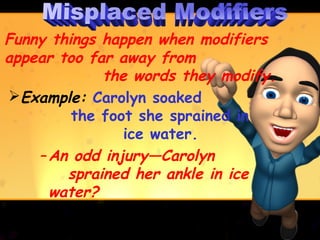
Funny things happen when modifiers
appear too far away from
             the words they modify.
Example: Carolyn soaked
         the foot she sprained in
                ice water.
    – An odd injury—Carolyn
        sprained her ankle in ice
      water?
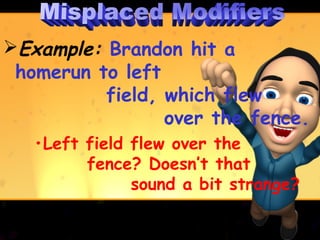
Example: Brandon hit a
 homerun to left
          field, which flew
                 over the fence.
   •Left field flew over the
         fence? Doesn’t that
               sound a bit strange?
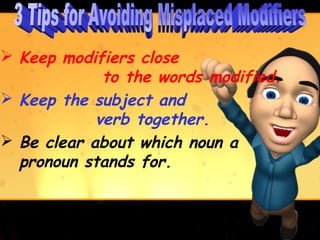
 Keep modifiers close
             to the words modified.
 Keep the subject and
            verb together.
 Be clear about which noun a
  pronoun stands for.
!Dicho y
 hecho!
Things
                                That
                                Make
                               Ya Go,
                               Hmmm!

Learning about Dangling Participial Phrases
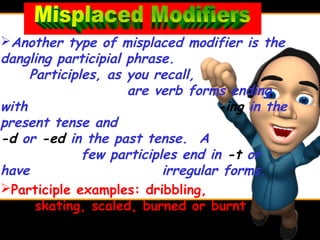
Another type of misplaced modifier is the
dangling participial phrase.
     Participles, as you recall,
                     are verb forms ending
with                                -ing in the
present tense and
-d or -ed in the past tense. A
              few participles end in -t or
have                       irregular forms.
Participle examples: dribbling,
      skating, scaled, burned or burnt
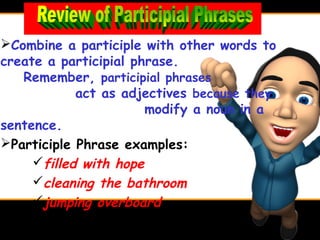
Combine a participle with other words to
create a participial phrase.
   Remember, participial phrases
            act as adjectives because they
                       modify a noun in a
sentence.
Participle Phrase examples:
     filled with hope
     cleaning the bathroom
     jumping overboard
That’s it!
Things
                           That
                           Make
                          Ya Go,
                          Hmmm!


Learning about Verbals (Infinitives)
When the preposition to is followed by a noun,
           it is a prepositional phrase: to
                      the beach. When to is
followed                                        by a
verb—to run, to see, to feel
          —it is an infinitive. Why does this
                         matter? The rules that
govern                        infinitives are different
from rules                          that govern
prepositional phrases; since
infinitives are closely related to verbs,
                  they can have a passive or active
voice                                    as well as
!Hasta
mañana!
Things
                        That
                        Make
                       Ya Go,
                       Hmmm!

Learning about Other Types of
           Phrases
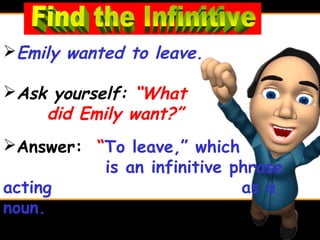
Emily wanted to leave.

Ask yourself: “What
    did Emily want?”
Answer: “To leave,” which
          is an infinitive phrase
acting                      as a
noun.
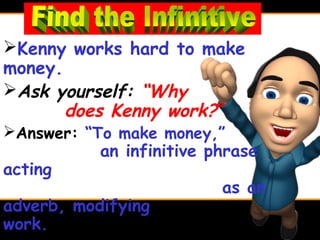
Kenny works hard to make
money.
Ask yourself: “Why
       does Kenny work?”
Answer: “To make money,”
           an infinitive phrase
acting
                          as an
adverb, modifying
work.
Woo hoo!
Things
                        That
                        Make
                       Ya Go,
                       Hmmm!

Learning about Other Types of
           Phrases
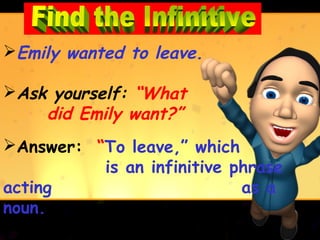
Emily wanted to leave.

Ask yourself: “What
    did Emily want?”
Answer: “To leave,” which
          is an infinitive phrase
acting                      as a
noun.
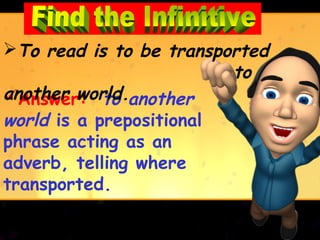
To read is to be transported
                         to
another world.another
Answer: to
world is a prepositional
phrase acting as an
adverb, telling where
transported.
Let’s do
 more!
Things
                        That
                        Make
                       Ya Go,
                       Hmmm!

Learning about Other Types of
           Phrases
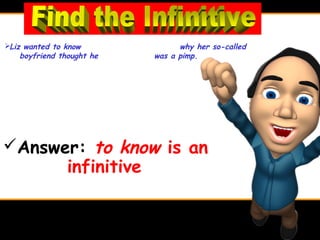
Liz wanted to know                why her so-called
    boyfriend thought he     was a pimp.


Answer: to know is an
                infinitive
To have been in love
             is to have
suffered.
Answer: To have been
            is the subject of the
                   sentence; to have
suffered is                      an
infinitive acting as an
  adverbial phrase.
To have been in love
             is to have
suffered.
Answer: To have been
            is the subject of the
                   sentence; to have
suffered is                      an
infinitive acting as an
  adverbial phrase.
Alrighty
 then!
Things
                       That
                       Make
                      Ya Go,
                      Hmmm!

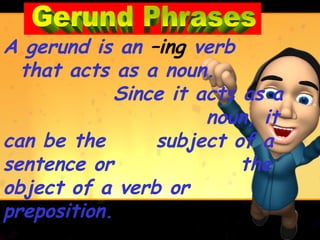
Learning about Gerund Phrases
A gerund is an –ing verb
  that acts as a noun.
            Since it acts as a
                      noun, it
can be the      subject of a
sentence or               the
object of a verb or
preposition.
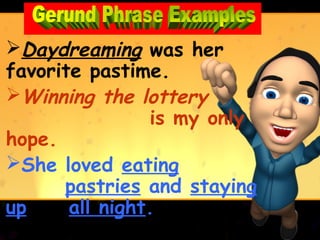
Daydreaming was her
favorite pastime.
Winning the lottery
                is my only
hope.
She loved eating
      pastries and staying
up     all night.
Dante hated studying.
Partying and e-mailing
            his friends took up
most                       of his
homework time.
He was thinking of hiring
someone to upgrade his
computer, but unfortunately,
spending money appalled him.
!Basta!

Participial phrases web page version 2005-2006

  • 1.
    Things That Make Ya Go, Hmmm! Learning about Phrases
  • 2.
    A phrase isa group of words that acts as a part of speech rather than as a complete sentence. You already know the function of a noun, adjective, or adverb—a phrase simply takes on one of those functions. A phrase does not have a subject or a verb. The two main kinds of phrases are prepositional phrases and verbal phrases.
  • 3.
  • 4.
    Things That Make Ya Go, Hmmm! Learning about Phrases
  • 5.
    Another kind ofphrase is the verbal— infinitive, gerunds, & participles. As you can tell from the name, they are related to verbs. They look verby—yes, that’s a word —but never act as verbs. Instead they act as nouns, adjectives, or adverbs. There are three types of verbals we’ll study: participial phrases, infinitive phrases, and gerund phrases.
  • 6.
  • 7.
    Things That Make Ya Go, Hmmm! Learning about Participial Phrases
  • 8.
    These are simplyphrases that seem to have verbs but not subjects. A participle is really half a verb. participle verb fallen had fallen screaming was screaming screaming
  • 9.
    See the difference?A participle can’t take a subject, because it’s missing part of the verb. A participle looks like a verb, but it isn’t complete. A form of the verb to be + a participle = a verb.
  • 10.
    With the verbto be, you only have a participle. The function of a participial phrase is to modify a noun —in other words, a participial phrase acts as an adjective.
  • 11.
  • 12.
    Things That Make Ya Go, Hmmm! Learning about Participial Phrases
  • 13.
    Lying on herbed, Shanna ordered Chinese food. The socks lost in the dryer were her favorites.
  • 14.
    Screaming with laughter,the students hid under their desks. Kolby, left behind at school, wept over his homework.
  • 15.
    See how eachparticipial phrase tells us something about a noun? Lying on her bed describes Shanna and lost in the dryer describes the socks. Notice that Shanna is the subject of the verb ordered; socks is the subject of were. So lying, screaming, left, and lost have no subject; instead
  • 16.
    of acting asverbs, they are describing the subject of the sentence. Recognizing participial phrases is crucial in avoiding the dreaded misplaced modifier or dangling participle. Hey, that’s pretty simple.
  • 17.
  • 18.
    Things That Make Ya Go, Hmmm! Learning about Dangling Modifiers
  • 19.
     A modifieris a word or group of words that describes another.  Modifiers can be adjectives: Keng made a brilliant statement (adjective) (noun)  Modifiers can be adverbs: Alex bowled wonderfully (verb) (adverb)  Modifiers can be clauses or phrases: The girl who snuck out her window was my date. (noun) (Clause modifies noun = adjective clause)
  • 20.
  • 21.
    Things That Make Ya Go, Hmmm! Learning about Misplaced Modifiers
  • 22.
    Funny things happenwhen modifiers appear too far away from the words they modify. Example: Carolyn soaked the foot she sprained in ice water. – An odd injury—Carolyn sprained her ankle in ice water?
  • 23.
    Example: Brandon hita homerun to left field, which flew over the fence. •Left field flew over the fence? Doesn’t that sound a bit strange?
  • 24.
     Keep modifiersclose to the words modified.  Keep the subject and verb together.  Be clear about which noun a pronoun stands for.
  • 25.
  • 26.
    Things That Make Ya Go, Hmmm! Learning about Dangling Participial Phrases
  • 27.
    Another type ofmisplaced modifier is the dangling participial phrase. Participles, as you recall, are verb forms ending with -ing in the present tense and -d or -ed in the past tense. A few participles end in -t or have irregular forms. Participle examples: dribbling, skating, scaled, burned or burnt
  • 28.
    Combine a participlewith other words to create a participial phrase. Remember, participial phrases act as adjectives because they modify a noun in a sentence. Participle Phrase examples: filled with hope cleaning the bathroom jumping overboard
  • 29.
  • 30.
    Things That Make Ya Go, Hmmm! Learning about Verbals (Infinitives)
  • 31.
    When the prepositionto is followed by a noun, it is a prepositional phrase: to the beach. When to is followed by a verb—to run, to see, to feel —it is an infinitive. Why does this matter? The rules that govern infinitives are different from rules that govern prepositional phrases; since infinitives are closely related to verbs, they can have a passive or active voice as well as
  • 32.
  • 33.
    Things That Make Ya Go, Hmmm! Learning about Other Types of Phrases
  • 34.
    Emily wanted toleave. Ask yourself: “What did Emily want?” Answer: “To leave,” which is an infinitive phrase acting as a noun.
  • 35.
    Kenny works hardto make money. Ask yourself: “Why does Kenny work?” Answer: “To make money,” an infinitive phrase acting as an adverb, modifying work.
  • 36.
  • 37.
    Things That Make Ya Go, Hmmm! Learning about Other Types of Phrases
  • 38.
    Emily wanted toleave. Ask yourself: “What did Emily want?” Answer: “To leave,” which is an infinitive phrase acting as a noun.
  • 39.
    To read isto be transported to another world.another Answer: to world is a prepositional phrase acting as an adverb, telling where transported.
  • 40.
  • 41.
    Things That Make Ya Go, Hmmm! Learning about Other Types of Phrases
  • 42.
    Liz wanted toknow why her so-called boyfriend thought he was a pimp. Answer: to know is an infinitive
  • 43.
    To have beenin love is to have suffered. Answer: To have been is the subject of the sentence; to have suffered is an infinitive acting as an adverbial phrase.
  • 44.
    To have beenin love is to have suffered. Answer: To have been is the subject of the sentence; to have suffered is an infinitive acting as an adverbial phrase.
  • 45.
  • 46.
    Things That Make Ya Go, Hmmm! Learning about Gerund Phrases
  • 47.
    A gerund isan –ing verb that acts as a noun. Since it acts as a noun, it can be the subject of a sentence or the object of a verb or preposition.
  • 48.
    Daydreaming was her favoritepastime. Winning the lottery is my only hope. She loved eating pastries and staying up all night.
  • 49.
    Dante hated studying. Partyingand e-mailing his friends took up most of his homework time. He was thinking of hiring someone to upgrade his computer, but unfortunately, spending money appalled him.
  • 50.