Verbals
Is it a VERB or a VERBAL??
• Telling the difference
between a verb and a
verbal is not done by
looking only at the word
itself.
• You have to see how the
word is being used.
• In both cases, the word
looks like a verb, but if it’s
used as something other
than a verb…it’s a VERBAL
Is it a VERB or a VERBAL??
• Examples:
– Waxed
– Flowing
– Playing
– Sleeping
• These can be verbs or
verbals depending upon
how they are used in the
sentence.
Is it a VERB or a VERBAL??
• Examples:
– Our helpers waxed the floors.
– The waxed floors were
slippery and dangerous.
Is it a VERB or a VERBAL??
• Examples:
– Water was flowing over the
rocks in the stream.
– Flowing water carries a great
deal of potential energy.
Basic Information on Verbals
• Verbals are verb forms
(words that look like verbs
or could be verbs in other
sentences) that are used
as one of the following:
– Noun
– Adjective
– Adverb
• A verbal can never be the
verb of the sentence.
Basic Information on Verbals
• There are three different
kinds of verbals:
– Infinitive
– Participle
– Gerund
• Each verbal has a specific
purpose and use in a
sentence.
Infinitives
• An infinitive has three
possible functions:
– As a noun
– As an adjective
– As an adverb
• It is a form of a verb that
generally appears with the
word ‘to’ and acts as a
noun, adjective, or adverb.
Infinitives Used As Nouns
• Subject: To understand required
maturity and acceptance. To sleep is
the only thing Eli wants after his long
day of work.
• Direct Object: I hate to go.
• Predicate Noun: Our best chance of
winning against our enemy is to pray.
• Object of the Preposition: I was about
to eat when the guests arrived.
• Appositive: You have only one choice,
to go.
Unlike gerunds, infinitives
can also act as adjectives
and adverbs.
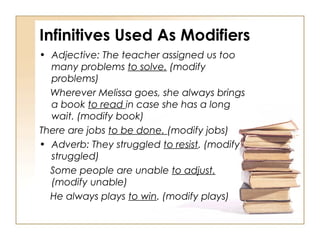
• Adjective: The teacher assigned us too
many problems to solve. (modify
problems)
Wherever Melissa goes, she always brings
a book to read in case she has a long
wait. (modify book)
There are jobs to be done. (modify jobs)
• Adverb: They struggled to resist. (modify
struggled)
Some people are unable to adjust.
(modify unable)
He always plays to win. (modify plays)
Infinitives Used As Modifiers
Identifying Infinitives
Identify the infinitive in each sentence. Then,
label each as subject, direct object, predicate
noun, object of the preposition, appositive,
adjective, or adverb.
1.Worried by my decision, I decided to sleep.
2. To build was the architect’s fondest dream.
3. The teacher assigned us too many pages to
read.
4. My mother likes to eat.
5. They were reluctant to dance.
Prepositional Phrase or Infinitive?
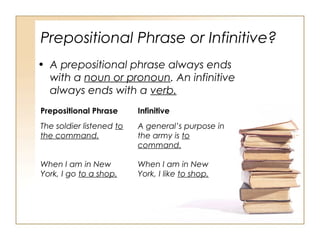
• A prepositional phrase always ends
with a noun or pronoun. An infinitive
always ends with a verb.
Prepositional Phrase Infinitive
The soldier listened to
the command.
When I am in New
York, I go to a shop.
A general’s purpose in
the army is to
command.
When I am in New
York, I like to shop.
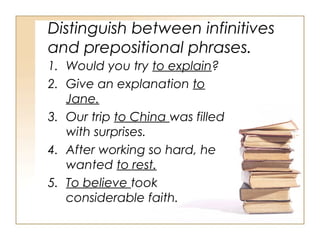
Distinguish between infinitives
and prepositional phrases.
1. Would you try to explain?
2. Give an explanation to
Jane.
3. Our trip to China was filled
with surprises.
4. After working so hard, he
wanted to rest.
5. To believe took
considerable faith.
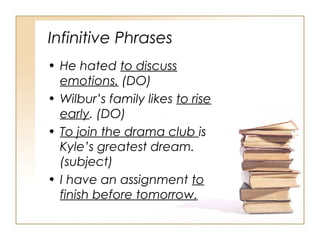
Infinitive Phrases
• He hated to discuss
emotions. (DO)
• Wilbur’s family likes to rise
early. (DO)
• To join the drama club is
Kyle’s greatest dream.
(subject)
• I have an assignment to
finish before tomorrow.
Participles
• Verb forms that are used as
adjectives are called
participles.
• They will have two forms:
– Present (ending in “-ing”)
– Past (ending in “-ed” or “-
en”)
• These contain action, but
they are not used as verbs
in the sentence.
Participles
• Examples:
– Smoking gun
– Snoring spouse
– Broken window
– Elected official
– Streaming video
– Buzzing noise
– Winning touchdown
– Walking track
Participles
• Participles can appear in
several places in the
sentence, but they are
most commonly found
describing / modifying the
subject.
• Participle phrases are
always used as adjectives.
Participles
• Most participle phrases will
have commas setting them
off. This is especially true
when they open a
sentence and modify the
subject.
– Running at full speed, the
back raced twenty yards for
a score.
– Crying loudly, the baby
wanted some attention.
Examples:
Jumping high, Brent hit his
head on the ceiling.
The chemist, blinded by
smoky fumes, stumbled.
Scanning the book, Ann
spotted the answer.
The box wrapped in orange
is for you.
Gerunds
• A gerund looks a lot like a
participle because it ends
in “-ing.”
• However, the gerund is
going to be used as a
noun.
• Gerunds will show up as
subjects, direct or indirect
objects or objects of
prepositions.
• Gerunds are defined as the
-ing form of a verb. They
have several functions.
1. Used as subjects and
complements
• Skiing is my favorite sport.
• Hiking can be very
strenuous.
• Seeing is believing.
2. Used as objects following
prepositions and
prepositional expressions
•Thanks for tending my
children.
•The job consists of typing,
filing, and answering the
phone.
3. Used as objects following
certain verbs.*
•The children enjoyed watching
the parade.
•Ms. Terrell avoided paying her
taxes until it was too late.
•Gerunds can sometimes take
objects of their own:
•Roland is afraid of making
mistakes.
•Sandy is considering leaving
New York.
Gerunds
• Examples:
– Chewing gum in class is not
allowed. (subject)
– I liked eating at the new
restaurant. (direct object)
– Without running very hard I
won the race.
– Abusing the warm fuzzy
kitten is not allowed in this
class. (subject)
Practice:
• You will be shown ten
sentences with a word or
phrase underlined.
• Identify the word or
phrases as:
– Infinitive
– Participle
– Gerund
Practice:
1. Sleeping soundly in his
bed, Ron was not going
to be disturbed by
anyone in his house.
2. I wanted to try out for the
lacrosse team this spring.
3. The rushing waters of the
Colorado River were
great for rafting.
Practice:
4. The warm fuzzy kitten,
meowing loudly in the
hallway, was a nuisance.
5. We tried shooting with the
NBA’s new basketball and
found it to be
challenging.
6. To run a mile in less than
four minutes is nearly
impossible.
Practice:
7. Charging wildly down the
street, the bulls tried to
crush the citizens of
Pamplona.
8. Cheating on a final exam
in English is not an
advisable solution to not
studying.
9. To sleep, perchance to
dream.
Practice:
10. On the sixth day of Xmas,
my true love gave to me
six geese a-laying, five
gold rings, four calling
birds, three French hens,
two turtle doves and a
partridge in a pear tree.
SURPRISE, SURPRISE, SURPRISE!!
• Now that you can identify
these verbals, you have
the great privilege of going
on to the next great step in
verbals……..
DIAGRAMMING!!

Verbals (infinitives, participles, gerunds)

  • 1.
  • 2.
    Is it aVERB or a VERBAL?? • Telling the difference between a verb and a verbal is not done by looking only at the word itself. • You have to see how the word is being used. • In both cases, the word looks like a verb, but if it’s used as something other than a verb…it’s a VERBAL
  • 3.
    Is it aVERB or a VERBAL?? • Examples: – Waxed – Flowing – Playing – Sleeping • These can be verbs or verbals depending upon how they are used in the sentence.
  • 4.
    Is it aVERB or a VERBAL?? • Examples: – Our helpers waxed the floors. – The waxed floors were slippery and dangerous.
  • 5.
    Is it aVERB or a VERBAL?? • Examples: – Water was flowing over the rocks in the stream. – Flowing water carries a great deal of potential energy.
  • 6.
    Basic Information onVerbals • Verbals are verb forms (words that look like verbs or could be verbs in other sentences) that are used as one of the following: – Noun – Adjective – Adverb • A verbal can never be the verb of the sentence.
  • 7.
    Basic Information onVerbals • There are three different kinds of verbals: – Infinitive – Participle – Gerund • Each verbal has a specific purpose and use in a sentence.
  • 8.
    Infinitives • An infinitivehas three possible functions: – As a noun – As an adjective – As an adverb • It is a form of a verb that generally appears with the word ‘to’ and acts as a noun, adjective, or adverb.
  • 9.
    Infinitives Used AsNouns • Subject: To understand required maturity and acceptance. To sleep is the only thing Eli wants after his long day of work. • Direct Object: I hate to go. • Predicate Noun: Our best chance of winning against our enemy is to pray. • Object of the Preposition: I was about to eat when the guests arrived. • Appositive: You have only one choice, to go.
  • 10.
    Unlike gerunds, infinitives canalso act as adjectives and adverbs.
  • 11.
    • Adjective: Theteacher assigned us too many problems to solve. (modify problems) Wherever Melissa goes, she always brings a book to read in case she has a long wait. (modify book) There are jobs to be done. (modify jobs) • Adverb: They struggled to resist. (modify struggled) Some people are unable to adjust. (modify unable) He always plays to win. (modify plays) Infinitives Used As Modifiers
  • 12.
    Identifying Infinitives Identify theinfinitive in each sentence. Then, label each as subject, direct object, predicate noun, object of the preposition, appositive, adjective, or adverb. 1.Worried by my decision, I decided to sleep. 2. To build was the architect’s fondest dream. 3. The teacher assigned us too many pages to read. 4. My mother likes to eat. 5. They were reluctant to dance.
  • 13.
    Prepositional Phrase orInfinitive? • A prepositional phrase always ends with a noun or pronoun. An infinitive always ends with a verb. Prepositional Phrase Infinitive The soldier listened to the command. When I am in New York, I go to a shop. A general’s purpose in the army is to command. When I am in New York, I like to shop.
  • 14.
    Distinguish between infinitives andprepositional phrases. 1. Would you try to explain? 2. Give an explanation to Jane. 3. Our trip to China was filled with surprises. 4. After working so hard, he wanted to rest. 5. To believe took considerable faith.
  • 15.
    Infinitive Phrases • Hehated to discuss emotions. (DO) • Wilbur’s family likes to rise early. (DO) • To join the drama club is Kyle’s greatest dream. (subject) • I have an assignment to finish before tomorrow.
  • 16.
    Participles • Verb formsthat are used as adjectives are called participles. • They will have two forms: – Present (ending in “-ing”) – Past (ending in “-ed” or “- en”) • These contain action, but they are not used as verbs in the sentence.
  • 17.
    Participles • Examples: – Smokinggun – Snoring spouse – Broken window – Elected official – Streaming video – Buzzing noise – Winning touchdown – Walking track
  • 18.
    Participles • Participles canappear in several places in the sentence, but they are most commonly found describing / modifying the subject. • Participle phrases are always used as adjectives.
  • 19.
    Participles • Most participlephrases will have commas setting them off. This is especially true when they open a sentence and modify the subject. – Running at full speed, the back raced twenty yards for a score. – Crying loudly, the baby wanted some attention.
  • 20.
    Examples: Jumping high, Brenthit his head on the ceiling. The chemist, blinded by smoky fumes, stumbled. Scanning the book, Ann spotted the answer. The box wrapped in orange is for you.
  • 21.
    Gerunds • A gerundlooks a lot like a participle because it ends in “-ing.” • However, the gerund is going to be used as a noun. • Gerunds will show up as subjects, direct or indirect objects or objects of prepositions.
  • 22.
    • Gerunds aredefined as the -ing form of a verb. They have several functions. 1. Used as subjects and complements • Skiing is my favorite sport. • Hiking can be very strenuous. • Seeing is believing.
  • 23.
    2. Used asobjects following prepositions and prepositional expressions •Thanks for tending my children. •The job consists of typing, filing, and answering the phone.
  • 24.
    3. Used asobjects following certain verbs.* •The children enjoyed watching the parade. •Ms. Terrell avoided paying her taxes until it was too late. •Gerunds can sometimes take objects of their own: •Roland is afraid of making mistakes. •Sandy is considering leaving New York.
  • 25.
    Gerunds • Examples: – Chewinggum in class is not allowed. (subject) – I liked eating at the new restaurant. (direct object) – Without running very hard I won the race. – Abusing the warm fuzzy kitten is not allowed in this class. (subject)
  • 26.
    Practice: • You willbe shown ten sentences with a word or phrase underlined. • Identify the word or phrases as: – Infinitive – Participle – Gerund
  • 27.
    Practice: 1. Sleeping soundlyin his bed, Ron was not going to be disturbed by anyone in his house. 2. I wanted to try out for the lacrosse team this spring. 3. The rushing waters of the Colorado River were great for rafting.
  • 28.
    Practice: 4. The warmfuzzy kitten, meowing loudly in the hallway, was a nuisance. 5. We tried shooting with the NBA’s new basketball and found it to be challenging. 6. To run a mile in less than four minutes is nearly impossible.
  • 29.
    Practice: 7. Charging wildlydown the street, the bulls tried to crush the citizens of Pamplona. 8. Cheating on a final exam in English is not an advisable solution to not studying. 9. To sleep, perchance to dream.
  • 30.
    Practice: 10. On thesixth day of Xmas, my true love gave to me six geese a-laying, five gold rings, four calling birds, three French hens, two turtle doves and a partridge in a pear tree.
  • 31.
    SURPRISE, SURPRISE, SURPRISE!! •Now that you can identify these verbals, you have the great privilege of going on to the next great step in verbals……..
  • 32.

Editor's Notes

  • #5 In the first sentence, the word is being used as a verb to tell what action is being done. In the other one, the word still looks like a verb, but it is being used as an adjective
  • #6 The same thing is true here as in the other example. The second sentence shows the verb working as an adjective instead of a verb.
  • #10 Students need to learn the parts of speech. The subject is STUDENTS. The verb is NEED. The infinitive TO LEARN is the object of the verb. Therefore, it is a noun.
  • #17 Present participles can function as nouns—the subjects, direct objects, indirect objects, objects of prepositions, and subject complements in sentences.