Participatory Rapid Appraisal

               A report in
 Agricultural Extension 220 – Farming
        Systems Development
               Ronel D. Caña
                 Student

           Joselito D. Tucit, M. Sc.
                  Professor
Introduction
Participatory Rapid Appraisal (PRA):
• a growing combination of approaches and
  methods that enable vulnerable people to
  share, enhance, and analyze their knowledge
  of life and conditions, to plan and act and to
  monitor and evaluate.
Introduction
Participatory Rapid Appraisal (PRA):
• first developed in India and Kenya during the
  1980s; it has been mainly used by
  nongovernmental organizations (NGOs)
  working on the grass-roots level.
Introduction
Participatory Rapid Appraisal (PRA):
• emphasizes empowering local people to
  assume an active role in analyzing their own
  living conditions, problems, and potentials in
  order to seek a change in their situation.
Introduction
Participatory Rapid Appraisal (PRA):
• an important principle of PRA is to share the
  results of the analysis between the PRA team
  and the community members by
  visualization, public presentations and
  discussions during meetings.
What is Participatory Rapid Appraisal
                (PRA)?
• Participatory Rapid Appraisal is an
  intensive, systematic but semi-structured
  learning experience carried out in a
  community by a multi-disciplinary team which
  includes community members.
What is Participatory Rapid Appraisal
                (PRA)?
The results of the PRA can be used for:

• Needs assessment;
• Feasibility studies;
• Identifying priorities for development activities;
• Implementing development activities where new
  information needs to be collected;
• Monitoring or evaluating development activities.
What is Participatory Rapid Appraisal
                (PRA)?
The conduct o PRA will require the following:

•   Participation;
•   Respect for community members;
•   Interest in what they know, say, show, and do;
•   Patience, without rushing and interrupting;
•   Listening, not lecturing;
•   Humility;
•   Methods which empower community members to
    express, share, enhance and analyze their knowledge.
Main Features of PRA
Following are the main features of PRA:

•   Triangulation;
•   Multidisciplinary team;
•   Mix of Techniques;
•   Flexibility and informality;
•   “In the community” approach;
•   On the spot analysis;
•   Self-criticism.
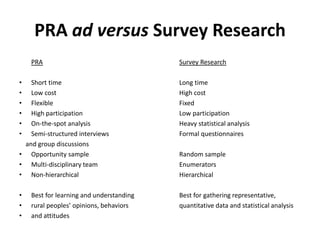
PRA ad versus Survey Research
    PRA                                   Survey Research

•  Short time                             Long time
•  Low cost                               High cost
•  Flexible                               Fixed
•  High participation                     Low participation
•  On-the-spot analysis                   Heavy statistical analysis
•  Semi-structured interviews             Formal questionnaires
 and group discussions
• Opportunity sample                      Random sample
• Multi-disciplinary team                 Enumerators
• Non-hierarchical                        Hierarchical

•   Best for learning and understanding   Best for gathering representative,
•   rural peoples’ opinions, behaviors    quantitative data and statistical analysis
•   and attitudes
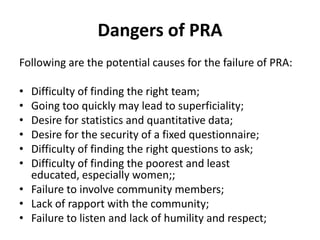
Dangers of PRA
Following are the potential causes for the failure of PRA:

• Difficulty of finding the right team;
• Going too quickly may lead to superficiality;
• Desire for statistics and quantitative data;
• Desire for the security of a fixed questionnaire;
• Difficulty of finding the right questions to ask;
• Difficulty of finding the poorest and least
  educated, especially women;;
• Failure to involve community members;
• Lack of rapport with the community;
• Failure to listen and lack of humility and respect;
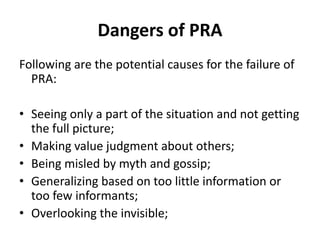
Dangers of PRA
Following are the potential causes for the failure of
  PRA:

• Seeing only a part of the situation and not getting
  the full picture;
• Making value judgment about others;
• Being misled by myth and gossip;
• Generalizing based on too little information or
  too few informants;
• Overlooking the invisible;
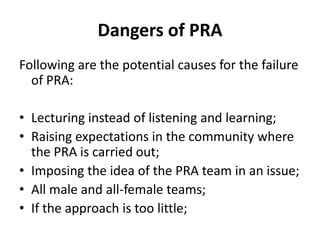
Dangers of PRA
Following are the potential causes for the failure
  of PRA:

• Lecturing instead of listening and learning;
• Raising expectations in the community where
  the PRA is carried out;
• Imposing the idea of the PRA team in an issue;
• All male and all-female teams;
• If the approach is too little;
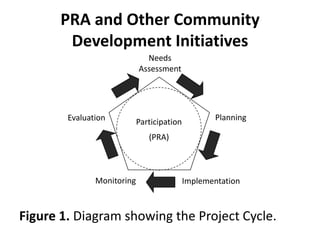
PRA and Other Community
        Development Initiatives
                              Needs
                            Assessment


        Evaluation          Participation           Planning

                               (PRA)


               Monitoring                   Implementation


Figure 1. Diagram showing the Project Cycle.
Tools and Techniques of PRA
• Direct observation – is systematically observing
  objects, events, processes, relationships or
  people and recording these observations. Direct
  observation is a good way to cross-check
  respondent’s answers. Use a checklist to do
  observations systematically. The steps are:
  – Think about the objectives and broad topics of the
    PRA;
  – Identify indicators which you can asses through direct
    observation;
  – List down the indicators.
Tools and Techniques of PRA
• Review of secondary data sources – secondary
  sources are sources of information that are
  relevant to the area or subject of the planned
  PRA and are available in published or
  unpublished form;
Tools and Techniques of PRA
• Construction of diagrams – a diagram is any
  simple model which presents information in an
  easily understandable visual form. Diagrams are
  constructed to:
  –   Greatly simplify complex information;
  –   Show/picture an analytical procedure;
  –   Facilitate communication;
  –   Stimulate discussion;
  –   Increase consensus among members;
  –   Involve community members and to discover their
      views and categories by encouraging them to draw
      diagrams of their own;
Tools of PRA: Diagrams
• Seasonal calendar – a calendar showing the
  main activities, problems and opportunities
  throughout the annual cycle in diagrammatic
  form (multi-layer diagrams in one sheet). It
  helps identify the events that have impact on
  the peoples’ lives. Information in the calendar
  include dates, events, cash flow and even
  input prices;
Tools of PRA: Diagrams
• Semi-structured interviews – is a guided
  interview where only some of the questions
  are predetermined and new questions come
  up during the interview. The interviewer
  prepares a list of topics and questions rather
  than a fixed questionnaire. The targets are
  individuals, key informants and focus groups;
Tools of PRA: Diagrams
• Time trends – are quantitative changes over
  time and can be used for many variables
  (those that have impact to the lives of the
  people on the area). Examples are input
  prices, rainfall, livestock population, etc.).
Tools of PRA: Diagrams
• Historical profile – chronological list of events in
  the community. This reveals important
  information for understanding the present
  situation in a community;
• Daily routine/daily activity profile – collection of
  day-to-day activities of community members;
• Flow diagram – this diagram shows cause, effects
  and relationships between key variables;
• Venn diagram – shows key institutions and
  individuals in a community and their relationships
  and importance for decision making;
Tools and Techniques of PRA
• Drawing maps and taking photographs – drawn
  maps of the area are sources of spatial
  information in the area, and taking photos will
  show the features of the area. An ideal method
  for mapping is to conduct “participatory
  mapping”. While “transect mapping” is mapping
  of the main land use zones of the area (Includes
  Soil, land use, crops and vegetation, problems
  and opportunities – presented in linear distance
  along the transect path).
Tools and Techniques of PRA
The maps drawn and photos taken may be done
  for topics such as:
  •   Demography
  •   Social and residential stratification;
  •   Use of natural resources;
  •   Fields and land use;
  •   Spatial arrangement of houses and use of space;
  •   Mobility;
  •   Water;
  •   Soils.
Tools and Techniques of PRA
Analysis group discussion – also, the focus group
  discussion where, the participants are allowed to
  conduct a free discussion on important and
  related topics. Rules for analysis group discussion
  are:
   •   Listen
   •   Learn
   •   Facilitate
   •   Don’t dominate
   •   Don’t lecture
   •   Don’t interrupt
   •   Respect people’s opinions
Tools and Techniques of PRA
• Ranking – ranking or scoring is placing
  something in order. This complements semi-
  structured interviewing by generating basic
  information which leads to more direct
  questioning.
  o Preference ranking;
  o Pairwise ranking;
  o Direct matrix ranking; and
  o Wealth ranking.
Tools and Techniques of PRA
• Innovation assessment – helps to asses and
  prioritizes possible options for development
  activities. It also identifies the innovation
  (intervention) and its implementation. This
  activity is done after the analysis group
  discussion;
Tools and Techniques of PRA
• Sustainability analysis – this is useful for the periodic review
  of development activities. Without collection of
  information, this sharpens the group’s analytical skills and
  brings out important issues. The questions to be answered
  are:
   o   Activity;
   o   Goals/Objectives;
   o   Output indicators;
   o   Impact indicators;
   o   Strengths;
   o   Weaknesses;
   o   What should we continue doing?
   o   What should we start doing?
   o   What should we stop doing?
Writing the PRA Report
• As the final part of the PRA, the report should
  be prepared for later presentation. The report
  will contain the proceedings and results of the
  conducted activities. Also contained in the
  report are the recommendations and action
  plans.
Writing the PRA Report
Considerations in preparing and presenting the
  report are the following:
   o Who will read the report
     (community, government, NGOs, donors)?
   o What will the report be used for?
   o What should the report contain?
   o How should the information be presented?
   o Who will write the report?

Writing the PRA report follows common technical
 writing principles, guidelines and formats.
With that, I would like to extend my deepest appreciation
and recognition for your valuable attention to the rendition
                  of this report session.

                    Thank you!


                    Ronel D. Caña, MSA-to-be
         Mud Creek (Sapang Putik), San Ildefonso, Bulacan
            0927-210-1341 ronel.cana@yahoo.com
Participatory rapid appraisal

  • 1.
    Participatory Rapid Appraisal A report in Agricultural Extension 220 – Farming Systems Development Ronel D. Caña Student Joselito D. Tucit, M. Sc. Professor
  • 2.
    Introduction Participatory Rapid Appraisal(PRA): • a growing combination of approaches and methods that enable vulnerable people to share, enhance, and analyze their knowledge of life and conditions, to plan and act and to monitor and evaluate.
  • 3.
    Introduction Participatory Rapid Appraisal(PRA): • first developed in India and Kenya during the 1980s; it has been mainly used by nongovernmental organizations (NGOs) working on the grass-roots level.
  • 4.
    Introduction Participatory Rapid Appraisal(PRA): • emphasizes empowering local people to assume an active role in analyzing their own living conditions, problems, and potentials in order to seek a change in their situation.
  • 5.
    Introduction Participatory Rapid Appraisal(PRA): • an important principle of PRA is to share the results of the analysis between the PRA team and the community members by visualization, public presentations and discussions during meetings.
  • 6.
    What is ParticipatoryRapid Appraisal (PRA)? • Participatory Rapid Appraisal is an intensive, systematic but semi-structured learning experience carried out in a community by a multi-disciplinary team which includes community members.
  • 7.
    What is ParticipatoryRapid Appraisal (PRA)? The results of the PRA can be used for: • Needs assessment; • Feasibility studies; • Identifying priorities for development activities; • Implementing development activities where new information needs to be collected; • Monitoring or evaluating development activities.
  • 8.
    What is ParticipatoryRapid Appraisal (PRA)? The conduct o PRA will require the following: • Participation; • Respect for community members; • Interest in what they know, say, show, and do; • Patience, without rushing and interrupting; • Listening, not lecturing; • Humility; • Methods which empower community members to express, share, enhance and analyze their knowledge.
  • 9.
    Main Features ofPRA Following are the main features of PRA: • Triangulation; • Multidisciplinary team; • Mix of Techniques; • Flexibility and informality; • “In the community” approach; • On the spot analysis; • Self-criticism.
  • 10.
    PRA ad versusSurvey Research PRA Survey Research • Short time Long time • Low cost High cost • Flexible Fixed • High participation Low participation • On-the-spot analysis Heavy statistical analysis • Semi-structured interviews Formal questionnaires and group discussions • Opportunity sample Random sample • Multi-disciplinary team Enumerators • Non-hierarchical Hierarchical • Best for learning and understanding Best for gathering representative, • rural peoples’ opinions, behaviors quantitative data and statistical analysis • and attitudes
  • 11.
    Dangers of PRA Followingare the potential causes for the failure of PRA: • Difficulty of finding the right team; • Going too quickly may lead to superficiality; • Desire for statistics and quantitative data; • Desire for the security of a fixed questionnaire; • Difficulty of finding the right questions to ask; • Difficulty of finding the poorest and least educated, especially women;; • Failure to involve community members; • Lack of rapport with the community; • Failure to listen and lack of humility and respect;
  • 12.
    Dangers of PRA Followingare the potential causes for the failure of PRA: • Seeing only a part of the situation and not getting the full picture; • Making value judgment about others; • Being misled by myth and gossip; • Generalizing based on too little information or too few informants; • Overlooking the invisible;
  • 13.
    Dangers of PRA Followingare the potential causes for the failure of PRA: • Lecturing instead of listening and learning; • Raising expectations in the community where the PRA is carried out; • Imposing the idea of the PRA team in an issue; • All male and all-female teams; • If the approach is too little;
  • 14.
    PRA and OtherCommunity Development Initiatives Needs Assessment Evaluation Participation Planning (PRA) Monitoring Implementation Figure 1. Diagram showing the Project Cycle.
  • 15.
    Tools and Techniquesof PRA • Direct observation – is systematically observing objects, events, processes, relationships or people and recording these observations. Direct observation is a good way to cross-check respondent’s answers. Use a checklist to do observations systematically. The steps are: – Think about the objectives and broad topics of the PRA; – Identify indicators which you can asses through direct observation; – List down the indicators.
  • 16.
    Tools and Techniquesof PRA • Review of secondary data sources – secondary sources are sources of information that are relevant to the area or subject of the planned PRA and are available in published or unpublished form;
  • 17.
    Tools and Techniquesof PRA • Construction of diagrams – a diagram is any simple model which presents information in an easily understandable visual form. Diagrams are constructed to: – Greatly simplify complex information; – Show/picture an analytical procedure; – Facilitate communication; – Stimulate discussion; – Increase consensus among members; – Involve community members and to discover their views and categories by encouraging them to draw diagrams of their own;
  • 18.
    Tools of PRA:Diagrams • Seasonal calendar – a calendar showing the main activities, problems and opportunities throughout the annual cycle in diagrammatic form (multi-layer diagrams in one sheet). It helps identify the events that have impact on the peoples’ lives. Information in the calendar include dates, events, cash flow and even input prices;
  • 19.
    Tools of PRA:Diagrams • Semi-structured interviews – is a guided interview where only some of the questions are predetermined and new questions come up during the interview. The interviewer prepares a list of topics and questions rather than a fixed questionnaire. The targets are individuals, key informants and focus groups;
  • 20.
    Tools of PRA:Diagrams • Time trends – are quantitative changes over time and can be used for many variables (those that have impact to the lives of the people on the area). Examples are input prices, rainfall, livestock population, etc.).
  • 21.
    Tools of PRA:Diagrams • Historical profile – chronological list of events in the community. This reveals important information for understanding the present situation in a community; • Daily routine/daily activity profile – collection of day-to-day activities of community members; • Flow diagram – this diagram shows cause, effects and relationships between key variables; • Venn diagram – shows key institutions and individuals in a community and their relationships and importance for decision making;
  • 22.
    Tools and Techniquesof PRA • Drawing maps and taking photographs – drawn maps of the area are sources of spatial information in the area, and taking photos will show the features of the area. An ideal method for mapping is to conduct “participatory mapping”. While “transect mapping” is mapping of the main land use zones of the area (Includes Soil, land use, crops and vegetation, problems and opportunities – presented in linear distance along the transect path).
  • 23.
    Tools and Techniquesof PRA The maps drawn and photos taken may be done for topics such as: • Demography • Social and residential stratification; • Use of natural resources; • Fields and land use; • Spatial arrangement of houses and use of space; • Mobility; • Water; • Soils.
  • 24.
    Tools and Techniquesof PRA Analysis group discussion – also, the focus group discussion where, the participants are allowed to conduct a free discussion on important and related topics. Rules for analysis group discussion are: • Listen • Learn • Facilitate • Don’t dominate • Don’t lecture • Don’t interrupt • Respect people’s opinions
  • 25.
    Tools and Techniquesof PRA • Ranking – ranking or scoring is placing something in order. This complements semi- structured interviewing by generating basic information which leads to more direct questioning. o Preference ranking; o Pairwise ranking; o Direct matrix ranking; and o Wealth ranking.
  • 26.
    Tools and Techniquesof PRA • Innovation assessment – helps to asses and prioritizes possible options for development activities. It also identifies the innovation (intervention) and its implementation. This activity is done after the analysis group discussion;
  • 27.
    Tools and Techniquesof PRA • Sustainability analysis – this is useful for the periodic review of development activities. Without collection of information, this sharpens the group’s analytical skills and brings out important issues. The questions to be answered are: o Activity; o Goals/Objectives; o Output indicators; o Impact indicators; o Strengths; o Weaknesses; o What should we continue doing? o What should we start doing? o What should we stop doing?
  • 28.
    Writing the PRAReport • As the final part of the PRA, the report should be prepared for later presentation. The report will contain the proceedings and results of the conducted activities. Also contained in the report are the recommendations and action plans.
  • 29.
    Writing the PRAReport Considerations in preparing and presenting the report are the following: o Who will read the report (community, government, NGOs, donors)? o What will the report be used for? o What should the report contain? o How should the information be presented? o Who will write the report? Writing the PRA report follows common technical writing principles, guidelines and formats.
  • 30.
    With that, Iwould like to extend my deepest appreciation and recognition for your valuable attention to the rendition of this report session. Thank you! Ronel D. Caña, MSA-to-be Mud Creek (Sapang Putik), San Ildefonso, Bulacan 0927-210-1341 ronel.cana@yahoo.com