PARTICIPATORY
RURAL
APPRAISAL
D.Lokeshwaran
Pg Scholar
Department of Agricultural Extension
Course Teacher
Dr.J.Meenambigai
Associate Professor
Department of Agricultural Extension
PARTICIPATORY RURAL APPRAISAL
Appraisal The finding out of information about
problems, needs, and potential in a village. It is the
first stage in any project.
Participatory Means that people are involved in
the process a "bottom-up" approach that requires
good communication skills and attitude of project
staff.
• Rural The techniques can be used in any
situation, urban or rural, with both literate and
illiterate. people.
KEY PRINCIPLES
• Participation - participation by the communities
Flexibility time and resources available
• Teamwork - conducted by a local team with local
languvage
• Optimal ignorance - both time and money
Systematic-generated data, qualitative nature
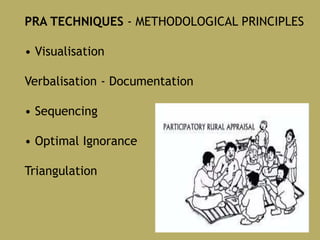
PRA TECHNIQUES - METHODOLOGICAL PRINCIPLES
• Visualisation
Verbalisation - Documentation
• Sequencing
• Optimal Ignorance
Triangulation
PRA TECHNIQUES
Direct observation - Observations are related to
questions: What? When? Where? Who? Why? How?
Do it yourself - Villagers are encouraged to teach
the researcher how to to do various activities. The
researcher will learn how much skill and strength
are required to do day-to-day rural activities,
gaining an insider's perspective on a situation.
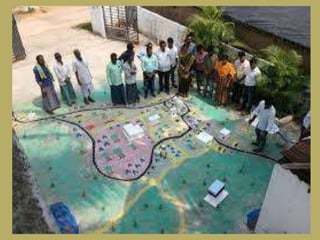
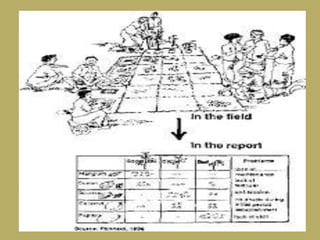
PARTICIPATORY MAPPING AND MODELING Using local
materials, villagers draw or model
current or historical conditions. The researcher then
interviews the villager by "interviewing the map."
This technique can be used to show soils, water
sources, wealth rankings, household assets, land-use
patterns, changes in farming practices, constraints,
trends, health and welfare conditions, and the
distribution of various resources.
SEASONAL CALENDARS
Variables such as rainfall, labour, income,
expenditures, debt, animal fodder or pests, and
harvesting periods can be drawn (or created with
stones, seeds, and sticks) to show month-to-month
variations and seasonal constraints and to highlight
opportunities for action.
An 18-month calendar can better illustrate
variations than a 12-month calendar.
DAILY-ACTIVITY PROFILES
• Researchers can explore and compare the daily-
activity patterns of men, women, youth, and
elders by charting the amount of time taken to
complete tasks.
SEMI STRUCTURED
INTERVIEWING
structured interviewing and listening
A semi technique uses some predetermined
questions and topics but allows new topics to be
pursued as the interview develops. The
interviews are informal and conversational but
carefully controlled.
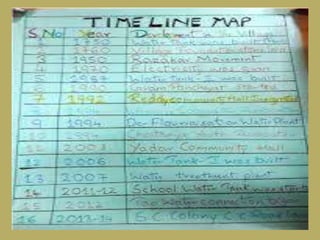
TIME LINES
Major historical community events and changes
are dated and listed. Understanding the cycles of
change can help communities focus on future
actions and information requirements.
LOCAL HISTORIES
Local histories are similar to time lines but give a
more detailed account of how things have changed
or are changing. For example, histories can be
developed for crops, population changes,
community health trends and epidemics, education
changes, road developments, and trees and
forests.
VENN DIAGRAMS
To show the relationship between things,
overlapping circles are used to represent people,
villages, or institutions; lines are added to reflect
inputs and outputs.
WEALTH AND WELL-BEING RANKINGS
• People are asked to sort cards (or slips of paper)
representing individuals or households from rich
to poor or from sick to healthy.
This technique can be used for crosschecking
information and for initiating discussions on a
specific topic (for example, poverty).
The technique can also be used to produce a
benchmark against which future development
interventions can be measured or evaluated.
MATRICES
Matrices can be used to gather information and to
facilitate or focus analyses and discussions.
o For example, a problem opportunity matrix could
have columns with the following labels: soil type,
land use, cropping patterns, and available
resources; and rows with the following labels:
problems, constraints, local solutions, and
initiatives already tried.
FOLKLORE, SONGS, POETRY, AND
DANCE
Local folklore, songs, dance, and poetry are
analyzed to provide insight into values, history,
practices, and beliefs.
DIAGRAMS EXHIBITION
Transitions
• Diagrams, maps, charts, and photos of the
research activity are displayed in a public place
to share information, facilitate discussions, and
provide an additional crosschecking device. The
exhibition can inspire other villagers to take part
in research activities.
SHARED PRESENTATIONS AND ANALYSIS
• Participants are encouraged to present their
findings to other villagers and to outsiders,
providing another opportunity for crosschecking,
feedback, comment, and criticism.
PRA
TOOLS
SOCIAL MAPPING
Social mapping is involves the
sketching/drawing of houses and other social
facilities and infrastructure (i.e. temple,
stores, rice mills, school, pharmacy, trails and
roads, water pumps, irrigation and recreation
facilities) in a village.
It helps to visualize and situate the location of
households and other social
facilities/infrastructure in a village.It serves as
a baseline for planning, implementation,
monitoring, and evaluation of village
development activities (including selection of
village organizing strategy).
RESOURCE MAP
The Village Resource Map is a tool that helps us to
learn about a community and its resource base.
The primary concern is not to develop an accurate
map but to get useful information about local
perceptions of resources..
Objectives: To learn the villagers' perception of
what natural resources are found in the
community and how they are used.
TIMELINE (HISTORICAL MAPPING)
The timeline with basic events can be used
for focused discussions on problems, social
and technological innovations or on
communities history of cooperation's and
activities which helped them to solve in past
problems successfully.
WEALTH RANKING
• Wealth ranking is determines the economic
attributes of households in a village. It shows
information on the relative wealth and well-being
of households in a village. It helps in determining
the social and economic status of households in a
village.
PAIR-WISE RANKING
• Pair-wise ranking is a PRA method that helps
villagers to set priorities (i.e. problems, needs,
actions, etc.).
Ranking can be undertaken with key informants
or group of villagers that represents a good
mixture of interests.
It can also be conducted based on gender to
determine different preferences between men
and women.
ADVANTAGES OF PRA
Identification of genuine priorities for target group
Devolution of management responsibilities
Motivation and mobilisation of local development
workers
Forming better linkages between communities and
development institutions Use of local resource
Mobilisation of community resources
• More sustainable development activities
DISADVANTAGES
Raising expectations which cannot be realised
• Proposal of development plans which
participating agencies cannot respond to
Risk of "capture" of activities by local interests
o Failure to take account of stratification in
communities
RRA- Rapid Rural Appraisal
• RRA is more commonly described as a systematic but semi-
structured activity out in the field by a multidisciplinary team and is
designed to obtain new information and to formulate new hypotheses
about rural life.
• Rapid Rural Appraisal (RRA) is an approach used for
identifying quickly, inexpensively, and reliably groups and
individuals most in need of primary health care. The
method has been used primarily in agricultural research.
The techniques of RRA include:
 interview and question design techniques for individual, household
and key informant interviews
 methods of cross-checking information from different sources
 sampling techniques that can be adapted to a particular objective
 methods of obtaining quantitative data in a short time frame
 group interview techniques, including focus-group interviewing
 methods of direct observation at site level, and
 use of secondary data sources.
Participatory Technology Development
• Participatory Technology Development (PTD) is the practical
process of bringing together the knowledge and research
capacities of the local farming communities with that of the
commercial and scientific institutions in an interactive way. It
involves activities where local producers and traders work
together with external actors in the identification generation,
testing and application of new technologies and practices.
The process of technology development is closely
linked with a process of social change.
 Encouraging local innovation through self organized
planning, implementation and evaluation of systematic
experiments fosters self respect and self confidence in
the rural communities involved.
It also fosters a process of cultural awareness and
change, as the planning and assessment obliges the
participants to take account of their situation and the
responsibilities of different people in the community.
Example: the different needs of women and men and
the different barriers they face in trying to change their
situation.
Steps in PTD
§ Farmers and extension personnel together discuss their farming
situation to identify major problems.
§ After the problem identification and prioritization, different options are
sought for solving it. These options come from farmer's knowledge as
well as scientific stream. The role of extension worker is to provide
appropriate technical options for testing.
§ Incorporating the best options, the farmers and extension personnel
jointly design the experiments for field implementation. The task of
carrying out the experiment is entrusted to a willing farmer in the Self
Help Group (SHG).
§ The SHG members monitor and discuss the progress of the
experiment during their group meetings.
§ Farmers record all the vital observations for the final
evaluation of the experiment.
§ On completion of the experiment, the farmers discuss
the results in the SHG and evaluate the experiment
thoroughly.
§The results are shared among other farmers.
Bibliography
Chambers, R. (1994a) The origins and practice of
Participatory Rural Appraisal, World Development,
Vol. 22, No. 7, pp. 953-69.
• Participatory Rural Appraisal, 2003 World Bank.
• Methods of Participatory Appraisal, Phil Bartle,
2003
CSMED.
Participatory Rural Appraisal, Mohan Dhamotharan,
1998-Dhaka.
PRA

PRA

  • 1.
  • 2.
    D.Lokeshwaran Pg Scholar Department ofAgricultural Extension Course Teacher Dr.J.Meenambigai Associate Professor Department of Agricultural Extension
  • 4.
    PARTICIPATORY RURAL APPRAISAL AppraisalThe finding out of information about problems, needs, and potential in a village. It is the first stage in any project. Participatory Means that people are involved in the process a "bottom-up" approach that requires good communication skills and attitude of project staff. • Rural The techniques can be used in any situation, urban or rural, with both literate and illiterate. people.
  • 8.
    KEY PRINCIPLES • Participation- participation by the communities Flexibility time and resources available • Teamwork - conducted by a local team with local languvage • Optimal ignorance - both time and money Systematic-generated data, qualitative nature
  • 9.
    PRA TECHNIQUES -METHODOLOGICAL PRINCIPLES • Visualisation Verbalisation - Documentation • Sequencing • Optimal Ignorance Triangulation
  • 10.
    PRA TECHNIQUES Direct observation- Observations are related to questions: What? When? Where? Who? Why? How? Do it yourself - Villagers are encouraged to teach the researcher how to to do various activities. The researcher will learn how much skill and strength are required to do day-to-day rural activities, gaining an insider's perspective on a situation.
  • 11.
    PARTICIPATORY MAPPING ANDMODELING Using local materials, villagers draw or model current or historical conditions. The researcher then interviews the villager by "interviewing the map." This technique can be used to show soils, water sources, wealth rankings, household assets, land-use patterns, changes in farming practices, constraints, trends, health and welfare conditions, and the distribution of various resources.
  • 12.
    SEASONAL CALENDARS Variables suchas rainfall, labour, income, expenditures, debt, animal fodder or pests, and harvesting periods can be drawn (or created with stones, seeds, and sticks) to show month-to-month variations and seasonal constraints and to highlight opportunities for action. An 18-month calendar can better illustrate variations than a 12-month calendar.
  • 14.
    DAILY-ACTIVITY PROFILES • Researcherscan explore and compare the daily- activity patterns of men, women, youth, and elders by charting the amount of time taken to complete tasks.
  • 16.
    SEMI STRUCTURED INTERVIEWING structured interviewingand listening A semi technique uses some predetermined questions and topics but allows new topics to be pursued as the interview develops. The interviews are informal and conversational but carefully controlled.
  • 18.
    TIME LINES Major historicalcommunity events and changes are dated and listed. Understanding the cycles of change can help communities focus on future actions and information requirements.
  • 19.
    LOCAL HISTORIES Local historiesare similar to time lines but give a more detailed account of how things have changed or are changing. For example, histories can be developed for crops, population changes, community health trends and epidemics, education changes, road developments, and trees and forests.
  • 20.
    VENN DIAGRAMS To showthe relationship between things, overlapping circles are used to represent people, villages, or institutions; lines are added to reflect inputs and outputs.
  • 22.
    WEALTH AND WELL-BEINGRANKINGS • People are asked to sort cards (or slips of paper) representing individuals or households from rich to poor or from sick to healthy. This technique can be used for crosschecking information and for initiating discussions on a specific topic (for example, poverty). The technique can also be used to produce a benchmark against which future development interventions can be measured or evaluated.
  • 23.
    MATRICES Matrices can beused to gather information and to facilitate or focus analyses and discussions. o For example, a problem opportunity matrix could have columns with the following labels: soil type, land use, cropping patterns, and available resources; and rows with the following labels: problems, constraints, local solutions, and initiatives already tried.
  • 25.
    FOLKLORE, SONGS, POETRY,AND DANCE Local folklore, songs, dance, and poetry are analyzed to provide insight into values, history, practices, and beliefs.
  • 26.
    DIAGRAMS EXHIBITION Transitions • Diagrams,maps, charts, and photos of the research activity are displayed in a public place to share information, facilitate discussions, and provide an additional crosschecking device. The exhibition can inspire other villagers to take part in research activities.
  • 27.
    SHARED PRESENTATIONS ANDANALYSIS • Participants are encouraged to present their findings to other villagers and to outsiders, providing another opportunity for crosschecking, feedback, comment, and criticism.
  • 29.
  • 32.
    SOCIAL MAPPING Social mappingis involves the sketching/drawing of houses and other social facilities and infrastructure (i.e. temple, stores, rice mills, school, pharmacy, trails and roads, water pumps, irrigation and recreation facilities) in a village. It helps to visualize and situate the location of households and other social facilities/infrastructure in a village.It serves as a baseline for planning, implementation, monitoring, and evaluation of village development activities (including selection of village organizing strategy).
  • 34.
    RESOURCE MAP The VillageResource Map is a tool that helps us to learn about a community and its resource base. The primary concern is not to develop an accurate map but to get useful information about local perceptions of resources.. Objectives: To learn the villagers' perception of what natural resources are found in the community and how they are used.
  • 36.
    TIMELINE (HISTORICAL MAPPING) Thetimeline with basic events can be used for focused discussions on problems, social and technological innovations or on communities history of cooperation's and activities which helped them to solve in past problems successfully.
  • 40.
    WEALTH RANKING • Wealthranking is determines the economic attributes of households in a village. It shows information on the relative wealth and well-being of households in a village. It helps in determining the social and economic status of households in a village.
  • 41.
    PAIR-WISE RANKING • Pair-wiseranking is a PRA method that helps villagers to set priorities (i.e. problems, needs, actions, etc.). Ranking can be undertaken with key informants or group of villagers that represents a good mixture of interests. It can also be conducted based on gender to determine different preferences between men and women.
  • 43.
    ADVANTAGES OF PRA Identificationof genuine priorities for target group Devolution of management responsibilities Motivation and mobilisation of local development workers Forming better linkages between communities and development institutions Use of local resource Mobilisation of community resources • More sustainable development activities
  • 44.
    DISADVANTAGES Raising expectations whichcannot be realised • Proposal of development plans which participating agencies cannot respond to Risk of "capture" of activities by local interests o Failure to take account of stratification in communities
  • 45.
    RRA- Rapid RuralAppraisal • RRA is more commonly described as a systematic but semi- structured activity out in the field by a multidisciplinary team and is designed to obtain new information and to formulate new hypotheses about rural life. • Rapid Rural Appraisal (RRA) is an approach used for identifying quickly, inexpensively, and reliably groups and individuals most in need of primary health care. The method has been used primarily in agricultural research.
  • 46.
    The techniques ofRRA include:  interview and question design techniques for individual, household and key informant interviews  methods of cross-checking information from different sources  sampling techniques that can be adapted to a particular objective  methods of obtaining quantitative data in a short time frame  group interview techniques, including focus-group interviewing  methods of direct observation at site level, and  use of secondary data sources.
  • 47.
    Participatory Technology Development •Participatory Technology Development (PTD) is the practical process of bringing together the knowledge and research capacities of the local farming communities with that of the commercial and scientific institutions in an interactive way. It involves activities where local producers and traders work together with external actors in the identification generation, testing and application of new technologies and practices.
  • 48.
    The process oftechnology development is closely linked with a process of social change.  Encouraging local innovation through self organized planning, implementation and evaluation of systematic experiments fosters self respect and self confidence in the rural communities involved. It also fosters a process of cultural awareness and change, as the planning and assessment obliges the participants to take account of their situation and the responsibilities of different people in the community. Example: the different needs of women and men and the different barriers they face in trying to change their situation.
  • 49.
    Steps in PTD §Farmers and extension personnel together discuss their farming situation to identify major problems. § After the problem identification and prioritization, different options are sought for solving it. These options come from farmer's knowledge as well as scientific stream. The role of extension worker is to provide appropriate technical options for testing. § Incorporating the best options, the farmers and extension personnel jointly design the experiments for field implementation. The task of carrying out the experiment is entrusted to a willing farmer in the Self Help Group (SHG). § The SHG members monitor and discuss the progress of the experiment during their group meetings.
  • 50.
    § Farmers recordall the vital observations for the final evaluation of the experiment. § On completion of the experiment, the farmers discuss the results in the SHG and evaluate the experiment thoroughly. §The results are shared among other farmers.
  • 51.
    Bibliography Chambers, R. (1994a)The origins and practice of Participatory Rural Appraisal, World Development, Vol. 22, No. 7, pp. 953-69. • Participatory Rural Appraisal, 2003 World Bank. • Methods of Participatory Appraisal, Phil Bartle, 2003 CSMED. Participatory Rural Appraisal, Mohan Dhamotharan, 1998-Dhaka.