Situation Analysis,  Village Profile  & Poverty Ranking
Situation Analysis Situation Analysis is  Research tool, used to analyze and evaluate the situation of the community while ensuring participation of the community A  "situation analysis"  is a procedure during which the overall characteristics and priority problems of a community are   identified. Statistical figure along with emphasis on qualitative analysis, thorough understanding of the situation and evaluation of needs, opportunities and limitations.
Situation Analysis The need to solve problems is as old as the human civilization. From the earliest years of the history to the present times we are faced with a number of issues, which require resolution, on a daily basis.  The two main reasons for problem solving emerged: 1) something around us is not to our liking, thus we need to do something to improve this situation to conform to our beliefs; 2) something potentially useful exists independent of our observations and perception, thus we need to discover this phenomenon and put it to use.
The issues of the first kind are as simple as itching back that needs scratching, or so we think.  The issues of the second kind could be as complex as differential equations, which, once discovered, can help describe a vast number of natural events.
Key points  about situation analysis It is defined as a process of gathering and analysing information to guide planning and action. 2. It should not be seen simply as a technical exercise. Rather, it should be seen as part of  community mobilisation . For this reason, it is most effective when it involves participation of a wide range of people and organisations.
Situation Analysis----- 3. There are six key steps to carrying out a situation analysis. These are  setting objectives to be achieved;  identifying the technical skills needed; deciding the geographical area to be  covered;  ensuring particularly vulnerable children  and women are included;  deciding on a timeframe and  deciding what resources will be needed
Continue….. Information can be gathered from a variety of different sources including  previous reports and statistics;  interviews;  questionnaires; case studies;  surveys;  group discussions;  mapping and other participatory exercises.
Situation Analysis Why does this situation exist? What are the root causes? Economic factors  --  Who owns? Who controls? Who pays? Who gets? Who gets left out? Why? Political factors   – Who decides? For whom do they decide? How do decisions get made ? Who is left out of the process? Why?
Continue……. Social Factors   – Who is left out? Who is included? Why? Historic Factors   – What past events influence the situation today? Cultural Factors   – What values are evident? What do people believe in? Who  influences what people believe?
Situation Analysis Introduction Research tool, used to analyze and evaluate the situation of the community while ensuring participation of the community A  "situation analysis"  is a procedure during which the overall characteristics and priority problems of a community are   identified. Statistical figure along with emphasis on qualitative analysis, thorough understanding of the situation and evaluation of needs, opportunities and limitations.
Objectives To determine the economic status (poverty ranking) of people living in targeted area. Identification and prioritization of community Needs and possible interventions Data collection To create a better understanding of the nature of existing capacities and other factors that influence effective engagement of CBOs and local level institutions in poverty reduction initiatives. to build a foundation for good decision making on program priorities and the use of limited resources on a local or statewide basis.
Situation Analysis Passive participation lowest participation from the subjects; they are only informed about the plans after the desired objective has been achieved. Participation in information giving In this type of participation the opinions of people are gathered through surveys but after the objective has been achieved. Participation in consultation Here surveys are conducted and opinions taken before the objective is achieved but no change of plan is based on these surveys. Types of Participation
Situation Analysis Functional participation This is the most popular and the most commonly practiced form all over the world. In this type the people are allowed to participate in and implement pre-decided plans by forming groups or organizations. Interactive participation In this type of participation a meeting is conducted with the target group without any mindset and the plan of action is decided after interacting with the people and analyzing their needs. However the sponsors still can intervene and force a change of plans. Types of Participation
Situation Analysis Self-mobilization In this type the people are exhorted to form groups and organization and realize their own needs and utilize their resources combined with external funding for their own betterment. Here all classes of the community get together but the power usually rests with the influential class. Empowerment Here the power rests with the people themselves and side by side equal distribution of power is also ensured. Types of Participation
What is PRA? PRA is intended to enable local communities to conduct their own analysis and plan and take action.  (Chambers R.1992)
PRA TOOLS There are variety of methods that are used during PRA exercise in order to elicit community participation in the generation of information. These methods can be classified into three broad categories.
Visualized Analysis Interviewing and sampling Group and team dynamics These methods can be used singularly one at time or in a combination of two to three, all the three are combined for best results. PRA TOOLS
Visualized Analysis Participatory mapping and modeling like   Resource maps Social maps of residential areas of villages Topical maps e.g. collection sites for water points, soils etc Impact monitoring map e.g. pest attack, soil erosion, deforestation etc.
B.  Participatory Diagramming Trend Lines Show quantitative changes over time and can be used for many variables such as: Yields, area under cultivation, livestock population, prices, rainfall etc.
C. Discussion and Brain storming  like Semi Structured Interviews creates discussions among the participants to get their point of view.
SA Introduction to PRA Tools Social Mapping Transact walk Semi Structured Interviewing Pie Diagram & Venn Diagram Focus Group Discussion Problem tree Venn Diagram Cause & Effect Analysis Seasonal Calendar Times lines Ranking Problem Solution Matrix
Social mapping is a  PRA method that involves the sketching/ drawing of houses and other social facilities and infrastructure (i.e. mosque, stores, rice mills, school, pharmacy, trails and roads, water pumps, irrigation and recreation facilities) in a village.  It serves as a baseline for planning, implementation, monitoring and evaluation of village development activities. Social Mapping
Situation Analysis To observe the Target Area To verify the information provided by the Community To get oriented about the available resources of Target Area To get familiarized with the local environment  Transact Walk
Situation Analysis Transect maps differentiate between the main land use zones.  They compare the main features, resources, uses and problems of different land zones. Using these tools the team can get an overall picture of the area. For a transect walk, willing and knowledgeable community members are taken along for a walk through the village and important surrounding areas. Transact Walk
Situation Analysis Open ended Questions related to Checklist Informal discussion Group discussion Semi Structured Interviews
Semi Structured Interviewing Semi-structured interviewing is guided discussion where only some of the questions are pre-determined and new questions come up during the interview.  The interviewers prepare a list of topics and questions rather than utilizing a fixed questionnaire.  Semi-structured interviews are held with :  Individuals: For representative information, interviews are held with a number of different individuals on the same topic.  Key informants: For specialized information, these individuals have special knowledge which others do not possess (e.g. midwives on birth complications).  Groups: For general community-level information.  Focus: To discuss a specific topic in detail.
Situation Analysis Each team member should be clear about the topic A multi sectoral, gender balanced team should be selected Local norms and languages should be followed Comprehensive and detailed note taking is also important Personal interpretations should not be taken into account Necessary probing  must be done but sensitive issues should avoided The interview should be conducted in a an informal fashion Politeness should be maintained through out the interview Guidelines for SSIs
Situation Analysis Failure to listen closely Repeating questions Helping the interviewee to give an answer Asking vague questions Asking insensitive questions Failure to probe (cross-check) a topic Believing everything / failure to judge answers Asking leading questions Allowing the interviewee to go on too long Overgeneralization of findings Relying too much on what the well-off, the better educated, the old, and the men have to say Ignoring anything that does not fit the ideas and preconceptions of the interviewer Giving too much weight to answers that contain “quantitative data” Incomplete note taking Common mistakes during SSIs
Definition of Poor Person having very little money; not having enough money for basic needs.   (O xford dictionary ) Disadvantage Needy  Impoverished Deprived  Penniless Poverty Stricken Hard up
Definition of Poverty  The state of being poor; conditions are abject poverty/absolute poverty. (O xford dictionary ) Less than $1 a day. (International definition) Poverty Line Rs. 944.47 per person per month (Economic Survey of Pakistan) *H/h size of Punjab Province is 6.4 persons.
Poverty Bands Extremely Poor   <Rs. 472.23  per capita Ultra Poor Rs. 708.35 Poor Rs. 944.47 Vulnerable Rs. 1180.59 Non-poor Rs. 1888.94 Better off Rs. 1888.94 (over)
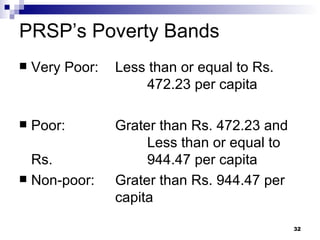
PRSP’s Poverty Bands Very Poor: Less than or equal to Rs.  472.23 per capita Poor: Grater than Rs. 472.23 and  Less than or equal to Rs.  944.47 per capita Non-poor:  Grater than Rs. 944.47 per  capita
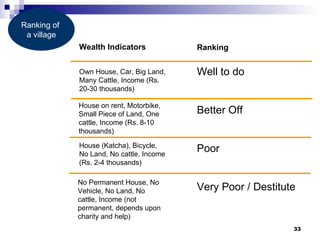
Ranking of  a village Wealth Indicators Ranking Well to do Better Off Poor Very Poor / Destitute Own House, Car, Big Land, Many Cattle, Income (Rs. 20-30 thousands) House on rent, Motorbike, Small Piece of Land, One cattle, Income (Rs. 8-10 thousands) House (Katcha), Bicycle, No Land, No cattle, Income (Rs. 2-4 thousands) No Permanent House, No Vehicle, No Land, No cattle, Income (not permanent, depends upon charity and help)
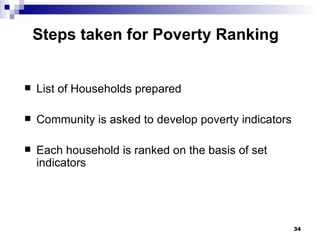
Steps taken for Poverty Ranking List of Households prepared  Community is asked to develop poverty indicators Each household is ranked on the basis of set indicators
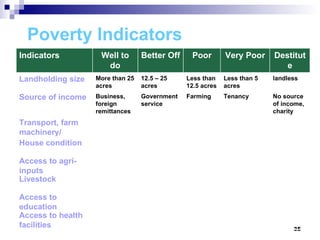
Poverty Indicators No source of income, charity Tenancy  Farming Government service Business, foreign remittances  landless Less than 5 acres Less than 12.5 acres 12.5 – 25 acres More than 25 acres Access to health facilities Access to education Livestock Access to agri-inputs House condition Transport, farm machinery/  Source of income  Landholding size   Destitute Very Poor Poor Better Off Well to do Indicators
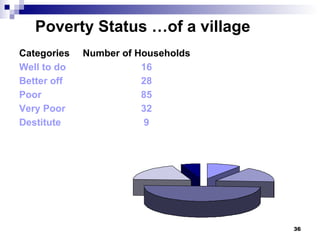
Poverty Status …of a village 9 Destitute 32 Very Poor 85 Poor 28 Better off 16 Well to do Number of Households Categories
Problems and Resources Identification It could be identified generally just listing down problems community are facing and resources available in the communities. OR It could be identified sector wise like Problems and resources in Health/education/livelihood etc sectors
 
Village Profile
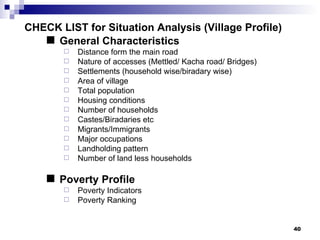
CHECK LIST for Situation Analysis (Village Profile) General Characteristics Distance form the main road Nature of accesses (Mettled/ Kacha road/ Bridges) Settlements (household wise/biradary wise) Area of village Total population Housing conditions Number of households Castes/Biradaries etc Migrants/Immigrants Major occupations Landholding pattern Number of land less households Poverty Profile Poverty Indicators Poverty Ranking
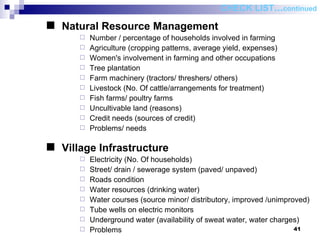
CHECK LIST ... continued Natural Resource Management Number / percentage of households involved in farming Agriculture (cropping patterns, average yield, expenses) Women's involvement in farming and other occupations Tree plantation Farm machinery (tractors/ threshers/ others) Livestock (No. Of cattle/arrangements for treatment) Fish farms/ poultry farms Uncultivable land (reasons) Credit needs (sources of credit) Problems/ needs Village Infrastructure Electricity (No. Of households) Street/ drain / sewerage system (paved/ unpaved)  Roads condition Water resources (drinking water) Water courses (source minor/ distributory, improved /unimproved) Tube wells on electric monitors Underground water (availability of sweat water, water charges) Problems
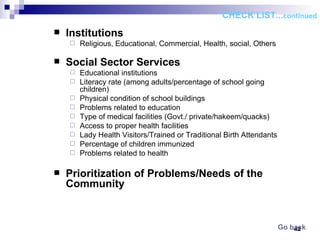
Institutions Religious, Educational, Commercial, Health, social, Others   Social Sector Services Educational institutions Literacy rate (among adults/percentage of school going children) Physical condition of school buildings Problems related to education Type of medical facilities (Govt./ private/hakeem/quacks) Access to proper health facilities Lady Health Visitors/Trained or Traditional Birth Attendants Percentage of children immunized Problems related to health Prioritization of Problems/Needs of the Community   CHECK LIST... continued Go back
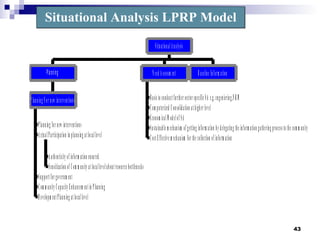
Situational Analysis LPRP Model
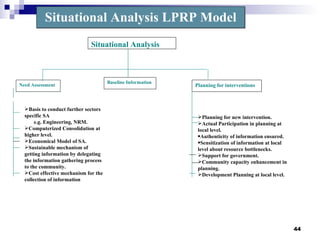
Baseline Information Need Assessment   Basis to conduct further sectors specific SA  e.g. Engineering, NRM. Computerized Consolidation at higher level. Economical Model of SA. Sustainable mechanism of getting information by delegating the information gathering process to the community. Cost effective mechanism for the collection of information Planning for interventions Planning for new intervention. Actual Participation in planning at local level. Authenticity of information ensured.  Sensitization of information at local level about resource bottlenecks. Support for government. Community capacity enhancement in planning. Development Planning at local level. Situational Analysis Situational Analysis LPRP Model

S Ituationanalysis 3

  • 1.
    Situation Analysis, Village Profile & Poverty Ranking
  • 2.
    Situation Analysis SituationAnalysis is Research tool, used to analyze and evaluate the situation of the community while ensuring participation of the community A &quot;situation analysis&quot; is a procedure during which the overall characteristics and priority problems of a community are identified. Statistical figure along with emphasis on qualitative analysis, thorough understanding of the situation and evaluation of needs, opportunities and limitations.
  • 3.
    Situation Analysis Theneed to solve problems is as old as the human civilization. From the earliest years of the history to the present times we are faced with a number of issues, which require resolution, on a daily basis. The two main reasons for problem solving emerged: 1) something around us is not to our liking, thus we need to do something to improve this situation to conform to our beliefs; 2) something potentially useful exists independent of our observations and perception, thus we need to discover this phenomenon and put it to use.
  • 4.
    The issues ofthe first kind are as simple as itching back that needs scratching, or so we think. The issues of the second kind could be as complex as differential equations, which, once discovered, can help describe a vast number of natural events.
  • 5.
    Key points about situation analysis It is defined as a process of gathering and analysing information to guide planning and action. 2. It should not be seen simply as a technical exercise. Rather, it should be seen as part of community mobilisation . For this reason, it is most effective when it involves participation of a wide range of people and organisations.
  • 6.
    Situation Analysis----- 3.There are six key steps to carrying out a situation analysis. These are setting objectives to be achieved; identifying the technical skills needed; deciding the geographical area to be covered; ensuring particularly vulnerable children and women are included; deciding on a timeframe and deciding what resources will be needed
  • 7.
    Continue….. Information canbe gathered from a variety of different sources including previous reports and statistics; interviews; questionnaires; case studies; surveys; group discussions; mapping and other participatory exercises.
  • 8.
    Situation Analysis Whydoes this situation exist? What are the root causes? Economic factors -- Who owns? Who controls? Who pays? Who gets? Who gets left out? Why? Political factors – Who decides? For whom do they decide? How do decisions get made ? Who is left out of the process? Why?
  • 9.
    Continue……. Social Factors – Who is left out? Who is included? Why? Historic Factors – What past events influence the situation today? Cultural Factors – What values are evident? What do people believe in? Who influences what people believe?
  • 10.
    Situation Analysis IntroductionResearch tool, used to analyze and evaluate the situation of the community while ensuring participation of the community A &quot;situation analysis&quot; is a procedure during which the overall characteristics and priority problems of a community are identified. Statistical figure along with emphasis on qualitative analysis, thorough understanding of the situation and evaluation of needs, opportunities and limitations.
  • 11.
    Objectives To determinethe economic status (poverty ranking) of people living in targeted area. Identification and prioritization of community Needs and possible interventions Data collection To create a better understanding of the nature of existing capacities and other factors that influence effective engagement of CBOs and local level institutions in poverty reduction initiatives. to build a foundation for good decision making on program priorities and the use of limited resources on a local or statewide basis.
  • 12.
    Situation Analysis Passiveparticipation lowest participation from the subjects; they are only informed about the plans after the desired objective has been achieved. Participation in information giving In this type of participation the opinions of people are gathered through surveys but after the objective has been achieved. Participation in consultation Here surveys are conducted and opinions taken before the objective is achieved but no change of plan is based on these surveys. Types of Participation
  • 13.
    Situation Analysis Functionalparticipation This is the most popular and the most commonly practiced form all over the world. In this type the people are allowed to participate in and implement pre-decided plans by forming groups or organizations. Interactive participation In this type of participation a meeting is conducted with the target group without any mindset and the plan of action is decided after interacting with the people and analyzing their needs. However the sponsors still can intervene and force a change of plans. Types of Participation
  • 14.
    Situation Analysis Self-mobilizationIn this type the people are exhorted to form groups and organization and realize their own needs and utilize their resources combined with external funding for their own betterment. Here all classes of the community get together but the power usually rests with the influential class. Empowerment Here the power rests with the people themselves and side by side equal distribution of power is also ensured. Types of Participation
  • 15.
    What is PRA?PRA is intended to enable local communities to conduct their own analysis and plan and take action. (Chambers R.1992)
  • 16.
    PRA TOOLS Thereare variety of methods that are used during PRA exercise in order to elicit community participation in the generation of information. These methods can be classified into three broad categories.
  • 17.
    Visualized Analysis Interviewingand sampling Group and team dynamics These methods can be used singularly one at time or in a combination of two to three, all the three are combined for best results. PRA TOOLS
  • 18.
    Visualized Analysis Participatorymapping and modeling like Resource maps Social maps of residential areas of villages Topical maps e.g. collection sites for water points, soils etc Impact monitoring map e.g. pest attack, soil erosion, deforestation etc.
  • 19.
    B. ParticipatoryDiagramming Trend Lines Show quantitative changes over time and can be used for many variables such as: Yields, area under cultivation, livestock population, prices, rainfall etc.
  • 20.
    C. Discussion andBrain storming like Semi Structured Interviews creates discussions among the participants to get their point of view.
  • 21.
    SA Introduction toPRA Tools Social Mapping Transact walk Semi Structured Interviewing Pie Diagram & Venn Diagram Focus Group Discussion Problem tree Venn Diagram Cause & Effect Analysis Seasonal Calendar Times lines Ranking Problem Solution Matrix
  • 22.
    Social mapping isa PRA method that involves the sketching/ drawing of houses and other social facilities and infrastructure (i.e. mosque, stores, rice mills, school, pharmacy, trails and roads, water pumps, irrigation and recreation facilities) in a village. It serves as a baseline for planning, implementation, monitoring and evaluation of village development activities. Social Mapping
  • 23.
    Situation Analysis Toobserve the Target Area To verify the information provided by the Community To get oriented about the available resources of Target Area To get familiarized with the local environment Transact Walk
  • 24.
    Situation Analysis Transectmaps differentiate between the main land use zones. They compare the main features, resources, uses and problems of different land zones. Using these tools the team can get an overall picture of the area. For a transect walk, willing and knowledgeable community members are taken along for a walk through the village and important surrounding areas. Transact Walk
  • 25.
    Situation Analysis Openended Questions related to Checklist Informal discussion Group discussion Semi Structured Interviews
  • 26.
    Semi Structured InterviewingSemi-structured interviewing is guided discussion where only some of the questions are pre-determined and new questions come up during the interview. The interviewers prepare a list of topics and questions rather than utilizing a fixed questionnaire. Semi-structured interviews are held with : Individuals: For representative information, interviews are held with a number of different individuals on the same topic. Key informants: For specialized information, these individuals have special knowledge which others do not possess (e.g. midwives on birth complications). Groups: For general community-level information. Focus: To discuss a specific topic in detail.
  • 27.
    Situation Analysis Eachteam member should be clear about the topic A multi sectoral, gender balanced team should be selected Local norms and languages should be followed Comprehensive and detailed note taking is also important Personal interpretations should not be taken into account Necessary probing must be done but sensitive issues should avoided The interview should be conducted in a an informal fashion Politeness should be maintained through out the interview Guidelines for SSIs
  • 28.
    Situation Analysis Failureto listen closely Repeating questions Helping the interviewee to give an answer Asking vague questions Asking insensitive questions Failure to probe (cross-check) a topic Believing everything / failure to judge answers Asking leading questions Allowing the interviewee to go on too long Overgeneralization of findings Relying too much on what the well-off, the better educated, the old, and the men have to say Ignoring anything that does not fit the ideas and preconceptions of the interviewer Giving too much weight to answers that contain “quantitative data” Incomplete note taking Common mistakes during SSIs
  • 29.
    Definition of PoorPerson having very little money; not having enough money for basic needs. (O xford dictionary ) Disadvantage Needy Impoverished Deprived Penniless Poverty Stricken Hard up
  • 30.
    Definition of Poverty The state of being poor; conditions are abject poverty/absolute poverty. (O xford dictionary ) Less than $1 a day. (International definition) Poverty Line Rs. 944.47 per person per month (Economic Survey of Pakistan) *H/h size of Punjab Province is 6.4 persons.
  • 31.
    Poverty Bands ExtremelyPoor <Rs. 472.23 per capita Ultra Poor Rs. 708.35 Poor Rs. 944.47 Vulnerable Rs. 1180.59 Non-poor Rs. 1888.94 Better off Rs. 1888.94 (over)
  • 32.
    PRSP’s Poverty BandsVery Poor: Less than or equal to Rs. 472.23 per capita Poor: Grater than Rs. 472.23 and Less than or equal to Rs. 944.47 per capita Non-poor: Grater than Rs. 944.47 per capita
  • 33.
    Ranking of a village Wealth Indicators Ranking Well to do Better Off Poor Very Poor / Destitute Own House, Car, Big Land, Many Cattle, Income (Rs. 20-30 thousands) House on rent, Motorbike, Small Piece of Land, One cattle, Income (Rs. 8-10 thousands) House (Katcha), Bicycle, No Land, No cattle, Income (Rs. 2-4 thousands) No Permanent House, No Vehicle, No Land, No cattle, Income (not permanent, depends upon charity and help)
  • 34.
    Steps taken forPoverty Ranking List of Households prepared Community is asked to develop poverty indicators Each household is ranked on the basis of set indicators
  • 35.
    Poverty Indicators Nosource of income, charity Tenancy Farming Government service Business, foreign remittances landless Less than 5 acres Less than 12.5 acres 12.5 – 25 acres More than 25 acres Access to health facilities Access to education Livestock Access to agri-inputs House condition Transport, farm machinery/ Source of income Landholding size Destitute Very Poor Poor Better Off Well to do Indicators
  • 36.
    Poverty Status …ofa village 9 Destitute 32 Very Poor 85 Poor 28 Better off 16 Well to do Number of Households Categories
  • 37.
    Problems and ResourcesIdentification It could be identified generally just listing down problems community are facing and resources available in the communities. OR It could be identified sector wise like Problems and resources in Health/education/livelihood etc sectors
  • 38.
  • 39.
  • 40.
    CHECK LIST forSituation Analysis (Village Profile) General Characteristics Distance form the main road Nature of accesses (Mettled/ Kacha road/ Bridges) Settlements (household wise/biradary wise) Area of village Total population Housing conditions Number of households Castes/Biradaries etc Migrants/Immigrants Major occupations Landholding pattern Number of land less households Poverty Profile Poverty Indicators Poverty Ranking
  • 41.
    CHECK LIST ...continued Natural Resource Management Number / percentage of households involved in farming Agriculture (cropping patterns, average yield, expenses) Women's involvement in farming and other occupations Tree plantation Farm machinery (tractors/ threshers/ others) Livestock (No. Of cattle/arrangements for treatment) Fish farms/ poultry farms Uncultivable land (reasons) Credit needs (sources of credit) Problems/ needs Village Infrastructure Electricity (No. Of households) Street/ drain / sewerage system (paved/ unpaved) Roads condition Water resources (drinking water) Water courses (source minor/ distributory, improved /unimproved) Tube wells on electric monitors Underground water (availability of sweat water, water charges) Problems
  • 42.
    Institutions Religious, Educational,Commercial, Health, social, Others   Social Sector Services Educational institutions Literacy rate (among adults/percentage of school going children) Physical condition of school buildings Problems related to education Type of medical facilities (Govt./ private/hakeem/quacks) Access to proper health facilities Lady Health Visitors/Trained or Traditional Birth Attendants Percentage of children immunized Problems related to health Prioritization of Problems/Needs of the Community CHECK LIST... continued Go back
  • 43.
  • 44.
    Baseline Information NeedAssessment Basis to conduct further sectors specific SA e.g. Engineering, NRM. Computerized Consolidation at higher level. Economical Model of SA. Sustainable mechanism of getting information by delegating the information gathering process to the community. Cost effective mechanism for the collection of information Planning for interventions Planning for new intervention. Actual Participation in planning at local level. Authenticity of information ensured. Sensitization of information at local level about resource bottlenecks. Support for government. Community capacity enhancement in planning. Development Planning at local level. Situational Analysis Situational Analysis LPRP Model