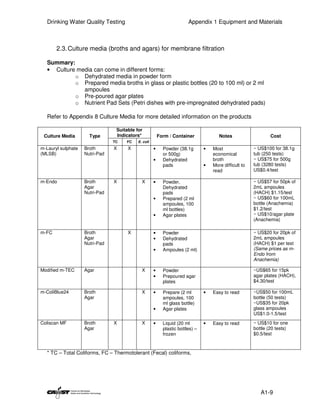
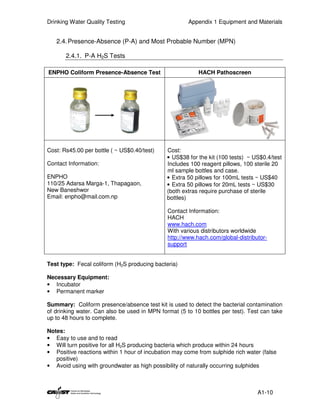
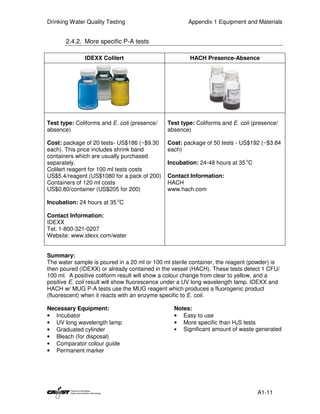
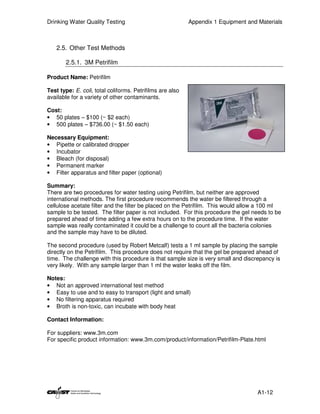
INTRODUCTION TO
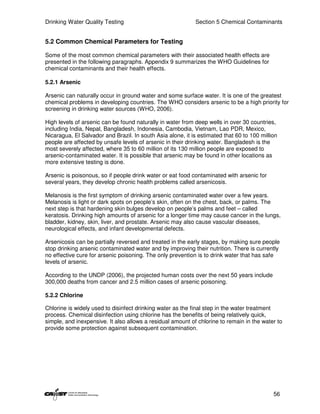
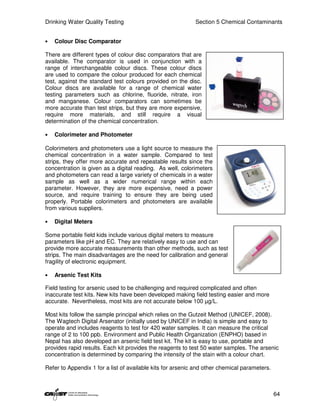
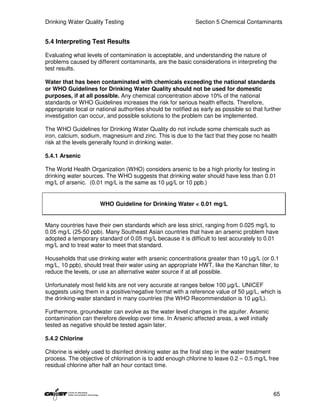
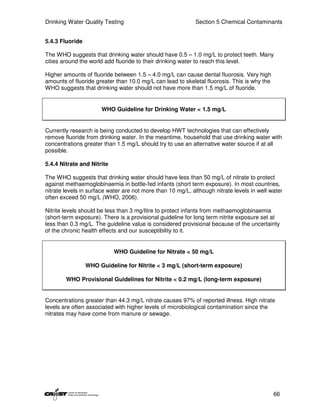
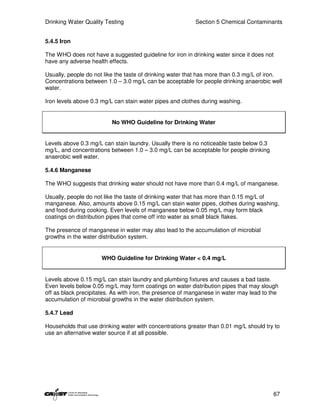
DRINKING WATER QUALITY TESTING
_____________________________________
A CAWST TRAINING MANUAL
June 2009 Edition
12, 2916 – 5th Avenue
                                  Calgary, Alberta
                                 T2A 6K4, Canada
                             Phone + 1 (403) 243-3285
                              Fax + 1 (403) 243-6199
                             E-mail: cawst@cawst.org
                              Website: www.cawst.org


CAWST is a Canadian non-proft organization focused on the principle that clean
water changes lives. Safe water and basic sanitation are fundamentals necessary to
empower the world’s poorest people and break the cycle of poverty. CAWST
believes that the place to start is to teach people the skills they need to have safe
water in their homes. CAWST transfers knowledge and skills to organizations and
individuals in developing countries through education, training and consulting
services. This ever expanding network can motivate individual households to take
action to meet their own water and sanitation needs.

One of CAWST’s core strategies is to make knowledge about water common
knowledge. This is achieved, in part, by developing and freely distributing education
materials with the intent of increasing its availability to those who need it most.

This document is open content and licensed under the Creative Commons Attribution
Works 3.0 Unported License. To view a copy of this license, visit
http://creativecommons.org/licenses/by/3.0/ or send a letter to Creative Commons,
171 Second Street, Suite 300, San Francisco, California 94105, USA.

You are free to:
• Share — to copy, distribute and transmit this document
• Remix — to adapt this document. We would appreciate receiving a copy of any
   changes that you’ve made to improve this document.

Under the following conditions:
• Attribution. You must give CAWST credit for this document (but not in any way
   that suggests that CAWST endorses you or your use of this document).

CAWST and its directors, employees, contractors, and volunteers do not assume any
responsibility for and make no warranty with respect to the results that may be
obtained from the use of the information provided.
Drinking Water Quality Testing                                 Table of Contents


Table of Contents

Acronyms
 Glossary
 Section 1   Introduction of Drinking Water Quality Testing
       1.1   Drinking Water Quality
       1.2   Community and Household Water Treatment
       1.3   Need for Drinking Water Quality Testing
       1.4   Drinking Water Quality Guidelines and Standards
       1.5   Drinking Water Quality Testing Options
       1.6   Lessons Learned
       1.7   Summary of Key Points
       1.8   References

 Section 2 Planning for Water Quality Testing
       2.1 The Planning Process
       2.2 Summary of Key Points

 Section 3   Water Sampling and Quality Control
       3.1   Determining the Sample Size
       3.2   Choosing a Sample Method
       3.3   How to Collect Water Samples
       3.4   How to Transport Water Samples
       3.5   How to Dilute a Water Sample
       3.6   Ensuring Quality Control
       3.7   Checklist for Field Work
       3.8   Health and Safety
       3.9   Summary of Key Points
      3.10   References

 Section 4   Testing for Physical Contaminants
       4.1   WHO Guidelines for Physical Parameters
       4.2   Potential Health Effects
       4.3   Test Methods
       4.4   Interpreting Test Results
       4.5   Summary of Key Points
       4.6   References

 Section 5   Testing for Chemical Contaminants
       5.1   WHO Guidelines for Chemical Contaminants
       5.2   Common Chemicals Parameters for Testing
       5.3   Test Methods
       5.4   Interpreting Test Results
       5.5   Summary of Key Points
       5.6   References


                                                                                   i
Drinking Water Quality Testing                                      Table of Contents


 Section 6   Testing for Microbiological Contaminants
       6.1   WHO Guidelines for Microbiological Contaminants
       6.2   Potential Health Effects
       6.3   Infectious Dose
       6.4   Indicator Organisms
       6.5   Test Methods
       6.6   Interpreting Test Results
       6.7   Summary of Key Points
       6.8   References

 Section 7   Interpreting Test Results
       7.1   Steps for Data Interpretation
       7.2   Interpreting Laboratory Reports
       7.3   Summary of Key Points
       7.4   References

Appendices
Appendix 1     Equipment and Materials
Appendix 2     Establishing a Laboratory
Appendix 3     Determining the Sample Size
Appendix 4     Quality Control
Appendix 5     Data Recording Forms
Appendix 6     Single Parameter Testing Procedures
Appendix 7     Example Test Report
Appendix 8     Culture Media for Microbiological Testing
Appendix 9     WHO Guidelines and Health Effects of Chemical Contaminants


                                                                                    ii
Drinking Water Quality Testing                                   Acronyms and Glossary


Acronyms

BSF           biosand filter
CAWST         Centre for Affordable Water and Sanitation Technology
CFU           colony forming units
EC            electrical conductivity
ENPHO         Environment and Public Health Organization
FRC           free residual chlorine
HWTS          household water treatment and safe storage
MF            membrane filtration
MPN           most probable number
NGO           non-governmental organization
nd            no date
NOP           not operating properly
NPS           nutrient pad set
NTU           nephelometric turbidity units
P-A           presence-absence
PET           polyethylene perephthalate
PPB           parts per billion
PPM           parts per million
SODIS         solar disinfection
TCU           true colour units
TDI           tolerable daily intake
TDS           total dissolved solids
TNTC          too numerous to count
UN            United Nations
UNDP          United Nations Development Programs
UNICEF        United Nations Children’s Education Fund
US EPA        United States Environmental Protection Agency
WHO           World Health Organization


                                                                                     iii
Drinking Water Quality Testing                                                  Acronyms and Glossary


Glossary

Adsorption                                Broth                                Culture Media
The adherence of gas molecules,           A broth is a liquid mixture          Combination of nutrients and
ions, microorganism or molecules          containing nutrients for culturing   reagents used to culture
in solution to the surface of a solid.    microorganisms.                      microorganisms (e.g. broths,
                                                                               agars)
Agar                                      Chemical
A semi-solid gel mixture containing       Involving or resulting from a        Criterion
nutrients for culturing                   reaction between two or more         A standard of judgment or a
microorganisms.                           substances.                          rule for evaluating or testing
                                                                               something.
Algae                                     Chlorine
Aquatic species that encompass            A: Combined chlorine                 Discharge
several groups of relatively simple       Chlorine that is present in water    The volume of fluid passing a
living aquatic organisms that             that is combined with other          point per unit of time,
capture light energy through              chemicals.                           commonly expressed in
                                                                                 3
photosynthesis, using it to convert       B: Free chlorine                     m /second, L/minute.
inorganic substances into organic         Chlorine present in water that is
matter.                                   not combined with other chemicals    Dissolved oxygen
                                          and available to disinfect any       Oxygen dissolved in water; one
Anaerobic                                 additional contaminants introduced   of the most important indicators
Pertaining to, taking place in, or        to the water.                        of the condition of a water
caused by the absence of oxygen.          C: Total chlorine                    body. Dissolved oxygen is
                                          Combined chlorine + Free chlorine    necessary for the life of fish and
Aquifer                                                                        most other aquatic organisms.
A geologic formation, group of            Coliform
formations, or part of a formation        A group of generally harmless        Dissolved solids
that contains sufficient saturated        bacteria which may be faecal or      An expression for the amount
sand or gravel (permeable                 environmental in origin.             of solids which are contained in
material) to yield significant                                                 a liquid in a dissolved form.
quantities of water to springs and        Colony (bacterial)
wells.                                    A cluster of bacteria growing on     Effluent
                                          the surface of or within a solid     Outflow from a particular
Bacteria                                  media, usually cultured from a       source, such as stream that
Single-celled microscopic                 single cell and appears as a         flows from a lake or liquid
organisms.                                circular dot on the media.           waste that flows from a factory
                                                                               or sewage treatment plant.
Basic                                     Concentration
The opposite of acidic; water that        The ratio of the quantity of any     Fecal bacteria
has pH greater than 7.                    substance present in a sample of     Microscopic single-celled
                                          given volume or a given weight       organisms found in the wastes
Biological                                compared to the volume or weight     or warm blooded animals. Their
Any substance derived from                of the sample (e.g. mg/L, µg/L,      presence indicates
animal products or other biological       ppm, ppb).                           contamination by the wastes of
sources.                                                                       warm-blooded animals and the
                                          Constituent                          possible presence of
Biodegradation                            A chemical or biological substance   pathogenic organisms.
Transformation of a substance into        in water, sediment, or living
new compounds through                     organism of the area that can be     Filter paper
biochemical reactions or actions of       measured by an analytical method.    A porous paper used in the
microorganisms such as bacteria.                                               membrane filtration technique
                                          Contamination                        through which the sample is
Blue-baby syndrome                        Degradation of water quality         filtered and which retains the
A condition most common in young          compared to original or natural      bacteria. Pore sizes for fecal
infants and certain elderly people        conditions due to human or natural   bacteria are between 0.45 and
that can be caused by ingestion of        activity.                            0.7
high amounts of nitrate, which
results in the blood losing its ability
to effectively carry oxygen.


                                                                                                                iv
Drinking Water Quality Testing                                                   Acronyms and Glossary


Fresh water                                Organic                              Quantitative
Water that contains less than              Containing carbon, but possibly      Distinguishing substances
1,000 mg/L of dissolved solids             also containing hydrogen, oxygen,    based on their quantity using
such as salt.                              chlorine, nitrogen, and other        measurements. Ex: mass,
                                           elements.                            number, height.
Guideline
A recommended limit that should            Pathogen                             Runoff
not be exceeded; guidelines are            Any living organism that causes      The flow of precipitation or
not intended to be standards of            disease.                             snowmelt that appears in
practice, or to give rise to a legal                                            streams or surface-water
duty or obligation, but in certain         pH                                   bodies.
circumstances they could assist in         A scale representation of the
evaluation and improvement.                amount of hydrogen ions in           Standard
                                           solution reflecting acidity or       A mandatory limit that must not
Ion                                        alkalinity.                          be exceeded; standards often
A positively or negatively charged                                              reflect a legal duty or obligation.
atom or group of atoms.                    Photometer
                                           Digital device used to measure the   Suspended solids
Leaching                                   concentration of a parameter         Solids that are not in true
The removal of materials in                (chemical, physical) in a sample.    solution and that can be
solution from soil or rock; also                                                removed by filtration. Such
refers to movement of pesticides           Physical                             suspended solids usually
or nutrients from land surface to          A material thing which can be        contribute directly to turbidity.
ground water.                              touched and seen, rather than an     Defined in waste management,
                                           idea or spoken words                 these are small particles of
Membrane Filtration                                                             solid pollutants that resist
Water quality testing method used          Point-source contaminant             separation by conventional
to measure microbiological                 Any substance that degrades          methods.
contamination by enumeration of            water quality and originates from
indicator bacteria colony forming          discrete locations such as           Turbidity
units                                      discharge pipes of latrines or       The amount of solid particles
                                           septic tanks, drainage ditches or    that are suspended in water
Nonpoint source contaminant                well concentrated livestock          and that cause light rays
A substance that pollutes or               operation.                           shining through the water to
degrades water that comes from                                                  scatter. Thus, turbidity makes
agricultural runoff, the atmosphere,       Potable water                        the water cloudy or even
roadways, and other diffuse                Water that is safe and has a good    opaque in extreme cases.
sources.                                   taste for human consumption.         Turbidity is measured in
                                                                                nephelometric turbidity units
Nephelometric Turbidity Unit               Pollution                            (NTU).
(NTU)                                      Undesirable state of the natural
Unit of measure for the turbidity of       environment being contaminated       Water quality
water. Essentially, a measure of           with harmful substances as a         A term used to describe the
the cloudiness of water as                 consequence of human activities      chemical, physical, and
measured by a nephelometer.                or natural calamities.               biological characteristics of
Turbidity is based on the amount                                                water, usually in respect to its
of light that is reflected off particles   Qualitative                          suitability for a particular
in the water.                              Distinguishing substances based      purpose.
                                           on their quality using words. Ex:
                                           color, smell, hardness.


References

http://ga.water.usgs.gov/edu/dictionary.html

http://water.usgs.gov/glossaries.html


                                                                                                                   v
Drinking Water Quality Testing                                         Section 1 Introduction


1 Introduction to Drinking Water Quality Testing

Having safe drinking water and basic sanitation is a human need and right for every man,
woman and child. People need clean water and sanitation to maintain their health and
dignity. Having better water and sanitation is essential in breaking the cycle of poverty
since it improves people’s health, strength to work, and ability go to school.

Yet 884 million people around the world live without improved drinking water and 2.5
billion people still lack access to improved sanitation, including 1.2 billion who do not have
a simple latrine at all (WHO/UNICEF, 2008). Many of these people are among those
hardest to reach: families living in remote rural areas and urban slums, families displaced
by war and famine, and families living in the poverty-disease trap, for whom improved
sanitation and drinking water could offer a way out.
.
The World Health Organization (WHO) estimates that 88% of diarrheal disease is caused
by unsafe water, inadequate sanitation and poor hygiene. As a result, more than 4,500
children die every day from diarrhea and other diseases. For every child that dies,
countless others, including older children and adults, suffer from poor health and missed
opportunities for work and education.


The global water crisis claims more lives through disease than any war claims through
guns (UNDP, 2006).


In 2000, the United Nations created the Millennium Development Goals (MDGs) to
improve the quality of life for people all over the world. The following are the eight MDGs
that are to be achieved by the year 2015:

1. Eliminate extreme poverty and hunger.
2. Achieve universal primary education.
3. Promote gender equality and empower women.
4. Reduce child mortality.
5. Improve maternal health.
6. Combat HIV/AIDS, malaria and other diseases.
7. Ensure environmental sustainability.
   (c) Reduce the proportion of people without sustainable access to safe drinking water
   and basic sanitation by half.
8. Develop a global partnership for development.

The WHO/UNICEF Joint Monitoring Programme for Water Supply and Sanitation (JMP) is
the official United Nations organization responsible for monitoring progress towards the
MDG targets for improved drinking water and sanitation.


                                                                                              1
Drinking Water Quality Testing                                                  Section 1 Introduction


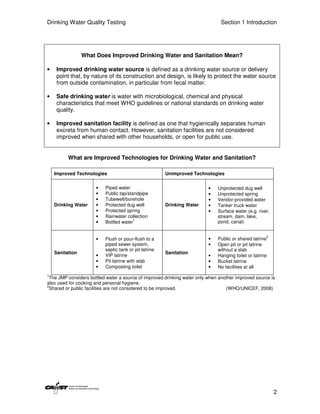
                 What Does Improved Drinking Water and Sanitation Mean?

•    Improved drinking water source is defined as a drinking water source or delivery
     point that, by nature of its construction and design, is likely to protect the water source
     from outside contamination, in particular from fecal matter.

•    Safe drinking water is water with microbiological, chemical and physical
     characteristics that meet WHO guidelines or national standards on drinking water
     quality.

•    Improved sanitation facility is defined as one that hygienically separates human
     excreta from human contact. However, sanitation facilities are not considered
     improved when shared with other households, or open for public use.


          What are Improved Technologies for Drinking Water and Sanitation?

    Improved Technologies                               Unimproved Technologies


                      •    Piped water                                     •   Unprotected dug well
                      •    Public tap/standpipe                            •   Unprotected spring
                      •    Tubewell/borehole                               •   Vendor-provided water
    Drinking Water    •    Protected dug well           Drinking Water     •   Tanker truck water
                      •    Protected spring                                •   Surface water (e.g. river,
                      •    Rainwater collection                                stream, dam, lake,
                                         1
                      •    Bottled water                                       pond, canal)


                                                                                                       2
                      •    Flush or pour-flush to a                        •   Public or shared latrine
                           piped sewer system,                             •   Open pit or pit latrine
                           septic tank or pit latrine                          without a slab
    Sanitation                                          Sanitation
                      •    VIP latrine                                     •   Hanging toilet or latrine
                      •    Pit latrine with slab                           •   Bucket latrine
                      •    Composting toilet                               •   No facilities at all
1
  The JMP considers bottled water a source of improved drinking water only when another improved source is
also used for cooking and personal hygiene.
2
  Shared or public facilities are not considered to be improved.                   (WHO/UNICEF, 2008)


                                                                                                            2
Drinking Water Quality Testing                                         Section 1 Introduction


1.1 Drinking Water Quality

We find our drinking water from different places depending on where we live in the world.
Three sources that are used to collect drinking water are:

1. Ground water – Water that fills the spaces between rocks and soil making an aquifer.
   Ground water depth and quality varies from place to place. About half of the world’s
   drinking water comes from the ground.

2. Surface water – Water that is taken directly from a stream, river, lake, pond, spring or
   similar source. Surface water quality is generally unsafe to drink without treatment.

3. Rainwater – Water that is collected and stored using a roof top, ground surface or
   rock catchment. The quality of rain water collected from a roof surface is usually
   better than a ground surface or rock catchment.

Water is in continuous movement on, above and below the surface of the earth. As water
is recycled through the earth, it picks up many things along its path. Water quality will vary
from place to place, with the seasons, and with various kinds of rock and soil which it
moves through.

For the most part, it is natural processes that affect water quality. For instance, water
moving through underground rocks and soils may pick up natural contaminants, even with
no human activity or pollution in the area. In addition to nature's influence, water is also
polluted by human activities, such as open defecation, dumping garbage, poor agricultural
practices, and chemical spills at industrial sites.

Even though water may be clear, it does not necessarily mean that it is safe for us to
drink. It is important for us to judge the safety of water by taking the following three
qualities into consideration:

1. Microbiological – bacteria, viruses, protozoa, and worms

2. Chemical – minerals, metals and chemicals

3. Physical – temperature, colour, smell, taste and turbidity

Safe drinking water should have the following microbiological, chemical and physical
qualities:

•   Free of pathogens
•   Low in concentrations of toxic chemicals
•   Clear
•   Tasteless and colourless (for aesthetic purposes)

When considering drinking water quality, in most cases microbiological contamination is
the main concern since it is responsible for the majority of illnesses and deaths related to
drinking unsafe water.


                                                                                            3
Drinking Water Quality Testing                                          Section 1 Introduction


1.2 Community and Household Water Treatment

Water can be treated at a central location, in large volumes, and then supplied to
households through a network of pipes. This is often called centralized or community
water treatment. Smaller volumes of water can also be treated at the point of use (POU),
such as in a home. This is commonly called household water treatment and safe storage
(HWTS) since the family members gather the water, and then treat and store it in their
home.

Most people around the world wish to have safe water piped directly to their homes
through a community water treatment system. Unfortunately, the money and resources
needed to construct, operate and maintain a community system are not always available
in most developing countries.

The main advantage of HWTS is that it can be used immediately in the homes of poor
families to improve their drinking water quality. It is proven to be an effective way to
prevent diseases from unsafe water. HWTS lets people take responsibility of their own
water security by treating and safely storing water themselves.

HWTS is also less expensive, more appropriate for treating smaller volumes of water, and
provides an entry or starting point for hygiene and sanitation education. There are a wide
range of simple HWTS technologies that provide options based on what is most suitable
and affordable for the individual household.

Some limitations of HWTS are that it requires families to be knowledgeable about its
operation and maintenance, and they need to be motivated to use the technology
correctly. As well, most HWTS processes are designed to remove pathogens rather than
chemicals.

With both centralized and household water treatment, using the multi-barrier approach is the
best way to reduce the risk of drinking unsafe water. Each step in the process, from source
protection, to water treatment and safe storage, provides an incremental health risk
reduction. Both community and household water treatment systems follow the same water
treatment process. The only difference is the scale of the systems that are used by
communities and households.

                             Household Water Treatment


    Source         Sedimentation       Filtration        Disinfection      Safe Storage
   Protection


Important Note:

The majority of water quality testing literature and research is related to large-scale,
community treatment systems. This information has been adapted to focus on household
water treatment in this manual.


                                                                                            4
Drinking Water Quality Testing                                         Section 1 Introduction


1.3 Need for Drinking Water Quality Testing

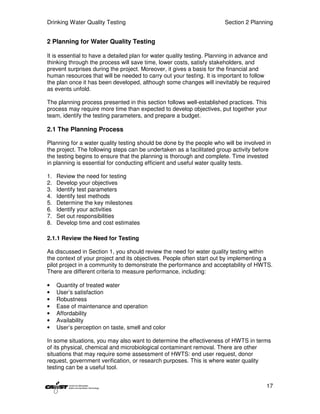
The following are common reasons to do water quality testing at the household level:

•   ensure safe drinking water
•   identify problems
•   adopt precautionary measures
•   raise awareness
•   determine the effectiveness of the HWTS process
•   select an appropriate water source
•   influence government to supply safe water

Household water treatment and safe storage is becoming a popular option for obtaining
safe water. Different processes and technologies such as the biosand filter, ceramic filter,
solar disinfection (SODIS) and chlorination are being introduced from different
governmental and non-governmental organizations (NGOs). Water quality tests are very
useful in understanding the difference between source water, treated water and stored
water quality.

1.4 Drinking Water Quality Guidelines and Standards


              What is the Difference between Guidelines and Standards?

Standard – a mandatory limit that must not be exceeded; standards often indicate a legal
duty or obligation.

Guideline – a recommended limit that should not be exceeded; guidelines are not
intended to be standards of practice, or indicate a legal duty or obligation, but in certain
circumstances they could assist in evaluation and improvement.


The World Health Organization (WHO) is part of the United Nations (UN) and it focuses
on international public health. The WHO writes the Guidelines for Drinking Water Quality
(2006) to help make sure that people are drinking safe water around the world.

The WHO Guidelines explain that safe drinking water will not make people sick at any
time throughout their life, including when they are young, old or sick. Safe drinking water
should be good to use for all of our personal needs, including drinking, cooking, and
washing.

The WHO Guidelines cover microbiological, chemical and physical qualities. However, it
is stressed that microbiological quality is the most important since this is biggest cause of
illness and death around the world.


                                                                                               5
Drinking Water Quality Testing                                        Section 1 Introduction


Although there are several contaminants in water that may be harmful to humans, the first
priority is to ensure that drinking water is free of pathogens that cause disease.

                                                                               (WHO, 2006)


The implementation of the WHO Guidelines for Drinking Water Quality varies among
countries. There is no single approach that is used worldwide. The Guidelines are
recommendations to work towards and they are not mandatory limits.

Countries can take the WHO Guidelines into consideration along with the local
environmental, social, economic and cultural conditions. This may lead to countries
developing their own national standards that are quite different the WHO Guidelines.

There is an overwhelming need to increase the availability of safe drinking water in ways
that are in line with the WHO Guidelines. To meet this worldwide demand, a variety of
household water treatment and safe storage technologies are being promoted as
effective, appropriate, acceptable and affordable practices to improve drinking water
quality.

Testing can be done to determine if pathogens are present in the drinking water.
However, occasional tests conducted on a water supply may provide a false sense of
security or inconclusive results as water quality can vary widely and rapidly. Regular
testing can also be time consuming and expensive. It should be undertaken only when
needed to influence practical decisions with respect to supply or treatment.

The general health, well-being or energy levels of the local population can also provide
some insight into the quality of the drinking water. However, it is important to remember
that diarrhoeal diseases can also result from poor food and personal hygiene.

1.5 Drinking Water Quality Testing Options

Establishing water quality testing as part of your project depends on your objectives and
availability of resources. The following are some guiding questions for you to ask when
starting out to help select appropriate water quality test methods:

•   Why do you need to conduct water quality testing?
          o Baseline information
          o Planning and policy development
          o Management and operational information
          o Other purposes
•   What water quality information is required?

Historically, conventional laboratories were mainly used to carry out water quality testing.
Now there is a wide variety of good testing kits and products available in the commercial
market that allows you to conduct water quality testing on your own without relying on a
laboratory. The following sections present the different methods that are available:


                                                                                               6
Drinking Water Quality Testing                                           Section 1 Introduction


•     Observation
•     Doing it yourself in the field
•     Using a mobile laboratory
•     Sending your samples to a laboratory for analysis.

1.5.1 Observation

Most HWTS technologies and processes disseminated by governmental and NGOs have
already been tested and validated through laboratory experiments. Therefore, it can be
assumed that implementation of the technology and process will result in improved water
quality. The basic operating and maintenance requirements recommended by the project
implementer should be observed and monitored to ensure safe drinking water.

Other simple observations can be undertaken to identify potential water quality issues and
minimize the risk of contamination. Poor water quality may be indicated by observing the
water source, the immediate household surroundings, containers used to carry water from
the source, storage containers, and personal hygiene and sanitation practices.

Water quality can also be assessed by making qualitative observations of its physical
characteristics such as the turbidity, colour, odour and taste. The following are examples
where water contamination is indicated through visual observation, taste or smell. If
contamination is suspected through observation, then testing is the next step to confirm
the water quality.
                                     Qualitative Observations


          Water Observations                           Possible Contaminants
    Foamy                                 Detergents
    Black in colour                       Manganese, bacteria growth
    Brown, yellow or reddish in colour    Iron
    Dark brown or yellow in colour        Tannins and pigment from leaves and back
    White deposits or scale               Hardness, dissolved metals
    Earthy, fishy, muddy, peaty odour     Organic matter, algae, bacteria
    Rotten egg odour                      Hydrogen sulphide
    Chlorine odour                        Chlorine residual from water treatment process
    Bitter or metallic taste              pH, zinc, copper
                                                              (Adapted from Singh et al., 2003)


                                                                                             7
Drinking Water Quality Testing                                           Section 1 Introduction


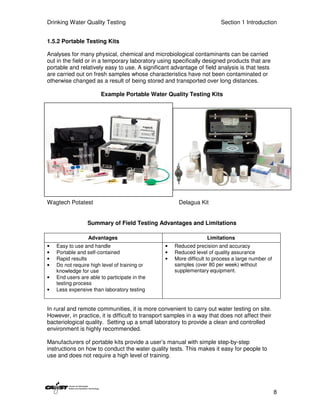
1.5.2 Portable Testing Kits

Analyses for many physical, chemical and microbiological contaminants can be carried
out in the field or in a temporary laboratory using specifically designed products that are
portable and relatively easy to use. A significant advantage of field analysis is that tests
are carried out on fresh samples whose characteristics have not been contaminated or
otherwise changed as a result of being stored and transported over long distances.

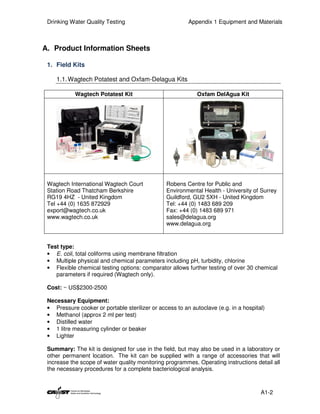
                       Example Portable Water Quality Testing Kits


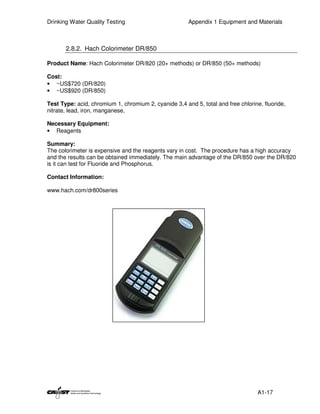
Wagtech Potatest                                       Delagua Kit


                 Summary of Field Testing Advantages and Limitations

                  Advantages                                       Limitations
•   Easy to use and handle                       •   Reduced precision and accuracy
•   Portable and self-contained                  •   Reduced level of quality assurance
•   Rapid results                                •   More difficult to process a large number of
•   Do not require high level of training or         samples (over 80 per week) without
    knowledge for use                                supplementary equipment.
•   End users are able to participate in the
    testing process
•   Less expensive than laboratory testing


In rural and remote communities, it is more convenient to carry out water testing on site.
However, in practice, it is difficult to transport samples in a way that does not affect their
bacteriological quality. Setting up a small laboratory to provide a clean and controlled
environment is highly recommended.

Manufacturers of portable kits provide a user’s manual with simple step-by-step
instructions on how to conduct the water quality tests. This makes it easy for people to
use and does not require a high level of training.


                                                                                                   8
Drinking Water Quality Testing                                              Section 1 Introduction


Portable water testing kits can also be a useful tool to raise awareness about water
quality. Community Health Promoters or field staff can use water quality testing to help
bring about positive changes in the hygiene and sanitation behaviour of many individuals.
Many tests show visual results which help people to improve their understanding of their
water quality.

Portable water quality test kits should have the following characteristics:

•   Easy to use with simple instructions
•   Small and easy to transport
•   No restrictions on air transport
•   Fast results
•   Limited requirement for distilled or deionized water
•   Dilution not necessary
•   Does not require calibration
•   Robust (limited effects from UV light; shock; humidity or temperature)
•   Can test several parameters
•   Easy to repair or replace
•   Limited consumables or consumables are easy to obtain
•   Reasonable cost of equipment and consumables

Appendix 1: Equipment and Products provides more information on the above portable
tests kits as well as other equipment and materials generally used by different
government and NGOs.

1.5.3 Mobile Laboratory Testing

It is possible to set up a laboratory in a suitable motor vehicle, e.g. truck or van. In effect,
this is a variant of field testing, but may provide better facilities than test kits. In practice, it
is only feasible where projects are scattered in different locations and they have common
water quality monitoring. Government agencies and research centres responsible for
monitoring and water quality testing sometimes use mobile laboratories for periodic water
quality testing. The vehicle is usually the most costly piece of equipment.


                                                                                                   9
Drinking Water Quality Testing                                        Section 1 Introduction


1.5.4 Laboratory Testing

Water quality testing can also be carried out in a laboratory. This method requires
facilities, trained technician, equipment and other supporting materials. Laboratory testing
can be useful if you are only taking a small number of samples and your project is located
close to an urban area where a laboratory is present.

             Summary of Laboratory Testing Advantages and Limitations

                 Advantages                                     Limitations
•   Controlled environment                     •   Relatively expensive
•   High level of precision and accuracy       •   Requires trained and skilled technicians
•   High level of quality assurance            •   Usually located in urban areas, may require
•   More consistent results                        samples to be transported over long
•   More samples can be processed in a             distances
    shorter time                               •   Some laboratories may have very limited
•   Accepted by international standards            options of test methods


Governments and university researchers often use laboratories for water quality testing.
This is due to the fact that laboratories provide more accurate and precise results, which
are often required for quality control and monitoring. Laboratory testing is preferred when
carrying out technology verification and preparing water quality guidelines.

UNICEF also recommends that some complex chemicals such as antimony, barium,
cadmium, mercury, molybdenum, selenium and uranium should be tested at a laboratory
in order to achieve a reliable result.

The cost of a laboratory sample tests varies depending on the following parameters:

•   Geographical location of the laboratory
•   Types of chemical or biological contaminants
•   Quantity of sample tests
•   Accuracy and precision level required

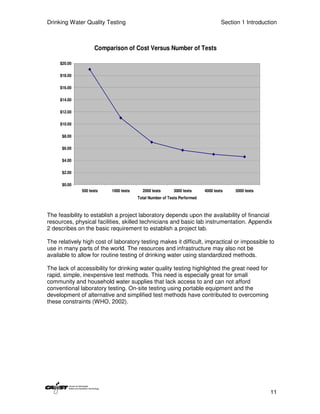
The costs are usually reduced as the numbers of tests increase. The following graph
shows a reduction costs when the number of tests is increased. This was based on
setting up a semi-permanent laboratory using reusable glassware (Baker, 2006).


                                                                                            10
Drinking Water Quality Testing                                                     Section 1 Introduction


                     Comparison of Cost Versus Number of Tests

     $20.00

     $18.00

     $16.00

     $14.00

     $12.00

     $10.00

      $8.00

      $6.00

      $4.00

      $2.00

      $0.00
              500 tests    1000 tests     2000 tests      3000 tests      4000 tests    5000 tests
                                        Total Number of Tests Performed


The feasibility to establish a project laboratory depends upon the availability of financial
resources, physical facilities, skilled technicians and basic lab instrumentation. Appendix
2 describes on the basic requirement to establish a project lab.

The relatively high cost of laboratory testing makes it difficult, impractical or impossible to
use in many parts of the world. The resources and infrastructure may also not be
available to allow for routine testing of drinking water using standardized methods.

The lack of accessibility for drinking water quality testing highlighted the great need for
rapid, simple, inexpensive test methods. This need is especially great for small
community and household water supplies that lack access to and can not afford
conventional laboratory testing. On-site testing using portable equipment and the
development of alternative and simplified test methods have contributed to overcoming
these constraints (WHO, 2002).


                                                                                                      11
Drinking Water Quality Testing                                         Section 1 Introduction


1.5.5 Selecting Drinking Water Quality Test Methods

Selecting a test method depends on the purpose of the test and how the results are going
to be used. There is no single test to determine the safety of drinking water.

Deciding on an appropriate method is based on the following considerations:

•   Objectives of your testing program.
•   The range of concentrations of the contaminants that need to be determined
           o Detection limits depend on the type of method; both low and high
               concentrations can be tested with more accuracy in a laboratory.
•   The accuracy and precision required
           o The greater accuracy and precision required, the greater the analytical
               complexity and cost
•   The maximum time period between sampling and analysis
•   Technical skills required
•   Cost of equipment and materials for each test

In the case where different methods can achieve the above requirements, the ultimate
choice may be dictated by familiarity with the method and/or the availability of necessary
equipment.

1.6 Lessons Learned

Smaller projects that are just getting off the ground do not usually do water quality testing.
Many project implementers have shown initial interest in water quality testing; however
they end up finding that it can be an onerous and expensive task. The cost (about US$2-4
per test) is not affordable for many project implementers who want to conduct water
quality testing on a regular basis.

Some larger projects have found portable water testing to be useful in determining the
effectiveness of the technology and for monitoring and evaluating its implementation.
These project implementers may have their own laboratory set up and have received
training on water quality testing.

Sometimes project implementers do random testing that is not part of a regular and
structured monitoring program. Doing occasional or random tests may provide a false
sense of security or inconclusive results as water quality can vary widely and rapidly.

Laboratory testing is preferred when carrying out technology verification and preparing
water quality guidelines. UNICEF recommends that some complex chemicals such as
antimony, barium, cadmium, mercury, molybdenum, selenium and uranium should be
tested by a laboratory to achieve a reliable result. However, testing specifically for these
chemicals is not usually a concern for the majority of HWTS projects.


                                                                                           12
Drinking Water Quality Testing                                           Section 1 Introduction


Water quality testing has been used by some projects as an effective tool to raise
awareness about the importance of safe water in rural communities. It can be an effective
tool for Community Health Promoters or field staff to help bring about positive changes in
people’s hygiene and sanitation behaviours. Users have a chance to participate in the
testing process and they can visually see the results. However the results should be
interpreted and presented properly to the users to avoid misunderstandings and possible
negative behaviour change. For example, showing treated water as being positive for
contamination (despite considerable improvement compared to the original source) may
discourage the household from using their water.

1.7 Summary of Key Points

•   Water quality can be defined by three broad categories: physical, chemical and
    biological attributes.

•   The WHO Guidelines for Drinking Water Quality defines safe water as a not
    representing any significant risk to health over the lifetime of consumption.

•   Adoption of the WHO Guidelines for Drinking Water Quality varies among countries
    and regions. There is no single approach that is used worldwide.

•   Although there are several contaminants in water that may be harmful to humans, the
    first priority is to ensure that drinking water is free of microorganisms that cause
    disease (pathogens)

•   Common reasons to conduct water quality testing at the household level are to:
         o ensure safe drinking water
         o identify problems
         o adopt precautionary measures
         o raise awareness
         o determine the effectiveness of HWT technologies
         o select an appropriate water source
         o influence government to supply safe water

•   There are four broad options for water quality testing: observation, testing using
    portable (field) kits, mobile laboratory testing and specialized laboratory testing.

•   There is no single test to determine the safety of drinking water.


                                                                                            13
Drinking Water Quality Testing                                     Section 1 Introduction


1.8 References

Baker D. (2006). Water Lab Equipment, Unpublished document. Centre for Affordable
Water and Sanitation Technology, Calgary, Canada.

Singh, G. and Singh J. (2003). Water Supply and Sanitation Engineering, Standards
Publisher Distributors, India.

UNICEF (2003). Water Quality Assessment and Monitoring, Technical Bulletin No.6.
Available at: www.supply.unicef.dk/catalogue/bulletin6.htm

World Health Organization (2001). Water Quality: Guidelines, Standards and Health.
Edited by Lorna Fewtrell and Jamie Bartram. IWA Publishing, London, UK. Available at:
www.who.int/water_sanitation_health/dwq/whoiwa/en/index.html

World Health Organization (2006). Guidelines for Drinking-Water Quality: Incorporating
First Addendum. Vol. 1, Recommendations, Third Edition. WHO, Geneva, Switzerland.
Available at: www.who.int/water_sanitation_health/dwq/gdwq3rev/en/index.html

World Health Organization (2008). Guidelines for Drinking-Water Quality: Second
Addendum. Vol. 1, Recommendations, Third Edition. WHO, Geneva, Switzerland.
Available at: www.who.int/water_sanitation_health/dwq/secondaddendum20081119.pdf

World Health Organization and United Nations Children’s Fund (2004) Meeting the MDG
Drinking Water and Sanitation Target: A Mid-Term Assessment of Progress. UNICEF,
New York, USA and WHO, Geneva, Switzerland. Available at
www.unicef.org/wes/files/who_unicef_watsan_midterm_rev.pdf

World Health Organization and United Nations Children’s Fund (2005). WHO/UNICEF
Joint Monitoring Programme for Water Supply and Sanitation. Water for Life: Making it
Happen. UNICEF, New York, USA and WHO, Geneva, Switzerland. Available at:
www.who.int/water_sanitation_health/monitoring/jmp2005/en/index.html

World Health Organization and United Nations Children’s Fund (2008). Progress on Drinking
Water and Sanitation: Special Focus on Sanitation. UNICEF, New York, USA and WHO,
Geneva, Switzerland. Available at: www.wssinfo.org/en/40_MDG2008.html


                                                                                         14
Drinking Water Quality Testing                                     Section 1 Introduction


Assignment: Selecting Water Quality Test Methods

1. Why do you want to conduct water quality testing for your project?


2. Which testing options do you think will be the most appropriate for your project? Why?


                                                                                      15
Drinking Water Quality Testing                                        Section 1 Introduction


Assignment: Answers

1. The following are common reasons to do water quality testing at the household level:

•   ensure safe drinking water
•   identify problems
•   adopt precautionary measures
•   raise awareness
•   determine the effectiveness of the HWTS process
•   select an appropriate water source
•   influence government to supply safe water

2. Project specific answers. If you have any questions ask your facilitator.


                                                                                         16
Drinking Water Quality Testing                                         Section 2 Planning


2 Planning for Water Quality Testing

It is essential to have a detailed plan for water quality testing. Planning in advance and
thinking through the process will save time, lower costs, satisfy stakeholders, and
prevent surprises during the project. Moreover, it gives a basis for the financial and
human resources that will be needed to carry out your testing. It is important to follow
the plan once it has been developed, although some changes will inevitably be required
as events unfold.

The planning process presented in this section follows well-established practices. This
process may require more time than expected to develop objectives, put together your
team, identify the testing parameters, and prepare a budget.

2.1 The Planning Process

Planning for a water quality testing should be done by the people who will be involved in
the project. The following steps can be undertaken as a facilitated group activity before
the testing begins to ensure that the planning is thorough and complete. Time invested
in planning is essential for conducting efficient and useful water quality tests.

1.   Review the need for testing
2.   Develop your objectives
3.   Identify test parameters
4.   Identify test methods
5.   Determine the key milestones
6.   Identify your activities
7.   Set out responsibilities
8.   Develop time and cost estimates

2.1.1 Review the Need for Testing

As discussed in Section 1, you should review the need for water quality testing within
the context of your project and its objectives. People often start out by implementing a
pilot project in a community to demonstrate the performance and acceptability of HWTS.
There are different criteria to measure performance, including:

•    Quantity of treated water
•    User’s satisfaction
•    Robustness
•    Ease of maintenance and operation
•    Affordability
•    Availability
•    User’s perception on taste, smell and color

In some situations, you may also want to determine the effectiveness of HWTS in terms
of its physical, chemical and microbiological contaminant removal. There are other
situations that may require some assessment of HWTS: end user request, donor
request, government verification, or research purposes. This is where water quality
testing can be a useful tool.


                                                                                        17
Drinking Water Quality Testing                                         Section 2 Planning


Water quality testing in developing countries can be a quite expensive and onerous
undertaking if it is done properly. Careful judgement about the need for water quality
testing is essential. As discussed in Section 1, there are alternative ways to assess the
performance of HWTS such as household surveys and observations. However, if you
are going to assess the technical effectiveness of technology, you may need to carry out
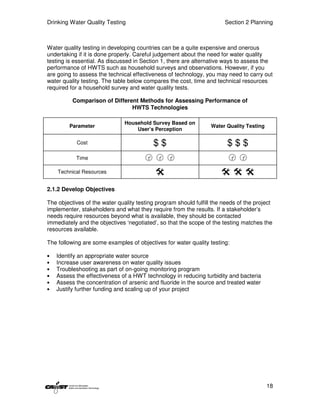
water quality testing. The table below compares the cost, time and technical resources
required for a household survey and water quality tests.

          Comparison of Different Methods for Assessing Performance of
                               HWTS Technologies

                               Household Survey Based on
         Parameter                                                Water Quality Testing
                                   User’s Perception

            Cost                          $$                            $$$
           Time

    Technical Resources


2.1.2 Develop Objectives

The objectives of the water quality testing program should fulfill the needs of the project
implementer, stakeholders and what they require from the results. If a stakeholder’s
needs require resources beyond what is available, they should be contacted
immediately and the objectives ‘negotiated’, so that the scope of the testing matches the
resources available.

The following are some examples of objectives for water quality testing:

•   Identify an appropriate water source
•   Increase user awareness on water quality issues
•   Troubleshooting as part of on-going monitoring program
•   Assess the effectiveness of a HWT technology in reducing turbidity and bacteria
•   Assess the concentration of arsenic and fluoride in the source and treated water
•   Justify further funding and scaling up of your project


                                                                                          18
Drinking Water Quality Testing                                           Section 2 Planning


2.1.3 Identify Test Parameters

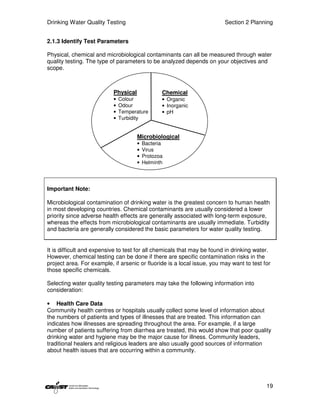
Physical, chemical and microbiological contaminants can all be measured through water
quality testing. The type of parameters to be analyzed depends on your objectives and
scope.


                           Physical              Chemical
                           •   Colour            • Organic
                           •   Odour             • Inorganic
                           •   Temperature       • pH
                           •   Turbidity


                                      Microbiological
                                      •   Bacteria
                                      •   Virus
                                      •   Protozoa
                                      •   Helminth


Important Note:

Microbiological contamination of drinking water is the greatest concern to human health
in most developing countries. Chemical contaminants are usually considered a lower
priority since adverse health effects are generally associated with long-term exposure,
whereas the effects from microbiological contaminants are usually immediate. Turbidity
and bacteria are generally considered the basic parameters for water quality testing.


It is difficult and expensive to test for all chemicals that may be found in drinking water.
However, chemical testing can be done if there are specific contamination risks in the
project area. For example, if arsenic or fluoride is a local issue, you may want to test for
those specific chemicals.

Selecting water quality testing parameters may take the following information into
consideration:

• Health Care Data
Community health centres or hospitals usually collect some level of information about
the numbers of patients and types of illnesses that are treated. This information can
indicates how illnesses are spreading throughout the area. For example, if a large
number of patients suffering from diarrhea are treated, this would show that poor quality
drinking water and hygiene may be the major cause for illness. Community leaders,
traditional healers and religious leaders are also usually good sources of information
about health issues that are occurring within a community.


                                                                                          19
Drinking Water Quality Testing                                          Section 2 Planning


• End Users’ Request
End users may show interest in the effectiveness and reliability of a HWT technology.
Sometimes they want to be able to see the pathogens to better understand the process.
In this situation, it can be beneficial to do microbiological testing to demonstrate the
presence of pathogens in the water.

• Natural Disasters
Natural disasters such as flooding, earthquakes and landslides often cause
contamination of water sources. Deterioration of the water source can affect the
effectiveness of different HWT technologies. Depending on the type and intensity of the
natural disaster, it may be a good idea to conduct water quality testing.

• Geographic Location
Due to natural geological formations, some regions may be prone to arsenic, fluoride or
other chemical contamination. In these areas, it may be a good idea to conduct water
quality testing. Also, you may want to do testing near industrial or agricultural operations
where there may be by-products that may cause water contamination.

• Secondary Information
Government agencies, research centres or international organizations may carry out a
national or regional survey and report on the surface and ground water quality. This type
of information provides a general idea of the local situation, which helps to determine
the type of tests and parameters required for the area.

2.1.4 Identify Test Methods

As mentioned in Section 1, there are many testing methods, tools and kits available to
do microbiological, physical and chemical testing.

Once you have selected which parameters you will be testing for, you will need to select
which methods are more suitable to achieve your objectives.

Sections 4, 5 and 6 provide a more in-depth understanding on different test methods for
physical, chemical and microbiological parameters.

2.1.5 Determine Key Milestones

The concept of milestones in the planning process was originally derived from
engineering highways. A milestone or kilometre sign was placed along a road at regular
intervals. This gave the traveler a better idea of the path being followed and the
remaining distance to the desired destination.

Similarly, a milestone within the planning process indicates what achievements are
needed to be reached in order to meet the final goal. In planning your milestones, it is
best to begin with the end in mind. Working back in time, determine the key milestones
that have to be accomplished prior to completing the final report.

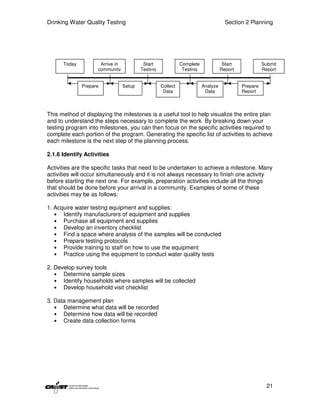
The example below shows the key milestones on top and the major activities below
starting from today and extending to the completion of the water quality testing program.


                                                                                         20
Drinking Water Quality Testing                                                      Section 2 Planning


      Today          Arrive in            Start              Complete              Start             Submit
                    community            Testing              Testing             Report             Report


              Prepare            Setup             Collect              Analyze            Prepare
                                                    Data                 Data              Report


This method of displaying the milestones is a useful tool to help visualize the entire plan
and to understand the steps necessary to complete the work. By breaking down your
testing program into milestones, you can then focus on the specific activities required to
complete each portion of the program. Generating the specific list of activities to achieve
each milestone is the next step of the planning process.

2.1.6 Identify Activities

Activities are the specific tasks that need to be undertaken to achieve a milestone. Many
activities will occur simultaneously and it is not always necessary to finish one activity
before starting the next one. For example, preparation activities include all the things
that should be done before your arrival in a community. Examples of some of these
activities may be as follows:

1. Acquire water testing equipment and supplies:
   • Identify manufacturers of equipment and supplies
   • Purchase all equipment and supplies
   • Develop an inventory checklist
   • Find a space where analysis of the samples will be conducted
   • Prepare testing protocols
   • Provide training to staff on how to use the equipment
   • Practice using the equipment to conduct water quality tests

2. Develop survey tools
   • Determine sample sizes
   • Identify households where samples will be collected
   • Develop household visit checklist

3. Data management plan
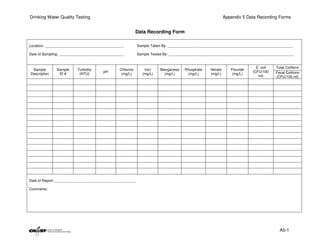
   • Determine what data will be recorded
   • Determine how data will be recorded
   • Create data collection forms


                                                                                                       21
Drinking Water Quality Testing                                          Section 2 Planning


2.1.7 Assign Responsibilities

Once the list of activities has been developed, the next step is to assign responsibility
for each activity. In the case of larger projects, there may be several people involved
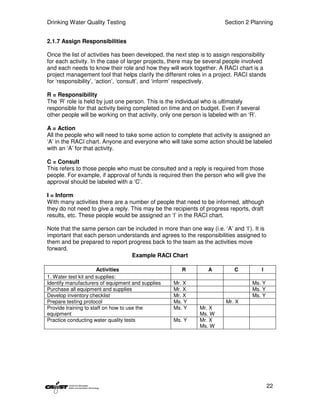
and each needs to know their role and how they will work together. A RACI chart is a
project management tool that helps clarify the different roles in a project. RACI stands
for ‘responsibility’, ‘action’, ‘consult’, and ‘inform’ respectively.

R = Responsibility
The ‘R’ role is held by just one person. This is the individual who is ultimately
responsible for that activity being completed on time and on budget. Even if several
other people will be working on that activity, only one person is labeled with an ‘R’.

A = Action
All the people who will need to take some action to complete that activity is assigned an
‘A’ in the RACI chart. Anyone and everyone who will take some action should be labeled
with an ‘A’ for that activity.

C = Consult
This refers to those people who must be consulted and a reply is required from those
people. For example, if approval of funds is required then the person who will give the
approval should be labeled with a ‘C’.

I = Inform
With many activities there are a number of people that need to be informed, although
they do not need to give a reply. This may be the recipients of progress reports, draft
results, etc. These people would be assigned an ‘I’ in the RACI chart.

Note that the same person can be included in more than one way (i.e. ‘A’ and ‘I’). It is
important that each person understands and agrees to the responsibilities assigned to
them and be prepared to report progress back to the team as the activities move
forward.
                                Example RACI Chart

                       Activities                     R          A          C            I
1. Water test kit and supplies:
Identify manufacturers of equipment and supplies   Mr. X                           Ms. Y
Purchase all equipment and supplies                Mr. X                           Ms. Y
Develop inventory checklist                        Mr. X                           Ms. Y
Prepare testing protocol                           Ms. Y                Mr. X
Provide training to staff on how to use the        Ms. Y      Mr. X
equipment                                                     Ms. W
Practice conducting water quality tests            Ms. Y      Mr. X
                                                              Ms. W


                                                                                             22
Drinking Water Quality Testing                                                Section 2 Planning


2.1.8 Develop Time and Cost Estimates

The final step is to estimate the time and cost necessary to complete each activity. By
using the list of activities as a ‘project breakdown’ it is much easier to estimate the time
required and forecast the cost for each activity.

Normally, the cost and time is estimated, or at least agreed to, by the person who is
ultimately responsible for the activity. It is important to recognize that the time required
for each activity may not be additive since many activities may be undertaken at the
same time. For this reason, sometimes activities are assigned ‘deadlines for
completion’ rather than assigning the time requirement needed to complete each
activity.
                                 Example Time Estimate
                                                              Week
         Activities
                                   1             2              3         4               5
1. Preparation
2. Set up
3. Collect data
4. Analyze data
5. Prepare final report

Cost estimates should be supported whenever possible by actual quotes (e.g. for testing
equipment and supplies). A budget should be prepared to include all capital costs (eg.
equipment, office supplies) and on-going expenses including transportation and human
resources.
                   Example Budget for Testing 30 Biosand Filters
                                                                               Cost
                                 Activities
                                                                              (US$)
      1. Office Supplies
      Paper                                                                            15.00
      Photocopies                                                                      30.00
      Printing                                                                         50.00
      Maps                                                                             10.00
      2. Field Work
      Local transportation to project (6 days at $20/day)                             120.00
      Test equipment and supplies                                                     120.00
      Refreshment for community meetings                                              120.00
      3. Human Resources
      Staff daily allowances (1 team leader, 3 members,1 driver)                      180.00
                                                            Total Costs               645.00
                                                 Contingencies 10%                     64.50
                                                            Grand total               709.50


                                                                                               23
Drinking Water Quality Testing                                         Section 2 Planning


2.2 Summary of Key Points

•   A detailed plan for water quality testing is essential.

•   Planning in advance and thinking through the process will save time, lower costs,
    satisfy stakeholders, and prevent surprises during the project. Moreover, it gives an
    idea of the financial and human resources that will be needed to carry out your
    testing.

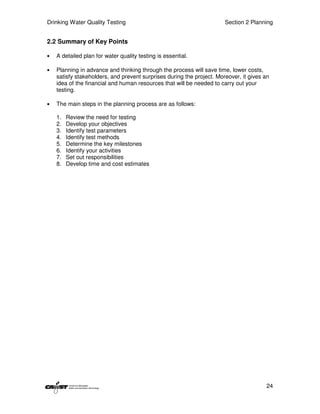
•   The main steps in the planning process are as follows:

    1.   Review the need for testing
    2.   Develop your objectives
    3.   Identify test parameters
    4.   Identify test methods
    5.   Determine the key milestones
    6.   Identify your activities
    7.   Set out responsibilities
    8.   Develop time and cost estimates


                                                                                       24
Drinking Water Quality Testing                                        Section 2 Planning


Assignment: Prepare a Water Quality Testing Plan

1. Explain why you need to conduct water quality testing for your project. What are
   your specific objectives?


2. Identify the key milestones required to meet your objectives.


3. Identify the specific activities that need to be undertaken to accomplish each
   milestone.


Answers:
Question 1 (See Section 2.1.2)
Question 2 (See Section 2.1.5)
Question 3 (See Section 2.1.6)


                                                                                      25
Drinking Water Quality Testing           Section 3 Water Sampling and Quality Control


3 Water Sampling and Quality Control

The following section discusses how many water samples you need to take depending
on your needs; how to collect and transport water samples from different sources;
different measures that you can take to ensure quality control; and the importance of
health and safety.

3.1 Determining the Sample Size

The following guidelines can help you to determine the sample size required for large
and small projects.

Small Projects (less than 100 households)

The sample size depends on the purpose of the water quality testing.


• For a trend analysis, 10-20% of households can be used as the sample size. If
  resources are available, it would be good to test all the households in a small project.

• For a statistical analysis, a minimum of 30 units is needed for sampling. For example,
 30 children at a school, 30 filters in the village, or 30 households in the community.


Large Projects (greater than 100 households)

Geographical location and socioeconomic status should be considered during the
sample selection. Before determining the sample size, the area should be divided into
different geographical areas, such as high land, low land, or coastal areas, to get an
accurate representation. Households should also be classified based on socioeconomic
status such as high, medium, and low income. In general, 5-10% of the total
households can be taken as a sample from each geographical area and each
socioeconomic group.

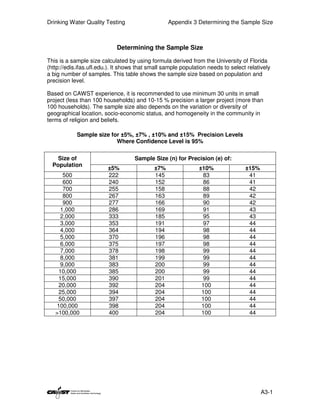
Appendix 3 explains sample size calculations by using a formula derived from the
University of Florida. It shows that a small sample population requires the selection of a
relatively large number of samples. The table in the appendix shows the sample size
based on population and precision level.

Based on CAWST’s experience, for large project, it is recommended that a 15-20%
precision level be used for the sample size. Moreover, sample size depends on the
variation or diversity of geographical location, socioeconomic status, and homogeneity
in the community in terms of religion and beliefs.


“Sample size is primarily determined by money and politics, not statistics.”
                                          ~ Dr. Lawrence Grummer-Strawn, CDC (nd)


                                                                                          26
Drinking Water Quality Testing          Section 3 Water Sampling and Quality Control


3.2 Choosing a Sampling Method

Basically there are two types of sampling methods: probability and non-probability.

•   Probability sampling: every unit of the population has an equal chance (probability)
    of being selected in the sample.
•   Non-probability sampling: does not use random selection.

3.2.1 Probability Sampling methods

•   Simple Random Sampling
In this method, every unit of the population has an equal chance of being selected in
the sample. A sample unit can be drawn either by using a random numbers table or by
drawing a unit from the list of the total population. In this context, total population
means the group of people, items or units under the study or research.

We can use different methods to randomly select the participants, such as drawing
names or numbers from a hat, or using a computerized random number generator
(www.random.org).


For example, your sample size is 50 from a total population of 200 households. Write
the name of each household in a separate piece of paper and put it into a container.
Randomly select 50 names from the hat.


•   Systematic Sampling
In this method, a sample unit can be taken at particular intervals. The interval can be
calculated by dividing the total number of units in the population by the number of units
to be selected (sample size).


The following is an example of systematic sampling:

•   Your sample size is 100 households from a total population of 1000 households
•   1000 divided by 100 = 10 households
•   from a list of the 1000 households, begin at a random household on the list, and
    select every 10th household to be sampled


•   Cluster Sampling
In this method, the population is divided into clusters or groups, and some of these are
then chosen by simple random sampling or by an alternative method. It is a good
method to use for large projects. Samples taken from households of the same street or
households with the same tribe are an example of cluster sampling. The population is
divided into clusters,


                                                                                       27
Drinking Water Quality Testing           Section 3 Water Sampling and Quality Control


For example, an organization wishes to find out the effectiveness of a technology in the
project area. It would be too costly and take too long to survey every household in the
project. Instead, 50 households are randomly selected from all households using a
local pond as their water source. These households using a pond water source are
considered as a cluster sampling.


•   Stratified Random Sampling
Stratified sampling methods are generally used when the population is heterogeneous.
To choose a stratified random sample, divide the population into groups of individuals
that are similar in some way that is important to the response.


For example, if you were interested in assessing the rate of technology adoption in
terms of social status, select samples through stratified random sampling. In this
context, the total population can be stratified by their economic status such as low
income, medium income and high income.


3.2.2 Non-probability Sampling Methods

Non-probability sampling does not use random selection. In this method, generalization
of the findings is not possible because the sample is not representative of population.

•  Convenience Sampling
Convenience sampling does not produce a representative sample of the population
because people or items are only selected for a sample if they can be accessed easily
and conveniently.


For example, this may include the first ten people meeting in a temple or the first row of
people in a meeting.


•   Purposive Sampling
A purposive sample is one in which an evaluator tries to create a representative sample
without actually sampling at random. One of the most common uses of purposive
sampling is in selecting a group of geographical areas to represent a larger area.


For example, it is not feasible to do a house-to-house survey covering the whole
country. Due to financial constraints only a small number of towns and cities can be
sampled; therefore you might choose these in a purposive way.


                                                                                       28
Drinking Water Quality Testing           Section 3 Water Sampling and Quality Control


•  Quota Sampling
Quota sampling is a type of stratified sampling in which selection within the strata is
non-random.

For example, you have small project of 100 biosand filters and want to asses their
effectiveness after 2 years. Your quota for the sample is 10%. Therefore, you only
need to sample 10 filters to meet this quota.

= 10% of 100 (sample size)
= 10 filters


•   Snowball Sampling

This method is often used when you are trying to reach populations that are
inaccessible or hard to find. The evaluator has a certain criteria they have to meet to be
considered as a sample.


                                                                                          29
Drinking Water Quality Testing           Section 3 Water Sampling and Quality Control


3.3 How to Collect Water Samples

 It is important to collect water samples under normal, every day conditions in order to
gain a representative sample. Proper procedures for collecting samples must also be
observed. Techniciens should be properly trained since the way in which samples are
collected has an important bearing on the tests results

Samples should be collected in a non-reactive borosilicate glass, plastic bottle or plastic
bag that has been cleaned, rinsed and sterilized. A sample container is usually
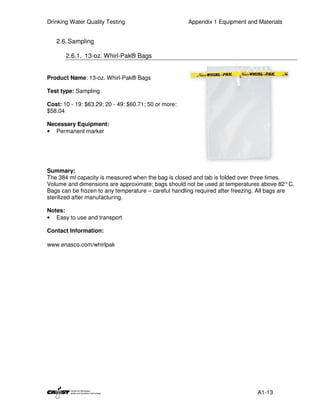
provided as part of portable field kits. Disposable Whirl-pak® sample bags are another
option to collect water samples although they are more expensive than reusable
containers ($0.10-0.20/bag).


            Whirl-pak® Sample Bag                      Plastic Sample Bottles
            (120 to 720 ml)                            (200 to 1500 ml)


100 ml is the minimum volume that should be taken as a sample to obtain reliable
results, especially for microbiological testing. More water should be collected than
needed (i.e. 200 – 1000 ml) in case if multiple tests are required.

Every sample container should have a label. The sample label has information about:

•   Project name
•   Sample location (e.g. household, source)
•   Sample description (e.g. inlet water, storage bucket water)
•   ID number
•   Date and time
•   Name of the person collecting the sample.
•   Test to be performed (optional)


                                                                                        30
Drinking Water Quality Testing            Section 3 Water Sampling and Quality Control


You need to take care to avoid contaminating the container and the water sample.
General procedures for collecting drinking water samples are as follows:

•   Do not touch inside of the sample container
•   Do not rinse the sample container
•   Do not put the cap of sample container on the ground while sampling
•   Always label the container before sampling

                                                              (Adapted from WHO, 1997).

You can reuse heat resistant plastic and glass sample containers but you will need to
sterilize them in an autoclave or a pressure cooker. If these are not available, you can
boil them and let them dry with their lid partially closed until they cool down, then close
tight to avoid contamination.

If another person is assigned to take a water sample, you must tell them about:

•   The purpose for which the analysis is required
•   The location, number and type of samples required
•   The accuracy and precision of analysis required
•   The required reporting forms

3.3.1 Sampling a Surface Water Source

You should try to obtain samples that are representative of the source of the drinking
water supply. Do not take samples that are too near the bank, too far from the point of
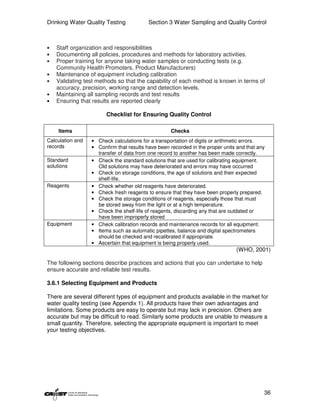
draw off, or at a depth above/below the point of draw off. Water quality can change
depending on the time of day or season. It is important to sample at the same time of
day and record the weather conditions when you are taking your sample.

It may be possible to take samples by hand if it is easy to get the water. In many cases
it may be inconvenient or dangerous to enter the water source such as river, pond or
canal. In these cases, you may need to tie your container to a piece of wire or rope and
throw it into the water.

To sample the water:

•   Grasp the sample container firmly and dip the open mouth of the container into the
    water.
•   Submerge the container about 30 cm below the surface of the water and scoop up
    the water sample. This scooping action ensures that no external contamination
    enters the sample container.
•   Lift the sample container carefully and place on a clean surface where it cannot be
    knocked over.

In areas where the water is moving water (e.g. rivers and streams) the sample should
be taken against the direction of flow.


                                                                                         31
Drinking Water Quality Testing             Section 3 Water Sampling and Quality Control


3.3.2 Sampling an Open Well

•   Fasten a cable, rope or string to the sample container.
•   Lower the sample container into the well or tank, taking care not to allow the
    container to touch the walls of the structure where it may pick up dirt.
•   Submerge the container to a depth of 30 cm. Lift the sample container carefully and
    place on a clean surface.

3.3.3 Sampling a Pump

•   Pump water to waste for 5-10 minutes or until the water temperature has stabilized.
•   Take a water sample with the sample container.

3.3.4 Sampling a Tap

•   Remove any attachments (e.g. nozzles, pipes) from the tap.
•   Carefully clean and disinfect the inside and outside of the tap.
•   Open the tap and let water flow for 2-3 minutes before taking a sample. This
    ensures that any deposits in the pipes are washed out.
•   Take a water sample with the sample container.

3.3.5 Sampling a Storage Container

•    Pre-treatment
Your technique will also depend on type of storage container. If possible, lower the
sample container into the tank, taking care not to allow the container to touch the walls
of the container where it may pick up dirt. Submerge the container to a depth of 30 cm.
Lift the sample container carefully and place on a clean surface.

•  Post-treatment
Carefully take off the lid (if available) of the stored container and pour water into the
sample container. Do not use the ladle or dipping cup that the household may use as it
may introduce contamination which is not from the storage container.

3.3.6 Sampling a HWT Technology
Many project implementers are concerned about the effectiveness of their HWT
technology and want to make sure that it is effectively removing pathogens from
drinking water. In this case, it is only worthwhile to carry out water quality testing if the
technology is being operated and maintained properly. We already know that any
technology will not produce good quality water if it is not being used correctly, so it is
not worth spending money on water quality testing. Therefore any HWT technology
which is not fulfilling the normal operating conditions should be recorded as “not
operating properly (NOP)” and no samples should be taken.


                                                                                            32
Drinking Water Quality Testing            Section 3 Water Sampling and Quality Control


The following 8 conditions for a biosand filter must be checked before taking a water
sample:

•   Filter is being used for more than one month since installation
•   Diffuser is in good condition and placed properly
•   Flow rate is equal to or less than 0.6 L/minute
•   Water level is 5 cm above the sand
•   Top of sand is level
•   Inlet water turbidity is less than 50 NTU
•   Filter is used daily
•   No leaks

To take a sample from a biosand filter, first clean and disinfect the outlet pipe. Pour a
bucket of water into the filter until it is full. Take a sample of the outlet water into the
sample container. Note that the sample you are taking is actually the water that has
been sitting in the filter during the pause period and it may not match the source of the
water that was just poured into the filter.

The following 3 conditions for a ceramic filter must be checked before taking a water
sample:

•   No visible cracks or breaks in the ceramic filter container
•   Flow is not more than 2 L/hour

To take a sample from a ceramic filter, first clean and disinfect the tap. Open the tap
and fill the sample container.

The following 5 conditions for SODIS must be checked before taking a water sample:

•   Bottles are made of clear, PET plastic
•   Size of bottles is not greater than 10 cm (4”) in diameter
•   Bottles have a lid and does not leak
•   Bottles are not scratched and/or dirty
•   Bottles are kept at least 6 hours or more in the sun

3.4 How to Transport Water Samples

Bacteria do not generally survive well in water due to a variety of factors. It is well
known that the numbers of bacteria within a water sample rapidly decline 24 hours after
it has been collected. Temperature can also affect die off within the water sample, with
higher temperatures leading to greater die offs.

Samples should be collected and placed on ice in an insulated container if they cannot
be tested immediately; preferably held at <10 ° during transit. Samples should be
                                                 C
tested the same day and refrigerated overnight if necessary. If the time between
collection and test exceeds 6 hours, the final report should include information on the
conditions and duration of sample transport. Samples exceeding 30 hours holding time
(from collection to testing) should not be tested (BCCDC, 2006; Bartram et al., 1996).


                                                                                          33
Drinking Water Quality Testing              Section 3 Water Sampling and Quality Control


3.5 How to Dilute a Water Sample
You may have to dilute your samples if there are high levels of contamination. Diluting
your sample with distilled water will reduce the concentration of the contamination –
making it easier to measure and obtain more accurate results

The following table provides an example method to calculate sample dilutions for the
membrane filtration method in microbiological testing. It is used to avoid too many
coliform colonies growing making the sample ‘too numerous to count’ (TNTC).

                                 Example Sample Dilutions

                                                                              Multiplication
                         Volume of distilled
Volume of sample                                    Volume filtered          factor to obtain
                            water mixed
                                                                             CFU per 100 ml
        1 ml                     99 ml                   100 ml                   100 x
        5 ml                     95 ml                   100 ml                    20 x
        10 ml                    90 ml                   100 ml                    10 x
        50 ml                    50 ml                   100 ml                     2x
       100 ml                     0 ml                   100 ml                     1x


Dilution Tips:

•   Take a small sample volume with a sterile pipette
•   Working with small sample volumes can reduce the accuracy of results. Moreover
    you need to be vary careful on how you handle the sample
•   If distilled water is not available, you can use boiled water (eg. clean rainwater,
    bottled water or spring water).
•   For microbiological testing, never use chlorinated water to dilute your samples as
    chlorine residual will affect your test results (it will kill the bacteria you are trying to
    test for)


                                                                                               34
Drinking Water Quality Testing            Section 3 Water Sampling and Quality Control


3.6 Ensuring Quality Control

When we carry out repeated tests many times on the same sample of water, it will
rarely happen that we get the same results each time. This is due to the inherent
variability associated with all analytical techniques. Therefore, the result of a water
quality test is only a best-estimate or approximation of the true value of what is being
measured. It is not possible to tell if a test result is exactly right.

Scientific research studies often explain the level of precision including details of the
statistical analysis that was conducted on the results. Statistical analysis of test results
is a complex subject and falls outside the scope of this manual. This section, therefore
presents only a simplified discussion of the most important aspects of quality control
during sampling and testing.

There are two types of errors which commonly contribute during water quality testing:
random and systematic. Random errors (often related to precision) occur from many
different non-measurable contributing sources. The following are the potential sources
of random error:

•   Non-detectable variance in individual measurements used in the overall
    measurement such as volume, mass and scale values
•   Fluctuations in light intensity, temperature, humidity, power supply and
    electromagnetic effects
•   Human variance
•   Non-detectable deterioration in resources - human (alertness/fatigue), equipment
    (calibration/standardization) and chemicals (quality)

Systematic errors (often related to bias) occur from different measurable sources or
valuable judgment which can be determined, reduced and in some cases eliminated.
Systematic errors usually produce a bias (or shift) of the result from the true value. The
sources of such error can be associated with the measurement technique such as poor
training of the analysts and poor calibration of equipment.

The major strategies for reducing the role of random and systematic errors are:

•   Increase sample size – a larger sample will yield more precise estimates of
    population parameters
•   Reduce measurement variability by using strict measurement protocols, better
    instrumentation, or averages of multiple measurements
•   Improve sampling procedures – a more refined sampling strategy (e.g., stratified
    random sampling combined with the appropriate analytic techniques can often
    reduce sampling variability compared to simple random sampling)
•   Use water quality testing forms to record the name of samples and other values

Regardless if you are conducting field or laboratory testing, a quality control system
should be designed from the planning stage to help reduce errors. Your system will be
simpler for field testing, but it should have a basic set of operating principles, practices
and actions necessary to remove or reduce errors caused by personnel, equipment,
supplies and analytical methodology.

In general a quality control system should include the following:


                                                                                           35
Drinking Water Quality Testing            Section 3 Water Sampling and Quality Control


•   Staff organization and responsibilities
•   Documenting all policies, procedures and methods for laboratory activities.
•   Proper training for anyone taking water samples or conducting tests (e.g.
    Community Health Promoters, Product Manufacturers)
•   Maintenance of equipment including calibration
•   Validating test methods so that the capability of each method is known in terms of
    accuracy, precision, working range and detection levels.
•   Maintaining all sampling records and test results
•   Ensuring that results are reported clearly

                        Checklist for Ensuring Quality Control

    Items                                          Checks
Calculation and   • Check calculations for a transportation of digits or arithmetic errors.
records           • Confirm that results have been recorded in the proper units and that any
                    transfer of data from one record to another has been made correctly.
Standard          • Check the standard solutions that are used for calibrating equipment.
solutions           Old solutions may have deteriorated and errors may have occurred
                  • Check on storage conditions, the age of solutions and their expected
                    shelf-life.
Reagents          • Check whether old reagents have deteriorated.
                  • Check fresh reagents to ensure that they have been properly prepared.
                  • Check the storage conditions of reagents, especially those that must
                    be stored away from the light or at a high temperature.
                  • Check the shelf-life of reagents, discarding any that are outdated or
                    have been improperly stored
Equipment         • Check calibration records and maintenance records for all equipment.
                  • Items such as automatic pipettes, balance and digital spectrometers
                    should be checked and recalibrated if appropriate.
                  • Ascertain that equipment is being properly used.
                                                                               (WHO, 2001)

The following sections describe practices and actions that you can undertake to help
ensure accurate and reliable test results.

3.6.1 Selecting Equipment and Products

There are several different types of equipment and products available in the market for
water quality testing (see Appendix 1). All products have their own advantages and
limitations. Some products are easy to operate but may lack in precision. Others are
accurate but may be difficult to read. Similarly some products are unable to measure a
small quantity. Therefore, selecting the appropriate equipment is important to meet
your testing objectives.


                                                                                           36
Drinking Water Quality Testing           Section 3 Water Sampling and Quality Control


Example

A supplier produces test strips for measuring pH. Two products are available. One with
a range between pH 1 to 14 and another with a range of 6.5 to 10.0. As drinking water
usually lies between 6.5 and 8.5 the second strip is more suited to our work and
provides better precision.

      1    2   3   4    5   6    7   8   9   10   11   12 13 14
                                                                   Product 1

     6.5 6.75 7 7.25 7.5 7.75 8 8.25 8.5 8.75 9 9.25 9.5 9.75

                                                                  Product 2


3.6.2 Equipment Calibration

It is important to calibrate equipment according to the manufacturer’s specifications to
get good results. Most electronic equipment will require some sort of calibration.
Commonly used equipment that requires proper calibration include pH meters,
turbidimeters, and photometers.

Before starting microbiological testing, it is important the check and calibrate the
temperature of the incubator. The incubation temperature is dependent upon the type
of media and the test to be carried out. Therefore understanding the procedure and
recommendations of different methods is essential to get accurate results. These
procedures and recommendations can be obtained by the product manufacturer.

Some portable test kits can be easily calibrated according to the specific test needs.
Manufacturers usually supply the instructions for calibration. It is recommended that the
temperature of the incubator be checked before a batch of testing. The calibration
process can take up to 2 hours.


Important Note:

Incubators operating over the recommended temperature range can give you
completely inaccurate results.


3.6.3 Quality of Consumables and Culture Media

Most consumables and culture media have a shelf-life and should be used before they
expire. Some need to be stored in a refrigerator while others need to be kept in a cool
and dry place. You should follow the manufacturer’s instructions help to protect the life
of the reagents and their effectiveness.


                                                                                       37
Drinking Water Quality Testing            Section 3 Water Sampling and Quality Control


Reliability of the reagents and media is important so you may also want to test them
with a known level of contamination. You should also check the following prior to using
them:

•   Expiry date
•   Date manufactured
•   Condition upon delivery
•   Reagent’s catalogue and instruction

Large projects should monitor the quality of reagents, media and membranes on a
regular basis. Whenever you need to order new products, it is a good idea to compare
them with those currently in use. Appendix 4 describes more about the quality control
for culture media.

3.6.4 Unequal Distribution of Microorganisms in a Water Sample

One factor that can significantly affect test results is the uneven distribution of
microorganisms in any one water source and even within one water sample. This
happens because bacteria like to clump together and may also stick to the sides of
your sample container.

It is not uncommon for independent tests performed from a single water sample, and
using the same test method, to produce slightly different results. Test results are most
variable when microorganisms are present in very low concentrations (BCCDC, 2006).


Important Note:

It is recommended to thoroughly shake any water sample for at least 10 seconds
before testing to help ensure an even distribution of microorganisms throughout the
water.


3.6.5 Secondary Contamination

Water samples for microbiological testing need to be handled carefully to avoid
secondary contamination. The following steps should be undertaken to enhance the
quality of test results.

•   Wash hands before starting work
•   Regularly clean your working area with disinfectant
•   Put testing equipment in a clean place
•   Never touch the inside of equipment (e.g. sample containers, Petri dishes, test
    tubes)
•   Never eat, drink or smoke when carrying out tests
•   Wear gloves if you have any open wounds
•   If testing from more than one source at the same time, test the least contaminated
    samples first (e.g. test filtered water first, then storage water, and test source water
    last)


                                                                                         38
Drinking Water Quality Testing            Section 3 Water Sampling and Quality Control


Equipment must be cleaned and sterilized thoroughly before each use to avoid
secondary contamination and ensure accurate results. Manufacturers usually include
instructions on how to sterilize their equipment.

Some methods for disinfecting equipment in the field are:

• Dry heat: The flame from a gas cigarette-lighter, for example, can be used to
  disinfect forceps used for holding membrane filter paper. It must be a butane or
  propane gas lighter, not one that uses gasoline or similar liquid fuel or matches,
  which would blacken the forceps.

• Formaldehyde: This gas is a powerful bactericide. It is generated by the combustion
  of methanol (but no other alcohol) in a closed space where oxygen becomes
  depleted. In the field, this is a convenient way to disinfect the filtration apparatus
  between uses. Wait 5 minutes to ensure sterilization.

• Disinfecting reusable materials: Reusable materials, such as Petri dishes (glass or
 metal), may be disinfected by putting them in boiling water for 15 minutes, by heating
 them at 180oC for 30 minutes in an oven, or by heating in a pressure cooker for at
 least 20 minutes.

• Never use bleach, chlorine or disinfectants that may leave a residue without properly
 rinsing (with distilled water) or boiling the equipment afterwards. The residue may
 affect results by inhibiting or killing the bacteria you are trying to test for.

                                                                (Adapted from WHO, 1996)
3.6.6 Multiple Sampling

Duplicate or triplicate samples can be collected to enhance the reliability of the test.
They are independent samples taken from the same location at approximately the
same time. It is recommended to collect duplicate or triplicate samples at a rate of 5%
(see box below); however it depends on the availability of resources (WHO, 1996).


Example of duplicate sampling at 5%

A rate of 5% duplicate samples means you need to duplicate every 1 in 20 samples. So
if you plan to test 100 samples of water, you will need to take a duplicate sample of
sample number 20, 40, 60, 80 and 100. So you will end up with 5 more samples to test.
It is important that you collect the duplicate in a different container as this will help
identify possible errors in sample collection.


                                                                                           39
Drinking Water Quality Testing            Section 3 Water Sampling and Quality Control


3.6.7 Controls: Blank Sampling and True Positives

Blank samples help with quality control to make sure that secondary contamination is
not taking place. Method blanks and, where possible, field blanks should be tested with
your samples. A method blank uses distilled water, although boiled water can be used if
distilled water is not available. You test the method blank the same as your field
samples. If the method blank shows any results from the test, then you know that there
was some secondary contamination.

A field blank is distilled water that has been bottled in the laboratory, transported with
sample bottles to the site, preserved and transported back with the other samples for
testing.

Important Note:

It is recommended to use blank samples 5% of the time during the testing process.
This means you have to add 1 blank sample in every 20 samples

A true positive sample is the opposite of a blank sample. You use (or create) a sample
which you are certain has fecal contamination. A long stick in a pit latrine or any other
method should help you create the sample (remember 1g of feces contains over
millions of coliform bacteria). Be careful not to cross-contaminate your other samples
with this highly contaminate sample. Make sure to filter this sample last. If no growth
occurs in this sample there may be a problem with your culture media or incubator.

3.6.8 Reading Test Results

Correct reading of the test results is also important for quality control. Reading results
can be subjective depending on the individual who is doing the test. For example,
chemical tests that use test strips need to have an accurate colour match which relies
on a visual observation.

People who are conducting microbiological testing should be trained on how to properly
read the results since they can be more complicated to interpret. Section 6 provides
more information on how to read microbiological test results.


                                                                                             40
Drinking Water Quality Testing            Section 3 Water Sampling and Quality Control


3.7 Checklist for Field Work

The following are things to remember to bring when you go to the field to take water
samples and conduct tests.

For sampling
• Sample bottles (sterilized), labels and marker pens
• Transport containers and ice packs to keep the samples cool
• Spares of all above items

For documentation
• Pens
• Sample labels
• Field notebook
• Data sheet

For testing
• List of tests to be performed on site
• Test procedures and equipment manuals
• Testing equipment
• Consumables (including distilled water, pH buffers, standards and blanks)
• Check and calibrate any electronic meters (pH, turbiditimeter and incubator)
• First-aid kit

3.8 Health and Safety

It is important to work safely and avoid injuries while carrying out water quality testing.
It is the responsibility of the project implementer to provide safety equipment, but it is
the responsibility of each individual to use the equipment properly and to request
equipment if it is not available. It is also the responsibility of project implementer to
provide safety training to anyone involved in water sampling and testing.

In addition, the technician should understand any special hazards and risks associated
with specific chemicals such as arsenic and methanol and follow the prescribed safety
precautions.

Samples and any waste generated during the testing process may contain pathogens
or chemicals that may be harmful to health and must be properly and safely disposed.
See section 6 on how to dispose of waste.


                                                                                          41
Drinking Water Quality Testing           Section 3 Water Sampling and Quality Control


3.9 Summary of Key Points

•   The sample size will differ between small and large projects.

•   There are two types of sampling methods: probability and non-probability.

•   The goal of water sampling is to collect the sample under normal, every day
    conditions in order to gain a representative sample of the water source.

•   Many project implementers are concerned about the effectiveness of a HWT
    technology and want to make sure that it is effectively removing pathogens from
    drinking water. It is only worthwhile to carry out water quality testing if the
    technology is being operated and maintained properly. Samples should not be
    taken from any HWT technology which is not fulfilling the normal operating
    conditions.

•   The numbers of bacteria within a water sample rapidly decline 24 hours after it has
    been collected. Samples should be collected and placed on ice in an insulated
    container if they cannot be analyzed immediately. Samples should be analyzed the
    same day and refrigerated overnight if necessary. Samples exceeding 30 hours
    holding time (from collection to testing) should not be tested.

•   There is an inherent variability associated with all analytical techniques. Therefore,
    the result of a water quality test is only a best-estimate or approximation of the true
    value of being measured.

•   There are two types of errors which commonly contribute during water quality
    testing: random errors and systematic errors.

•   Regardless if you are conducting field or laboratory testing, a quality control system
    should be designed to help reduce errors.

•   It is not uncommon for independent tests performed from a single water sample,
    and using the same test method, to produce slightly different results. Test results
    are most variable when microorganisms are present in very low concentrations.

•   It is the responsibility of the project implementer to provide safety equipment and
    training to anyone involved in water sampling and testing.


                                                                                          42
Drinking Water Quality Testing           Section 3 Water Sampling and Quality Control


Quality Control Summary

During sampling

•   Label the bottle before taking a water sample
•   Do not touch the inside of the bottle
•   Do not rinse the bottle
•   Do not put the bottle cap on the ground while sampling

During testing

•   Wash hands before starting work
•   Regularly clean your working area with disinfectant
•   Put testing equipment in a clean place
•   Never eat, smoke or drink when carrying out water quality tests
•   Cover wounds with a waterproof dressing or wear gloves
•   Never touch the inside of equipment – sample containers, Petri dishes, measuring
    containers
•   Calibrate equipment according to directions
•   Check to ensure reagents have not expired

During sterilization

•   Sterilize equipment between uses
•   Boil metal or glass equipment for 15 minutes OR
•   Heat in pressure cooker for 20 minutes OR
•   Heat in oven at 180° for 30 minutes
                         C

Microbiological testing

•   Never touch part of the filtration apparatus such as the bronze disc and the collar
•   Do not touch colonies with your fingers or with everyday objects such as pens and
    pencils that you may use again for other purposes
•   Do not carry out microbiological tests in areas of food preparation
•   Open Petri dishes for a minimum time possible
•   If testing more than one type of water sample at the same time, test least
    contaminated first (e.g. treated water, stored water, transport water, source water)
•   Properly dispose all waste materials
•   Use multiple samples

Health and Safety

•   Provide safety training for technicians
•   Provide safety equipment for technicians
•   Identify any special hazards/risks associated with the tests you are conducting (i.e.
    arsenic, methanol)
•   Properly dispose of waste that may contain pathogens and/or chemicals


                                                                                       43
Drinking Water Quality Testing         Section 3 Water Sampling and Quality Control


3.10 References

BCCDC Environmental Health Laboratory Services (2006). Safe Drinking Water: Public
Health Laboratory Surveillance Update. British Columbia, Canada. Available at:
www.vch.ca/environmental/docs/water/safe_drinking_water.pdf

Life Water International (2004). Water Quality Testing: A Key to Avoiding Health Risks
Simple Test procedures for Rural Drinking Water Sources. Life Water International.
San Luis Obispo, USA. Available at:
www.medrix.org/SafeWater/Lifewater%20WaterTesting%20040625.pdf

Schoenbach, V.J., Schildkraut, J. and W. Rosamond (2004) Sources of Error. Available
at: www.epidemiolog.net/evolving/SourcesofError.pdf

Thompson T, Farwell J., Kunikane S., Jackson D., Appleyard S.,Callan P, Bartram J
and P. Kingston (2007). Chemical Safety of Drinking-water: Assessing Priorities for
Risk Management, World Health Organisation, Geneva Switzerland. Available at:
http://whqlibdoc.who.int/publications/2007/9789241546768_eng.pdf

World Health Organization (1997). Guidelines for Drinking Water Quality, Volume 3,
Surveillance and Control of Community Supplies, Geneva. Available at:
www.who.int/water_sanitation_health/dwq/gdwq2v1/en/index2.html


                                                                                      44
Drinking Water Quality Testing                                     Section 4 Physical Contaminants


4 Testing for Physical Contaminants

The physical characteristics of drinking water are usually things that we can measure with our
own senses: turbidity, colour, taste, odour and temperature. In general, we judge drinking water
to have good physical qualities if it is clear, tastes good, has no smell and is cool.

4.1 WHO Guidelines for Physical Parameters

The appearance, taste and odour of drinking water should be acceptable to the consumer. The
table below shows the WHO Guidelines for Drinking Water Quality for physical parameters.

                     WHO Guidelines for Drinking Water Quality: Physical

               Parameter                            WHO Guideline
            Colour              Aesthetic value of < 15 True Colour Units (TCU)
            Odour               Aesthetic only, no health based value is proposed
            Temperature         Aesthetic only, no health based value is proposed
            Turbidity           < 5 NTU
                                                                             (WHO, 2007)

4.2 Potential Health Effects

Physical contaminants generally do have not direct health effects themselves; however, their
presence may relate to a higher risk of microbiological and chemical contamination which may
be harmful to human health. For example, increased turbidity levels are often associated with
higher levels of disease-causing pathogens such as viruses, parasites and some bacteria
(WHO, 2007).

4.3 Test Methods

Drinking water samples can be tested for the following physical parameters: colour, odour,
taste, temperature and turbidity. A data recording form for water quality testing is available in
Appendix 5.

4.3.1 Colour

Colour in drinking water may be due to the presence of coloured organic substances and
certain metals such as iron, manganese and copper. In general, colour of a water sample is
evaluated by simple visual observation. It can also be measured by visual comparison with a
series of standard solutions.

4.3.2 Odour and Taste

In general, odour and taste are evaluated by observation. When smelling a water sample from
an unknown source, do not breathe the odour in directly. Use your hand to gently waft the
vapours towards your nose. Never drink a sample from an unknown source.


                                                                                                    45
Drinking Water Quality Testing                                    Section 4 Physical Contaminants


4.3.3 Temperature

A thermometer is used to measure the temperature of water.

4.3.4 Turbidity

Turbidity is the cloudiness of water that is caused by suspended particles. An increase in
turbidity means that there is increased cloudiness. Turbidity is usually caused by suspended
particles of sand, silt and clay.

Nephelometers measure the intensity of light scattered by the suspended particles. The result
is a measurement of turbidity in nephelometric turbidity units (NTU). The WHO Guideline for
turbidity in drinking water is less than 5 NTU.

A simple test to measure the turbidity is to use a 2 L clear plastic bottle filled with the sample
water. Place this on top of large print such as the CAWST logo on this manual. If you can see
this logo looking down through the top of the bottle, the water probably has a turbidity of less
than 50 NTU.

Turbidity tubes are another easy and cheap way to visually estimate NTU. DelAgua and
Wagtech portable test kits provide turbidity tubes or you can build one yourself using the
following instructions.

Equipment required (makes three tubes):

•   8 foot clear plastic tube (e.g. tubes used to hold fluorescent light bulbs)
•   3 - 1 9/16 to 1 5/8 inch Plexiglas discs
•   3 - 1½ inch white Plexiglas discs
•   Sharp knife or scissors
•   Black permanent marker or electrical tape
•   Plexiglas sealant
•   Measuring tape or ruler

1. Using the knife-cut the 8 foot plastic tube into three equal lengths (32 inches).
2. Insert the 1 9/16 to 1 5/8 inch white Plexiglas disc into one end and seal with Plexiglas
   sealant. If disc has a center hole, plug it with sealant. (Note: this will likely have to be
   treated with sealant more than once to fill all spaces. An easy way to check to see if more
   sealant is necessary, is to blow into the tube at the opposite end of the disc and feel if air
   escapes near the end with the disc inserted into it.)
3. Using the black marker or electrical tape, color half of the white Plexiglas disc or color two
   opposite quadrants black, similar to a secchi disc.
4. Drop the white and black disc into the tube.
5. Starting from the top of the target draw a line around the tube, leaving a space in the
   circular line for a label.
6. As shown in the illustration, draw lines at the heights above the target according to the
   following table.


                                                                                                46
Drinking Water Quality Testing                                 Section 4 Physical Contaminants


Note that turbidity unit labels are not always equally spaced, therefore you cannot estimate
NTUs between lines on the turbidity tube (Peterson, nd).

Line Heights on Plastic Tube

             Distance above target         Turbidity Units
   Line
                   (inches)              (approximate NTU)
    1                 2.875                     200
    2                  4.5                      100

    3                  7.5                       50

    4                 12.25                      20

    5                  17                        15

    6                 20.75                      10


There are also different types of electronic turbidimeters that you can buy from companies like
Hach and Wagtech. A turbidimeter is operated by a battery or power supply and it gives the
digital reading of the turbidity level. Although it is more expensive and vulnerable to damage,
the turbidimeter gives more accurate results. It has the capacity to measure a wide range of
turbidiy levels and is useful to measure filtered water which may have levels less than 10 NTU.


  Wagtech Turbidimeter
    (Wagtech, nd)


                                                                                               47
Drinking Water Quality Testing                                     Section 4 Physical Contaminants


4.4 Interpreting Test Results

In general, we judge drinking water to have good physical qualities if it is clear, tastes good,
has no smell and is cool.

4.4.1 Colour

Levels of colour above 15 TCU can be detected in a glass of water by most people, although it
generally does not pose a health threat. Colour may occur in drinking water for any one or
more of several reasons. It may be due to the presence of:

•   Natural organic matter and vegetation, such as leaves and bark
•   Metals such as iron, manganese and copper, which are abundant in nature and are
    naturally coloured (see section 5.6 for more information about testing chemicals)
•   Highly coloured industrial waste, the most common of which are pulp and paper and textile
    waste
                                      Colour Observations


                    Observations                                Possible Contaminants
    Foamy                                          Detergents
    Black                                          Manganese, bacteria growth
    Brown, yellow or red                           Iron
    Dark brown or yellow                           Tannins and pigment from vegetation
    White deposits or scale                        Hardness, dissolved metals
                                                                   (Adapted from Singh et al., 2003)

The colour of surface water is mainly due to natural organic matter. In general, hard surface
water is less coloured than soft surface water. The colour of groundwater is usually due to it’s
the presence of metals, such as iron, manganese and copper. In some areas, especially those
associated with limestone, the colour of groundwater from both shallow and deep wells may be
from natural organic matter (Health Canada, 1995).

The presence of colour in water may have an effect on the measurement of turbidity. As well,
moderate colour in certain types of water may have an adverse effect upon the removal of
turbidity by coagulation and sedimentation (Health Canada, 1995).

Water that is coloured with organic matter can also reduce the effectiveness of disinfection with
chlorine and make it difficult to produce free residual chlorine.


                                                                                                       48
Drinking Water Quality Testing                                       Section 4 Physical Contaminants


4.4.2 Odour and Taste

Although taste and odour are not parameters of health concern, they are perhaps the most
important characteristics of drinking water from the point of view of the user. It is next to
impossible to convince people that water is safe to drink if it either tastes or smells bad. Bad
taste and odour may cause people to reject the water in favour of another.

A common example is chlorine. People often dislike the taste and smell of over-chlorinated
water (in the context of a new water supply or household chlorination initiative) and will prefer to
go back to a possibly contaminated drinking water source. Guidance in proper dosage and
awareness raising should always accompany supply of chlorinated water.

Newly drilled boreholes in ground with high concentration of iron, or which have not been
properly disinfected after drilling can develop a smell and taste over time. The well could
eventually be abandonded. A similar scenario can occur with saline (salty) aquifers.

Althought taste and odour themselves do not pose a health threat, they may indicate chemical
or biological contamination, especially when a change happens quickly. Poor taste or odour
may suggest the need for more testing.

                                      Odour Observations

      Odour Observations                              Possible Contaminants

                                 •   Most frequently observed
                                 •   May be detected only after addition of chlorine
   Earthy, musty, mouldy
                                 •   Can be produced by specific bacteria called actinomycetes
                                 •   Very low concentrations can lead to complaints

   Grass, hay, straw, wood       •   Often associated with algal by-products and sometimes
                                     described as decayed vegetation
   Marshy, swampy, septic,       •   Very offensive
   sewage, rotten egg            •   Sulphur that is natural or human made
   Chlorine                      •   Chlorine residual after disinfection
                                                              (Adapted from Government of PEI, nd)

4.4.3 Temperature

Temperature does not carry any significance in terms of contaminaton. However, we generally
prefer cool water over warm water. High water temperature (20-30° can also enhance the
                                                                  C)
growth of microorganisms and may lead to taste, odour, colour and corrosion problems. The
most desirable temperature for drinking water is between 4oC to 10oC (39-50oF) and
temperatures above 25oC (77oF) are usually objectionable.


                                                                                                     49
Drinking Water Quality Testing                                 Section 4 Physical Contaminants


4.4.4 Turbidity

Turbidity is usually caused by suspended particles of sand, silt and clay which are not harmful
in low amounts. However, higher turbidity levels are often associated with higher levels of
viruses, parasites and some bacteria because they can sometimes attach themselves to the
dirt in the water. Therefore, we must be cautious of turbid water as it usually has more
pathogens, so drinking it increases our chances of becoming sick.

Drinking water should have a turbidity of less than 5 NTU. If it is greater than 5 NTU,
sedimentation and/or filtration should be undertaken to reduce the levels. The graph below
shows how microbiological contamination (indicated by E.coli) can incease with turbidity.

     Relationship between level of turbidity and presence of E. coli in source water.


Turbidity is also a key factor in the operation of different HWT technologies. Water with a
turbidity level greater than 50 NTU should be sedimented or strained before it goes through a
biosand or ceramic filter. The turbidity must be very low (less than 30 NTU) for chlorine or
SODIS to effectively disinfect drinking water.


                                                                                              50
Drinking Water Quality Testing                                    Section 4 Physical Contaminants


4.5 Summary of Key Points

•   The physical characteristics of drinking water are usually things that we can measure with
    our own senses: turbidity, colour, taste, odour and temperature.

•   In general, we judge drinking water to have good physical qualities if it is clear, tastes good,
    has no smell and is cool.

•   Physical contaminants generally do have not direct health effects themselves; however,
    their presence may relate to a higher risk of microbiological and chemical contamination
    which may be harmful to human health.

•   Turbidity is the cloudiness of water that is caused by suspended particles of sand, silt and
    clay which are not harmful in low amounts. Higher turbidity levels are often associated with
    higher levels of viruses, parasites and some bacteria. Since pathogens are the main source
    of water-related diseases, we must be cautious of turbid water.

•   The turbidity of the source water is also a key factor in the operation of different HWT
    technologies. Water with a turbidity level greater than 50 NTU should be sedimented or
    strained before it goes through a biosand or ceramic filter. The turbidity must be very low
    (less than 30 NTU) for chlorine or SODIS to effectively disinfect drinking water.


                                                                                                  51
Drinking Water Quality Testing                                Section 4 Physical Contaminants


4.6 References

Government of Prince Edward Island (nd). Taste and Odour. Environment, Engergy and
Forestry, Canada. Available at: www.gov.pe.ca/envengfor/index.php3?number=43848&lang=E

Health Canada (1995). Colour, Water Quality, Environmental and Workplace Health. Available
at: www.hc-sc.gc.ca/ewh-semt/pubs/water-eau/colour-couleur/index_e.html

Peterson, J. (nd) UWEX Environmental Resources Center, University of Wisconsin-Madison,
USA. Available at: http://clean-water.uwex.edu/wav/monitoring/turbidity/tubedirections.htm

Wagtech International (2006). An Introduction to Portable Water Quality Testing.
Avalable at: www.wagtech.co.uk

World Health Organization (2007). Chemical Safety of Drinking-water: Assessing Priorities for
Risk Management. Geneva, Switzerland. Available at:
http://whqlibdoc.who.int/publications/2007/9789241546768_eng.pdf


                                                                                             52
Drinking Water Quality Testing                                  Section 4 Physical Contaminants


Assignment: Self Assessment

1. What is the WHO guideline for turbidity? What are higher turbidity levels are often
   associated with?


2. a) What should be done to water with a turbidity level greater than 50 NTU?


b) For chlorine and SODIS to effectively work, what should the level of turbidity be?


3. a) What is the main concern with water that has a bad taste or odor.


b) How do you interpret the water quality if you smell a rotten egg odour?


4. a) Why might color occur in drinking water?


b) What does a yellow or reddish colour indicate?


Answers:
Question 1 (See Section 4.4.4)
Question 2 (See Section 4.4.4)
Question 3 (See Section 4.4.2)
Question 4 (See Section 4.4.1)


                                                                                            53
Drinking Water Quality Testing                              Section 5 Chemical Contaminants


5 Testing for Chemical Contaminants

Water may contain chemicals which can be beneficial or harmful to our health. Many
chemicals find their way into our drinking water supply through different natural processes
and human activities. Naturally occurring chemicals, such as arsenic, fluoride, sulfur, calcium
and magnesium, are generally found in groundwater. Human activities can add other
chemicals such as nitrogen, phosphorous and pesticides to our ground, surface and rain
water. Many developing countries are experiencing a rise in industrial activity with no strict
compliance to environmental rules and regulations. As a result, water sources are
increasingly becoming contaminated with industrial chemical waste.


While microbiological contamination is the largest public health threat, chemical
contamination can be a major health concern in some cases. Water can be chemically
contaminated through natural causes (e.g. arsenic, fluoride) or through human activity (e.g.
nitrate, heavy metals, pesticides).
                                                                             (UNICEF, 2008)


The health concerns related to chemicals in drinking water are mainly those that cause
adverse effects after long term exposure. The severity of these health effects depends upon
the chemical and its concentration, as well as the length of exposure. There are only a few
chemicals that can lead to health problems after a single exposure, except through massive
accidental contamination of a drinking water supply (WHO, 2006).

There are many chemicals that may occur in drinking water; however only a few cause
health effects on a large-scale. Arsenic and fluoride are usually the chemicals that we are
most concerned about in developing countries. Other chemicals, such as nitrates and
nitrites, lead and uranium may also be an issue under certain conditions (WHO, 2006).


Often chemical contamination goes unnoticed until disease occurs due to chronic exposure.
By this time it can be too late to regain health by changing water sources, hence water
should be tested for chemicals from the outset.
                                                                              (UNICEF, 2008)


Natural chemical contamination rarely changes over time for a particular water source.
Hence, testing for chemical contamination is done less frequently or only during
commissioning of a new water source.

HWT technologies may not be able to remove all chemical contaminants from drinking
water. Therefore, water quality testing carried out at the water source can help to identify an
effective and appropriate HWT technology for a particular area.


                                                                                              54
Drinking Water Quality Testing                                    Section 5 Chemical Contaminants


5.1 WHO Guidelines for Chemical Contaminants

“Pure” water does not actually exist in nature, as all water contains some naturally occurring
chemicals that have leached from the surrounding environment. In most cases, the levels of
naturally occurring chemicals are either beneficial, or minimal and of little consequence.
There are also many human made chemicals that can contaminate water and affect its
usability. Sources of chemical contaminants can be divided into the following five groups.

                                Sources of Chemical Contamination

     Source of Chemicals                      Examples                           Chemicals
                                   Rocks and soils                     Arsenic, Barium, Boron,
                                                                       Chromium, Fluoride,
Naturally occurring chemicals                                          Manganese, Molybdenum,
                                                                       Selenium, Sodium, Sulphate
                                                                       and Uranium
                                   Application of manure, fertilizer   Ammonia, Nitrate, Nitrite
Chemicals from agricultural
                                   and pesticides; intensive animal
activities
                                   production practices
                                   Sewage and water disposal,          Nitrate, ammonia, heavy metals,
Chemicals from human               urban runoff, fuel leakage          pesticides, other organic
settlements                                                            chemical

Chemicals from industrial          Manufacturing, processing and       Antimony, Cadmium, Cyanide,
activities                         mining                              Lead, Nickel, Mercury
                                   Water treatment chemicals;          Aluminium, Chlorine, Iodine,
Chemicals from water treatment
                                   corrosion of. And leaching from,    Silver, Zinc
and distribution
                                   storage tanks and pipes
                                                                                         (WHO, 2004)

The risks associated with chemically contaminated water are identified through the
comprehensive testing of water samples. Once a contaminant has been identified, it is
possible to establish the effects it will have on human health using previously conducted
research. However, most developing countries do not have the resources to acquire this
knowledge. So, why do we talk about this?

The WHO established a set of drinking water guidelines based on research and experiments
to recommend the maximum chemical contaminant concentrations for drinking water.

The WHO Guidelines were recommended on the basis of a tolerable daily intake (TDI) of
contaminants. A dose of TDI is varied on the weight of body and quantity of daily drinking
water consumption (WHO, 2006).

Appendix 9 summarizes the WHO Guidelines for chemical contaminants.


                                                                                                    55
Drinking Water Quality Testing                              Section 5 Chemical Contaminants


5.2 Common Chemical Parameters for Testing

Some of the most common chemical parameters with their associated health effects are
presented in the following paragraphs. Appendix 9 summarizes the WHO Guidelines for
chemical contaminants and their health effects.

5.2.1 Arsenic

Arsenic can naturally occur in ground water and some surface water. It is one of the greatest
chemical problems in developing countries. The WHO considers arsenic to be a high priority for
screening in drinking water sources (WHO, 2006).

High levels of arsenic can be found naturally in water from deep wells in over 30 countries,
including India, Nepal, Bangladesh, Indonesia, Cambodia, Vietnam, Lao PDR, Mexico,
Nicaragua, El Salvador and Brazil. In south Asia alone, it is estimated that 60 to 100 million
people are affected by unsafe levels of arsenic in their drinking water. Bangladesh is the
most severely affected, where 35 to 60 million of its 130 million people are exposed to
arsenic-contaminated water. It is possible that arsenic may be found in other locations as
more extensive testing is done.

Arsenic is poisonous, so if people drink water or eat food contaminated with arsenic for
several years, they develop chronic health problems called arsenicosis.

Melanosis is the first symptom of drinking arsenic contaminated water over a few years.
Melanosis is light or dark spots on people’s skin, often on the chest, back, or palms. The
next step is that hardening skin bulges develop on people’s palms and feet – called
keratosis. Drinking high amounts of arsenic for a longer time may cause cancer in the lungs,
bladder, kidney, skin, liver, and prostate. Arsenic may also cause vascular diseases,
neurological effects, and infant developmental defects.

Arsenicosis can be partially reversed and treated in the early stages, by making sure people
stop drinking arsenic contaminated water and by improving their nutrition. There is currently
no effective cure for arsenic poisoning. The only prevention is to drink water that has safe
levels of arsenic.

According to the UNDP (2006), the projected human costs over the next 50 years include
300,000 deaths from cancer and 2.5 million cases of arsenic poisoning.

5.2.2 Chlorine

Chlorine is widely used to disinfect drinking water as the final step in the water treatment
process. Chemical disinfection using chlorine has the benefits of being relatively quick,
simple, and inexpensive. It also allows a residual amount of chlorine to remain in the water to
provide some protection against subsequent contamination.


                                                                                            56
Drinking Water Quality Testing                                Section 5 Chemical Contaminants


Three things can happen when chlorine is added to water:

1. Some chlorine reacts with the organic matter and pathogens and kills them. This portion
   of the added chlorine is said to be consumed.
2. Some chlorine reacts with other organic matter and forms new chlorine compounds. This
   portion is called combined chlorine.
3. Excess chlorine that is not consumed or combined and remains in the water is known as
   free residual chlorine (FRC).

The objective of chlorination is to add enough chlorine to leave 0.2 – 0.5 mg/L FRC after half
an hour contact time. Factors influencing the effectiveness of chlorine as a disinfectant are
concentration, contact time, pH, temperature and the presence of organic matter in the
water. All of these factors can vary day to day and in different seasons.

5.2.3 Fluoride

Fluoride can naturally occur in groundwater and some surface water. Drinking water is
normally the major source of fluoride exposure, with exposure from diet and from burning
high fluoride coal also major contributors in some regions.

High levels of fluoride can be found naturally in many areas of the world including, Africa, the
Eastern Mediterranean and southern Asia. One of the best known high fluoride areas
extends from Turkey through Iraq, Iran, Afghanistan, India, northern Thailand and China.
However, there are many other areas with water sources that contain high fluoride levels and
which pose a risk to those drinking the water, notably parts of the rift valley in Africa. It is
possible that fluoride may be found in other locations as more extensive testing is done.

A small amount of fluoride in water is generally good for strengthening people’s teeth and
preventing decay. Fluoride is added to some city water systems and certain consumer
products to protect teeth such as toothpastes and mouthwashes.

Small amounts of fluoride are generally good for people’s teeth. But at higher amounts over
time, it can cause dental fluorosis and damage people’s teeth by staining and pitting. Over
many years, fluoride can build up in people’s bones, leading to skeletal fluorosis characterized
by stiffness and joint pain. In severe cases, it can cause changes to the bone structure and
crippling effects. Infants and young children are most at risk from high amounts of fluoride since
their bodies are still growing and developing.

There is currently no effective cure for fluorosis – the only prevention is to drink water that
has safe levels of fluoride.

5.2.4 Nitrates and Nitrites

Nitrate and nitrite are naturally occurring chemicals in the environment that are part of the
nitrogen cycle. Nitrate is commonly used in fertilizers and for agriculture and nitrite is used as
food preservatives, especially in processed meat.

Nitrate in ground water and surface water is normally low but can reach high levels if there is
leaching or runoff from agricultural fertilizers or contamination from human and animal feces.
Nitrite is formed as a consequence of microbial activity and may be intermittent.


                                                                                              57
Drinking Water Quality Testing                                  Section 5 Chemical Contaminants


High nitrate and nitrite levels can cause serious illness by acute exposure. The main health
concern is methaemoglobinaemia, or blue baby syndrome, which occurs in infants that are
bottle fed with formula prepared with drinking water. It causes them to have difficulty breathing
and their skin turns blue from a lack of oxygen. It is a serious illness that can sometimes lead to
death.

5.2.5 Iron

Iron can be naturally found in groundwater and some surface water (such as creeks, rivers
and some shallow dug wells). There are areas of the world that have naturally high amounts
of iron in their groundwater. Iron can also be found in drinking water that is passed through
rusty steel or cast iron pipes.

Iron can come in two forms in water: dissolved and suspended. If groundwater comes from a
deep tube well, the iron may be dissolved and not visible. However, once the iron is exposed
to air, it usually turns the water black or orange colour. If surface water has iron in it, it will be
a red-orange colour from the iron that is suspended in the water.

Drinking water with high concentrations of iron will not make people sick. Iron, however, can
change the colour of water and it may cause people to not use it and choose another, possibly
contaminated, water source instead.

5.2.6 Manganese

Manganese can be naturally found in groundwater and surface water, and it usually occurs
with iron. However, human activities may also be responsible for manganese contamination
in water in some areas.

Manganese can come in two forms in water: dissolved and suspended. If groundwater
comes from a deep tube well, the manganese may be dissolved and not visible. In surface
water, manganese can be dissolved or suspended. Water with high levels of suspended
manganese usually has a black colour or black flakes in it.

People need small amounts of manganese to keep healthy and food is the major source for
people. However, too little or too much manganese can cause adverse health effects.

High levels of manganese, however, can turn water a black colour and it may cause people to
not use it and choose another, possibly contaminated, water source instead.

5.2.7 Lead

Lead contamination usually comes from human rather than natural sources. Mining activities
and abandoned mine pits can result in lead contamination of surrounding sources. The use
of lead pipes can also result in elevated lead levels in drinking water.

Long-term exposure to low lead levels can cause adverse neurological effects, especially in
infants, young children and pregnant women. Lead exposure is most serious for infants and
young children because they absorb lead more easily than adults and are more susceptible


                                                                                                  58
Drinking Water Quality Testing                              Section 5 Chemical Contaminants


to its harmful effects. Even low level exposure may harm the intellectual development,
behaviour, size and hearing of infants (Environment Canada, 2004).

5.2.8 pH

pH is a measure of the acidity or alkalinity of the water. The pH for drinking water generally
lies between 6.5 and 8.0. Water at 25° (80° F) with a pH less than 7.0 is considered acidic,
                                        C
while a pH greater than 7.0 is considered basic (alkaline). When a pH level is 7.0, it is
considered neutral.

The pH of the water in a stream, river, lake or underground flow will vary depending on a
number of conditions: the source of the water; the type of soil, bedrock and vegetation
through which it travels; the types of contaminants the water encounters in its path; and even
the amount of mixing and aeration due to turbulence in its flow. The effects of a specific type
of water pollution on living plants and animals can vary greatly.


No health-based guideline value is proposed for pH by the WHO. Although pH usually has
no direct impact on consumers, it is one of the most important water quality parameters for
HWT. For example, for effective disinfection with chlorine, the pH should preferably be less
than 8.


                                                                                           59
Drinking Water Quality Testing                               Section 5 Chemical Contaminants


5.2.9 Total Dissolved Solids (TDS)

Total dissolved solids (TDS) are made up of inorganic salts (mainly sodium chloride,
calcium, magnesium, and potassium) and small amounts of organic matter that are
dissolved in water. There are areas of the world that have naturally high amounts of TDS in
their drinking water.

TDS in drinking water comes from natural sources, sewage, urban runoff and industrial
wastewater. Brackish or saline aquifers can exist naturally or develop overtime in coastal
regions with sea water infiltration due to lowering of aquifer depths.

Drinking water with high concentrations of total dissolved solids will not make people sick.

Although there are no direct health concerns, TDS concentrations greater than 1,200 mg/L (e.g.
brackish or saline water) cause a bitter or salty taste. Some people can taste salt in drinking
water at levels around 500 mg/L, and it may cause them to not use it and choose another,
possibly contaminated, water source instead.

Water with extremely low TDS concentrations (e.g. rainwater) may also be unacceptable
because of its flat taste.

Electrical conductivity (EC) of a substance is defined as its ability to conduct or transmit
electricity. The presence of chemicals (such as calcium and magnesium ions) gives water
the ability to conduct electricity. Testing for EC does not give specific information about the
chemicals present in water, but it gives an estimation of TDS. Thus, the EC of water is an
indirect measure of dissolved chemicals.

                           TDS (mg/L or ppm) = EC (µS/cm) x 0.67


                                                                                             60
Drinking Water Quality Testing                                 Section 5 Chemical Contaminants


5.3 Test Methods

There are several factors to be taken into consideration when choosing an appropriate
testing method, including:

•   available resources
•   required level of sensitivity and specificity
•   technical skills
•   geographical location
•   type and purpose of the results required

Laboratory and field testing are the two main methods used by government and non-
governmental organisations. NGO’s tend to favor a portable field kit for their chemical
testing, whereas governmental institutes, research centers and universities generally prefer
to use laboratory testing which can provide more accurate results. The following table lists
the recommendations made by UNICEF for appropriate test methods and equipment.

                   Recommended Test Methods for Different Chemicals

              Chemical                         Recommended Test Methods
       pH                        Test strips, digital meter
       Ammonia                   Test strips, laboratory
       Antimony                  Laboratory
       Arsenic                   Laboratory, Gutzeit Method (Digital and visual Arsenator)
       Barium                    Laboratory
       Boron                     Laboratory
       Cadmium                   Laboratory
       Chlorine (free)           Comparator, test Strips, photometer
       Chloride                  Test strips, laboratory
       Chromium                  Pocket colorimeter, photometer
       Copper                    Colour disc, colorimeter, laboratory
       Cyanides                  Colour disc, colorimeter, laboratory
       Fluoride                  Colorimeter, Photometer
       Iron                      Colour disc, photometer, colorimeter
       Lead                      Colorimeter, laboratory
       Manganese                 Colorimeter, photometer
       Mercury                   Laboratory
       Molybdenum                Laboratory
       Nickel                    Colorimeter, laboratory
       Nitrates                  Test strips, colour disc, colorimeter, photometer
       Nitrites                  Test strips, colour disc, colorimeter, photometer
       Silver                    Laboratory
       Selenium                  Laboratory
       TDS                       Digital meter
       Uranium                   Laboratory

                                                                                   (UNICEF, 2003)


                                                                                              61
Drinking Water Quality Testing                                Section 5 Chemical Contaminants


5.3.1 Laboratory Test Methods

The following methods are generally used to test chemical contaminants in the laboratory.

•   Colorimetric Method

This method is based on measuring the intensity of colour of a reaction product or a
coloured target chemical. The optical absorbance is measured using light of a suitable
wavelength. The concentration is determined by means of a calibration curve obtained using
known concentrations of the determinant.

•   Atomic Absorption Spectrometer (AAS)

This method is used to analyze the presence of metals. Atomic Absorption Spectrometry
(AAS) is based on the phenomenon that free atoms in the ground state can absorb light of a
certain wavelength. Each element has its own specific absorption, meaning no other
elements absorb this wavelength when light is passed through the atom in its vapour state.
As this absorption of light depends on the concentration of atoms in the vapour, the
concentration of the target element in the water sample can be determined.

•   Chromatography

This is a separation method based on the affinity difference between two phases: stationary
and mobile. A sample is injected into a column either packed or coated with the stationary
phase, and separated by the mobile phase based on the difference in interaction (distribution
or adsorption) between compounds and the stationary phases. Compounds with a low
affinity for the stationary phase move more quickly through the column and remove earlier.
A suitable detector measures the compounds that are removed from the column. There are
many types of chromatography: ion chromatography, liquid chromatography and gas
chromatography, which are used to identify metallic, inorganic and organic compounds.

5.3.2 Field Test Methods

There are different ways to test chemical contaminants in the field. The most popular are
test strips, colour comparators, colorimeters, and digital meters.

•   Test (Reagent) Strips

There are many different types of test strips available to measure different chemical
contaminants. They are generally convenient and easy to use for technical and non-technical
people; provide quick results; and are the cheapest way to do field testing. The main
limitation of test strips is that they are less accurate since they require a visual interpretation
of the results.

Test strips typically have a plastic handle with a reagent area at one end. Typically, you dip
the reagent area into a water sample, remove it, and compare the color of the reagent area
with a color chart. Some test strips work by presence/absence of a color change at a
threshold concentration.


                                                                                               62
Drinking Water Quality Testing                               Section 5 Chemical Contaminants


Sometimes people ignore the instructions for the specific test strip that they are using. This
is the major pitfall, and can lead to incorrect results. There are two things to keep in mind:
the activation method and the read time. These are given on the bottle label and in the
product insert.

It is important to use the required activation mode for the test strip you are using. Different
strips require dipping the strip in the sample, or swishing the strip back and forth in the
sample, or holding the reagent area in a stream of sample. Also, test strips require different
times that you must wait before you compare the strip to the colour chart. Using the wrong
activation method or reading your resulting too early or late for that strip may lead to
incorrect results (Morris and Sweazy, nd).

Test strips are available to measure pH and a variety of chemicals including arsenic, chlorine
and manganese.


 Merckoquant test             The reagent area is dipped      After the reaction time has
      strips                    into the water sample.        passed, the colour of the reagent
                                                              area is compared with the colour
                                                              chart on the package to determine
                                                              the concentration.


Test Strip Tips:

Understanding the limits and concentration ranges of the parameters you are testing is
essential when selecting testing equipment and consumables. Make sure to purchase the
test strip that is most suited to your purpose. Different ranges can exist for the same
parameter. For example you can find pH strips ranging from 1 to 14 (with increments of 1),
or 4.5 to 9.0 (with increments of 0.5 or even 0.25). The latter is the most suitable for drinking
water quality testing since we are generally looking for pH around 7 rather than at the
extreme ends of the scale.

Test strips are available in individual packaging which can be useful as deterioration can
occur with humidity, heat, dust and light.


                                                                                              63
Drinking Water Quality Testing                              Section 5 Chemical Contaminants


•   Colour Disc Comparator

There are different types of colour disc comparators that are
available. The comparator is used in conjunction with a
range of interchangeable colour discs. These colour discs
are used to compare the colour produced for each chemical
test, against the standard test colours provided on the disc.
Colour discs are available for a range of chemical water
testing parameters such as chlorine, fluoride, nitrate, iron
and manganese. Colour comparators can sometimes be
more accurate than test strips, but they are more expensive,
require more materials, and still require a visual
determination of the chemical concentration.

•   Colorimeter and Photometer

Colorimeters and photometers use a light source to measure the
chemical concentration in a water sample. Compared to test
strips, they offer more accurate and repeatable results since the
concentration is given as a digital reading. As well, colorimeters
and photometers can read a large variety of chemicals in a water
sample as well as a wider numerical range within each
parameter. However, they are more expensive, need a power
source, and require training to ensure they are being used
properly. Portable colorimeters and photometers are available
from various suppliers.

•   Digital Meters

Some portable field kids include various digital meters to measure
parameters like pH and EC. They are relatively easy to use and can
provide more accurate measurements than other methods, such as test
strips. The main disadvantages are the need for calibration and general
fragility of electronic equipment.

•   Arsenic Test Kits

Field testing for arsenic used to be challenging and required complicated and often
inaccurate test kits. New kits have been developed making field testing easier and more
accurate. Nevertheless, most kits are not accurate below 100 µg/L.

Most kits follow the sample principal which relies on the Gutzeit Method (UNICEF, 2008).
The Wagtech Digital Arsenator (initially used by UNICEF in India) is simple and easy to
operate and includes reagents to test for 420 water samples. It can measure the critical
range of 2 to 100 ppb. Environment and Public Health Organization (ENPHO) based in
Nepal has also developed an arsenic field test kit. The kit is easy to use, portable and
provides rapid results. Each kit provides the reagents to test 50 water samples. The arsenic
concentration is determined by comparing the intensity of the stain with a colour chart.

Refer to Appendix 1 for a list of available kits for arsenic and other chemical parameters.


                                                                                              64
Drinking Water Quality Testing                               Section 5 Chemical Contaminants


5.4 Interpreting Test Results

Evaluating what levels of contamination is acceptable, and understanding the nature of
problems caused by different contaminants, are the basic considerations in interpreting the
test results.

Water that has been contaminated with chemicals exceeding the national standards
or WHO Guidelines for Drinking Water Quality should not be used for domestic
purposes, if at all possible. Any chemical concentration above 10% of the national
standards or WHO Guidelines increases the risk for serious health effects. Therefore,
appropriate local or national authorities should be notified as early as possible so that further
investigation can occur, and possible solutions to the problem can be implemented.

The WHO Guidelines for Drinking Water Quality do not include some chemicals such as
iron, calcium, sodium, magnesium and zinc. This is due to the fact that they pose no health
risk at the levels generally found in drinking water.

5.4.1 Arsenic

The World Health Organization (WHO) considers arsenic to be a high priority for testing in
drinking water sources. The WHO suggests that drinking water should have less than 0.01
mg/L of arsenic. (0.01 mg/L is the same as 10 µg/L or 10 ppb.)


                      WHO Guideline for Drinking Water < 0.01 mg/L


Many countries have their own standards which are less strict, ranging from 0.025 mg/L to
0.05 mg/L (25-50 ppb). Many Southeast Asian countries that have an arsenic problem have
adopted a temporary standard of 0.05 mg/L because it is difficult to test accurately to 0.01
mg/L and to treat water to meet that standard.

Households that use drinking water with arsenic concentrations greater than 10 µg/L (or 0.1
mg/L, 10 ppb), should treat their water using an appropriate HWT, like the Kanchan filter, to
reduce the levels, or use an alternative water source if at all possible.

Unfortunately most field kits are not very accurate at ranges below 100 µg/L. UNICEF
suggests using them in a positive/negative format with a reference value of 50 µg/L, which is
the drinking-water standard in many countries (the WHO Recommendation is 10 µg/L).

Furthermore, groundwater can evolve as the water level changes in the aquifer. Arsenic
contamination can therefore develop over time. In Arsenic affected areas, a well initially
tested as negative should be tested again later.

5.4.2 Chlorine

Chlorine is widely used to disinfect drinking water as the final step in the water treatment
process. The objective of chlorination is to add enough chlorine to leave 0.2 – 0.5 mg/L free
residual chlorine after half an hour contact time.


                                                                                             65
Drinking Water Quality Testing                              Section 5 Chemical Contaminants


5.4.3 Fluoride

The WHO suggests that drinking water should have 0.5 – 1.0 mg/L to protect teeth. Many
cities around the world add fluoride to their drinking water to reach this level.

Higher amounts of fluoride between 1.5 – 4.0 mg/L can cause dental fluorosis. Very high
amounts of fluoride greater than 10.0 mg/L can lead to skeletal fluorosis. This is why the
WHO suggests that drinking water should not have more than 1.5 mg/L of fluoride.


                      WHO Guideline for Drinking Water < 1.5 mg/L


Currently research is being conducted to develop HWT technologies that can effectively
remove fluoride from drinking water. In the meantime, household that use drinking water with
concentrations greater than 1.5 mg/L should try to use an alternative water source if at all
possible.

5.4.4 Nitrate and Nitrite

The WHO suggests that drinking water should have less than 50 mg/L of nitrate to protect
against methaemoglobinaemia in bottle-fed infants (short term exposure). In most countries,
nitrate levels in surface water are not more than 10 mg/L, although nitrate levels in well water
often exceed 50 mg/L (WHO, 2006).

Nitrite levels should be less than 3 mg/litre to protect infants from methaemoglobinaemia
(short-term exposure). There is a provisional guideline for long term nitrite exposure set at
less than 0.3 mg/L. The guideline value is considered provisional because of the uncertainty
of the chronic health effects and our susceptibility to it.


                            WHO Guideline for Nitrate < 50 mg/L

                 WHO Guideline for Nitrite < 3 mg/L (short-term exposure)

        WHO Provisional Guidelines for Nitrite < 0.2 mg/L (long-term exposure)


Concentrations greater than 44.3 mg/L nitrate causes 97% of reported illness. High nitrate
levels are often associated with higher levels of microbiological contamination since the
nitrates may have come from manure or sewage.


                                                                                             66
Drinking Water Quality Testing                            Section 5 Chemical Contaminants


5.4.5 Iron

The WHO does not have a suggested guideline for iron in drinking water since it does not
have any adverse health effects.

Usually, people do not like the taste of drinking water that has more than 0.3 mg/L of iron.
Concentrations between 1.0 – 3.0 mg/L can be acceptable for people drinking anaerobic well
water.

Iron levels above 0.3 mg/L can stain water pipes and clothes during washing.


                          No WHO Guideline for Drinking Water


Levels above 0.3 mg/L can stain laundry. Usually there is no noticeable taste below 0.3
mg/L, and concentrations between 1.0 – 3.0 mg/L can be acceptable for people drinking
anaerobic well water.

5.4.6 Manganese

The WHO suggests that drinking water should not have more than 0.4 mg/L of manganese.

Usually, people do not like the taste of drinking water that has more than 0.15 mg/L of
manganese. Also, amounts above 0.15 mg/L can stain water pipes, clothes during washing,
and food during cooking. Even levels of manganese below 0.05 mg/L may form black
coatings on distribution pipes that come off into water as small black flakes.

The presence of manganese in water may also lead to the accumulation of microbial
growths in the water distribution system.


                      WHO Guideline for Drinking Water < 0.4 mg/L


Levels above 0.15 mg/L can stain laundry and plumbing fixtures and causes a bad taste.
Even levels below 0.05 mg/L may form coatings on water distribution pipes that may slough
off as black precipitates. As with iron, the presence of manganese in water may lead to the
accumulation of microbial growths in the water distribution system.

5.4.7 Lead

Households that use drinking water with concentrations greater than 0.01 mg/L should try to
use an alternative water source if at all possible.


                                                                                          67
Drinking Water Quality Testing                              Section 5 Chemical Contaminants


5.4.8 pH

Readings beyond the range of 6.5 - 8.5 give an indication that there are dissolved chemicals
present. In this scenario it is recommended to use an alternate water source if at all possible.

The optimum range for chlorine disinfection is between pH 5.5 and 7.5; disinfection is not
reliable when the pH of the water is above 9. If the pH is above the recommended range
then the quantity of chlorine added can be increased and the contact time should be
lengthened. A higher FRC level (0.6 mg/L) should be used for pH levels between 8 and 9.

5.4.9 Electrical Conductivity and Total Dissolved Solids

The WHO does not have a suggested guideline for total dissolved solids in drinking water
since it does not have any adverse health effects.

Usually, people do not like the taste of drinking water that has 500 mg/L of TDS.

High levels of TDS can stain water pipes and clothes during washing. It can also cause scale
to form in water distribution pipes and in water heater devices that come off as white flakes.


                           No WHO Guideline for Drinking Water


•   Fresh: <1,000 mg/L TDS
•   Brackish: 1,000 - 5,000 mg/L TDS
•   Highly Brackish: 5,000 - 15,000 mg/L TDS
•   Saline: 15,000 - 30,000 mg/L TDS
•   Sea Water: 30,000 - 40,000 mg/L TDS
                                                               (Water Quality Association, nd)

Testing for EC does not give specific information about the chemicals present in water, but it
gives an estimation of the TDS. More specific testing must be done to discover which
chemicals are present. TDS concentrations greater than 1200 mg/L (e.g. saline water) may
cause an objectionable taste. Water with extremely low TDS concentrations (e.g. rainwater)
may also be unacceptable because of its flat taste (WHO, 2006).


                                                                                            68
Drinking Water Quality Testing                            Section 5 Chemical Contaminants


5.6 Summary of Key Points

•   Sources of chemical contaminants can be divided into the following five groups:

           •   Naturally occurring
           •   From agricultural activities
           •   From human settlements
           •   From industrial activities
           •   From water treatment and distribution

•   The effect of chemical contaminants on human health depends on the following factors:

           •   Type of contaminant and its concentration
           •   Length and frequency of exposure
           •   The user’s age and physical health condition
           •   Immunity level

•   The chemical contaminants of most concern worldwide are:

           •   Arsenic
           •   Fluoride
           •   Nitrates
           •   Heavy metals (e.g. lead)

•   The following factors to be taken into consideration when choosing an appropriate
    chemical testing method:

           •   Available sources
           •   Technical skills
           •   Geographical location
           •   Type and purpose of the results required

•   Water that has been contaminated with chemicals exceeding the national standards or
    WHO Guidelines for Drinking Water Quality should not be used for domestic purposes, if
    at all possible.


                                                                                        69
Drinking Water Quality Testing                              Section 5 Chemical Contaminants


5.7 References

Environment Canada (2004). Canadian Water Quality Guidelines. Available at:
www.ec.gc.ca/ceqg-rcqe/English/Ceqg/Water/default.cfm#dri

Morris, D. and J. Sweazy (nd). Technical Bulletin: The Advantages and Pitfalls of Reagent
Strips in Dialysis, Other Medical, and Non-Medical Applications. Stericheck, Environmental
Test Systems. Available at: www.sterichek.com/articles.asp?AID=7&l=

UNICEF (2003). Water Quality Assessment and Monitoring, Technical Bulletin No.6.
Available at: www.supply.unicef.dk/catalogue/bulletin6.htm

UNICEF (2008), UNICEF Handbook on Water Quality. Available at:
www.unicef.org/wes/files/WQ_Handbook_final_signed_16_April_2008.pdf

United States Environmental Protection Agency (2006). Consumer Fact Sheet on
Nitrates/Nitrites. Available at: www.epa.gov/safewater/dwh/c-ioc/nitrates.html

United State Environmental Protection Agency (2006). Drinking Water and Health: What
You Need to Know. Available at: www.epa.gov/safewater/dwh/index.html

University of Adelaide (2006). School of Chemistry and Physics. Available at:
www.chemistry.adelaide.edu.au

Wagtech International (n.d.). An Introduction to Portable Water Quality Testing.
Available at: www.wagtech.co.uk

Water Quality Association (n.d.). Water Classifications.Available at:
www.pacificro.com/watercla.htm

World Health Organization (2006). Guidelines for Drinking Water Quality, Third Edition.
Geneva, Switzerland. Available at:
www.who.int/water_sanitation_health/dwq/gdwq3rev/en/index.html

World Health Organization (2007).Chemical Safety of Drinking Water: Assessing
Priorities for Risk Management. Geneva, Switzerland. Available at:
http://whqlibdoc.who.int/publications/2007/9789241546768_eng.pdf


                                                                                          70
Drinking Water Quality Testing                            Section 5 Chemical Contaminants


Assignment: Self Assessment

1. a) What does pH indicate?


b) What does the pH of water depend on?


c) What does a pH reading of 9 indicate?


2. a) What are TDS and what are the sources of?


b) What does a TDS reading of 1300 mg/L indicate?


3. a) What factors should be taken into consideration when choosing an appropriate testing
method?


b) If you were going to test for pH and fluoride what tests methods could you choose?


4. What would you suggest if the test result of source water shows an arsenic contamination
between 30-40 ppb?


Answers:
Question 1 (See Section 5.2.8)
Question 2a (See Section 5.2.9)
Question 2b (See Section 5.4.9)
Question 3 (See Section 5.3)
Question 4 (See Sections 5.2.1 and 5.4.1)


                                                                                        71
Drinking Water Quality Testing           Section 6 Testing for Microbiological Contamination


6 Testing for Microbiological Contamination

Water naturally contains a diverse population of living organisms, such as aquatic plants,
animals, algae, bacteria, parasites and viruses. Some of these organisms are harmless and
others can be harmful to humans. Those of greatest concern to us are pathogens, or
disease causing organisms. We sometimes refer to these pathogens as microorganisms,
microbes or bugs, depending on the local language and country.

In the 21st century, contaminated water is the world’s second biggest killer of children. Every
year some 1.5 million people die as a result of diarrhea and other diseases caused by
unclean water and poor sanitation. Close to half of all people in developing countries suffer
at any given time from a health problem caused by water and sanitation deficits (UNDP,
2006).

The WHO Guidelines for Drinking Water Quality highlight that infectious diseases caused by
pathogenic bacteria, viruses, protozoa and helminths are common in drinking water and
inflict widespread health effects. Although there are several contaminants in water that may
be harmful to humans, the first priority is to ensure that drinking water is free of
microorganisms that cause disease (WHO, 2006). Therefore, the primary objective of
HWTS should be the removal of pathogens in the water to levels that do not cause infection
in the local population.

Testing can be done to determine if pathogens are present in the drinking water. However,
other indicators of the effectiveness of the water treatment, such as the incidence of
diarrheal diseases, can also be important and sometimes more significant than the actual
water quality indicators. The general health, well-being or energy levels of the local
population can also provide some insight into the quality of the community water supply.


                                                                                             72
Drinking Water Quality Testing             Section 6 Testing for Microbiological Contamination


6.1 WHO Guidelines for Microbiological Contaminants

The WHO Guidelines for Drinking Water Quality recommend that all water intended for
drinking should have zero fecal contamination in any 100 ml sample. However, many
countries have developed their own water quality standards which may differ from the WHO
Guidelines. For example, in 2007 Nepal developed national drinking water standards where
total coliform should be zero at least 95% of the time.

The risk of fecal contamination in drinking water using E. coli as an indicator is shown in the
following table. Many relief agencies also use these values to determine when water
treatment is required in emergency situations (adapted from Médecins Sans Frontières,
1994).

            Fecal Contamination in Drinking Water and its Associated Risk

      E. coli level                    1                                               2
                                  Risk                       Recommended Action
  (CFU/100 ml sample)
           0-10            Reasonable quality     Water may be consumed as it is

          10-100           Polluted               Treat if possible, but may be consumed as it is

        100-1000           Dangerous              Must be treated

          > 1000           Very Dangerous         Rejected or must be treated thoroughly
                                                                     1             2
                                                                    ( WHO,1997, Harvey, 2007)

Routine water quality testing techniques are not available for viruses, protozoa and
helminths. The WHO Guidelines recommend protection of the water source and treatment to
remove them from drinking water. The degree of treatment required is a function of the
source water (i.e. ground or surface water) and level of fecal contamination.


                                                                                                    73
Drinking Water Quality Testing              Section 6 Testing for Microbiological Contamination


6.2 Potential Health Effects

Diseases associated with water can be categorized depending on the source of the pathogen
and the route by which we come into contact with the pathogen.

                Diseases Associated with Water Contaminated with Pathogens

                                                                             How to Stop Getting
  Possible Diseases            Source           How We Get Sick
                                                                                      Sick
 Diarrhea, cholera,                           Drinking water with       Improve drinking water quality by
 typhoid, shigellosis,       Water-borne      pathogens                 removing or killing pathogens.
 hepatitis A and E
 Trachoma, scabies                            Pathogens touch the       Provide enough water needed for
                             Water-washed     skin or eye               basic hygiene.
                                                                        Improve basic hygiene practices.
 Schistosomiasis,                             Pathogens go through      Do not bath or swim in water that
 guinea worm                                  the skin                  is known to be contaminated.
                             Water-based                                Improve water quality by
                                                                        removing or killing source of
                                                                        pathogens.
 Malaria, dengue,                             Pathogens are passed      Prevent insects from breeding in
 yellow fever, filariasis,                    on by insects that        water. Use pesticides to control
                             Water-insect
 river blindness,                             breed or live in water,   insects. Prevent insects from
                               vector
 sleeping sickness                            such as                   biting by using bednets and
                                              mosquitos                 wearing long clothes.


                                                                                                        74
Drinking Water Quality Testing           Section 6 Testing for Microbiological Contamination


Pathogens found in water can also be divided into four main categories: bacteria, viruses,
protozoa, and helminths (worms).

6.2.1 Bacteria

Bacteria are the most common microorganisms found in human and animal feces. Drinking
water contaminated by feces is the primary cause of water-borne infections. This is often
called the fecal-oral route of transmission since the source of the pathogens is human or
animal feces. With some bacteria, only a few are needed to make us sick.

The most common water-borne diseases caused by bacteria are diarrhea (also known as
gastroenteritis), cholera and typhoid. About 1.5 million people die every year from diarrheal
diseases, including cholera (WHO/UNICEF, 2005). It is estimated that 88% of diarrheal
disease is caused by unsafe water, inadequate sanitation and poor hygiene (WHO, 2004).

Cholera remains a global threat and is one of the key indicators of social development.
While cholera is no longer a threat to countries with basic hygiene standards, it remains a
challenge in countries where access to safe drinking water and adequate sanitation is
limited.

Between 100,000 and 300,000 cases are reported each year, with over 94% of the cases in
Africa. These numbers are underestimated, as many countries in the Indian subcontinent
and southeast Asia do not report their cholera cases. A recent estimate puts the number of
people who die from cholera each year at about 120,000, and the total number of yearly
cholera cases worldwide at 3 to 5 million. Almost every developing country in the world faces
cholera outbreaks or the threat of a cholera epidemic (WHO, 2009).

Similar to cholera, typhoid is prevalent in countries that lack access to safe drinking water
and sanitation. Every year, there are an estimated 22 million cases of typhoid worldwide
resulting in 216,000 deaths (WHO, 2009a).

6.2.2 Viruses

Viruses are the smallest of the pathogens. Viruses are unable to replicate by themselves
and must invade a host cell to make more viruses. This disrupts the functions or causes the
death of the host cell. It is difficult and expensive for us to study viruses so we know less
about them than other pathogens.

Viruses that are transmitted by water can cause diarrhea, hepatitis A and E. However,
viruses generally produce milder symptoms than bacteria. Hepatitis A occurs sporadically
worldwide and is common throughout the developing world with 1.5 million cases every year
(WHO, 2004).

There are other viruses that are transmitted by vectors that depend on water to
survive. For example, mosquitoes spread diseases such as Dengue Fever, Rift
Valley Fever, Japanese Encephalitis, West Nile Fever, Ross River Fever,
Equine Encephalitis, and Chikungunya. Most of these diseases occur in tropical
and sub-tropical areas.


                                                                                                75
Drinking Water Quality Testing          Section 6 Testing for Microbiological Contamination


Human immunodeficiency virus (HIV) and viruses causing the common cold cannot be
transmitted through water since it does not provide a suitable environment for the viruses to
survive.

6.2.3 Protozoa

Protozoa are single-celled organisms and some can stay alive without a host. Some
protozoa are able to form cysts which allow the organism to stay dormant and survive in
harsh environments. The protozoa cysts become active once the environmental conditions
become more favourable. Cryptosporidium is an example of a protozoa that can from a cyst
which is resistant to chlorine disinfection.

There are several different types of protozoa that may cause illness, such as amoeba,
cryptosporidium and giardia. On a worldwide basis, infections of amoebic dysentery are the
most common resulting in about 500 million cases each year. These protozoa live
predominantly in tropical areas.

Malaria is also a parasitic infection that is passed on by mosquitoes. Approximately 900,000
people die each year of malaria, 90% of which are children under the age of five. There are
estimated to be 247 million episodes of malaria every year, mostly occurring in sub-Saharan
Africa (WHO, 2009b).

6.2.4 Helminths

Helminths, more commonly known as worms or flukes, require a host body to survive and
are generally passed in human and animal feces. Both helminths and protozoa are
considered to be parasites. They spend part of their life in hosts that live in water before
being transmitted to humans. Many types of worms can live for several years and weaken
their host by using up their food.

Common types of helminths that cause illness in developing countries include round worms,
pin worms, hook worms and guinea worms. The WHO estimates that 133 million people
suffer from intestinal worms each year. These infections can lead to severe consequences
such as cognitive impairment, severe dysentery or anaemia, and cause approximately 9,400
deaths every year (WHO, 2000).

Schistosomiasis, also known as bilharzia, is caused by the trematode flatworm. This is
widespread disease that affects about 200 million people worldwide. Although it has a
relatively low mortality rate, schistosomiasis causes severe symptoms in millions of people.
The disease is often associated with large scale water resource projects, such as the
construction of dams and irrigation canal which provide ideal breeding grounds for the
flatworm.


                                                                                               76
Drinking Water Quality Testing                   Section 6 Testing for Microbiological Contamination


6.3 Infective Dose

The minimum number of pathogens needed to make somebody sick
is called the infective dose. The presence of a pathogen in water does
not always mean that it will make someone sick. The infective dose is
different depending on the type of pathogen. Generally, bacteria have
a higher infective dose than viruses, protozoa and worms. This means
that with some bacteria, larger numbers need to be ingested to cause
illness relative to other pathogens.

Infants, young children, the sick and elderly generally have a lower
infective dose than an average adult. This means that they are most
at risk and more likely to die from water related diseases. Over 90%
of deaths from diarrheal diseases in developing countries occur in
children under 5 years old (WHO, 2007).
                                                                                                   1
         Dose of Microorganisms Needed to Produce Infection in Humans ID50

                                                                                 Disease-Producing
       Disease                   Pathogen               Type of Pathogen
                                                                                       Dose
      Shigellosis               Shigella spp.                Bacteria                 10 - 1000

     Typhoid fever            Salmonella typhi               Bacteria                  100,000

        Cholera                Vibrio cholerae               Bacteria                100,000,000


                                                                           (Adapted from Ryan et al., 2003)


1 Infective dose is the dose necessary to cause disease in 50% of the exposed individuals, hence ID50. These
numbers should be viewed with caution and cannot be directly used to assess risk since they are often
extrapolated from epidemiologic investigations, best estimates based on a limited data base from outbreaks,
worst case estimates, or other complex variables (US FDA).


                                                                                                           77
Drinking Water Quality Testing           Section 6 Testing for Microbiological Contamination


6.4 Indicator Organisms

Testing for every pathogen in water would be both time consuming, complicated and
expensive. Alternatively, the presence or absence of certain bacterial indicator organisms is
used to determine the safety of the water. The use of bacteria as indicators dates back to
1885 where they were used in the first routine bacteriological examination of water quality in
London, England (WHO, nd). Since then indicator tests have been found to be cheaper,
easier to perform and yield faster results, compared to direct pathogen testing.

Indicator organisms should ideally possess the following characteristics:

•   Present whenever pathogens are present
•   Present in the same or higher numbers than pathogens
•   Specific for fecal or sewage pollution
•   At least as resistant as pathogens to conditions in natural water environments, and water
    purification and disinfection processes
•   Non-pathogenic
•   Not reproduce in water
                                                                                  (WHO, nd).

There is no universal indicator to ensure that water is pathogen free, but there are several
types of indicators, each with certain characteristics. The choice of indicator depends on the
relationship between the indicator and pathogens. Coliform bacteria are most commonly
used as indicators because they exist in high ratios to pathogens making them easier to
detect in a water sample. However, some bacterial pathogens may exist in higher ratios than
the coliform indicators, such as Yersinia. Besides coliform indicators, fecal streptococci and
enterococci have also been proposed as indicators of fecal contamination of water.

Total coliforms, thermotolerant coliforms (also called fecal coliforms) and Escherichia coli
(more commonly referred to as E. coli) are the main indicator groups. As shown in the
following diagram, thermotolerant coliforms are a sub-type of total coliforms and E. coli is a
member of the thermotolerant group.


                                                                                             78
Drinking Water Quality Testing          Section 6 Testing for Microbiological Contamination


                                 Heterotrophic Bacteria:
                                 Most bacteria in nature,
                                 includes all pathogens


                                 Total Coliforms:
                                 Presence in water may
                                 indicate contamination


                              Thermotolerant Coliforms:
                              Found in intestines of
                              warm-blooded animals
                                    E. coli:
                                    Indicator of fecal
                                    contamination


Important Note:

The presence of bacterial indicators does not always correlate with the presence of protozoa
or viruses in drinking water, and vice versa. There are many cases of waterborne disease
outbreaks in which the drinking water met all requirements for bacteriological water quality
(as well as process efficiency indicators and other water quality parameters).

(BCCDC Environmental Health Laboratory Services, 2006)


                                                                                         79
Drinking Water Quality Testing            Section 6 Testing for Microbiological Contamination


6.4.1 Total Coliforms

Total coliforms have been used as an indicator of drinking water since the early 1900s and
are commonly used in testing wastewater effluent (EPA, 2006). There is some debate
internationally about the public health significance of this bacterial indicator group in drinking
water since they are not specific indicators of fecal pollution. An understanding of the basic
definition of this group of bacteria, however, is important to assessing possible risks as poor
drinking water quality is associated with the presence of these organisms.

Originally, total coliforms included four groups of bacteria: Escherichia, Klebsiella,
Enterobacter and Citrobacter. These four groups are found in the feces of warm-blooded
animals, including humans. However, recent scientific evidence has shown that total
coliforms actually include a much broader grouping of bacteria than the four original groups.
In fact, to date there are now nineteen recognized groups of bacteria that fall under total
coliforms, of which only ten of these groups have actually been associated with feces.

Several environmental species included as total coliforms are associated with soil,
vegetation, or water sediments. Thus, not all total coliforms represent bacteria coming from
the feces. Recent research has also demonstrated that some groups of total coliforms that
are found in the feces of animals are also capable of replicating in nutrient rich
environments. This makes it difficult to assess whether the water in which total coliforms
were detected was contaminated with feces or not.

Overall, the total coliform group has become a less specific measure of public health risk. In
fact, the group violates the two basic criteria for a good indicator, these being the
requirement for the microorganism to only be associated with the feces of animals and to be
incapable of replicating in the environment.

                                 (BCCDC Environmental Health Laboratory Services, 2006)

6.4.2 Thermotolerant (Fecal) Coliforms

Thermotolerant coliforms are a sub-group of the total coliform group. They used to be
commonly referred to as fecal coliforms since they are found in warm-blooded animals (i.e.
birds and mammals). Historically, fecal coliforms have been extensively used as bacterial
indicators of fecal contamination. Among the coliforms in human feces, 96.4% are fecal
coliforms. They are distinguished from total coliforms by their ability to grow at higher
                  o        o
temperatures (42 C - 44.5 C), a useful trait for the laboratory. When compared to the
presence of total coliforms, the presence of fecal coliforms in a water sample adds
significant weight to a possible health risk.

With respect to total coliforms, thermotolerant coliforms are a more specific indicator of fecal
contamination than total coliforms (EPA, 2006). More recently, E. coli has replaced
thermotolerant coliforms as the preferred indicator since it is a more specific indicator of
contamination by human or animal feces.

                   (Adapted from BCCDC Environmental Health Laboratory Services, 2006)


                                                                                               80
Drinking Water Quality Testing            Section 6 Testing for Microbiological Contamination


6.4.3 Escherichia coli (E. coli)

E. coli is the most important indicator used in drinking water quality testing and has been
used for over 50 years. It is a coliform bacteria found predominantly in the feces of warm-
blooded animals. The majority of E. coli is harmless; however there are some strains (such
as O157:H7) that are known to cause severe diarrhea and other symptoms.

Most thermotolerant coliforms are actually E. coli. A study showed that over 96% of a
thermotolerant (fecal) coliform sample was E. coli (Warren et al. 1978). It has similar
biochemical properties to the other coliforms and is distinguished by the presence of the
enzyme β-glucuronidase and galactosidase. Many different water testing methods make use
of the presence of this enzyme for detection of E. coli in water samples. Over 95% of E. coli
tested to date possesses this enzyme. Of note, most strains of O157:H7 do not produce this
enzyme and is one of the very few that cannot be detected by β-glucuronidase-based
methods. However, the likelihood that O157:H7 being the only E. coli strain present in a
fecally contaminated water sample is remote.

E. coli is to date one of the best indicators for fecal contamination. However, there is debate
over E. coli’s ability to survive and replicate outside the host, particularly in warmer tropical
climates. Recent studies have shown the capacity of E. coli to resist and grow in soils (Ishii
et al, 2006, Solo-Gabriel et al., 2000, Fujioka et al., 1999). Nevertheless high quantities of
E. coli will most probably indicate fecal contamination and hence the need for water source
protection and/or treatment.

6.4.4 Fecal Streptococci and Enterococci

Parallel to the research conducted on coliforms, a group of bacteria known as fecal
streptococci were also being investigated as important indicators. Enterococci are a subset
of the fecal streptococci group. Four key points in favour of the fecal streptococci were:

•   Relatively high numbers in the excreta of humans and other warm blooded animals
•   Presence in wastewater and known polluted waters
•   Absence from pure water and environments having no contact with human and animal
    life
•   Persistence without multiplication in the environment
                                                                             (WHO, 2001)

Fecal streptococci and enterococci are generally absent from pure, unpolluted waters having
no contact with human and animal life, with the exception being growth in soil and on plants
in tropical climates. Thus for water quality purposes, they can be regarded as indicators of
fecal pollution, although some could originate from other habitats, making them less reliable
than E. coli as an indicator. They are also not as good a fecal indicator when pathogenic
protozoa are present (US EPA, 2006).


           CAWST recommends that E. coli be used as the indicator organism for
                              microbiological testing.


                                                                                               81
Drinking Water Quality Testing          Section 6 Testing for Microbiological Contamination


        Microbiological Indicators Excreted in the Feces of Warm Blooded Animals
                          (average numbers per gram wet weight)

            Groups                Thermotolerant Coliforms            Fecal Streptococci

Farm Animals

Chicken                                   1,300,000                        3,400,000

Cow                                        230,000                         1,300,000

Duck                                      33,000,000                      54,000,000

Horse                                       12,600                         6,300,000

Pig                                       3,300,300                       84,000,000

Sheep                                     16,000,000                      38,000,000

Turkey                                     290,000                         2,800,000
Domestic Pets
Cat                                       7,900,000                       27,000,000

Dog                                       23,000,000                      980,000,000

Humans                                    13,000,000                       3,000,000
                                                                     (Adapted from WHO, 2001)


Important Note:

Bacterial indicators, such as E. coli, are not intended to be absolute indicators for the
presence of pathogens. Rather the presence of these bacterial indicators in a water sample
is consistent with the fact that the water was likely contaminated with feces and at a higher
risk for causing disease.

Fecally contaminated water may or may not have pathogenic microorganisms in it.
Consequently, drinking bacterially-contaminated water may or may not cause disease. The
concept of using bacteria as indicators of water quality and public health safety is based on
risk by association.

(BCCDC Environmental Health Laboratory Services, 2006)


                                                                                            82
Drinking Water Quality Testing           Section 6 Testing for Microbiological Contamination


6.5 Test Methods

There are three main testing methods to determine the presence of bacteria in water:

•   Presence/Absence (P-A)
•   Most Probable Number (MPN)
•   Membrane Filtration

Traditionally, membrane filtration using international standardized methods was
recommended to measure indicator bacteria in drinking water. This method requires trained
technicians, equipment and other supporting materials available only in a laboratory or the
use of a field analysis kit. The relatively high cost of laboratory testing makes it difficult,
impractical or impossible to perform these tests in many parts of the world. The resources
and infrastructure are simply not available to allow for routine testing of drinking water using
internationally standardized methods.

These constraints highlighted the great need for a rapid, simple, inexpensive test methods.
This need is especially great for small community and household water supplies that lack
access to and can not afford conventional laboratory testing. On-site testing using portable
equipment and the development of alternative and simplified testing methods, such as P-A
or MPN tests, have contributed to overcoming these constraints (Adapted from WHO, 2002).

Different products for each of the test methods are now widespread and commercially
available. Appendix 1 provides commercial equipment and product information.

The following sections present the different test methods, outline how they are conducted,
and discuss the advantages and limitations for each method.


Important Note:

Results from one test methods are not directly comparable to another (e.g. MPN versus
membrane filtration). Different types of test methods have different sensitivities for bacteria
indicators. Although these tests are intended to target the same group of bacteria (i.e. total
coliforms), their functionality is based on specific biochemical properties of the indicator
bacteria. One method will, for example, detect more total coliforms than another.

(Adapted from BCCDC Environmental Health Laboratory Services, 2006)


                                                                                              83
Drinking Water Quality Testing            Section 6 Testing for Microbiological Contamination


6.5.1 Presence-Absence

Presence-absence (P-A) is a qualitative test that depends on a colour change to indicate the
presence of contamination. For this test, you simply mix the water sample (commonly 10 ml)
with a special culture media, and incubate the mixture according to the manufacturer’s
instructions. If the test turns out to be positive, meaning that the indicator bacteria is present,
the water sample will change to a specific colour.

The advantages of this method are that it is relatively inexpensive, quick and easy to use.
The main limitation is that it will only measure quality; the results do not indicate the type and
quantity of bacteria in the sample.


                                                                 www.trafalgarscientific.co.uk


               Summary of Presence-Absence Advantages and Limitations

Advantages                                        Limitations

•   Simple to understand and use (requires        •   Only provides qualitative results; does
    minimal training)                                 not indicate the type and quantity of
•   Achieves results rapidly (within 24 hours)        bacteria
•   Some tests do not require many items of       •   Not recommended by WHO for the
    equipment (such as chemicals, power               analysis of surface water and untreated
    source, incubator etc.)                           small community supplies
•   Portable and durable in the field             •   Not able to determine the removal
•   Inexpensive for a limited number of tests         efficiency and effectiveness of HWT
                                                      technologies


Important Note:

P-A testing is designed to be used in situations where the water is most likely not polluted
(i.e. the test result is negative) such as groundwater and community water supplies that are
treated and piped to people’s homes. P-A testing is therefore a rapid test to simply verify the
presence of coliform bacteria indicating fecal contamination of the water.


                                                                                                 84
Drinking Water Quality Testing            Section 6 Testing for Microbiological Contamination


Quantitative testing techniques like membrane filtration is preferred where a significant
proportion of tests provide a positive reaction. If positive results are found using P-A testing,
the water sample should be re-tested using either MPN or membrane filtration to confirm the
level of contamination.

P-A testing is of limited use with respect to HWT technologies like the biosand filter or
ceramic filters. These technologies may not provide 100% efficiency for the removal of
bacteria, so there is a chance that P-A tests will turn positive when testing the filtered water.
This test will not indicate the level of contamination, despite the fact that it is improved
quality compared to the original water source, or help to determine the removal efficiency of
these technologies.

There is a number of commercially available P-A products. The traditional tests are based on
the principal that fecal bacteria produce hydrogen sulphide (H2S tests), more modern
techniques use nutrient-indicators (ONPG and MUG) which react with specific coliform
enzymes. The general process for using IDEXX Colilert® is as follows:

•   A powdered reagent is added to a 10 ml sample
•   The sample is incubated at 35oC for 24 hours
•   The results are read: Colourless = negative, Yellow = total coliforms present,
    Yellow/fluorescent = fecal coliforms present (tested with a UV lamp).

The hydrogen sulphide test (H2S) is a P-A test that has been used for two decades to detect
the presence of fecal pathogens. To check for the presence of H2S indicator bacteria in
water, a strip of test paper is added to a water sample. If the test paper turns black, it means
that H2S was produced, which in turn means that bacteria of fecal origin are present in the
water sample. This is based on the assumption that fecal bacteria are the only H2S
producing bacteria, which is not the case as sulphate-reducing bacteria (non-fecal origin)
and water source naturally rich in sulfides (this is particularly true in groundwater) will also
make the test turn positive (WHO, 2002). A level of caution is therefore required when using
H2S methods.

                                  Example H2S Test Bottles


                                                                                               85
Drinking Water Quality Testing          Section 6 Testing for Microbiological Contamination


6.5.2 Most Probable Number

Most Probable Number (MPN) indicates the bacteria density that is most likely to be present
in the water sample. It is a statistical testing method based on the number of positive tubes
of a water sample. P-A testing can be adapted to quantitatively determine the levels of total
or fecal coliforms in a water sample.


            Multiple tubes (10 ml each)                      Multiple wells (1 ml each)


In the case of multiple tubes:

•   The water sample is dispensed into 10 tubes (each of 10 ml and containing the
    liquid/powder/solid form reagent)
•   The samples are incubated at 35oC for 24 hours
•   The number of positive tubes out of 10 is recorded


The following table is used to determine the most probable number of coliform in the water
sample

                                          MPN Index

  Number of
                   0       1     2        3     4      5        6      7      8      9       10
Positive Tubes
  MPN Index
                  <1.1    1.1    2.2    3.6    5.1     6.9     9.2    12.0   16.1   23.0     >23
 (CFU/100 ml)

MPN has become a popular screening method for total coliforms and E. coli since it is
generally more sensitive than membrane filtration. It uses a lower incubation temperature,
35 C instead of 44.5oC, which is less stressful on the microorganisms.
  o


                                                                                             86
Drinking Water Quality Testing          Section 6 Testing for Microbiological Contamination


                      Summary of MPN Advantages and Limitations

Advantages                                      Limitations

•   Provides quantitative results               •   Requires more time for results (24 hours
•   Relatively simple to understand and use         to incubate samples)
    (requires some training)                    •   More labour intensive than P-A testing
•   Relatively inexpensive for occasional       •   Requires some training
    testing                                     •   Requires more equipment than P-A
•   Can be used with turbid water                   testing (e.g. power source, incubator,
•   More sensitive than membrane filtration         pipettes)
                                                •   Not practical if needing to test many
                                                    (>10) samples at a time


6.5.3 Membrane Filtration

Membrane filtration (MF) is the most accurate method to get an exact number of bacteria.
This method is highly reproducible and can be used to test relatively large sample volumes.

However, membrane filtration also has limitations, particularly when testing waters with high
turbidity or large numbers of non-coliform (background) bacteria. Turbidity caused by the
presence of algae or suspended particles may not let you test a sample volume sufficient to
produce significant results. Low coliform estimates may be caused by the presence of high
numbers of non-coliform bacteria or toxic metals or toxic organic compounds like phenols.

             Summary of Membrane Filtration Advantages and Limitations

Advantages                                      Limitations

•   Provides quantitative results               •   More labour intensive than P-A or MPN
•   Most accurate method to get number of           testing
    bacteria; results obtained directly by      •   More complicated to understand and
    colony count                                    read results; requires more training
•   Many samples can be tested at once          •   Requires more equipment than P-A and
•   Internationally recognized test methods         MPN testing (e.g. power source,
                                                    incubator, pipettes, filter paper, Petri
                                                    dishes)
                                                •   Less applicable to turbid waters
                                                •   Cost of consumables is high in many
                                                    countries


                                                                                           87
Drinking Water Quality Testing            Section 6 Testing for Microbiological Contamination


In the membrane filtration method, a 100 ml water sample is vacuumed through a filter using
a small hand pump. After filtration, the bacteria remain on the filter paper which is then
placed in a Petri dish with a nutrient solution (also known as culture media, broth or agar).
The Petri dishes are placed in an incubator at a specific temperature and time which can
vary according the type of indicator bacteria and culture media (e.g. total coliforms are
incubated at 35oC and fecal coliforms are incubated at 44.5oC with some types of culture
media). After incubation, the bacteria colonies can be seen with the naked eye or using a
magnifying glass. The size and colour of the colonies depends on the type of bacteria and
culture media used.

Some water testing field kits provide membrane filtration equipment, such as the Oxfam-
Delagua Kit and the Wagtech Potatest Kit.


Important Note:

Good laboratory technique is essential when accuracy is important for membrane filtration.
For reliable results, take care in sample collection and preservation, maintain a clean
laboratory or work surface, use proper sterilization practices, and control the temperature on
the incubator. See Section 3 Water Sampling and Quality Control for more details.


Filter Paper

There are different types of filter paper available in the market. The pore size is crucial to
retain different types of bacteria. A pore size of 0.45µm is most commonly used.

Culture Media

Bacteria cannot be seen with the human eye. In order to observe them they are “grown”
under controlled conditions. Culture media are substances, in liquid, semi-solid or in solid
form, which contain nutrients intended to support the growth of bacteria. Different media are
used to grow different indicator bacteria.

In most cases, the culture media is placed in a Petri dish and bacteria are transferred to the
media. The Petri dish is then incubated so that the bacteria will replicate hundreds of
thousands of times and eventually appear on the Petri dish as concentric circles called
colonies (sing. colony). The number of colonies formed on the media is reported as colony
forming units (CFU) per unit of volume of the water sample (i.e. 100 ml), hence CFU/100ml.

Different culture media products have different storage requirements and shelf lives. Once
opened the media is exposed to contamination and should be stored safely. Be sure to
follow the manufacturer’s instructions on how to properly use the media.


                                                                                                 88
Drinking Water Quality Testing            Section 6 Testing for Microbiological Contamination


               Nutrient Pads                                  Broths and Agars


Nutrient Pads are prepared with                  Broths can be found in powder form
dehydrated broths in plastic Petri dishes.       (requires preparation with distilled water) or
                                                 liquid form (no preparation needed).
They require rehydration with 2-3 ml of
distilled water in each Petri dish.              Agars are broths in a gel form. They need
                                                 to be prepared by mixing the agar powder
These Petri dishes cannot be reused.             with water and heating. When the
                                                 temperature has reduced to 40-50C, but the
Notes:                                           media is still liquid, it is poured into Petri
• Nutrient pads are practical, since they        dishes. It will become a semi-solid gel at
   minimize contamination and there is no        room temperature.
   preparation required
• They can be expensive for many tests           Notes:
   and are bulky for transport                   • Liquid broths don’t require preparation
                                                 • Powder broths are generally the most
                                                    economical for over 200 tests
                                                 • Powders don’t require strict storage but
                                                    liquid broths need to be refrigerated
                                                 • Agars require taller Petri dishes and
                                                    need to be prepared in advance.
                                                 • Pre-poured Agar plates can also be
                                                    purchased but tend to be the most
                                                    costly.

Different products have different storage requirements and shelf lives. Once opened the
media is exposed to contamination and should be stored safely. Be sure to follow the
manufacturer’s instructions.

Appendix 1 contains a list of culture media products and their suppliers.

Appendix 8 provides a table with the most commonly used culture media and their
specifications.


                                                                                              89
Drinking Water Quality Testing          Section 6 Testing for Microbiological Contamination


Colony Counting Techniques

After incubation, you need to remove the Petri dishes and count the colonies. You will count
all colonies of a certain colour, depending on the indicator bacteria and the media used.

Colonies may vary considerably in size. Generally, where there are a large number of
colonies, they are smaller in diameter. Where colonies are fewer, they tend to be larger. This
is because the colonies compete for nutrients and will grow larger when there is no
competition.
Use the horizontal grid lines on the filter paper to help count large numbers of colonies.
Examine and count all colonies with the particular colour you are looking for. Colonies shown
in every grid square are to be counted. Go from top to bottom and left to right until all grid
squares are covered.


                   Method for Counting Colonies Using a Grid


       Count top to bottom by                       Count top to bottom by
       rows along grid lines                        columns along grid lines


You will report the number of colony forming units (CFU) per 100 ml of water sample. It is
difficult to count more than 100 colonies. Petri dishes with more than 250 colonies can be
reported as “too numerous to count” (TNTC). Some colonies may overlap thus creating
counting errors. Dilutions can be made to avoid this. See Section 3.5 for instructions on how
to dilute your water sample.

Most culture media manufacturers provide an info sheet or troubleshooting guide which can
help you in the counting process and identifying colonies.


                                                                                           90
Drinking Water Quality Testing           Section 6 Testing for Microbiological Contamination


The following are examples of different indicator bacteria colonies:


Thermotolerant (fecal) coliforms colonies      E. coli colonies appear as blue dots using
appear as purple dots and total coliforms      m-Coliblue broth. The red dots indicate total
as pink dots using Coliscan broth.             coliform colonies.


 When testing for both total and fecal coliforms (or E. coli), remember that the total
 coliform count must include the fecal coliform (or E. coli) colonies. For example with
 m-ColiBlue broth, if you count 10 red colonies and 5 blue colonies (E. coli), then the total
 coliform count is 15, not 10, as E.coli is also part of the total coliform group.


Safe Waste Disposal

Bacterial cultures must be disposed of safely and properly as each colony is made up of
millions of individual bacteria. Contaminated material, such as used Petri dishes, pads and
filter paper, must be disinfected before disposal. This can be accomplished by using a
chlorine solution. Use one of the following options:

1. Add liquid chlorine to each Petri dish until full, allow 10 to 15 minutes contact time with
   the bleach, pour the liquid down the drain, dispose of the test containers in the normal
   waste
2. Or, place the Petri dishes, pads and filter paper into boiling water and heat for at least 30
   minutes (Oxfam-DelAgua WaterTesting Kit-User Manual, nd). You may wish to do this
   outside as the smell may become uncomfortable.
3. Or, place Petri dishes, pads and filter paper open into a bucket which contains at least a
   quarter glass full of bleach (~70 ml) mixed with 2 litres of water. Allow at least 1 hour
   contact time, then dispose of the pads and membranes and boil the Petri dishes to fully
   disinfect and to wash off the bleach.

Always wash your hands thoroughly with soap after handling the contaminated waste and
before touching the disinfected Petri dishes.


                                                                                                91
Drinking Water Quality Testing            Section 6 Testing for Microbiological Contamination


6.6 Interpreting Test Results

It is extremely important that sampling and testing be as precise and accurate as possible,
so that the end results can be interpreted correctly.

The results are based on the data recorded during the testing process. The use of a data
recording form allows you to easily manage the data and helps you be as accurate as
possible. See Appendix 7 for an example recording form.

Recall that there is no universal indicator to ensure that water is pathogen free, but there are
several different types, each with certain characteristics. The choice of indicator depends on
the relationship between the indicator and bacteria. Coliform indicators are most commonly
used because they exist in high ratios to pathogens making them easier to detect in a water
sample.

It should also be noted that a single negative sample is not necessarily indicative of unsafe
water. Only a trend of data can be used to confirm the water quality. If the second sample
does not contain E. coli or other indicator bacteria, a third sample should be collected. If the
third sample contains E. coli or other bacteria, the user should be advised to treat their
drinking water.


Interpretation of Presence/Absence Results:

If positive results are found using P-A testing, the water sample should be re-tested using
MPN or membrane filtration to confirm the level of contamination. The WHO does not
recommend P-A testing for the quantitative analysis of surface water, untreated small
community supplies, or large supplies that may experience occasional operation and
maintenance problems.

P-A testing is of limited use with respect to HWT technologies like the biosand filter or
ceramic filters. Since these technologies do not provide 100% efficiency for the removal of
bacteria, there is a chance that P-A tests will turn positive when testing filtered water. This
test will not indicate the level of contamination, despite the fact that it is improved quality
compared to the original water source, or help to determine the removal efficiency of these
technologies.

Interpretation of Most Probable Number Results:

The results from MPN tests give you the most probable number of CFU per 100 ml. Based
on the different types of MPN tests (Idexx-Quanti Tray, ColiPlate-400 or the simple 10 tube
test) different indexes are statistically calculated. It is important to determine the index that
coincides with the test used for correct quantification of results. Refer to the WHO table
below to determine the risk and recommended action based on the CFU/100 ml results.


                                                                                                92
Drinking Water Quality Testing             Section 6 Testing for Microbiological Contamination


Interpretation of Membrane Filtration Results:

The results you are interested in from the membrane filtration show the number of E. coli
colony forming units in a 100 ml water sample. In the case of the household water treatment
project, a comparison can be made between the source water, treated water and stored
water after treatment.

According to the WHO, the risk of fecal pollution using E. coli as an indicator is shown in the
following table. Many relief agencies also use these values to determine when water
treatment is required in emergency situations (adapted from Médecins Sans Frontières,
1994).
                           Fecal Pollution and its Associated Risk

      E. coli level                    1                                               2
                                  Risk                       Recommended Action
  (CFU/100 ml sample)
           0-10            Reasonable quality     Water may be consumed as it is

          11-100           Polluted               Treat if possible, but may be consumed as it is

        101-1000           Dangerous              Must be treated

          > 1000           Very Dangerous         Rejected or must be treated thoroughly
                                                                     1             2
                                                                    ( WHO,1997, Harvey, 2007)


                                                                                                    93
Drinking Water Quality Testing            Section 6 Testing for Microbiological Contamination


6.7 Summary of Key Points

• The WHO Guidelines for Drinking Water Quality recommends that all water intended for
    drinking should have no fecal contamination in any 100 ml sample. However, many
    countries have developed their own water quality standards which may differ from the
    WHO Guidelines.

• According to the WHO, the risk of fecal pollution using E. coli as an indicator is shown in
    the following table. Many relief agencies also use these values to determine when water
    treatment is required in emergency situations (adapted from Médecins Sans Frontières,
    1994).

•    Testing for every conceivable pathogen in water would be both time consuming,
     complicated and expensive. Alternatively, the presence or absence of certain bacterial
     indicator organisms is used to determine the safety of the water. The most commonly
     used indicator for fecal contamination is E. coli.

•     There are three main testing methods to determine the presence of bacteria in water:
      Presence/Absence (P-A), Most Probable Number (MPN) and Membrane Filtration (MF).
      The choice of method will depend on many factors including the nature of the source(s)
      being tested, the frequency and extent of the testing program, the resources available
      and the purpose/objective of the testing.

•    Different products for each of the methods are now widespread and commercially
     available. Appendix 1 provides commercial equipment and product information.

•    P-A testing is of limited use with respect to HWT technologies like the biosand filter or
     ceramic filters. Since these technologies do not provide 100% efficiency for the removal
     of bacteria, there is a chance that P-A tests will always turn positive when testing filtered
     water. This test will not indicate the level of contamination, despite the fact that it is
     improved quality compared to the original water source, or help to determine the removal
     efficiency of these technologies.


                                                                                               94
Drinking Water Quality Testing          Section 6 Testing for Microbiological Contamination


6.8 References

Aliev S., Shodmonov P., Babakhanova N. and O. Schmoll (2006). Rapid Assessment of
Drinking Water Quality in the Republic of Tajikistan, Country Report, Ministry of Health of the
Republican of Tajikistan. Available at: www.untj.org/files/reports/RADWQ.pdf

Baker D.L. and W.F. Duke (2006). Intermittent Slow Sand Filters for Household Use -A Field
Study in Haiti, IWA Publishing, London, UK.

BCCDC Environmental Health Laboratory Services (2006). Safe Drinking Water: Public
Health Laboratory Surveillance Update. British Columbia, Canada. Available at:
www.vch.ca/environmental/docs/water/safe_drinking_water.pdf

Bartram J. and R. Balance (edited) WHO (1996). Water Quality Monitoring: A Practical
Guide to the Design and Implementation of Freshwater Quality Studies and Monitoring
Programmes, Published on behalf of United Nations Environment Programme and the World
Health Organization and UNDP. Available at:
www.who.int/water_sanitation_health/resourcesquality/wqmonitor/en/

Geldreich, E.E. (1978). Bacterial Populations and indicator concepts in feces, sewage,
stormwater and solid wastes. In indicator of microbial water quality, WHO, 2001 pp.297.
Available at: www.who.int/water_sanitation_health/dwq/iwachap13.pdf

Canadian Council of Ministers of the Environment, A Water Quality Task Group (2006). A
Canada-wide Framework for Water Quality Monitoring. Available at:
www.ccme.ca/assets/pdf/wqm_framework_1.0_e_web.pdf

Fujioka, R., C. Sian-Denton, M. Borja, J. Castro, and K. Morphew (1999). Soil: the
environmental source of Escherichia coli and enterococci in Guam's streams. J. Appl.
Microbiol. Symp. Suppl. 85:83S-89S

Harvey, P. (2007). Well Factsheet: Field Water Quality Testing in Emergencies. Water,
Engineering and Development Centre, Loughborough University, United Kingdom. Available
at: www.lboro.ac.uk/orgs/well/resources/fact-sheets/fact-sheets
htm/WQ%20in%20emergencies.htm

Howard A.G. (2002). Water Quality Surveillance: A practical guide. WEDC, Loughborough
University, UK. Available at: www.lboro.ac.uk/wedc/watermark/practical-guide/wqs-
insides.pdf

Ishii, S., W.B. Ksoll, R.E. Hicks, and M.J. Sadowsky (2006). Presence and growth of
naturalized Escherichia coli in temperate soils from Lake Superior watersheds. Appl.
Environ. Microbiol. 72 :612–621

Médecins Sans Frontières (1994). Public Health Engineering in Emergency Situations, Paris.

Solo-Gabriele H.M., Wolfert M.A., Desmarais T.R. and C.J. Palmer (2000). Sources of
Escherichia coli in a coastal subtropical environment. Appl Environ Microbiol. 2000.66(1)


                                                                                            95
Drinking Water Quality Testing         Section 6 Testing for Microbiological Contamination


United Nations Development Programme (2006). Human Development Report 2006. Beyond
scarcity: Power, poverty and the global water crisis. Available at:
http://hdr.undp.org/hdr2006/

US Environment Protection Agency (2006). Distribution System Indicators of Drinking Water
Quality. Office of Ground Water and Drinking Water, Standards and Risk Management
Division, Washington DC, USA. Available at:
www.epa.gov/safewater/disinfection/tcr/pdfs/issuepaper_tcr_indicators.pdf

United States Geological Service (2003). Sample Collection Preservation and Storage.
Available at: http://water.usgs.gov/owq/FieldManual/Chapter7-Archive/Chapter7.1/7.1.2.html

University of Surrey (n.d.) Oxfam-DelAgua Water Testing Kit Manual. Robens Centre for
Public and Environmental Health, UK. Available at: www.recpeh.com

Warren, L. S., R. E. Benoit, and J. A. Jessee (1978). Rapid Enumeration of Fecal
Coliforms in Water by a Colorimetric β-Galactosidase Assay. Applied and Environmental
Microbiology 35(1):136-141.

World Health Organization (1997). Guideline for Drinking Water Quality 2nd Edition, Volume
3, Surveillance and Control of Community Supplies, Geneva. Available at:
www.who.int/water_sanitation_health/dwq/gdwqvol32ed.pdf

World Health Organization (2001). Water Quality: Guidelines, Standards and Health. Edited
by Lorna Fewtrell and Jamie Bartram. IWA Publishing, London, UK. Available at:
www.who.int/water_sanitation_health/dwq/whoiwa/en/index.html

World Health Organization (2002). Evaluation of the H2S Method for Detection of Fecal
Contamination of Drinking Water. Prepared by M. Sobsey and F. Pfaender, Department of
Environmental Sciences and Engineering, School of Public Health, University of North
Carolina, USA. Available at: www.who.int/water_sanitation_health/dwq/WSH02.08.pdf

World Health Organization (2004). Water, Sanitation and Hygiene Links to Health: Facts and
Figures. Website: www.who.int/water_sanitation_health/publications/facts2004/en/

World Health Organization (2006). Guidelines for Drinking Water Quality, Third Edition.
Website: www.who.int/water_sanitation_health/dwq/gdwq3rev/en/index.html

World Health Organization (2007). Cholera. Website:
www.who.int/topics/cholera/about/en/index.html

World Health Organization (2009a). Typhoid Fever in Diarrheal Diseases.
Available at: http://www.who.int/vaccine_research/diseases/diarrheal/en/index7.html

World Health Organization (2009b). Malaria Fact Sheet.
Available at:http://www.who.int/mediacentre/factsheets/fs094/en/index.html

World Health Organization (n.d). Microbiological Aspects, WHO Seminar Pack for Drinking
Water Quality. Available at: www.who.int/water_sanitation_health/dwq/S03.pdf


                                                                                          96
Drinking Water Quality Testing     Section 6 Testing for Microbiological Contamination


World Health Organization and UNICEF (2005). WHO/UNICEF Joint Monitoring Programme
for Water Supply and Sanitation. Water for Life: Making it Happen. Website:
www.who.int/water_sanitation_health/monitoring/jmp2005/en/index.html


                                                                                     97
Drinking Water Quality Testing           Section 6 Testing for Microbiological Contamination


Assignment: Self Assessment
1. What are the characteristics that a bacterial indicator should have?


2. a) What are thermotolerant coliforms?


b) High quantities of E. coli will most probably indicate what?


3. List and describe the 3 main microbiological testing methods.


4. a) How do you interpret the result, if your E. coli test result shows 9 CFU/100 ml sample?


b) How do you interpret the result if your E. coli test shows more than 100 CFU/100 ml
sample?


c) How do you interpret your test result if it shows turbidity at 10-20 NTUs and an E. coli level
of 9 CFU/100 ml sample?


Answers:
Question 1 (See Section 6.4)
Question 2a (See Section 6.4.2)
Question 2b (See Section 6.4.3)
Question 3 (See Section 6.5)
Question 4 (See Section 6.6)


                                                                                              98
Drinking Water Quality Testing                              Section 7 Interpreting Test Results


7 Interpreting Test Results

Data interpretation allows you to learn from the water quality test results, helps you improve
your sampling program, and is really the reason you collected the data in the first place. You
will need to take a good look at the numbers and try to make sense of them to develop your
final conclusions and recommendations. Besides providing a report of the analysis for given
contaminants, most water testing laboratories or portable test kits provide little explanation of
the test results. The information provided in this section will help you understand and
interpret physical, chemical and biological test results.

Although we have separated physical, chemical and biological tests, it is useful to compare
the results to determine any correlations.

There are three basic approaches for interpreting data generated from water quality tests:

1. The measured values of physical, chemical and biological contaminants can be compared
to national water quality standards or the WHO Guidelines for Drinking Water Quality.
2. Data records can be reviewed to see how they change over time and location to identify
any trends or correlations.

3. Scientific analysis can be done for academic purposes and scientific research.


                                                                                              99
Drinking Water Quality Testing                              Section 7 Interpreting Test Results


7.1 Steps for Data Interpretation

                                                           • Assemble data from the water quality
                     1. Collect data for analysis            testing.

                                                           • Enter the data in the suitable table,
                                                             spreadsheet or database.
                   2. Check that data entered on
                    the data recording forms are           • Deal with “unusual readings”. i.e. if
                       complete and accurate                 some results are unusual, it would be a
                                                             good idea to re-test . For example, if
                                                             number of E-coli is higher in the filtered
                                                             water compared to inlet water, it would
                      3. Choose appropriate                  be good to retake samples on different
                        statistical analysis                 days and times.

                                                           • Data analyses methods should be
 3.1 Trend        3.2 Compare             3.3 Scientific     selected in advance, and there should
 analysis,        data to                 analysis i.e.      be sufficient data to run the analysis.
 changes in       national                 technology
 space and        standards or             verification    • Results should be recorded in a simple
 time             WHO                                        format. The end users have to be able
                  Guidelines                                 to understand the results.

                                                           • Interpret the results so they are
              4. Interpret data in relation to               meaningful to the project objectives
                     project objectives                      and situation of the local context.
                                                             When generating results, keep in mind
                                                             the quality control and reliability of the
                                                             testing process.
                    5. Report results.
                Advise Community Health                    • Develop conclusions and
                 Promoters and Product                       recommendations. Report the results.
               Manufacturers as necessary


                     (Adapted from Canadian Council of Ministers of the Environment, 2006)

7.1.1 Collect Data Recording Forms

Data recording forms are used to document your samples and test results. See Appendix 5
for an example data recording form. Many forms may be used, depending on how many
samples are taken and the number of tests performed, so it is important to choose the
correct forms for data entry. It is essential to collect all data forms and to verify the
information and results for each day before preparing a database.


                                                                                                 100
Drinking Water Quality Testing                              Section 7 Interpreting Test Results


7.1.2 Check the Data Record Forms

The data record forms need to be checked thoroughly to ensure that all information was
recorded clearly and completely. If any data is missing or incomplete, another sample should
be taken and/or the test should be repeated to get accurate and complete information. The
most common errors are transcription mistakes, such as are incorrect positioning of the
decimal point or recording data for a different sample.

If there are any unusual test results, another sample should be taken and the test should be
repeated. For example, if the results are far out of the expected or possible range, the test
should be done again as there may be problems with equipment calibration, expired test
strips or broths or the simply the data was not properly encoded. Refer back to Section 3 on
quality control which explains how to limit such errors.

7.1.3 Choose an Appropriate Analysis

The selection of data analysis and graphic presentation is based on the following types of
testing.

•   Trend and Correlation Analysis

Trend analysis shows how a physical, chemical or biological parameter changes with time
and location. Graphing is an excellent way to display your data, and is very helpful when you
are analyzing trends and correlations. There are many kinds of graphs, and you are
encouraged to be creative in finding different ways of looking at data.

Time-history graphs can illustrate changes in water quality over a period of time (i.e. in hours,
days, months, or years). For example, the following graph shows that average E.coli
numbers were gradually reducing till May and is increasing trend on June and onward.

                                 Average Number of E. coli


    60


    50


    40


    30


    20


    10


    0
         Jan-08    Feb-08    Mar-08     Apr-08    May-08     Jun-08     Jul-08   Aug-08


                                                                                             101
Drinking Water Quality Testing                                                     Section 7 Interpreting Test Results


A spatial graph can be used to show how water quality varies according to the sampling
locations. The following graph shows that the source water and transfer bucket water both
have E. coli contamination, but the transfer bucket water has higher levels, probably due to
secondary contamination. The filtered water is good in terms of water quality; however the
results show that there is a recontamination problem in the storage water.

                                                          Risk of Water Contamination

                                         250
       Average E.coli per Sample Point


                                                                   202
                                         200

                                         150

                                                   98
                                         100

                                         50
                                                                                                      23
                                                                                      1
                                          0
                                               Source water   Transfer Bucket   Filter Spout   Storage (n=107)
                                                  (n=87)          (n=107)         (n=106)
                                                                      Sample Points

                                                                                               (Duke et al., 2006)

A correlation graph can be used to see if there is a relationship between two different
parameters. For example, the following graph shows the correlation between E. coli counts
and turbidity in a river. The graph shows that the higher the turbidity, the higher the levels of
E. coli in the water.


                                                                                                                     102
Drinking Water Quality Testing                               Section 7 Interpreting Test Results


•   Comparison Analysis

A comparison analysis is usually carried out to determine the existing situation compared
with national standards or WHO Guidelines. This type of analysis is useful to compare the
effectiveness of technology between different locations or user groups, such as high,
medium and low-income households.

•   Scientific Analysis

Scientific analysis can be done for academic purposes and scientific research. Water testing
processes should be very comprehensive with a high number of tests that are repeated more
than once. The results should be verified by statistical inferences such as confidence level,
standard of error and t-test. This type of analysis focuses on high precision in the
methodology.

The method of data analyses should be selected in advance to get a sufficient number of test
results for the statistical analysis. In general 30 units (e.g. 30 filters, 30 households) are
necessary for a statistical analysis.

The type of statistical analysis should meet the needs of the audience who will be reviewing
the results. If a water quality test is carried out upon the request of end users, statistical
analysis should be simple and the results should be self explanatory. Statistical measures
including percentage, frequency and average are better understood and can be graphed.

Software is available to process numerical data and perform statistical tests. Spreadsheets,
such as Microsoft Excel, can also have powerful graphical and statistical capability.

7.1.4 Interpret Data in Relation to the Objectives

The objectives of the project and the water quality testing program need to be kept in mind
when you are interpreting your test results. Different objectives will result in different
interpretations of the data. The following are some examples of objectives for water quality
testing:

•   Assess the effectiveness of a HWT technology in reducing turbidity and bacteria
•   Assess the concentration of arsenic and fluoride in the source and treated water
•   Assess the effectiveness of a HWT technology in the removal of physical, biological and
    chemical contaminants to prepare policy guidelines
•   Assess the effectiveness of a HWT technology in the removal of chemical contaminants
    to prepare national guidelines for drinking water quality

Project implementers often carry out water quality testing to bring awareness in the
community about the difference between contaminated water and treated water. In such
situations, results may be presented immediately to the community without complete
interpretation of the overall data. This situation can sometimes backfire if you generate a
negative test result in front of the community without the ability to explain the result or
perform any quality control to verify the test. This can easily create a negative impression
about the project implementation and should be avoided if possible. If it is necessary to
distribute early results, it is important to emphasize that they are incomplete and full results
will be available after the data has been interpreted.


                                                                                              103
Drinking Water Quality Testing                               Section 7 Interpreting Test Results


7.1.5 Report the Results

The primary purpose of a report is to share your results, conclusions and recommendations
to an audience. This information should be assembled in a well organized and easy to read
format. It is particularly important to include graphs and tables to help make the report easy
to understand.

Reports should be made as early as possible so that corrective actions can be taken to
ensure safe drinking water. It is also important to share the results with the users so that they
are aware of how to operate their HWT technology properly. Reporting the results also gives
feedback to improve the project implementation.


Important Note:

As drinking water quality is a sensitive topic, simply providing the testing results without
guidance and interpretation could lead to dangerous misinterpretations and inappropriate
action or inaction (especially if the report is disseminated outside of the organisation). Water
quality testing can be a great mobilisation tool as long as the results are interpreted and
presented properly.


Appendix 7 gives an example of a water quality testing report.


7.2 Interpreting Laboratory Reports

If you send your water to a laboratory for testing, they will send you’re a report with the
results. Most laboratories provide little additional explanation of test results beyond the units
used or possibly a footnote in the event that a problem is identified.

A laboratory report will normally contain a table of possible contaminants and physical
characteristics for which your sample was tested, and the measured concentration of each.
If you have any problems understanding the way information is presented on the laboratory
report, you should contact the testing laboratory directly for explanation.


                                                                                              104
Drinking Water Quality Testing            Section 7 Interpreting Test Results


                                 Northeast Environmental Laboratory Inc. (nd)


                                                                         105
Drinking Water Quality Testing                                Section 7 Interpreting Test Results


7.3 Summary of Key Points

•   There are three basic approaches for interpreting data generated from water quality tests:

    1. The measured values of physical, chemical and biological contaminants can be
    compared to national water quality standards or the WHO Guidelines for Drinking Water
    Quality.
    2. Data records can be reviewed to see how they change over time and location to
    identify any trends or correlations.

    3. Scientific analysis can be done for academic purposes and scientific research.

•   The following are the general steps for data interpretation:

           o   Collect data recording forms
           o   Check the data recording forms
           o   Choose an appropriate analysis
           o   Interpret data in relation to the objectives
           o   Report the results

•   When producing a water quality testing report, be sure to consider:

           o   The objectives of the testing
           o   The audience for the report
           o   The clarity of the report and interpretation of the results


                                                                                             106
Drinking Water Quality Testing                            Section 7 Interpreting Test Results


7.4 References

Baker D.L. and W. F. Duke (2006).Intermittent Slow Sand Filters for Household Use -A Field
Study in Haiti, IWA Publishing, London, UK.

Bartram J. and R. Balance (edited) (1996). Water Quality Monitoring: A Practical Guide to the
Design and Implementation of Freshwater Quality Studies and Monitoring Programmes,
Published on behalf of United Nations Environment Programme and the World Health
Organization and UNDP. Available at:
www.who.int/water_sanitation_health/resourcesquality/wqmonitor/en/

Bauman, E.R. 1962. Should Small Water Supplies be Superchlorinated?, Part II. Water and
Sewage Works. (1):21-24.

Canadian Council of Ministers of the Environment, A Water Quality Task Group (2006). A
Canada-wide Framework for Water Quality Monitoring. Available at:
www.ccme.ca/assets/pdf/wqm_framework_1.0_e_web.pdf

Water Quality Standards and Interpretation (nd). Available at:
http://co.laplata.co.us/water_well_web/Standards.pdf


                                                                                         107
Drinking Water Quality Testing                                                             Appendix 1 Equipment and Materials


                                                  Equipment and Materials
A.        PRODUCT INFORMATION SHEETS ......................................................................................... 2
     1.      Field Kits ................................................................................................................ 2
          1.1.      Wagtech Potatest and Oxfam-Delagua Kits ..................................................... 2
     2.      Microbiological testing.......................................................................................... 3
          2.1.      Membrane filtration .......................................................................................... 3
             2.1.1.        ColiQuant MF ......................................................................................................... 3
             2.1.2.        Filter Units .............................................................................................................. 4
             2.1.3.        Membrane Filters, Absorbent pads ........................................................................ 5
             2.1.4.        Petri Dishes ............................................................................................................ 6
          2.2.      Incubation ........................................................................................................ 8
             2.2.1.        Semi-portable incubators ....................................................................................... 8
          2.3.      Culture media (broths and agars) for membrane filtration ................................ 9
          2.4.      Presence-Absence (P-A) and Most Probable Number (MPN) ........................ 10
             2.4.1.        P-A H2S Tests ...................................................................................................... 10
             2.4.2.        More specific P-A tests ........................................................................................ 11
          2.5.      Other Test Methods ....................................................................................... 12
             2.5.1.        3M Petrifilm .......................................................................................................... 12
          2.6.      Sampling........................................................................................................ 13
             2.6.1.        13-oz. Whirl-Pak® Bags....................................................................................... 13
     3. Chemical and Physical testing ............................................................................... 14
          2.7.      Test strips ...................................................................................................... 14
          2.8.      Colorimeters and Photometers....................................................................... 15
             2.8.1.        Wagtech Color comparator kit.............................................................................. 15
             2.8.2.        Hach Colorimeter DR/850 .................................................................................... 17
          2.9.      Parameter specific test kits ............................................................................ 18
             2.9.1.        Arsenic ................................................................................................................. 18
             2.9.2.        Fluoride ................................................................................................................ 20
             2.9.3.        Chlorine & pH ....................................................................................................... 21

B.        COST OF EQUIPMENT AND CONSUMABLES ...................................................................... 22

C.        SUPPLIER CONTACT INFORMATION .................................................................................... 24


                                                                                                                                           A1-1
Drinking Water Quality Testing                          Appendix 1 Equipment and Materials


A. Product Information Sheets

 1. Field Kits

    1.1. Wagtech Potatest and Oxfam-Delagua Kits

            Wagtech Potatest Kit                            Oxfam DelAgua Kit


 Wagtech International Wagtech Court            Robens Centre for Public and
 Station Road Thatcham Berkshire                Environmental Health - University of Surrey
 RG19 4HZ - United Kingdom                      Guildford, GU2 5XH - United Kingdom
 Tel +44 (0) 1635 872929                        Tel: +44 (0) 1483 689 209
 export@wagtech.co.uk                           Fax: +44 (0) 1483 689 971
 www.wagtech.co.uk                              sales@delagua.org
                                                www.delagua.org


 Test type:
 • E. coli, total coliforms using membrane filtration
 • Multiple physical and chemical parameters including pH, turbidity, chlorine
 • Flexible chemical testing options: comparator allows further testing of over 30 chemical
    parameters if required (Wagtech only).

 Cost: ~ US$2300-2500

 Necessary Equipment:
 • Pressure cooker or portable sterilizer or access to an autoclave (e.g. in a hospital)
 • Methanol (approx 2 ml per test)
 • Distilled water
 • 1 litre measuring cylinder or beaker
 • Lighter

 Summary: The kit is designed for use in the field, but may also be used in a laboratory or
 other permanent location. The kit can be supplied with a range of accessories that will
 increase the scope of water quality monitoring programmes. Operating instructions detail all
 the necessary procedures for a complete bacteriological analysis.


                                                                                      A1-2
Drinking Water Quality Testing                            Appendix 1 Equipment and Materials


2. Microbiological Testing

   2.1. Membrane filtration

Also see 1.1 Wagtech Potatest and Delagua Kits which provide membrane filtration

       2.1.1. ColiQuant MF

Product Name: ColiQuant MF

Test type:
• E. coli (fecal coliform) and enterobacter (non-fecal
   coliform) using membrane filtration

Cost: 20 tests - $211.50 (~ $10.60 each), refill 20 tests -
$148.50 (~ $7.43 each)

Necessary Equipment:
• Incubator
• Filter apparatus, broth, filter paper, pad, calibrated dropper (included)
• Bleach (for disposal)
• Alcohol
• Sterile dilution water (if needed)
• Permanent marker

Summary: This product uses a Coliscan broth and is designed for the membrane filtration
procedure. Colour charts are included to make the interpretation easier and the manual
provides a variety of useful information.

Notes:
• Filter apparatus, filter papers and pads are included
• Filter papers and filter pads are reusable (microwave for 2 minutes )
• Slow ordering process (approx. 8 weeks to arrive)
• Disinfection of the apparatus is done with alcohol wipes (not by burning methanol) which
   may leave some contamination
• Expensive

Manufacturer Information:                           Distributors:

Micrology Laboratories L.L.C.                       ww.lamotte.com (USA)
info@micrologylabs.com                              www.anachemia.com (North America)
www.micrologylabs.com                               www.prolabmas.co.id (Indonesia)


                                                                                    A1-3
Drinking Water Quality Testing                  Appendix 1 Equipment and Materials


       2.1.2. Filter Units

       Nalgene Analytical Filter Units            Wagtech Filters Holders


NALGENE Labware                          Wagtech International Ltd Wagtech
www.nalgenelabware.com                   Court Station Road Thatcham
                                         Berkshire RG19 4HZ
International                            United Kingdom
Tel: +1 585-899-7198 E-mail:
intl@nalgenunc.com                       Tel: +44 (0) 1635 872929
Fax: +1 585-899-7195                     Fax: +44 (0) 1635 862898
North America                            E-mail: export@wagtech.co.uk
Tel: 1-800-625-4327 E-mail:              Website: www.wagtech.co.uk
nnitech@nalgenunc.com
Fax: 585-586-8987
Europe
Tel: +44 (0) 5602 750996
E-mail: vibeke.rowell@thermofisher.com
Fax: +45 4631 2099


Test type: Membrane filtration

Cost: ~ US$7 each (Nalgene)

Necessary Equipment:
• Membrane filters
• Plastic vacuum pump

Summary:
• For use with 47 mm membranes


                                                                             A1-4
Drinking Water Quality Testing                            Appendix 1 Equipment and Materials


        2.1.3. Membrane Filters, Absorbent pads

                Membrane filters                             Absorbent pads


    •   Individually wrapped                       •  Absorbent pads are required when
    •   Sometimes sold with absorbent pads            using liquid broths (not Agars).
    •   Also known as cellulose nitrate filters    • They can be purchased:
        or mix cellulose ester filters.              o in plastic Petri dishes already
    •   The most common size is 45mm                     impregnated with dehydrated
        diameter (fits in standard filtration            broth or plain
        equipment, such as Wagtech Potest,           o with membrane filters
        Delagua Kits and Plastic filtration          o separately (usually sold with a
        units) and pore size 0.45 µm for                 dispenser)
        typical bacteriological testing of total
        and fecal coliforms.
    •   Best to use white/gridded membrane
        filters for drinking water quality
        testing


Test type: Membrane filtration

Cost:
• Absorbent Pads and Membranes, ~ US$0.4 - $1 per pad and membrane
      o Pack of 200, US$80 (Wagtech, UK)
      o Pack of 100, US$112 (Millipore, USA)
• Membranes filters, Pack of 600, US$246 (Millipore, USA)
• Absorbent Pads, Pack of 30, ~US$7

Necessary Equipment:
• Filters holder

Contact Information:
There are many suppliers of membrane filters and absorbent pads. The most commonly
known is Millipore (www.millipore.com) based in USA and Whatman (www.whatman.com)
based in the UK, both with regional offices and distributors


                                                                                    A1-5
Drinking Water Quality Testing                             Appendix 1 Equipment and Materials


          2.1.4. Petri Dishes


    Disposable (polystyrene)       Disposable (polystyrene)          Aluminum re-usable Petri
    pre-sterilized Petri dishes    pre-sterilized Petri dishes. To   dishes. Require sterilization
    with absorbent pads.           be used with agars or liquid      before each use, and
                                   broths (require absorbent         absorbent pads. For liquid
    See nutrient pads (above)      pads)                             broths. Not usually suitable
    which also contain                                               for agars.
    dehydrated culture media on
    the pad)


Petri dishes come in various types:

•     Plastic (polystyrene, polypropylene) or aluminum
•     Re-usable (usually the polypropylene and aluminum) or disposable (polystyrene)
•     Some are sold with absorbent pads for direct use with liquid broths (nutrient media) or
      are already impregnated with dehydrated liquid media.

Do not to reuse the polystyrene Petri dishes.

Test type: Membrane filtration

Cost: US$0.25-0.55 per dish (plastic), ~ US$2.70 per dish (aluminum)

Necessary Equipment:
• Sterilizer (for the re-usable dishes)
• Marker

Summary:
• Widely used in microbiology, the standard-size polystyrene Petri dishes are presterilized
• The plastic ones are generally stackable for ease of use.
• Plastic dishes (50 to 55mm diameter by 9 to 12 mm height) tend to be taller than the
  aluminum ones (50mm diameter by 8mm height)

Contact Information:
There are many suppliers worldwide for plastic Petri dishes. Re-usable (aluminum) Petri
dishes are more difficult to obtain. Try Wagtech and Delagua (see Section 1Field Kits).


                                                                                         A1-6
Drinking Water Quality Testing   Appendix 1 Equipment and Materials


                                                           A1-7
Drinking Water Quality Testing                         Appendix 1 Equipment and Materials


   2.2. Incubation

       2.2.1. Semi-portable incubators

                                       Wagtech
Hova-Bator Egg Incubator                                     Hach Portable Incubator
                                  Portable Incubator


Cost: ~US$50                   Cost: Email Wagtech          Cost: ~ US$1000

Benefits:                      Benefits:                    Benefits:
 • Very economical              • Rechargeable (battery      • Battery pack optional –
 • Easy to use.                   operated)                    + US$200)
 • Large incubation space       • 2 temperature settings     • Plugs in cigarette
   (~ 40 Petri dishes)          • Maintains temperature        lighter
                                  within ± 0.5°C             • Variable temperature
Limitations:                                                   settings (30 – 50° C)
 • No thermostat               Limitations:                  • Maintains temperature
 • Air flow can dry up Petri    • Limited incubation           within ± 0.5°C
   dishes                         space (16 aluminum/10      • Large incubation area
 • Require calibration            plastic Petri dishes)        (~ 40 Petri dishes)
   check before each use
 • Will not work with          (Supplied with the Wagtech   Limitations:
   sensitive culture media     Potatest Field Kit)           • More expensive

www.gqfmfg.com                                              www.hach.com

For international suppliers                                 For international suppliers
(Middle East, Brazil, Chile,                                see www.hach-lange.com
Europe, Australia) see
www.gqfmfg.com/store/inter
national.asp


                                                                                   A1-8
Drinking Water Quality Testing                                        Appendix 1 Equipment and Materials


       2.3. Culture media (broths and agars) for membrane filtration

  Summary:
  • Culture media can come in different forms:
           o Dehydrated media in powder form
           o Prepared media broths in glass or plastic bottles (20 to 100 ml) or 2 ml
              ampoules
           o Pre-poured agar plates
           o Nutrient Pad Sets (Petri dishes with pre-impregnated dehydrated pads)

  Refer to Appendix 8 Culture Media for more detailed information on the products

                                 Suitable for
 Culture Media        Type       Indicators*             Form / Container              Notes                    Cost
                                TC   FC    E. coli
m-Lauryl sulphate   Broth       X     X              •     Powder (38.1g        •   Most                ~ US$100 for 38.1g
(MLSB)              Nutri-Pad                              or 500g)                 economical          tub (250 tests)
                                                     •     Dehydrated               broth               ~ US$75 for 500g
                                                           pads                 •   More difficult to   tub (3280 tests)
                                                                                    read                US$0.4/test

m-Endo              Broth       X            X       •     Powder,                                      ~ US$57 for 50pk of
                    Agar                                   Dehydrated                                   2mL ampoules
                    Nutri-Pad                              pads                                         (HACH) $1.15/test
                                                     •     Prepared (2 ml                               ~ US$60 for 100mL
                                                           ampoules, 100                                bottle (Anachemia)
                                                           ml bottles)                                  $1.2/test
                                                     •     Agar plates                                  ~ US$10/agar plate
                                                                                                        (Anachemia)

m-FC                Broth             X              •     Powder                                       ~ US$20 for 20pk of
                    Agar                             •     Dehydrated                                   2mL ampoules
                    Nutri-Pad                              pads                                         (HACH) $1 per test
                                                     •     Ampoules (2 ml)                              (Same prices as m-
                                                                                                        Endo from
                                                                                                        Anachemia)

Modified m-TEC      Agar                     X       •     Powder                                       ~US$65 for 15pk
                                                     •     Prepoured agar                               agar plates (HACH),
                                                           plates                                       $4.30/test

m-ColiBlue24        Broth                    X       •     Prepare (2 ml        •   Easy to read        ~US$50 for 100mL
                    Agar                                   ampoules, 100                                bottle (50 tests)
                                                           ml glass bottle)                             ~US$35 for 20pk
                                                     •     Agar plates                                  glass ampoules
                                                                                                        US$1.0-1.5/test
Coliscan MF         Broth       X            X       •     Liquid (20 ml        •   Easy to read        ~ US$10 for one
                    Agar                                   plastic bottles) –                           bottle (20 tests)
                                                           frozen                                       $0.5/test


  * TC – Total Coliforms, FC – Thermotolerant (Fecal) coliforms,


                                                                                                           A1-9
Drinking Water Quality Testing                        Appendix 1 Equipment and Materials


   2.4. Presence-Absence (P-A) and Most Probable Number (MPN)

       2.4.1. P-A H2S Tests

ENPHO Coliform Presence-Absence Test                      HACH Pathoscreen


Cost: Rs45.00 per bottle ( ~ US$0.40/test)    Cost:
                                              • US$38 for the kit (100 tests) ~ US$0.4/test
Contact Information:                          Includes 100 reagent pillows, 100 sterile 20
                                              ml sample bottles and case.
ENPHO                                         • Extra 50 pillows for 100mL tests ~ US$40
110/25 Adarsa Marga-1, Thapagaon,             • Extra 50 pillows for 20mL tests ~ US$30
New Baneshwor                                 (both extras require purchase of sterile
Email: enpho@mail.com.np                      bottles)

                                              Contact Information:
                                              HACH
                                              www.hach.com
                                              With various distributors worldwide
                                              http://www.hach.com/global-distributor-
                                              support


Test type: Fecal coliform (H2S producing bacteria)

Necessary Equipment:
• Incubator
• Permanent marker

Summary: Coliform presence/absence test kit is used to detect the bacterial contamination
of drinking water. Can also be used in MPN format (5 to 10 bottles per test). Test can take
up to 48 hours to complete.

Notes:
• Easy to use and to read
• Will turn positive for all H2S producing bacteria which produce within 24 hours
• Positive reactions within 1 hour of incubation may come from sulphide rich water (false
   positive)
• Avoid using with groundwater as high possibility of naturally occurring sulphides


                                                                                 A1-10
Drinking Water Quality Testing                        Appendix 1 Equipment and Materials


       2.4.2. More specific P-A tests

              IDEXX Colilert                           HACH Presence-Absence


Test type: Coliforms and E. coli (presence/   Test type: Coliforms and E. coli (presence/
absence)                                      absence)

Cost: package of 20 tests- US$186 (~$9.30     Cost: package of 50 tests - US$192 (~$3.84
each). This price includes shrink band        each)
containers which are usually purchased
separately.                                   Incubation: 24-48 hours at 35 oC
Colilert reagent for 100 ml tests costs
US$5.4/reagent (US$1080 for a pack of 200)    Contact Information:
Containers of 120 ml costs                    HACH
US$0.80/container (US$205 for 200)            www.hach.com

Incubation: 24 hours at 35 oC

Contact Information:
IDEXX
Tel: 1-800-321-0207
Website: www.idexx.com/water


Summary:
The water sample is poured in a 20 ml or 100 ml sterile container, the reagent (powder) is
then poured (IDEXX) or already contained in the vessel (HACH). These tests detect 1 CFU/
100 ml. A positive coliform result will show a colour change from clear to yellow, and a
positive E. coli result will show fluorescence under a UV long wavelength lamp. IDEXX and
HACH w/ MUG P-A tests use the MUG reagent which produces a fluorogenic product
(fluorescent) when it reacts with an enzyme specific to E. coli.

Necessary Equipment:                             Notes:
• Incubator                                      • Easy to use
• UV long wavelength lamp                        • More specific than H2S tests
• Graduated cylinder                             • Significant amount of waste generated
• Bleach (for disposal)
• Comparator colour guide
• Permanent marker


                                                                                 A1-11
Drinking Water Quality Testing                             Appendix 1 Equipment and Materials


   2.5. Other Test Methods

       2.5.1. 3M Petrifilm

Product Name: Petrifilm

Test type: E. coli, total coliforms. Petrifilms are also
available for a variety of other contaminants.

Cost:
• 50 plates – $100 (~ $2 each)
• 500 plates – $736.00 (~ $1.50 each)

Necessary Equipment:
• Pipette or calibrated dropper
• Incubator
• Bleach (for disposal)
• Permanent marker
• Filter apparatus and filter paper (optional)

Summary:
There are two procedures for water testing using Petrifilm, but neither are approved
international methods. The first procedure recommends the water be filtered through a
cellulose acetate filter and the filter be placed on the Petrifilm. This would allow a 100 ml
sample to be tested. The filter paper is not included. For this procedure the gel needs to be
prepared ahead of time adding a few extra hours on to the procedure time. If the water
sample was really contaminated it could be a challenge to count all the bacteria colonies
and the sample may have to be diluted.

The second procedure (used by Robert Metcalf) tests a 1 ml sample by placing the sample
directly on the Petrifilm. This procedure does not require that the gel be prepared ahead of
time. The challenge with this procedure is that sample size is very small and discrepancy is
very likely. With any sample larger than 1 ml the water leaks off the film.

Notes:
• Not an approved international test method
• Easy to use and to easy to transport (light and small)
• No filtering apparatus required
• Broth is non-toxic, can incubate with body heat

Contact Information:

For suppliers: www.3m.com
For specific product information: www.3m.com/product/information/Petrifilm-Plate.html


                                                                                    A1-12
Drinking Water Quality Testing                        Appendix 1 Equipment and Materials


   2.6. Sampling

       2.6.1. 13-oz. Whirl-Pak® Bags


Product Name: 13-oz. Whirl-Pak® Bags

Test type: Sampling

Cost: 10 - 19: $63.29; 20 - 49: $60.71; 50 or more:
$58.04

Necessary Equipment:
• Permanent marker


Summary:
The 384 ml capacity is measured when the bag is closed and tab is folded over three times.
Volume and dimensions are approximate; bags should not be used at temperatures above 82° C.
Bags can be frozen to any temperature – careful handling required after freezing. All bags are
sterilized after manufacturing.

Notes:
• Easy to use and transport

Contact Information:

www.enasco.com/whirlpak


                                                                                A1-13
Drinking Water Quality Testing                                                           Appendix 1 Equipment and Materials


3. Chemical and Physical Testing

     2.7. Test strips

                                                  HACH                       Macherey-Nagel                                    EMD

                                 Range (Steps)           Price            Range              Price             Steps                      Price
                                 0-425ppm (0,
   Total                         25, 50, 120,        (see website)                                      0, 85, 170, 270,
                                                                                                                                 US$50/100 tests
 Hardness                        250, 425            XX/50 tests                                        360, 430 ppm
                                 ppm)
  Total
Dissolved                                            XX/25 tests
   Iron
                                 0-50ppm (0,
                                                                                                        0, 10, 25, 50, 100,
                                 1, 2, 5, 10,                                                                                    US$60/100 tests
                                                                                                        250, 500mg/L
              Nitrate            20, 50 ppm)
                                                      XX/25 tests
Nitrate and                      0-4ppm (0,
                                                                                                        0, 0.1, 0.3, 0.6, 1,
  Nitrite                        0.15, 0.3, 1,                       0, 1, 5, 10, 20,      £23.94/100                            US$56/100 tests
                                                                                                        2, 3 g/L
              Nitrite            1.5, 3 ppm)                         40, 80mg/l            tests
                                                                     0, 0.1, 0.3, 0.6,     £23.94/100   0, 2, 5, 10, 20, 40,
                                                                                                                                 US$56/100 tests
                                                                     1, 2, 3mg/l           tests        80 ppm
                                 0-10ppm (0,
  Free &
                                 0.5, 1.0, 2.0,                                                         0, 0.5, 1, 2, 5, 10,
   Total                                             XX/50 tests                                                                 US$100/75 tests
                                 4.0, 10.0                           0, 1, 3, 10, 30,      £50.17/100   20 ppm
 Chlorine
                                 ppm)                                100mg/l               tests
              Free Chlorine
  5 in 1
              Total Chlorine
 Water
              Total Hardness                          XX/50 tests
 Quality
   Test       Total Alkalinity
              pH
                                                                     0, 500, 1000,                      0, 500, 1000,
                                 10-20 ppm           XX/40 tests     1500,                 £28.80/100   1500, 2000, 3000         US$50/100 tests
 Chloride                        increments                          2000>3000mg/l         tests        ppm
                                 100-200 ppm
                                                     XX/40 tests
                                 increments
                                 0-240ppm (0,
   Total                         40, 80, 120,
                                                     XX/50 tests
 alkalinity                      180, 240
                                 ppm)
                                 4-9 pH (4, 5,                       0, 1, 2, 3, 4, 5,
                                 6, 7, 8, 9 pH       XX/50 tests     6, 7, 8, 9 pH         £10.06/100   Various options          US$95/600 tests
    pH                           Units)                              Units                 tests

                                                     XX/100 tests

                                 0-6ppm (0,
 Amonia                          0.25, 0.5, 1,       XX/25 tests
                                 3, 6 ppm)
                                                                     0, 5, 20, 50,         £39.50/100   0, 10, 25, 50, 100,
Aluminium                                                                                                                            US$90/100 tests
                                                                     200, 500mg/l          tests        250 ppm
                                                                     0, 10, 25, 50,
                                                                                                        0, 10, 30, 60, 100,
Ammonium                                                             100, 200,             £40.58/100                                US$70/100 tests
                                                                                                        200, 400 ppm
                                                                     400mg/l               tests
                                                                     0, 3, 10, 25, 50,     £36.11/100   10, 25, 50, 100,          US$100/100
Phosphate
                                                                     100mg/l               tests        250, 500 ppm             tests
                                                                     0, 2, 5, 10, 20,      £68.71/30
 Fluoride
                                                                     50, 100mg/L F,        tests
Refer to manufacturer’s websites for more choice and information (www.hach.com,
www.macherey-nagel.com, www.emdchemicals.com). There are also many other manufacturers
of test strips.


                                                                                                                                 A1-14
Drinking Water Quality Testing                         Appendix 1 Equipment and Materials


   2.8. Colorimeters and Photometers

       2.8.1. Wagtech Color comparator kit

Product Name: Wagtech Color Comparator kits

Test type: See table below

Cost:
• ~US$155 for the kit
• ~US$75 for each colour disc (one for each chemical parameter)
• Reagents vary between US$90 to $120 for 250 tests (US$0.40-0.50 per test)

Necessary Equipment:
• Colour discs
• Comparator reagents
• Distilled water (if necessary)

Summary: The colour comparator is quick and easy to use and gives accurate reliable results.
The kit is used in conjunction with tablet reagents and colour charts to test 32 different
parameters. Just add a tablet reagent to the test sample, place the tube in the comparator and
match the colour against the appropriate colour disc. The kit includes: comparator, 4 square
cuvettes and dilution tube. The kit contains no reagents or discs these should be ordered
separately.


                                                                                  A1-15
Drinking Water Quality Testing                         Appendix 1 Equipment and Materials


               Colour discs                                   Comparator Reagents


Notes:
• Easy to use and to easy to transport (light and small)
• Relatively precise results.

Contact Information:
Wagtech International Wagtech Court
Station Road Thatcham Berkshire
RG19 4HZ
United Kingdom
Tel +44 (0) 1635 872929
export@wagtech.co.uk
www.wagtech.co.uk


                                                                                A1-16
Drinking Water Quality Testing                         Appendix 1 Equipment and Materials


       2.8.2. Hach Colorimeter DR/850

Product Name: Hach Colorimeter DR/820 (20+ methods) or DR/850 (50+ methods)

Cost:
• ~US$720 (DR/820)
• ~US$920 (DR/850)

Test Type: acid, chromium 1, chromium 2, cyanide 3,4 and 5, total and free chlorine, fluoride,
nitrate, lead, iron, manganese,

Necessary Equipment:
• Reagents

Summary:
The colorimeter is expensive and the reagents vary in cost. The procedure has a high accuracy
and the results can be obtained immediately. The main advantage of the DR/850 over the DR/820
is it can test for Fluoride and Phosphorus.

Contact Information:

www.hach.com/dr800series


                                                                                   A1-17
Drinking Water Quality Testing                        Appendix 1 Equipment and Materials


   2.9. Parameter specific test kits

       2.9.1. Arsenic

There are many arsenic kits available. Most are based on the Gutzeit Method which results in the
production of arsine gas which reacts with mercuric bromide impregnated on test paper resulting
in colour change.

 Wagtech Digital Arsenator           HACH Arsenic Test Kit              ENPHO Arsenic Kit


Cost: US$700 (420 tests),         Cost: US$123 (100 tests),       Cost: ~Rs.6000.00 ($75) for
$1.70/test                        $1.20/test                      50 tests ($1.50/test)

Summary: The Digital              Summary: The HACH Arsenic       Summary: ENPHO has
Arsenator uses an optical         test kit is similar to the      developed a semi-quantitative
photometer to digitally           Wagtech Visual Arsenic          low cost field test kit for testing
measure the colour change on      Detection kit.                  untreated ground water, like
mercuric bromide filter paper,                                    tube-well. The salient features
and it’s portable. It detects     Contact Information:            of the kit are easy to test,
arsenic within a reported range   www.hach.com                    portable and rapid. Once the
of 2-100 µg/L. The Arsenator                                      reagents are finished they can
is significantly more expensive                                   be refilled. If the concentration
than manual colour                                                of arsenic in the water is
comparison kits, but is more                                      higher than 150 µg/L it is
accurate and precise. The                                         better to dilute the sample with
complete system comes with                                        distilled water, for better
sufficient reagents and                                           results. Range: 10 µg/L – 500
consumables for 420 tests.                                        µg/L.

Contact Information:                                              Contact Information:
Wagtech International                                             ENPHO
Wagtech Court                                                     110/25 Adarsa Marga-1,
Station Road Thatcham                                             Thapagaon, New Baneshwor
Berkshire, RG19 4HZ, UK                                           Nepal
Tel +44 (0) 1635 872929                                           Email: enpho@mail.com.np
export@wagtech.co.uk
www.wagtech.co.uk


                                                                                    A1-18
Drinking Water Quality Testing                             Appendix 1 Equipment and Materials


Other Commercially Available Arsenic Test Kits*

 •   Acustrip Inc. ( www.acustrip.com ) markets five different arsenic test kits. The main
     product, the Arsenic Check test (#481396) has a range of 5-500 µg/L, while the
     lowerpriced, less sensitive version (#481298) has a range of 10-1000 µg/L. The
     company also markets a low-range kit (#481297) with a range of 2-160 µg/L and two
     “individual” kits for household use. The Acustrip kits have a reported reaction time of
     only 12 minutes.
 •   The Asia Arsenic Network ( www.asia-arsenic.net ), an early player in arsenic
     testing and kit development, continues to market an inexpensive kit with a range of
     20-700 µg/L in Bangladesh (through NIPSOM – National Institute of Preventative and
     Social Medicine – www.nipsom.org ) and Nepal (through ENPHO - Environment and
     Public Health Organization, www.enpho.org). Kit specifications are available online.
 •   Merck ( www.merck-chemicals.com ) has produced arsenic test kits for many years.
     Currently the company markets two colorimetric (colour chart) kits: the standard
     Merckoquant arsenic test kit (#117917) with a reported detection range of 20-3000
     µg/L and the newer more sensitive kit (#117927) with a reported detection range of 5-
     500 µg/L. Merck has also released a new digital optical photometer Spectroquant
     arsenic kit (#101747) with a reported range of 1-100 µg/L. This kit is used with
     Merck’s photometers to digitally measure colour results for better accuracy and
     precision. These photometers are typically used in a laboratory setting, but one
     model, the Nova 60A (# 1.09751.0001) comes with a battery pack and can be used
     as a “portable field station” (although it is much larger and heavier than the arsenator,
     below).
 •   A joint project between UNICEF and the Rajiv Gandhi National Drinking Water
     Mission in India has developed specifications for a field kit that does not use the
     conventional mercuric-bromide paper. Instead, a detector tube is filled with a granular
     media coated with a secondary colour reagent that reacts with arsenic and mercuric
     bromide to produce a pink colour. Following completion of the test, arsenic
     concentration (10-110 µg/L) is read directly by measuring the extent of pink colour
     penetration in the detector tube. Specifications for the kit are available from the Rural
     Water Supply Network (RWSN)
 •   UNICEF also supported the development of locally manufactured arsenic test kits in
     China, Thailand and Vietnam, and the former two are still in use. The Thai kit,
     developed and marketed by Mahidol University ( www.mahidol.ac.th ), has a
     detection range of 10-110 µg/L and is used both in Thailand and in other countries in
     the region.

* This list does not include all available kits, and it also does not constitute an
endorsement of the companies or products that are listed.

Modified Extract from UNICEF Handbook on Water Quality, 2008
Available at: www.unicef.org/wes/files/WQ_Handbook_final_signed_16_April_2008.pdf


                                                                                      A1-19
Drinking Water Quality Testing                        Appendix 1 Equipment and Materials


       2.9.2. Fluoride

       Fluoride, Pocket Colorimeter II Test Kit

Product Name: Hach Fluoride Colorimeter II

Cost: ~US$385

Test type: Fluoride

Necessary Equipment:
• Reagents

Summary:
Range 0.1 to 2 mg/L, with SPADNS Fluoride AccuVac reagent set (50 tests). Two
precalibrated curves provided for using SPADNS Fluoride AccuVacs or SPADNS Fluoride
Solution (order separately, Cat. No. 444-49). Software allows for data logging and
calibration slope adjustment.

Note: If you will be testing for other chemical parameters too, the HACH DR/850 may be
more suitable as it tests for fluoride as well.


Contact Information:
HACH (USA)
www.hach.com


                                                                                A1-20
Drinking Water Quality Testing                          Appendix 1 Equipment and Materials


       2.9.3. Chlorine & pH

       Chlorine ‘Pool’ Tester - Free residual and Total Chlorine

Product Name: Pooltester – Residual and Total Chlorine, pH

Cost: US$10-15 (for 20 tests), DPD (Chlorine) and Phenol Red (pH) reagents (tablets)
cost between $0.10 and $0.50 per tablet.

Test type: Free Residual Chlorine (DPD1), Total chlorine (DPD3), pH (Phenol Red)

Summary:
The most economical method to test for residual chlorine, total chlorine and pH.

Notes: Any standard pool tester should work. Make sure the ranges are sensitive
enough between 0.1 mg/L and 1.0 mg/L (for example steps should be 0.1, 0.2, 0.3, 0.4,
0.5, etc.) when you wish to test for residual chlorine (which is ideally between 0.2 and
0.5 mg/L).

The DPD tablets are designed for a specific volume of water (usually 10mL). Check
instructions.


                                                                                   A1-21
Drinking Water Quality Testing                               Appendix 1 Equipment and Materials


B. Cost of Equipment and Consumables

                                                                                    Cost
   Company                         Equipment and Materials
                                                                                 (2008 US$)
 Hach             Biological Test Kits
 Company,         Hach MEL/MPN Total Coliform and E. coli                            3092.70
 USA              Biological Reagents
                  Replacement Apparatus Set for 50 samples                            111.80
                  Buffered dilution water (pk/25)                                     105.85
                  Lauryl Tryptose w/MUG broth tubes, pk/15                             50.00
                  m-ColiBlue24 media set for 50 tests                                 151.20
                  Absorbent pads and Membranes, Pack of 200                            80.00
                  Chemical Test Kits
                  CEL/850 Basic Drinking Water Lab                                   3377.45
                  Replacement agents                                                  645.35
                  Chemical Test Strips
                  Ammonia 925 tests)                                                   41.70
                  Alkalinity (50 tests)                                                19.35
                  Arsenic low range (100)                                             272.30
                  Chloride (30-600ppm)                                                  25.0
                  Copper (25 tests)                                                    41.70
                  Chlorine, hardness, alkalinity and pH (50 tests)                     30.65
                  Hardness (50 tests)                                                  19.35
                  Iron (25 tests)                                                      41.70
                  Nitrate and Nitrite (25 tests)                                       41.70
                  pH (50 tests)                                                        25.00
                  Phosphorous (50 tests)                                               41.70
 Wagtech          Biological Test Kits
                                                                           o
 International,   WagTech JMP Kit includes switch able between 37 and 44             2500.00
 UK               C incubator, materials for 200 faecal coliform tests,
                  turbidimeter, Conductivity meter, Wagtech photometer kit
                  which allows the measurement of 400 different chemical
                  parameters including Ammonia, Aluminium, Manganese,
                  Iron, Fluoride and Nitrate.

                  Biological Test Reagents
                  m-ColiBlue24 media set for 50 tests                                 151.20
                  100 ml bottle for 50 tests                                           78.90
                  Membrane Laurel Sulphate Broth 38.1g to the 500mL                    102.0
                  Absorbent Pads and Membranes, Pack of 200                            80.00
                  Chemical Test Kits
                  Wagtech Digital Arsenator a portable instrument kit to              650.00
                  measure low levels of arsenic in drinking water. Measures
                  within the range 2 - 100 ppm arsenic. Includes materials for
                  420 tests.
                  WagTech 7100-Portable Photometer                                   1,031.00
                  WagTech 10195 Comparator Kit                                         155.00
                  Comparator Discs for per chemical                                     75.00
                  Chemical Test Reagents
                  Ammonia (250 tests)                                                  70.00
                  Chlorine free and total (250 tests)                                  42.00
                  Fluoride (250 tests)                                                100.00


                                                                                        A1-22
Drinking Water Quality Testing                            Appendix 1 Equipment and Materials


                                                                                Cost
  Company                        Equipment and Materials
                                                                             (2008 US$)
                Iron (250 tests)                                                   110.00
                Manganese (250 tests)                                               84.00
                Nitrate (250 tests)                                                122.00
                Phosphate (250 tests)                                              116.00
University of   Biological Test Kit
Surrey, UK      Oxfam DelAgua Portable Test Kit includes material for 200        3500.00
                faecal coliform tests, chlorine test apparatus and
                turbidimeter
                Biological Test Reagents
                Membrane Laurel Sulphate Broth 38.1g to the 500mL (for            102.00
                250 tests)
                Absorbent Pads and Membranes, Pack of 200                           80.00
                The following methods are not recognized widely but you
                can use for your own validation:
ENPHO,          Chemical Test Kit
Nepal           ENPHO-Nepal Arsenic Kit including 50 tests                       100.000
                ENPHO Field Kit including testing reagents for 10 chemical        250.00
                parameters (100 tests)
Micrology       Biological Test Kit
Laboratories,   Coliscan Kit is available, and includes materials for 100         187.00
USA             tests, including Coliscan MF medium, 100 membrane filters
                (47 mm), 100 dishes with absorbent pad, instruction page,
                and a colony color guide
                Plastic Filter Apparatus                                             8.00
                Filter support Pad for 10 pcs                                       23.00
                Graduated Cylinder (100 mL) from Uniscience Lab,                     3.00
                Pipettes 3 mL (500 pcs)                                             30.00
                Wash Bottles 250 mL                                                  3.50
                Portable Egg Incubator Hova Bator (G.Q.F. manufacturing)     50.00-100.00
                A small incubator used in poultry production.


                                                                                    A1-23
Drinking Water Quality Testing                           Appendix 1 Equipment and Materials


C. Supplier Contact Information

Hach Company                                    Anachemia Science
P.O. Box 389                                    P.O. Box 147
Loveland, CO 80539                              Lachine, QC H8S 4A7
Tel: (800) 525-5940                             Tel: (800) 361-0209
Website: www.hach.com                           Website: www.anachemia.com

Wagtech International Ltd                       Robens Centre for Public and
Wagtech Court, Station Road                     Environmental Health
Thatcham Berkshire                              AW19, University of Surrey
RG19 4HZ                                        Guildford, GU2 5XH
United Kingdom                                  United Kingdom
Tel: +44 (0) 1635 872929                        Tel: +44 1483 879209/879281
Fax: +44 (0) 1635 862898                        Fax: +44 1483 879971
Email: sales@wagtech.co.uk                      Email: delagua@surrey.ac.uk
Website: www.wagtech.co.uk                      Website: www.rcpeh.com or
                                                        www.delagua.org

Environment and Public Health Organization      Millipore Corporation
(ENPHO)                                         397 Williams Street
110/25 Adarsa Marg-1, Thapagaon, New            Marlborough, MA 01752
Baneshwor, G.P.O Box No. : 4102,                Tel: (800) 225-1380
Kathmandu(East), Nepal                          Website: www.millipore.com
Tel: 977-1-4468641, 4493188
Fax: 977-1-4491376
Email: enpho@mail.com.np
Website: www.enpho.org/products.htm

Merck Limited, Shiv Sagar Estate 'A'            Tintometer GmbH, Lovibond Water Testing
Dr Annie Besant Road                            Schleefstraße 8a
Worli, Mumbai- 400018 INDIA                     D-44287 Dortmund
Tel: (91-22) 6660 9000                          Tel: (+49) 2 31 / 9 45 10 - 0
Fax: (91-22) 2495 4590/ 2495 0354/ 2495 0307/   Fax: (+49) 2 31 / 9 45 10 - 30
2493 6046                                       Email: e-verkauf@tintometer.de
Email: maria.mendes@merck.co.in                 Website:
                                                www.tintometer.de/tintometer/english/e_kont
                                                akt.htm

Micrology Laboratories                          UniScience Laboratories
PO Box 340                                      94 Trottier Bay, Fort Garry Industrial Park
Goshen, IN 46526-5360                           Winnipeg, R3T 3Y5, Manitoba, Canada
Tel: (574) 533-3351                             Tel: (204) 269 9644,
Fax: (574) 533-3370                             Toll Free: 877 406 9773 (USA & Canada)
Website: www.micrologylabs.com                  Fax: 204 269 0674
                                                Email: sales@unisciencelab.com
                                                Website: www.unisciencelab.com
Dynamic Aqua-Supply Ltd.
112 - 8299 129th Street
Surrey, BC V3W 0A6,Canada
Tel: 1 (604) 543-7504
Fax: 1 (604) 543-7604 ;
Email: sales@dynamicaqua.com


                                                                                         A1-24
Drinking Water Quality Testing                           Appendix 2 Establishing a Laboratory


                   Establishing a Water Quality Testing Laboratory

Having a water quality testing laboratory within the project makes it easier to monitor water
quality and identify the effectiveness of a HWT program. A laboratory set up is often driven
by scientific and regulatory considerations so it may not be feasible to establish a laboratory
in all projects. The feasibility depends upon the availability of financial resources, physical
facilities, lab personnel and basic lab instrumentation.

Basic Purpose of a Project Laboratory:

•   Determine the level of physical, biological and chemical contaminants of treated water
    (before and after) through household water treatment technology.
•   Identify the contaminants present in local water supply and sources.
•   Raise awareness regarding the consequences of contaminated water in the communities.
•   Analyze the quality of drinking water samples for the further improvement of water source
    or household water treatment technology.
•   Provide reliable water quality testing services to clients based on their request.

Range and Types of Samples

The water quality lab should focus on testing samples related to drinking water (i.e. different
sources, before and after treatment).

Scope of Work

The scope can include procurement of equipment, reagents, training, delivery and installation
to provide a fully functioning laboratory. Depending on the local situation, lab personnel may
identify the analytical procedures to be used. Determination of the instruments, equipment,
and laboratory information management systems specifications, and consumables, supplies,
spare parts required for the operation of a fully functioning laboratory.

Analytical methods should be designed according to the national water quality standards.
The WHO Guidelines for Drinking Water Quality are also available to help determine testing
procedures. Other published governmental and non-governmental methodologies can be
used as references as well such guideline for Canadian Drinking Water Quality and Oxfam
Guidelines for Water Quality Treatment in Emergency.

Laboratory Layout

You should organize the layout and design of laboratory furniture and equipment taking into
consideration the space available, storage, sterilization, sample retention, and
office/clerical/supervisory staff. As well, special attention has to be given for the proper
disposal of waste generated during the testing process.


                                                                                           A2-1
Drinking Water Quality Testing                          Appendix 2 Establishing a Laboratory


Physical Facility

•    A room size at least 3 m x 4 m with good ventilation, sink and water supply
•    Refrigerator
•    Shelves or racks
•    Source of electricity

Staff and Equipment

One or possibly two laboratory staff may be required to undertake the required physical,
chemical and microbiological tests.

The laboratory staff of each type of laboratory, in liaison with the project implementer would
typically be responsible for:

•   Laboratory management
•   Determining and procuring the equipment and supplies that will be needed
•   Ensuring that laboratory standards are being followed and maintain quality control of
•   analytical procedure
•   Training new staff in the use of new equipment and procedures
•   Enforcing safety precautions and procedures, especially for fire and explosions
•   Preparing reagents and media, standardizing as necessary and storage under proper
    conditions of reagents and media.
•   Checking accuracy of electronic equipment used in field analyses.
•   Preparing an inventory and stock control of chemicals and media.

It would be appropriate to provide two sets of portable water testing equipment during the
initial stage. The following is a potential equipment list for a laboratory.

•   Single incubator
•   18 aluminium Petri dishes
•   Spirit thermometer
•   18 aluminium calibration Petri dishes
•   Transformer/ battery
•   Charger
•   Two pin plug adaptor
•   Internal rechargeable and removable DC battery
•   Battery cable and crocodile clips
•   Vehicle cigarette adaptor
•   Membrane filtration unit
•   Membrane filters
•   Absorbent pads (2 containers)
•   Pad dispenser
•   Forceps
•   Dropping pipettes (5)
•   Containers that can be sterilized
•   Plastic beakers
•   Media measuring device
•   Lighter


                                                                                           A2-2
Drinking Water Quality Testing                        Appendix 2 Establishing a Laboratory


•    Portable magnifier
•    Tube of silicone grease
•    Dilution tube (with brush)
•    Tablet crusher (3)
•    Waterproof digital turbidity meter
•   Calibration kit
•   Carrying case
•   Conductivity meter
•   pH 4, 7, 10 buffer solutions
•   Replacement batteries 1.5 V (4)
•   Photometer
•   Photometer lid
•   6 test tubes
•   Reagents:
         Chlorine (free, combined, total)
         Fluoride
         Chlorine (free, combined, total)
         Fluoride
         Nitrate
         Iron
         Manganese
         Phosphate LR
         Phosphate HR
•    Screwdriver
•    Stopwatch
•    Manuals (4)
•    Paper towel
•    Whirl-pak sample bags
•    Alcohol strip
•    Distilled water
•    Methanol
•    Sterilizer (autoclave, etc.)

Safe Waste Disposal

A project laboratory should be designed to dispose the lab waste generated during the
testing process. Active bacterial cultures grown during incubation must be disposed of
properly. See Section 6 for more details on how to safely dispose waste.


                                                                                         A2-3
Drinking Water Quality Testing                          Appendix 2 Establishing a Laboratory


Case Study: Community Laboratory in Cambodia

The Water and Watershed Research Program in the Department of Biology at the University
of Victoria assisted in the installation of a water quality testing laboratory in Siem Reap,
Cambodia.

The total cost for the lab equipment and supply was about US$10,000. The re-modeling of
building cost about $2,500. The operating cost is about $25,000 US per year which includes
the salaries for two employees, supplies, etc. The employees are a lab technician and field
supervisor who go out into communities to conduct interviews and collect samples.

The lab is able test about 30 samples per day. The tests done on each sample include
membrane filtration using standard lab equipment. Conductivity, salinity, TDS, turbidity, iron,
nitrates, phosphates, chlorine, and other colormetric analyses are performed using the Hach
890 colorimeter, a Hach portable turbidimeter and a portable conductivity meter.

(University of Victoria, Personal Correspondence, 2007)


                                                                                           A2-4
Drinking Water Quality Testing                    Appendix 3 Determining the Sample Size


                             Determining the Sample Size

This is a sample size calculated by using formula derived from the University of Florida
(http://edis.ifas.ufl.edu.). It shows that small sample population needs to select relatively
a big number of samples. This table shows the sample size based on population and
precision level.

Based on CAWST experience, it is recommended to use minimum 30 units in small
project (less than 100 households) and 10-15 % precision a larger project (more than
100 households). The sample size also depends on the variation or diversity of
geographical location, socio-economic status, and homogeneity in the community in
terms of religion and beliefs.

            Sample size for ±5%, ±7% , ±10% and ±15% Precision Levels
                          Where Confidence Level is 95%

    Size of                         Sample Size (n) for Precision (e) of:
  Population
                         ±5%                ±7%                ±10%               ±15%
      500                222                145                  83                41
      600                240                152                  86                41
      700                255                158                  88                42
      800                267                163                  89                42
      900                277                166                  90                42
     1,000               286                169                  91                43
     2,000               333                185                  95                43
     3,000               353                191                  97                44
     4,000               364                194                  98                44
     5,000               370                196                  98                44
     6,000               375                197                  98                44
     7,000               378                198                  99                44
     8,000               381                199                  99                44
     9,000               383                200                  99                44
    10,000               385                200                  99                44
    15,000               390                201                  99                44
    20,000               392                204                 100                44
    25,000               394                204                 100                44
    50,000               397                204                 100                44
    100,000              398                204                 100                44
   >100,000              400                204                 100                44


                                                                                         A3-1
Drinking Water Quality Testing                                    Appendix 4 Quality Control


                                      Quality Control

Large-scale projects may want to monitor the quality of reagents, media and membranes
on a regular basis. Whenever you need to order new reagents, media and membrane
pad; it is a good idea to compare the products with those currently in use.

Procedure

1. Assemble at least five positive water samples (samples that have been shown to be
contaminated). The use of more samples will increase the sensitivity of the test.

2. Process the samples using the test batch of materials and the batch currently in use.

3. Incubate the testing apparatus.

4. Compare the growth characteristics of the contaminating organism on the two batches
of materials. Note any unusual readings.

5. Count or calculate the number of colonies per 100 mL.

6. Transform the counts to logarithms and enter the results for the two batches of
materials in parallel columns.

7. Calculate the difference d between the two transformed results for each sample
(include the + or - sign).

8. Calculate the mean of the differences and the standard deviation.

9. Perform a t-test, using the number of samples as n.

10. Use a statistical table to determine the critical value of t at the 0.05 significance level
(two-tailed test). Some critical values are given below.

If the calculated value of t exceeds the critical value, the two batches of materials give
significantly different results.

                                                                Critical value of t at 0.05
    No of samples (n)             Degree of freedom
                                                                    significance level
             5                              4                              2.78
             6                              5                              2.57
             7                              6                              2.45
             8                              7                              2.37
             9                              8                              2.31
             10                             9                              2.26


If this test indicates a problem with the new batch of materials, the test conditions and
procedure should be carefully reviewed and the batch retested. The batch should be
rejected as unsatisfactory only if the problems are confirmed by this second test.


                                                                                          A4-1
Drinking Water Quality Testing                                   Appendix 4 Quality Control


Precision Testing

Precision testing is important in the microbiological laboratory because test results can
reveal procedural problems and problems with the materials. Satisfactory results must
be obtained from precision tests before the results of monitoring tests are reported.

Procedure

1. At the beginning of each month, or at the earliest convenient time, collect 15 samples
that are likely to be positive by the first procedure, with a range of positive results.

2. Make duplicate analyses of each sample. The same analyst should do the tests, but
all technicians should be included, on a rota basis.

3. Record the results of the duplicate tests as D1 and D2. Calculate the logarithm of
each result. If either of a set of duplicate results is zero, add 1 to both values before
calculating the logarithms.

4. Calculate the difference R between each pair of transformed duplicates, and the mean
of these differences .

5. Calculate the precision criterion as 3.27 R.

6. Thereafter, analyse 10% of routine samples, or a minimum of two samples per day, in
duplicate. Calculate the logarithm of each result and the difference between the
logarithms. If the difference is greater than the calculated precision criterion, technician
variability is excessive and the analytical procedure should be reviewed. The laboratory
manager should decide whether or not to release monitoring test results in the light of
past performance.
                                                                (Adapted from WHO, 1996)


                                                                                            A4-2
Drinking Water Quality Testing                                                                            Appendix 5 Data Recording Forms


                                                          Data Recording Form

Location: _______________________________________          Sample Taken By: ______________________________________________________________

Date of Sampling: ________________________________         Sample Tested By: ______________________________________________________________


                                                                                                                          E. coli   Total Coliform
 Sample       Sample     Turbidity             Chlorine       Iron    Manganese    Phosphate    Nitrate      Flouride
                                       pH                                                                               (CFU/100    Fecal Coliform
Description    ID #       (NTU)                 (mg/L)       (mg/L)     (mg/L)       (mg/L)     (mg/L)        (mg/L)
                                                                                                                           ml)      (CFU/100 ml)


Date of Report: ________________________________________

Comments:


                                                                                                                                      A5-1
Drinking Water Quality Testing                                    Appendix 6 Test Procedures


                                         Arsenic
Sources

Arsenic can naturally occur in ground water and some surface water. It is one of the
greatest chemical problems in developing countries. The WHO considers arsenic to be a
high priority for screening in drinking water sources (WHO, 2006).

High levels of arsenic can be found naturally in water from deep wells in over 30
countries, including India, Nepal, Bangladesh, Indonesia, Cambodia, Vietnam, Lao PDR,
Mexico, Nicaragua, El Salvador and Brazil. In south Asia alone, it is estimated that 60 to
100 million people are affected by unsafe levels of arsenic in their drinking water.
Bangladesh is the most severely affected, where 35 to 60 million of its 130 million people
are exposed to arsenic-contaminated water. It is possible that arsenic may be found in
other locations as more extensive testing is done.

Potential Health Effects

Arsenic is poisonous, so if people drink water or eat food contaminated with arsenic for
several years, they develop chronic health problems called arsenicosis.

Melanosis is the first symptom of drinking arsenic contaminated water over a few years.
Melanosis is light or dark spots on people’s skin, often on the chest, back, or palms. The
next step is that hardening skin bulges develop on people’s palms and feet – called
keratosis. Drinking high amounts of arsenic for a longer time may cause cancer in the
lungs, bladder, kidney, skin, liver, and prostate. Arsenic may also cause vascular
diseases, neurological effects, and infant developmental defects.

Arsenicosis can be partially reversed and treated in the early stages, by making sure
people stop drinking arsenic contaminated water and by improving their nutrition. There
is currently no effective cure for arsenic poisoning. The only prevention is to drink water
that has safe levels of arsenic.

According to the UNDP (2006), the projected human costs over the next 50 years
include 300,000 deaths from cancer and 2.5 million cases of arsenic poisoning.

WHO Guidelines

The World Health Organization (WHO) considers arsenic to be a high priority for testing
in drinking water sources. The WHO suggests that drinking water should have less than
0.01 mg/L of arsenic. (0.01 mg/L is the same as 10 µg/L or 10 ppb.)


                    WHO Guideline for Drinking Water < 0.01 mg/L


                                                                                              A6-1
Drinking Water Quality Testing                                    Appendix 6 Test Procedures


Many countries have their own standards which are less strict, ranging from 0.025 mg/L
to 0.05 mg/L (25-50 ppb). Many Southeast Asian countries that have an arsenic problem
have adopted a temporary standard of 0.05 mg/L because it is difficult to test accurately
to 0.01 mg/L and to treat water to meet that standard.

Household Water Treatment Options

One way to deal with arsenic in groundwater is to use a different source of drinking
water, such as rainwater or surface water. Some people collect and store their rainwater
and use it for drinking and cooking instead of arsenic contaminated ground water. If
people change their water source to surface water, they will probably need to treat the
water to remove turbidity and pathogens.

If people are unable to change to a water source that doesn’t have arsenic, there are
several different technologies that have been developed to remove arsenic from water.
Each technology has advantages and limitations. Many of these technologies are being
used in Bangladesh where the arsenic problem is widespread. See the Household Water
Treatment for Arsenic Removal Fact Sheets for more information on the different
technologies.
                                          Arsenic
                                         Mitigation

            Alternative                                           Arsenic Removal
       Arsenic Free Sources                                        Technologies

       •   Safe tube wells                                   •   Oxidation
       •   Deep wells                                        •   Coagulation
       •   Rainwater harvesting                              •   Adsorption
       •   Surface water                                     •   Complexation


                                                                                        A6-2
Drinking Water Quality Testing                                     Appendix 6 Test Procedures


Arsenic Test Procedure

This test procedure uses the ENPHO-Nepal test kit reagents and equipment. If you buy
equipment from a different company, then you will have to follow their instructions for the
arsenic test.

ENPHO-Nepal Test Kit Reagents and Equipment:
•   Arsine Generator Flask
•   Mercuric Bromide Paper Holder
•   Measuring Cylinder
•   Mercuric Bromide Paper
•   Tablet 1 and Tablet 2
•   Reagent 1
•   Standard Solution (5000 ppb)
•   Cap of Mercuric Bromide Paper Holder
•   Cotton
•   Distilled Water (for dilution)
•   Forceps
•   Colour Chart
•   Disposal Bag
•   Water Sample


Instructions:
1. Take a piece of cotton and insert it in the wider part of the tube of bromide paper
holder.
2. Soak the cotton with one drop of Reagent 1.
3. Place the Mercuric Bromide paper in the cap “c” and fit it in the small tube.
4. Measue 20 mL of your water sample and pour in arsenic generator flask.
5. Add a piece of Tablet 1 in your water sample
6. Add a piece of Tablet 2 in your water sample and immediatly fit the mercuric
bromide paper holder tightly and allow it to stay till the tablets are completely dissolved.
7. After the tablets completely dissolve, gently swirl the flask and let stand for 5 minutes.
8. Detached the bromide paper holder from the flask and remove the filter paper with the
help of forceps.
9. Compare the colour on the bromide paper with colour chart.


                                                                                               A6-3
Drinking Water Quality Testing                                   Appendix 6 Test Procedures


                                        Chlorine
Sources

Chlorine is a chemical that we commonly add to drinking water to kill most pathogens
that can make us sick. Chlorine is not usually found naturally in the environment in large
amounts that can hurt us.

Two things can happen when we add chlorine to water:

1. Some chlorine reacts with other organic matter and forms new chlorine compounds.
   This part is called combined chlorine.
2. Left over chlorine that is not combined is called free chlorine. The free chlorine is
   mostly what gives protection of the drinking water to help prevent against secondary
   contamination. It is good to have 0.2 - 0.5 mg/L of free chlorine.

                  Total Chlorine = Combined Chlorine + Free Chlorine
The amount of chlorine required to disinfect water is very dependant on each source
(organic matter, pH, temperature, etc).

Potential Health Effects

A small amount of chlorine in water is good since it kills most pathogens that can make
us sick. Many cities around the world add chlorine to their water to make it safe for
people to drink.

High amounts of chlorine can irritate our skin and eyes if we touch it. The strong smell of
chlorine can also hurt our throat and lungs if we breathe it in.

WHO Guidelines

The WHO suggests that drinking water should have less than 5.0 mg/L of chlorine.
When we add chlorine to disinfect drinking water, it is good to have between 0.2 – 0.5
mg/L of free residual chlorine to give long-term protection.


                    WHO Guideline for Drinking Water < 5.0 mg/L


Household Water Treatment Options

Since the addition of chlorine to water is a form of water treatment, we normally do not
try to remove chlorine from drinking water. It is good to have some chlorine in drinking
water to help make it safe.


                                                                                           A6-4
Drinking Water Quality Testing                                  Appendix 6 Test Procedures


Chlorine Test Procedure

This test procedure uses Wagtech reagents and equipment. If you buy equipment from a
different company, then you will have to follow their instructions for the chlorine test.

Reagents and Equipment:
• Wagtech DPD No.1 Tablets
• Wagtech DPD No.3 Tablets
• Wagtech Comparator
• Wagtech Colour Disc
• Square Test Tubes (13.5 mm) 10 mL
• Water Sample


Instructions:
1. Rinse a square test tube with your water sample and leave 2 or 3 drops of water in
   the tube.
2. Add one DDP No.1 Tablet , crush the tablet, and then fill the test tube with the water
   sample to the 10 ml mark. Mix to dissolve the tablet.
3. Place the test tube in the Comparator and match immediately against the colour disc.
   The disc reading represents the free chlorine as mg/L. Stop the test at this stage if
   you are only determining the free chlorine.
4. If you want to determine the total chlorine, add one DPD No.3 Tablet to the same
   test tube. Crush the tablet and mix to dissolve.
5. Let the test tube to stand for two minutes.
6. Place the test tube in the Comparator and match against the colour disc. The disc
   reading represents the total chlorine as mg/L.
7. The combined chlorine (mg/L) is calculated by using the following formula:


                  Total Chlorine = Combined Chlorine + Free Chlorine
                  Combined Chlorine = Total Chlorine - Free Chlorine


                                                                                            A6-5
Drinking Water Quality Testing                                       Appendix 6 Test Procedures


                                           Fluoride
Sources

Fluoride can naturally occur in groundwater and some surface water. Drinking water is
normally the major source of fluoride exposure, with exposure from diet and from
burning high fluoride coal also major contributors in some regions.

High levels of fluoride can be found naturally in many areas of the world including,
Africa, the Eastern Mediterranean and southern Asia. One of the best known high
fluoride areas extends from Turkey through Iraq, Iran, Afghanistan, India, northern
Thailand and China. However, there are many other areas with water sources that
contain high fluoride levels and which pose a risk to those drinking the water, notably
parts of the rift valley in Africa. It is possible that fluoride may be found in other locations
as more extensive testing is done.

Potential Health Effects

A small amount of fluoride in water is generally good for strengthening people’s teeth
and preventing decay. Fluoride is added to some city water systems and certain
consumer products to protect teeth such as toothpastes and mouthwashes.

Small amounts of fluoride are generally good for people’s teeth. But at higher amounts over
time, it can cause dental fluorosis and damage people’s teeth by staining and pitting. Over
many years, fluoride can build up in people’s bones, leading to skeletal fluorosis
characterized by stiffness and joint pain. In severe cases, it can cause changes to the bone
structure and crippling effects. Infants and young children are most at risk from high
amounts of fluoride since their bodies are still growing and developing.

There is currently no effective cure for fluorosis – the only prevention is to drink water
that has safe levels of fluoride.

WHO Guidelines

The WHO suggests that drinking water should have 0.5 – 1.0 mg/L to protect teeth.
Many cities around the world add fluoride to their drinking water to reach this level.

Higher amounts of fluoride between 1.5 – 4.0 mg/L can cause dental fluorosis. Very high
amounts of fluoride greater than 10.0 mg/L can lead to skeletal fluorosis. This is why the
WHO suggests that drinking water should not have more than 1.5 mg/L of fluoride.


                     WHO Guideline for Drinking Water < 1.5 mg/L


                                                                                               A6-6
Drinking Water Quality Testing                                     Appendix 6 Test Procedures


Household Water Treatment Options

The best way to deal with fluoride in groundwater is to find a different source of drinking
water, such as rainwater or surface water. Some people collect and store their rainwater
during the wet season and use it for drinking or to dilute their groundwater during the
rest of the year. This helps to lower the amount of fluoride in their water and make it
safer to drink. If people change their water source to surface water, they will probably
need to treat the water to remove turbidity and pathogens.

Many of the areas that have fluoride contamination are arid and alternative sources of
water are not available. There are emerging household water treatment technologies
that are able to remove fluoride from drinking water. More research is needed to find a
simple, affordable and locally available technology that can be easily used by
households.

                                          Fluoride
                                          Mitigation

             Alternative                                          Fluoride Removal
       Fluoride Free Sources                                        Technologies

       • Rainwater harvesting                                 •   Activated alumina
       • Surface water                                        •   Nalgonda technique
                                                              •   Bone charcoal
                                                              •   Clay
                                                              •   Contact precipitation


                                                                                          A6-7
Drinking Water Quality Testing                                      Appendix 6 Test Procedures


Fluoride Test Procedure

This test procedure uses Wagtech reagents and equipment. If you buy equipment from a
different company, then you will have to follow their instructions for the fluoride test.


Reagents and Equipment:
• Wagtech Fluoride No. 1 Tablets
• Wagtech Fluoride No.2 Tablets
• Wagtech Comparator
• Wagtech Colour Disc
• Square Test Tubes (13.5 mm) 10 mL
• Water Sample


Instructions:
1. Fill a square test tube with your water sample to the 10 mL mark.
2. Add one Fluoride No.1 Tablet, crush the tablet, and mix to dissolve.
3. Add one Fluoride No.2 Tablet, crush the tablet, and mix to dissolve.
4. Let the test tube stand for 5 minutes.
5. Place the test tube in the Comparator and match against the colour disc. The disc
   reading represents the fluoride as mg/L.


                                                                                            A6-8
Drinking Water Quality Testing                                    Appendix 6 Test Procedures


                                           Iron
Sources

Iron can be naturally found in groundwater and some surface water (such as creeks,
rivers and some shallow dug wells). There are areas of the world that have naturally high
amounts of iron in their groundwater. Iron can also be found in drinking water that is
passed through rusty steel or cast iron pipes.

Iron can come in two forms in water: dissolved and suspended. If groundwater comes
from a deep tube well, the iron may be dissolved and not visible. However, once the iron
is exposed to air, it usually turns the water black or orange colour. If surface water has
iron in it, it will be a red-orange colour from the iron that is suspended in the water.

Potential Health Effects

Drinking water with high concentrations of iron will not make people sick. Iron, however, can
change the colour of water and it may cause people to not use it and choose another,
possibly contaminated, water source instead.

WHO Guidelines

The WHO does not have a suggested guideline for iron in drinking water since it does
not have any adverse health effects.

Usually, people do not like the taste of drinking water that has more than 0.3 mg/L of
iron. Concentrations between 1.0 – 3.0 mg/L can be acceptable for people drinking
anaerobic well water.

Iron levels above 0.3 mg/L can stain water pipes and clothes during washing.


                         No WHO Guideline for Drinking Water


Household Water Treatment Options

There are some different options to help take iron out of drinking water. To remove the
orange colour suspended iron, you can let a container of water sit for a day and some of
the orange flakes may settle to the bottom. Afterwards, you will need to pour out the
clearer water from the container and throw away the orange flakes in a safe spot.

Filters (such as the biosand filter or ceramic filters) can also be used to take out some of
the iron from drinking water. Even straining the water through a cloth can remove some
of the suspended iron.


                                                                                           A6-9
Drinking Water Quality Testing                                  Appendix 6 Test Procedures


Iron Test Procedure

This test procedure uses Wagtech reagents and equipment. If you buy equipment from a
different company, then you will have to follow their instructions for the iron test.

Reagents and Equipment:
• Wagtech Iron No. 1 Tablets
• Wagtech Iron No.2 Tablets
• Wagtech Comparator
• Wagtech Colour Disc
• Square Test Tubes (13.5 mm) 10 mL
• Water Sample


Instructions:
1. Fill a square test tube with your water sample to the 10 mL mark.
2. Add one Iron No.1 Tablet, crush the tablet, and mix to dissolve.
3. Add one Iron No.2 Tablet, crush the tablet, and mix to dissolve.
4. Let the test tube stand for 10 minutes.
5. Place the test tube in the Comparator and match against the colour disc. The disc
   reading represents the iron as mg/L.


                                                                                       A6-10
Drinking Water Quality Testing                                    Appendix 6 Test Procedures


                                       Manganese
Sources

Manganese can be naturally found in groundwater and surface water, and it usually
occurs with iron. However, human activities may also be responsible for manganese
contamination in water in some areas.

Manganese can come in two forms in water: dissolved and suspended. If groundwater
comes from a deep tube well, the manganese may be dissolved and not visible. In
surface water, manganese can be dissolved or suspended. Water with high levels of
suspended manganese usually has a black colour or black flakes in it.

Potential Health Effects

People need small amounts of manganese to keep healthy and food is the major source
for people. However, too little or too much manganese can cause adverse health effects.

High levels of manganese, however, can turn water a black colour and it may cause people
to not use it and choose another, possibly contaminated, water source instead.

WHO Guidelines

The WHO suggests that drinking water should not have more than 0.4 mg/L of
manganese.

Usually, people do not like the taste of drinking water that has more than 0.15 mg/L of
manganese. Also, amounts above 0.15 mg/L can stain water pipes, clothes during
washing, and food during cooking. Even levels of manganese below 0.05 mg/L may form
black coatings on distribution pipes that come off into water as small black flakes.

The presence of manganese in water may also lead to the accumulation of microbial
growths in the water distribution system.


                    WHO Guideline for Drinking Water < 0.4 mg/L


Household Water Treatment Options

There are some different options to help take suspended manganese out of drinking
water. First of all, you can let a container of water sit for a day and some of the black
flakes may settle to the bottom. Afterwards, you will need to pour out the clearer water
from the container and throw away the black flakes in a safe spot.

Filters (such as the biosand filter or ceramic filters) can also be used to take out some of
the suspended manganese from drinking water. Even straining the water through a cloth
can remove some of the flakes.


                                                                                            A6-11
Drinking Water Quality Testing                                  Appendix 6 Test Procedures


Manganese Test Procedure

This test procedure uses Wagtech reagents and equipment. If you buy equipment from a
different company, then you will have to follow their instructions for the manganese test.

Reagents and Equipment:
• Wagtech Manganese No. 1 Tablets
• Wagtech Manganese No.2 Tablets
• Wagtech Comparator
• Wagtech Colour Disc
• Square Test Tubes (13.5 mm) 10 mL
• Water Sample


Instructions:
1. Fill a square test tube with your water sample to the 10 mL mark.
2. Add one Manganese No.1 Tablet, crush the tablet, and mix to dissolve.
3. Add one Manganese No.2 Tablet, crush the tablet, and mix to dissolve. Put the cap
   on the tube.
4. Let the test tube stand for 20 minutes.
5. Place the test tube in the Comparator and match against the colour disc. The disc
   reading represents the manganese as ug/L.


                                                                                       A6-12
Drinking Water Quality Testing                                  Appendix 6 Test Procedures


                                      Phosphate
Sources

Phosphate or phosphorus is a natural mineral that is mined and used in fertilizers and
soaps. They help plants to grow including water plants in lakes and rivers. With
excessive plant growth, the waterways become clogged and fish will die off.

Potential Health Effects

Phosphates are not usually considered harmful to our health. However, high amounts of
phosphate in water usually indicate that there is some contamination from mining,
domestic wastewater, or excessive fertilizers being applied to farm land. This is an
indicator that protecting the water source is needed to maintain a healthy natural water
system.

WHO Guidelines

The WHO does not suggest a guideline value for phosphate in drinking water.


                        No WHO Guideline for Drinking Water


Household Water Treatment Options

There are currently no practical or common household water treatment technologies that
are able to remove phosphate from drinking water.


                                                                                         A6-13
Drinking Water Quality Testing                                    Appendix 6 Test Procedures


Manganese Test Procedure

This test procedure uses Wagtech reagents and equipment. If you buy equipment from a
different company, then you will have to follow their instructions for the phosphate test.


Reagents and Equipment:
• Wagtech Phosphate No. 1 LR Tablets
• Wagtech Phosphate No.2 LR Tablets
• Wagtech Comparator
• Wagtech Colour Disc
• Square Test Tubes (13.5 mm) 10 mL
• Water Sample


Instructions:
1. Fill a square test tube with your water sample to the 10 mL mark.
2. Add one Phopshate No.1 LR Tablet, crush the tablet, and mix to dissolve.
3. Add one Phosphate No.2 LR Tablet, crush the tablet, and mix to dissolve.
4. Let the test tube stand for 10 minutes.
5. Place the test tube in the Comparator and match against the colour disc. The disc
   reading represents the phosphate as mg/L.


                                                                                             A6-14
Drinking Water Quality Testing                                     Appendix 6 Test Procedures


                                         Turbidity
Sources

Turbidity is a physical property of water. It is the ‘cloudiness’ caused by small particles
(suspend solids) that are generally invisible to the naked eye. One can compare it to
smoke in air. In rivers and other surface waters, turbidity usual increases after heavy rain
as the water picks up the dirt particles before emptying into the water sources.

The units for measuring turbidity are NTU (Nephelometric Turbidity Units) which are not
concentrations (mg per L) such as units for chemical testing, but rather values
associated with how much light is reflected due to the amount of particles in the water.
The more particles, the higher the NTU value.

Potential Health Effects

Turbidity doesn’t cause direct health impacts but is an indicator of biological
contamination, as viruses, parasites and bacteria like to attach themselves to small
particles. It also reduces the effectiveness of chlorination as chlorine will combine with
the particles and less will be available to combine with the pathogens.

WHO Guidelines

The WHO guideline for turbidity is less than 5 NTU, which, to the naked eye, looks like
clear water from a tap, spring or deep borehole.


                      WHO Guideline for Drinking Water < 5 NTU


Household Water Treatment Options

Water with turbidity levels greater than 50 NTU can be often left to settle, allowing the
particles to fall to the bottom. Filtering the water through a clean cotton cloth folded a few
times over can also significantly reduce turbidity.


                                                                                             A6-15
Drinking Water Quality Testing                                    Appendix 6 Test Procedures


Turbidity Test Procedure

A simple test to measure the turbidity is to use a 2 L clear plastic bottle filled with the
sample water. Place this on top of large print such as the CAWST logo on the participant
manual. If you can see this logo looking down through the top of the bottle, the water
probably has a turbidity of less than 50 NTU.

Turbidity tubes are another easy and cheap way to visually estimate NTU. DelAgua and
Wagtech testing kits provide turbidity tubes, but you can even make one yourself.

Turbidity meters are electronic devices which provide quick and very accurate results
allowing for high precision for turbidity less than 5 NTU.

Equipment:
• Turbidity tube


Instructions:
1. Go outside or in a room with good lighting.
2. Rinse the turbidity tube with sample water 2 to 3 times.
3. Place a sheet of white paper on the floor
4. Hold the tube vertically and pour water sample into the tube slowly in stages of few
   centimeters of water column at a time.
5. Holding the tube at hip level, over the white sheet of paper, try to see the cross or
   circle at the bottom of the tube after each addition of water column from the top of
   the tube. Keep on doing this until the black cross or circle at the bottom of the tube
   just disappears or blurs completely.
6. Hold the tube vertically and read turbidity in NTU using the graduation on the side of
   the tube. The result is the value of the line nearest the water level. (For some tubes
   you may have to refer to a correspondence table).


Remarks: The readings will be significantly affected by the amount light, and the vision
of the person doing the test. Some larger particles may settle directly to the bottom,
blocking the view. Give it a good shake and take the reading.


                                                                                            A6-16
Drinking Water Quality Testing                                      Appendix 6 Test Procedures


                Microbiological Testing: Presence–Absence (P-A)

Test Procedure

This test procedure uses the Hach Pathoscreen reagents and equipment. If you buy
equipment from a different company, then you will have to follow their instructions for the
presence-absence test.

Hach Reagents and Equipment:
•   Bottle (20 mL)
•   PathoScreen Medium P/A Pillows
•   Methanol or Alcohol
•   Scissors
•   Water Sample


Instructions:
1. Fill the sterilized bottle with 20 mL of your water sample.
2. Wipe the outside of the pillow with alcohol before opening it.
3. Use scissors to cut open one end of the pillow.
4. Add the powder to your water sample.
5. Put the cap on the bottle and shake it to mix the powder and water.
6. Put the bottle somewhere with a constant temperature (25 – 35oC) for 24 to 48 hours.
7. Check the bottle after 24 hours to see if there is a colour change. If there is no colour
change, then let the bottle sit for another 24 hours.
8. Compare the colour of the water sample with the following chart to determine the
results.


                  Colour                                            Result

No colour change                               Negative
Changes from yellow to black                   Positive
Black precipitate forms                        Positive


                                                                                           A6-17
Drinking Water Quality Testing                                      Appendix 6 Test Procedures


         Microbiological Testing: Most Probable Number (MPN)
Test Procedure

This test procedure uses the Hach Pathoscreen reagents and equipment. If you buy
equipment from a different company, then you will have to follow their instructions for the
MPN test.

Hach Reagents and Equipment:
•   5 bottles (20 mL)
•   5 PathoScreen Medium P/A Pillows
•   Methanol or Alcohol
•   Scissors
•   5 Water Samples


Instructions:
1. Fill one of the sterilized bottles with 20 mL of your water sample.
2. Wipe the outside of the pillow with alcohol before opening it.
3. Use scissors to cut open one end of the pillow.
4. Add the powder to your water sample.
5. Put the cap on the bottle and shake it to mix the powder and water.
6. Repeat Steps 1-5 for the other four water samples.
6. Put the bottles somewhere with a constant temperature (25 – 35oC) for 24 to 48
hours.
7. Check the bottles after 24 hours to see if there is a colour change. If there is no colour
change, then let the bottle sit for another 24 hours.
8. Compare the colour of the water samples with the following table to determine the
results.


                  Colour                                            Result

No colour change                               Negative water sample
Changes from yellow to black                   Positive water sample
Black precipitate forms                        Positive water sample


                                                                                          A6-18
Drinking Water Quality Testing                                  Appendix 6 Test Procedures


9. Compare the results of the 5 water samples with the following table to determine the
overall level of contamination of the water samples.


        Positive Water Samples                             MPN/100 mL

                     0                                          < 1.1
                     1                                           1.1
                     2                                           2.6
                     3                                           4.6
                     4                                           8.0
                     5                                          > 8.0


                                                                                      A6-19
Drinking Water Quality Testing                                   Appendix 6 Test Procedures


              Microbiological Testing: Membrane Filtration
Test Procedure 1

This test procedure uses the Wagtech equipment. If you buy equipment from a different
company, then you will have to follow their instructions for the membrane filtration test.


Wagtech Equipment:
       1. Hand Pump
       2. Base Container
       3. Sample Cup
       4. Filter Cup
       5. Filter Paper Holder
       6. Gaskets
       7. Bronze Support


Other Equipment:
•   Methanol
•   Lighter
•   Forceps
•   Tissue
•   Petri Dishes
•   Filter Papers (0.45 um)
•   Pad Dispenser
•   Pads


                                                                                         A6-20
Drinking Water Quality Testing                                    Appendix 6 Test Procedures


Putting the Wagtech Equipment Together:
1. Put the filter equipment together by following the picture below.


Instructions for Sterilizing Wagtech Equipment:

The following steps should be done before taking a water sample and after filtering each
sample.

1. Dry the filter cup and sample cup dry with clean tissue paper.
2. Pour 1 mL of methanol into the sample cup and swirl.
3. Put the sample cup upright and away from anything that can catch on fire.
4. Light the methanol. While the methanol is still burning turn the filter equipment into the
   sample cup.
5. Wait for at least 5 minutes to ensure that the sample cup and filter equipment are
   sterilized (methanol burns anaerobically and forms formaldehyde a strong bactericide).
6. Pour away any methanol that is left over in the sample cup.


                                                                                         A6-21
Drinking Water Quality Testing                                     Appendix 6 Test Procedures


Instructions for Using Wagtech Equipment:
1. Use the dispenser to put a pad in a sterile Petri dish.

2. Pour about 2 mL of broth onto the pad.

3. Sterilise the forceps by holding the tips in a flame for 5 seconds. Allow the forceps to cool
   before handling the filter paper.

4. Using forceps, place a sterile filter paper onto the bronze support. Make sure that the
   grid side of the filter paper is facing up. If the filter paper tears or becomes contaminated,
   throw it out and use a new one.


5. Lock the filter paper in place by pushing the filter cup firmly down into position.

6. Pour your water sample into the filter cup up to the 100 mL mark.

7. Connect the hand pump to the base container and pump to suck the water sample
   through the filter paper.


8. When all the water has been filtered, undo the hand pump and take off the filter cup.


                                                                                          A6-22
Drinking Water Quality Testing                                     Appendix 6 Test Procedures


9. Use the sterile forceps to take the filter paper off the bronze support.


10. Place the filter paper on top of the pad and broth in the Petri dish.


11. Put the lid on the Petri dish and label it with the sample number and date.

12. Put the Petri dish into the rack and repeat this process for all of your water samples.
   When you are finished, place the rack into the incubator. Wait between 1 to 4 hours
   after filtering before incubating your samples to allow the bacteria to resuscitate/recover.


                                                                                         A6-23
Drinking Water Quality Testing                                    Appendix 6 Test Procedures


Test Procedure 2

This test procedure uses the Nalgene equipment. If you buy equipment from a different
company, then you will have to follow their instructions for the membrane filtration test.

Nalgene Equipment:
1. Hand Pump
2. Nalgene Plastic Filter Unit
3. Sample Cup

Other Equipment:
•   Methanol
•   Lighter
•   Forceps
•   Tissue
•   Petri Dishes
•   Pad Dispenser
•   Pads

Instructions for Using Nalgene Equipment:
1. Use the dispenser to put a pad in a sterile Petri dish.

2. Pour about 2 mL of broth onto the pad.

3. Open the package and place the sterilized plastic filter on the table.

4. Pour your water sample into the filter cup up to the 100 mL mark.

5. Connect the hand pump to the base container and pump to suck the water sample
    through the filter paper.

6. When all the water has been filtered, undo the hand pump. Squeeze, twist and take off
    the filter cup.

7. Sterilise the forceps by holding the tips in a flame for 5 seconds. Allow the forceps to cool
    before handling the filter paper.

8. Use the sterile forceps to take the filter paper off the base container.

9. Place the filter paper on top of the pad and broth in the Petri dish.

10. Put the lid on the Petri dish and label it with the sample number and date.

11. Put the Petri dish into the rack and repeat this process for all of your water samples.
    When you are finished, place the rack into the incubator. Wait between 1 to 4 hours
    after filtering before incubating your samples.


                                                                                         A6-24
Drinking Water Quality Testing                                   Appendix 7 Example Test Report


                            Example Water Quality Test Report

The report should be written by a qualified technician with input and collaboration with field
workers and technicians for good interpretation of results and recommendations.

The following is an example template for a report used in the context of water quality monitoring
for a small project. In the example, new supplies (drilled wells, hand-dug wells) are tested every
6 months for chemical parameters and every 3 months for feacal contamination. Depending on
resources, you may only want to test for chemical contaminants once or twice (depending on
the result of the test!) but more frequently for fecal contramination (depending on the source
type). In this example, random sampling was not necessary. In the case where a large number
of systems need to be tested (such as a biosand filter project, or a large geographical area) then
the sampling method chosen should be explained in the “Methodology” section of the report.
See Section 3 and Appendix 5 for sampling methods.


                                                                                                 A7-1
Drinking Water Quality Testing                                    Appendix 7 Example Test Report


                  Quarterly Water Quality Testing Report
                     for October to December 2007
                                 January 2008
    Prepared by: A. Smith, Monitoring Officer, NGO Good Water Quality for All

1. Introduction

Water quality monitoring reports are produced every 3 months as part of the NGO’s monitoring
and evaluation programme. This is the fourth and final report for the year 2007 covering all
project areas (villages A, B, C and D) and all water supply systems (drilled wells, hand-dug
wells, biosand filters).

2. Objectives

Water testing is done in the context of domestic use with a particular focus on drinking water
quality as one of the programme’s objective is improving drinking water supply.

Water quality testing is undertaken within the NGO’s project areas:

1. To assess the quality of newly constructed water supplies and treatement systems at
   commissioning
2. To monitor the quality of existing supply and treatement systems

Though this report does include biosand filter water quality, it does not include analysis of the
effectiveness of the biosand filters in our programmes. Refer to the report intitled “Biosand Filter
Water Quality Testing Report – December 2007” which analysed the effectiveness of biosand
filters programme in Village D, based on the chosen media and project context.

3. Testing Parameters

For drinking water, the national standards, WHO guidelines and UNICEF recommend
monitoring micorbiological quality as first priority (i.e. fecal coliforms or E.coli). 10 CFU/100 ml
has been used as the acceptable limit. Other important priorities are the aesthetic quality of
water (to ensure user acceptability) and contimation with chemicals of known health risk.
Chemicals of concern for health in our project area include fluoride and arsenic and for aesthetic
concern, iron, manganese, color, odour and taste. pH and Turbidity will also be tested in relation
to the biosand filter and household chlorination.

Physical and biological parameters are tested every 3 months, and chemical contamination
every six months (where relevent).

4. Testing Methodology

Samples are collected in the field by trained field workers (see data collection sheets in
appendix) using sterilised sample bottles and placed in the fridge. All testing is started within 8
hours of sample collection by a trained technicien in a dedicated room and clean environment.


                                                                                                A7-2
Drinking Water Quality Testing                                                      Appendix 7 Example Test Report


 Parameter           Method                               Details
 E.coli              Membrane filtration with             See testing protocol in appendix. Duplicate samples are
                     Coliscan-MF broth                    tested. 1 field blank per batch of 20 samples.
 pH                  Test strips                          Product: EMD test strips. ref.9588-3. pH Range 5 to 10,
                                                          step 0.3 to 0.5
 Turbidity           Turbidity tube                       Wagtech
 Colour,             Visual observation and               See data collection sheets
 odour, taste        discussion with user
 Fluroride           Visual color comparison              Wagtech Color disk (Wag-WE10224) and reagent Wag-
                                                          WE10322 (range 0 to 1.5 mg/l) dillutions made for
                                                          concentrations beyond range using deionised water
 Arsenic             Wagtech Arsenator                    Range 2 to 100ppb
 Iron                Test strip                           ITS Inc. Sensafe Iron Check (ref. 480125). Range 0 to 5
                                                          mg/l. Sensitivities: 0, 0.02, 0.05, 0.1, 0.2, 0.3, 0.5, 0.75,
                                                          1.0, 2.0, 5.0
 Manganese           Test strip                           ITS Inc. Sensafe Iron Check (ref. 481020). Range 0 to 2
                                                          mg/l. Sensitivities: <0.02, 0.05, 0.1, 0.2, 0.5, 1.0, 2.0 ppm
                                                          (mg/L)

5. Results

Results were transcribed on data recording sheets and summarized in the following table.
Information is grouped by source and village. For trend analysis purposes, the data from the
past quarters have been included in the tables. All new data is marked in italic. Parameters
exceeding national drinking water quality standards are in bold.

SampleID     Date           pH      Tb*     F*    Ar*     Fe*   Mn*    E.coli*    Obs*
Samples from Borehole (Market- BHA)
Location: Village A – Depth 52m – India Mark II handpump (Date of Comissioning : 12 Jan 2007)
BHA-1          12-01-07       8     10      0      0    0.3     0.2      15       Newly commissioned. Slab and pump clean
BHA-2          15-04-07      ND     <5    ND      ND    ND      ND        5       Slight metalic taste
BHA-3          10-07-07      7.9    <5      0      0    0.4     0.3       0       Metalic taste. Complaints from users
BHA-4          12-10-07      ND     <5    ND      ND    ND      ND       10       Slight colour (orange)
BHA-5          14-12-07       8     10      0      0    0.4     0.2      30       Cracks on slab
Samples from Borehole (School- BHB)
Location: Village B - Depth 45m – India Mark II handpump (Date of Comissioning : 13 Dec 2007)
BHB-1          14-12-07      7.2    <5     20      0    0.2      0        0       Water smell of chlorine
Samples from Hand dug well (HDC)
Location: Village C - Depth 8m – Open well (Date of commissioning : 6 Jul 2007)
HDC-1          10-07-07        7.5     10      0     0    0.1     0     150
HDC-2          12-10-07        ND      40     ND    ND    ND     ND     260       Water slightly cloudy
HDC-3          14-12-07        4.5     50      0     0    0.1     0     500       Brownish color water
Samples from Biosand filter outlet (Ref:BSD1)
Location: Village D - (Installation date: 10 Jan 2007)
BSD1-1         12-01-07         8      10      0     0    0.0    0       14       Water slightly cloudy
BSD1-2         15-04-07        ND       5     ND    ND    ND    ND       10
BSD1-3         10-07-07        7.5     <5      0    100   0.0   0.01     0        Borehole water used in dry season
BSD1-4         12-10-07        ND      <5     ND    ND    ND    ND       10
BSD1-5         14-12-07         8       5      0     0    0.0    0       3
* Tb = Turbidity (NTU), F = Fluoride (ppm), Ar = Arsenic (ppb), Mn = Manganese (ppm), E.coli = CFU/100ml, Obs =
Observations made by field worker. ND = Parameter was not tested.


                                                                                                                       A7-3
Drinking Water Quality Testing                                    Appendix 7 Example Test Report


6. Interpretation and Recommendations

Summary

•   The bacteriological quality of all systems tested where within acceptable range (0 to 14
    CFU/100 ml) except for the hand-dug well in Village C (ref: HDC) has increased levels of
    fecal contamination (500 CFU/100 ml in the latest test) and recently the Market Borehole in
    Villlage A.
•   Very high levels of fluroride (20 mg/L, 10 times the limit) where found in the first test for the
    newly commissioned borehole at the school in Village B.
•   Arsenic was found at excessive concentration (100 ppb) in a biosand filter (BSD1) in Village
    D in July.

Village A
The turbidity for the Market borehole (BHA) is high (should be <5 NTU). The variation in the
rainy season shows possible infiltration of surface waters or insufficient development of
borehole. This could lead to bacteriological contamination. Recommend more testing, checking
BH apron integrity and drilling records, recommend treatment and rehabilitation if possible.
The iron still seems to be a problem. Recommend continued testing, coupled with user’s survey
to establish if concentrations are a deterrent (could lead to returning to less safe water sources).
Suggest settling and filtration, and explanation that is not harmfull for health.

Village B
New borehole, these are the first tests. Fluoride is over 100x over limit. Recommend doing
further fluoride tests to confirm as soon as possible.

Village C
The hand-dug well (ref: HDC) showed significant and increasing levels of feacal contamination
(500 CFU/100ml) since the commissioning of the well (July 2007). This could be due to surface
water infiltration and/or poor user hygiene. Recommend checking the well lining and sanitation
practices around area. Recommend users to treat water.

Village D
The July testing showed 100ppb of Arsenic. Further investigations in August confirmed that the
biosand filter users in the area were using borehole water in the dry season (a borehole which
was contaminated with Arsenic) because the hand-dug well in the rainy season would dry up.
Recommend adapting the biosand filters in the area to elimiate Arsenic or recommend using
another source in the dry season. Further arsenic testing should be done to confirm arsenic
contamination.


                                                                                                A7-4
Drinking Water Quality Testing                                                            Appendix 8 Culture Media


                                 Culture Media for Microbiological Testing
                                                    Suitable for
                                                    Indicators*      Incubation Time        Form /
Photo            Culture Media         Type                                                                Colony Counting
                                                        TT     E.    and Temperature       Container
                                                  TC
                                                        C     coli
                                                                        o
               m-Lauryl sulphate      Broth        X    X            ~30 C for 4 hours    Powder         Both thermotolerant
                                                                                    o
               (MLSB)                                                then 44 ± 0.5 C      (38.1g or      and total coliforms
                                      Nutri-                         (for FC) for 14hrs   500g)          produce yellow
                                      Pad                                                                colonies.
                                                                     35.0 ± 0.5° (for
                                                                                C
                                                                     TC) for 18hrs


               m-Endo                 Broth        X          (X)    35.0 ± 0.5° for
                                                                                C         Powder         Total coliforms
                                                                     24hrs                               produce light to dark
                                      Agar                                                Dehydrated     blue colonies. (E. coli
                                                                                          pads           produce dark red
                                                                                                         colonies with a green
                                      Nutri-                                                             metallic sheen).
                                      Pad


               m-FC                   Broth             X            44.5 ± 0.5°C         Powder         Thermotolerant
                                                                                                         coliforms produce
                                      Agar                                                               blue to blue-grey
                                                                                                         colonies.


               Modified m-TEC         Agar                     X     35.0 ± 0.5° for
                                                                                C         Powder         E. coli produce red-
                                                                     2hrs then 44.5 ±                    magenta colonies.
                                                                     0.5° for 22-
                                                                         C
                                                                     24hours


               m-ColiBlue24           Broth                    X     35 ± 0.5° for 22-
                                                                              C           Liquid (2 ml   E. coli produce blue
                                                                     24hrs                ampoules,      colonies and total
                                       Agar                                               100ml glass    coliform produce red
                                                                                          bottle) –      colonies.
                                                                                          refrigerated

                                                                                          Prepared
                                                                                          agar plates


               Coliscan MF            Broth        X           X     ambient to 37° C     Liquid (20     E. coli produce purple
                                                                     (ideally 34-37°C     ml plastic     blue or dark blue
                                      Agar                           for 18-20 hrs)       bottles) –     colonies.
                                                                                          frozen


* TC – Total Coliforms, FC – Thermotolerant Coliforms

                                                                                                                    A8-1
Drinking Water Quality Testing                                    Appendix 9 WHO Guidelines


      WHO Guidelines for Drinking Water Quality: Selected Chemicals

                   Chemical                            Guideline Value
        pH                             No health based value is proposed
        Aluminium                      No health based value is proposed
        Ammonia                        No health based value is proposed
        Antimony                       0.02 mg/L
        Arsenic                        0.01 mg/L
        Barium                         0.7 mg/L
        Boron                          0.5 mg/L
        Cadmium                        0.003 mg/L
        Calcium                        No health based value is proposed
        Chloride                       No health based value is proposed
        Chlorine                       5 mg/L
        Chromium                       0.05 mg/L
        Copper                         2.0 mg/L
        Cyanide                        0.07 mg/L
                                       1.5 mg/L (Recommended to have 0.5 - 1.0
        Fluoride
                                       mg/L for artificial fluoridation of drinking water)
        Iron                           No health based value is proposed
        Lead                           0.01 mg/L
        Manganese                      0.4 mg/L
        Mercury                        0.006 mg/L (for inorganic mercury)
        Molybdenum                     0.07 mg/L
        Nickel                         0.07 mg/L
        Nitrate                        50 mg/L
                                       3 mg/L (short-term exposure)
        Nitrite
                                       0.2 mg/L (long-term exposure)
        Potassium                      No health based value is proposed
        Silver                         No health based value is proposed
        Sodium                         No health based value is proposed
        Total dissolved solids (TDS)   No health based value is proposed
        Uranium                        0.015 mg/L
        Zinc                           No health based value is proposed

                                                              (Adapted from WHO, 2006)


                                                                                             A9-1
Drinking Water Quality Testing                                   Appendix 9 WHO Guidelines


Potential Health Effects

The effect of the contaminant on human health depends largely upon the type of
contaminant, its concentration, the length and frequency of exposure. The user’s age,
physical health condition and immunity can also have a large influence on the resulting
health effect. A list of chemical contaminants, the health impacts they pose, and
potential contamination sources are provided in the following table.


                Potential Health Impacts of Chemical Contamination

                    Potential Health Effect from
Chemical                                                                     Source
                          Drinking Water
                                                           Naturally occurring; most abundant metal.
              Little indication that orally ingested       Aluminium salts are widely used in water
Aluminium     aluminium is acutely toxic. No health        treatment as coagulants to reduce organic
              based guideline is proposed.                 matter, colour, turbidity and
                                                           microorganism levels.
              Ammonia in drinking water is not of
                                                           Sewage, industrial processes, and
Ammonia       immediate health relevance. No health
                                                           agricultural activities
              based guideline is proposed.
              Itchy, rough and broken skin. Eczema and     High concentrations may occur from
Antimony      dermatitis result from long term and         mining operations and active volcanic
              regular contact with antimony.               areas.
                                                           Naturally occurring; also used
              Skin disease (melanosis and keratosis).
                                                           commercially and industrially in the
              May lead to lung, bladder, kidney, skin,
                                                           manufacture of transistors, lasers and
Arsenic       liver, and prostate cancer. Also known to
                                                           semi-conductors. Some areas have
              cause vascular diseases, neurological
                                                           relatively high concentrations of arsenic in
              effects, and infant developmental defects.
                                                           groundwater.
                                                           Used in a variety of industrial applications;
              No evidence that barium is carcinogenic
Barium                                                     however barium in water comes mainly
              or mutagenic.
                                                           from natural sources.
                                                           Used in the manufacture of glass, soaps
                                                           and detergents and as flame retardants.
                                                           Found naturally in groundwater, but its
              Toxic to the male reproductive tract and     presence in surface water is frequently a
Boron
              may cause developmental toxicity.            consequence of the discharge of treated
                                                           sewage that contains detergents.
                                                           Conventional water treatment does not
                                                           significantly remove boron.
                                                           Used in the steel industry, plastics and in
                                                           batteries. Released in wastewater,
                                                           fertilizers and local air pollution.
Cadmium       High doses can cause kidney damage.          Contamination in drinking water may also
                                                           be caused by galvanized pipes, solders
                                                           and metal fittings. Food is the main
                                                           source of exposure.

              Essential element for human nutrition. No
Calcium                                                    Naturally occurring.
              health based guideline is proposed.


                                                                                             A9-2
Drinking Water Quality Testing                                    Appendix 9 WHO Guidelines


                   Potential Health Effect from
Chemical                                                                      Source
                         Drinking Water
                                                            Chloride in drinking water comes from
                                                            natural sources, sewage, industrial
             Several studies have suggested that the
                                                            effluents, and from urban runoff
Chloride     chloride may play a role in kidney function
                                                            containing de-icing salt. Main source of
             and nutrition.
                                                            human exposure is the addition of salt to
                                                            food.
             Effects are not likely to occur at levels of
             chlorine that are normally found in the        Produced in large amounts and widely
Chlorine     environment. High dose of chlorine             used industrially and domestically as an
             irritates the skin, the eyes, and the          important disinfectant and bleach.
             respiratory system.
             No significant health effects have been
                                                            Naturally occurring. Food appears to be
Chromium     attributed to chromium due to lack of
                                                            the major source of uptake.
             toxicological data.
                                                            Used to make pipes, valves and fittings.
             Copper is both an essential nutrient and       Copper sulphate pentahydrate is
             drinking water contaminant. Can effect         sometimes added to surface water to
             the gastrointestinal tract, impact may be      control algae. Primary source in drinking
Copper
             greater on sensitive populations such as       water is the corrosion of copper plumbing.
             the carriers of the gene for Wilson            Food and water are the primary sources
             disease and other metabolic disorders.         of copper exposure in developed
                                                            countries.
                                                            Can be found in some foods, particularly
             Long-term consumption effects the thyroid      in some developing countries, and
Cyanide
             and the nervous system.                        occasionally found in drinking water from
                                                            industrial contamination.
             Low concentrations (0.5 – 1.0 mg/L)            Naturally occurring; used widely in
             provide protection against dental caries,      industry; used to produce phosphate
             especially in children. Higher levels can      fertilizers. In most circumstances food is
Fluoride
             cause mottling of teeth and dental             the main source of intake. Some areas
             fluorosis. Much higher levels can result in    have relatively high concentrations of
             skeletal damage.                               fluoride in groundwater.
                                                            Naturally occurring; one of most abundant
             Essential element for human nutrition. No
Iron                                                        metals. Also found in drinking water from
             health based guideline is proposed.
                                                            corrosion of steel and cast iron pipes.
             Infants, children and pregnant women are
                                                            Used in the production of lead-acid
             most susceptible. Infants and children:
                                                            batteries solders and alloys. Lead in
             Delays in physical or mental
Lead                                                        drinking water is usually from household
             development; deficits in attention span
                                                            plumbing systems that use lead in pipes,
             and learning abilities. Adults: Kidney
                                                            solders and fittings.
             problems; high blood pressure.
                                                            Naturally occurring; one of most abundant
             Essential element for human nutrition.         metals, usually found with iron. Used in
Manganese    Adverse effects can result from both           manufacturing and in cleaning, bleaching
             deficiency and overexposure.                   and disinfection products. Food is the
                                                            main source of exposure.
                                                            Used in the mining industry, production of
             Causes neurological symptoms and               chlorine, electrical appliances, and in
Mercury
             kidney damage.                                 dental amalgams. Food is the main
                                                            source of exposure.


                                                                                             A9-3
Drinking Water Quality Testing                                    Appendix 9 WHO Guidelines


                     Potential Health Effect from
Chemical                                                                      Source
                           Drinking Water
                                                            Naturally occurring; relatively rare
               Essential element for human nutrition.
                                                            element. Used in manufacturing of special
               High doses may cause liver dysfunction
                                                            steels, used as lubricant additives and in
Molybdenum     and joint pain in the knees, hands and
                                                            agriculture to prevent molybdenum
               feet.
                                                            deficiency of crops. May be found in high
                                                            concentrations near mining sites.
                                                            Naturally occurring; used in the
                                                            production of stainless steel and nickel
               Higher chances of lung cancer, nose
                                                            alloys. Food is the main source of
               cancer, birth defects, allergic reactions,
Nickel                                                      exposure. However, nickel in water can
               heart disorders.
                                                            be significant in areas where there is
                                                            heavy industrial pollution or relatively high
                                                            concentrations in groundwater.
                                                            Naturally occurring as part of the nitrogen
               Main health concern is
                                                            cycle. Nitrate is used in fertilizers and
               methaemoglobinaemia, or blue baby
                                                            sodium nitrite is used as a food
               syndrome, that occurs in infants that are
Nitrate and                                                 preservative. Concentration of nitrate in
               usually bottle fed. Symptoms include
nitrite                                                     groundwater and surface water is caused
               shortness of breath and their skin turning
                                                            by agricultural runoff; leaching from septic
               blue due to the lack of oxygen.
                                                            tanks, and sewage. Nitrite is from
                                                            microbial activity and may be intermittent.
               Essential element for human nutrition. No    Naturally occurring; not commonly found
               health based guideline is proposed.          in drinking water at levels that are a
               Increased exposure could result in health    concern to human health. However,
Potassium      effects in people with kidney disease or     drinking water treated by water softeners
               who are taking medication that interferes    using potassium chloride may significantly
               with normal potassium functions in the       increase exposure and result in adverse
               body.                                        health effects in susceptible individuals.
                                                            Naturally occurring; occasionally found in
               No health based guideline is proposed.       groundwater, surface water and drinking
Silver         Only a small percentage of silver is         water. Silver salts are sometimes used by
               absorbed by the body.                        HWT technologies to reduce bacteria (i.e.
                                                            ceramic filters).
                                                            Sodium salts (e.g. sodium chloride) are
                                                            found in virtually all food and drinking
                                                            water. Food is the main source of
Sodium         No health based guideline is proposed.
                                                            exposure. Water softeners can add
                                                            significantly to the sodium content in
                                                            drinking water.
                                                            TDS in drinking water comes from natural
Total          Although there are no direct health          sources, sewage, urban runoff and
Dissolved      concerns, very low or high concentrations    industrial wastewater. Concentrations of
Solids (TDS)   may cause an objectionable taste.            TDS in water vary greatly in different
                                                            geological regions.


                                                                                              A9-4
Drinking Water Quality Testing                                  Appendix 9 WHO Guidelines


                   Potential Health Effect from
Chemical                                                                    Source
                         Drinking Water
                                                          Naturally occurring. Used mainly as a fuel
                                                          in nuclear power stations. Contamination
             Little information is available on the
                                                          is caused by leaching from natural
             chronic health effects of exposure to
                                                          deposits, release from mining operations,
Uranium      uranium in drinking water. Radiological
                                                          emissions from the nuclear industry,
             effects are not considered in the drinking
                                                          combustion of coal and other fuels, and
             water guidelines.
                                                          use of phosphate fertilizers that contain
                                                          uranium.
             Zinc is an essential trace element for       Found in virtually all food and drinking
Zinc         human nutrition. No health based             water. Food is the main source of
             guideline is proposed.                       exposure.
                                                                    (Adapted from WHO, 2006)


                                                                                           A9-5

Participant manual drinking_water_quality_testing_jun_09[1]

  • 1.
    INTRODUCTION TO DRINKING WATERQUALITY TESTING _____________________________________ A CAWST TRAINING MANUAL June 2009 Edition
  • 2.
    12, 2916 –5th Avenue Calgary, Alberta T2A 6K4, Canada Phone + 1 (403) 243-3285 Fax + 1 (403) 243-6199 E-mail: cawst@cawst.org Website: www.cawst.org CAWST is a Canadian non-proft organization focused on the principle that clean water changes lives. Safe water and basic sanitation are fundamentals necessary to empower the world’s poorest people and break the cycle of poverty. CAWST believes that the place to start is to teach people the skills they need to have safe water in their homes. CAWST transfers knowledge and skills to organizations and individuals in developing countries through education, training and consulting services. This ever expanding network can motivate individual households to take action to meet their own water and sanitation needs. One of CAWST’s core strategies is to make knowledge about water common knowledge. This is achieved, in part, by developing and freely distributing education materials with the intent of increasing its availability to those who need it most. This document is open content and licensed under the Creative Commons Attribution Works 3.0 Unported License. To view a copy of this license, visit http://creativecommons.org/licenses/by/3.0/ or send a letter to Creative Commons, 171 Second Street, Suite 300, San Francisco, California 94105, USA. You are free to: • Share — to copy, distribute and transmit this document • Remix — to adapt this document. We would appreciate receiving a copy of any changes that you’ve made to improve this document. Under the following conditions: • Attribution. You must give CAWST credit for this document (but not in any way that suggests that CAWST endorses you or your use of this document). CAWST and its directors, employees, contractors, and volunteers do not assume any responsibility for and make no warranty with respect to the results that may be obtained from the use of the information provided.
  • 3.
    Drinking Water QualityTesting Table of Contents Table of Contents Acronyms Glossary Section 1 Introduction of Drinking Water Quality Testing 1.1 Drinking Water Quality 1.2 Community and Household Water Treatment 1.3 Need for Drinking Water Quality Testing 1.4 Drinking Water Quality Guidelines and Standards 1.5 Drinking Water Quality Testing Options 1.6 Lessons Learned 1.7 Summary of Key Points 1.8 References Section 2 Planning for Water Quality Testing 2.1 The Planning Process 2.2 Summary of Key Points Section 3 Water Sampling and Quality Control 3.1 Determining the Sample Size 3.2 Choosing a Sample Method 3.3 How to Collect Water Samples 3.4 How to Transport Water Samples 3.5 How to Dilute a Water Sample 3.6 Ensuring Quality Control 3.7 Checklist for Field Work 3.8 Health and Safety 3.9 Summary of Key Points 3.10 References Section 4 Testing for Physical Contaminants 4.1 WHO Guidelines for Physical Parameters 4.2 Potential Health Effects 4.3 Test Methods 4.4 Interpreting Test Results 4.5 Summary of Key Points 4.6 References Section 5 Testing for Chemical Contaminants 5.1 WHO Guidelines for Chemical Contaminants 5.2 Common Chemicals Parameters for Testing 5.3 Test Methods 5.4 Interpreting Test Results 5.5 Summary of Key Points 5.6 References i
  • 4.
    Drinking Water QualityTesting Table of Contents Section 6 Testing for Microbiological Contaminants 6.1 WHO Guidelines for Microbiological Contaminants 6.2 Potential Health Effects 6.3 Infectious Dose 6.4 Indicator Organisms 6.5 Test Methods 6.6 Interpreting Test Results 6.7 Summary of Key Points 6.8 References Section 7 Interpreting Test Results 7.1 Steps for Data Interpretation 7.2 Interpreting Laboratory Reports 7.3 Summary of Key Points 7.4 References Appendices Appendix 1 Equipment and Materials Appendix 2 Establishing a Laboratory Appendix 3 Determining the Sample Size Appendix 4 Quality Control Appendix 5 Data Recording Forms Appendix 6 Single Parameter Testing Procedures Appendix 7 Example Test Report Appendix 8 Culture Media for Microbiological Testing Appendix 9 WHO Guidelines and Health Effects of Chemical Contaminants ii
  • 5.
    Drinking Water QualityTesting Acronyms and Glossary Acronyms BSF biosand filter CAWST Centre for Affordable Water and Sanitation Technology CFU colony forming units EC electrical conductivity ENPHO Environment and Public Health Organization FRC free residual chlorine HWTS household water treatment and safe storage MF membrane filtration MPN most probable number NGO non-governmental organization nd no date NOP not operating properly NPS nutrient pad set NTU nephelometric turbidity units P-A presence-absence PET polyethylene perephthalate PPB parts per billion PPM parts per million SODIS solar disinfection TCU true colour units TDI tolerable daily intake TDS total dissolved solids TNTC too numerous to count UN United Nations UNDP United Nations Development Programs UNICEF United Nations Children’s Education Fund US EPA United States Environmental Protection Agency WHO World Health Organization iii
  • 6.
    Drinking Water QualityTesting Acronyms and Glossary Glossary Adsorption Broth Culture Media The adherence of gas molecules, A broth is a liquid mixture Combination of nutrients and ions, microorganism or molecules containing nutrients for culturing reagents used to culture in solution to the surface of a solid. microorganisms. microorganisms (e.g. broths, agars) Agar Chemical A semi-solid gel mixture containing Involving or resulting from a Criterion nutrients for culturing reaction between two or more A standard of judgment or a microorganisms. substances. rule for evaluating or testing something. Algae Chlorine Aquatic species that encompass A: Combined chlorine Discharge several groups of relatively simple Chlorine that is present in water The volume of fluid passing a living aquatic organisms that that is combined with other point per unit of time, capture light energy through chemicals. commonly expressed in 3 photosynthesis, using it to convert B: Free chlorine m /second, L/minute. inorganic substances into organic Chlorine present in water that is matter. not combined with other chemicals Dissolved oxygen and available to disinfect any Oxygen dissolved in water; one Anaerobic additional contaminants introduced of the most important indicators Pertaining to, taking place in, or to the water. of the condition of a water caused by the absence of oxygen. C: Total chlorine body. Dissolved oxygen is Combined chlorine + Free chlorine necessary for the life of fish and Aquifer most other aquatic organisms. A geologic formation, group of Coliform formations, or part of a formation A group of generally harmless Dissolved solids that contains sufficient saturated bacteria which may be faecal or An expression for the amount sand or gravel (permeable environmental in origin. of solids which are contained in material) to yield significant a liquid in a dissolved form. quantities of water to springs and Colony (bacterial) wells. A cluster of bacteria growing on Effluent the surface of or within a solid Outflow from a particular Bacteria media, usually cultured from a source, such as stream that Single-celled microscopic single cell and appears as a flows from a lake or liquid organisms. circular dot on the media. waste that flows from a factory or sewage treatment plant. Basic Concentration The opposite of acidic; water that The ratio of the quantity of any Fecal bacteria has pH greater than 7. substance present in a sample of Microscopic single-celled given volume or a given weight organisms found in the wastes Biological compared to the volume or weight or warm blooded animals. Their Any substance derived from of the sample (e.g. mg/L, µg/L, presence indicates animal products or other biological ppm, ppb). contamination by the wastes of sources. warm-blooded animals and the Constituent possible presence of Biodegradation A chemical or biological substance pathogenic organisms. Transformation of a substance into in water, sediment, or living new compounds through organism of the area that can be Filter paper biochemical reactions or actions of measured by an analytical method. A porous paper used in the microorganisms such as bacteria. membrane filtration technique Contamination through which the sample is Blue-baby syndrome Degradation of water quality filtered and which retains the A condition most common in young compared to original or natural bacteria. Pore sizes for fecal infants and certain elderly people conditions due to human or natural bacteria are between 0.45 and that can be caused by ingestion of activity. 0.7 high amounts of nitrate, which results in the blood losing its ability to effectively carry oxygen. iv
  • 7.
    Drinking Water QualityTesting Acronyms and Glossary Fresh water Organic Quantitative Water that contains less than Containing carbon, but possibly Distinguishing substances 1,000 mg/L of dissolved solids also containing hydrogen, oxygen, based on their quantity using such as salt. chlorine, nitrogen, and other measurements. Ex: mass, elements. number, height. Guideline A recommended limit that should Pathogen Runoff not be exceeded; guidelines are Any living organism that causes The flow of precipitation or not intended to be standards of disease. snowmelt that appears in practice, or to give rise to a legal streams or surface-water duty or obligation, but in certain pH bodies. circumstances they could assist in A scale representation of the evaluation and improvement. amount of hydrogen ions in Standard solution reflecting acidity or A mandatory limit that must not Ion alkalinity. be exceeded; standards often A positively or negatively charged reflect a legal duty or obligation. atom or group of atoms. Photometer Digital device used to measure the Suspended solids Leaching concentration of a parameter Solids that are not in true The removal of materials in (chemical, physical) in a sample. solution and that can be solution from soil or rock; also removed by filtration. Such refers to movement of pesticides Physical suspended solids usually or nutrients from land surface to A material thing which can be contribute directly to turbidity. ground water. touched and seen, rather than an Defined in waste management, idea or spoken words these are small particles of Membrane Filtration solid pollutants that resist Water quality testing method used Point-source contaminant separation by conventional to measure microbiological Any substance that degrades methods. contamination by enumeration of water quality and originates from indicator bacteria colony forming discrete locations such as Turbidity units discharge pipes of latrines or The amount of solid particles septic tanks, drainage ditches or that are suspended in water Nonpoint source contaminant well concentrated livestock and that cause light rays A substance that pollutes or operation. shining through the water to degrades water that comes from scatter. Thus, turbidity makes agricultural runoff, the atmosphere, Potable water the water cloudy or even roadways, and other diffuse Water that is safe and has a good opaque in extreme cases. sources. taste for human consumption. Turbidity is measured in nephelometric turbidity units Nephelometric Turbidity Unit Pollution (NTU). (NTU) Undesirable state of the natural Unit of measure for the turbidity of environment being contaminated Water quality water. Essentially, a measure of with harmful substances as a A term used to describe the the cloudiness of water as consequence of human activities chemical, physical, and measured by a nephelometer. or natural calamities. biological characteristics of Turbidity is based on the amount water, usually in respect to its of light that is reflected off particles Qualitative suitability for a particular in the water. Distinguishing substances based purpose. on their quality using words. Ex: color, smell, hardness. References http://ga.water.usgs.gov/edu/dictionary.html http://water.usgs.gov/glossaries.html v
  • 8.
    Drinking Water QualityTesting Section 1 Introduction 1 Introduction to Drinking Water Quality Testing Having safe drinking water and basic sanitation is a human need and right for every man, woman and child. People need clean water and sanitation to maintain their health and dignity. Having better water and sanitation is essential in breaking the cycle of poverty since it improves people’s health, strength to work, and ability go to school. Yet 884 million people around the world live without improved drinking water and 2.5 billion people still lack access to improved sanitation, including 1.2 billion who do not have a simple latrine at all (WHO/UNICEF, 2008). Many of these people are among those hardest to reach: families living in remote rural areas and urban slums, families displaced by war and famine, and families living in the poverty-disease trap, for whom improved sanitation and drinking water could offer a way out. . The World Health Organization (WHO) estimates that 88% of diarrheal disease is caused by unsafe water, inadequate sanitation and poor hygiene. As a result, more than 4,500 children die every day from diarrhea and other diseases. For every child that dies, countless others, including older children and adults, suffer from poor health and missed opportunities for work and education. The global water crisis claims more lives through disease than any war claims through guns (UNDP, 2006). In 2000, the United Nations created the Millennium Development Goals (MDGs) to improve the quality of life for people all over the world. The following are the eight MDGs that are to be achieved by the year 2015: 1. Eliminate extreme poverty and hunger. 2. Achieve universal primary education. 3. Promote gender equality and empower women. 4. Reduce child mortality. 5. Improve maternal health. 6. Combat HIV/AIDS, malaria and other diseases. 7. Ensure environmental sustainability. (c) Reduce the proportion of people without sustainable access to safe drinking water and basic sanitation by half. 8. Develop a global partnership for development. The WHO/UNICEF Joint Monitoring Programme for Water Supply and Sanitation (JMP) is the official United Nations organization responsible for monitoring progress towards the MDG targets for improved drinking water and sanitation. 1
  • 9.
    Drinking Water QualityTesting Section 1 Introduction What Does Improved Drinking Water and Sanitation Mean? • Improved drinking water source is defined as a drinking water source or delivery point that, by nature of its construction and design, is likely to protect the water source from outside contamination, in particular from fecal matter. • Safe drinking water is water with microbiological, chemical and physical characteristics that meet WHO guidelines or national standards on drinking water quality. • Improved sanitation facility is defined as one that hygienically separates human excreta from human contact. However, sanitation facilities are not considered improved when shared with other households, or open for public use. What are Improved Technologies for Drinking Water and Sanitation? Improved Technologies Unimproved Technologies • Piped water • Unprotected dug well • Public tap/standpipe • Unprotected spring • Tubewell/borehole • Vendor-provided water Drinking Water • Protected dug well Drinking Water • Tanker truck water • Protected spring • Surface water (e.g. river, • Rainwater collection stream, dam, lake, 1 • Bottled water pond, canal) 2 • Flush or pour-flush to a • Public or shared latrine piped sewer system, • Open pit or pit latrine septic tank or pit latrine without a slab Sanitation Sanitation • VIP latrine • Hanging toilet or latrine • Pit latrine with slab • Bucket latrine • Composting toilet • No facilities at all 1 The JMP considers bottled water a source of improved drinking water only when another improved source is also used for cooking and personal hygiene. 2 Shared or public facilities are not considered to be improved. (WHO/UNICEF, 2008) 2
  • 10.
    Drinking Water QualityTesting Section 1 Introduction 1.1 Drinking Water Quality We find our drinking water from different places depending on where we live in the world. Three sources that are used to collect drinking water are: 1. Ground water – Water that fills the spaces between rocks and soil making an aquifer. Ground water depth and quality varies from place to place. About half of the world’s drinking water comes from the ground. 2. Surface water – Water that is taken directly from a stream, river, lake, pond, spring or similar source. Surface water quality is generally unsafe to drink without treatment. 3. Rainwater – Water that is collected and stored using a roof top, ground surface or rock catchment. The quality of rain water collected from a roof surface is usually better than a ground surface or rock catchment. Water is in continuous movement on, above and below the surface of the earth. As water is recycled through the earth, it picks up many things along its path. Water quality will vary from place to place, with the seasons, and with various kinds of rock and soil which it moves through. For the most part, it is natural processes that affect water quality. For instance, water moving through underground rocks and soils may pick up natural contaminants, even with no human activity or pollution in the area. In addition to nature's influence, water is also polluted by human activities, such as open defecation, dumping garbage, poor agricultural practices, and chemical spills at industrial sites. Even though water may be clear, it does not necessarily mean that it is safe for us to drink. It is important for us to judge the safety of water by taking the following three qualities into consideration: 1. Microbiological – bacteria, viruses, protozoa, and worms 2. Chemical – minerals, metals and chemicals 3. Physical – temperature, colour, smell, taste and turbidity Safe drinking water should have the following microbiological, chemical and physical qualities: • Free of pathogens • Low in concentrations of toxic chemicals • Clear • Tasteless and colourless (for aesthetic purposes) When considering drinking water quality, in most cases microbiological contamination is the main concern since it is responsible for the majority of illnesses and deaths related to drinking unsafe water. 3
  • 11.
    Drinking Water QualityTesting Section 1 Introduction 1.2 Community and Household Water Treatment Water can be treated at a central location, in large volumes, and then supplied to households through a network of pipes. This is often called centralized or community water treatment. Smaller volumes of water can also be treated at the point of use (POU), such as in a home. This is commonly called household water treatment and safe storage (HWTS) since the family members gather the water, and then treat and store it in their home. Most people around the world wish to have safe water piped directly to their homes through a community water treatment system. Unfortunately, the money and resources needed to construct, operate and maintain a community system are not always available in most developing countries. The main advantage of HWTS is that it can be used immediately in the homes of poor families to improve their drinking water quality. It is proven to be an effective way to prevent diseases from unsafe water. HWTS lets people take responsibility of their own water security by treating and safely storing water themselves. HWTS is also less expensive, more appropriate for treating smaller volumes of water, and provides an entry or starting point for hygiene and sanitation education. There are a wide range of simple HWTS technologies that provide options based on what is most suitable and affordable for the individual household. Some limitations of HWTS are that it requires families to be knowledgeable about its operation and maintenance, and they need to be motivated to use the technology correctly. As well, most HWTS processes are designed to remove pathogens rather than chemicals. With both centralized and household water treatment, using the multi-barrier approach is the best way to reduce the risk of drinking unsafe water. Each step in the process, from source protection, to water treatment and safe storage, provides an incremental health risk reduction. Both community and household water treatment systems follow the same water treatment process. The only difference is the scale of the systems that are used by communities and households. Household Water Treatment Source Sedimentation Filtration Disinfection Safe Storage Protection Important Note: The majority of water quality testing literature and research is related to large-scale, community treatment systems. This information has been adapted to focus on household water treatment in this manual. 4
  • 12.
    Drinking Water QualityTesting Section 1 Introduction 1.3 Need for Drinking Water Quality Testing The following are common reasons to do water quality testing at the household level: • ensure safe drinking water • identify problems • adopt precautionary measures • raise awareness • determine the effectiveness of the HWTS process • select an appropriate water source • influence government to supply safe water Household water treatment and safe storage is becoming a popular option for obtaining safe water. Different processes and technologies such as the biosand filter, ceramic filter, solar disinfection (SODIS) and chlorination are being introduced from different governmental and non-governmental organizations (NGOs). Water quality tests are very useful in understanding the difference between source water, treated water and stored water quality. 1.4 Drinking Water Quality Guidelines and Standards What is the Difference between Guidelines and Standards? Standard – a mandatory limit that must not be exceeded; standards often indicate a legal duty or obligation. Guideline – a recommended limit that should not be exceeded; guidelines are not intended to be standards of practice, or indicate a legal duty or obligation, but in certain circumstances they could assist in evaluation and improvement. The World Health Organization (WHO) is part of the United Nations (UN) and it focuses on international public health. The WHO writes the Guidelines for Drinking Water Quality (2006) to help make sure that people are drinking safe water around the world. The WHO Guidelines explain that safe drinking water will not make people sick at any time throughout their life, including when they are young, old or sick. Safe drinking water should be good to use for all of our personal needs, including drinking, cooking, and washing. The WHO Guidelines cover microbiological, chemical and physical qualities. However, it is stressed that microbiological quality is the most important since this is biggest cause of illness and death around the world. 5
  • 13.
    Drinking Water QualityTesting Section 1 Introduction Although there are several contaminants in water that may be harmful to humans, the first priority is to ensure that drinking water is free of pathogens that cause disease. (WHO, 2006) The implementation of the WHO Guidelines for Drinking Water Quality varies among countries. There is no single approach that is used worldwide. The Guidelines are recommendations to work towards and they are not mandatory limits. Countries can take the WHO Guidelines into consideration along with the local environmental, social, economic and cultural conditions. This may lead to countries developing their own national standards that are quite different the WHO Guidelines. There is an overwhelming need to increase the availability of safe drinking water in ways that are in line with the WHO Guidelines. To meet this worldwide demand, a variety of household water treatment and safe storage technologies are being promoted as effective, appropriate, acceptable and affordable practices to improve drinking water quality. Testing can be done to determine if pathogens are present in the drinking water. However, occasional tests conducted on a water supply may provide a false sense of security or inconclusive results as water quality can vary widely and rapidly. Regular testing can also be time consuming and expensive. It should be undertaken only when needed to influence practical decisions with respect to supply or treatment. The general health, well-being or energy levels of the local population can also provide some insight into the quality of the drinking water. However, it is important to remember that diarrhoeal diseases can also result from poor food and personal hygiene. 1.5 Drinking Water Quality Testing Options Establishing water quality testing as part of your project depends on your objectives and availability of resources. The following are some guiding questions for you to ask when starting out to help select appropriate water quality test methods: • Why do you need to conduct water quality testing? o Baseline information o Planning and policy development o Management and operational information o Other purposes • What water quality information is required? Historically, conventional laboratories were mainly used to carry out water quality testing. Now there is a wide variety of good testing kits and products available in the commercial market that allows you to conduct water quality testing on your own without relying on a laboratory. The following sections present the different methods that are available: 6
  • 14.
    Drinking Water QualityTesting Section 1 Introduction • Observation • Doing it yourself in the field • Using a mobile laboratory • Sending your samples to a laboratory for analysis. 1.5.1 Observation Most HWTS technologies and processes disseminated by governmental and NGOs have already been tested and validated through laboratory experiments. Therefore, it can be assumed that implementation of the technology and process will result in improved water quality. The basic operating and maintenance requirements recommended by the project implementer should be observed and monitored to ensure safe drinking water. Other simple observations can be undertaken to identify potential water quality issues and minimize the risk of contamination. Poor water quality may be indicated by observing the water source, the immediate household surroundings, containers used to carry water from the source, storage containers, and personal hygiene and sanitation practices. Water quality can also be assessed by making qualitative observations of its physical characteristics such as the turbidity, colour, odour and taste. The following are examples where water contamination is indicated through visual observation, taste or smell. If contamination is suspected through observation, then testing is the next step to confirm the water quality. Qualitative Observations Water Observations Possible Contaminants Foamy Detergents Black in colour Manganese, bacteria growth Brown, yellow or reddish in colour Iron Dark brown or yellow in colour Tannins and pigment from leaves and back White deposits or scale Hardness, dissolved metals Earthy, fishy, muddy, peaty odour Organic matter, algae, bacteria Rotten egg odour Hydrogen sulphide Chlorine odour Chlorine residual from water treatment process Bitter or metallic taste pH, zinc, copper (Adapted from Singh et al., 2003) 7
  • 15.
    Drinking Water QualityTesting Section 1 Introduction 1.5.2 Portable Testing Kits Analyses for many physical, chemical and microbiological contaminants can be carried out in the field or in a temporary laboratory using specifically designed products that are portable and relatively easy to use. A significant advantage of field analysis is that tests are carried out on fresh samples whose characteristics have not been contaminated or otherwise changed as a result of being stored and transported over long distances. Example Portable Water Quality Testing Kits Wagtech Potatest Delagua Kit Summary of Field Testing Advantages and Limitations Advantages Limitations • Easy to use and handle • Reduced precision and accuracy • Portable and self-contained • Reduced level of quality assurance • Rapid results • More difficult to process a large number of • Do not require high level of training or samples (over 80 per week) without knowledge for use supplementary equipment. • End users are able to participate in the testing process • Less expensive than laboratory testing In rural and remote communities, it is more convenient to carry out water testing on site. However, in practice, it is difficult to transport samples in a way that does not affect their bacteriological quality. Setting up a small laboratory to provide a clean and controlled environment is highly recommended. Manufacturers of portable kits provide a user’s manual with simple step-by-step instructions on how to conduct the water quality tests. This makes it easy for people to use and does not require a high level of training. 8
  • 16.
    Drinking Water QualityTesting Section 1 Introduction Portable water testing kits can also be a useful tool to raise awareness about water quality. Community Health Promoters or field staff can use water quality testing to help bring about positive changes in the hygiene and sanitation behaviour of many individuals. Many tests show visual results which help people to improve their understanding of their water quality. Portable water quality test kits should have the following characteristics: • Easy to use with simple instructions • Small and easy to transport • No restrictions on air transport • Fast results • Limited requirement for distilled or deionized water • Dilution not necessary • Does not require calibration • Robust (limited effects from UV light; shock; humidity or temperature) • Can test several parameters • Easy to repair or replace • Limited consumables or consumables are easy to obtain • Reasonable cost of equipment and consumables Appendix 1: Equipment and Products provides more information on the above portable tests kits as well as other equipment and materials generally used by different government and NGOs. 1.5.3 Mobile Laboratory Testing It is possible to set up a laboratory in a suitable motor vehicle, e.g. truck or van. In effect, this is a variant of field testing, but may provide better facilities than test kits. In practice, it is only feasible where projects are scattered in different locations and they have common water quality monitoring. Government agencies and research centres responsible for monitoring and water quality testing sometimes use mobile laboratories for periodic water quality testing. The vehicle is usually the most costly piece of equipment. 9
  • 17.
    Drinking Water QualityTesting Section 1 Introduction 1.5.4 Laboratory Testing Water quality testing can also be carried out in a laboratory. This method requires facilities, trained technician, equipment and other supporting materials. Laboratory testing can be useful if you are only taking a small number of samples and your project is located close to an urban area where a laboratory is present. Summary of Laboratory Testing Advantages and Limitations Advantages Limitations • Controlled environment • Relatively expensive • High level of precision and accuracy • Requires trained and skilled technicians • High level of quality assurance • Usually located in urban areas, may require • More consistent results samples to be transported over long • More samples can be processed in a distances shorter time • Some laboratories may have very limited • Accepted by international standards options of test methods Governments and university researchers often use laboratories for water quality testing. This is due to the fact that laboratories provide more accurate and precise results, which are often required for quality control and monitoring. Laboratory testing is preferred when carrying out technology verification and preparing water quality guidelines. UNICEF also recommends that some complex chemicals such as antimony, barium, cadmium, mercury, molybdenum, selenium and uranium should be tested at a laboratory in order to achieve a reliable result. The cost of a laboratory sample tests varies depending on the following parameters: • Geographical location of the laboratory • Types of chemical or biological contaminants • Quantity of sample tests • Accuracy and precision level required The costs are usually reduced as the numbers of tests increase. The following graph shows a reduction costs when the number of tests is increased. This was based on setting up a semi-permanent laboratory using reusable glassware (Baker, 2006). 10
  • 18.
    Drinking Water QualityTesting Section 1 Introduction Comparison of Cost Versus Number of Tests $20.00 $18.00 $16.00 $14.00 $12.00 $10.00 $8.00 $6.00 $4.00 $2.00 $0.00 500 tests 1000 tests 2000 tests 3000 tests 4000 tests 5000 tests Total Number of Tests Performed The feasibility to establish a project laboratory depends upon the availability of financial resources, physical facilities, skilled technicians and basic lab instrumentation. Appendix 2 describes on the basic requirement to establish a project lab. The relatively high cost of laboratory testing makes it difficult, impractical or impossible to use in many parts of the world. The resources and infrastructure may also not be available to allow for routine testing of drinking water using standardized methods. The lack of accessibility for drinking water quality testing highlighted the great need for rapid, simple, inexpensive test methods. This need is especially great for small community and household water supplies that lack access to and can not afford conventional laboratory testing. On-site testing using portable equipment and the development of alternative and simplified test methods have contributed to overcoming these constraints (WHO, 2002). 11
  • 19.
    Drinking Water QualityTesting Section 1 Introduction 1.5.5 Selecting Drinking Water Quality Test Methods Selecting a test method depends on the purpose of the test and how the results are going to be used. There is no single test to determine the safety of drinking water. Deciding on an appropriate method is based on the following considerations: • Objectives of your testing program. • The range of concentrations of the contaminants that need to be determined o Detection limits depend on the type of method; both low and high concentrations can be tested with more accuracy in a laboratory. • The accuracy and precision required o The greater accuracy and precision required, the greater the analytical complexity and cost • The maximum time period between sampling and analysis • Technical skills required • Cost of equipment and materials for each test In the case where different methods can achieve the above requirements, the ultimate choice may be dictated by familiarity with the method and/or the availability of necessary equipment. 1.6 Lessons Learned Smaller projects that are just getting off the ground do not usually do water quality testing. Many project implementers have shown initial interest in water quality testing; however they end up finding that it can be an onerous and expensive task. The cost (about US$2-4 per test) is not affordable for many project implementers who want to conduct water quality testing on a regular basis. Some larger projects have found portable water testing to be useful in determining the effectiveness of the technology and for monitoring and evaluating its implementation. These project implementers may have their own laboratory set up and have received training on water quality testing. Sometimes project implementers do random testing that is not part of a regular and structured monitoring program. Doing occasional or random tests may provide a false sense of security or inconclusive results as water quality can vary widely and rapidly. Laboratory testing is preferred when carrying out technology verification and preparing water quality guidelines. UNICEF recommends that some complex chemicals such as antimony, barium, cadmium, mercury, molybdenum, selenium and uranium should be tested by a laboratory to achieve a reliable result. However, testing specifically for these chemicals is not usually a concern for the majority of HWTS projects. 12
  • 20.
    Drinking Water QualityTesting Section 1 Introduction Water quality testing has been used by some projects as an effective tool to raise awareness about the importance of safe water in rural communities. It can be an effective tool for Community Health Promoters or field staff to help bring about positive changes in people’s hygiene and sanitation behaviours. Users have a chance to participate in the testing process and they can visually see the results. However the results should be interpreted and presented properly to the users to avoid misunderstandings and possible negative behaviour change. For example, showing treated water as being positive for contamination (despite considerable improvement compared to the original source) may discourage the household from using their water. 1.7 Summary of Key Points • Water quality can be defined by three broad categories: physical, chemical and biological attributes. • The WHO Guidelines for Drinking Water Quality defines safe water as a not representing any significant risk to health over the lifetime of consumption. • Adoption of the WHO Guidelines for Drinking Water Quality varies among countries and regions. There is no single approach that is used worldwide. • Although there are several contaminants in water that may be harmful to humans, the first priority is to ensure that drinking water is free of microorganisms that cause disease (pathogens) • Common reasons to conduct water quality testing at the household level are to: o ensure safe drinking water o identify problems o adopt precautionary measures o raise awareness o determine the effectiveness of HWT technologies o select an appropriate water source o influence government to supply safe water • There are four broad options for water quality testing: observation, testing using portable (field) kits, mobile laboratory testing and specialized laboratory testing. • There is no single test to determine the safety of drinking water. 13
  • 21.
    Drinking Water QualityTesting Section 1 Introduction 1.8 References Baker D. (2006). Water Lab Equipment, Unpublished document. Centre for Affordable Water and Sanitation Technology, Calgary, Canada. Singh, G. and Singh J. (2003). Water Supply and Sanitation Engineering, Standards Publisher Distributors, India. UNICEF (2003). Water Quality Assessment and Monitoring, Technical Bulletin No.6. Available at: www.supply.unicef.dk/catalogue/bulletin6.htm World Health Organization (2001). Water Quality: Guidelines, Standards and Health. Edited by Lorna Fewtrell and Jamie Bartram. IWA Publishing, London, UK. Available at: www.who.int/water_sanitation_health/dwq/whoiwa/en/index.html World Health Organization (2006). Guidelines for Drinking-Water Quality: Incorporating First Addendum. Vol. 1, Recommendations, Third Edition. WHO, Geneva, Switzerland. Available at: www.who.int/water_sanitation_health/dwq/gdwq3rev/en/index.html World Health Organization (2008). Guidelines for Drinking-Water Quality: Second Addendum. Vol. 1, Recommendations, Third Edition. WHO, Geneva, Switzerland. Available at: www.who.int/water_sanitation_health/dwq/secondaddendum20081119.pdf World Health Organization and United Nations Children’s Fund (2004) Meeting the MDG Drinking Water and Sanitation Target: A Mid-Term Assessment of Progress. UNICEF, New York, USA and WHO, Geneva, Switzerland. Available at www.unicef.org/wes/files/who_unicef_watsan_midterm_rev.pdf World Health Organization and United Nations Children’s Fund (2005). WHO/UNICEF Joint Monitoring Programme for Water Supply and Sanitation. Water for Life: Making it Happen. UNICEF, New York, USA and WHO, Geneva, Switzerland. Available at: www.who.int/water_sanitation_health/monitoring/jmp2005/en/index.html World Health Organization and United Nations Children’s Fund (2008). Progress on Drinking Water and Sanitation: Special Focus on Sanitation. UNICEF, New York, USA and WHO, Geneva, Switzerland. Available at: www.wssinfo.org/en/40_MDG2008.html 14
  • 22.
    Drinking Water QualityTesting Section 1 Introduction Assignment: Selecting Water Quality Test Methods 1. Why do you want to conduct water quality testing for your project? 2. Which testing options do you think will be the most appropriate for your project? Why? 15
  • 23.
    Drinking Water QualityTesting Section 1 Introduction Assignment: Answers 1. The following are common reasons to do water quality testing at the household level: • ensure safe drinking water • identify problems • adopt precautionary measures • raise awareness • determine the effectiveness of the HWTS process • select an appropriate water source • influence government to supply safe water 2. Project specific answers. If you have any questions ask your facilitator. 16
  • 24.
    Drinking Water QualityTesting Section 2 Planning 2 Planning for Water Quality Testing It is essential to have a detailed plan for water quality testing. Planning in advance and thinking through the process will save time, lower costs, satisfy stakeholders, and prevent surprises during the project. Moreover, it gives a basis for the financial and human resources that will be needed to carry out your testing. It is important to follow the plan once it has been developed, although some changes will inevitably be required as events unfold. The planning process presented in this section follows well-established practices. This process may require more time than expected to develop objectives, put together your team, identify the testing parameters, and prepare a budget. 2.1 The Planning Process Planning for a water quality testing should be done by the people who will be involved in the project. The following steps can be undertaken as a facilitated group activity before the testing begins to ensure that the planning is thorough and complete. Time invested in planning is essential for conducting efficient and useful water quality tests. 1. Review the need for testing 2. Develop your objectives 3. Identify test parameters 4. Identify test methods 5. Determine the key milestones 6. Identify your activities 7. Set out responsibilities 8. Develop time and cost estimates 2.1.1 Review the Need for Testing As discussed in Section 1, you should review the need for water quality testing within the context of your project and its objectives. People often start out by implementing a pilot project in a community to demonstrate the performance and acceptability of HWTS. There are different criteria to measure performance, including: • Quantity of treated water • User’s satisfaction • Robustness • Ease of maintenance and operation • Affordability • Availability • User’s perception on taste, smell and color In some situations, you may also want to determine the effectiveness of HWTS in terms of its physical, chemical and microbiological contaminant removal. There are other situations that may require some assessment of HWTS: end user request, donor request, government verification, or research purposes. This is where water quality testing can be a useful tool. 17
  • 25.
    Drinking Water QualityTesting Section 2 Planning Water quality testing in developing countries can be a quite expensive and onerous undertaking if it is done properly. Careful judgement about the need for water quality testing is essential. As discussed in Section 1, there are alternative ways to assess the performance of HWTS such as household surveys and observations. However, if you are going to assess the technical effectiveness of technology, you may need to carry out water quality testing. The table below compares the cost, time and technical resources required for a household survey and water quality tests. Comparison of Different Methods for Assessing Performance of HWTS Technologies Household Survey Based on Parameter Water Quality Testing User’s Perception Cost $$ $$$ Time Technical Resources 2.1.2 Develop Objectives The objectives of the water quality testing program should fulfill the needs of the project implementer, stakeholders and what they require from the results. If a stakeholder’s needs require resources beyond what is available, they should be contacted immediately and the objectives ‘negotiated’, so that the scope of the testing matches the resources available. The following are some examples of objectives for water quality testing: • Identify an appropriate water source • Increase user awareness on water quality issues • Troubleshooting as part of on-going monitoring program • Assess the effectiveness of a HWT technology in reducing turbidity and bacteria • Assess the concentration of arsenic and fluoride in the source and treated water • Justify further funding and scaling up of your project 18
  • 26.
    Drinking Water QualityTesting Section 2 Planning 2.1.3 Identify Test Parameters Physical, chemical and microbiological contaminants can all be measured through water quality testing. The type of parameters to be analyzed depends on your objectives and scope. Physical Chemical • Colour • Organic • Odour • Inorganic • Temperature • pH • Turbidity Microbiological • Bacteria • Virus • Protozoa • Helminth Important Note: Microbiological contamination of drinking water is the greatest concern to human health in most developing countries. Chemical contaminants are usually considered a lower priority since adverse health effects are generally associated with long-term exposure, whereas the effects from microbiological contaminants are usually immediate. Turbidity and bacteria are generally considered the basic parameters for water quality testing. It is difficult and expensive to test for all chemicals that may be found in drinking water. However, chemical testing can be done if there are specific contamination risks in the project area. For example, if arsenic or fluoride is a local issue, you may want to test for those specific chemicals. Selecting water quality testing parameters may take the following information into consideration: • Health Care Data Community health centres or hospitals usually collect some level of information about the numbers of patients and types of illnesses that are treated. This information can indicates how illnesses are spreading throughout the area. For example, if a large number of patients suffering from diarrhea are treated, this would show that poor quality drinking water and hygiene may be the major cause for illness. Community leaders, traditional healers and religious leaders are also usually good sources of information about health issues that are occurring within a community. 19
  • 27.
    Drinking Water QualityTesting Section 2 Planning • End Users’ Request End users may show interest in the effectiveness and reliability of a HWT technology. Sometimes they want to be able to see the pathogens to better understand the process. In this situation, it can be beneficial to do microbiological testing to demonstrate the presence of pathogens in the water. • Natural Disasters Natural disasters such as flooding, earthquakes and landslides often cause contamination of water sources. Deterioration of the water source can affect the effectiveness of different HWT technologies. Depending on the type and intensity of the natural disaster, it may be a good idea to conduct water quality testing. • Geographic Location Due to natural geological formations, some regions may be prone to arsenic, fluoride or other chemical contamination. In these areas, it may be a good idea to conduct water quality testing. Also, you may want to do testing near industrial or agricultural operations where there may be by-products that may cause water contamination. • Secondary Information Government agencies, research centres or international organizations may carry out a national or regional survey and report on the surface and ground water quality. This type of information provides a general idea of the local situation, which helps to determine the type of tests and parameters required for the area. 2.1.4 Identify Test Methods As mentioned in Section 1, there are many testing methods, tools and kits available to do microbiological, physical and chemical testing. Once you have selected which parameters you will be testing for, you will need to select which methods are more suitable to achieve your objectives. Sections 4, 5 and 6 provide a more in-depth understanding on different test methods for physical, chemical and microbiological parameters. 2.1.5 Determine Key Milestones The concept of milestones in the planning process was originally derived from engineering highways. A milestone or kilometre sign was placed along a road at regular intervals. This gave the traveler a better idea of the path being followed and the remaining distance to the desired destination. Similarly, a milestone within the planning process indicates what achievements are needed to be reached in order to meet the final goal. In planning your milestones, it is best to begin with the end in mind. Working back in time, determine the key milestones that have to be accomplished prior to completing the final report. The example below shows the key milestones on top and the major activities below starting from today and extending to the completion of the water quality testing program. 20
  • 28.
    Drinking Water QualityTesting Section 2 Planning Today Arrive in Start Complete Start Submit community Testing Testing Report Report Prepare Setup Collect Analyze Prepare Data Data Report This method of displaying the milestones is a useful tool to help visualize the entire plan and to understand the steps necessary to complete the work. By breaking down your testing program into milestones, you can then focus on the specific activities required to complete each portion of the program. Generating the specific list of activities to achieve each milestone is the next step of the planning process. 2.1.6 Identify Activities Activities are the specific tasks that need to be undertaken to achieve a milestone. Many activities will occur simultaneously and it is not always necessary to finish one activity before starting the next one. For example, preparation activities include all the things that should be done before your arrival in a community. Examples of some of these activities may be as follows: 1. Acquire water testing equipment and supplies: • Identify manufacturers of equipment and supplies • Purchase all equipment and supplies • Develop an inventory checklist • Find a space where analysis of the samples will be conducted • Prepare testing protocols • Provide training to staff on how to use the equipment • Practice using the equipment to conduct water quality tests 2. Develop survey tools • Determine sample sizes • Identify households where samples will be collected • Develop household visit checklist 3. Data management plan • Determine what data will be recorded • Determine how data will be recorded • Create data collection forms 21
  • 29.
    Drinking Water QualityTesting Section 2 Planning 2.1.7 Assign Responsibilities Once the list of activities has been developed, the next step is to assign responsibility for each activity. In the case of larger projects, there may be several people involved and each needs to know their role and how they will work together. A RACI chart is a project management tool that helps clarify the different roles in a project. RACI stands for ‘responsibility’, ‘action’, ‘consult’, and ‘inform’ respectively. R = Responsibility The ‘R’ role is held by just one person. This is the individual who is ultimately responsible for that activity being completed on time and on budget. Even if several other people will be working on that activity, only one person is labeled with an ‘R’. A = Action All the people who will need to take some action to complete that activity is assigned an ‘A’ in the RACI chart. Anyone and everyone who will take some action should be labeled with an ‘A’ for that activity. C = Consult This refers to those people who must be consulted and a reply is required from those people. For example, if approval of funds is required then the person who will give the approval should be labeled with a ‘C’. I = Inform With many activities there are a number of people that need to be informed, although they do not need to give a reply. This may be the recipients of progress reports, draft results, etc. These people would be assigned an ‘I’ in the RACI chart. Note that the same person can be included in more than one way (i.e. ‘A’ and ‘I’). It is important that each person understands and agrees to the responsibilities assigned to them and be prepared to report progress back to the team as the activities move forward. Example RACI Chart Activities R A C I 1. Water test kit and supplies: Identify manufacturers of equipment and supplies Mr. X Ms. Y Purchase all equipment and supplies Mr. X Ms. Y Develop inventory checklist Mr. X Ms. Y Prepare testing protocol Ms. Y Mr. X Provide training to staff on how to use the Ms. Y Mr. X equipment Ms. W Practice conducting water quality tests Ms. Y Mr. X Ms. W 22
  • 30.
    Drinking Water QualityTesting Section 2 Planning 2.1.8 Develop Time and Cost Estimates The final step is to estimate the time and cost necessary to complete each activity. By using the list of activities as a ‘project breakdown’ it is much easier to estimate the time required and forecast the cost for each activity. Normally, the cost and time is estimated, or at least agreed to, by the person who is ultimately responsible for the activity. It is important to recognize that the time required for each activity may not be additive since many activities may be undertaken at the same time. For this reason, sometimes activities are assigned ‘deadlines for completion’ rather than assigning the time requirement needed to complete each activity. Example Time Estimate Week Activities 1 2 3 4 5 1. Preparation 2. Set up 3. Collect data 4. Analyze data 5. Prepare final report Cost estimates should be supported whenever possible by actual quotes (e.g. for testing equipment and supplies). A budget should be prepared to include all capital costs (eg. equipment, office supplies) and on-going expenses including transportation and human resources. Example Budget for Testing 30 Biosand Filters Cost Activities (US$) 1. Office Supplies Paper 15.00 Photocopies 30.00 Printing 50.00 Maps 10.00 2. Field Work Local transportation to project (6 days at $20/day) 120.00 Test equipment and supplies 120.00 Refreshment for community meetings 120.00 3. Human Resources Staff daily allowances (1 team leader, 3 members,1 driver) 180.00 Total Costs 645.00 Contingencies 10% 64.50 Grand total 709.50 23
  • 31.
    Drinking Water QualityTesting Section 2 Planning 2.2 Summary of Key Points • A detailed plan for water quality testing is essential. • Planning in advance and thinking through the process will save time, lower costs, satisfy stakeholders, and prevent surprises during the project. Moreover, it gives an idea of the financial and human resources that will be needed to carry out your testing. • The main steps in the planning process are as follows: 1. Review the need for testing 2. Develop your objectives 3. Identify test parameters 4. Identify test methods 5. Determine the key milestones 6. Identify your activities 7. Set out responsibilities 8. Develop time and cost estimates 24
  • 32.
    Drinking Water QualityTesting Section 2 Planning Assignment: Prepare a Water Quality Testing Plan 1. Explain why you need to conduct water quality testing for your project. What are your specific objectives? 2. Identify the key milestones required to meet your objectives. 3. Identify the specific activities that need to be undertaken to accomplish each milestone. Answers: Question 1 (See Section 2.1.2) Question 2 (See Section 2.1.5) Question 3 (See Section 2.1.6) 25
  • 33.
    Drinking Water QualityTesting Section 3 Water Sampling and Quality Control 3 Water Sampling and Quality Control The following section discusses how many water samples you need to take depending on your needs; how to collect and transport water samples from different sources; different measures that you can take to ensure quality control; and the importance of health and safety. 3.1 Determining the Sample Size The following guidelines can help you to determine the sample size required for large and small projects. Small Projects (less than 100 households) The sample size depends on the purpose of the water quality testing. • For a trend analysis, 10-20% of households can be used as the sample size. If resources are available, it would be good to test all the households in a small project. • For a statistical analysis, a minimum of 30 units is needed for sampling. For example, 30 children at a school, 30 filters in the village, or 30 households in the community. Large Projects (greater than 100 households) Geographical location and socioeconomic status should be considered during the sample selection. Before determining the sample size, the area should be divided into different geographical areas, such as high land, low land, or coastal areas, to get an accurate representation. Households should also be classified based on socioeconomic status such as high, medium, and low income. In general, 5-10% of the total households can be taken as a sample from each geographical area and each socioeconomic group. Appendix 3 explains sample size calculations by using a formula derived from the University of Florida. It shows that a small sample population requires the selection of a relatively large number of samples. The table in the appendix shows the sample size based on population and precision level. Based on CAWST’s experience, for large project, it is recommended that a 15-20% precision level be used for the sample size. Moreover, sample size depends on the variation or diversity of geographical location, socioeconomic status, and homogeneity in the community in terms of religion and beliefs. “Sample size is primarily determined by money and politics, not statistics.” ~ Dr. Lawrence Grummer-Strawn, CDC (nd) 26
  • 34.
    Drinking Water QualityTesting Section 3 Water Sampling and Quality Control 3.2 Choosing a Sampling Method Basically there are two types of sampling methods: probability and non-probability. • Probability sampling: every unit of the population has an equal chance (probability) of being selected in the sample. • Non-probability sampling: does not use random selection. 3.2.1 Probability Sampling methods • Simple Random Sampling In this method, every unit of the population has an equal chance of being selected in the sample. A sample unit can be drawn either by using a random numbers table or by drawing a unit from the list of the total population. In this context, total population means the group of people, items or units under the study or research. We can use different methods to randomly select the participants, such as drawing names or numbers from a hat, or using a computerized random number generator (www.random.org). For example, your sample size is 50 from a total population of 200 households. Write the name of each household in a separate piece of paper and put it into a container. Randomly select 50 names from the hat. • Systematic Sampling In this method, a sample unit can be taken at particular intervals. The interval can be calculated by dividing the total number of units in the population by the number of units to be selected (sample size). The following is an example of systematic sampling: • Your sample size is 100 households from a total population of 1000 households • 1000 divided by 100 = 10 households • from a list of the 1000 households, begin at a random household on the list, and select every 10th household to be sampled • Cluster Sampling In this method, the population is divided into clusters or groups, and some of these are then chosen by simple random sampling or by an alternative method. It is a good method to use for large projects. Samples taken from households of the same street or households with the same tribe are an example of cluster sampling. The population is divided into clusters, 27
  • 35.
    Drinking Water QualityTesting Section 3 Water Sampling and Quality Control For example, an organization wishes to find out the effectiveness of a technology in the project area. It would be too costly and take too long to survey every household in the project. Instead, 50 households are randomly selected from all households using a local pond as their water source. These households using a pond water source are considered as a cluster sampling. • Stratified Random Sampling Stratified sampling methods are generally used when the population is heterogeneous. To choose a stratified random sample, divide the population into groups of individuals that are similar in some way that is important to the response. For example, if you were interested in assessing the rate of technology adoption in terms of social status, select samples through stratified random sampling. In this context, the total population can be stratified by their economic status such as low income, medium income and high income. 3.2.2 Non-probability Sampling Methods Non-probability sampling does not use random selection. In this method, generalization of the findings is not possible because the sample is not representative of population. • Convenience Sampling Convenience sampling does not produce a representative sample of the population because people or items are only selected for a sample if they can be accessed easily and conveniently. For example, this may include the first ten people meeting in a temple or the first row of people in a meeting. • Purposive Sampling A purposive sample is one in which an evaluator tries to create a representative sample without actually sampling at random. One of the most common uses of purposive sampling is in selecting a group of geographical areas to represent a larger area. For example, it is not feasible to do a house-to-house survey covering the whole country. Due to financial constraints only a small number of towns and cities can be sampled; therefore you might choose these in a purposive way. 28
  • 36.
    Drinking Water QualityTesting Section 3 Water Sampling and Quality Control • Quota Sampling Quota sampling is a type of stratified sampling in which selection within the strata is non-random. For example, you have small project of 100 biosand filters and want to asses their effectiveness after 2 years. Your quota for the sample is 10%. Therefore, you only need to sample 10 filters to meet this quota. = 10% of 100 (sample size) = 10 filters • Snowball Sampling This method is often used when you are trying to reach populations that are inaccessible or hard to find. The evaluator has a certain criteria they have to meet to be considered as a sample. 29
  • 37.
    Drinking Water QualityTesting Section 3 Water Sampling and Quality Control 3.3 How to Collect Water Samples It is important to collect water samples under normal, every day conditions in order to gain a representative sample. Proper procedures for collecting samples must also be observed. Techniciens should be properly trained since the way in which samples are collected has an important bearing on the tests results Samples should be collected in a non-reactive borosilicate glass, plastic bottle or plastic bag that has been cleaned, rinsed and sterilized. A sample container is usually provided as part of portable field kits. Disposable Whirl-pak® sample bags are another option to collect water samples although they are more expensive than reusable containers ($0.10-0.20/bag). Whirl-pak® Sample Bag Plastic Sample Bottles (120 to 720 ml) (200 to 1500 ml) 100 ml is the minimum volume that should be taken as a sample to obtain reliable results, especially for microbiological testing. More water should be collected than needed (i.e. 200 – 1000 ml) in case if multiple tests are required. Every sample container should have a label. The sample label has information about: • Project name • Sample location (e.g. household, source) • Sample description (e.g. inlet water, storage bucket water) • ID number • Date and time • Name of the person collecting the sample. • Test to be performed (optional) 30
  • 38.
    Drinking Water QualityTesting Section 3 Water Sampling and Quality Control You need to take care to avoid contaminating the container and the water sample. General procedures for collecting drinking water samples are as follows: • Do not touch inside of the sample container • Do not rinse the sample container • Do not put the cap of sample container on the ground while sampling • Always label the container before sampling (Adapted from WHO, 1997). You can reuse heat resistant plastic and glass sample containers but you will need to sterilize them in an autoclave or a pressure cooker. If these are not available, you can boil them and let them dry with their lid partially closed until they cool down, then close tight to avoid contamination. If another person is assigned to take a water sample, you must tell them about: • The purpose for which the analysis is required • The location, number and type of samples required • The accuracy and precision of analysis required • The required reporting forms 3.3.1 Sampling a Surface Water Source You should try to obtain samples that are representative of the source of the drinking water supply. Do not take samples that are too near the bank, too far from the point of draw off, or at a depth above/below the point of draw off. Water quality can change depending on the time of day or season. It is important to sample at the same time of day and record the weather conditions when you are taking your sample. It may be possible to take samples by hand if it is easy to get the water. In many cases it may be inconvenient or dangerous to enter the water source such as river, pond or canal. In these cases, you may need to tie your container to a piece of wire or rope and throw it into the water. To sample the water: • Grasp the sample container firmly and dip the open mouth of the container into the water. • Submerge the container about 30 cm below the surface of the water and scoop up the water sample. This scooping action ensures that no external contamination enters the sample container. • Lift the sample container carefully and place on a clean surface where it cannot be knocked over. In areas where the water is moving water (e.g. rivers and streams) the sample should be taken against the direction of flow. 31
  • 39.
    Drinking Water QualityTesting Section 3 Water Sampling and Quality Control 3.3.2 Sampling an Open Well • Fasten a cable, rope or string to the sample container. • Lower the sample container into the well or tank, taking care not to allow the container to touch the walls of the structure where it may pick up dirt. • Submerge the container to a depth of 30 cm. Lift the sample container carefully and place on a clean surface. 3.3.3 Sampling a Pump • Pump water to waste for 5-10 minutes or until the water temperature has stabilized. • Take a water sample with the sample container. 3.3.4 Sampling a Tap • Remove any attachments (e.g. nozzles, pipes) from the tap. • Carefully clean and disinfect the inside and outside of the tap. • Open the tap and let water flow for 2-3 minutes before taking a sample. This ensures that any deposits in the pipes are washed out. • Take a water sample with the sample container. 3.3.5 Sampling a Storage Container • Pre-treatment Your technique will also depend on type of storage container. If possible, lower the sample container into the tank, taking care not to allow the container to touch the walls of the container where it may pick up dirt. Submerge the container to a depth of 30 cm. Lift the sample container carefully and place on a clean surface. • Post-treatment Carefully take off the lid (if available) of the stored container and pour water into the sample container. Do not use the ladle or dipping cup that the household may use as it may introduce contamination which is not from the storage container. 3.3.6 Sampling a HWT Technology Many project implementers are concerned about the effectiveness of their HWT technology and want to make sure that it is effectively removing pathogens from drinking water. In this case, it is only worthwhile to carry out water quality testing if the technology is being operated and maintained properly. We already know that any technology will not produce good quality water if it is not being used correctly, so it is not worth spending money on water quality testing. Therefore any HWT technology which is not fulfilling the normal operating conditions should be recorded as “not operating properly (NOP)” and no samples should be taken. 32
  • 40.
    Drinking Water QualityTesting Section 3 Water Sampling and Quality Control The following 8 conditions for a biosand filter must be checked before taking a water sample: • Filter is being used for more than one month since installation • Diffuser is in good condition and placed properly • Flow rate is equal to or less than 0.6 L/minute • Water level is 5 cm above the sand • Top of sand is level • Inlet water turbidity is less than 50 NTU • Filter is used daily • No leaks To take a sample from a biosand filter, first clean and disinfect the outlet pipe. Pour a bucket of water into the filter until it is full. Take a sample of the outlet water into the sample container. Note that the sample you are taking is actually the water that has been sitting in the filter during the pause period and it may not match the source of the water that was just poured into the filter. The following 3 conditions for a ceramic filter must be checked before taking a water sample: • No visible cracks or breaks in the ceramic filter container • Flow is not more than 2 L/hour To take a sample from a ceramic filter, first clean and disinfect the tap. Open the tap and fill the sample container. The following 5 conditions for SODIS must be checked before taking a water sample: • Bottles are made of clear, PET plastic • Size of bottles is not greater than 10 cm (4”) in diameter • Bottles have a lid and does not leak • Bottles are not scratched and/or dirty • Bottles are kept at least 6 hours or more in the sun 3.4 How to Transport Water Samples Bacteria do not generally survive well in water due to a variety of factors. It is well known that the numbers of bacteria within a water sample rapidly decline 24 hours after it has been collected. Temperature can also affect die off within the water sample, with higher temperatures leading to greater die offs. Samples should be collected and placed on ice in an insulated container if they cannot be tested immediately; preferably held at <10 ° during transit. Samples should be C tested the same day and refrigerated overnight if necessary. If the time between collection and test exceeds 6 hours, the final report should include information on the conditions and duration of sample transport. Samples exceeding 30 hours holding time (from collection to testing) should not be tested (BCCDC, 2006; Bartram et al., 1996). 33
  • 41.
    Drinking Water QualityTesting Section 3 Water Sampling and Quality Control 3.5 How to Dilute a Water Sample You may have to dilute your samples if there are high levels of contamination. Diluting your sample with distilled water will reduce the concentration of the contamination – making it easier to measure and obtain more accurate results The following table provides an example method to calculate sample dilutions for the membrane filtration method in microbiological testing. It is used to avoid too many coliform colonies growing making the sample ‘too numerous to count’ (TNTC). Example Sample Dilutions Multiplication Volume of distilled Volume of sample Volume filtered factor to obtain water mixed CFU per 100 ml 1 ml 99 ml 100 ml 100 x 5 ml 95 ml 100 ml 20 x 10 ml 90 ml 100 ml 10 x 50 ml 50 ml 100 ml 2x 100 ml 0 ml 100 ml 1x Dilution Tips: • Take a small sample volume with a sterile pipette • Working with small sample volumes can reduce the accuracy of results. Moreover you need to be vary careful on how you handle the sample • If distilled water is not available, you can use boiled water (eg. clean rainwater, bottled water or spring water). • For microbiological testing, never use chlorinated water to dilute your samples as chlorine residual will affect your test results (it will kill the bacteria you are trying to test for) 34
  • 42.
    Drinking Water QualityTesting Section 3 Water Sampling and Quality Control 3.6 Ensuring Quality Control When we carry out repeated tests many times on the same sample of water, it will rarely happen that we get the same results each time. This is due to the inherent variability associated with all analytical techniques. Therefore, the result of a water quality test is only a best-estimate or approximation of the true value of what is being measured. It is not possible to tell if a test result is exactly right. Scientific research studies often explain the level of precision including details of the statistical analysis that was conducted on the results. Statistical analysis of test results is a complex subject and falls outside the scope of this manual. This section, therefore presents only a simplified discussion of the most important aspects of quality control during sampling and testing. There are two types of errors which commonly contribute during water quality testing: random and systematic. Random errors (often related to precision) occur from many different non-measurable contributing sources. The following are the potential sources of random error: • Non-detectable variance in individual measurements used in the overall measurement such as volume, mass and scale values • Fluctuations in light intensity, temperature, humidity, power supply and electromagnetic effects • Human variance • Non-detectable deterioration in resources - human (alertness/fatigue), equipment (calibration/standardization) and chemicals (quality) Systematic errors (often related to bias) occur from different measurable sources or valuable judgment which can be determined, reduced and in some cases eliminated. Systematic errors usually produce a bias (or shift) of the result from the true value. The sources of such error can be associated with the measurement technique such as poor training of the analysts and poor calibration of equipment. The major strategies for reducing the role of random and systematic errors are: • Increase sample size – a larger sample will yield more precise estimates of population parameters • Reduce measurement variability by using strict measurement protocols, better instrumentation, or averages of multiple measurements • Improve sampling procedures – a more refined sampling strategy (e.g., stratified random sampling combined with the appropriate analytic techniques can often reduce sampling variability compared to simple random sampling) • Use water quality testing forms to record the name of samples and other values Regardless if you are conducting field or laboratory testing, a quality control system should be designed from the planning stage to help reduce errors. Your system will be simpler for field testing, but it should have a basic set of operating principles, practices and actions necessary to remove or reduce errors caused by personnel, equipment, supplies and analytical methodology. In general a quality control system should include the following: 35
  • 43.
    Drinking Water QualityTesting Section 3 Water Sampling and Quality Control • Staff organization and responsibilities • Documenting all policies, procedures and methods for laboratory activities. • Proper training for anyone taking water samples or conducting tests (e.g. Community Health Promoters, Product Manufacturers) • Maintenance of equipment including calibration • Validating test methods so that the capability of each method is known in terms of accuracy, precision, working range and detection levels. • Maintaining all sampling records and test results • Ensuring that results are reported clearly Checklist for Ensuring Quality Control Items Checks Calculation and • Check calculations for a transportation of digits or arithmetic errors. records • Confirm that results have been recorded in the proper units and that any transfer of data from one record to another has been made correctly. Standard • Check the standard solutions that are used for calibrating equipment. solutions Old solutions may have deteriorated and errors may have occurred • Check on storage conditions, the age of solutions and their expected shelf-life. Reagents • Check whether old reagents have deteriorated. • Check fresh reagents to ensure that they have been properly prepared. • Check the storage conditions of reagents, especially those that must be stored away from the light or at a high temperature. • Check the shelf-life of reagents, discarding any that are outdated or have been improperly stored Equipment • Check calibration records and maintenance records for all equipment. • Items such as automatic pipettes, balance and digital spectrometers should be checked and recalibrated if appropriate. • Ascertain that equipment is being properly used. (WHO, 2001) The following sections describe practices and actions that you can undertake to help ensure accurate and reliable test results. 3.6.1 Selecting Equipment and Products There are several different types of equipment and products available in the market for water quality testing (see Appendix 1). All products have their own advantages and limitations. Some products are easy to operate but may lack in precision. Others are accurate but may be difficult to read. Similarly some products are unable to measure a small quantity. Therefore, selecting the appropriate equipment is important to meet your testing objectives. 36
  • 44.
    Drinking Water QualityTesting Section 3 Water Sampling and Quality Control Example A supplier produces test strips for measuring pH. Two products are available. One with a range between pH 1 to 14 and another with a range of 6.5 to 10.0. As drinking water usually lies between 6.5 and 8.5 the second strip is more suited to our work and provides better precision. 1 2 3 4 5 6 7 8 9 10 11 12 13 14 Product 1 6.5 6.75 7 7.25 7.5 7.75 8 8.25 8.5 8.75 9 9.25 9.5 9.75 Product 2 3.6.2 Equipment Calibration It is important to calibrate equipment according to the manufacturer’s specifications to get good results. Most electronic equipment will require some sort of calibration. Commonly used equipment that requires proper calibration include pH meters, turbidimeters, and photometers. Before starting microbiological testing, it is important the check and calibrate the temperature of the incubator. The incubation temperature is dependent upon the type of media and the test to be carried out. Therefore understanding the procedure and recommendations of different methods is essential to get accurate results. These procedures and recommendations can be obtained by the product manufacturer. Some portable test kits can be easily calibrated according to the specific test needs. Manufacturers usually supply the instructions for calibration. It is recommended that the temperature of the incubator be checked before a batch of testing. The calibration process can take up to 2 hours. Important Note: Incubators operating over the recommended temperature range can give you completely inaccurate results. 3.6.3 Quality of Consumables and Culture Media Most consumables and culture media have a shelf-life and should be used before they expire. Some need to be stored in a refrigerator while others need to be kept in a cool and dry place. You should follow the manufacturer’s instructions help to protect the life of the reagents and their effectiveness. 37
  • 45.
    Drinking Water QualityTesting Section 3 Water Sampling and Quality Control Reliability of the reagents and media is important so you may also want to test them with a known level of contamination. You should also check the following prior to using them: • Expiry date • Date manufactured • Condition upon delivery • Reagent’s catalogue and instruction Large projects should monitor the quality of reagents, media and membranes on a regular basis. Whenever you need to order new products, it is a good idea to compare them with those currently in use. Appendix 4 describes more about the quality control for culture media. 3.6.4 Unequal Distribution of Microorganisms in a Water Sample One factor that can significantly affect test results is the uneven distribution of microorganisms in any one water source and even within one water sample. This happens because bacteria like to clump together and may also stick to the sides of your sample container. It is not uncommon for independent tests performed from a single water sample, and using the same test method, to produce slightly different results. Test results are most variable when microorganisms are present in very low concentrations (BCCDC, 2006). Important Note: It is recommended to thoroughly shake any water sample for at least 10 seconds before testing to help ensure an even distribution of microorganisms throughout the water. 3.6.5 Secondary Contamination Water samples for microbiological testing need to be handled carefully to avoid secondary contamination. The following steps should be undertaken to enhance the quality of test results. • Wash hands before starting work • Regularly clean your working area with disinfectant • Put testing equipment in a clean place • Never touch the inside of equipment (e.g. sample containers, Petri dishes, test tubes) • Never eat, drink or smoke when carrying out tests • Wear gloves if you have any open wounds • If testing from more than one source at the same time, test the least contaminated samples first (e.g. test filtered water first, then storage water, and test source water last) 38
  • 46.
    Drinking Water QualityTesting Section 3 Water Sampling and Quality Control Equipment must be cleaned and sterilized thoroughly before each use to avoid secondary contamination and ensure accurate results. Manufacturers usually include instructions on how to sterilize their equipment. Some methods for disinfecting equipment in the field are: • Dry heat: The flame from a gas cigarette-lighter, for example, can be used to disinfect forceps used for holding membrane filter paper. It must be a butane or propane gas lighter, not one that uses gasoline or similar liquid fuel or matches, which would blacken the forceps. • Formaldehyde: This gas is a powerful bactericide. It is generated by the combustion of methanol (but no other alcohol) in a closed space where oxygen becomes depleted. In the field, this is a convenient way to disinfect the filtration apparatus between uses. Wait 5 minutes to ensure sterilization. • Disinfecting reusable materials: Reusable materials, such as Petri dishes (glass or metal), may be disinfected by putting them in boiling water for 15 minutes, by heating them at 180oC for 30 minutes in an oven, or by heating in a pressure cooker for at least 20 minutes. • Never use bleach, chlorine or disinfectants that may leave a residue without properly rinsing (with distilled water) or boiling the equipment afterwards. The residue may affect results by inhibiting or killing the bacteria you are trying to test for. (Adapted from WHO, 1996) 3.6.6 Multiple Sampling Duplicate or triplicate samples can be collected to enhance the reliability of the test. They are independent samples taken from the same location at approximately the same time. It is recommended to collect duplicate or triplicate samples at a rate of 5% (see box below); however it depends on the availability of resources (WHO, 1996). Example of duplicate sampling at 5% A rate of 5% duplicate samples means you need to duplicate every 1 in 20 samples. So if you plan to test 100 samples of water, you will need to take a duplicate sample of sample number 20, 40, 60, 80 and 100. So you will end up with 5 more samples to test. It is important that you collect the duplicate in a different container as this will help identify possible errors in sample collection. 39
  • 47.
    Drinking Water QualityTesting Section 3 Water Sampling and Quality Control 3.6.7 Controls: Blank Sampling and True Positives Blank samples help with quality control to make sure that secondary contamination is not taking place. Method blanks and, where possible, field blanks should be tested with your samples. A method blank uses distilled water, although boiled water can be used if distilled water is not available. You test the method blank the same as your field samples. If the method blank shows any results from the test, then you know that there was some secondary contamination. A field blank is distilled water that has been bottled in the laboratory, transported with sample bottles to the site, preserved and transported back with the other samples for testing. Important Note: It is recommended to use blank samples 5% of the time during the testing process. This means you have to add 1 blank sample in every 20 samples A true positive sample is the opposite of a blank sample. You use (or create) a sample which you are certain has fecal contamination. A long stick in a pit latrine or any other method should help you create the sample (remember 1g of feces contains over millions of coliform bacteria). Be careful not to cross-contaminate your other samples with this highly contaminate sample. Make sure to filter this sample last. If no growth occurs in this sample there may be a problem with your culture media or incubator. 3.6.8 Reading Test Results Correct reading of the test results is also important for quality control. Reading results can be subjective depending on the individual who is doing the test. For example, chemical tests that use test strips need to have an accurate colour match which relies on a visual observation. People who are conducting microbiological testing should be trained on how to properly read the results since they can be more complicated to interpret. Section 6 provides more information on how to read microbiological test results. 40
  • 48.
    Drinking Water QualityTesting Section 3 Water Sampling and Quality Control 3.7 Checklist for Field Work The following are things to remember to bring when you go to the field to take water samples and conduct tests. For sampling • Sample bottles (sterilized), labels and marker pens • Transport containers and ice packs to keep the samples cool • Spares of all above items For documentation • Pens • Sample labels • Field notebook • Data sheet For testing • List of tests to be performed on site • Test procedures and equipment manuals • Testing equipment • Consumables (including distilled water, pH buffers, standards and blanks) • Check and calibrate any electronic meters (pH, turbiditimeter and incubator) • First-aid kit 3.8 Health and Safety It is important to work safely and avoid injuries while carrying out water quality testing. It is the responsibility of the project implementer to provide safety equipment, but it is the responsibility of each individual to use the equipment properly and to request equipment if it is not available. It is also the responsibility of project implementer to provide safety training to anyone involved in water sampling and testing. In addition, the technician should understand any special hazards and risks associated with specific chemicals such as arsenic and methanol and follow the prescribed safety precautions. Samples and any waste generated during the testing process may contain pathogens or chemicals that may be harmful to health and must be properly and safely disposed. See section 6 on how to dispose of waste. 41
  • 49.
    Drinking Water QualityTesting Section 3 Water Sampling and Quality Control 3.9 Summary of Key Points • The sample size will differ between small and large projects. • There are two types of sampling methods: probability and non-probability. • The goal of water sampling is to collect the sample under normal, every day conditions in order to gain a representative sample of the water source. • Many project implementers are concerned about the effectiveness of a HWT technology and want to make sure that it is effectively removing pathogens from drinking water. It is only worthwhile to carry out water quality testing if the technology is being operated and maintained properly. Samples should not be taken from any HWT technology which is not fulfilling the normal operating conditions. • The numbers of bacteria within a water sample rapidly decline 24 hours after it has been collected. Samples should be collected and placed on ice in an insulated container if they cannot be analyzed immediately. Samples should be analyzed the same day and refrigerated overnight if necessary. Samples exceeding 30 hours holding time (from collection to testing) should not be tested. • There is an inherent variability associated with all analytical techniques. Therefore, the result of a water quality test is only a best-estimate or approximation of the true value of being measured. • There are two types of errors which commonly contribute during water quality testing: random errors and systematic errors. • Regardless if you are conducting field or laboratory testing, a quality control system should be designed to help reduce errors. • It is not uncommon for independent tests performed from a single water sample, and using the same test method, to produce slightly different results. Test results are most variable when microorganisms are present in very low concentrations. • It is the responsibility of the project implementer to provide safety equipment and training to anyone involved in water sampling and testing. 42
  • 50.
    Drinking Water QualityTesting Section 3 Water Sampling and Quality Control Quality Control Summary During sampling • Label the bottle before taking a water sample • Do not touch the inside of the bottle • Do not rinse the bottle • Do not put the bottle cap on the ground while sampling During testing • Wash hands before starting work • Regularly clean your working area with disinfectant • Put testing equipment in a clean place • Never eat, smoke or drink when carrying out water quality tests • Cover wounds with a waterproof dressing or wear gloves • Never touch the inside of equipment – sample containers, Petri dishes, measuring containers • Calibrate equipment according to directions • Check to ensure reagents have not expired During sterilization • Sterilize equipment between uses • Boil metal or glass equipment for 15 minutes OR • Heat in pressure cooker for 20 minutes OR • Heat in oven at 180° for 30 minutes C Microbiological testing • Never touch part of the filtration apparatus such as the bronze disc and the collar • Do not touch colonies with your fingers or with everyday objects such as pens and pencils that you may use again for other purposes • Do not carry out microbiological tests in areas of food preparation • Open Petri dishes for a minimum time possible • If testing more than one type of water sample at the same time, test least contaminated first (e.g. treated water, stored water, transport water, source water) • Properly dispose all waste materials • Use multiple samples Health and Safety • Provide safety training for technicians • Provide safety equipment for technicians • Identify any special hazards/risks associated with the tests you are conducting (i.e. arsenic, methanol) • Properly dispose of waste that may contain pathogens and/or chemicals 43
  • 51.
    Drinking Water QualityTesting Section 3 Water Sampling and Quality Control 3.10 References BCCDC Environmental Health Laboratory Services (2006). Safe Drinking Water: Public Health Laboratory Surveillance Update. British Columbia, Canada. Available at: www.vch.ca/environmental/docs/water/safe_drinking_water.pdf Life Water International (2004). Water Quality Testing: A Key to Avoiding Health Risks Simple Test procedures for Rural Drinking Water Sources. Life Water International. San Luis Obispo, USA. Available at: www.medrix.org/SafeWater/Lifewater%20WaterTesting%20040625.pdf Schoenbach, V.J., Schildkraut, J. and W. Rosamond (2004) Sources of Error. Available at: www.epidemiolog.net/evolving/SourcesofError.pdf Thompson T, Farwell J., Kunikane S., Jackson D., Appleyard S.,Callan P, Bartram J and P. Kingston (2007). Chemical Safety of Drinking-water: Assessing Priorities for Risk Management, World Health Organisation, Geneva Switzerland. Available at: http://whqlibdoc.who.int/publications/2007/9789241546768_eng.pdf World Health Organization (1997). Guidelines for Drinking Water Quality, Volume 3, Surveillance and Control of Community Supplies, Geneva. Available at: www.who.int/water_sanitation_health/dwq/gdwq2v1/en/index2.html 44
  • 52.
    Drinking Water QualityTesting Section 4 Physical Contaminants 4 Testing for Physical Contaminants The physical characteristics of drinking water are usually things that we can measure with our own senses: turbidity, colour, taste, odour and temperature. In general, we judge drinking water to have good physical qualities if it is clear, tastes good, has no smell and is cool. 4.1 WHO Guidelines for Physical Parameters The appearance, taste and odour of drinking water should be acceptable to the consumer. The table below shows the WHO Guidelines for Drinking Water Quality for physical parameters. WHO Guidelines for Drinking Water Quality: Physical Parameter WHO Guideline Colour Aesthetic value of < 15 True Colour Units (TCU) Odour Aesthetic only, no health based value is proposed Temperature Aesthetic only, no health based value is proposed Turbidity < 5 NTU (WHO, 2007) 4.2 Potential Health Effects Physical contaminants generally do have not direct health effects themselves; however, their presence may relate to a higher risk of microbiological and chemical contamination which may be harmful to human health. For example, increased turbidity levels are often associated with higher levels of disease-causing pathogens such as viruses, parasites and some bacteria (WHO, 2007). 4.3 Test Methods Drinking water samples can be tested for the following physical parameters: colour, odour, taste, temperature and turbidity. A data recording form for water quality testing is available in Appendix 5. 4.3.1 Colour Colour in drinking water may be due to the presence of coloured organic substances and certain metals such as iron, manganese and copper. In general, colour of a water sample is evaluated by simple visual observation. It can also be measured by visual comparison with a series of standard solutions. 4.3.2 Odour and Taste In general, odour and taste are evaluated by observation. When smelling a water sample from an unknown source, do not breathe the odour in directly. Use your hand to gently waft the vapours towards your nose. Never drink a sample from an unknown source. 45
  • 53.
    Drinking Water QualityTesting Section 4 Physical Contaminants 4.3.3 Temperature A thermometer is used to measure the temperature of water. 4.3.4 Turbidity Turbidity is the cloudiness of water that is caused by suspended particles. An increase in turbidity means that there is increased cloudiness. Turbidity is usually caused by suspended particles of sand, silt and clay. Nephelometers measure the intensity of light scattered by the suspended particles. The result is a measurement of turbidity in nephelometric turbidity units (NTU). The WHO Guideline for turbidity in drinking water is less than 5 NTU. A simple test to measure the turbidity is to use a 2 L clear plastic bottle filled with the sample water. Place this on top of large print such as the CAWST logo on this manual. If you can see this logo looking down through the top of the bottle, the water probably has a turbidity of less than 50 NTU. Turbidity tubes are another easy and cheap way to visually estimate NTU. DelAgua and Wagtech portable test kits provide turbidity tubes or you can build one yourself using the following instructions. Equipment required (makes three tubes): • 8 foot clear plastic tube (e.g. tubes used to hold fluorescent light bulbs) • 3 - 1 9/16 to 1 5/8 inch Plexiglas discs • 3 - 1½ inch white Plexiglas discs • Sharp knife or scissors • Black permanent marker or electrical tape • Plexiglas sealant • Measuring tape or ruler 1. Using the knife-cut the 8 foot plastic tube into three equal lengths (32 inches). 2. Insert the 1 9/16 to 1 5/8 inch white Plexiglas disc into one end and seal with Plexiglas sealant. If disc has a center hole, plug it with sealant. (Note: this will likely have to be treated with sealant more than once to fill all spaces. An easy way to check to see if more sealant is necessary, is to blow into the tube at the opposite end of the disc and feel if air escapes near the end with the disc inserted into it.) 3. Using the black marker or electrical tape, color half of the white Plexiglas disc or color two opposite quadrants black, similar to a secchi disc. 4. Drop the white and black disc into the tube. 5. Starting from the top of the target draw a line around the tube, leaving a space in the circular line for a label. 6. As shown in the illustration, draw lines at the heights above the target according to the following table. 46
  • 54.
    Drinking Water QualityTesting Section 4 Physical Contaminants Note that turbidity unit labels are not always equally spaced, therefore you cannot estimate NTUs between lines on the turbidity tube (Peterson, nd). Line Heights on Plastic Tube Distance above target Turbidity Units Line (inches) (approximate NTU) 1 2.875 200 2 4.5 100 3 7.5 50 4 12.25 20 5 17 15 6 20.75 10 There are also different types of electronic turbidimeters that you can buy from companies like Hach and Wagtech. A turbidimeter is operated by a battery or power supply and it gives the digital reading of the turbidity level. Although it is more expensive and vulnerable to damage, the turbidimeter gives more accurate results. It has the capacity to measure a wide range of turbidiy levels and is useful to measure filtered water which may have levels less than 10 NTU. Wagtech Turbidimeter (Wagtech, nd) 47
  • 55.
    Drinking Water QualityTesting Section 4 Physical Contaminants 4.4 Interpreting Test Results In general, we judge drinking water to have good physical qualities if it is clear, tastes good, has no smell and is cool. 4.4.1 Colour Levels of colour above 15 TCU can be detected in a glass of water by most people, although it generally does not pose a health threat. Colour may occur in drinking water for any one or more of several reasons. It may be due to the presence of: • Natural organic matter and vegetation, such as leaves and bark • Metals such as iron, manganese and copper, which are abundant in nature and are naturally coloured (see section 5.6 for more information about testing chemicals) • Highly coloured industrial waste, the most common of which are pulp and paper and textile waste Colour Observations Observations Possible Contaminants Foamy Detergents Black Manganese, bacteria growth Brown, yellow or red Iron Dark brown or yellow Tannins and pigment from vegetation White deposits or scale Hardness, dissolved metals (Adapted from Singh et al., 2003) The colour of surface water is mainly due to natural organic matter. In general, hard surface water is less coloured than soft surface water. The colour of groundwater is usually due to it’s the presence of metals, such as iron, manganese and copper. In some areas, especially those associated with limestone, the colour of groundwater from both shallow and deep wells may be from natural organic matter (Health Canada, 1995). The presence of colour in water may have an effect on the measurement of turbidity. As well, moderate colour in certain types of water may have an adverse effect upon the removal of turbidity by coagulation and sedimentation (Health Canada, 1995). Water that is coloured with organic matter can also reduce the effectiveness of disinfection with chlorine and make it difficult to produce free residual chlorine. 48
  • 56.
    Drinking Water QualityTesting Section 4 Physical Contaminants 4.4.2 Odour and Taste Although taste and odour are not parameters of health concern, they are perhaps the most important characteristics of drinking water from the point of view of the user. It is next to impossible to convince people that water is safe to drink if it either tastes or smells bad. Bad taste and odour may cause people to reject the water in favour of another. A common example is chlorine. People often dislike the taste and smell of over-chlorinated water (in the context of a new water supply or household chlorination initiative) and will prefer to go back to a possibly contaminated drinking water source. Guidance in proper dosage and awareness raising should always accompany supply of chlorinated water. Newly drilled boreholes in ground with high concentration of iron, or which have not been properly disinfected after drilling can develop a smell and taste over time. The well could eventually be abandonded. A similar scenario can occur with saline (salty) aquifers. Althought taste and odour themselves do not pose a health threat, they may indicate chemical or biological contamination, especially when a change happens quickly. Poor taste or odour may suggest the need for more testing. Odour Observations Odour Observations Possible Contaminants • Most frequently observed • May be detected only after addition of chlorine Earthy, musty, mouldy • Can be produced by specific bacteria called actinomycetes • Very low concentrations can lead to complaints Grass, hay, straw, wood • Often associated with algal by-products and sometimes described as decayed vegetation Marshy, swampy, septic, • Very offensive sewage, rotten egg • Sulphur that is natural or human made Chlorine • Chlorine residual after disinfection (Adapted from Government of PEI, nd) 4.4.3 Temperature Temperature does not carry any significance in terms of contaminaton. However, we generally prefer cool water over warm water. High water temperature (20-30° can also enhance the C) growth of microorganisms and may lead to taste, odour, colour and corrosion problems. The most desirable temperature for drinking water is between 4oC to 10oC (39-50oF) and temperatures above 25oC (77oF) are usually objectionable. 49
  • 57.
    Drinking Water QualityTesting Section 4 Physical Contaminants 4.4.4 Turbidity Turbidity is usually caused by suspended particles of sand, silt and clay which are not harmful in low amounts. However, higher turbidity levels are often associated with higher levels of viruses, parasites and some bacteria because they can sometimes attach themselves to the dirt in the water. Therefore, we must be cautious of turbid water as it usually has more pathogens, so drinking it increases our chances of becoming sick. Drinking water should have a turbidity of less than 5 NTU. If it is greater than 5 NTU, sedimentation and/or filtration should be undertaken to reduce the levels. The graph below shows how microbiological contamination (indicated by E.coli) can incease with turbidity. Relationship between level of turbidity and presence of E. coli in source water. Turbidity is also a key factor in the operation of different HWT technologies. Water with a turbidity level greater than 50 NTU should be sedimented or strained before it goes through a biosand or ceramic filter. The turbidity must be very low (less than 30 NTU) for chlorine or SODIS to effectively disinfect drinking water. 50
  • 58.
    Drinking Water QualityTesting Section 4 Physical Contaminants 4.5 Summary of Key Points • The physical characteristics of drinking water are usually things that we can measure with our own senses: turbidity, colour, taste, odour and temperature. • In general, we judge drinking water to have good physical qualities if it is clear, tastes good, has no smell and is cool. • Physical contaminants generally do have not direct health effects themselves; however, their presence may relate to a higher risk of microbiological and chemical contamination which may be harmful to human health. • Turbidity is the cloudiness of water that is caused by suspended particles of sand, silt and clay which are not harmful in low amounts. Higher turbidity levels are often associated with higher levels of viruses, parasites and some bacteria. Since pathogens are the main source of water-related diseases, we must be cautious of turbid water. • The turbidity of the source water is also a key factor in the operation of different HWT technologies. Water with a turbidity level greater than 50 NTU should be sedimented or strained before it goes through a biosand or ceramic filter. The turbidity must be very low (less than 30 NTU) for chlorine or SODIS to effectively disinfect drinking water. 51
  • 59.
    Drinking Water QualityTesting Section 4 Physical Contaminants 4.6 References Government of Prince Edward Island (nd). Taste and Odour. Environment, Engergy and Forestry, Canada. Available at: www.gov.pe.ca/envengfor/index.php3?number=43848&lang=E Health Canada (1995). Colour, Water Quality, Environmental and Workplace Health. Available at: www.hc-sc.gc.ca/ewh-semt/pubs/water-eau/colour-couleur/index_e.html Peterson, J. (nd) UWEX Environmental Resources Center, University of Wisconsin-Madison, USA. Available at: http://clean-water.uwex.edu/wav/monitoring/turbidity/tubedirections.htm Wagtech International (2006). An Introduction to Portable Water Quality Testing. Avalable at: www.wagtech.co.uk World Health Organization (2007). Chemical Safety of Drinking-water: Assessing Priorities for Risk Management. Geneva, Switzerland. Available at: http://whqlibdoc.who.int/publications/2007/9789241546768_eng.pdf 52
  • 60.
    Drinking Water QualityTesting Section 4 Physical Contaminants Assignment: Self Assessment 1. What is the WHO guideline for turbidity? What are higher turbidity levels are often associated with? 2. a) What should be done to water with a turbidity level greater than 50 NTU? b) For chlorine and SODIS to effectively work, what should the level of turbidity be? 3. a) What is the main concern with water that has a bad taste or odor. b) How do you interpret the water quality if you smell a rotten egg odour? 4. a) Why might color occur in drinking water? b) What does a yellow or reddish colour indicate? Answers: Question 1 (See Section 4.4.4) Question 2 (See Section 4.4.4) Question 3 (See Section 4.4.2) Question 4 (See Section 4.4.1) 53
  • 61.
    Drinking Water QualityTesting Section 5 Chemical Contaminants 5 Testing for Chemical Contaminants Water may contain chemicals which can be beneficial or harmful to our health. Many chemicals find their way into our drinking water supply through different natural processes and human activities. Naturally occurring chemicals, such as arsenic, fluoride, sulfur, calcium and magnesium, are generally found in groundwater. Human activities can add other chemicals such as nitrogen, phosphorous and pesticides to our ground, surface and rain water. Many developing countries are experiencing a rise in industrial activity with no strict compliance to environmental rules and regulations. As a result, water sources are increasingly becoming contaminated with industrial chemical waste. While microbiological contamination is the largest public health threat, chemical contamination can be a major health concern in some cases. Water can be chemically contaminated through natural causes (e.g. arsenic, fluoride) or through human activity (e.g. nitrate, heavy metals, pesticides). (UNICEF, 2008) The health concerns related to chemicals in drinking water are mainly those that cause adverse effects after long term exposure. The severity of these health effects depends upon the chemical and its concentration, as well as the length of exposure. There are only a few chemicals that can lead to health problems after a single exposure, except through massive accidental contamination of a drinking water supply (WHO, 2006). There are many chemicals that may occur in drinking water; however only a few cause health effects on a large-scale. Arsenic and fluoride are usually the chemicals that we are most concerned about in developing countries. Other chemicals, such as nitrates and nitrites, lead and uranium may also be an issue under certain conditions (WHO, 2006). Often chemical contamination goes unnoticed until disease occurs due to chronic exposure. By this time it can be too late to regain health by changing water sources, hence water should be tested for chemicals from the outset. (UNICEF, 2008) Natural chemical contamination rarely changes over time for a particular water source. Hence, testing for chemical contamination is done less frequently or only during commissioning of a new water source. HWT technologies may not be able to remove all chemical contaminants from drinking water. Therefore, water quality testing carried out at the water source can help to identify an effective and appropriate HWT technology for a particular area. 54
  • 62.
    Drinking Water QualityTesting Section 5 Chemical Contaminants 5.1 WHO Guidelines for Chemical Contaminants “Pure” water does not actually exist in nature, as all water contains some naturally occurring chemicals that have leached from the surrounding environment. In most cases, the levels of naturally occurring chemicals are either beneficial, or minimal and of little consequence. There are also many human made chemicals that can contaminate water and affect its usability. Sources of chemical contaminants can be divided into the following five groups. Sources of Chemical Contamination Source of Chemicals Examples Chemicals Rocks and soils Arsenic, Barium, Boron, Chromium, Fluoride, Naturally occurring chemicals Manganese, Molybdenum, Selenium, Sodium, Sulphate and Uranium Application of manure, fertilizer Ammonia, Nitrate, Nitrite Chemicals from agricultural and pesticides; intensive animal activities production practices Sewage and water disposal, Nitrate, ammonia, heavy metals, Chemicals from human urban runoff, fuel leakage pesticides, other organic settlements chemical Chemicals from industrial Manufacturing, processing and Antimony, Cadmium, Cyanide, activities mining Lead, Nickel, Mercury Water treatment chemicals; Aluminium, Chlorine, Iodine, Chemicals from water treatment corrosion of. And leaching from, Silver, Zinc and distribution storage tanks and pipes (WHO, 2004) The risks associated with chemically contaminated water are identified through the comprehensive testing of water samples. Once a contaminant has been identified, it is possible to establish the effects it will have on human health using previously conducted research. However, most developing countries do not have the resources to acquire this knowledge. So, why do we talk about this? The WHO established a set of drinking water guidelines based on research and experiments to recommend the maximum chemical contaminant concentrations for drinking water. The WHO Guidelines were recommended on the basis of a tolerable daily intake (TDI) of contaminants. A dose of TDI is varied on the weight of body and quantity of daily drinking water consumption (WHO, 2006). Appendix 9 summarizes the WHO Guidelines for chemical contaminants. 55
  • 63.
    Drinking Water QualityTesting Section 5 Chemical Contaminants 5.2 Common Chemical Parameters for Testing Some of the most common chemical parameters with their associated health effects are presented in the following paragraphs. Appendix 9 summarizes the WHO Guidelines for chemical contaminants and their health effects. 5.2.1 Arsenic Arsenic can naturally occur in ground water and some surface water. It is one of the greatest chemical problems in developing countries. The WHO considers arsenic to be a high priority for screening in drinking water sources (WHO, 2006). High levels of arsenic can be found naturally in water from deep wells in over 30 countries, including India, Nepal, Bangladesh, Indonesia, Cambodia, Vietnam, Lao PDR, Mexico, Nicaragua, El Salvador and Brazil. In south Asia alone, it is estimated that 60 to 100 million people are affected by unsafe levels of arsenic in their drinking water. Bangladesh is the most severely affected, where 35 to 60 million of its 130 million people are exposed to arsenic-contaminated water. It is possible that arsenic may be found in other locations as more extensive testing is done. Arsenic is poisonous, so if people drink water or eat food contaminated with arsenic for several years, they develop chronic health problems called arsenicosis. Melanosis is the first symptom of drinking arsenic contaminated water over a few years. Melanosis is light or dark spots on people’s skin, often on the chest, back, or palms. The next step is that hardening skin bulges develop on people’s palms and feet – called keratosis. Drinking high amounts of arsenic for a longer time may cause cancer in the lungs, bladder, kidney, skin, liver, and prostate. Arsenic may also cause vascular diseases, neurological effects, and infant developmental defects. Arsenicosis can be partially reversed and treated in the early stages, by making sure people stop drinking arsenic contaminated water and by improving their nutrition. There is currently no effective cure for arsenic poisoning. The only prevention is to drink water that has safe levels of arsenic. According to the UNDP (2006), the projected human costs over the next 50 years include 300,000 deaths from cancer and 2.5 million cases of arsenic poisoning. 5.2.2 Chlorine Chlorine is widely used to disinfect drinking water as the final step in the water treatment process. Chemical disinfection using chlorine has the benefits of being relatively quick, simple, and inexpensive. It also allows a residual amount of chlorine to remain in the water to provide some protection against subsequent contamination. 56
  • 64.
    Drinking Water QualityTesting Section 5 Chemical Contaminants Three things can happen when chlorine is added to water: 1. Some chlorine reacts with the organic matter and pathogens and kills them. This portion of the added chlorine is said to be consumed. 2. Some chlorine reacts with other organic matter and forms new chlorine compounds. This portion is called combined chlorine. 3. Excess chlorine that is not consumed or combined and remains in the water is known as free residual chlorine (FRC). The objective of chlorination is to add enough chlorine to leave 0.2 – 0.5 mg/L FRC after half an hour contact time. Factors influencing the effectiveness of chlorine as a disinfectant are concentration, contact time, pH, temperature and the presence of organic matter in the water. All of these factors can vary day to day and in different seasons. 5.2.3 Fluoride Fluoride can naturally occur in groundwater and some surface water. Drinking water is normally the major source of fluoride exposure, with exposure from diet and from burning high fluoride coal also major contributors in some regions. High levels of fluoride can be found naturally in many areas of the world including, Africa, the Eastern Mediterranean and southern Asia. One of the best known high fluoride areas extends from Turkey through Iraq, Iran, Afghanistan, India, northern Thailand and China. However, there are many other areas with water sources that contain high fluoride levels and which pose a risk to those drinking the water, notably parts of the rift valley in Africa. It is possible that fluoride may be found in other locations as more extensive testing is done. A small amount of fluoride in water is generally good for strengthening people’s teeth and preventing decay. Fluoride is added to some city water systems and certain consumer products to protect teeth such as toothpastes and mouthwashes. Small amounts of fluoride are generally good for people’s teeth. But at higher amounts over time, it can cause dental fluorosis and damage people’s teeth by staining and pitting. Over many years, fluoride can build up in people’s bones, leading to skeletal fluorosis characterized by stiffness and joint pain. In severe cases, it can cause changes to the bone structure and crippling effects. Infants and young children are most at risk from high amounts of fluoride since their bodies are still growing and developing. There is currently no effective cure for fluorosis – the only prevention is to drink water that has safe levels of fluoride. 5.2.4 Nitrates and Nitrites Nitrate and nitrite are naturally occurring chemicals in the environment that are part of the nitrogen cycle. Nitrate is commonly used in fertilizers and for agriculture and nitrite is used as food preservatives, especially in processed meat. Nitrate in ground water and surface water is normally low but can reach high levels if there is leaching or runoff from agricultural fertilizers or contamination from human and animal feces. Nitrite is formed as a consequence of microbial activity and may be intermittent. 57
  • 65.
    Drinking Water QualityTesting Section 5 Chemical Contaminants High nitrate and nitrite levels can cause serious illness by acute exposure. The main health concern is methaemoglobinaemia, or blue baby syndrome, which occurs in infants that are bottle fed with formula prepared with drinking water. It causes them to have difficulty breathing and their skin turns blue from a lack of oxygen. It is a serious illness that can sometimes lead to death. 5.2.5 Iron Iron can be naturally found in groundwater and some surface water (such as creeks, rivers and some shallow dug wells). There are areas of the world that have naturally high amounts of iron in their groundwater. Iron can also be found in drinking water that is passed through rusty steel or cast iron pipes. Iron can come in two forms in water: dissolved and suspended. If groundwater comes from a deep tube well, the iron may be dissolved and not visible. However, once the iron is exposed to air, it usually turns the water black or orange colour. If surface water has iron in it, it will be a red-orange colour from the iron that is suspended in the water. Drinking water with high concentrations of iron will not make people sick. Iron, however, can change the colour of water and it may cause people to not use it and choose another, possibly contaminated, water source instead. 5.2.6 Manganese Manganese can be naturally found in groundwater and surface water, and it usually occurs with iron. However, human activities may also be responsible for manganese contamination in water in some areas. Manganese can come in two forms in water: dissolved and suspended. If groundwater comes from a deep tube well, the manganese may be dissolved and not visible. In surface water, manganese can be dissolved or suspended. Water with high levels of suspended manganese usually has a black colour or black flakes in it. People need small amounts of manganese to keep healthy and food is the major source for people. However, too little or too much manganese can cause adverse health effects. High levels of manganese, however, can turn water a black colour and it may cause people to not use it and choose another, possibly contaminated, water source instead. 5.2.7 Lead Lead contamination usually comes from human rather than natural sources. Mining activities and abandoned mine pits can result in lead contamination of surrounding sources. The use of lead pipes can also result in elevated lead levels in drinking water. Long-term exposure to low lead levels can cause adverse neurological effects, especially in infants, young children and pregnant women. Lead exposure is most serious for infants and young children because they absorb lead more easily than adults and are more susceptible 58
  • 66.
    Drinking Water QualityTesting Section 5 Chemical Contaminants to its harmful effects. Even low level exposure may harm the intellectual development, behaviour, size and hearing of infants (Environment Canada, 2004). 5.2.8 pH pH is a measure of the acidity or alkalinity of the water. The pH for drinking water generally lies between 6.5 and 8.0. Water at 25° (80° F) with a pH less than 7.0 is considered acidic, C while a pH greater than 7.0 is considered basic (alkaline). When a pH level is 7.0, it is considered neutral. The pH of the water in a stream, river, lake or underground flow will vary depending on a number of conditions: the source of the water; the type of soil, bedrock and vegetation through which it travels; the types of contaminants the water encounters in its path; and even the amount of mixing and aeration due to turbulence in its flow. The effects of a specific type of water pollution on living plants and animals can vary greatly. No health-based guideline value is proposed for pH by the WHO. Although pH usually has no direct impact on consumers, it is one of the most important water quality parameters for HWT. For example, for effective disinfection with chlorine, the pH should preferably be less than 8. 59
  • 67.
    Drinking Water QualityTesting Section 5 Chemical Contaminants 5.2.9 Total Dissolved Solids (TDS) Total dissolved solids (TDS) are made up of inorganic salts (mainly sodium chloride, calcium, magnesium, and potassium) and small amounts of organic matter that are dissolved in water. There are areas of the world that have naturally high amounts of TDS in their drinking water. TDS in drinking water comes from natural sources, sewage, urban runoff and industrial wastewater. Brackish or saline aquifers can exist naturally or develop overtime in coastal regions with sea water infiltration due to lowering of aquifer depths. Drinking water with high concentrations of total dissolved solids will not make people sick. Although there are no direct health concerns, TDS concentrations greater than 1,200 mg/L (e.g. brackish or saline water) cause a bitter or salty taste. Some people can taste salt in drinking water at levels around 500 mg/L, and it may cause them to not use it and choose another, possibly contaminated, water source instead. Water with extremely low TDS concentrations (e.g. rainwater) may also be unacceptable because of its flat taste. Electrical conductivity (EC) of a substance is defined as its ability to conduct or transmit electricity. The presence of chemicals (such as calcium and magnesium ions) gives water the ability to conduct electricity. Testing for EC does not give specific information about the chemicals present in water, but it gives an estimation of TDS. Thus, the EC of water is an indirect measure of dissolved chemicals. TDS (mg/L or ppm) = EC (µS/cm) x 0.67 60
  • 68.
    Drinking Water QualityTesting Section 5 Chemical Contaminants 5.3 Test Methods There are several factors to be taken into consideration when choosing an appropriate testing method, including: • available resources • required level of sensitivity and specificity • technical skills • geographical location • type and purpose of the results required Laboratory and field testing are the two main methods used by government and non- governmental organisations. NGO’s tend to favor a portable field kit for their chemical testing, whereas governmental institutes, research centers and universities generally prefer to use laboratory testing which can provide more accurate results. The following table lists the recommendations made by UNICEF for appropriate test methods and equipment. Recommended Test Methods for Different Chemicals Chemical Recommended Test Methods pH Test strips, digital meter Ammonia Test strips, laboratory Antimony Laboratory Arsenic Laboratory, Gutzeit Method (Digital and visual Arsenator) Barium Laboratory Boron Laboratory Cadmium Laboratory Chlorine (free) Comparator, test Strips, photometer Chloride Test strips, laboratory Chromium Pocket colorimeter, photometer Copper Colour disc, colorimeter, laboratory Cyanides Colour disc, colorimeter, laboratory Fluoride Colorimeter, Photometer Iron Colour disc, photometer, colorimeter Lead Colorimeter, laboratory Manganese Colorimeter, photometer Mercury Laboratory Molybdenum Laboratory Nickel Colorimeter, laboratory Nitrates Test strips, colour disc, colorimeter, photometer Nitrites Test strips, colour disc, colorimeter, photometer Silver Laboratory Selenium Laboratory TDS Digital meter Uranium Laboratory (UNICEF, 2003) 61
  • 69.
    Drinking Water QualityTesting Section 5 Chemical Contaminants 5.3.1 Laboratory Test Methods The following methods are generally used to test chemical contaminants in the laboratory. • Colorimetric Method This method is based on measuring the intensity of colour of a reaction product or a coloured target chemical. The optical absorbance is measured using light of a suitable wavelength. The concentration is determined by means of a calibration curve obtained using known concentrations of the determinant. • Atomic Absorption Spectrometer (AAS) This method is used to analyze the presence of metals. Atomic Absorption Spectrometry (AAS) is based on the phenomenon that free atoms in the ground state can absorb light of a certain wavelength. Each element has its own specific absorption, meaning no other elements absorb this wavelength when light is passed through the atom in its vapour state. As this absorption of light depends on the concentration of atoms in the vapour, the concentration of the target element in the water sample can be determined. • Chromatography This is a separation method based on the affinity difference between two phases: stationary and mobile. A sample is injected into a column either packed or coated with the stationary phase, and separated by the mobile phase based on the difference in interaction (distribution or adsorption) between compounds and the stationary phases. Compounds with a low affinity for the stationary phase move more quickly through the column and remove earlier. A suitable detector measures the compounds that are removed from the column. There are many types of chromatography: ion chromatography, liquid chromatography and gas chromatography, which are used to identify metallic, inorganic and organic compounds. 5.3.2 Field Test Methods There are different ways to test chemical contaminants in the field. The most popular are test strips, colour comparators, colorimeters, and digital meters. • Test (Reagent) Strips There are many different types of test strips available to measure different chemical contaminants. They are generally convenient and easy to use for technical and non-technical people; provide quick results; and are the cheapest way to do field testing. The main limitation of test strips is that they are less accurate since they require a visual interpretation of the results. Test strips typically have a plastic handle with a reagent area at one end. Typically, you dip the reagent area into a water sample, remove it, and compare the color of the reagent area with a color chart. Some test strips work by presence/absence of a color change at a threshold concentration. 62
  • 70.
    Drinking Water QualityTesting Section 5 Chemical Contaminants Sometimes people ignore the instructions for the specific test strip that they are using. This is the major pitfall, and can lead to incorrect results. There are two things to keep in mind: the activation method and the read time. These are given on the bottle label and in the product insert. It is important to use the required activation mode for the test strip you are using. Different strips require dipping the strip in the sample, or swishing the strip back and forth in the sample, or holding the reagent area in a stream of sample. Also, test strips require different times that you must wait before you compare the strip to the colour chart. Using the wrong activation method or reading your resulting too early or late for that strip may lead to incorrect results (Morris and Sweazy, nd). Test strips are available to measure pH and a variety of chemicals including arsenic, chlorine and manganese. Merckoquant test The reagent area is dipped After the reaction time has strips into the water sample. passed, the colour of the reagent area is compared with the colour chart on the package to determine the concentration. Test Strip Tips: Understanding the limits and concentration ranges of the parameters you are testing is essential when selecting testing equipment and consumables. Make sure to purchase the test strip that is most suited to your purpose. Different ranges can exist for the same parameter. For example you can find pH strips ranging from 1 to 14 (with increments of 1), or 4.5 to 9.0 (with increments of 0.5 or even 0.25). The latter is the most suitable for drinking water quality testing since we are generally looking for pH around 7 rather than at the extreme ends of the scale. Test strips are available in individual packaging which can be useful as deterioration can occur with humidity, heat, dust and light. 63
  • 71.
    Drinking Water QualityTesting Section 5 Chemical Contaminants • Colour Disc Comparator There are different types of colour disc comparators that are available. The comparator is used in conjunction with a range of interchangeable colour discs. These colour discs are used to compare the colour produced for each chemical test, against the standard test colours provided on the disc. Colour discs are available for a range of chemical water testing parameters such as chlorine, fluoride, nitrate, iron and manganese. Colour comparators can sometimes be more accurate than test strips, but they are more expensive, require more materials, and still require a visual determination of the chemical concentration. • Colorimeter and Photometer Colorimeters and photometers use a light source to measure the chemical concentration in a water sample. Compared to test strips, they offer more accurate and repeatable results since the concentration is given as a digital reading. As well, colorimeters and photometers can read a large variety of chemicals in a water sample as well as a wider numerical range within each parameter. However, they are more expensive, need a power source, and require training to ensure they are being used properly. Portable colorimeters and photometers are available from various suppliers. • Digital Meters Some portable field kids include various digital meters to measure parameters like pH and EC. They are relatively easy to use and can provide more accurate measurements than other methods, such as test strips. The main disadvantages are the need for calibration and general fragility of electronic equipment. • Arsenic Test Kits Field testing for arsenic used to be challenging and required complicated and often inaccurate test kits. New kits have been developed making field testing easier and more accurate. Nevertheless, most kits are not accurate below 100 µg/L. Most kits follow the sample principal which relies on the Gutzeit Method (UNICEF, 2008). The Wagtech Digital Arsenator (initially used by UNICEF in India) is simple and easy to operate and includes reagents to test for 420 water samples. It can measure the critical range of 2 to 100 ppb. Environment and Public Health Organization (ENPHO) based in Nepal has also developed an arsenic field test kit. The kit is easy to use, portable and provides rapid results. Each kit provides the reagents to test 50 water samples. The arsenic concentration is determined by comparing the intensity of the stain with a colour chart. Refer to Appendix 1 for a list of available kits for arsenic and other chemical parameters. 64
  • 72.
    Drinking Water QualityTesting Section 5 Chemical Contaminants 5.4 Interpreting Test Results Evaluating what levels of contamination is acceptable, and understanding the nature of problems caused by different contaminants, are the basic considerations in interpreting the test results. Water that has been contaminated with chemicals exceeding the national standards or WHO Guidelines for Drinking Water Quality should not be used for domestic purposes, if at all possible. Any chemical concentration above 10% of the national standards or WHO Guidelines increases the risk for serious health effects. Therefore, appropriate local or national authorities should be notified as early as possible so that further investigation can occur, and possible solutions to the problem can be implemented. The WHO Guidelines for Drinking Water Quality do not include some chemicals such as iron, calcium, sodium, magnesium and zinc. This is due to the fact that they pose no health risk at the levels generally found in drinking water. 5.4.1 Arsenic The World Health Organization (WHO) considers arsenic to be a high priority for testing in drinking water sources. The WHO suggests that drinking water should have less than 0.01 mg/L of arsenic. (0.01 mg/L is the same as 10 µg/L or 10 ppb.) WHO Guideline for Drinking Water < 0.01 mg/L Many countries have their own standards which are less strict, ranging from 0.025 mg/L to 0.05 mg/L (25-50 ppb). Many Southeast Asian countries that have an arsenic problem have adopted a temporary standard of 0.05 mg/L because it is difficult to test accurately to 0.01 mg/L and to treat water to meet that standard. Households that use drinking water with arsenic concentrations greater than 10 µg/L (or 0.1 mg/L, 10 ppb), should treat their water using an appropriate HWT, like the Kanchan filter, to reduce the levels, or use an alternative water source if at all possible. Unfortunately most field kits are not very accurate at ranges below 100 µg/L. UNICEF suggests using them in a positive/negative format with a reference value of 50 µg/L, which is the drinking-water standard in many countries (the WHO Recommendation is 10 µg/L). Furthermore, groundwater can evolve as the water level changes in the aquifer. Arsenic contamination can therefore develop over time. In Arsenic affected areas, a well initially tested as negative should be tested again later. 5.4.2 Chlorine Chlorine is widely used to disinfect drinking water as the final step in the water treatment process. The objective of chlorination is to add enough chlorine to leave 0.2 – 0.5 mg/L free residual chlorine after half an hour contact time. 65
  • 73.
    Drinking Water QualityTesting Section 5 Chemical Contaminants 5.4.3 Fluoride The WHO suggests that drinking water should have 0.5 – 1.0 mg/L to protect teeth. Many cities around the world add fluoride to their drinking water to reach this level. Higher amounts of fluoride between 1.5 – 4.0 mg/L can cause dental fluorosis. Very high amounts of fluoride greater than 10.0 mg/L can lead to skeletal fluorosis. This is why the WHO suggests that drinking water should not have more than 1.5 mg/L of fluoride. WHO Guideline for Drinking Water < 1.5 mg/L Currently research is being conducted to develop HWT technologies that can effectively remove fluoride from drinking water. In the meantime, household that use drinking water with concentrations greater than 1.5 mg/L should try to use an alternative water source if at all possible. 5.4.4 Nitrate and Nitrite The WHO suggests that drinking water should have less than 50 mg/L of nitrate to protect against methaemoglobinaemia in bottle-fed infants (short term exposure). In most countries, nitrate levels in surface water are not more than 10 mg/L, although nitrate levels in well water often exceed 50 mg/L (WHO, 2006). Nitrite levels should be less than 3 mg/litre to protect infants from methaemoglobinaemia (short-term exposure). There is a provisional guideline for long term nitrite exposure set at less than 0.3 mg/L. The guideline value is considered provisional because of the uncertainty of the chronic health effects and our susceptibility to it. WHO Guideline for Nitrate < 50 mg/L WHO Guideline for Nitrite < 3 mg/L (short-term exposure) WHO Provisional Guidelines for Nitrite < 0.2 mg/L (long-term exposure) Concentrations greater than 44.3 mg/L nitrate causes 97% of reported illness. High nitrate levels are often associated with higher levels of microbiological contamination since the nitrates may have come from manure or sewage. 66
  • 74.
    Drinking Water QualityTesting Section 5 Chemical Contaminants 5.4.5 Iron The WHO does not have a suggested guideline for iron in drinking water since it does not have any adverse health effects. Usually, people do not like the taste of drinking water that has more than 0.3 mg/L of iron. Concentrations between 1.0 – 3.0 mg/L can be acceptable for people drinking anaerobic well water. Iron levels above 0.3 mg/L can stain water pipes and clothes during washing. No WHO Guideline for Drinking Water Levels above 0.3 mg/L can stain laundry. Usually there is no noticeable taste below 0.3 mg/L, and concentrations between 1.0 – 3.0 mg/L can be acceptable for people drinking anaerobic well water. 5.4.6 Manganese The WHO suggests that drinking water should not have more than 0.4 mg/L of manganese. Usually, people do not like the taste of drinking water that has more than 0.15 mg/L of manganese. Also, amounts above 0.15 mg/L can stain water pipes, clothes during washing, and food during cooking. Even levels of manganese below 0.05 mg/L may form black coatings on distribution pipes that come off into water as small black flakes. The presence of manganese in water may also lead to the accumulation of microbial growths in the water distribution system. WHO Guideline for Drinking Water < 0.4 mg/L Levels above 0.15 mg/L can stain laundry and plumbing fixtures and causes a bad taste. Even levels below 0.05 mg/L may form coatings on water distribution pipes that may slough off as black precipitates. As with iron, the presence of manganese in water may lead to the accumulation of microbial growths in the water distribution system. 5.4.7 Lead Households that use drinking water with concentrations greater than 0.01 mg/L should try to use an alternative water source if at all possible. 67
  • 75.
    Drinking Water QualityTesting Section 5 Chemical Contaminants 5.4.8 pH Readings beyond the range of 6.5 - 8.5 give an indication that there are dissolved chemicals present. In this scenario it is recommended to use an alternate water source if at all possible. The optimum range for chlorine disinfection is between pH 5.5 and 7.5; disinfection is not reliable when the pH of the water is above 9. If the pH is above the recommended range then the quantity of chlorine added can be increased and the contact time should be lengthened. A higher FRC level (0.6 mg/L) should be used for pH levels between 8 and 9. 5.4.9 Electrical Conductivity and Total Dissolved Solids The WHO does not have a suggested guideline for total dissolved solids in drinking water since it does not have any adverse health effects. Usually, people do not like the taste of drinking water that has 500 mg/L of TDS. High levels of TDS can stain water pipes and clothes during washing. It can also cause scale to form in water distribution pipes and in water heater devices that come off as white flakes. No WHO Guideline for Drinking Water • Fresh: <1,000 mg/L TDS • Brackish: 1,000 - 5,000 mg/L TDS • Highly Brackish: 5,000 - 15,000 mg/L TDS • Saline: 15,000 - 30,000 mg/L TDS • Sea Water: 30,000 - 40,000 mg/L TDS (Water Quality Association, nd) Testing for EC does not give specific information about the chemicals present in water, but it gives an estimation of the TDS. More specific testing must be done to discover which chemicals are present. TDS concentrations greater than 1200 mg/L (e.g. saline water) may cause an objectionable taste. Water with extremely low TDS concentrations (e.g. rainwater) may also be unacceptable because of its flat taste (WHO, 2006). 68
  • 76.
    Drinking Water QualityTesting Section 5 Chemical Contaminants 5.6 Summary of Key Points • Sources of chemical contaminants can be divided into the following five groups: • Naturally occurring • From agricultural activities • From human settlements • From industrial activities • From water treatment and distribution • The effect of chemical contaminants on human health depends on the following factors: • Type of contaminant and its concentration • Length and frequency of exposure • The user’s age and physical health condition • Immunity level • The chemical contaminants of most concern worldwide are: • Arsenic • Fluoride • Nitrates • Heavy metals (e.g. lead) • The following factors to be taken into consideration when choosing an appropriate chemical testing method: • Available sources • Technical skills • Geographical location • Type and purpose of the results required • Water that has been contaminated with chemicals exceeding the national standards or WHO Guidelines for Drinking Water Quality should not be used for domestic purposes, if at all possible. 69
  • 77.
    Drinking Water QualityTesting Section 5 Chemical Contaminants 5.7 References Environment Canada (2004). Canadian Water Quality Guidelines. Available at: www.ec.gc.ca/ceqg-rcqe/English/Ceqg/Water/default.cfm#dri Morris, D. and J. Sweazy (nd). Technical Bulletin: The Advantages and Pitfalls of Reagent Strips in Dialysis, Other Medical, and Non-Medical Applications. Stericheck, Environmental Test Systems. Available at: www.sterichek.com/articles.asp?AID=7&l= UNICEF (2003). Water Quality Assessment and Monitoring, Technical Bulletin No.6. Available at: www.supply.unicef.dk/catalogue/bulletin6.htm UNICEF (2008), UNICEF Handbook on Water Quality. Available at: www.unicef.org/wes/files/WQ_Handbook_final_signed_16_April_2008.pdf United States Environmental Protection Agency (2006). Consumer Fact Sheet on Nitrates/Nitrites. Available at: www.epa.gov/safewater/dwh/c-ioc/nitrates.html United State Environmental Protection Agency (2006). Drinking Water and Health: What You Need to Know. Available at: www.epa.gov/safewater/dwh/index.html University of Adelaide (2006). School of Chemistry and Physics. Available at: www.chemistry.adelaide.edu.au Wagtech International (n.d.). An Introduction to Portable Water Quality Testing. Available at: www.wagtech.co.uk Water Quality Association (n.d.). Water Classifications.Available at: www.pacificro.com/watercla.htm World Health Organization (2006). Guidelines for Drinking Water Quality, Third Edition. Geneva, Switzerland. Available at: www.who.int/water_sanitation_health/dwq/gdwq3rev/en/index.html World Health Organization (2007).Chemical Safety of Drinking Water: Assessing Priorities for Risk Management. Geneva, Switzerland. Available at: http://whqlibdoc.who.int/publications/2007/9789241546768_eng.pdf 70
  • 78.
    Drinking Water QualityTesting Section 5 Chemical Contaminants Assignment: Self Assessment 1. a) What does pH indicate? b) What does the pH of water depend on? c) What does a pH reading of 9 indicate? 2. a) What are TDS and what are the sources of? b) What does a TDS reading of 1300 mg/L indicate? 3. a) What factors should be taken into consideration when choosing an appropriate testing method? b) If you were going to test for pH and fluoride what tests methods could you choose? 4. What would you suggest if the test result of source water shows an arsenic contamination between 30-40 ppb? Answers: Question 1 (See Section 5.2.8) Question 2a (See Section 5.2.9) Question 2b (See Section 5.4.9) Question 3 (See Section 5.3) Question 4 (See Sections 5.2.1 and 5.4.1) 71
  • 79.
    Drinking Water QualityTesting Section 6 Testing for Microbiological Contamination 6 Testing for Microbiological Contamination Water naturally contains a diverse population of living organisms, such as aquatic plants, animals, algae, bacteria, parasites and viruses. Some of these organisms are harmless and others can be harmful to humans. Those of greatest concern to us are pathogens, or disease causing organisms. We sometimes refer to these pathogens as microorganisms, microbes or bugs, depending on the local language and country. In the 21st century, contaminated water is the world’s second biggest killer of children. Every year some 1.5 million people die as a result of diarrhea and other diseases caused by unclean water and poor sanitation. Close to half of all people in developing countries suffer at any given time from a health problem caused by water and sanitation deficits (UNDP, 2006). The WHO Guidelines for Drinking Water Quality highlight that infectious diseases caused by pathogenic bacteria, viruses, protozoa and helminths are common in drinking water and inflict widespread health effects. Although there are several contaminants in water that may be harmful to humans, the first priority is to ensure that drinking water is free of microorganisms that cause disease (WHO, 2006). Therefore, the primary objective of HWTS should be the removal of pathogens in the water to levels that do not cause infection in the local population. Testing can be done to determine if pathogens are present in the drinking water. However, other indicators of the effectiveness of the water treatment, such as the incidence of diarrheal diseases, can also be important and sometimes more significant than the actual water quality indicators. The general health, well-being or energy levels of the local population can also provide some insight into the quality of the community water supply. 72
  • 80.
    Drinking Water QualityTesting Section 6 Testing for Microbiological Contamination 6.1 WHO Guidelines for Microbiological Contaminants The WHO Guidelines for Drinking Water Quality recommend that all water intended for drinking should have zero fecal contamination in any 100 ml sample. However, many countries have developed their own water quality standards which may differ from the WHO Guidelines. For example, in 2007 Nepal developed national drinking water standards where total coliform should be zero at least 95% of the time. The risk of fecal contamination in drinking water using E. coli as an indicator is shown in the following table. Many relief agencies also use these values to determine when water treatment is required in emergency situations (adapted from Médecins Sans Frontières, 1994). Fecal Contamination in Drinking Water and its Associated Risk E. coli level 1 2 Risk Recommended Action (CFU/100 ml sample) 0-10 Reasonable quality Water may be consumed as it is 10-100 Polluted Treat if possible, but may be consumed as it is 100-1000 Dangerous Must be treated > 1000 Very Dangerous Rejected or must be treated thoroughly 1 2 ( WHO,1997, Harvey, 2007) Routine water quality testing techniques are not available for viruses, protozoa and helminths. The WHO Guidelines recommend protection of the water source and treatment to remove them from drinking water. The degree of treatment required is a function of the source water (i.e. ground or surface water) and level of fecal contamination. 73
  • 81.
    Drinking Water QualityTesting Section 6 Testing for Microbiological Contamination 6.2 Potential Health Effects Diseases associated with water can be categorized depending on the source of the pathogen and the route by which we come into contact with the pathogen. Diseases Associated with Water Contaminated with Pathogens How to Stop Getting Possible Diseases Source How We Get Sick Sick Diarrhea, cholera, Drinking water with Improve drinking water quality by typhoid, shigellosis, Water-borne pathogens removing or killing pathogens. hepatitis A and E Trachoma, scabies Pathogens touch the Provide enough water needed for Water-washed skin or eye basic hygiene. Improve basic hygiene practices. Schistosomiasis, Pathogens go through Do not bath or swim in water that guinea worm the skin is known to be contaminated. Water-based Improve water quality by removing or killing source of pathogens. Malaria, dengue, Pathogens are passed Prevent insects from breeding in yellow fever, filariasis, on by insects that water. Use pesticides to control Water-insect river blindness, breed or live in water, insects. Prevent insects from vector sleeping sickness such as biting by using bednets and mosquitos wearing long clothes. 74
  • 82.
    Drinking Water QualityTesting Section 6 Testing for Microbiological Contamination Pathogens found in water can also be divided into four main categories: bacteria, viruses, protozoa, and helminths (worms). 6.2.1 Bacteria Bacteria are the most common microorganisms found in human and animal feces. Drinking water contaminated by feces is the primary cause of water-borne infections. This is often called the fecal-oral route of transmission since the source of the pathogens is human or animal feces. With some bacteria, only a few are needed to make us sick. The most common water-borne diseases caused by bacteria are diarrhea (also known as gastroenteritis), cholera and typhoid. About 1.5 million people die every year from diarrheal diseases, including cholera (WHO/UNICEF, 2005). It is estimated that 88% of diarrheal disease is caused by unsafe water, inadequate sanitation and poor hygiene (WHO, 2004). Cholera remains a global threat and is one of the key indicators of social development. While cholera is no longer a threat to countries with basic hygiene standards, it remains a challenge in countries where access to safe drinking water and adequate sanitation is limited. Between 100,000 and 300,000 cases are reported each year, with over 94% of the cases in Africa. These numbers are underestimated, as many countries in the Indian subcontinent and southeast Asia do not report their cholera cases. A recent estimate puts the number of people who die from cholera each year at about 120,000, and the total number of yearly cholera cases worldwide at 3 to 5 million. Almost every developing country in the world faces cholera outbreaks or the threat of a cholera epidemic (WHO, 2009). Similar to cholera, typhoid is prevalent in countries that lack access to safe drinking water and sanitation. Every year, there are an estimated 22 million cases of typhoid worldwide resulting in 216,000 deaths (WHO, 2009a). 6.2.2 Viruses Viruses are the smallest of the pathogens. Viruses are unable to replicate by themselves and must invade a host cell to make more viruses. This disrupts the functions or causes the death of the host cell. It is difficult and expensive for us to study viruses so we know less about them than other pathogens. Viruses that are transmitted by water can cause diarrhea, hepatitis A and E. However, viruses generally produce milder symptoms than bacteria. Hepatitis A occurs sporadically worldwide and is common throughout the developing world with 1.5 million cases every year (WHO, 2004). There are other viruses that are transmitted by vectors that depend on water to survive. For example, mosquitoes spread diseases such as Dengue Fever, Rift Valley Fever, Japanese Encephalitis, West Nile Fever, Ross River Fever, Equine Encephalitis, and Chikungunya. Most of these diseases occur in tropical and sub-tropical areas. 75
  • 83.
    Drinking Water QualityTesting Section 6 Testing for Microbiological Contamination Human immunodeficiency virus (HIV) and viruses causing the common cold cannot be transmitted through water since it does not provide a suitable environment for the viruses to survive. 6.2.3 Protozoa Protozoa are single-celled organisms and some can stay alive without a host. Some protozoa are able to form cysts which allow the organism to stay dormant and survive in harsh environments. The protozoa cysts become active once the environmental conditions become more favourable. Cryptosporidium is an example of a protozoa that can from a cyst which is resistant to chlorine disinfection. There are several different types of protozoa that may cause illness, such as amoeba, cryptosporidium and giardia. On a worldwide basis, infections of amoebic dysentery are the most common resulting in about 500 million cases each year. These protozoa live predominantly in tropical areas. Malaria is also a parasitic infection that is passed on by mosquitoes. Approximately 900,000 people die each year of malaria, 90% of which are children under the age of five. There are estimated to be 247 million episodes of malaria every year, mostly occurring in sub-Saharan Africa (WHO, 2009b). 6.2.4 Helminths Helminths, more commonly known as worms or flukes, require a host body to survive and are generally passed in human and animal feces. Both helminths and protozoa are considered to be parasites. They spend part of their life in hosts that live in water before being transmitted to humans. Many types of worms can live for several years and weaken their host by using up their food. Common types of helminths that cause illness in developing countries include round worms, pin worms, hook worms and guinea worms. The WHO estimates that 133 million people suffer from intestinal worms each year. These infections can lead to severe consequences such as cognitive impairment, severe dysentery or anaemia, and cause approximately 9,400 deaths every year (WHO, 2000). Schistosomiasis, also known as bilharzia, is caused by the trematode flatworm. This is widespread disease that affects about 200 million people worldwide. Although it has a relatively low mortality rate, schistosomiasis causes severe symptoms in millions of people. The disease is often associated with large scale water resource projects, such as the construction of dams and irrigation canal which provide ideal breeding grounds for the flatworm. 76
  • 84.
    Drinking Water QualityTesting Section 6 Testing for Microbiological Contamination 6.3 Infective Dose The minimum number of pathogens needed to make somebody sick is called the infective dose. The presence of a pathogen in water does not always mean that it will make someone sick. The infective dose is different depending on the type of pathogen. Generally, bacteria have a higher infective dose than viruses, protozoa and worms. This means that with some bacteria, larger numbers need to be ingested to cause illness relative to other pathogens. Infants, young children, the sick and elderly generally have a lower infective dose than an average adult. This means that they are most at risk and more likely to die from water related diseases. Over 90% of deaths from diarrheal diseases in developing countries occur in children under 5 years old (WHO, 2007). 1 Dose of Microorganisms Needed to Produce Infection in Humans ID50 Disease-Producing Disease Pathogen Type of Pathogen Dose Shigellosis Shigella spp. Bacteria 10 - 1000 Typhoid fever Salmonella typhi Bacteria 100,000 Cholera Vibrio cholerae Bacteria 100,000,000 (Adapted from Ryan et al., 2003) 1 Infective dose is the dose necessary to cause disease in 50% of the exposed individuals, hence ID50. These numbers should be viewed with caution and cannot be directly used to assess risk since they are often extrapolated from epidemiologic investigations, best estimates based on a limited data base from outbreaks, worst case estimates, or other complex variables (US FDA). 77
  • 85.
    Drinking Water QualityTesting Section 6 Testing for Microbiological Contamination 6.4 Indicator Organisms Testing for every pathogen in water would be both time consuming, complicated and expensive. Alternatively, the presence or absence of certain bacterial indicator organisms is used to determine the safety of the water. The use of bacteria as indicators dates back to 1885 where they were used in the first routine bacteriological examination of water quality in London, England (WHO, nd). Since then indicator tests have been found to be cheaper, easier to perform and yield faster results, compared to direct pathogen testing. Indicator organisms should ideally possess the following characteristics: • Present whenever pathogens are present • Present in the same or higher numbers than pathogens • Specific for fecal or sewage pollution • At least as resistant as pathogens to conditions in natural water environments, and water purification and disinfection processes • Non-pathogenic • Not reproduce in water (WHO, nd). There is no universal indicator to ensure that water is pathogen free, but there are several types of indicators, each with certain characteristics. The choice of indicator depends on the relationship between the indicator and pathogens. Coliform bacteria are most commonly used as indicators because they exist in high ratios to pathogens making them easier to detect in a water sample. However, some bacterial pathogens may exist in higher ratios than the coliform indicators, such as Yersinia. Besides coliform indicators, fecal streptococci and enterococci have also been proposed as indicators of fecal contamination of water. Total coliforms, thermotolerant coliforms (also called fecal coliforms) and Escherichia coli (more commonly referred to as E. coli) are the main indicator groups. As shown in the following diagram, thermotolerant coliforms are a sub-type of total coliforms and E. coli is a member of the thermotolerant group. 78
  • 86.
    Drinking Water QualityTesting Section 6 Testing for Microbiological Contamination Heterotrophic Bacteria: Most bacteria in nature, includes all pathogens Total Coliforms: Presence in water may indicate contamination Thermotolerant Coliforms: Found in intestines of warm-blooded animals E. coli: Indicator of fecal contamination Important Note: The presence of bacterial indicators does not always correlate with the presence of protozoa or viruses in drinking water, and vice versa. There are many cases of waterborne disease outbreaks in which the drinking water met all requirements for bacteriological water quality (as well as process efficiency indicators and other water quality parameters). (BCCDC Environmental Health Laboratory Services, 2006) 79
  • 87.
    Drinking Water QualityTesting Section 6 Testing for Microbiological Contamination 6.4.1 Total Coliforms Total coliforms have been used as an indicator of drinking water since the early 1900s and are commonly used in testing wastewater effluent (EPA, 2006). There is some debate internationally about the public health significance of this bacterial indicator group in drinking water since they are not specific indicators of fecal pollution. An understanding of the basic definition of this group of bacteria, however, is important to assessing possible risks as poor drinking water quality is associated with the presence of these organisms. Originally, total coliforms included four groups of bacteria: Escherichia, Klebsiella, Enterobacter and Citrobacter. These four groups are found in the feces of warm-blooded animals, including humans. However, recent scientific evidence has shown that total coliforms actually include a much broader grouping of bacteria than the four original groups. In fact, to date there are now nineteen recognized groups of bacteria that fall under total coliforms, of which only ten of these groups have actually been associated with feces. Several environmental species included as total coliforms are associated with soil, vegetation, or water sediments. Thus, not all total coliforms represent bacteria coming from the feces. Recent research has also demonstrated that some groups of total coliforms that are found in the feces of animals are also capable of replicating in nutrient rich environments. This makes it difficult to assess whether the water in which total coliforms were detected was contaminated with feces or not. Overall, the total coliform group has become a less specific measure of public health risk. In fact, the group violates the two basic criteria for a good indicator, these being the requirement for the microorganism to only be associated with the feces of animals and to be incapable of replicating in the environment. (BCCDC Environmental Health Laboratory Services, 2006) 6.4.2 Thermotolerant (Fecal) Coliforms Thermotolerant coliforms are a sub-group of the total coliform group. They used to be commonly referred to as fecal coliforms since they are found in warm-blooded animals (i.e. birds and mammals). Historically, fecal coliforms have been extensively used as bacterial indicators of fecal contamination. Among the coliforms in human feces, 96.4% are fecal coliforms. They are distinguished from total coliforms by their ability to grow at higher o o temperatures (42 C - 44.5 C), a useful trait for the laboratory. When compared to the presence of total coliforms, the presence of fecal coliforms in a water sample adds significant weight to a possible health risk. With respect to total coliforms, thermotolerant coliforms are a more specific indicator of fecal contamination than total coliforms (EPA, 2006). More recently, E. coli has replaced thermotolerant coliforms as the preferred indicator since it is a more specific indicator of contamination by human or animal feces. (Adapted from BCCDC Environmental Health Laboratory Services, 2006) 80
  • 88.
    Drinking Water QualityTesting Section 6 Testing for Microbiological Contamination 6.4.3 Escherichia coli (E. coli) E. coli is the most important indicator used in drinking water quality testing and has been used for over 50 years. It is a coliform bacteria found predominantly in the feces of warm- blooded animals. The majority of E. coli is harmless; however there are some strains (such as O157:H7) that are known to cause severe diarrhea and other symptoms. Most thermotolerant coliforms are actually E. coli. A study showed that over 96% of a thermotolerant (fecal) coliform sample was E. coli (Warren et al. 1978). It has similar biochemical properties to the other coliforms and is distinguished by the presence of the enzyme β-glucuronidase and galactosidase. Many different water testing methods make use of the presence of this enzyme for detection of E. coli in water samples. Over 95% of E. coli tested to date possesses this enzyme. Of note, most strains of O157:H7 do not produce this enzyme and is one of the very few that cannot be detected by β-glucuronidase-based methods. However, the likelihood that O157:H7 being the only E. coli strain present in a fecally contaminated water sample is remote. E. coli is to date one of the best indicators for fecal contamination. However, there is debate over E. coli’s ability to survive and replicate outside the host, particularly in warmer tropical climates. Recent studies have shown the capacity of E. coli to resist and grow in soils (Ishii et al, 2006, Solo-Gabriel et al., 2000, Fujioka et al., 1999). Nevertheless high quantities of E. coli will most probably indicate fecal contamination and hence the need for water source protection and/or treatment. 6.4.4 Fecal Streptococci and Enterococci Parallel to the research conducted on coliforms, a group of bacteria known as fecal streptococci were also being investigated as important indicators. Enterococci are a subset of the fecal streptococci group. Four key points in favour of the fecal streptococci were: • Relatively high numbers in the excreta of humans and other warm blooded animals • Presence in wastewater and known polluted waters • Absence from pure water and environments having no contact with human and animal life • Persistence without multiplication in the environment (WHO, 2001) Fecal streptococci and enterococci are generally absent from pure, unpolluted waters having no contact with human and animal life, with the exception being growth in soil and on plants in tropical climates. Thus for water quality purposes, they can be regarded as indicators of fecal pollution, although some could originate from other habitats, making them less reliable than E. coli as an indicator. They are also not as good a fecal indicator when pathogenic protozoa are present (US EPA, 2006). CAWST recommends that E. coli be used as the indicator organism for microbiological testing. 81
  • 89.
    Drinking Water QualityTesting Section 6 Testing for Microbiological Contamination Microbiological Indicators Excreted in the Feces of Warm Blooded Animals (average numbers per gram wet weight) Groups Thermotolerant Coliforms Fecal Streptococci Farm Animals Chicken 1,300,000 3,400,000 Cow 230,000 1,300,000 Duck 33,000,000 54,000,000 Horse 12,600 6,300,000 Pig 3,300,300 84,000,000 Sheep 16,000,000 38,000,000 Turkey 290,000 2,800,000 Domestic Pets Cat 7,900,000 27,000,000 Dog 23,000,000 980,000,000 Humans 13,000,000 3,000,000 (Adapted from WHO, 2001) Important Note: Bacterial indicators, such as E. coli, are not intended to be absolute indicators for the presence of pathogens. Rather the presence of these bacterial indicators in a water sample is consistent with the fact that the water was likely contaminated with feces and at a higher risk for causing disease. Fecally contaminated water may or may not have pathogenic microorganisms in it. Consequently, drinking bacterially-contaminated water may or may not cause disease. The concept of using bacteria as indicators of water quality and public health safety is based on risk by association. (BCCDC Environmental Health Laboratory Services, 2006) 82
  • 90.
    Drinking Water QualityTesting Section 6 Testing for Microbiological Contamination 6.5 Test Methods There are three main testing methods to determine the presence of bacteria in water: • Presence/Absence (P-A) • Most Probable Number (MPN) • Membrane Filtration Traditionally, membrane filtration using international standardized methods was recommended to measure indicator bacteria in drinking water. This method requires trained technicians, equipment and other supporting materials available only in a laboratory or the use of a field analysis kit. The relatively high cost of laboratory testing makes it difficult, impractical or impossible to perform these tests in many parts of the world. The resources and infrastructure are simply not available to allow for routine testing of drinking water using internationally standardized methods. These constraints highlighted the great need for a rapid, simple, inexpensive test methods. This need is especially great for small community and household water supplies that lack access to and can not afford conventional laboratory testing. On-site testing using portable equipment and the development of alternative and simplified testing methods, such as P-A or MPN tests, have contributed to overcoming these constraints (Adapted from WHO, 2002). Different products for each of the test methods are now widespread and commercially available. Appendix 1 provides commercial equipment and product information. The following sections present the different test methods, outline how they are conducted, and discuss the advantages and limitations for each method. Important Note: Results from one test methods are not directly comparable to another (e.g. MPN versus membrane filtration). Different types of test methods have different sensitivities for bacteria indicators. Although these tests are intended to target the same group of bacteria (i.e. total coliforms), their functionality is based on specific biochemical properties of the indicator bacteria. One method will, for example, detect more total coliforms than another. (Adapted from BCCDC Environmental Health Laboratory Services, 2006) 83
  • 91.
    Drinking Water QualityTesting Section 6 Testing for Microbiological Contamination 6.5.1 Presence-Absence Presence-absence (P-A) is a qualitative test that depends on a colour change to indicate the presence of contamination. For this test, you simply mix the water sample (commonly 10 ml) with a special culture media, and incubate the mixture according to the manufacturer’s instructions. If the test turns out to be positive, meaning that the indicator bacteria is present, the water sample will change to a specific colour. The advantages of this method are that it is relatively inexpensive, quick and easy to use. The main limitation is that it will only measure quality; the results do not indicate the type and quantity of bacteria in the sample. www.trafalgarscientific.co.uk Summary of Presence-Absence Advantages and Limitations Advantages Limitations • Simple to understand and use (requires • Only provides qualitative results; does minimal training) not indicate the type and quantity of • Achieves results rapidly (within 24 hours) bacteria • Some tests do not require many items of • Not recommended by WHO for the equipment (such as chemicals, power analysis of surface water and untreated source, incubator etc.) small community supplies • Portable and durable in the field • Not able to determine the removal • Inexpensive for a limited number of tests efficiency and effectiveness of HWT technologies Important Note: P-A testing is designed to be used in situations where the water is most likely not polluted (i.e. the test result is negative) such as groundwater and community water supplies that are treated and piped to people’s homes. P-A testing is therefore a rapid test to simply verify the presence of coliform bacteria indicating fecal contamination of the water. 84
  • 92.
    Drinking Water QualityTesting Section 6 Testing for Microbiological Contamination Quantitative testing techniques like membrane filtration is preferred where a significant proportion of tests provide a positive reaction. If positive results are found using P-A testing, the water sample should be re-tested using either MPN or membrane filtration to confirm the level of contamination. P-A testing is of limited use with respect to HWT technologies like the biosand filter or ceramic filters. These technologies may not provide 100% efficiency for the removal of bacteria, so there is a chance that P-A tests will turn positive when testing the filtered water. This test will not indicate the level of contamination, despite the fact that it is improved quality compared to the original water source, or help to determine the removal efficiency of these technologies. There is a number of commercially available P-A products. The traditional tests are based on the principal that fecal bacteria produce hydrogen sulphide (H2S tests), more modern techniques use nutrient-indicators (ONPG and MUG) which react with specific coliform enzymes. The general process for using IDEXX Colilert® is as follows: • A powdered reagent is added to a 10 ml sample • The sample is incubated at 35oC for 24 hours • The results are read: Colourless = negative, Yellow = total coliforms present, Yellow/fluorescent = fecal coliforms present (tested with a UV lamp). The hydrogen sulphide test (H2S) is a P-A test that has been used for two decades to detect the presence of fecal pathogens. To check for the presence of H2S indicator bacteria in water, a strip of test paper is added to a water sample. If the test paper turns black, it means that H2S was produced, which in turn means that bacteria of fecal origin are present in the water sample. This is based on the assumption that fecal bacteria are the only H2S producing bacteria, which is not the case as sulphate-reducing bacteria (non-fecal origin) and water source naturally rich in sulfides (this is particularly true in groundwater) will also make the test turn positive (WHO, 2002). A level of caution is therefore required when using H2S methods. Example H2S Test Bottles 85
  • 93.
    Drinking Water QualityTesting Section 6 Testing for Microbiological Contamination 6.5.2 Most Probable Number Most Probable Number (MPN) indicates the bacteria density that is most likely to be present in the water sample. It is a statistical testing method based on the number of positive tubes of a water sample. P-A testing can be adapted to quantitatively determine the levels of total or fecal coliforms in a water sample. Multiple tubes (10 ml each) Multiple wells (1 ml each) In the case of multiple tubes: • The water sample is dispensed into 10 tubes (each of 10 ml and containing the liquid/powder/solid form reagent) • The samples are incubated at 35oC for 24 hours • The number of positive tubes out of 10 is recorded The following table is used to determine the most probable number of coliform in the water sample MPN Index Number of 0 1 2 3 4 5 6 7 8 9 10 Positive Tubes MPN Index <1.1 1.1 2.2 3.6 5.1 6.9 9.2 12.0 16.1 23.0 >23 (CFU/100 ml) MPN has become a popular screening method for total coliforms and E. coli since it is generally more sensitive than membrane filtration. It uses a lower incubation temperature, 35 C instead of 44.5oC, which is less stressful on the microorganisms. o 86
  • 94.
    Drinking Water QualityTesting Section 6 Testing for Microbiological Contamination Summary of MPN Advantages and Limitations Advantages Limitations • Provides quantitative results • Requires more time for results (24 hours • Relatively simple to understand and use to incubate samples) (requires some training) • More labour intensive than P-A testing • Relatively inexpensive for occasional • Requires some training testing • Requires more equipment than P-A • Can be used with turbid water testing (e.g. power source, incubator, • More sensitive than membrane filtration pipettes) • Not practical if needing to test many (>10) samples at a time 6.5.3 Membrane Filtration Membrane filtration (MF) is the most accurate method to get an exact number of bacteria. This method is highly reproducible and can be used to test relatively large sample volumes. However, membrane filtration also has limitations, particularly when testing waters with high turbidity or large numbers of non-coliform (background) bacteria. Turbidity caused by the presence of algae or suspended particles may not let you test a sample volume sufficient to produce significant results. Low coliform estimates may be caused by the presence of high numbers of non-coliform bacteria or toxic metals or toxic organic compounds like phenols. Summary of Membrane Filtration Advantages and Limitations Advantages Limitations • Provides quantitative results • More labour intensive than P-A or MPN • Most accurate method to get number of testing bacteria; results obtained directly by • More complicated to understand and colony count read results; requires more training • Many samples can be tested at once • Requires more equipment than P-A and • Internationally recognized test methods MPN testing (e.g. power source, incubator, pipettes, filter paper, Petri dishes) • Less applicable to turbid waters • Cost of consumables is high in many countries 87
  • 95.
    Drinking Water QualityTesting Section 6 Testing for Microbiological Contamination In the membrane filtration method, a 100 ml water sample is vacuumed through a filter using a small hand pump. After filtration, the bacteria remain on the filter paper which is then placed in a Petri dish with a nutrient solution (also known as culture media, broth or agar). The Petri dishes are placed in an incubator at a specific temperature and time which can vary according the type of indicator bacteria and culture media (e.g. total coliforms are incubated at 35oC and fecal coliforms are incubated at 44.5oC with some types of culture media). After incubation, the bacteria colonies can be seen with the naked eye or using a magnifying glass. The size and colour of the colonies depends on the type of bacteria and culture media used. Some water testing field kits provide membrane filtration equipment, such as the Oxfam- Delagua Kit and the Wagtech Potatest Kit. Important Note: Good laboratory technique is essential when accuracy is important for membrane filtration. For reliable results, take care in sample collection and preservation, maintain a clean laboratory or work surface, use proper sterilization practices, and control the temperature on the incubator. See Section 3 Water Sampling and Quality Control for more details. Filter Paper There are different types of filter paper available in the market. The pore size is crucial to retain different types of bacteria. A pore size of 0.45µm is most commonly used. Culture Media Bacteria cannot be seen with the human eye. In order to observe them they are “grown” under controlled conditions. Culture media are substances, in liquid, semi-solid or in solid form, which contain nutrients intended to support the growth of bacteria. Different media are used to grow different indicator bacteria. In most cases, the culture media is placed in a Petri dish and bacteria are transferred to the media. The Petri dish is then incubated so that the bacteria will replicate hundreds of thousands of times and eventually appear on the Petri dish as concentric circles called colonies (sing. colony). The number of colonies formed on the media is reported as colony forming units (CFU) per unit of volume of the water sample (i.e. 100 ml), hence CFU/100ml. Different culture media products have different storage requirements and shelf lives. Once opened the media is exposed to contamination and should be stored safely. Be sure to follow the manufacturer’s instructions on how to properly use the media. 88
  • 96.
    Drinking Water QualityTesting Section 6 Testing for Microbiological Contamination Nutrient Pads Broths and Agars Nutrient Pads are prepared with Broths can be found in powder form dehydrated broths in plastic Petri dishes. (requires preparation with distilled water) or liquid form (no preparation needed). They require rehydration with 2-3 ml of distilled water in each Petri dish. Agars are broths in a gel form. They need to be prepared by mixing the agar powder These Petri dishes cannot be reused. with water and heating. When the temperature has reduced to 40-50C, but the Notes: media is still liquid, it is poured into Petri • Nutrient pads are practical, since they dishes. It will become a semi-solid gel at minimize contamination and there is no room temperature. preparation required • They can be expensive for many tests Notes: and are bulky for transport • Liquid broths don’t require preparation • Powder broths are generally the most economical for over 200 tests • Powders don’t require strict storage but liquid broths need to be refrigerated • Agars require taller Petri dishes and need to be prepared in advance. • Pre-poured Agar plates can also be purchased but tend to be the most costly. Different products have different storage requirements and shelf lives. Once opened the media is exposed to contamination and should be stored safely. Be sure to follow the manufacturer’s instructions. Appendix 1 contains a list of culture media products and their suppliers. Appendix 8 provides a table with the most commonly used culture media and their specifications. 89
  • 97.
    Drinking Water QualityTesting Section 6 Testing for Microbiological Contamination Colony Counting Techniques After incubation, you need to remove the Petri dishes and count the colonies. You will count all colonies of a certain colour, depending on the indicator bacteria and the media used. Colonies may vary considerably in size. Generally, where there are a large number of colonies, they are smaller in diameter. Where colonies are fewer, they tend to be larger. This is because the colonies compete for nutrients and will grow larger when there is no competition. Use the horizontal grid lines on the filter paper to help count large numbers of colonies. Examine and count all colonies with the particular colour you are looking for. Colonies shown in every grid square are to be counted. Go from top to bottom and left to right until all grid squares are covered. Method for Counting Colonies Using a Grid Count top to bottom by Count top to bottom by rows along grid lines columns along grid lines You will report the number of colony forming units (CFU) per 100 ml of water sample. It is difficult to count more than 100 colonies. Petri dishes with more than 250 colonies can be reported as “too numerous to count” (TNTC). Some colonies may overlap thus creating counting errors. Dilutions can be made to avoid this. See Section 3.5 for instructions on how to dilute your water sample. Most culture media manufacturers provide an info sheet or troubleshooting guide which can help you in the counting process and identifying colonies. 90
  • 98.
    Drinking Water QualityTesting Section 6 Testing for Microbiological Contamination The following are examples of different indicator bacteria colonies: Thermotolerant (fecal) coliforms colonies E. coli colonies appear as blue dots using appear as purple dots and total coliforms m-Coliblue broth. The red dots indicate total as pink dots using Coliscan broth. coliform colonies. When testing for both total and fecal coliforms (or E. coli), remember that the total coliform count must include the fecal coliform (or E. coli) colonies. For example with m-ColiBlue broth, if you count 10 red colonies and 5 blue colonies (E. coli), then the total coliform count is 15, not 10, as E.coli is also part of the total coliform group. Safe Waste Disposal Bacterial cultures must be disposed of safely and properly as each colony is made up of millions of individual bacteria. Contaminated material, such as used Petri dishes, pads and filter paper, must be disinfected before disposal. This can be accomplished by using a chlorine solution. Use one of the following options: 1. Add liquid chlorine to each Petri dish until full, allow 10 to 15 minutes contact time with the bleach, pour the liquid down the drain, dispose of the test containers in the normal waste 2. Or, place the Petri dishes, pads and filter paper into boiling water and heat for at least 30 minutes (Oxfam-DelAgua WaterTesting Kit-User Manual, nd). You may wish to do this outside as the smell may become uncomfortable. 3. Or, place Petri dishes, pads and filter paper open into a bucket which contains at least a quarter glass full of bleach (~70 ml) mixed with 2 litres of water. Allow at least 1 hour contact time, then dispose of the pads and membranes and boil the Petri dishes to fully disinfect and to wash off the bleach. Always wash your hands thoroughly with soap after handling the contaminated waste and before touching the disinfected Petri dishes. 91
  • 99.
    Drinking Water QualityTesting Section 6 Testing for Microbiological Contamination 6.6 Interpreting Test Results It is extremely important that sampling and testing be as precise and accurate as possible, so that the end results can be interpreted correctly. The results are based on the data recorded during the testing process. The use of a data recording form allows you to easily manage the data and helps you be as accurate as possible. See Appendix 7 for an example recording form. Recall that there is no universal indicator to ensure that water is pathogen free, but there are several different types, each with certain characteristics. The choice of indicator depends on the relationship between the indicator and bacteria. Coliform indicators are most commonly used because they exist in high ratios to pathogens making them easier to detect in a water sample. It should also be noted that a single negative sample is not necessarily indicative of unsafe water. Only a trend of data can be used to confirm the water quality. If the second sample does not contain E. coli or other indicator bacteria, a third sample should be collected. If the third sample contains E. coli or other bacteria, the user should be advised to treat their drinking water. Interpretation of Presence/Absence Results: If positive results are found using P-A testing, the water sample should be re-tested using MPN or membrane filtration to confirm the level of contamination. The WHO does not recommend P-A testing for the quantitative analysis of surface water, untreated small community supplies, or large supplies that may experience occasional operation and maintenance problems. P-A testing is of limited use with respect to HWT technologies like the biosand filter or ceramic filters. Since these technologies do not provide 100% efficiency for the removal of bacteria, there is a chance that P-A tests will turn positive when testing filtered water. This test will not indicate the level of contamination, despite the fact that it is improved quality compared to the original water source, or help to determine the removal efficiency of these technologies. Interpretation of Most Probable Number Results: The results from MPN tests give you the most probable number of CFU per 100 ml. Based on the different types of MPN tests (Idexx-Quanti Tray, ColiPlate-400 or the simple 10 tube test) different indexes are statistically calculated. It is important to determine the index that coincides with the test used for correct quantification of results. Refer to the WHO table below to determine the risk and recommended action based on the CFU/100 ml results. 92
  • 100.
    Drinking Water QualityTesting Section 6 Testing for Microbiological Contamination Interpretation of Membrane Filtration Results: The results you are interested in from the membrane filtration show the number of E. coli colony forming units in a 100 ml water sample. In the case of the household water treatment project, a comparison can be made between the source water, treated water and stored water after treatment. According to the WHO, the risk of fecal pollution using E. coli as an indicator is shown in the following table. Many relief agencies also use these values to determine when water treatment is required in emergency situations (adapted from Médecins Sans Frontières, 1994). Fecal Pollution and its Associated Risk E. coli level 1 2 Risk Recommended Action (CFU/100 ml sample) 0-10 Reasonable quality Water may be consumed as it is 11-100 Polluted Treat if possible, but may be consumed as it is 101-1000 Dangerous Must be treated > 1000 Very Dangerous Rejected or must be treated thoroughly 1 2 ( WHO,1997, Harvey, 2007) 93
  • 101.
    Drinking Water QualityTesting Section 6 Testing for Microbiological Contamination 6.7 Summary of Key Points • The WHO Guidelines for Drinking Water Quality recommends that all water intended for drinking should have no fecal contamination in any 100 ml sample. However, many countries have developed their own water quality standards which may differ from the WHO Guidelines. • According to the WHO, the risk of fecal pollution using E. coli as an indicator is shown in the following table. Many relief agencies also use these values to determine when water treatment is required in emergency situations (adapted from Médecins Sans Frontières, 1994). • Testing for every conceivable pathogen in water would be both time consuming, complicated and expensive. Alternatively, the presence or absence of certain bacterial indicator organisms is used to determine the safety of the water. The most commonly used indicator for fecal contamination is E. coli. • There are three main testing methods to determine the presence of bacteria in water: Presence/Absence (P-A), Most Probable Number (MPN) and Membrane Filtration (MF). The choice of method will depend on many factors including the nature of the source(s) being tested, the frequency and extent of the testing program, the resources available and the purpose/objective of the testing. • Different products for each of the methods are now widespread and commercially available. Appendix 1 provides commercial equipment and product information. • P-A testing is of limited use with respect to HWT technologies like the biosand filter or ceramic filters. Since these technologies do not provide 100% efficiency for the removal of bacteria, there is a chance that P-A tests will always turn positive when testing filtered water. This test will not indicate the level of contamination, despite the fact that it is improved quality compared to the original water source, or help to determine the removal efficiency of these technologies. 94
  • 102.
    Drinking Water QualityTesting Section 6 Testing for Microbiological Contamination 6.8 References Aliev S., Shodmonov P., Babakhanova N. and O. Schmoll (2006). Rapid Assessment of Drinking Water Quality in the Republic of Tajikistan, Country Report, Ministry of Health of the Republican of Tajikistan. Available at: www.untj.org/files/reports/RADWQ.pdf Baker D.L. and W.F. Duke (2006). Intermittent Slow Sand Filters for Household Use -A Field Study in Haiti, IWA Publishing, London, UK. BCCDC Environmental Health Laboratory Services (2006). Safe Drinking Water: Public Health Laboratory Surveillance Update. British Columbia, Canada. Available at: www.vch.ca/environmental/docs/water/safe_drinking_water.pdf Bartram J. and R. Balance (edited) WHO (1996). Water Quality Monitoring: A Practical Guide to the Design and Implementation of Freshwater Quality Studies and Monitoring Programmes, Published on behalf of United Nations Environment Programme and the World Health Organization and UNDP. Available at: www.who.int/water_sanitation_health/resourcesquality/wqmonitor/en/ Geldreich, E.E. (1978). Bacterial Populations and indicator concepts in feces, sewage, stormwater and solid wastes. In indicator of microbial water quality, WHO, 2001 pp.297. Available at: www.who.int/water_sanitation_health/dwq/iwachap13.pdf Canadian Council of Ministers of the Environment, A Water Quality Task Group (2006). A Canada-wide Framework for Water Quality Monitoring. Available at: www.ccme.ca/assets/pdf/wqm_framework_1.0_e_web.pdf Fujioka, R., C. Sian-Denton, M. Borja, J. Castro, and K. Morphew (1999). Soil: the environmental source of Escherichia coli and enterococci in Guam's streams. J. Appl. Microbiol. Symp. Suppl. 85:83S-89S Harvey, P. (2007). Well Factsheet: Field Water Quality Testing in Emergencies. Water, Engineering and Development Centre, Loughborough University, United Kingdom. Available at: www.lboro.ac.uk/orgs/well/resources/fact-sheets/fact-sheets htm/WQ%20in%20emergencies.htm Howard A.G. (2002). Water Quality Surveillance: A practical guide. WEDC, Loughborough University, UK. Available at: www.lboro.ac.uk/wedc/watermark/practical-guide/wqs- insides.pdf Ishii, S., W.B. Ksoll, R.E. Hicks, and M.J. Sadowsky (2006). Presence and growth of naturalized Escherichia coli in temperate soils from Lake Superior watersheds. Appl. Environ. Microbiol. 72 :612–621 Médecins Sans Frontières (1994). Public Health Engineering in Emergency Situations, Paris. Solo-Gabriele H.M., Wolfert M.A., Desmarais T.R. and C.J. Palmer (2000). Sources of Escherichia coli in a coastal subtropical environment. Appl Environ Microbiol. 2000.66(1) 95
  • 103.
    Drinking Water QualityTesting Section 6 Testing for Microbiological Contamination United Nations Development Programme (2006). Human Development Report 2006. Beyond scarcity: Power, poverty and the global water crisis. Available at: http://hdr.undp.org/hdr2006/ US Environment Protection Agency (2006). Distribution System Indicators of Drinking Water Quality. Office of Ground Water and Drinking Water, Standards and Risk Management Division, Washington DC, USA. Available at: www.epa.gov/safewater/disinfection/tcr/pdfs/issuepaper_tcr_indicators.pdf United States Geological Service (2003). Sample Collection Preservation and Storage. Available at: http://water.usgs.gov/owq/FieldManual/Chapter7-Archive/Chapter7.1/7.1.2.html University of Surrey (n.d.) Oxfam-DelAgua Water Testing Kit Manual. Robens Centre for Public and Environmental Health, UK. Available at: www.recpeh.com Warren, L. S., R. E. Benoit, and J. A. Jessee (1978). Rapid Enumeration of Fecal Coliforms in Water by a Colorimetric β-Galactosidase Assay. Applied and Environmental Microbiology 35(1):136-141. World Health Organization (1997). Guideline for Drinking Water Quality 2nd Edition, Volume 3, Surveillance and Control of Community Supplies, Geneva. Available at: www.who.int/water_sanitation_health/dwq/gdwqvol32ed.pdf World Health Organization (2001). Water Quality: Guidelines, Standards and Health. Edited by Lorna Fewtrell and Jamie Bartram. IWA Publishing, London, UK. Available at: www.who.int/water_sanitation_health/dwq/whoiwa/en/index.html World Health Organization (2002). Evaluation of the H2S Method for Detection of Fecal Contamination of Drinking Water. Prepared by M. Sobsey and F. Pfaender, Department of Environmental Sciences and Engineering, School of Public Health, University of North Carolina, USA. Available at: www.who.int/water_sanitation_health/dwq/WSH02.08.pdf World Health Organization (2004). Water, Sanitation and Hygiene Links to Health: Facts and Figures. Website: www.who.int/water_sanitation_health/publications/facts2004/en/ World Health Organization (2006). Guidelines for Drinking Water Quality, Third Edition. Website: www.who.int/water_sanitation_health/dwq/gdwq3rev/en/index.html World Health Organization (2007). Cholera. Website: www.who.int/topics/cholera/about/en/index.html World Health Organization (2009a). Typhoid Fever in Diarrheal Diseases. Available at: http://www.who.int/vaccine_research/diseases/diarrheal/en/index7.html World Health Organization (2009b). Malaria Fact Sheet. Available at:http://www.who.int/mediacentre/factsheets/fs094/en/index.html World Health Organization (n.d). Microbiological Aspects, WHO Seminar Pack for Drinking Water Quality. Available at: www.who.int/water_sanitation_health/dwq/S03.pdf 96
  • 104.
    Drinking Water QualityTesting Section 6 Testing for Microbiological Contamination World Health Organization and UNICEF (2005). WHO/UNICEF Joint Monitoring Programme for Water Supply and Sanitation. Water for Life: Making it Happen. Website: www.who.int/water_sanitation_health/monitoring/jmp2005/en/index.html 97
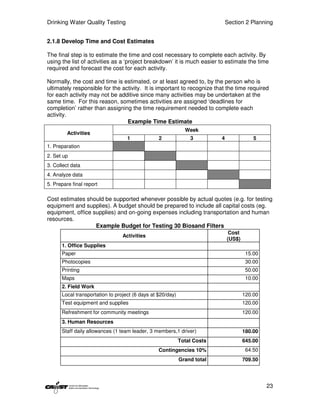
  • 105.
    Drinking Water QualityTesting Section 6 Testing for Microbiological Contamination Assignment: Self Assessment 1. What are the characteristics that a bacterial indicator should have? 2. a) What are thermotolerant coliforms? b) High quantities of E. coli will most probably indicate what? 3. List and describe the 3 main microbiological testing methods. 4. a) How do you interpret the result, if your E. coli test result shows 9 CFU/100 ml sample? b) How do you interpret the result if your E. coli test shows more than 100 CFU/100 ml sample? c) How do you interpret your test result if it shows turbidity at 10-20 NTUs and an E. coli level of 9 CFU/100 ml sample? Answers: Question 1 (See Section 6.4) Question 2a (See Section 6.4.2) Question 2b (See Section 6.4.3) Question 3 (See Section 6.5) Question 4 (See Section 6.6) 98
  • 106.
    Drinking Water QualityTesting Section 7 Interpreting Test Results 7 Interpreting Test Results Data interpretation allows you to learn from the water quality test results, helps you improve your sampling program, and is really the reason you collected the data in the first place. You will need to take a good look at the numbers and try to make sense of them to develop your final conclusions and recommendations. Besides providing a report of the analysis for given contaminants, most water testing laboratories or portable test kits provide little explanation of the test results. The information provided in this section will help you understand and interpret physical, chemical and biological test results. Although we have separated physical, chemical and biological tests, it is useful to compare the results to determine any correlations. There are three basic approaches for interpreting data generated from water quality tests: 1. The measured values of physical, chemical and biological contaminants can be compared to national water quality standards or the WHO Guidelines for Drinking Water Quality. 2. Data records can be reviewed to see how they change over time and location to identify any trends or correlations. 3. Scientific analysis can be done for academic purposes and scientific research. 99
  • 107.
    Drinking Water QualityTesting Section 7 Interpreting Test Results 7.1 Steps for Data Interpretation • Assemble data from the water quality 1. Collect data for analysis testing. • Enter the data in the suitable table, spreadsheet or database. 2. Check that data entered on the data recording forms are • Deal with “unusual readings”. i.e. if complete and accurate some results are unusual, it would be a good idea to re-test . For example, if number of E-coli is higher in the filtered water compared to inlet water, it would 3. Choose appropriate be good to retake samples on different statistical analysis days and times. • Data analyses methods should be 3.1 Trend 3.2 Compare 3.3 Scientific selected in advance, and there should analysis, data to analysis i.e. be sufficient data to run the analysis. changes in national technology space and standards or verification • Results should be recorded in a simple time WHO format. The end users have to be able Guidelines to understand the results. • Interpret the results so they are 4. Interpret data in relation to meaningful to the project objectives project objectives and situation of the local context. When generating results, keep in mind the quality control and reliability of the testing process. 5. Report results. Advise Community Health • Develop conclusions and Promoters and Product recommendations. Report the results. Manufacturers as necessary (Adapted from Canadian Council of Ministers of the Environment, 2006) 7.1.1 Collect Data Recording Forms Data recording forms are used to document your samples and test results. See Appendix 5 for an example data recording form. Many forms may be used, depending on how many samples are taken and the number of tests performed, so it is important to choose the correct forms for data entry. It is essential to collect all data forms and to verify the information and results for each day before preparing a database. 100
  • 108.
    Drinking Water QualityTesting Section 7 Interpreting Test Results 7.1.2 Check the Data Record Forms The data record forms need to be checked thoroughly to ensure that all information was recorded clearly and completely. If any data is missing or incomplete, another sample should be taken and/or the test should be repeated to get accurate and complete information. The most common errors are transcription mistakes, such as are incorrect positioning of the decimal point or recording data for a different sample. If there are any unusual test results, another sample should be taken and the test should be repeated. For example, if the results are far out of the expected or possible range, the test should be done again as there may be problems with equipment calibration, expired test strips or broths or the simply the data was not properly encoded. Refer back to Section 3 on quality control which explains how to limit such errors. 7.1.3 Choose an Appropriate Analysis The selection of data analysis and graphic presentation is based on the following types of testing. • Trend and Correlation Analysis Trend analysis shows how a physical, chemical or biological parameter changes with time and location. Graphing is an excellent way to display your data, and is very helpful when you are analyzing trends and correlations. There are many kinds of graphs, and you are encouraged to be creative in finding different ways of looking at data. Time-history graphs can illustrate changes in water quality over a period of time (i.e. in hours, days, months, or years). For example, the following graph shows that average E.coli numbers were gradually reducing till May and is increasing trend on June and onward. Average Number of E. coli 60 50 40 30 20 10 0 Jan-08 Feb-08 Mar-08 Apr-08 May-08 Jun-08 Jul-08 Aug-08 101
  • 109.
    Drinking Water QualityTesting Section 7 Interpreting Test Results A spatial graph can be used to show how water quality varies according to the sampling locations. The following graph shows that the source water and transfer bucket water both have E. coli contamination, but the transfer bucket water has higher levels, probably due to secondary contamination. The filtered water is good in terms of water quality; however the results show that there is a recontamination problem in the storage water. Risk of Water Contamination 250 Average E.coli per Sample Point 202 200 150 98 100 50 23 1 0 Source water Transfer Bucket Filter Spout Storage (n=107) (n=87) (n=107) (n=106) Sample Points (Duke et al., 2006) A correlation graph can be used to see if there is a relationship between two different parameters. For example, the following graph shows the correlation between E. coli counts and turbidity in a river. The graph shows that the higher the turbidity, the higher the levels of E. coli in the water. 102
  • 110.
    Drinking Water QualityTesting Section 7 Interpreting Test Results • Comparison Analysis A comparison analysis is usually carried out to determine the existing situation compared with national standards or WHO Guidelines. This type of analysis is useful to compare the effectiveness of technology between different locations or user groups, such as high, medium and low-income households. • Scientific Analysis Scientific analysis can be done for academic purposes and scientific research. Water testing processes should be very comprehensive with a high number of tests that are repeated more than once. The results should be verified by statistical inferences such as confidence level, standard of error and t-test. This type of analysis focuses on high precision in the methodology. The method of data analyses should be selected in advance to get a sufficient number of test results for the statistical analysis. In general 30 units (e.g. 30 filters, 30 households) are necessary for a statistical analysis. The type of statistical analysis should meet the needs of the audience who will be reviewing the results. If a water quality test is carried out upon the request of end users, statistical analysis should be simple and the results should be self explanatory. Statistical measures including percentage, frequency and average are better understood and can be graphed. Software is available to process numerical data and perform statistical tests. Spreadsheets, such as Microsoft Excel, can also have powerful graphical and statistical capability. 7.1.4 Interpret Data in Relation to the Objectives The objectives of the project and the water quality testing program need to be kept in mind when you are interpreting your test results. Different objectives will result in different interpretations of the data. The following are some examples of objectives for water quality testing: • Assess the effectiveness of a HWT technology in reducing turbidity and bacteria • Assess the concentration of arsenic and fluoride in the source and treated water • Assess the effectiveness of a HWT technology in the removal of physical, biological and chemical contaminants to prepare policy guidelines • Assess the effectiveness of a HWT technology in the removal of chemical contaminants to prepare national guidelines for drinking water quality Project implementers often carry out water quality testing to bring awareness in the community about the difference between contaminated water and treated water. In such situations, results may be presented immediately to the community without complete interpretation of the overall data. This situation can sometimes backfire if you generate a negative test result in front of the community without the ability to explain the result or perform any quality control to verify the test. This can easily create a negative impression about the project implementation and should be avoided if possible. If it is necessary to distribute early results, it is important to emphasize that they are incomplete and full results will be available after the data has been interpreted. 103
  • 111.
    Drinking Water QualityTesting Section 7 Interpreting Test Results 7.1.5 Report the Results The primary purpose of a report is to share your results, conclusions and recommendations to an audience. This information should be assembled in a well organized and easy to read format. It is particularly important to include graphs and tables to help make the report easy to understand. Reports should be made as early as possible so that corrective actions can be taken to ensure safe drinking water. It is also important to share the results with the users so that they are aware of how to operate their HWT technology properly. Reporting the results also gives feedback to improve the project implementation. Important Note: As drinking water quality is a sensitive topic, simply providing the testing results without guidance and interpretation could lead to dangerous misinterpretations and inappropriate action or inaction (especially if the report is disseminated outside of the organisation). Water quality testing can be a great mobilisation tool as long as the results are interpreted and presented properly. Appendix 7 gives an example of a water quality testing report. 7.2 Interpreting Laboratory Reports If you send your water to a laboratory for testing, they will send you’re a report with the results. Most laboratories provide little additional explanation of test results beyond the units used or possibly a footnote in the event that a problem is identified. A laboratory report will normally contain a table of possible contaminants and physical characteristics for which your sample was tested, and the measured concentration of each. If you have any problems understanding the way information is presented on the laboratory report, you should contact the testing laboratory directly for explanation. 104
  • 112.
    Drinking Water QualityTesting Section 7 Interpreting Test Results Northeast Environmental Laboratory Inc. (nd) 105
  • 113.
    Drinking Water QualityTesting Section 7 Interpreting Test Results 7.3 Summary of Key Points • There are three basic approaches for interpreting data generated from water quality tests: 1. The measured values of physical, chemical and biological contaminants can be compared to national water quality standards or the WHO Guidelines for Drinking Water Quality. 2. Data records can be reviewed to see how they change over time and location to identify any trends or correlations. 3. Scientific analysis can be done for academic purposes and scientific research. • The following are the general steps for data interpretation: o Collect data recording forms o Check the data recording forms o Choose an appropriate analysis o Interpret data in relation to the objectives o Report the results • When producing a water quality testing report, be sure to consider: o The objectives of the testing o The audience for the report o The clarity of the report and interpretation of the results 106
  • 114.
    Drinking Water QualityTesting Section 7 Interpreting Test Results 7.4 References Baker D.L. and W. F. Duke (2006).Intermittent Slow Sand Filters for Household Use -A Field Study in Haiti, IWA Publishing, London, UK. Bartram J. and R. Balance (edited) (1996). Water Quality Monitoring: A Practical Guide to the Design and Implementation of Freshwater Quality Studies and Monitoring Programmes, Published on behalf of United Nations Environment Programme and the World Health Organization and UNDP. Available at: www.who.int/water_sanitation_health/resourcesquality/wqmonitor/en/ Bauman, E.R. 1962. Should Small Water Supplies be Superchlorinated?, Part II. Water and Sewage Works. (1):21-24. Canadian Council of Ministers of the Environment, A Water Quality Task Group (2006). A Canada-wide Framework for Water Quality Monitoring. Available at: www.ccme.ca/assets/pdf/wqm_framework_1.0_e_web.pdf Water Quality Standards and Interpretation (nd). Available at: http://co.laplata.co.us/water_well_web/Standards.pdf 107
  • 115.
    Drinking Water QualityTesting Appendix 1 Equipment and Materials Equipment and Materials A. PRODUCT INFORMATION SHEETS ......................................................................................... 2 1. Field Kits ................................................................................................................ 2 1.1. Wagtech Potatest and Oxfam-Delagua Kits ..................................................... 2 2. Microbiological testing.......................................................................................... 3 2.1. Membrane filtration .......................................................................................... 3 2.1.1. ColiQuant MF ......................................................................................................... 3 2.1.2. Filter Units .............................................................................................................. 4 2.1.3. Membrane Filters, Absorbent pads ........................................................................ 5 2.1.4. Petri Dishes ............................................................................................................ 6 2.2. Incubation ........................................................................................................ 8 2.2.1. Semi-portable incubators ....................................................................................... 8 2.3. Culture media (broths and agars) for membrane filtration ................................ 9 2.4. Presence-Absence (P-A) and Most Probable Number (MPN) ........................ 10 2.4.1. P-A H2S Tests ...................................................................................................... 10 2.4.2. More specific P-A tests ........................................................................................ 11 2.5. Other Test Methods ....................................................................................... 12 2.5.1. 3M Petrifilm .......................................................................................................... 12 2.6. Sampling........................................................................................................ 13 2.6.1. 13-oz. Whirl-Pak® Bags....................................................................................... 13 3. Chemical and Physical testing ............................................................................... 14 2.7. Test strips ...................................................................................................... 14 2.8. Colorimeters and Photometers....................................................................... 15 2.8.1. Wagtech Color comparator kit.............................................................................. 15 2.8.2. Hach Colorimeter DR/850 .................................................................................... 17 2.9. Parameter specific test kits ............................................................................ 18 2.9.1. Arsenic ................................................................................................................. 18 2.9.2. Fluoride ................................................................................................................ 20 2.9.3. Chlorine & pH ....................................................................................................... 21 B. COST OF EQUIPMENT AND CONSUMABLES ...................................................................... 22 C. SUPPLIER CONTACT INFORMATION .................................................................................... 24 A1-1
  • 116.
    Drinking Water QualityTesting Appendix 1 Equipment and Materials A. Product Information Sheets 1. Field Kits 1.1. Wagtech Potatest and Oxfam-Delagua Kits Wagtech Potatest Kit Oxfam DelAgua Kit Wagtech International Wagtech Court Robens Centre for Public and Station Road Thatcham Berkshire Environmental Health - University of Surrey RG19 4HZ - United Kingdom Guildford, GU2 5XH - United Kingdom Tel +44 (0) 1635 872929 Tel: +44 (0) 1483 689 209 export@wagtech.co.uk Fax: +44 (0) 1483 689 971 www.wagtech.co.uk sales@delagua.org www.delagua.org Test type: • E. coli, total coliforms using membrane filtration • Multiple physical and chemical parameters including pH, turbidity, chlorine • Flexible chemical testing options: comparator allows further testing of over 30 chemical parameters if required (Wagtech only). Cost: ~ US$2300-2500 Necessary Equipment: • Pressure cooker or portable sterilizer or access to an autoclave (e.g. in a hospital) • Methanol (approx 2 ml per test) • Distilled water • 1 litre measuring cylinder or beaker • Lighter Summary: The kit is designed for use in the field, but may also be used in a laboratory or other permanent location. The kit can be supplied with a range of accessories that will increase the scope of water quality monitoring programmes. Operating instructions detail all the necessary procedures for a complete bacteriological analysis. A1-2
  • 117.
    Drinking Water QualityTesting Appendix 1 Equipment and Materials 2. Microbiological Testing 2.1. Membrane filtration Also see 1.1 Wagtech Potatest and Delagua Kits which provide membrane filtration 2.1.1. ColiQuant MF Product Name: ColiQuant MF Test type: • E. coli (fecal coliform) and enterobacter (non-fecal coliform) using membrane filtration Cost: 20 tests - $211.50 (~ $10.60 each), refill 20 tests - $148.50 (~ $7.43 each) Necessary Equipment: • Incubator • Filter apparatus, broth, filter paper, pad, calibrated dropper (included) • Bleach (for disposal) • Alcohol • Sterile dilution water (if needed) • Permanent marker Summary: This product uses a Coliscan broth and is designed for the membrane filtration procedure. Colour charts are included to make the interpretation easier and the manual provides a variety of useful information. Notes: • Filter apparatus, filter papers and pads are included • Filter papers and filter pads are reusable (microwave for 2 minutes ) • Slow ordering process (approx. 8 weeks to arrive) • Disinfection of the apparatus is done with alcohol wipes (not by burning methanol) which may leave some contamination • Expensive Manufacturer Information: Distributors: Micrology Laboratories L.L.C. ww.lamotte.com (USA) info@micrologylabs.com www.anachemia.com (North America) www.micrologylabs.com www.prolabmas.co.id (Indonesia) A1-3
  • 118.
    Drinking Water QualityTesting Appendix 1 Equipment and Materials 2.1.2. Filter Units Nalgene Analytical Filter Units Wagtech Filters Holders NALGENE Labware Wagtech International Ltd Wagtech www.nalgenelabware.com Court Station Road Thatcham Berkshire RG19 4HZ International United Kingdom Tel: +1 585-899-7198 E-mail: intl@nalgenunc.com Tel: +44 (0) 1635 872929 Fax: +1 585-899-7195 Fax: +44 (0) 1635 862898 North America E-mail: export@wagtech.co.uk Tel: 1-800-625-4327 E-mail: Website: www.wagtech.co.uk nnitech@nalgenunc.com Fax: 585-586-8987 Europe Tel: +44 (0) 5602 750996 E-mail: vibeke.rowell@thermofisher.com Fax: +45 4631 2099 Test type: Membrane filtration Cost: ~ US$7 each (Nalgene) Necessary Equipment: • Membrane filters • Plastic vacuum pump Summary: • For use with 47 mm membranes A1-4
  • 119.
    Drinking Water QualityTesting Appendix 1 Equipment and Materials 2.1.3. Membrane Filters, Absorbent pads Membrane filters Absorbent pads • Individually wrapped • Absorbent pads are required when • Sometimes sold with absorbent pads using liquid broths (not Agars). • Also known as cellulose nitrate filters • They can be purchased: or mix cellulose ester filters. o in plastic Petri dishes already • The most common size is 45mm impregnated with dehydrated diameter (fits in standard filtration broth or plain equipment, such as Wagtech Potest, o with membrane filters Delagua Kits and Plastic filtration o separately (usually sold with a units) and pore size 0.45 µm for dispenser) typical bacteriological testing of total and fecal coliforms. • Best to use white/gridded membrane filters for drinking water quality testing Test type: Membrane filtration Cost: • Absorbent Pads and Membranes, ~ US$0.4 - $1 per pad and membrane o Pack of 200, US$80 (Wagtech, UK) o Pack of 100, US$112 (Millipore, USA) • Membranes filters, Pack of 600, US$246 (Millipore, USA) • Absorbent Pads, Pack of 30, ~US$7 Necessary Equipment: • Filters holder Contact Information: There are many suppliers of membrane filters and absorbent pads. The most commonly known is Millipore (www.millipore.com) based in USA and Whatman (www.whatman.com) based in the UK, both with regional offices and distributors A1-5
  • 120.
    Drinking Water QualityTesting Appendix 1 Equipment and Materials 2.1.4. Petri Dishes Disposable (polystyrene) Disposable (polystyrene) Aluminum re-usable Petri pre-sterilized Petri dishes pre-sterilized Petri dishes. To dishes. Require sterilization with absorbent pads. be used with agars or liquid before each use, and broths (require absorbent absorbent pads. For liquid See nutrient pads (above) pads) broths. Not usually suitable which also contain for agars. dehydrated culture media on the pad) Petri dishes come in various types: • Plastic (polystyrene, polypropylene) or aluminum • Re-usable (usually the polypropylene and aluminum) or disposable (polystyrene) • Some are sold with absorbent pads for direct use with liquid broths (nutrient media) or are already impregnated with dehydrated liquid media. Do not to reuse the polystyrene Petri dishes. Test type: Membrane filtration Cost: US$0.25-0.55 per dish (plastic), ~ US$2.70 per dish (aluminum) Necessary Equipment: • Sterilizer (for the re-usable dishes) • Marker Summary: • Widely used in microbiology, the standard-size polystyrene Petri dishes are presterilized • The plastic ones are generally stackable for ease of use. • Plastic dishes (50 to 55mm diameter by 9 to 12 mm height) tend to be taller than the aluminum ones (50mm diameter by 8mm height) Contact Information: There are many suppliers worldwide for plastic Petri dishes. Re-usable (aluminum) Petri dishes are more difficult to obtain. Try Wagtech and Delagua (see Section 1Field Kits). A1-6
  • 121.
    Drinking Water QualityTesting Appendix 1 Equipment and Materials A1-7
  • 122.
    Drinking Water QualityTesting Appendix 1 Equipment and Materials 2.2. Incubation 2.2.1. Semi-portable incubators Wagtech Hova-Bator Egg Incubator Hach Portable Incubator Portable Incubator Cost: ~US$50 Cost: Email Wagtech Cost: ~ US$1000 Benefits: Benefits: Benefits: • Very economical • Rechargeable (battery • Battery pack optional – • Easy to use. operated) + US$200) • Large incubation space • 2 temperature settings • Plugs in cigarette (~ 40 Petri dishes) • Maintains temperature lighter within ± 0.5°C • Variable temperature Limitations: settings (30 – 50° C) • No thermostat Limitations: • Maintains temperature • Air flow can dry up Petri • Limited incubation within ± 0.5°C dishes space (16 aluminum/10 • Large incubation area • Require calibration plastic Petri dishes) (~ 40 Petri dishes) check before each use • Will not work with (Supplied with the Wagtech Limitations: sensitive culture media Potatest Field Kit) • More expensive www.gqfmfg.com www.hach.com For international suppliers For international suppliers (Middle East, Brazil, Chile, see www.hach-lange.com Europe, Australia) see www.gqfmfg.com/store/inter national.asp A1-8
  • 123.
    Drinking Water QualityTesting Appendix 1 Equipment and Materials 2.3. Culture media (broths and agars) for membrane filtration Summary: • Culture media can come in different forms: o Dehydrated media in powder form o Prepared media broths in glass or plastic bottles (20 to 100 ml) or 2 ml ampoules o Pre-poured agar plates o Nutrient Pad Sets (Petri dishes with pre-impregnated dehydrated pads) Refer to Appendix 8 Culture Media for more detailed information on the products Suitable for Culture Media Type Indicators* Form / Container Notes Cost TC FC E. coli m-Lauryl sulphate Broth X X • Powder (38.1g • Most ~ US$100 for 38.1g (MLSB) Nutri-Pad or 500g) economical tub (250 tests) • Dehydrated broth ~ US$75 for 500g pads • More difficult to tub (3280 tests) read US$0.4/test m-Endo Broth X X • Powder, ~ US$57 for 50pk of Agar Dehydrated 2mL ampoules Nutri-Pad pads (HACH) $1.15/test • Prepared (2 ml ~ US$60 for 100mL ampoules, 100 bottle (Anachemia) ml bottles) $1.2/test • Agar plates ~ US$10/agar plate (Anachemia) m-FC Broth X • Powder ~ US$20 for 20pk of Agar • Dehydrated 2mL ampoules Nutri-Pad pads (HACH) $1 per test • Ampoules (2 ml) (Same prices as m- Endo from Anachemia) Modified m-TEC Agar X • Powder ~US$65 for 15pk • Prepoured agar agar plates (HACH), plates $4.30/test m-ColiBlue24 Broth X • Prepare (2 ml • Easy to read ~US$50 for 100mL Agar ampoules, 100 bottle (50 tests) ml glass bottle) ~US$35 for 20pk • Agar plates glass ampoules US$1.0-1.5/test Coliscan MF Broth X X • Liquid (20 ml • Easy to read ~ US$10 for one Agar plastic bottles) – bottle (20 tests) frozen $0.5/test * TC – Total Coliforms, FC – Thermotolerant (Fecal) coliforms, A1-9
  • 124.
    Drinking Water QualityTesting Appendix 1 Equipment and Materials 2.4. Presence-Absence (P-A) and Most Probable Number (MPN) 2.4.1. P-A H2S Tests ENPHO Coliform Presence-Absence Test HACH Pathoscreen Cost: Rs45.00 per bottle ( ~ US$0.40/test) Cost: • US$38 for the kit (100 tests) ~ US$0.4/test Contact Information: Includes 100 reagent pillows, 100 sterile 20 ml sample bottles and case. ENPHO • Extra 50 pillows for 100mL tests ~ US$40 110/25 Adarsa Marga-1, Thapagaon, • Extra 50 pillows for 20mL tests ~ US$30 New Baneshwor (both extras require purchase of sterile Email: enpho@mail.com.np bottles) Contact Information: HACH www.hach.com With various distributors worldwide http://www.hach.com/global-distributor- support Test type: Fecal coliform (H2S producing bacteria) Necessary Equipment: • Incubator • Permanent marker Summary: Coliform presence/absence test kit is used to detect the bacterial contamination of drinking water. Can also be used in MPN format (5 to 10 bottles per test). Test can take up to 48 hours to complete. Notes: • Easy to use and to read • Will turn positive for all H2S producing bacteria which produce within 24 hours • Positive reactions within 1 hour of incubation may come from sulphide rich water (false positive) • Avoid using with groundwater as high possibility of naturally occurring sulphides A1-10
  • 125.
    Drinking Water QualityTesting Appendix 1 Equipment and Materials 2.4.2. More specific P-A tests IDEXX Colilert HACH Presence-Absence Test type: Coliforms and E. coli (presence/ Test type: Coliforms and E. coli (presence/ absence) absence) Cost: package of 20 tests- US$186 (~$9.30 Cost: package of 50 tests - US$192 (~$3.84 each). This price includes shrink band each) containers which are usually purchased separately. Incubation: 24-48 hours at 35 oC Colilert reagent for 100 ml tests costs US$5.4/reagent (US$1080 for a pack of 200) Contact Information: Containers of 120 ml costs HACH US$0.80/container (US$205 for 200) www.hach.com Incubation: 24 hours at 35 oC Contact Information: IDEXX Tel: 1-800-321-0207 Website: www.idexx.com/water Summary: The water sample is poured in a 20 ml or 100 ml sterile container, the reagent (powder) is then poured (IDEXX) or already contained in the vessel (HACH). These tests detect 1 CFU/ 100 ml. A positive coliform result will show a colour change from clear to yellow, and a positive E. coli result will show fluorescence under a UV long wavelength lamp. IDEXX and HACH w/ MUG P-A tests use the MUG reagent which produces a fluorogenic product (fluorescent) when it reacts with an enzyme specific to E. coli. Necessary Equipment: Notes: • Incubator • Easy to use • UV long wavelength lamp • More specific than H2S tests • Graduated cylinder • Significant amount of waste generated • Bleach (for disposal) • Comparator colour guide • Permanent marker A1-11
  • 126.
    Drinking Water QualityTesting Appendix 1 Equipment and Materials 2.5. Other Test Methods 2.5.1. 3M Petrifilm Product Name: Petrifilm Test type: E. coli, total coliforms. Petrifilms are also available for a variety of other contaminants. Cost: • 50 plates – $100 (~ $2 each) • 500 plates – $736.00 (~ $1.50 each) Necessary Equipment: • Pipette or calibrated dropper • Incubator • Bleach (for disposal) • Permanent marker • Filter apparatus and filter paper (optional) Summary: There are two procedures for water testing using Petrifilm, but neither are approved international methods. The first procedure recommends the water be filtered through a cellulose acetate filter and the filter be placed on the Petrifilm. This would allow a 100 ml sample to be tested. The filter paper is not included. For this procedure the gel needs to be prepared ahead of time adding a few extra hours on to the procedure time. If the water sample was really contaminated it could be a challenge to count all the bacteria colonies and the sample may have to be diluted. The second procedure (used by Robert Metcalf) tests a 1 ml sample by placing the sample directly on the Petrifilm. This procedure does not require that the gel be prepared ahead of time. The challenge with this procedure is that sample size is very small and discrepancy is very likely. With any sample larger than 1 ml the water leaks off the film. Notes: • Not an approved international test method • Easy to use and to easy to transport (light and small) • No filtering apparatus required • Broth is non-toxic, can incubate with body heat Contact Information: For suppliers: www.3m.com For specific product information: www.3m.com/product/information/Petrifilm-Plate.html A1-12
  • 127.
    Drinking Water QualityTesting Appendix 1 Equipment and Materials 2.6. Sampling 2.6.1. 13-oz. Whirl-Pak® Bags Product Name: 13-oz. Whirl-Pak® Bags Test type: Sampling Cost: 10 - 19: $63.29; 20 - 49: $60.71; 50 or more: $58.04 Necessary Equipment: • Permanent marker Summary: The 384 ml capacity is measured when the bag is closed and tab is folded over three times. Volume and dimensions are approximate; bags should not be used at temperatures above 82° C. Bags can be frozen to any temperature – careful handling required after freezing. All bags are sterilized after manufacturing. Notes: • Easy to use and transport Contact Information: www.enasco.com/whirlpak A1-13
  • 128.
    Drinking Water QualityTesting Appendix 1 Equipment and Materials 3. Chemical and Physical Testing 2.7. Test strips HACH Macherey-Nagel EMD Range (Steps) Price Range Price Steps Price 0-425ppm (0, Total 25, 50, 120, (see website) 0, 85, 170, 270, US$50/100 tests Hardness 250, 425 XX/50 tests 360, 430 ppm ppm) Total Dissolved XX/25 tests Iron 0-50ppm (0, 0, 10, 25, 50, 100, 1, 2, 5, 10, US$60/100 tests 250, 500mg/L Nitrate 20, 50 ppm) XX/25 tests Nitrate and 0-4ppm (0, 0, 0.1, 0.3, 0.6, 1, Nitrite 0.15, 0.3, 1, 0, 1, 5, 10, 20, £23.94/100 US$56/100 tests 2, 3 g/L Nitrite 1.5, 3 ppm) 40, 80mg/l tests 0, 0.1, 0.3, 0.6, £23.94/100 0, 2, 5, 10, 20, 40, US$56/100 tests 1, 2, 3mg/l tests 80 ppm 0-10ppm (0, Free & 0.5, 1.0, 2.0, 0, 0.5, 1, 2, 5, 10, Total XX/50 tests US$100/75 tests 4.0, 10.0 0, 1, 3, 10, 30, £50.17/100 20 ppm Chlorine ppm) 100mg/l tests Free Chlorine 5 in 1 Total Chlorine Water Total Hardness XX/50 tests Quality Test Total Alkalinity pH 0, 500, 1000, 0, 500, 1000, 10-20 ppm XX/40 tests 1500, £28.80/100 1500, 2000, 3000 US$50/100 tests Chloride increments 2000>3000mg/l tests ppm 100-200 ppm XX/40 tests increments 0-240ppm (0, Total 40, 80, 120, XX/50 tests alkalinity 180, 240 ppm) 4-9 pH (4, 5, 0, 1, 2, 3, 4, 5, 6, 7, 8, 9 pH XX/50 tests 6, 7, 8, 9 pH £10.06/100 Various options US$95/600 tests pH Units) Units tests XX/100 tests 0-6ppm (0, Amonia 0.25, 0.5, 1, XX/25 tests 3, 6 ppm) 0, 5, 20, 50, £39.50/100 0, 10, 25, 50, 100, Aluminium US$90/100 tests 200, 500mg/l tests 250 ppm 0, 10, 25, 50, 0, 10, 30, 60, 100, Ammonium 100, 200, £40.58/100 US$70/100 tests 200, 400 ppm 400mg/l tests 0, 3, 10, 25, 50, £36.11/100 10, 25, 50, 100, US$100/100 Phosphate 100mg/l tests 250, 500 ppm tests 0, 2, 5, 10, 20, £68.71/30 Fluoride 50, 100mg/L F, tests Refer to manufacturer’s websites for more choice and information (www.hach.com, www.macherey-nagel.com, www.emdchemicals.com). There are also many other manufacturers of test strips. A1-14
  • 129.
    Drinking Water QualityTesting Appendix 1 Equipment and Materials 2.8. Colorimeters and Photometers 2.8.1. Wagtech Color comparator kit Product Name: Wagtech Color Comparator kits Test type: See table below Cost: • ~US$155 for the kit • ~US$75 for each colour disc (one for each chemical parameter) • Reagents vary between US$90 to $120 for 250 tests (US$0.40-0.50 per test) Necessary Equipment: • Colour discs • Comparator reagents • Distilled water (if necessary) Summary: The colour comparator is quick and easy to use and gives accurate reliable results. The kit is used in conjunction with tablet reagents and colour charts to test 32 different parameters. Just add a tablet reagent to the test sample, place the tube in the comparator and match the colour against the appropriate colour disc. The kit includes: comparator, 4 square cuvettes and dilution tube. The kit contains no reagents or discs these should be ordered separately. A1-15
  • 130.
    Drinking Water QualityTesting Appendix 1 Equipment and Materials Colour discs Comparator Reagents Notes: • Easy to use and to easy to transport (light and small) • Relatively precise results. Contact Information: Wagtech International Wagtech Court Station Road Thatcham Berkshire RG19 4HZ United Kingdom Tel +44 (0) 1635 872929 export@wagtech.co.uk www.wagtech.co.uk A1-16
  • 131.
    Drinking Water QualityTesting Appendix 1 Equipment and Materials 2.8.2. Hach Colorimeter DR/850 Product Name: Hach Colorimeter DR/820 (20+ methods) or DR/850 (50+ methods) Cost: • ~US$720 (DR/820) • ~US$920 (DR/850) Test Type: acid, chromium 1, chromium 2, cyanide 3,4 and 5, total and free chlorine, fluoride, nitrate, lead, iron, manganese, Necessary Equipment: • Reagents Summary: The colorimeter is expensive and the reagents vary in cost. The procedure has a high accuracy and the results can be obtained immediately. The main advantage of the DR/850 over the DR/820 is it can test for Fluoride and Phosphorus. Contact Information: www.hach.com/dr800series A1-17
  • 132.
    Drinking Water QualityTesting Appendix 1 Equipment and Materials 2.9. Parameter specific test kits 2.9.1. Arsenic There are many arsenic kits available. Most are based on the Gutzeit Method which results in the production of arsine gas which reacts with mercuric bromide impregnated on test paper resulting in colour change. Wagtech Digital Arsenator HACH Arsenic Test Kit ENPHO Arsenic Kit Cost: US$700 (420 tests), Cost: US$123 (100 tests), Cost: ~Rs.6000.00 ($75) for $1.70/test $1.20/test 50 tests ($1.50/test) Summary: The Digital Summary: The HACH Arsenic Summary: ENPHO has Arsenator uses an optical test kit is similar to the developed a semi-quantitative photometer to digitally Wagtech Visual Arsenic low cost field test kit for testing measure the colour change on Detection kit. untreated ground water, like mercuric bromide filter paper, tube-well. The salient features and it’s portable. It detects Contact Information: of the kit are easy to test, arsenic within a reported range www.hach.com portable and rapid. Once the of 2-100 µg/L. The Arsenator reagents are finished they can is significantly more expensive be refilled. If the concentration than manual colour of arsenic in the water is comparison kits, but is more higher than 150 µg/L it is accurate and precise. The better to dilute the sample with complete system comes with distilled water, for better sufficient reagents and results. Range: 10 µg/L – 500 consumables for 420 tests. µg/L. Contact Information: Contact Information: Wagtech International ENPHO Wagtech Court 110/25 Adarsa Marga-1, Station Road Thatcham Thapagaon, New Baneshwor Berkshire, RG19 4HZ, UK Nepal Tel +44 (0) 1635 872929 Email: enpho@mail.com.np export@wagtech.co.uk www.wagtech.co.uk A1-18
  • 133.
    Drinking Water QualityTesting Appendix 1 Equipment and Materials Other Commercially Available Arsenic Test Kits* • Acustrip Inc. ( www.acustrip.com ) markets five different arsenic test kits. The main product, the Arsenic Check test (#481396) has a range of 5-500 µg/L, while the lowerpriced, less sensitive version (#481298) has a range of 10-1000 µg/L. The company also markets a low-range kit (#481297) with a range of 2-160 µg/L and two “individual” kits for household use. The Acustrip kits have a reported reaction time of only 12 minutes. • The Asia Arsenic Network ( www.asia-arsenic.net ), an early player in arsenic testing and kit development, continues to market an inexpensive kit with a range of 20-700 µg/L in Bangladesh (through NIPSOM – National Institute of Preventative and Social Medicine – www.nipsom.org ) and Nepal (through ENPHO - Environment and Public Health Organization, www.enpho.org). Kit specifications are available online. • Merck ( www.merck-chemicals.com ) has produced arsenic test kits for many years. Currently the company markets two colorimetric (colour chart) kits: the standard Merckoquant arsenic test kit (#117917) with a reported detection range of 20-3000 µg/L and the newer more sensitive kit (#117927) with a reported detection range of 5- 500 µg/L. Merck has also released a new digital optical photometer Spectroquant arsenic kit (#101747) with a reported range of 1-100 µg/L. This kit is used with Merck’s photometers to digitally measure colour results for better accuracy and precision. These photometers are typically used in a laboratory setting, but one model, the Nova 60A (# 1.09751.0001) comes with a battery pack and can be used as a “portable field station” (although it is much larger and heavier than the arsenator, below). • A joint project between UNICEF and the Rajiv Gandhi National Drinking Water Mission in India has developed specifications for a field kit that does not use the conventional mercuric-bromide paper. Instead, a detector tube is filled with a granular media coated with a secondary colour reagent that reacts with arsenic and mercuric bromide to produce a pink colour. Following completion of the test, arsenic concentration (10-110 µg/L) is read directly by measuring the extent of pink colour penetration in the detector tube. Specifications for the kit are available from the Rural Water Supply Network (RWSN) • UNICEF also supported the development of locally manufactured arsenic test kits in China, Thailand and Vietnam, and the former two are still in use. The Thai kit, developed and marketed by Mahidol University ( www.mahidol.ac.th ), has a detection range of 10-110 µg/L and is used both in Thailand and in other countries in the region. * This list does not include all available kits, and it also does not constitute an endorsement of the companies or products that are listed. Modified Extract from UNICEF Handbook on Water Quality, 2008 Available at: www.unicef.org/wes/files/WQ_Handbook_final_signed_16_April_2008.pdf A1-19
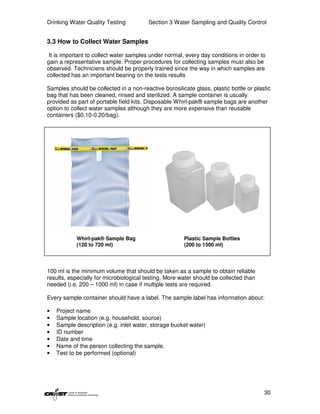
  • 134.
    Drinking Water QualityTesting Appendix 1 Equipment and Materials 2.9.2. Fluoride Fluoride, Pocket Colorimeter II Test Kit Product Name: Hach Fluoride Colorimeter II Cost: ~US$385 Test type: Fluoride Necessary Equipment: • Reagents Summary: Range 0.1 to 2 mg/L, with SPADNS Fluoride AccuVac reagent set (50 tests). Two precalibrated curves provided for using SPADNS Fluoride AccuVacs or SPADNS Fluoride Solution (order separately, Cat. No. 444-49). Software allows for data logging and calibration slope adjustment. Note: If you will be testing for other chemical parameters too, the HACH DR/850 may be more suitable as it tests for fluoride as well. Contact Information: HACH (USA) www.hach.com A1-20
  • 135.
    Drinking Water QualityTesting Appendix 1 Equipment and Materials 2.9.3. Chlorine & pH Chlorine ‘Pool’ Tester - Free residual and Total Chlorine Product Name: Pooltester – Residual and Total Chlorine, pH Cost: US$10-15 (for 20 tests), DPD (Chlorine) and Phenol Red (pH) reagents (tablets) cost between $0.10 and $0.50 per tablet. Test type: Free Residual Chlorine (DPD1), Total chlorine (DPD3), pH (Phenol Red) Summary: The most economical method to test for residual chlorine, total chlorine and pH. Notes: Any standard pool tester should work. Make sure the ranges are sensitive enough between 0.1 mg/L and 1.0 mg/L (for example steps should be 0.1, 0.2, 0.3, 0.4, 0.5, etc.) when you wish to test for residual chlorine (which is ideally between 0.2 and 0.5 mg/L). The DPD tablets are designed for a specific volume of water (usually 10mL). Check instructions. A1-21
  • 136.
    Drinking Water QualityTesting Appendix 1 Equipment and Materials B. Cost of Equipment and Consumables Cost Company Equipment and Materials (2008 US$) Hach Biological Test Kits Company, Hach MEL/MPN Total Coliform and E. coli 3092.70 USA Biological Reagents Replacement Apparatus Set for 50 samples 111.80 Buffered dilution water (pk/25) 105.85 Lauryl Tryptose w/MUG broth tubes, pk/15 50.00 m-ColiBlue24 media set for 50 tests 151.20 Absorbent pads and Membranes, Pack of 200 80.00 Chemical Test Kits CEL/850 Basic Drinking Water Lab 3377.45 Replacement agents 645.35 Chemical Test Strips Ammonia 925 tests) 41.70 Alkalinity (50 tests) 19.35 Arsenic low range (100) 272.30 Chloride (30-600ppm) 25.0 Copper (25 tests) 41.70 Chlorine, hardness, alkalinity and pH (50 tests) 30.65 Hardness (50 tests) 19.35 Iron (25 tests) 41.70 Nitrate and Nitrite (25 tests) 41.70 pH (50 tests) 25.00 Phosphorous (50 tests) 41.70 Wagtech Biological Test Kits o International, WagTech JMP Kit includes switch able between 37 and 44 2500.00 UK C incubator, materials for 200 faecal coliform tests, turbidimeter, Conductivity meter, Wagtech photometer kit which allows the measurement of 400 different chemical parameters including Ammonia, Aluminium, Manganese, Iron, Fluoride and Nitrate. Biological Test Reagents m-ColiBlue24 media set for 50 tests 151.20 100 ml bottle for 50 tests 78.90 Membrane Laurel Sulphate Broth 38.1g to the 500mL 102.0 Absorbent Pads and Membranes, Pack of 200 80.00 Chemical Test Kits Wagtech Digital Arsenator a portable instrument kit to 650.00 measure low levels of arsenic in drinking water. Measures within the range 2 - 100 ppm arsenic. Includes materials for 420 tests. WagTech 7100-Portable Photometer 1,031.00 WagTech 10195 Comparator Kit 155.00 Comparator Discs for per chemical 75.00 Chemical Test Reagents Ammonia (250 tests) 70.00 Chlorine free and total (250 tests) 42.00 Fluoride (250 tests) 100.00 A1-22
  • 137.
    Drinking Water QualityTesting Appendix 1 Equipment and Materials Cost Company Equipment and Materials (2008 US$) Iron (250 tests) 110.00 Manganese (250 tests) 84.00 Nitrate (250 tests) 122.00 Phosphate (250 tests) 116.00 University of Biological Test Kit Surrey, UK Oxfam DelAgua Portable Test Kit includes material for 200 3500.00 faecal coliform tests, chlorine test apparatus and turbidimeter Biological Test Reagents Membrane Laurel Sulphate Broth 38.1g to the 500mL (for 102.00 250 tests) Absorbent Pads and Membranes, Pack of 200 80.00 The following methods are not recognized widely but you can use for your own validation: ENPHO, Chemical Test Kit Nepal ENPHO-Nepal Arsenic Kit including 50 tests 100.000 ENPHO Field Kit including testing reagents for 10 chemical 250.00 parameters (100 tests) Micrology Biological Test Kit Laboratories, Coliscan Kit is available, and includes materials for 100 187.00 USA tests, including Coliscan MF medium, 100 membrane filters (47 mm), 100 dishes with absorbent pad, instruction page, and a colony color guide Plastic Filter Apparatus 8.00 Filter support Pad for 10 pcs 23.00 Graduated Cylinder (100 mL) from Uniscience Lab, 3.00 Pipettes 3 mL (500 pcs) 30.00 Wash Bottles 250 mL 3.50 Portable Egg Incubator Hova Bator (G.Q.F. manufacturing) 50.00-100.00 A small incubator used in poultry production. A1-23
  • 138.
    Drinking Water QualityTesting Appendix 1 Equipment and Materials C. Supplier Contact Information Hach Company Anachemia Science P.O. Box 389 P.O. Box 147 Loveland, CO 80539 Lachine, QC H8S 4A7 Tel: (800) 525-5940 Tel: (800) 361-0209 Website: www.hach.com Website: www.anachemia.com Wagtech International Ltd Robens Centre for Public and Wagtech Court, Station Road Environmental Health Thatcham Berkshire AW19, University of Surrey RG19 4HZ Guildford, GU2 5XH United Kingdom United Kingdom Tel: +44 (0) 1635 872929 Tel: +44 1483 879209/879281 Fax: +44 (0) 1635 862898 Fax: +44 1483 879971 Email: sales@wagtech.co.uk Email: delagua@surrey.ac.uk Website: www.wagtech.co.uk Website: www.rcpeh.com or www.delagua.org Environment and Public Health Organization Millipore Corporation (ENPHO) 397 Williams Street 110/25 Adarsa Marg-1, Thapagaon, New Marlborough, MA 01752 Baneshwor, G.P.O Box No. : 4102, Tel: (800) 225-1380 Kathmandu(East), Nepal Website: www.millipore.com Tel: 977-1-4468641, 4493188 Fax: 977-1-4491376 Email: enpho@mail.com.np Website: www.enpho.org/products.htm Merck Limited, Shiv Sagar Estate 'A' Tintometer GmbH, Lovibond Water Testing Dr Annie Besant Road Schleefstraße 8a Worli, Mumbai- 400018 INDIA D-44287 Dortmund Tel: (91-22) 6660 9000 Tel: (+49) 2 31 / 9 45 10 - 0 Fax: (91-22) 2495 4590/ 2495 0354/ 2495 0307/ Fax: (+49) 2 31 / 9 45 10 - 30 2493 6046 Email: e-verkauf@tintometer.de Email: maria.mendes@merck.co.in Website: www.tintometer.de/tintometer/english/e_kont akt.htm Micrology Laboratories UniScience Laboratories PO Box 340 94 Trottier Bay, Fort Garry Industrial Park Goshen, IN 46526-5360 Winnipeg, R3T 3Y5, Manitoba, Canada Tel: (574) 533-3351 Tel: (204) 269 9644, Fax: (574) 533-3370 Toll Free: 877 406 9773 (USA & Canada) Website: www.micrologylabs.com Fax: 204 269 0674 Email: sales@unisciencelab.com Website: www.unisciencelab.com Dynamic Aqua-Supply Ltd. 112 - 8299 129th Street Surrey, BC V3W 0A6,Canada Tel: 1 (604) 543-7504 Fax: 1 (604) 543-7604 ; Email: sales@dynamicaqua.com A1-24
  • 139.
    Drinking Water QualityTesting Appendix 2 Establishing a Laboratory Establishing a Water Quality Testing Laboratory Having a water quality testing laboratory within the project makes it easier to monitor water quality and identify the effectiveness of a HWT program. A laboratory set up is often driven by scientific and regulatory considerations so it may not be feasible to establish a laboratory in all projects. The feasibility depends upon the availability of financial resources, physical facilities, lab personnel and basic lab instrumentation. Basic Purpose of a Project Laboratory: • Determine the level of physical, biological and chemical contaminants of treated water (before and after) through household water treatment technology. • Identify the contaminants present in local water supply and sources. • Raise awareness regarding the consequences of contaminated water in the communities. • Analyze the quality of drinking water samples for the further improvement of water source or household water treatment technology. • Provide reliable water quality testing services to clients based on their request. Range and Types of Samples The water quality lab should focus on testing samples related to drinking water (i.e. different sources, before and after treatment). Scope of Work The scope can include procurement of equipment, reagents, training, delivery and installation to provide a fully functioning laboratory. Depending on the local situation, lab personnel may identify the analytical procedures to be used. Determination of the instruments, equipment, and laboratory information management systems specifications, and consumables, supplies, spare parts required for the operation of a fully functioning laboratory. Analytical methods should be designed according to the national water quality standards. The WHO Guidelines for Drinking Water Quality are also available to help determine testing procedures. Other published governmental and non-governmental methodologies can be used as references as well such guideline for Canadian Drinking Water Quality and Oxfam Guidelines for Water Quality Treatment in Emergency. Laboratory Layout You should organize the layout and design of laboratory furniture and equipment taking into consideration the space available, storage, sterilization, sample retention, and office/clerical/supervisory staff. As well, special attention has to be given for the proper disposal of waste generated during the testing process. A2-1
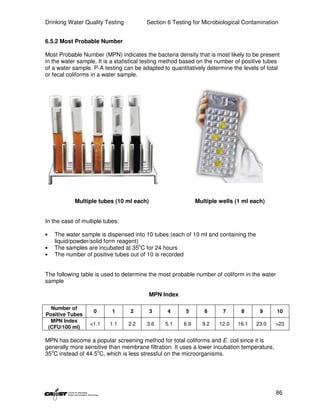
  • 140.
    Drinking Water QualityTesting Appendix 2 Establishing a Laboratory Physical Facility • A room size at least 3 m x 4 m with good ventilation, sink and water supply • Refrigerator • Shelves or racks • Source of electricity Staff and Equipment One or possibly two laboratory staff may be required to undertake the required physical, chemical and microbiological tests. The laboratory staff of each type of laboratory, in liaison with the project implementer would typically be responsible for: • Laboratory management • Determining and procuring the equipment and supplies that will be needed • Ensuring that laboratory standards are being followed and maintain quality control of • analytical procedure • Training new staff in the use of new equipment and procedures • Enforcing safety precautions and procedures, especially for fire and explosions • Preparing reagents and media, standardizing as necessary and storage under proper conditions of reagents and media. • Checking accuracy of electronic equipment used in field analyses. • Preparing an inventory and stock control of chemicals and media. It would be appropriate to provide two sets of portable water testing equipment during the initial stage. The following is a potential equipment list for a laboratory. • Single incubator • 18 aluminium Petri dishes • Spirit thermometer • 18 aluminium calibration Petri dishes • Transformer/ battery • Charger • Two pin plug adaptor • Internal rechargeable and removable DC battery • Battery cable and crocodile clips • Vehicle cigarette adaptor • Membrane filtration unit • Membrane filters • Absorbent pads (2 containers) • Pad dispenser • Forceps • Dropping pipettes (5) • Containers that can be sterilized • Plastic beakers • Media measuring device • Lighter A2-2
  • 141.
    Drinking Water QualityTesting Appendix 2 Establishing a Laboratory • Portable magnifier • Tube of silicone grease • Dilution tube (with brush) • Tablet crusher (3) • Waterproof digital turbidity meter • Calibration kit • Carrying case • Conductivity meter • pH 4, 7, 10 buffer solutions • Replacement batteries 1.5 V (4) • Photometer • Photometer lid • 6 test tubes • Reagents: Chlorine (free, combined, total) Fluoride Chlorine (free, combined, total) Fluoride Nitrate Iron Manganese Phosphate LR Phosphate HR • Screwdriver • Stopwatch • Manuals (4) • Paper towel • Whirl-pak sample bags • Alcohol strip • Distilled water • Methanol • Sterilizer (autoclave, etc.) Safe Waste Disposal A project laboratory should be designed to dispose the lab waste generated during the testing process. Active bacterial cultures grown during incubation must be disposed of properly. See Section 6 for more details on how to safely dispose waste. A2-3
  • 142.
    Drinking Water QualityTesting Appendix 2 Establishing a Laboratory Case Study: Community Laboratory in Cambodia The Water and Watershed Research Program in the Department of Biology at the University of Victoria assisted in the installation of a water quality testing laboratory in Siem Reap, Cambodia. The total cost for the lab equipment and supply was about US$10,000. The re-modeling of building cost about $2,500. The operating cost is about $25,000 US per year which includes the salaries for two employees, supplies, etc. The employees are a lab technician and field supervisor who go out into communities to conduct interviews and collect samples. The lab is able test about 30 samples per day. The tests done on each sample include membrane filtration using standard lab equipment. Conductivity, salinity, TDS, turbidity, iron, nitrates, phosphates, chlorine, and other colormetric analyses are performed using the Hach 890 colorimeter, a Hach portable turbidimeter and a portable conductivity meter. (University of Victoria, Personal Correspondence, 2007) A2-4
  • 143.
    Drinking Water QualityTesting Appendix 3 Determining the Sample Size Determining the Sample Size This is a sample size calculated by using formula derived from the University of Florida (http://edis.ifas.ufl.edu.). It shows that small sample population needs to select relatively a big number of samples. This table shows the sample size based on population and precision level. Based on CAWST experience, it is recommended to use minimum 30 units in small project (less than 100 households) and 10-15 % precision a larger project (more than 100 households). The sample size also depends on the variation or diversity of geographical location, socio-economic status, and homogeneity in the community in terms of religion and beliefs. Sample size for ±5%, ±7% , ±10% and ±15% Precision Levels Where Confidence Level is 95% Size of Sample Size (n) for Precision (e) of: Population ±5% ±7% ±10% ±15% 500 222 145 83 41 600 240 152 86 41 700 255 158 88 42 800 267 163 89 42 900 277 166 90 42 1,000 286 169 91 43 2,000 333 185 95 43 3,000 353 191 97 44 4,000 364 194 98 44 5,000 370 196 98 44 6,000 375 197 98 44 7,000 378 198 99 44 8,000 381 199 99 44 9,000 383 200 99 44 10,000 385 200 99 44 15,000 390 201 99 44 20,000 392 204 100 44 25,000 394 204 100 44 50,000 397 204 100 44 100,000 398 204 100 44 >100,000 400 204 100 44 A3-1
  • 144.
    Drinking Water QualityTesting Appendix 4 Quality Control Quality Control Large-scale projects may want to monitor the quality of reagents, media and membranes on a regular basis. Whenever you need to order new reagents, media and membrane pad; it is a good idea to compare the products with those currently in use. Procedure 1. Assemble at least five positive water samples (samples that have been shown to be contaminated). The use of more samples will increase the sensitivity of the test. 2. Process the samples using the test batch of materials and the batch currently in use. 3. Incubate the testing apparatus. 4. Compare the growth characteristics of the contaminating organism on the two batches of materials. Note any unusual readings. 5. Count or calculate the number of colonies per 100 mL. 6. Transform the counts to logarithms and enter the results for the two batches of materials in parallel columns. 7. Calculate the difference d between the two transformed results for each sample (include the + or - sign). 8. Calculate the mean of the differences and the standard deviation. 9. Perform a t-test, using the number of samples as n. 10. Use a statistical table to determine the critical value of t at the 0.05 significance level (two-tailed test). Some critical values are given below. If the calculated value of t exceeds the critical value, the two batches of materials give significantly different results. Critical value of t at 0.05 No of samples (n) Degree of freedom significance level 5 4 2.78 6 5 2.57 7 6 2.45 8 7 2.37 9 8 2.31 10 9 2.26 If this test indicates a problem with the new batch of materials, the test conditions and procedure should be carefully reviewed and the batch retested. The batch should be rejected as unsatisfactory only if the problems are confirmed by this second test. A4-1
  • 145.
    Drinking Water QualityTesting Appendix 4 Quality Control Precision Testing Precision testing is important in the microbiological laboratory because test results can reveal procedural problems and problems with the materials. Satisfactory results must be obtained from precision tests before the results of monitoring tests are reported. Procedure 1. At the beginning of each month, or at the earliest convenient time, collect 15 samples that are likely to be positive by the first procedure, with a range of positive results. 2. Make duplicate analyses of each sample. The same analyst should do the tests, but all technicians should be included, on a rota basis. 3. Record the results of the duplicate tests as D1 and D2. Calculate the logarithm of each result. If either of a set of duplicate results is zero, add 1 to both values before calculating the logarithms. 4. Calculate the difference R between each pair of transformed duplicates, and the mean of these differences . 5. Calculate the precision criterion as 3.27 R. 6. Thereafter, analyse 10% of routine samples, or a minimum of two samples per day, in duplicate. Calculate the logarithm of each result and the difference between the logarithms. If the difference is greater than the calculated precision criterion, technician variability is excessive and the analytical procedure should be reviewed. The laboratory manager should decide whether or not to release monitoring test results in the light of past performance. (Adapted from WHO, 1996) A4-2
  • 146.
    Drinking Water QualityTesting Appendix 5 Data Recording Forms Data Recording Form Location: _______________________________________ Sample Taken By: ______________________________________________________________ Date of Sampling: ________________________________ Sample Tested By: ______________________________________________________________ E. coli Total Coliform Sample Sample Turbidity Chlorine Iron Manganese Phosphate Nitrate Flouride pH (CFU/100 Fecal Coliform Description ID # (NTU) (mg/L) (mg/L) (mg/L) (mg/L) (mg/L) (mg/L) ml) (CFU/100 ml) Date of Report: ________________________________________ Comments: A5-1
  • 147.
    Drinking Water QualityTesting Appendix 6 Test Procedures Arsenic Sources Arsenic can naturally occur in ground water and some surface water. It is one of the greatest chemical problems in developing countries. The WHO considers arsenic to be a high priority for screening in drinking water sources (WHO, 2006). High levels of arsenic can be found naturally in water from deep wells in over 30 countries, including India, Nepal, Bangladesh, Indonesia, Cambodia, Vietnam, Lao PDR, Mexico, Nicaragua, El Salvador and Brazil. In south Asia alone, it is estimated that 60 to 100 million people are affected by unsafe levels of arsenic in their drinking water. Bangladesh is the most severely affected, where 35 to 60 million of its 130 million people are exposed to arsenic-contaminated water. It is possible that arsenic may be found in other locations as more extensive testing is done. Potential Health Effects Arsenic is poisonous, so if people drink water or eat food contaminated with arsenic for several years, they develop chronic health problems called arsenicosis. Melanosis is the first symptom of drinking arsenic contaminated water over a few years. Melanosis is light or dark spots on people’s skin, often on the chest, back, or palms. The next step is that hardening skin bulges develop on people’s palms and feet – called keratosis. Drinking high amounts of arsenic for a longer time may cause cancer in the lungs, bladder, kidney, skin, liver, and prostate. Arsenic may also cause vascular diseases, neurological effects, and infant developmental defects. Arsenicosis can be partially reversed and treated in the early stages, by making sure people stop drinking arsenic contaminated water and by improving their nutrition. There is currently no effective cure for arsenic poisoning. The only prevention is to drink water that has safe levels of arsenic. According to the UNDP (2006), the projected human costs over the next 50 years include 300,000 deaths from cancer and 2.5 million cases of arsenic poisoning. WHO Guidelines The World Health Organization (WHO) considers arsenic to be a high priority for testing in drinking water sources. The WHO suggests that drinking water should have less than 0.01 mg/L of arsenic. (0.01 mg/L is the same as 10 µg/L or 10 ppb.) WHO Guideline for Drinking Water < 0.01 mg/L A6-1
  • 148.
    Drinking Water QualityTesting Appendix 6 Test Procedures Many countries have their own standards which are less strict, ranging from 0.025 mg/L to 0.05 mg/L (25-50 ppb). Many Southeast Asian countries that have an arsenic problem have adopted a temporary standard of 0.05 mg/L because it is difficult to test accurately to 0.01 mg/L and to treat water to meet that standard. Household Water Treatment Options One way to deal with arsenic in groundwater is to use a different source of drinking water, such as rainwater or surface water. Some people collect and store their rainwater and use it for drinking and cooking instead of arsenic contaminated ground water. If people change their water source to surface water, they will probably need to treat the water to remove turbidity and pathogens. If people are unable to change to a water source that doesn’t have arsenic, there are several different technologies that have been developed to remove arsenic from water. Each technology has advantages and limitations. Many of these technologies are being used in Bangladesh where the arsenic problem is widespread. See the Household Water Treatment for Arsenic Removal Fact Sheets for more information on the different technologies. Arsenic Mitigation Alternative Arsenic Removal Arsenic Free Sources Technologies • Safe tube wells • Oxidation • Deep wells • Coagulation • Rainwater harvesting • Adsorption • Surface water • Complexation A6-2
  • 149.
    Drinking Water QualityTesting Appendix 6 Test Procedures Arsenic Test Procedure This test procedure uses the ENPHO-Nepal test kit reagents and equipment. If you buy equipment from a different company, then you will have to follow their instructions for the arsenic test. ENPHO-Nepal Test Kit Reagents and Equipment: • Arsine Generator Flask • Mercuric Bromide Paper Holder • Measuring Cylinder • Mercuric Bromide Paper • Tablet 1 and Tablet 2 • Reagent 1 • Standard Solution (5000 ppb) • Cap of Mercuric Bromide Paper Holder • Cotton • Distilled Water (for dilution) • Forceps • Colour Chart • Disposal Bag • Water Sample Instructions: 1. Take a piece of cotton and insert it in the wider part of the tube of bromide paper holder. 2. Soak the cotton with one drop of Reagent 1. 3. Place the Mercuric Bromide paper in the cap “c” and fit it in the small tube. 4. Measue 20 mL of your water sample and pour in arsenic generator flask. 5. Add a piece of Tablet 1 in your water sample 6. Add a piece of Tablet 2 in your water sample and immediatly fit the mercuric bromide paper holder tightly and allow it to stay till the tablets are completely dissolved. 7. After the tablets completely dissolve, gently swirl the flask and let stand for 5 minutes. 8. Detached the bromide paper holder from the flask and remove the filter paper with the help of forceps. 9. Compare the colour on the bromide paper with colour chart. A6-3
  • 150.
    Drinking Water QualityTesting Appendix 6 Test Procedures Chlorine Sources Chlorine is a chemical that we commonly add to drinking water to kill most pathogens that can make us sick. Chlorine is not usually found naturally in the environment in large amounts that can hurt us. Two things can happen when we add chlorine to water: 1. Some chlorine reacts with other organic matter and forms new chlorine compounds. This part is called combined chlorine. 2. Left over chlorine that is not combined is called free chlorine. The free chlorine is mostly what gives protection of the drinking water to help prevent against secondary contamination. It is good to have 0.2 - 0.5 mg/L of free chlorine. Total Chlorine = Combined Chlorine + Free Chlorine The amount of chlorine required to disinfect water is very dependant on each source (organic matter, pH, temperature, etc). Potential Health Effects A small amount of chlorine in water is good since it kills most pathogens that can make us sick. Many cities around the world add chlorine to their water to make it safe for people to drink. High amounts of chlorine can irritate our skin and eyes if we touch it. The strong smell of chlorine can also hurt our throat and lungs if we breathe it in. WHO Guidelines The WHO suggests that drinking water should have less than 5.0 mg/L of chlorine. When we add chlorine to disinfect drinking water, it is good to have between 0.2 – 0.5 mg/L of free residual chlorine to give long-term protection. WHO Guideline for Drinking Water < 5.0 mg/L Household Water Treatment Options Since the addition of chlorine to water is a form of water treatment, we normally do not try to remove chlorine from drinking water. It is good to have some chlorine in drinking water to help make it safe. A6-4
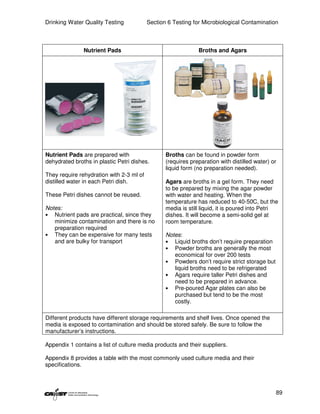
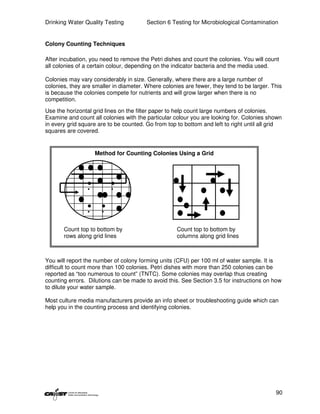
  • 151.
    Drinking Water QualityTesting Appendix 6 Test Procedures Chlorine Test Procedure This test procedure uses Wagtech reagents and equipment. If you buy equipment from a different company, then you will have to follow their instructions for the chlorine test. Reagents and Equipment: • Wagtech DPD No.1 Tablets • Wagtech DPD No.3 Tablets • Wagtech Comparator • Wagtech Colour Disc • Square Test Tubes (13.5 mm) 10 mL • Water Sample Instructions: 1. Rinse a square test tube with your water sample and leave 2 or 3 drops of water in the tube. 2. Add one DDP No.1 Tablet , crush the tablet, and then fill the test tube with the water sample to the 10 ml mark. Mix to dissolve the tablet. 3. Place the test tube in the Comparator and match immediately against the colour disc. The disc reading represents the free chlorine as mg/L. Stop the test at this stage if you are only determining the free chlorine. 4. If you want to determine the total chlorine, add one DPD No.3 Tablet to the same test tube. Crush the tablet and mix to dissolve. 5. Let the test tube to stand for two minutes. 6. Place the test tube in the Comparator and match against the colour disc. The disc reading represents the total chlorine as mg/L. 7. The combined chlorine (mg/L) is calculated by using the following formula: Total Chlorine = Combined Chlorine + Free Chlorine Combined Chlorine = Total Chlorine - Free Chlorine A6-5
  • 152.
    Drinking Water QualityTesting Appendix 6 Test Procedures Fluoride Sources Fluoride can naturally occur in groundwater and some surface water. Drinking water is normally the major source of fluoride exposure, with exposure from diet and from burning high fluoride coal also major contributors in some regions. High levels of fluoride can be found naturally in many areas of the world including, Africa, the Eastern Mediterranean and southern Asia. One of the best known high fluoride areas extends from Turkey through Iraq, Iran, Afghanistan, India, northern Thailand and China. However, there are many other areas with water sources that contain high fluoride levels and which pose a risk to those drinking the water, notably parts of the rift valley in Africa. It is possible that fluoride may be found in other locations as more extensive testing is done. Potential Health Effects A small amount of fluoride in water is generally good for strengthening people’s teeth and preventing decay. Fluoride is added to some city water systems and certain consumer products to protect teeth such as toothpastes and mouthwashes. Small amounts of fluoride are generally good for people’s teeth. But at higher amounts over time, it can cause dental fluorosis and damage people’s teeth by staining and pitting. Over many years, fluoride can build up in people’s bones, leading to skeletal fluorosis characterized by stiffness and joint pain. In severe cases, it can cause changes to the bone structure and crippling effects. Infants and young children are most at risk from high amounts of fluoride since their bodies are still growing and developing. There is currently no effective cure for fluorosis – the only prevention is to drink water that has safe levels of fluoride. WHO Guidelines The WHO suggests that drinking water should have 0.5 – 1.0 mg/L to protect teeth. Many cities around the world add fluoride to their drinking water to reach this level. Higher amounts of fluoride between 1.5 – 4.0 mg/L can cause dental fluorosis. Very high amounts of fluoride greater than 10.0 mg/L can lead to skeletal fluorosis. This is why the WHO suggests that drinking water should not have more than 1.5 mg/L of fluoride. WHO Guideline for Drinking Water < 1.5 mg/L A6-6
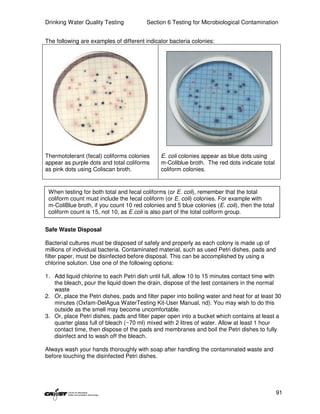
  • 153.
    Drinking Water QualityTesting Appendix 6 Test Procedures Household Water Treatment Options The best way to deal with fluoride in groundwater is to find a different source of drinking water, such as rainwater or surface water. Some people collect and store their rainwater during the wet season and use it for drinking or to dilute their groundwater during the rest of the year. This helps to lower the amount of fluoride in their water and make it safer to drink. If people change their water source to surface water, they will probably need to treat the water to remove turbidity and pathogens. Many of the areas that have fluoride contamination are arid and alternative sources of water are not available. There are emerging household water treatment technologies that are able to remove fluoride from drinking water. More research is needed to find a simple, affordable and locally available technology that can be easily used by households. Fluoride Mitigation Alternative Fluoride Removal Fluoride Free Sources Technologies • Rainwater harvesting • Activated alumina • Surface water • Nalgonda technique • Bone charcoal • Clay • Contact precipitation A6-7
  • 154.
    Drinking Water QualityTesting Appendix 6 Test Procedures Fluoride Test Procedure This test procedure uses Wagtech reagents and equipment. If you buy equipment from a different company, then you will have to follow their instructions for the fluoride test. Reagents and Equipment: • Wagtech Fluoride No. 1 Tablets • Wagtech Fluoride No.2 Tablets • Wagtech Comparator • Wagtech Colour Disc • Square Test Tubes (13.5 mm) 10 mL • Water Sample Instructions: 1. Fill a square test tube with your water sample to the 10 mL mark. 2. Add one Fluoride No.1 Tablet, crush the tablet, and mix to dissolve. 3. Add one Fluoride No.2 Tablet, crush the tablet, and mix to dissolve. 4. Let the test tube stand for 5 minutes. 5. Place the test tube in the Comparator and match against the colour disc. The disc reading represents the fluoride as mg/L. A6-8
  • 155.
    Drinking Water QualityTesting Appendix 6 Test Procedures Iron Sources Iron can be naturally found in groundwater and some surface water (such as creeks, rivers and some shallow dug wells). There are areas of the world that have naturally high amounts of iron in their groundwater. Iron can also be found in drinking water that is passed through rusty steel or cast iron pipes. Iron can come in two forms in water: dissolved and suspended. If groundwater comes from a deep tube well, the iron may be dissolved and not visible. However, once the iron is exposed to air, it usually turns the water black or orange colour. If surface water has iron in it, it will be a red-orange colour from the iron that is suspended in the water. Potential Health Effects Drinking water with high concentrations of iron will not make people sick. Iron, however, can change the colour of water and it may cause people to not use it and choose another, possibly contaminated, water source instead. WHO Guidelines The WHO does not have a suggested guideline for iron in drinking water since it does not have any adverse health effects. Usually, people do not like the taste of drinking water that has more than 0.3 mg/L of iron. Concentrations between 1.0 – 3.0 mg/L can be acceptable for people drinking anaerobic well water. Iron levels above 0.3 mg/L can stain water pipes and clothes during washing. No WHO Guideline for Drinking Water Household Water Treatment Options There are some different options to help take iron out of drinking water. To remove the orange colour suspended iron, you can let a container of water sit for a day and some of the orange flakes may settle to the bottom. Afterwards, you will need to pour out the clearer water from the container and throw away the orange flakes in a safe spot. Filters (such as the biosand filter or ceramic filters) can also be used to take out some of the iron from drinking water. Even straining the water through a cloth can remove some of the suspended iron. A6-9
  • 156.
    Drinking Water QualityTesting Appendix 6 Test Procedures Iron Test Procedure This test procedure uses Wagtech reagents and equipment. If you buy equipment from a different company, then you will have to follow their instructions for the iron test. Reagents and Equipment: • Wagtech Iron No. 1 Tablets • Wagtech Iron No.2 Tablets • Wagtech Comparator • Wagtech Colour Disc • Square Test Tubes (13.5 mm) 10 mL • Water Sample Instructions: 1. Fill a square test tube with your water sample to the 10 mL mark. 2. Add one Iron No.1 Tablet, crush the tablet, and mix to dissolve. 3. Add one Iron No.2 Tablet, crush the tablet, and mix to dissolve. 4. Let the test tube stand for 10 minutes. 5. Place the test tube in the Comparator and match against the colour disc. The disc reading represents the iron as mg/L. A6-10
  • 157.
    Drinking Water QualityTesting Appendix 6 Test Procedures Manganese Sources Manganese can be naturally found in groundwater and surface water, and it usually occurs with iron. However, human activities may also be responsible for manganese contamination in water in some areas. Manganese can come in two forms in water: dissolved and suspended. If groundwater comes from a deep tube well, the manganese may be dissolved and not visible. In surface water, manganese can be dissolved or suspended. Water with high levels of suspended manganese usually has a black colour or black flakes in it. Potential Health Effects People need small amounts of manganese to keep healthy and food is the major source for people. However, too little or too much manganese can cause adverse health effects. High levels of manganese, however, can turn water a black colour and it may cause people to not use it and choose another, possibly contaminated, water source instead. WHO Guidelines The WHO suggests that drinking water should not have more than 0.4 mg/L of manganese. Usually, people do not like the taste of drinking water that has more than 0.15 mg/L of manganese. Also, amounts above 0.15 mg/L can stain water pipes, clothes during washing, and food during cooking. Even levels of manganese below 0.05 mg/L may form black coatings on distribution pipes that come off into water as small black flakes. The presence of manganese in water may also lead to the accumulation of microbial growths in the water distribution system. WHO Guideline for Drinking Water < 0.4 mg/L Household Water Treatment Options There are some different options to help take suspended manganese out of drinking water. First of all, you can let a container of water sit for a day and some of the black flakes may settle to the bottom. Afterwards, you will need to pour out the clearer water from the container and throw away the black flakes in a safe spot. Filters (such as the biosand filter or ceramic filters) can also be used to take out some of the suspended manganese from drinking water. Even straining the water through a cloth can remove some of the flakes. A6-11
  • 158.
    Drinking Water QualityTesting Appendix 6 Test Procedures Manganese Test Procedure This test procedure uses Wagtech reagents and equipment. If you buy equipment from a different company, then you will have to follow their instructions for the manganese test. Reagents and Equipment: • Wagtech Manganese No. 1 Tablets • Wagtech Manganese No.2 Tablets • Wagtech Comparator • Wagtech Colour Disc • Square Test Tubes (13.5 mm) 10 mL • Water Sample Instructions: 1. Fill a square test tube with your water sample to the 10 mL mark. 2. Add one Manganese No.1 Tablet, crush the tablet, and mix to dissolve. 3. Add one Manganese No.2 Tablet, crush the tablet, and mix to dissolve. Put the cap on the tube. 4. Let the test tube stand for 20 minutes. 5. Place the test tube in the Comparator and match against the colour disc. The disc reading represents the manganese as ug/L. A6-12
  • 159.
    Drinking Water QualityTesting Appendix 6 Test Procedures Phosphate Sources Phosphate or phosphorus is a natural mineral that is mined and used in fertilizers and soaps. They help plants to grow including water plants in lakes and rivers. With excessive plant growth, the waterways become clogged and fish will die off. Potential Health Effects Phosphates are not usually considered harmful to our health. However, high amounts of phosphate in water usually indicate that there is some contamination from mining, domestic wastewater, or excessive fertilizers being applied to farm land. This is an indicator that protecting the water source is needed to maintain a healthy natural water system. WHO Guidelines The WHO does not suggest a guideline value for phosphate in drinking water. No WHO Guideline for Drinking Water Household Water Treatment Options There are currently no practical or common household water treatment technologies that are able to remove phosphate from drinking water. A6-13
  • 160.
    Drinking Water QualityTesting Appendix 6 Test Procedures Manganese Test Procedure This test procedure uses Wagtech reagents and equipment. If you buy equipment from a different company, then you will have to follow their instructions for the phosphate test. Reagents and Equipment: • Wagtech Phosphate No. 1 LR Tablets • Wagtech Phosphate No.2 LR Tablets • Wagtech Comparator • Wagtech Colour Disc • Square Test Tubes (13.5 mm) 10 mL • Water Sample Instructions: 1. Fill a square test tube with your water sample to the 10 mL mark. 2. Add one Phopshate No.1 LR Tablet, crush the tablet, and mix to dissolve. 3. Add one Phosphate No.2 LR Tablet, crush the tablet, and mix to dissolve. 4. Let the test tube stand for 10 minutes. 5. Place the test tube in the Comparator and match against the colour disc. The disc reading represents the phosphate as mg/L. A6-14
  • 161.
    Drinking Water QualityTesting Appendix 6 Test Procedures Turbidity Sources Turbidity is a physical property of water. It is the ‘cloudiness’ caused by small particles (suspend solids) that are generally invisible to the naked eye. One can compare it to smoke in air. In rivers and other surface waters, turbidity usual increases after heavy rain as the water picks up the dirt particles before emptying into the water sources. The units for measuring turbidity are NTU (Nephelometric Turbidity Units) which are not concentrations (mg per L) such as units for chemical testing, but rather values associated with how much light is reflected due to the amount of particles in the water. The more particles, the higher the NTU value. Potential Health Effects Turbidity doesn’t cause direct health impacts but is an indicator of biological contamination, as viruses, parasites and bacteria like to attach themselves to small particles. It also reduces the effectiveness of chlorination as chlorine will combine with the particles and less will be available to combine with the pathogens. WHO Guidelines The WHO guideline for turbidity is less than 5 NTU, which, to the naked eye, looks like clear water from a tap, spring or deep borehole. WHO Guideline for Drinking Water < 5 NTU Household Water Treatment Options Water with turbidity levels greater than 50 NTU can be often left to settle, allowing the particles to fall to the bottom. Filtering the water through a clean cotton cloth folded a few times over can also significantly reduce turbidity. A6-15
  • 162.
    Drinking Water QualityTesting Appendix 6 Test Procedures Turbidity Test Procedure A simple test to measure the turbidity is to use a 2 L clear plastic bottle filled with the sample water. Place this on top of large print such as the CAWST logo on the participant manual. If you can see this logo looking down through the top of the bottle, the water probably has a turbidity of less than 50 NTU. Turbidity tubes are another easy and cheap way to visually estimate NTU. DelAgua and Wagtech testing kits provide turbidity tubes, but you can even make one yourself. Turbidity meters are electronic devices which provide quick and very accurate results allowing for high precision for turbidity less than 5 NTU. Equipment: • Turbidity tube Instructions: 1. Go outside or in a room with good lighting. 2. Rinse the turbidity tube with sample water 2 to 3 times. 3. Place a sheet of white paper on the floor 4. Hold the tube vertically and pour water sample into the tube slowly in stages of few centimeters of water column at a time. 5. Holding the tube at hip level, over the white sheet of paper, try to see the cross or circle at the bottom of the tube after each addition of water column from the top of the tube. Keep on doing this until the black cross or circle at the bottom of the tube just disappears or blurs completely. 6. Hold the tube vertically and read turbidity in NTU using the graduation on the side of the tube. The result is the value of the line nearest the water level. (For some tubes you may have to refer to a correspondence table). Remarks: The readings will be significantly affected by the amount light, and the vision of the person doing the test. Some larger particles may settle directly to the bottom, blocking the view. Give it a good shake and take the reading. A6-16
  • 163.
    Drinking Water QualityTesting Appendix 6 Test Procedures Microbiological Testing: Presence–Absence (P-A) Test Procedure This test procedure uses the Hach Pathoscreen reagents and equipment. If you buy equipment from a different company, then you will have to follow their instructions for the presence-absence test. Hach Reagents and Equipment: • Bottle (20 mL) • PathoScreen Medium P/A Pillows • Methanol or Alcohol • Scissors • Water Sample Instructions: 1. Fill the sterilized bottle with 20 mL of your water sample. 2. Wipe the outside of the pillow with alcohol before opening it. 3. Use scissors to cut open one end of the pillow. 4. Add the powder to your water sample. 5. Put the cap on the bottle and shake it to mix the powder and water. 6. Put the bottle somewhere with a constant temperature (25 – 35oC) for 24 to 48 hours. 7. Check the bottle after 24 hours to see if there is a colour change. If there is no colour change, then let the bottle sit for another 24 hours. 8. Compare the colour of the water sample with the following chart to determine the results. Colour Result No colour change Negative Changes from yellow to black Positive Black precipitate forms Positive A6-17
  • 164.
    Drinking Water QualityTesting Appendix 6 Test Procedures Microbiological Testing: Most Probable Number (MPN) Test Procedure This test procedure uses the Hach Pathoscreen reagents and equipment. If you buy equipment from a different company, then you will have to follow their instructions for the MPN test. Hach Reagents and Equipment: • 5 bottles (20 mL) • 5 PathoScreen Medium P/A Pillows • Methanol or Alcohol • Scissors • 5 Water Samples Instructions: 1. Fill one of the sterilized bottles with 20 mL of your water sample. 2. Wipe the outside of the pillow with alcohol before opening it. 3. Use scissors to cut open one end of the pillow. 4. Add the powder to your water sample. 5. Put the cap on the bottle and shake it to mix the powder and water. 6. Repeat Steps 1-5 for the other four water samples. 6. Put the bottles somewhere with a constant temperature (25 – 35oC) for 24 to 48 hours. 7. Check the bottles after 24 hours to see if there is a colour change. If there is no colour change, then let the bottle sit for another 24 hours. 8. Compare the colour of the water samples with the following table to determine the results. Colour Result No colour change Negative water sample Changes from yellow to black Positive water sample Black precipitate forms Positive water sample A6-18
  • 165.
    Drinking Water QualityTesting Appendix 6 Test Procedures 9. Compare the results of the 5 water samples with the following table to determine the overall level of contamination of the water samples. Positive Water Samples MPN/100 mL 0 < 1.1 1 1.1 2 2.6 3 4.6 4 8.0 5 > 8.0 A6-19
  • 166.
    Drinking Water QualityTesting Appendix 6 Test Procedures Microbiological Testing: Membrane Filtration Test Procedure 1 This test procedure uses the Wagtech equipment. If you buy equipment from a different company, then you will have to follow their instructions for the membrane filtration test. Wagtech Equipment: 1. Hand Pump 2. Base Container 3. Sample Cup 4. Filter Cup 5. Filter Paper Holder 6. Gaskets 7. Bronze Support Other Equipment: • Methanol • Lighter • Forceps • Tissue • Petri Dishes • Filter Papers (0.45 um) • Pad Dispenser • Pads A6-20
  • 167.
    Drinking Water QualityTesting Appendix 6 Test Procedures Putting the Wagtech Equipment Together: 1. Put the filter equipment together by following the picture below. Instructions for Sterilizing Wagtech Equipment: The following steps should be done before taking a water sample and after filtering each sample. 1. Dry the filter cup and sample cup dry with clean tissue paper. 2. Pour 1 mL of methanol into the sample cup and swirl. 3. Put the sample cup upright and away from anything that can catch on fire. 4. Light the methanol. While the methanol is still burning turn the filter equipment into the sample cup. 5. Wait for at least 5 minutes to ensure that the sample cup and filter equipment are sterilized (methanol burns anaerobically and forms formaldehyde a strong bactericide). 6. Pour away any methanol that is left over in the sample cup. A6-21
  • 168.
    Drinking Water QualityTesting Appendix 6 Test Procedures Instructions for Using Wagtech Equipment: 1. Use the dispenser to put a pad in a sterile Petri dish. 2. Pour about 2 mL of broth onto the pad. 3. Sterilise the forceps by holding the tips in a flame for 5 seconds. Allow the forceps to cool before handling the filter paper. 4. Using forceps, place a sterile filter paper onto the bronze support. Make sure that the grid side of the filter paper is facing up. If the filter paper tears or becomes contaminated, throw it out and use a new one. 5. Lock the filter paper in place by pushing the filter cup firmly down into position. 6. Pour your water sample into the filter cup up to the 100 mL mark. 7. Connect the hand pump to the base container and pump to suck the water sample through the filter paper. 8. When all the water has been filtered, undo the hand pump and take off the filter cup. A6-22
  • 169.
    Drinking Water QualityTesting Appendix 6 Test Procedures 9. Use the sterile forceps to take the filter paper off the bronze support. 10. Place the filter paper on top of the pad and broth in the Petri dish. 11. Put the lid on the Petri dish and label it with the sample number and date. 12. Put the Petri dish into the rack and repeat this process for all of your water samples. When you are finished, place the rack into the incubator. Wait between 1 to 4 hours after filtering before incubating your samples to allow the bacteria to resuscitate/recover. A6-23
  • 170.
    Drinking Water QualityTesting Appendix 6 Test Procedures Test Procedure 2 This test procedure uses the Nalgene equipment. If you buy equipment from a different company, then you will have to follow their instructions for the membrane filtration test. Nalgene Equipment: 1. Hand Pump 2. Nalgene Plastic Filter Unit 3. Sample Cup Other Equipment: • Methanol • Lighter • Forceps • Tissue • Petri Dishes • Pad Dispenser • Pads Instructions for Using Nalgene Equipment: 1. Use the dispenser to put a pad in a sterile Petri dish. 2. Pour about 2 mL of broth onto the pad. 3. Open the package and place the sterilized plastic filter on the table. 4. Pour your water sample into the filter cup up to the 100 mL mark. 5. Connect the hand pump to the base container and pump to suck the water sample through the filter paper. 6. When all the water has been filtered, undo the hand pump. Squeeze, twist and take off the filter cup. 7. Sterilise the forceps by holding the tips in a flame for 5 seconds. Allow the forceps to cool before handling the filter paper. 8. Use the sterile forceps to take the filter paper off the base container. 9. Place the filter paper on top of the pad and broth in the Petri dish. 10. Put the lid on the Petri dish and label it with the sample number and date. 11. Put the Petri dish into the rack and repeat this process for all of your water samples. When you are finished, place the rack into the incubator. Wait between 1 to 4 hours after filtering before incubating your samples. A6-24
  • 171.
    Drinking Water QualityTesting Appendix 7 Example Test Report Example Water Quality Test Report The report should be written by a qualified technician with input and collaboration with field workers and technicians for good interpretation of results and recommendations. The following is an example template for a report used in the context of water quality monitoring for a small project. In the example, new supplies (drilled wells, hand-dug wells) are tested every 6 months for chemical parameters and every 3 months for feacal contamination. Depending on resources, you may only want to test for chemical contaminants once or twice (depending on the result of the test!) but more frequently for fecal contramination (depending on the source type). In this example, random sampling was not necessary. In the case where a large number of systems need to be tested (such as a biosand filter project, or a large geographical area) then the sampling method chosen should be explained in the “Methodology” section of the report. See Section 3 and Appendix 5 for sampling methods. A7-1
  • 172.
    Drinking Water QualityTesting Appendix 7 Example Test Report Quarterly Water Quality Testing Report for October to December 2007 January 2008 Prepared by: A. Smith, Monitoring Officer, NGO Good Water Quality for All 1. Introduction Water quality monitoring reports are produced every 3 months as part of the NGO’s monitoring and evaluation programme. This is the fourth and final report for the year 2007 covering all project areas (villages A, B, C and D) and all water supply systems (drilled wells, hand-dug wells, biosand filters). 2. Objectives Water testing is done in the context of domestic use with a particular focus on drinking water quality as one of the programme’s objective is improving drinking water supply. Water quality testing is undertaken within the NGO’s project areas: 1. To assess the quality of newly constructed water supplies and treatement systems at commissioning 2. To monitor the quality of existing supply and treatement systems Though this report does include biosand filter water quality, it does not include analysis of the effectiveness of the biosand filters in our programmes. Refer to the report intitled “Biosand Filter Water Quality Testing Report – December 2007” which analysed the effectiveness of biosand filters programme in Village D, based on the chosen media and project context. 3. Testing Parameters For drinking water, the national standards, WHO guidelines and UNICEF recommend monitoring micorbiological quality as first priority (i.e. fecal coliforms or E.coli). 10 CFU/100 ml has been used as the acceptable limit. Other important priorities are the aesthetic quality of water (to ensure user acceptability) and contimation with chemicals of known health risk. Chemicals of concern for health in our project area include fluoride and arsenic and for aesthetic concern, iron, manganese, color, odour and taste. pH and Turbidity will also be tested in relation to the biosand filter and household chlorination. Physical and biological parameters are tested every 3 months, and chemical contamination every six months (where relevent). 4. Testing Methodology Samples are collected in the field by trained field workers (see data collection sheets in appendix) using sterilised sample bottles and placed in the fridge. All testing is started within 8 hours of sample collection by a trained technicien in a dedicated room and clean environment. A7-2
  • 173.
    Drinking Water QualityTesting Appendix 7 Example Test Report Parameter Method Details E.coli Membrane filtration with See testing protocol in appendix. Duplicate samples are Coliscan-MF broth tested. 1 field blank per batch of 20 samples. pH Test strips Product: EMD test strips. ref.9588-3. pH Range 5 to 10, step 0.3 to 0.5 Turbidity Turbidity tube Wagtech Colour, Visual observation and See data collection sheets odour, taste discussion with user Fluroride Visual color comparison Wagtech Color disk (Wag-WE10224) and reagent Wag- WE10322 (range 0 to 1.5 mg/l) dillutions made for concentrations beyond range using deionised water Arsenic Wagtech Arsenator Range 2 to 100ppb Iron Test strip ITS Inc. Sensafe Iron Check (ref. 480125). Range 0 to 5 mg/l. Sensitivities: 0, 0.02, 0.05, 0.1, 0.2, 0.3, 0.5, 0.75, 1.0, 2.0, 5.0 Manganese Test strip ITS Inc. Sensafe Iron Check (ref. 481020). Range 0 to 2 mg/l. Sensitivities: <0.02, 0.05, 0.1, 0.2, 0.5, 1.0, 2.0 ppm (mg/L) 5. Results Results were transcribed on data recording sheets and summarized in the following table. Information is grouped by source and village. For trend analysis purposes, the data from the past quarters have been included in the tables. All new data is marked in italic. Parameters exceeding national drinking water quality standards are in bold. SampleID Date pH Tb* F* Ar* Fe* Mn* E.coli* Obs* Samples from Borehole (Market- BHA) Location: Village A – Depth 52m – India Mark II handpump (Date of Comissioning : 12 Jan 2007) BHA-1 12-01-07 8 10 0 0 0.3 0.2 15 Newly commissioned. Slab and pump clean BHA-2 15-04-07 ND <5 ND ND ND ND 5 Slight metalic taste BHA-3 10-07-07 7.9 <5 0 0 0.4 0.3 0 Metalic taste. Complaints from users BHA-4 12-10-07 ND <5 ND ND ND ND 10 Slight colour (orange) BHA-5 14-12-07 8 10 0 0 0.4 0.2 30 Cracks on slab Samples from Borehole (School- BHB) Location: Village B - Depth 45m – India Mark II handpump (Date of Comissioning : 13 Dec 2007) BHB-1 14-12-07 7.2 <5 20 0 0.2 0 0 Water smell of chlorine Samples from Hand dug well (HDC) Location: Village C - Depth 8m – Open well (Date of commissioning : 6 Jul 2007) HDC-1 10-07-07 7.5 10 0 0 0.1 0 150 HDC-2 12-10-07 ND 40 ND ND ND ND 260 Water slightly cloudy HDC-3 14-12-07 4.5 50 0 0 0.1 0 500 Brownish color water Samples from Biosand filter outlet (Ref:BSD1) Location: Village D - (Installation date: 10 Jan 2007) BSD1-1 12-01-07 8 10 0 0 0.0 0 14 Water slightly cloudy BSD1-2 15-04-07 ND 5 ND ND ND ND 10 BSD1-3 10-07-07 7.5 <5 0 100 0.0 0.01 0 Borehole water used in dry season BSD1-4 12-10-07 ND <5 ND ND ND ND 10 BSD1-5 14-12-07 8 5 0 0 0.0 0 3 * Tb = Turbidity (NTU), F = Fluoride (ppm), Ar = Arsenic (ppb), Mn = Manganese (ppm), E.coli = CFU/100ml, Obs = Observations made by field worker. ND = Parameter was not tested. A7-3
  • 174.
    Drinking Water QualityTesting Appendix 7 Example Test Report 6. Interpretation and Recommendations Summary • The bacteriological quality of all systems tested where within acceptable range (0 to 14 CFU/100 ml) except for the hand-dug well in Village C (ref: HDC) has increased levels of fecal contamination (500 CFU/100 ml in the latest test) and recently the Market Borehole in Villlage A. • Very high levels of fluroride (20 mg/L, 10 times the limit) where found in the first test for the newly commissioned borehole at the school in Village B. • Arsenic was found at excessive concentration (100 ppb) in a biosand filter (BSD1) in Village D in July. Village A The turbidity for the Market borehole (BHA) is high (should be <5 NTU). The variation in the rainy season shows possible infiltration of surface waters or insufficient development of borehole. This could lead to bacteriological contamination. Recommend more testing, checking BH apron integrity and drilling records, recommend treatment and rehabilitation if possible. The iron still seems to be a problem. Recommend continued testing, coupled with user’s survey to establish if concentrations are a deterrent (could lead to returning to less safe water sources). Suggest settling and filtration, and explanation that is not harmfull for health. Village B New borehole, these are the first tests. Fluoride is over 100x over limit. Recommend doing further fluoride tests to confirm as soon as possible. Village C The hand-dug well (ref: HDC) showed significant and increasing levels of feacal contamination (500 CFU/100ml) since the commissioning of the well (July 2007). This could be due to surface water infiltration and/or poor user hygiene. Recommend checking the well lining and sanitation practices around area. Recommend users to treat water. Village D The July testing showed 100ppb of Arsenic. Further investigations in August confirmed that the biosand filter users in the area were using borehole water in the dry season (a borehole which was contaminated with Arsenic) because the hand-dug well in the rainy season would dry up. Recommend adapting the biosand filters in the area to elimiate Arsenic or recommend using another source in the dry season. Further arsenic testing should be done to confirm arsenic contamination. A7-4
  • 175.
    Drinking Water QualityTesting Appendix 8 Culture Media Culture Media for Microbiological Testing Suitable for Indicators* Incubation Time Form / Photo Culture Media Type Colony Counting TT E. and Temperature Container TC C coli o m-Lauryl sulphate Broth X X ~30 C for 4 hours Powder Both thermotolerant o (MLSB) then 44 ± 0.5 C (38.1g or and total coliforms Nutri- (for FC) for 14hrs 500g) produce yellow Pad colonies. 35.0 ± 0.5° (for C TC) for 18hrs m-Endo Broth X (X) 35.0 ± 0.5° for C Powder Total coliforms 24hrs produce light to dark Agar Dehydrated blue colonies. (E. coli pads produce dark red colonies with a green Nutri- metallic sheen). Pad m-FC Broth X 44.5 ± 0.5°C Powder Thermotolerant coliforms produce Agar blue to blue-grey colonies. Modified m-TEC Agar X 35.0 ± 0.5° for C Powder E. coli produce red- 2hrs then 44.5 ± magenta colonies. 0.5° for 22- C 24hours m-ColiBlue24 Broth X 35 ± 0.5° for 22- C Liquid (2 ml E. coli produce blue 24hrs ampoules, colonies and total Agar 100ml glass coliform produce red bottle) – colonies. refrigerated Prepared agar plates Coliscan MF Broth X X ambient to 37° C Liquid (20 E. coli produce purple (ideally 34-37°C ml plastic blue or dark blue Agar for 18-20 hrs) bottles) – colonies. frozen * TC – Total Coliforms, FC – Thermotolerant Coliforms A8-1
  • 176.
    Drinking Water QualityTesting Appendix 9 WHO Guidelines WHO Guidelines for Drinking Water Quality: Selected Chemicals Chemical Guideline Value pH No health based value is proposed Aluminium No health based value is proposed Ammonia No health based value is proposed Antimony 0.02 mg/L Arsenic 0.01 mg/L Barium 0.7 mg/L Boron 0.5 mg/L Cadmium 0.003 mg/L Calcium No health based value is proposed Chloride No health based value is proposed Chlorine 5 mg/L Chromium 0.05 mg/L Copper 2.0 mg/L Cyanide 0.07 mg/L 1.5 mg/L (Recommended to have 0.5 - 1.0 Fluoride mg/L for artificial fluoridation of drinking water) Iron No health based value is proposed Lead 0.01 mg/L Manganese 0.4 mg/L Mercury 0.006 mg/L (for inorganic mercury) Molybdenum 0.07 mg/L Nickel 0.07 mg/L Nitrate 50 mg/L 3 mg/L (short-term exposure) Nitrite 0.2 mg/L (long-term exposure) Potassium No health based value is proposed Silver No health based value is proposed Sodium No health based value is proposed Total dissolved solids (TDS) No health based value is proposed Uranium 0.015 mg/L Zinc No health based value is proposed (Adapted from WHO, 2006) A9-1
  • 177.
    Drinking Water QualityTesting Appendix 9 WHO Guidelines Potential Health Effects The effect of the contaminant on human health depends largely upon the type of contaminant, its concentration, the length and frequency of exposure. The user’s age, physical health condition and immunity can also have a large influence on the resulting health effect. A list of chemical contaminants, the health impacts they pose, and potential contamination sources are provided in the following table. Potential Health Impacts of Chemical Contamination Potential Health Effect from Chemical Source Drinking Water Naturally occurring; most abundant metal. Little indication that orally ingested Aluminium salts are widely used in water Aluminium aluminium is acutely toxic. No health treatment as coagulants to reduce organic based guideline is proposed. matter, colour, turbidity and microorganism levels. Ammonia in drinking water is not of Sewage, industrial processes, and Ammonia immediate health relevance. No health agricultural activities based guideline is proposed. Itchy, rough and broken skin. Eczema and High concentrations may occur from Antimony dermatitis result from long term and mining operations and active volcanic regular contact with antimony. areas. Naturally occurring; also used Skin disease (melanosis and keratosis). commercially and industrially in the May lead to lung, bladder, kidney, skin, manufacture of transistors, lasers and Arsenic liver, and prostate cancer. Also known to semi-conductors. Some areas have cause vascular diseases, neurological relatively high concentrations of arsenic in effects, and infant developmental defects. groundwater. Used in a variety of industrial applications; No evidence that barium is carcinogenic Barium however barium in water comes mainly or mutagenic. from natural sources. Used in the manufacture of glass, soaps and detergents and as flame retardants. Found naturally in groundwater, but its Toxic to the male reproductive tract and presence in surface water is frequently a Boron may cause developmental toxicity. consequence of the discharge of treated sewage that contains detergents. Conventional water treatment does not significantly remove boron. Used in the steel industry, plastics and in batteries. Released in wastewater, fertilizers and local air pollution. Cadmium High doses can cause kidney damage. Contamination in drinking water may also be caused by galvanized pipes, solders and metal fittings. Food is the main source of exposure. Essential element for human nutrition. No Calcium Naturally occurring. health based guideline is proposed. A9-2
  • 178.
    Drinking Water QualityTesting Appendix 9 WHO Guidelines Potential Health Effect from Chemical Source Drinking Water Chloride in drinking water comes from natural sources, sewage, industrial Several studies have suggested that the effluents, and from urban runoff Chloride chloride may play a role in kidney function containing de-icing salt. Main source of and nutrition. human exposure is the addition of salt to food. Effects are not likely to occur at levels of chlorine that are normally found in the Produced in large amounts and widely Chlorine environment. High dose of chlorine used industrially and domestically as an irritates the skin, the eyes, and the important disinfectant and bleach. respiratory system. No significant health effects have been Naturally occurring. Food appears to be Chromium attributed to chromium due to lack of the major source of uptake. toxicological data. Used to make pipes, valves and fittings. Copper is both an essential nutrient and Copper sulphate pentahydrate is drinking water contaminant. Can effect sometimes added to surface water to the gastrointestinal tract, impact may be control algae. Primary source in drinking Copper greater on sensitive populations such as water is the corrosion of copper plumbing. the carriers of the gene for Wilson Food and water are the primary sources disease and other metabolic disorders. of copper exposure in developed countries. Can be found in some foods, particularly Long-term consumption effects the thyroid in some developing countries, and Cyanide and the nervous system. occasionally found in drinking water from industrial contamination. Low concentrations (0.5 – 1.0 mg/L) Naturally occurring; used widely in provide protection against dental caries, industry; used to produce phosphate especially in children. Higher levels can fertilizers. In most circumstances food is Fluoride cause mottling of teeth and dental the main source of intake. Some areas fluorosis. Much higher levels can result in have relatively high concentrations of skeletal damage. fluoride in groundwater. Naturally occurring; one of most abundant Essential element for human nutrition. No Iron metals. Also found in drinking water from health based guideline is proposed. corrosion of steel and cast iron pipes. Infants, children and pregnant women are Used in the production of lead-acid most susceptible. Infants and children: batteries solders and alloys. Lead in Delays in physical or mental Lead drinking water is usually from household development; deficits in attention span plumbing systems that use lead in pipes, and learning abilities. Adults: Kidney solders and fittings. problems; high blood pressure. Naturally occurring; one of most abundant Essential element for human nutrition. metals, usually found with iron. Used in Manganese Adverse effects can result from both manufacturing and in cleaning, bleaching deficiency and overexposure. and disinfection products. Food is the main source of exposure. Used in the mining industry, production of Causes neurological symptoms and chlorine, electrical appliances, and in Mercury kidney damage. dental amalgams. Food is the main source of exposure. A9-3
  • 179.
    Drinking Water QualityTesting Appendix 9 WHO Guidelines Potential Health Effect from Chemical Source Drinking Water Naturally occurring; relatively rare Essential element for human nutrition. element. Used in manufacturing of special High doses may cause liver dysfunction steels, used as lubricant additives and in Molybdenum and joint pain in the knees, hands and agriculture to prevent molybdenum feet. deficiency of crops. May be found in high concentrations near mining sites. Naturally occurring; used in the production of stainless steel and nickel Higher chances of lung cancer, nose alloys. Food is the main source of cancer, birth defects, allergic reactions, Nickel exposure. However, nickel in water can heart disorders. be significant in areas where there is heavy industrial pollution or relatively high concentrations in groundwater. Naturally occurring as part of the nitrogen Main health concern is cycle. Nitrate is used in fertilizers and methaemoglobinaemia, or blue baby sodium nitrite is used as a food syndrome, that occurs in infants that are Nitrate and preservative. Concentration of nitrate in usually bottle fed. Symptoms include nitrite groundwater and surface water is caused shortness of breath and their skin turning by agricultural runoff; leaching from septic blue due to the lack of oxygen. tanks, and sewage. Nitrite is from microbial activity and may be intermittent. Essential element for human nutrition. No Naturally occurring; not commonly found health based guideline is proposed. in drinking water at levels that are a Increased exposure could result in health concern to human health. However, Potassium effects in people with kidney disease or drinking water treated by water softeners who are taking medication that interferes using potassium chloride may significantly with normal potassium functions in the increase exposure and result in adverse body. health effects in susceptible individuals. Naturally occurring; occasionally found in No health based guideline is proposed. groundwater, surface water and drinking Silver Only a small percentage of silver is water. Silver salts are sometimes used by absorbed by the body. HWT technologies to reduce bacteria (i.e. ceramic filters). Sodium salts (e.g. sodium chloride) are found in virtually all food and drinking water. Food is the main source of Sodium No health based guideline is proposed. exposure. Water softeners can add significantly to the sodium content in drinking water. TDS in drinking water comes from natural Total Although there are no direct health sources, sewage, urban runoff and Dissolved concerns, very low or high concentrations industrial wastewater. Concentrations of Solids (TDS) may cause an objectionable taste. TDS in water vary greatly in different geological regions. A9-4
  • 180.
    Drinking Water QualityTesting Appendix 9 WHO Guidelines Potential Health Effect from Chemical Source Drinking Water Naturally occurring. Used mainly as a fuel in nuclear power stations. Contamination Little information is available on the is caused by leaching from natural chronic health effects of exposure to deposits, release from mining operations, Uranium uranium in drinking water. Radiological emissions from the nuclear industry, effects are not considered in the drinking combustion of coal and other fuels, and water guidelines. use of phosphate fertilizers that contain uranium. Zinc is an essential trace element for Found in virtually all food and drinking Zinc human nutrition. No health based water. Food is the main source of guideline is proposed. exposure. (Adapted from WHO, 2006) A9-5