Environmental Indicators: Measuring
Urban Development in Mountains of India


                   Kashinath Vajpai
           Climate Himalaya Initiative, India
              info@climatehimalaya.net

              www.climatehimalaya.net
               http://chimalaya.org
Developing Urban Settlements
 Cities in Mountains of India are in the process of expansion

 Increase in population due to high migration from highland to lowland areas

 Rapid infrastructure development

 Two important characteristics: 1. Massive growth in absolute numbers 2.
  Increasing concentration

 Rapid population growth, high densities, poverty and high differentials in
  access to housing, public services and infrastructure led to an increase in
  vulnerability over last few decades (Aromar R., 2008)

 India is one of the more vulnerable and risk-prone countries in the world
  (IFRC 2005)
Urban Development Vs. Environmental
Issues
 High pollution, water scarcity, deteriorating soil, loss of biodiversity and poor
   agriculture productivity

 Various disasters, health hazards, deteriorating environmental quality, economic
   losses

 Climate change variability increased the frequency and intensity of hazards and
   the probability of extreme events

 Degrade the resilience of poor and vulnerable communities
 Further degrading resilience of in one half of the poor, vulnerable communities
   (Nicholls, et al 2006).

 Inadequate provisions of comprehensive and environmental sensitive planning.
The Extent of Problem-Example
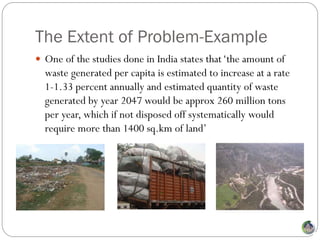
 One of the studies done in India states that ‘the amount of
  waste generated per capita is estimated to increase at a rate
  1-1.33 percent annually and estimated quantity of waste
  generated by year 2047 would be approx 260 million tons
  per year, which if not disposed off systematically would
  require more than 1400 sq.km of land’
Study Objectives
 To discuss the major environmental concerns in the urban
  areas of Indian mountains

 To review and analyze relevant policies and guidelines in
  urban development and environmental context

 To develop a set of indicators on various environmental
  parameters in urban context

 To analyze city development plans in concurrence with
  environmental considerations.
Information Areas in the Study
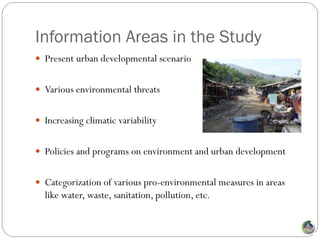
 Present urban developmental scenario


 Various environmental threats


 Increasing climatic variability


 Policies and programs on environment and urban development


 Categorization of various pro-environmental measures in areas
  like water, waste, sanitation, pollution, etc.
Plan: Sustaining Himalayan Ecosystem
Mission
     Management and safeguarding Himalayan glaciers and
      ecosystem

     Exchange of information


     Develop monitoring network


     Community based management of ecosystem


     Maintain 2/3rd area under forest
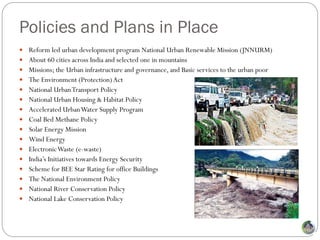
Policies and Plans in Place
 Reform led urban development program National Urban Renewable Mission (JNNURM)
 About 60 cities across India and selected one in mountains
 Missions; the Urban infrastructure and governance, and Basic services to the urban poor
 The Environment (Protection) Act
 National Urban Transport Policy
 National Urban Housing & Habitat Policy
 Accelerated Urban Water Supply Program
 Coal Bed Methane Policy
 Solar Energy Mission
 Wind Energy
 Electronic Waste (e-waste)
 India’s Initiatives towards Energy Security
 Scheme for BEE Star Rating for office Buildings
 The National Environment Policy
 National River Conservation Policy
 National Lake Conservation Policy
What Policies and Plans Entail
 National River Conservation Plan (NRCP): Capacity building of ULBs


 The National Lake Conservation Plan: Restore and conserve the urban and semi urban
   lakes

 The Municipal Solid Wastes (Management and Handling Rules): Role of ULBs in
   decentralized waste collection and management

 The Plastics (manufacture, usage and waste management) rules : Emphasizes in to
   specific thickness of plastics and procedural recycling.

 The National Urban Sanitation Policy: Specific sanitation strategy for the cities


 The National Action Plan for Climate Change (NAPCC): Reduce climatic impacts and
   emphasizes on inter connected issues towards adaptation and mitigation- focus on poor
   and vulnerable.
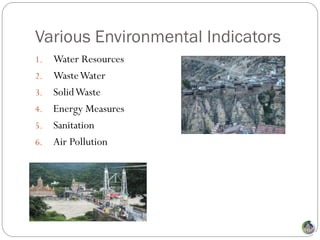
Various Environmental Indicators
1.   Water Resources
2.   Waste Water
3.   Solid Waste
4.   Energy Measures
5.   Sanitation
6.   Air Pollution


                       Photo: Joydeep Mukherjee/Sanctuary Photolibrary
Water Resources
Water Use                 Regulatory mechanism         Recycle and Re-use
 Judicious use of        and Pricing                  •   At house hold level
  water and               • Proper water pricing at    •   Community places
                             House hold and                (schools, hospitals,
  discouraging excess        Commercial level              hotels, malls/ markets,
  water use for           • Correct metering               etc.)
  multiple purposes          system in place
 Correcting /            • Illegal connection and
                             suction pumps.            Rainwater Harvesting
  Repairing the leakage   • Regular monitoring         •   Roof top rainwater
  system in existing                                       harvesting
  water supply system     Pumping of Water             •   Mandatory provisions
 Operation and           • Replace from central           for RWH in buildings
  Maintenance               place to the flood plain   •   Construction of soak
                            areas having proven            pits
 Construction of new       capacity of water
  water lines             • Controlled extraction      •   Incentives and
                                                           disincentives for RWH
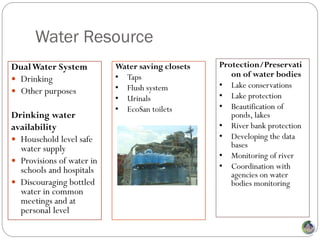
Water Resource
Dual Water System          Water saving closets   Protection/Preservati
                           • Taps                    on of water bodies
 Drinking
                           • Flush system         • Lake conservations
 Other purposes
                           • Urinals              • Lake protection
                           • EcoSan toilets       • Beautification of
Drinking water                                       ponds, lakes
availability                                      • River bank protection
 Household level safe                            • Developing the data
  water supply                                       bases
                                                  • Monitoring of river
 Provisions of water in
  schools and hospitals                           • Coordination with
                                                     agencies on water
 Discouraging bottled                               bodies monitoring
  water in common
  meetings and at
  personal level
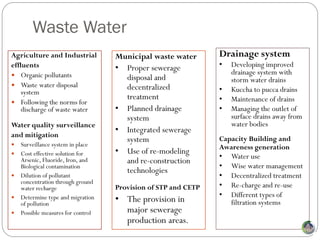
Waste Water
Agriculture and Industrial          Municipal waste water       Drainage system
effluents                           • Proper sewerage           •   Developing improved
 Organic pollutants                                                drainage system with
                                      disposal and                  storm water drains
 Waste water disposal                decentralized
    system                                                      •   Kuccha to pucca drains
                                      treatment                 •   Maintenance of drains
 Following the norms for
    discharge of waste water        • Planned drainage          •   Managing the outlet of
                                      system                        surface drains away from
Water quality surveillance                                          water bodies
                                    • Integrated sewerage
and mitigation
                                      system                    Capacity Building and
   Surveillance system in place                                Awareness generation
   Cost effective solution for     • Use of re-modeling
                                                                •   Water use
    Arsenic, Fluoride, Iron, and      and re-construction
    Biological contamination                                    •   Wise water management
                                      technologies
   Dilution of pollutant                                       •   Decentralized treatment
    concentration through ground
    water recharge                  Provision of STP and CETP   •   Re-charge and re-use
                                                                •   Different types of
   Determine type and migration
    of pollution
                                    • The provision in              filtration systems
   Possible measures for control     major sewerage
                                      production areas.
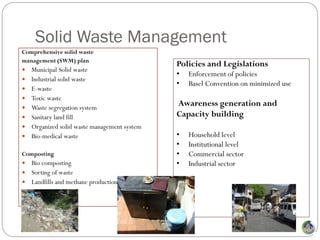
Solid Waste Management
Comprehensive solid waste
management (SWM) plan
                                              Policies and Legislations
 Municipal Solid waste
                                              •   Enforcement of policies
   Industrial solid waste
                                              •   Basel Convention on minimized use
   E-waste
   Toxic waste
   Waste segregation system
                                              Awareness generation and
   Sanitary land fill                        Capacity building
   Organized solid waste management system
   Bio-medical waste                         •   Household level
                                              •   Institutional level
Composting                                    •   Commercial sector
 Bio composting                              •   Industrial sector
 Sorting of waste
 Landfills and methane production
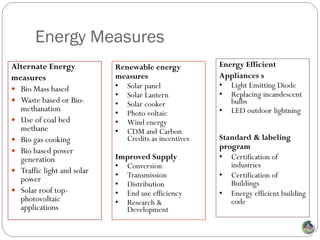
Energy Measures
Alternate Energy            Renewable energy           Energy Efficient
measures                    measures                   Appliances s
 Bio Mass based            • Solar panel              • Light Emitting Diode
                            • Solar Lantern            • Replacing incandescent
 Waste based or Bio-                                     bulbs
                            • Solar cooker
  methanation               • Photo voltaic            • LED outdoor lightning
 Use of coal bed           • Wind energy
  methane                   • CDM and Carbon
 Bio gas cooking              Credits as incentives   Standard & labeling
                                                       program
 Bio based power
  generation                Improved Supply            • Certification of
                            • Conversion                  industries
 Traffic light and solar
  power                     • Transmission             • Certification of
                            • Distribution                Buildings
 Solar roof top-           • End use efficiency       • Energy efficient building
  photovoltaic              • Research &                  code
  applications                Development
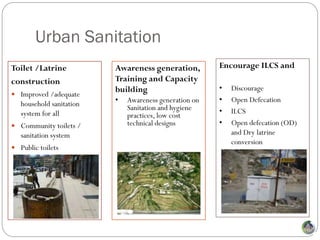
Urban Sanitation
Toilet /Latrine           Awareness generation,         Encourage ILCS and
construction              Training and Capacity
                          building                      •   Discourage
 Improved /adequate
                          •   Awareness generation on   •   Open Defecation
   household sanitation       Sanitation and hygiene
   system for all                                       •   ILCS
                              practices, low cost
 Community toilets /         technical designs         •   Open defecation (OD)
   sanitation system                                        and Dry latrine
                                                            conversion
 Public toilets
Air Pollution
Clean Fuel                    Pollution Control                Data base on Indoor
 CNG, LPG,                   Measures and                     Air pollution
                              Encouraging Public               •   In Slum/EWS area
   battery/electricity
                                                               •   Major pollution sources
   operated vehicles, Bio     Transport System
                                                               •   Burning of solid waste
   diesel                     •   Private vehicles             •   Emissions of CO2, SO2,
                              •   Public transport system          NOx
Inventorying key                                               •   Consumption of Ozone
                              •   Polluting Industries             depleting substances
Polluting industries          •   Non motorized
 In and around the city          Transport – cycles           Awareness generation
                              •   Facilities for pedestrians   and Capacity building
 All those included in RED
   category                                                    •   Household level
                                                               •   Commercial establishments
                                                               •   Industries
Selected Examples
 Bio-mass based gasifires are being used in states like Bihar, Karnataka, etc.

 The Kolkata and Mumbai Municipality are under trial for LED and the Mumbai
   Municipal Corporation has implemented SSP (Slum Sanitation Project)

 The Delhi Government has made it mandatory to construct Rain Water
   Harvesting system

 Solar based common lights, traffic lights, water heaters, energy audits, energy
   efficient building, CNG buses/Autos, etc. in Delhi

 In Mizoram –Aizawl, there are more than 10,000 rainwater harvesting (RWH)
   tanks in individual houses, those were constructed by the residents at their own
   expense and with the technical support of state government.
Way Forward
 Need to consider different environmental factors through an
  inclusive city development planning process

 Develop the capacities and know how among the authorities,
  planners and elected representatives on various environmental
  measures

 A thorough analysis of environmental concerns in the urban areas


 Developing a set of practical localized environmental indicators
  those could be included during city development planning.
Way Forward
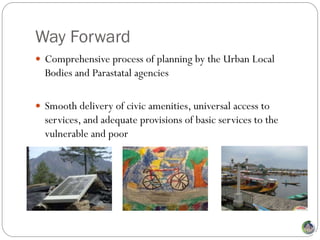
 Comprehensive process of planning by the Urban Local
  Bodies and Parastatal agencies

 Smooth delivery of civic amenities, universal access to
  services, and adequate provisions of basic services to the
  vulnerable and poor
Thank You

Environmental Indicators: Measuring Urban Development in Mountains of India [Kashinath Vajpai]

  • 1.
    Environmental Indicators: Measuring UrbanDevelopment in Mountains of India Kashinath Vajpai Climate Himalaya Initiative, India info@climatehimalaya.net www.climatehimalaya.net http://chimalaya.org
  • 2.
    Developing Urban Settlements Cities in Mountains of India are in the process of expansion  Increase in population due to high migration from highland to lowland areas  Rapid infrastructure development  Two important characteristics: 1. Massive growth in absolute numbers 2. Increasing concentration  Rapid population growth, high densities, poverty and high differentials in access to housing, public services and infrastructure led to an increase in vulnerability over last few decades (Aromar R., 2008)  India is one of the more vulnerable and risk-prone countries in the world (IFRC 2005)
  • 3.
    Urban Development Vs.Environmental Issues  High pollution, water scarcity, deteriorating soil, loss of biodiversity and poor agriculture productivity  Various disasters, health hazards, deteriorating environmental quality, economic losses  Climate change variability increased the frequency and intensity of hazards and the probability of extreme events  Degrade the resilience of poor and vulnerable communities  Further degrading resilience of in one half of the poor, vulnerable communities (Nicholls, et al 2006).  Inadequate provisions of comprehensive and environmental sensitive planning.
  • 4.
    The Extent ofProblem-Example  One of the studies done in India states that ‘the amount of waste generated per capita is estimated to increase at a rate 1-1.33 percent annually and estimated quantity of waste generated by year 2047 would be approx 260 million tons per year, which if not disposed off systematically would require more than 1400 sq.km of land’
  • 5.
    Study Objectives  Todiscuss the major environmental concerns in the urban areas of Indian mountains  To review and analyze relevant policies and guidelines in urban development and environmental context  To develop a set of indicators on various environmental parameters in urban context  To analyze city development plans in concurrence with environmental considerations.
  • 6.
    Information Areas inthe Study  Present urban developmental scenario  Various environmental threats  Increasing climatic variability  Policies and programs on environment and urban development  Categorization of various pro-environmental measures in areas like water, waste, sanitation, pollution, etc.
  • 7.
    Plan: Sustaining HimalayanEcosystem Mission  Management and safeguarding Himalayan glaciers and ecosystem  Exchange of information  Develop monitoring network  Community based management of ecosystem  Maintain 2/3rd area under forest
  • 8.
    Policies and Plansin Place  Reform led urban development program National Urban Renewable Mission (JNNURM)  About 60 cities across India and selected one in mountains  Missions; the Urban infrastructure and governance, and Basic services to the urban poor  The Environment (Protection) Act  National Urban Transport Policy  National Urban Housing & Habitat Policy  Accelerated Urban Water Supply Program  Coal Bed Methane Policy  Solar Energy Mission  Wind Energy  Electronic Waste (e-waste)  India’s Initiatives towards Energy Security  Scheme for BEE Star Rating for office Buildings  The National Environment Policy  National River Conservation Policy  National Lake Conservation Policy
  • 9.
    What Policies andPlans Entail  National River Conservation Plan (NRCP): Capacity building of ULBs  The National Lake Conservation Plan: Restore and conserve the urban and semi urban lakes  The Municipal Solid Wastes (Management and Handling Rules): Role of ULBs in decentralized waste collection and management  The Plastics (manufacture, usage and waste management) rules : Emphasizes in to specific thickness of plastics and procedural recycling.  The National Urban Sanitation Policy: Specific sanitation strategy for the cities  The National Action Plan for Climate Change (NAPCC): Reduce climatic impacts and emphasizes on inter connected issues towards adaptation and mitigation- focus on poor and vulnerable.
  • 10.
    Various Environmental Indicators 1. Water Resources 2. Waste Water 3. Solid Waste 4. Energy Measures 5. Sanitation 6. Air Pollution Photo: Joydeep Mukherjee/Sanctuary Photolibrary
  • 11.
    Water Resources Water Use Regulatory mechanism Recycle and Re-use  Judicious use of and Pricing • At house hold level water and • Proper water pricing at • Community places House hold and (schools, hospitals, discouraging excess Commercial level hotels, malls/ markets, water use for • Correct metering etc.) multiple purposes system in place  Correcting / • Illegal connection and suction pumps. Rainwater Harvesting Repairing the leakage • Regular monitoring • Roof top rainwater system in existing harvesting water supply system Pumping of Water • Mandatory provisions  Operation and • Replace from central for RWH in buildings Maintenance place to the flood plain • Construction of soak areas having proven pits  Construction of new capacity of water water lines • Controlled extraction • Incentives and disincentives for RWH
  • 12.
    Water Resource Dual WaterSystem Water saving closets Protection/Preservati • Taps on of water bodies  Drinking • Flush system • Lake conservations  Other purposes • Urinals • Lake protection • EcoSan toilets • Beautification of Drinking water ponds, lakes availability • River bank protection  Household level safe • Developing the data water supply bases • Monitoring of river  Provisions of water in schools and hospitals • Coordination with agencies on water  Discouraging bottled bodies monitoring water in common meetings and at personal level
  • 13.
    Waste Water Agriculture andIndustrial Municipal waste water Drainage system effluents • Proper sewerage • Developing improved  Organic pollutants drainage system with disposal and storm water drains  Waste water disposal decentralized system • Kuccha to pucca drains treatment • Maintenance of drains  Following the norms for discharge of waste water • Planned drainage • Managing the outlet of system surface drains away from Water quality surveillance water bodies • Integrated sewerage and mitigation system Capacity Building and  Surveillance system in place Awareness generation  Cost effective solution for • Use of re-modeling • Water use Arsenic, Fluoride, Iron, and and re-construction Biological contamination • Wise water management technologies  Dilution of pollutant • Decentralized treatment concentration through ground water recharge Provision of STP and CETP • Re-charge and re-use • Different types of  Determine type and migration of pollution • The provision in filtration systems  Possible measures for control major sewerage production areas.
  • 14.
    Solid Waste Management Comprehensivesolid waste management (SWM) plan Policies and Legislations  Municipal Solid waste • Enforcement of policies  Industrial solid waste • Basel Convention on minimized use  E-waste  Toxic waste  Waste segregation system Awareness generation and  Sanitary land fill Capacity building  Organized solid waste management system  Bio-medical waste • Household level • Institutional level Composting • Commercial sector  Bio composting • Industrial sector  Sorting of waste  Landfills and methane production
  • 15.
    Energy Measures Alternate Energy Renewable energy Energy Efficient measures measures Appliances s  Bio Mass based • Solar panel • Light Emitting Diode • Solar Lantern • Replacing incandescent  Waste based or Bio- bulbs • Solar cooker methanation • Photo voltaic • LED outdoor lightning  Use of coal bed • Wind energy methane • CDM and Carbon  Bio gas cooking Credits as incentives Standard & labeling program  Bio based power generation Improved Supply • Certification of • Conversion industries  Traffic light and solar power • Transmission • Certification of • Distribution Buildings  Solar roof top- • End use efficiency • Energy efficient building photovoltaic • Research & code applications Development
  • 16.
    Urban Sanitation Toilet /Latrine Awareness generation, Encourage ILCS and construction Training and Capacity building • Discourage  Improved /adequate • Awareness generation on • Open Defecation household sanitation Sanitation and hygiene system for all • ILCS practices, low cost  Community toilets / technical designs • Open defecation (OD) sanitation system and Dry latrine conversion  Public toilets
  • 17.
    Air Pollution Clean Fuel Pollution Control Data base on Indoor  CNG, LPG, Measures and Air pollution Encouraging Public • In Slum/EWS area battery/electricity • Major pollution sources operated vehicles, Bio Transport System • Burning of solid waste diesel • Private vehicles • Emissions of CO2, SO2, • Public transport system NOx Inventorying key • Consumption of Ozone • Polluting Industries depleting substances Polluting industries • Non motorized  In and around the city Transport – cycles Awareness generation • Facilities for pedestrians and Capacity building  All those included in RED category • Household level • Commercial establishments • Industries
  • 18.
    Selected Examples  Bio-massbased gasifires are being used in states like Bihar, Karnataka, etc.  The Kolkata and Mumbai Municipality are under trial for LED and the Mumbai Municipal Corporation has implemented SSP (Slum Sanitation Project)  The Delhi Government has made it mandatory to construct Rain Water Harvesting system  Solar based common lights, traffic lights, water heaters, energy audits, energy efficient building, CNG buses/Autos, etc. in Delhi  In Mizoram –Aizawl, there are more than 10,000 rainwater harvesting (RWH) tanks in individual houses, those were constructed by the residents at their own expense and with the technical support of state government.
  • 19.
    Way Forward  Needto consider different environmental factors through an inclusive city development planning process  Develop the capacities and know how among the authorities, planners and elected representatives on various environmental measures  A thorough analysis of environmental concerns in the urban areas  Developing a set of practical localized environmental indicators those could be included during city development planning.
  • 20.
    Way Forward  Comprehensiveprocess of planning by the Urban Local Bodies and Parastatal agencies  Smooth delivery of civic amenities, universal access to services, and adequate provisions of basic services to the vulnerable and poor
  • 21.